Introduction
Open partial horizontal laryngectomiesReference Succo, Peretti, Piazza, Remacle, Eckel and Chevalier1 show cure rates comparable to total laryngectomies for selected T2–3 supraglottic and glottic laryngeal squamous cell carcinomas.Reference Chawla and Carney2,Reference Rizzotto, Crosetti, Lucioni and Succo3 After open partial horizontal laryngectomy, patients have an increased risk of impaired deglutition and aspiration related to different factors, such as disease extension, surgical technique and patient status.Reference Succo, Crosetti, Bertolin, Lucioni, Arrigoni and Panetta4,Reference Lewin, Hutcheson, Barringer, May, Roberts and Holsinger5 The main prognostic factors for swallowing recovery are: type of partial laryngectomy (supraglottic, supracricoid and supratracheal laryngectomy, or types I, II and III, respectively),Reference Alicandri-Ciufelli, Piccinini, Grammatica, Chiesi, Bergamini and Luppi6 preservation of one versus both cricoarytenoid units, and resection of epiglottis, thyroepiglottic space and tongue base.Reference Lips, Speyer, Zumach, Kross, Kross and Kremer7,Reference Benito, Holsinger, Pérez-Martín, Garcia, Weinstein and Laccourreye8
The functional outcome is also influenced by the prolonged presence of the tracheostomy tube, which may have an inhibitory effect on laryngotracheal sensitivity.Reference Ceriana, Carlucci, Schreiber, Fracchia, Cazzani and Dichiarante9,Reference Holsinger, Tomeh, Moore, Yan, Chen and Laccourreye10 We hypothesised that early tube removal could be associated with improvement in deglutition. Herein, we describe our experience with a circumferential tracheostomy in open partial horizontal laryngectomy and early removal of the tracheostomy tube, focusing on the effects on swallowing.
Materials and methods
Patients
Between April 2018 and June 2019, 35 patients were operated on by open partial horizontal laryngectomy at the University Hospital of Modena. The inclusion criteria were: (1) surgical treatment by open partial horizontal laryngectomy type I or II for squamous cell carcinoma; and (2) availability of clinical data (including post-operative swallowing rehabilitation details). The exclusion criteria were: (1) complications (such as sepsis, bleeding, wound infection, pharyngocutaneous fistula, neck abscess or surgical revision) that delayed swallowing rehabilitation; and (2) missing clinical data. Patients who met the inclusion criteria were eligible for the study and their clinical charts were retrospectively evaluated. Patients were retrospectively divided into two groups as described below.
Between April 2018 and November 2018, patients undergoing open partial horizontal laryngectomy were treated according to the current technique at that time: joining of the trachea to the skin by two inferior silk stitches. Patients underwent positioning of a fenestrated cuffless tracheostomy tube on the 1st post-operative day and maintained it during the entire hospital stay. The tracheostomy tube was removed before discharge in all patients who were not candidates for radiotherapy, after occluding it for 72 hours (group 1).
Between December 2018 and June 2019, we changed our management by performing a circumferential tracheostomy, which allows safe removal of the cannula even in patients with not completely patent airways. The cuffless tube was positioned on the 1st post-operative day and the tracheostomy tube was removed on the 2nd post-operative day (group 2). When the indication for radiotherapy was given, the tracheostomy tube was repositioned.
Swallowing rehabilitation
On the 6th post-operative day, a joint evaluation was performed by the speech therapist and the physician. By means of fibre-optic endoscopic evaluation of swallowing, the suitability to continue through the consecutive phases of rehabilitation was evaluated. Each patient was instructed at first to swallow their saliva, and subsequently swallow pureed and thick liquids; this then proceeded to thin liquids and solids, and, finally, a semi-solid meal. When 80 per cent of the semi-solid meal components had been successfully introduced, the patient was considered self-sufficient and was discharged.
The main phases of rehabilitation were recorded as follows: the first day that the patient could swallow thick liquids (rehabilitation phase one), the first try with a semi-solid meal (phase two), and oral feeding sufficiency (80 per cent of oral intake; phase three). Rehabilitation phases one, two and three were considered as the main endpoints. The timing and modality of tracheostomy closure were the secondary endpoints.
Surgical technique
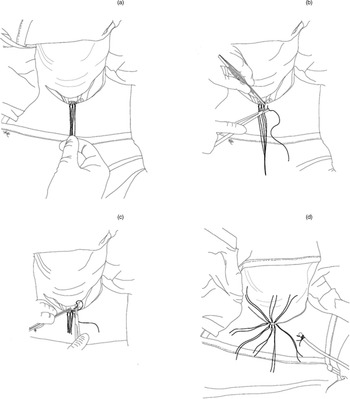
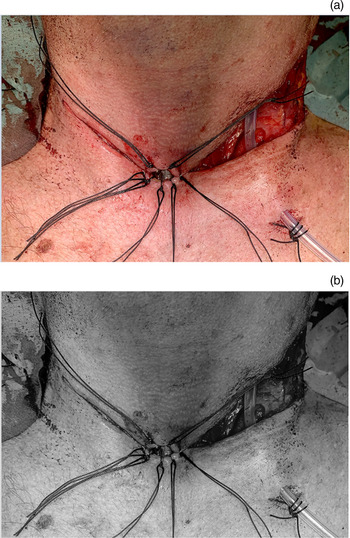
Circumferential tracheostomy was performed as follows. Once the laryngotracheal framework was skeletonised, before performing the superior pharyngotomy, a 2–3 cm incision between the second and third tracheal rings was performed. The inferior tracheal ring was sealed with the inferior cutaneous flap by means of three size 3.0 silk stitches. Two lateral stitches were placed to attach the inferior cutaneous flap to the lateral side of the superior tracheal ring (Figure 1). The aim of these sutures was to seal the cervical compartments. The open partial horizontal laryngectomy procedure was then completed with the pexy. Finally, the superior cutaneous flap was sutured to the superior cervical ring by means of three size 3.0 silk stitches to complete the circumferential tracheostomy (Figure 2) and a small cuffed tracheal tube was positioned.
(a) The inferior tracheal ring was sealed with the inferior cutaneous flap by means of three 3.0 silk stitches. (b & c) A lateral stitch is placed to attach the inferior cutaneous flap to the lateral side of the superior tracheal ring in order to seal the cervical compartments from the tracheostomy area. (d) The superior cutaneous flap is sutured to the superior cervical ring by means of three size 3.0 silk stitches to complete the circumferential tracheostomy.

(a & b) Circumferential tracheostomy in a supracricoid laryngectomy procedure. The tracheostomy is completely separated from the lateral neck regions.

During the post-operative period, tube removal was made possible by the presence of the suture wires patched onto the skin to keep the tracheostomy patent, and the tracheostomy was not covered. At discharge, in patients who were not going to undertake radiotherapy, the tracheostoma was covered after removal of the stitches.
Statistical analysis
The statistical analysis was performed using SSPS Statistics for Windows (IBM, Chicago, Illinois, USA). Continuous variables were expressed as mean ± standard deviation (SD). Comparisons between groups were performed using Pearson's chi-square or Fisher's exact test, as appropriate. The student's t-test was used for continuous variables with normal distribution, while the Mann–Whitney U test was adopted for continuous variables without a normal distribution. The strength of the correlation between the parameters was determined using the Spearman's rank correlation test. The results were considered significant for p values of less than 0.05 with a confidence interval of 95 per cent.
This research was conducted in accordance with ethical principles, including the World Medical Association Declaration of Helsinki (2002). For this kind of retrospective investigation, the local ethical committee does not require formal ethical assessment.
Results
Between April 2018 and November 2018, 18 patients were subjected to open partial horizontal laryngectomy, receiving two stitches from the inferior tracheal ring to the skin (group 1); 12 of the 18 patients were included in this group.
Between December 2018 and June 2019, 17 patients were subjected to open partial horizontal laryngectomy, undergoing circumferential fixation of the trachea to the skin (group 2); 12 of the 17 patients were included in this group.
Overall, 24 patients were included in the study. These patients’ charts were thoroughly reviewed.
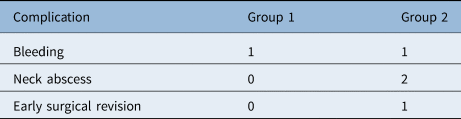
Eleven patients were excluded for the following reasons: four were subjected to type III open partial horizontal laryngectomy, three had missing clinical records and four showed early complications that required the swallowing rehabilitation programme to be delayed (Table 1). Regarding complications, one patient was excluded from group 1 and three patients were excluded from group 2.
Early complications occurring in the two groups

Patients were divided into two groups based on the tracheostomy technique: group 1 had two stitches from the inferior tracheal ring to the skin; group 2 had circumferential fixation of the trachea to the skin. Data represent numbers of patients.
The mean (± SD) age of patients at the time of surgery was 65 ± 7 years (range, 51–75 years), with no statistical difference between the two groups (64.5 vs 65.6 years; p > 0.05). The overall male-to-female ratio was 3.8.
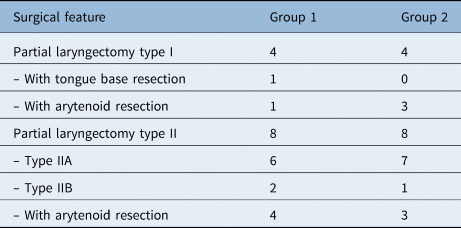
The surgical details are depicted in Table 2. No significant differences between the groups were detected in terms of surgical technique (open partial horizontal laryngectomy type I vs type II) or tongue base and arytenoid resection (p > 0.05).
Surgical characteristics of the two groups

Patients were divided into two groups based on the tracheostomy technique: group 1 had two stitches from the inferior tracheal ring to the skin; group 2 had circumferential fixation of the trachea to the skin. Data represent numbers of patients.
At the time of data collection, all patients had undergone follow up for a mean time of 14 months (range, 6–20 months). No patient undergoing open partial horizontal laryngectomy type II had pre-operative swallowing impairment, whereas four patients undergoing open partial horizontal laryngectomy type I had pre-operative dysphagia (two from group 1 and two from group 2).
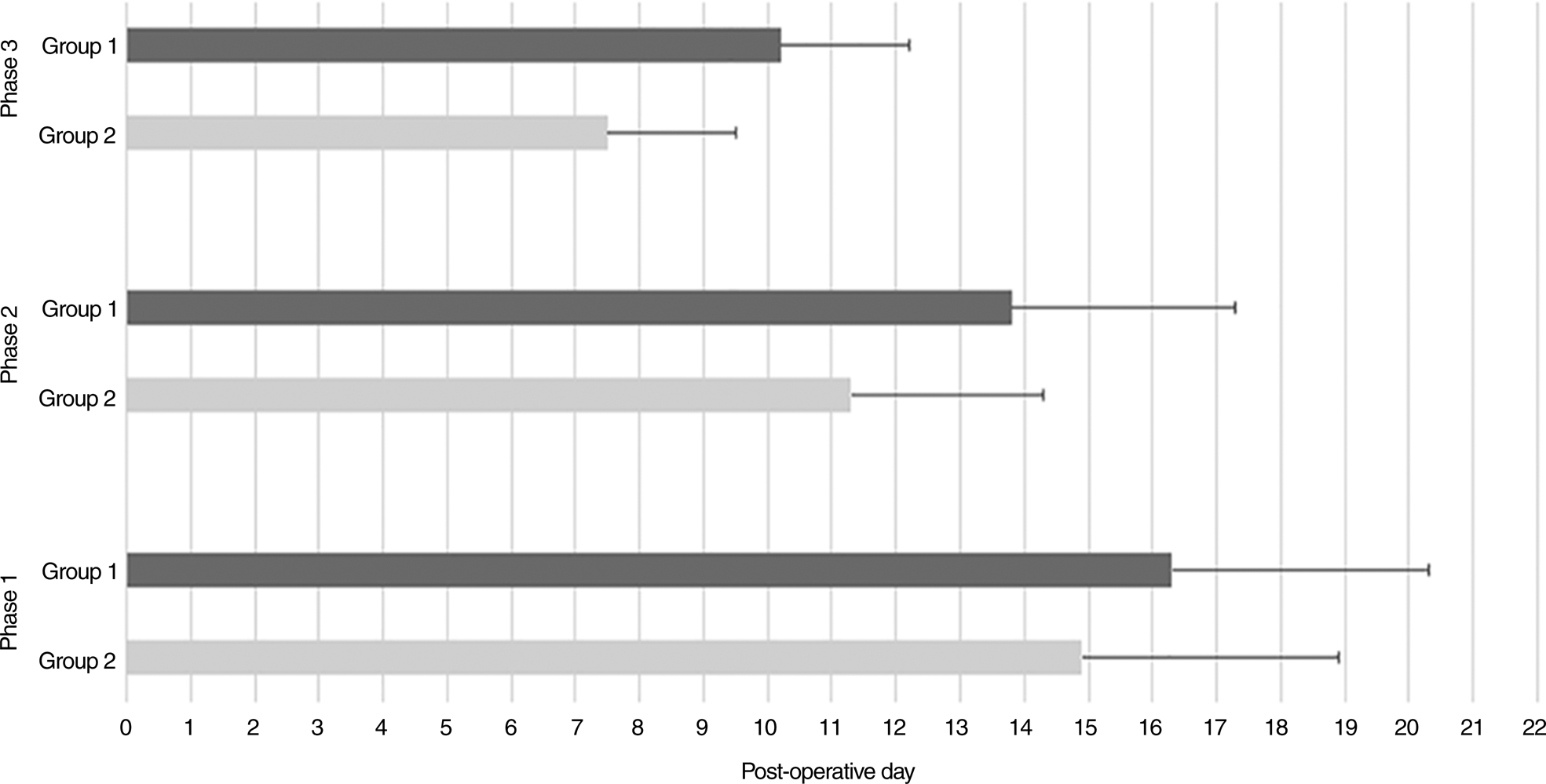
In group 1, rehabilitation phase one (thick liquids swallowing) was accomplished on average on the 10th post-operative day (mean = 10.2 ± 2 days; range, 7–16 days) versus the 7th post-operative day in group 2 (mean = 7.5 ± 2 days; range, 6–14 days) (p < 0.01). Rehabilitation phase two (first attempt with a semi-solid meal) was accomplished on average on the 14th post-operative day in group 1 (mean = 13.8 ± 3.5 days; range, 8–22 days) versus the 11th post-operative day in group 2 (mean = 11.3 ± 3 days; range, 7–17 days) (p < 0.05). Rehabilitation phase three (oral feeding sufficiency) was accomplished on average on the 16th post-operative day in group 1 (mean = 16.3 ± 4 days; range, 9–25 days) versus the 15th post-operative day in group 2 (mean = 14.9 ± 4 days; range, 8–21 days) (p > 0.05). The days that each phase of swallowing was accomplished, for each group, are displayed in Figure 3.
Accomplishment of deglutition (rehabilitation) stages for the two tracheostomy technique groups (group 1 had two stitches from inferior tracheal ring to the skin; group 2 had circumferential fixation of the trachea to the skin). Phase one = thick liquids swallowing (p = 0.01); phase two = first attempt with a semi-solid meal (p = 0.04); phase three = oral feeding sufficiency (p = 0.62).

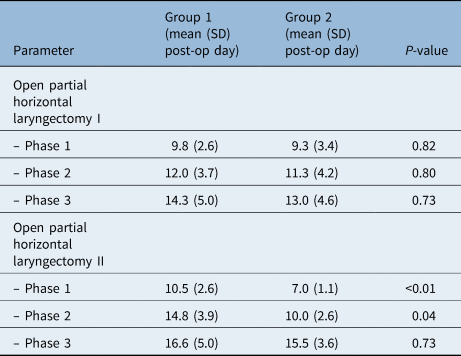
Rehabilitation phases one, two and three were analysed separately for the open partial horizontal laryngectomy type I and open partial horizontal laryngectomy type II subgroups (Table 3). In the open partial horizontal laryngectomy type I subgroups, no statistically significant differences were demonstrated in comparison of phases one, two and three (p > 0.05). In the open partial horizontal laryngectomy type II subgroups, phase one was achieved significantly earlier in group 2 than in group 1 (mean post-operative day = 7 vs 10.5, respectively; p < 0.01). In addition, phase two was achieved significantly earlier in group 2 than in group 1 (mean post-operative day = 10 vs 14.8, respectively; p < 0.05). No statistically significant difference was detected in comparison of phase three (mean post-operative day = 15.5 vs 16.6 in group 2 vs 1, respectively; p > 0.05).
Days of accomplishment of the three rehabilitation phases, for both groups, for each laryngectomy type

Patients were divided into two groups based on the tracheostomy technique: group 1 had two stitches from the inferior tracheal ring to the skin; group 2 had circumferential fixation of the trachea to the skin. The rehabilitation phases were: the first day the patient could swallow thick liquids (phase one), the first try with a semi-solid meal (phase two) and oral feeding sufficiency (80 per cent of oral intake; phase three). SD = standard deviation; post-op = post-operative
In three patients, the tracheostomy tube was repositioned for the patient to undergo radiation or chemoradiation therapy (one patient in group 1 vs two patients in group 2). The repositioning of a small-sized tracheostomy tube was performed once the histological results were available, and did not require further surgery as the tracheostoma was still patent in all cases. Among the remaining patients, 15 of 21 (71 per cent) achieved spontaneous closure of the tracheostomy (9 in group 1 vs 6 in group 2), whereas 6 patients (29 per cent) needed surgical closure (2 in group 1 vs 4 in group 2).
Discussion
Our results, collected from a small sample of patients undergoing circumferential tracheostomy after open partial horizontal laryngectomy, show a favourable trend in improving swallowing rehabilitation, especially in the initial phase. The circumferential tracheostomy and consequent early decannulation represents a minor but helpful surgical tip, which could contribute to a functional improvement in the early post-operative course. It also carries the advantage of safer airway management, allowing removal of the cannula, even in patients with not completely patent airways, and quick and easy replacement by the nursing staff.
Group 2 patients (who underwent circumferential fixation of the trachea to the skin) had a significant advance in achieving thick liquid swallowing and semi-solid meals compared with group 1 patients (who received two stitches from the inferior tracheal ring to the skin); group 1 accomplished those swallowing steps on average 3–4 days later. Moreover, group 2 patients achieved oral feeding sufficiency earlier than group 1 patients, although this comparison is not statistically significant.
A tracheostomy tube is necessary to ensure a safe airway after open partial horizontal laryngectomy, because patients can experience oedema and haematoma of the neolarynx; it also provides protection from saliva and food aspiration due to impaired swallowing function. Tracheostomies, however, may bring some disadvantages: Bartella et al.,Reference Bartella, Kamal, Berman, Steiner, Frölich and Hölzle11 in a cohort of patients operated on for head and neck cancer, demonstrated that the timing of decannulation was negatively correlated with swallowing function recovery. It is reasonable that patients can only relearn swallowing and coughing when air is able to pass through the larynx, and that tube removal might accelerate the recovery. After decannulation, the progressive restoration of mucosal sensitivity is expected after prolonged contact with the tube and, especially, the cuff. A minimum salivary passage in the trachea might help in triggering the onset of a valid cough reflex, a protective reflex of paramount importance.
The decannulation timing depends, however, on the regression of post-operative swelling. Most papers describe the maintenance of the tracheostomy tube for weeks to months after open partial horizontal laryngectomy: mean decannulation time varies from the 8th post-operative dayReference Leszczyńska, Wierzbicka, Tokarski and Szyfter12 to 3.5 months after surgery.Reference Gonçalves, Bertelli, Malavasi, Kikuchi, Rodrigues and Menezes13–Reference Clasen, Keszte, Dietz, Oeken, Meister and Guntinas-Lichius16 For this reason, we sought to describe a tracheostomy technique that could allow circumferential stomal patency and consequent early decannulation even in patients with a not completely pervious airway.
• Tracheostomy is required to ensure a safe airway in open partial horizontal laryngectomies
• Prolonged tracheostomy tube presence can contribute to post-operative dysphagia
• Tracheostomy with circumferential anchorage to skin can allow early cannula removal
• Circumferential tracheostomy can positively influence swallowing function, via more rapid rehabilitation after open partial horizontal laryngectomy
• Functional advancements are more pronounced after open partial horizontal laryngectomy type II compared to type I
It is unreasonable to suppose that this surgical expedient might justify a difference in terms of overall swallowing recovery; this outcome is influenced, in fact, by other relevant aspects.Reference Alicandri-Ciufelli, Piccinini, Grammatica, Chiesi, Bergamini and Luppi6 Among them, the role of adjuvant radiotherapy must be considered when discussing long-term dysphagia.Reference Marchese-Ragona, Marioni, Chiarello, Staffieri and Pastore17 Another issue is whether the sparing of one or two arytenoids, as well as the partial removal of the base of the tongue, improves swallowing.Reference Yüce, Cağli, Bayram, Karasu, Sati and Güney18,Reference Pinar, Imre, Calli, Oncel and Katilmis19 Finally, the most relevant aspect is the possible worse outcome of supraglottic versus supracricoid laryngectomy when measuring swallowing.Reference Karasalihoglu, Yagiz, Tas, Uzun, Adali and Koten20 The distinct analysis of open partial horizontal laryngectomy types I and II confirms that the latter benefits significantly more from the circumferential tracheostomy technique and consequent early decannulation. It is reasonable that open partial horizontal laryngectomy type I has an intrinsic risk of delayed swallowing, which is not influenced by the decannulation timing, and only a robust rehabilitation programme, and the motivation and compliance of the patient, can modify it.Reference Karasalihoglu, Yagiz, Tas, Uzun, Adali and Koten20
It is noticeable that patients subjected to circumferential tracheostomy undergo a slightly higher complication rate compared with the control group. We hypothesised that, by hermetically fixing the skin to the trachea at 360°, the soft tissues of the lateral compartment of the neck are sealed, and the blood and fluid imbibition do not find an outer path. Haematomas or seromas can lead to a secondary infection with the formation of abscesses. This speculation, however, refers to preliminary results, which do not have statistical significance and therefore must be considered with caution.
The present study has some limitations, primarily its retrospective nature and the small sample size. Although data have been collected retrospectively, in our institution, when the general and local conditions of the patients are favourable, the rehabilitation programme follows a standardised and homogeneous path. The small sample size, because of a change of management at our institution, means that statistical power is low; the present results, therefore, should be confirmed by further study with a larger sample of patients.
Acknowledgement
Dr Elisa Aggazzotti-Cavazza, for the figures.
Competing interests
None declared