The dramatic increase in women’s higher educational attainment since the mid-twentieth century represents one of the most transformative trends in recent American history. While men earned more degrees than women from the establishment of higher education in the United States through the 1970s, women have outnumbered men as the recipients of bachelor’s degrees since 1981; and during the 2012–13 academic year, women comprised an impressive 57 percent of the nation’s college students.Footnote 1 In addition to a variety of demographic, social, and economic factors that facilitated the striking increase in women’s higher educational attainment, the federal government played an important role in promoting this trend.Footnote 2 Since the postwar era, federal higher education policy has emphasized the goal of expanding access to college degrees. Beginning with the G.I. Bill in 1944, American lawmakers used gender-neutral financial-aid programs as the primary mechanism for achieving that end.Footnote 3 These policies, which grew to include the National Defense Education Act (NDEA) of 1958 and the Higher Education Act (HEA) of 1965, made no reference to the sex of beneficiaries and made no attempt to consciously alter the gender dynamics of higher educational attainment in the United States. They simply provided federal student loans, grants, and work-study opportunities to help make college affordable for millions of students.
Title IX of the 1972 Education Amendments represents a bold departure from this trend. By prohibiting sex-based discrimination in college admissions, it revolutionized the gender dynamics of American higher educational institutions and marked a dramatic shift in U.S. higher education policy. Occupying a brief paragraph in an otherwise rambling omnibus bill, the pithy statute established that “no person in the United States shall, on the basis of sex, be excluded from participation in, be denied the benefits of, or be subjected to discrimination under any education program or activity receiving federal financial assistance” (P.L. 92-318). Unlike postwar financial-aid programs that stopped short of attempting to correct for gender disparities in college accessibility, Title IX voiced a full-throated call for gender equality in access to the nation’s colleges and universities. Rather than incremental change at the margins of existing programs, this movement from gender-neutral financial aid to gender-conscious institutional regulation illustrates dramatic policy change at a critical juncture.Footnote 4 By requiring higher educational institutions to subject male and female applicants to equal treatment in the admissions process, Title IX single-handedly revolutionized how American postsecondary institutions treat women and set the stage for women to outpace men as the recipients of bachelor’s degrees.
In both scholarly and popular conceptualizations, Title IX is largely recognized for having expanded athletic opportunities for women.Footnote 5 However, our understanding of the landmark amendment stops short of fully appreciating the novelty of invoking federal regulation in higher education policy and Title IX’s dramatic departure from policy precedents. The literature on Title IX has yet to consider its noteworthy deviation from the gender-neutral, redistributive structure of existing higher education policies that expanded access to college by providing financial aid to students.Footnote 6 Moreover, the successful passage of Title IX, with its revolutionary gender-conscious approach to expanding access to college, is particularly puzzling when we consider women’s marginalization in American politics during the early 1970s and the absence of a highly organized women’s movement advocating on behalf of equal educational opportunity for women.Footnote 7
This article uses historical analysis to investigate the political factors that facilitated Title IX’s passage in 1972 and the dramatic shift to gender-conscious higher education policy. I draw upon a variety of primary and secondary sources, including author-conducted interviews with lawmakers, congressional staffers, political activists, and administrators involved in the passage and administration of Title IX; the Congressional Record; oral history interviews; transcripts from House and Senate committee deliberations; and the historical literature on Title IX.
The analysis suggests that, as Frank R. Baumgartner and Bryan D. Jones note, fully understanding dramatic policy change requires that we “not take for granted how we generate and maintain our image of public policy problems.”Footnote 8 In the case of Title IX, a burgeoning gender-consciousness in the political environment—shaped by the success of powerful civil rights policies that used federal regulation to combat race-based discrimination and characterized by a newfound recognition of sex discrimination as a systematic phenomenon—reshaped how lawmakers approached the goal of ensuring equal access to higher education. Their conceptualization of the barriers limiting access to college shifted from one centered on financial need to one characterized by institutional discrimination against women. Coupled with strategic maneuvering by a small group of political elites, this shift in how we understand educational barriers and newfound concern regarding gender inequality in higher education facilitated the successful passage of Title IX and the birth of gender-conscious higher education policy.
“Women Need Not Apply”: Sex Discrimination and a New Course for Higher Education Policy
One of the basic concepts upon which our democracy was founded was the idea that people can only be free and equal where there is equality of opportunity. If women are unreasonably denied access to public places and public educational institutions (which they support with taxes), then women cannot be considered full and equal citizens. Women should be fully integrated into the educational institutions of our Nation as students (and teachers), and accepted as mature individuals with potential and worth.
—Ms. Virginia A. Allen, Chair of the President’s Task Force on Women’s Rights and ResponsibilitiesFootnote 9
Before the creation of broadly reaching, need-based financial-aid programs during the late 1950s and the 1960s, many women in the United States found it difficult to obtain private financial support to pursue higher education. For families with limited resources to devote to educating their children, it often made more sense to invest in college education for sons because, presumably, they would need to be “breadwinners” for their families, whereas money spent on daughters’ education would likely be lost when women exited the labor force upon marriage or to have children.Footnote 10 Very few scholarships were made available to women, and women often found it difficult to find jobs that would enable them to work their way through college. With the passage of landmark federal student aid programs under the National Defense Education Act of 1958 and the Higher Education Act of 1965, U.S. lawmakers mounted a powerful assault on financial barriers to higher educational access for American women. By the early 1970s, lawmakers had virtually removed financial need as a barrier to women’s higher educational attainment; however, formidable institutional barriers continued to suppress the number of women earning college degrees. It was not uncommon for women to be denied college admission on the basis of their sex.Footnote 11 While most schools invoked gender quotas restricting the number of women allowed in a particular class, others simply refused to admit female students.Footnote 12 Harvard, Princeton, and the University of North Carolina, for example, set strict gender quotas that limited the number of women permitted to study in their institutions, while Dartmouth excluded women entirely.Footnote 13 To win one of the coveted “women’s seats” in a college, female applicants generally had to have better grades and higher test scores than their male counterparts. Thus, although women enjoyed access to federal funds to help meet the cost of earning a postsecondary degree, discriminatory admissions policies limited the number of women who would have the opportunity to use such financial aid in the first place.
Well into the mid-twentieth century, sex discrimination was largely conceptualized as a matter of individual misfortune, rather than a systematic barrier that widely limited equal opportunity for women. As Title IX activist Dr. Bernice Sandler notes, “the word ‘sex discrimination’ was relatively new” in the 1960s and 1970s. While there was concern for the unfair treatment of women, sex discrimination was not perceived as a formal concept, and women tended to attribute discriminatory treatment to the idiosyncrasies of a particular person or individual department.Footnote 14 As Sandler notes, “You [didn’t] think about it as a pattern. It’s just an individual instance here and there.”Footnote 15 For many women, individual instances of unfair treatment by higher educational institutions were all too common, and some were beginning to notice a trend.
Sandler’s personal experience being passed over for a faculty position because she “came on too strong for a woman” piqued her interest in gender discrimination in higher education. Working with Vincent Macaluso, the assistant director of the U.S. Department of Labor’s Office of Federal Contract Compliance, Sandler attempted to challenge sex discrimination in faculty hiring. Citing Executive Order 11246, which the Johnson administration had established in 1965 to regulate federal contractors by prohibiting discrimination on the basis of sex, race, religion, or national origin in hiring and employment decisions, Sandler inundated the Office of Civil Rights (OCR) at the U.S. Department of Health, Education, and Welfare (HEW) with hundreds of charges against American colleges and universities that were not in compliance with the order. As the OCR investigated these complaints, the government withheld federal grants from a number of institutions until they produced plans for improving the treatment of women faculty, graduate students, and staff.Footnote 16 Meanwhile, Sandler found an ally in Representative Edith Green (D-Ore.), whose interest was piqued upon receiving a copy of Sandler’s complaint.Footnote 17
Representative Green, who would eventually author Title IX, had firsthand experience with the discrimination that women and girls faced in education.Footnote 18 After winning election to Congress in 1955, Green distinguished herself as a capable proponent for educational opportunity and emerged as a champion of gender equality. In the late 1970s, she recalled her dismay during a subcommittee hearing a decade before during which school superintendents advocating for programs to prevent at-risk boys from dropping out of school were unabashedly unconcerned with the attrition of at-risk girls. The educators and Green’s male colleagues on the committee took for granted that the academic well-being of boys was more important than that of girls because, as Green recalled, “[boys] were going to be the breadwinners.”Footnote 19
In the Senate, Birch Bayh (D-Ind.) would emerge as the principal proponent of Title IX. Sen. Bayh’s interest in gender equality in higher education was rooted in the discrimination experienced by his first wife, Marvella. When the academically gifted Marvella completed high school in the early 1950s, she set her sights on attending the University of Virginia. Despite excellent credentials that included academic merit, a record as a champion debater, and service as governor of Girl’s State and president of Girl’s Nation, her application to UVA was returned with a note that simply said, “Women need not apply.”Footnote 20
It is important to note that the emergence of political efforts to end sex discrimination emanated not from a large and organized women’s movement but from a small cadre of elites who had firsthand experiences with sex discrimination. The women’s rights movement had not yet become an organized force that could support the fight against sex discrimination in higher education. Margaret Dunkle recalls that contemporary women’s organizations were just beginning to form at the time that Title IX was created and considered by Congress.Footnote 21 A 1972 Congressional Quarterly Weekly Report described the nascent women’s movement as a “disorganized, heterogeneous, and fragmented” movement that struggles with “disagreements on the proper tactics” to employ to achieve equal rights.Footnote 22 The established women’s groups, such as the American Association of University Women—which boasted an excess of one hundred thousand members—the Business Professional Women, and the League of Women Voters, had limited knowledge regarding equity issues and remained at the sidelines during the early stages of Title IX’s development.Footnote 23 Rather than emerging from strong and broad-reaching activism, the development of Title IX, as Margaret Dunkle describes it, “was really a few people who made a huge change.”Footnote 24
The growing consciousness among political elites that sex discrimination represented an important challenge to educational opportunity in the United States occurred in a political context that was increasingly aware of discrimination and amenable to the use of federal regulation to combat it. The previous decade marked a defining period in American politics during which U.S. policymakers invoked the power of the state to challenge discrimination. Congress took steps to alleviate sex discrimination in employment wages with the Equal Pay Act of 1963. The following year, lawmakers passed the Civil Rights Act of 1964, which made it illegal to discriminate against students and employees on the basis of race, color, or nationality.Footnote 25 In Title VI of the Civil Rights Act, lawmakers banned such discrimination in any program receiving federal financial aid. Title VII of the act prohibited sex discrimination, but only in the area of employment. Although these landmark civil rights programs promoted race and gender equality in employment and race equality in education, lawmakers had yet to address the significant barrier that discriminatory admissions policies posed to gender equality in higher education.Footnote 26
In the wake of the civil rights movement, Representative Green, Senator Bayh, and Bernice Sandler began to think seriously about how the government could address discrimination against women in college admissions. Although lawmakers had drawn upon federal regulation as a powerful tool to promote equal treatment in American institutions during the 1960s, the use of federal regulation represented a promethean approach to expanding access to higher education. It was only after lawmakers began to reimagine equal access to college degrees as a matter of institutional change as opposed to the provision of financial resources to individual students that this approach to higher education policy became a legitimate option. To successfully adopt this unorthodox approach to expanding access to college education, lawmakers would have to make a solid case that sex discrimination by higher educational institutions represented a barrier requiring federal intervention. It would also require that lawmakers adopt a strategic approach for moving their antidiscrimination proposal through the political process, drawing upon growing consciousness regarding gender discrimination.
Representative Green and her allies looked to civil rights legislation as a template for achieving institutional change. The value of using the regulatory power of the state to compel institutional compliance with nondiscrimination laws influenced Edith Green’s decision to pursue a regulatory approach to addressing sex discrimination in college admissions. As social policy expert and early Title IX advocate Margaret Dunkle notes, “There is a long-established tradition at the federal level of coupling a stick—[such as] a prohibition against discrimination or a requirement to do something—with a carrot, [like] student aid.”Footnote 27 In the 1960s, a similar pairing generated a significant expansion of higher educational opportunities to African Americans. While the National Defense Education Act and the Higher Education Act had extended need-based student aid to low-income African Americans, the Civil Rights Act prevented racial discrimination in higher educational institutions from severely restricting black students’ usage of that aid. In the case of the Title IX regulation, lawmakers were “basically playing catch-up” by challenging sex-based discrimination that hindered women from broadly using the financial-aid benefits that were provided under the NDEA and the HEA.Footnote 28
Problematizing Sex Discrimination in College Admissions
The politics of the early 1970s paved the way for lawmakers to take decisive steps to reduce sex discrimination in higher education. In Congress, liberal lawmakers began to highlight issues related to sex discrimination. In June 1970, Representative Martha Griffiths (D-Mich.) and Senator Bayh began lining up support for the Equal Rights Amendment, which proposed amending the U.S. Constitution to guarantee women and men equal rights.Footnote 29 That same month, as chair of the House Committee on Education and Labor’s Special Subcommittee on Education, Green held hearings on discrimination against women in education and employment.
Green’s subcommittee hearings on sex discrimination represent a critical juncture in the process by which discriminatory admissions policies became the focus of federal efforts to expand access to higher education.Footnote 30 They yielded valuable testimony confirming the need for legislation that would protect women and girls from sex discrimination in education, and they marked the genesis of Title IX. Witnesses providing testimony during these crucial hearings included women’s rights activists, college professors, a number of Green’s female congressional colleagues, and representatives from colleges, professional organizations, and advocacy groups like the American Association of University Women and Bernice Sandler’s Women’s Equity Action League (WEAL).
Beyond these groups, interest in Representative Green’s investigation into sex discrimination in education and employment was sparse. Catherine Stimpson recalls the lack of seriousness with which the Education Subcommittee’s fifteen male members treated the hearings, noting that “no more than four of them ever appeared at one time to listen to the testimony, a comment either on the nature of congressional subcommittee hearings or on the prevailing attitude of men in government towards the issue of women’s rights.”Footnote 31 Also conspicuously absent from the hearings on sex discrimination were the major education organizations like the National Education Association (NEA), the American Council on Education, and the American Federation of Teachers (AFT). These groups paid little attention to the proceedings because they did not regard sex discrimination in education as a particularly pressing issue.Footnote 32
The testimonies presented at the subcommittee hearings suggested otherwise. While witnesses highlighted the many forms of discrimination that challenged American women in a range of areas, chronic gender disparity in higher education soon became a focal point of the hearings. Among the discriminatory practices that witnesses discussed, their remarks regarding sex discrimination in university admissions were particularly striking. Although men had always pursued postsecondary education at higher rates than women, the gender gap in enrollment was expanding in the late 1960s and early 1970s.Footnote 33 A major source of this trend was the fact that many colleges and universities maintained quota systems that restricted the number of women admitted each year.Footnote 34 For example, a few years before the hearings, twenty-one thousand women applied for college admission in the state of Virginia and were rejected, while not a single man who applied for admission was rejected.Footnote 35 Many schools made it clear that, to gain admission, women needed to be “especially well qualified.”Footnote 36 Men, however, were not held to such lofty standards. It was not unusual for incoming freshman classes to be characterized by substantial gender imbalances. In 1970, the University of North Carolina’s freshman class consisted of 1,900 men and only 426 women.Footnote 37
Such inequality characterized the gender dynamics of American higher education more broadly. In 1971, 26 percent of young men had completed at least four years of college, compared to only 18 percent of young women.Footnote 38 Representative Green’s subcommittee hearings demonstrated the magnitude of gender inequality in American higher education. When the hearings came to a close, she placed a special order with the federal printing office to produce a whopping six thousand copies of the hearing transcripts, which she promptly mailed to the presidents of major colleges and universities as well as members of committees and organizations that dealt with education.Footnote 39
The testimonies presented during these hearings provided Green and her allies with valuable evidence to support their argument that sex discrimination represented an egregious barrier to equal higher educational opportunity. They drew upon this information to make the case that institutional regulation represented a natural shift for U.S. higher education policy—one that was not only necessary, but a simple matter of fairness. As such, Green’s subcommittee hearings were crucial to redefining the problem of educational access as one of institutional discrimination rather than financial need.
Although the Education Subcommittee’s sex discrimination hearings revealed gender inequality to be a significant national problem, it became apparent when the hearings concluded in July 1970 that Edith Green’s original plan of appending an amendment prohibiting sex discrimination in education to the Civil Rights Act might not be the most effective approach. Requesting that she tread carefully around the fragile progress that the 1964 Civil Rights Act had achieved, Assistant Attorney General Jerris Leonard and African American leaders suggested that Green and her allies present their proposal as separate legislation.Footnote 40 Rather than amending the Civil Rights Act, Leonard suggested that Green should use it as a blueprint for a unique proposal.Footnote 41 Representative Green decided to present Title IX as an amendment to the omnibus education bill that Senator Claiborne Pell (D-R.I.) introduced to reauthorize the student aid provisions of the National Defense Education Act and the Higher Education Act, which were scheduled to expire on June 30, 1971. In a special message to Congress on March 19, 1970, President Richard Nixon emphasized the administration’s commitment to enhancing federal support for higher education in the form of student loans, grants, and aid to community colleges.Footnote 42 This placed the topic of higher education in a prominent position on the political agenda. The following month, the President’s Taskforce on Women’s Rights and Responsibilities issued a report entitled “A Matter of Simple Justice,” highlighting the problem of sex discrimination in the United States.Footnote 43 This focus on higher education and a growing awareness of problems related to sex discrimination provided an amenable political context for the introduction of Title IX.
Two Chambers, One Goal: Pushing Title IX Through the Political Process
With the beginning of the 92nd Congress in January 1971, the Republican president and the Democratically controlled House and Senate prioritized the task of reauthorizing the landmark federal student aid programs that were created under the National Defense Education Act of 1958 and the Higher Education Act of 1965. In a message to Congress on February 22, 1971, President Nixon proclaimed that it would be “a year of national debate on the goals and potentials of our system of higher education.” The year could also provide “a time of opportunity to discover new concepts of mission and purpose, which are responsive to the diverse needs of our country.”Footnote 44 Nixon revealed the administration’s proposal for continuing federal aid for higher education, which was drafted by Secretary Elliot Richardson and the staff at HEW. Known as H.R. 5191, “The Higher Education Opportunity Act of 1971,” Nixon’s proposal expressed a commitment to continued financial aid for needy students but revealed a new interest in providing assistance for higher income students as well.Footnote 45 While Nixon expressed a strong commitment to providing funds to colleges and universities that traditionally serve black Americans—calling these institutions “an indispensible national resource”—he placed no such emphasis on the importance of providing aid to women’s colleges.Footnote 46
“Low-Key” Politics in the House of Representatives
Representative Edith Green decided to attach her sex discrimination proposal to H.R. 7248, the congressional version of the omnibus reauthorization bill, which was known simply as “the Education Amendments.” As Senator Birch Bayh notes, Edith Green was a stalwart proponent of gender equality in higher education; and, in the politics surrounding the anti-sex discrimination regulation, “the real trooper in the House.”Footnote 47 Recognizing the value of the landmark 1964 legislation for providing a blueprint for addressing discrimination, Green drew upon the exact language used in the Civil Rights Act, which had banned discrimination on the basis of race, color, and nationality in all federally funded programs, when drafting Title IX.Footnote 48 Bernice Sandler remembers Representative Green’s approach to drafting the statute saying, “She changed it, took the wording from Title VI—put ‘sex’ instead of race, color, national origin in it and limited it to education.” Occupying a brief paragraph in the lengthy reauthorization bill, Green’s proposal prohibited sex discrimination in federally funded education programs.Footnote 49 The purpose of Title IX was to outlaw the use of federal funds to support education programs that engaged in sex discrimination. Title IX addressed a broad range of issues related to gender equality in education, providing legal recourse for gender discrimination in admissions and employment, sexual harassment, and discrimination against pregnant and parenting students and faculty members.Footnote 50 Along with congressional representatives Shirley Chisholm (D-N.Y.) and Patsy Mink (D-Hawaii) and senators Birch Bayh (D-Ind.) and George McGovern (D-S.D.), Representative Green and her allies in Congress began working to secure support for the regulation in both legislative chambers.
A crucial component in the successful passage of Title IX was Representative Green’s strategy for maneuvering the regulation through Congress. To avoid provoking intense objection to Title IX, Green asked allies to forgo lobbying on behalf of the proposal.Footnote 51 Margaret Dunkle describes Edith Green’s strategy as keeping Title IX “under the radar,” submitting it nonchalantly—as something that simply followed the pattern of Title VI of the Civil Rights Act.Footnote 52 As WEAL activist Bernice Sandler recalls, “Edith Green was a superb politician.” She continues:
I remember this meeting, there were maybe, I don’t know, seven, eight of us, in ’72, and we came and we said, “We’re ready to lobby. You just tell us what you want us to do, and we’ll do it.” She said, “I don’t want you to lobby at all.” And we thought, “What?” And she said, “If you lobby, people are going to ask what’s in this bill, and if they find out what’s in it, they’re not going to vote for it.” She said, “They’re going to vote for it, it’s going to pass.” And she was absolutely right. We were horrified—we thought she was wrong. We didn’t know as much as she did.Footnote 53
This low-key approach to steering Title IX through Congress can be credited with averting demands for exemptions that would significantly weaken its ability to promote women’s access to college.Footnote 54 If Title IX had attracted too much attention, says Dunkle, “[It] would have had so many exclusions that it would have looked like Swiss cheese.”Footnote 55 The strategy that Edith Green and her allies used to maneuver Title IX through Congress has been described as “stealth politics.”Footnote 56 According to Jean C. Robinson, Pamela Barnhouse Walters, and Julia Lamber, proponents of Title IX consciously downplayed the extent to which the regulation would reshape higher education and minimized discussion of the initiative in order to avoid opposition.Footnote 57 Yet, although historical analysis confirms that Edith Green intentionally avoided attracting unnecessary attention to Title IX as it made its way through the House of Representatives, the historical record also suggests that—ultimately—Title IX’s movement through the political process fell short of perfect stealth. While the amendment failed to garner extensive attention during committee deliberations on the education reauthorization bill, on a number of occasions lawmakers engaged in discussion about gender discrimination in higher education and the importance to equal access for women. At one point, when the issue of sex discrimination in faculty hiring came up during committee hearings, Green and her colleague Representative John Brademas (D-Ind.) engaged in the following good-humored exchange:Footnote 58
MRS. GREEN: Congressman Brademas.
MR. BRADEMAS: Thank you, Madam Chairman. Let me say we have a very effective “women’s lib” leader here [referring to Rep. Green]. She is rapidly converting me. I noticed that at the University of California at Berkeley, Madam Chairman, in 1923, 2.6 percent of the professors were women, and in 1960 and 1970, it is 2.3 percent.
MRS. GREEN: Would my colleague yield?
MR. BRADEMAS: Of course.
MRS. GREEN: The rapid conversion reminds me of the 1954 decision: “with all deliberate speed.”
MR. BRADEMAS: Madam Chairman—
SECRETARY RICHARDSON: I think the Congressman deserves credit for conversion, since he is an overseer of Harvard University and Harvard has signed . . . an agreement with the Office of Civil Rights.
MRS. GREEN: I do know, but I do want you to know it was not instantaneous.
MR. BRADEMAS: Madam Chairman, it is never too late to be saved.
When the education reauthorization bill made its way out of committee deliberations and onto the House floor, the bulk of discussion revolved around the financial-aid provisions that it reauthorized and its provisions for busing to facilitate school desegregation. Although debate over Title IX represented a small fraction of congressional deliberation over the omnibus bill, a number of Green’s female colleagues in the House voiced strong support for the measure. Representative Patsy Mink (D-Hawaii), for example, emphasized the impropriety of providing federal tax dollars—which are drawn from male and female citizens alike—to institutions that subject women to unfair treatment. Addressing her colleagues from the House floor, she offered a clarification of Title IX’s reach, framing it as a simple matter of fairness that resonated with the awareness that gender discrimination is unfair. “Any college or university which has an undergraduate admission policy which discriminates against women applicants,” she said, “is free to do so under our bill, but such institutions should not be asking the taxpayers of this country to pay for this kind of discrimination. . . . Just as we insist that schools be color-blind, we must insist also that they be sex-blind as well.”Footnote 59 Throughout deliberations, Green and her colleagues framed the inclusion of Title IX as a matter of simple fairness that resonated with the contemporaneous appeals to equal opportunity.
On a small number of occasions, members of Congress acknowledged the problem of sex discrimination in higher education and even alluded to evidence presented during Representative Green’s earlier subcommittee hearings on sex discrimination.Footnote 60 Supporters of Title IX voiced objection to the allocation of federal funds to support institutions engaging in discriminatory admissions policies. As such, they appealed to the right of all women who contributed to the federal treasury to withhold their tax dollars from supporting institutions engaging in sex discrimination.Footnote 61
Although Edith Green’s strategy of minimizing fanfare around Title IX in hopes of avoiding intense opposition afforded the regulation a relatively smooth journey through the political process, and although the passage of the Equal Rights Amendment had recently signaled lawmakers’ interest in promoting gender equality in higher education, Title IX was not without opposition. Many of Title IX’s opponents took issue with the idea of the federal government regulating college admissions. Speaking on behalf of Harvard, Princeton, Yale, Notre Dame, and other elite private institutions, Representative John Erlenborn (R-Ill.) disagreed that the federal government should force colleges to admit women and men equally. Such a policy, he argued, would place undue burden on those institutions.Footnote 62 In a letter to Edith Green, John Honey, vice president of Governmental Affairs and Research at Syracuse University, urged the exclusion of Title IX from the reauthorization bill, saying that the proposal failed to represent “an appropriate subject for congressional action.”Footnote 63 Some universities objected on the grounds that gender-egalitarian admissions policies could prove detrimental to the financial well-being of their institutions. Harvard, Yale, Princeton, and other elite institutions claimed that male alumni donated more money to their schools than female alumni and that admitting a greater proportion of women would significantly reduce financial support.Footnote 64 While some opponents took overt exception to the notion of admitting women and men to higher educational institutions on an equal basis, others framed their objections as rooted in concerns regarding an overreaching of government power, rather than opposition to equal opportunities for women.
In the House, Representative Erlenborn emerged as a strong opponent of the amendment. The federal government, he argued, had no place dictating whether institutions of higher education admit women and, if they do, how many they should agree to accommodate. According to Erlenborn: “Passage of Title IX would establish a dangerous precedent. . . . If Congress permits the Federal Government to take away from colleges their right to determine the composition of their own student bodies, it will plant the seed of destruction for our system of higher education as we know it.”Footnote 65 To support his argument, he produced a number of letters from elite higher educational institutions decrying the prospect of having to admit women and men at equal rates. He responded to these objections by proposing an amendment that would exempt all undergraduate institutions from the Title IX regulation.Footnote 66 Citing support from Civil Rights Commission chair, Father Theodore Hesburgh, and Harris Wolford, a former member of the U.S. Commission on Civil Rights, Erlenborn assured his colleagues that they need not worry that supporting an amendment exempting undergraduate programs from Title IX would signal a lack of support for civil or human rights.Footnote 67 Providing for gender equality in graduate and professional degree programs, he argued, would provide a great deal of opportunity to women without burdening higher educational institutions. Approved by a close vote of 194–189, the Erlenborn amendment significantly weakened Title IX in the House version of the Education Amendments by exempting all undergraduate programs from the prohibition against sex discrimination.Footnote 68 On November 4, 1971, the House of Representatives passed its version of the omnibus reauthorization bill—which included a weakened Title IX—by a vote of 332–38, sending the proposal to the Senate.
Less-Than-Stealthy Politics in the Senate
By adroitly drawing upon burgeoning gender consciousness in the political environment to frame gender equality in college access as a natural extension of U.S. higher education policy, Representative Green facilitated Title IX’s successful movement through the House of Representatives. While the amendment’s movement through the House could be described as surprisingly “low-key,” considering the magnitude of change it proposed, its movement through the Senate could be described as anything but stealthy. On August 5, 1971, Senator Bayh introduced the Title IX prohibition against sex discrimination in education on the floor of the Senate, asserting that the proposed amendment would “guarantee that women, too, enjoy the educational opportunity every American deserves.”Footnote 69 Pointing to the recommendations offered by President Nixon’s Task Force on Women’s Rights and Responsibilities and the 1964 Civil Rights Act’s failure to include sex discrimination, Bayh asserted that passing Title IX would yield “a forward step, both in higher education and in protecting equal rights for all Americans.”Footnote 70 A number of his colleagues, however, failed to see Title IX as such a clear-cut remedy for protecting citizens’ rights. Although most accounts of the passage of Title IX suggest that it moved through Congress with relatively little fanfare, analysis of Senate proceedings reveals that the proposal generated contentious debate.
As the Senate deliberated over the education reauthorization bill in early 1972, it was clear that, in the wake of civil rights policies that challenged race discrimination in the United States, Americans were becoming increasingly concerned about the problem of sex discrimination.Footnote 71 One women’s rights advocate poignantly characterized sex discrimination as “the last socially acceptable prejudice.”Footnote 72 During his State of the Union address on January 20, 1972, President Nixon expressed support for extending the authority of the Civil Rights Commission to include sex discrimination, and in Congress lawmakers continued to strategize how best to guide Title IX through the political process.Footnote 73 While some lawmakers objected to the notion of federal regulation over access to college admissions, this increasing gender consciousness made it difficult to advocate for continued sex discrimination in admissions.
In probing the effects that Title IX would have on universities, Senator Peter Dominick (R-Colo.) made a point of questioning how it would affect a number of areas far removed from college admissions. It was through this probing that opponents focused on the potential redistributive effects of Title IX, and it was along these lines that the question of how the regulation would affect athletics was raised. Senator Dominick asked whether the ban on sex discrimination would require women and men to play on the same football teams and to share athletic equipment and facilities.Footnote 74 As a slippery slope of seemingly preposterous outcomes that could result from Title IX offered a politically expedient way to defeat the proposal, discussion shifted away from Title IX’s intended objective of ensuring equal college access for women. In addition to requiring men and women to play on the same sports teams, to use the same locker rooms, and to share athletic equipment, opponents argued, Title IX would fly in the face of appropriate gender norms. Senator Strom Thurmond (R-S.C.) expressed outrage at the possibility that Title IX could require gender integration in military academies like the Citadel, which was located in his home state.Footnote 75 Despite Senator Bayh’s feeble attempts to emphasize that gender equity in college admissions was the primary aim of the law, this line of questioning provided opponents with a mechanism for casting doubt on the propriety of the amendment. By emphasizing the amendment’s impact on activities outside of admissions, opponents successfully emphasized Title IX’s redistributive effects in a way that piqued the attention of organized interests—namely, sports groups—that would come to dominate Title IX politics.
Once the topic of athletics entered the political discourse, Bayh had a difficult time keeping the Senate focused on the amendment’s central objective of ensuring gender equality in higher education by providing women and men with equal access to college admissions. Contesting the germaneness of Title IX to the education reauthorization bill, Strom Thurmond prompted the Senate chair to abruptly end its consideration.Footnote 76 This sequence of events marks the point at which sports became a dominant issue in the politics of Title IX. Opponents like Peter Dominick and Strom Thurmond recognized the benefits of emphasizing the potential redistributive effects of Title IX—that it could require schools to reallocate resources for women wishing to play sports and that military schools could be forced to accommodate women and, thus, turn away male applicants.
The sports issue was a particularly potent point of disagreement because it cast doubt on the amendment while not taking the politically risky approach of directly opposing women’s right to equal access to higher education. Once sports became a topic of interest, athletic directors at top programs became concerned. Senator Bayh notes that the athletic directors of Notre Dame and the University of Alabama were among the earliest opponents to Title IX. Expressing fears that the regulation would “destroy” their football programs, they asked the senator to reconsider his support for the bill.Footnote 77 As former Office of Civil Rights staff member Valerie Bonnette recalls, “When it became clear that athletics was going to be covered by Title IX in the early 1970s, many people thought it would be the end of college sports as we knew them.”Footnote 78 Bernice Sandler remembers typical lamentations about the burden that Title IX would place on athletic programs. As a typical argument went, “We have football; we don’t have money for an extra program for girls. It’s going to cost money, and where are we going to get the money?”Footnote 79
As such, controversy over the sports issue provided opponents with an opportunity to galvanize well-organized interest groups that could mount formidable opposition to Title IX’s potential redistributive effects. As more people began to recognize the possible redistributive effects of Title IX and to understand the weight of the reform under consideration, additional resistance surfaced. After the Senate’s initial debate and the introduction of the sports issue, the Washington Post and the New York Times produced multiple editorials in opposition to Title IX.Footnote 80 Senator Bayh was unable to raise the issue of sex discrimination in education again in the Senate until February 1972, when the chamber revisited the omnibus education reauthorization bill.
Taking into account the controversy evoked by the inclusion of military academies under Title IX, Bayh submitted a revised amendment that exempted these institutions from the ban on sex discrimination. In hopes of preventing his colleagues from scrapping the proposal entirely and to allay concerns that the reach of Title IX would extend beyond the call of ensuring gender equality in college admissions, Bayh accepted a number of exemptions that would shield certain institutions and programs from Title IX regulation. While private undergraduate programs, traditionally sex-segregated institutions like military academies, and single-sex programs like beauty pageants were excluded from Title IX, the regulation would prohibit sex discrimination at all public colleges and universities—which traditionally serviced the vast majority of American undergraduates and enrolled a full 78 percent of college students in 1972—as well as all graduate degree programs.Footnote 81 The revisions satisfied his colleagues, and the Senate voted to approve Title IX by a voice vote on February 28, 1972. That same day, the Senate passed its version of the omnibus education reauthorization bill, Title IX and all.
Three months later, the House and Senate conference committee worked to reconcile their respective versions of the education reauthorization bill. In the wake of Congress’s passage of the Equal Rights Amendment on March 22, 1972, conference committee members devoted careful attention to how their higher education proposals dealt with the issue of sex discrimination. The chief difference between the House version of Title IX and the Senate version of Title IX was that the House version had severely weakened the amendment’s power to challenge sex discrimination in higher education by exempting all undergraduate institutions from the regulation. The Senate version, on the other hand, exempted private undergraduate programs but subjected all public undergraduate programs to the regulation. Members of the conference committee managed to strengthen Title IX by adopting the Senate language, thereby subjecting all public undergraduate institutions to the Title IX regulation.Footnote 82 Conferees submitted the compromise bill—officially entitled “The Education Amendments of 1972”—to the House and the Senate on May 22 and 23. On May 24, the Senate approved the education reauthorization bill by a vote of 63–15, and the House passed it by a vote of 218–210.Footnote 83
Regulating Opportunity with Gender-Conscious Higher Education Policy
On June 23, 1972, President Richard Nixon signed the 1972 Education Amendments (P.L. 92-318) into law. The successful passage of Title IX marked a pivotal moment for U.S. higher education policy: the birth of one of the most significant anti-discrimination policies of the twentieth century and a dramatic shift in U.S. higher education policy. As political scientist Eileen McDonagh and journalist Laura Pappano note, Title IX was intended “to gain for women the educational access that the G.I. Bill paid for and secured for economically disadvantaged men and that Title IV of the Civil Rights Act of 1964 guaranteed successfully to African American men.”Footnote 84 This brief, unprepossessing paragraph effectively banned sex discrimination in public undergraduate programs and all vocational, graduate, and professional programs receiving federal funding. The only programs not subject to the regulation were private undergraduate programs, schools whose single-sex nature was based on long-standing religious tenets, military schools, social fraternities and sororities, youth programs like Girls and Boys Nation/State, father-son/mother-daughter activities, and beauty pageants.
Departing from the financial-aid approach to expanding access to higher education that had long characterized federal higher education policies, Title IX mirrored civil rights legislation, invoking the regulatory powers of the state to reform postsecondary access. In providing women with a legal claim against sex discrimination in higher education, Title IX forever reshaped the nation’s colleges and universities and paved the way for a dramatic increase in women’s educational attainment after the 1970s. As a result of its passage, overt sex discrimination in college admissions has declined precipitously, and lawmakers institutionalized awareness of women’s issues on college campuses across America.Footnote 85
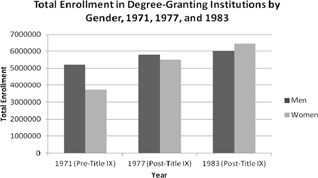
By prohibiting gender quotas and the exclusion of women from public colleges and universities, Title IX significantly increased women’s access to higher education. Figure 1 illustrates the gender dynamics of U.S. college enrollment before and after the passage of Title IX. In 1971, the year immediately preceding its adoption, men outnumbered women as students at degree-granting institutions by more than 1.4 million. By 1977, only five years after the passage of Title IX, the gender gap in college enrollment had narrowed considerably, with male college students outnumbering their female counterparts by fewer than three hundred thousand people. Six years later, in 1983, women students outnumbered men by more than four hundred thousand.
Source: The National Center for Education Statistics (NCES), Digest of Educaiton Statistics.

By prohibiting sex discrimination in college admissions, Title IX helped to narrow the gender gap in U.S. higher educational attainment. While only 18 percent of young women and 26 percent of young men had completed at least a bachelor’s degree in 1971, that number had increased to 27 percent for both women and men by 1994.Footnote 86 Before Title IX’s passage in 1972, women received only 9 percent of medical degrees, 7 percent of law degrees, and 1 percent of dental degrees. By 1997, women earned 38 percent of medical degrees, 43 percent of law degrees, and 38 percent of dental degrees.Footnote 87 Title IX also promoted greater gender equality in faculty hiring and compensation, required fair treatment for pregnant and parenting students, and prohibited sexual harassment in schools. Using the regulatory powers of the state, U.S. lawmakers compelled higher educational institutions to subject women and men to the same admissions standards.
Conclusion
Title IX represents a dramatic shift in U.S. higher education policy. Since the postwar era, the federal government had focused its higher education efforts on the task of expanding access to college degrees by providing financial aid to students. In the early 1970s, a growing awareness of institutionalized sex discrimination in American colleges and universities fueled a shift in how lawmakers conceptualized barriers to higher educational access and how we think about the government’s role in providing access to higher education. This transformation illustrates Baumgartner and Jones’s assertion that U.S. policymaking “is punctuated by bursts of activity that modify issue understandings and lead to non-incremental policy change.”Footnote 88 No longer was affordability the challenge that prevented equal access to the nation’s postsecondary institutions. Rather, discriminatory admissions policies that unfairly limited the number of seats made available to women emerged as the new barrier that required federal attention.
In passing Title IX of the 1972 Education Amendments, U.S. lawmakers effectively used the regulatory power of the state not only to institutionalize gender equality in college admissions but also to demonstrate an unprecedented gender-consciousness in higher education policy. Unlike the G.I. Bill, the National Defense Education Act, and the Higher Education Act, which expanded access to college via gender-neutral federal financial aid, Title IX broke with higher education policy precedent by invoking gender-conscious federal regulation to increase women’s access to college. In doing so, this landmark policy contributed to an enormous shift in the gender dynamics of U.S. higher educational institutions. After Title IX’s passage in 1972, the proportion of women attending American colleges and universities increased precipitously; and, by 1981, women had surpassed men as the recipients of bachelor’s degrees.
We have seen that the successful passage of civil rights legislation in the years immediately preceding lawmakers’ consideration of Title IX yielded a political context in which lawmakers took seriously the problem of discrimination and provided Representative Edith Green with a powerful template to use when drafting the ban on sex discrimination. Drawing directly upon the language used in Title VI of the Civil Rights Act of 1964, Green crafted Title IX as an unprepossessing amendment to a large omnibus education reauthorization bill. Green and her small cadre of political allies worked to consciously avert intense opposition against the proposed regulation. Although elite higher educational institutions and their allies in Congress successfully championed exemptions that relieved private undergraduate programs and traditionally single-sexed programs from regulation under Title IX, the amendment successfully compelled women’s equal admission to public undergraduate programs—which serve the greatest number of American college students—and all vocational, professional, and graduate programs. As a result, this landmark higher education policy significantly increased women’s access to college and paved the way for dramatic increases in women’s higher educational attainment.