




No CrossRef data available.
Article contents
Definition of genetic markers in nuclear ribosomal DNA for a neglected parasite of primates, Ternidens deminutus (Nematoda: Strongylida) – diagnostic and epidemiological implications
Published online by Cambridge University Press: 23 May 2005
Abstract
Ternidens deminutus (Strongylida) is a parasitic nematode infecting non-human and human primates in parts of Africa, Asia and the Pacific islands. The present study genetically characterized T. deminutus and defined genetic markers in nuclear ribosomal DNA (rDNA) as a basis for developing molecular-diagnostic tools. The sequences of the second internal transcribed spacer (ITS-2) of rDNA were determined for adult specimens of T. deminutus (Nematoda: Strongylida: Oesophagostominae) from the Olive baboon and the Mona monkey.Nucleotide sequence data used in this paper are available in the EMBL, GenBank and DDJB databases under the Accession nos. AJ888729, AJ888730, AF136576, Y10789, Y10790, Y11733, Y11735, Y11736, AJ001594, AJ001599, AJ006149 and AJ006150. The former 2 sequences represent original data reported in this paper. The length and G+C content of the ITS-2 sequences was 216 bp and ~43%, respectively. While there was no sequence variation among individual T. deminutus specimens from the baboon, 6 (2·8%) nucleotide differences were detected in the ITS-2 between the parasite from baboon and that of the Mona monkey, which is similar to the difference (3·2%) between 2 other species of Oesophagostominae (Oesophagostomum bifurcum and O. stephanostomum) from non-human primates, suggesting significant population variation or the existence of cryptic (i.e. hidden) species within T. deminutus. Pairwise comparisons of the ITS-2 sequences of the 2 operational taxonomic units of T. deminutus with previously published ITS-2 sequences for selected members of the subfamilies Oesophagostominae and Chabertiinae indicated that species from primates (including those representing the subgenera Conoweberia and Ihleia) are closely related, in accordance with previous morphological studies. The sequence differences (27–48·3%) in the ITS-2 between the 2 taxonomic units of T. deminutus and hookworms (superfamily Ancylostomatoidea) enabled their identification and delineation by polymerase chain reaction (PCR)-based mutation scanning. The genetic markers in the ITS-2 provide a foundation for improved, PCR-based diagnosis of T. deminutus infections and for investigating the life-cycle, transmission patterns and ecology of this parasite.
Keywords
Information
- Type
- Research Article
- Information
- Copyright
- © 2005 Cambridge University Press
INTRODUCTION
Ternidens deminutus Railliet and Henry 1909 (syn. Tridontophorus deminutus Railliet and Henry, 1905 and Globocephalus macaci Smith, Fox and White, 1908) is an enigmatic parasitic nematode of primates in Africa, Asia and some Pacific islands. The parasite belongs to the subfamily Oesophagostominae (order Strongylida) and has been reported to infect both non-human primates (including species of Gorilla and Cynomolgus) and humans (Skrjabin et al. 1952; Goldsmid, 1991). It is harboured in the large intestines of primates and is considered to affect human health (Goldsmid, 1991). Some parts of southern and central Africa have been reported to be endemic for T. deminutus. However, in spite of its significance in humans and high prevalence (up to 87%) in some areas (Goldsmid, 1991), this parasite has been largely ignored. A number of reports indicate that the diagnosis of T. deminutus infection in humans, based on coprological examination, has consistently been confused with ‘hookworm infection’ because the eggs of the parasite are similar morphologically to those of hookworms (i.e., Ancylostoma duodenale, Necator americanus and others) (reviewed by Goldsmid, 1991). Also, T. deminutus eggs cannot be distinguished reliably from those of other bursate nematodes, such as species of Oesophagostomum (nodule worms) (cf. Goldsmid, 1991). Although the method of copro-culture (e.g., Blotkamp et al. 1993) is applicable to the diagnosis of T. deminutus infection based on the identification of third-stage larvae (L3s), this approach has not been employed routinely, mainly because it is relatively time-consuming, labour intensive and more costly to carry out than other conventional coproscopic procedures (such as faecal smear and flotation) (Kato and Miura, 1954; Ridley and Hawgood, 1956; Martin and Beaver, 1968), and requires skilled personnel to identify larvae to the genus level. The specific identification of adult worms released in the faeces after anthelmintic treatment of humans is another option for diagnosis, but again, this approach had not been used because it is laborious and time consuming.
Based on the evidence presented in the 1950s and 1980s (reviewed by Goldsmid, 1991), T. deminutus could be readily classified as a neglected parasite of humans. There is neither precise information on the life-cycle or transmission of the parasite, nor is it known whether the parasite of humans is limited in distribution to endemic foci identified previously in central and southern Africa or whether it occurs more widely on other continents. It is not known whether different species of primate, such as the Olive baboon (Papio anubis) and Mona monkey (Cercopithecus mona), which in some countries and regions live in sympatry with humans, act as reservoirs for human infection, or whether the parasite in all primate host species is the same species or whether genetic variants or cryptic (i.e., hidden) species exist which have particular host species affiliations. While there is some evidence that adult T. deminutus in the baboon can be smaller than the parasite in humans (Goldsmid, 1991), it is unclear as to whether this phenotypic (size) variation relates to genetic variation within the species.
Previous studies have demonstrated consistently that the sequence of the second internal transcribed spacer (ITS-2) of nuclear ribosomal DNA (rDNA) allows the identification of strongylid nematodes to species, irrespective of developmental stage (reviewed by Gasser, 2001; Gasser et al. 2004a) and that systematic relationships can be inferred from ITS-2 sequence data sets (e.g., Chilton et al. 1997, 2001; Hung et al. 2000). In the present study, the aims were to characterize T. deminutus from the Olive baboon and the Mona monkey from Ghana by their ITS-2 sequence, to compare the parasite(s) with other members of the order Strongylida, and to establish a molecular approach (employing the genetic markers defined) for the specific identification of T. deminutus and differentiation from selected strongylid nematodes as a ‘starting point’ for investigating the biology, epidemiology and ecology of T. deminutus.
MATERIALS AND METHODS
Adult nematodes were collected at necropsy from the large intestines of an Olive baboon (n=9) and from a Mona monkey (n=1) in Ghana. Adult worms were identified as T. deminutus based on an existing description (see Skrjabin et al. 1952), washed extensively in physiological saline and frozen at −70 °C until required for DNA isolation. The 9 nematodes (3 males and 6 females) from the baboon were designated TdB1–TdB9 and the single, female nematode from the Mona monkey was designated TdM.
Genomic DNA was isolated from individual nematodes using a small-scale sodium-dodecyl-sulphate/proteinase K extraction procedure (Gasser et al. 1993), followed by mini-column (WizardTM Clean-Up, Promega) purification. The ITS-2 was amplified by the PCR (Saiki et al. 1988) using primers NC1 (forward; 5′-ACGTCTGGTTCAGGGTTGTT-3′) and NC2 (reverse; 5′-TTAGTTTCTTTTCCTCCGCT-3′). Polymerase chain reaction was performed in a 50 μl volume for 30 cycles at 94 °C for 30 sec (denaturation), 55 °C for 30 sec (annealing) and 72 °C for 30 sec (extension), followed by 1 cycle at 72 °C for 5 min (final extension). Negative (no-DNA) and known positive controls were included in each set of reactions. Amplicons were examined on ethidium bromide-stained 2·5% agarose-TBE gels using ΦX174-HaeIII size markers. In order to scan for nucleotide variation within and among ITS-2 amplicons, single-strand conformation polymorphism (SSCP) analysis was conducted as described recently (Gasser et al. 2004b). Based on this analysis, selected ITS-2 amplicons were purified using mini-columns (using WizardTM PCR-Prep, Promega) and sequenced in both orientations using the same primers (separately) as used for the PCR. The 5′- and 3′- ends of the ITS-2 sequences were established based on comparison with other strongylid nematodes (e.g., Chilton et al. 1997; Newton et al. 1998; Gasser et al. 1999a,b). The ITS-2 sequences for T. deminutus (Accession nos. AJ888730 and AJ888729) were compared with those of selected members of the subfamilies Oesophagostominae, Chabertiinae and the superfamily Ancylostomatoidea, available in the GenBank database (Accession nos. AF136576, Y10789, Y10790, Y11733, Y11735, Y11736, AJ001594, AJ001599, AJ006149 and AJ006150; Romstad et al. 1997, 1998; Newton et al. 1998; Chilton and Gasser, 1999; Gasser et al. 1999a,b). The sequences were aligned using Clustal W (www.ebi.ac.uk/clustalw; Thompson, Higgins and Gibson, 1994), corrected by eye and adjusted and improved according to a secondary structure model for the ITS-2 pre-rRNA (cf. Chilton et al. 1998; Newton et al. 1998) to increase positional similarity in regions with a greater level of variation among species. Restriction mapping of the ITS-2 sequences of T. deminutus for ~177 common endonucleases was carried out using the program DNA StriderTM v.1.2.1. Pairwise comparisons of sequence differences (D) were made using the formula D=1−(M/L) (Chilton, Gasser and Beveridge, 1995), where M is the number of alignment positions at which the 2 sequences have a base in common, and L is the total number of alignment positions over which the 2 sequences are compared. A polymorphic position in one ITS-2 sequence was not considered different from another if the latter sequence contained a common nucleotide.
RESULTS
SSCP analysis of the amplicons (~310 bp) was conducted, in order to detect sequence variation in the ITS-2 within and among T. deminutus individuals (Fig. 1). While no variation in SSCP profiles was detected among all 9 individuals of T. deminutus from the baboon, the profile representing the individual worm from the Mona monkey was distinctly different. Hence, the ITS-2 amplicon representing the operational taxonomic unit from Mona monkey (i.e., sample TdM) and selected amplicons representing the operational taxonomic unit from baboon (i.e., samples TdB1, TdB3 and TdB5) were sequenced. While no nucleotide variation was detectable in the ITS-2 among the latter 3 samples, there were 6 nucleotide differences (2·8%) (see alignment positions 6, 131, 194, 247, 275 and 304; Fig. 2) over a common sequence length of 216 bp between the 2 operational taxonomic units of T. deminutus. These nucleotide differences related to 5 transitions and 1 transversion. Based on comparisons with previously published sequences for members of the Chabertiidae (see Romstad et al. 1997; Newton et al. 1998; Gasser et al. 1999a,b), the ITS-2 sequences of T. deminutus from baboon or Mona monkey (216 bp) were the same in length as those of Oesophagostomum bifurcum, O. stephanostomum and O. quadrispinulatum, 1–2 bp longer than those of O. columbianum (214 bp) and O. denatum (215 bp) and 9–42 bp shorter compared with those of O. radiatum (225 bp), Chabertia ovina (235 bp) and O. venulosum (257 bp) (cf. Newton et al. 1998). The G+C content of the ITS-2 of both taxonomic units of T. deminutus was 43%, which was within the range determined previously (41–44%) for the subfamilies Oesophagostominae and Chabertiinae (Newton et al. 1998). The pairwise comparison of both the ITS-2 sequence of T. deminutus from baboon and that from Mona monkey with those published previously for 7 other species representing the subgenera Conoweberia (O. bifurcum), Ihleia (O. stephanostomum), Oesophagostomum (O. dentatum and O. quadrispinulatum), Proteracrum (O. columbianum), Hysteracrum (O. venulosum) and Bosicola (O. radiatum) and C. ovina (see Romstad et al. 1997; Newton et al. 1998; Gasser et al. 1999a,b) revealed differences ranging from 3·2 to 40·6% (Table 1). Irrespective of the nucleotide variation (2·8%) between the 2 taxonomic units of T. deminutus, the levels of sequence difference (upon pairwise comparison) between T. deminutus and other members of the Chabertiidae included herein varied from 5·6 to 40·6% (Table 1). The genetic difference in the ITS-2 between T. deminutus from baboon and T. deminutus from the Mona monkey (2·8%) was similar to that between O. bifurcum (representing human, Mona monkey, Patas monkey and Olive baboon; Romstad et al. 1997; Gasser et al. 1999a; de Gruijter et al. 2004, 2005a) and O. stephanostomum (from chimpanzee; Gasser et al. 1999b) (3·2%). T. deminutus from the Mona monkey was more different genetically from O. stephanostomum (7·4%) than T. deminutus (from either primate species) vs O. bifurcum (6·9%), and T. deminutus (from baboon) vs O. stephanostomum (5·6%).

Fig. 1. Single-strand conformation polymorphism (SSCP) analysis of selected ITS-2 rDNA amplicons of Ternidens deminutus from Mona monkey (sample TdM) and baboon (samples TdB1–TdB3 and TdB5–TdB7) compared with those from Oesophagostomum bifurcum, Ancylostoma duodenale and Necator americanus (lanes 1–10, respectively).

Fig. 2. An alignment of the ITS-2 rDNA sequences (over 332 nucleotide positions) of Ternidens deminutus from Olive baboon (B) or Mona monkey (M) with those of Oesophagostomum bifurcum (representing human, Mona monkey, Patas monkey and Olive baboon), O. stephanostomum (representing chimpanzee) and the 2 principal hookworms, Ancylostoma duodenale and Necator americanus, of humans in Africa. Sequences with GenBank Accession numbers AJ888730, AJ888729, Y11733, AF136576, AJ001594 and AJ001599 have been used as representatives (cf. Romstad et al. 1997, 1998; Newton et al. 1998; Chilton and Gasser, 1999; Gasser et al. 1999a,b). Nucleotide differences among all 6 sequences are indicated with asterisks (bottom); the 6 nucleotide differences between T. deminutus B and T. deminutus M are marked with crosses (top).

From diagnostic and molecular-epidemiological perspectives, it was relevant to establish the magnitude and nature of sequence differences in the ITS-2 among the Oesophagostominae from each primate host, and A. duodenale and N. americanus, the 2 principal hookworms of humans in Africa (Hotez et al. 2004). Comparisons revealed sequence differences of ~27·0–29·5% (T. deminutus/O. bifurcum/O. stephanostomum vs A. duodenale) and ~47·4–48·6% (T. deminutus/O. bifurcum/O. stephanostomum vs N. americanus) (see Table 1). The alignment of selected ITS-2 sequences (Fig. 2) revealed nucleotide differences at 206 of 332 alignment positions, consisting of 131 (64%) deletion/insertion events, 35 (17%) transitional and 19 (9%) transversional alterations, and 22 (11%) multiple substitutions. Associated with these nucleotide differences were regions in the ITS-2 (positions 72–110 and 148–321) of diagnostic value for their identification and differentiation (see Fig. 2).
DISCUSSION
Given that the level of sequence variation in the ITS-2 within species of strongylid nematodes and among different developmental stages (eggs, larvae and adults) thereof is low, the genetic markers in the ITS-2 are useful for systematic studies and for establishing PCR-based diagnostic tools (reviewed by Gasser, 1999, 2001; Gasser et al. 2004a). The sequence difference (2·8%) in the ITS-2 between the operational taxonomic units of T. deminutus from the baboon and Mona monkey was similar to the difference (3·2%) between O. bifurcum (from human, Mona monkey or baboon) and O. stephanostomum (from chimpanzee) and significantly less than the percentages among all other species of strongylid nematode considered herein (5·6–40·6%). In the absence of nucleotide variation within T. deminutus from baboon, and given that O. bifurcum and O. stephanostomum represent distinct morphospecies (Skrjabin et al. 1952), it is possible that the genetic variants (genotypes) of T. deminutus could represent sibling species. The findings also showed that the genetic markers in the ITS-2 are useful for their delineation by SSCP-based analysis. Also, the nucleotide difference at nucleotide position 194 in the ITS-2 of T. deminutus from the baboon is associated with a diagnostic cleavage site for endonuclease SfaNI, enabling its differentiation from T. deminutus from the Mona monkey. As no polymorphic nucleotide positions were detectable in the ITS-2 sequence among individual specimens from baboon, PCR-based RFLP could provide a useful approach for molecular-epidemiological studies of T. deminutus. Further molecular study of adult specimens of T. deminutus from baboon and Mona monkey from a range of geographical origins in Africa is required to test the hypothesis that T. deminutus represents a species complex. It should also be established whether there are any morphological characters (excluding size and colour differences in the adults; see Goldsmid, 1991) for the differentiation of the parasite from baboon from that from Mona monkey. Moreover, a combined morphological-molecular study of T. deminutus from a wider range of primate host species (living in allopatry of sympatry), including humans, would be useful to establish the extent of genetic diversity within T. deminutus and to infer whether non-human primates represent a reservoir for human infection in sympatric areas. Conducting such investigations would be of significance for preventing and controlling T. deminutus infection in humans. As emphasized by Goldsmid (1991), presently very little is known about the biology and transmission of T. deminutus and the (clinical or pathological) effects on its primate hosts.
The situation for T. deminutus is similar to that of O. bifurcum which is known to infect a range of primate species, including the Senegal langur, giant south African baboon, baboon sphinx, baboon, rhesus monkey, chimpanzee and human (Skrjabin et al. 1952) and can cause serious disease in humans (‘Dapaong tumour’ and multi-nodular disease) in northern Ghana and Togo in Africa (Polderman and Blotkamp, 1995). Interestingly, while some investigations, employing PCR-based SSCP analysis of the ITS-2 (Gasser et al. 1999a) and of part of the mitochondrial cytochrome c oxidase subunit 1 gene (pcox1) (de Gruijter et al. 2002), had reported that there was no clear genetic differentiation between O. bifurcum from humans and the Mona monkey, 2 recent molecular investigations, using a high stringency-random amplification of polymorphic DNA (RAPD) method (de Gruijter et al. 2004) and amplified fragment length polymorphism (AFLP) analysis (de Gruijter et al. 2005a), have provided evidence that O. bifurcum from humans is genetically distinct from O. bifurcum from the Olive baboon, and from the Mona and Patas monkeys. These results demonstrated clearly genetic substructuring within O. bifurcum from different primate hosts in Ghana, indicating that the transmission of the different subpopulations of parasite may be specific to individual host species or host groups, and providing support for the proposal that O. bifurcum from the non-human primate species examined is not transmissible to humans (de Gruijter et al. 2004, 2005a). That 6 unequivocal nucleotide differences were detected in the ITS-2 between T. deminutus from baboon and Mona monkey (as distinct from O. bifurcum where there is no unequivocal nucleotide change in the ITS-2 between these 2 non-human primate species; de Gruijter et al. 2004, 2005a) raises the prospect that there are genetic differences between T. deminutus of humans and that of other non-human primates, which would facilitate molecular-epidemiological study of T. deminutus by SSCP analysis of the ITS-2.
When the ITS-2 sequences for the morphospecies T. deminutus from a wide range of primate species become available, detailed molecular investigations into the prevalence and distribution could be undertaken. Based on published evidence, the distribution of T. deminutus is broad but appears to be discontinuous (Goldsmid, 1991), but there is still very limited information about distribution. Infection has been recorded in a range of Old World monkey species in Africa, Asia and South-eastern Asia and some Pacific islands, whereas infection of humans has been reported predominantly in central and southern Africa, the Comoros Islands and Mauritius (e.g., Sandground, 1929, 1931; Van den Berghe, 1934; Amberson and Schwarz, 1952; Kilala, 1971; Goldsmid, 1971a, 1974, 1982). While some workers have considered the prevalence of T. deminutus to be low (e.g., Cook, 1986), studies in Zimbabwe have shown clearly that the parasite is common in both ‘monkeys’ and humans, with the prevalence of infection in some African communities being as high as 87% (Goldsmid, 1972, 1982; cf. Goldsmid, 1991). Based on its difference in geographical distribution in humans (i.e., limited to central and southern Africa) compared with that in various non-human primates (i.e., much broader through the Old World tropics) (Goldsmid, 1971a, 1974, 1982; Goldsmid and Lyons, 1973), Goldsmid (1991) proposed that a distinct variant of T. deminutus might exist in each species of primate. This proposal remains to be tested. Although no morphological characters for the differentiation of different operational taxonomic units were identified, T. deminutus specimens from humans were consistently reported to be larger and darker than those from baboons (Goldsmid and Lyons, 1973; Goldsmid, 1974, 1982). Whether these differences relate to population variation or a species (genetic) difference remains to be determined, but the genetic difference (2·8%) in T. deminutus between Mona monkey and baboon is encouraging. Also, while a likely hypothesis is that T. deminutus infects its primate host via oral ingestion of the infective L3s (as is the case for species of Oesophagostomum), it has also been postulated that the parasite could employ an intermediate host in its life-cycle (cf. Amberson and Schwarz, 1952; Goldsmid, 1971a,b; Goldsmid, 1974, 1982). Involvement of an intermediate host may possibly explain the lack of success in experimentally infecting baboons or humans and failed attempts of exsheathment (cf. Goldsmid, 1991). It has been speculated that termites, a common part of the diet of both baboons and humans in some parts of Africa, may be involved (Goldsmid, 1991). Clearly, such hypotheses regarding prevalence, distribution, life-history, transmission and ecology of T. deminutus could be addressed employing PCR-based tools using genetic markers in internal transcribed spacer rDNA. While no specimens of T. deminutus from humans were available for this study, it is likely that the ITS-2 will be similar in sequence to those of the operational taxonomic units from Olive baboon and Mona monkey. It should thus be possible, based on genetic differences and markers defined in the ITS-2 to establish a molecular approach for the differential diagnosis of T. deminutus infection from other gastrointestinal infections in humans with other strongylid nematodes (such as nodule worms and hookworms). Considerable progress has already been made in developing conventional PCR assays for the specific detection of O. bifurcum, A. duodenale and N. americanus infections in humans (see Verweij et al. 2000, 2001; de Gruijter et al. 2005b), and recent, unpublished findings (Jaco Verweij, personal communication) indicate the feasibility of real-time PCR assays using markers in the ITS-2. Hence, there is excellent prospect for establishing an effective PCR-based tool for T. deminutus. Such an approach would overcome the limitations of traditional copro-diagnostic methods and would significantly enhance investigations of the biology, epidemiological and ecological of this interesting parasite.
Thanks are due to Coby Blotkamp for confirming the morphological identification of the Ternidens deminutus specimens used herein and to Neil Chilton for suggestions. ARS is the grateful recipient of an Australian-Europe Scholarship in 2004. Project support was provided by the Dutch Foundation for the Advancement of Tropical Research (WOTRO-NWO). RBG's research is presently supported through grants from the Australian Academy of Science, the Collaborative Research Program of the University of Melbourne and the Australian Research Council.
References
REFERENCES
Amberson, J. M. and
Schwarz, E. (
1952).
Ternidens deminutus Railliet and Henry, a nematode parasite of man and primates.
Annals of Tropical Medicine and Parasitology
46,
227–237.CrossRefGoogle Scholar
Blotkamp, J.,
Krepel, K. P.,
Kumar, V.,
Baeta, S.,
van't Noorende, J. M. and
Polderman, A. M. (
1993).
Observations on the morphology of adults and larval stages of Oesophagostomum sp. isolated from man in northern Togo and Ghana.
Journal of Helminthology
67,
49–61.Google Scholar
Chilton, N. B. and
Gasser, R. B. (
1999).
Sequence differences in the internal transcribed spacers of DNA among four species of hookworm (Ancylostomatoidea: Ancylostoma).
International Journal for Parasitology
29,
1971–1977.CrossRefGoogle Scholar
Chilton, N. B.,
Gasser, R. B. and
Beveridge, I. (
1995).
Differences in a ribosomal DNA sequence of morphologically indistinguishable species within the Hypodontus macropi complex (Nematoda: Strongyloidea).
International Journal for Parasitology
25,
647–651.CrossRefGoogle Scholar
Chilton, N. B.,
Gasser, R. B. and
Beveridge, I. (
1997).
Phylogenetic relationships of Australian strongyloid nematodes inferred from ribosomal DNA sequence data.
International Journal for Parasitology
27,
1481–1494.CrossRefGoogle Scholar
Chilton, N. B.,
Hoste, H.,
Newton, L. A.,
Beveridge, I. and
Gasser, R. B. (
1998).
Common secondary structures for the second internal transcribed spacer pre-rRNA of two subfamilies of trichostrongylid nematodes.
International Journal for Parasitology
28,
1765–1773.CrossRefGoogle Scholar
Chilton, N. B.,
Newton, L. A.,
Beveridge, I. and
Gasser, R. B. (
2001).
Evolutionary relationships of trichostrongyloid nematodes (Strongylida) inferred from ribosomal DNA sequence data.
Molecular Phylogenetics and Evolution
19,
367–386.CrossRefGoogle Scholar
Cook, G. C. (
1986).
The clinical significance of gastrointestinal helminths – a review.
Transactions of the Royal Society of Tropical Medicine and Hygiene
80,
675–685.CrossRefGoogle Scholar
Gasser, R. B. (
1999).
PCR-based technology in veterinary parasitology.
Veterinary Parasitology
84,
229–258.CrossRefGoogle Scholar
Gasser, R. B. (
2001).
Identification of parasitic nematodes and study of genetic variability using PCR approaches. In
Parasitic Nematodes: Molecular Biology, Biochemistry and Immunology
(ed. Kennedy, M. W. and Harnett, W.), pp.
53–82.
CABI Publishing, CAB International,
Wallingford,
UK.CrossRef
Gasser, R. B.,
Chilton, N.B.,
Hoste, H. and
Beveridge, I. (
1993).
Rapid sequencing of rDNA from single worms and eggs of parasitic helminths.
Nucleic Acids Research
21,
2525–2526.CrossRefGoogle Scholar
Gasser, R. B.,
Hu, M.,
Abs EL-Osta, Y. G.,
Zarlenga, D. S. and
Pozio, E. (
2004 b).
Non-isotopic single-strand conformation polymorphism analysis of sequence variability in ribosomal DNA expansion segments within the genus Trichinella (Nematoda: Adenophorea).
Electrophoresis
25,
3357–3364.Google Scholar
Gasser, R. B.,
Hung, G.-C.,
Chilton, N. B. and
Beveridge, I. (
2004 a).
Advances in developing molecular-diagnostic tools for strongyloid nematodes of equids: fundamental and applied implications.
Molecular and Cellular Probes
18,
3–16.Google Scholar
Gasser, R. B.,
Woods, W. G.,
Blotkamp, J.,
Verweij, J.,
Storey, P. A. and
Polderman, A. M. (
1999 a).
Screening for nucleotide variations in ribosomal DNA arrays of Oesophagostomum bifurcum by PCR-coupled single-strand conformation polymorphism.
Electrophoresis
20,
1486–1491.Google Scholar
Gasser, R. B.,
Woods, W. G.,
Huffman, M. A.,
Blotkamp, J. and
Polderman, A. M. (
1999 b).
Molecular separation of Oesophagostomum stephanostomum and Oesophagostomum bifurcum (Nematoda: Strongyloidea) from non-human primates.
International Journal for Parasitology
29,
1087–1091.Google Scholar
Goldsmid, J. M. (
1971 a).
Ternidens deminutus: a parasitological enigma in Rhodesia. Research Lecture Series No. 4. Faculty of Medicine, University of Rhodesia.
Goldsmid, J. M. (
1971 b).
Studies on the life cycle and biology of Ternidens deminutus (Railliet and Henry, 1909) (Nematoda: Strongylidae).
Journal of Helminthology
45,
341–352.Google Scholar
Goldsmid, J. M. (
1972).
Ternidens deminutus (Railliet and Henry, 1909) and hookworm in Rhodesia and a review of the treatment of human infections with Ternidens deminutus.
Central African Journal of Medicine
18 (Suppl.),
1–14.Google Scholar
Goldsmid, J. M. (
1974).
The intestinal helminthozoonoses of primates in Rhodesia.
Annales de la Société Belge de Medecine Tropicale
54,
87–101.Google Scholar
Goldsmid, J. M. (
1982).
Ternidens infection. In
Handbook Series in Zoonoses
(ed. Steele, H.). Section C: Parasitic Zoonoses, Vol. 2, pp.
269–288.
CRC Press,
Boca Raton, Florida.
Goldsmid, J. M. (
1991).
The African hookworm problem: an overview. In
Parasitic Helminths and Zoonoses in Africa
(ed. MacPherson, C. N. L. and Craig, P. S.), pp.
101–137.
Unwin Hyman,
London.
Goldsmid, J. M. and
Lyons, N. F. (
1973).
Studies on Ternidens deminutus Railliet and Henry, 1909 (Nematoda). I. External morphology.
Journal of Helminthology
47,
119–126.Google Scholar
de Gruijter, J. M.,
Gasser, R. B.,
Polderman, A. M.,
Asigri, V. and
Dijkshoorn, L. (
2005 a).
High resolution DNA fingerprinting by AFLP to study the genetic variation among Oesophagostomum bifurcum (Nematoda) from human and non-human primates in Ghana.
Parasitology
130,
229–237.Google Scholar
de Gruijter, J. M.,
van Lieshout, L.,
Gasser, R. B.,
Verweij, J. J.,
Brienen, E. A. T.,
Ziem, J. B.,
Yelifari, L. and
Polderman, A. M. (
2005 b).
PCR-based differential diagnosis of Ancylostoma duodenale and Necator americanus in humans from northern Ghana.
Tropical Medicine and International Health. (in the Press).Google Scholar
de Gruijter, J. M.,
Polderman, A. M.,
Zhu, X. Q. and
Gasser, R. B. (
2002).
Screening for haplotypic variability within Oesophagostomum bifurcum (Nematoda) employing a single-strand conformation polymorphism approach
Molecular and Cellular Probes
16,
185–190.Google Scholar
de Gruijter, J. M.,
Ziem, J.,
Verweij, J. J.,
Polderman, A. M. and
Gasser, R. B. (
2004).
Genetic substructuring within Oesophagostomum bifurcum (Nematoda) from human and non-human primates from Ghana based on random amplification of polymorphic DNA analysis.
American Journal of Tropical Medicine and Hygiene
71,
227–233.Google Scholar
Hotez, P. J.,
Brooker, S.,
Bethony, J. M.,
Bottazzi, M. E.,
Loukas, A. and
Xiao, S. (
2004).
Hookworm infection.
New England Journal of Medicine
351,
799–807.CrossRefGoogle Scholar
Hung, G.-C.,
Chilton, N. B.,
Beveridge, I. and
Gasser, R. B. (
2000).
A molecular systematic framework for equine strongyles based on DNA sequence data.
International Journal for Parasitology
30,
95–103.CrossRefGoogle Scholar
Kato, K. and
Miura, M. (
1954).
On the comparison of some stool examination methods.
Japanese Journal of Parasitology
3,
35. [In Japanese.]Google Scholar
Kilala, C. P. (
1971).
Ternidens deminutus infecting man in southern Tanzania.
East African Medical Journal
48,
636–645.Google Scholar
Martin, L. K. and
Beaver, P. C. (
1968).
Evaluation of Kato thick-smear technique for quantitative diagnosis of helminth infections.
American Journal of Tropical Medicine and Hygiene
17,
382–391.CrossRefGoogle Scholar
Newton, L. A.,
Chilton, N. B.,
Beveridge, I. and
Gasser, R. B. (
1998).
Systematic relationships of some members of the genera Oesophagostomum and Chabertia (Nematoda: Chabertiidae) based on ribosomal DNA sequence data.
International Journal for Parasitology
28,
1781–1789.CrossRefGoogle Scholar
Polderman, A. M. and
Blotkamp, J. (
1995).
Oesophagostomum infections in humans.
Parasitology Today
11,
451–456.CrossRefGoogle Scholar
Ridley, D. S. and
Hawgood, B. C. (
1956).
The value of formol-ether concentration of faecal cysts and ova.
Journal of Clinical Pathology
9,
74–76.CrossRefGoogle Scholar
Romstad, A.,
Gasser, R. B.,
Monti, J. R.,
Polderman, A. M.,
Nansen, P.,
Pit, D. S. S. and
Chilton, N. B. (
1997).
Differentiation of Oesophagostomum bifurcum from Necator americanus by PCR using genetic markers in spacer ribosomal DNA.
Molecular and Cellular Probes
11,
169–176.CrossRefGoogle Scholar
Romstad, A.,
Gasser, R. B.,
Nansen, P.,
Polderman, A. M. and
Chilton, N. B. (
1998).
Necator americanus (Nematoda: Ancylostomatidae) from Africa and Malaysia have different ITS-2 rDNA sequences.
International Journal for Parasitology
28,
611–615.CrossRefGoogle Scholar
Saiki, R. K.,
Gelfand, D. H.,
Stoffel, S.,
Scharf, S. J.,
Higuchi, R.,
Horn, G. T.,
Mullis, K. B. and
Erlich, H. A. (
1988).
Primer-directed enzymatic amplification of DNA with a thermostable DNA polymerase.
Science
239,
487–491.CrossRefGoogle Scholar
Sandground, J. H. (
1929).
Ternidens deminutus (Railliet and Henry) as a parasite of man in Southern Rhodesia; together with observations and experimental infection studies on an unidentified parasite of man from this region.
Annals of Tropical Medicine and Parasitology
23,
23–32.CrossRefGoogle Scholar
Sandground, J. H. (
1931).
Studies on the life-history of Ternidens deminutus, a nematode parasite of man, with observations on its incidence in certain regions of Southern Africa.
Annals of Tropical Medicine and Parasitology
25,
147–184.CrossRefGoogle Scholar
Skrjabin, K. I.,
Shikhobalova, N. P.,
Schulz, R. S.,
Popova, T. I.,
Boev, S. N. and
Delyamure, S. L. (
1952).
Strongylata. In
Keys to Parasitic Nematodes Vol. 3
(ed. Skrjabin, K. I.),
E. J. Brill,
New York [English Translation; Israel Program for Scientific Translation, 1961, Jerusalem].
Thompson, J. D.,
Higgins, D. G. and
Gibson, T. J. (
1994).
CLUSTAL W: improving the sensitivity of progressive multiple sequence alignment through sequence weighting, position-specific gap penalties and weight matrix choice.
Nucleic Acids Research
22,
4673–4680.CrossRefGoogle Scholar
Van den Berghe, I. (
1934).
L'existence de Ternidens deminutus au Katanga.
Annales de la Société Belge de Medecine Tropicale
41,
189.Google Scholar
Verweij, J. J.,
Pit, D. S. S.,
van Lieshout, L.,
Baeta, S. M.,
Dery, G. D.,
Gasser, R. B. and
Polderman, A. M. (
2001).
Determining the prevalence of Oesophagostomum bifurcum and Necator americanus infections using specific PCR amplification of DNA from faecal samples.
Tropical Medicine and International Health
6,
726–731.CrossRefGoogle Scholar
Verweij, J. J.,
Polderman, A. M.,
Wimmenhove, M. C. and
Gasser, R. B. (
2000).
PCR assay for the specific amplification of Oesophagostomum bifurcum DNA from human faeces.
International Journal for Parasitology
30,
137–142.CrossRefGoogle Scholar

Fig. 1. Single-strand conformation polymorphism (SSCP) analysis of selected ITS-2 rDNA amplicons of Ternidens deminutus from Mona monkey (sample TdM) and baboon (samples TdB1–TdB3 and TdB5–TdB7) compared with those from Oesophagostomum bifurcum, Ancylostoma duodenale and Necator americanus (lanes 1–10, respectively).
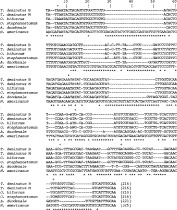
Fig. 2. An alignment of the ITS-2 rDNA sequences (over 332 nucleotide positions) of Ternidens deminutus from Olive baboon (B) or Mona monkey (M) with those of Oesophagostomum bifurcum (representing human, Mona monkey, Patas monkey and Olive baboon), O. stephanostomum (representing chimpanzee) and the 2 principal hookworms, Ancylostoma duodenale and Necator americanus, of humans in Africa. Sequences with GenBank Accession numbers AJ888730, AJ888729, Y11733, AF136576, AJ001594 and AJ001599 have been used as representatives (cf. Romstad et al. 1997, 1998; Newton et al. 1998; Chilton and Gasser, 1999; Gasser et al. 1999a,b). Nucleotide differences among all 6 sequences are indicated with asterisks (bottom); the 6 nucleotide differences between T. deminutus B and T. deminutus M are marked with crosses (top).

Table 1. Pairwise comparison of sequence differences (%) in the ITS-2 rDNA among Ternidens deminutus from the Olive baboon (B; Accession number AJ888730) or the Mona monkey (M; Accession number AJ888729), 6 species of Oesophagostomum (subfamily Oesophagostominae) and Chabertia ovina (subfamily Chabertiinae) from various host species and the 2 predominant hookworms of humans, Ancylostoma duodenale and Necator americanus (superfamily Ancylostomatoidea)
 You have
Access
- 27
- Cited by