INTRODUCTION
The family Onuphidae was erected by Kinberg (Reference Kinberg1865) as ‘Onuphiaea', based on the genus Onuphis. The first species included in the family belonged to the genus Nereis (N. tubicola Müller, 1776, presently valid as Hyalinoecia tubicola). Paxton (Reference Paxton1986) made an excellent historical revision of this family, accepting 23 valid genera with about 300 described species (Paxton, Reference Paxton1986; Budaeva & Fauchald, Reference Budaeva and Fauchald2011). The onuphids have been reported worldwide, from all oceans and at all depths (Glémarec, Reference Glémarec1991); their members are mostly tubicolous, ranging from a few centimetres to 3 m in length (Paxton, Reference Paxton1986). Since their tubes can occur in dense aggregations, these worms can be quite important in the stabilization of marine sediments (Carrera-Parra, Reference Carrera-Parra, De León-González, Bastida-Zavala, Carrera-Parra, García-Garza, Salazar-Vallejo and Solís-Weiss2009).
The genus Mooreonuphis was established by Fauchald (Reference Fauchald1982a) and 11 species were referred to the newly erected genus. Since then, eight new species have been added, including M. bidentata herein described. Mooreonuphis was first thought to be restricted to American waters. However, Paxton (Reference Paxton, Beesley, Ross and Glasby2000) reported two yet undescribed species from Sydney, Australia, in shallow waters, although only the mention of their presence is briefly made. Seven species have been recorded from Caribbean waters: M. bidentata sp. nov.; M. cirrata (Hartman); M. dangrigae (Fauchald); M. intermedia (Kinberg); M. jonesi Fauchald; M. nebulosa (Moore); and M. pallidula (Hartman). Of these, the type locality of the first four is the Caribbean.
In general, onuphids are poorly represented in the shallow waters of the Gulf of Mexico and the Caribbean, especially when compared to other areas at the same latitude but located in the Eastern Tropical Pacific (Fauchald, Reference Fauchald1980; González-Ortiz et al., Reference Gonzalez-Ortiz, Hernández-Alcántara and Solís-Weiss1997). Therefore, when the study of samples from the Puerto Morelos area showed that there were specimens of Mooreonuphis which did not correspond to any of the species so far recorded for the Caribbean, it seemed particularly interesting to analyse them and describe this new species from the Mexican Caribbean.
MATERIALS AND METHODS
The present study was based on new material collected from the Puerto Morelos fringing reef, Mexican Caribbean (20°51.319′N 86°51.798′W) in March 2010. Additional material was taken from collections made in April 2008 in Chinchorro Bank (18o34′21.4N 87o20′20.9W) Quintana Roo, Mexico. In both cases, the dead coral rocks were taken by SCUBA diving, and then fixed with a 4% formaldehyde–seawater solution. Subsequently, the rocks were fragmented to separate the organisms, which were sorted under a stereomicroscope and then preserved in 70% ethanol. The positions of the stations were determined by Global Positioning System (GPS).
In her detailed revision of the Onuphidae, Paxton (Reference Paxton1986) analysed the relationships among genera but she also attempted to standardize the nomenclature of the morphological characters used under different names in this family. Her terminology modifications (Paxton, Reference Paxton1998), as well as those introduced by Budaeva & Fauchald (Reference Budaeva and Fauchald2011), are used here in the description of the new species.
The holotype and paratypes are deposited in the Colección Nacional de Poliquetos located in the Instituto de Ciencias del Mar y Limnología (ICMyL), Universidad Nacional Autónoma de México (UNAM) (CNP-ICML, UNAM; DFE.IN.061.0598).
Scanning electron microscope (SEM) photographs were taken with a JEOL JSM6360LV microscope, following standard methodology. The measurements were made for the holotype with ranges indicated in parentheses for the paratypes when appropriate. Length of body is measured without antennae or palps; body width is measured at chaetiger 10, without parapodia.
RESULTS
SYSTEMATICS
Phylum ANNELIDA Lamarck, 1809
Family ONUPHIDAE Kinberg, Reference Kinberg1865
Subfamily ONUPHINAE Kinberg, Reference Kinberg1865
Genus Mooreonuphis Fauchald, Reference Fauchald1982a
Mooreonuphis bidentata sp. nov.
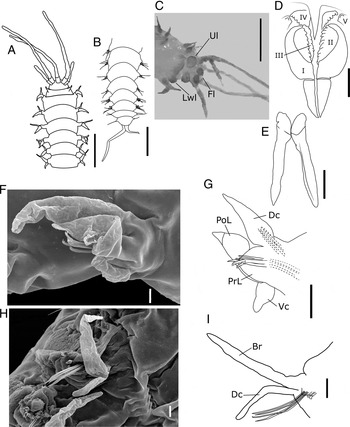
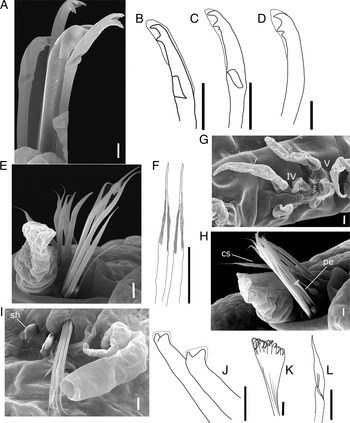
(Figures 1A–I, 2A–L)
TYPE MATERIAL
Holotype: Colección Nacional de Poliquetos, ICMyL, UNAM (CNP-ICML POH–52–001), Puerto Morelos, Quintana Roo, Mexican Caribbean, Station 6 (20°51.319′N 86°51.798′W); 3 March 2010; 2.20 m; coll. V. Solís-Weiss.
Paratypes: 4 specimens: Colección Nacional de Poliquetos, ICMyL, UNAM (CNP-ICML POP–52–001): three specimens, one of them coated with gold for SEM studies: Station 6 (20°51.319′N 86°51.798′W), Puerto Morelos, Quintana Roo, Mexican Caribbean; 3 March 2010; 2.20 m; coll. V. Solís-Weiss; and one specimen: Station 6 (18°33.23′N 87°17.95′W), San Andrés, Chinchorro Bank, Quintana Roo, Mexican Caribbean; 13 April 2008; 9 m; coll. V. Solís-Weiss.
DIAGNOSIS
Body slender, cylindrical, yellowish in preserved specimens. Prostomium short, rounded, frontal lips long and stout; two small eyes. Palpophore and ceratophores of antennae smooth, styles gradually tapering. Branchiae simple filaments from chaetigers 18–24. First 4–5 chaetigers with bi- and tridentate pseudocompound hooded falcigers, and subulate ventral cirri. Chaetigers 1–4 with large median simple tridentate hooded hooks; all falcigers and hooks with short blunt hoods. Compound spinigers from chaetigers 5–6 to 12–14. Bidentate subacicular hooded hooks from chaetigers 13–15.
DESCRIPTION
The description is based on the holotype, with variations of paratypes included. Holotype complete with 90 chaetigers, 26 mm long and 1 mm wide not including chaetae. All paratypes incomplete with 47–96 chaetigers: 22–28.8 mm long and 0.9–1.3 mm wide. Body slender, cylindrical, yellowish, with no colour pattern in organisms preserved in 70% ethanol. Prostomium short, with two long and stout frontal lips. Paired palps 0.8 mm long (1 mm in paratypes), reaching to chaetiger 1 (chaetiger 2 in a paratype). Three antennae about equal in length, with smooth ceratophores and gradually tapering styles, ending in fine tips (Figure 1A, C): median antenna 1.5 mm long (2–3 mm in paratypes) and reaching to chaetiger 4 (chaetiger 6 in a paratype), lateral antennae 1.5 mm long (2–3 mm in paratypes) reaching to chaetiger 4 (chaetiger 6 in a paratype). A small pair of eyes is located between the lateral antennae and the palps. Peristomial cirri short, inserted in the anterior margin of the peristomium, more or less between the palps and the lateral antennae (Figure 1A).
Mooreouphis bidentata sp. nov. (holotype): (A) anterior end, dorsal view; (B) pygidium, paratype, dorsal view; (C) anterior end, ventral view, frontal lip (Fl), upper lip (Ul), lower lip (Lwl); (D) maxillae, roman numerals = number of maxilla; (E) mandibles; (F) parapodium 3, paratype, anterior view; (G) parapodium 1, anterior view, dorsal cirrus (Dc), postchaetal lobe (PoL), prechaetal lobe (PrL), ventral cirrus (Vc); (H) parapodium 40, paratype; (I) parapodium 24, anterior view, branchia (Br), dorsal cirrus (Dc). Scale bars: A 2 mm; B 0.5 mm; C 1 mm; D, E 100 µm; F, H, I 50 µm; G 200 µm.

Modified parapodia (chaetigers 1 to 4–5) longer than posterior parapodia, anteroventrally directed (Figure 1A). First four chaetigers with low prechaetal lobes, and subulate postchaetal lobes (Figure 1G), later reduced, by chaetiger 12. Subulate ventral cirrus on first four chaetigers (chaetigers 1 to 4–5 in paratypes) (Figure 1F, G), replaced by glandular pad from chaetiger 5 (chaetigers 5–6 in paratypes). Branchiae as single filaments, from chaetiger 24 (chaetigers 18–24 in paratypes) (Figure 1I); at maximum development, length more than double the length of dorsal cirrus (Figure 1H). Anterior parapodia with five very slender notoaciculae and three neuroaciculae (Figure 1G); in posterior chaetigers, aciculae reduced to two in notopodium and one in neuropodium. First four chaetigers with a large median simple tridentate hooded hook, larger and stouter than the pseudocompound hooded falcigers (Figure 2D). Chaetigers 1 to 4–5 with simple limbate chaetae, and bi- and tridentate pseudocompound hooded falcigers (Figure 2A); all falcigers and hooks with short blunt hoods: chaetiger 1 with a pseudocompound bidentate hooded falciger (1 bidentate falciger in paratypes too) (Figure 2B) and two pseudocompound tridentate hooded falcigers (2–3 tridentate falcigers in paratypes) (Figure 2C); chaetiger 2 with two pseudocompound bidentate hooded falcigers (1–2 bidentate falcigers in paratypes) and two pseudocompound tridentate hooded falcigers (2–4 tridentate falcigers in paratypes); chaetigers 3 and 4 with two pseudocompound bidentate hooded falcigers (0–2 bidentate falcigers in paratypes) and pseudocompound tridentate hooded falcigers (1–3 tridentate falcigers in paratypes); chaetiger 5 with only one pseudocompound bidentate hooded falciger (0–6 bidentate falcigers in paratypes). From chaetigers 5–6, simple limbate chaetae (Figure 2F), pectinate chaetae and compound spinigers replacing pseudocompound falcigers and simple hooks. Limbate chaetae in two fascicles (Figure 2E), inferior bundle with short chaetae, superior bundle longer and more slender (Figure 2F). Pectinate chaetae flat with about ten teeth of similar size (Figure 2K). Compound spinigers from chaetigers 5 to 12 (chaetigers 5–6 to 12–14 in paratypes) (Figures 2H, L), making holotype only specimen of the type material with compound spinigers and pseudocompound hooded falcigers in same parapodium (chaetiger 5). Pair of bidentate subacicular hooded hooks from chaetiger 13 (chaetigers 13 or 15 in paratypes), to the end of body (Figure 2I, J). Pygidium with two pairs of anal cirri (Figure 1B). Tubes not found associated with the organisms, therefore unknown.
Mooreouphis bidentata sp. nov.: (A) pseudocompound hooded falcigers, parapodium 3, paratype; (B) pseudocompound bidentate hooded falciger; (C) pseudocompound tridentate hooded falciger; (D) large median simple tridentate hooded hook; (E) fascicles of simple limbate chaetae, parapodium 9, paratype; (F) limbate chaetae; (G) parapodia 4–5, paratype, roman numerals = number of chaetiger; (H) parapodium 8, paratype, compound spiniger (cs), pectinate chaetae (pe); (I) median parapodium, paratype, bidentate subacicular hooded hooks (sh); (J) bidentate subacicular hooded hooks; (K) pectinate chaetae; (L) compound spiniger. Scale bars: A, B, C, D, J, L 20 µm; E, I 25 µm; F 50 µm; G 100 µm; H 10 µm, K 5 µm.

Mandibles white, large, calcified with distally smooth cutting plates (Figure 1E). Maxillae robust and sclerotized. Maxillary formula: Mx I = 1 + 1, Mx II = 8 + 9, Mx III = 7 + 0, Mx IV = 5 + 7 and Mx V = 1 + 1 (Figure 1D).
REMARKS
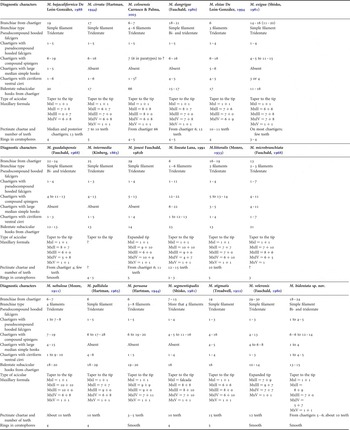
The morphological characteristics and distribution of the 19 species so far recognized in the genus Mooreonuphis (including M. bidentata sp. nov.) are summarized in Tables 1 and 2. Mooreonuphis bidentata sp. nov., belongs to a group of 10 species with branchiae as a single filament appearing posterior to chaetiger 10. Of these, M. exigua from Southern California, M. cirrata from the Gulf of California and Ecuador, M. guadalupensis from north-western Mexico, M. intermedia from the western Atlantic, M. jonesi from Bermuda, and M. dangrigae from Belize, do not have large median simple tridentate hooded hooks. On the other hand, M. bajacalifornica from north-western Mexico, M. stigmatis from Washington, M. veleronis from California, and M. bidentata from the Mexican Caribbean, have large median simple tridentate hooded hooks at least in chaetigers 4 and 5. Therefore, M. bidentata sp. nov. is the first species described from the Atlantic Ocean with single filament branchiae starting posterior to chaetiger 10 and large median simple tridentate hooded hooks.
List of species in the genus Mooreonuphis with some comparative morphological characteristics.

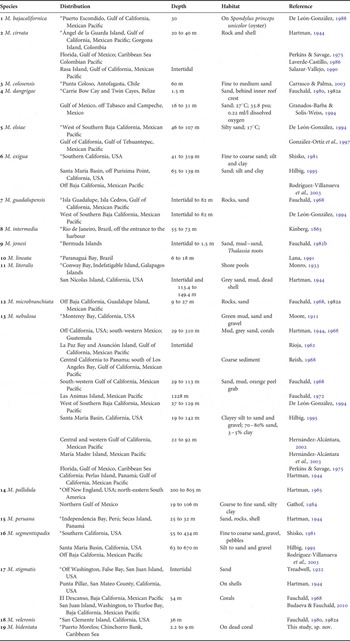
World distribution, depth and substrate of species in the genus Mooreonuphis (*, type locality).

In addition, the possession of bi- and tridentate pseudocompound hooded falcigers in the first 4–5 chaetigers clearly separates M. bidentata sp. nov. from the other three species with large median simple tridentate hooded hooks, since in all of them only tridentate pseudocompound hooded falcigers are present. In this, M. bidentata sp. nov. is only similar to M. bajacalifornica, in having large median simple tridentate hooded hooks, pseudocompound hooded falcigers in the first 5 chaetigers and single filament branchiae around chaetiger 19; however, as mentioned above, in M. bajacalifornica, all the pseudocompound hooded falcigers are tridentate. Also, there are marked differences between these two species in distribution and habitat: M. bajacalifornica was recorded at Puerto Escondido, north-eastern Mexican Pacific, on Spondylus princeps unicolor (an oyster) at 30 m depth, whereas M. bidentata sp. nov. was found in the Mexican Caribbean Sea, in dead coral rocks at 2.2 m depth.
ETYMOLOGY
The name of this new species is due to its characteristic pseudocompound bidentate hooded falcigers, which mainly distinguishes it from other related species of Mooreonuphis.
TYPE LOCALITY
Puerto Morelos, Quintana Roo, Mexican Caribbean Sea.
HABITAT
The specimens of Mooreonuphis bidentata sp. nov. were found at 2.20 to 9 m depth on dead coral rocks.
DISTRIBUTION
Puerto Morelos and San Andrés, Chinchorro Bank, Quintana Roo, Mexican Caribbean Sea.
DISCUSSION
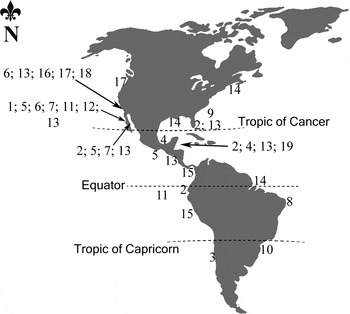
Onuphids are distributed from the littoral to deep-sea zones (Paxton, Reference Paxton1986), in different habitats and occasionally reach very high densities (Hsieh & Simon, Reference Hsieh and Simon1987). In fact, it is the fourth most diverse polychaete family in the deep-sea (Paterson et al., Reference Paterson, Glover, Frojan, Whitaker, Budaeva, Chimonides and Doner2009). However, the genus Mooreonuphis seems to have a limited distribution: although Paxton (Reference Paxton, Beesley, Ross and Glasby2000) reported that Mooreonuphis is represented in Sydney, Australia, by two yet unnamed species from shallow depths, until now, all described species of the genus have been recorded only from the American coasts (Table 2). Besides, as another indication of its restricted distribution, more than half of its species (9) have been recorded so far only from their type locality. A survey of their geographical distribution reveals that the species of Mooreonuphis are preferably distributed on the Pacific coasts (13 species; 68%) rather than in the Atlantic Ocean (8 species; 42%); and only the species M. cirrata and M. nebulosa have been recorded from both coasts of America (Figure 3).
World distribution of all described species of Mooreonuphis (numbers matching those on the list of species from Table 2).

Latitudinally, the genus Mooreonuphis is best represented in the warm-temperate regions (14 species); ten species have been recorded in tropical zones, and only M. stigmatis is present in cold waters from the Northern Pacific (Table 2). In the Pacific, the warm-temperate Californian Province has the higher number of species, i.e. California (5 species) and north-western Mexico (9 species) (Figure 3). Except for the Gulf of California (4 species), reports of most Mooreonuphis species in the Eastern Tropical Pacific come from disjunct geographical regions. On the contrary, in the Atlantic Ocean, the majority of species have been collected from tropical areas, since the Caribbean together with the Brazilian Provinces are home to seven species of Mooreonuphis, while only M. lineata and M. pallidula have been reported from warm-temperate environments.
On the other hand, practically all species of Mooreonuphis have been recorded from shelf depths or intertidal zones: four species were found at less than 2.5 m, while the distribution range of 14 species is found between 3 and 200 m (Table 2). Despite the high diversity in the family Onuphidae in the deep-sea, only four species of Mooreonuphis have been recorded at depths greater than 200 m. Of those, only M. pallidula is also recorded on the continental slope. The species found at depths below 200 m, are characterized by large bathymetric ranges (>278 m), M. nebulosa being the species with the largest distribution range, and the one collected at the greatest depth (1228 m), in the central region of the Gulf of California (Fauchald, Reference Fauchald1972) (Table 2).
In summary, the distribution of the Mooreonuphis species shows that most of the species so far described are found in the Pacific Ocean, on the continental shelf and in warm-temperate areas. On the other hand, in vast areas of the Gulf of Mexico and South America they are not as well represented. An increased effort in sampling those areas is necessary to confirm the distribution patterns so far recognized in this genus.
KEY FOR THE SPECIES OF MOOREONUPHIS (AMENDED FROM FAUCHALD, 1982A)
1 Branchiae start on chaetigers 6 or 7……………2
— Branchiae start posterior to chaetiger 10……………8
2 (1). All branchiae simple……………M. pallidula (Hartman, Reference Hartman1965)
— At least some branchiae pectinate……………3
3 (2). Large median simple tridentate hooded hooks present……………4
— Large median simple tridentate hooded hooks absent……………6
4 (3). Pseudocompound tridentate hooded falcigers in 4 or 8 chaetigers……………5
— Pseudocompound tridentate hooded falcigers in 11 chaetigers; large median simple tridentate hooded hooks present from chaetigers 6 to 22……………M. lineata Lana, Reference Lana1991
5 (4). Large median simple tridentate hooded hooks present on chaetigers 5 and 6………M. elsiae De León-González, 1994
— Large median simple tridentate hooded hooks present from chaetigers 4 to 12–15………M. nebulosa (Moore, Reference Moore1911)
6 (3). Bidentate subacicular hooded hooks present from chaetigers 16 or 19………7
— Bidentate subacicular hooded hooks present from chaetiger 66' M. colosensis Carrasco & Palma, Reference Carrasco and Palma2003
7 (6). Tridentate pseudocompound hooded falcigers in the first 5 chaetigers; bidentate subacicular hooded hooks from chaetigers 19–20M. peruana (Hartman, Reference Hartman1944)
— Tridentate pseudocompound hooded hooks in the first 4 chaetigers; bidentate subacicular hooded hooks from chaetiger 16……………M. segmentispadix (Shisko, Reference Shisko1981)
8 (1). Branchiae with 2 or 3 filaments……………9
— All branchiae simple filaments……………10
9 (8). Bidentate subacicular hooded hooks present from chaetiger 13……………M. littoralis (Monro, Reference Monro1933)
— Bidentate subacicular hooded hooks present from chaetiger 21………M. microbranchiata (Fauchald, Reference Fauchald1968)
10 (8) Expanded acicula in some anterior chaetigers……11
— Acicula taper evenly to the tip in all chaetigers…12
11 (10) Expanded acicula present in chaetigers 4–8; large median simple tridentate hooded hooks present in chaetigers 4 to 6–8……………M. veleronis (Fauchald, Reference Fauchald1980)
— Expanded acicula present in chaetigers 8–15; large median simple tridentate hooded hooks absent……………M. jonesi Fauchald, Reference Fauchald1982b
12 (10). Large median simple tridentate hooded hooks in some anterior chaetigers (usually first 5 chaetigers)…13
— Large median simple tridentate hooded hooks absent……………15
13 (12). All pseudocompound hooded falcigers tridentate……………14
— Pseudocompound hooded falcigers bi- and tridentate in the first 4–5 chaetigersM. bidentata sp. nov.
14 (13) Tridentate pseudocompound hooded hooks present in the first 3 chaetigers; compound spinigers present in chaetigers 4–16……M. stigmatis (Treadwell, Reference Treadwell1922)
— Tridentate pseudocompound hooded hooks present in the first 5 chaetigers; compound spinigers present in chaetigers 6–11……………M. bajacalifornica De León-González, Reference De León-González1988
15 (12). Pseudocompound hooded falcigers bi- and tridentate in the first 4 or 5 chaetigers……………16
— All pseudocompound hooded falcigers tridentate……………17
16 (15) Cirriform ventral cirri on the first 3 chaetigers; bidentate subacicular hooded hooks from chaetigers 12–13…………M. guadalupensis (Fauchald, Reference Fauchald1968)
— Cirriform ventral cirri on the fist 4–5 chaetigers; bidentate subacicular hooded hooks from chaetigers 15–17……………M. dangrigae (Fauchald, Reference Fauchald1980)
17 (15). Branchiae start on chaetigers 14–17……………18
— Branchiae start on chaetiger………25M. intermedia (Kinberg, Reference Kinberg1865)
18 (17) Cirriform ventral cirri in the first 6 chaetigers………M. cirrata (Hartman, Reference Hartman1944)
— Cirriform ventral cirri in the first 3–4……………chaetigers M. exigua (Shisko, Reference Shisko1981)
ACKNOWLEDGEMENTS
Thanks are due to all those who helped in the sampling trip to Chinchorro Bank in 2008, especially Laura Sanvicente who was a full partner in this project, together with her research group; Mari-Carmen García head of Chinchorro National Park who allowed our stay there and helped with all the logistics involved and Roberto Iglesias, head of the UASA–ICML–UNAM who facilitated the work of one of us (V.S.W.) in the Puerto Morelos area, are also thanked. Amauri Mendoza led the boat to the sampling area in Puerto Morelos. We also thank Ismael N. Cruz Pérez for the review of the specimen from Chinchorro Bank, Yolanda Hornelas for the electronic microscope photographs, and Andrea Gutiérrez Martínez and Luis E. Salgado Valverde for preparing the edition of the figures. The two anonymous referees are thanked for their comments. This research was totally financed by the Instituto de Ciencias del Mar y Limnología, UNAM.