… [A]s well as the chalices, ciboria, monstrances, vestments, retables, confessionals, images, Holy Week floats, altars etc. they destroyed roofs, ceilings, doors, windows, grilles, balconies, floors, bells etc. leaving only the walls.Footnote 1
In 1961, Father (later Bishop) Antonio Montero Moreno published the definitive reckoning of the anticlerical violence of the Spanish Civil War. This meticulous delineation of the ‘religious persecution’ of 1936–9 confirmed the deaths of nearly 7,000 religious personnel, 13 bishops, 4,184 diocesan priests, 2,365 monks and brothers and 283 nuns.Footnote 2 The anticlerical onslaught took place largely during the first months of the Civil War, a period of regime collapse when central authority was disrupted and de facto power lay with spontaneous revolutionary committees of trade unionists and militiamen. Arson attacks on ecclesiastical buildings – ‘church-burning’ – entailed widespread destruction, while searches of ecclesiastical buildings – either for ‘treasure’ or for arms – caused great damage and served as invitations for looting. Religious objects were also confiscated during searches of private homes.
In and of itself, this extensive episode of iconoclastic violence has received little historical attention. Studies of the Republican rearguard examine violence in more general terms and tend to concentrate on violence against the person.Footnote 3 Similarly, the historiography of anticlericalism in Spain has focused on the protagonists, seeing iconoclasm as one of a range of transgressive actions that cemented bonds between newly formed revolutionary groups.Footnote 4 The anticlerical repertoire is well established, and several studies speculate as to motive and intention. But the effects of the iconoclasm, particularly on those who owned, venerated or loved these destroyed or damaged objects, remains unexamined.Footnote 5
The anticlerical violence of 1930s Spain was intertwined with both the wider Civil War – which allowed the violence to rage unchecked – and the preceding Second Republic, which established the Church as a political protagonist. The political historiography has tended to regard anticlericalism as a secondary issue, one factor among several that fuelled the left/right divide. In contrast, clerical commentators tend to disregard the wider political context, seeing instead a history of religious persecution and martyrdom that began with the secularising legislation of the Second Republic. Given the scale of the killings, which clearly fitted the Christian idea of martyrdom, this is perhaps not surprising.Footnote 6 The first beatification causes were opened in the late 1940s and, though they came to completion only after 1986, testimony was collected even before the war had ended. The memory of the violence was thus handed down through the voices of the victims and – as this paper will show – by the objects themselves.
These testimonies acknowledged the huge scale of violence against buildings, monuments, images and objects, as did Father Montero in his final chapter on the ‘martyrdom of things’, which drew heavily on the first attempt at some kind of overview of material loss, Castro Albarrán's La gran víctima (1939). Both authors interpreted iconoclastic violence as a sustained and coordinated attempt to drive religion – that is, Roman Catholicism – out of Spain. Indeed, Canon Castro Albarrán had been prominent in formulating the arguments for ‘holy war’ that were used to justify the military rising of July 1936 and proved instrumental in baptising the ensuing war effort as a ‘crusade’.Footnote 7 The iconoclasm was used as evidence – perhaps even as proxy – of the intentions of their adversaries. The ‘martyrdom of things’ was defined by the nature of the enemy: barbarous, pitiless, insensate and Satanic.
The rhetorical point was to underline the attack on religion, the prevention of Christian worship and the injury to Catholic culture. Barbarism – denoted by terms such as vandalism, pillage and sacking – converted the anticlericals into a savage horde, intent on wreaking unimaginable destruction. As Gamboni has noted, in the modern period ‘ignorance’ became ‘a key concept in the stigmatization of iconoclasm’, and descriptions of the iconoclasm always emphasised its ‘vandalism’.Footnote 8 References to pillage and sacking underlined the lack of regard for beauty or history. ‘Energumens’ acting under diabolic instruction targeted the tabernacle, then the altar and then the crucifix, finally setting fire to ‘all vestments, images, reredoses and whatever else they might find’, destroying art and heritage alongside religion.Footnote 9
It is the fact and the scale of the iconoclasm that is of concern in these descriptions, and which is, in turn, assumed to reveal the truth about the perpetrators. Unlike human beings, ‘things’ are always ‘innocent’, Montero argued. Their sacred nature in and of itself demonstrated their assailants’ intent to extirpate Christianity. As he pointed out, there can be no military motive for ‘destroying an image of the Virgin, burning a reredos, or trampling on corpses’.Footnote 10 Again, ‘martyrdom’ lay in the intention and purpose of the assailants, as well as their choice of targets. The assumption was that these were sacred objects: images, tabernacles and Eucharistic paraphernalia. In Catholic tradition, there is a liminality to these objects, notably those that represent the body.Footnote 11 Not only are human beings made in the image of God, but God also took human form. Images are thus both material and immaterial, just as is, in another example, the consecrated Host.Footnote 12 The tabernacle had its own place within the church and was treated with a veneration that had been significantly enhanced by modern eucharistic practices such as ‘watching’ and, under Pius X, frequent communion.Footnote 13 Reverence towards these objects was not necessarily the preserve of believers. Militiamen searching the Claretian church in Barbastro, ostensibly for arms, stopped before the tabernacle when one said ‘Careful! Only a priest can open this; I know something about these things.’ And, indeed, they asked a priest to open it.Footnote 14
This particular class of ‘holy’ object – and, indeed, this kind of magical thinking – was surely what Fr Montero had in mind when he wrote that ‘their obliteration highlights the hatred of what lay behind them, [that is] of God, which they represent’.Footnote 15 But these were not the only targets of the anticlericals nor did they represent the limits of the iconoclasm. As the destruction was usually undiscriminating, it encompassed sacred objects (images, relics, tabernacles, chalices, ciboria, vestments), secular items (paintings, pews, retables, glass- and metalwork) – both of which could include valuable, and even priceless, works of art – and everyday objects of little intrinsic value (candles, food, cutlery, linen etc.). Similarly, while contemporary accounts focus on ‘church-burning’, it only accounts for part of the material destruction. Searches of ecclesiastical buildings and private homes led to the confiscation of personal and domestic religious objects which, like those from destroyed churches, could be treated in various ways. Many items were burnt, destroyed or deliberately defaced; others were stolen, looted or lost; some were reused, requisitioned or stored. But whatever their fate, it depended on an interaction with human beings, and one that was governed as much by the materiality of the object as by the intention of the person.
There is little hint of this complexity in Montero Moreno's ‘martyrdom of things’, nor of the materiality of the things he is discussing. They are martyred, not by their own choice or agency, but by their sacred nature, that is their liminality, and the evil intentions of their assailants. There is no precision to his – or anyone else's – statistics, no typology of the different types of damage, no differentiation of the material destruction. In an entirely specious table, categories such as ‘liturgical objects destroyed’ and ‘churches partly destroyed, profaned and sacked’ are recorded as ‘almost all’, ‘all of those affected’ and, for ‘churches destroyed’, ‘several’.Footnote 16 Similarly, according to Castro Albarrán, in Seville, in one afternoon, seven churches were ‘reduced to ashes’, another six ‘sacked by the mob’ while ‘other churches that we won't go through now as it would never end’ lost ‘for ever a countless number of paintings, sculptures, garments, sacred vessels, objects in ceramic and metal, embroideries, tapestries, grilles, jewellery, reliquaries … the list would be interminable’.Footnote 17
There is no doubt that, apart from buildings, the damage was hard – and is now impossible – to catalogue. This was due in part to the scale and complexity of the iconoclasm, in part to the length of the war and in part to a lack of inventories.Footnote 18 Numbers became another way to represent the criminal barbarity of indiscriminate destruction, though the attention paid to monetary value acted as a reminder that these items were also property. The attempts at accounting may have served as a coping mechanism, surveying and quantifying the damage in a way that made it seem manageable, even as it served as a claim to restitution.Footnote 19 But, even so, there is a vagueness around material damage that not only permeates contemporary commentary but also came to structure the historical record. Paradoxically, this persists even through the lists that punctuate every account of the violence. As with the accounting measures, these lists purport to catalogue but, as none of the terms are defined, fail to provide even a taxonomy of lost objects. The list simply becomes another device to emphasise the scale of the losses and the vandalism of the attackers.
The sharp contrast between the generalities with which the iconoclasm is treated and the forensic data-gathering around those who had died is unmistakable and characterises all the accounts and memoirs – collectively known as ‘martyrologies’ – that we have. As Montero relied on these accounts, it is not surprising that, in contradistinction to his ‘figures’ on material damage, he provided detailed lists of names of the religious personnel who were killed, their dates, place of death, place of origin and, where possible, the manner of their execution.
There thus appears to be a significant difference in the confidence with which religious authorities approached violence against human beings as against that directed at material objects. Priests and religious knew how to recognise, define and, crucially, how to write about martyrs, hence the steady production of martyrologies and, later, of beatification causes. The Francoist state also collected information on the anticlerical violence – most notoriously in the extraordinary archive known as the Causa General, essentially a prosecution of the Second Republic for crimes against Spain – but it relied on the Church for information on anticlerical violence. The stereotypes and vague reckonings are thus repeated in the official record, which is far fuller and more precise in its documentation of violence against the person than of material damage, of which, however, we can find tantalising traces.
So, what then are we to make of the ‘martyrdom of things’? Why this strange formulation for an episode that most clerical commentators actually seem to avoid in some way? One answer may lie in the political instrumentalisation of the anticlerical violence and the sacralisation of Franco's war effort, that is, the construction of the Crusade.Footnote 20 Alternatively, Montero's own argument may suggest a more metaphorical reading, whereby the sacrifice of blameless objects underlined the innocence of the clerical victims, in contrast to the war dead, who died bearing arms.Footnote 21 Each has some validity, but neither engages with the actual nature of iconoclasm, that is, the materiality of material destruction. Given that the sources largely do not engage with this either, this is probably not surprising. But a close and sometimes cross-grained reading of them reveals much about the ‘martyrdom of things’ and not simply in terms of the attentions of their assailants.
Martyrdom is a voluntary act. It entails the willing acceptance of death for a higher cause or purpose, an act of resignation that renders that death sacrificial. If martyrdom is a sacrificing of the self then, clearly, there can be no ‘martyrdom of things’ as ‘things’ have no subjectivity. They do, however, have a materiality that makes certain demands of those who interact with them. And interaction with material objects – images, ‘holy’ pictures, rosaries, medals, scapulars, prayer cards and, above all, crucifixes – was definitional in the everyday practice of Catholicism.Footnote 22 The ‘agency of the object’ structures human actions when engaged with that object, both in ordinary circumstances and at the moment of their destruction. The different and varied ways in which religious items were treated during the ‘martyrdom of things’ tells us much not only about the iconoclasm, but also about the nature of Spanish Catholicism.
I Burning and breaking: the forms of destruction
In its strictest sense, iconoclasm means image-breaking.Footnote 23 There is clear evidence that this very particular kind of object – an icon/idol – was sought out by those intent on attacking the physical presence of the Church in 1936. In the large towns and cities, left-wing activists, usually mobilised through trade unions and now forming spontaneous revolutionary committees, used arson to signal the end of the old social order.Footnote 24 As militia groups formed, armed columns then took the incendiarism out to the pueblos, where they found no shortage of collaborators to help strip the churches, and, often, torch the buildings. As the contents were emptied, however, a distinction emerged in the way different objects were treated, with some apparently being seen for what they were and others as what they were made of.
There is no clear categorisation here. The same kinds of objects were treated in different ways on different occasions. But there were some patterns. Invariably, the assailants piled furnishings, altars, statues and whatever else they could find into a large pyre, either in the church or on the street outside. One parish priest in Madrid, for example, specified the burning of ‘some twenty-five prie-dieux’, while in Olot (Girona) a bonfire was made in the Carmelite church of ‘the usual combustibles … retables, images, confessionals, benches, doors’.Footnote 25 The religious images found inside Spanish churches were predominantly made of polychromed wood and so were easy to burn. Indeed, ‘the burning and destruction of images’ was the ‘most common’ anticlerical act: crucifixes and statues of the Virgin and saints were invariably the first items to be removed.Footnote 26 In Linares de la Sierra (Huelva), local Socialists tried to save the images, removing them from the parish church before the altars, pews and other furniture were burnt inside it. But more militant elements insisted that the images be burnt too; they were only ‘branches of orange trees’, they told the villagers, before using them to stage a mock bullfight and throwing them on a bonfire.Footnote 27
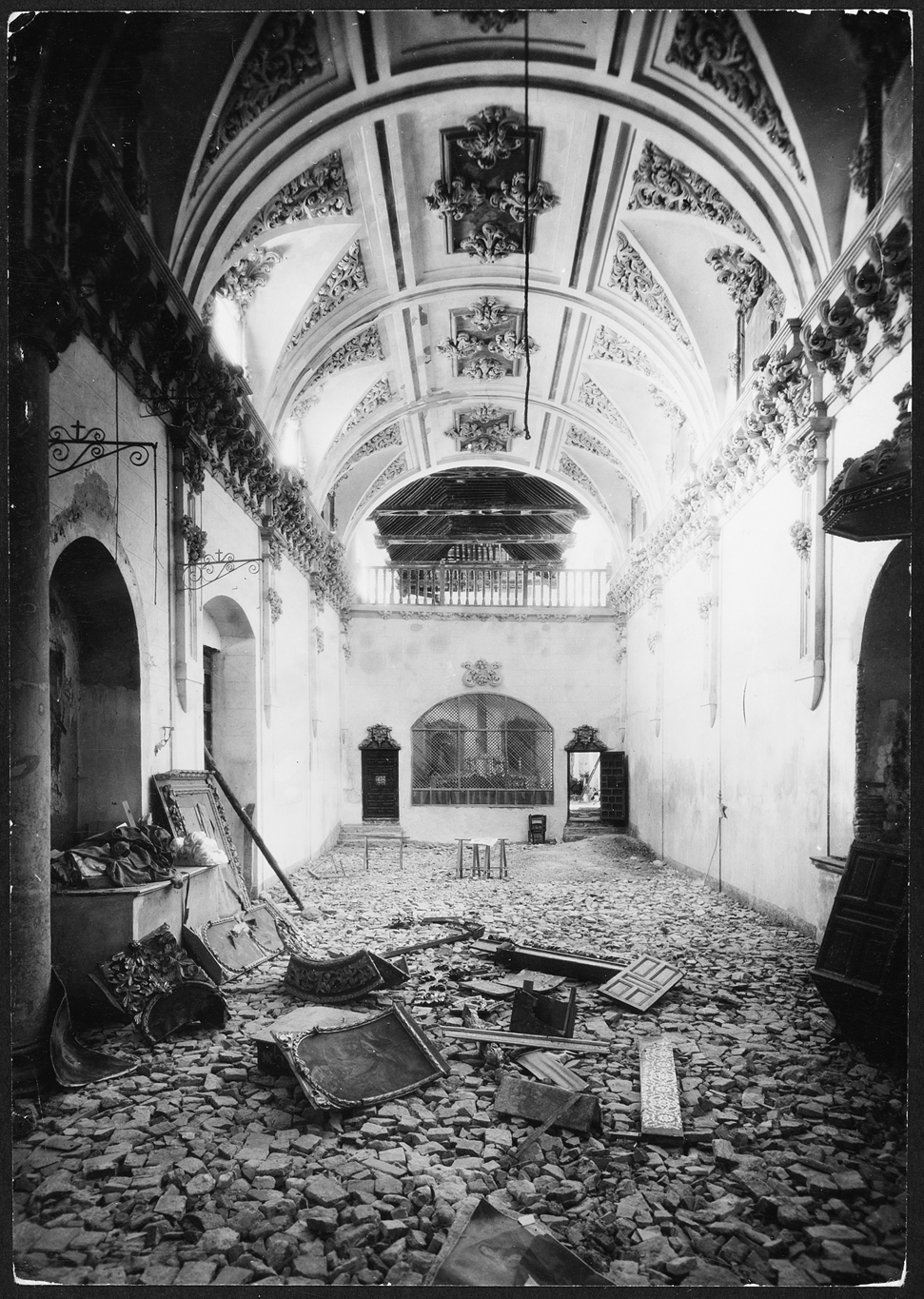
As this example clearly shows, the actions of the iconoclasts were provocative, usually performative and always transgressive. They were also complex; hence the bullfight with the Virgin's veil as a cape, and a statue as the charging bull, both animated by human action in a spectacle designed as entertainment. Breaking taboos formed a collective bond and hardened a revolutionary identity rooted in socialist and proletarian values. The Church, long allied to the political right, was singled out as the enemy of the people, and ecclesiastical property of all kinds assaulted. The enmity of the ‘people’ – or at least of the revolutionaries – was clear. However, while the ‘power’ of the Spanish Church remains the go-to explanation for anticlerical violence, it was an easy target. Despite endless rumours of stockpiled arms and priests firing from bell towers, ecclesiastical buildings were undefended, and the objects inside them, by definition, offered no resistance. (See Figure 1.) Indeed, this may have contributed to Montero's insistence on their ‘innocence’.
Convent of Mother of God, Ronda (Málaga), after a search for arms. (Reproduced with kind permission of Biblioteca Nacional de España.)

The result of this powerlessness was enormous destruction. Famously, Spain's only known work by Michelangelo, a statue of the infant John the Baptist, was smashed to pieces, while El Greco's Risen Christ had its arms and feet hacked off.Footnote 28 The threat posed to national heritage was immediately recognised by the Republican government, which established an official body to protect ‘artistic heritage’ on 1 August 1936, five months before equivalent measures were taken by the Francoist side.Footnote 29 There was widespread horror at the destruction – particularly from those with a background in art or heritage work – which was blamed on ‘incontrollables’.Footnote 30 Indeed, the effective steps the Republican government took to protect artistic heritage may well reflect the profound discomfort caused by having to take such measures against those on their own side.
As the war progressed, a more stable Republican government requisitioned religious objects to protect and catalogue them.Footnote 31 Significant works were recoded as art, that is, as museum objects rather than active subjects – and agents – of devotion. ‘Great’ religious art and architecture was preserved, but as heritage; faith and worship were, in effect, consigned to the past. As this substantial official initiative was, however, a response to the destruction, it has been argued that the anticlerical violence was, in fact, the continuation or completion of the Second Republic's secularising project ‘from below’ and by non-legislative means.Footnote 32 The same argument emphasises the materialism of the proletariat, which, rejecting the ‘opium’ of religion, and deeply critical of the wealth of the Church, took measures to alleviate their own poverty after years of resentment towards Christian charity and religious communities who demanded prayers and gratitude from those who came to them in need.Footnote 33
Many objects were taken from ecclesiastical buildings, a process depicted by clerical commentators as ‘pillage’ and by some historians as a redistribution or reparto but which most closely resembles looting. Though we have almost no information about some of the most common – and most useful – church objects, in general looted objects have to be both portable and desirable, either because they are valuable or because they serve a practical purpose. In Alberca de Záncara (Cuenca), the militiamen took ‘the bells, wax and vestments that were left’ after the church was stripped. Similarly, all the alms-boxes went from Nuestra Señora de los Angeles parish church in Madrid; metal objects, including a gold reliquary, disappeared along with ‘useful items’ from the Capuchin monastery in Santander; chalices, patens and ciboria were taken from the sacristy of the Daughters of Charity in Almería.Footnote 34 The subsequent fate of these objects is usually obscure; some will have been sold while others moved into domestic space. We know, for example, of items repurposed as drinking vessels and cooking pots – one Cantabrian militiaman apparently made a point of drinking red wine from a chalice – while candles and other small items could simply be used as they were.Footnote 35
However, metal objects in particular seem to have been viewed primarily in terms of their material. Altar railings and grilles were removed and bells taken down, with profound effects on local sound-scapes: the writer Concha Espina remarked that now only cowbells were heard in her Cantabrian valley.Footnote 36 Studies of the north-eastern dioceses of Cuenca and Barcelona show that bells were taken systematically, quite often simply by dropping them from the belfry.Footnote 37 The lack of heed paid to damage to the bells – let along the fabric of the church – underscores the point that the assailants wanted the material, and not the artefacts themselves. Metal has a clear intrinsic value, it is very useful in wartime and, crucially, it is not combustible. The effort required to remove railings and, especially, bells was amply rewarded by the valuable raw material that they yielded.
Melting down and recasting metal is hardly a domestic enterprise. Cloth, on the other hand, can be reworked at home. Again, textiles were often burnt – as at Malvarrosa (Valencia) where the Hospitallers’ vestments, habits and church linens blazed in a great pyre – but there are also many cases of cloth being saved from the flames.Footnote 38 In the province of Almería, vestments and altar cloths were taken from the city church of San Sebastián and the parish church in Leitor, while the Sisters of Mary Immaculate lost both church and household cloths.Footnote 39 At the Dominican house in Calanda (Aragón), after a general looting in which ‘some took clothes, others food from the dispensary, the animals and poultry; others clocks and typewriters … they broke the images, burnt the altars, and the sacristy cloths and vestments were shared between the women’.Footnote 40 In this mixture of looting, iconoclasm and reparto, the women's role is distinctive. It does not seem to have been unusual for women to take the lead in seizing church textiles, presumably because they were the ones who would remake or reuse them. There is clear evidence of recycling, with women making cushions and curtains from ‘chalice cloths’ and vestments, ‘espadrilles, trousers and shirts’ from other church fabrics, and underwear – presumably heavy woollen petticoats – from ‘white religious habits’.Footnote 41
Though it seems clear that these fabrics moved into domestic space, and were repurposed for practical use, we know little of how they were used, or even what kind of cloths were taken. Church textiles range from fine lawn through cotton and linen to heavily embroidered silks, while habits and cassocks were made of heavier stuff, such as wool. As the historical record runs out at the point at which they were taken, we do not know how these garments were viewed, if they held any memory of their own history, or were passed down with stories as to their origin. The ornate embroideries commonly used as chasubles and outer vestments would have been distinctive in both quality and pattern and, as they were fragile, may not have survived for long. But, again, we do not know the effect these repurposed garments had on others or if they were genuinely only seen as practical pieces of cloth. Certainly, religious images treated as fuel did not simply become wood. When the Hospitallers’ church in Malvarrosa (Valencia) was dismantled – a process that began on 15 August 1936 – the shattered images were taken to the kitchen ‘where Brother José Miguel had to go through the pain, which made him collapse, of burning the remnants of those objects that had inspired such devotion in him in the days of his religious life’.Footnote 42
Garments, too, are objects with meaning. They have an intimate relationship with humans – perhaps the closest of any objects – and are invested with emotional meaning through family association, gift-giving and personal memory.Footnote 43 For ordained priests and professed religious, clothing also has a ritual purpose and significance and is an integral part of the ceremonies that mark their entry into community or the clerical life. Church embroideries were frequently bequeathed or presented to religious communities, often to commemorate these clothing or profession ceremonies. Similarly, vestments were commonly given as ordination presents, often by close relatives.
When the young Jesuit priest José María Lamamié de Clairac – who died at the front as a military chaplain – celebrated his first Masses in September 1935, he wore a chasuble embroidered by his mother, which had first been worn at her own wedding, and the alb his grandmother and great-aunt had made for his uncle's ordination.Footnote 44 As with many church items, these had a family history as well as a religious one. But the soutane was a highly personal item. Priests and religious often regarded their distinctive dress with great affection, and were reluctant to abandon it, even in the face of death. One jailed Capuchin, RP Domitilo de Ayóo, refused to remove his habit, or his beard, saying he would rather die than ‘take off the habit I've worn since I was ten’. Indeed, one attempt to change failed when he appeared briefly in lay dress, highly agitated, to tell his companions, ‘I feel very bad like this.’Footnote 45
Few cases were as extreme as this, but other monks delayed removing their habits or did so only with ‘the sadness you might imagine’.Footnote 46 As with the images, these objects are not simply the material of which they are made, and it is inconceivable that the iconoclasts did not recognise this, not least through the effect they had on others. Indeed, it is hard not to see Brother José Miguel's ‘collapse’ as the result of deliberate intention. Religious statues – even bad ones – had the animation so commonly attributed to art objects through terms such as ‘vivid’ or ‘lifelike’. Many are dressed, including Jesus the Nazarene, which – unlike clothed images of the Virgin, which are usually simply a frame – has a full polychromed body which is intended to be stripped as part of the Passion story. Even in a liturgical context, then, clothes are designed to be put on and taken off. That is, to echo W. J. T. Mitchell, what they want. So, during the Civil War, clothed images were often stripped – as were clergy – and others dressed up. Headgear, that long-standing staple of caricature, was the most common choice for these parodic re-dressings of religious statues, with militia caps a frequent addition. The Sacred Heart in one Madrid convent spent the first months of the war ‘with a militia cap, a red rag, and a rifle in its hand’.Footnote 47
Human bodies too were dressed up as vestments became a staple of carnivalesque performances. This is hardly surprising. Vestments ‘want’ to be put on; they are, at one level, a specialised theatrical prop and so were well suited to parodies of religious ceremonies or processions, which were sometimes, apparently, carried out just for fun. One militiaman in Alboloduy (Almería) created a costume from ‘the tunic from an image’ and various vestments, while parades or mock processions round pueblos ‘in ecclesiastical dress’ with ‘the intention of mocking and ridiculing religion and the ministers of the Lord’ were common.Footnote 48 As with other transgressive behaviours, this burlesque of religious rite was a breaking of taboos, a clear signal of disrespect or contempt, and a demonstration of the powerlessness of sacred objects. The performativity has received less attention, but it is quite possible that this quality of liturgical objects as props or costumes is reflected in the theatricality of the iconoclasm, which is quite unmistakable.Footnote 49
II ‘They dragged the saints through the streets’
The same performative quality was seen, repeatedly, in the ritualistic ways images were treated by the iconoclasts themselves. In Montoro (Córdoba), for example, ‘they dragged the saints through the streets’ as the Holy Week figure of Jesus the Nazarene was taken to the river with other images from the church. Similarly, the figure of Christ from the chapel of the Augustinian nuns in Madrid was ‘mutilated and pulled through the streets with a rope around its neck’.Footnote 50 Many images were ‘drowned’ by being thrown in rivers – often after burning – while the bonfires themselves were often located at some kind of threshold, the church door, the boundaries of the pueblo, a riverbank.Footnote 51 The same process of dragging or parading was enacted on priests’ bodies – both dead and living – in a clear demonstration of the interchangeability of person and object, priest and image. Religious statues – that is, simulacra of the human body – were thus treated in very similar ways to the living bodies of priests. As the post-war summary of the destruction from the diocese of Córdoba succinctly put it:
All the IMAGES were profaned as well. As to how, the profanation varied: they were battered, their hands and feet were cut off, their eyes were gouged out, their heads were split, they were shot with all manner of equipment, the place where the heart would be was perforated, as were hands and feet, and other similar methods were used, that could only have been dictated by an infernal hatred.Footnote 52
Catholic Spain has, of course, a long history of hierophanic images, their apparent physicality accentuated by the plasticity of polychrome sculpture. Statues of Jesus, the Virgin Mary and various saints were credited with human qualities – moving, weeping, sweating or bleeding – as well as with intercessionary powers.Footnote 53 But ideas of ‘living’ images went very deep. In Santander, for example, militiamen spoke of burning images ‘alive’.Footnote 54 This interchangeability between people and images was seen repeatedly, as when the Madrid Augustinians encountered two Dominican fathers ‘bleeding like an Ecce Homo’, or the archdiocese of Seville listed ‘consecrated persons’ alongside churches, ‘sacred images’ and ‘the Holy Eucharist’ in a register of what had been defiled.Footnote 55
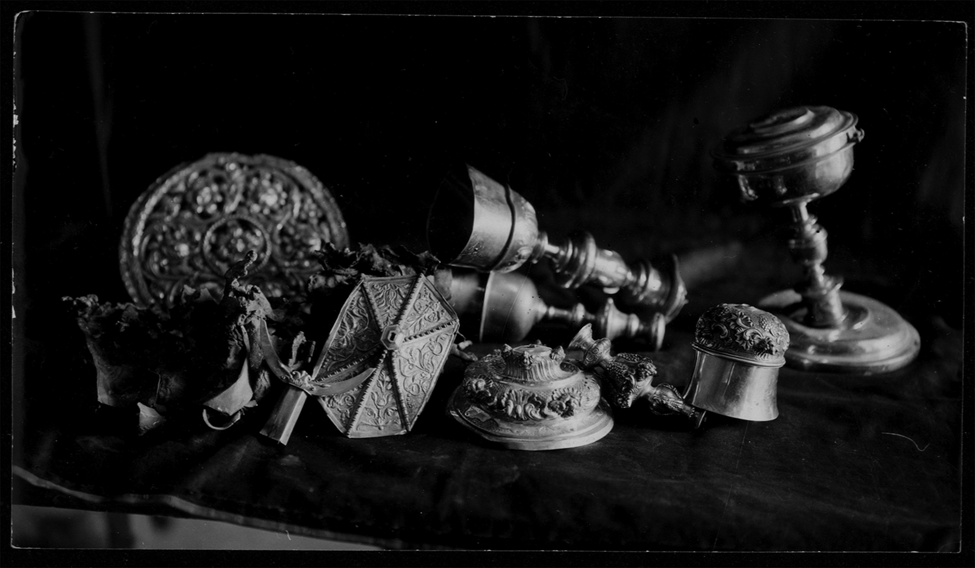
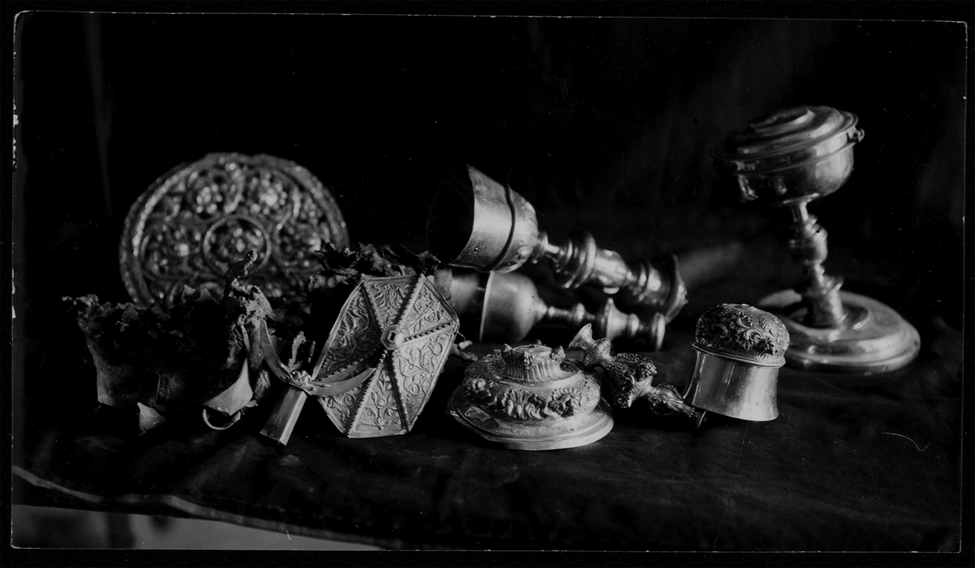
Such a strong sense of animation would seem to go beyond a simple notion of magical objects whose charm could be broken by the straightforward fact of treating them as blocks of wood. There is evidence of magical thinking on all sides, not least in the blinding of statues that could not see and the torture of images that could not feel. We do not know if any of the objects looted from churches were kept for use as talismans and good luck charms but it must be highly likely.Footnote 56 Similarly, claims that food tasted better if cooked over wood from images and church fittings may have been simple bravado, but may also have been – or been understood as – referring to some innate quality, or magic, that ‘holy’ wood possessed.Footnote 57 In other cases, of course, objects were taken for profit, with gold- and silverwork an obvious target. (See Figure 2.) In Barcelona, anarchists immediately took such objects in order to buy arms. Some were sold and melted down into ingots, others stored until they could be sold abroad, including on an individual initiative.Footnote 58 But even this, entirely secular, illegal export of artworks was depicted as ‘a simple flight into Egypt’ as virgins and saints crossed the border from Spain.Footnote 59
Broken chalices and eucharistic objects (Morón de la Frontera, Seville). (Reproduced with kind permission of Biblioteca Nacional de España.)
The veneration of images has been crucial historically in establishing Catholic identities, that is, a sense of who is Catholic and who is not.Footnote 60 Those who do not respect or venerate religious images are placed outside the Catholic fold, whether Jews, heretics, Protestants or anticlericals. But the same principle worked in reverse, as was shown by an order given by the local defence committee in Sabadell (Cataluña) on 8 September 1936 confiscating all personal religious objects. If any remained in private homes after a certain date, their owners would be seen as ‘seditious’.Footnote 61 Such orders were followed up by searches. Domestic space was to be denuded of devotional objects, and personal religious faith was to have no outward expression. Religious objects are here being taken emblematically, as a badge of identity, and some private devotional items had, of course, long been used in just this emblematic way. Door plaques, particularly to the Sacred Heart of Jesus, had long been encouraged as both a pious practice and – from the nineteenth-century ‘culture wars’ – a political identity.Footnote 62
Under conditions of war, these emblems were both reassuring and dangerous. Crucifixes, rosaries and religious pictures were common domestic items, part of the material culture of everyday Spanish life. One Jesuit priest interrogated in Valencia insisted his rosary was ‘a memento of my mother’ while, in Madrid, a woman refused the anarchist militias’ orders to take down a crucifix and picture of the Virgin, on the grounds that ‘as well as an emblem of our faith’ they were ‘a reminder of our parents’.Footnote 63 Many religious items were miniature, and commonly carried: crosses, scapulars and medals were all relatively easy to conceal, including by Republicans. A militiaman in Toledo showed the discalced Carmelites in hiding in the city ‘with some complacency the holy scapular and medals he wore hanging at his breast’. These may have been carried as charms but, presumably, he revealed them as a sign of his trustworthiness; certainly he did not betray the friars, though nor would he help them escape to Madrid.Footnote 64
Carrying religious objects in the first months of war was undoubtedly dangerous. Their emblematic nature meant they could reveal someone's true identity if discovered, which was a particular danger for priests in hiding. At least two Jesuits in Barcelona disappeared after being betrayed by their breviaries while, in Valencia, a Dominican found with a rosary in his pocket was driven off to be shot, the rosary around his neck.Footnote 65 Together with crucifixes, rosaries and prayer books were the items most commonly kept by priests and monks, with breviaries used to structure the day, say the daily office and follow the liturgical year.
Pensions sheltering priests in plain clothes, groups of nuns living clandestinely in flats and Catholic homes were subject to repeated searches. The Handmaids of the Sacred Heart had their rosaries and profession crosses taken – ostensibly to be melted down to make bullets – while the small image of the Virgin ‘which had heard our private prayers and dispensed so many graces in those distressing situations’ was thrown from the balcony to crash on the street.Footnote 66 Some people resisted or dissembled, but most hid or disguised the objects. On 12 October 1936, after hearing of a search, Concha Espina buried in the garden a silver rosary, religious pendants, her granddaughters’ medallitas, and two crucifixes, one of ivory and the other her late father's. A picture of the Virgin she had had since childhood was concealed behind a Velázquez reproduction.Footnote 67 These were the items they saved. Others were presumably left in place so as not to arouse suspicion.
The list gives a sense of the texture of domestic devotional life and its dependence on material objects. Less affluent households also risked saving at least some religious items. Two women in Cuatro Caminos (Madrid), for example, made frequent reference in their correspondence with the bishop to their small altar to Mary, Help of Christians, the rosaries they said every Saturday, and the miracles the image had worked during the war, when the altar must have been hidden.Footnote 68 It was not simply the preservation of these objects but the pious practices and devotional routines associated with them that were important. This was particularly true of the rosary, the domestic devotion par excellence: in Concha Espina's house it was said daily, before an improvised bedroom altar made with a prayer card.Footnote 69 Even in jail, where many priests and male religious were detained, along with numerous Catholic laypeople, all deprived of religious paraphernalia, they made rosaries from string, with knots or olive stones for the beads, as well as carving crosses, medals and crucifixes with knives, and making rings with threads from matting.Footnote 70
It is this personal quality – the emotional life of objects – that comes through most clearly when looking at these domestic items. People risked much to retain or replace them; they had a resonance which was not confined to religious virtuosi but which priests and religious clearly demonstrated. Many of those in hiding had taken small, personal, religious objects with them, usually rosaries, scapulars or crucifixes. These items carried considerable emotional weight: those detained or under threat of execution kept them close wherever they were and for as long as they could. Often, this meant until the moment of death. One Capuchin father, arrested in a boarding house in Madrid, slipped a crucifix into his sleeve while collecting his hat and later died holding it.Footnote 71 A Jesuit from Manresa (Barcelona) left with only his Vow Crucifix, kissing it before hiding it in his jacket pocket and fleeing across open country, through which he was tracked and killed.Footnote 72
Many bodies were found with – or identified by – religious possessions: a scapular, a small image of the Virgin, a crucifix, a medal, a prayer card.Footnote 73 Sometimes these were bloodstained. The crucifix taken from the pocket of one of the Talavera Hospitallers by a militiaman was thrown away, but retrieved by ‘a pious woman’ and returned to the community, where it was received as a relic.Footnote 74 Similarly, when the bodies of three old order Carmelite monks were exhumed in Hinojosa del Duque (Córdoba) in January 1940, the author of the community martyrology identified one of the bodies. ‘With my own hands’, he wrote, he took his ‘handkerchief, his rosary, a scapular and a crucifix that I wear round my neck with the same veneration with which St Pancras carried the blood of his martyred father’.Footnote 75
The relationship between people and objects thus continued to the moment of death and beyond. These were not, in themselves, ‘martyred’ objects. They had accompanied the ‘martyrs’, but not been attacked themselves. Rather, these small pious objects acted both as testimony – they had, after all, witnessed the events – and as conveyors of memory. On occasion, these relics were selected – even curated – by the martyrs themselves. One Dominican who managed to keep his rosary with him in jail in Valencia when ‘they took medals, rosaries, scapulars from everyone and broke them and shot them’ wrote of it as ‘a sacred memory. It has been in my hands in the most difficult moments; it has been my best friend. I have put it to my lips in very bitter times; it has slept next to me and been the language I have for the Virgin.’Footnote 76 He survived the war and gave the rosary to his mother, presumably as testimony not only to his suffering but also to his providential survival. The Barbastro Claretians were not so fortunate but they too managed to keep their breviaries while in prison, as well as the rosaries, and crucifixes they took with them to their deaths. One, Esteban Casadevall, who made his final profession in prison, was given the founder's crucifix to kiss on the eve of his execution, as he no longer had his own. They also left writings, including a farewell letter on a handkerchief and a chocolate wrapper they had inscribed with their names and phrases such as ‘Long Live Christ the King!’, ‘Grace and Glory to God’, ‘Long live the martyrs’, ‘Long live Catholic Barbastro’ and ‘Forgive my enemies’.Footnote 77
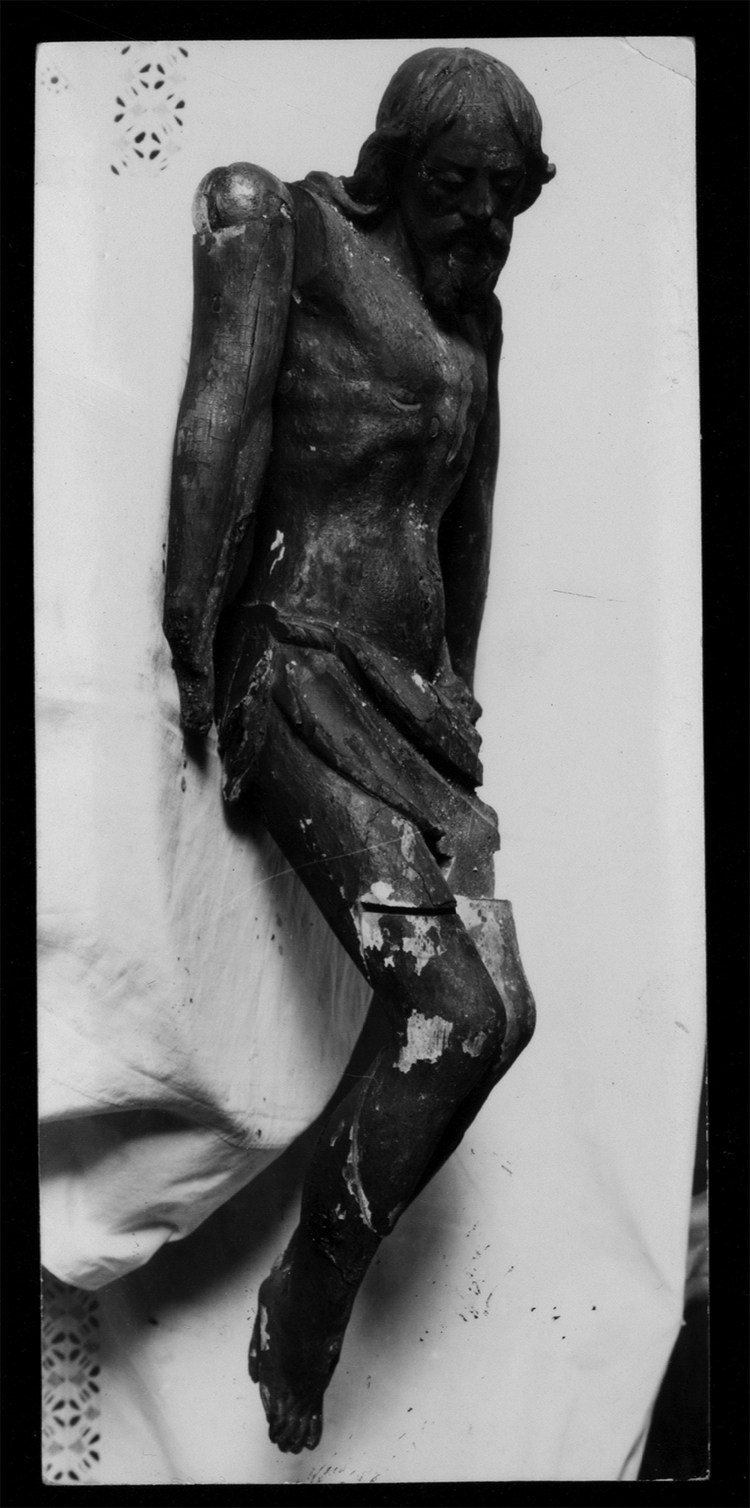
Objects thus became relics, vessels of memory of those killed. In Barbastro, as elsewhere, they are now displayed in a small museum dedicated to the ‘martyrs’, who are also now beatified by the Catholic Church.Footnote 78 However, objects also had the potential to create their own relics, by, for example, being snatched – or ‘rescued’ – from the flames. This was the case with the hand of Christ of Piera (Cataluña), and a smoke-blackened figure of Christ from a crucifix in Calera de Leon (see Figure 3).Footnote 79 More commonly, fragments and broken images were brought together as photographic assemblages. Headless, faceless or armless statues were grouped together; decapitated heads of statues were pictured in close-up, portrait-style or brought together in a series, the counterpart to the maimed and mutilated images seen in other photographs. In every case, the image of the debris accentuated that of the lost (whole) original.
Carbonised figure of Christ pulled from the ashes, parish church of Santiago Apóstol, Calera de Leon (Badajoz). (Reproduced with kind permission of Biblioteca Nacional de España.)

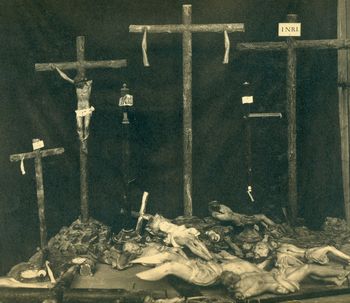
Many of these images are by anonymous photographers selling to the press or documenting the damage for those charged with assessing it. In either case, they come to us through the Francoist press and propaganda agency. But named photographers also worked in this field, notably Pelayo Mas Castañeda, who specialised in art history. His highly aestheticised prints presented assemblages of mutilated crucifixes, in various ways, with standing crosses as a Calvary, or fragments on the ground as at Golgotha. (See Figure 4.) There was thus a double mimesis: the very familiarity of the form of the broken image – particularly in the case of the crucifix – made it easy for the viewer to reconstruct it imaginatively. Whole and part, the original image and its damaged relic, came together in a new aesthetic of religious destruction. The beauty of the original image was preserved in the fragments that remained.
Pelayo Más Castañeda, Assemblage of Broken Crucifixes. (Reproduced with kind permission of Postulación para las Causas de los Mártires, Archdiocese of Toledo.)

Pelayo Mas Castañeda's photographs also echoed the theology of suffering that is fundamental to Christian thought. Man was made in the image of God; religious images were vehicles for a divine presence. Breaking an image was thus an assault on the divine. The broken images echoed Christ's broken body on the cross, the suffering of the images, his Passion. But, of course, scripture tells us that Christ's body was not broken. The Church's teaching on ‘wholeness’ prohibited the veneration of ‘mutilated’ images, with a few specific exceptions. The broken image must be restored or destroyed; they do not survive, although the major images were then replaced – including the Christ of Piera, which incorporates the original nails in the new crucifix. But, just as an infirm or disabled priest was unable to say Mass in public, broken images were not displayed. Some of the thousands of items retrieved after the Civil War were returned to their owners, others were stored, while those beyond repair were destroyed, including by burning.
So, even as ‘the rubble was cleared away after the fact to make place for new altars’, the memory of the breaking remained.Footnote 80 It survived in a remarkable body of photographic images that memorialised the breaking, aestheticising the broken icon and recuperating it from the defacing intent of the iconoclasts. This was done through familiar techniques of devotional representation. Decapitated, mutilated and eyeless images were photographed as single objects against a plain background. Indeed, eyeless images feature particularly heavily in the photographic record, particularly ‘blinded’ virgins.Footnote 81 The framing encouraged the watcher to engage directly with the image, to concentrate upon it as an encouragement to prayer, just as with a crucifix by Velázquez or Pacheco or an Ecce Homo by Gregorio Fernández.Footnote 82 In this way, the photograph transformed the image itself, creating a memory that would overlay the original ‘icon’ even as it confirmed its reliquary power.Footnote 83
These remnants, the ‘piles of debris’ left by the iconoclasm, were thus transformed into what de Boer refers to in the sixteenth-century Netherlands as ‘ruined beauty and things sacralized in the course of the storm’.Footnote 84 The broken objects are no longer sacred; they are revealed as material objects, just as the iconoclasts intended. They are no longer to be venerated; they are, still, expelled from churches. But the photographic record has allowed them to become totemic. The intimate relationship between people and objects – a shared martyrdom – established during the violence meant that they now represented an experience and not just an event. The power, the ‘charm’, of the object continued, even when that object no longer existed.