INTRODUCTION
Loss of autonomy/independence in everyday activities is a top concern among older adults (Prince & Butler, Reference Prince and Butler2007). Previous studies have shown loss of independence in instrumental activities of daily living (IADLs) is associated with reduced quality of life (Andersen et al., Reference Andersen, Wittrup-Jensen, Lolk, Andersen and Kragh-Sørensen2004). It is also associated with economic burden as it necessitates the need for assistance by family or formal paid caregivers (Small, McDonnell, Brooks, Papadoupoulos et al., Reference Small, McDonnell, Brooks and Papadoupoulos2002). Although loss of IADL independence is a key feature of a dementia syndrome, it is also now well recognized that subtle changes in everyday function begin early in a neurodegenerative process, including at the stage of mild cognitive impairment (MCI) (Albert et al., Reference Albert, DeKosky, Dickson, Dubois, Feldman, Fox and Snyder2011; Nygård, Reference Nygård2003; Tomaszewski Farias et al., Reference Tomaszewski Farias, Mungas, Reed, Harvey, Cahn-Weiner and DeCarli2006) and even in those still considered cognitively normal but who later develop MCI or dementia (Lau, Parikh, Harvey, Huang, & Tomaszewski Farias, Reference Lau, Parikh, Harvey, Huang and Tomaszewski Farias2016; Tomaszewski Farias et al., Reference Tomaszewski Farias, Chou, Harvey, Mungas, Reed, DeCarli and Beckett2013; Tomaszewski Farias, Mungas, Hinton, & Haan, Reference Tomaszewski Farias, Mungas, Hinton and Haan2011).
However, careful characterization of how functional decline develops in association with other clinical features, particularly cognitive decline, is still needed. Even among people who may never develop dementia, the dynamic interplay of functional and cognitive changes in older age has implications for disease management strategies in conditions such as depression (Kiosses & Alexopoulos, Reference Kiosses and Alexopoulos2005).
Several cross-sectional studies have shown that level of cognitive function is associated with everyday function (i.e., performance of IADL) as measured by self-report, informant-report, clinician-ratings, and performance-based tests (e.g., Aretouli & Brandt, Reference Aretouli and Brandt2010; Burdick et al., Reference Burdick, Rosenblatt, Samus, Steele, Baker, Harper and Rosenblatt2005; Burton, Strauss, Hultsch, & Hunter, Reference Burton, Strauss, Hultsch and Hunter2006; Jefferson, Paul, Ozonoff, & Cohen, Reference Jefferson, Paul, Ozonoff and Cohen2006; Mortimer, Ebbitt, Jun, & Finch, Reference Mortimer, Ebbitt, Jun and Finch1992; Willis, Reference Willis1996). Fewer studies have examined the relationship between cognition and everyday function using longitudinal designs; the results of these studies have shown mixed results. The results of several studies support the notion that cognitive decline may be detected on neuropsychological tests before decline in everyday function as measured by self-report, informant-report, or performance-based tests (e.g., Cahn-Weiner et al., Reference Cahn-Weiner, Tomaszewski Farias, Julian, Kramer, Reed, Mungas and Wetzel2007; Gross, Rebok, Unverzagt, Willis, & Brandt, Reference Gross, Rebok, Unverzagt, Willis and Brandt2011; see also Jack et al., Reference Jack, Knopman, Jagust, Shaw, Aisen, Weiner and Trojanowski2010). However, other studies have shown that mild decline in everyday functional abilities, as measured by clinician ratings, informant-report, or performance-based tests, predict subsequent cognitive decline (Fong et al., Reference Fong, Gleason, Wong, Habtemariam, Jones, Schmitt and Inouye2015; Lau et al., Reference Lau, Parikh, Harvey, Huang and Tomaszewski Farias2016; Pérès et al., Reference Pérès, Helmer, Amieva, Orgogozo, Rouch, Dartigues and Barberger-Gateau2008).
Previously, data from the Advanced Cognitive Training for Independent and Vital Elderly (ACTIVE) study have been used to investigate aspects of the complicated relationship between cognitive performance and IADLs. Specifically, Tucker-Drob (Reference Tucker-Drob2011) found no relation between change in cognition and change in self-reported IADLs using parallel process models that related 5-year trajectories of change in cognitive performance with 5-year trajectories of change in IADL functioning. Furthermore, Gross and colleagues (2011) examined whether baseline levels of cognitive function were associated with concurrent level and changes in everyday functioning in the ACTIVE cohort; memory accounted for the most variability in everyday functioning. That study, however, only examined cognition as a predictor of everyday tasks and did not evaluate bidirectional relationships between cognitive performance and everyday functioning, as we do in this study.
Our present study extends prior work by addressing whether initial levels of one process (i.e., cognition or IADL) are associated with subsequent changes in the other process using bivariate latent change score models. Specifically, the goal of the current study was to characterize the dynamic relationship between changes in cognitive performance and changes in self-reported IADL functioning. To do this, we studied a group of older adults who were cognitively normal at study baseline to examine the changing relationship over a 10-year period between IADLs and three cognitive domains: memory, inductive reasoning, and speed of processing.
Several models were tested in which each cognitive domain was evaluated separately. First, we tested a model in which there is no relationship between cognitive performance and IADLs. Next, as predicted by many disease models, we tested whether individual differences in cognitive performance are associated with subsequent changes in IADL functioning. Third, we examined an alternative model, the degree to which individual differences in IADL functioning precede and predict subsequent changes in cognitive function.
There are several reasons to expect support for this alternative model. For example, cognitively normal older adults may be capable of detecting subtle declines in everyday functioning such that their self-reports may be more sensitive to early disease than traditional cognitive tests. Finally, a fourth model tested whether a dynamic, bidirectional relationship best explains the association between IADLs and cognition such that individual differences in both influence each other’s within-person changes over time. We hypothesized that the results would support the fourth model and that the bidirectional relation between cognition and self-reported function would explain the evidence for both model 1 (cognition predicting subsequent change in IADL) and model 2 (IADL predicting subsequent change in cognition) in the extant literature.
METHODS
Participants
The ACTIVE study was a randomized, controlled trial of cognitive training for N=2802 adults aged 65 and older who were cognitively healthy at baseline. Participants were randomized to receive training in memory, reasoning, or speed of processing, or to a no-contact control group. Each training intervention included 10 one-hour sessions over a 6-week period. Participants underwent follow-up cognitive testing immediately after training and 1 (N=2564), 2 (N=2326), 3 (N=2234), 5 (N=2101), and 10 (N=1877) years after training. IADL functioning was not assessed at the immediate post-training visit, so we excluded that visit from latent change score analyses.
As the primary goal of the present study was to examine the dynamic coupling of cognitive and IADL functioning and not to examine training effects on these couplings, we also excluded the baseline study visit to minimize the need to account for practice effects in cognitive testing which are pronounced in this sample (Gross et al., Reference Gross, Inouye, Rebok, Brandt, Crane, Parisi and Brandeen-Roche2012). Participants were recruited from six metropolitan sites across the United States (University of Alabama at Birmingham, Johns Hopkins University, Wayne State University, Hebrew Rehabilitation Center for the Aged in Boston, Indiana University School of Medicine, and Pennsylvania State University). This research was completed in accordance with the Helsinki Declaration and approved by the Institutional Review Boards at each study site, including written informed consent.
Measures
We generated scores from tests in the ACTIVE neuropsychological battery representing memory, reasoning, and speed of processing from confirmatory factor analyses of each domain. The memory factor was constructed using immediate recall from the Hopkins Verbal Learning Test (Brandt, Reference Brandt1991), Auditory Verbal Learning Test (Rey, Reference Rey1964), and paragraph recall from the Rivermead Behavioral Memory Test (Wilson, Cockburn, & Baddeley, Reference Wilson, Cockburn and Baddeley1985). The reasoning factor was constructed from word series, letter series, and letter sets (Ekstrom, French, Harman, & Derman, Reference Ekstrom, French, Harman and Derman1976; Gonda & Schaie, Reference Gonda and Schaie1985; Thurstone & Thurstone, Reference Thurstone and Thurstone1949; Willis, Reference Willis1996). The speed of processing factor was composed of the second, third, and fourth trials of the Useful Field of View (UFOV) task (Owsley, Sloane, McGwin, & Ball, Reference Owsley, Sloane, McGwin and Ball2002). Factor scores were estimated using maximum likelihood estimation with robust standard errors using the regression method.
To evaluate model fit of measurement models for the cognitive factor scores, we could not use standard summary statistics (e.g., root mean square error of approximation, RMSEA, and comparative fit index, CFI) because they would be perfect as there were only three tests per domain. Thus, item-level fit was assessed using normalized residuals which characterize the difference, in standardized Z-score units, between model-estimated correlations and sample correlations for each pairwise correlation in a factor (Bollen, Reference Bollen1989). All residuals were smaller than 2.0, indicating excellent fit to the data (Supplementary Table 1).
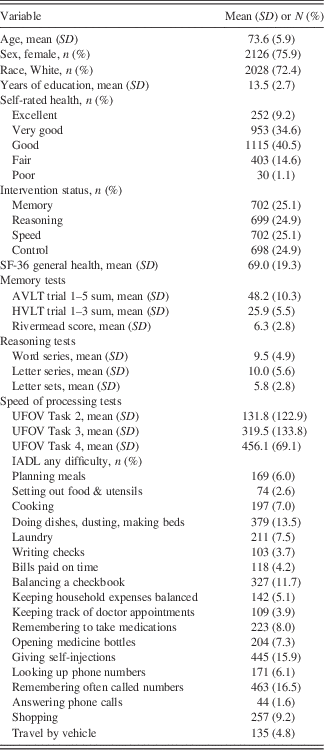
For self-reported IADL functioning, we derived a factor from 18 questions completed by participants assessing whether they were reporting difficulty with IADLs using the Minimum Dataset Home Care scale (see Table 1 for a list of IADLs assessed; MDS-HC; Morris et al., Reference Morris, Fries, Steel, Idegami, Bernabei, Carpenter and Topinkova1997). The validity and clinical utility of the MDS-HC has been previously established (Landi et al., Reference Landi, Tua, Onder, Carrara, Sgadari, Rinaldi and Bernabei2000; Morris, Jones, Fries, & Hirdes, Reference Morris, Jones, Fries and Hirdes2004). This instrument was best represented by a single factor (see Supplementary Table 2 for comparison of a unidimensional versus bifactor model, the latter represented by a “cognitive” and “physical” factor, in addition to a IADL general factor). Because of restriction in range across the various item response options, from the original Likert scale we collapsed each item into a dichotomous rating of “any difficulty” or “no difficulty”. The reference for each item is no difficulty. Higher scores indicate more IADL difficulty.
Sample characteristics of the ACTIVE sample (N=2802)

SD=standard deviation; AVLT=Auditory Verbal Learning Test; UFOV=Useful Field of View; IADL=Instrumental Activities of Daily Living.
This approach to scoring Minimum Data Set (MDS) IADL difficulty variable differs from that used in previous ACTIVE papers (e.g., Rebok et al., Reference Rebok, Ball, Guey, Jones, Kim, King and Willis2014; Willis et al., Reference Willis, Tennstedt, Marsiske, Ball, Elias, Koepke and Wright2006). We chose the factor score over the MDS indicator to assess a wider range of IADL difficulty. The correlation between these two variables is r=0.88 and in a sensitivity analysis using the MDS indicator, no inferences changed.
Analysis Plan
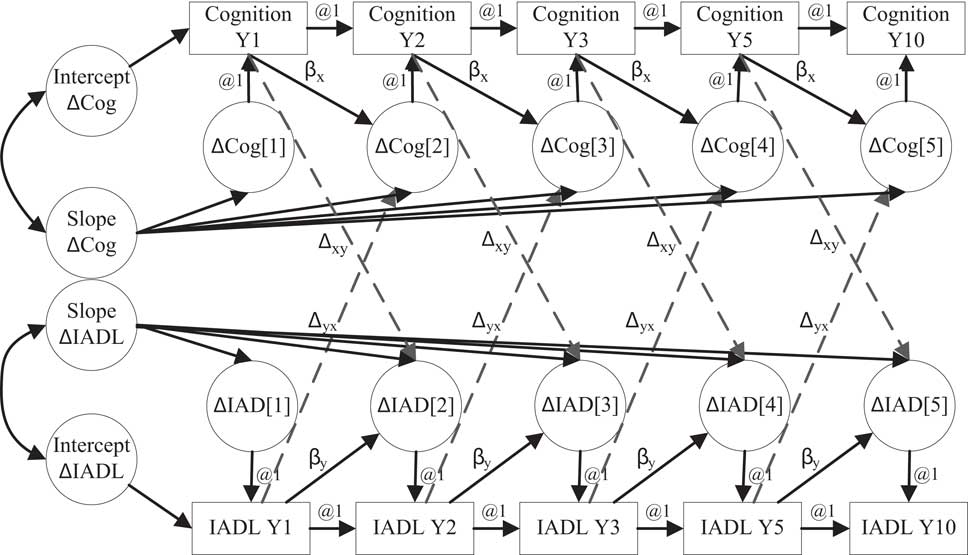
First, we derived factor scores for each of the three cognitive outcome and for IADL difficulty using confirmatory factor analysis. For each of the three cognitive outcomes of memory, reasoning, and speed, analyses followed a four-stage procedure. Figure 1 provides a generic structural equations model that describes the setup of a bivariate latent change score model. These analysis stages enabled us to test hypotheses for each cognitive outcome corresponding to (1) no relationship between cognitive performance and IADL functioning, (2) cognitive performance predicting changes in IADL functioning, (3) IADL functioning predicting changes in cognitive performance, and (4) a dynamic, bidirectional relationship between cognition and IADL function (e.g., individual differences in both cognition and IALDs influence each other’s within-person changes over time).
Latent change score model in which individual differences in IADL performance at time t predict subsequent change in cognitive performance between time t and t+1 (dotted arrows from IADL to change in cognition), and individual differences in cognition at time t predict subsequent change in IADL performance between time t and t+1 (dotted arrows from cognition to change in IADL). Models were estimated for memory, reasoning, and speed of processing. See the Analysis Plan section for the details of the model building procedure. The specific stage represented graphically here is shown in model stage 4 in Table 2 for each cognitive outcome.

First, to describe changes in each cognitive and IADL outcome, we fit bivariate latent change score models that had no couplings between cognitive performance and IADL functioning (Figure 1, ignoring dashed arrows). Second, we examined the relationship between individual differences in cognitive performance and subsequent changes in IADL functioning by allowing couplings between the two (Figure 1, ignoring dashed arrows from cognitive functioning to IADL difficulty change). Coupling parameters represent the time-dependent effect of one latent variable on subsequent change in the other, and were held equal between each time point in models (Gerstorf, Lovden, Rocke, Smith, & Lindenberger, Reference Gerstorf, Lovden, Rocke, Smith and Lindenberger2007). Third, we allowed couplings from IADL functioning to subsequent changes in cognitive performance (Figure 1, ignoring dashed arrows from IADL difficulty to cognitive change). Fourth, we allowed dual couplings between the processes (e.g., dashed arrows are present).
We tested the significance of progressively relaxing model constraints using likelihood ratio tests. We adjusted the final models for age (in years), sex, years of education, race (white, nonwhite), and self-rated health (Excellent, Very Good, Good, Fair, Poor). We report absolute fit of the models using RMSEA and CFI. Lower values of the RMSEA and higher values of the CFI indicate better fit; RMSEA<0.1 and CFI>0.9 generally are indicative of acceptable model fit (Hu & Bentler, Reference Hu and Bentler1999). For the best-fitting final models for each cognitive outcome, we report means of latent variables and magnitudes of couplings.
We used Mplus statistical software (version 7.11, Muthén & Muthén, version 7.11, Muthén & Muthén, Los Angeles CA, Reference Muthén and Muthén1998–2012). Models used a maximum likelihood estimator with the EM algorithm, which treats missing data in dependent variables as missing at random conditional on variables in the model.
Sensitivity Analyses
To test for intervention group differences in the dynamic relationship between cognitive performance and IADL functioning, we freed couplings to vary across intervention group in sub-analyses at the second, third, and fourth stages listed earlier in the analysis plan. In a second sensitivity analysis, we reran models using only data from the first, fifth, and tenth annual ACTIVE study visits to be sure inferences were unaffected by different periods of follow-up between study visits. In a third sensitivity analysis, we estimated a bivariate latent change score model for a general cognitive performance factor score from a confirmatory factor analysis of all the cognitive tests combined; no inferences changed with respect to IADL difficulty when we used this score (Supplementary Table 3).
RESULTS
Characteristics of the Sample
Demographic characteristics of the ACTIVE sample are in Table 1. On average participants at baseline were in their early 70s, approximately three quarters were female and white, and most participants had a high school or higher education. The sample varied in terms of general health status, but the majority of participants rated their health as at least “good.” By design, participants were selected to be cognitively normal as reflected by the mean Mini-Mental State Examination of 27.3 (Table 1). Consistent with normal cognition, they also reported few to no IADL difficulties at study baseline.
Relationship between Cognition and IADLs
The primary goal of the study was to better understand temporal associations between changes in cognition and change in IADLs (e.g., whether individual differences in cognition precede subsequent changes in IADLs, individual differences in IADLs precede subsequent changes in cognitive performance, or whether a bidirectional association between the two best explains their relationship). Because there are three primary cognitive measures (memory, reasoning and processing speed), three separate sets of models were used to examine the relationship between cognition and IADL difficulty.
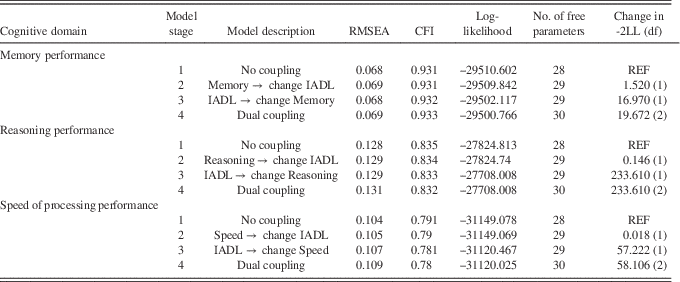
Table 2 provides model fit information (e.g., RMSEA, CFI) for tests of constraints in latent change score models for memory, reasoning, and speed of processing with IADL functioning. For each cognitive score, absolute model fit statistics (RMSEA, CFI) were excellent and largely comparable across stages of constraint testing. The log-likelihood (LL) statistics are interpreted alongside the number of free parameters in the next column. The column of change in -2 LL shows improvement in the log-likelihood statistic in χ2 units relative to model stage 1 (no coupling).
Model comparisons among alternative latent change score models of domain-specific cognitive performance and IADL functioning: Results from ACTIVE (N=2802)

RMSEA=root mean squared error of approximation; CFI=comparative fit index; df=degrees of freedom.
Memory
We first examined a model in which individual differences in memory predicted change in IADLs (Table 2, stage 2 under memory). This model did not fit the data substantially better than a model in which there was no relationship between these two variables (Table 2, stage 1 under memory) (χ2=1.52; df=1). That is, neither a lack of relationship between memory and IADLs, or change in memory preceding change in IADLs appeared to explain the relationship between these two constructs. We next examined a model in which individual differences in IADLs were predicting change in subsequent memory (Table 2, stage 3 under memory); this model fit the data better than the model representing no association between change in the two variables (χ2=16.97; df=1).
Finally, we examined a model in which change in IADLs and change in memory were allowed to be bidirectional (Table 2, stage 4 under memory); this model resulted in improved fit over the model with no couplings (χ2=19.67; df=2), but provided minimal gain relative to the model stage 3 that specified only associations between individual differences in IADLs and subsequent change in memory (χ2=19.672–16.97=2.70; df=1). Overall, these results suggest that preceding individual differences in IADLs appear to be driving subsequent memory change.
Reasoning
Next we examined a model where reasoning performance was a leading indicator of subsequent change in IADLs (Table 2, stage 2 under reasoning). Similar to memory, this model’s fit was not significantly different than a model in which the two variables were unrelated (χ2=0.15; df=1) (Table 2, stage 1 under reasoning). Neither no relationship, nor change in reasoning predicting subsequent change in IADLs explained the relationship between these two variables. We next examined a model in which IADLs were driving subsequent changes in reasoning (Table 2, stage 3 under reasoning); this model fit the data significantly better than the model representing no association between change in the two variables (χ2=233.61; df=1). The model with dynamic couplings between reasoning performance and IADLs fit better than model stage 1 (χ2=233.61; df=2), but was not statistically significantly better than model stage 3 (χ2=233.61–233.61=0.00; df=1). Thus, similar to memory, results suggest that IADLs are a leading indicator of subsequent changes in reasoning-based cognitive decline.
Speed of processing
When modeling individual differences in the speed of processing factor as a predictor of subsequent change in IADLs (Table 2, stage 2 under speed), there was no improvement in fit over a model representing no association between these two variables (Table 2, stage 1 under speed) (χ2=0.02; df=1). As was the case for memory and reasoning outcomes, the model in which individual differences in IADLs predicted subsequent change in speed of processing provided optimal fit to the data (χ2=57.22; df=1), and the dual coupling model (stage 4 under speed) was not statistically significantly superior to that model (χ2=58.10–57.22=0.88; df=1). Thus, results suggest that declines in IADL difficulty drive reduced performance in speed of processing.
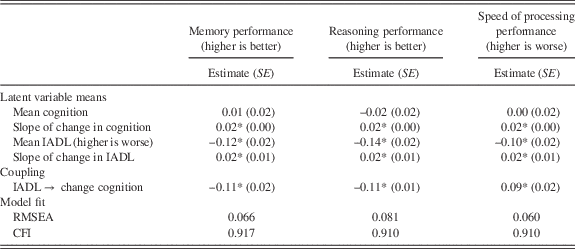
Table 3 shows latent variable means and couplings for each model adjusted for covariates. For each cognitive outcome and in each intervention condition, greater IADL difficulty was associated with a subsequently steeper rate of cognitive decline. The magnitude of the association was similar for each cognitive domain. The magnitude of these associations are on a standardized (mean 0, variance 1) scale and correspond to a small effect size (Cohen, Reference Cohen1988).
Parameter estimates from latent change score models with dynamic couplings between IADL functioning and cognitive performance: Results from ACTIVE (N=2,802)

Note. Each column is from a different bivariate latent change score model for each cognitive process. Parameters for latent variable means are in standardized N(0,1) units, per baseline standard deviation units. The row of parameter coefficients for couplings represent the annual rate of change in cognitive functioning at time t +1, in standardized N(0,1) units, per baseline standard deviation unit level of IADL difficulty at time t.
*p<.05, compared to 0 effect.
Sensitivity analysis
Models all fit significantly better when parameters for any modeling stage were allowed to vary by intervention group (Supplementary Table 4). Supplementary Tables 5 (for memory), 6 (for reasoning), and 7 (for speed of processing) show latent variable means and couplings (from IADL difficulty to subsequent change in cognition) from models with dynamic couplings between cognition and IADL difficulty, which were all allowed to vary by intervention group. The driver of intervention group differences was the post-training mean of the cognitive factor in the intervention group which trained that cognitive ability. That is, the mean cognitive score (representing post-training performance) was better in the intervention group that had been trained in that cognitive ability domain. For example, the mean memory score immediately post-training in the memory group was higher than the mean memory score in other groups. Dynamic couplings between cognition and IADL difficulty did not differ by intervention group.
In another sensitivity analysis, inferences were unchanged when we restricted analyses only to the first, fifth, and tenth study visits to balance the time between visits; see Supplementary Table 8.
DISCUSSION
The primary goal of this study was to examine the temporal relationship between cognitive performance (memory, reasoning, and speed of processing) and self-reported IADL functioning in healthy older adults. Results suggested that subtle, self-perceived difficulties in performing IADLs preceded and predicted subsequent declines on cognitive tests of memory, reasoning, and speed of processing. Initially, such findings may seem to run counter to most traditional models of symptom development associated with neurodegenerative diseases of aging in which cognitive deterioration, measured by conventional neuropsychological tests of these abilities, are expected to be evident before deterioration in everyday functioning.
Our results, however, are consistent with a growing body of research suggesting that older adults who are seemingly cognitively normal may be able to detect subtle changes in their everyday functional abilities (for example, taking longer to complete complex IADLs or being prone to making more errors) before changes are evident on objective tests of neuropsychological function (McAlister & Schmitter-Edgecombe, Reference McAlister and Schmitter-Edgecombe2016; Tomaszewski Farias et al., Reference Tomaszewski Farias, Chou, Harvey, Mungas, Reed, DeCarli and Beckett2013). Our results are consistent with other previous studies that have shown that when subjectively reported functional changes are present in individuals who still perform within the normal range on cognitive tests, it substantially increases the risk they will develop frank cognitive impairment (i.e., MCI) in subsequent years (Amariglio et al., Reference Amariglio, Mormino, Pietras, Marshall, Vannini, Johnson and Rentz2015). It is important to note that our sample included healthy older adults. Our findings may depend on intact insight and recall to detect and reliably report subtle functional changes and may not generalize to self-reports from older adults with cognitive impairment that limits insight or recall.
In the present study, the greater sensitivity of self-perceived early changes in functional abilities as compared to objective cognitive testing may occur because some everyday tasks are cognitively complex compared to traditional tests of memory, reasoning, or processing speed. Alternatively, it may be that healthy older adults perform everyday tasks under more challenging conditions (e.g., while multitasking, under time pressure, with environmental distractions or interruptions) than the conditions under which laboratory-based cognitive tests are administered (e.g., in a silent, distraction-free room). This critique of cognitive tests has been made rather convincingly in the neuropsychological literature for decades (Eslinger & Damasio, Reference Eslinger and Damasio1985; Shallice & Bugess, Reference Shallice and Burgess1991).
The cognitive measures used for this study were selected for the aims of the original ACTIVE study, which was designed to evaluate the effects of cognitive training on specific cognitive processes over time. The specific domains of processing speed, memory, and reasoning were selected because they were targeted by the interventions, they exhibit relatively early cognitive decline in older adults, they respond to cognitive intervention, and they are associated with IADL (Jobe et al., Reference Jobe, Smith, Ball, Tennstedt, Marsiske, Willis and Kleinman2001; Tennsted & Unverzagt, Reference Tennstedt and Unverzagt2013). Less structured cognitive measures of greater difficulty or complexity (e.g., dual task measures, tests of prospective memory) may have yielded different results and should be explored in future work.
Our study’s primary purpose was not to examine the effect of cognitive training on the association between cognition and everyday function; we had no reason to hypothesize training would modify this coupling, and thus we did not design our main analysis to test this question fully. Because, however, the data were available in ACTIVE, we conducted an extra analysis to ensure training did not affect this coupling. This analysis uncovered anticipated intervention group differences primarily on the post-training means for the cognitive test to which the participants were trained. For example, the group that received memory training showed a higher post-training memory cognitive test performance, compared to the non-memory trained groups. However, the relationships between self-reported IADLs changes and cognitive change were not affected by intervention assignment. This finding does not contrast with prior analyses from ACTIVE that have reported intervention group differences at 5- and 10-year follow-up visits because those analyses focused on intervention group differences in IADL difficulty (Rebok et al., Reference Rebok, Ball, Guey, Jones, Kim, King and Willis2014; Willis et al., Reference Willis, Tennstedt, Marsiske, Ball, Elias, Koepke and Wright2006).
Several distinct advantages of this study are the large, well-characterized ACTIVE sample with 10 years of longitudinal follow-up over six study visits. Contemporary modeling approaches used here enabled us to address the temporal ordering between changes in cognition and changes in IADLs. An important caveat of the study is the limited generalizability of the sample to high-functioning older adults who were rather homogenous in terms of education, sex, and ethnicity (although approximately 25% of the ACTIVE sample was African American); further research with other more diverse samples is needed to explore whether a similar temporal ordering of cognitive and IADL performance would be observed.
In particular, previous studies have suggested the relationship between cognitive and functional changes may differ by diagnostic status (e.g., normal cognitive aging versus MCI versus dementia) (Rog et al., Reference Rog, Quitania Park, Harvey, Huang, Mackin and Tomaszewski Farias2014) and depending on the method used to assess everyday function (e.g., self-report vs. performance-based methods; Schmitter-Edcombe, Parsey, & Cook, Reference Schmitter-Edgecombe, Parsey and Cook2011; Tucker-Drob, Reference Tucker-Drob2011). The differences across diagnostic status and methods may be due to the possibility that older adults tend to underestimate or overestimate their functional ability on self-report or that performance-based tests are not accurately capturing functional difficulties in the real world. Indeed, performance-based measures designed for individuals with dementia may not be sufficiently sensitive for healthy older adults or individuals with MCI, unless scoring procedures are modified to capture more subtle performance inefficiencies and corrected errors (Rycroft, Giovannetti, Divers, & Hulswit, Reference Rycroft, Giovannetti, Divers and Hulswit2017; Seligman, Giovannetti, Sestito, & Libon, Reference Seligman, Giovannetti, Sestito and Libon2014).
The cognitive measures included in this study targeted three specific cognitive processes, and the measure of memory was limited to performance on immediate free recall trials. As noted earlier, a wide range of other cognitive domains were not tested, which may have yielded different results. Additionally, there are many other potential causes of functional dependence unrelated to cognition. Thus, the causal mechanism between IADL functioning and cognitive changes is likely multifactorial and could be studied more carefully in other samples with diagnostic heterogeneity with respect to dementia.
The present findings have important implications for clinical practice and the development of intervention approaches. First, consistent with growing evidence from other studies, the present study suggests that older adults who perceive that their ability to perform high-level activities of daily living have diminished are an “at-risk” group. At the very least, they should be followed with serial neuropsychological testing over time to monitor for the development of cognitive impairment. Although there is now mounting evidence showing subtle functional changes in people with MCI, the issue of whether individuals with functional difficulties should be diagnosed with MCI versus dementia is far from settled (Morris, Reference Morris2012), particularly the cut-point at which too much functional difficulties meet diagnostic criteria for dementia.
Our results suggest that a clearer mapping of mild functional difficulties is needed across the continuum of healthy aging to dementia to improve diagnostic precision. In addition, findings suggest that older adults with subtle changes in self-reported functional capacities may be candidates for behavioral interventions to prevent decline. Furthermore, developing interventions that more explicitly target the maintenance of functional abilities (e.g., teaching compensatory strategies that help to promote continued independence) may prove to be an especially fruitful approach. In sum, there is mounting evidence that subjective cognitive and functional complaints constitute a risk for cognitive decline and eventual dementia, and the present study suggests that self-perceived diminished abilities to perform IADLs precede and predict subsequent cognitive decline. Such reports, when made by older adults without obvious cognitive impairment, should be taken seriously. They warrant additional subsequent monitoring and also offer a window of opportunity for the provision of support to bolster or maintain functional capacities.
ACKNOWLEDGMENTS
The ACTIVE intervention trials were supported by grants from the National Institute on Aging and the National Institute of Nursing Research to Hebrew Senior Life (U01NR04507), Indiana University School of Medicine (U01NR04508), Johns Hopkins University (U01AG14260), New England Research Institutes (U01AG14282), Pennsylvania State University (U01AG14263), the University of Alabama at Birmingham (U01AG14289), and the University of Florida (U01AG14276).ted by the Advanced Psychometrics Methods in Cognitive Aging Research (R13AG030995). Authors have no disclosures of conflict of interest.
Supplementary Material
To view supplementary material for this article, please visit https:/doi.org/10.1017/S1355617717000546