


Introduction
The influence of processes of freezing andthawing upon soils in terms of their permeability, consolidation, and other geotechnicalcharacteristics has been long established (Reference TaberTaber 1930, Reference Anderson and MorgensternAnderson and Morgenstern 1973, Reference Andersland and AndersonAndersland and Anderson 1978, Reference JessbergerJessberger 1979). Howeverour knowledge of these processes at the subglacialinterface and within subglacial materialsis deficient.
Recent studies have stressed the importanceof pore-water movement and the subglacialthermal regime in the hydrogeological processesthat lead to subglacial erosion and deposition(Reference Boulton, Price and SugdenBoulton 1972, Reference Clayton, Moran and CoatesClayton and Moran 1974, Reference Boulton, Wright and MoseleyBoulton 1975, Reference MenziesMenzies 1979[a]). The present authorbelieves that the influence of the migration offreezing fronts within subglacial material, whether in traction or lodged at the base of anice mass, must be considered further (Reference Mathews and MackayMathews and Mackay 1960).
Discussions on subglacial interface temperaturesindicate that the subglacial thermalregime can be expected to fluctuate across thefreezing point both temporally and spatiallyover wide areas of a glacier bed (Reference PatersonPaterson 1969, Reference HookeHooke 1977, Reference SugdenSugden 1977). It is thereforelikely that conditions do occur beneath icemasses such that freezing-front migrations willtake place within subglacial debris.
At present, data on subglacial debristemperatures appear to be limited. However, from computations of subglacial interface temperaturesand the likely heat balance within subglacialdebris some estimates of the probablerate of freezing-front propagation can be made.It should be borne in mind that these estimatesare tentative and must remain so until actualsubglacial debris temperatures become known.
From Table I it can be seen that with anassumed surface temperature of -1°C and alinear thermal gradient into a fully saturatedsoil, penetration rates of the freezing frontvary considerably depending on soil porosity, soil thermal conductivity, and the geothermalheat flux. Within Canada and on adopting valuesfor porosity of 0.30 to 0.65, for thermalconductivity 2.1 W m-1deg-1(Reference PennerPenner 1970)and for geothermal heat flux 42 mW m-2(Reference JudgeJudge 1973), penetration rates of 1 to 2 m a-1were calculated. It can therefore be suggestedthat such penetration values might have occurredwithin subglacial debris beneath the marginalareas of the Laurentide ice sheet. Markedvariations of these rates can be expected tooccur depending on the state of jointing andfracturing within the debris, the hydraulicconductivity, and the temperature of the percolatingmelt water as well as deviations fromthe simplified assumptions used to calculatethe penetration rate values.
Maximum depth and annual rate of penetration of the oocelsius isotherm into soils ofvariable porosity and thermal conductivity under changing geothermal heat flux rates*

Phenomena associated with the migration of freezing fronts
When a state is reached at which propagationof a freezing front occurs downwards into asaturated material, critical processes occur atthe interface between the frozen and unfrozenparts of the material. The result is that eithervolume expansion occurs, followed by heave, or itdoes not occur, and no segregation , ice forms.At the micro-level, the propagation of a freezingfront can be regarded as progressive pore-waterfreezing. The rate of advancement is, aswill be shown below, largely a function of pore-wateravailability, and debris porosity andpermeability. As pore water freezes at the frontseveral phenomena have been observed. Firstly, material which is saturated may freeze in situwith no pore-water migration. Secondly, porewater may, due to varying hydraulic potentialgradients, migrate toward the freezing front.Finally, it is thought that under saturatedconditions pore-water expulsion from the frontmay occur due to volumetric expansion as waterfreezes(Reference KhakimovKhakimov 1957, Reference McRoberts and MorgensternMcRoberts and Morgenstern 1975).
The above phenomenon of pore-water movement at the freezing interface can be analysed using Reference EverettEverett's (1961) approach involving the equilibriumbetween ice and water phases within thepores of the material. The pressure differenceacross the ice-water interface is given by

where
-
Pi is ice pressure,
-
Pw is pore-water pressure,
-
σiw is surface tension ice-water, and
-
ris equivalent pore radius of the soil.
Before discussing the conditions that arepredicted from Equation (1) it can be statedmore precisely that the differences between theice and pore-water pressures be represented as ∆p where ∆p = pi – pw
. If conditions occur on freezing where ∆p is less than  pore-water migration occurs toward the front thus creatinga pressure gradient with low pressure at the ice-water interface. If, however, ∆p >
 then pore-water expulsion away from the front takesplace (Reference McRoberts and MorgensternMcRoberts and Morgenstern 1975, Reference Arvidson and MorgensternArvidson and Morgenstern 1977).
It is normally accepted thatPi is equivalentto the overburden pressure or total stress, p. From Equation (1), therefore, it can bewritten that:
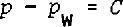
where c is a constant for a given soil and is equivalent to  Reference WilliamsWilliams (1968) has shown that c varies from a value of zero for coarsesands to values exceeding 0.2 Pa for clays.
Test data derived experimentally by several workers (Reference WilliamsWilliams 1968, Reference ArvidsonArvidson 1973, Reference Sutherland and GaskinSutherland and Gaskin 1973, Reference McRoberts and MorgensternMcRoberts and Morgenstern 1975)confirm that pore-water expulsion, as indicated above, does occur in both coarse- and fine-grained materials although inthe latter case a subsequent reversal of pore-water flow may sometimes occur. In the former, expulsion occurs under most conditions of stress sincecapproaches zero. In the latter, however, expulsion is observed only under conditions of higher total stress. Experimental values of higher stresses required to cause expulsion are in the range 80 to 200 kPa, well within the normal stress levels likely to occurat the base of a glacier, where normal stresses may exceed 30 MPa.
Beneath an ice mass conditions as describedin Equation (2) can be written as

Where
-
ρi is density of ice,
-
ρs is density of soil,
-
g is acceleration due to gravity,
-
hi is height of glacier ice, and
-
hs is depth of frozen soil.
Since in most instances ρsghs greatly exceeds ρighi Equation (3)becomes

From this generalized equation it can benoted that pore-water expulsion from the freezingfront will largely become a function of glaciericethickness provided that hsremains relatively small.
Other factors associated with pore-water migration
Experimental data derived by Reference PennerPenner (1970)and Reference McRoberts and MorgensternMcRoberts and Morgenstern (1975) indicate that the rate of freezing plays a major role in influencing pore-water pressures close to theice-water interface. It can be shown that:

where F is flux of water expelled and  is rate of freezing-front advance, and that

where n is porosity and Pw is density of water.
Using Darcy's law, Equation (5) becomes:

where k is hydraulic conductivity and i is hydraulic gradient.
From Equation (6) it can be noted that the other factors influencing rates of pore-water migration are changing permeability, variations inhydraulic gradient and length of flow paths. Infine-grained material, changes in effective pressure strongly control permeability whereas in coarse material such influences are minimal.
Beneath an ice mass it can be postulated that the rate of freezing-front advance will bea function of ice overburden pressures, subglacial debris permeability, and the thicknessof the subglacial debris stratum, as well as the associated thermal factors previously mentioned.
The influence of freezing fronts within subglacial debris
The following set of hypotheses are put forward to illustrate the influence that fluctuating freezing fronts might have on subglacial debris. It has been shown from recentstudies that pore-water conditions within subglacial debris allied with changes in the subglacial thermal regime lead to important boundary conditions on processes of erosion and deposition (Reference Boulton, Price and SugdenBoulton 1972, Reference Clayton, Moran and CoatesClayton and Moran 1974, Reference Boulton, Wright and MoseleyBoulton 1975, Reference AndrewsAndrews 1980).
The areas within the subglacial zone where such conditions of descending freezing fronts and deformable beds (Fig. la) are likely to occur arein the “hinge” zones near the ice margin where wet-based ice gives way to a cold-based set of region (Reference Clayton, Moran and CoatesClayton and Moran 1974, Reference MenziesMenzies 1979[a]) or in sub-marginal areas where a“polythermal” set of conditions may exist at the bed as described by Reference Goodman, King, Millar and RobinGoodman and others (1979)from work at the base of Glacier d'Argentière.In these sub-marginal zones, variations in basal and surface velocity, ice thickness, bed roughness, sediment characteristics, and atmospheric temperatures can be expected to cause oscillations of the freezing isotherm across the ice-glacier bed interface.
The influence of descending freezing fronts within subglacial debris: (A) hypothetical pre-conditions to freezing. (B) pore-water migration toward front into permeable debris.(e) pore-water expulsion into permeable debris. (D) pore-water migration into impermeable debris near freezing front and (E) pore-water expulsion into impermeable debris leading to elevated pore-water pressures within unfrozen debris zone.

The following hypothetical models summarize some of the effects descending freezing fronts may have upon subglacial debris, andon subsequent subglacial debris, and on subsequent subglacial process responses.
Case I. Pore-water movement toward freezing front: permeable substrate
In Case I, under conditions where ∆p isless than C, pore water will move toward anadvancing freezing front especially if the sub-front debris is permeable (Fig. lb). Analternative response, not considered here, mightoccur due to the segregation at the glacier ice-bed interface resulting in the glacier being “lifted” above the debris. In this latter instance the zone of maximum shear strain wouldnot descend into the debris, as is envisaged in Figure lb.
If this latter state does not occur thenthe displacement of the zone of maximum shearing will occur down into the debris from the interface, resulting in increased debris erosion by freeze-on processes. With loss of pore water tothe freezing front increased shearing resistance can be expected to occur within the sub-front debris leading to increased consolidation. The sediment and landform, on deglaciation, will be lodgement till, possibly fluted and moulded.
Case II. Pore-water expulsion from freezingfront: permeable substrate
Under certain conditions it has been shown, as previously noted, that when∆pexceedsC there is a tendency for pore water to be expelled from the freezing front (Fig. 1c).If the permeability of the sub-front debris is sufficiently large such that pore-water expulsion is of a high volume, the rate of advance of the freezing front may be considerably reduced. As in Case I a series of zones of maximum shearing will develop descending into the debris as the front progresses. Consequently re-erosion and reincorporation of debris up into the glacier icewill occur. Permeable material beneath this expulsion zone may exhibit the effects of pore-water throughflow by either being low in claycontent or having coatings or cutans of silt and clay. It may also be speculated that narrow, roughly horizontal, lenses or bands of higher strength material may occur due to pore-water expulsion from them as they lie immediately infront of the freezing line. A rough horizontal banding has been reported in several basal till sand may be indicative, in part, of this process(Reference MenziesMenzies 1979 [b]:320).
Case III. Pore-water movement toward freezing front: impermeable substrate
Similar conditions are developed as in Case I except that the debris is relatively impermeable to pore-water migration toward the freezing front(Fig. 1d).This state couldlead to a much slower propagation of the freezing front, since effective pore-water attraction to the front would be restricted. Zones ofmaximum shearing would tend to persist forlonger periods in anyone location resulting inmore efficient re-erosion of debris.
Case IV. Pore-water expulsion from freezing front: impermeable substrate
In this case it is envisaged that pore-waterexpulsion will occur from the freezingfront into a lower stratum of impermeablematerial resulting in elevated pore pressuresdeveloping at some depth beneath the front(Fig. le). As previously noted, with pore-water expulsion the propagation of the freezing front will be slowed. The elevated pore-water pressures may, in certain conditions, lead toeither the development of low internal shear strengths or virtual liquefaction of the substrate material. The effect of these pore-water pressures may be two-fold. Firstly, penecon temporaneous deformation of the debris is liable to occur with water-escape structures being developed, such as dish-like folds.Secondly, the influence of the pore-water pressures may lead to a form of hydrodynamic instability with frictional values in the areaof high pore-water approaching zero. This statemay then develop into' a “surge-type” condition in which velocities of internally deforming material beneath the ice rapidly increase(Reference Clarke and JarvisClarke and Jarvis 1976, Reference JonesJones 1979).So that this surge condition may occur, a tightly sealed system must exist around the area of potentialin stability in order to decrease considerably the possibility of pore-water escape. Debris beneath this deforming zone may become fluted and surficially moulded by the moving debris above it.Evidence is now accumulating, both in North America and Europe, that indicates that lobes of the Quaternary ice sheets may have surged in their outer marginal areas.
Conclusion
Freezing-front migration may have an appreciable influence upon processes active atthe basal ice-bed interface and on resultant sediments and landforms.
The hypotheses described simplify greatly the possible combinations of sediment type, sediment permeabilities, thermal conductivities, and stress distributions that may exist beneath an ice mass. This simplification illustrates conditions which might arise subglacially with freezing-front propagation into subglacial material, and suggests the processes and responses likely tooccur. The likelihood of such freezing processes occurring within Quaternary subglacial sediments appears, on theoretical grounds, to be highlyprobable; therefore, the hypotheses should betested in the field before further consideration is given to the implications of this work.
Acknowledgements
I am grateful to several individuals for discussion and correspondence on some of the issues raised in this paper, in particular to Jan Terasmae who critically read an earlier draft and to the two unknown referees whose helpful comments and suggestions were well received. I also thank L. Gasparotto and the typing staffof Brock University.



