Introduction
As the number of older people continues to increase, concerns about the future costs of caring for people with dementia have been voiced repeatedly. Ferri et al. (Reference Ferri2005) estimated that globally there were 24.3 million people with dementia in 2001, which would rise to 81.1 million by 2040. Wimo et al. (Reference Wimo, Jonsson and Winblad2006) estimated the total number of people with dementia worldwide in 2003 to be 27.7 million and the direct costs of caring to be US$156 billion. In the U.K., a report commissioned by the Alzheimer's Society estimated that in 2006/7 there were around 560,000 people with dementia in England, and projected that the number of people aged over 65 with dementia would grow by 80% by 2051 (Knapp et al., Reference Knapp2007). The report also estimated the total costs of dementia to be £17.03 billion (2005/6 prices), a large part of which would be accounted for by supported accommodation costs and informal care.
Making projections of the future costs of caring for the growing numbers of people with dementia inevitably involves much uncertainty. Such projections are based on estimates of the current numbers of people with dementia, their use of care services and associated costs, combined with assumptions about future trends. The accuracy of projections is also dependent on estimates of current costs, which in turn are dependent on the availability and quality of data and on the methods used. Uncertainty around the assumptions made about the future is intrinsically inevitable, but projections are still useful as a means of understanding how different factors could potentially affect future costs.
Previous research has shown that future long-term care expenditure is very sensitive to changes in assumptions about the future prevalence of dementia, future patterns of care and the evolution of the unit costs of care (Comas-Herrera et al., Reference Comas-Herrera, Wittenberg, Pickard and Knapp2007). McNamee et al. (Reference McNamee, Bond and Buck2001) and Comas-Herrera et al. (Reference Comas-Herrera, Wittenberg, Pickard and Knapp2007) have shown that reductions in the prevalence of dementia would have a substantial impact on future expenditure projections, and in particular that relatively small reductions in the prevalence rates of moderate to severe dementia would have a substantial impact in reducing projected future expenditure.
Most projections of the future numbers of people with dementia assume constant age-specific incidence or prevalence rates of dementia as a starting point. However, there have now been a number of studies that have investigated the potential hypothetical impact that preventive strategies or disease-slowing treatments could have on the future numbers of people with dementia (Brookmeyer et al., Reference Brookmeyer, Gray and Kawas1998; Sloane et al., Reference Sloane2002; Jorm et al., Reference Jorm, Dear and Burgess2005; Jagger et al., Reference Jagger2009).
Current patterns of care for people with dementia are also likely to change. In England, for example, the Government is implementing a new “Dementia Strategy” that can potentially change the availability and quality of services to people with dementia and their families (Department of Health, 2009a; Banerjee and Wittenberg, Reference Banerjee and Wittenberg2009) and major changes to the whole long-term care system are currently under discussion (Department of Health, 2009b).
The purpose of this study was twofold: first, to ascertain the views of a group of experts on future incidence and prevalence rates of dementia and patterns of care for dementia; and second, to investigate how incorporating scenarios about the future based on their views would affect projections of future expenditure on long-term care for older people with dementia. It was not the aim to make firm forecasts of future expenditure, which would not be realistic since there is inevitable uncertainty about future trends in the drivers of demand for care. The aim was to make projections on specified assumptions and test their sensitivity to different assumptions based on expert views.
Methods
A Delphi-style approach was used to gather expert views on future trends in prevalence of dementia, patterns of care and the pay of care staff. Projections were carried out using a macro-simulation model of future demand for long-term care by older people with dementia in England, and associated expenditure based on the most recent prevalence estimates for the U.K.
The Delphi panel
The Delphi technique was developed in the 1950s by the RAND Corporation to synthesize expert opinion, mainly on the emergence of new technologies (Dalkey, Reference Dalkey1967). It is often used as a method of formal consensus development in the area of health care (see Murphy et al., Reference Murphy1998 for an extensive discussion). The technique is characterized by three main features: anonymous response, iteration and controlled feedback, and statistical group response (Dalkey, Reference Dalkey1967). Respondents are sometimes asked to indicate their degree of confidence in their answers, which is then used to weight the responses.
Prior to starting the Delphi for this study, interviews were conducted with seven experts in dementia care and Alzheimer's disease (AD). The interviewees were asked about the major changes that they thought might take place in the field of dementia over the next fifty years. These interviews were transcribed and key phrases or topics were extracted to form the initial Delphi questionnaire. The experts were then asked to suggest colleagues who would be suitable participants for the Delphi process.
Fifty experts in AD and other dementias were invited to participate in the Delphi. Those who declined to do so were asked to nominate a colleague to take their place. A panel of 26 U.K.-based experts was assembled, all of whom completed consent forms and agreed to participate in the entire Delphi process.
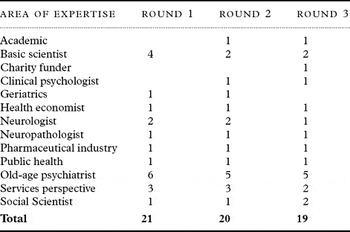
In the questionnaire the panelists were asked about their area of expertise. The options were: old-age psychiatrist, neurologist, basic scientist, services perspective, historical perspective and other (in which case they were asked to specify their expertise area). Table 1 shows the responses for the three Delphi rounds. Interestingly, a number of panelists changed the way in which they described themselves in the different rounds.
Areas of expertise of the Delphi panelists in each of the three rounds

Because anonymity was an important feature of the process, participants were asked not to discuss the questionnaire with colleagues until after the final round.
The Delphi process was conducted in three rounds. The first round involved a questionnaire containing ten statements. These statements had emerged from initial interviews and were divided into the following categories: four statements about the duration and severity of the disease; four statements about risk factors and incidence; and two statements about care arrangements. Participants were asked to choose, from a selection of estimates of the consequences of each statement, the one that they thought was the most likely to occur. Alternatively, they could put forward their own estimates. Furthermore, in order to measure how confident they were about their answers (as suggested by Dalkey, Reference Dalkey1967) they were asked to suggest how likely they thought it was that their chosen estimate would occur by 2050 (using three options: 0–33%; 34–66% or 67–100%). At the end of the first round panelists were asked which statements or scenarios they would like to retain, take out or modify in the questionnaire, and to add any statements that they felt should be considered in subsequent rounds.
The results from the 21 respondents of the first round were collated and analyzed in order to produce the second-round version of the questionnaire. The responses were cross-tabulated with likelihood selections. The options selected by one or fewer of the panelists were eliminated from the second round. (The literature does not specify the best method for trimming the outliers. Armon et al. (Reference Armon2001) suggest that 17% of the outliers either side of the median should be removed, but this seems rather arbitrary.) The scenario that had achieved 91% consensus was removed from the second round. This is slightly stricter than the 83% suggested by Armon et al. (Reference Armon2001), but lower than the 95% proposed by Stewart (Reference Stewart1999). Various other changes were then made to the questionnaire in view of the suggestions of panelists in the first round.
For the second round the questionnaire was redesigned by combining in a single table the responses to the statements and the likelihood that such response might occur. Panelists were presented with the revised questionnaire and asked to reconsider their selections in light of responses from the previous round. The options for which there was little consensus were shaded to indicate that those options were no longer available as possible answers.
Twenty completed second-round questionnaires were received from the 26 participants. The results for the second round were analyzed at group level and any options selected by one or fewer of the panelists (6%) were removed. This meant that the range of available cells narrowed significantly. The modified questionnaire was redistributed to participants in the third and final round of the Delphi process. Participants were again asked to consider their responses in light of answers from the previous rounds. In the third round we received 19 completed questionnaires.
Projections of long-term care expenditure for people with dementia
Future long-term care expenditure for older people with dementia was projected using an updated version of the Personal Social Services Research Unit Cognitive Impairment (PSSRU CI) model originally developed for the Alzheimer's Research Trust (Comas-Herrera et al., Reference Comas-Herrera, Wittenberg, Pickard and Knapp2007). This is a macrosimulation (or cell-based) computer model based on the long-term care projections model constructed by the PSSRU as part of a project on long-term care finance funded by the Department of Health (Wittenberg et al. Reference Wittenberg, Pickard, Comas-Herrera, Davies and Darton1998; Reference Wittenberg, Comas-Herrera, King, Malley, Pickard and Darton2006). The MRC CFAS survey was used to provide data on the characteristics and propensity to receive services by people with dementia (MRC CFAS, 1998; Melzer et al., Reference Melzer, McWilliams, Brayne, Johnson and Bond1999; McNamee et al., Reference McNamee, Gregson, Buck, Bamford, Bond and Wright1999). The model uses cognitive impairment as a measure of dementia.
The PSSRU CI model aims to make projections for England to 2031 of three key variables: the expected number of older people with dementia, their likely level of demand for long-term care services and the costs associated with meeting this demand. The projections are based on a set of base case assumptions (summarized in Box 1) about some of the key factors that will impact on future long-term care expenditure. This base case should be treated as a starting point for examination of the impact of varying the assumptions used in the model, not a forecast of the future.
Box 1: Main base case assumptions
• The older population changes in line with the 2004-based principal population projection of the Government Actuary's Department (GAD).
• Age/gender-specific prevalence rates of cognitive impairment and of functional disability remain unchanged from those in the Dementia UK report.
• Marital status rates change in line with GAD's 2003-based marital status and cohabitation projections.
• There is a constant ratio of single persons living alone to single people living with others.
• The proportion of older people receiving informal care, formal community care services and residential and nursing home care remains constant for each sub-group by age, disability, household composition and other needs-related circumstances.
• Health and social care unit costs rise by 2% per year in real terms. Real Gross Domestic Product rises in line with HM Treasury assumptions.
The model consists of three main parts. The first part divides the projected older population into sub-groups. The sub-groups were age, gender, cognitive impairment and/or functional disability, household composition and housing tenure. The second part focuses on the receipt of long-term care services, by attaching a probability of receiving services to each of the sub-groups. The last part of the model is concerned with expenditures on services. The model only covers the costs of formal long-term care services. It does not cover medication, acute health care services or the costs of informal care.
The projections presented here use the latest available estimates of the prevalence of dementia for the U.K. from the Dementia UK report (Knapp et al., Reference Knapp2007). All other data sources remain as used in Comas-Herrera et al. (Reference Comas-Herrera, Wittenberg, Pickard and Knapp2007).
Results
Delphi process outcomes
On the whole, the panel was moderately optimistic about future trends in the prevalence of dementia, and expected changes in care settings and the qualifications of carers. The outcomes of the Delphi process are summarized in Tables 2–5.
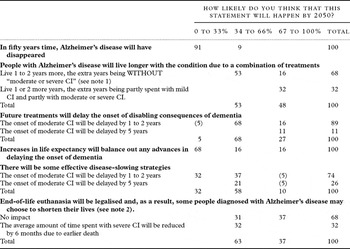
Statements about the impact of future treatments and the possibility of euthanasia: percentage of panel members that chose each statement at the final round

Note 1: The model uses, as a definition of “moderate cognitive impairment”, scoring 3 or more in AGECAT, but no problems with activities of daily living (ADL). This sentence implies that the extra years would be with mild cognitive impairment.
Note 2: Consent in the case of people with severe AD would be given through “living wills” or a special form of “power of attorney” (this clarification was added after the first round as suggested by panel members). The question did not specify whether “no impact” means that such legislation is unlikely to be passed or whether if it were passed it would not result in any changes.
CI = cognitive impairment; AD = Alzheimer's disease
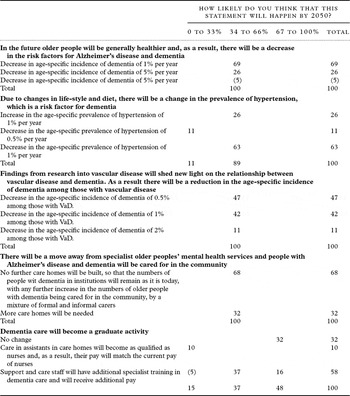
Statements about risk factors and underlying causes of dementia and care arrangements: percentage of panel members that chose each statement at the final round

VaD = vascular dementia
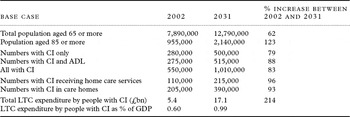
Projections of the future numbers of people with cognitive impairment, their future demand for services and associated expenditure. England, 2002–2031, under base case projections

CI = cognitive impairment; ADL = activities of daily living; LTC = long-term care; GDP = gross domestic product
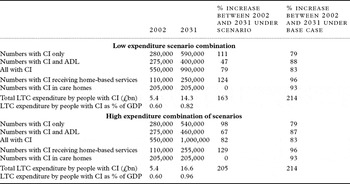
Projections of the future numbers of people with cognitive impairment, their future demand for services and associated expenditure: England, 2002–2031, under a “lower and higher expenditure” combination of scenarios based on the Delphi panel's views

Source: PSSRU CI model estimates, 2002 base.
CI = cognitive impairment; ADL = activities of daily living; LTC = long-term care; GDP = gross domestic product
In the first round, the panel reached consensus that it was not very likely (only 0–33% likely) that in the next fifty years AD would have disappeared. The impact of future treatments was expected to be fairly moderate. Two-thirds of the panel believed (with a probability between 34 and 66%) that as a result of future treatments people with AD would live longer with the disease, but the extra years of life would be spent without moderate or severe cognitive impairment (CI). A third of the panel believed (with high confidence, probability between 67 and 100%) that the extra years of life would be spent partly with mild CI and partly with moderate or severe CI.
The majority of the panel (with different levels of confidence) thought that future treatments may delay the onset of the disabling consequences of dementia by one to two years. Three-quarters of the panel also believed (with different levels of certainty) that there could be some effective disease-slowing strategies which may delay the onset of moderate CI by one to two years. A quarter of the panelists put the timescale delay at five years.
Two-thirds of the panel felt that (hypothetical) legalization of end-of-life euthanasia was not likely to have an impact on the average amount of time spent with AD. A third of the panel thought it would have a small impact (an average of six months).
Most panel members believed that, as a result of an improvement in risk factors, there could be a small decline in the incidence of dementia. Most also expected a decline in the prevalence of hypertension. All panel members agreed that there was likely to be a decline in the age-specific incidence of dementia among those with vascular disease. The majority of the panel believed that this decline would be between 0.5 and 1% of the age-specific incidence rate.
Two-thirds of the panelists thought that no further care homes would be built, so that the number of people with dementia in care homes will remain as it is today. Any further increase in the numbers of older people with dementia would be supported in the community by a combination of formal and informal care. However, a third of the panelists believed that more care homes would be needed.
Finally, about two-thirds of the panelists thought that support and care staff will have specialist training in dementia care and, as a result, will receive additional pay. A third of the panelists thought that there would be no change in the qualifications and pay of staff engaged in dementia care.
Overall, the majority of the panel agreed on scenarios that implied a small reduction in the prevalence of dementia in the next fifty years, a freeze in the numbers of older people in care homes at the current levels (the full statement was as follows: “a freeze in the number of beds in care homes to today's level, with the people who would have gone to a care home had there been no restriction in the number of beds being cared for in the community, by a mixture of formal and informal carers”) and an increase in the qualifications and pay of care assistants who look after older people with cognitive impairment. We had to make some more specific assumptions about the suggestions of the panel in order to be able to translate them into scenarios for the macro-simulation model. As a result, two different versions of the scenarios that aim to represent the main views of the panel were modeled, one resulting in a higher level of expenditure than the other. The aim was to illustrate the sensitivity of the model to our interpretation of the panel's views by showing an upper and a lower boundary.
Projected future expenditure on long-term care for people with dementia
The model projects that, between 2002 and 2031, under the base case assumptions, the number of people with dementia in England will rise from 550,000 to 1,010,000 – an increase of 83%. Of this total, 515,000 would also have functional disability (measured in terms of ability to perform activities of daily living). The model also projects that between 2002 and 2031 the numbers of hours of home care arranged by local authorities for older people with dementia would need to rise by 96% to keep pace with demographic pressures. The numbers of people with dementia in care homes would rise by 93%, from an estimate of 205,000 in 2002 to 390,000 in 2031.
Expenditure on long-term care services for older people with dementia in England (in 2002/3 prices; i.e. with expected real increases but not nominal changes in care costs) is projected to rise, under base case assumptions, from around £5.4 billion in 2002 to around £17.1 billion in 2031, in constant 2002 prices. This would amount to a rise from 0.60% of gross domestic product (GDP; used as an indication of an economy's capacity to meet expenditure) in 2002 to 0.99% of GDP in 2031. Table 4 summarizes these projections.
As discussed, two scenarios were used to incorporate the Delphi panel's views as assumptions in the model. Table 5 shows the impact of incorporating the views of the Delphi panelists, in the form of the lower and higher expenditure scenarios. The low expenditure scenario differs from the base case presented above in the following assumptions:
a) There will be a reduction in the prevalence of combined cognitive impairment and physical disability (as a proxy for moderate to severe cognitive impairment), as suggested by the panel in various statements. This assumption has been modeled by moving the age-specific prevalence rate upward by one year for each one-year increase in life expectancy. Of those who would no longer have combined cognitive impairment and physical disability, 80% have been allocated to the cognitive impairment-only group and 20% to the functionally disabled-only group. This takes into account that 20% of those with combined impairment in the sample had only mild cognitive impairment (based on a classification of severity according to the Mini-mental State Examination scores, see Comas-Herrera et al., Reference Comas-Herrera, Wittenberg, Pickard and Knapp2003) and that their combination of cognitive and functional impairment could be due to a coincidence of mild cognitive impairment and physical disability.
b) The number of beds in care homes will not increase between 2002 and 2031. Those who would have gone to a care home had there been no restriction on the number of beds were allocated, for their formal care, the number of hours of home care received on average by people with high levels of disability, according to the General Household Survey (11.6 hours per week). We assumed that the remaining hours of care needed are provided by informal carers, where the older person has a potential carer, and that all the places available in care homes are taken by people with combined cognitive impairment and functional disability.
c) Care assistants’ pay was assumed to rise by a one-off increase of 10% over and above projected increases in average earnings (these magnitudes have been chosen because, in the case of people working in care homes, their average wages would increase while still keeping them below the average wages paid to nurses. The increase has been calculated separately for those working in care homes and for home care workers. According to Laing (Reference Laing2004), the hourly staff costs for care assistants working in care homes in 2003/4 represented, on average, 30% of the total costs. For home care services, information in Curtis et al. (Reference Curtis and Netten2004) suggests that 71% of home care costs are attributable to salary costs).
The low expenditure combination of scenarios has the effect of lowering projected long-term care expenditure for people with dementia to £14.3 billion in the year 2031, compared to £17.1 billion under the base case assumptions. The main driver of this change is the decrease in age-specific prevalence rates of dementia, which in turn has the effect of decreasing the number of users of services. The expenditure effects of assumptions made about reduced institutionalization and increased care assistants’ wages nearly cancel each other out.
The high expenditure combination of scenarios assumes that the decrease in prevalence is smaller, by moving the age-specific prevalence upward by half a year for each year gained in life expectancy. It gives a more intensive average package of care at home to those who would have otherwise been in an institution (16 hours of home care and 3 of nursing care per week), and there is a one-off 20% increase in the pay of care assistants.
Under this higher expenditure scenario, long-term care expenditure for older people with dementia in 2031 would be £16.6 billion, which is still lower than the £17.1 billion projected under base case assumptions. Both of the scenarios, based on the views of the Delphi panelists, would result in lower long-term care expenditure than under the model's original assumptions, which include unchanged age and gender-specific prevalence rates of mild and moderate to severe CI, and unchanged patterns of care.
Discussion
This study sought the views of experts in the field of dementia about future trends in the incidence and prevalence of dementia and patterns of care for people with dementia. A Delphi approach was used to invite their views on a series of alternative statements. Statements agreed by the experts were used as the basis for two scenarios. Their implications for projected expenditure on long-term care were explored using a macro-simulation model that made projections of future long-term care expenditure for older people with dementia.
The Delphi panelists were moderately optimistic about the impact that scientific advances and changes in risk factors would have on the future incidence of dementia, the time people spend with cognitive impairment, and the progression of the underlying disease. Their views pointed towards a small reduction in the prevalence of dementia over the next fifty years, which would potentially result in the costs of long-term care for people with dementia growing more slowly than under a base case that assumes no changes in prevalence. The panel also suggested that there may be a freeze in the numbers of older people in care homes (the impact of this scenario in terms of costs depends largely on how intensive are the formal care packages used by people with severe dementia living in their own homes), and an increase in the qualifications and pay of care assistants who look after older people with dementia (which would result in higher expenditure than projected otherwise). Projections of future expenditure on long-term care that include assumptions that seek to capture the views of the Delphi panel suggest that future expenditure on long-term care for people with dementia will rise from 0.6% of GDP in 2002 to between 0.82% and 0.96% of GDP in 2031. This projected expenditure range is lower than the projected expenditure of 0.99% of GDP in 2031 obtained under a range of base case assumptions including no change in the prevalence of dementia, no change in institutionalization rates (by age, gender type of disability, household composition and housing tenure) and no change in the qualifications and pay of care assistants who look after people with dementia (above expected rises in average earnings).
It is important to highlight that a reduction in the rate of institutionalization for people with dementia, with alternative care at home being provided both by formal services and informal carers (as suggested by the panel) would result in increased costs to informal carers, but that these costs have not been included in this model. It is difficult to adequately meet the needs of people with severe dementia in their own homes and a policy that constrained institutionalization could have the effect of increasing unmet need (Department of Health, 2009a).
Despite frequent media reports of breakthroughs in the quest for a cure for AD and other dementias, or a vaccine, the only statement on which the Delphi panel reached complete consensus was that it was not very likely that AD would disappear within the next few decades. If, in fact, AD were to disappear and the prevalence of all other types of dementia were to remain constant, by 2031 the costs of long-term care for older people associated with dementia would be only £6.2 billion, compared to £17.1 billion under the base case. This figure should be treated with caution as it is expected that a substantial proportion of people who would no longer develop AD would develop other forms of dementia. On the other hand, the overall economic impact of a cure for AD would be much greater as it would also impact on acute health care expenditure and, crucially, would substantially reduce the burden to informal carers.
Limitations and strengths
Making projections about the future inevitably involves a great deal of uncertainty and the choice of assumptions made in a projections model needs careful consideration. This research has been innovative in trying to bridge the gap between qualitative forecasting methods and quantitative future expenditure modeling. Projections built on assumptions that are based on the views of a panel of experts have been compared to a base case in which prevalence of dementia and patterns of care remained unchanged. Both sets of results are based on hypothetical assumptions and the results are not intended as forecasts.
This project has raised a number of important methodological issues that could be addressed in future research. First, there was an inevitable trade-off between trying to capture accurately the views of the panelists about the future by being inclusive in the kind of statements included (independently of the ease with which those could be adapted as assumptions that could be modeled), and restricting the questionnaire to only those statements that could be modeled with precision.
The approach adopted in this study was to let the interviewees and panelists set the agenda with regards to the issues and statements that would be included. This then meant that it was not always straightforward to translate the statements agreed by the panel into scenarios about the future that could be modeled using the PSSRU model. While we have tried to do this as accurately as possible, we have had to approximate, using our own judgment, the scale of impact in terms of trends in prevalence of dementia, of statements about decreases in incidence of dementia, later onset of dementia and changes in the duration of dementia. For this reason, we have shown higher and lower scenarios, in order to illustrate the potential range of projected expenditure. It will be possible to model some of these scenarios more accurately in future research by combining the prevalence-based long-term care macro-simulation model with the outputs of an incidence-based epidemiological model.
While this study has tried to be as inclusive as possible in the selection of the Delphi panel, the response rate was lower than we hoped and it is not possible to establish how representative the panel is of the whole community of experts in the field of dementia (but then it is not clear anyway what such a “community” would be). As discussed above, the approach taken was exploratory and the choice of statements to be modeled was led by the experts who participated. The outcomes of the study suggest that a larger scale version of this exercise would benefit from a larger panel of experts, perhaps split into three groups by expertise: epidemiology, impact of new treatments and patterns of care and costs.
Finally, it is important to remember that the expenditure estimates and projections presented here do not include all the costs of dementia to society. A recent report has estimated the total costs of dementia care in England to be £17.03 billion in 2004 (Knapp et al., Reference Knapp2007). This figure is much higher than the estimated long-term care costs for 2002 of £5.4 billion because it covers a wider range of costs including, for example, the costs of informal care and of accommodation for people living in their own homes.
Conflict of interest
None.
Description of authors’ roles
All the authors were involved in the design of the study. Ms Adelina Comas-Herrera was the principal investigator. She initiated the project, oversaw the Delphi, and carried out most of the modeling of long-term care expenditure and the writing up. Ms Sara Northey's input was the design and conduct of the Delphi and writing the section of the paper relating to the Delphi. Mr. Raphael Wittenberg was involved in the development of the model used to estimate long-term care expenditure for people with dementia. He also contributed to the interpretation of the Delphi's outcomes and their modeling as scenarios, and had a substantial role in drafting the paper. Professor Martin Knapp was involved in raising the funds, the design of the project, the identification of experts on dementia and the design of the questionnaire, and had a substantial part in drafting the paper. Dr. Sarmishtha Bhattacharyya carried out a literature review on the different types of dementia, risk factors and current treatments that informed the design of the questionnaire. She also contributed to the interpretation of the Delphi outcomes and helped draft the paper. Professor Alistair Burns was involved in the design of the project, the identification of experts on dementia, the design of the questionnaire and drafting the paper.
Acknowledgments
This research would not have been possible without the experts who generously gave their time to participate in the project both as panelists and interviewees.
The research on which this paper is based was financed by the Alzheimer's Research Trust. It builds on the PSSRU long-term care projections model, which forms part of the Personal Social Services Research Unit's long-term program, financed by the Department of Health. This study used data from the Medical Research Council's Cognitive Function and Ageing Study. The MRC CFAS study is supported by major awards from the Medical Research Council and the Department of Health. The study authors would like to acknowledge the essential contribution of Family Health Authorities, local general practitioners, interviewers and interviewees for their participation in the CFAS study.
Responsibility for any errors and all views in this paper lies with the authors. The paper does not purport to represent the views of the Department of Health, the Alzheimer's Research Trust or the Medical Research Council.
The authors thank Angela Mehta for help in editing this paper and Nick Brawn for his help in formatting the questionnaires.