INTRODUCTION
Rice–wheat cropping systems presently cover about 14 million ha of land in South Asia including Bangladesh (Gupta & Seth Reference Gupta and Seth2007), wherein rice (Oryza sativa L.) is grown during the summer months (Kharif) from June to October and wheat (Triticum aestivum L.) during the winter season (Rabi) from November to April (Erenstein Reference Erenstein2009; Alam et al. Reference Alam, Salahin, Islam and Hasanuzzaman2014). Though the wheat–fallow–rice practice is gradually being adopted in line with population increase, a significant amount of land still remains fallow between wheat harvest and rice planting (Gathala et al. Reference Gathala, Kumar, Sharma, Saharawat, Jat, Singh, Kumar, Jat, Humphreys, Sharma, Sharma and Ladha2013, Reference Gathala, Timsina, Islam, Rahman, Hossain, Harun-Ar-Rashid, Ghosh, Krupnik, Tiwari and McDonald2015). The land lying fallow in between should be brought under cultivation for ensuring food security in the area under study. Despite being the prevalent staple food crop of the tropics and subtropics, the greatest yields of rice have been obtained from the temperate areas of Australia, USA, China and Japan (Kropff et al. Reference Kropff, Williams, Horie, Angus, Singh, Centeno, Cassman, Humphreys, Murray, Clampett and Lewin1994). Wheat, the principal crop of temperate regions, is also now grown with considerable success in tropical and sub-tropical climates (Saunders & Hettel Reference Saunders and Hettel1994). The production of wheat and rice in South Asia has increased during the past 50 years, due in part to area expansion and the introduction of new varieties, but mainly owing to strengthened cropland management at the cost of soil health (Foley et al. Reference Foley, Defries, Asner, Barford, Bonan, Carpenter, Chapin, Coe, Daily, Gibbs, Helkowski, Holloway, Howard, Kucharik, Monfreda, Patz, Prentice, Ramankutty and Snyder2005; Jahiruddin & Satter Reference Jahiruddin and Satter2010). Existing conventional cultivation methods (tillage with ‘country’ plough – an indigenous non-motorized primary tillage machine – power tiller or chisel plough followed by levelling with ladder or rotavator for upland crops and puddling of soil following several wet tillage operations) further deplete the already almost exhausted soil resources (Jahiruddin & Satter Reference Jahiruddin and Satter2010) to a point where yield increase depends on area expansion and, because productive land is scarce and clashes increasingly with non-agricultural encroachment, the introduction of new varieties (DeFries et al. Reference DeFries, Foley and Asner2004; Khan et al. Reference Khan, Rahman, Begum, Alam, Mondol, Islam and Salahin2008). Cereal grain yield increase is declining in many regions (Trostle Reference Trostle2008). However, a continuous significant increase in the yield of agricultural crops is needed to maintain food security for an increasing global population (Jahiruddin & Satter Reference Jahiruddin and Satter2010). Therefore, technologies capable of resource conservation, resource improvement and cost saving are required (Alam et al. Reference Alam, Biswas and Bell2016). To date, little information is available on potential yield increase of the principal field crops in Bangladesh (Alam et al. Reference Alam, Salahin, Islam and Hasanuzzaman2014) through conservation agricultural practices.
Maintenance of soil organic carbon (SOC) is critical for soil properties (Haynes Reference Haynes2005), improvement of agricultural productivity (Ghimire et al. Reference Ghimire, Adhikari, Chen, Shah and Dahal2012) and reduction of carbon (C) emissions (Alam et al. Reference Alam, Biswas and Bell2016). Microbial biomass C (MBC; soil labile organic C fractions) can respond to soil disturbance by tillage more rapidly than total organic carbon (TOC; Ghani et al. Reference Ghani, Dexter and Perrott2003; Haynes Reference Haynes2005). Frequent tillage can destroy soil organic matter (SOM; Hernanz et al. Reference Hernanz, López, Navarrete and Sánchez-Girón2002), but it is also an important crop establishment practice which contributes up to 0·20 in terms of crop yield (Khurshid et al. Reference Khurshid, Iqbal, Arif and Nawaz2006) and affects the sustainable use of soil resources through its influence on soil health (Lal & Stewart Reference Lal and Stewart2013). The sensible use of tillage practices overcomes soil constraints, whereas inappropriate tillage may cause a variety of unwanted consequences for crop establishment (Lal Reference Lal1993). This is why a quest for technologies that conserve resources and increase crop system yields (Gupta & Seth Reference Gupta and Seth2007; Erenstein et al. Reference Erenstein, Farooq, Malik and Sharif2008) has been initiated in the Eastern Gangetic Plains (Bangladesh) and other countries.
Zero tillage (ZT) or conservation tillage is one of the holistic technologies adopted by many countries (Erenstein et al. Reference Erenstein, Farooq, Malik and Sharif2008) and is defined as the seeding of a crop into unploughed fields using direct seeding/drilling or by tilling a reduced depth into soil for the placement of seed or seedlings and fertilizer (Erenstein & Laxmi Reference Erenstein and Laxmi2008). Li et al. (Reference Li, Liu, Qiao, Sun and Duan2004) stated that conservation tillage has a significant positive effect on soil fertility and crop productivity, which is in decline due to intensive cropping of high-yielding varieties (Rahman et al. Reference Rahman, Islam, Azirun and Boyce2014) and indiscreet cultivation practices (Alam et al. Reference Alam, Salahin, Islam and Hasanuzzaman2014). Contradictory results of yield following conventional tillage (CT) exist around the world (Ishaq et al. Reference Ishaq, Ibrahim and Lal2001; Videnovic et al. Reference Videnovic, Simic, Srdic and Dumanovic2011; Alam & Salahin Reference Alam and Salahin2013). However, no work has shown an increase in SOM due to CT practice (Al-Kaisi & Kwaw-Mensah Reference Al-Kaisi and Kwaw-Mensah2007; Tabaglio et al. Reference Tabaglio, Gavazzi and Menta2009; Alam et al. Reference Alam, Salahin, Islam and Hasanuzzaman2014); this is a major constraint in the soils of the studied region that mostly have SOM contents of 10 g/kg or even <5 g/kg (Jahiruddin & Satter Reference Jahiruddin and Satter2010).
Soil fertility and productivity vary due to land utilization, crop establishment techniques and following cropping systems through judicious selection of component crops (Rahman & Ranamukhaarachchi Reference Rahman and Ranamukhaarachchi2003). Farmers perceive the use of legumes, green manures and jute-based cropping systems as high risk due to knowledge gaps about cultivation and incorporation time for manures, which farmers think might disturb their regular cropping timing. The agricultural labour crisis (Islam et al. Reference Islam, Haque, Hossain, Saleque, Bell, Gilkes and Prakongkep2010, Reference Islam, Hossain, Saleque, Rabbani and Sarker2013) is also a contributing factor. Farmers are therefore reluctant to use them and this has caused a deterioration of SOM content in soils of the region (Alam et al. Reference Alam, Salahin, Islam and Hasanuzzaman2014). Along with retention of crop residues on the soil surface and fertilization using legumes in the crop rotation, minimum/no-tillage (NT) practices play an important role in maintaining soil fertility, improving fertilizer and/or water use efficiency, improving the physical conditions of soils and enhancing crop productivity (Sainju et al. Reference Sainju, Senwo, Nyakatawa, Tazisong and Reddy2008; Alam et al. Reference Alam, Salahin, Islam and Hasanuzzaman2014). However, after harvest, rice residue is almost fully (0·85–0·90) removed from fields to be used as animal fodder or burnt to remove obstacles to CT, otherwise additional tillage would be required (Gathala et al. Reference Gathala, Kumar, Sharma, Saharawat, Jat, Singh, Kumar, Jat, Humphreys, Sharma, Sharma and Ladha2013). Similarly, wheat residue is mostly used as animal feed and is sometimes burnt (Jahiruddin & Satter Reference Jahiruddin and Satter2010); in the latter case there is almost total C loss (Dobermann & Fairhurst Reference Dobermann and Fairhurst2002). As a result, research on conservation agriculture (CA) has started but it is still scarcely used in the region (Derpsch et al. Reference Derpsch, Friedrich, Kassam and Hongwen2010). However, a shift from CT to ZT is taking place spontaneously in wheat and other crops due to low input costs (0·20–0·59) and high net returns (0·28–0·33; Kumar et al. Reference Kumar, Saharawat, Gathala, Jat, Singh, Chaudhary and Jat2013; Aryal et al. Reference Aryal, Sapkota, Jat and Bishnoi2015).
Most rice–wheat system research has been carried out on the Indo-Gangetic plains (IGP) in areas outside the Eastern Gangetic Plains, where yield potential of the rice–wheat system is still quite low and stagnant (Ray et al. Reference Ray, Ramankutty, Mueller, West and Foley2012). Beside the low yield potential of this system, which feeds almost one billion people in the region, the soil physical, chemical and biological properties are deteriorating from destructive agricultural practices (removal of crop residues, tillage by country/power tiller/chisel plough followed by levelling of soil by rotavator with two to four passes and several wet tillage operations followed by puddling of soil) (Husnjak et al. Reference Husnjak, Filipovic and Kosutic2002). These include removal of crop residues by burning, for cooking and for animal feed (Mandal et al. Reference Mandal, Misra, Hati, Bandyopadhyay, Ghosh and Mohanty2004), failure to use leguminous/green-manuring crops/organic manures (Salahin et al. Reference Salahin, Alam, Islam, Naher and Majid2013) and excessive use of chemical fertilizers (Jahiruddin & Satter Reference Jahiruddin and Satter2010). To prevent further deterioration in soil health and simultaneously to achieve better crop yields, minimum soil disturbance with improved use of resources needs to be implemented by farmers, policy makers and human consumers in this food basket region (Balasubramanian et al. Reference Balasubramanian, Adhya, Ladha, Hershey and Neate2012).
Although there is high expectation for holistic performance of agricultural practices (Wall Reference Wall1998) based on rice-cropping systems, very little information on the benefits of crop production, soil properties and SOM in the typical climatic areas of IGP, Bangladesh, is available (Derpsch et al. Reference Derpsch, Friedrich, Kassam and Hongwen2010). Furthermore, three-crop systems including green manure or leguminous crops for increasing crop yields and improving soil health are virtually unknown (Salahin et al. Reference Salahin, Alam, Islam, Naher and Majid2013). Therefore, the current study was conducted to identify appropriate tillage practice(s) and cropping system(s) to increase the productivity of rice–wheat systems and to improve soil health. The general objectives were: (1) to evaluate the effects of tillage practices and cropping systems on soil hydro-physical properties; (2) to study the effect of tillage practices on the yield performances of component crops of the studied cropping systems; and (3) to find out the medium-term effect of tillage practices and cropping systems on organic matter status of soil.
MATERIALS AND METHODS
Description of the experimental site
The study area represents the IGP, as extensive areas of the Barind tract (Eastern Gangetic Plains) and the Madhupur tract have almost level, terrace-like topography. The Madhupur Tract and Barind Tract have similar clay type and similar mineral contents (Huq & Shoaib Reference Huq and Shoaib2013). The dominant soil types of the two tracts are Grey or Deep Grey Terrace soils (Jahiruddin & Satter Reference Jahiruddin and Satter2010). The experiment was conducted at the Bangladesh Agricultural Research Institute (BARI), Bangladesh from 2008 to 2012. The study area was in agro-ecological zone (AEZ) 28 (Madhupur Tract) at about 24°23′N and 90°08′E and was 7·5 m a.s.l. The soil type was grey terrace (Aeric Albaquept) under the order Inceptisols (SRDI 2005). The soils are poorly drained, grey and the underlying material is heavy, grey, little-altered, deeply weathered Madhupur or Piedmont clay. The major part of the subsoil is the E-horizon (FAO 1988; Brammer et al. Reference Brammer, Antoine, Kassam and Van Velthuizen1996). Soils of this AEZ are formed mainly from mica, kaolonite, interstratified vermiculite-smectite and kaolinite-smectite parent materials (Moslehuddin et al. Reference Moslehuddin, Hussain, Saheed and Egashira1999). Sub-tropical, wet and humid climates receive heavy rainfall in the monsoon with limited rainfall at other times (Alam et al. Reference Alam, Salahin, Islam and Hasanuzzaman2014; Gathala et al. Reference Gathala, Timsina, Islam, Rahman, Hossain, Harun-Ar-Rashid, Ghosh, Krupnik, Tiwari and McDonald2015).
Climate
Maximum summer temperatures range between 30 and 40 °C. The highest temperature was recorded in May (39 °C) and the minimum in January in 2011–12 (10 °C). April is the warmest month throughout the country, whereas January is the coldest month when the average temperature is around 11 °C. The minimum and maximum temperature of the experimental site varied between months and seasons. From late October to mid-March, the minimum and maximum temperatures were in the lowest range, whereas from mid-March to mid-October they were in the maximum range (Gathala et al. Reference Gathala, Timsina, Islam, Rahman, Hossain, Harun-Ar-Rashid, Ghosh, Krupnik, Tiwari and McDonald2015). Unlike the relatively dry northwestern region which receives about 1600 mm rainfall annually, most parts of the country experience over 2000 mm of rainfall per year. Most importantly, about 0·80 of the rainfall occurs during the monsoon season. The climatic data of the study area for the period 2008–12 indicates a mean annual rainfall of 1800 ± 40 mm of which 0·75 falls during the main growing season (Kharif), i.e. from mid-March to mid-October. More specifically, July and August alone experience >0·54 of annual rainfall. The period from October to May is virtually dry (Weatherbase 2013; Alam et al. Reference Alam, Salahin, Islam and Hasanuzzaman2014). Relative humidity in the Rabi season (RH; %) fluctuates between day (65–90%) and night (43–85%).
Crops and cropping season
Three distinct cropping seasons prevail in Bangladesh: Rabi, Kharif–I and Kharif–II. The Rabi season is from mid-October to mid-March, Kharif–I season from mid-March to the end of June and Kharif–II season from early July to mid-October (Alam et al. Reference Alam, Salahin, Islam and Hasanuzzaman2014). In the current experiment wheat (cvar BARI gom 19–Shourov), mungbean (cvar BARI mungbean 5) and dhaincha (Sesbania rostrata) were grown in Rabi, Kharif–I and Kharif–II, respectively.
Treatments and design
Three types of tillage practices and three different cropping systems were tested in a split-plot design with three replications. Tillage practices were assigned to the main plot and cropping systems to the sub-plot. Three types of tillage practices were: (a) ZT where a single slit was opened by furrow opener and seed sown, (b) CT ploughed by rotary tiller up to 100–120 mm depth (two passes) and (c) deep tillage (DT) by chiselling up to 250 mm depth followed by rotavator (three passes). Three cropping systems were as follows: WFT; wheat–fallow–T. aman (an ecotype of rice, O. sativa), WMT; wheat–mungbean–T. aman and WDT; wheat–dhaincha–T. aman.
Land preparation, seed sowing/transplanting, fertilizer application and intercultural operations
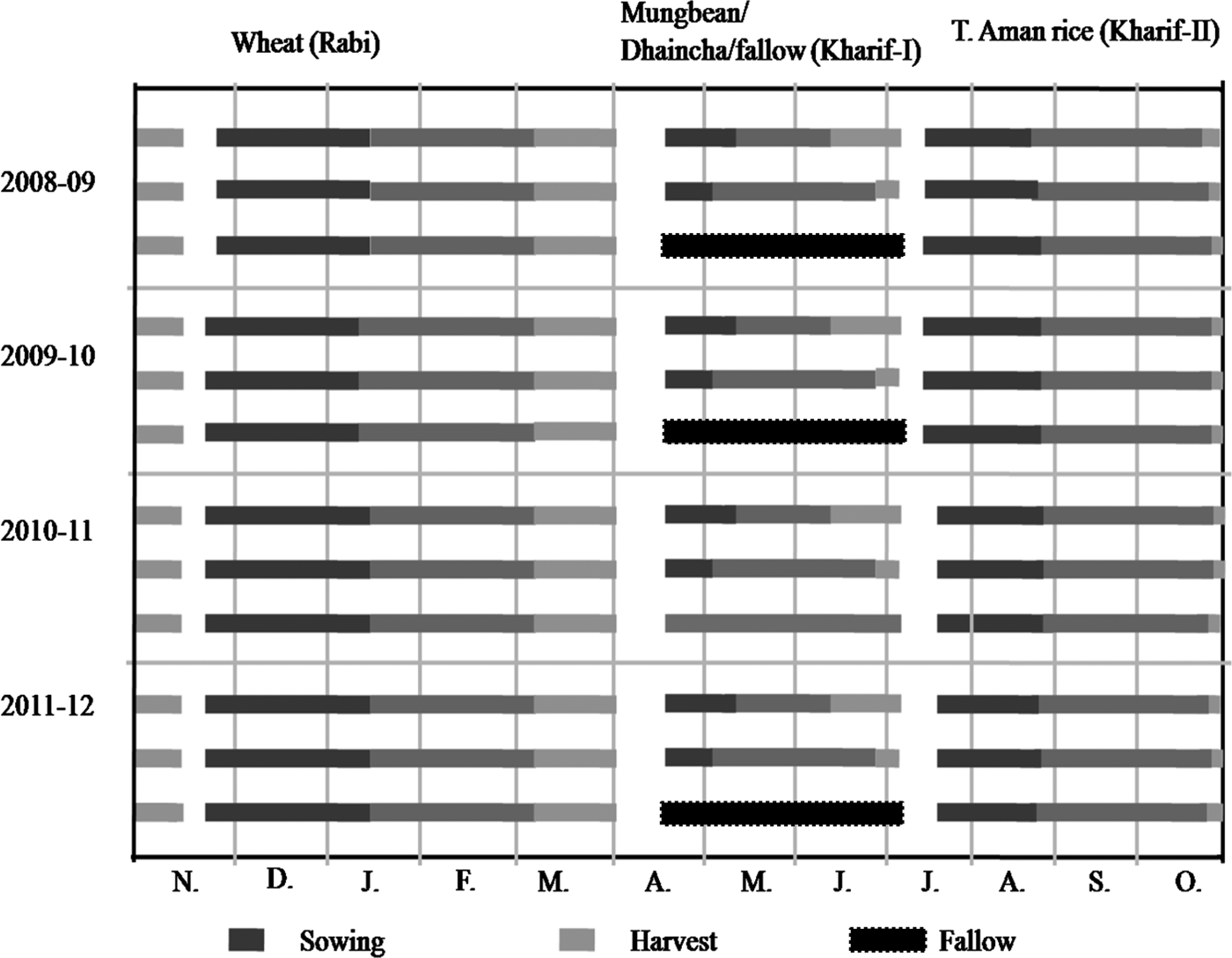
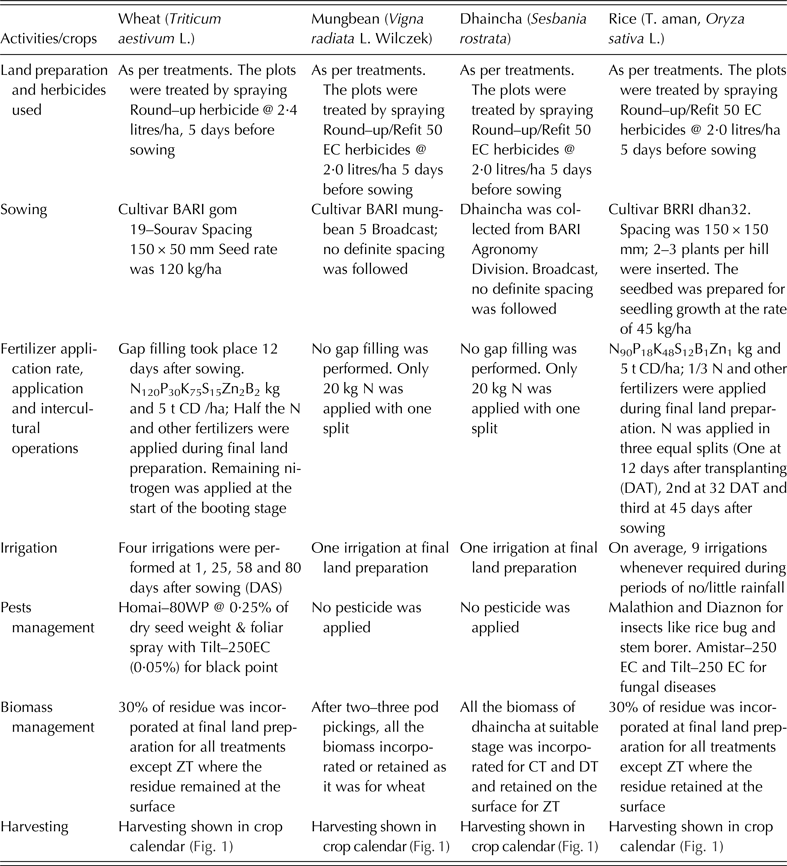
The different field operations from sowing to harvesting of crops in the cropping systems are given in Fig. 1 and Table 1.
Crop calendar showing the sowing, fallow, growing and harvesting periods of wheat (Triticum aestivum L.) mungbean (Vigna radiata L. Wilczek), dhaincha (Sesbania rostrata) and rice (Oryza sativa L., ecotype T. aman) crops from 2008 to 2012.

Summary of management activities for wheat, mungbean, dhaincha and rice crop production

Data collection
After sowing/transplanting, three 1 m2 areas in each sub-plot were separated by quadrats. Most of the yield data were recorded from the quadrats during the growing period and after harvest. The crop was cut at the ground level and threshing, cleaning and drying of grain were performed. Grain and straw/stover weight were recorded. Approximately 0·30 of rice and wheat straw was retained in the experimental field every year for conventional and DT practices. Mungbean biomass after two pickings and all dhaincha biomass were retained in the field after cutting and chopping for incorporation into the soil during CT and DT. For ZT, the biomass was kept on the surface. Soil samples were collected at specific depth intervals (0–150, 150–300 and 300–450 mm) from each sub-plot before sowing and/or after harvesting of crops every year. Properties, except root mass density (RMD) at 0–150 mm depth, are presented as variations among treatments since they were not significant at other depths.
Determination of different soil properties
The soils and different crop samples were analysed in the laboratory following standard methods. Soil organic matter was determined by the wet oxidation method (Jackson Reference Jackson1973). Particle size distribution was analysed using a hydrometer (Black Reference Black1965) and the textural class was determined using the USDA textural triangle (Soil Survey Staff 1951). Bulk density (BD) and particle density of the soil samples were determined by core sampler and pycnometer method, respectively (Karim et al. Reference Karim, Rahman, Ali and Karim1988). Moisture content was determined by the gravimetric method (Black Reference Black1965). Soil field capacity (FC) and permanent wilting point (PWP) were measured using pressure plate apparatus, where plant available water was calculated using Eqn 1 (Black Reference Black1965).
 $$D{\rm \; =} \left( {\displaystyle{{{\rm FC - PWP}} \over {{\rm 100}}}} \right){\rm \times \; BD\; \times \; Soil\; depth}$$
The double ring infiltrometer method was used to determine water infiltration and computed as cumulative infiltration and rate of infiltration in mm/h. Soil strength was determined by penetrometer as the capacity of the soil to resist the external force in kg/cm2 unit.
Total organic carbon (TOC) was determined following Eqns 2 and 3
 $${\rm Organic\; carbon} = \displaystyle{{{\rm Organic\; \; matter}} \over {1{\cdot}72}}$$
 $$\eqalign{{\rm TOC(t/ha)}\, & = \,{\rm 10000} \,{\rm m}^{\rm 2}\,{\rm in \,1\, ha}\, \cr & \quad \times \,{\rm soil\, depth}\,\,{\rm \times} \,\,{\rm BD \,\times\, OC}}$$
where 1·72 is the conversion factor from organic C to organic matter and BD is the bulk density in g/cm3 and OC is the percentage of organic carbon.
Microbial biomass C was determined by chloroform fumigation–incubation (Jenkinson & Powlson Reference Jenkinson and Powlson1976). Approximately 40 g of soil (at 55% of water-holding capacity) was placed into 50 ml glass beakers, fumigated for 1 day, evacuated and incubated with 10 ml of 1 N potassium hydroxide (KOH) in 1 litre glass jars at 25 °C for 10 days. Carbon dioxide production was quantified after titration of KOH with 1 N hydrochloric acid (HCl) (Anderson Reference Anderson, Page, Miller and Keeney1982). Soil MBC was calculated by dividing the mg CO2-C produced per kg of fumigated soil by an efficiency factor of 0·41 (Voroney & Paul Reference Voroney and Paul1984).
 $${\rm MBC}\, = \,{\rm Ec}/k_{{\rm ec}}$$
where Ec = mg CO2-C produced per kg of fumigated soil and k ec = 0·41 is the maximum efficiency of the method.
Properties of initial soil
Soil particle size distribution was 35, 37 and 28% sand, silt and clay, respectively, and the soil was classified as clay loam according to USDA textural class (Soil Survey Staff 1951). The moisture of the initial soil of the experimental site at FC was recorded at 27·0%, available water content 30·0 mm at 150 mm soil depth, BD 1·58 g/cm3, particle density 2·53 g/cm3 and porosity 38% of soil volume. The pH of the soil was slightly alkaline (pH 7·2). The soil was low in organic matter (8·6 g/kg) and total N (0·36 g/kg).
Root analysis
Root mass density was measured at maximum vegetative stage at three different soil depths (0–150, 160–300 and 310–450 mm) with an auger-like root sampler 150 mm internal diameter and 225 mm long using Eqn 5 (Schuurman & Goedewaagen Reference Schuurman and Goedewaagen1971).
 $${\rm Root\; mass\; density =} \displaystyle{{{\rm Mass\; of}\;{\rm root}} \over {{\rm Total\; volume\; of\; soil}}}{\rm mg/c}{\rm m}^{\rm 3}$$
Statistical analysis
The statistical analysis of variance for various crop yields and soil physical and organic matter-related properties were implemented using ANOVA and mean values were adjudged by Duncan Multiple Range Test (DMRT) at P < 0·05 (Steel & Torrie Reference Steel and Torrie1980). Microsoft Excel 2010 was used for treatment randomization, data computation and preparation of graphs.
RESULTS AND DISCUSSION
Biomass yields of mungbean and dhaincha under tillage practices and cropping systems
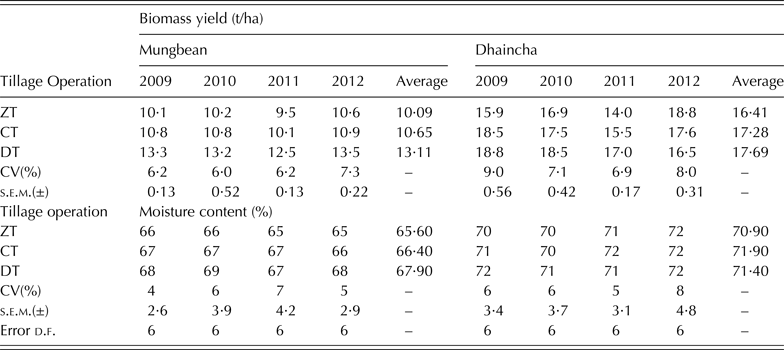
The effect of tillage practices on mungbean biomass yield was found to be significant (P < 0·01) in all study years. Deep tillage produced the highest biomass yields of mungbean (13·3, 13·2, 12·5 and 13·5 t/ha in 2009, 2010, 2011 and 2012, respectively), whereas the lowest yields were obtained in ZT (Table 2). Dhaincha biomass yield was also significantly (P < 0·01) affected by tillage practices in all study years except 2010 (Table 2). The highest biomass yield of dhaincha (18·8 t/ha) was recorded in DT in the first year, whereas in 2010 and 2011 they were 18·5, 17·0 t/ha. The lowest biomass was recorded in ZT in the first 3 years of the study. Dhaincha biomass yield in the 4th year gave the opposite result as influenced by the tillage practices. Zero tillage produced the highest biomass yield, which was followed by DT. Mungbean biomass of 10·1, 10·7 and 13·1 t/ha was added on a season basis through ZT, CT and DT, respectively, which were 16·4, 17·3 and 17·7 t/ha, respectively, of dhaincha biomass on a season basis (Table 2).
Biomass yields of mungbean (Vigna radiata L. Wilczek) and dhaincha (Sesbania rostrata) and their corresponding moisture contents under different cropping and tillage practices

ZT, zero tillage; CT, conventional tillage (by rotary tiller); DT, deep tillage (by chisel plough).
Organic matter status of post-harvest soil
Impact of tillage practices and cropping systems on soil organic matter status
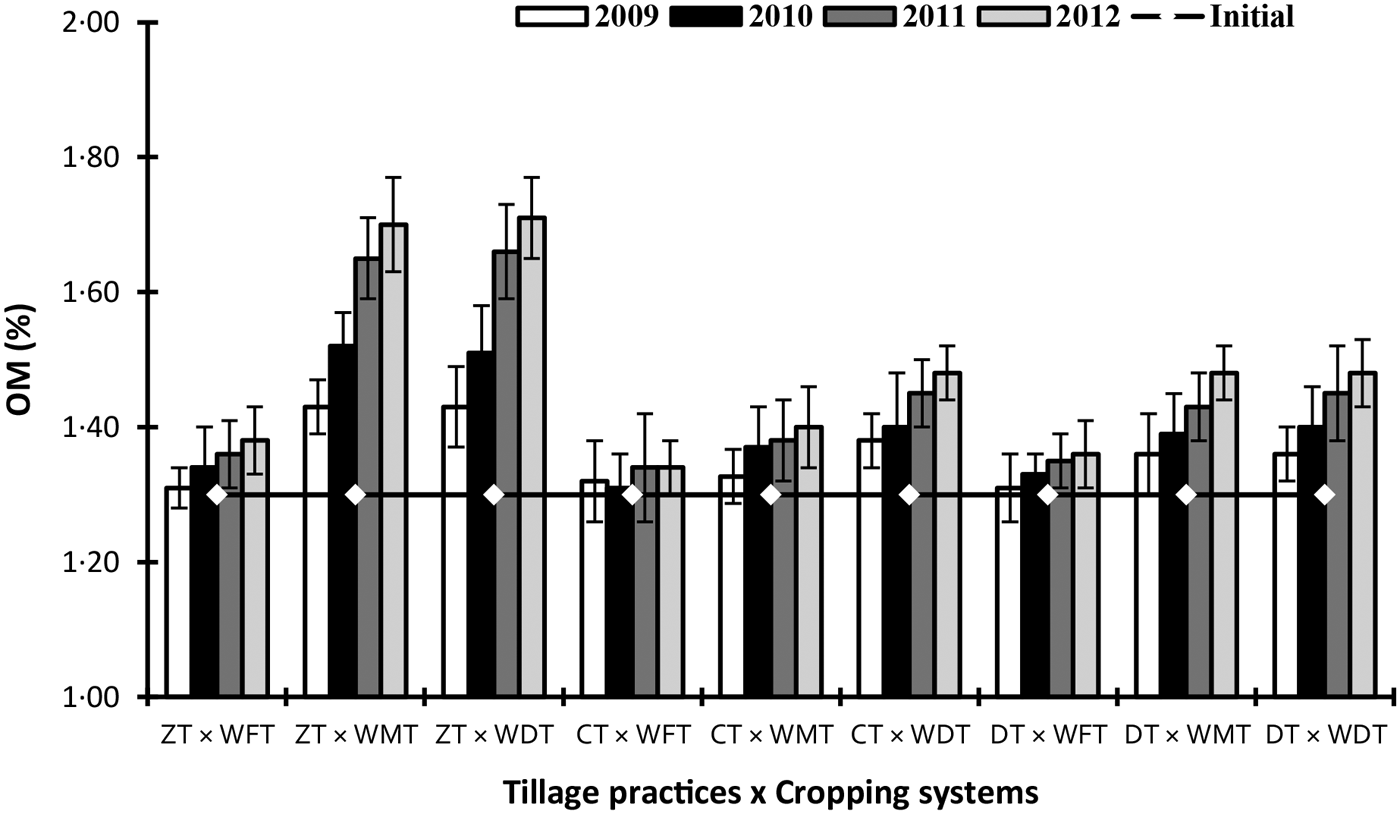
The organic matter (OM) content in the initial soil was 13 g/kg but changed over the years due to the different tillage practices. Soil organic matter ranged from 13·1 to 14·3 g/kg in 2009 and 13·1 to 15·2 g/kg in 2010. The highest OM (15·2 g/kg) was found in ZT under WMT followed by ZT under WDT (15·1 g/kg) in 2010, and the lowest (13·1 g/kg) was in CT under WFT. Zero tillage under WMT and WDT showed the highest OM content in 2009 and the minimum was in CT under WFT (Fig. 2). In 2011 and 2012, the maximum OM content (16·6 and 17·1 g/kg, respectively) was recorded in ZT under WDT, which was followed by ZT under WMT (16·4 and 17·0 g/kg in 2011 and 2012). In 2012, CT under WFT showed the minimum OM (13·4 g.kg), followed by DT under WFT (13·6 g/kg).
Effect of tillage depths and cropping systems on soil organic matter content over 4 years of cropping [Bars denote (±) s.e. and ZT, zero tillage; CT, conventional tillage; DT, deep tillage; WFT, wheat–fallow–T. aman; WMT, wheat–mungbean–T. aman; WDT, wheat–dhaincha–T. aman].

It was observed that the OM content decreased in CT and DT under WFT, whereas OM was gradually deposited in the soils where no or minimum disturbance took place throughout the four cropping cycles. Soil organic matter content in ZT with WDT in 2012 was approximately 20, 13 and 3% higher (P < 0·05) than the content in 2009, 2010 and 2011, respectively, while the SOM in ZT under WMT in 2012 was nearly 19, 12 and 3% higher (P < 0·05) than the SOM in 2009, 2010 and 2011, respectively (Fig. 2). Among the other treatments, DT under WDT and CT under WDT followed ZT under WMT and WDT cropping systems, whereas CT under WMT and DT under WMT showed slower rates of OM increase. It was also recorded that OM in different tillage practices under WFT were either depleted or remained unchanged. Similar results of SOM increase were also found by Chan & Heenan (Reference Chan and Heenan2005) among and between different tillage practices and cropping systems. Adding organic materials, such as green manures (Abbasi et al. Reference Abbasi, Tahir, Shah and Batool2009; Shah et al. Reference Shah, Ahmad and Rahman2011) and minimum soil disturbance by ZT (Havlin et al. Reference Havlin, Kissel, Maddux, Claassen and Long1990; Franzluebbers Reference Franzluebbers2002a ; Piovanelli et al. Reference Piovanelli, Gamba, Brandi, Simonini and Batistoni2006) might help maintain or increase the level of OM. Crop management systems that include rotations with high residue-producing crops such as legume crops (Ryan et al. Reference Ryan, Harris and Matar1992) and the maintenance of surface residue cover with reduced tillage result in greater SOC, which might improve soil productivity (Aulakh et al. Reference Aulakh, Khera, Doran and Bronson2001; Mohammad et al. Reference Mohammad, Shah, Shah and Shehzadi2008). Zero tillage also increased soil C levels compared to CT in sub-surface soils (Dick & Durkalski Reference Dick, Durkalski and Lal1998) due to higher decomposition rates (3·4 times) of buried residues/manures in the subsoil (Beare et al. Reference Beare, Pohland, Wright and Coleman1993).
Total organic carbon in soil
Zero tillage increased TOC in soil significantly (P < 0·05) at 0–150 mm depth, indicating its significant build-up within 4 years of ZT under legume and green manure incorporated rice–wheat cropping systems (Fig. 3). After 4 years of tillage and rice–wheat systems, TOC ranged from 16·28 t/ha in CT under WFT to 21·47 t/ha in ZT under WDT, while in ZT under WMT it was 21·35 t/ha. In the surface 150 mm of soil, TOC increased by 28 and 27% in ZT under WDT and WMT cropping systems, respectively (P < 0·05; Fig. 3). Increases of 2·5 and 2·4% were also found for TOC in CT and DT, respectively, under fallow-in-between cropping systems. This result is supported by Singh et al. (Reference Singh, Phogat, Dahiya and Batra2014). Tillage practices in different rice–wheat anchored cropping systems during the four experimental years influenced OC build-up at the 0–150 mm soil depth (P < 0·05). The C sequestration rate was much faster in ZT under WDT (1·17 t/ha/year), followed by ZT under WMT where C was sequestered at a rate of 1·14 t/ha/year. Conventional tillage under WFT showed negative values, indicating depletion of OC in the soil. Singh et al. (Reference Singh, Phogat, Dahiya and Batra2014) obtained a similar result during their experiment on clay loam soil under semi-arid climatic conditions. Gonzalez-Sanchez et al. (Reference Gonzalez-Sanchez, Ordonez-Fernandez, Carbonell-Bojollo, Veroz-Gonzalez and Gil-Ribes2012) also produced a similar result, which they correlated with soil texture, temperature for higher residue production, residue retention and absence of tillage.
Total soil organic carbon (top) and soil microbial biomass (top) C after 4 years of tillage practices and cropping systems. (s.e. (±) are showed in the error bars). ZT, zero tillage; CT, conventional tillage and DT, deep tillage; WFT, wheat–fallow–T. aman; WMT, wheat–mungbean–T. aman; WDT, wheat–dhaincha–T. aman.

Microbial biomass carbon
Microbial biomass C had a higher range of values in ZT than those in CT and DT in all years (Fig. 3). The effect of ZT under WMT and WDT on MBC after 4 years was significantly higher than other treatment combinations (P < 0·05). However, MCB ranged from 236 mg/kg in ZT under WDT (initial MBC was 141 mg/kg) to 138 mg/kg in DT under WFT where the initial MBC was 140 mg/kg. The increase in MBC was 69% in ZT under WDT (P < 0·05), 58% in ZT under WMT (P < 0·05), 32% in ZT under WFT (P < 0·05), 29% CT under WDT (P < 0·05), 24% in CT under WMT (P < 0·05), 16% in CT under WFT. Deep tillage under WDT and WMT also showed increases in MBC (14 and 6% over initial values), while a negative result was found in DT under WFT (Fig. 3). The result was supported by other studies where chisel plough and ZT caused an increase over CT by 57 and 181%, respectively (Alvarez et al. Reference Alvarez, Diaz, Barbero, Santanatoglia and Blotta1995) for MBC. Zero tillage and WMT/WDT with residues from rice and wheat increased MBC as described by Govaerts et al. (Reference Govaerts, Mezzalama, Unno, Sayre, Luna–Guido, Vanherck, Dendooven and Deckers2007) and Zhu et al. (Reference Zhu, Hu, Yang, Zhan and Zhang2014), who stated that ZT coupled with residue retention created conditions favourable for a significant increase in MBC. Balota et al. (Reference Balota, Colozzi-Filho, Andrade and Dick2003) attributed the MBC increase in ZT over CT and DT under sub-tropical conditions to several factors, such as a lower temperature, higher moisture content, greater soil aggregation and higher C content, adding that the minimal disturbance in ZT probably supplied a stable source of OC to support the microbial community compared to DT/CT where a sudden flush of microbial activity with each tillage event causes significant losses of C as CO2.
Effect of tillage depths and cropping systems on soil physical properties
Soil bulk density
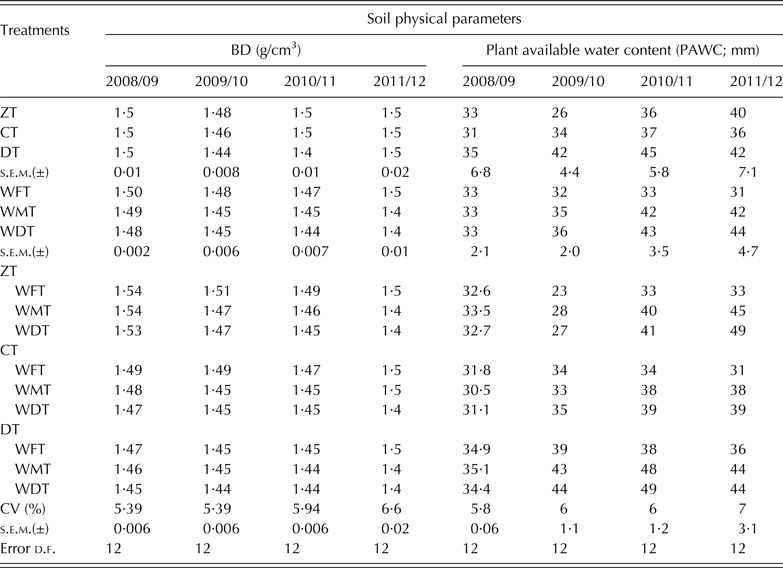
The effects of tillage and cropping systems influenced soil physical properties (Table 3). The difference in BD among different tillage depths was found to be insignificant after 4 years, but the effects of cropping systems and the interaction effects on BD were significant (P ⩽ 0·05) in all study years except in 2011/12, when no influence of tillage cropping system was found (Table 3). Bulk density ranged from 1·41 to 1·49 g/cm3 in 2011/12, whereas it varied from 1·49 to 1·44 g/cm3 in 2010/11, from 1·51 to 1·44 g/cm3 in 2009/10 and from 1·54 to 1·45 g/cm3 in 2008/09 at 0–150 mm soil depth.
Bulk density (BD) and plant available water content at 0–150 mm soil depth of post experimental soil as influenced by tillage depths and cropping systems

ZT, zero tillage; CT, conventional tillage; DT, deep tillage; WFT, wheat–fallow–T. aman; WMT, wheat–mungbean–T. aman; WDT, wheat–dhaincha–T. aman.
[Least significant difference (LSD)0·05 for Tillage – 0·06 (BD, 2009), 2·9 (PAWC, 2009), 0·013 (BD, 2010), 5·2 (PAWC, 2010), 0·04 (BD, 2011), 6·7 (PAWC, 2011), 0·06 (BD, 2012), 4·4 (PAWC, 2012); LSD0·05 for cropping systems – 0·01 (BD, 2009), 2·0 (PAWC, 2009), 0·01(BD, 2010), 2·1 (PAWC, 2010), 0·03(BD, 2011), 3·4 (PAWC, 2011), 3·1 (PAWC, 2012); LSD0·05 for Tillage × Cropping systems – 0·03 (BD, 2012), 3·5 (PAWC, 2009), 0·017(BD, 2010), 3·6 (PAWC, 2010), 0·06 (BD, 2011), 5·9 (PAWC, 2011), 0·06 (BD, 2012), 5·23 (PAWC, 2012)].
In all study years, the highest BD was recorded in ZT under WFT and the lowest was in all tillage practices under WMT and WDT. With the completion of every cropping cycle, BD values were found to have decreased in all treatment combinations. The maximum decreases, though not significant, were recorded in ZT under WMT and WDT (10 and 11%, respectively). The incorporation/retention of mungbean and dhaincha biomass in soil helped reduce soil BD (Table 3). The steady decrease in BD might have been caused by the gradual increase in OM content at the 0–150 mm depth, as a result of minimal soil disturbance and the continuous addition of organic residue from leguminous crops (mungbean and dhaincha) as well as residues of rice and wheat crops. Similarly, Sultani et al. (Reference Sultani, Gill, Anwar and Athar2007) found green manure crops in a cropping system reduced soil BD by 5–7% on average, which was counter-balanced by puddling of soil under CT and DT during rice transplanting (Behera et al. Reference Behera, Varshney and Goel2009). Tillage alone for wheat and tillage with puddling for rice in the initial year reduced BD at the 0–150 mm soil depth after one cropping cycle by an average of 7%. After 4 years, the differences in BD had reduced. In NSW, Australia, soil BD was reduced by 6·7% in no-till compared with CT after 14 years (So et al. Reference So, Grabski and Desborough2009). He et al. (Reference He, Kuhn, Zhang, Zhang and Li2009) and Chen et al. (Reference Chen, Bai, Wang, Chen, Gao, Tullberg, Murray, Li and Gong2008) reported that the difference in BD in the surface layer soil under NT and CT was negligible in the long term, which was in agreement with the findings of the current study.
Plant available water content
The effect of tillage depths and cropping systems on plant available soil moisture (PAWC) was significant (P < 0·05) (Table 3). In 2008/09, PAWC in DT under WDT and WMT was higher than that in ZT and CT under WFT. It remained almost the same in the next cropping cycle but ZT under WDT and WMT showed a consistent increasing trend (0·05 < P < 0·1) of soil PAWC (Table 3). In 2011/12, ZT under WDT conserved the highest available moisture (49·1 mm) in the soil, followed by DT under WMT (45·3 mm). The lowest PAWC (25·3 mm) was in ZT under WFT.
After four study years, a non-significant increase of PAWC (63·7%) in the soil was recorded in ZT under WDT, followed by ZT under WMT (48·7%) and DT under WDT (48%). The opposite result was observed with ZT under WFT (Table 3). This indicated that water loss was reduced by tillage practices that minimized soil disturbance and loss of organic matter and by the cultivation of green manure crops that kept the soil covered. Manipulating soil moisture dynamics with tillage could be one of the more feasible ways of increasing crop yields (Rahman & Islam Reference Rahman and Islam1998; Fernández-Ugalde et al. Reference Fernández-Ugalde, Virto, Bescansa, Imaz, Enrique and Karlen2009). The current results showed that green manure application affected important soil moisture indexes and increased the soils’ ability to hold water because OM has a higher water-holding capacity (WHC) than a similar volume of mineral soil (Annabi et al. Reference Annabi, Houot, Francou, Poitrenaud and Bissonnais2007). Soil organic matter enhances soil water retention because of its hydrophilic nature and its positive influence on soil structure (Annabi et al. Reference Annabi, Houot, Francou, Poitrenaud and Bissonnais2007). At 200 mm deep, PAWC has been found to be highest under minimum tillage with green manure, yielding up to 10–15% more volume water content (Alliaume et al. Reference Alliaume, Jorge and Dogliotti2012). Conservation tillage with residue retention also improves soil water content and crop yields in many environments (Hemmat & Eskandari Reference Hemmat and Eskandari2004; Munoz et al. Reference Munoz, Lopez-Pineiro and Ramirez2007). No tillage under crop rotation and residue retention can improve soil structure and stability, thereby facilitating better drainage and WHC, as C sequestration is raised though the increase in SOM by CA (Holland Reference Holland2004). Green manures in a crop rotation add OM to soil, which improves WHC (Bunch Reference Bunch1995; Salahin et al. Reference Salahin, Alam, Islam, Naher and Majid2013). Sur et al. (Reference Sur, Sidhu, Singh, Aggarwal and Sandhu1993) and Alam et al. (Reference Alam, Salahin, Islam and Hasanuzzaman2014) also reported that water intake and retention in a clay loam soil were increased significantly due to green manuring in between a rice–wheat cropping system.
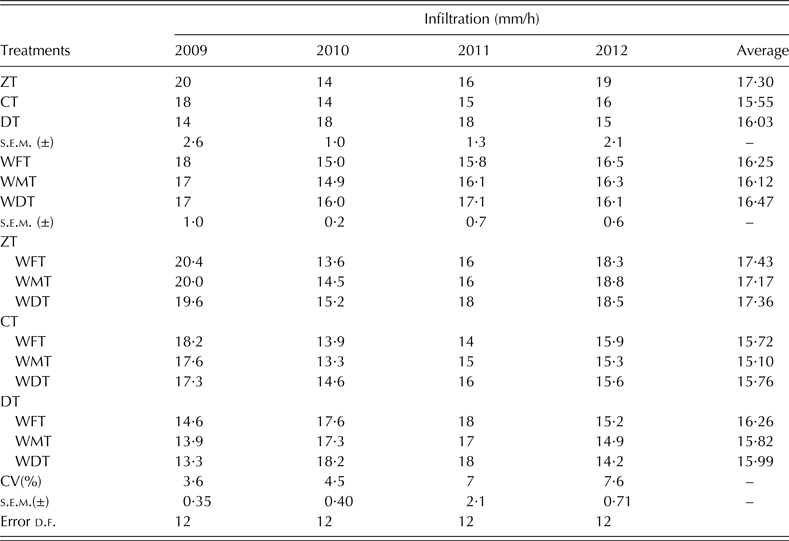
Water infiltration in soils
The effect of tillage practices and cropping systems after 4 years were also significant on soil–water intake (Table 4). After the first cropping cycle, the highest infiltration rate (20·4 mm/h) was found in ZT under WFT, which was similar to ZT under WMT and WDT (P > 0·05). The lowest infiltration rate (13·3 mm/h) was recorded in DT under WDT, which was significantly (P < 0·01) lower than that of other treatment combinations (Table 4). In the first cropping cycle, the higher infiltration in ZT might have been caused by cracks formed in the soil before the experimental period, while in contrast, DT might minimize the cracks over the course of three cropping cycles since the first cropping cycle. After the second experimental year, the maximum infiltration rate (18·2 mm/h) was recorded in plots having DT with WDT, whereas there was minimum infiltration in the ZT plots under WFT. Different tillage practices at different tillage depths changed the pore size distribution and the higher proportion of small pores and pore discontinuity were more developed in soils under CT and green manure cropping systems (Table 4). Therefore, lower infiltration rates were observed under DT and WDT. In the next cropping cycle, improved rates of water infiltration were recorded in the reduced tillage practices compared to DT with the same cropping systems.
Effect of tillage practices and cropping systems on water infiltration in soil

ZT, zero tillage; CT, conventional tillage; DT, deep tillage; WFT, wheat–fallow–T. aman; WMT, wheat–mungbean–T. aman; WDT, wheat–dhaincha–T. aman.
[Least significant difference (LSD)0·05 for Tillage – 1·99 (2009), 1·50 (2010), 7·35 (2011), 6·65 (2012); LSD0·05 for cropping systems – 0·63 (2009), 0·70 (2010), 1·22 (2011), 1·26 (2012); LSD0·05 for Tillage × Cropping systems – 1·09 (2009), 1·22 (2010), 2·12 (2011), 2·19 (2012)].
In 2011, the highest improvement in water entering the soil (15·1%) was recorded in ZT under WDT, followed by ZT under WMT (14·6%) and ZT under WFT (11·9%). The infiltration rate of water in soil remained similar in DT under different cropping systems. After 4 years, it was observed that the highest rate of water infiltration was found in ZT under different cropping systems while the lowest infiltration rate was recorded in DT under different cropping systems (Table 4). In 2012, the rate at which water entered the soil when treated with ZT in WFT, WMT and WDT were 35, 30 and 22% higher (P < 0·05), respectively, than the corresponding values of the same treatments found in 2010. The drastic reduction of water infiltration rate in CT in 2010 might be attributed to the crusts formed in the soil immediately after rainfall or irrigation (Table 4). The infiltration rate remained stable or showed little change in CT under different cropping systems in almost all years. Infiltration is an important soil feature as it controls leaching, runoff and crop water availability (Franzluebbers Reference Franzluebbers2002a ; Fernández-Ugalde et al. Reference Fernández-Ugalde, Virto, Bescansa, Imaz, Enrique and Karlen2009). Baumhart & Lescano (Reference Baumhart and Lescano1996) reported that soils under NT treatment have greater infiltration rates than tilled soils, which can be similar or lower than CT within a few years due to initial compaction and lack of sufficient biological activity for development of a stable soil structure (Unger Reference Unger1992; Sonnleitner et al. Reference Sonnleitner, Lorbeer and Schinner2003). Surface OM is also essential to water infiltration and conservation of nutrients (Franzluebbers Reference Franzluebbers2002b ) and surface OM was observed to improve under ZT in the current experiment. Organic matter build-up in the ZT soils under WMT and WDT could also have enhanced infiltration (Annabi et al. Reference Annabi, Houot, Francou, Poitrenaud and Bissonnais2007).
Soil strength
Penetration resistance showed an increasing trend with depth for all treatments. During the study period, there were differences among the tillage systems in penetration resistance at the 0–150 m depth (P < 0·01). The interaction effect of tillage depth and cropping system on soil strength also varied (P < 0·01; Fig. 4). After completion of the first cropping cycle, it was found that the 160–200 mm depth of post-harvest soil had the highest resistance to penetration (c. 1·69–2·24 kg/cm2). The lowest strength (0·1 kg/cm2) was measured from the surface soil in DT under WMT. The strength value ranged from 0·1 to 0·19 kg/cm2 in the top 0–40 mm soil depth.
Effect of tillage practices and cropping systems on soil strength at different soil depth increments after 4 years in comparison with the initial year–2008. Where (a) 0–40 mm soil depth, (b) 40–80 mm soil depth, (c) 80–120 mm soil depth, (d) 120–160 mm soil depth, (e) 160–200 mm soil depth, (f) 200–240 mm soil depth and (g) 240–280 mm soil depth [ZT, zero tillage; CT, conventional tillage; DT, deep tillage; WFT, wheat–fallow–T. aman; WMT, wheat–mungbean–T. aman; WDT, wheat–dhaincha–T. aman].

Soil strength was always low to a depth of 160 mm in all the treatments. The strength value increased from 160 to 200 mm and then decreased. The decreased strength value in the lower horizon might have been caused by higher moisture content due to a higher ground water table (Fig. 4). After 4 years, the interaction effect of tillage depths and cropping systems on soil strength was found to be insignificant at the 0–120 mm soil depth. At all depths below 120 mm, the penetration resistance/soil strength was found to be significantly (P < 0·05) different between treatments. The resistance value at 0–40 mm ranged from 0·1 kg/cm2 in CT under WFT to 0·14 kg/cm2 in DT and ZT under WMT and WDT. It was noticed that soil strength declined in all soil sampling depth increments in the 4th year compared to the first year results. Similar to first year strength, the strength value below the tillage depth in 2012 increased between soil depths of 160–200 mm and then decreased. The insignificant difference between treatments of tillage practices under different cropping systems proved the accumulation of organic matter in ZT soil under WMT and WDT. Wilkins et al. (Reference Wilkins, Siemens and Albrecht2002) and Wuest et al. (Reference Wuest, Williams and Gollany2006) reported a temporal decline in soil strength or BD with adoption of NT/ZT. Chen et al. (Reference Chen, Bai, Wang, Chen, Gao, Tullberg, Murray, Li and Gong2008) found that mechanical impedance increases as BD increases and water content decreases which Unger & Jones (Reference Unger and Jones1998) substantiated with their work on soil strength under ZT and crop rotations. Singh & Kaur (Reference Singh and Kaur2012) and Alam et al. (Reference Alam, Salahin, Islam and Hasanuzzaman2014) attributed differences in penetration resistance to organic matter and particle soil roughness. The current experiments also produced similar results.
Effects of tillage practices and cropping systems on root mass density
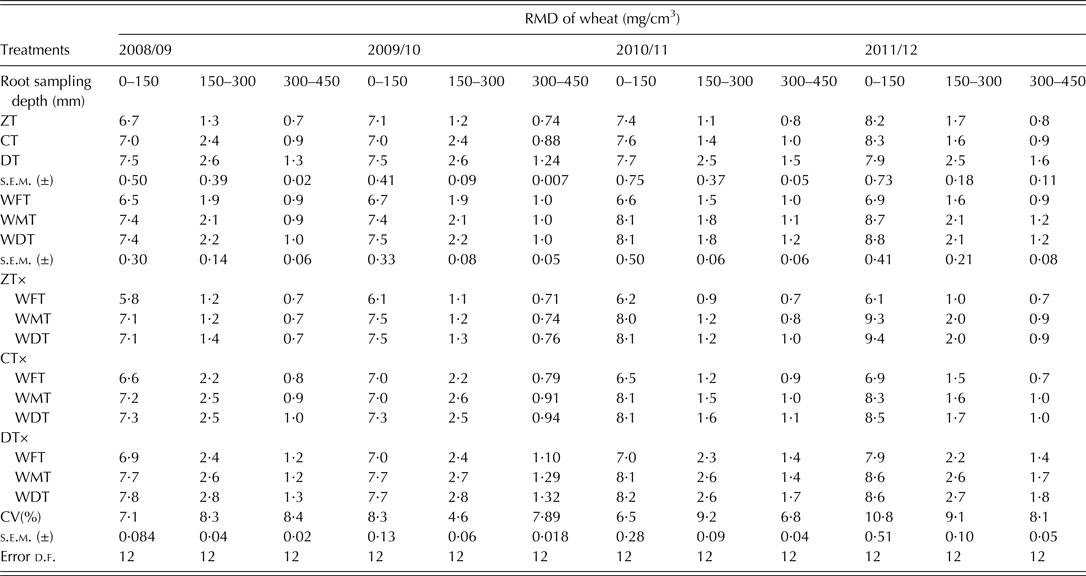
In the first year of experimentation, wheat RMD was significantly (P < 0·05) influenced by tillage practices and the interaction of tillage practices and cropping systems (Table 5). At all depths, RMD varied significantly (P < 0·05) among the three tillage practices. At 0–150 mm soil depth in 2009, the highest RMD was observed in DT under WDT (7·8 mg/cm3) and WMT (7·74 mg/cm3) cropping systems; whereas the lowest RMD (5·79 mg/cm3) was found in ZT under WFT (Table 5). In the first year of study, all tillage practices with WFT gave the lowest RMD. At 150–300 mm soil depth in 2009, the RMDs in CT and DT were found to be significantly (P < 0·05) higher than that of ZT. At 150–300 and 300–450 mm depth in 2009, the lower RMD was recorded where ZT was imposed on the soil while the higher RMD was recorded where soil was very disturbed. With the enforcement of tillage practices and cropping systems for four consecutive years, an evident development in root expansion was observed in the ZT, CT and DT under WMT and WDT cropping systems. In contrast, WFT with ZT, CT and DT decreased root growth at the root sampling depths. In the fourth rice cropping season, wheat RMD ranged from 6·05 to 9·39 mg/cm3, 1·03 to 2·69 mg/cm3 and 0·67 to 1·75 mg/cm3 in the top, sub-soil and deep soil layer, respectively. In 2012, the highest RMD (9·39 mg/cm3) at 0–150 mm was recorded in ZT under WDT, which was identical to ZT under WMT. At 150–300 mm depth, the highest RMD was found in DT under different cropping systems and the lowest was in ZT under WFT, although ZT with WMT and WDT showed improvement in root growth in the deeper layer. Throughout the study years and across all depth increments, ZT under WFT produced the lowest wheat RMD (Table 5).
Changes in root mass density (RMD) of wheat (Triticum aestivum L.) across 4 years of tillage practices and cropping systems

ZT, zero tillage; CT, conventional tillage; DT, deep tillage; WFT, wheat–fallow–T. aman; WMT, wheat–mungbean–T. aman; WDT, wheat–dhaincha–T. aman.
[Least significant difference (LSD)0·05 for Tillage – 0·23 (0–15, 2009), 1·22 (15–30, 2009), 0·09 (30–45, 2009), 0·62 (0–15, 2010), 1·16 (15–30, 2010), 0·06 (30–45, 2010), 0·36 (0–15, 2011), 0·98 (15–30, 2011), 0·23 (30–45, 2011), 0·97 (0–15, 2012), 0·31 (15–30, 2012), 0·41 (30–45, 2012); LSD0·05 for cropping systems – 0·15 (0–15, 2009), 0·07 (15–30, 2009), 0·03 (30–45, 2009), 0·24 (0–15, 2010), 0·03 (15–30, 2010), 0·03 (30–45, 2010), 0·51 (0–15, 2011), 0·16 (15–30, 2011), 0·08 (30–45, 2011), 0·90 (0–15, 2012), 0·18 (15–30, 2012), 0·09 (30–45, 2012); LSD0·05 for Tillage × Cropping systems – 0·26 (0–15, 2009), 0·13 (15–30, 2009), 0·06 (30–45, 2009), 0·41 (0–15, 2010), 0·17 (15–30, 2010), 0·06 (30–45, 2010), 0·88 (0–15, 2011), 0·28 (15–30, 2011), 0·14 (30–45, 2011), 1·56 (0–15, 2012), 0·31 (15–30, 2012), 0·16 (30–45, 2012)].
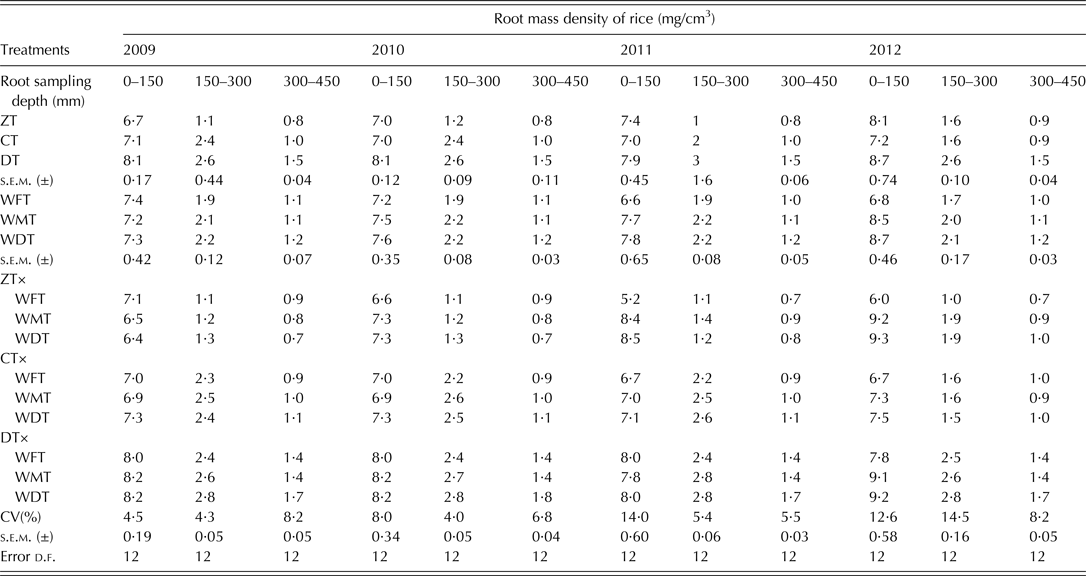
On the other hand, in the first experimental year, rice RMD was influenced by tillage practices, cropping systems and their interaction (Table 6). In the topsoil (0–150 mm) RMD varied significantly among the three tillage practices (P < 0·05). In the sub-soil (150–300 mm), RMD in CT and DT was found to be significantly (P < 0·05) higher than that of ZT. At the 0–150 cm soil depth in 2009, the highest RMD (8·23 mg/cm3) was observed in DT under WMT, whereas the lowest RMD (6·40 mg/cm3) was found in ZT under WDT (Table 6). At 150–300 and 300–450 mm depths in 2009, a lower RMD was recorded where minimum soil disturbance took place, while a higher RMD was recorded where DT was employed. After 4 years of a similar imposition of tillage practices and cropping systems, a notable improvement in root growth was observed in the ZT, CT and DT treatments under WMT and WDT. In contrast, fallow-in-between cropping system with ZT, CT and DT reduced root growth at all sampling depths. In 2012, RMD ranged from 6·0 to 9·26 mg/cm3 and 1·0 to 2·80 mg/cm3 in the top and sub-soil layers, respectively. The highest RMD (9·26 mg/cm3) at 0–150 mm was recorded in ZT under WDT, which was followed by DT under WDT and ZT under WMT. At 150–30 mm depth, the highest RMD was found in DT under different cropping systems and the lowest was in ZT under WFT, though ZT with WMT and WDT showed improvement in root growth in the deeper layers. At 300–450 mm depth, RMD ranged from 0·70 and 1·7 mg/cm3 where the trend was similar to RMD at the 150–300 mm depth.
Changes in root mass density of rice across 4 years tillage practices and cropping systems

ZT, zero tillage; CT, conventional tillage; DT, deep tillage; WFT, wheat–fallow–T. aman; WMT, wheat–mungbean–T. aman; WDT, wheat–dhaincha–T. aman.
[Least significant difference (LSD)0·05 for Tillage – 0·74 (0–150, 2009), 0·23(150–300, 2009), 0·34 (300–450, 2009), 1·85 (0–150, 2010), 0·44 (150–300, 2010), 0·26 (300–450, 2010), 1·39 (0–150, 2011), 0·48 (150–300, 2011), 0·46 (300–450, 2011), 1·89 (0–150, 2012), 1·22 (150–300, 2012), 0·22 (300–450, 2012); LSD0·05 for cropping systems – 0·34 (0–150, 2009), 0·09 (150–300, 2009),0·09(300–450, 2009), 0·60 (0–150, 2010), 0·09 (150–300, 2010), 0·08 (300–450, 2010), 1·06 (0–150, 2011), 0·10 (150–300, 2011), 0·56 (300–450, 2011), 1·03 (0–150, 2012), 0·29 (150–300, 2011), 0·09 (300–450, 2012); LSD0·05 for Tillage × Cropping systems – 0·58 (0–150, 2009), 0·16 (150–300, 2009), 0·16 (300–450, 2009), 1·05 (0–150, 2010), 0·15 (150–300, 2010), 0·14 (300–450, 2010), 1·84 (0–150, 2011), 0·17 (150–300, 2011), 0·10 (300–450, 2011), 1·79 (0–150, 2012), 0·50 (150–300, 2012), 0·16 (300–450, 2012)].
In wheat and rice, RMD decreased with increasing soil depth, but increased with tillage intensity (P < 0·05). In the first year, wheat roots extended into the deeper layer in DT with WMT and WDT and absorbed more nutrients from deep soil (Table 5); this influenced wheat growth and development. As a result, roots became thicker and exhibited increased density. In contrast, notable progress was only found in ZT after 4 years under WMT and WDT across depth increments (P < 0·05) and finally it approached the RMD in DT under WMT and WDT. The highest RMD was found in WDT and WMT at soil sampling depths of 0–150, 150–300 and 300–450 mm. This may have been due to the incorporation of biomass from dhaincha and mungbean, which favoured the accumulation of OM in the surface soil layer and enhanced plant root growth. Similar results were found by Parker & Lear (Reference Parker and Lear1996), Varsa et al. (Reference Varsa, Chong, Abolagi, Farquhar and Olsen1998) and Hassan et al. (Reference Hassan, Kitamura, Ahmed, Samir and Irshad2005).
In the initial year, rice roots penetrated the deeper layers in CT with WMT and WDT (P < 0·05) and took up more nutrients from the deep soil, which in turn influenced rice growth and development. As a result, roots became thicker and increased in density. As with wheat, noticeable improvements were only observed after 4 years in ZT under WMT and WDT at all soil depths and finally became almost equal to the RMD found in CT under WMT and WDT. The highest RMD of rice was found in WMT and WDT at all soil depths (Table 6). This may be due to the incorporation of biomass from dhaincha and mungbean, which favoured plant root growth. The findings of Kulakova et al. (Reference Kulakova, Suturin, Antonenko, Boik and Paradina1996) support the current results. Root mass density was drastically reduced in deeper soil, which was associated with increased soil BD in deeper soil. Root proliferation or extensibility was obstructed by the dense or compact layer of the soil profile. Similar results were found by Parker & Lear (Reference Parker and Lear1996) and Singh & Singh (Reference Singh and Singh1996). Son & Lee (Reference Son and Lee2011) also found similar results, i.e. that no tillage under rice cover crop systems with green manure increased rice root growth and RMD in the soil with corresponding increase in active SOM in the top soil. Son & Lee (Reference Son and Lee2011) also related the improvement in RMD to increased soil porosity under minimal tillage and residue cover. Oliveira & Merwin (Reference Oliveira and Merwin2001) also stated that increased porosity is especially important for crop development and enhanced root growth.
Effect of tillage practices and cropping systems on yield of wheat and rice
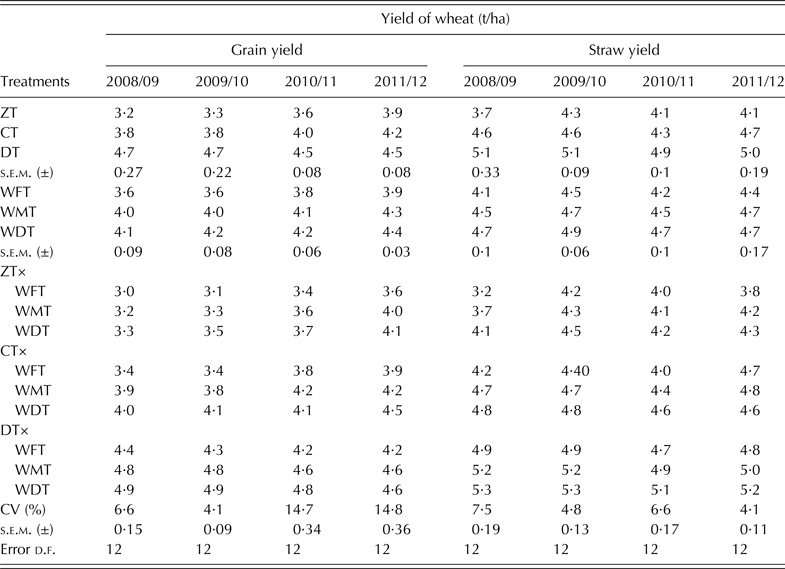
Grain and straw yields of wheat were significantly (P < 0·05) influenced by main plot, sub-plot treatments and their interactions in all experimental years except 2012 (Table 7). Maximum grain yields, 4·92 t/ha in 2009, 4·88 t/ha in 2010, 4·82 t/ha in 2011and 4·60 t/ha in 2012, were recorded in CT under WDT and WMT. The WMT and WDT with CT produced statistically similar yields in all years. Contrasting differences were found among the three treatment groups. Cropping systems with ZT always produced the lowest wheat yield, DT gave the highest yield and CT always remained in between (Table 7). Another noticeable result was that conservation tillage (ZT) with WDT resulted in yield increases with progressive cropping cycles.
Grain and straw yield of wheat after 4 years of tillage practices and cropping systems

ZT, zero tillage; CT, conventional tillage; DT, deep tillage; WFT, wheat–fallow–T. aman; WMT, wheat–mungbean–T. aman; WDT, wheat–dhaincha–T. aman.
[Least significant difference (LSD) for tillage practices – 0·72(2009), 0·73(2010), 1·5(2011), 2·0(2012); LSD for Cropping systems – 0·26(2009), 0·16(2010), 0·61(2011), 0·64(2012); LSD for tillage practices × Cropping systems–0·46(2009), 0·28(2010), 1·1(2011), 1·1(2012); LSD for tillage practices (straw yield) – 0·72(2009), 0·74(2010), 0·67(2011), 0·66(2012); LSD for cropping systems (straw yield)–0·63(2009), 0·39(2010), 0·25(2011), 0·17(2012)LSD for tillage practices × Cropping systems (straw yield)–1·1(2009), 0·67(2010), 0·44(2011), 0·30(2012)].
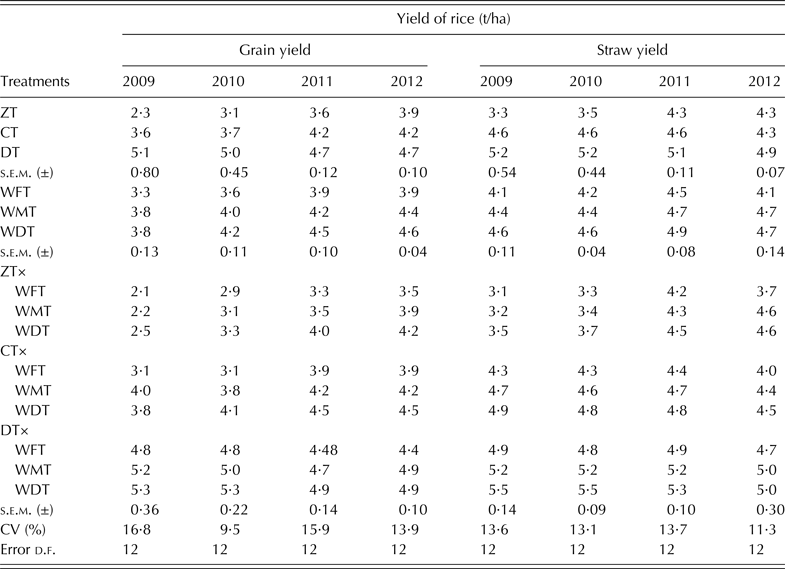
Effects of tillage practices and cropping systems on grain and straw yields of rice varied significantly (P < 0·05). In 2009, the grain and straw yields of monsoon rice were increased significantly (P < 0·05) with the increased tillage intensity and incorporation of legume residues (Table 8). The highest grain yield (5·28 t/ha) was found in DT under WDT and the lowest yield (2·11 t/ha) under ZT with WFT. The grain yield of rice followed the increasing trends from year to year. After 4 years of study, grain yields increased considerably where soil receive minimal disturbance and leguminous crops were grown and incorporated in between rice and wheat. The legume-based cropping systems produced similar yields to DT throughout the experiments.
Grain and straw yield pattern of rice after 4 years of tillage practices and cropping systems

ZT, zero tillage; CT, conventional tillage (by rotary tiller); DT, deep tillage (by chisel plough); WFT, wheat–fallow–T. aman; WMT, wheat–mungbean–T. aman; WDT, wheat–dhaincha–T. aman.
[Least significant difference (LSD) for tillage practices – 1·6(2009), 0·42(2010), 0·73(2011), 0·67(2012); LSD for Cropping systems – 0·34(2009), 0·23(2010), 0·30(2011), 0·20(2012); LSD for Tillage practices × Cropping systems – 0·60(2009), 0·40(2010), 0·52(2011), 0·34(2012); LSD for tillage practices (straw yield) – 0·83(2009), 1·02 (2010), 0·47(2011), 2·0(2012); LSD for Cropping systems (straw yield) – 0·14(2009), 0·16 (2010), 0·18(2011), 0·52(2012); LSD for Tillage practices × Cropping systems (straw yield) – 0·25(2009), 0·28(2010), 0·31(2011), 0·9089(2012)].
In line with the wheat yield result, ZT with WDT gave rise to the highest increase (25·6%), followed by ZT with WDT (25·6%), ZT with WFT (20·9%) and CT with WDT (16·1%). Conventional tillage with cropping systems showed a reduction in wheat yield and the largest reduction (6·5%) was in CT with WDT (Table 7). Aulakh et al. (Reference Aulakh, Khera, Doran and Bronson2001) demonstrated that a green manure crop and/or incorporating crop residue into a rice–wheat system had the potential to increase SOM while maintaining high wheat grain yields. Some residual benefits of green manures along with rice residues to the following crop have been reported in rice–rice (Becker et al. Reference Becker, Ladha and Ottow1994) and in rice–wheat (Aulakh et al. Reference Aulakh, Khera, Doran, Kuldip-Singh and Bijay-Singh2000). Crop rotation and conservation–tillage crop production play an important role in the success of most crop production enterprises. DeVita et al. (Reference DeVita, Dipaolo, Fecondo, Difonzo and Pisante2007) showed that higher yields were obtained with NT than CT in the years of cropping at Foggia. However, in the Canadian Prairie, no significant tillage-by-rotation interactions were found for wheat yields in long-term experiments (Hao et al. Reference Hao, Chang, Conner and Bergen2001). The inclusion of legumes in the cropping system was shown to give a net increase in wheat grain yield by 326 kg/ha in legume–wheat rotations with similar increases in straw yield (Mohammad et al. Reference Mohammad, Shah, Shah and Iqbal2003). Meenakshi et al. (Reference Meenakshi, Amarjit, Sharma, Kachroo and Bharat2007) and Bueno & Ladha (Reference Bueno and Ladha2009) reported that zero-tilled wheat recorded yield attributes and grain and straw yields similar to conventionally tilled crops in medium-term experiments.
Significant differences in rice yield were found among the three treatment groups: WFT with ZT consistently produced the lowest rice yields (P < 0·05), while cropping systems incorporating legumes (WMT and WDT) with DT gave the highest yields and cropping systems with CT always gave yields between those of ZT and DT (Table 8). Interestingly, the ZT with WDT and WMT resulted in progressive yield increases with each cropping cycle. The highest rice yield increase (75·9%) was seen in ZT with WMT, followed by ZT with WDT (72·7%). In contrast, DT with all cropping systems remained static or reduced rice grain yield by 5–8%. The highest yield reduction (8%) was in DT with WFT (Table 8). Similar results were obtained in several studies by Hemmat & Eskandari (Reference Hemmat and Eskandari2004) and Munoz et al. (Reference Munoz, Lopez-Pineiro and Ramirez2007), whereas Hammel (Reference Hammel1995) and Alam & Salahin (Reference Alam and Salahin2013) found contradictory results with NT on crop yields in arid areas of the USA and sub-tropical areas in the IGP area, respectively. Yield response of rice to previous green manuring in an Indian rice field ranged from 0·65 to 3·1 t/ha in high-yielding varieties (Yadvinder-Singh et al. Reference Yadvinder-Singh, Khind and Bijay-Singh1991; Gathala et al. Reference Gathala, Ladha, Saharawat, Kumar, Kumar and Sharma2011). Hiremath & Patel (Reference Hiremath and Patel1998) and Salahin et al. (Reference Salahin, Alam, Islam, Naher and Majid2013) also showed that green manuring with dhaincha in a rice-based cropping system increased growth, yield parameters, nutrient uptake and yield of rice, whereas Alam et al. (Reference Alam, Salahin, Islam and Hasanuzzaman2014) found increased rice and wheat yields with the incorporation of mungbean into the rice–wheat cropping system.
CONCLUSIONS
The OM status of soil after 4 years of tillage practices and cropping systems was found to develop considerably with ZT under WDT and WMT. These regimes conserved moisture in the soil profile, reduced soil strength and improved other soil physical properties such as BD and PAWC of soil, thus maintaining an increased water infiltration rate. Wheat and rice grain yields were consistently higher in DT under WDT, but the highest increase was found in ZT under WDT and WMT after four experimental years. Root mass density of rice and wheat in ZT under WDT and WMT showed a substantial increase at all depths by the end of the study, which emulated the RMD in DT under WDT and WMT. However, further investigation in diverse locations is recommended to investigate how many rotations following ZT are required to emulate the yield of DT and CT before settling on a final conclusion.
Special thanks are due to the Ministry of Agriculture, People's Republic of Bangladesh, for financial support for the study. We are also grateful for the advice of expert members after reviewing complete cropping cycles in review workshops arranged by BARI (Bangladesh Agricultural Research Institute) and BARC (Bangladesh Agricultural Research Council). Special thanks are due to Dr MD. Azizul Haque, Dr Shamsun Noor and Dr Rowshan Ara Begum and their teams for the provision of physical and chemical laboratory facilities.