Introduction
Mobilizing technologies
The yellow arch of Yellow Arch Studios is located precisely at 53.391884N 1.474074W. If I triangulate my geographical position to match these coordinates I will be standing under the keystone of the arch that leads through to a cobbled courtyard. A wide, heavy door to the right gives access to the stairwell leading up to the reception area, kitchen space, rehearsal rooms and, immediately to the right, the recording studio proper. If I time my visit to this location well, I may be lucky enough to witness the moment when a musician captures a transient idea using items precisely assembled in geographical space: microphones, microphone stands, headphones, instruments, cables, connectors, transistors, microchips, mixing desk, preamps, monitor speakers, computer monitors, hard drives. The exact spatial arrangement of these items is crucial for their function: the architectural separation of live and control rooms ensures a degree of control over the sounds that are captured, later to be recombined; and the musician must be within the variable bubble of the microphone's polar pattern, an invisible shaping of acoustic (geographical) space, to register the sounds of creative impulse.
The weight of this place – derived from the sum total of its bricks and mortar, the hefty 39-channel Amek Angela mixing desk and its related musical and economic successesFootnote 1 – means that if I set out to find it, it will, ceteris paribus, still be there. I will be able to point at the building and objects and confidently declare: here is Yellow Arch Studios. It is seemingly easy, then, to answer the question of where something is. But what happens when some of the objects constituting the studio become lighter? I may turn up touristically one morning to point at this place only to discover that some of those essential objects have been packed away and taken elsewhere, however temporarily. I can still point at the building, but without the apparatus to convert acoustic signals to electrical to digital, I could not be as confident in my declaration about what I am pointing at.
The decreasing size of computer technologies is directly proportional to their relative cost and accessibility, but inversely proportional to their processing power.Footnote 2 These twin developments led in the 1980s to the emergence of the ‘so-called “project studios” – often little more than home installations’,Footnote 3 which emanated from reciprocal innovations in both music-instrument and computer industries in the 1970s.Footnote 4 In 1973, Melody Maker ran an article offering basic advice about setting up a home studio, indicating (somewhat tongue-in-cheek) the emerging trend: ‘About half the garages and basements in England must be echoing to the siren song of rock music by now; everybody's building their own recording studios.’Footnote 5 In the same year, sales of electronic synthesizers were tracked as a separate category, indicating their viability in the emerging consumer industry of music technology.Footnote 6 At this point, prohibitive costs meant that only ‘star performers’ could assemble such home studios ‘to experiment and create while relatively unfettered by the constraints of time and money’ imposed by professional studios.Footnote 7 Technological innovations throughout the 1970s, plus the establishment of a viable market and the sociocultural impetus to make music with technologies, along with support communities developing online and in print,Footnote 8 took form by the 1980s to give rise to project studios – places that became serious commercial contenders.Footnote 9 Since the early 1990s, some (principally computer) technologies have continued to get smaller, lighter, cheaper and more powerful, leading to a proliferation of music-making practices across expanding socio-demographic planesFootnote 10 and in ‘geographic locations previously unusable for sonic creativity’.Footnote 11
Given the mobility and prevalence of music technologies and their associated practices, locating the project studio must be done in ways other than pointing at buildings. Or, at least, pointing at single buildings. But this is more than storm-chasing; it is not simply that music-making practices take place at particular locations (of course, they do), but that location describes the confluence of a range of factors that I want to understand better. Following an exposition of a case study and methodology, which follows immediately, this article consists of two central sections and then a further discussion. In the first central section, I set out a proposition for an ontology of project-studio music-making derived from an in-depth analysis and critical reflection of the case study; in the second central section, I explore that case study through the lens of the theoretical construct I propose. One might argue that deriving a theoretical position from a case study and then using that same case study to exemplify it is circular, but I contend that this relationship is in fact linear, in line with the phenomenological basis of the analytical methodology I employ. In the final section, I gather together several emergent themes in a further discussion that addresses the question of how music-making practices are stabilized and enduring, as may be necessary for them to be locatable.
The Middlewood Sessions case study
This article is derived from a longitudinal research project, starting in 2006, which grafted onto the Middlewood Sessions studio project (in which I was involved) that had begun tentatively in the summer of 2004.Footnote 12 Culminating in February 2012 with the release of a full-scale album,Footnote 13 the Middlewood Sessions case study provided a rich resource for gaining insight into the workings of a studio-based music project that produced a kind of popular music infusing the timbral aesthetics of jazz and orchestral music with the driving rhythms of dance music. The album, The Middlewood Sessions, was named ‘Jazz Album of the Month’ in April 2012 on Radio NL 6 in the Netherlands and achieved no. 14, by public vote, in the ‘Albums of 2012’ poll on Rté Pulse in Ireland. The first single, ‘Fall Back’, was released in June 2007 on London-based Brownswood Recordings, and this was followed by a double A-side release on WahWah 45s in 2008.Footnote 14 Two remixes were commissioned to support those releases, all of which were played by DJs of international standing and received some critical acclaim.Footnote 15 Six live UK performances took place between July 2007 and August 2008 (including performances at the Jazz Café and Cargo in London, and at the HiFi Club in Leeds). All of this had a domestic origin: a spare bedroom, eventually benefiting from some degree of acoustic treatment,Footnote 16 housed the technologies and hosted the step-by-step discoveries of what constituted Middlewood Sessions’ sound.
The purpose of a longitudinal research project is to understand a phenomenon over time, a moving target. This project began as a piece of research designed to understand something about the neatly circumscribed context of a small-scale collaboration between two people striving to make original music in a domestic project studio (as Middlewood Sessions originally was). The scope of the research soon had to adapt in order to account for the new locations participants sought to visit (including professional studios and performance venues, other musicians’ houses and on-location recording sites) and the increasingly complex social picture that emerged as musicians, visual artists and sound engineers were invited to contribute as those at the heart of the project pursued their growing ambitions.
Data were collected via four substantial interviews (spread between May 2007 and November 2011), participant diaries (of two types: reflective and for everyday organization), textual artefacts (press materials and reviews), radio-interview transcripts and ethnographic reports of live performances. Analyses of interviews and reflective diaries were carried out according to principles of thematic identification and grouping in line with interpretative phenomenological analysis;Footnote 17 themes were then organized using an adaptation of James P. Spradley's nine-point model for carrying out descriptive participant observations.Footnote 18 The participant-observation approach affords an insight ‘from the viewpoint of someone “inside” the case study’ and allows us ‘to understand a real-life phenomenon in depth’.Footnote 19 Participant observation is valuable in those respects, but it is also limited because of the inherently mono-perspectival, personal view it offers. Furthermore, it is not possible to disentangle the effects of my presence and ability to manipulate proceedings as a researcher from my role as music-making participant. While interviews and corroborating documents go some way towards objectifying the case study in rendering it as data, remnants of my memories and biases are bound to remain. And so, while I draw on interpretative phenomenological methods, I also draw on memory as part of a formalized reflection on the project-studio creativity in which I played a part.
Locating locations
Middlewood Sessions visited Yellow Arch Studios twice: once in August 2007 to record drums and a single, multitracked violinist, and once in June 2008 to record drums (again) and a seven-piece string section. It was one location amongst several others: the spare bedroom in the mid-terrace house on Middlewood Road in Sheffield, the grain loft at the Wood Lane Countryside Centre in Stannington,Footnote 20 the vocalist's attic studio in Woodseats, the drummer's basement studio in Nottingham, the Runaway Girl and the Forum in Sheffield city centre, the HiFi Club in Leeds, and Cargo and the Jazz Café in London. All of these locations and innumerable (irretrievable) other places mark out the spatial, geographical existence of Middlewood Sessions. Such geographical dispersal is predicated upon (though certainly not guaranteed by) the existence of computer technologies of certain physical dimensions and processing, storage and connective capacities that allow them, or their data, to be mobile.Footnote 21 Such technologies are commonplace and I do not contend that project studios, as predicated on these technologies, are special cases in conceptualizing musical creativity as having multiple locations. Quite the opposite: musical creativity, I would argue, has always been dispersed. Composers commit ideas to paper at different desks; artists record in different studios, perform in different venues and might have embryonic imaginings in unexpected places. Music is mobile.Footnote 22
Location, or spatiality, has been discussed in relation to music in several ways. Sara Cohen, Ruth Finnegan and Adam Krims discuss particular locales in terms of their musical, social, cultural, historical and economic dynamics.Footnote 23 Chris Gibson examines studios as urban places whose iconic status derives from a dynamic relation with the host city and the particular acoustic qualities of the recording environment; such places have had to change their function in light of changing recording technologies and the ensuing shifts in the broader music industry, with some becoming primarily tourist destinations.Footnote 24 Lelio Camilleri, Ruth Dockwray, Allan Moore and Simon Zagorski-Thomas explore strategies of sonic spatialization via music-production techniques that seek to exploit the stereo field as a meaningful dimension of the organization and structuration of sound.Footnote 25 Spatialization of sound, achieved through technological means, is historically, culturally and aesthetically conditioned because the placement of sounds in space, and in relation to other sounds, is tied up with the expected use of the music – by listeners who listen to music in particular locations.
While the space and place of music is at once geographical (economic, cultural, social) and musical (structural and constructional), my intention is to consider – on the basis of an in-depth critical reflection on the Middlewood Sessions case study – the significance of place, of location, primarily in relation to how music is made. I will not address the relationship between this music-making activity and the city or country in which it takes place, or the cultural or economic dimensions that act upon it, except implicitly and in the way that the work of the authors cited above influences my view. Instead, I propose an ontology of project-studio music-making that is intended to gather together what needs to be present, or to happen, for us to be able to declare: there is the Middlewood Sessions. At the start of this article, latitude and longitude gave a fixed, numerical identity to the confluence of objects and actions that fundamentally constitute the music-making activity in the project studio. But what constitutes this confluence? Where is the project studio and where is the specific studio project? The answer is: not in one place, but in many – it coalesces, decouples and reconvenes in a momentary relation with a momentary locale. The result of this confluence is a location with fixed coordinates, but location is an active proposition; music-making practices become located as they are carried out.
An ontology of project-studio music-making
Actions, objects, types and tokens
To be able to locate something, we need to be able to say what it is that we are locating. And this is to ask an ontological question: we know that music-making exists, but what kind of thing is it? The form of my question is derived from Julian Dodd, who asks a different, but not unrelated, question: ‘Works of music exist. […] So what kind of thing are they?’Footnote 26 His response, which he terms the ‘simple view’, is to divide the question into two inquiries: the categorical question (to what ontological category does music belong?) and the individuation question (what determines the identity of a musical work, distinguishing it from others?).Footnote 27 Musical works, as opposed to paintings or sculptures, are perplexing because they are repeatable but lack spatial location: ‘The question “Where is Beethoven's Fifth Symphony?” has a curious ring to it: its occurrences take place in concert-halls and living rooms, but we do not describe the work itself as inhabiting such spaces.’Footnote 28 Dodd's explanation of a work's repeatability lies in its status as a ‘generic entity: that is, something whose ontological category supports instantiation’, for which he invokes type/token theory.Footnote 29 This states that ‘a musical work is a type whose tokens are datable, locatable patterns of sounds: sound-sequence-events, in other words’.Footnote 30
When one listens to Beethoven's Fifth Symphony, ‘one hears two things at once, the symphony and a performance thereof’.Footnote 31 Both the token (the performance, the occurrence, a happening at a particular time and in a particular place) and the type (the musical work that exists non-spatially and non-temporally) are simultaneously accessed. ‘The token stands proxy for the type, and thereby enables one's perceptual experience to “pass through” the token, and so relate the listener to the type lying behind it.’Footnote 32 Other examples of types are the letter A and The Polar Bear.Footnote 33 Each type can be accessed only by a demonstrative reference to one of its tokens. I can ostensively point at the letter A scrawled on a wall and declare: there is an A. But it would be foolish to say the letter A, qua type, is in Hull. ‘Likewise, a certain polar bear may be found in London Zoo, but someone who set off to find The Polar Bear (as opposed to any of its tokens) would surely be regarded as having committed a category mistake.’Footnote 34 As for polar bears, so too for studios: pointing at Yellow Arch is to locate an instantiation of a type whose possible tokens are as various as they are numerous.
In one respect, Dodd's approach is similar to Christopher Small's answer to the question of what music is (though they phrase that question differently), in that music exists for human beings in experience; we can know a musical work only through experiencing one of its tokens,Footnote 35 ‘by performing, by listening, by rehearsing or practicing, by providing material for performance (what is called composition), or by dancing’ – in short, by ‘musicking’.Footnote 36 We may easily extend this list to include recording, editing, selecting plug-ins, processing, mixing, remixing, mastering and all the selecting and setting up of equipment that these activities require. Small rejects the notion of music as an object in his recovery of music as essentially active: ‘Music is not a thing at all but an activity, something that people do.’Footnote 37 While both Dodd and Small grant that music is necessarily experienced for us to know that it exists, they differ in their conception of music beyond that.
The fault line between Dodd and Small aligns with the Cartesian split between mind and matter, and the analogous Platonist distinction between eternal universals and earthly existence. For Dodd, types, as gathering the conditions that must be met in order for something to be a properly formed token of that type, exist eternally and are modally and temporally inflexible.Footnote 38 Following this line of thought, he argues that composition cannot be an act of making but must be an act of finding or selecting from a range of options that already exist; musical works ‘cannot be brought into existence by their composers’ because they are, as types, eternal.Footnote 39 Dodd's argument is persuasive to the point that such a seemingly bitter pill becomes much easier to swallow; our pre-theoretical intuitions are not as compromised as they may first appear. The prestige assigned to creative endeavour, it turns out, is not undermined by this consequence of Dodd's argument because that first tokening (discovery, finding) is just as dependent upon skill, knowledge, ken and vision as the more mystically inspired view of composition. Creativity, as discovery, is left intact – it is ‘only the creation of musical works that is ruled out’.Footnote 40
Small rejects the division between mind and matter, on the basis of the observation, after Gregory Bateson, that ‘mind is not substance at all but process, one of the processes of life […] and is thus inseparable from the living matter of whose operation it is the outcome’.Footnote 41 The mind is actively engaged with the physical world, as functioning living matter, which, particularly in light of advances in neurobiology and neurology, erodes the Cartesian dualism. In extending that position, Small rejects what he calls ‘the trap of reification, or thing-making’:
The convenience of having nouns that enable us to name and talk about things inclines us to think of every idea, every relationship, as if it were a thing. […] If we are not careful we find ourselves coming to treat the abstractions as if they were more real than the actions.Footnote 42
Furthermore:
Concert life today […] is dominated by the idea that musical works have a continuous reality that transcends any possible performance of them, that each musical work we hear has, somewhere Out There, a corresponding Platonic entity that exists prior to, and indeed independent of, all performance, an entity to which all possible performances are only approximations, ephemeral and contingent. This idea stems partly from the undeniable continuous existence of scores as permanent objects, which gives musical works the illusion of solidity, but it stems even more from the tendency in European thought […] to create abstract entities from actions and then treat them as if they were more real than the real actions to which they refer.Footnote 43
To address the ontological question of what kind of thing music-making practice might be, in order to locate it, I propose an approach that sits between the positions assumed by Dodd and Small. The type/token model explains the one–many relation between both musical works and musical work. Middlewood Sessions certainly came to life through the series of actions and interactions that constituted its musicking, but it also produced objects that endured and could be repeated. So, on the one hand, we can understand Middlewood Sessions as being located at the point at which its types are tokened, but it is only as eternal as its actions and objects permit, in a similar vein to the ‘primarily material and social’ ontology of jazz that Georgina Born describes.Footnote 44 The ontology of music-making in the project studio that I propose features two types, action and sound, each of which has to be tokened for us to be able to locate an instantiation of a studio project, of Middlewood Sessions. This ontology of two types requires a double tokening.
Clarifying the two-type ontology
While Small resists the possibility of music, as object, existing outside its performance and Dodd refuses embodiment as a possible continuant of a work's existence,Footnote 45 the ontology of project-studio music-making incorporates both actions and objects, musical work and musical works (whose one-letter difference is significant).Footnote 46 In an intuitive, everyday sense, work means effort; energy is expended to achieve something. Work indicates a process, but a work describes an end point; the thing that is achieved, the trace left behind once the work-effort has been done, inscribed somehow to remain available. This entwining of work (action) and works (objects) is essential to the way in which the ontology is structured, but it is enlightening to clarify the two as a means of disentangling the imbroglio.
The double tokening of a simultaneous, entwined pair of types is reminiscent of Nicolas Donin and Jacques Theureau's description of the act of composition as a double fabrication.Footnote 47 Both the work of art and the atelier (meaning ‘all the procedures of action and perception’) are, as Donin has it, ‘made available and built during the compositional process’.Footnote 48 The means through which the musical work is brought into existence, or the conditions for the efforts that are required to realize the work, are fabricated along with the features of the musical work. At this point in the life history of the musical work, the double fabrication or double tokening is most detectable because its sound structures are still provisional, mutable, and the energy required to crystallize the arrangement of sounds is still being expended. Once the conditions of the musical work have been fixed, in score form or as computer files, the atelier that provided the scaffolding for the construction of the work, or its transformation from imagination to empirical availability, can be dismantled, because it has served its purpose. But bring that musical work back into a studio, for revision or capture, then the atelier has to be reinstated. During a recording session, for example, music that existed in one form (perhaps as notation, or in a single person's imagination) is transformed into another; the ephemera of human activity and imagination are converted into some kind of inscription, which requires work, effort and energy. As Michael Dellaira puts it:
The recording studio is a place for fixing sound onto a medium that can be held in one's hands, to be cut, copied, pasted, manipulated, saved like a precious manuscript or discarded like scrap paper. […] This adds an additional step to the process of bringing music from paper to sound, from mind to ear (to mind).Footnote 49
Performance, notation, recording, playback, imagination, memory and direct perceptual experience are some of the states in which music exists. They all constitute tokens of a type – the musical work – or means by which a token could be realized. The recording studio negotiates them all; its assembled objects and people constitute the apparatus through which music morphs from one form of existence to another. Dellaira makes a distinction between ‘recorded objects which serve to document live musical performances and those which do not document but which are performances in and of themselves, as is the case with much electronic, computer, and popular music’.Footnote 50 The distinction aligns with two possible modes of operation: the studio either captures a musical work whose conditions have already been determined elsewhere, or it functions as a locus of bringing musical works previously unknown into being. The function of the Middlewood Sessions project studio switched between the two over time; generative functions predominated in the earlier stages of its lifespan, while the capturing function became the primary mode of operation during the final stage of its existence.Footnote 51 Whichever function prevails, Dellaira points out that the making of recorded objects is in itself a performance:
The recording studio is itself an instrument […]. For the recording studio is ‘played’ too, though not on stage and in real time. But it is played for an audience, an audience who, in the very act of bringing the concert hall to its living room, gladly embraces the illogical and willingly submits to illusion.Footnote 52
Even though the recipient audience is distant, what goes on in the studio is performed for them. And even though Dellaira claims that this performance does not take place in real time along the same lines as the real, chronologically experiential time of a live musical performance, it does take place in real time in terms of the making of a recording. In other words, the ‘playing’ of the recording studio, how its objects and functions are set to work, takes place at a specific time in a specific place: this ‘performance’ is a datable, locatable token. But so, too, is the performance of the musical work; this performance, even if the final recording ends up being a composite of several fragmentary performances spliced into an illusory temporal continuum, is datable and locatable. Musical works and musical work are conflated exactly at the point that sounds are committed to tape/hard drive; both are necessarily simultaneously tokened.
In thinking about composition (or production) as a heuristic path, a patterned and ordered process,Footnote 53 the distinctness between works (or sound structures, as they are tokened) and work (as some kind of ordered, enacted series of actions) is drawn out:
For S (sound structure) and H (heuristic path) constitute significantly different kinds of evidence for the nature of the composer's achievement. The sound structure is something that is, supposedly, audible in performance: it is something that can be heard. The composer's act of production, by contrast, is a datable and locatable action that is not audible in performance, but of which we usually gain knowledge by testimony, documentary evidence, and the like. Given this difference, it is hard to deny that S and H are distinct aesthetically as well as ontologically.Footnote 54
Heuristic paths cannot be played by musicians and they cannot be heard by listeners; they are followed by composers (or producers). Composers’ and producers’ actions are entirely different in kind from the outcomes of those actions.
Finally, Small's invocation of the role of the score – as a form of inscription that equates to audio files stored on a hard drive, layered and sequenced in a software environment – is infused with the double typology I propose in that it recognizes the score's ability to prompt the production of sounds and organize action in rituals of performance. He writes:
In charge of the ceremony is the conductor; he is the magus, the shaman, who immerses himself in the sacred book and summons up the spirit of the dead composer. He does this in order that those visions of sonic order which the composer imagined may be brought into being and felt by all those present.Footnote 55
Replace the conductor with the producer, hunched over the laptop and enveloped by the sound from the headphones, who resurrects the sounds of yesterday's recording session with the solitary saxophone player or the drum recording session from two years ago, or perhaps a sample of a now-deceased vocalist.Footnote 56 Although the score is not a musical work, or even a representation of it,Footnote 57 it is a script that has a role in ‘choreographing a series of real-time, social interactions between players: a series of mutual acts of listening and communal gestures that enact a particular vision of human society’.Footnote 58 These interactions, or relationships, are of two kinds: ‘those between the sounds that are made in response to the instructions given in the score and those between the participants in the performance’.Footnote 59 While Small, whose frame of reference is the performance of a symphony, invokes the score as the inscription that influences and organizes the relationships between people and the sounds they make, we may equally think about the session file in the same terms. The sounds organized therein, marking out musical time, rhythm, melodies, structures and gestures, organize human action and relationships in the immediate moment of their performance (in metrical, rhythmic musical time) and in the opportunities they present for coordinating longer-term efforts to get the music made.
This is an ontology of relationships – between people, technologies, instrumentalists, technicians, visual artists, record labels, DJs, audiences and musical materials (see Figure 1) – that has been derived from the case study, with the privilege of hindsight. The stable presentation here undermines the reality of flux with, for example, instrumentalists accruing gradually, connections with labels and DJs emerging only after much graft, and audiences being encountered and lost. Each type consists of a central, necessary core surrounded by layers that emerge, retreat, condition and influence the nature of the project as it progresses. The action-type has at its core people (P) and objects (O); family (F) plus instrumentalists and technical and visual artists (I) provide an immediate network of support, while record labels and DJs (L) open up access to an audience (A). At the core of the sound-type lies the sound structure (S), understood as a spectromorphological ensemble comprising the three elements of pitch/frequency, time/rhythm and timbre/identity (represented as a triangle).Footnote 60 These sound structures take the form of the emerging tracks (T) of Middlewood Sessions, which draw lines of association with the collective repertoire (R) that people working at the core of the project regard as influential. The studio project is located at the point at which the core of (P,O;S) is tokened, as conditioned by and in a relation with (F, I, L, A;T,R).
An ontology of music-making in the project studio.

If Middlewood Sessions is located at the point at which both action- and sound-types are necessarily simultaneously tokened, then it can be present in more than one place at the same time and in many places at many times. By specifying what factors need to be observable to say that studio-project practice is taking place, the categorical question of how to determine the existence of music-making practice is addressed because the conditions that must be met for activity to count as ‘Middlewood Sessions’ are laid out. Furthermore, by understanding the specific nature of the elements of each type, the question of individuation is addressed. The action-type accounts for the actors that must swarm, converge and convene to perform a ritual of symbolic actions (in the shape of some kind of working practice); the sound-type demands the presence of particular sound structures. For Middlewood Sessions, only the people working at the core of the project could carry out work for the project to be legitimately located. For example, when the artist using the pseudonym Spiritual South was working on the remix of ‘Fall Back’,Footnote 61 he may have been working with the sound structures (S) of one of the tracks (T), but he was tokening a different music-making project because the elements of the action-type (people, objects) were differently constituted.
Locating Middlewood Sessions
I will now focus on and animate the various components of the action-type with reference to the specifics of the Middlewood Sessions case study. (A detailed discussion of its sound structures might end up being a piece of music-analytical work instead.) The case study report is, then, inherently highly specific (that is part of its value) and inextricably linked to the theoretical position I have just set out.
People and objects
The early core of Middlewood Sessions was instigated by two protagonists (P1 and P2) who identified common musical interests at a point in each of their lives that synchronized motivation and opportunity to act upon a creative impulse. The sharing of musical influences proved vital for early constructions of the shared identity that would eventually be named Middlewood Sessions. Sitting next to someone to hear music the way they do, to share the first moment a groove is discovered or to effuse about some structural, melodic, harmonic, rhythmic or timbral element of a long-cherished track in a process of demonstrative exchange allows the ephemerality of shared aspirations and emerging collective identity to become tangible (or retrievable).Footnote 62 While this sharing was essential for constructing a constellation of artefacts (a repertoire of musical works, R; see Figure 1) to provide invaluable footholds in the gestative stages of the project, it proved insufficient to bring the project to maturity in line with the aspirations of quality that were evident from the very beginning, evidenced and exemplified by the very artefacts in this constellation of influences (R). The addition of another core member (P3) towards the final maturation stage of the project (roughly the last third of the project's life) provided the necessary technical skills and expertise to fuel the project to fruition, which came in the form of the (re-)production of the tracks for the album.Footnote 63 Musical influences and aspirations alone were inadequate to fuse the core of the project; complementarity of influences had to be supplemented by a complementarity of skills. In other words, knowledge of musical works must be complemented by an understanding of how to carry out musical work.
P1 identified a range of subgenres in setting up his musical heritage (hip hop, trip hop, broken beat, drum and bass, acid jazz), along with specific artists traversing a range of styles (the Cinematic Orchestra, James Taylor, John Coltrane, James Brown, Herbie Hancock, Jamiroquai, Matthew Herbert, Squarepusher, Nick Drake). Sonic characteristics were discussed in terms of era and scene (e.g. ‘the 70s jazz scene’) with a system of describing sounds based on emotive qualities (e.g. warmth, softness). Additionally, DJs were invoked as key influences (Gilles Peterson, Patrick Forge, Coldcut, DJ Food and Mr Scruff) revealing an experiential basis, as listener and practitioner, rooted in DJ culture that constituted the primary base of knowledge and expertise brought to bear on Middlewood Sessions.
P2 listed particular eras of jazz music as crucially influential on the way instruments and sounds interact (late big-band swing, bebop, cool jazz, modal jazz and jazz funk), with specific mentions of Miles Davis, Bill Evans, Dave Brubeck, Horace Silver and Art Blakey. Herbie Hancock, Massive Attack, Portishead, 4hero, Zero 7 and the Cinematic Orchestra were cited as exemplars of music production and structuration that were kept close at hand. Note the overlaps between P1 and P2: Herbie Hancock, trip hop (represented by Massive Attack and Portishead), Cinematic Orchestra. Apart from these repertoire references, concepts of experimentalism and modernism (derived from formal study of Cage, Feldman, Stravinsky, Cardew and Finnissy, for example) loomed large and, although they are not timbrally detectable in Middlewood Sessions'music, these influenced the exploratory, improvised processes of music-making that came to characterize activity in the project. P1 and P2 bind the action-type to the sound-type by tracing an edge between P and R.Footnote 64
P3 developed an interest in jazz through early experiences of playing the trumpet in big bands and brass bands. Contacts that he developed during this time provided an initial foothold for his first jobs as assistant recording engineer, which he pursued as a career after having discovered an interest in the crossover between music and physics. The early stages of his career were characterized by a widening portfolio of expertise charting a development from working with brass bands, local choirs and military bands to making recordings of chamber ensembles and orchestras of international standing. His involvement with Middlewood Sessions coincided with this growth of portfolio and expertise as part of a conscious aim to expand his knowledge and experience of recording a wider range of ensembles and styles of music.
Without technology to capture, store, process, replay, compare and disseminate musical ideas, the project would not exist. The agency of technology, as object (O), is easy enough to locate, but technological agency goes further than that: it exerts its character upon the associations people make with and through it; it asserts a presence that is as essential and integral to the coalescent project studio as the people who use it. Furthermore, technology is not unique, not special, but fundamentally entwined and subject to flux, just like any other actant force. Change in the equipment used for the project serves the dual function of indicating and facilitating the change in scope and quality of what can be produced. Better technology allows access to a refined level of sonic detail, which affords a more refined level of detail in critical listening. Such critical listening can be microscopic, but the knock-on effects of increased capacity for self-criticism add up to expand musical possibilities and affirm the aspiration to produce music of better quality. Change of equipment, then, is not simply replacement and maintenance – it constitutes a trajectory of increasing quality and aspiration, in line with the reported ambitions of those at the heart of the project.Footnote 65 The development of the project's creative potential (range of musical materials, willingness to experiment with sound combinations, innovations in production methods) is entwined with the development of the technological assemblage.
Of course, this interrelation – between creative, aesthetic, musical, technological and technical dimensions – is true for all studios,Footnote 66 but it becomes all the more acute, or noticeable perhaps, in a context where the assemblage does not pre-exist (as it does in professional studios, with all their architectural weight and heritage), but emerges in tandem with the collective identity of the studio project. The Middlewood Sessions project-studio assemblage was formed through a process akin to bricolageFootnote 67 whereby objects were acquired and deployed in a relation of necessity with the unfolding creative endeavour. These acquisitions, taking place in a piecemeal fashion, plot a gradual transition between audio systems of varying quality. Dan Hosken identifies three audio-system configurations that well describe the changes to the Middlewood Sessions assemblage: Audio System 1 is relatively inexpensive and simple but supports the development of a range of skills; Audio System 2 is still relatively inexpensive but has better sound quality and reduced noise levels for semi-professional work; and Audio System 3 features expanded input and output capacity for producing music of a quality suitable for semi-professional and professional work.Footnote 68 To make the ascent through this hierarchy, personal funds were the primary resource, though additional revenue streams began to flow as tracks generated modest royalties from radio play and sales following the release of ‘Fall Back’ in 2007. The reliance on personal funds demonstrates commitment, but also imposes a ceiling. This limitation was overcome by shifting strategies later on in the project, when equipment was hired rather than bought.Footnote 69 This shift implies a more temporary but flexible technological assemblage. The acquisition of equipment to carry out the musical work is determined by the aspiration towards a professional level of quality for the music that is being made. To put it another way, the intended parameters of the musical works shape the physical technological configuration. The double-type ontology is once again bound (O and T).
Better technologies become less detectable, though no less actant. Improvements in technologies were perceived as offering easier, more fruitful ways of working because their presence receded, leaving more time in each session to concentrate on recording, sketching, manipulating, editing or mixing sound. The agency of technology, although less detectable, remained equivalent to human agency, particularly when the studio moved from the comfort of the spare room to performing live on stage. In the studio, sound is rendered as data to be stored, copied, manipulated and retrieved. This cold characterization of sound, of music frozen as data, is returned to its living, animated state when the reliability or agency of technology is detected, when Logic Pro crashes or the hard drive fails to keep up: ‘When I lose takes, it makes me realize that the right take is hard won and that when I've got it, it is a precious thing that really needs looking after.’Footnote 70 That profound (yet cooling) process at the core of music technologies – reification – turns out to be fragile after all; the illusion of the safety of music as data is revealed. As the project extended its reach beyond the walls of the spare bedroom, first in the rehearsal room then in the club, the importance of reliability increased and the equivalent status of technology's agency came into sharp focus.
We needed, by the end of the rehearsals, to feel comfortable with the laptop in exactly the same way as we needed to feel comfortable with the material and other members of the band. The laptop, in this respect, is another actual band member that needs to be reliable and needs to perform as effectively as the drummer or bass player.Footnote 71
Middlewood Sessions amassed a large ensemble, featuring three vocalists, a pianist (doubling Fender Rhodes), a guitarist, a bassist, a drummer, a percussionist, a seven-piece string section and a nine-piece horn section. This ensemble was too large to be accommodated on stage in live performances, so the laptop was used to provide the parts of the arrangement that were missing from the reduced live line-up. I will pick up this line of discussion below.
Family and skilled contributors
All creative activity takes place within a broader life context.Footnote 72 Family members provide vital support with advice and opinions about early musical offerings or by meeting the practical demands of everyday life. The supporting role of family members is made all the more acute when the creative activity takes place in the domestic environment; proximity implicates family in emotional terms, and the shared physical space makes family a continuous actant force.
This is [my partner's] house as well. And sometimes we're doing a recording session until 10 o'clock at night, and it's not a huge house so she can't make any noise […]. It's a sacrifice in that way, definitely.Footnote 73
[My partner's] role has been informed by boredom of the project. I mean, how many times can you hear a track before it winds you up? So, she's been tolerant in that respect. She just wants me to get it finished and get it out of the way because she's been there every time I've been frustrated […]. And she's been at the forefront and [has] received the brunt of that.Footnote 74
Family members are present and tolerant, but they also form an essential network of reinforcement by contributing their views to the gradual development of the music. The corroboration they provide marks the first encounter with ‘a circle of actual auditors that is gradually widened’.Footnote 75 Subjective and aesthetic judgments are valuable in trialling sounds and images, but first these things must somehow be made. The physical practicalities of such making, demanding energy and effort, mean that musicians must be fed sandwiches and cake, cables must be coiled, and the floors of the hired grain loft must be swept free of crumbs before any lofty notions of identity construction or the discovery of musical works can be assigned. All of these practical jobs were taken on by family members.
In addition to the two original protagonists, 26 instrumentalists (the number of musicians involved was slightly greater in June 2009 than it had been in May 2009 since additional personnel performed in the string section), two sound engineers (one of whom became the third core member) and a visual artist contributed to the project. Their involvement was primarily predicated on friendship. Initially, friends of the core members (mostly professional, trained musicians) were invited to record parts for developing tracks. Following that, these friends, early collaborators, provided access points to wider networks of musicians as the scope of the project grew in ambition. Informal channels based on friendship provided an easy route for expansion and perpetuated a spirit of collaboration, but they also replaced more formal modes of engagement, such as contracts and agents, that typically stabilize relations and rights in the creative process. The informality of relations brought by working with friends permitted a recursive, experimental approach, as exemplified by a recording session with a saxophonist in March 2007 for the track ‘Red Waters’.
The saxophonist was (and still is) a good friend of one of the core participants. They had known each other for 12 years by that point and had gigged together regularly throughout that period, performing as a jazz duo and as part of larger jazz ensembles; they had also made a few recordings of original material in 1996–7. The heritage of having worked together as performers, composers and producers, coupled with the fact that the styles of jazz they had performed mapped quite neatly onto Middlewood Sessions’ emerging musical ‘idiolect’,Footnote 76 meant that the path to collaborating on the saxophone part for ‘Red Waters’ was already well trodden. The 2007 recording session lasted for just over two hours and took place at home. Several positions in the house were tried before the best acoustic was identified, and a selection of inexpensive microphones was tested before the final choice (an AKG C1000 S) was made. This type of experimentation reflected the limited but growing technical resources and expertise, and indicates that a sense of sonic identity was developing. The musical material consisted of two sections based on the same harmonic sequence forming an instrumental melodic section (the ‘head’) and a section of rhythmic chording.Footnote 77 These had not been sequenced into an overall structural scheme by this point; they were free-floating, nascent blocks of music. For the recording session, rudimentary transcriptions had been prepared of the basic single-line melody and the chording arrangement in three parts. The emerging sound-type was held in place by the combination of the session file audio (including sketched drum, bass, guitar and Rhodes parts) and the skeletal notation. The parameters of the experimentation, in addition to the deployment of the technological apparatus, encompassed harmonization of the melody, playing style (including timbre and articulation) and the way in which the alto and tenor saxophones were layered. Decisions about these parameters were made as the session progressed, and each one had a consequential effect on how the track subsequently developed; decisions made in the immediacy of the session rippled out into the longer term. For example, the variant harmonizations of the melody (including the addition of lower parallel fourths) that emerged through improvised experimentation provided a contrasting block of music which, once the session had ended, was used as a stepping stone for constructing the larger-scale structure of the whole track.
During this single session, as an exemplification of many others like it, the relationship between the two friends and their relationships with the musical material were explored, affirmed and celebrated.Footnote 78 The skills and knowledge of each person converged; the committal of sounds to hard disk was an act of affirmation, of consensus and validation. Their shared expertise was celebrated as an opportunity to develop original music, and the productive relationship between two friends was realized, encoded and represented in the growing sonic object.
The quest for technical and sonic clarity – how to encode Middlewood Sessions in sound – required an experimental, exploratory approach that could be feasibly carried out only in a complicit mode based on relations of informal friendship. But as the project's identity became delineated, as sound structures and working practices became fixed, the reliance on informal relations became less acute. How this notion of complicit collectivity was understood and enacted changed over the life of the project, indicating not only that melodies, harmonies, orchestrations and rhythmic features become more refined in the cultivation of a coherent musical identity, but also that the character of the relations between actors is reshaped: ‘For groups change, in both their constitution and their values; and as they change, so do their styles of musicking.’Footnote 79 In the early days, the relation between core and outer layers of the action-type was founded upon a proposed power relation of equity, however illusory, in order to maximize exploration. In the later stages, once musical materials and working processes had become more settled, this notion of equity was tempered by the acknowledgement that the core in its entirety (P,O;S) exerted control over the collectivity. Any opportunities for freedom or exploration were embedded within specific dimensions of the music or uses of technologies, rather than defining the overall ethos of the project. The resulting recorded artefact is, then, a symbol of controlled collectivity that simultaneously encodes the layered sonic contributions of the players and the contour of the actant social construct. By describing the origins of particular elements of the music, social relationships – a particular ‘vision of human society’Footnote 80 – are also made visible:
So, I think a lot of the rhythmic elements have come from [P1] in terms of bass line and the general groove; and then [the drummer] in terms of the more complicated layer on top of that; [the percussionist] in terms of what's gone on top of that. I think a lot of the harmonic content has come from [P2] and obviously the arrangements. But even then I think the style of playing has been left up to the players.Footnote 81
Relationships between contributors mature and stabilize over time just as musical materials do. And just as buildings stabilize social life (an idea I will explore in the final part of this article), the mutual interplay between social relations and musical materials secures and propagates the collective identity of the collaboration. The energy of a player's performance is a binding force because the ongoing involvement – a social presence – lends constancy to an otherwise ephemeral collective identity. Instrumentalists’ sounds, which are valued because they are specific, inspiring and surprising, generate sonic continuity through the techniques, skills and particular physical instruments being used. All of this is captured in the recording session to be combined, recombined and retrieved simultaneously as both the musical material of the track and the developing collaborative studio project. The conflation of social presence, musical material, specific instrumental skill and ritualized patterns of working is captured by P3:
[The drummer], he's been there all along. He's done all the sketch sessions in his basement and he's done all the live gigs and he's done all the subsequent sessions. His playing is an inspiration. When you watch him play – put him in front of a drum kit – there's a spark.Footnote 82
The energy generated from an individual's instrumental expertise, giving life to a musical idea at the point of recording, multiplies when musicians interact. According to P2:
What I was looking for in the recording sessions was to really capture what happens when people sit down and play their instruments and respond to music […]. If you can get musicians in through a room, you're going to get something quite special. So that motivation, that idea of really capturing the sense of spontaneity, of energy, of liveness – that comes from this social thing.Footnote 83
The notion of collectivity, an illusion represented by layers of sound constructed in sequencing software, is made manifest in recording sessions at Yellow Arch and in the Wood Lane grain loft populated by friends, and friends of friends. The meeting of musicians in a live room spawns a set of reactions and interactions that, for this project, surpassed the wealth of sonic materials made digitally available by the technologies of the project studio as samples and synthesizers. The meeting of these musicians, in the presence of some technologies assembled to record, is a moment of localization, articulation, coalescence, which is at once social and sonic.
But what brought this about? In short, it was the developing sonic object, as a representation of the ambitions, imaginations and aspirations of those driving the project. The track, inscribed as audio files on a hard drive, emerging from many scattered improvisatory offerings, afforded musical opportunities. Or, more than that, it demanded effort to bring about the realization of its potential, faintly perceived as gaps and absences in the existing sound offering the sense of some imagined future with a more complete, effective combination of sounds. The perception of a disparity between existing sonic attributes and aspirations of sound quality compels producers to act: to book the studio, to phone the cellist to ask for recommendations and contact details for six other string players, to transcribe into notation, to print parts, to make sandwiches and cakes, to copy data onto an external hard drive, to call to negotiate with the in-house sound engineer at the studio, to gather together the required microphones (to make up for those that the studio does not own) and, eventually, to travel a few miles down the road, parking outside the studio and passing under the keystone of the yellow arch. All of this human effort is motivated and organized by the sonic object which, being retrieved from the external hard drive and copied onto the studio's Mac Pro computer, catalyses and focuses the ensuing intense ritual of the three-hour recording session: ‘During the enactment of the ritual, time is concentrated in a heightened intensity of experience. During that concentrated time, relationships are brought into existence between participants.’Footnote 84
The ritual of the recording session begins with the assembly of the apparatus of inscription, positioned carefully in the architectural space: musical instruments, notated parts on music stands, microphones, microphone stands, XLR cables and jack cables for headphones puncturing the adjoining wall through to amps, preamps, compressors, a patch bay, mixing desk, audio interface and computer technology. The (potential) sonic object triggered this particular assemblage and, in combination with the notated parts, choreographs the precise and finely tuned movements of bowing arms, fingers, breaths and electrical currents. In this staged moment, a particular set of relationships is explored, affirmed and celebrated: not only those inhering between musicians, synchronizing movements out of the corner of an eye in order to synchronize sounds, but also those between the particular moment of music-making and the exciting heritage of recording practice experienced at that moment in that charged location.
Labels, DJs and an audience
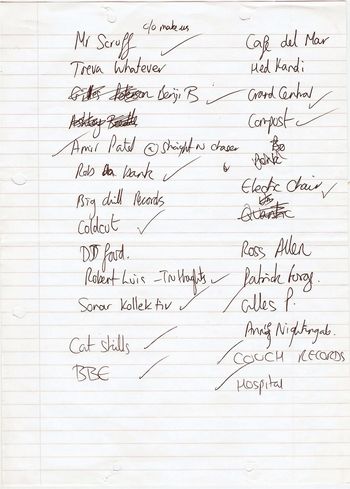
Middlewood Sessions initially released material in conjunction with two London-based independent record labels, both run by established and respected DJs: ‘Fall Back’ on Brownswood Recordings, followed by ‘Red Waters’ and ‘Astro Blue’ as a double A-side on WahWah 45s.Footnote 85 These two 12-inch vinyl releases cascaded from a distribution of demo CDs sent out in September 2006 to a target list containing 25 labels and DJs that were selected because they were associated with music broadly in alignment with what Middlewood Sessions produced (see Figure 2 for the original working document, complete with uncertainties, redactions and re-additions). This blanket mailshot gave rise to the first radio play in the UK by Gilles Peterson on BBC Radio 1 on 12 October 2006. The act of packaging up a demo CD and committing it irretrievably to the postal system indicates the point at which the project had become sufficiently coherent and tangible in musical materials and ethos to inspire enough confidence to share it with others. What was at stake was a judgment about the quality of the four musical works on that CD and about the effectiveness of all the work that had gone into developing the music and the project's identity up to that point.
Working list of labels and DJs (September 2006).

Labels and DJs open up routes of dissemination via radio play, club rotation and sales. In doing so, they represent artists to an audience and, in reversing that flow, an audience to the artists. Record labels and DJs share the same mediatory function; they do not simply convey music from one party to the next, they inflect it. For example, Peterson's reputation is founded upon his work in establishing influential record labels (BGP Records, Acid Jazz, Talkin’ Loud, Brownswood Recordings) and as a radio DJ (from pirate radio stations Radio Invicta, Civic Radio, KJAZZ, Solar Radio and Horizon to legally licensed stations such as BBC London, Jazz FM, Kiss FM, BBC Radio 1 and BBC Radio 6 Music). The persona he constructs, as label boss and DJ, is dependent on his ability to get ‘the finest new music he can lay his hands on’ to populate his shows, which ‘are a marker for everything that is great about underground music’.Footnote 86 His skills lie in the appropriation and dissemination of music previously unheard by his listenership; his audience coheres and endures through the conferment of respect upon Peterson as prescient and tasteful, and through the territories of musical style that are mapped out by his selections. All of this is predicated on the availability of immutable, mobile inscriptionsFootnote 87 such as, in this case, the demo CD which at once represents the ambitions of participants and allows the work of one location to be moved and gathered elsewhere.Footnote 88
Labels and DJs are focal points: they summarize an accumulation of artefacts, a set of values, a group of artists, a stylistic territory and an audience. There is a play of projections, a reciprocal relationship, between labels, DJs, audiences and artists. A loyal and discerning listenership places trust in the label or DJ to curate music of a particular type and quality; if successfully done, the relationship endures. This listenership, by proxy association, becomes the audience of Middlewood Sessions. In the single broadcast on 12 October 2006, the work of the studio project is validated, its musical work is displaced to other locations, and the once-notional audience becomes concretized by the symbolic agency of the DJ. The same can be said of Peterson's decision to release ‘Fall Back’ on his Brownswood imprint, as explained by P1:
I think having been picked up by a label makes the audience actually concrete. Gilles Peterson's got this following, he's got this reputation, he's got this worldwide audience […]. But there's always a notion of audience when you're writing music. Well, certainly from my point of view – I've never tried to generate music purely for itself.Footnote 89
What is the case for a DJ's set is also true for a label's back catalogue. Both are constructs that assemble music to achieve some kind of coherence: in the DJ set, the logic is of a temporal-structural kind, moving the dance floor in a particular way and in a particular rhythm;Footnote 90 for the label's catalogue, the logic is to do with creating a coherent identity that is at once musically and commercially motivated. By becoming part of a DJ's set or a label's back catalogue (curated by the same person in this case), the musical works of the studio project begin to acquire values by their comparative juxtaposition with other musical works. While this sounds like a retreat into reification, it is really an aesthetic proposition because the DJ's set, radio playlist or label's back catalogue (for committed fans) means that musical works are heard, actively, in relation to other musical works. This juxtaposition gives rise to a meaningful aesthetic experience for those making the music, as P2 puts it:
The fact that they play our music right next to […] Jamiroquai and then an Alice Coltrane track – and we're right in the middle of it – it's nice to put us into that context […]. That was actually one of the most interesting things for me, looking at all the set lists from the radio and seeing where it goes and how it fits and attaches with other things.Footnote 91
If back catalogues are stable because they are historical records, then radio playlists represent a state of flux (perhaps because there are more of them and they are intended to be experienced temporally) in which tracks are continually reselected, reordered and recombined. The making and remaking of symbolic constructs, such as set lists, makes and remakes the audience of the music. In this sense, labels and DJs (L) bind a relation between Middlewood Sessions’ music (S,T) and its constellation of influential tracks (R), which has significance for those involved in the project (P and I) and those who listen to its music (A).
Displaced localization
Although the audience is represented, and powerfully so, it remains imagined until it is encountered. Middlewood Sessions performed six times between July 2007 and August 2008: twice at the Runaway Girl and once at the Forum in Sheffield, at the HiFi Club in Leeds, and at Cargo and the Jazz Café in London. The translation from studio to live equates to a translation from one kind of tokening to another. The relationship between performance and recording is inverted; performances are no longer the objects of recording, but recordings the objects of performance. And this inversion requires effort. Porting the material constructed in the studio to the live stage involved the usual activities: rehearsal, logistics (organizing rehearsal space, transport, instruments, equipment), technical specification and negotiation, planning the set and producing materials for performance (scores, instrumental parts, click tracks and backing tracks). With musicians living in different cities, responding to the demands of their jobs and domestic lives, taking holidays at different times, the task of getting all the performers to the same place at the same time was complex.
Performing live is risky, but with risk comes purpose. Live performance provides an opportunity to connect with an audience, where musicianship and material are demonstrated, and listeners hopefully convinced that what they may have known as an audio recording really is the product of this group of musicians they see before them. A live gig provides immediate feedback through the responses of the audience, who will hopefully dance instead of staring back with glazed eyes. The material that was trialled countless times in the studio to an imagined audience is now put through its paces in front of a real, fleshy crowd.Footnote 92 A successful performance maintains or grows the project's following; lines of association will remain open and renewable. An unsuccessful performance leads to a severance of those lines of association, as listeners spend their time listening to other artists. The studio can be used to construct sonic realities that would be impossible and implausible in a live context, but these constructions, fabricated in the studio, are entirely possible and plausible, such is the ‘reality of illusion’ that music technologies foster.Footnote 93 Change the context, shift those constructions to the live stage, then the illusion, as explained by P3, is unveiled:
To recreate even part of [the album] would require quite complicated tracks […]. To leave the improvisation elements in as well […] would mean a very, very complicated play-out system for the [parts] you couldn't fit on stage. And even then, you're probably still talking a 24-piece band to be able to reproduce it. So, that's a big venue just for the stage size, and you'd then need to fill the venue to get the right atmosphere […]. You're probably talking 1,500- to 2,000-capacity venues just to get […] a big enough stage to fit everybody on.Footnote 94
The live stage simultaneously extends and bounds the project. Playing live extends the project to new locations, transcending its familiar territory, but the physical reality of the musical work, as presented in performance, is limited by the size of the stage and the duration of the set. The assembled ensemble on the album is virtual. Musical interactions between the players take place in an illusory place, an entire world of sound constructed without the full ensemble ever meeting. For some tracks, the seven-piece string section was recorded four times to achieve a richer sound with a greater sense of depth. In combination with other multitracked instrumental sections (percussion, guitars, pianos, Rhodes, vocals), some tracks on the album represent some 50 different players.Footnote 95 This number of musicians is entirely plausible virtually but implausible practically for this style of music and its associated venues.
Locational dissonance between different places, and between the virtual and the physical, requires resolution. The venues that Middlewood Sessions played were of the 300-capacity order, and their stages could accommodate eight musicians fairly comfortably. The ‘epic’ and ‘cinematic’Footnote 96 qualities of the music had to be retained (in order for the musical works to be properly tokened), which meant that the sonic presence of all those musicians on the album was necessary too. Technology, in the form of backing tracks, spins a line of association with the amassed ensemble, forged during recording sessions, which could not be physically present on stage. The live performance is tethered to its studio origin, which is another place localized again elsewhere, displaced and replaced, by the live performance. To take away the backing tracks during performance would be to sever this connective thread and to weaken the tokening of the studio project. Technology, then, has a dual effect of causing locational dissonance and resolving it. Sounds, ideas, identities and acoustic properties are captured and stored, later to be retrieved and represented in another place and at another time.
The working process of the studio, gradually gathering bits and pieces together and assembling them one layer at a time, means that the parameters of a musical work emerge, to become complete only at the end of the recording process. Live performance is necessarily complete, however it turns out, and gives musicians a different view of the musical works as they are played out in chronological time. The opportunities afforded by real interaction, happening on stage with other musicians, are celebrated during the time it takes for the lines of association between locations to be traced out, along the M1 between London and Sheffield, by the hired white van, laden with equipment and ideas fresh from the previous night's gig. P2 recollects a discussion that took place during a return journey:
On the way back to Nottingham and Sheffield [after the Cargo gig in London], we had some interesting conversations in the cab of the van […]. [Our drummer] doesn't yet think we're doing his drum kit (which is a very good kit) enough justice […]. I got the sense that he was really signing up to play a greater role in the project. After the Forum gig, when we were packing down, he was saying that now he's played tunes like ‘Fall Back’ and ‘Astro Blue’, he can hear more opportunities for what he might do, ways to reflect the instrumental parts and to draw ideas out of the material.Footnote 97
Instantaneous movement between virtual locations, with music, messages and selves encoded as data, bypasses opportunities for sociality and shared reflection. The physical actualization of the previously virtual, brought about by train tickets, diesel, coordinated diaries and a ‘well-gigged stage’,Footnote 98 has a profound impact upon the attitudes, aspirations and working practices of the studio project, and upon the resulting music. Just as the notional audience is represented symbolically by the record label and DJ, location too gives shape and texture to this ephemeral crowd. The tangible experiences of the hard-brick venue – the flow of movement through its spaces, the temperature, odour and jostle – convert into symbols whose qualities amass during the gig and flow back into the studio. The building uproots from its foundations, transubstantiates from bricks and mortar into weightless mental image, to be carried back along the motorway to take its place amongst the constellation of shared symbols that are recalled and cherished by those carrying out the musical work of bringing about musical works.
Further discussion
Stability: buildings, inscriptions and rituals
Middlewood Sessions was instantiated numerous times over its eight-year lifespan. The one–many relation between the enduring project entity and the diverse work that was carried out is similar to that which exists between a work and its various performances. Middlewood Sessions produced 14 tracks over its lifespan, nine of which made it onto the final album released in February 2012. These tracks are separate musical works that are gathered and ordered as an album, but such is the reality of current reception practice in the stylistic field(s) of popular music relating to Middlewood Sessions that the track delimits the primary unit of a musical work. The tracks are rhythmically, harmonically, melodically, timbrally and structurally distinct while sharing a sense of similarity that binds them together as part of the same project. Importantly, for each of these distinct tracks, or tokens of distinct sound-types, a new studio project was not instantiated. Sound-types are numerous, distinct and individuated, but belong to just one studio project, bound by the work ethics and processes that run through the action-type. Just as musical works must be recognizable for them to be deemed repeatable and individuated, so too must music-making practices (at least if there is to be a chance of them being coherently locatable). Given the fractured nature of creative practices, shattered and scattered across many times and places,Footnote 99 how does a studio project endure? What stabilizes it? This question will occupy the remainder of this article. In response, I propose buildings, inscriptions and rituals as three possible candidates. As Thomas F. Gieryn has it:
Buildings stabilize social life. They give structure to social institutions, durability to social networks, persistence to behavior patterns. What we build solidifies society against time and its incessant forces for change […]. Brick and mortar resist intervention and permutation, as they accomplish a measure of stasis.Footnote 100
Buildings such as studios are design-intensive places,Footnote 101 and design concerns both material and social aspects: ‘Walls and joists are arrayed so that a building is able to stand up, but eventual owners or occupants must also be able to see space that suits their needs.’Footnote 102 The structuring of the building is a structuring of possible social action in what it permits and what it excludes. This is not to say that practice in the studio is propagated purely by its buildings and objects; just that they go a long way towards stabilizing it through their sheer presence and the patterns of behaviour that become established within them. Studios are designed in such a way as to prohibit certain kinds of social interaction so that, for example, the capture of sound is not repeatedly compromised;Footnote 103 they are also designed to make optimal use of the available space for critical and focused audition.Footnote 104
By pointing at the Yellow Arch building, I ostensively indicate the technological and social assemblage that constitutes that studio. The building stands proxy. Social groupings are no less made and remade in this studio than anywhere else,Footnote 105 but the convergent, swarming and necessarily performed continuation is disguised behind the thick Victorian brick walls of the former nut-and-bolt factory. This insulating, isolating architectural property runs through Antoine Hennion's exploration of the role of the music producer as an intermediary between artist and public.Footnote 106 The producer, representing a proxy public, coaxes out, tests and shapes the singer's talents and individualities.Footnote 107 Quoting earlier writing, Hennion states: ‘The studio is a room entirely isolated from the outside acoustically.’Footnote 108 He continues:
This construction, which may be only simple acoustical and architectural technique, materializes in the most palpable sense of the term the key operation of music producers. In order to carry out tests, producers must construct a model. If a full-scale test is too expensive, they have to construct a world in miniature and try to create test conditions there that can be reproduced on the larger scale. The studio is a padded room cut off from the outside world by a heavy, soundproofed door, a room that warns off outsiders with its red light while singers, producers, musicians, and technicians are locked inside.Footnote 109
Once in place, this laboratory-studio acts to pry sonic fragments away from their flesh-and-blood origin, transforming the organic into data to be recombined and reconstructed in the making of a song: ‘After having first served as an isolation tank, then as a place for gathering bits and pieces in order to reconstruct relationships, the studio is transformed into a machine for dissolving its own walls so as to diffuse its experience along ever longer channels.’Footnote 110 This is all well and good for professional studios, but what of project studios embedded into the fabric of domestic life? Of course, Hennion, writing in 1989, could not have predicted the changes to technologies and practices that were about to unfold (nor was that his project). But still, the mobility of technology challenges the laboratory isolation of Hennion's case and therefore the private–public relation that is maintained by the specialized architectural setting of the professional studio. The studio may be deemed a private place because access is controlled (one's presence there is a privilege, and necessarily so – how noisy it would be otherwise), but it is also public because of its commercial existence. One can pay for access.
The domestic project studio demonstrates one of the ‘new modes of public-in-private and private-in-public that disrupt commonly held spatial models of these as two separate “spheres”’,Footnote 111 which are facilitated by technologies that reconfigure where information (and processing power) can be accessed. Mobile computer technologies undermine some of the stability afforded by architectural and locational specificity, contributing to the blurring distinction between public and private identities (private being interpreted in this case as meaning the domestic dwelling-place, and public as meaning such institutions as professional studios that are sonically private but commercially accessible). But these technologies are also fundamental to the propagation of the kind of creative endeavour at issue here in their ability to capture, store and retrieve data – basic processes which lend a sense of continuity, not unlike the score functioning as a repository of information and instructions, giving rise to the illusion of permanence.Footnote 112
Just as Small's conception of music rests upon performance – making and remaking relationships with musical materials, other musicians and listeners at a particular point in one's history – so depends Latour's view of society upon performed continuation. Latour states:
If you don't have the festival now or print the newspaper today, you simply lose the grouping, which is not a building in need of restoration but a movement in need of continuation. If a dancer stops dancing, the dance is finished. No inertia will carry the show forward […]. The object of an ostensive definition remains there, whatever happens to the index of the onlooker. But the object of the performative definition vanishes when it is no longer performed – or if it stays, then it means that other actors have taken over the relay.Footnote 113
To rephrase: if the singer stops singing, the song finishes. Or if the producer stops recording, the recording session ends. But this cannot mean that the studio project ceases to exist, each time brought into existence anew. The studio project endures. It is picked up again at the next session, even though there has been no continual performance of the social grouping (or the musical material). Some other actor must carry the baton: technology. Technology is a continuous actor in rendering music ‘liquid as code’ and encouraging ‘an open sequence in which the closing down of a musical object […] is followed by its potential re-opening and re-creation’.Footnote 114 Although discussing mobile communication technologies, Mimi Sheller's rendering is instructive:
Mobile communication systems allow such persons to become more readily mobile through space because of the greater potential for ‘self-retrieval’ at the other end of the journey. Such identities can leave traces of their selves in informational space (contact numbers for family and friends, bank-account details, pin numbers, and access codes) which allow them more easily to pick up various ‘story lines’ through which their identities are stabilised.Footnote 115
One such storyline would be someone's participation in a studio project – as a singer, drummer, arranger, producer, engineer, visual artist, tea-maker. This participation weaves a thread amongst other storylines, or identities, in the person's life: parent, lecturer, teacher, spouse, academic, racquet-sports player, musician. The possession of a mobile telephone allows an easy ‘conversational coupling’ of ‘a wide range of “absent presences”’, or multifarious identities, in a ‘constant flickering of conversation’.Footnote 116 This coupling, switching and flickering also applies to computer technologies more generally: each of the various identities that constitute a person's life experience can have some trace on the same machine. The same laptop is used to store precious photos of the first hours of a child's life, to access incessant work email, to make a video call to parents one moment and an interviewee the next, and to capture and manipulate audio as part of an ongoing creative enterprise. Layers of identities are represented by the Logic Pro project window, newly opened, recalling the exact moment where work was previously left off, superimposing itself on Outlook, which represents another collection of storylines. Each has a place in the informational space of the hard drive (and beyond) and can be easily retrieved.
Computer technology, in its capacity to store not only data but also traces of identities, provides durability and a measure of stability.Footnote 117 As opposed to analogue media (grooves on wax and vinyl, traces of light on film), digital representations ‘take measurements rather than impressions of what they represent […] they convert information from material into numerical entities’.Footnote 118 Timothy Binkley continues: ‘Of course, one cannot store a number without using some kind of physical object,’ by which he means a hard drive onto which numbers, as data, are written and can be overwritten time and time again.Footnote 119 The placement of this hard drive into a laptop of sturdy construction makes this data physically mobile and, barring accidents and the ravages of time, safe. This computer, with all its connectivity and possible compatibility with other computers, means that this data is virtually mobile through replication onto other servers and hard drives, to be retrieved later. Computer storage technologies allow all manner of representations of things (objects and events) to ‘have the properties of being mobile but also immutable, presentable, readable and combinable with one another’Footnote 120 through the inscription, storage and relay of data. While the storage of data renders the digital representation of something immutable, this state is, ideally, temporary. Data remains immutable during the interim between inscriptions, between recording sessions, until it becomes mutable once again. Just as for the printing press and its products, computer technologies mean that ‘a location can accumulate other places far away in space and time’.Footnote 121 In this case, this accumulation might be the sound of instruments in a location captured during a recording session and stored as digital representation. The inscriptions that computers allow us to make, though physically manifest as ‘magnetic blips’,Footnote 122 provide stability in their rendering of music (or identities or the sonic imprint of architectural spaces) as code; they are mobile and, most crucially during the periods when activity is suspended, immutable (until they are reopened and made mutable again).
While technology continually acts to facilitate the storage and eventual retrieval of data, ideas and identities, the exact objects carrying out this performance changed over time in the Middlewood Sessions project studio. The early technological configuration of Cubase on a single-core PC tower system (including a weighty CRT monitor that required some effort to get to Manchester to record a trumpeter in February 2006) morphed into Logic Pro 9 software on dual-core MacBook Pro. The capabilities of software changed during this period (for example, the possible track counts on sequencing packages increased and the plug-ins available for processing sounds developed),Footnote 123 along with storage capacities and processing speeds. But, regardless of these kinds of changes, the function of the technology – to store inscriptions for later retrieval, serving as both memory and catalyst – remained the same.
Of course, participants in the studio project are not without memory. The deposition of traces of music – representing the emergent collective identity of the studio project, left behind on the hard drive later to be retrieved, recalled, repositioned – constitutes a ‘textual level’Footnote 124 that represents a text of some kind emerging perhaps from an improvisatory, exploratory and collaborative endeavour. This text (in R. Keith Sawyer's study, a script emerging from improvised theatre; in this study, a collection of tracks emerging from a combined effort to make music) has two other levels: at the group level, interactions between participants are symbolic; at the historical level, ‘macrosocial structures and norms emerge over time’.Footnote 125 Both group and historical levels imply some form of repeated, eventually entrenched behaviour that is naturalized and possibly shared by a delimited group such as that made up of participants in a studio project. Shared behaviours, perhaps eventually rituals, will emerge alongside the musical material; these rituals, played out in various locations, provide a degree of durability and stability. Small explains:
Ritual is a form of organized behavior in which humans use the language of gesture, or paralanguage, to affirm, to explore and to celebrate their ideas of how the relationships of the cosmos (or of a part of it), operate, and thus of how they themselves should relate to it and to one another […]. When we take part in a ritual act ‘the lived-in order merges with the dreamed-of order’.Footnote 126
Such ritual enactment captures the aspirational nature of Small's view of musicking – that the relationships we put into play are really those that we desire and long for, representing our view of the world as we would like it to be. Rituals exist on many levels of society, from grand royal and religious ceremonies or large-scale cultural events to those formal or informal patterns of behaviour involving just one or two people, perhaps amongst family groups and friends.Footnote 127 And rituals certainly exist for people collaborating on a music project, whose working methods become established over time in the pursuit of the shared ambitions and aspirations,Footnote 128 in association with technologies and sound structures at the core of the studio project.
Conclusion
To return to where I began, Yellow Arch Studios was one of the places in which Middlewood Sessions was located. Its draw was reputational and architectural in that it had a particular acoustic that some well-known musicians had exploited. Such a spacious and vibrant acoustic derives from the unique dimensions of the live room, which far exceeds the proportions of most domestic rooms. Of course, the acoustics of iconic studios can now be replicated digitally,Footnote 129 and superimposed upon sounds recorded anywhere; the acoustic properties of a location can be mimicked and recreated in the spare bedroom, shrouding sounds with the qualities of another grander or more famous place. Unlike characterful locations such as the live room of Yellow Arch or the grain loft at Wood Lane, the technologies used to retrieve them are not unique. Of spare bedrooms there are many, but in the case of Yellow Arches and Jazz Cafés there is but one of each.
For Middlewood Sessions, the allure of particular places such as Yellow Arch (for its acoustics) and the Jazz Café (for its heritage and audience) was too great to resist; the project had to depart from (and deny) its domestic origins to complete its musical work. It was located in multiple places, each of which played a part in its history and sound. To answer the question of where the project studio is, one has to look for where its parts coalesce, for where the constituent parts of its action-type are tokened along with its sound-types. And once this coalescence has taken place, that location, that point in geographical space of latitudinal and longitudinal correlation, can be gathered up, inscribed digitally and relocated in another place at another time.