INTRODUCTION
To writers on epistemic “stance” has come the inevitable if somewhat belated realization that we should not turn to “individual speakers and single turns as loci of pragmatic meaning” (Kärkkäinen Reference Kärkkäinen2003:22), as earlier speech act-oriented work on epistemic stance had done (e.g., Hübler Reference Hübler1983, Holmes Reference Holmes1984, Ohta Reference Ohta1991). Viewed as an activity (hence “stance-taking” [Kärkkäinen Reference Kärkkäinen2006] and “stance acts” [Du Bois Reference Du Bois and Englebretson2007]), stance should now be returned in its “interactional,” “intersubjective,” “dialogic,” and “sequential” matrix,Footnote 1 creating a rush of possibilities: the possibility of discovering stance in diverse unit types, from intonation units to cross-turn sequences in multiparty talk; the possibility, too, of looking past relatively discrete lexical and grammatical resources for denoting or indexing stance (e.g., complement-taking predicates, modal auxiliaries, adverbials) in favor of larger-scale configurations of signs, which may include nonverbal behavior such as facial gesturing, bodily orientation, or gaze (e.g., Goodwin Reference Goodwin, Hoyle and Adger1998, Reference Goodwin2006; Matoesian Reference Matoesian2005; Haddington Reference Haddington2006; Agha Reference Agha2007:96–103). Some even appeal to cultural presuppositions. Strauss Reference Strauss2004, for instance, invites us to consider “cultural standing” – group-relative norms that classify knowledge into local-cultural categories such as “controversial” or “matter-of-fact,” categories that in turn mediate epistemic stance-taking.
But with every bold step beyond sentences and single speakers, past the propositions over which stance once had scope, we may wonder what remains of epistemic stance in that narrower, more familiar sense: the use of lexical and grammatical resources for evaluating the propositional content expressed by an utterance, whether in terms of “epistemic modality” (expression of degree and type of speaker “certainty”) or “evidentiality” (expression of “information source”).Footnote 2 In her corpus-based research on the epistemic phrase I think in American English, Kärkkäinen Reference Kärkkäinen2003, Reference Kärkkäinen2006 finds this phrase so bleached and given over to its interactional functions that it often serves strictly as a discourse marker. This and related evidence have inspired her to conclude that “[s]howing commitment to the status of the information that one is providing, i.e. marking epistemic stance … [is] an essentially interactive activity” (Kärkkäinen Reference Kärkkäinen2003:183; emphasis in original).Footnote 3
And so the balance swings brusquely from “denotational” to “interactional” planes of analysis (Silverstein Reference Silverstein and Sawyer1997, Reference Silverstein2004; cf. Wortham Reference Wortham2005). Attractive but equally unsettling are definitions of stance that include both the interactional and the denotational. In Wu's (Reference Wu2004) monograph on stance marking in Mandarin, for instance, “stance” means “a speaker's indication of how he or she knows about, is commenting on, or is taking an affective or other position toward the person or matter being addressed” (2004:3; emphasis added). For Kiesling (Reference Kiesling, Kiesling and Paulston2005:96; cf. Ochs Reference Ochs and Miller1993) it is “a person's expression of their relationship to their talk (e.g., certain about what they are saying) and to their interlocutors (e.g., friendly or dominating)” (emphasis added). One wonders whether the inclination to parallelistically juxtapose the propositional and the interactional is motivated partly by the trope of stance itself, which hovers semantically between an embodied posture and a mental one. As alluring as “stance” qua trope may be, it cannot obviously explain itself.
It is with this issue in mind that this article examines the movement from epistemic (or, more broadly, “propositional”; Agha Reference Agha2007) stance to interactional stance – the two senses of “stance” over which Wu's and Kiesling's glosses range. Rather than dismiss or diminish the categorial values of linguistic form-types used to signal epistemic stance in sentence-sized units, these values are repositioned here as “text-defaults” (Agha Reference Agha2007:46; defined below) and studied in relation to distinct forms of reflexive activity (i.e. “activities in which communicative signs are used to typify other perceivable signs,” Agha Reference Agha2007:16; see also Silverstein Reference Silverstein, Basso and Selby1976, Lucy Reference Lucy1993). Reflexivity is not limited to the capacity to refer to and predicate about language and language use – a point many linguistic anthropologists have stressed. To cite a familiar axis of variation, reflexivity can be denotationally explicit, like the explicit primary performatives of classic speech act theory (I bet you sixpence), or the verbs of speaking and manner in the matrix clause of direct reports (said, blurted out, mumbled), which reflexively typify the quoted segment's action (Wortham & Locher Reference Wortham and Locher1999); but more often than not, reflexivity remains denotationally implicit,Footnote 4 and this article calls attention to a vital but underappreciated type of denotationally implicit reflexivity that comes from “text-metrical” (Silverstein Reference Silverstein and Lucy1992, Reference Silverstein2004; Agha Reference Agha2007) or “poetic” structure (Jakobson Reference Jakobson and Sebeok1960). A poetics of stance may permit us to chart the movement from propositional to interactional stance. While lexical and grammatical resources may help interactants fashion a “denotational text” – information flow – the text-metrical organization of these resources in discourse can motivate a second type of text, an “interactional text,” an emergent model of social action and role inhabitance (Silverstein Reference Silverstein and Sawyer1997, Reference Silverstein2004; Wortham Reference Wortham2005; Agha Reference Agha2007). Applied to stance, the claim is this: that the text-metrical organization of propositional stance (orientations toward propositional content) can reflexively motivate construals of interactional stance (orientations toward interactants) (see Agha Reference Agha2007:96–103).Footnote 5
To illustrate this movement from propositional to interactional stance via text-metrical structure, I take as my empirical object epistemic stance marking in Tibetan ‘debate’ (rtsod pa) in India – a form of twice-daily argumentation, a site where we may rightly expect epistemic stance to figure prominently. No comprehensive account of epistemic stance-marking in Tibetan can be offered here, nor a sustained discussion of debate (see Lempert Reference Lempert2005). After describing the primary Tibetan auxiliary verbs, which are central lexicogrammatical resources for epistemic stance marking, I examine the pragmatic effects of their text-metrical organization in a stretch of debate discourse. In describing how poetic structures can facilitate this movement from propositional to interactional stance, this article speaks to recent literature on stance that acknowledges the relevance of poetics (Anward Reference Anward2004, Kärkkäinen Reference Kärkkäinen2006, Du Bois Reference Du Bois and Englebretson2007) but that has not clarified how text-metrical structures contribute to the construal of action and can, in particular, help map one type of stance into another. It is on this issue that the “pragmatic-poetic turn” noted by Silverstein Reference Silverstein2004 becomes invaluable. This turn, which has involved an appropriation of Jakobson's (Reference Jakobson and Sebeok1960, Reference Jakobson1966, Reference Jakobson1968) “poetic function” – an appropriation informed (inter alia) by Peircian semiotics and extended to the study of discourse in all its channels and modalities (Perrino Reference Perrino2002, Lempert Reference Lempert2005, Agha Reference Agha2007) – permits us to describe how interactional stances can be motivated out of propositional ones, such that we can maintain the trope of “stance” in all its alluring polysemy.
TEXT-METRICAL (“POETIC”) PERFORMATIVITY
Jakobson Reference Jakobson and Sebeok1960 famously theorized the “poetic function” as the reflexive foregrounding of message form. As the moniker suggests, we find the poetic function in culturally recognized genres of “poetry,” but it manifests, too, in countless species of oral and written discourse (Jakobson Reference Jakobson and Sebeok1960, Reference Jakobson1966; see Banti & Giannattasio Reference Banti, Giannattasio and Duranti2004). Set off in italics and delivered with a measure of parallelism, his memorable capsule description of the poetic function begs repeating: “The poetic function projects the principle of equivalence from the axis of selection into the axis of combination” (Jakobson Reference Jakobson and Sebeok1960:358). As well noted, Jakobson uses a Saussurean idiom. For Saussure Reference Saussure1983, forms that enjoy the same distributional privileges share a certain semantic “equivalence,” and Jakobson spied an analogous type of “equivalence” afoot on the real-time syntagmatic horizon.Footnote 6 There, linearly co-occurring elements could be scanned for their comparability, for contrast and complementarity, likeness and unlikeness. Though Jakobson felt that the poetic function could be found everywhere, not just in official poetries, subsequent work in ethnopoetics and folklore tended to confine itself to relatively marked forms of language use. Thus Bauman bemoaned the fact that “parallelism has been studied almost exclusively as it figures in highly marked and elaborate systems of oral poetry, such as oral epic or ritual speech … with little or no attention to its use as an esthetic device in conversational contexts” (Reference Bauman1977:19). A decade later, Tannen Reference Tannen1987, Reference Tannen1989 responded, stressing the pervasiveness of the poetic function in conversation through copious observations made from transcribed discourse. Tannen tentatively organized her observations using distinctions like “self-” versus “allo-”repetition (based on who initiates the pattern, self or other), “scale of fixity in form” (based on what elements are carried over, from replicas to repetition-with-variation), and temporal scale (based on the time of onset, immediate or delayed). She also presciently sensed the relevance of cultural reflexivity, the way forms of repetition and variation are mediated by group-relative norms, such as whether repetition itself is prized.Footnote 7
The interactional functions of poetic structure in conversation were many and varied. In Tannen's data these included strategies she captioned as “getting or keeping the floor,” “showing listenership,” “providing back-channel response,” “gearing up to answer or speak,” “humor and play, and “ratifying another's contribution” (Tannen Reference Tannen1989:51 et passim). Other studies then added to the list. Johnstone Reference Johnstone1994, for instance, assembled two volumes dedicated to repetition in discourse, from “echoing” and “mirroring” in therapeutic encounters (Ferrara Reference Ferrara and Johnstone1994) to repetition in air–ground communication (Cushing Reference Cushing and Johnstone1994), expanding (among other things) our appreciation of the functional diversity of poetic phenomena in discourse. As the list of functions expands, so too does a corrosive question: By what means do poetic structures motivate pragmatic construals? Conventional, type-level properties of the poetic pattern, the formal, metrical arrangement of the signs themselves, something else?
Consider the barbs traded by the young males in Goodwin's (Reference Goodwin1990:180) classic study, barbs that often exhibit “format tying”:

Besides the dispreferred second pair-part in this spirited exchange, Chopper opts for tight, cross-turn parallelism, conveniently spotlighting his novel element: the causative make (me). Exchanges like this, observes Goodwin (Reference Goodwin1990:180–1), “display their status as escalations of prior actions – by making use of the talk of prior speaker and transforming it to their advantage; in essence, they turn the prior action on its head.” Indeed, in building on Tony's utterance, Chopper figurates a kind of adversative “escalation.” This exchange exhibits a kind of orderliness that cannot be reduced to the adjacency pair, because the poetic properties of Chopper's response help motivate the construal of ‘opposition’ and ‘escalation’ independently of conventional, norm-based principles of sequential co-occurrence that have been the privileged object of study for Conversation Analysis and related traditions. It would be wrong to try to wrest this parallelistic figuration of action from its co(n)textual moorings and assign to it some independent, categorial pragmatic-poetic value. Dense cross-turn parallelism can signify the very opposite effect – ‘connectedness’ or ‘intimacy’ – as evident in greetings, for instance (e.g., Perrino Reference Perrino2002). Poetic structure is just one of several, concurrent functional resources that should be studied together and in relation to event-independent presuppositions in play at the time of semiosis (Agha Reference Agha1996, Reference Agha2007). As for the fundamental question of how this poetic structure gets its effects, it exhibits iconic, or more precisely diagrammatic motivation, to use a familiar Peircian idiom. For Peirce (Reference Peirce1932:157), diagrams “represent the relations … of the parts of one thing by analogous relations in their own parts” (see also Haiman Reference Haiman1980, Reference Haiman and Bright1992; Bouissac Reference Bouissac1986; Mannheim Reference Mannheim and Duranti2001:102).Footnote 8 And to the extent that this poetic structure functions reflexively, serving specifically as a principle for the construal of action, we may term this a “metapragmatic icon” (Keane Reference Keane1997; Silverstein Reference Silverstein1981, Reference Silverstein2004; Parmentier Reference Parmentier1997) – an image of an act, a figuration of illocutionary force, limned through the text-metrical organization of signs.Footnote 9
What might these reflections on the pragmatic-poetic nexus tell us about stance? In a recent essay on stance, Du Bois Reference Du Bois and Englebretson2007 assigns a generous place to the poetic function. He observes how “speakers build their utterances by selectively reproducing elements of a prior speaker's utterance” (Du Bois Reference Du Bois and Englebretson2007:140; see also Goodwin Reference Goodwin2006:197–198 et passim). By “mapping resonances between juxtaposed utterances in discourse” (140), by teasing out poetic patterns and making them visible in the physical trace – the transcript – Du Bois asks us to examine the dialogicality of stance. “As stances build on each other dialogically,” he writes, “the analogy implied by their structural parallelism triggers a series of interpretive and interactional consequences”. To illustrate with a simple case (Du Bois Reference Du Bois and Englebretson2007:159):
(46) (This Retirement Bit SBC011: 444.12–446.30)

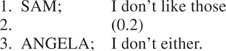
Du Bois (Reference Du Bois and Englebretson2007:159) argues that “[a]nalogical relations are established between the juxtaposed stances (I don't like those : I don't either),” such that “[t]he foregrounding of this dialogic relation potentially invites inferences based on the comparison.”Footnote 10 To highlight forms of cross-utterance and cross-turn parallelism, he retranscribes these stretches of discourse using a transcription format termed a “diagraph” (Du Bois Reference Du Bois and Englebretson2007:166):
(53)

Du Bois (Reference Du Bois and Englebretson2007:166) wishes to consider the “stance differential,” a function of the comparability of parallelistically juxtaposed utterances, assessed in terms of their relative likeness–unlikeness. On a related note, Anward Reference Anward2004 explores what he calls “recycling with différance,” emphasizing not just that interactants selectively reproduce utterance-partials over turns of talk but that the textual juxtaposition of such partials may serve as a sign-vehicle in its own right.
What needs additional clarification is the issue of just how stance differential operates, and especially how poetic structure can put into articulation lexicogrammatical resources for expressing propositional stance. The need for such clarification is evident in a recent essay by Kärkkäinen, who observes that “stance is not only constructed by grammatical or lexical means, but that the sequential occurrence of stance markers and the degree of syntactic, semantic, and/or prosodic parallelism or ‘resonance’ across speakers is also a resource for stance taking” (2006:699). Parallelism or “resonance” isn't just one more resource for stance taking – something separate, which must take its place in an ever-expanding list of stance markers. Poetic structure can put into articulation lexical and grammatical resources in ways that map propositional into interactional stance, hence mediating between two broad types of stance.
It is to this mapping issue that Agha's Reference Agha2007 work speaks, work informed by Silverstein's longstanding research on poetics and textuality in discourse (e.g., Silverstein Reference Silverstein and Schiffrin1984, Reference Silverstein and Lucy1992, Reference Silverstein and Sawyer1997, Reference Silverstein2004). Agha (Reference Agha2007:96–103) has explicitly teamed the study of “propositional stance” (understood as evaluations of propositional content, epistemic or otherwise, anchored to a participation framework; cf. Silverstein Reference Silverstein2004:622–23) with the study of text-metricality. Set within a text-metricalized discourse space, propositional stances become comparable and hence subject to evaluation in terms of their “fractional congruence” (Agha Reference Agha2007:97), their degree of likeness–unlikeness. From the text-metrical comparability of propositional stance, we can – following the tracks of our interactants – discern “emergent alignments and stances among participants,” signs, that is, of interactional stance (Agha Reference Agha2007:96; cf. Goffman Reference Goffman and Goffman1981; Goodwin Reference Goodwin, Hoyle and Adger1998; Goodwin, Goodwin & Yaeger-Dror Reference Goodwin, Goodwin and Yaeger-Dror2002; Silverstein Reference Silverstein2004:622–23).
Of note is the way Agha Reference Agha2007 offers a well-defined place for the categorial values of linguistic form-types,Footnote 11 such as the lexicogrammatical resources for propositional stance marking, yet he demotes these by calling attention to their precarious status in discourse as mere “text-defaults,” “in the sense that the item regularly conveys a set of effects in the absence of interference from co-textual effects” (2007:39). Linguistic forms so conceived supply interactants with default values that are modulated by effects projected by the signs with which they co-occur as elements of their co(n)text, which he terms a “text-configuration.” Semiotic effects produced concurrently by distinct functional principles (that is, as part of text-configurations) can “illuminate each other during usage,” and “are reciprocally reflexive when considered in relation to each other” (Agha Reference Agha1996:470). In a simple case like Bill Clinton's old slogan bridge to the future, Agha notes the juxtaposition of future (an abstract noun) and bridge (a concrete noun); in men are wolves, similarly, we have two semantically +animate nouns, only the first of which is +human. Comparable units (bridge : future, men : wolves) partially converge and partially diverge, exhibiting “fractional congruence” – by-degrees likeness–unlikeness between text-partials. For some, these fractionally congruent text-configurations may prove readable, serving as a coherent sign-vehicle in their own right: Men succumb to base, “bestial” desires; President Clinton offers the nation real, “tangible” progress. Agha describes a range of more complex cases, especially those featuring deictic expressions (in particular, spatial deictic forms in English, Mayan, and Lhasa Tibetan). Here again he considers the textual mutability of categorial deictic values, noting the diverse ways in which a text-configuration can diverge from the values of its text-partials. A text-configuration featuring deictic forms may, summarizes Agha –
(a) specify more fully the categorial effects of a deictic token; or
(b) render defeasible (i.e., partly deform or cancel) some dimension of categorial content, such as one or more of its text-defaults; or
(c) constitute effects notionally distinct from deictic-categorial content (Agha Reference Agha2007:49)
Agha's remarks on text-configurationality and fractional congruence usefully reposition the study of categorial values in language, incorporating but subordinating them within the study of textuality.Footnote 12
Two points should be underscored here. First, text-metrical structures “do” things by serving reflexive functions in discourse; specifically, they diagrammatically motivate pragmatic effects – including stance effects – by “measuring” out the signs they comprise into comparable, cardinally ordered units (Silverstein Reference Silverstein2004). Second, poetic structures incorporate lexical and grammatical resources in ways that permit us to model the “movement” from utterance-level propositional stance to cross-turn interactional stance. It is in this sense that text-metrical structures can be said to mediate between two broad categories of stance effects and are not just one more resource for stance-taking.
AN EXERCISE IN THE POETICS OF STANCE IN TIBETAN BUDDHIST ‘DEBATE’ (rtsod pa)
Tibetan Buddhist ‘debate’ (rtsod pa) is the premier vehicle for learning and language socialization at the major Tibetan Buddhist monasteries of the Geluk sect, including the diasporic Geluk monasteries built in southern India in the early 1970s (Onoda Reference Onoda1992; Perdue Reference Perdue1992; Dreyfus Reference Dreyfus1997, Reference Dreyfus2003). Pedagogically, this agonistic form of face-to-face argumentation promotes logical acuity and helps monks understand the intricacies of Buddhist doctrine. Propadeutically, it readies monks for the next phase of their career, which normatively involves a focus on the meditative arts. Educationally, debate can make or break educational identities, for symbolic capital in the monasteries is largely allocated based on competence in this dialogic practice; those who fare poorly on the debating courtyard will likely find themselves shuttled into lower-status, service-oriented work at the monastery. As with many types of argumentation, debate is accompanied by a textual ideology that privileges propositionality. This ideology stipulates that all the propositions expressed in the innumerable pages of authoritative Buddhist doctrine cohere, if approached with hermeneutic sophistication and care. On the debating courtyard, monks deliberately place this ideology in jeopardy. The fate of this textual ideology is put in the hands of the incumbents of two distinct speech-event roles in debate: the “challenger,” who is obliged to sunder interpropositional coherence and threatening the textual ideology, and the “defendant,” who performatively maintains coherence, rescuing the ideology. If the defendant succeeds, if he holds tradition's claims together, he ritually reproduces the textual ideology – the sense of doctrine's wholeness, a foundation on which the monastic order can continue to rest. In the same breath he presents himself as knowledgeable (Lempert Reference Lempert2005).
Expectations of epistemic commitment are asymmetrically distributed across these two speech-event roles. By default, epistemic commitment is not expected of challengers, who must counter the defendant indefatigably and at any expense, even if it means advancing a blatantly counterfactual claim (Lempert Reference Lempert2005). A philosophy tutor of mine once recounted with amusement and admiration how a rhetorically gifted challenger once coaxed a defendant into declaring that carrots were sentient, a proposition no Gelukpa would accept. One monk reduced this to a baldly stated rule of thumb: If a defendant says something is so, the challenger should counter that it isn't, and vice versa. Monks who inhabit the challenger role should not submit to favoritism or succumb to discrimination. Friendships are to be suspended and status ignored. No heed is to be paid to the defendant's identity whatsoever. In certain cases – cases where one's own teacher sits as defendant – most monks confessed that they tended to be more circumspect, less likely to deliver severe taunts, for instance. Some recommended using honorific forms liberally when reincarnated lamas sit as defendants. (Indeed, I noticed not only a tendency for challengers to use honorific forms for such high-status defendants but also that the onset of taunts occurred later for reincarnated lamas than for ordinary monks.) Still, the vast majority stated that challengers are obliged to be – to use a much maligned word – objective. Challengers must perform operations on the defendant's discourse regardless of who the defendant is and what challengers themselves really think about the matter, and I should add that in non-debate contexts monks involved in the curriculum were often quite firm and forthcoming with their opinions on a range of philosophical issues. In contrast to the challenger, the defendant is obliged to evaluate the propositions thrust at him, and from him epistemic commitment is, indeed, expected (on this point see Dreyfus Reference Dreyfus2003:211, but on forms of displacement see Lempert Reference Lempert2007b). It is the defendant's knowledgeability that is on trial. It is where he stands that counts.
Auxiliary verbs as resources for epistemic stance marking
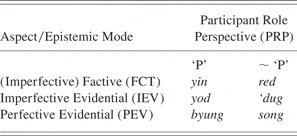
In terms of lexicogrammatical resources for epistemic stance-taking in what some have called “Standard Spoken Tibetan” (Tournadre & Dorje Reference Tournadre and Dorje2003), the variety used in this debate, auxiliary verbs are central. The only obligatory element of the clause is the predicate, and the simplest predicate consists of an auxiliary verb (Agha Reference Agha1993). As Agha Reference Agha1993 clarifies, the six primary auxiliaries are portmanteau predicates that code aspect, epistemic mode, and a grammaticalized indexical category that he terms “participant-role perspective” (see Table 1Footnote 13).
Primary auxiliary verbs in Lhasa Tibetan (from Agha Reference Agha1993).

Participant-role perspective is a type of verb indexicality whose value depends on sentence-level illocution type: the “personal” or participant-indexing auxiliaries (yin, yod, byung) index ‘speaker’ in assertions and ‘addressee’ in questions; the parallel set of auxiliaries (red, ‘dug, song) are “impersonal,” or better, participant-nonspecific (for a sustained discussion, see Agha Reference Agha1993; cf. DeLancey Reference DeLancey1992, Reference DeLancey1997).Footnote 14
Figure 1 lists a series of subjectless sentences, but we can “recover” the null subject through attention to participant role perspective. (In examples [a] and [c] the yin predicate functions as a copular verb; in [b] and [d] it functions as an auxiliary.) As (a) and (b) are in assertoric mood, yin indexes ‘speaker’, inviting us to infer that the subject is ‘I’. As (c) and (d) are questions, they invite us to infer that the null subject is ‘you’.
Participant role perspective (PRP) in Tibetan auxiliary verbs. P = Participant specific (P.AUX), ‘personal perspective’ (Source: Agha Reference Agha1993).

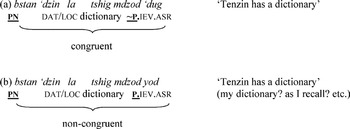
When topical noun phrases do occur, interaction effects with the auxiliaries result, yielding subtypes of “certainty” (based on the factive predicate) and subtypes of epistemic “warrants” (based on the evidential predicates; for details, see Agha Reference Agha1993). In Figure 2, sentences (a) and (b) are denotationally equivalent, ‘Tenzin has a dictionary’; the auxiliaries ‘dug and yod are both imperfective evidentials, equal in respect of both aspect and epistemic mode, differing only in respect of participant-role perspective, ‘dug being participant-nonspecific, yod being participant-specific – a “personal” perspective verb.
Interaction effects of topical noun phrase and verb indexicality.

In (a) the ‘dug auxiliary is participant-nonspecific and hence congruent with the co-occurring topical NP (‘Tenzin’). Not so for (b), for here we have the same topical NP but with a personal-perspective verb in assertoric mood, indexing ‘speaker’. Line (b) is not ungrammatical; it simply requires a special context to be judged appropriate. Verb indexicality on the auxiliary minimally creates the sense of some kind of “personal” association or involvement, and the rest is resolved through contextualization. (Perhaps Tenzin has ‘my’ dictionary. Perhaps this is a recollection [‘as I recall, Tenzin has a dictionary’].)
In addition to the six primary auxiliaries, there is a gnomic auxiliary verb yog red, where the proposition is modalized as ‘generally known to be true’.

The epistemic warrant here, the alleged information source, is anchored not to a proximal speech-act participant but to a generic information source.Footnote 15 No exhaustive account of these resources is possible here, of course. I have highlighted only a few epistemic stance effects, those that facilitate an understanding of the debate discourse considered next. The focal contrast in the debate segment, as we shall see, is that of the participant-indexing factive predicate yin versus the gnomic auxiliary yog red.
Stance and counter-stance in the opening moments of a debate
The debate discourse considered below is drawn from a roughly 45-minute Rigchung preliminary debate I recorded in the summer of 2000 at Sera Mey monastic-college in Bylakuppe, India.Footnote 16 Intracollegiate and reserved for monks who have finished a rigorous, roughly six-year course of debate-centered philosophical study, the Rigchung debates are, expectedly, a prestigious affair. With only 16 candidates permitted annually, obtaining candidacy is no easy feat. Before the Rigchung debates convene in August, the candidates must make rounds through the college's regional houses (khang mtshan), where they serve as defendant for evening debate sessions, typically two back-to-back sessions, each of 45 minutes. By default, the defendant is presumed to be knowledgeable; he is, after all, one of only 16 monks to stand for this prestigious annual debate. Nowhere is this status more transparent than in his seat. In the debate hall where this event was recorded, the defendant's seat is the highest, the most embellished, and the closest to the room's altar area where statues and paintings of Buddhist deities and lineage masters are arrayed.
Yet there is something suspect – sinister even – about this scene, for isn't this junior defendant rather presumptuous to enjoy such a majestic seat? In Sera Mey's main assembly hall a similar seating arrangement exists but only a very high-status monk (the abbot or abbot emeritus, typically) would dare occupy its central seat. The defendant, then, is invited into the highest-status seat in the room, and this discrepancy between the status of the seat and the status of the occupant creates dramatic tension: Will the monk-defendant live up to the presumption of knowledgeability, or will he falter?
And he can falter almost immediately. For the defendant, the most anxiety-ridden moment occurs in the first few seconds. In a customary opening salvo for this type of debate, the challenger lobs at the defendant three syllables drawn from a section of the textbook on which the debate will later focus. The defendant must recognize the line from which these syllables are torn – and quickly, for should he demur, he risks drawing taunts from the challenger and audience. Debate thus begins as a test of the defendant's memory, after which the test of logical acuity and knowledge, the debate proper, begins. With the three-syllable-long fragment recognized, the defendant must, with the challenger's prodding, reconstruct the clause and sentence from which those syllables were torn, working backward. In an alternating, dialogic fashion, challenger and defendant then begin to reconstruct the pieces of the clause and the line, after which the defendant names the subsection that houses the line, the sections that house the subsection, the chapter that houses all the preceding, and so on, until he has meticulously established the three syllables' provenance. To the extent that the challenger works in concert with the defendant, they seem to establish consensus on what their monastic-college's authoritative text says. But just when they establish consensus, the challenger, and those who later rise from their seats to join him, begin to destroy this impression of coherence, threatening the textual ideology that ascribes interpropositional unity to the canon of authoritative Buddhist doctrine. Even before this turn from consensus and dissensus, before this turn against the hallowed textual ideology, the challenger's stance-behavior foreshadows the debate's fateful trajectory. (Underlining in the free translation column indicates material from the monastic textbook.)

Line 4b is the defendant's first response, his chance to demonstrate that he recognizes the three-syllable-long fragment. And demonstrate he does, as evident from the epistemic stance effects he creates by the auxiliary and by mood marking.

In terms of the interaction effects of topical NP and verbal indexicality in the auxiliary, 4b is in assertoric mood, so the participant-indexing yin predicate indexes ‘speaker’, yet the topical noun phrase here (the nominalized clause ‘because one will turn away’) does not denote anything straightforwardly interpretable as ‘speaker’ or speaker-related. This apparent noncongruence is easily resolved once we note that the nominalized clause is independently recognizable to monks as a citation from a Buddhist philosophical text. In fact, the clause is drawn from a chapter on the topic of “refuge,” the foundational act in which Buddhists commit themselves to the Buddha, his doctrine, and his community – collectively known as the Three Jewels. The line describes the risk of abandoning or “turning away” from the Three Jewels, the objects of refuge. If one lacks knowledge of suffering in the world and lacks the conviction that the Three Jewels can save one from that suffering, one's refuge won't be stable, the passage suggests.Footnote 17 Two key contextual facts are relevant here: The topical noun phrase is a citation from a textbook under discussion, and debate is a test of memory, not just one of logical acuity. Together these help motivate the construal that a “recollection-perspective” epistemic stance effect is in play, an effect we might gloss ‘as I recall’. (This type of epistemic stance effect is quite common in debate.) In addition, we may note the directive-assertive mood marker da, freely translated here as ‘so take note’. The defendant seems eager to broadcast his success at recollection. (I return to this point later, but for a detailed treatment, see Lempert Reference Lempert2005.)
How does the challenger respond to the defendant's first move? Figure 3 re-presents lines 4b through 10b in a more schematic fashion, teasing out the cross-turn parallelism in an effort to appreciate the poetics of epistemic stance and its pragmatic significance. (Orthographic transcription of debate discourse has been omitted here, and the propositional content has been reduced to variables [a, b, c, d]. Free English translation remains below each line. Line 7b is set apart because it represents a break in the poetic structure, as described below.)
Cross-turn parallelism (lines 4b–10b).

In line 7a the challenger (C) repeats the defendant's (D) utterance with word-by-word fidelity, down to the quotative clitic,Footnote 18 though paralinguistically he introduces a dip in relative loudness. A parallel move appears in line 10a–b, with D repeating with fidelity what C just said in 9a–b, also adding a quotative clitic framing; though instead of lowered volume, he initiates latching, leaving no perceivable gap between his utterance and the challenger's (more on this contrast later). Another parallel is seen in line 5, where C responds to D's recollection-perspective epistemic stance with a backchannel vocalization, mm. In parallel, in line 8, we see D respond to C's epistemic stance in like measure, mm. In brief, D initiates patterns in text-segment 2 (7c–10b) that parallel C's behavior in text-segment 1 (4b–7a). In brief, we have a symmetrical ABCC–ABCC text-metrical structure. This parallel structure invites us to compare the two key epistemic stance effects, whose similarities and differences now stand out.
To appreciate the challenger's epistemic stance in 7c, let us first consider what looms in the middle of this otherwise elegant parallel structure. Line 7b represents a break in the poetic structure. Until line 7b, C seems to pay obeisance to D; at the very least, he makes no effort to disturb the presumption of D's knowledgeability. (For others ways in which C does this before and just as the debate begins, see Lempert Reference Lempert2005.) Recall C's backchannel vocalization following D's epistemic stance, as well as the lower volume that accompanies his repetition of D in line 7a. We should also recall that D didn't just inhabit a recollection-stance perspective; he added a directive-assertive mood marker, which helps transform this epistemic stance into a demeanor-indexical, an sign of speaker-knowledgeability. In 7b, where the poetic structure breaks, the challenger fires off a formulaic expression used in debate, ‘it follows that it isn't so’. This expression denotes opposition to an unstated claim attributed by default to the defendant. It is a frozen form that challengers typically use to initiate topic shifts; it suggests that a new line of argument is imminent. Indeed, a closer look at C's epistemic stance in 7c, reveals how his obeisance begins to wane. D had indexed personal knowledge with his recollection-perspective epistemic stance and added a directive-assertive mood-marker to boot (“I remember that line!” as it were). Rather than index personal knowledge, C does the precise opposite: he uses the gnomic auxiliary yog red, epistemically anchoring his utterance in an impersonal, generic information source. And rather than use a directive-assertive mood marker (da), C opts for a confirmation-seeking question, shifting the indexical focus back toward his interlocutor, D. These text-metrically juxtaposed epistemic stances thus appear as inverse icons of each other, like mirror-image symmetry. Since our interactants are in the throes of discussing Buddhist doctrine, this generic voice may be specified as the impersonal voice of tradition. In context the auxiliary yog red acquires gnomic-evidential overtones, with doctrinal tradition understood as the implicit information source. Taken together, through this poetic juxtaposition of epistemic stance and counter-stance, the challenger performatively undermines the defendant's self-focused claims to knowledgeability. He “subordinates” the defendant's personalized claim within a claim about generic knowledge, putting the defendant in his place – on a lower peg in a hierarchy, shadowed by tradition, to which everyone, defendant included, owes obeisance.
And the challenger's move is not without effect, as evidenced by the role reversal that ensues in text-segment 2. D acts just as C had acted – deferential. To be sure, he does not entirely relinquish his claims to knowledgeability. Though he repeats C's utterance in line 10a–b, he does not lower his volume as C had done, but rather latches with C, coming in right on his heels, without perceivable pause. Nor does C fully abandon obeisance, for again he lowers his relative volume in 9a–b. When the debate proper begins minutes later, the challenger's obeisance completely gives way, his speech becoming peppered with verbal taunts and punctuated by blistering hand-claps that tend to explode ever closer to the defendant's seat (see Lempert Reference Lempert2005).
At this tender moment so early in the debate, then, the challenger inhabits an epistemic stance (line 7c) that is an inverse icon of the defendant's in line 4b. In context this counter stance amounts to a type of pragmatic-poetic opposition, specifically an attempt to subordinate the junior defendant to doctrinal tradition. And it works. It sparks a (partial) role reversal, a reversal of fortune for our defendant, for the defendant begins to demonstrate a measure of interactional subordinance toward the challenger. (The role reversal itself can be seen as indirect evidence of the salience of the challenger's move in 7c.) As should be evident, the illocutionary force of epistemic stance marking here isn't neatly localizable; it cannot be pinned on a single utterance or even on two adjacent utterances. This stance-centered drama becomes evident only when utterance-level stance effects are situated within an emergent, cross-turn text-metrical structure. Consequently, the challenger's act of subordination is not detachable. Were we to isolate out a text-partial, a fragment of this text, the illocutionary force vanishes. Absent here are explicit primary performatives (‘I challenge you,’ etc.), which are relatively localizable and which can be reported after the fact as evidence of deeds performed. This is not to say that monks avoid denotationally explicit forms of metapragmatic reflexivity (i.e., metapragmatic discourse; see Silverstein Reference Silverstein and Lucy1992). Perhaps the most damning taunt a challenger at Sera Mey can deliver is, ‘[you] contradict text, [you] contradict scripture’! (dpe cha dang ‘gal / phya dpe dang ‘gal) (for other taunts, see Lempert Reference Lempert2005), where ‘contradict’ (‘gal) reflexively typifies the defendant's behavior as a gross moral-exegetical transgression. Like other debates in my corpus, this debate is replete with verba dicendi such as the imperative of ‘say’ (labs), uttered by challengers – sometimes in rapid-fire fashion – as they press the defendant to answer their questions. Even in the swatch of discourse analyzed above, we see a modest denotational contribution made by the challenger's formulaic expression of opposition (7b, ‘it follows that it isn't so’). Though the challenger's formulaic expression denotes opposition and indexes the expectation of a subsequent turn “against” the defendant – thus serving as reflexive principles for the construal of action, too – the brunt of the reflexive metapragmatic labor is assumed by the poetic structure. It is the poetic structure that puts into articulation lexicogrammatical resources for epistemic-stance marking, fashioning them into a metapragmatic icon of subordination to doctrinal tradition. Though fleeting, the challenger's move foreshadows the debate's plot, for only minutes later this same challenger and the other challengers who join him on the debating floor begin in earnest to “unsettle” (Goldbert Reference Goldbert1985) the defendant, to sunder the textual ideology that the defendant must uphold and overturn the presumption of his knowledgeability.
DISCUSSION
A virtue of Du Bois's Reference Du Bois and Englebretson2007 essay on stance is its integration of diverse literature, which ranges from work on assessment and alignment to work on epistemic modality and evidentiality. All this he consolidates into a geometric figure, the stance “triangle,” a visual heuristic for stance's purportedly multifaceted nature. A “triune” act or “tri-act,” stance taking involves three interrelated events, as he sees it: “In taking a stance, the stancetaker (1) evaluates an object, (2) positions a subject (usually the self), and (3) aligns with other subjects.” Though distinct, the three are “subsidiary acts of a single overarching, unified stance act” (Du Bois Reference Du Bois and Englebretson2007:163). Viewed through Du Bois's framework, this article can be said to clarify the relations between the “evaluation” vector (a subject's evaluation of a stance object, here by means of lexicogrammatical resources for expressing epistemicity) and the “alignment” vector (a subject's orientation toward another subject). The text-metrical (poetic) organization of proposition-centric evaluations diagrammatically motivates alignment effects, we might say.Footnote 19 In their reflexive capacity, their capacity to serve implicit metapragmatic functions, text-metrical structures can therefore mediate between two broad categories of stance effects. So conceived, poetic structure acts as a pivot, permitting movement from propositional to interactional stance.
Several parting clarifications are in order, however. First, text-metrical structures are, as noted, just one way of metapragmatically regimenting discourse, of reflexively bringing a measure of determinacy to the construal of action. In discourse, we typically find congeries of metasemiotic activity, from the denotationally explicit to the implicit, from the relatively discrete (e.g., performative verbs) to the configurational (e.g., cross-turn parallelism). In this traffic of reflexive activity we should acknowledge, too, the presence of event-independent “cultural” presuppositions, which risk escaping attention because they are not empirically manifest in transcripts. Though admittedly underrepresented here (save for the note about debate's role-based norms of epistemic commitment) and in most work on stance, group-relative cultural presuppositions also mediate stance taking (Haviland Reference Haviland1989, Strauss Reference Strauss2004), perhaps even serving as conditions on the intelligibility of certain stance effects.
Second, left underexamined is the issue of the relative scale of poetic structures. Du Bois rightly does not wish to confine “dialogicality” to the symmetric alternation of speech-act role inhabitance across turns of talk and the cross-turn parallelism of propositional stance that results. He views dialogicality expansively, seeing it either “immediately within the current exchange of stance utterances, or more remotely along the horizons of language and prior text as projected by the community of discourse” (Du Bois Reference Du Bois and Englebretson2007:140; cf. Bakhtin Reference Bakhtin1981, Agha Reference Agha2005, Silverstein Reference Silverstein2005, Lempert & Perrino Reference Lempert and Perrino2007). Cultural presuppositions and interdiscursive dialogicality – virtual, in absentia phenomena par excellence – remind us of just how cramped transcripts can be, how they can prematurely delimit the range of perceivable stance effects (Lempert Reference Lempert2007a). While the artifactual and theory-laden character of transcription is a familiar topic (e.g., Ochs Reference Ochs and Schieffelin1979; Edwards & Lampert Reference Edwards and Lampert1993; Duranti Reference Duranti1997:122–161), methodologically it is worth asking whether stance effects can be directly induced from observables “in” the transcript, as if stance were as localizable as the trope of “stance” suggests.
Third, I intend “interactional stance” strictly as a provisional term, an analytic placeholder. For certain ends, we may indeed want to resolve “interactional stance” into distinct but related activities or processes (e.g., positioning and footing [Schiffrin Reference Schiffrin, De Fina, Schiffrin and Bamberg2006a, Reference Schiffrin2006b], positioning and alignment [Du Bois Reference Du Bois and Englebretson2007]). What is more, the stark “propositional” – “interactional” stance dichotomy recapitulates widespread representation-versus-interaction dichotomies (including the division into “denotational” and “interactional” textuality), most of which appear to be responses to hegemonic referentialist language-ideologies from which we just cannot seem to escape. The parallelistic structure here (denotational text : interactional text :: propositional stance : interactional stance, etc.) formulates the second element, the interactional half, as a rejoinder to all those who would privilege the former, and in so doing it risks ironically reinscribing the referentialist ideologies that incited this insurrection in the first place. “One has simply to get beyond denotation (reference and modalized predication) in the way one looks at communication,” enjoins Silverstein (Reference Silverstein2006:276) in his recent reflections on the divides between the traditions of pragmatics, discourse analysis, and linguistic anthropology. Once we truly register this – or perhaps in order to poetically coax ourselves into registering this – we may wish to dissolve and recompose these distinctions, perhaps opting for a meter of three, as Du Bois proposes.
Like most tropes incorporated into our technical lexical registers, stance refuses to submit to its post-theoretical value. Its career from folk term to analytical term is hardly linear, as may be sensed when authors seem predisposed to juxtapose the denotational and the interactional when they gloss it. While such juxtapositions spur us to take interaction seriously and caution against reducing epistemic stance to some extra-interactional semantic “coding” of subjectivity, they also expose the uncomfortable, untheorized space between these two senses of stance. Stance taking in discourse may be merely one place to witness text-metricality, as noted by Kärkkäinen (Reference Kärkkäinen2006:722) when she writes, “Stance-taking sequences are simply one frequent environment where such resonances are readily observable”; but text-metricality, for its part, may lend coherence to a multifaceted conception of stance.