

The claim that joint democracy decreases the probability of war is widely accepted in international relations. While there may be other explanations for the absence of conflict among those states that happen to be democratic, such as the adoption of liberal economic policies and/or joint membership in international governmental organizations, most scholars believe that democracy itself is an important force for peace.Footnote 1, Footnote 2 One reason that scholars remain skeptical of attempts to dispute the empirical association between democracy and peace is that the theoretical explanations for why democracies ought to be less conflict prone have proven quite fruitful, with many of their additional observable implications gathering support. Many believe the democratic peace is no longer an isolated empirical finding but the foundation of a mature research program (see e.g. Ray Reference Ray1995, Reference Ray2003).
In many ways, selectorate theory lies at the heart of this research program. It not only accounts for many patterns with respect to international conflict (Bueno de Mesquita et al. Reference Bueno de Mesquita, Morrow, Siverson and Smith1999; Morrow et al. Reference Morrow, Bueno de Mesquita, Siverson and Smith2006), but also international cooperation (Bueno de Mesquita and Smith Reference Bueno de Mesquita and Smith2007, Reference Bueno de Mesquita and Smith2009),Footnote 3 the provision of public goods, institutional change, leadership tenure, and many other domestic-level outcomes (Bueno de Mesquita et al. Reference Bueno de Mesquita, Smith, Siverson and Morrow2003). Until recently, it was also one of few explanations for the democratic peace that had been formalized.Footnote 4, Footnote 5
Recently, Clarke and Stone (Reference Clarke and Stone2008) argued that the proxy variables used to measure the key concepts of selectorate theory largely do not account for the relationship between democracy and the outcomes of interest. Yet, even if we accept their claim,Footnote 6 one might wonder whether this reflects the crude nature of the measurement of the theory’s key variables or whether there is a fundamental flaw in selectorate theory itself.
We seek to demonstrate the latter. Specifically, in this article, we show that a few particular modeling choices in Bueno de Mesquita et al. (Reference Bueno de Mesquita, Morrow, Siverson and Smith1999, Reference Bueno de Mesquita, Smith, Siverson and Morrow2003) prove critical for their primary conclusions with respect to democratic governance – namely that pairs of democracies are unlikely to come into conflict with one another because they are compelled to try harder to win their wars and that democratic leaders have little choice but to provide public goods if they wish to remain in office. The modeling choices that produce these results are neither required nor justified by the core assumptions of selectorate theory. They are also, we believe, difficult to defend substantively. That they appear necessary for some of the most celebrated results of selectorate theory is therefore quite troubling.
Our goal, to be clear, is to bring these shortcomings to light – no more and no less. At various points below, we will derive results that are clearly at odds with existing empirical observation. We do not expect anyone to believe these results. Our purpose is not to generate new testable hypotheses, as one often does with theoretical models, but to elucidate the logical implications of the core assumptions of selectorate theory.Footnote 7 Insofar as selectorate theory has played a key role in the field, as discussed above, we see value in this. However, we do not wish to misrepresent our work. We believe that our analysis convincingly shows that selectorate theory neither provides a compelling explanation for the democratic peace nor for the greater provision of public goods by democratic leaders. That the models we use to build this argument yield observable implications that lack face validity is no more relevant, for our purpose, than the absence of many key features of real-world politics.
We develop our claims by analyzing simple formal models that are designed to capture what the authors themselves identify as the critical assumptions of selectorate theory while avoiding some of what we believe to be more problematic features of their models.Footnote 8 Specifically, the terms of the ‘negotiations’ found in Bueno de Mesquita et al. (Reference Bueno de Mesquita, Morrow, Siverson and Smith1999) are not chosen by the actors themselves, nor is the consent of both parties required for such an outcome to be reached in lieu of war, and Bueno de Mesquita et al. (Reference Bueno de Mesquita, Smith, Siverson and Morrow2003) assume that leaders retain office so long as a sufficiently large number of people are made better off by their doing so, regardless of whether any individual member of the selectorate actually profits directly from supporting the leader. In other words, the democratic peace obtains in Bueno de Mesquita et al. (Reference Bueno de Mesquita, Morrow, Siverson and Smith1999) because the authors assume away one of the defining features of the international system,Footnote 9 while the link between public goods and political survival hinges upon the assumption that collectively desirable outcomes will occur even in the absence of clear incentives for individuals to adopt the strategies that would produce them.Footnote 10
We begin by demonstrating that even if democratic states try harder in war, it is still not clear that we should expect pairs of democracies to be less likely to come into conflict than other pairs of states. The democratic peace obtains in our simplified model if peaceful outcomes can be unilaterally imposed, as they are in Bueno de Mesquita et al. (Reference Bueno de Mesquita, Morrow, Siverson and Smith1999). However, once we model negotiations as a simple ultimatum, an approach popularized by Fearon (Reference Fearon1995), it does not. Instead, we find that war becomes less likely as the size of the first state’s winning coalition increases, but becomes more likely as the second one’s does so. In other words, if negotiated agreements are reached only after one state proposes terms to another, and the latter finds those terms acceptable, then selectorate theory cannot explain the democratic peace but instead predicts a pattern that is at odds with the empirical record.
We next demonstrate that the core assumptions of selectorate theory do not unambiguously indicate that democracies provide public goods. Bueno de Mesquita et al. (Reference Bueno de Mesquita, Smith, Siverson and Morrow2003) assume that the only relevant calculation is whether members of the incumbent leader’s winning coalition would expect to receive more goods if the leader was retained than if she was replaced. This, in effect, forces members of the selectorate to ignore the very defining feature of public goods – that they do not individually need to support the incumbent in order to enjoy any public goods she will provide if retained, though they must do so in order to receive private goods. This would not matter if support for the incumbent increased her likelihood of surviving in office, but as the size of the selectorate increases, that effect quickly grows negligible. We are by no means the first to argue that instrumental rationality provides a poor explanation for voter behavior, but we think the implications of this for selectorate theory, which claims to derive the democratic peace and good governance from models based almost entirely upon instrumental rationality, have been overlooked.Footnote 11
Finally, we consider an extension where leaders choose between private goods, public goods, and club goods – which are non-rivalrous in their consumption but are excludable.Footnote 12 Although the core assumptions of selectorate theory do not give us much reason to expect leaders of more inclusive regimes to provide public goods, they do indicate that such leaders would provide club goods. Thus, we argue that selectorate theory provides a compelling explanation for why leaders of more inclusive regimes implement policies that benefit large numbers of people while leaders of less inclusive regimes reward a small number of cronies, but we note that the core assumptions of selectorate theory do not give us reason to believe that any leader will serve the interest of their entire population. The relative proportion of winners may be greater in democracies, but in politics there are always winners and losers.
We begin with a brief review of selectorate theory. We then present a simple model of crisis bargaining, followed by a simple model of leader selection. We then discuss the implications of our analysis before concluding.
Selectorate theory and the democratic peace
The literature on the democratic peace grew out of the observation of an association between joint democracy and a reduced likelihood of conflict (Babst Reference Babst1964; Bremer Reference Bremer1992; Maoz and Russett Reference Maoz and Russett1993). Two general approaches to explaining this have emerged: one focuses on norms, one on institutions. Recently, scholars have gravitated toward the institutional approach,Footnote 13 which place the emphasis on electoral accountability. All leaders are assumed to be self-interested, and to value retaining office, but democrats are expected to behave differently – irrespective of their commitment to normative values – because they rely upon a broader base of support and thus must satisfy larger segments of the populace in order to retain power.
To date, the most prominent institutional explanation of the democratic peace is selectorate theory (Bueno de Mesquita et al. Reference Bueno de Mesquita, Morrow, Siverson and Smith1999, Reference Bueno de Mesquita, Smith, Siverson and Morrow2003), which contends that a great deal of state behavior can be characterized by the relative proportion of a society’s population that falls into each of two groups: the selectorate, denoted S, and the winning coalition, W. The selectorate is the subset of the population that directly influences the selection of a leader. In an electoral democracy, the selectorate is simply the electorate, but the authors use the more general term because many leaders come to power through non-electoral paths. Even in a military junta, however, there are those whose support is critical – typically, the senior officers. The winning coalition is the minimal subset of the selectorate whose support is sufficient to allow one to take office.Footnote 14 In electoral democracies, W typically constitutes a large proportion of S.Footnote 15 In other regimes, W may be countably small.
The primary implication of selectorate theory, according to the authors, is that leaders who must satisfy larger minimum winning coalitions are more likely to rely on the distribution of public goods than private goods in order to remain in office, while the opposite is true of leaders of systems with smaller minimum winning coalitions, where ‘good policy is bad politics’. A secondary implication is that as the ratio of W, the minimum winning coalition, to S, the selectorate, increases, the leader retains fewer resources for herself. As democratic states typically have both a large W and a large ratio of W to S, they are expected to produce larger quantities of public goods, and their leaders are more likely to be removed from office following policy failures that constitute exogenous shocks to the leader’s resource base. Extensive empirical analyses seemingly indicate that democracy is associated with many positive outcomes, and that leaders of democracies are more susceptible to removal from office following policy failure (Bueno de Mesquita et al. Reference Bueno de Mesquita, Smith, Siverson and Morrow2003).Footnote 16
Selectorate theory has been applied to a wide range of outcomes beyond the democratic peace, the provision of public goods, and the average duration of a leader’s tenure. The authors have applied selectorate theory to explain tax rates, corruption, and other domestic-level factors (Bueno de Mesquita et al. Reference Bueno de Mesquita, Smith, Siverson and Morrow2003). With respect to international relations, the authors offer novel claims about which states are more likely to pursue regime change as a war aim (Bueno de Mesquita et al. Reference Bueno de Mesquita, Smith, Siverson and Morrow2003; Morrow et al. Reference Morrow, Bueno de Mesquita, Siverson and Smith2006) and which states are most likely to provide foreign aid, how much they will give if they do, and to whom (Bueno de Mesquita and Smith Reference Bueno de Mesquita and Smith2007, Reference Bueno de Mesquita and Smith2009). McGillivray and Smith (Reference McGillivray and Smith2006, Reference McGillivray and Smith2008) draw on selectorate theory in developing their theory of Leader-Specific Punishments, which explains patterns in sovereign debt, trade, economic sanctions, and other outcomes.
Put simply, few other theories have proven to be as rich, parsimonious, and influential. It is therefore important to highlight what we believe to be significant shortcomings.
Negotiation and the democratic peace
In this section, we demonstrate that the non-standard bargaining protocol in the model analyzed by Bueno de Mesquita et al. (Reference Bueno de Mesquita, Morrow, Siverson and Smith1999) is critical to producing their results.Footnote 17 Naturally, this would not itself be much of a concern if the authors provided strong theoretical justification for their choice of bargaining protocol, but they do not, and the bargaining protocol they select is difficult to justify substantively. Specifically, the terms of a negotiated agreement are not chosen by the players but are instead treated as exogenous. Moreover, negotiated agreements can be unilaterally imposed by one side regardless of whether the other would prefer war to abiding by such terms. Though treating the good in dispute as divisible addresses one part of the argument presented in Fearon (Reference Fearon1995), their approach does not address the more fundamental point Fearon raised: the costs of war are sufficient to ensure the existence of a range of agreements that both sides prefer to war.
We analyze a simpler model, one that assumes one of the key results that they derive from their model, thereby stacking the deck in favor of reproducing their argument. We show that the democratic peace is implied by our model under their bargaining protocol – which does not involve any real bargaining – but is not compatible with the ultimatum bargaining protocol, which has become one of the standard protocols in the literature. Put differently, we show that their claim to have explained the democratic peace critically hinges upon the assumption that would-be targets play no role in determining whether agreements are reached – that war occurs if and only if the challenger finds the expected outcome of fighting more attractive than some exogenously given terms.
We do not explicitly model reselection following the international crisis, nor the selection of war effort. However, we take as given the relationship between domestic institutions and war effort that emerges endogenously from the model in Bueno de Mesquita et al. (Reference Bueno de Mesquita, Morrow, Siverson and Smith1999). This allows us to focus attention on the author’s choice of bargaining protocol.
We stress that we have built the key results of Bueno de Mesquita et al. (Reference Bueno de Mesquita, Morrow, Siverson and Smith1999) with respect to leader reselection and war effort directly into our model. Any differences in our conclusions about the relationship between regime type and the likelihood of war therefore must follow from differences in assumptions about the bargaining protocol – a point further emphasized by the fact that the democratic peace emerges from our streamlined model when we treat negotiations the same way as Bueno de Mesquita et al. (Reference Bueno de Mesquita, Morrow, Siverson and Smith1999).
In our model, the leader of state 1, denoted L 1, and the leader of state 2, denoted L 2, contest the division of some good, whose value is normalized to 1. We assume that the good in dispute is of value because it can be used to increase each leader’s resource base.Footnote 18
We first assume the game begins with L 1 choosing between war and a negotiated agreement. We do not allow L 2 the opportunity to reject the agreement. Under such a negotiated agreement, L 1 receives  $$x\in [0,1]$$
while L 2 receives 1−x, where the value of x is exogenously determined. This mirrors the bargaining protocol in Bueno de Mesquita et al. (Reference Bueno de Mesquita, Morrow, Siverson and Smith1999).
We then consider a version of the model where L 1 issues an ultimatum. That is, L 1 chooses the size of x and L 2 decides whether to accept or reject. The payoffs for a negotiated agreement remain the same: L 1 receives x and L 2 receives 1−x. However, in this version, x is chosen by L 1, and the agreement enters into force if and only if L 2 accepts it.
Our primary reason for choosing the ultimatum bargaining protocol is that it has become standard in the study of crisis bargaining.Footnote 19 However, we have little reason to believe that the ultimatum protocol leads us to different conclusions than we would reach if we selected even more complicated bargaining protocols, at least with respect to the question of whether an agreement is immediately reached.Footnote 20 If one wishes to model war duration, for example, a more sophisticated protocol is surely warranted, but for our purposes, the ultimatum is not only the most natural choice, but is also going to produce the same substantive conclusions we would arrive at if we adopted a more flexible protocol. The important question then is not whether negotiation in the real world always involves one side issuing a take-it-or-leave-it proposal, but whether one side can force the other to accept a set of exogenously given terms even when such terms are less attractive than war. We think the answer to that is clear.
War itself is modeled identically in both versions of the model. L 1 wins the war with probability p and L 2 wins with probability 1−p. Winning is assumed to be worth 1−c i to each  $$i\in \{ 1,2\} $$
and losing −c i, where
 $$c_{i} \in [0,1]$$
reflects i’s subjective loss of utility for incurring the costs of war. Let
 $$p={{e_{1} } \over {e_{1} {\plus}e_{2} }}$$
, where e i>0 is the amount of resources leader L i devotes to the war effort. We assume that L i selects e i to ensure that p maximizes their probability of survival in office, subject to budget constraints. We further assume war outcomes influence survival, with the victorious being more likely to remain in office.Footnote 21
More formally, let the optimal war effort be denoted by  $$e_{i}^{{\asterisk}} $$
, and let
 $$e_{i}^{{\asterisk}} $$
increase as W i increases or S i decreases. Moreover, let the magnitude of this effect increase as W j increases or S j decreases
 $$\forall i\,\ne\,j$$
. Thus,
 $${{\partial e_{i}^{{\asterisk}} } \over {\partial W_{i} }}\, \gt \, 0$$
,
 $${{\partial e_{i}^{{\asterisk}} } \over {\partial S_{i} }}\, \lt \, 0$$
,
 $${{\partial ^{2} e_{i}^{{\asterisk}} } \over {\partial W_{i} \partial W_{j} }}\, \gt \, 0$$
, and
 $${{\partial ^{2} e_{i}^{{\asterisk}} } \over {\partial S_{i} \partial S_{j} }}\, \lt \, 0$$
.
Substantively, these assumptions indicate that leaders of more open regimes try harder to win the wars they fight, and leaders of all regimes are forced to try harder when facing an opponent who has domestic political incentives to mobilize a large share of their available resources. These assumptions echo key results derived in Bueno de Mesquita et al. (Reference Bueno de Mesquita, Morrow, Siverson and Smith1999).
Let us further assume that the cost L i incurs under the optimal war effort is a strictly convex function of L i’s war effort. That is, we assume that the cost of war increases at an increasing rate,  $${{\partial c_{i} } \over {\partial e_{i} }}\, \gt \, 0$$
and
 $${{\partial ^{2} c_{i} } \over {\partial ^{2} e_{i} }}\, \gt \, 0$$
. This indicates that there are diminishing returns to scale, as we might expect, given that p increases at a decreasing rate as e 1 increases and decreases at a decreasing rate as e 2 increases. As c i reflects the subjective loss of utility associated with war under a given level of effort, this should be uncontroversial.
Note that as we do not explicitly model reselection or the choice of war effort, the version of the model with the bargaining protocol equivalent to that in Bueno de Mesquita et al. (Reference Bueno de Mesquita, Morrow, Siverson and Smith1999) is not game-theoretic but decision-theoretic. But note also that whether war occurs in their model or not is entirely determined by one player. In the decision-theoretic version, L 1 chooses negotiation if and only if  $$x \,\geq\, p\,{\minus}\,c_{1} \equiv\hat{x}$$
. That is, war is avoided if and only if the would-be aggressor finds the exogenously given terms more attractive than the expected outcome of war. The would-be target has no say in the matter whatsoever, as in Bueno de Mesquita et al. (Reference Bueno de Mesquita, Morrow, Siverson and Smith1999), but p is implicitly assumed to depend on both e 1 and e 2, which themselves depend on W 1 and W 2. Thus, the likelihood of war is still a function of dyadic characteristics including, but not limited to, regime type.
That wars are least likely to occur when both sides are democratic follows readily from the assumptions we made above. That is,  $${{\partial e_{1}^{{\asterisk}} } \over {\partial W_{1} }}\, \gt \, 0$$
,
 $${{\partial ^{2} e_{1}^{{\asterisk}} } \over {\partial W_{1} \partial W_{2} }}\, \gt \, 0$$
,
 $${{\partial c_{1} } \over {\partial e_{1} }}\, \gt \, 0$$
, and
 $${{\partial ^{2} c_{1} } \over {\partial ^{2} e_{1} }}\, \gt \, 0$$
ensure that c 1 increases, and therefore
 $$\hat{x}$$
decreases, as W 1 increases, and that this effect itself increases as W 2 increases. Therefore, the conditions under which L 1 rejects x in favor of war become more difficult to satisfy as the size of the minimum winning coalitions in both states increase. When facing an opponent who will put up stiff resistance, as leaders of regimes with large winning coalitions do by assumption, would-be aggressors realize that if they choose to fight, they will have to try harder, and thus incur greater costs. This is especially true if they too have a large winning coalition. The cost of war is thus more likely to prove unacceptable to the only state with any say in whether war occurs when both leaders prevail over regimes with large winning coalitions. Insofar as we expect larger values of W to be found in democracies, this implies that war should be particularly unlikely between pairs of democracies because democratic leaders will find a wider range of outcomes preferable to wars they will be forced to try very hard to win.
Now let us turn to the second version, where L 1 chooses the size of x and L 2 decides whether to accept or reject. It is straightforward to establish that L 2 is willing to accept any  $$x \,\leq\, p{\plus}c_{2} $$
but will reject any
 $$x\, \gt \, p{\plus}c_{2} $$
. As
 $$U_{{L_{1} }} (x=p{\plus}c_{2} ) \,\geq\, EU_{{L_{1} }} (x\, \gt \, p{\plus}c_{2} )$$
is equivalent to
 $$p{\plus}c_{2} \,\geq\, p\,{\minus}\,c_{1} \Leftrightarrow c_{1} {\plus}c_{2} \,\geq\, 0$$
, L 1 must always prefer to set
 $$x=p{\plus}c_{2} $$
, which L 2 is certain to accept. Thus, this model always predicts peace. As such, it rather obviously cannot imply any relationship between W 1, W 2, and the likelihood of war.
This informal proof mirrors that of Fearon (Reference Fearon1995). It also demonstrates that Bueno de Mesquita et al. (Reference Bueno de Mesquita, Morrow, Siverson and Smith1999) were able to claim that selectorate theory explains the democratic peace only because they sidestepped Fearon’s argument about the inefficiency of war through their peculiar choice of bargaining protocol. That is, Fearon proved that if we assume that war is but a means to an end, and acknowledge that it is a necessarily costly means to that end, there is always a set of outcomes that both sides prefer war. If we allow states to choose for themselves the terms of any peaceful agreement, then unless we introduce information or commitment problems, we expect peace to obtain. If we arbitrarily decide that the only terms on offer are those that fall down from the sky, then even in the absence of information and commitment problems, war may occur. However, there is something deeply unsatisfying about a theory that allows war to occur for such reasons.
Of course, one might reasonably wonder what the equilibria to this model would look like if we assume incomplete information despite the fact that Bueno de Mesquita et al. (Reference Bueno de Mesquita, Morrow, Siverson and Smith1999) assumed complete information. So let us now assume that leaders vary in the extent to which they suffer a subjective loss of utility when devoting their optimal amount of resources toward the war effort. More formally, let 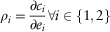 $$\rho _{i} ={{\partial c_{i} } \over {\partial e_{i} }}\forall i\in \{ 1,2\} $$
. For simplicity, assume that ρ 1 is known, while ρ 2 takes on one of two values, such that L 2 knows the value of ρ 2 but L 1 only knows the probability distribution from which it is drawn. That is, assume
 $$\rho _{2} =\bar{\rho }_{2} $$
with probability q and
 $$\rho _{2} =\underline{\rho } _{2} $$
with probability 1−q, where
 $$\underline{\rho } _{2} \, \lt \, \bar{\rho }_{2} $$
. Then L 1 knows that with probability q, L 2 suffers a greater loss of utility, denoted
 $$c_{2} =\bar{c}_{2} $$
, and with probability 1−q, L 2’s subjective loss of utility is not as great, and
 $$c_{2} =\underline{c} _{2} $$
, where
 $$\underline{c} _{2} \, \lt \, \overline{c} _{2} $$
.
There are two non-overlapping perfect Bayesian equilibria to this model, as we demonstrate in the Appendix. In one, L 1 sets  $$x=p{\plus}\underline{c} _{2} \,\equiv\,\underline{x} $$
, which L 2 accepts, regardless of type. In the other, L 2 sets
 $$x=p{\plus}\bar{c}_{2} \,\equiv\,\bar{x}$$
, which L 2 accepts if and only if
 $$c_{2} =\bar{c}_{2} $$
and therefore the ex ante probability of war is 1−q. The former equilibrium obtains when
 $$q \,\leq\, {{c_{1} {\plus}\underline{c} _{2} } \over {c_{1} {\plus}\bar{c}_{2} }}\,\equiv\,\hat{q}.$$
Simple comparative statics on 1 tell the rest of the story. Recall that  $$c_{2} =\bar{c}_{2} $$
when
 $$\rho _{2} =\bar{\rho }_{2} $$
, where
 $$\rho _{2} ={{\partial c_{2} } \over {\partial e_{2} }}$$
. As
 $${{\partial e_{2}^{{\asterisk}} } \over {\partial W_{2} }}\, \gt \, 0$$
, c 2 increases as W 2 increases. Note that the difference between
 $$\bar{c}_{2} $$
and
 $$\underline{c} _{2} $$
must increase as W 2 increases.Footnote 22 Therefore,
 $$\hat{q}$$
decreases as W 2 increases, and the conditions sustaining an equilibrium in which there is a non-zero probability of war become easier to satisfy. This indicates that democracies make attractive targets, as others have argued (Schultz Reference Schultz2001). Finally, as
 $${{\partial c_{1} } \over {\partial e_{1}^{{\asterisk}} }}\, \gt \, 0$$
and
 $${{\partial e_{1}^{{\asterisk}} } \over {\partial W_{1} }}\, \gt \, 0$$
, c 1 increases as W 1 increases. As
 $$\hat{q}$$
increases as c 1 increases, the conditions sustaining the equilibrium with a positive probability of war become more difficult to satisfy as W 1 increases.Footnote 23
It may seem as though we are arguing that democratic states are less transparent. We are not. Rather, our model indicates that any given level of uncertainty about the rate at which a leader suffers a loss of utility when devoting scarce resources to war necessarily matters more as the expected mobilization increases. Suppose that c i is simply d ie i, contrary to the assumptions above. Let us assume that e i=1 for the autocracies and e i=3 for democracies. Finally, let  $$\overline{d} _{i} =2$$
for all regime types while
 $$\underline{d} _{i} =1$$
for autocracies but
 $$\underline{d} _{i} =1.5$$
for democracies. This would imply that democracies are more transparent in that there is less uncertainty over the rate at which they lose utility when mobilizing for war. However, it would still imply a larger difference between
 $$\underline{c} _{2} $$
and
 $$\bar{c}_{2} $$
for democracies, as
 $$\underline{c} _{2} =1$$
and
 $$\bar{c}_{2} =2$$
if L 2 is the leader of an autocracy while
 $$\underline{c} _{2} =4.5$$
and
 $$\bar{c}_{2} =6$$
for a democracy.
This leads to our first key result.
Proposition 1: The equilibrium exhibiting a positive probability of war exists under conditions that are more difficult to satisfy as W 1 increases or W 2 decreases.
This result provides little support for the democratic peace as it is conventionally understood. It suggests that we ought to observe a monadic peace in that leaders of democracies must be more confident that their opponent suffers large costs when mobilizing for war before they are willing to make demands that carry a risk of rejection than are leaders of other systems. As Bueno de Mesquita et al. (Reference Bueno de Mesquita, Morrow, Siverson and Smith1999) observe, most studies conclude that there is little evidence of a monadic peace, and they consider the fact that their model does not anticipate such an effect to be a virtue. Further, as it indicates that the conditions under which a leader is willing to make a demand that carries some risk of war are more readily satisfied when the opponent is democratic, the incomplete information version of our model appears to indicate that war is least likely to occur when the challenger is democratic and the target autocratic. However, there is strong evidence that such dyads are among the most conflict prone (Bennett Reference Bennett2006). Perhaps surprisingly, the model also indicates that the most war-prone dyads would consist of an autocratic challenger and a democratic target, which are also among the most conflict prone. Thus, our model suggests that dyads consisting of one democratic and one autocratic state may exhibit either the highest or lowest risk of war, relative to all other combinations, depending upon which is the challenger.Footnote 24
All models are simplifications. We do not take issue with the bargaining protocol in Bueno de Mesquita et al. (Reference Bueno de Mesquita, Morrow, Siverson and Smith1999) simply because it does not comport with our understanding of international politics. If the choice of bargaining protocol made little difference to the substantive conclusion, there would be no reason to object to it. The important point here is that the democratic peace does not emerge once we allow for genuine bargaining.
Individual strategy and public good provision
Up until this point, we have taken for granted that leaders of democracies are motivated to try harder to produce good policy outcomes. We did so for the sake of argument. At this point, however, we turn a more critical eye toward the claim that leaders of democracies have little choice but to provide public goods if they wish to survive in office.
In this section, we analyze a few simple models of leader selection. In each, members of S may either retain the incumbent leader, L, or replace her with some challenger, C. The only difference between the first two variants is the decision rule employed by members of S. We first discuss a decision rule that mirrors that used by Bueno de Mesquita et al. (Reference Bueno de Mesquita, Smith, Siverson and Morrow2003), where L is retained if and only if W members of S expect to receive greater benefits from L than C. We then present the results obtained using an alternative decision rule, where L is retained if and only if W members of S find that it is in their individual self-interest to express support for L rather than C. That is, one version of the model allows outcomes to obtain so long as the right number of people would benefit from them, irrespective of whether they have any of those people have an individual incentive to engage in the behavior that would produce such an outcome, while the other requires such incentives be in place.
Each variant begins with L and C simultaneously stating their platforms. For now, a platform consists of but two elements: a bundle of proposed expenditures on the provision of private goods, which we denote  $$\nu ^{j} =\mathop{\sum}\nolimits_i^S \nu _{i}^{j} \;\forall \;j\in \{ L,C\} ,i\in S$$
; and a budget for the provision of public goods, which we denote
 $$\gamma ^{j} \,\geq\, 0$$
. The total amount of resources available is denoted R>0. We require
 $$\nu ^{j} {\plus}\gamma ^{j} \,\leq\, R$$
, indicating that no candidate can credibly promise to spend more resources than the state has.Footnote 25
We assume that delivering  $$\nu _{i}^{j} $$
to individual i requires candidate j to expend precisely
 $$\nu _{i}^{j} $$
resources. However, we assume a more complicated production technology for public goods. In allocating γ j resources toward the production of public goods, candidate j produces only
 $$\mu ^{j} \, \lt \, \gamma ^{j} $$
units of public goods.Footnote 26 Note that assuming
 $$\mu ^{j} \, \lt \, \gamma ^{j} $$
does not rule out the possibility that
 $$S\mu ^{j} \,\geq\, \gamma ^{j} $$
. That is, we assume that when candidate j allocates
 $$\gamma ^{j} $$
resources toward the production of public goods, no single member of S receives as much value as they would have if j allocated an equivalent amount of resources toward the provision of private goods for that selector, but it may, nonetheless, be true that more j satisfies more selectors in this manner than j could have through the provision of private goods. Had we instead assumed
 $$\gamma ^{j} \, \gt \, \mu ^{j} $$
, there would be no reason for any leader to rely upon the provision of private goods.
After L and C state their platforms, the selectorate decides which candidate to support. Throughout, we will assume that platforms are both credible and common knowledge.Footnote 27 We also assume L’s level of efficiency at generating public goods is common knowledge, though members of S must rely upon a common prior expectation with respect to C’s ability to produce public goods, such that for a given γ C, all i expect to receive  $$\hat{\mu }_{{\gamma ^{C} }}^{C} $$
.Footnote 28
Throughout, we assume that members of S care only about the amount of goods they receive. In the first two versions of our model, i’s value for having j in office is  $$\nu _{i}^{j} {\plus}\mu ^{j} $$
, or the amount of private goods they will receive individually plus the public goods everyone gets to enjoy. We assume candidate j receives
 $$R\,{\minus}\,\nu ^{j} \,{\minus}\,\gamma ^{j} $$
if they are selected to be leader, indicating that any resource not spent buying support are consumed by j, and 0 otherwise.
Let  $$W^{j} \,\subset\,S$$
denote a set of size W whose members belong to the winning coalition of candidate j. We assume that members of W L can expect to remain in L’s coalition if and only if they support L. All those who support C have the same probability of being included in W C, and thus expect to receive private goods from C only with probability
 $${W \over S}$$
. Note that Bueno de Mesquita et al. (Reference Bueno de Mesquita, Smith, Siverson and Morrow2003) identify this as a critical assumption of selectorate theory.
Our model is simpler than any of the models discussed in Bueno de Mesquita et al. (Reference Bueno de Mesquita, Smith, Siverson and Morrow2003). We do not model the leader’s choice of tax rates or individual decisions with respect to leisure vs. labor decisions. However, this setup is sufficient to illustrate our argument.
When we require only that W members of S derive greater utility from having L remain in office, as in Bueno de Mesquita et al. (Reference Bueno de Mesquita, Smith, Siverson and Morrow2003), without regard to whether individual selectors have an incentive to lend their personal support to the incumbent rather than the challenger, L retains office so long as the following inequality holds:
 $$\nu _{i}^{L} {\plus}\mu ^{L} \,\geq\, {W \over S}\nu _{i}^{C} {\plus}\hat{\mu }_{{\gamma ^{C} }}^{C} .$$
Suppose that C promises to allocate all of R in the form of private goods, giving  $${R \over W}$$
to each member of W C. Then L can secure office either by setting
 $$\nu _{i}^{L} ={R \over S}\;\forall \;i\in W^{L} $$
or by allocating
 $$\gamma ^{L} \left( {{R \over S}} \right)$$
, which produces
 $$\mu ^{L} ={R \over S}$$
.
So long as  $$W{R \over S}\, \gt \, \gamma ^{L} \left( {{R \over S}} \right)$$
, the former is less cost-effective than the latter and L will prefer to secure the support necessary for retaining office by providing public goods rather than private goods. In other words, we can readily identify a perfect Bayesian equilibrium in which L sets
 $$\gamma ^{L} =\gamma ^{L} \left( {{R \over S}} \right)$$
, which denotes the level of γ L necessary to ensure that
 $$\mu ^{L} ={R \over S}$$
, and
 $$\nu ^{L} =0$$
, while C sets
 $$\gamma ^{C} =0$$
,
 $$\nu _{i}^{C} ={R \over W}\;\forall \;i\in W^{C} $$
, and
 $$\nu _{m}^{C} =0\;\forall \;m\in S/W^{C} $$
. In this equilibrium, L retains office. In words, there exists an equilibrium in which L retains office by providing a level of public goods sufficient to match the quantity of private goods that members of the selectorate could expect to receive if C took office. Importantly, this equilibrium is more likely to obtain as W increases or S increases. Thus, we have derived some of the most important results of selectorate theory from our model, simple though it is, having used the same decision rule as the authors.
We stress that this decision rule does not link individual strategies to aggregate outcomes. However, if the outcomes that maximize social utility could be assumed to obtain irrespective of the incentives facing individuals, there would be no dilemma to the one-shot Prisoner’s Dilemma, one of the most famous applications of non-cooperative game theory. There would be no Tragedy of the Commons. No need for governments to provide public goods. In short, the world would be a very different place. Yet, this is how Bueno de Mesquita et al. (Reference Bueno de Mesquita, Smith, Siverson and Morrow2003) determine whether L retains office.
Of course, we acknowledge that a vibrant literature in political science similarly assumes that outcomes preferred by sufficiently large number of voters will obtain in equilibrium.Footnote 29 It is not our intention to question all such work. Again we stress that all models are simplifications, and even patently false assumptions are not worth criticizing if they do not distort the analysis. In addition, in many of the models where candidates are assumed to take office if a plurality of voters receive greater utility from having them do so, the substantive conclusions do not change if we require that individual voters adopt strategies that maximize their individual expected utilities. However, they do here.
Suppose that we no longer assume that L retains office if and only if W members of S derive greater utility from having L remain in office, but instead require each  $$i\in S$$
to adopt the individual strategy that maximizes their individual expected utility. More formally, we now assume that each
 $$i\in S$$
supports L if and only if
 $$EU_{i} ({\rm support}\;L) \,\geq\, EU_{i} ({\rm support}\;C)$$
, or
 $$\bar{p}(\nu _{i}^{L} {\plus}\mu ^{L} ){\plus}(1\,{\minus}\,\bar{p})\hat{\mu }_{{\gamma ^{C} }}^{C} \,\geq\, \underline{p} \mu ^{L} {\plus}(1\,{\minus}\,\underline{p} )\left( {{W \over S}\nu _{i}^{C} {\plus}\hat{\mu }_{{\gamma ^{C} }}^{C} } \right),$$
where  $$\bar{p}$$
denotes the probability that L retains office with i’s support,
 $$\underline{p} $$
denotes the probability that L retains office absent i’s support. Given the nature of public goods, we argue that this is a more appropriate decision rule. If each i chooses whom to support by evaluating inequality 3, i will have assumed that she will receive any public goods provided by j, regardless of whether she supports j, yet also assumed that she must support j in order to receive private goods from j in the event that j takes office.
This brings us to our next key result.
Proposition 2: There exists a perfect Bayesian equilibrium to the leader selection game using the decision rule outlined by inequality 3, where L sets  $$\nu ^{L} =\gamma ^{L} =0$$
.
The intuition behind this result is that when members of S concern themselves solely with the amount of goods they expect to receive as a function of whom they individually choose to support, if L does not propose to allocate any resources to anyone, every member of S may, nonetheless, be indifferent between supporting L and supporting C. If we assume that members of S default to supporting L when indifferent, as we implicitly did above, then L wins despite not allocating any goods to anyone because no individual member of S can benefit by deviating and pledging their support to C. If they did so, C still would not win, and they would continue to expect to receive nothing.
This equilibrium pretty clearly does not match reality, though its existence is telling theoretically. Of course, it rests critically upon an arbitrary assumption about how members of S behave when indifferent. So let us now allow members of S to receive arbitrarily small rewards or punishments for expressing support for the incumbent, irrespective of the outcome. These parameters will function primarily to break ties. More formally, let each  $$i\in S$$
receive
 $$\alpha _{i}^{L} \,\sim\,U[\,{\minus}\,{\varepsilon},{\varepsilon}]$$
when supporting L, where
 $${\varepsilon}$$
is some quantity arbitrarily close to 0. Let each
 $$\alpha _{i}^{L} $$
be known by i and only i. That is, no member of S can know how non-material considerations will influence the behavior of any other member of S, nor can the candidates. The primary effect of these terms is to make selector’s decisions probabilistic, thereby preventing strange equilibria like the one just discussed.
We then obtain the next result.
Proposition 3: In any perfect Bayesian equilibrium to the leader selection game with non-material incentives to support the incumbent, L’s choice of γ L is increasing in W, all else equal, but only takes on positive values if the difference between  $$\bar{p}$$
and
 $$\underline{p} $$
is non-trivial.
This appears to support the conclusions of Bueno de Mesquita et al. (Reference Bueno de Mesquita, Smith, Siverson and Morrow2003). All else equal, L allocates greater resources toward the provision of public goods as W increases. If we associate large values of W with democracy, this would seem to indicate that democrats are more likely to provide public goods than are their authoritarian counterparts.
However, the restriction that L only sets  $$\gamma ^{L} \, \gt \, 0$$
when
 $$\bar{p}\,{\minus}\,\underline{p} $$
takes on non-trivial values is not a small caveat. Scholars have long recognized that it is highly implausible that a single voter’s decision will influence the outcome of a national election in a modern electoral democracy.Footnote 30 Put simply, if the best explanation for the provision of public goods we can come up with is that voters are dissuaded from supporting the challenger out of fear that they will significantly decrease the prospects of the leader retaining office in so doing, we do not have much of an explanation of public goods provision.
For this reason, we now consider an extension of the model.
Unlike above, we now allow L and C the choice of providing club goods in addition to (or instead of) private goods and public goods. Formally, let  $$\kappa ^{j} $$
denote the resources j expends when providing
 $$\zeta _{B}^{j} $$
benefit to members of B in the form of club goods. As above, we assume
 $$\zeta _{B}^{j} \, \lt \, \kappa ^{j} $$
so as to ensure that providing club goods is not a strictly dominant strategy for all j, irrespective of W and S. However, we do not rule out the possibility that
 $$B\zeta _{B}^{j} \, \gt \, \kappa ^{j} $$
, which would indicate that it is more economically efficient to satisfy B members of S through the provision of club goods than private goods.
We assume that there are returns to scale in the provision of club goods. Formally,  $${{\partial \kappa ^{j} } \over {\partial \zeta _{B}^{j} }}\, \gt \, 0$$
but
 $${{\partial ^{2} \kappa ^{j} } \over {\partial ^{2} \zeta _{B}^{j} }}\, \lt \, 0$$
, indicating that costs increase at a decreasing rate.
We need not assume that supporting j is a prerequisite for belonging to B j, or the set of individuals granted access to the club goods provided by candidate j, but it makes sense to assume that the probability of being granted access to club goods is related to the choice of whom to support.
As with public goods, we assume that L’s ability to produce club goods is known, whereas  $$\hat{\zeta }_{B}^{C} $$
denotes the expected benefit to B C when C allocates
 $$\kappa ^{C} $$
to the provision of club goods.
A proof of the following result can be found in the Appendix.
Proposition 4: There exists a perfect Bayesian equilibrium to the extended leader selection game where L sets  $$\nu ^{L} =\gamma ^{L} =0$$
and
 $$\kappa ^{L} \, \gt \, 0$$
.
In this equilibrium, L provides a level of club goods that ensures W members of S derive greater expected utility from supporting L than C. Critically, this equilibrium is more likely to exist as W increases. Intuitively, the size of the winning coalition must exceed a certain threshold before it becomes more efficient to buy support through the provision of club goods than private goods. This is essentially the argument Bueno de Mesquita et al. (Reference Bueno de Mesquita, Smith, Siverson and Morrow2003) make about public goods, but as club goods are excludable, L can create a material incentive to support her over C by promising to distribute them, whereas promises to provide public goods cannot create such an incentive.
This may seem like a subtle distinction, but it is an important one. We do not dispute that democratic leaders adopt policies that benefit more people than do the policies chosen by autocrats, but we do question the claim that the policies they select create benefits that none can be excluded from. Many government programs do just that. The politics of exclusion can be as extreme and brutal as slavery, apartheid, and genocide – all of which have been pursued by democratic governments. Even if we set aside the more provocative examples, though, the point stands. Democracy does not seem to benefit the poor (Ross Reference Ross2006). Through its choice of monetary policy, governments decide whether to set the interests of net creditors above those of net debtors and the unemployed. Unsurprisingly, governments of the right, who tend to draw support from the wealthy, favor policies that lower inflation, while governments of the left, whose supporters tend to be poorer, do the opposite.Footnote 31 To say that democratic governments rely solely on the provision of club goods is undoubtedly a simplification, but it is one that we believe lands nearer the mark.
Conclusion
Selectorate theory has proven to be very influential in the study of politics, not only because it claims to provide an explanation for the democratic peace, but also to yield important insights into patterns of international cooperation and a variety of domestic outcomes. Many also find the theory attractive owing its relative parsimony. Seemingly, we need only assume that leaders enjoy wielding power and that their subjects prefer to receive more goods rather than less in order to explain a wide range of empirical regularities. Selectorate theory offers those who are reluctant to claim that democracy instills in its citizens greater virtues the ability to, nonetheless, believe that democratic institutions are critical for producing peace (at least among fellow democracies) and prosperity (which is assumed to be fostered by public goods). The appeal of such a theory is obvious. The implications are both surprising, given the nature of the assumptions, as well as normatively satisfying.
Yet, as we hope to have illustrated, this stylized interpretation is not warranted. Specifically, some of the most celebrated results reported in Bueno de Mesquita et al. (Reference Bueno de Mesquita, Morrow, Siverson and Smith1999, Reference Bueno de Mesquita, Smith, Siverson and Morrow2003) depend critically upon modeling assumptions that neither are justified by the core logic of their theory nor substantively easy to defend.
With respect to the democratic peace, Bueno de Mesquita et al. (Reference Bueno de Mesquita, Morrow, Siverson and Smith1999) implicitly assumed that when states negotiate with one another, neither of them has any influence on the distribution of benefits each would receive. Moreover, they assumed that peace requires the consent of only one party, in contrast to the traditional interpretation of anarchy. We analyzed a very simple model, one in which we assumed the very patterns Bueno de Mesquita et al. (Reference Bueno de Mesquita, Morrow, Siverson and Smith1999) derived from their model with respect to the relationship between domestic institutions and optimal war effort. Despite this substantial simplification, we found that the democratic peace obtained under their bargaining protocol, but appears incompatible with the more flexible protocol found in Fearon (Reference Fearon1995), which has subsequently become one of the standard ways of modeling crisis bargaining.
We acknowledge that the particular manner in which we chose to represent incomplete information does not follow directly any of the assumptions in Bueno de Mesquita et al. (Reference Bueno de Mesquita, Morrow, Siverson and Smith1999), who assumed complete information. Yet, even if the democratic peace could be reconciled with our model using a different approach to modeling incomplete information, we would continue to argue that there is no unambiguous evidence that the core assumptions of selectorate theory point toward the democratic peace. We contend that if a theory can only account for a given finding under arbitrary specifications that are not informed by the core assumptions of the theory, that theory provides a poor explanation for said finding.
After replacing the non-standard bargaining protocol used by Bueno de Mesquita et al. (Reference Bueno de Mesquita, Morrow, Siverson and Smith1999) with the ultimatum bargaining protocol, we derived rather puzzling results regarding the relationship between regime type and conflict. We are relatively untroubled by these results because we see the model we presented as being useful for illustrating the fragile nature of the results reported by Bueno de Mesquita et al. (Reference Bueno de Mesquita, Morrow, Siverson and Smith1999), but not necessarily so for generating novel empirical implications. For the sake of argument, we found it useful to assume certain patterns with respect to war effort. However, it is not obvious to us, given our subsequent arguments about public goods, that we would want to build a model on such assumptions if we wished to generate empirical implications.
With respect to public goods, though they are non-excludable by definition, in order to prove that leaders of large W systems are required to provide public goods if they wish to retain office, the authors assumed that members of S make decisions without regard for the relationship between their individual behavior and their individual access to goods. Members of S are fundamentally non-strategic in their models.
To illustrate this, we analyzed a very simple model, one that lacked many of the moving parts found in Bueno de Mesquita et al. (Reference Bueno de Mesquita, Smith, Siverson and Morrow2003). Despite these differences, we first showed that if we employed the same decision rule as the authors, we could reproduce their key claims. However, once we adopted more appropriate decision rules, we no longer found evidence that democrats are likely to distribute public goods. We did, however, demonstrate with an extension of the model that democrats are more likely to provide club goods.
This is not a trivial difference. We argue that all leaders govern primarily with the interests of the members of their winning coalition in mind, whereas Bueno de Mesquita et al. (Reference Bueno de Mesquita, Smith, Siverson and Morrow2003) argue that democrats are forced to serve the interests of their entire populations. We argue that the core assumptions of selectorate theory do not unambiguously support such a conclusion, though they do imply that leaders of more inclusive regimes implement policies that benefit a larger proportion of the population. We stress that in politics, there are always winners and losers. For many, the claim that democratic leaders have no choice but to rely on non-exclusionary policies might come as welcome news, or perhaps a grievous insult. Many of the world’s democracies have all too rich a history of practicing the politics of exclusion, after all. There is also reason to doubt whether democracy helps the poor (Ross Reference Ross2006). A system of governance that benefits roughly half the population is quite preferable to one that benefits 1%, but we ought to recognize that a half is not a whole.
Our criticism of the depiction of democratic politics in Bueno de Mesquita et al. (Reference Bueno de Mesquita, Morrow, Siverson and Smith1999, Reference Bueno de Mesquita, Smith, Siverson and Morrow2003), where leaders are driven to make everyone happy, should not be taken to mean that we find no merit in selectorate theory. One of the central motivating puzzles discussed in Bueno de Mesquita et al. (Reference Bueno de Mesquita, Smith, Siverson and Morrow2003) concerns the empirical observation that those leaders whose people suffer most appear to have the strongest hold on power. Their answer to this important puzzle is that, in authoritarian regimes, ‘good policy is bad politics’. We see no reason to suggest that this is not a compelling, if unhappy, explanation. We just happen to believe that some of the most widely celebrated claims associated with selectorate theory, specifically with regards to the democratic peace and the provision of public goods, are problematic. And we think it is important to acknowledge these limitations.
Acknowledgments
The authors would like to thank Erik Gartzke, Brenton Kenkel, Keith Krehbiel, Nolan McCarty, Alastair Smith, and Scott Wolford, the participants of the 2010 Annual Meeting of the Peace Science Society (International), and the 2013 mini-conference on mathematical models of politics at the University at Buffalo for helpful comments and suggestions. Any remaining errors are the authors.
Appendix
Crisis bargaining
Proposition 1
There are two pure strategy PBEs to the model with incomplete information. In the first, L 1 sets  $$x=\underline{x} $$
; the strong L 2 accepts if and only if
 $$x \,\leq\, \underline{x} $$
; the weak L 2 accepts if and only if
 $$x \,\leq\, \bar{x}$$
. In the second, L 1 sets
 $$x=\bar{x}$$
; the strong L 2 accepts if and only if
 $$x \,\leq\, \underline{x} $$
; the weak L 2 accepts if and only if
 $$x \,\leq\, \bar{x}$$
.
L 1’s optimal offer is straightforward. If L 1 sets  $$x\, \gt \, \bar{x}$$
, war results with certainty, which cannot be optimal as
 $$\bar{x}\,\equiv\,p{\plus}\bar{c}_{2} \, \gt \, p\,{\minus}\,c_{1} $$
. If L 1 sets
 $$x\, \lt \, \underline{x} $$
, L 1 foregoes better terms of agreement than would have been available had L 1 set
 $$x=\underline{x} $$
, which L 2 is certain to accept, regardless of type. If L 1 sets
 $$\underline{x} \, \lt \, x\, \lt \, \bar{x}$$
, L 1 receives the same payoff when L 2 is strong as L 1 would have received had L 1 set
 $$x=\bar{x}$$
, and L 1’s payoff from having the weak L 2 accept is strictly inferior to L 1’s payoff from having the weak L 2 accept
 $$x=\bar{x}$$
. Given the choice between
 $$x=\underline{x} $$
and
 $$x=\bar{x}$$
, L 1’s strategy follows immediately from inequality 1.
L 2’s strategy follows readily from setting  $$u_{{L_{2} }} ({\rm acc}) \,\geq\, EU_{{L_{2} }} ({\rm rej})\Leftrightarrow $$
 $$1 \,{\minus}\,x \,\geq\, 1\,{\minus} \,p\,{\minus}\,c_{2} $$
. When L 2 is strong, that is,
 $$\rho =\underline{\rho } $$
and thus
 $$c_{2} =\underline{c} _{2} $$
, this simplifies to
 $$x \,\leq\, p{\plus}\underline{c} _{2} \,\equiv\,\underline{x} $$
. When L 2 is weak, that is,
 $$\rho =\bar{\rho }$$
and thus
 $$c_{2} =\bar{c}_{2} $$
, this simplifies to
 $$x \,\leq\, p{\plus}\bar{c}_{2} \,\equiv\,\bar{x}$$
.
The probability of war in the equilibrium where L 1 sets  $$x=\underline{x} $$
is 0. When L 1 sets
 $$x=\bar{x}$$
, the ex ante probability of war is 1−q. The former equilibrium exists if and only if
 $$q \,\leq\, \hat{q}$$
, the latter if and only if
 $$q\, \gt \, \hat{q}$$
. Therefore, Proposition 1 follows from the comparative statics on inequality 1, which are discussed in the text.
Leader selection
Proposition 2
The following beliefs and pure strategies constitute a perfect Bayesian equilibrium. L sets  $$\nu ^{L} =0$$
and
 $$\gamma ^{L} =0$$
; C sets
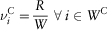 $$\nu _{i}^{C} ={R \over W}\;\forall \;i\in W^{C} $$
,
 $$\nu _{m}^{C} =0\;\forall \;m\in S/W^{C} $$
, and
 $$\gamma ^{C} =0$$
; all
 $$i\in S$$
support L if and only if inequality 3 holds, supporting C otherwise, and believe
 $$\hat{\mu }_{{\gamma ^{C} }}^{C} \, \gt \, 0$$
if
 $$\gamma ^{C} \, \gt \, 0$$
and
 $$\hat{\mu }_{{\gamma ^{C} }}^{C} =0$$
otherwise, and believe
 $$\bar{p}=1$$
,
 $$\underline{p} =1$$
.
Note that the appropriate solution concept is perfect Bayesian equilibrium as the actor’s strategies depend upon their beliefs,  $$\hat{\mu }^{C} $$
,
 $$\bar{p}$$
, and
 $$\underline{p} $$
. However, note that as the behavior of the selectorate is deterministic, all
 $$i\in S$$
can update their beliefs
 $$\bar{p}$$
and
 $$\underline{p} $$
to certainty. In addition, note that the actors do not have the opportunity to learn about
 $$\hat{\mu }^{C} $$
.
Specifically, as every member of S supports L in equilibrium, and L requires the support of only W members of S, then from the perspective of any given i, L wins either with or without i’s support. Thus,  $$\bar{p}=1$$
and
 $$\underline{p} =1$$
.
Substituting the equilibrium platforms for L and C into inequality 3, we get
 $$\bar{p} \cdot 0{\plus}(1\,{\minus}\,\bar{p}) \cdot 0 \,\geq\, \underline{p} \cdot 0{\plus}(1\,{\minus}\,\underline{p} )\left( {{W \over S}{R \over W}} \right),$$
which, after substituting in  $$\bar{p}=1$$
and
 $$\underline{p} =1$$
, simplifies to
 $$0{\plus}0 \,\geq\, 0{\plus}0\left( {{R \over S}} \right),$$
or simply  $$0 \,\geq\, 0$$
. Thus, i’s strategy is incentive compatible, as
 $$0 \,\geq\, 0$$
is true by definition.
Given that L expects to retain office, L has no incentive to set  $$\nu ^{L} \, \gt \, 0$$
or
 $$\gamma ^{L} \, \gt \, 0$$
. Thus, L’s strategy is incentive compatible.
C has no incentive to deviate from the equilibrium strategy, as C cannot prevent L from winning by changing her platform, nor does C’s payoff depend upon her platform in any equilibrium in which C does not take office. This completes the proof. □
Proposition 3
In any perfect Bayesian equilibrium, each  $$i\in S$$
supports L if and only if
 $$\bar{p}(\nu _{i}^{L} {\plus}\mu ^{L} ){\plus}(1\,{\minus}\,\bar{p})\hat{\mu }_{{\gamma ^{C} }}^{C} {\plus}\alpha _{i}^{L} \,\geq\, \underline{p} \mu ^{L} {\plus}(1\,{\minus}\,\underline{p} )\left( {{W \over S}\nu _{i}^{C} {\plus}\hat{\mu }_{{\gamma ^{C} }}^{C} } \right),$$
where  $$\hat{\mu }_{{\gamma ^{C} }}^{C} \, \gt \, 0$$
if
 $$\gamma ^{C} \, \gt \, 0$$
and
 $$\hat{\mu }_{{\gamma ^{C} }}^{C} =0$$
otherwise.
Solving inequality 4 for  $$\alpha _{i}^{L} $$
, we can alternatively say that i supports L if
 $$\alpha _{i}^{L} \,\geq\, \hat{\alpha }_{i}^{L} $$
, where
 $$\hat{\alpha }_{i}^{L} \,\equiv\,(\hat{\mu }_{{\gamma ^{C} }}^{C} \,{\minus}\,\mu ^{L} )(\overline{p} \,{\minus}\,\underline{p} ){\plus}(1\,{\minus}\,\underline{p} ){W \over S}\nu _{i}^{C} \,{\minus}\,\overline{p} \nu _{i}^{L} $$
. While candidate j cannot know whether
 $$m\in S,m\,\ne\,i$$
will support L, given that i does not know the value of
 $$\alpha _{m}^{L} $$
, i knows that the probability
 $$m\in S,m\,\ne\,i$$
supports L, which we will denote as
 $$S_{m}^{L} $$
, is given by
 $$\openup 6ptS_{m}^{L} =\left\{ {\matrix{ {{{\displaystyle{ \varepsilon}\,{\minus}\,\hat{\alpha }_{m}^{L} } \over {\displaystyle2{\varepsilon}}}} \hfill & {{\rm if}\,{\minus}\,{\varepsilon} \,\leq\, \hat{\alpha }_{m}^{L} \,\leq\, {\varepsilon}} \hfill \cr 0 \hfill & {{\rm if}\;\hat{\alpha }_{m}^{L} \, \gt \, {\varepsilon}} \hfill \cr 1 \hfill & {{\rm if}\;\hat{\alpha }_{m}^{L} \, \lt \, \,{\minus}\,{\varepsilon}} \hfill \cr } } \right..$$
Then  $$\bar{p}$$
is the probability that L’s expected level of support is at least as large as W, where L’s expected level of support is
 $$1{\plus}\mathop{\sum}\limits_m S_{m}^{L} $$
. Similarly,
 $$\underline{p} $$
is the probability that L’s expected level of support without i is at least as large as W, or
 $$pr(\mathop{\sum}\nolimits_m S_{m}^{L} ) \,\geq\, W$$
.
From the perspective of L, the probability of retaining office is  $$pr(\mathop{\sum}\nolimits_i^S S_{i}^{L} \,\geq\, W)\,\equiv\,\hat{p}$$
, and the optimal values of
 $$\nu ^{L} $$
and
 $$\gamma ^{L} $$
depend upon L’s expected utility,
 $$\hat{p}(R\,{\minus}\,\nu ^{L} \,{\minus}\,\gamma ^{L} )$$
, subject to the constraint
 $$\nu ^{L} {\plus}\gamma ^{L} \,\leq\, R$$
. The optimal allocations can be found by maximizing
 $$\hat{p}(R\,{\minus}\,\nu ^{L} \,{\minus}\,\gamma ^{L} )\,{\minus} $$
 $$ \lambda (\nu ^{L} {\plus}\gamma ^{L} \,{\minus}\,R)$$
with respect to
 $$\nu ^{L} $$
and
 $$\gamma ^{L} $$
, respectively.
We are particularly interested in L’s choice of  $$\gamma ^{L} $$
, which is given by
 $$\lambda ={{\partial \hat{p}} \over {\partial \gamma ^{L} }}(R\,{\minus}\,\nu ^{L} \,{\minus}\,\gamma ^{L} )\,{\minus}\,\hat{p}.$$
Intuitively, this tells us that if R increased, L would increase  $$\gamma ^{L} $$
in proportion to the impact of
 $$\gamma ^{L} $$
on her probability of retaining office, weighted by the rents L extracts from office upon victory, while decreasing
 $$\gamma ^{L} $$
as her expected probability of retaining office increases.
Clearly,  $$\hat{p}$$
at least weakly decreases as W increases, as
 $$\hat{p}=pr\left( {\mathop{\sum}\nolimits_i^S S_{i}^{L} \,\geq\, W} \right)$$
. This indicates that, all else equal, L’s optimal
 $$\gamma ^{L} $$
increases as W increases.
However, inspection of  $$\hat{\alpha }_{i}^{L} $$
clearly indicates that the impact of
 $$\gamma ^{L} $$
on the probability that any given i supports L, or
 $$S_{i}^{L} $$
, goes to 0 as
 $$\bar{p}\,{\minus}\,\underline{p} $$
goes to 0. In the limit, as
 $$\bar{p}\,{\minus}\,\underline{p} \to0$$
,
 $${{\partial \hat{p}} \over {\partial \gamma ^{L} }}\to0$$
, and by 5, we can see that L’s optimal allocation of resources toward the provision of public goods, which cannot take on negative values, must also go to 0.□
Proposition 4
Let  $$\underline{s} ^{L} $$
be the probability that any given member of S belongs to B L if they support C, sC be the probability that they belong to B C if they support L, s −L be the probability that they belong to B L if they support L, and s −CL be the probability that they belong to B C if they support C. We assume that
 $$s^{C} \, \lt \, s^{L} $$
owing to the uncertainty about the makeup of B C for the same reasons that Bueno de Mesquita et al. (Reference Bueno de Mesquita, Smith, Siverson and Morrow2003) stress that no member of S can be sure that they will be part of C’s winning coalition.
The more narrowly candidates can target club goods, the more closely s −L will approximate 1 and sL will approximate 0, allowing L to avoid wasting resources. However, we need not assume that it is possible for L to do so.
Again requiring each  $$i\in S$$
to select a strategy that maximizes their individual expected utility, L retains office if and only if
 $$\eqalign{\bar{p}(\nu _{i}^{L} {\plus}\mu ^{L} {\plus}\bar{s}^{L} \zeta _{B}^{L} ){\plus}(1\,{\minus}\,\bar{p})(\hat{\mu }_{{\gamma ^{C} }}^{C} {\plus}\underline{s} ^{C} \hat{\zeta }_{B}^{C} ) \,\geq\, \underline{p} (\mu ^{L} {\plus}\underline{s} ^{L} \zeta _{B}^{L} ) \cr\quad{\plus}(1\,{\minus}\,\underline{p} )\left( {{W \over S}\nu _{i}^{C} {\plus}\hat{\mu }_{{\gamma ^{C} }}^{C} {\plus}\bar{s}^{C} \hat{\zeta }_{B}^{C} } \right). (6)$$
For all non-trivial values of S, the difference between  $$\bar{p}$$
and
 $$\underline{p} $$
approaches 0 and the provision of public goods is a strictly dominated strategy. Consider then the choice between club goods and private goods.
Recall that we assume  $${{\partial \kappa ^{j} } \over {\partial \zeta _{B}^{j} }}\, \gt \, 0$$
and
 $${{\partial ^{2} \kappa ^{j} } \over {\partial ^{2} \zeta _{B}^{j} }}\, \lt \, 0$$
. We also assumed
 $$\zeta _{B}^{j} \, \lt \, \kappa ^{j} $$
. Finally, recall that the cost of providing private goods if equivalent to the amount of private goods distributed. This implies that the cost of satisfying 6 for one member of S through the provision of private goods must be lower than that of doing so through the provision of club goods. However, as the marginal cost of attracting support from each additional member of S through the provision of club goods is strictly less than that of the previous member, whereas the marginal cost of attracting support of another member of S through the provision of private goods never changes, at some point the lines must cross, making it cheaper to satisfy 6 for W members of S through the provision of club goods. The larger W, the more likely it is that L will find it economically efficient to distribute club goods.□



