Introduction Footnote 1
In a chapter on religion in his seminal text, History of the Yorubas (written in the 1890s, published posthumously in 1921), the pioneering clergyman and self-made historian Samuel Johnson characterizes in adversarial and exclusionary terms the relationship between women and a group of political actors bound by a ritual oath of secrecy and engaged in “the worship of spirits or the souls of departed relatives” known as Egungun:
The dress of the Egungun consists of cloths of various colors or the feathers of different kinds of birds, or skins of different animals. The whole body from head to foot is concealed from view: the Egungun seeing only from the meshes of a species of network covering the face, and speaking in a sepulchral tone of voice. The women believe (or rather feign to believe) that the Egunguns came from the spirit world. An Egungun (the Agan) is the executor of women accused of witchcraft, and of those who are proven guilty of such crimes as murder, incendiarism, etc. In these later times, the Egungun worship has become a national religious institution, and its anniversaries are celebrated with grand festivities. (…) The mysteries connected with it are held sacred and inviolable, and although little boys of 5 or 6 years of age are often initiated, yet no woman may know these mysteries on pain of death. Footnote 2
Johnson’s assessment of women’s relationship to the institution of Egungun is consistent with the documented views of nineteenth-century missionaries in Yoruba communities throughout the region. Footnote 3 Even at Otta, a community with many women who believed strongly in the power of witchcraft, James White, a missionary of Yoruba parentage writing between the 1850s and 1880s, claimed that women were forced to revere men wearing Egungun masks as incarnate ancestors. Footnote 4 Drawing on similar missionary sources, Francine Shields and Robin Law accept Christian evangelical interpretations of Egungun’s treatment of women, identifying one of Egungun’s principal functions as persecuting aje, often translated as “witches.” Footnote 5
Art historians, drawing on ethnographic sources and material culture from the second half of the twentieth century, often juxtapose the notion of Egungun as violent toward women with the rationale of another Yoruba masquerade tradition known as Gelede as concerned primarily with placating women, the stereotypical embodiment of aje. Under the direction of separate groups of elders comprised of men and women, respectively, male masqueraders honor aje associated with women’s reproductive, productive, and spiritual labor through Gelede performances. The dual notions of Egungun as focused on punishing women and Gelede as placating them dominates the scholarship on these Yoruba masquerade traditions. Footnote 6
This article focuses on the historical factors that have fueled such a view of Egungun. Missionaries recognized that local elite men were often frustrated by evangelical efforts to nurture a Christian congregation in their communities. At Otta in 1842, missionaries erected a mission house on the edge of the town. The distance of the mission from the center of town, where the town’s leader’s made decisions, arguably reflected the ambivalent attitudes of these leaders toward the mission. Footnote 7 In his letters to other missionaries, White documents moments when he believed that the male organizers and performers of masquerades made it difficult for him to convert women and children to Christianity. As his frustration grew, he began to present himself and the people of Otta, most notably the women, as exploited by the town’s male elite, who were interfering with or contradicting British evangelical, economic, and imperial goals. Footnote 8 White, a Yoruba evangelist, produced accounts that are exceptional in their depth of documentation of ritual practice. Footnote 9 Yet, like those of his contemporaries, his records do not offer nuanced perspectives of the gendered dimensions of Egungun practice. Yoruba agents of Christian missions wrote for British audiences in ways that reflected their adoption of British and Christian gender categories and ways of viewing Yoruba culture. Footnote 10
Historiographical Debates
The missionary view has, by and large, endured even though a small group of art historians and ethnographers offer thought-provoking analyses of the relationship between the features of Egungun’s organizational structure and practice in specific communities, on the one hand, and the issue of power on the other hand. These scholars offer critical insights into the importance of the complex organizational structure and range of performers and practices associated with Egungun. They reveal that Egungun masquerades are distinguished by their attire, behavior, status, rank, style or mode of performance, and function. Footnote 11 Drawing on their field research in the Egbado-Yoruba town of Ilaro, Drewal and Thompson Drewal argue that Egungun’s organizational structure reflects a shared distribution of authority among its members, including men and women. Footnote 12 They challenge what they identify as a widely held view of Egungun in terms of the maleness of its membership and its role in subjugating and aiming to control the ‘destructive powers’ of women suspected of being aje. The Egbado practitioners of Egungun they interviewed express the idea that an Egungun does not kill an aje. Only aje members of Egungun can kill an aje. Thompson Drewal and Drewal conclude that the powerful elderly women, the “mothers” – which include the Iya Agan, the Otun Iya Agan, and the Iya Mako – wield the ultimate power of life and death in Egungun. Footnote 13 Building on Thompson Drewal and Drewal’s emphasis of agency over structure, I interpret accounts of violence associated with Egungun as reflecting the behavior of a few among many that must be understood in the context of missionary encounters and the efforts of the ambitious to push the limits of their power. I do not find evidence that enforcing violence was the primary purpose of Egungun on the whole.
Even since the publication of Thompson Drewal and Drewal’s article in 1978, subsequent writers have continued to adopt the missionary view that defines the character of the organization and practice of Egungun by the behavior and function of an individual Egungun masquerade (named Agan) and of a small minority of unnamed masquerades. Footnote 14 Furthermore, historians and ethnographers have taken what nineteenth-century missionaries and contemporary Egungun leaders and other Yoruba speakers more generally say at face value about past and present practice. Based on their observations of (and conversations with) male Egungun performers as well as of prohibitions preventing women from wearing or even touching the mask, writers too often assume that the incarnate spirits that Egungun embody are male and are mobilized with the aim of controlling women’s power. Footnote 15 Scholars of Egungun tend to overlook how gender operates in Yoruba culture, historically and in the present day. They have by and large assumed that sex and gender are the same and that women are outsiders in the Egungun domain while serving as the main point of reference in the Gelede domain. Footnote 16 They also overlook another critical element the shapes people’s participation in Egungun – kinship. I argue that Egungun performances have long been informed by and enacted notions of kinship based on biology, marriage, or other social factors and in so doing trouble such facile assumptions about gender.
Diverging from the above-mentioned traditional views and informing my perspective are two scholars who make compelling arguments pertaining to the view and practice of gender (and kinship) in Yoruba culture. These writers, who adopt a more fluid understanding of gender in Yoruba society, have helped me reassess how gender intersects with other social categories in Egungun. James Matory thoughtfully links ritual, social, and political acts (e.g., spirit possession and “mounting” a horse or a sexual partner) to the politics of royal wives and ritual wives (the latter of which include both women and men) and to the eras in which kings depended on “wives” to administer a kingdom and empire. Footnote 17 His model of shifting patterns of gendered ritual and political authority resonates with my own ethnographic evidence at Otta and shapes my thinking about gender subjectivity and power.
Similarly, Oyeronke Oyewumi argues that seniority (i.e., a person’s age and tenure within a kin group) is a better indicator of status and power than gender in Yoruba history and culture. Footnote 18 The daughter of a royal family in the Yoruba town of Ogbomoso, Oyewumi, translates the terms oko and iyawo as markers of an insider and outsider status in a lineage, while scholars generally translate them as “husband” and “wife,” respectively. Married women and men, on this view, held the status of wife (outsider) in their marital lineages and husband (insider) in their biological lineages, and status within these lineages was determined by the moment at which individuals entered the lineages, whether by birth or marriage. Footnote 19 Combining Matory’s and Oyewumi’s insights, I view gender as having long been a mutable category featuring multiple (e.g., more than two) gender identities.
I find resonance with Matory’s and Oyewumi’s views in more recent ethnographic evidence of the historical relationship of women to the practice and organization of Egungun and Gelede at Otta. This evidence has implications for interpretations of the context in which nineteenth-century missionaries and twentieth- and twenty-first-century researchers made and recorded their observations. Recent ethnographic evidence suggests that gender has not been the only factor at play here; gender, kinship, and seniority form a constellation of relationships that together shape how individuals have historically mobilized Egungun to harness power. This power, in turn, shapes social relationships. Considering kinship and seniority in Egungun and the extent to which they overlap with ethnicity in Gelede aids in shifting the focus from the person who is masked to the individuals who sponsor and regulate performances. In Yoruba society and masquerade culture kin are people who identify themselves as members of the same marital, birth, or ritual lineage; gender and age based on birth or initiation determine rank and obligations within a kin group. Footnote 20 Through Egungun (and Gelede) performances, participants and the organization of chiefs that govern these masquerades create an expanded kin group, incorporating children or loyal followers of the same ancestor (of the lineage or town). They oblige other “followers” or observers to meet the demands (in deference, labor, money, etc.) of the ancestor. In essence, Egungun and Gelede performances enact models of kinship defined by membership or ritual devotion. At the same time, while Egungun and Gelede performances have recast observers and non-initiates as outsiders (wives in Oyewumi’s framework), these performances have involved masqueraders and chiefs whose participation as such often was determined by biology and marriage, which means by birth within (or marriage into) a lineage that claims ownership over a particular masquerade performer or chieftaincy title.
I became aware of the constellations of these social relationships that inform participation in Egungun and Gelede while engaging in ethnographic research in Otta and other Yoruba towns in Nigeria during several trips there from 2003 to 2006. As I spent time conducting research in Otta, my relationships with masquerade organizers (Egungun more than Gelede) evolved, as did my understanding of the extent of their power and authority within the complex network of relationships that animate Egungun and shape its significance within the town. Both my relationships with the organizers and my observations of relationships within Egunugun led me to understand gender in a more complex and fluid way than the missionaries’ interpretation of it as a means by which men subordinate women.
My research also led me to investigate the assumptions that undergird a researcher’s approach to historical data, along with the nature of such data. In this article, I reflect on a neglected aspect of the work of Africanist historians – how our identities shape our experiences when conducting research and the ethnographic evidence we collect, and how we interpret this evidence – in the case presented here, of Egungun – against the historical background of missionary sources. Footnote 21 While my main focus here is on Egungun, my understanding of this evolving masquerade tradition is informed by my research on Gelede as well. Geertz and many post-modern anthropologists, philosophers, feminists, and other ethnographers offer profound insights into the subjectivist position. Footnote 22
Africanist historians increasingly have engaged in such scholarship by situating the role of their personal relationships and social backgrounds within the process of interpreting evidence they use to reconstruct the past. Footnote 23 For example, Nwando Achebe offers a thoughtful reflection on her own identities as a daughter, wife, and guest representing a distinct Igbo community from the one in which she worked. Footnote 24 She draws inspiration from a group of social historians and ethnographers who conducted fieldwork between the late 1970s and the 1990s and reflected on the complex dynamics that characterized their relationship with members of their host societies. Footnote 25 Achebe’s reflection on her identities informs my thinking about my subjectivities in the field. Adapting Achebe’s model for my purposes, I draw on my experience as a twenty-first-century foreign researcher – at the time a young, single, childless, African-American, adult man in my late twenties. I reflect on the influence of my social location and identities on the process of building relationships, collecting data on gender and social relations within Egungun and Gelede, and interpreting my relationships and ethnographic data in juxtaposition with the archival data from the Church Missionary Society (CMS) Yoruba missions, produced by White, a nineteenth-century Christian missionary of Yoruba descent.
Before discussing my encounter with Egungun and Gelede during my fieldwork, however, it is important to understood these masquerades as continuing social practices in which a range of actors in a variety of roles participate at specific moments and places in the life of a Yoruba town. In the following, after introducing Egungun and Gelede performance, I discuss women’s status as witches, mothers, and wives in detail and consider how that layered status influences their relationship to Egungun.
Egungun Masquerade
Egungun is an ancestral masquerade practice and a masking society devoted to honoring ancestors and their living descendants. It first developed into a political institution in the Yoruba-speaking kingdom of Oyo as it grew into an empire in the early seventeenth century. Imperial administrators from Oyo established Egungun at Otta in the late eighteenth century and it remains an important institution in the life of the town. Footnote 26 The outward, public function of Egungun practitioners is to perform elaborate rituals that involve music, drumming, prayers, and dance. During festivals and other important occasions, these masquerades parade throughout the compound, street, and market. They mark seasonal changes and major political processes as well as natural or social processes that are significant to the life of the community – births, weddings, and funerals, in addition to harvests and epidemics. Footnote 27
An individual, male or female, may come to own or possess an Egungun mask by creating, inheriting, or seizing it by force. If the owner is male, he may carry or wear the mask, or he may enlist the help of another individual who possesses certain skills that are desirable in a performer. A woman must rely on a male to carry her Egungun mask. But despite conventions that prevent females from wearing an Egungun mask – and in some instances, from viewing either a mask or a male donning a mask – many women do own Egungun masks. Moreover, the conventions that regulate Egungun have not been consistently upheld; sometimes women in their marital or birth homes or in ritual spaces watch the performer of a masquerade robe and disrobe even if “women,” by custom, are typically barred from viewing that masquerade during its performances. Footnote 28 And women perform songs and dance steps alongside the man who wears the Egungun mask.
Egungun masquerade performances are enacted in a variety of public places – the town square, the market, the street, the war camp, the war front as well as in private places – family compounds and shrines. The performers move from space to space, and in the process they entertain, honor, and police all of the men, women, and children of the community as well as the spirits that are believed to influence every aspect of human endeavor. The Egungun masquerade society includes a hierarchy of male priests who hold chieftaincy titles. They conduct meetings and perform some of their rituals in their sacred grove, a place that is most often portrayed as off-limits to women, potential witches. Therefore, many observers have concluded that Egungun is an institution with a set of practices that limit women’s opportunities and maintain male dominance. Footnote 29
Gelede Masquerade
Gelede emerged after the Oyo kingdom consolidated control over its trade routes and while Egungun was becoming entrenched to the southwest of Oyo’s capital in the 1770s. A prince from the kingdom of Ketu, then a tributary of Oyo, founded the royal dynasty in the ancient town of Ilobi and introduced a masquerade that became known as Gelede. To resolve a Ketu succession dispute, the prince reportedly commissioned and dispatched a masquerade to terrorize the population of Ketu. After that, the Ilobi residents taught the Ketu the secrets of how to perform Gelede. This masquerade tradition flourished along the trade corridor in the southwest from 1774 to 1830, passing through Ketu, Egbado, and Awori areas and connecting Oyo to the coast. Unlike the Gelede masquerades that terrorized Ketu’s inhabitants, however, other less menacing Gelede masquerades mobilized to appeal to market women, Oyo administrators (many of whom were women), Hausa traders who were men, and European merchantmen. These prominent commercial agents were essential to prosperity and the promotion of peace in the region and had become among the most common discernibly human figures represented in Gelede masquerade performances, as White documented after observing a 1854 Gelede event at Otta. Footnote 30
Such twentieth-century researchers as Drewal and Thompson Drewal, Bolaji, Babatunde, and Lawal, writing more than a century after its founding, identify Gelede as above all honoring women or a mystical power harnessed by female (and male) elders. Gelede performances petition human and spiritual forces to act harmoniously, reminding them that they are children of the same archetypal mother, known as Iya Nla. Organizers have also mobilized Gelede to placate Iya Nla, asking that she influence her children to promote human and agricultural fertility and discourage them from using force to resolve conflicts. Typically, Gelede performances, which occur during the daylight hours, are preceded by a night vigil featuring Efe, also known as the “humorist.” Efe offers prayers and social commentary (ranging from humor and satire to ridicule) while also signaling an upcoming Gelede performance. Footnote 31
My ethnographic and archival research at Otta reveals that Gelede performances tend to be organized at the level of one of Otta’s four main wards or districts, known as Otun, Osi, Ijana, and Oruba. Footnote 32 While White’s accounts from the middle of the nineteenth century and contemporary oral tradition credit the Egbado people, who settled at Oruba in the 1830s, as having introduced the practice of Gelede at Otta, by the 1850s the other three wards had not only adopted Gelede but had also began to complete alongside Oruba for supremacy in the town’s Gelede practice. Footnote 33 Otta’s Awori population, based at Otun and Osi, had welcomed the arrival of waves of Oyo administrators in the 1770s and refugees beginning in the 1790s at Ijana; they welcomed Egbado refugees several decades later. In the second half of the nineteenth century, longstanding and new residents of Otta reportedly embraced a collective identify forged through their joint resistance to attacks staged by the town’s ambitious neighbors, the Fon people of Dahomey to the west and the Egba people of Abeokuta to the north. Footnote 34 The memory of this shared historical experience has crystalized in the town’s appellation and in the claim that the warrior Iganmode (meaning a “bundle of warriors”) valiantly used a cutlass, an ear-cleaning bud, and a Gelede mask to defend the town against its enemies. Whereas many people at Otta claim that Iganmode was a historical warrior, a few contend that he was a mythical figure created to represent the unity of Otta’s inhabitants (men and women, indigenes and immigrants) in defense of their community. Footnote 35 The invention of Iganmode offered a figure that Otta’s diverse populations – Awori, Oyo, and Egbado – could all embrace to support claims of particular populations that they introduced specific masquerades – Egungun by the Oyo people and Gelede by the Egbado and Awori peoples. Before explaining how Gelede came to be associated with the archetypal mother and witch, Iya Nla, I will explicate the missionary view of Egungun and reflect upon the broader significance of witches in Yoruba culture and at Otta in particular.
“Women Terrifiers” – The Missionary View of Egungun Masquerades
The missionary view of the relationship between women and Egungun finds an early expression in the writing of the Baptist missionary William H. Clarke. In Travels and Explorations in Yorubaland, 1854–1858, Clarke offers a graphic statement about the involvement of Egungun in conflicts between spouses.
If a man’s wife becomes uncontrollable, or offers any resistance to her husband, he has but to call to his assistance one of these women terrifiers and his success forthwith becomes complete. If she dares resist, Egungun gives her a drubbing not to be forgotten and takes his exit with the thanks of a victorious husband. Footnote 36
Clarke presents Egungun as a group upon whom husbands call to aid them in disciplining their wives whenever they challenge their spouse’s authority. Whether drubbing insubordinate wives (here) or executing suspected witches (Johnson’s opening quote), the defining feature of Egungun for missionaries is its use of violence to exclude women from knowing its secrets, to beat them for being insubordinate, or to execute them as suspected witches. Footnote 37
Johnson’s and Clarke’s references to Egungun are part of the same missionary view. Embedded in the notion of Egungun as “women terrifiers” is the notion that maleness is a prerequisite for wearing the mask, joining the group, and knowing its secrets. This idea is predicated on an assumption that Egungun are imposters, not incarnate ancestors. In essence, men were insiders and women were outsiders who did not find in Egungun a way of controlling or exercising authority over men.
The missionary view of Egungun as “women terrifiers” resonates with Christianity’s civilizing mission, which presents African men and women as in need of reform. Both men and women need to reject all claims to religious authority not sanctioned by the church. Women were a vulnerable population that needed protection from abusive men. Women also were potential converts that needed to understand the missionary view of Egungun. This view effective treats women as objects whose bodies un-converted men and missionaries compete to possess.
My interest in comparing a nineteenth-century missionary view and that of a modern-day ethnographer draws inspiration from reflection on the context in which observers encounter Egungun and how they documented their encounters. Missionaries mostly acquired knowledge of Egungun masquerades through accounts of performances offered by converts and potential converts. There are few moments in which missionaries observed the Egungun performances about which they wrote; these moments include festival processions in which Egungun paraded throughout public places like streets and markets and private places like compounds. When missionaries observed or reported on performances in private family compounds, they interpreted husbands were insiders and wives were outsiders. Missionaries did not record many of the nuanced details of Egungun that ethnographers like myself have chronicled. Beyond Agan, the executioners, the names of Egungun were not mentioned. Missionaries were silent on the range of types of Egungun masks, their hierarchy and that of the Egungun priesthood. Missionaries had an adversarial relationship with Egungun practitioners and priests as they did with those of Gelede and other orisha groups. It is this relationship that informs Peel’s belief that scholars must interpret missionary accounts of practices they were aimed at undermining through a hermeneutic of deep suspicion. Footnote 38 The missionary James White expresses frustration toward masquerade organizers and performers for the challenges they posed in his efforts to nurture a Christian community at Otta. Consideration must be given to the context of the missionary’s encounters with Egungun when evaluating the missionary view. As noted above and explicated, ethnographers offer a far more nuanced understanding of Egungun as a complex and evolving historical practice and institution in which gender is one of many factors shaping how people participate in it. My research suggests that there are moments when women are doing the terrifying through Egungun.
Feared as Witches, Respected as Mothers: Women in the Realm of Egungun
Following the lead of nineteenth-century missionaries, scholars of Yoruba religion, anthropology, and art history commonly translate aje to mean “witch” or “witchcraft,” yet I strongly agree with Barry Hallen that the concept of an aje represents much more. Footnote 39 Aje can refer to an innate mystical or psychic power, a personality type, an individual, or a spirit. Footnote 40 For many contemporary Yoruba speakers, the term aje conjures images of supernatural beings, clairvoyants, diviners, witches, witchdoctors, and medicine men as well as individuals who shape-shift into various animal forms. Aje are also more respectfully and somewhat vaguely known as “the people of the world,” “the owners of the world,” “the owners of two bodies,” “those who use power secretly,” “those who can do and undo,” and “the elders.” Footnote 41 They can use their power to bless or to curse. However, Yoruba speakers apply this term to a variety of individuals, animals, and supernatural beings, they most often identify aje as elderly, postmenopausal women, characterized as witches. It is the association of aje with the malevolent agency, and the imposition of that agency onto female bodies, that justifies the subordination of women and the use of powerful Egungun to achieve that end.
Aje also represent the benevolent qualities of women, as expressed in the social role they play as mothers. Footnote 42 The title “mother” serves as an endearing reminder that all of humanity enters the world via the womb. Mothers are the givers and sustainers of life. Bearing, rearing, educating, feeding, clothing, and protecting their children are among the ways mothers ensure that they and their husbands have living descendants who will venerate them as ancestors (Egungun). The mothers also play the crucial role of shaping the reputation of their relatives by performing the praise songs and reciting the histories of their fathers and husbands during Egungun performances and in other ritual contexts. Footnote 43
Mothers garner respect in Yoruba society, but they are also feared for their ability not only to withhold their praise, knowledge, and blessings but also to harm or kill. Envy and jealousy are examples of negative characteristics associated with mothers, providing the rationale for the association of mothers with witches. Reportedly, these qualities drive mothers to use the power of aje to afflict consciously or unconsciously babies, their co-wives, their husbands, and others who become the objects of their wrath. Such fears of mothers fuel projections of them and all women as the source of misfortune. To cope with such fears, communities mobilized Egungun and Gelede masquerades. Missionaries documented their encounters with (and what people said about) masquerade organizers and performers. Footnote 44 As they became increasingly aware of the capacity of masquerade performers to appeal to the religious, political, and economic needs of potential converts, missionaries vilified performers and organizers in their writings and their daily evangelical work. This point is crucial to any analysis of missionary records and yet all-too-often is overlooked in discussions of Egungun’s violent behavior and of Gelede’s non-combative conduct. There also is evidence that neither conforms perfectly to these stereotypes; some Egungun performances placate powerful women and, as my evidence from Otta suggests, Gelede masquerades sometime involve violence. Footnote 45 I came to this conclusion after having contemplated not only the literature on Egungun and witchcraft but also Otta’s reputation as a haven for witches in light of the relationships of women to Egungun and Gelede that I observed and documented during my fieldwork at Otta.
Otta: City of “Witches,” City of “Mothers”
Oral traditions documented by Pierre Verger in the 1960s surfaced in my own conversations with contemporary residents of Otta; these traditions identify Otta as Ilu Aje (the “City of Witches”), founded by a diviner and a group of “Mothers.” Footnote 46 Traditionally, in order to establish a Yoruba town and to crown a king, a secret society known as an Osugbo must be created. This society includes both men and women. After the formation of the Osugbo at Otta in the seventeenth century, a hunter led a group of migrants carrying an unspecified mask from Ile-Ife to Otta, and the hunter became Otta’s first king. Footnote 47 Today, the town is known throughout much of the Yoruba-speaking world not only for its rich masquerade traditions but also as a place where “witchcraft” and “magic” have been particularly strong. Footnote 48 James White’s journals and reports suggest that the prevalence in Otta of beliefs that has made it a haven of aje – in both its position and negative associations – may have contributed to the continued importance of Egungun in the 1850s. Footnote 49
White arrived at Otta in 1854, a little more than a decade after that town’s inhabitants had suffered a crushing defeat at the hands of the Egba people from the town of Abeokuta, and competing factions in the town fought over whether the monarchy should be abolished altogether (this was the Abeokuta-Otta War that began in 1842). Footnote 50 It was in this context of insecurity that White began his evangelical work in a town whose rulers did not welcome the missionaries until 1852 (first under William Morgan, a European, and later under White, a “native” evangelist, to serve as pawns to keep Abeokuta from attacking again). Footnote 51 Royals and warriors mobilized opposing Egungun masquerades to maintain their authority and target their enemies (each other, potential “witches”). Footnote 52 Intra- and inter-town wars heightened suspicions that malevolent forces, that is, witches, fed off the violence of warfare. Footnote 53 The extent to which the residents of Otta resisted Christian conversion heightened White’s perception (and that of Christian converts) of the town’s inhabitants as being enchanted by the “devil” to believe in witchcraft. Footnote 54
Missionaries like White tended to characterize Egungun as particularly hostile to women – a means of frightening them into submission. Missionaries gave reports of Egungun beating and executing social deviants, including women suspected of witchcraft. These writers often focused on taboos against women wearing masks, touching the cloth of an Egungun masquerader, viewing certain Egungun masks, or entering the grove that is sacred to Egungun. Footnote 55
Contemporary discourses draw on narratives of Otta that emphasize the town’s longstanding reputation as a haven for witchcraft. A young, college-educated, middle-class woman, a resident of nearby Lagos, who once spent a few weeks living and working at Otta in the late 1990s, describes it as a town pervaded by “idol worshippers.” Footnote 56 In 2006, a pastor of the world-renowned Pentecostal church at Otta, Winner’s Chapel, once openly challenged the so-called witches and herbalists of Otta to reveal themselves during a service and declared that he would defeat them with the “blood of Jesus.” Footnote 57 Vicki Brennan, who conducted research among Christian congregations near Otta, told me of a song that is sung in a church in another Nigerian town that tells the story of how one of the church founders went to Otta and defeated the very powerful witches there with prayer. Footnote 58 Even local inhabitants say it is rumored that witches are prominent at Otta – that they fly around the town during the day instead of restricting their movements to the night, like the better-behaved witches of other communities. Footnote 59 I heard similar comments from several chiefs as well as a local politician who is a member of one of the royal families of Otta. One chief from Otta and another from a distant Yoruba town referenced similar oral traditions that offer mythical explanations linking Otta to witchcraft and may explain Otta’s reputation as Ilu Aje. Footnote 60 My understanding of the town’s reputation and the ways in which women relate to Egungun masquerades and the organization that governs performances shifted radically as my relationship with organizers changed. My identity evolved in ways that are essential to contextualizing the relationship of the narrator to the subjects that he or she discusses.
From Stranger to Husband: Positioning Myself in My Fieldwork
During the summer of 2003, I traveled to Otta, having read James White’s descriptions of Egungun masquerades. I wanted to confirm the continued practice of these masquerades in the town and to collect oral traditions that I could use to help me reconstruct the history and politics of masquerading in Otta. I arrived at the Department of History and Strategic Studies at the University of Lagos, where I obtained a research affiliation and generous support from graduate students and faculty in the department and from where I planned my PhD research at nearby Otta. Perhaps foreshadowing experiences that awaited me at Otta, a group of women who worked as department administrative assistants gave me a name, “Omowale” (“a child has returned home”), as if to say “you are one of ours now.” Omowale is a Yoruba name commonly given to Nigerians born abroad as well as to Westerners who travel to Nigeria and whose presence has been welcomed. I was happy to receive this name, as my passport, accent, and mannerisms marked me as a foreigner that Yoruba speakers commonly identify as oyinbo (“white-skinned” or “Westerner”).
I journeyed to the Nigerian National Archives in Ibadan before traveling to Otta, where protocol dictated that I visit the palace to obtain the approval of “His Royal Highness,” the current king of Otta, before roaming the town to ask questions about “traditional” institutions. The palace secretary and personal assistant to the king directed my companion, a fellow graduate student from the University of Lagos, and me to the home of a woodcarver of masks who then led us to the igbale, the headquarters of the Egungun organization and a building with paintings of Egungun all over it. Images of Egungun also appeared in paintings on some family compounds we noted as we moved about the town. While I neither conducted interviews nor collected oral traditions during this short visit, I left having observed tangible evidence that Egungun remains a viable social and political institution and force in the community. The most visible markers of Egungun’s contemporary prominence included a statue erected in 2000 depicting an Egungun masquerade in the town’s central square and, just two blocks away, the igbale.
I returned to Otta the following summer to meet with and interview several leading male Egungun chiefs. They informed me that Otta’s Egungun festival would begin in December of that year and advised me to attend. I returned in December to document the festival and interview the king and some of the festival’s organizers and practitioners. I came to understand gender by learning about social relations enacted through Egungun and as I developed relationships with practitioners in the field.
Nature of the Evidence and the Research Process
As I have reflected on my archival and ethnographic data, I have found the work of performance theorist and Yoruba ritual specialist Margaret Thompson Drewal to be helpful in my assessment of the nature of this data and of a theoretical framework that links the subjectivity of missionaries and ethnographers. I draw on her definition of “performance.” In the context of masquerade enactments, it represents the ways in which masqueraders and observers dress, speak, and move to invoke, placate, mimic, or embody otherworldly forces that have the power to bless or curse, nurture or destroy, a community. Through performance, performers identify precedents in myths and enact, improvise, and comment upon them, and in the process shape social, political, and material relations. Footnote 61
Whereas Thompson Drewal focuses on the improvisations of twentieth-century ritual performers, I apply her definition to both nineteenth-century missionaries and twenty-first-century masqueraders and residents who narrated the history of Egungun practices, practitioners, or chiefs. I further contend that missionary narratives constitute performances akin to the utterances and actions of the masqueraders, singers, and other ritual performers as well as of the chiefs, observers, and practitioners whom researchers encounter during fieldwork. I use performance as an overarching framework within which to bring these sources into conversation with one another. This approach to the analysis of written and oral sources yields a more complete picture of the history and practice of masquerades at Otta than is available elsewhere or that each alone can offer.
In addition, Joel Noret’s work on the history of Egungun in the Abomey region of the Republic of Benin offers a compelling model of how to work with the ethnographic evidence I collected. Noret’s research focuses on Egungun practitioners he interviewed in the 1990s; his interlocutors claim to have an ancestor who, after being enslaved, became a dignitary and banned the performance of Egungun among the minority Yoruba population living in a Fon community in the Abomey region. Later in the early twentieth century under colonial rule, other Yoruba lineages began to embrace Egungun alongside Fon ancestral rites. The descendants of the dignitary were late in embracing Egungun and, according to Noret, did so as a nostalgic return to an ancient Yoruba tradition that legitimized the status of their lineage. Footnote 62
Like Noret’s work in Abomey, my work in Otta highlights how participation in Egungun in colonial and post-colonial Yoruba communities has been informed by a view of the past as offering a source of prestige to be claimed in the present. However, missionaries identified Egungun as part of a past that Yoruba speakers needed to reject. Johnson links Egungun not only to ancestor worship and a national religious institution, but also to a view of patriarchal power enacted through punishing women suspected of witchcraft; the latter needed to be supplanted by a Christian model with Jesus as the leader in the spiritual realm and the husband as the head of the family. Johnson knowingly or unknowingly provides a framework for linking the extension of patriarchal power (e.g., during the eras of Oyo imperial expansion in the seventeenth and eighteenth centuries and during the wars occasioned by Oyo’s collapse) to moments in which men aimed to exclude women who defied convention by targeting them as witches.
Linking the vulnerable subjects (slaves and women, respectively) in the work of Noret and Johnson, I contend that some individuals who occupied a marginal subject position, in terms of one aspect of their identity, gained prominence in the realm of Egungun based on another aspect of their identity. In Noret’s analysis, slaves and their descendants obtained power in Egungun based on their membership within a Yoruba lineage as the dominance of the master–slave relationship over social life declined. In my ethnographic work, women attained power in the Egungun priesthood at Otta at least in part due to the town’s status as the “city of witches,” a place where powerful witches are revered as the community’s founders.
Furthermore, people I interviewed at Otta legitimized their status by offering compelling accounts of Egungun’s centrality to a community’s identity and heritage. Data I collected in the field identifies both Egungun and witchcraft as central to the myths, spiritual forces, and identities that residents of Otta narrate as important and as interconnected in ways that challenge the view of Egungun as deployed to persecute witches and by extension, women. I collected oral traditions and histories during semi-structured interviews and informal conversations with Egungun and Gelede chiefs, performers, and sponsors, and served as a participant–observer during masquerade performance rituals myself. My analysis of oral sources focuses on accounts of the origin of and changes in masquerade performances and in the leadership of the organization that historically governs them. Like the missionary White, who labored more than a hundred years before me at Otta and drew his first convert in the town, a man named Abraham Ajaka, Prince Kunle Andrew, a current resident and member of a royal lineage of the town, served as a valuable guide and mediator for me in the early stages of my work at Otta. Footnote 63 My interest in reconstructing the history of Otta by focusing on the importance of his masquerades in the political, social, and economic history of Yoruba communities reflects an entirely different agenda and methodology from those of missionaries. My approach is more accommodating than the adversarial approach taken by the missionaries, who saw Egungun as a rival belief system.
Practitioners and members of Egungun lineages present themselves as the custodians of masquerades that they overwhelmingly claim their ancestors brought from Oyo. Residents of Otta less commonly claim that aje (witches) founded and own the town. Yoruba taboos limit explicit reference to aje in public discourse. However, in public and private discussions a particular group of Egungun chiefs at Otta often include indirect references to aje.
The Owners of Egungun
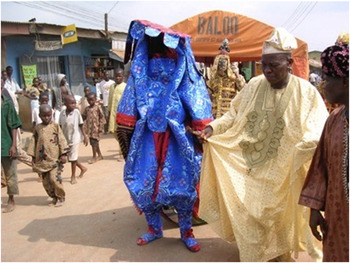
The role of women in Egungun leadership was a frequent topic of my conversations with the king of Otta in his palace. These encounters were less like formal question-and-answer interviews and more like monologues in which the king discussed aspects of Egungun that intrigued him or that he wanted to convey to foreign guests. On 26 December 2004, while I was waiting to interview the king, an Egungun ancestral masquerade named Babaa (“father,” see Figure 1) visited the palace, accompanied by a small procession of drummers, praise singers, kinfolk, and their followers. Using prayers and dancing, the Egungun bestowed its wishes for a long, healthy, and prosperous reign for the king, who responded with cash and praise. Immediately after the Egungun masquerade departed from the palace, I spoke with the king. He turned to me and started our discussion with the following comment in English:
That Egungun that you have just seen belongs to the female chiefs of the Egungun cult. The female chiefs, we call them the Iya Agba Oje [elder mothers of Egungun]. We also call them Oloye Obinrin [female chiefs]. It is the women, particularly the elderly women – these people we call the Iya Agba Oje – it is they that own the Egungun as a cult. They are very important. If any Egungun wants to make a show, that Egungun must have the approval of the Iya Agba Oje. Failure to do that may result in the sanctioning of the Egungun. They may even ask the Egungun to be suspended indefinitely. That may tell you how important they are in the overall organization of the Egungun cult. The male chiefs are regarded as the heads of the society like the men are regarded as the heads of family and society. But the people that have the power for this Egungun administration are the women, the Iya Agba Oje, in Otta. Footnote 64
Egungun Baba Muko, named Babaa (“father”), is owned by the Iya Agba Oje (the elderly women chiefs of Egungun) at Otta. This Egungun performs on special days during the festival period, including one day, seen here, set aside for Babaa. It honors deceased Egungun chiefs and initiated members. 2004/2005 Egungun Festival, Otta. Photograph by author.

My conversation with the king of Otta was the first time I had heard anyone at Otta talk explicitly about the prominent role of female chiefs in Egungun affairs. Prior to my interview with the king, I had interviewed several high-ranking male Egungun chiefs. None of them had made such bold statements about the gendered distribution of power and authority among Egungun chiefs or spoke of the powerful influence of women in Egungun. I had been given to understand that women held power only in the domain of Gelede. One of the leading male Egungun chiefs who came closest to acknowledging a debate about whether the male and female chiefs own the Egungun cult actually took an opposing stance from that of the king. This chief claimed that while the Egungun society can do nothing without the women, it is the men who actually own the Egungun. Footnote 65
Here I am not interested in resolving the debate at Otta over who “owns” Egungun. Yet, the debate offers evidence of a tension that underscores the importance of properly understanding Egungun power relations to also understanding gender relations in a Yoruba community where Egungun practice flourishes. My evidence at Otta corroborates Thompson Drewal and Drewal’s evidence pertaining to the gendered distribution of power in Egungun and begs for a deeper look into both the historiography on the relationship of women to the practice and organization or cult of Egungun and the local historical factors that make such patterns possible, a point to which I shall return in the conclusion of this article.
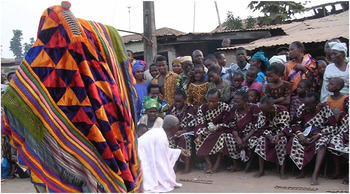
I met the members of the Iya Agba Oje (the elder mothers of the Egungun masquerade society) just three days before my first interview with the king. As I began to record a masquerade performance, I stood across from a group of women who were all dressed alike in blouses (buba) and skirts (iro) sewn from the same maroon-and-white fabric and worn in the same style. Footnote 66 These women sat together on a row of chairs that separated the crowd, which stood behind them, from the open area where the masqueraders danced. I watched an elderly man wearing white beg these women for money while an Egungun danced (Figure 2). I observed another Egungun performer prostrate himself before these women. I concluded that these women must occupy a major status. One of the women summoned me and asked me to identify myself and state my purpose in recording the event. This woman was arguably the youngest among them and, being the only member of the group who was fluent in English, spoke on behalf of the whole group. After I answered her questions, she invited me to sit with them, offering me an ideal spot from which to observe the Egungun masqueraders as they danced. It was several days later, during my interview with the king, that I began to realize how central this group of women is to Egungun at Otta.
An Egungun Alabala masquerade shows off its dancing skills while an elderly man wearing white kneels in front of the Iya Agba Oje, asking them for money. The majority of observers standing behind the female chiefs watch the exchange between these chiefs and the man. Photograph by author, December 2004.

Over the course of the festival, from December 2004 to April 2005, I spent a good deal of time talking with one of the members of Iya Agba Oje known as the Elesho, in her home, in the headquarters of the female Egungun chiefs, at Egungun performances, and at local markets. (Many women merchants were also members of the Iya Agba Oje.) I learned that they held their meetings separately from the male Egungun chiefs, and that both bodies of chiefs sent their respective representatives to meet with the group from the other sex and report back to their own group. As we became more familiar with one another, these women began to refer rather playfully to me as oko Elesho – “the husband of Elesho.” The Elesho’s generosity and the half-serious, half-flirtatious acknowledgement of my new “insider” status conferred on me by the women of the masquerade society gave me a window through which to view the institution of Egungun as it exists in Otta today.
The Elesho is a middle-aged woman in her mid-to-late fifties. She is divorced, with several children. Her responsibilities as the Elesho include observing the affairs of the male Egungun cult members and reporting back to the Iya Agba Oje. She likely became aware of my growing interaction with the Egungun society’s male hierarchy of chiefs as well as my presence at Egungun masquerade performances during the first week of the festival of December 2004. Later, she allowed me to observe and participate in rituals that enhanced my understanding of her role in Egungun. She permitted me to document several rituals that occurred in her family’s compound, involving prayers and libations offered in honor of the Egungun that she owned. On one occasion she offered a few elements of the history of another Egungun in her family. And finally, the entire group of female Egungun chiefs allowed me to enter their sacred grove. I had not been invited into the igbale, the sacred grove for male Egungun chiefs and initiates, even though I had also been playfully adopted as the son of the Oloponda, the leader of the male council of Egungun chiefs.
I observed how male Egungun chiefs and other prominent members of the town treated the Iya Agba Oje. On days when the entire community descended on a particular area of town to witness the performance of a popular Egungun, the Iya Agba Oje were given front-row seats. They generally wore attire provided for them in tribute by the families sponsoring that performance. Egungun masqueraders greeted the women by touching their foreheads to the ground as they prostrated themselves before the Iya Agba Oje who, in turn, bowed and touched their hands to the earth and then to their foreheads three times. I observed their actions as I sat with them during the performances I attended. On the closing day of the festival, the king of Otta himself came to greet these women. Although he did not prostrate himself before them, he did give them money, possibly as a sign of his own patronage.
As a result of all my conversations with the Iya Agba Oje and female and male chiefs in other Yoruba towns, I developed a new perspective on the evolving historical relationship between Egungun, women, and witches. One of the challenges I faced was that in some contexts it is inappropriate to speak about witches or to assume that all women are potential witches. However, the Elesho offered a story that suggests that the Iya Agba Oje consider themselves as possessing the power of execution conferred on them through their membership in the Egungun cult, while non-cult members – including some scholars and numerous conservative Christians and Muslims – consider these women “witches.” According to one story, a man once egregiously violated a taboo by stepping on the cloth of an Egungun during a performance. When he refused to apologize or show any sense of remorse, the Iya Agba Oje responded by threatening him. Reportedly, that night the man entered his home for the last time. He immediately became ill and remained bedridden until he died five years later. Footnote 67 This account is corroborated by the owner of a prominent masquerade, who said the following:
If you touch the Egungun cloth, you will offend the women. It’s the women that are dangerous. The men can only flog you, but the women will not (…) the women will not talk. They will use their witchcraft to charm the person, and that will be the end of that person.
The implication here is that the Iya Agba Oje, through their capacity as Egungun chiefs, were the source of the man’s illness and ultimate death, and women who take a life are directly or indirectly “suspected” of being witches by outsiders. This story has proverbial overtones and corroborates the Drewals’ claim that the women chiefs of Egungun in a nearby Egungun town hold the power of life and death.
Several years later, in December 2010, the king made a cryptic statement that has influenced how I view the women chiefs and gender identities in the ritual context of Egungun historically.
In our own system, this Egungun system, we have those we call [the] Iya Agba Oje. They are chiefs, women chiefs, and these women chiefs, I want to tell you, have very great power. Of course, it is not young women. They are elderly women. They are women who sometimes we refer to as men. It is they who know everything, every secret about the Egungun cult. Footnote 68
The king’s comments identify Egungun as an arena in which gender is fluid; women can temporarily become “men.” The king’s insights and my observations of the women chiefs suggest that discourses on gender roles with respect to various aspects of the practice and management of Egungun at Otta do not assume that daily gender identity remains constant. Returning to my relationship to the Elesho, I posit that as the outsider (the iyawo in Oyewumi’s model) I structurally and symbolically held the status of “wife” and the Elesho that of “husband” – a woman who in this instance was a “man.” This gender fluidity resonates with the notion of aje (the mothers) as shape shifters, possessing the capacity to assume other forms.
When Men Became Women
My perspective differs from that of nineteenth-century missionaries and generations of scholars in one fundamental way. An examination of my own relationship to the Elesho alongside Oyewumi’s view of seniority in Yoruba culture offers insight into the extent of gender fluidity and identities in Egungun. Moreover, the power and authority that the Iya Agba Oje wield at Otta suggest that many assumptions about how gender operates in the realm of Egungun need to be reconsidered. The view that Egungun is controlled by men and that it exists to control women and to persecute aje – the special power that is associated with women in Yoruba culture – has persisted since the time of James White and other nineteenth-century missionaries. This view should be evaluated against the conditions in which missionaries encountered communities that practiced Egungun and the need to identify factors that hindered the progress of the mission.
During the nineteenth century, wars fueled by Oyo’s decline and collapse and by efforts to supplant Oyo’s regional hegemony propelled warriors and warlords to unprecedented power in matters of state and in the realm of Egungun. At Otta, one warlord known as the Ajana became the regent after Otta lost the abovementioned war to Abeokuta in 1842. According to an Egungun chief who also claims to be a descendant of the Ajana, this warlord’s primary function was to punish lawbreakers and to lead the town’s defenses in battle. He mobilized his own Egungun to achieve these ends. Yet, in the wake of Otta’s lost war and without a king on the throne, his Egungun enslaved and killed innocent people. The town’s other leaders responded by banning the warlord’s Egungun. The warlord created a new more entertaining Egungun, named Ajofoyinbo (meaning “we dance for the white men”) to entertain the missionaries who helped negotiate peace between Otta and Abeokuta and the terms by which the prince and heir to the throne would be permitted to become the king. While the warlord placated missionaries with his new Egungun, he was at the center of a movement to abolish Otta’s monarchy from 1854 to 1859.
An analysis of White’s journals suggests that the Ajana worked behind the scenes through another body charged with maintaining law and order, Oloru, to target members of the prince’s entourage. Another group, according to the Egungun chief referenced above, introduced yet another new Egungun named Apaje (meaning “killer of witches”). Reflecting notions of gender fluidity that accompany witchcraft discourses among Yoruba speakers, I contend that Apaje targeted seemingly invincible men like the warlord as witches. At the same time that Apaje emerged at Otta, the warlords and his supporters were deposed from office and replaced by a new administration that was more loyal to the monarchy and that was aligned with the missionaries. The politics surrounding the introduction and banishment of various Egungun at Otta in the 1850s suggests that powerful men mobilized Egungun masquerades more to target one another than to target women. At least structurally and symbolically, these men in some respects became women or aje.
White offers no commentary on any of the specific Egungun identified by the chief whom I interviewed. Yet, my analysis of the evidence presented by White and by the chief suggests that warfare and its consequences fueled fears that witchcraft threatened the safety of the town’s inhabitants in the middle of the nineteenth century. Events pertaining to the rise and fall of the warlord known as the Ajana of Otta also foreshadow the consequences of the transition from the slave trade to the commercial trade promoted by missionaries who saw European evangelical and commercial interests as intertwined. The warlord profited from the slave trade as well as from his interference in the movement of people and goods from the port towns of Badagry and Lagos to the south and the new hinterland state of Abeokuta to the north. The master–slave relationship that obstructed the practice of Egungun among a minority Yoruba population in Abomey, according to Noret, fueled the practice in a Yoruba town (Otta) whose economy was dominated first by slave owners and later by commercial merchants of palm produce and cloth.
Economic historians link the decline of the slave trade and the growth of the palm produce trade in the nineteenth century to concerns about women’s power. Men were disproportionately slow to respond to the economic transitions that were under way. Men had trouble adapting for two reasons: the ideology that palm production and trade were women’s work and their failure to appreciate the labor intensity involved in processing, trading and transporting palm oil. Initially, men did not retain enough slaves in their households to participate in palm oil production, so they were unable to make the same profits they had amassed from the slave trade; conversely, women traders had the knowledge, contacts, and networks needed to adapt best to the growing palm trade. Footnote 69 The wealth that women derived from this trade enabled them to translate their economic power into social and political power; the creation of the titles of the Iyalode reflects the power and authority that some exceptional women garnered during this era. Footnote 70 Men were somewhat emasculated by the abolition of the overseas trade that generally benefited men and with the rise of a trade that, in the eyes of some, was “women’s work.” Some men responded to the upheavals associated with jealousy and envy by mobilizing Egungun to destroy women’s trading stalls in the market and even Christian mission houses and converts. Footnote 71 The longstanding adversarial relationship between missionaries and practitioners of Egungun were reflected in their writings.
As I argue elsewhere, cooperation between men and women as well as husbands and wives reflects a neglected aspect of the history of Egungun and of gender relations among the Yoruba people. In the last decades of the nineteenth century, a warrior returned to his home in Otta from a war camp, where he proposed to a woman on the condition that he would sponsor the performances of an Egungun she had inherited from her father. The Egungun was named Oya after the legendary wife of the Oyo king, Shango, and is the only popular mythical figure, whether man or woman, to have an Egungun named in her honor. When the couple arrived at Otta, his senior wife, a prominent cloth merchant, provided the cloth and other resources needed to stage performances. Together, the husband and his two wives introduced a new form of Egungun performance that inspired many other families to adopt the same form; in essence, Oya gave birth to many other Egungun. The senior wife parlayed her financial resources and the opportunity to market them to the town during Egungun performances into a chieftaincy title; she became the first Iyalode of Otta when a British colonial administrator conferred the title in the 1920s. Footnote 72
Developments in the British colonial policy of indirect rule informed the incorporation of local authorities, such as the senior wife who became the Iyalode, into the colonial administration. Footnote 73 By this time, Egungun and other masquerade groups that had been engaged in acts of violence were banned. The changes in Egungun performances associated with masquerade of the two women enabled the new mode of performance not only to be permitted but also to proliferate.
This case resonates with Oyewumi’s emphasis on kinship and seniority, which here represents the entrance of the wives into the lineages of their husbands. Today these women are praised by their families in the performance of the Egungun. The case of an Egungun named after the mythical wife of an Oyo king demonstrates that the view that Egungun was based on the exclusion of women is unsustainable and that kinship and material wealth have also shaped participation in Egungun. If descendants of the warrior are correct in claiming that the warrior paraded the Oya masquerade during the early years of its performances at Otta, then we also arguably have a case of gender transformation, of a warrior becoming a mythical wife through the agency of his wives. Whether the parade of Oya embodied the warrior or another man appointed to perform as Oya, what is most evident is that “mothers” have been honored, not unlike they are in the realm of Gelede. This is only fitting for a masquerade tradition and a town owned by the “mothers,” as my fieldwork reveals. Yoruba practices of gender seem fluid enough to allow for “mothers” honored as ancestors to temporarily become “fathers,” as Egungun are typically hailed – “Baba mi, Ara Orun” (My father, the people of heaven). Gender did not serve as a barrier in these women’s ability to wield power and promote their reputations in a manner comparable to that of their husbands. The model here is one of collaboration between the genders where gender serves as one of many factors shaping how people participate in Egungun.
Conclusion
During the twentieth century and in contemporary times, women have been disproportionately associated with aje, and missionaries and colonial and postcolonial Nigerians have translated aje as “witch.” At the same time, Otta has been known throughout the region of southwest Nigeria as a haven for women identified as aje, and as a community where the practice of Egungun has flourished. Might the prominence of the Iya Agba Oje as women associated with aje and of Egungun at Otta be interconnected? Verger references an oral tradition that establishes a mythological basis for women’s ritual and political importance to the founding of the town. In addition, Otta’s king suggests that residents of the town note the distinction between sex and gender when it comes to the realm of Egungun. Taken together, Verger and the king’s insights lead me to conclude that scholars should not assume that gender equals sex when interpreting what missionaries and practitioners say or write.
Sex and gender are socially and culturally constructed and involve performances of a set of stylized bodily acts that are not voluntary. These acts constitute regulative discourses that discipline bodies to perform actions that maintain the appearance of sex and gender as natural or coherent. By extension, “women” appear as an ahistorical group with common characteristics as distinct from “men” instead of as performances dictated by power. Footnote 74 It is the assumed naturalness of biological differences ascribed to sex that serves as the bedrock of missionary and colonial discourses that scholars by and large uncritically adopt. Even the notion of gender flexibility or fluidity needs to be interrogated as to whether it best characterizes the range of social hierarchies that have historically animated African societies. Footnote 75 The assumed objectivity of observers and the conditions under which observations occurred and knowledge is produced need also be interrogated as critical ethnographers thoughtfully demonstrate.
The case of the female Egungun chiefs at Otta, and of my relationship to one of its members (the elesho), complicates assumptions about where women stand in both historical and contemporary Yoruba societies. These cases represent two contemporary examples of gender fluidity. The king of Otta regards that Iya Agba Oje (the Elder Mothers or Grandmothers of Egungun) as women who are sometimes referred to as men. Yoruba ritual and social discourses offer clues for interpreting the king’s reference. These discourses demonstrate that the term aje (typically translated as witch and assumed to be a woman) can refer literally or symbolically to the “Mothers,” the “Elders,” the “Owners of the World,” or the “World.” Footnote 76 My encounters and conversations with the female chiefs and the king among others at Otta inform my interpretations of Yoruba gender discourses and missionary sources. It was during these encounters that I acquired the name “Oko Elesho” (which literary translates as husband of Elesho). Evaluating my evolving status at Otta as a foreign visitor who became a “husband” of a powerful female chief, sometimes referred to as a man, led me to conclude that I effectively and figuratively became the “wife” (or outsider) who “married” into a community of insiders. I find support for this interpretation in Oyewumi’s alternative translation of oko as a reference to individuals born into a lineage and iyawo as individuals who married into the lineage of their spouses. Further support of my reading of gender in Yoruba culture comes from conversations with Yoruba speakers who confirmed that oko is often used as an expression of affinity by a mother to a favored child, whether daughter or son. Footnote 77 I became both the metaphorical “wife” and “son” of the Elesho. Whether as “wife” or as “son,” a claim of affection comes with an expectation of loyalty and subordination. My research illustrates the importance of understanding Yoruba gender discourse in more metaphorical, multivocal, and fluid than literal and fixed ways.
My research has broader implications for understanding the power that some women have wielded in Egungun and Yoruba culture. The King of Otta’s references to Otta’s female Egungun chiefs as the owners of the Egungun cult and as helping him administer the town not only belies the traditional narrative of Egungun as hostile to women. His statements reveal a view of women was the ultimate wielders of power and the decision makers at the levels of the family, community, and kingdom. These women are not simply advisers who present information; they are the decision makers who inform the king and the male chiefs of the policies they wish to uphold.
There are historical precedents from the eighteenth, nineteenth, and twentieth centuries that are worth noting here. Like the council of non-royal chiefs to the king in imperial Oyo (from the rise of Bashorun Gaa, the war chief and effective ruler of Oyo, in 1754 to the collapse of the empire in 1836), these women tell the king and male Egungun chiefs of Otta what to do to avoid facing rejection and death. Footnote 78 This explanation of a particular group of women’s power may explain the reason why the aje of Otta are so feared in and outside of the town.
The king’s description of women’s power also speaks to the importance of women’s material, social, and spiritual resources in the “performance” of masculine dominance. In the quote that opens this article, the missionary, Johnson, identities women as both feigning belief that Egungun are departed ancestors and as coerced into providing food for elaborate Egungun festivals at Oyo. Based on his observations from the late nineteenth century, he believes that the force of habit led women to no longer be deceived about the “true” identity of Egungun masqueraders. Footnote 79 Yet, he oversimplifies the ways in which women’s resources were critical to the perpetuation of Egungun. Elsewhere I demonstrate that two women, who were the wives of a late nineteenth-century warrior at Otta, pooled their ritual paraphernalia, knowledge, and commercial resources to introduce a new masquerade figure and ritual practice at Otta. Her labor inspired nearly twenty families to adopt new Egungun figures and practices since the early twentieth century. Footnote 80 As Barber astutely observes, women build the masculine personae of Egungun through their performance of the praise songs that harness the Egungun’s power. Footnote 81
The domains of culture and politics intersect both historically and in contemporary life and gender roles play into that intersection. Women held titled offices in the Oyo palace and capital during the era of Oyo imperialism and its aftermath in the nineteenth century. The highest-ranking women in the Oyo palace were the heads of religious practices and groups, and thus were able to translate their religious and cultural power into political power. As cultural brokers, community mediators, and ritual leaders, these and other historical women used their knowledge and networks to secure important political positions. Footnote 82 One of the women I reference elsewhere was able to use her wealth and commercial networks to introduce a new Egungun masquerade and ritual, thereby translating commercial and cultural power into political power as a chief (known as the Iyalode, or “Mother who owns the outside world”) appointed by a British colonial administrator. Many of women in other Yoruba towns like Abeokuta, Ijaye, and Ibadan in the nineteenth century were able to convert their commercial power into political power.
Yet there were limits; some of these same women faced criticism for “behaving too much like men.” The unprecedented rise and power of some women who acquired the title of Iyalode made them vulnerable to ridicule and even suspicion as witches. Footnote 83 Lorelle Semley identifies two women, a royal wife and a priestess, who received appointments as French colonial agents in early twentieth century Ketu, a Yoruba town north of Dahomey and west of the Yoruba heartland. Compelled to promote unpopular policies on the behalf of a colonial regime that empowered them, these “Queens of Ketu” experienced such scathing criticism that they were deposed in less than six years. Footnote 84 The rise of and opposition to women who stretched the limits of gender fluidity deserve greater attention. They test the limits of our understanding of gender and of the structures and performances of power and authority that shape social interactions and the ways we remember them.
The entrenchment of Islam and Christianity into Yoruba and Nigerian life during the eras of colonial and independent rule have complicated if not hindered the ability of such women to translate their cultural and religious power into political power. New evidence that I am uncovering in the Yoruba town of Iragbiji, Oshun State, suggests that there are new and increased opportunities for women to occupy positions of power and authority among Egungun priests. Many men have embraced modernity through conversion to Islam and Christianity in ways that have led them to abandon offices that they would have otherwise occupied based on their birth in a lineage owning an Egungun title. With titles and other positions left unclaimed some women have filled these roles. One woman I encountered even her cultural and religious power in the realm of Egungun into a Muslim office in the mosque. More research is needed that explores these patterns and their implications.
The research presented in this article reveals that the spread of Christianity played into nineteenth-century missionary perceptions of the culture they were trying to infiltrate. As Peel insightfully observes, a critical hermeneutic is required when analyzing missionary accounts of Yoruba cultural practices, practitioners, and institutions because the missionary’s “civilizing mission” was predicated on undermining and replacing Yoruba cultural and religious elements with European cultural elements and Christianity. A critical hermeneutic is also needed whether scholars are analyzing missionary (and colonial) records or ethnographic sources including oral traditions.
My non-adversarial approach yields a richer and more accurate understanding of the role of gender in Yoruba history and culture. It reveals the importance of using performance as a method of observation and as a category of analysis. Relying on archival materials particularly those produced by those who had an overtly antagonistic relationship yields a distorted view. Scholars should read these sources against the grain and with a keen awareness of gender as a historically constructed category, that sex does not equal gender, and that kinship and other categories and resources shape social and historical constructions of gender.
John Thabiti Willis is an Assistant Professor of African History at Carleton College. He received his BA from Clark Atlanta University, his MPS from Cornell University, and his MA and PhD from Emory University. His scholarship focuses on West African history, with a special emphasis on Nigeria. His current book project, Masquerading Politics: Kinship, Gender, Ethnicity in a Yoruba Town (under contract with Indiana University Press), examines how masquerade performances and the organizations that govern them have been key arenas through which shifting coalitions of state actors have sought to shape the processes of state formation and imperial expansion, and have played important roles in incorporating immigrants, punishing criminals, and challenging and asserting power in precolonial and colonial Africa. E-mail: jcwillis@carleton.edu