Developmental origins of health and disease and gender inequality
In every corner of the world, women do not have the same rights and opportunities as men. Although considerable progress toward gender equality has been made, women continue to be disadvantaged compared with men. Across the globe, women earn less money than men, women do more unpaid work than men, and this contributes to poverty affecting many more women than men.1,2 There are many other intertwined factors that are unequally distributed between men and women.Reference Sen, Ostlin and George3,Reference Horton4 Although the extent of inequality differs widely between countries and settings, the disadvantaged position of women compared with men is universal. In this paper, I will argue that as long as women are more often confronted with poverty, violence, and mental health problems and if they continue to have less access to good quality food and education, this does not only affect these women but also hampers the development and health of future generations. Gender inequality does not “just” affect half of the world’s population, but it also affects all of us and all of the future generations.
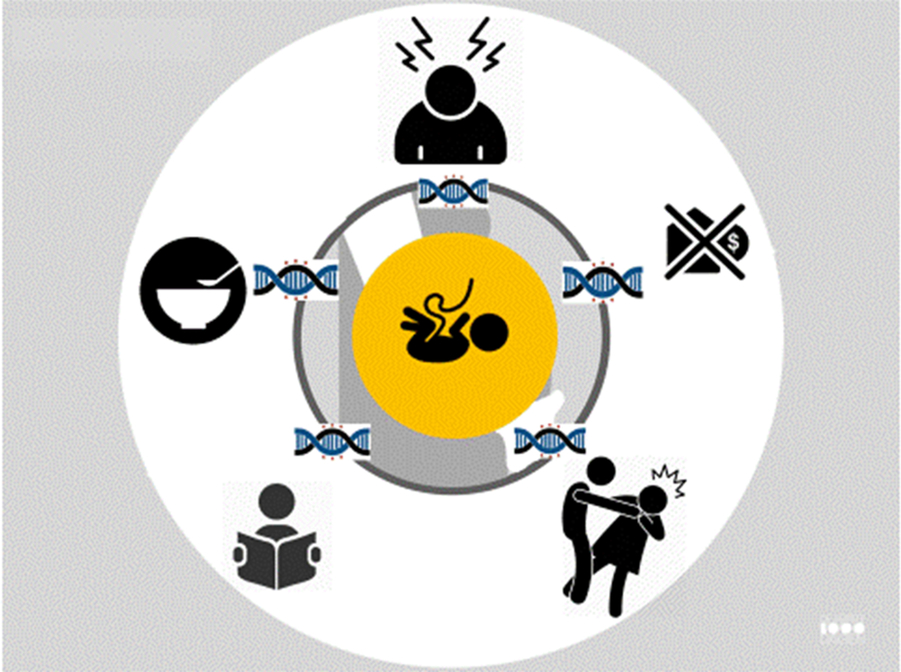
The environment in which an individual develops, from the very earliest stages of life into early childhood, has a fundamental influence on its growth and development. Environmental stressors acting in early life affect the organs and tissues developing during critical periods of growth and thereby permanently alter their structure and function with lasting consequences for behavior, the ability to learn, and susceptibility to disease. Physical, psychological, and nutritional stressors during development affect gene expression and influence the developmental trajectory and an individual’s ability to reach its full developmental potential.Reference Fleming, Watkins and Velazquez5 Especially before birth, but also in the early years after birth, the environment in which an individual grows and develops is largely determined by the mother and her direct environment. Therefore, the physical and psychosocial stressors that women are exposed directly or indirectly affect their developing child and consequently reduce its ability to reach its full potential (Fig. 1). There is evidence that the physical and psychosocial stressors that women are exposed to leave lasting epigenetic marks on their offspring’s DNA. Inequality is thereby “baked” into the organs and tissues of the offspring. In the following paragraphs I will discuss some of the most poignant gender inequalities and the effect on their offspring’s development and health to give some impression of the impact achieving gender equality might have on future generations.
How gender inequality affects offspring’s development and health.

Gender inequalities
Poverty
In every country in the world, women earn less money than men1 and they spend three times as much time on unpaid work and care.2 Women are more often confronted with poverty than men. In fact, 70% of the world’s poor are women.Reference Sen, Ostlin and George3 The link between poverty and poor health is well established, and children of poor mothers are disadvantaged in many ways. Children of poor mothers are more likely to be born small, more likely to die in the first year of life, they are less likely to be well nourished, less likely to grow well and do well in school, and they are less healthy.Reference Cooper and Stewart6 The effects of poverty on children’s nutrition, growth, development, and health are substantial and are observed in every setting.Reference Brooks-Gunn and Duncan7 Whether in the United Sates or in Uganda, children growing up in poverty have poorer development and poorer health. Although poverty is a complex problem, there is evidence to suggest that interventions aimed at alleviating poverty (such as in cash and near-cash subsidies) have a lasting positive effect on the future development of children in terms of improved cognitive and school performance, graduation rates, and adult earnings.8 This suggests that lifting women out of poverty will create a secure future for herself and have beneficial effects for their children.
Violence
Women are more often victims of violence than men.Reference Garcia-Moreno, Jansen and Ellsberg9 The most common type of violence against women is intimate partner violence, with one in three women globally experiencing physical or sexual violence by an intimate partner at some time in her life. Internationally, studies suggest that domestic and family violence during pregnancy is widespread and that violence often begins during pregnancy, or, if domestic violence already exists, it is likely to increase in severity during pregnancy.10 Women who experience violence during pregnancy are more likely to deliver prematurely and are at increased risk of delivering a baby with poorer neonatal outcomes.Reference Shah and Shah11 After birth, these children more often have internalizing problemsReference Martinez-Torteya, Bogat, Levendosky and von Eye12 and higher circulating levels of cortisol.Reference Levendosky, Bogat and Lonstein13 Infants exposed to violence show insecure attachments, increased behavioral problems, reduced levels of prosocial behavior, and increased aggressive behavior,Reference Cameranesi, Lix and Piotrowski14 and there are indications that they have increased rates of obesity and cardiovascular and metabolic diseases.Reference Dunn, Nishimi and Neumann15 In fact, epigenetic studies have shown that prenatal exposure to violence leaves lasting epigenetic marks on the glucocorticoid receptor that can still be detected 10–19 years later.Reference Radtke, Ruf and Ginter16 If violence continues after birth, those who grow up with violence are more likely to perpetrate or experience intimate partner violence, perpetuating the transgenerational transmission of violence. Programs that are aimed to reduce and prevent violence have shown that nurse home visitation, especially when started in pregnancy and continued until the second birthday of the child, is effective in preventing child maltreatment in the subsequent years.Reference Eckenrode, Ganzel and Henderson17 This is a promising way to break the intergenerational cycle of violence and improve the lives of generations to come.
Education
Although the difference in level of schooling between men and women is decreasing, girls still have less schooling than boys, and 63 million girls worldwide are out of school. Education of girls has a measurable impact on their own and their children’s health outcomes.Reference Desai and Alva18 Children of mothers with lower levels of education have poorer health at birthReference Ruiz, Goldblatt and Morrison19 and they are less likely to survive infancy.Reference Gage, Fang, O’Neill and Dirienzo20 Maternal educational attainment of mothers correlates positively with offspring’s educational attainment.Reference Harding21 Young children of educated mothers have higher levels of cognitive development than children of less educated mothers. Also, they are more likely to have access to interventions than children of less educated mothers and are more likely to grow up healthy as a consequence.Reference Walker, Wachs and Gardner22 Although experimental evidence of educational interventions before or during pregnancy are lacking, there is evidence to suggest that maternal education plays a causal role in stimulating child growth, development, and health. For example, adoption studies show that children who are adopted by couples with a higher education grow and develop better than those adopted by couples with lower education.Reference Chen and Li23
Food
There are various gender inequalities in relation to food, each contributing to suboptimal conditions for the offspring. Women in general have poorer quality diets. In some parts of the world, women are twice as likely to be undernourished than men due to gender inequality in access to foodReference Kshatriya and Acharya24, while in many other parts of the world the poorer diets of women translate into higher obesity rates in women than men.25 Suboptimal nutrition during gestation, whether due to a lack of food or obesity, has negative consequences for the offspring and increases the risk of chronic degenerative diseases and behavioral problems. Both under- and overnutrition during gestation increase susceptibility to disease with the effects of suboptimal nutrition at both ends of the spectrum being substantial. Men and women whose mothers had been undernourished in pregnancy had doubled rates of cardiovascular disease,Reference Roseboom, van der Meulen and Osmond26 and similarly, children of obese mothers had significantly increased rates of cardiovascular disease.Reference Reynolds, Allan and Raja27 It seems likely that if women have equal access to good quality food, their offspring would benefit. Good nutrition is fundamental for optimal growth development and health. Through its effect on health and cognitive development, it is also vital for academic performance and productivity and therefore for healthy economies and socioeconomic development. Improving nutrition of women before and during pregnancy will translate into improved human capital and healthier societies.
Mental health
Women experience more anxiety and depression than men.Reference Temmerman, Khosla, Laski, Mathews and Say28 Mental disorders in women including depression and anxiety are among the most common conditions that coexist with pregnancy and are associated with a range of negative child outcomes, including poor infant growth, children’s emotional and behavioral difficulties, and insecure attachment to caregivers. Maternal depressive symptoms are negatively associated with parenting skills.Reference Wachs, Black and Engle29 Depressed mothers are less involved, less sensitive, and more negative when interacting with their young children.Reference Cooper, Tomlinson, Swartz, Woolgar, Murray and Molteno30 There are indications that cognitive behavioral therapy has beneficial effects for pregnant women and their children. Children of mothers who underwent cognitive behavioral therapy had less behavioral problems and there are preliminary indications of structural changes in their brain that are visible in childhood and may be partly mediated through epigenetic changes.Reference Bleker, Milgrom and Sexton-Oates31 This suggests that improving women’s mental health is likely to benefit their own as well as their offspring’s well-being and health.
The need to address gender inequality to provide a good start in life
Millions of children are failing to reach their developmental potential because they were exposed to poverty, violence, poor nutrition, and stress during critical periods of growth and development which led their brains to develop suboptimally, their bodies be more susceptible to chronic degenerative disease, and themselves less able to contribute to society. The levels of gender inequality and their effect on development and human capital of the next generation are likely to be substantial. The economic cost of a poor start in life are steep and the case for countries to invest in the early years is clearReference Gertler, Heckman and Pinto32 as was highlighted during the first Human Capital Summit: Investing in the Early Years for Growth and Productivity, hosted by the World Bank.33 It is essential to strive beyond gender equality (aiming for equal access) and aim for gender equity so that women’s needs are met (since, for instance, nutritional needs differ between men and women) and children start life without exposure to nutritional, environmental, and psychosocial stressors that hamper their potential to develop fully. However, if we frame gender equality as a women’s issue, we are failing to highlight the importance of gender equality for the health and well-being of the next generation. Conversely, if we as a DOHaD society fail to underscore the complex context in which programming occurs and focus too much on women’s individual choices and influences on her child, we are all too likely to blame individual women.Reference Richardson, Daniels and Gillman34 The solutions we have sought so far have not fully taken into account the complex gender inequality in society. Indeed, there are intricate links between poverty and nutrition, education, violence, and mental health, and addressing gender inequality in each of these factors individually is unlikely to be effective. To make progress, the complex nonlinear and bidirectional links between these factors need to be taken into account.
UN agencies, the World Bank, and others work hard to make progress on this front. The UN Secretary General’s Global Strategy for Women’s, Children’s and Adolescent Health 2016–2030 and its goals to survive, thrive, and transform provide momentum to lay the foundations for a lifetime of health and well-being for the benefit of today’s women and children and tomorrow's adults and future generations.35 This is a promising indication that the global community is aware of the importance of good early development as a fundamental right of every child.Reference Machel36–Reference Barker, Barker, Fleming and Lampl38
With the early environment being of fundamental importance for achieving an individual’s full potential, the right to health and the right for children to good early development are inextricably linked to equal rights for men and women. Such rights imply legal obligations of governments to ensure access to proper food, work, and education. Yet in more than 100 countries, laws prohibit women from working in certain jobs, 49 countries do not have laws against domestic violence, and in 39 countries, sons and daughters do not have the same inheritance rights. In 18 countries, husbands can legally prevent their wives from working, and in 8 countries (including the United States), women do not have the right to paid maternity leave. These legislations promote gender inequality and thereby ultimately prevent children from fulfilling their full developmental potential. As such, these laws are against the human rights. So far, we as a scientific community have not sufficiently explored the possibility to work with human rights experts to address our aim to give each child the best possible start and aim for gender equality.Reference Toebes and Stronks39
If we are to make progress in turning DOHaD science into practice, we need to address gender equality. Achieving optimal chances for each and every child to develop to its full potential can only be achieved if their mothers enjoy equal access to work, get equal pay, equal access to education, access to good nutrition, and are safe from violence and stress from mental health issues. To gauge the importance of a good start in life, we need to consider the level of inequity in poverty, violence, mental illness, and access to food and education and the effects of these exposures during pregnancy on the growth development and health of the offspring. We need to better understand their complex adaptive interactions and find ways to address these to achieve gender equity. Crucially, we need to move forward with policies designed to prevent this loss of human potential and create equal opportunities for men and women. After all, gender equality is not only a fundamental human right, but also a necessary foundation for healthier future generations.