


Introduction
Faced with multiple dimensions of pressure, constraint and change, welfare systems across advanced economies continue to experience profound challenge and reform. Aside from their now normalised financial pressures, welfare systems grapple with their historic layering of often contradictory bureaucratic and market reform processes (Farnsworth and Irving, Reference Farnsworth and Irving2011; Hemerijck, Reference Hemerijck2013). This, critics argue, has resulted in welfare systems characterised in nationally specific ways by fragmentation, rationing, inefficiency, depersonalisation, individualisation and inequality (Cottam, Reference Cottam2018; Farnsworth and Irving, 2013). This is to the detriment of all welfare users but especially those with more complex and/or longer-term support needs where current provision frequently struggles to deliver the intensity, duration and integration of welfare support required (Smith et al., Reference Smith, Hesselgreaves, Charlton and Wilson2025).
In response, academic scholarship and policy debate have taken a ‘relational turn’ (Bartels and Turnbull, Reference Bartels and Turnbull2020) in recent years, with various change-focused ‘practice narratives’ put forward (Wilson et al., Reference Wilson, French, Hesselgreaves, Lowe and Smith2024). All of these narratives seek, in slightly different ways, to respond to the limits of current welfare transactionalism and to recentre people and relationships in modern welfare systems (Wilson et al., Reference Wilson, French, Hesselgreaves, Lowe and Smith2024). Prominent amongst them have been Hilary Cottam’s ideas and Participle experiments that have stimulated a valuable emerging field of relational welfare scholarship and debate, with important insights and potential for progressive welfare change.
To further support that potential, the present article argues that sharper analytical understanding is needed around the diversity of what relational welfare can be, of the relational identifiers that help to differentiate relational from non-relational approaches, and of the potential variation and hierarchical nature of those relational identifiers across different forms of relational welfare intervention. To advance these contributions, we draw on sixty-one qualitative interviews with staff and service users across sixteen UK-based Supported Employment services rooted in the values, principles and practices of relational welfare, seeking to support individuals into good quality, well-matched paid employment.
The next section offers an outline of Cottam’s relational welfare thinking followed by an overview of our data and methods and then our qualitative findings. A concluding discussion steps out to reflect on implications for relational welfare scholarship and policy practice.
Relational welfare: unpacking identifiers, extents and forms
Led by the work of Hilary Cottam, relational welfare scholarship has flourished in the past two decades across diverse fields including typologisation (Bartels and Turnbull, Reference Bartels and Turnbull2020; Wilson et al., Reference Wilson, French, Hesselgreaves, Lowe and Smith2024), social care (El-Hoss et al., Reference El-Hoss, Thomas, Gradinger and Hughes2023), health (von Heimburg and Ness, 2021), child protection (Featherstone et al., Reference Featherstone, Gupta and Morris2021), public service reform (Smith et al., Reference Smith, Hesselgreaves, Charlton and Wilson2025) and – our empirical focus – employment activation (Pearson et al., Reference Pearson, Lindsay, Batty, Cullen and Eadson2023). Relational welfare has also struck a political and policy chord (IPPR, 2014; NEF, 2014; New Local, 2021; MMU, 2025) and has transformed UK policy approaches in a range of domains and localities. Examples include the Wigan Deal to re-empower communities within policy processes (Naylor and Wellings, Reference Naylor and Wellings2019), Changing Future Northumbria’s person-centred ‘liberated method’ (Smith et al., Reference Smith, Hesselgreaves, Charlton and Wilson2025) and East Ayrshire’s Vibrant Communities that centres citizens in policy co-design (East Ayrshire Council, 2023).
What explains this growing focus on, and call for, a shift to a relational welfare approach? For Cottam, modern welfare systems have come to emphasise the rationing of demand and resources through an extensive and expensive apparatus of gatekeeping, assessment and triage. Where people are supported, Cottam describes a system characterised by processing individuals through a series of fragmented, short-term, formulaic service-led transactions to one of people’s myriad needs – ‘a person dismembered into many ailing parts’ (Cottam, Reference Cottam2018, p. 149). What is lacking, Cottam argues, is any serious attempt to deliver joined-up, person-centred support that enables and empowers people to achieve meaningful and sustained positive change and independence in their whole person and life. Although multiple different services may engage with an individual around specific issues, none have “a general plan with an end goal in sight, and none are focusing on the underlying issues…[T]he system is a costly gyroscope that spins round the families, keeping them at the heart of the system, stuck exactly where they are (Cottam, Reference Cottam2011, pp. 138–139).
The solution, Cottam argues, has to be a ‘paradigm change’ (Cottam, Reference Cottam2020, p. 4) to get ‘back to the root of things’ (Cottam, Reference Cottam2018, Reference Cottam2022, Reference Cottam2023). Developed and tested across a decade of her practical, bottom-up place-based Participle policy experiments across the UK, Cottam describes the radically different – almost antithetical – relational welfare paradigm (Cottam, Reference Cottam2020, Reference Cottam2021) across several inverted key principles:
-
• From managing need and patching single issues to growing capabilities (Nussbaum and Glover, Reference Nussbaum and Glover1996; Sen Reference Sen1985) and the good life: shifting the support goal to long-term, whole-person support that grows citizens’ capabilities and possibilities, not on managing (or simply managing out) discrete issues short-term;
-
• From transactions and infrastructure to people and relationships: shifting to a system that centres whole people as active welfare participants as well as recipients and that is rooted in communities and relationships, not a series of disparate, infrastructure-heavy top-down single-issue services and systems delivered to passive service users;
-
• From auditing money to collecting multiple forms of resource: shifting to place-based, community-led interventions that join up multiple forms of resource (e.g. money, time, skills) from multiple sources, not a top-down, service-siloed finance-dominated approach;
-
• From targeted to open: supporting all citizens to flourish and drawing on the resources of all citizens as creators and providers, not rationed and targeted delivery to passive welfare recipients.
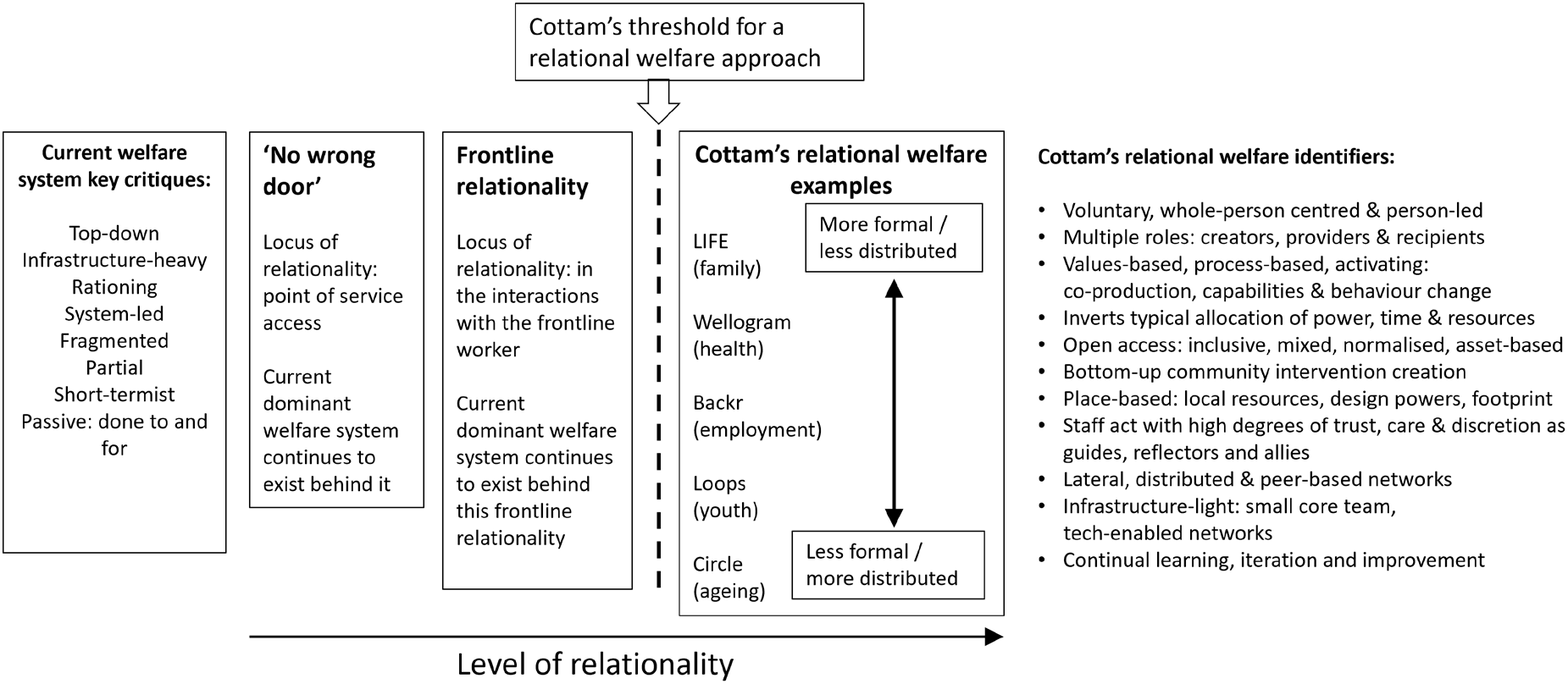
Figure 1 critically assesses Cottam’s body of work in order to both synthesise her views of the distinctiveness and key characteristics of a truly relational approach as well as to highlight the diverse forms of her Particle experiments. This helps analytically to explore key questions around whether, when and why different welfare approaches should, for Cottam, truly be seen as relational.
Cottam’s levels of relationality and core features of truly relational welfare approaches.

At the far left of Figure 1 is Cottam’s critique of the current simultaneously bureaucratic and quasi-marketised non-relational welfare model: top-down, infrastructure-heavy, service-led, highly rationing, fragmented, short-term and pacifying individuals into ‘learnt dependency’ (Cottam, Reference Cottam2018, p. 127). Stepping rightwards introduces two increasingly common relational modifications to that current welfare caricature, both of which Cottam finds preferable but still inadequate to be considered a truly relational welfare approach. First, approaches might take a ‘single front door’ approach, simplifying access to services by ‘hiding the wiring’ behind a keyworker, service or online portal. Although this helpfully simplifies and expands service access, for Cottam it changes nothing about the still problematic non-relational welfare system, services, practices or values behind it. Second, and further, an intervention might have a highly relational frontline worker who is able to effectively deliver the kinds of whole-person, person-led, values-based, capability-expanding relational welfare support that Cottam craves. Although an important improvement, if it is still embedded in a problematic broader non-relational system, then such an approach would, in Cottam’s view, be inherently limited and inadequate: ‘[R]elationships, in other words, might play a role in improving a service – but even if such improvements were made, the framing of the current offer would remain transactional, and their effects are therefore likely to be marginal’ (Cottam, Reference Cottam2014, p. 107).
For Cottam, the threshold to a truly relational welfare approach comes in the next step. Her work centres on five different relational interventions from her decade-long Particle ‘experiments’: LIFE; Wellogram; Backr; Loops; and Circle. These experiments vary markedly in their form, with one dimension of difference being their varying formality and distributed nature. Whilst all of Cottam’s experiments are in different ways radically different from traditional welfare approaches, LIFE and Wellogram are superficially closer to a more traditional keyworker model whilst Circle and Loops appear superficially to be more radical in being markedly more distributed, informal, peer-based approaches. Understanding the detailed variation across Cottam’s Participle exemplars helps to understand relational welfare more deeply and precisely.
Briefly, LIFE is a family support intervention where a keyworker works intensively with high discretion and low bureaucracy and rules around, and led by, an individual’s own need, goals, family and community. Caseloads are very low, and financial resources are high (in UK welfare terms), pooled from multiple previously fragmented family services and budgets. Wellogram is a keyworker-based health intervention where individuals are allocated a Wellogram ‘guide’ who becomes a trusted support and challenge in their day-to-day life to grow self-led, network-supported positive behaviour change. Backr is a network-based employment support intervention built around place-based networked peer-support and self-led problem-solving with that network support. This is accompanied by a structured spine of core sessions (MeetUps) to grow skills, motivation and networks, as well as more intensive keyworker support for individuals particularly stuck or struggling (Momentum). Loops is a youth intervention built around the place-based identification of free experiences (e.g. electronic repair, dance, beauty, music) from the community that young people can be matched to via a low-cost tech platform according to their passions in order to grow participation, connections, confidence, skills and motivation. Somewhat similarly, Circle is a community-based, tech-enabled place-based network for older adults, acting as part practical support from community members (e.g. DIY tasks, lifts, help shopping) and part valued social interactions and connections.
What, then, do Cottam’s diverse relational welfare examples have in common that both connect and differentiate them as truly relational? Looking across Cottam’s body of work, recurring themes emerge as relational welfare identifiers, even if these are visible in different mixes and extents across these Participle examples. The far right of Figure 1 synthesises Cottam’s distinctive relational characteristics or identifiers. For Cottam, a relational welfare approach must be voluntary, centred on the person in the context of their whole life and led by the person. Individuals should be welfare creators and providers using their own strengths, skills and assets as well as welfare recipients. Welfare should be part of a community-based peer network open to all and bringing different types of people and their varying types and extents of assets together in normalised mutual support, socialisation and relationships. This emphasis grows in the less formal, more distributed approaches such as Circle and Loops, but is present in the more formalised approaches of LIFE and Wellogram as supplements to keyworkers. Thus, relational welfare is participatory, active and activating, growing people’s abilities and supporting positive self-led behaviour change as part of a values-based process seeking to grow longer-term independence and resilience as well as satisfy short-term needs. To achieve this, the approach disrupts the typical allocation of power, time and resources away from gatekeeping, triage, assessment and bureaucracy and towards the maximisation of resources at the frontline. Instead, relational welfare is infrastructure-light, concentrating devolved control of resources down to people and provision in community networks and frontline delivery of their self-led interventions. Technology is key in enabling the approach, and paid staff teams are typically small, acting in allyship with individuals within their own networks as enablers, guides and reflectors with high levels of freedom, discretion, care and allyship. And through it all is an emphasis on experimentation, agility, learning, iteration and continual improvement at pace guided by welfare participants themselves.
Ideas of governmentalities (Faubion, Reference Faubion2000; Rabinow, Reference Rabinow2000) – the separate analytical importance of, and interconnections between, the techniques of government (gouverner) and the active and contested (re)construction of truths, norms and desired projects (mentalités) – are clear, and it is no surprise that Cottam cites Foucault as one of her leading influences (Cottam, Reference Cottam2010, p. 55). Welfare systems are reconstructed by Cottam as liberating and empowering rather than as pathologising, constraining, disciplining and pacifying. Individuals are recast as active agents with assets rather than as problematic, passive and dependent. And power is reformulated as distributed, networked, contested and capillary rather than rightfully owned and controlled top-down by the welfare state and its actors. The state remains key, but its key role shifts importantly from direct service provider or service funder to instead/also one of growing and supporting the necessary enabling environment within which these types of relational welfare characteristics, interventions and governmentalities can emerge, embed and flourish.
Reflecting on this context, the present article makes three-fold empirical, analytical and policy contributions. Firstly, social policy scholarship emphasises the value of knowledge from lived experience for policy research and practice (McIntosh and Wright, Reference McIntosh and Wright2018; Wright and Patrick, Reference Wright and Patrick2019), yet relational welfare scholarship and policy debates remain strikingly expert-led and policy focused. Our first contribution is to recentre the voices of participants and staff themselves in relational welfare debates. As we do so, we highlight their strikingly positive experiences of, and outcomes from, these relationally infused Supported Employment services, in stark contrast to many of their previous UK non-relational activation experiences. Secondly, we support more nuanced thinking around whether, how far and why purportedly relational welfare interventions should be considered truly relational – and thus should be considered likely to have potentially transformative relational experiences and outcomes – based on their qualitative form and presence of relational identifiers. This includes the creation of an emergent hierarchy of identifiers that can help to more incisively assess the relationality of different relational welfare forms. Thirdly, this analytical precision offers important guidance to help policy stakeholders to remain faithful to any relational policy ambitions. This is a key issue in the UK’s emerging £1bn Connect to Work Supported Employment programme, for example – designed as a divergent relational welfare approach but with real questions around whether it is being delivered, managed and experienced as such.
Data and methods
To explore these questions, the article draws on sixty-one semi-structured interviews with twenty-five participants (and one participant’s parent carer) and thirty-six frontline employment advisors across sixteen different UK-based Supported Employment services infused with the values, principles and practices of relational welfare. Supported Employment is a voluntary, strengths-based, person-centred model of employment support for individuals with disabilities, health conditions and/or other complex disadvantages and is underpinned by progressive, person-centred values. These include zero exclusion criteria beyond the participant’s motivation to find work, the centring of participant agency and preferences, participant co-production and empowerment through the support journey, and the objective of supporting transitions to sustained, well-matched employment in the open economy that enhances the quality of life of individuals and their families. In terms of their support offer, Supported Employment services offer end-to-end person-centred support across the five phases of engagement and recruitment, whole-person vocational profiling, employer engagement, job matching and transitions, and ongoing in-work support. Across these phases, Supported Employment services are (if delivered to model) distinctive in the allyship and trust between advisor and participant, the co-production, intensity and flexibility of their support, and the view of employers as equal partners alongside jobseekers in order to seek to ensure that jobs are well-matched, sustained and beneficial to both parties.
Important in Supported Employment services is adherence not only to relational values, principles and practices but also to a fidelity scale that provides a list of key service characteristics that are evidenced to be associated with better outcomes for participants. These include, for example, the nature and extent of employer engagement, vocational profiling, job matching and ongoing in-work support. There are two main Supported Employment fidelity scales internationally – Individual Placement and Support (IPS) developed in the 1990s and the Supported Employment Quality Framework (SEQF) just under a decade ago. IPS typically supports individuals with health conditions (e.g. mental health, physical health, substance issues) and involves integration of the IPS employment advisor into the relevant clinical team. SEQF is designed to support individuals with learning disabilities and/or autism or other groups requiring especially low caseloads and intensive support (e.g. care leavers). Meta-analyses across around fifty randomised controlled trials find that the IPS model of Supported Employment is consistently and markedly more effective than standard employment support across a range of employment outcomes (Drake and Bond, Reference Drake and Bond2023; Whitworth et al., Reference Whitworth, Baxter, Cullingworth and Clowes2024) as well as cost-effective (Park et al., Reference Park, Rinaldi, Brinchmann, Killackey, Aars, Mykletun and McDaid2022).
Underpinned by a robust evidence base, Supported Employment is in a period of rapid innovation to new population groups, and the UK is at the international forefront of Supported Employment innovation and expansion. Our interviews included IPS and SEQF services from across the UK that supported jobseekers with low to moderate mental health and/or physical health issues, learning disabilities, autism, substance misuse issues, homelessness and disabilities and long-term health conditions. Many of these services had existed for around five years and were part of large central government-funded expansion programmes of IPS substance misuse, IPS in primary care expansion and SEQF Supported Employment expansion. National evaluations of the IPS substance misuse and IPS primary care programmes in which those former services were situated demonstrated employment impacts of almost 30 per cent higher than business-as-usual control groups (Whitworth et al., Reference Whitworth, Baxter, Cullingworth and Clowes2024). Other services were funded locally and/or had existed for far longer. Services followed standard IPS and SEQF fidelity models and provided time-limited support of up to twelve months out-of-work support and four months in-work support, a now common evidence-based approach in Supported Employment services (Burns et al., Reference Burns, Yeeles, Langford, Montes, Burgess and Anderson2015).
Table 1 in the Supplementary Materials describes the sample characteristics in detail. Across the twenty-five participant interviewees, around two-thirds are male, interviewees are spread relatively evenly in age across the working age range, and most are White British. Eight participants with learning disabilities and/or autism were participating across three SEQF services, plus two participants with other health conditions. Fifteen participants were participating across eight IPS services supporting individuals with substance misuse issues (twelve participants) and moderate mental and/or physical health conditions (three participants). Most participants had relatively recent employment experience, but a minority had been out of work for many years. Across the thirty-six Supported Employment provider staff interviews, slightly over half are female, most are aged over thirty, and most are White British. Around a quarter worked in SEQF services while three-quarters worked in IPS services. Interviewed staff were either frontline Employment Specialists working directly with participants or Team Leaders, typically without a participant caseload. The majority of the interviewed staff had a high level of IPS/SEQF experience.
Semi-structured interviews were conducted digitally between March 2022 and January 2023 and lasted between thirty and sixty minutes. The aim of the interviews was to give voice to the participant’s experiences of their support in order to describe its nature, distinctiveness, strengths and weaknesses and effects. Interviews were conducted by university researchers and, for interviews with disabled participants, by experts by experience from Breakthrough UK and Speakup Self Advocacy disabled people’s organisations. Anonymised verbatim transcripts were created from interview recordings, and thematic analysis was conducted in NVivo. Interviews were read multiple times, with all text of thematic interest coded openly into free nodes. Axial coding then brought free nodes together thematically into node trees through a gradual process of iterative reflection and refinement of the number, size and shape of the emerging tree nodes. The final result was a series of complex, multi-level tree nodes focusing on separate key aspects of Supported Employment through which key themes could be understood.
The research received ethical approval from the lead university’s University Ethics Committee. Data were immediately pseudonymised and stored securely on the university OneDrive, available only to the qualitative research team. Interviewees were recruited from their Supported Employment provider by sharing ethically approved materials. Interviewed participants with lived experience were given a £25 voucher as thanks for sharing their insights and time.
Relational welfare on the ground: user and practitioner perspectives
For at least two decades, the UK has been a difficult place to search for work if you are one of the UK’s four million workless disabled people in receipt of benefits or one of the roughly 600,000 workless disabled individuals who want to work (Evans and Vaid, Reference Evans and Vaid2023). As a public system, UK employment support is typically tightly rationed, thinly resourced and compliance-based (IES, 2024), with only around 10 per cent of non-working disabled people of working age receiving any employment support at all each year (Evans and Vaid, Reference Evans and Vaid2023). The experiences and outcomes of those who do participate in (often contracted-out) UK employment support can also sometimes be problematic, with ‘parking’ (i.e. being ignored by providers) (Carter and Whitworth, Reference Carter and Whitworth2015) and damaging sanctions (Pattaro et al., Reference Pattaro, Bailey, Williams, Gibson, Wells, Tranmer and Dibben2022) being recurrent problems for disabled and more vulnerable jobseekers in particular.
In contrast, the participants that we spoke with consistently described highly positive experiences of these Supported Employment services, frequently contrasted with previous experiences with the UK’s ultra-lean and conditionality-based, work-first Jobcentre Plus public employment service:
Really worked to understand me, my drives, my fears, my passions, my dislikes and likes, my values. (Tabatha, 30–39, Female, White British, <1yr workless, IPS moderate mental health participant, Service C)
You go to the Jobcentre and all they want to do is just pile you into any job… it doesn’t matter what you say and what your experience is. (David, 40–49, Male, White British, <1yr workless, IPS Alcohol & Drugs participant, Service A)
Participants described three features of their support as key to their positive experiences and outcomes, and these resonate strongly with the core tenets of relational welfare: the human connection and relationship with their employment advisor; participant agency and personalisation; and the felt commitment to the goal of growing their opportunities, capabilities and quality of life.
Human connection: the relationship between participants and their employment advisor
Relational welfare is rooted at its heart in human connection, trust and care. Our interview data highlights the widespread presence of respectful, supportive, genuine relationships between participants and their frontline employment advisors. These relationships were highly valued by participants who repeatedly praised the nature and interpersonal skills of their advisors and their inclusive, compassionate and empowering nature:
What I really liked working with him was that it felt like a conversation… I really felt like we were equals, which was really important. I felt like he really, really cared about his work, but also me, and about making sure that I was in a job that satisfied me…he really helped me believe in myself in a very natural way. (Tabatha, 30–39, Female, White British, <1yr workless, IPS moderate mental health participant, Service C)
Having such an approach is particularly important when working with vulnerable participants who have had bad experiences of employability services previously, or for whom the idea of paid work feels a long way away. Participants emphasised the importance of feeling care, connection, lack of judgement, trust and security in the support they received:
When I first approached IPS I was not very long sober, and I wasn’t in a very good place…He really did not treat me as a number or commodity and just tick, tick, tick, ask these questions, tick, tick, tick. I felt that he was getting to know me, understanding my story, understanding my needs, understanding what I felt was realistic in respect of a job. (Oliver, 50–59, Male, White British, 10yrs workless, IPS Alcohol & Drugs participant, Service M)
There was a lot of trust, definitely. Which you definitely need in that sort of situation; you’re quite vulnerable at that stage. (Donald, 30–39, Male, White British, <1yr workless, IPS Alcohol & Drugs participant, Service D)
As simple as it sounds, being listened to, receiving empathy and having needs and preferences taken seriously in a non-judgemental manner was mentioned by almost all participants as a valued and distinctive feature of their support – ‘that feeling of being respected and believed’ as one participant described. Important to participants was that these relationships were human and personal, open and honest, trusted and risk-free, and rooted in the genuine care and growth of the individual’s self-esteem, capabilities and quality of life. There was a consistent, powerful theme from participants of having an ally in their corner, for many the first time they had felt this from an employment service:
It’s nice to have like someone I know I can trust, someone I know I can rely on…He’s had my back for me, and it’s a nice feeling. (Terry, 40–49, Male, White British, 3yrs workless, IPS Alcohol & Drugs participant, Service B)
I was completely lost, I was confused, and I was early in my recovery, and it was good for me to know that I have someone in my corner to help me out with my fight, and that was the main, best positive way to get back on track. (Stephen, 30-39, Male, White Eastern European, 2yrs workless, IPS Alcohol & Drugs participant, Service D)
Supported Employment advisors themselves were keenly aware that their participants’ previous employment support experiences often left them feeling ‘more of a number than a person’. The nature and qualities of frontline staff, and their relationships and interactions with participants, are key in relational welfare. Across these services, the values, empathy, care, listening and communication skills of advisors were all key, but so too were their determination, proactivity and a continual focus on progress at an appropriately person-centred pace given their circumstances. There was recognition by advisors that they also often needed to break through the initial distrust, disengagement and low expectations that previous negative employability experiences had frequently created in participants.
Growing the person: personalisation and empowerment through co-production
A second key relational theme from our interviews was the extent to which support was experienced as genuinely personalised to individuals’ needs, situations and goals and the ways in which it enabled and empowered participants’ agency. As this employment advisor described:
We try and aid that co-production in any way that we can…Anything that kind of encourages that person to feel more at ease and more comfortable and really in charge of the conversation, because we’re here, yeah, to give that advice, but it’s not our life, we’re not in charge of it. (Josie, 20–29, Female, White British, experienced SEQF Supported Employment Team Leader, Service J)
Personalisation of support is frequently described as a central feature of its effectiveness (van Berkel and Valkenburg, Reference Van Berkel and Valkenburg2007), yet it remains surprisingly elusive in UK employability provision. In contrast, participants of these Supported Employment services experienced their support as genuinely tailored to their individual needs and goals:
They were talking to me, trying to find exactly what I wanted to do…they were caring for me as a person. And basically, they told me from the beginning they didn’t want me just to get any job; they wanted me to get something that’s based on my skills, things that I like. (Jasper, 30–39, Male, Hispanic, <1yr workless, IPS Alcohol & Drugs participant, Service M)
This sensitivity and personalisation by advisors to the context of participants’ whole lives, journeys and overall wellbeing helped to strengthen participants’ trust, hope, engagement and motivation that this time things might just be different:
He [employment advisor] is really professional and very aware that he is dealing with people in recovery and that recovery kind of ebbs and flows…I relapsed a few times, and he was just really supportive around it. I just felt like he kind of understood the types of things his participants were dealing with. (Meg, 30–39, Female, British Asian, 2yrs workless, IPS Alcohol & Drugs participant, Service M)
Many times we made a few plans I couldn’t actually deliver on…I was still in recovery, you know, and I was recovering in many, many senses. There was never this kind of pressure, you know. They were always loving, always giving me the incentive [to move towards employment]. (Jasper, 30–39, Male, Hispanic, <1yr workless, IPS Alcohol & Drugs participant, Service M)
Agency and its growth through co-production have been strong themes within recent activation scholarship (Pearson et al., Reference Pearson, Lindsay, Batty, Cullen and Eadson2023; Wright and Patrick, Reference Wright and Patrick2019) and both are central to relational welfare. The participants that we interviewed felt empowered to actively co-produce the content, pace and direction of their support journey. Aside from helping to improve the relevance of the support and employment options discussed, these relationships of equality and co-production with their advisors helped participants to feel valued, respected and engaged in the support.
Importantly, personalisation and co-production were for employment advisors not simply about trying to maximise participant engagement or a short-term job start. Rather, co-production was for advisors also a strategy of participant empowerment towards the overriding goal of growing the participant’s capabilities to better enable them to handle inevitable future employment (and wider) goals, challenges and setbacks. As such, co-production acted as a shifting space during support journeys for participant agency to operate and grow – ‘tailoring support to allow for that platform of freedom’ as one advisor described it. This meant a careful balance of providing participants with the support they needed but being mindful whilst doing so to always seek to both nurture and maximise participant agency, ownership and capabilities such that the balance gradually shifted towards participants and away from the advisor. The goal, as Smith et al (Reference Smith, Hesselgreaves, Charlton and Wilson2025) describe, is to progress individuals at their right pace such that extrinsic support is gradually replaced by intrinsic agency and capability. As one advisor described:
This is all about that person being in the driving seat. But if you plonk someone in the driving seat and they’ve never been in the driving seat before, they don’t know what to do. We need to be supportive and take the lead, but always with that fading plan, so it’s never about putting something in that we can’t step back from. It’s all about putting the participant first and trying to support them [but] it’s not just about helping them; it’s about helping them to help themselves. So you’ve got to try and get the balance right between supporting them and enabling them. (Rohan, 50–59, Male, White British, experienced SEQF Supported Employment manager, Service K)
Participants felt that this shifting balance of co-production, and resulting growth in their agency and empowerment, were important outcomes of the service alongside any employment outcomes. It helped to improve their self-confidence, independence, capabilities and resilience and to better manage their lives and challenges more broadly moving forwards:
If you get a bit stuck, then you ask them for a bit of help again, and they sort of nudge you back in the direction you need to go. And I really like that, you know. It’s not doing everything for you; they’re basically encouraging you to help yourself. (David, 40–49, Male, White British, <1yr workless, IPS Alcohol & Drugs participant, Service A)
Creating possibility and growing the good life
A third and final theme that emerged was creating possibility. This centred on individuals being empowered to develop a view of how they wished their future life to be and to have the belief and support to have a reasonable opportunity to achieve it. The participants that we interviewed wanted to work given the right support and the right job role, and all saw paid work inside their vision of the good life just as much as their employment advisors. However, and unusually for the UK activation landscape, the main objective in these services was not job entry. Instead, the shared vision of Supported Employment advisors and participants was a good quality job role and workplace that was well-matched to the individual’s passions, skills and needs such that it meaningfully and sustainably improved the participant’s quality of life. As this advisor and participant described:
If they’re just putting you in a job that isn’t right for you, or you’re not supported in, you’re just going to be back in the same circle, so you might as well just really get under the skin of the issue. (Tabatha, 30–39, Female, White British, <1yr workless, IPS moderate mental health participant, Service C)
Work does improve people’s health and wellbeing, and there’s lots of evidence to show it, but also bad work can make people really ill and have a detrimental impact on their life. So it’s important that we get people into good employment wherever possible and that we also provide that additional support, where we have to, to sustain their job. (Trent, 50–59, Male, White British, experienced SEQF service manager, Service K)
The gap between that shared employment vision and participants’ starting point with the service was often significant. The participants interviewed were all facing significant health, disability and other challenges in their lives, many had not worked in several years and most had negative experiences with previous employment support. As such, participants frequently began their Supported Employment journey in a difficult, sometimes desperate, place. However, through their support, individuals gradually started to feel hope that positive change in their lives was possible. As these interviewees explained:
I think she [the advisor], like, thrives on making you be the better person than what you’ve maybe walked in as. (Sarah, 40–49, Female, White British, <1yr workless, SEQF disability or long-term health condition participant, Service J)
It changed my perspective of what I was capable of, and it really opened up doors for me that I hadn’t in any way known were there, let alone been knocking on. (Tabatha, 30–39, Female, White British, <1yr workless, IPS moderate mental health participant, Service C)
This creation of hope and possibility was in sharp contrast to many participants’ descriptions of previous experiences of other UK employment programmes where interviewees described feeling like ‘just another number’, being ‘processed’ or part of ‘mass production’ and where ‘random jobs’ or ‘any minimum pay job’ were the goal. The negative consequences of this approach had been felt keenly by many participants, further harming rather than uplifting and progressing already vulnerable individuals. In contrast, advisors were clear that people, values, human connections and capabilities were key to enabling the distinctive, almost antithetical, offer of Supported Employment to participants:
[Other services] stigmatise people who are in [substance] recovery, you know…we would try and kind of humanise individuals. Make them actually feel like they are worth it. They are worth it, their voices are actually heard, and they can re-build their lives. (Reece, 20–29, Male, Black British, experienced IPS Substance Misuse employment specialist, Service M)
There’s a genuine desire to support people without giving them a label if you like and believing in them as probably the Jobcentre maybe didn’t. (Raife, 40–49, Male, White British, experienced IPS Substance Misuse Team Leader, Service A)
For participants, the support was experienced not simply as an employment service but also as a much-needed, and often long-absent, relationship of trust, support, care and hope from the welfare system. Participants described their relationships with their Supported Employment advisor as an unusual and powerful combination of personal and professional:
They’re [the advisor] not a therapist, not a friend, not a doctor, but exist in a very, it’s a very nice place. Because you have a certain level of intimacy, but it’s boundaried and structured and personal. But you feel like you are on the end of a service as well. (Tabatha, 30–39, Female, White British, <1yr workless, IPS moderate mental health participant, Service C)
Due to the distinctive nature of those advisor relationships, participants talked about feeling less pressure and worry, having increased self-esteem and self-confidence, and having a greater sense of hope and optimism for the future. In doing so, and in contrast to so many of their previous interactions with employability services, these Supported Employment services were gradually, but genuinely, experienced as transformative by participants. The following quote was typical:
It just opened my horizons, you know, because when I was depressed, I was just seeing like this, you know, it was just kind of tunnel vision, just able to focus like 5 minutes ahead of me, you know. And with their help, I was able to start planning forward, thinking of the future, thinking of OK five months’ time, maybe one year’s time, maybe two years’ time…So honestly they actually helped me to walk again. (Jasper, 30–39, Male, Hispanic, <1yr workless, IPS Alcohol & Drugs participant, Service M)
Discussion
Its advocates argue that relational welfare offers a radical alternative possibility for a more effective, efficient, equitable and sustainable welfare approach that delivers better experiences and outcomes for jobseekers, staff, communities, employers and government alike. Taking the case study of relationally infused UK Supported Employment services, our first aim has been to recentre the voices of frontline staff and participants in the relational welfare debate. UK activation research with disabled or more complex disadvantaged individuals can be a depressing déjà vu of frustrating and negative participant experiences (Wright and Patrick, Reference Wright and Patrick2019). In contrast, our interviewees universally shared strikingly positive accounts of their experiences in these services and the tangible difference that it had made to themselves and their life trajectories. Particularly emphasised were three aspects of their support that resonate as core tenets of relational welfare approaches: human connections and relationships; agency and personalisation; and the felt commitment to the goal of growing opportunities, capabilities and quality of life.
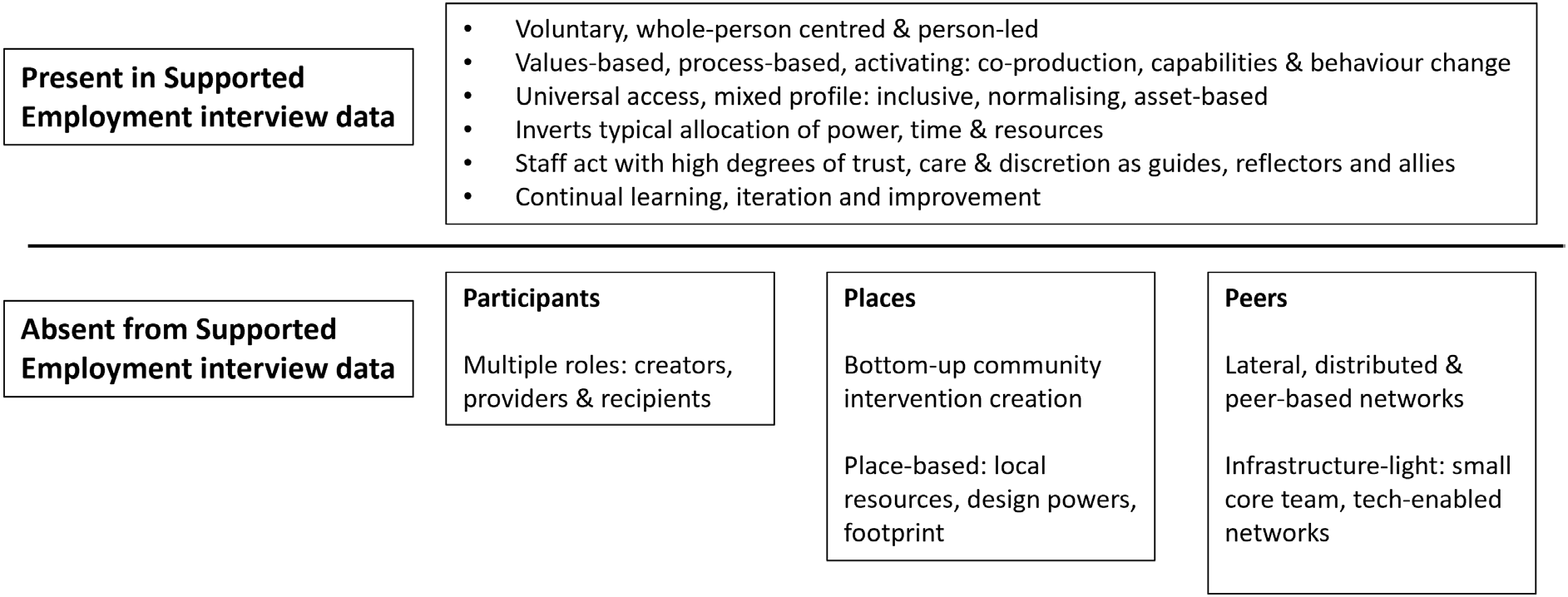
Our second aim and contribution is to use those lived experiences to provide greater analytical clarity within relational welfare scholarship around its varying forms and, related, relational identifiers. Rather than seeing all of Cottam’s relational welfare identifiers as equally important, Figure 2 indicates that our interviewees instead highlighted six which they felt were key to the distinctiveness and positivity of their Supported Employment experiences and effects: whole-person centred, person-led support; values-based, process-based, activating support that centred co-production and capabilities; inclusivity, non-judgementalism, normalisation of support and a focus on strengths and assets rather than problems and barriers; inverted power and resources with frequent, intensive and meaningful substantive support driven by the individual; a feeling from participants of trust, care, allyship and honest constructive challenge from frontline staff; and proactive continual learning and improvement from staff and services committed to doing right by those that they support.
An emergent hierarchy of relational welfare characteristics.

Conversely, five of Cottam’s relational identifiers are absent from our interview data, and these relate to participants, places and peers, respectively. Regarding participants, our interviewees did not have the opportunity to design these interventions nor to become part of the provision. Regarding the role of places, the Supported Employment services in our sample were mostly part of top-down funded and designed programmes rather than community-led bottom-up creations. Communities and services had minimal roles or discretion in service design since these were designed by local or central policy stakeholders and also followed prescriptive fidelity models (though services and frontline staff did have ample discretion in delivery). Regarding the role of peers, Supported Employment services did engage wider family and seek to build natural supports in workplaces and communities. However, they operated relatively traditional vertical provision between a keyworker and participant with large staff teams and without deep peer-based distributed networks of delivery (as in Circle, Loops and Backr) or delivery support (as in Wellogram or LIFE). Our interview approach provided freedom for interviewees to describe what was important for them in their Supported Employment experiences and priorities. Hence, this is not to say that these emphases may not be of value to interviewees, rather that they did not emerge organically in interviews.
Does this absence of several relational identifiers in our interview data reflect a quantitative lack of relationality in these Supported Employment services such that they should not be considered truly relational? Or, rather, does it reflect their particular qualitative relational form which, as indicated in and around Figure 1, can and does vary? Our data point to the latter rather than the former. As noted above, one consideration is that our interview data do highlight that respondents’ experiences and outcomes were strikingly distinctive from, and markedly more positive than, typical non-relational UK activation support and that the key features of this positivity centre on characteristics that are identifiers of a relational welfare approach. A second consideration is that reflecting back across Cottam’s example highlights that each would be mapped differently in their own versions of Figure 2. These Supported Employment services map similarly in form and feel to LIFE on one end of the relational continuum – more formal, less distributed, but still for Cottam inherently relational. Building on the variation in relational forms identified in Figure 1, our qualitative data suggest a hierarchy in the relational identifiers with a core set of characteristics identified here as shared across, and necessary for, all relational interventions, but potentially existing alone in more formalised relational welfare interventions. There is then a separate set of identifiers that our data suggest are not necessary for a formalised relational welfare approach to be truly relational in its distinctive experience and effects, although clearly they would be present in more informal, distributed relational approaches. A further important question emerges then from this finding around the extent to which, and the conditions in which, these wider relational characteristics might further strengthen more formal relational approaches even if they do not strictly require them.
Finally, these findings have important implications for guiding, supporting and protecting relational welfare interventions in policy and practice. In the UK activation context currently, for example, the next phase in one strand of the national evolution of Supported Employment provision is its large-scale expansion inside DWP’s £1bn Connect to Work provision across England and Wales of IPS and SEQF services for individuals with disabilities, long-term health conditions or more complex disadvantages. Although the initial policy design was built in central government around relational values, principles and practices, the process of Connect to Work implementation is now owned by local areas recognising the importance of local places to maximisation of the Supported Employment – and relational – approach. Although bound by some central parameters, localities have significant autonomy and have introduced a wide variety of different approaches that have sometimes at best flexed and innovated, and at worst undermined, the relationality of the policy through which its distinctive values and effects are believed to flow. For example, there has been a failure by some local areas and/or providers to really understand and deliver the inherent relational distinctiveness of the model, commissioning, programme managing and/or delivering generic employment support rather than Supported Employment. There has been the introduction of risks to values, motivations, practices and equity created by the introduction locally of payment-by-results models or profit-motivated providers. And relationality has been pressurised in all areas by significant pressure within the programme centrally to reach aggressive volume and outcome targets quickly, as well as – or potentially instead of – focusing on strengthening the quality of relational values, practices and support as per the model. By being sharper analytically around the necessary and wider beneficial characteristics of a more formalised relational welfare approach, the findings above offer valuable guidance to central and local policy stakeholders around the true relationality – and thus expected distinctiveness and positivity – of local Connect to Work services both as they exist and as they might be developed and strengthened.
Supplementary material
The supplementary material for this article can be found at https://doi.org/10.1017/S0047279426101664
Acknowledgements
The authors gratefully acknowledge funding from NIHR (NIHR202996) and West London Alliance for the research.
Competing interests
No authors have any competing interests to declare.


 Open access

