Introduction
About 20 years ago, palliative care programs emerged across the United States as separate and independent programs from hospice. Since then, these programs have continued to spread in hospitals, outpatient clinics, cancer clinics, as well as through community-based programs, albeit this growth has not been uniform (Morrison et al., Reference Morrison, Augustin and Souvanna2011). While availability of palliative care services has expanded, accessibility to palliative care remains a barrier, particularly among underserved populations that are financially challenged and geographically isolated (Morrison et al., Reference Morrison, Augustin and Souvanna2011). That said, the spread of palliative care was most likely fueled by numerous studies documenting that with palliative care, seriously ill patients and their families reported fewer emergency department visits, less pain, fewer depressive symptoms, improved satisfaction with health care, and both better self-reported quality of life, as well as the quality of care (Gade et al., Reference Gade, Venohr and Conner2008; Zimmermann et al., Reference Zimmermann, Swami and Krzyzanowska2014; Davis et al., Reference Davis, Temel and Balboni2015; Cunningham et al., Reference Cunningham, Travers and Chapman2016).
Despite the growth in palliative care programs, and in spite of its measured benefits for seriously ill patients and their family members, barriers to palliative care enrollment remain. Knowledge of palliative care, for both patients and health care providers, is one of the greatest barriers to receiving palliative care. A national study conducted by the Center to Advance Palliative Care (CAPC) found that 8% of surveyed consumers are knowledgeable about palliative care (Center to Advance Palliative Care, 2011). Additionally, studies have found similar lack of knowledge and misconceptions of palliative care among physicians (Aldridge et al., Reference Aldridge, Hasselaar and Garralda2016). In a survey of physicians, nearly one-third (29%) reported palliative care to be the same as hospice (Snyder et al., Reference Snyder, Hazelett and Allen2013), which contributes to lack of or late referrals to palliative care (Scibetta et al., Reference Scibetta, Kerr and Mcguire2016; Wadhwa et al., Reference Wadhwa, Popovic and Pope2018). Thus, patients cannot rely on physicians to provide consistent and timely referral to palliative care.
The tremendous need for palliative care education is clearly illustrated by study findings that consumers who were informed about palliative care were more likely to want access to it, either for themselves or for a seriously ill loved one (Center to Advance Palliative Care, 2011, p. 8). There has not been a uniform or national effort to provide widespread consumer education on palliative care. Complicating things further, there is not a standard definition of palliative care, although CAPC has made tremendous efforts to promote consistent language (Center to Advance Palliative Care, 2011). In addition to the challenges of consistent definition is the method in which palliative care is defined. In a recent review of YouTube palliative care educational videos (Liu et al., Reference Liu, Cardenas, Zhu and Enguidanos2019), investigators found that most videos that aimed to increase knowledge about palliative care employed a top-down approach, with nearly two-thirds of videos using a physician or a nurse protagonist. Only 15.5% of the protagonists were palliative care consumers. Moreover, the vast majority (>90%) of protagonists were white. Given the extensive documentation of ethnic disparities in access to end-of-life care (LoPresti et al., Reference LoPresti, Dement and Gold2016), and potential distrust of the health care system among some ethnic groups (Gardner et al., Reference Gardner, Doherty and Bates2018), alternate palliative care educational approaches are needed.
Stories have been found to resonate better with audiences and overcome ethnic disparities as it is easier to identify with a storyteller, aided by the emotional appeal of the personal stories (Bekker et al., Reference Bekker, Winterbottom and Butow2013; Goddu et al., Reference Goddu, Raffel and Peek2015). More importantly, the effect of stories and their ability to connect through identification with the storyteller was found to be capable of creating shifts in knowledge and behavioral intentions (Murphy et al., Reference Murphy, Frank and Chatterjee2013). Further, the use of patients as their own narrators or storytellers has been found to be an effective strategy for communicating health information (Berkley-Patton et al., Reference Berkley-Patton, Goggin and Liston2009; Reininger et al., Reference Reininger, Barroso and Mitchell-Bennett2010; Bokhour et al., Reference Bokhour, Fix and Gordon2016). In fact, a study examining the effectiveness of a brochure of African American hospice role model stories found that, after reading the brochure, older African American adults had improved knowledge of hospice services as well as high intentions to enroll in hospice care should the need arise (Enguidanos et al., Reference Enguidanos, Kogan and Lorenz2011). Thus, role model stories may be an excellent source for increasing public awareness and understanding of palliative care.
Despite its effectiveness in improving knowledge, role model stories disseminated in the form of brochures have limited influence as they are bound geographically, incur significant printing costs, and exclude people who have low literacy or are illiterate and who may have certain physical impairments, such as low vision. Role model video stories widely available on the Internet could potentially address most of these limitations. Internet use among older adults continues to rise: as at 2019, an estimated 88% of adults aged 50–64 and 73% of adults aged 65 or older reported using the internet (Pew Reseach Center, 2019). Furthermore, 70% of adults aged 50–64 and 38% of adults aged 65 and older reported using YouTube (Perrin and Anderson, Reference Perrin and Anderson2019), with 68% and 46% of adults in the 50–64 and 65+ age groups, respectively, using Facebook (Perrin and Anderson, Reference Perrin and Anderson2019). This suggests that older adults are comfortable using social media, including consuming videos online. In light of that, the purpose of this study was to determine if videos of theory-based role model stories alongside clear palliative care definitions (Center to Advance Palliative Care, 2011) are effective in increasing consumer knowledge of palliative care and intention to enroll in palliative care, should participants have a future medical need.
Methods
Theoretical framework
This study is framed by two theoretical models that have been shown to be effective in previous health promotion research (Suarez et al., Reference Suarez, Nichols and Brady1993; Corby et al., Reference Corby, Enguídanos and Kay1996; King et al., Reference King, Nu'Man and Fuller2008; Whittaker et al., Reference Whittaker, Maddison and McRobbie2008; Reininger et al., Reference Reininger, Barroso and Mitchell-Bennett2010).
Social learning theory
Social learning theory (Bandura, Reference Bandura1977) states that people learn from observation, by imitating, and/or modeling the actions or behaviors of others. In other words, individuals will mimic role models they have seen or observed with the incentive of reducing the likelihood of making mistakes. This observation process can occur either in-person or via multimedia platforms. We used this theory to guide our selection of role models to also mimic a more representative population by race/ethnicity, age, gender, marital status, and disease condition to extend the likelihood of observers’ ability to relate to the individuals in the videos. In the palliative care role model video stories, the audience was exposed to the concept of palliative care and the role models’ experiences with this additional care through personal storytelling.
Theory of reasoned action
The theory of reasoned action (Ajzen and Fishbein, Reference Ajzen and Fishbein1980) posits that individual behaviors are determined by behavioral intention, which in turn is influenced by the individual's attitude toward the new behavior and subjective norms surrounding that behavior. Attitudes are related to the positive or negative outcomes resulting from, in this case, enrolling in palliative care. The role models’ iteration of the advantages, or disadvantages, from receiving palliative care, shapes the consumer's perceived subjective norms about palliative care. In fact, the consumer's attitude toward palliative care may be more compellingly shaped by the opinion of the role models than by a physician's recommendation, particularly if the role model is someone with whom they can identify.
Intervention: Role model video stories
Recruitment of video role models
Patients were recruited as role models through hospice and palliative care service providers in California, Colorado, and Georgia. Patients who were cognitively intact and enrolled in home-based palliative care were eligible to participate in the interviews. Patients were approached by their palliative care providers who determined if the patient was interested in participating. Once interest was confirmed, providers sought patient permission to share their contact information with the principal investigator (PI). Next, the PI or the project manager contacted each patient to explain the project, and when possible, patients (and their family members) were provided with example videos to illustrate our project. Each patient role model who participated in the project was given $500 for their participation. All interviews and video-taping were conducted in the home of the patient. All patients agreed to share their full names and were sent drafts of the videos for review prior to finalization. Patient role models were purposefully chosen to represent diverse ages, races, and health conditions, in line with social learning theory.
Interview protocol and story development
We developed a semi-structured protocol to elicit information about the role model's personal background (general information about them such as age, family background, place of birth, and current or previous employment position), brief health history, and his/her attitudes, beliefs, and experiences related to palliative care, following our theoretical model. Each interview was video-taped and subsequently transcribed verbatim.
Video editing was guided by the principles of theory of reasoned action; specifically, when possible, we were careful to include segments illustrating individuals’ initial attitudes and beliefs about palliative care, factors influencing their enrollment, and experience following receipt of palliative care. Each role model video story was approximately 3–4 min long as shorter videos have been found to have higher engagement, with videos 3 min and under recording the highest and longest engagement (Guo et al., Reference Guo, Kim and Rubin2014). We also included in all videos the definition of palliative care as defined by CAPC (Center to Advance Palliative Care, 2011).
Study design
A pretest–posttest design was used to test the efficacy of the role model video stories in increasing participants’ knowledge of palliative care as well as to ascertain their intention to enroll either themselves or a family member in palliative care services if ill. This study was approved by the Institutional Review Board of the University of Southern California.
Study sample eligibility and recruitment
Study participants were recruited from community centers, retirement communities, a caregiver support group, and senior centers in the greater Los Angeles area. Individuals aged 50 or older, English-speaking, cognitively intact, and able to view videos were eligible for the study. Research staff contacted potential sites who assisted with subject recruitment by posting flyers and reaching out to their clients. In 2018, 13 survey groups were held at 13 sites. Group participation ranged from 3 to 22 participants.
Role model videos viewed
We showed all participants the three role model video stories. The first video was of an older white woman (Mary) with chronic heart failure and her caregiver husband. In the video, she is shown with her oxygen tube and her pulse oximeter. The second role model (Dorothy) was an older African American woman with heart disease who lived alone with her cat. The third role model was a middle-aged white man (Ted) diagnosed with stage IV liver and bone cancer.
Measures
We used the Palliative Care Knowledge Scale (PaCKS) which is comprised of 13 questions with a response set of true, false, and I do not know (Kozlov et al., Reference Kozlov, Carpenter and Rodebaugh2017). The PaCKS has demonstrated test–retest reliability (Kozlov et al., Reference Kozlov, Carpenter and Rodebaugh2017). We also included two questions on intent to enroll in palliative care services that were modified from a previous study of intentions to enroll in hospice care (Enguidanos et al., Reference Enguidanos, Kogan and Lorenz2011). These questions were (1) If a family member was extremely ill, I would consider enrolling them in palliative care and (2) If I had a disease that could not be cured, I would want to receive palliative care. Each question included response options of yes, no, and I do not know. Additionally, we included socio-demographic questions in the survey.
After reviewing the study information sheet with participants, research assistants asked participants to complete the pretest survey plus a demographic survey. Following completion of the pretest survey, we showed participants the three role model video stories. We viewed the videos in the same order throughout the study. Total duration of the videos was approximately 12 min. The participants then completed a posttest survey, repeating the same baseline questions (minus demographics). At the end of the study, participants were given between $20 and $25, depending on their need to engage a temporary caregiver, in appreciation of their time.
Statistical analysis
Descriptive statistics were employed to describe participant characteristics. A total knowledge score was calculated by summing correct responses of items on the PaCKS. Change in total knowledge score from pretest to posttest was analyzed using t-tests. Using the chi-square test, we also examined the differences between intent to access palliative care for one's self and for a seriously ill loved one before and after watching the role model video stories. Regression analysis was conducted to determine predictors of greater change in knowledge score. Analyses were conducted using STATA version 14 (StataCorp, 2015).
Results
Sample description
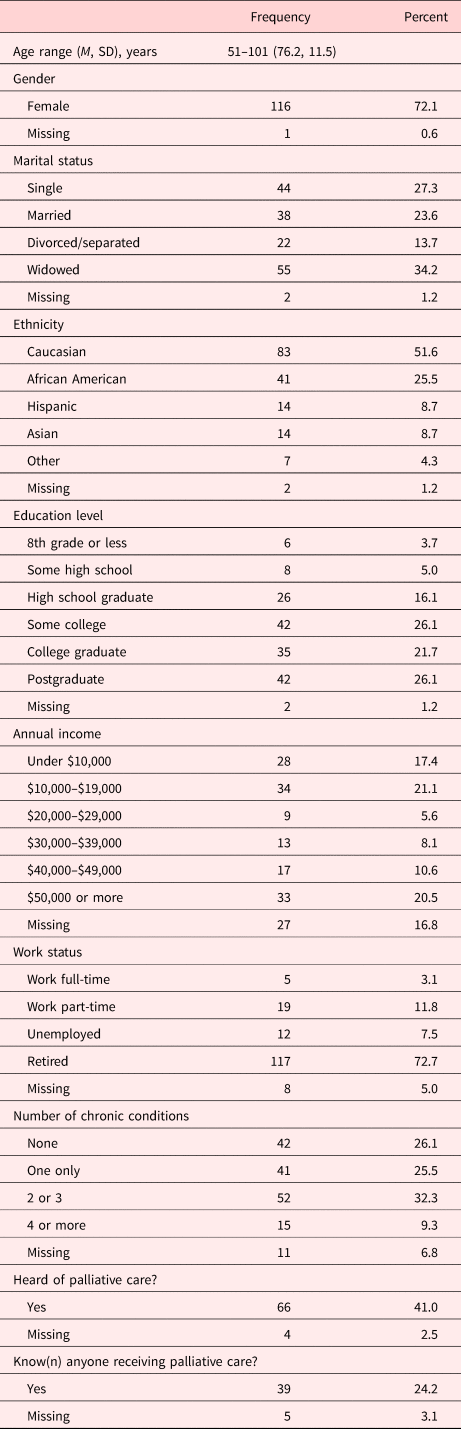
Our sample included 161 adults aged 50 and older (Table 1). Ages ranged from 51 to 101 (M = 76.3, SD = 11.5). The sample was predominantly retired (72.7%) and female (72.1%). Just over a third (34.2%) were widowed. The sample was very diverse: 51.6% were white, 25.5% black, 8.7% Asians, and 8.7% Hispanic. Almost half of the sample received some college education, and 47.8% were college graduates. In terms of annual incomes, just over half (53.0%) earned less than $30,000. About 41.6% of the sample reported having at least two chronic conditions. Prior to viewing the video, 41.0% reported that they had previously heard of palliative care, while 24.2% reported knowing someone who received palliative care.
Participant demographics (N = 161)

Knowledge and intentions
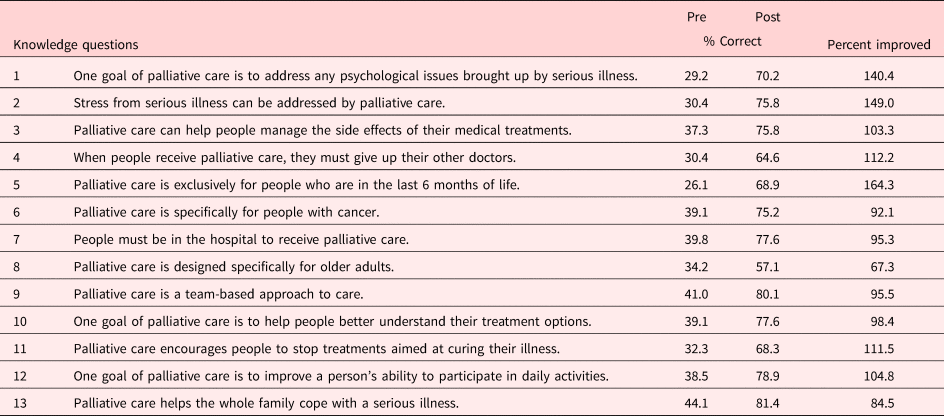
At baseline, the average score on the knowledge questions was 4.5 (SD = 5.0), out of 13 possible questions. Mean knowledge scores significantly increased from pretest to posttest (M = 10.0, SD = 4.0; t(126) = 12.0, p < 0.001). There was improvement among all 13 items in the PaCKS (Table 2), with the largest improvement found in knowledge that palliative care is not only for people who are in the last 6 months of life (164.3% improvement; p < 0.001), that stress from serious illness can be addressed by palliative care (149.0% improvement; p = 0.001), and that palliative care also seeks to address any psychological issues brought up by serious illness (140.4% improvement; p = 0.001).
Responses to knowledge questions (N = 161)

There also was significant increase in intentions to enroll both oneself and a family member in palliative care services should the need arise. At pretest, 36.0% of participants said that they would want to receive palliative care if they had a disease that could not be cured; this increased to 73.3% at posttest after watching the three role model video stories (χ 2 = 7.8, p < 0.01). Similarly, at pretest 37.3% of participants would consider enrolling a seriously ill family member in palliative care if needed, increasing to 78.3% at posttest (χ 2 = 7.5, p < 0.01).
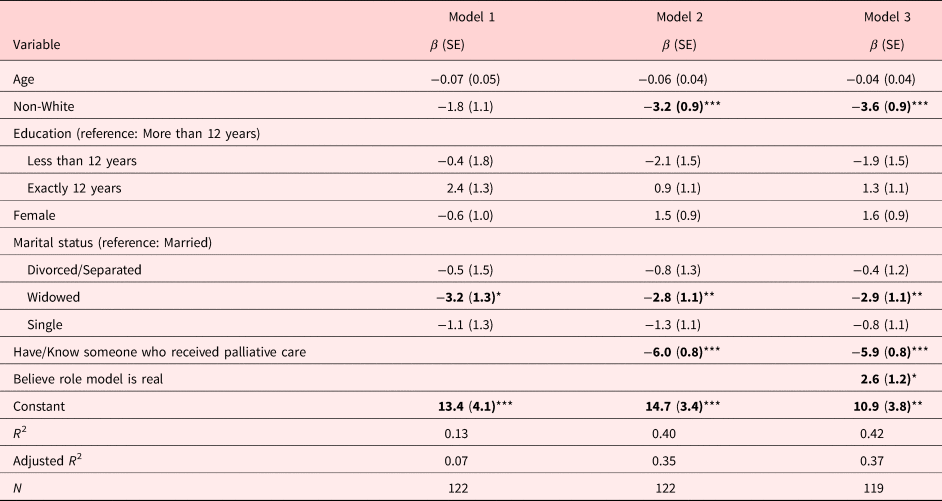
Regression analysis (Table 3) revealed that participants who believed the role models were real people (β = 2.6, SE = 1.2, p < 0.05) significantly predicted higher change in knowledge scores, controlling for all other variables in the model. On the other hand, participants who had prior knowledge of or experience with palliative care (β = −5.9, SE = 0.8, p < 0.001), had lower change in knowledge scores, controlling for other variables in the model. Additionally, being non-white (β = −3.6, SE = 0.9, p < 0.001) and widowed (β = −2.9, SE = 1.1, p < 0.01), as opposed to being married, were significant predictors of lower changes in knowledge score.
Multilevel regressions of change in knowledge scores (β)

***p < 0.001, **p < 0.01, *p < 0.05.
The bold emphasis was merely to highlight the variables that had statistical significance, which was also highlighted using asterisks.
Discussion
To our knowledge, this is the only study employing role model video stories to improve patient knowledge about palliative care. Previous studies using videos targeting populations with advanced or serious illness have focused largely on decision-making aids in advance care planning (Volandes et al., Reference Volandes, Ferguson and Davis2011). Other studies employing videos have focused on improving palliative care knowledge among surgical residents (Bradley et al., Reference Bradley, Webb and Schmitz2010). Given the overall lack of knowledge of palliative care among both consumers and health care providers, the need to increase awareness among consumers is critical. In this study, we found that participants who were exposed to 12 min of the three palliative care role model video stories demonstrated significant improvements in their knowledge of palliative care. Equally significant was the increase in behavioral intentions either to seek palliative care for themselves (increased by 107%) or to recommend palliative care to a family member (increased by 110%) with a serious illness. Moreover, item-by-item analysis of the PaCKS survey demonstrated that there was significant improvement in each item. Importantly, the item with the fewest correct responses at baseline was the statement that palliative care is for those in the last 6 months of life; at pretest, only 26% of respondents answered this correctly, increasing at posttest to 69%, an increase of 165%. The belief that palliative care has similar requirements or is the same as hospice is a growing problem. In a recent survey conducted in New York, the most common misconception of palliative care was that it is care for those at the end of life (Shalev et al., Reference Shalev, Phongtankuel and Kozlov2018). This misconception could potentially result in barriers to palliative care, similar to those found with hospice care.
The item with the lowest rate of improvement and the one with the least correct at posttest was that “palliative care is designed specifically for older adults.” About one-third (34%) responded correctly at pretest, increasing to 57% at posttest. This low rate of correct responses may reflect the protagonists in the three videos shown. While one man was in his late 50s, the other two role models were clearly older, with one (Dorothy) stating that she recently turned 81 and that she is “getting old.” This finding speaks to the need to include a wider age range of role model stories when developing these educational materials. Our collection included a younger role model, however, in our efforts to be more broadly representative of ethnicity and gender, we did not include the story of the younger role model in this study.
Additionally, the significant association between believing role models were actual patients and the higher change in knowledge scores suggests that role models are engaging and believable, and therefore are effective protagonists for palliative care educational materials. More research is needed to determine if these videos would be equally effective in improving physician knowledge and understanding of palliative care as well.
Limitations
This study has limitations. All participants were recruited in the greater Los Angeles area and, in general, were highly educated. The sample also did not include non-English-speaking participants as our videos were only available in English. Additionally, this study was not longitudinal and therefore could not test retention of palliative care knowledge or actual behavior related to accessing palliative care.
Implications
Given the challenges in physician referrals, having alternative sources of information for patients could provide an aid to physicians in providing this kind of education to their patients. Such education could aid in narrowing the gap in knowledge and as an extension, potentially provide consumers with access to additional support that may be beneficial to them, and their families, during times of serious illness. Our findings support those of other health promotion efforts in hospice awareness, obesity prevention, women's health, as well as smoking cessation (Suarez et al., Reference Suarez, Nichols and Brady1993; Whittaker et al., Reference Whittaker, Maddison and McRobbie2008; Reininger et al., Reference Reininger, Barroso and Mitchell-Bennett2010; Enguidanos et al., Reference Enguidanos, Kogan and Lorenz2011) and suggest that palliative care role model video stories are an effective strategy to increasing knowledge of palliative care and in correcting misconceptions about palliative care. Mechanisms are needed to more broadly distribute and increase visibility of these palliative care patient stories.
Acknowledgments
This study was generously supported by the Heart to Heart Hospice Foundation and Auen Foundation. Sincerest gratitude to all the patients, namely Mary Ann and Dan McCoy, Dorothy Crowe, and Ted Balaska, who so kindly let us into their homes and shared their stories (http://gero.usc.edu/labs/enguidanoslab/research/patient-stories/).
Conflict of interest
The authors declared that they have no conflict of interest.
Author's contribution
D.F.H. and K.J.: study concept and design, acquisition of subjects and data, analysis and interpretation of data, and preparation of manuscript. A.R.: study concept and design, preparation of manuscript. S.E.: study concept and design, analysis and interpretation of data, preparation of manuscript.