Introduction
Parascaris spp. is a clinically important helminth parasite infecting foals (Clayton and Duncan, Reference Clayton and Duncan1978; Cribb et al., Reference Cribb, Corté, Bouré and Peregrine2006; Tatz et al., Reference Tatz, Segev, Steinman, Berlin, Milgram and Kelmer2012) with anthelmintic resistance reported worldwide (Peregrine et al., Reference Peregrine, Molento, Kaplan and Nielsen2014). Anthelmintic resistance has not been described for other mammalian ascarid species. The ability to maintain gastro-intestinal helminths in vitro would enhance the experimental tractability of nematode parasites by facilitating the application of a range of molecular and biochemical tools and analyses in clinically relevant species. Such an advance would prompt a paradigm shift in parasitology research permitting progress in key areas including evaluation of anthelmintics and natural products with anthelmintic properties (Rapson et al., Reference Rapson, Jenkins and Topley1985; Brownlee et al., Reference Brownlee, Holden-Dye and Walker1997; O'Grady and Kotze, Reference O'Grady and Kotze2004; Jansen et al., Reference Jansen, Krücken, Demeler, Basiaga, Kornaś and von Samson-Himmelstjerna2013), application of transcriptomics to investigate the genetic mechanisms driving anthelmintic resistance (Jansen et al., Reference Jansen, Krücken, Demeler, Basiaga, Kornaś and von Samson-Himmelstjerna2013), induction of RNAi interference for the identification of novel drug targets (McCoy et al., Reference McCoy, Warnock, Atkinson, Atcheson, Martin, Robertson, Maule, Marks and Mousley2015), analysis of excretory and secretory products (Young et al., Reference Young, McKeand and Knox1995; Geldhof et al., Reference Geldhof, Claerebout, Knox, Jagneessens and Vercruysse2000; Islam et al., Reference Islam, Miyoshi, Yokomizo and Tsugi2004; Cribb et al., Reference Cribb, Corté, Bouré and Peregrine2006; Burk et al., Reference Burk, Dangoudoubiyam, Brewster-Barnes, Bryant, Howe, Carter, Vanzant, Harmon, Kazacos and Rossano2014; Thomas et al., Reference Thomas, Jeyathilakan, Basith and Senthilkumar2016) and interrogation of host–parasite interactions (Kotze and McClure, Reference Kotze and McClure2001).
Most of the literature on in vitro culture and maintenance of ascarid parasites has focused on the pig nematode, Ascaris suum, where a variety of culture conditions have been employed. Some reports describe in vitro maintenance of larval stages (Douvres and Urban, Reference Douvres and Urban1983, Reference Douvres and Urban1986); however, the size and nutrient requirements of the intestinal stages introduce new challenges to in vitro maintenance. Chehayeb et al. (Reference Chehayeb, Robertson, Martin and Geary2014) maintained adult A. suum collected from the small intestine of pigs for 24 h in Locke's solution where glucose was provided as the main nutrient. Weisblat and Russel (Reference Weisblat and Russel1976) described culturing A. suum in artificial perienteric fluid (APF), and Brownlee et al. (Reference Brownlee, Holden-Dye and Walker1997) maintained worms in APF for 5 days. Islam et al. (Reference Islam, Miyoshi, Yokomizo and Tsugi2004) maintained adult A. suum under both aerobic and anaerobic conditions to observe changes in proteome expression patterns. Worms were maintained in Roswell Park Memorial Institute-1640 (RPMI-1640) medium, and viability was maintained in both systems for over 2 weeks. Dmitryjuk et al. (Reference Dmitryjuk, Łopieńska-Biernat and Zaobidna2014) sustained adult A. suum in Ascaris Ringer's solution (ARS) for 20 h without any nutrient, while McCoy et al. (Reference McCoy, Warnock, Atkinson, Atcheson, Martin, Robertson, Maule, Marks and Mousley2015) maintained A. suum for 8 days in ARS without any nutrient. In contrast, only two studies have reported the in vitro maintenance of Parascaris spp. Burk et al. (Reference Burk, Dangoudoubiyam, Brewster-Barnes, Bryant, Howe, Carter, Vanzant, Harmon, Kazacos and Rossano2014) reported culturing of larval stages and maintenance of adult stages to investigate the production of excretory–secretory products. In that study, two adult worms were maintained in RPMI-1640 medium at 37 °C for 5 days. Jansen et al. (Reference Jansen, Krücken, Demeler, Basiaga, Kornaś and von Samson-Himmelstjerna2013) maintained an undisclosed number of adult worms in APF for 30 h at 37 °C for in vitro ivermectin exposure. No attempts have been made to evaluate the requirements for long-term in vitro maintenance of Parascaris spp. intestinal stages, nor to characterize their preferred environment and nutrient requirements.
In order to determine the optimum in vitro requirements and monitor the effects of in vitro drug exposure, it is necessary to ascertain helminth longevity and viability. In vitro evaluation of anthelmintic efficacy in adult worms has been done by determining worm longevity by classifying them on an alive or dead basis (Eguale et al., Reference Eguale, Tilahun, Debella, Feleke and Makonnen2007a, Reference Eguale, Tilahun, Debella, Feleke and Makonnen2007b; Hu et al., Reference Hu, Ellis, Yiu, Miller, Urban, Shi and Aroian2013). While Hu et al. (Reference Hu, Ellis, Yiu, Miller, Urban, Shi and Aroian2013) implemented a scoring system on a 0–3 scale to assess worm movement, it was still largely subjective and the results considered worms only on an alive (score 1–3) or dead (score 0) basis. Similarly, Richards et al. (Reference Richards, Behnke and Duce1995) described a simple method to monitor drug sensitivity of Necator americanus and Ancylostoma caninum based on the observation of worm motility of treated vs control worms. Worms were characterized as either active or inactive after gentle prodding. Neither the method proposed by Hu et al. (Reference Hu, Ellis, Yiu, Miller, Urban, Shi and Aroian2013) nor Richards et al. (Reference Richards, Behnke and Duce1995) allows for the objective evaluation of worm viability over a series of time points. A similar subjective method was reported by Dmitryjuk et al. (Reference Dmitryjuk, Łopieńska-Biernat and Zaobidna2014) to monitor the effects of in vitro anthelmintic exposure to adult A. suum. Later, a motility assay was developed by O'Grady and Kotze (Reference O'Grady and Kotze2004) that utilized a scoring system to monitor anthelmintic efficacy against Haemonchus contortus. While the scoring system allows one to observe a decline in viability over time, the definition of each score is subjective as scores are assigned based on the investigators definition of significant movement, and a set amount of time for each observation was not described. Marcellino et al. (Reference Marcellino, Gut, Lim, Singh, McKerrow and Sakanari2012) developed the WormAssay, a high throughput screening method to assess the anthelmintic efficacy against macroparasites based on motility. The WormAssay uses an open source computer software program and a camera to automatically assess worm movement and provide a quantitative measurement. Worms must be placed in microtiter plates, and the system is compatible with plates of either 6, 12, 24, 48 or 96 wells. The Parascaris species, however, are still too large for the well plates used in this system. Even the largest wells (six-well plate) measuring approximately 3.48 cm in diameter are not large enough for a mature Parascaris spp., which are commonly over 10 cm long (Clayton and Duncan, Reference Clayton and Duncan1978). The Worminator uses a similar method but is specifically designed for determining the motility of microscopic nematode stages (Storey et al., Reference Storey, Marcellino, Miller, Maclean, Mostafa, Howell, Sakanari, Wolstenholme and Kaplan2014).
The purpose of this study was to characterize appropriate in vitro conditions for maintaining intestinal Parascaris spp., and to establish a scoring system to monitor worm viability over several time points.
Materials and methods
Parasite sources
The study took place over the course of eight foal necropsies from October 2016 to October 2017. The foals were born in a herd housed at the University of Kentucky that has not been treated with any anthelmintics since 1979 and has been documented to harbour a variety of equine parasites through natural infection (Lyons et al., Reference Lyons, Drudge and Tolliver1990). The foals employed in the study consisted of five colts and three fillies. Foals were humanely euthanized when they reached 4.5–5 months old and subsequently necropsied.
Study design
During the first phase of this study (necropsies 1–3), worms were monitored on an alive/dead basis in order to make initial observations on the necessary conditions for in vitro maintenance and nutrient requirements of Parascaris spp. specimens. The second phase (necropsies 4–8) commenced following the development of a scoring system to objectively assess the viability of Parascaris spp. specimens under various environmental and nutrient conditions.
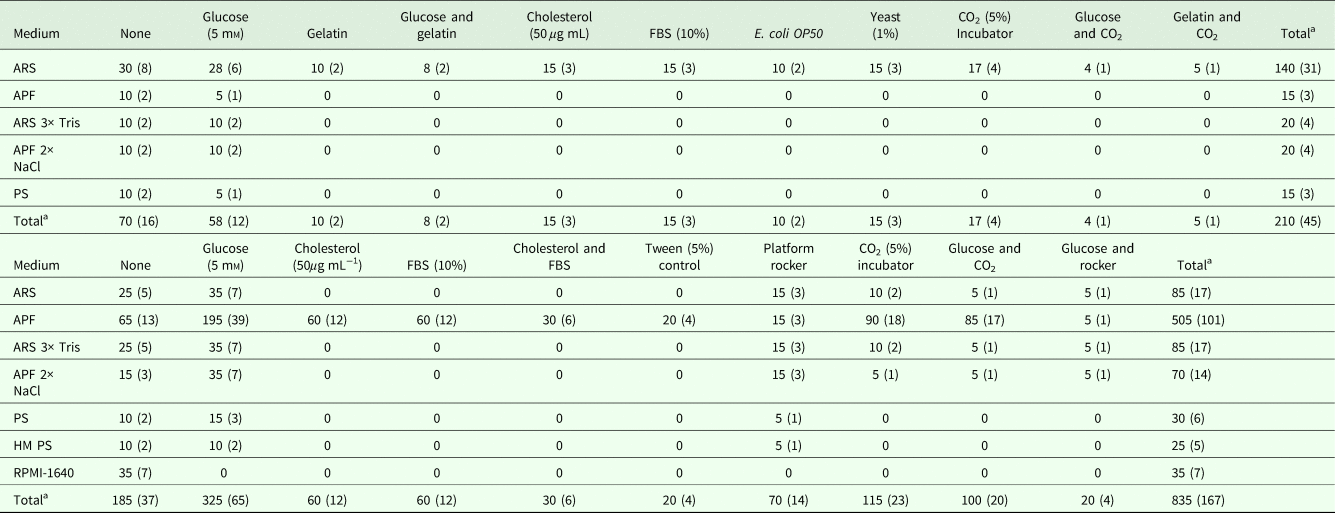
A variety of different media types, nutrient supplements and environmental conditions were examined (see ‘Preparation of culture media’ and ‘Nutrient supplementation’ sections). The number of worms evaluated for each media, nutrient and environmental condition (CO2 and platform rocker) is described in Table 1.
Distribution of intestinal stages of Parascaris spp. specimens among the different media, nutrients and environmental conditions (i.e. CO2 incubator, platform rocker) for in vitro maintenance. The number of worms is listed followed by the number of cultures in parenthesis

FBS, fetal bovine serum; ARS, Ascaris Ringer's solution; APF, artificial perienteric fluid; ARS 3× Tris, ARS with triple Tris buffer concentration; APF 2× NaCl, APF with double NaCl concentration; PS, physiological saline (0.9% NaCl); HMPS, homemade physiological saline (0.9% NaCl); Roswell Park Memorial Institute-1640, RPMI-1640.
The top table is from phase 1 of the study (necropsies 1–3) for initial observations regarding worm longevity. The bottom table is from phase 2 of the study (necropsies 4–8) when worm viability was assessed. Cultures were kept at 37 °C.
a Totals do not include the worm and culture counts when a nutrient was combined with another nutrient, CO2 or the platform rocker because these were already accounted for in the individual nutrient, CO2 and platform rocker columns.
Collection of Parascaris spp.
Following necropsy, the small intestine was detached from the stomach and cecum. The intestinal contents were milked out onto a 425 µm mesh sieve. Room temperature (RT) tap water was slowly added to the sieve to dilute the contents to better visualize the worms. Intestinal stages of Parascaris spp. (adult and fourth larval stage, L4) specimens were recovered using a spay hook and placed in a container of RT media of either ARS (see Table 2 for composition) (necropsies 1–6) or RPMI-1640 (R8758, Sigma-Aldrich, St. Louis, MO, USA) (necropsies 7 and 8). The container was placed into a water bath maintained at 37 °C for transport to the laboratory. Worms were classified as adult or L4, and adult worms were further characterized by sex. Worms were considered adults when gonads were visible as white material in the mid-section of the worm. Males were differentiated from females by being smaller and having less gonad material than females, and occasionally presented with a curved hook in the tail. Immature worms (L4) did not have any visible gonad material.
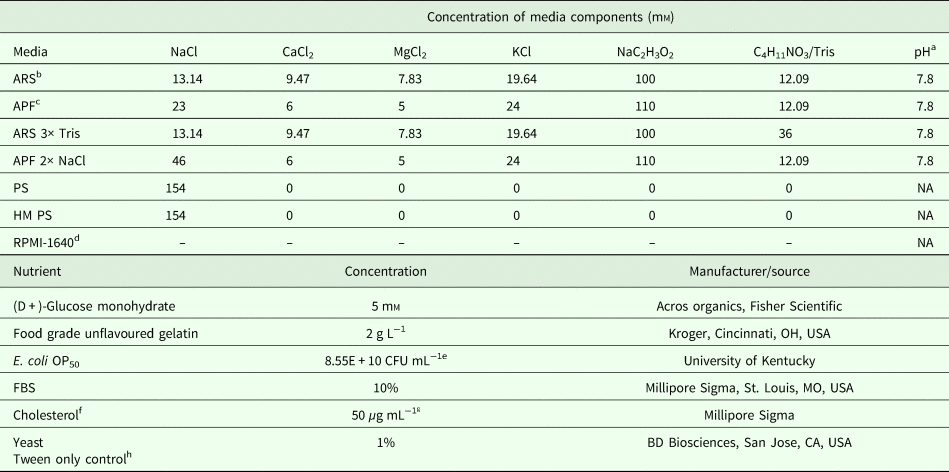
Components of the media tested and nutrients provided for the in vitro maintenance for intestinal stages of Parascaris spp
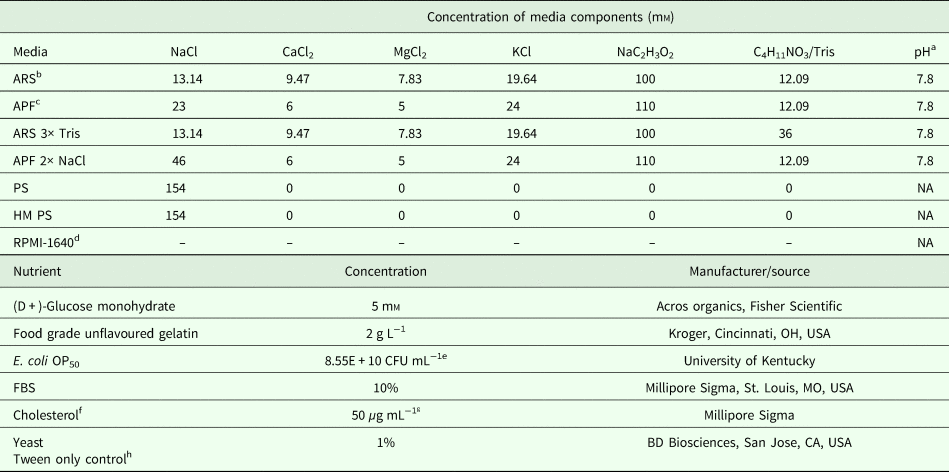
ARS, Ascaris Ringer's solution; APF, artificial perienteric fluid; ARS 3× Tris, ARS with triple the Tris buffer concentration; APF 2× NaCl, APF with double the NaCl concentration; PS, physiologic saline; HMPS, homemade physiologic saline; RPMI, Roswell Park Memorial Institute; CFU, colony forming units
a pH adjusted with hydrochloric acid, the pH was not adjusted for PS, HMPS or RPMI-1640.
b McCoy et al. (Reference McCoy, Warnock, Atkinson, Atcheson, Martin, Robertson, Maule, Marks and Mousley2015).
c Weisblat and Russel (Reference Weisblat and Russel1976).
d The components remained as provided by the manufacturer (Millipore Sigma).
e Average number of CFU calculated from all input concentrations.
f Prepared as at 0.1% stock solution in 5% aqueous Tween 80 (Bolla et al., Reference Bolla, Weinstein and Lou1972).
g Urban and Douvres, (Reference Urban, Douvres and Xu1984).
h Included not as a nutrient, but as a control because cholesterol was prepared by dissolving it in 5% aqueous Tween 80 (Bolla et al., Reference Bolla, Weinstein and Lou1972).
In vitro maintenance of Parascaris spp.
Worms were maintained in vented TPP tissue culture flasks (300 cm2, MidSci, St. Louis, MO, USA) containing 200 mL of the pre-assigned medium. Media were changed every 12 h. This was done by placing a cell strainer of 400 µm pore size (pluriSelect Life Science, Leipzig, Germany) over the mouth of the flask and allowing the old media to flow through while keeping the worms in the flask to limit handling and subsequent damage. New media, pre-warmed to 37 °C, were then added to the flask. The flasks were kept in the pre-determined incubator with or without CO2 (5%) supplementation at 37 °C.
In the first phase of the study (necropsies 1–3), worms were maintained in groups of four or five, containing two males and at least one female and one L4 worm. In the second phase of the study (necropsies 4–8), a total of five worms were placed in each culture flask consisting of either two males, one female and two immatures, or three males, one female and one L4 worm. The variation in worm stage/sex within each cohort was due to the number of worms per category collected at each necropsy.
Preparation of culture media
Media [ARS, APF, ARS 3× Tris, APF 2× NaCl, physiological saline (PS) (Hospira Inc, Lake Forest, IL, USA), homemade physiological saline (HMPS) and RPMI-1640; see Table 2] were freshly prepared, stored at 4 °C and then warmed to 37 °C prior to adding to the culture flasks. Streptomycin (1 mg/1L), penicillin (1000 U/1L) and amphotericin-B (10 µg/1L) were added to all media types, except when Escherichia coli was added as a nutrient (see ‘Nutrient supplementation’ section). All media types were employed within 24 h of preparation.
Nutrient supplementation
A list of the nutrients and their respective concentrations can be found in Table 2. Escherichia coli OP50 (University of Kentucky) was prepared in the following manner. Lysogeny broth (LB) (Miller formulation, ThermoFisher Scientific, Waltham, MA, USA) and LB-agar (Fisher Scientific, Hampton, NH, USA) were prepared according to the manufacturer's instructions. Escherichia coli OP50 (University of Kentucky) were cultured in 15 mL of LB broth overnight at 37 °C in a shaking incubator at 225 rpm. Following incubation, cells were pelleted by centrifugation at 3220 g for 8 min. After centrifugation, the supernatant was decanted and pelleted. Escherichia coli were re-suspended in 15 mL of filter-sterilized culture media. Colony forming units (CFUs) were determined for the E. coli suspension by plating 10-fold serial dilutions to determine the starting culture concentration (i.e. input). The remaining suspension was equally divided and added to the assigned flasks. One flask was kept without worms as a control. Prior to the media changes, an aliquot of the media from the culture flasks, including the flask without worms, was plated to determine the final concentration (i.e. output) of surviving E. coli.
Environmental conditions
The environmental conditions assessed were the use of a 5% CO2 incubator and platform rocker. The number of flasks assigned to each condition can be found in Table 1. Pre-assigned flasks were placed in a 5% CO2 incubator at 37 °C for the entirety of their survival. Flasks assigned to the platform rocker (Hofer Scientific Instruments, San Francisco, CA, USA, model PR70) were maintained at approximately 60 rpm within the air-only incubator at 37 °C for the entirety of their survival.
Longevity and viability assessment of Parascaris spp.
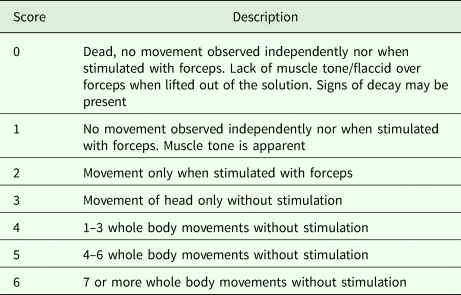
For the first phase of the study (necropsies 1–3), worms were monitored on an alive or dead basis and the number of worms surviving per flask at each time point/media change was recorded (i.e. longevity). Worms were considered dead when they became flaccid and/or displayed signs of decay. Flaccidity was determined by placing the worm over a pair of forceps at midpoint and carefully lifting it out of the medium. If the worm draped loosely over the forceps and appeared as an acute angle, it was considered flaccid. Decay was noted visually and determined as a breakdown of the exterior cuticle. The second phase of the study (necropsies 4–8) began with the development of an objective scoring system to monitor worm viability. Prior to each medium change, worm viability was assessed and awarded a score according to the descriptions in Table 3. Each worm was observed for 15 s for movement while remaining in the flask. If no movement occurred during the 15 s observatory period, forceps were used to gently stimulate the worm in an attempt to initiate movement. If still no movement was observed, the forceps were used to assess flaccidity and check for decay as previously described. Dead worms were removed from the flask and discarded.
Scoring system used to assess the in vitro viability of Parascaris spp. intestinal stages. Scores were assigned following individual observation for 15 s
Statistical analyses
Phase 1: longevity
For the first phase of the study (necropsies 1–3), a percent reduction in the number of worms in each flask was calculated at each time point. The final time of longevity was considered when all worms in a flask had died. Mean longevity with 95% confidence intervals (CI), and the range for media, nutrient and incubator type were calculated using Microsoft Excel 2016 (Redmond, WA, USA).
Further statistical analyses were performed using SAS software (version 9.4, SAS Institute, Cary, North Carolina, USA). Here, five mixed linear models with repeated measures across time were constructed to determine which media, nutrient supplementation profile and incubator type significantly affected worm longevity. ‘Percent loss’ was the response variable for all analyses. The first model assessed the longevity of worms maintained in the different media types without nutrient supplementation or CO2 incubator. The covariates were ‘Time’ and the interaction term ‘media ID×none’, where ‘none’ implied an air incubator and no nutrients were used. ‘Necropsy date’ was kept as a random effect. The second analysis was used to analyse the supplementation with glucose in all types of media because it was the only nutrient tested across all media types. The interaction term ‘Media ID×glucose’ was the covariate analysed and ‘necropsy date’ was kept as the random effect. The third model examined worm longevity when maintained in ARS media supplemented with either glucose, gelatin, E. coli, yeast, FBS, cholesterol, or gelatin and glucose. ARS was the only medium supplemented with all the nutrients and therefore was the only medium examined in this model. ‘Nutrient’ and ‘time’ were the covariates examined. ‘Necropsy date’ and ‘CO2’ were kept as random effects. The fourth model examined the use of the CO2 incubator across all media and nutrient supplements. The covariates examined were ‘time’ and ‘CO2’. ‘Necropsy date’, ‘Media ID’ and ‘nutrient’ were kept as random effects. The fifth analysis analysed the stage (L4 or adult) and sex (adult worms only) over time, regardless of media, nutrients used or the use of the CO2 incubator. The covariates analysed were ‘stage’ and ‘sex’. ‘Media ID’ and ‘necropsy date’ were kept as random effects. Any time a significant covariate (α = 0.05) was observed, a ‘least squares means’ analysis was performed for a Tukey's pairwise comparison.
Phase 2: viability
For the second phase of the study (necropsies 4–8), the scoring system (see Table 3) was used to monitor worm viability. Mean worm viability per flask at each time point was calculated. Worms that had died continued to receive a score of zero and were included in the mean calculation until all the worms within the same flask had died. Mean values and 95% CI were calculated using Microsoft Excel 2016. The percent viability per flask was calculated in Microsoft Excel for each time point using the following formula, where ‘X’ refers to each time point:
 $$\% {\rm Viability} =\! 100\!-\!\left( {\displaystyle{{({\rm initial\ score}-{\rm score\ at\ time}\,\,{}_{}^{\prime} X^{\prime})} \over {{\rm initial\ score}}} \times\! 100\%} \right).$$
Further statistical analyses were performed using SAS software (version 9.4, SAS Institute). Here, a total of six mixed linear models with repeated measures across time were performed to determine which media, nutrients and environmental conditions significantly affected worm viability. For all models, ‘percent viability’ was the response variable. The first model assessed the viability of worms maintained in the different media without nutrient supplementation, CO2 incubator or platform rocker. The covariates were ‘time’ and the interaction term ‘media ID×none’, where ‘none’ implied that no nutrients or environmental conditions were implemented. ‘Necropsy date’ was kept as a random effect. The second model analysed worm viability when maintained in one of the saline-based media (i.e. ARS, APF, ARS 3× Tris, APF 2× NaCl, PS, HM PS) with glucose compared with worm viability maintained in the same saline-based media without glucose. Glucose was the only nutrient added across all saline-based media types and therefore was the only nutrient analysed in this model. The covariates examined were ‘time’ and the interaction term ‘media ID×glucose’. ‘Necropsy date’ was kept as a random effect. The third model examined worm viability when maintained in APF media supplemented with either glucose, FBS, cholesterol, a combination of FBS and cholesterol, Tween only control or as a no nutrient control. APF was the only medium supplemented with all the nutrients and therefore was the only medium examined in this model. ‘Nutrient’ and ‘time’ were the covariates examined. ‘Necropsy date’ and ‘environment’ (i.e. CO2 incubator or platform rocker) were kept as random effects. The fourth model examined the use of the platform rocker and CO2 incubator across all media and nutrient supplements. The covariates examined were ‘time’ and ‘environment’. ‘Necropsy date’, ‘Media ID’ and ‘nutrient’ were kept as random effects. The fifth model analysed the use of RPMI against all media, nutrients and environmental conditions. The covariate tested was ‘RPMI’, and ‘necropsy date’ was kept as a random effect. The last model analysed the stage (L4 or adult) and sex (adult worms only) over time, regardless of media, nutrients used or the use of the CO2 incubator or platform rocker. The covariates analysed were ‘stage’ and ‘sex’. ‘Media ID’ and ‘necropsy date’ were kept as random effects. Any time a significant covariate (α = 0.05) was observed, a ‘least squares means’ analysis was performed for a Tukey's pairwise comparison.
Results
A total of 212 cultures were performed and a total of 1045 Parascaris spp. worms were used. The number of cultures and worms per media type, nutrient supplementation and environmental condition (incubator type and/or platform rocker) can be found in Table 2.
Phase 1: longevity
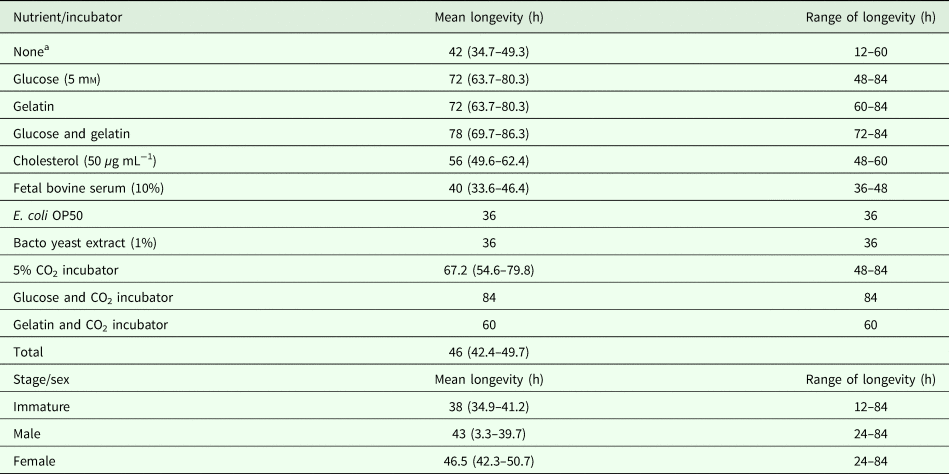
For the first phase of the study pertaining to worm longevity (necropsies 1–3), a total of 210 worms were used consisting of 98 adult males, 54 adult females and 58 L4s. During this phase of the study, the worms lived a maximum of 84 h. The media type employed when considered without nutrient supplementation or CO2 did have a significant effect on worm longevity (P = 0.0100); however, the least squares means pairwise comparison did not identify any significant differences between media. ARS was the only media type significantly affecting worm viability with the addition of glucose. Worms maintained in ARS supplemented with glucose lived significantly longer than worms maintained in ARS alone (P < 0.0001). There were no significant differences observed in any of the other media types supplemented with glucose compared with when glucose was not added. Regarding the various types of nutrient supplementation with the ARS media, worms maintained with glucose (P < 0.0006) or a combination of glucose and gelatin (P < 0.0001) had significantly better longevity than worms maintained without any nutrient. Worms maintained with glucose had significantly better longevity than worms maintained with E. coli (P = 0.0008), yeast (P < 0.0001), FBS (P = 0.0013) or cholesterol (P = 0.0279). Similarly, worms maintained with a combination of glucose and gelatin had significantly better longevity than those maintained with gelatin only (P = 0.0484), E. coli (P < 0.0001), yeast (P < 0.0001), FBS (P < 0.0001) or cholesterol (P = 0.0008). The mean longevity, 95% CI and range of longevity for the different nutrients and incubator type can be found in Table 4. The use of a CO2 incubator did not significantly affect worm longevity (P = 0.2854). ‘Adult male (P = 0.0021) and female (P < 0.0001) worms’ had significantly better longevity than immature worms, however there was no significant difference between males and females (P = 0.5780). The mean longevity, 95% CI and range of longevity for immatures, males and females can be found in Table 4.
Mean longevity of intestinal stages of Parascaris spp. in vitro with various nutrients and CO2 incubator use, and of different stages and sex (necropsies 1–3). Worms were maintained in tissue culture flasks (300 cm2) in groups of four or five
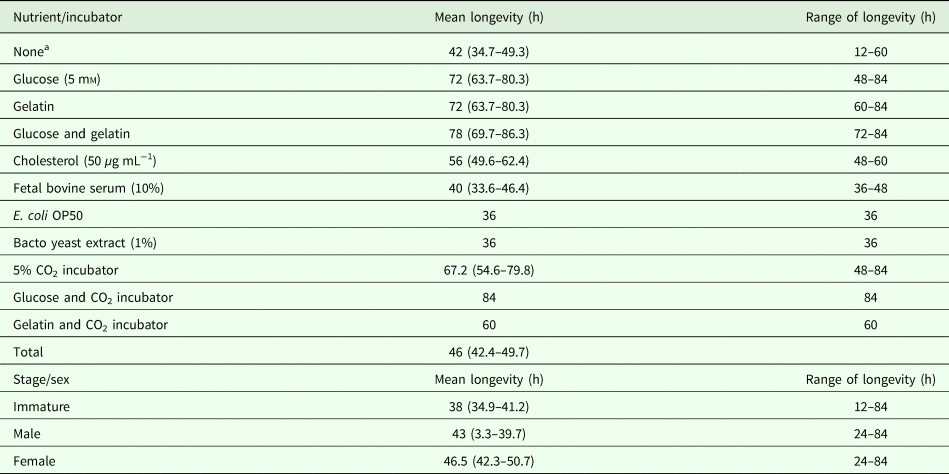
All worms were kept in 200 mL of Ascaris Ringer's solution and incubated at 37 °C. The time of longevity was considered the hour when all worms in a flask were dead. Flasks were checked every 12 h. The 95% confidence intervals are included in parenthesis (α = 0.05).
a ‘None’ implies an air incubator and no nutrient was used.
Phase 2: viability
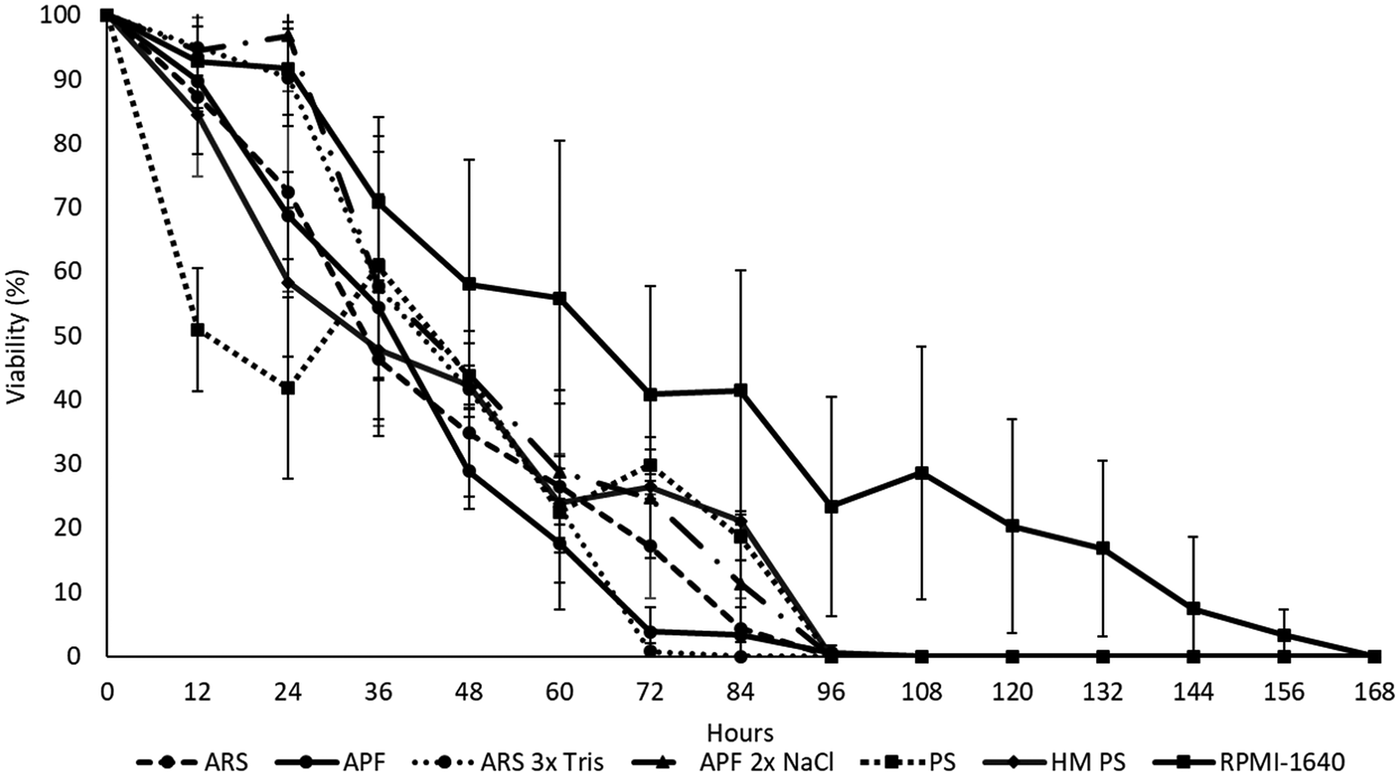
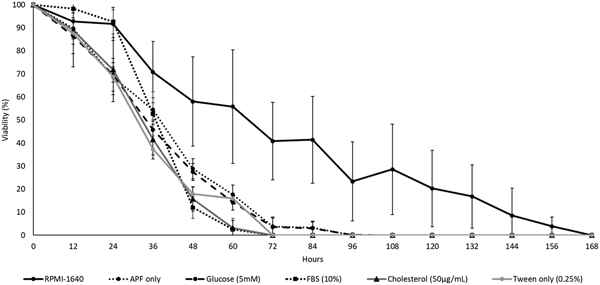
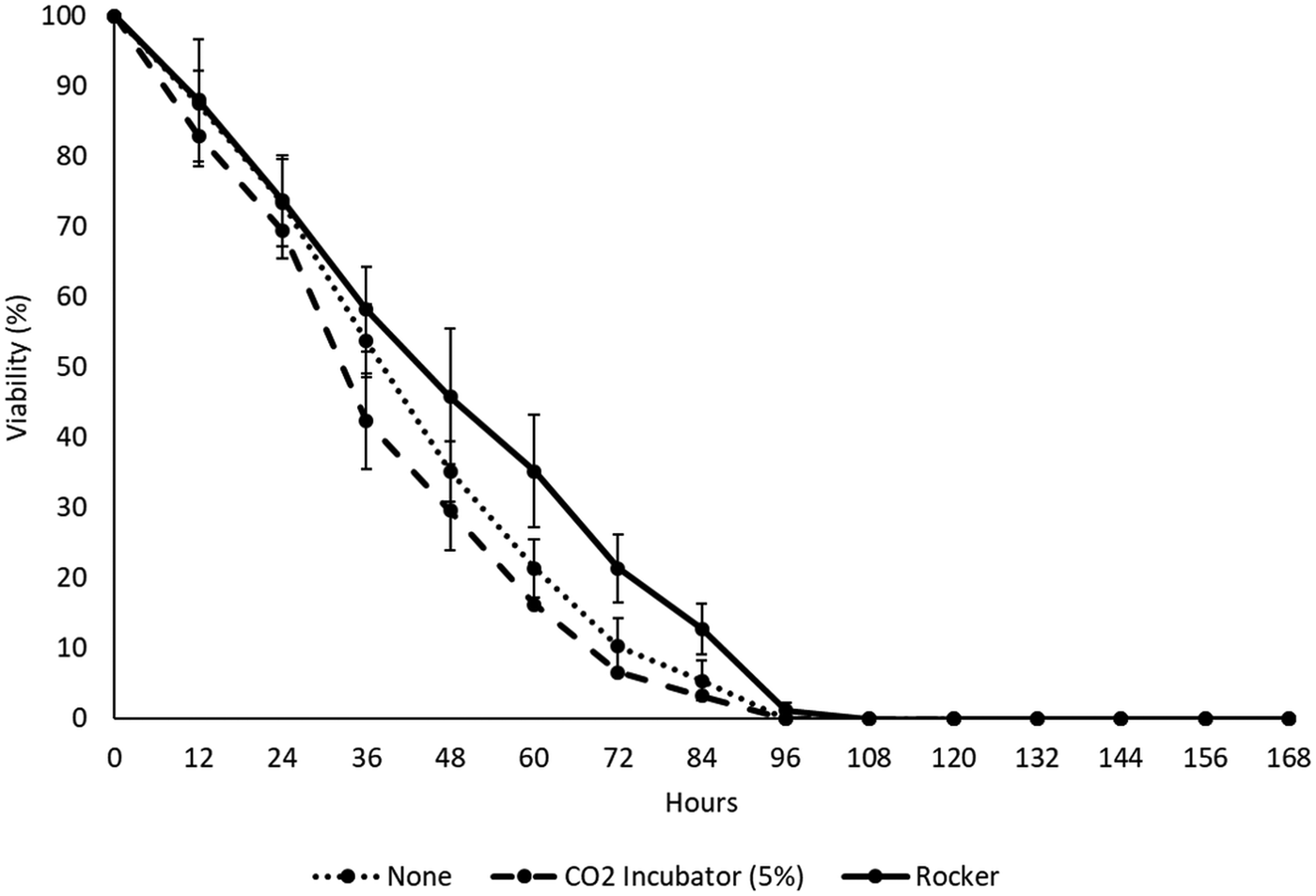
For the second phase of the study pertaining to worm viability (necropsies 4–8), a total of 835 worms were used, consisting of 350 adult males, 215 adult females and 270 L4s. The RPMI-1640 media resulted in significantly better worm viability than any of the other media (P < 0.0001) (Fig. 1). APF 2× NaCl had significantly better viability than ARS (P = 0.0002). APF (P = 0.0005), ARS 3× Tris (P = 0.0169) and APF 2× NaCl (P < 0.0001) had significantly better viability than the HMPS. The addition of glucose to the saline-based media did not significantly affect worm viability compared with those maintained in the saline-based media without glucose (P = 0.3048). The addition of a nutrient to the APF medium did significantly decrease worm viability (P = 0.0413), however the least squares means pairwise comparison did not identify any significant differences (Fig. 2). The use of the platform rocker resulted in significantly better worm viability than worms maintained without the rocker (P = 0.0305), while there were no significant differences in worm viability between the use of an air or CO2 incubator (P = 1.0000) (Fig. 3). Overall, worms maintained in RPMI-1640 had significantly better viability than worms maintained with any other method regardless of media, nutrient or environmental condition (P < 0.0001) (Figs 1 and 2). In regards to worm stage and sex, adult worms regardless of sex had significantly better viability than L4s (P < 0.0001) and females had significantly better viability than males (P < 0.0001) across all media types, nutrient supplementation and environmental conditions.
A graphical representation of mean viability of Parascaris spp. intestinal stages when maintained in various media types (ARS, Ascaris Ringer's solution; APF, artificial perienteric fluid; ARS 3× Tris, ARS with triple the amount of Tris buffer; APF 2× NaCl, APF with double the amount of NaCl; PS, physiologic saline; HMPS, homemade physiologic saline; RPMI, Roswell Park Memorial Institute). Error bars represent 95% confidence intervals (α = 0.05).

A graphical representation of mean viability of Parascaris spp. intestinal stages when maintained in either artificial perienteric fluid (APF) medium only, APF medium supplemented nutrients [glucose, fetal bovine serum (FBS), cholesterol, cholesterol and FBS, tween], or Roswell Park Memorial Institute-1640 (RPMI-1640) medium only. Error bars represent 95% confidence intervals (α = 0.05).

A graphical representation of mean viability of Parascaris spp. intestinal stages maintained with environmental conditions of a platform rocker or a 5% CO2 incubator across all media and nutrient types. ‘None’ implies stationary culture flasks in an air incubator. Error bars represent 95% confidence intervals (α = 0.05).

Discussion
This is the first study to determine the preferred in vitro conditions for the intestinal stages of Parascaris spp., and to describe a reliable and objective method for assessing their viability. Worm motility and the presence of muscle tone appears to be a reliable indicator for assessing in vitro conditions. This study is the first to report a difference in in vitro worm viability for Parascaris spp. between L4 and adult stages, as well as between male and female adult worms.
Intestinal stages of Parascaris spp. must be active swimmers against the flow of intestinal contents in order to maintain their position in the host and avoid being expelled by peristalsis (Drudge and Lyons, Reference Drudge, Lyons and Robinson1983). Therefore, worm responses to in vitro conditions should be judged based on activity level, where a decrease in activity likely reflects a decrease in overall worm viability. Other scoring systems for gastrointestinal nematodes have been developed, but these did not provide strict parameters of movement per score (Richards et al., Reference Richards, Behnke and Duce1995; O'Grady and Kotze, Reference O'Grady and Kotze2004). While Parascaris spp. intestinal stages are not compatible with the current size restrictions of the WormAssay (Marcellino et al., Reference Marcellino, Gut, Lim, Singh, McKerrow and Sakanari2012), a modification of this technique to accommodate larger macroparasites should be a target for future research.
The use of RPMI-1640 media resulted in significantly better worm viability than all other media types regardless of nutrient supplementation and/or environmental condition (Figs 1 and 2). Worms lived a maximum of 168 h in RPMI-1640 (Figs 1 and 2), which is well above the 84 and 96 h achieved in phase 1 and phase 2, respectively, with the addition of glucose (Table 3 and Fig. 2). At this time, it is unknown which components of the RPMI-1640 media caused this improvement in viability and longevity, but it is likely due to the combination of vitamins and amino acids that were missing from the other media evaluated. This finding is in agreement with Urban et al. (Reference Urban, Douvres and Xu1984) who found improved growth and survival of L4 A. suum when cultured in RPMI-1640 rather than a saline medium supplemented with glucose.
The use of sugar (glucose or dextrose) as a nutrient is reported in several other studies maintaining adult stages of A. suum (Weisblat and Russel, Reference Weisblat and Russel1976; Brownlee et al., Reference Brownlee, Holden-Dye and Walker1997; Chehayeb et al., Reference Chehayeb, Robertson, Martin and Geary2014), and one study used dextrose for maintaining adult P. equorum (Jansen et al., Reference Jansen, Krücken, Demeler, Basiaga, Kornaś and von Samson-Himmelstjerna2013). While it is assumed that sugar is necessary for the in vitro cultivation of Ascaris and Parascaris species, this had not previously been evaluated in a published study. In phases 1 and 2 of this study, Parascaris spp. survived a maximum of 84 and 96 h, respectively, when glucose was added as a nutrient and it did not significantly affect worm viability. The success of the RPMI-1640, but not the glucose provides evidence that Parascaris spp. intestinal stages require different and/or additional nutrients beyond glucose for sustainment in vitro. It is interesting that A. suum can be maintained for 8 days in ARS without any nutrient supplementation (McCoy et al., Reference McCoy, Warnock, Atkinson, Atcheson, Martin, Robertson, Maule, Marks and Mousley2015). In the current study, Parascaris spp. did not live more than 168 h in any of the media regardless of the media type or nutrient provided. This may suggest that adult A. suum and Parascaris spp. worms have very different nutrient and metabolic requirements, however direct conclusions cannot be made at this time. A comparative study could be performed to determine the viability of Parascaris spp. and A. suum when supplemented with different nutrients, and analyses of the media after a nutrient has been provided could determine if the worms successfully ingested the nutrient. If so, the effectiveness of the worm to generate energy from the given nutrient could be assessed using metabolic techniques. Such findings would provide significant advances towards in vitro techniques of the parasitic stages.
Douvres and Urban (Reference Douvres and Urban1983, Reference Douvres and Urban1986) described methods for culturing larval stages of Ascaris species utilizing various gaseous stages, including 5% CO2. Several studies report the maintenance of adult A. suum worms without CO2 (Weisblat and Russel, Reference Weisblat and Russel1976; Brownlee et al., Reference Brownlee, Holden-Dye and Walker1997; Chehayeb et al., Reference Chehayeb, Robertson, Martin and Geary2014; McCoy et al., Reference McCoy, Warnock, Atkinson, Atcheson, Martin, Robertson, Maule, Marks and Mousley2015). Jansen et al. (Reference Jansen, Krücken, Demeler, Basiaga, Kornaś and von Samson-Himmelstjerna2013) maintained P. equorum adult worms without 5% CO2 while Burk et al. (Reference Burk, Dangoudoubiyam, Brewster-Barnes, Bryant, Howe, Carter, Vanzant, Harmon, Kazacos and Rossano2014) cultured second and third larval stages of P. equorum under 5% CO2 conditions, but not the adult worms. Based on these reports, it appears that adult worms may not require CO2, but this had not been specifically evaluated for Parascaris spp. The current study did not find the use of 5% CO2 to significantly affect worm longevity or viability (Fig. 3). However, this study did not investigate the impact of CO2 on worms maintained in RPMI-1640 and this should be evaluated in future studies.
The use of a platform rocker for in vitro maintenance of ascarid parasites had not been evaluated prior to this study. In this study, the use of the rocker significantly improved worm viability (Fig. 3), however no firm conclusions can be made at this time. The platform rocker could not be tested simultaneously with CO2 due to limited space in the incubator. Furthermore, this study did not evaluate RPMI-140 media with the use of the rocker, and this should be investigated in future studies.
It is also known that nematodes are unable to synthesize cholesterol de novo (Dutky et al., Reference Dutky, Robbins and Thompson1967; Cole and Krusberg, Reference Cole and Krusberg1968); however, this study did not find the addition of cholesterol to improve worm longevity or viability. Additionally, the addition of FBS did not significantly improve viability. These findings are interesting because Urban et al. (Reference Urban, Douvres and Xu1984) found the addition of cholesterol (50 µg mL−1) and serum (10%) to RPMI-1640 to have an additive effect on the growth of L4 A. suum. Urban et al. (Reference Urban, Douvres and Xu1984) also found that an increase in cholesterol concentration to 250 µg mL−1 from 50 µg mL−1 reversed this effect. While the aforementioned study examined the development of larval stages, it is possible that a similar scenario was observed in the current study where the Parascaris spp. intestinal stages were negatively impacted by the cholesterol concentration examined herein. Future studies should investigate varying concentrations of cholesterol to determine if there is an optimum concentration and/or a tolerance threshold.
The varying sample sizes between the nutrient trials are a limitation to this study, particularly in regards to the number of worms used for evaluating the RPMI-1640 media and the saline-based medias supplemented with cholesterol, FBS, yeast and E. coli (Table 1). Variations occurred due to the number of worms harvested at each necropsy. While the results of this study clearly support he recommendation for using RPMI-1640 for maintaining intestinal stages of Parascaris spp., the conclusions should be interpreted with caution and warrant further investigation. The effects of stocking density and keeping male, female and immature worms together would also provide interesting points for future studies.
It is important to note that the in vivo immune responses exhibited by the foal prior to necropsy may also affect worm viability in vitro. Foals typically gain immunity to Parascaris spp. worms around 9 months of age (Clayton and Duncan, Reference Clayton and Duncan1979). Some response by the immune system to the present parasites is expected and it is unknown how the parasites were affected prior to harvest and culturing. This variability was controlled for by using foals which were all born into the same herd, and harvesting the worms when the foals were between 4.5 and 5 months of age which is the peak age for Parascaris spp. burden (Fabiani et al., Reference Fabiani, Lyons and Nielsen2016) and thus minimizing the potential influence of host immunity.
In summary, the scoring system proved to be a useful method for monitoring L4 and adult worm viability in vitro, and should be considered for future studies. This study found RPMI-1640 media to significantly improve worm viability. The use of a 5% CO2 incubator did not significantly affect worm viability, but a platform rocker significantly increased viability. The viability of adult worms was also significantly better than that of L4s. Further investigations should be performed to examine the effects of a platform rocker and CO2 incubator when RPMI-1640 is used as the culture media.
Author ORCIDs
Jessica Scare, 0000-0001-9309-9879.
Acknowledgements
We are very grateful to the farm staff for caring so well for the equine research herd. We also extend our gratitude to members of the Nielsen laboratory for assisting with the necropsies, and especially to the late Dr Eugene Lyons and Sharon Tolliver for sharing their abundance of knowledge and expertise in leading the necropsy team.
Financial support
This research was supported by the Gluck Equine Research Foundation.
Conflict of interest
None.
Ethical standards
The research was conducted following approval from the University of Kentucky's Institutional Animal Care and Use Committee (IACUC) under protocol number 2012-1046.