INTRODUCTION
Multiple Sclerosis (MS) is a chronic and progressive inflammatory disease of the central nervous system (CNS) that affects approximately 2.5 million people worldwide.Footnote 1 Despite the considerable diagnostic and therapeutic advances during the past decades, MS still results in different degrees of progressive disabilities for most of the affected, requiring various medical and nonmedical interventions. People with MS represent a heterogeneous population, and their needs vary according to their individual experiences with the disease and its symptoms (Forbes et al., Reference Forbes, While and Taylor2007). Along with family carers, a wide range of health professionals play a central role in supporting patients with MS (Campion, Reference Campion1996; Forbes et al., Reference Forbes, While and Dyson2003).
Patients severely affected by MS suffer from a variety of symptoms, including physical dysfunctions, intense pain, and psychological distress (Strupp et al., Reference Strupp, Hartwig and Golla2012; Edmonds et al., Reference Edmonds, Vivat and Burman2007b ; Higginson et al., Reference Higginson, Hart and Silber2006; Forbes et al., Reference Forbes, While and Mathes2006). Against the common notion that MS is not lethal, it certainly can lead to death (Ragonese et al., Reference Ragonese, Aridon and Salemi2008; Sumelahti et al., Reference Sumelahti, Hakama and Elovaara2010). We recently identified a growing interest among severely affected MS patients to communicate about death and dying (Buecken et al., Reference Buecken, Galushko and Golla2012). MS may also result in depression, which is one of the major risk factors for suicidal ideation, occurring in more than 25% of MS patients (Feinstein, Reference Feinstein2002; Reference Feinstein1997), and is reflected in alarming rates of euthanasia and assisted suicide within this population (Kuempfel et al., Reference Kuempfel, Hoffmann and Pollmann2007). Neurological care alone does not necessarily address all patients' needs (Kuempfel et al., Reference Kuempfel, Hoffmann and Pollmann2007), and there are first indications that palliative care (PC) can be a valuable complementary asset for patients who are severely affected by this disease (Higginson et al., Reference Higginson, Costantini and Silber2011; Edmonds et al., Reference Edmonds, Hart and Wei2010; Strupp et al., Reference Strupp, Hartwig and Golla2012; Galushko et al., Reference Galushko, Golla and Strupp2014).
Severe affectedness by MS as felt by patients can be measured using the “objective” criteria of the Expanded Disability Status Scale (EDSS)Footnote 2 , which does not yet cover all aspects relevant for patients (Strupp et al., Reference Strupp, Hartwig and Golla2012; Galushko et al., Reference Galushko, Golla and Pfaff2008). Another approach, one that is standard in PC, is to ask the patients themselves whether they feel severely affected and the reasons for this. Studies by our own research group have shown that, when considering the subjective criterion of feeling severely affected in addition to the physical burden, rated by the EDSS, other factors contribute to feeling severely affected by MS, such as difficult psychosocial circumstances, social isolation, and loss of independence, or at least changes in degree of self-reliance, relationships, and social roles (Strupp et al., Reference Strupp, Hartwig and Golla2012; Golla et al., Reference Golla, Galushko and Pfaff2012; Galushko et al., Reference Galushko, Golla and Hartwig2009a ). There also seems to be a lack of information as well as poor coordination between services (Freeman & Thompson, Reference Freeman and Thompson2000; Somerset et al., Reference Somerset, Campbell and Sharp2001).
In a recent study by Leray et al. (Reference Leray, Yaouanq and Le Page2010), the clinical course of MS was separated into two phases: an early phase from onset to irreversible moderate disability, and an irreversible late phase, where assistance is required to walk 100 meters. The duration of the late phase was nearly identical among patients regardless of the length of the early phase. These findings demonstrate that MS disability progression initially probably depends on autoimmune demyelination and can be modified, whereas the later stages are probably determined by axonal loss and to date cannot be influenced causally. Thus, to optimize treatment and care for severely affected MS patients in this latter stage presents a challenge, and it is thus important to analyze specific care needs for specific patient groups, especially with regard to the heterogeneity of patients in order to meet their particular (unmet) needs.
Thus, our study aimed to identify the specific palliative care needs of severely affected MS patients by analyzing patients feeling (1) more or (2) less severely affected and their possible differences in expressed care needs. With that we hope to provide a better understanding of differences in clinically relevant care needs for different subgroups of severely affected MS patients. These results might then enable those working and caring for such patients to provide sensitive and effective care, and may have implications for healthcare strategies and further research efforts.
METHODS
Development of Questionnaire
A questionnaire specifically developed for patients feeling severely affected was employed as described by Buecken et al. (Reference Buecken, Galushko and Golla2012). Briefly, this questionnaire includes questions in the domains of social and family support, access to care, physicians and medical care (including communication), access to information, nursing, rehabilitation, psychological support, social work, spirituality, complementary medicine, co-therapies, aiding devices, self-help, autonomy (including accommodation, work, leisure, finances, social activities), biographical continuity, quality of life, and disease-specific and sociodemographic issues. The questionnaire was also supplemented with existing validated instruments for the domains of quality of life (Hamburg Quality of Life Questionnaire in Multiple Sclerosis [HAQUAMS]) (Gold et al., Reference Gold, Heesen and Schulz2001), the doctor–patient interaction and spirituality scale (Consultation and Relational Empathy [CARE]) (Neumann et al., Reference Neumann, Wirtz and Bollschweiler2008; Mercer et al., Reference Mercer, Maxwell and Heaney2004), and the Functional Assessment of Chronic Illness Therapy–Spiritual Well-Being (FACIT–Sp) (Peterman et al., Reference Peterman, Fitchett and Brady2002). Finally, the questionnaire consisted of 25 needs categories as well as additional questions concerning demographics, and included a self-rating question on how severely patients felt affected by MS on a scale from 1 (less strongly severely affected) to 10 (totally affected). We defined an MS patients group who felt highly severely affected (group 1, estimation ≥7, median-split) and who felt less severely affected by MS (group 2, estimation <7).
To assess who, in the patient's opinion, was most burdened by their disease, we employed a yes/no format on the following variables: parents, children, siblings, partners, friends, neighbors, and other relatives. The same format was employed to assess where patients received medical help (e.g., family doctor, neurologist, emergency medical service, hospital ambulance) and from whom they wished more emotional support (e.g., family, friends, physician, nursing care service, psychologist, spiritual caregiver) to analyze the need for home visits, the need for nursing care, and to assess where patients felt cared for best (e.g., at home, in a home for the elderly, a nursing care home for young patients in need of care, in assisted-living surroundings specializing in MS patients, in mixed-living groups with people suffering from various diseases, or in specialized facilities for MS patients). In order to assess the amount of stress on their next of kin, patients were asked to rate on a 5-point Likert-type scale from very much to very little. To perform a Mann–Whitney U test, we then combined two new scale items summing (1) “very high” and “rather high” as well as (2) “moderate,” “rather little,” and “very little.”
Inclusion Criteria
To be included in the sample, patients only needed to report feeling severely affected by multiple sclerosis. In a two-step selection process, we first invited patients via an advertisement placed in the periodical journal Aktiv published by the German Multiple Sclerosis Society (DMSG) to participate in our Germany-wide study on unmet needs of severely affected MS patients and asking them if they felt severely affected by MS. Only persons responding in the affirmative to this question were included in our study and sent a questionnaire. Thus, all participants felt severely affected. Yet, to analyze subgroups and to evaluate how severely they felt affected, patients were asked to self-rate this condition.
Ethical Implications
The study was approved by the ethical committee at the University Hospital of Cologne, Germany (#06-191).
Statistical Analysis
Descriptive statistics were utilized to present perceived needs as well as correlations to show links between variables. Data analysis was performed using PASW Statistics 18 (formerly SPSS Statistics). Chi-squared tests were employed to compare categorical data. The nonparametric Mann–Whitney U test was employed to compare differences between the two independent groups when the dependent variable was either ordinal or continuous. A p value less than 0.05 was considered significant. Alpha adjustment for multiple testing was not performed.
Data Analysis
Since the questionnaire covered a wide range of needs categories, the research team (JS, MG, HG, NE, and RV) concentrated on the following topics of clinical relevance for care optimization:Footnote 3
-
1. care and support of next of kin
-
2. medical care
-
3. home visits/house calls
-
4. nursing care
-
5. rehabilitation
-
6. emotional support, and
-
7. co-therapies (e.g., occupational therapy, physical therapy, speech therapy
Needs in these categories were first analyzed descriptively within the whole sample (N = 573), where they showed a rather wide and complex distribution. We thus decided to analyze whether adding a subjective rating could identify a clinically relevant subgroup of patients. We then applied a median-split with respect to the subjective estimation on how severely MS patients felt affected by MS (see above, 1–10 ordinal rating scale) and defined an MS patients group who felt highly severely affected (group 1, estimation ≥7) and another who felt less severely affected by MS (group 2, estimation <7).
RESULTS
Response Rate
A total of 867 people responded to the nationwide advertisement and indicated an interest in participating in our research project. We received a total of 573 (66.1%) completed questionnaires. Analysis of the postal codes of returned questionnaires indicated that participants were distributed throughout Germany.
Demographical and Clinical Data
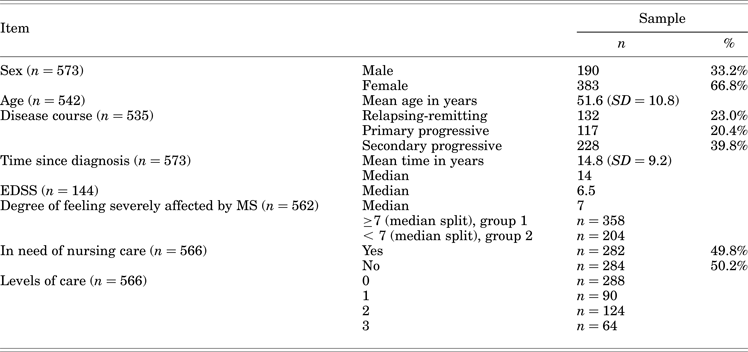
Some 573 patients feeling severely affected by MS requested a questionnaire to take part in the study, and, of these, 468 (81.7%) completed the questionnaire themselves. Some 94 (16.4%) questionnaires were completed by relatives according to patient instructions. The median age of patients was 51 years (range 20–83 years), 66.8% of whom were female (Table 1). Of those 573 patients, the greater part (358, 62.48%) felt highly severely affected (group 1, ≥7).
Demographic and clinical data of the sample

Notes. The nursing care levels according to the German long-term care legislation are as follows:
Grade 1. Support is necessary for at least two activities in the areas of body care, eating, and mobility (at least once daily), as well as housekeeping (at least several times a week), with an overall average duration of at least 90 minutes daily.
Grade 2. Support is necessary at least three times daily, with an overall average duration of at least three hours daily.
Grade 3. Support is necessary around the clock, including nights, with an overall average duration of at least five hours daily.
Grade 3 + . Cases of hardship with exceptionally high need for support.
Some 39.8% of participants suffered from a secondary progressive, 23% from a relapsing-remitting, and 20.4% from a primary progressive form of MS. A total of 468 patients (81.7%) completed the questionnaire by themselves; in 94 (16.4%) questionnaires the answers were ticked by relatives under the patient's instructions.
Specific Care Needs
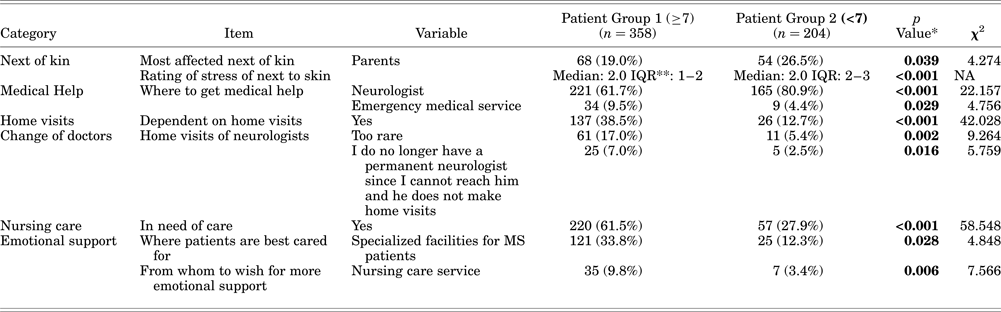
Comparing groups 1 and 2 revealed the following differences in care needs (see Table 2).
Differences in specific care needs

* Chi-square and Mann–Whitney U Test: All comparisons have one df.
**IQR = interquartile range.
Next of Kin
Patients differed in their perceptions of who was most stressed by the disease with regard to their parents (p = 0.039), with group 1 (≥7) finding their parents to be less affected. There were no differences found, however, in other relatives, siblings, partners, etc. Differences in the amount of stress their disease caused on their next of kin (5-point Likert-type scale; “very high” to “very low”) were found to be significantly higher (p < 0.001) in patient group 1 (≥7).
Where to Get Medical Help
Differences were found in two contact points—namely, private neurologists (p < 0.001) and emergency medical services (p = 0.029). Patients in group 1 (≥7) seemed to find less help from their private neurologist compared to group 2 (<7), whereas patients in group 1 (≥7) found more help from their emergency medical service. No differences were found with respect to hospital or family doctor/general practitioner.
Home Visits
The data show that patients significantly differ in their perceptions regarding the need for home visits, with group 1 (≥7) patients being in greater need (p < 0.001). As to whether the participants found that their neurologists paid them enough visits, patients again differed in their opinions, with group 1 (≥7) finding that their neurologists visited too rarely (p = 0.002).
Change of Doctors
Patients in group 1 (≥7) did not have a permanent neurologist any longer, since they could not reach him and he did not make home visits (p = 0.016).
Nursing Care
Some 49.8% of all participants were in need of care. There was a significant difference between both patient groups (p < 0.001), with group 1 (≥7) being in more need of care. As to where people with advanced MS were best cared for (i.e., at home, in a nursing care home for young people with MS, in living groups adjusted for people with MS), the groups differed in their opinions only with regard to specialized facilities for MS patients, with group 1 (≥7) patients believing that these infrastructures could ensure better care for MS patients (p = 0.028).
Emotional Support
The groups did not differ in their need for emotional support in the situations inquired about (i.e., when moving into a nursing home, when having job-related problems, when having to move back into the parental home). The groups significantly differed only in the wish for more emotional support from their nursing care service (p = 0.006), with group 1 (≥7) patients expressing a higher demand.
DISCUSSION
We have demonstrated that there is an association between the degree of feeling severely affected by multiple sclerosis and perceived unmet care needs. The great number of MS patients taking part allowed grounded insight into their experienced unmet needs, and we were able to identify significant care issues.
Our study sample was unique in that it involved people feeling severely affected by self-report only and not judged by third-parties using “objective” measures such as the EDSS. This fits with the palliative care approach, where intervention is guided by a subjective assessment of suffering. Even if the median EDSS score (6.5) in our study was lower than in other studies on people severely affected by MS (Edmonds et al., Reference Edmonds, Vivat and Burman2007a ), this does not mean that our patients suffered less but might ache from symptoms and problems not assessed by EDSS or that their personal perception was not in accordance with objective criteria. EDSS scores were only known for 25% of our patients, indicating that this parameter might not be relevant for the greater part of patients, as otherwise a potentially higher EDSS score could be anticipated since our sample was older and had a longer and more often a progressive course of the disease compared to the German MS registry (Flachenecker et al., Reference Flachenecker, Stuke and Elias2008).
We found good concordance between feeling more severely affected by MS and being in need of more and better care. However, this relationship could have been caused by the fact that patients felt severely affected due to their specific care needs.
The number one need for MS patients found in a study by Koopman et al. (Reference Koopman2003) was to have support from family and friends and to know that people were interested. Thus, psychological/psychosocial care is an essential service for people with MS as well as for their relatives and friends, as they are the main source of support for MS patients. In our sample of severely affected patients, special emphasis was placed on parents being in need of support (in the patient's opinion), as they seem to be very much affected by their children's disease. Group psychotherapy, as described by Landoni et al. (Reference Landoni, Giordano and Guidetti2000) for patients with MS and an experience of psychological support for patients' families, may help relatives not only with the emotional load that comes with the disease and the patient's everyday care, but also with their own emotional management and their own distresses and fears. In our study, at least in patient group 1 (≥7), we found a further special emphasis for emotional support—namely, the wish for more emotional support by their nursing care service. Patients in this group might have been socially isolated due to disease progression, so that nursing team members were probably closest and most available for them. Nevertheless, they were unable to cope with all the wishes and needs of patients, which often extended far beyond just nursing care. The focus on nursing care services for emotional support of patients belonging to group 1 (≥7) might also be associated with the fact that home visits by other healthcare professionals like neurologists were sparse or nonexistent, though patients expressed a strong need for home visits. This situation can institute a vicious circle, where rare home visits affect patients who feel more severely affected by their disease, which increases their need for support.
That there indeed is a strong need for home visits regardless of by whom (neurologists, psychotherapists, co-therapists, or a family doctor), has been underlined by other studies (Galushko et al., Reference Galushko, Golla and Hartwig2009a ; Golla et al., Reference Golla, Galushko and Pfaff2012). Being visited less often by healthcare providers or friends and working colleagues is also likely to enhance emotional burden. In consequence, patients severely affected by MS become increasingly reliant on those relatives and friends who remain available to them as the disease progresses. The wish for emotional and spiritual support from people with MS is supported by the findings of several studies (Wollin et al., Reference Wollin, Yates and Kristjanson2006; Golla et al., Reference Golla, Galushko and Pfaff2012; Kristjanson et al., Reference Kristjanson, Aoun and Oldham2006) and increases with regard to discussing end-of-life-issues (Galushko et al., Reference Galushko, Golla and Ostgathe2009b ; Buecken et al., Reference Buecken, Galushko and Golla2012), an important issue for MS patients though often denied (Bronnum-Hansen et al., Reference Bronnum-Hansen, Stenager and Nylev-Stenager2005). As long as homecare services for severely affected MS patients do not meet the crucial needs of patients as well as of their next of kin (Figved et al., Reference Figved, Myhr and Larsen2007), this will lead to unwanted hospital readmissions.
How can the expressed care needs be met? Although they are complex and wide ranging, introducing a subjective rating of the severity of affectedness gives some insight into which areas should be explored specifically for this patient group. Multiprofessional care seems indispensable. The “classical” medical system includes neurologists, physiotherapists, urologists, speech therapists, occupational therapists, psychotherapists, or general practitioners. But the question remains: who feels responsible for ensuring these services for patients feeling severely affected by MS? An additional approach supporting both assessment and care as given by palliative care could be a valuable asset. Even though all patients with life-limiting progressive diseases are entitled to PC, very few MS patients currently receive support from specialized palliative care (Ostgathe et al., Reference Ostgathe, Alt-Epping and Golla2011). Palliative care appears to remain a counterintuitive approach for MS patients (Voltz, Reference Voltz2010), and the results of many studies (Buecken et al., Reference Buecken, Galushko and Golla2012; Strupp et al., Reference Strupp, Hartwig and Golla2012; Galushko et al., Reference Galushko, Golla and Hartwig2009a ; Golla et al., Reference Golla, Galushko and Pfaff2012) support the finding that, due to its chronic and fluctuating time course, multiple sclerosis has to date not been regarded as a focus of PC. Thus, needs assessment in this group is essential for designing a concept of intertwined palliative and routine neurological care for severely affected MS patients. Specialized palliative homecare teams can be particularly effective in taking a coordinated approach to improve symptom management and quality of life at home as well. This underlines the importance of more research to define the role of palliative care in multiple sclerosis (Wollin et al., Reference Wollin, Yates and Kristjanson2006).
A recent study by Higginson and colleagues (Reference Higginson, McCrone and Hart2009) showed that, compared to a later referral, receiving PC earlier in the course of MS has a similar effect on reducing the symptoms of severely affected MS patients but greater effects on reducing caregiver burden. Higginson and Booth (Reference Higginson and Booth2011) also introduced a randomized fast-track trial to evaluate PC treatment for MS patients and found it effective in improving pain relief and reducing nausea, vomiting, mouth problems, and sleeping.
The inability to considerably alter disease progression is sometimes interpreted as “there is nothing more that can be done,” but this is precisely the reason why health professionals must initiate whatever steps are necessary to alleviate symptoms and offer appropriate support. Of course, palliative care cannot solve all problems by itself, but MS patient services should be offered in an integrated manner, linked with experts in rehabilitation medicine and neurology, to improve care for this special patient group.
STRENGTHS AND LIMITATIONS
In line with the subjectivity of symptoms, patients were included due to their subjective feeling of being severely affected. The fact that only few studies have focused on assessment of the unmet needs of people feeling severely affected by MS makes our study even more important, since we here learned from an insider's perspective how patients can be cared for in an optimal way. Yet, we must acknowledge the subjective perspective in terms of assessing needs, as this limits any generalization.
Generalization of our findings might also be restricted as we recruited our participants by advertising our study in the journal of the national multiple sclerosis society. Patients who are members of this self-help organization and thus receive the journal might differ from patients who are not. Self-reported data have limitations (e.g., selective memory). Yet we accepted those limitations in order to gain insight into the views of severely affected MS patients since they are the experts on their own (unmet) needs.
Our study was cross-sectional in nature, and respondents filled in all the questions, so completing one may have influenced responses to others. In addition, the predictive values of some items are quite low. This may not invalidate our results, but it has to be considered critically.
There is a principle of statistics which dictates that, upon performing multiple tests within a “family,” the value of alpha should be adjusted (i.e., lower than the conventional 0.05 level) so that overall type 1 error inflation is controlled. We decided against following this approach, since our study was exploratory by nature.
CONCLUSION
The data presented herein show an association between the degree of feeling severely affected by multiple sclerosis and perceived unmet care needs. Regarding the ordinal rating scale, we can now define specific care needs when having scores equal to or greater than 7.
Our data may help to shape patient-centered support structures for different patient groups. In- and outpatient palliative care, with its multidisciplinary approach, might be one further option to meet the particular needs of patients and their relatives, consequently leading to more satisfaction and well-being.
CONFLICT OF INTEREST STATEMENT
The authors have no conflicts of interests to declare.
ACKNOWLEDGMENTS
We wish to thank all of our patients for sharing their views. We acknowledge the generous support given by the Gemeinnützige Hertie-Stiftung (grant # 1.01.1/06/009). We also acknowledge the generous support provided by the German Society of Multiple Sclerosis (DMSG). We would also like to thank the Institute of Medical Statistics, Informatics, and Epidemiology (IMSIE) at University Hospital of Cologne for their support and counsel. Our department is supported for clinical studies by the Federal Ministry of Education and Research (BMBF01KN0706). The clinical and academic activities of the Department of Palliative Medicine, University Clinic of Cologne, are substantially supported by German Cancer Aid (Deutsche Krebshilfe e.V.). The authors would also like to thank Sigrid Altmeyer for data management as well as Silvia Arnold for proofreading and language editing.