Ryegrass species are native to the Mediterranean region but are now widely distributed throughout temperate areas of the world (Styles Reference Styles1986). The genus Lolium of the Gramineae family includes eight ryegrass species: Italian, perennial, rigid, Dalmatian (L. subulatum Vis.), Canary Islands (L. canariense Steud.), poison, hardy (L. remotum Schrank.), and Persian darnel (L. persicum Boiss. & Hohen ex Boiss.). The general biosystematics of Lolium, reviewed by Terrell (1968), may be briefly summarized as follows: (1) all taxa for which chromosome numbers have been counted are diploid with 2n=14); (2) perennial, Italian, and perhaps rigid are self-incompatible and cross-pollinated; (3) poison, hardy, and perhaps L. rigidum var. rottbollioides are self-compatible and self-pollinated. According to Terrell (1968), there are two compatible groups in Lolium, the self-pollinated poison and hardy and the cross-pollinated perennial and Italian. Lolium spp. are among the most troublesome grass weeds, mainly because of a high capacity to evolve complex herbicide resistance patterns (Campagna et al. Reference Campagna, Gasparetto and Sattin2001; Heap Reference Heap2016; Kotoula-Syka et al. Reference Kotoula-Syka, Tal and Rubin2000; Powles and Matthews Reference Powles and Matthews1996; Salas et al. Reference Salas, Burgos, Mauromoustakos, Lassiter, Scott and Alcober2013).
Herbicide-resistant biotypes of weeds are an increasing threat to crop production. An understanding of the basic biology of resistant biotypes, including their growth and development relative to susceptible biotypes, may yield information helpful in the management of resistance (Crooks et al. Reference Crooks, Burton, York and Brownie2005). A consequence of herbicide resistance in weed biotypes may be reduced “fitness” (i.e., a less “fit” biotype produces fewer progeny) compared with susceptible biotypes (Gressel and Segel Reference Gressel and Segel1982). Many reports compare vegetative growth characteristics (e.g., competitiveness, biomass, height, leaf area) of resistant and susceptible biotypes rather than fecundity (Watkinson and White Reference Watkinson and White1985). Although vegetative characteristics are often highly correlated with reproductive parameters, they are not synonymous. The magnitude of differences in vegetative growth and competitiveness, if any, varies with herbicide family and plant species. Herbicide resistance, however, may not have a detectable effect on growth characteristics. For some species, canopy height, biomass, and seed yield were similar for weed biotypes with resistance or susceptibility to cyclohexanedione, dinitroaniline, and organoarsenical and sulfonylurea herbicides (Harris et al. Reference Harris, Gossett and Toler1995; Holt and Thill Reference Holt and Thill1994; Park et al. Reference Park, Mallory-Smith, Ball and Mueller-Warrant2004; Wiederholt and Stoltenberg Reference Wiederholt and Stoltenberg1996). Moreover, weed biotypes resistant to acetolactate synthase (ALS)-inhibiting herbicides may exhibit similar vegetative growth characteristics and competitiveness relative to susceptible biotypes of the same species (Alcocer-Ruthling et al. Reference Alcocer-Ruthling, Thill and Shafii1992; Christoffoleti et al. Reference Christoffoleti, Westra and Moore1997; Lamego et al. Reference Lamego, Vidal and Burgos2011; Marshall et al. Reference Marshall, Al-Khatib and Loughlin2001; Massinga et al. Reference Massinga, Al-Khatib, Amand and Miller2005; Park et al. Reference Park, Mallory-Smith, Ball and Mueller-Warrant2004; Thompson et al. Reference Thompson, Thill and Shafii1994). Nevertheless, even in cases in which susceptible and resistant ryegrass biotypes are physiologically similar, they may present different characteristics regarding their ability to compete with other cultures. The more adapted biotypes are usually more competitive and are therefore capable of increasing their dominance with time and eliminating the biotypes that are less fit to occupy a certain ecological niche (Oliveira et al. Reference Oliveira, Agostinetto, Vargas, Avila and Tarouco2014).
Among herbicide-resistant weeds, rigid ryegrass is perhaps the most infamous. Rigid ryegrass is the first example of a weed that demonstrated multiple resistance to many herbicide families, including aryloxyphenoxyproprionates, cyclohexanediones, sulfonylureas, and dinitroanilines (Powles et al. Reference Powles, Holtum, Matthews and Liljegren1990). The patterns of resistance are variable, reflecting the genetic diversity of the species and the management practices imposed (Heap and Knight Reference Heap and Knight1986; Powles et al. Reference Powles, Preston, Bryan and Jutsum1997). Resistance in rigid ryegrass is one of the most economically important examples of herbicide resistance in world agriculture (Powles et al. Reference Powles, Preston, Bryan and Jutsum1997).
Italian ryegrass has been listed as the top weed with resistance to 15 sites of action in the United States (Heap Reference Heap2016) and is one of the 10 most troublesome weeds of wheat in 10 of the 13 southern U.S. states (Webster and Nichols Reference Webster and Nichols2012). Italian ryegrass populations as low as 10 plants m−2 reduced wheat yield by 4% (Liebl and Worsham Reference Liebl and Worsham1987). At 93 plants m−2, wheat yield was reduced by 61% (Appleby et al. Reference Appleby, Olson and Colbert1976). Diclofop-methyl has been used for selective control of Italian ryegrass in wheat in the United States since the early 1980s. Italian ryegrass, which has evolved resistance to diclofop, is the number one weed problem in Arkansas wheat (Barapour 2007, 2012) and is also a serious and widespread weed problem, mostly in grain fields, in many other states across the United States (Heap Reference Heap2016). The majority of Italian ryegrass populations in the southern United States are now resistant to diclofop; 25% are cross-resistant to pinoxaden (Salas et al. Reference Salas, Burgos, Mauromoustakos, Lassiter, Scott and Alcober2013). Most diclofop-resistant populations (about 80%) are also resistant to ALS inhibitors, showing complex resistance patterns to mesosulfuron, imazamox, and pyroxsulam (Salas et al. Reference Salas, Burgos, Mauromoustakos, Lassiter, Scott and Alcober2013). The latest problem is increasing resistance to glyphosate (Dickson et al. Reference Dickson, Scott, Burgos, Salas and Smith2011).
Weed identification at the seedling stage is key to selecting the most effective herbicide control measure, as the response of weed species differs within the same genus (Burgos et al. Reference Burgos, Shivrain, Scott, Mauromoustakos, Kuk, Sales and Bullington2011; Mathis and Oliver Reference Mathis and Oliver1980; McClelland et al. Reference McClelland, Oliver, Mathis and Frans1978). Therefore, it is necessary to study the vegetative and reproductive characteristics of ryegrass for the correct identification of ryegrass species. The aim of this research was to evaluate which morphological characteristics of ryegrass accessions from Arkansas can be used for proper species identification. The objectives were to (1) identify common vegetative and phenological characteristics of ryegrass collected from various Arkansas counties; (2) compare a representative type of these accessions with known poison, rigid, and perennial ryegrass specimens; and (3) suggest a simplified identification key that can be used for effective ryegrass management.
Materials and Methods
Sampling and Experimental Layout
Ryegrass seeds were collected from Arkansas, Craighead, Crittenden, Cross, Desha, Faulkner, Independence, Lawrence, Lee, Lonoke, Monroe, Perry, Poinsett, Prairie, Randolph, St. Francis, White, and Woodruff counties in Arkansas wheat fields prior to crop harvest. The rigid, poison, and perennial ryegrass seeds were obtained from Western Regional Plant Introduction Station, Pullman, WA 99164.
Seeds were sown in pots filled with Canadian sphagnum peat moss and wood pulp (SunGro Horticulture, Agawam, MA) on October 18, 2001, and November 5, 2002, for the first and second year, respectively, under greenhouse conditions (30/20 C day/night temperature and 14 h photoperiod). On November 12, 2001, and November 22, 2002, 2- to 3-leaf ryegrass seedlings were transplanted in the field, 1.5 by 1.5 m apart. Field studies were conducted at the University of Arkansas Agricultural Experiment Station, Fayetteville, AR (36.099221° N, 94.179184° W), on a Pembroke silt loam (fine-silty, mixed, mesic Mollic Paleudalfs) with 30% sand, 52% silt, 18% clay, 1% organic matter, and a pH of 6.6.
The experimental design was a randomized complete block design with 10 replications, each consisting of all ryegrass accessions collected across the state. The experimental site was sprayed with glyphosate at 0.84 kg ae ha−1 prior to ryegrass seedling transplant to eliminate existing vegetation. All transplanted ryegrass seedlings were covered with paper cups (with holes cut on top) for 4 wk to protect the transplants from freeze injury.
Data Collection
During periods of active growth (April to June), qualitative (plant growth habit, plant stem color, and node color) and quantitative (plant height) traits were recorded every 2 wk. At maturity, final plant height and numbers of tillers and spikes were recorded. Two spikes per plant per replication were collected to measure spike and spikelet length, awn length, number of spikelets per spike, number of seeds per spikelet, number of seeds per spike, and number of seeds per plant [(number of seeds per spikelet) × (number of spikelets per spike)×(number of spikes per plant)]. All weeds were removed within a 1 m radius of each ryegrass plant every other week. The rest of the field was mowed with a rotary mower. The field was not irrigated due to timely rainfall throughout the spring months.
Statistical Analysis
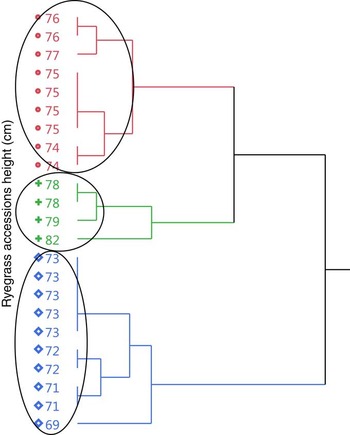
Analysis of variance (ANOVA) using PROC GLM in SAS 9.3 for Windows was conducted for data analysis. Because the qualitative morphological characteristics of ryegrass accessions and species were the same both years, data were analyzed with years as a random variable. A hierarchical cluster analysis was performed on height to determine the ryegrass groups based on height; this was then used as one taxonomic identifier of species. Based on pseudo F-statistic and cubic clustering criteria, three clusters were chosen.
Discriminant analysis was performed to differentiate the variation between ryegrass species, which were assigned as categorical variables, and their reproductive characteristics, which were assigned as covariates. The means over all observations were obtained and then standardized across accessions to ensure that the analysis was not influenced by the units of measurement of the variables. The linear function was then used, assuming that the covariance matrices within each species are equal while the covariate means differ between groups.
Results and Discussion
Characteristics of Ryegrass Accessions
Arkansas ryegrass accessions exhibit distinguishable differences based on both vegetative (recorded during the vegetative period) and reproductive (recorded during the reproductive period) characteristics. These are described in the following sections.
Vegetative Characteristics
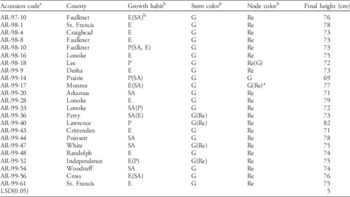
Arkansas ryegrass accessions can be classified in three groups in terms of plant height. These include tall (77 to 82 cm), intermediate (74 to 76 cm), and short (68 to 73 cm) plants (Table 1; Figure 1). The accessions from Lawrence, Lonoke (AR-99-28), Monroe, Poinsett, and St. Francis counties were all classified as tall, whereas those from Arkansas, Crittenden, Desha, Faulkner, Lee, Lonoke (AR-99-33), Perry, and Prairie counties were short. Accessions from Craighead, Cross, Faulkner, Independence, Lonoke (AR-98-16), Poinsett, Randolph, St. Francis, White, and Woodruff counties were classified as intermediate (Table 1). At harvest, the ryegrass accession from Lawrence County was the tallest (82 cm), whereas the accession from Prairie County was the shortest (69 cm). The differences in height between ryegrass accessions reflect differential competitive ability within these accessions (Fraga et al. Reference Fraga, Agostinetto, Vargas, Nohatto, Thurmer and Holz2013). The taller accession is expected to dominate the competitive relationship through shading (Blair Reference Blair2001) if its competitor, wheat for example, is shorter. Bararpour et al. (Reference Bararpour, Oliver and Norsworthy2012) reported that the natural infestation of Italian ryegrass in Arkansas reduced wheat yield an average of 75%.
Ryegrass height classification based on hierarchical clustering

Vegetative characteristics of Italian ryegrass accessions from Arkansas during the growing season.Footnote a

a Abbreviations: AR, Arkansas; SA, spreading–ascending; E, erect; P, prostrate; G, green; Re, red.
b Letters in parentheses indicate variants in the population. An asterisk (*) indicates a recessive characteristic with regard to color.
Ryegrass plants from Lawrence and Lee counties had a prostrate growth habit, and plants from Arkansas, Poinsett, White, and Woodruff counties had spreading– ascending (SA) growth characteristics (Table 1). Accessions from Cross, Faulkner (AR-97-10), and Monroe counties had a combination of erect (60%) and SA plants (40%).
All other ryegrass accessions, except those collected from Faulkner (AR-98-10), Independence, Lonoke (AR-99-33), Perry, and Prairie, exhibited an erect growth habit. An erect growth habit could provide a competitive advantage to a weed against a crop, as it enhances capture and use of resources, particularly photosynthetic active radiation, by the weed (Korres and Froud-Williams Reference Korres and Froud-Williams2002).
Stem color in most accessions was dark green, except for ryegrass from Independence, Lawrence, Perry, and White counties, which included plants (40%) with red pigmentation (Table 1). Most ryegrass plants had red nodes, except those from Prairie County, which had green nodes; ryegrass plants from Lee and Monroe counties had either green or red nodes in proportion 60:40 for each county.
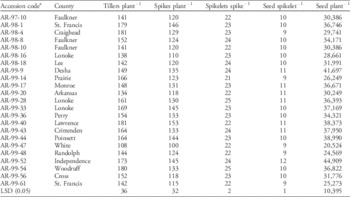
The number of tillers of accessions from Lawrence and Craighead counties did not differ from those of Crittenden, Cross, Desha, Faulkner (AR-98-8), Lonoke (AR-99-28 and AR-99-33), Monroe, Perry, Poinsett, Prairie, and Woodruff (Table 2). The ryegrass accession from White County had the lowest number of tillers (108 plant−1) compared with those with 181 tillers plant−1 (AR-98-4 and AR-99-40). Increases in biomass production or its components, including tillers, are positively related to increased competitiveness for both crop plants and weeds, as in the case of cereals, particularly winter wheat, and blackgrass (Alopecurus myosuroides Huds.) (Chauvel et al. Reference Chauvel, Munier-Jolain, Grandgirard and Gueritaine2002). The number of spikes (reproductive structure of ryegrass) increased with the number of tillers, which would ultimately increase the ryegrass soil seedbank. Lemerle et al. (Reference Lemerle, Michael and Sutton1979) reported reductions in crop tillering and inflorescence formations resulting in poor grain yield due to Italian ryegrass interference. Alshallash and Drennan (Reference Alshallash and Drennan1993) recorded substantial decreases in both total dry weight and grain yield relative to the weed-free crop when Italian ryegrass was growing with a range of wheat densities (0, 25, 50, 100, and 200 plants m−²) with and without 100 weed plants m−². Hashem et al. (Reference Hashem, Radosevich and Roush1998) measured reductions up to 92% in winter wheat yield due to competition from Italian ryegrass.
Vegetative and reproductive characteristics of Italian ryegrass accessions from Arkansas.

a Abbreviation: AR, Arkansas
Reproductive Characteristics
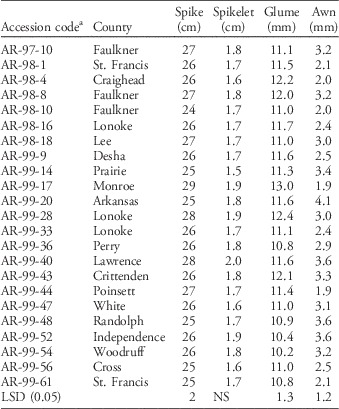
Ryegrass from Lawrence County had the greatest number of spikes (153 spikes plant−1), while ryegrass from White County had the lowest number (100 spikes plant−1) (Table 2). The number of spikes per plant of the accession from Lawrence County did not differ from those of Craighead, Crittenden, Desha, Faulkner (AR-98-8), Independence, Lonoke (AR-99-28 and AR-99-33), Monroe, Perry, Poinsett, Prairie, Randolph, St. Francis (AR-98-1), and Woodruff counties. Accessions from Arkansas, Cross, Faulkner (AR-97-10, AR-98-8, and AR-98-10), Lee, Lonoke (AR-98-16 and AR-99-28), Randolph, Prairie, St. Francis (AR-99-61), and White counties had similar numbers of spikes.
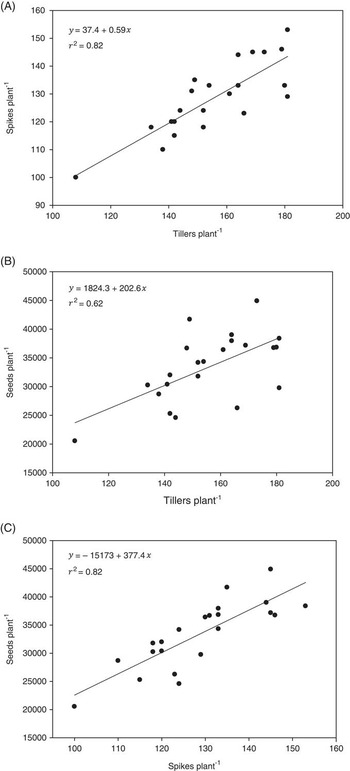
Ryegrass from Independence County had 24 spikelets spike−1, while ryegrass from Prairie County had 21 spikelets spike−1 (Table 2). The number of spikelets per spike from Independence County did not differ from that of Lawrence, and the number of spikelets per spike from Prairie County did not differ from White County. Ryegrass had 9 to 12 seeds spikelet−1 (Table 2). The Independence County accession, with 12 seeds spikelet−1, and the accessions from Craighead, Prairie, Randolph, St. Francis (AR-99-61), and White counties, with 9 seeds spikelet−1, had the highest and lowest number of seeds per spikelet, respectively. However, the number of seeds per spikelet from the Independence County accession did not differ from those of Arkansas, Crittenden, Desha, Lawrence, Lonoke (AR-99-28), and Monroe counties; and the number of seeds per spikelet from the White County accession also did not differ from those of Craighead, Cross, Faulkner, Lee, Lonoke (AR-98-16 and AR-99-33), Perry, Poinsett, Prairie, Randolph, St. Francis, and Woodruff counties. Tillers plant–1 were highly related with spikes plant–1 and seeds plant–1 (r2=0.82 and 0.62, respectively) (Figures 2A and 2B). In addition spikes plant–1 were highly related with seed plant–1 (r2=0.82) (Figure 2C). The high correlation between tillers per plant, spikes per plant with seeds per plant highlights the importance of these variables in the reproductive capacity of ryegrass and their usefulness as classification tools. These variables convey information about the potential contribution of ryegrass species or populations to soil seedbanks if not controlled effectively.
Comparisons of reproductive characteristics among Arkansas ryegrass accessions grown under field conditions and correlation of (A) number of tillers and spikes production; (B) number of tillers and seed production; and (C) number of spikes and seed production.

The Monroe County accession had the longest spike (29 cm) and the Faulkner accession (AR-98-10) had the shortest (24 cm) (Table 3); spikelet lengths ranged from 1.5 (Prairie) to 2 cm (Lawrence) (Table 3). The Monroe County accession had the longest glume (13 mm) and Woodruff County had the shortest (10.2 mm). All ryegrass accessions from Arkansas County were awned. The ryegrass from Arkansas, Independence, Lawrence, and Randolph counties had the longest awns (3.6 and 4.1 mm), whereas those from Monroe and Poinsett counties had the shortest awns (1.9 mm). Ryegrass accessions from the state of Arkansas had an erect to prostrate growth habit, dark green stems or green stems with red pigmentation, green to red nodes, glumes shorter than spikelets, and medium seed size (5 to 7 mm) with 1.9 to 4 mm awns. The accession from Lawrence County had the highest number of spikes, and ryegrass from White County had the lowest number of spikes. In terms of seeds per spikelet, ryegrass from Independence County had 12 seeds spikelet−1 and that from White County had 9 seeds spikelet−1. The number of spikelets per spike differed among ryegrass accessions. Spike, spikelet, glume, and awn lengths also differed among ryegrass accessions.
Selected reproductive characteristics of Italian ryegrass accessions from Arkansas.

a Abbreviation: AR, Arkansas
Evidence in this research and in accordance with existing literature (Yatskievych Reference Yatskievych1999) indicates that the accessions collected from Arkansas counties belong to Italian ryegrass, a highly competitive species (Alshallash and Drennan Reference Alshallash and Drennan1993; Hashem et al. Reference Hashem, Radosevich and Roush1998; Lemerle et al. Reference Lemerle, Michael and Sutton1979). Competitiveness pertains to the ability of an organism (weed species in this case) to perform better in acquiring resources in relation to another organism (crop plants) within the same habitat (Korres et al. Reference Korres, Norsworthy, Tehranchian, Gitsopoulos, Loka, Oosterhuis, Gealy, Moss, Burgos, Miller and Palhano2016). Weediness, which comprises traits that secure the survival and dispersal of weeds, even under severe environmental conditions, can be described through various morphological, phenological, or physiological characteristics (Korres et al. Reference Korres, Norsworthy, Tehranchian, Gitsopoulos, Loka, Oosterhuis, Gealy, Moss, Burgos, Miller and Palhano2016). The high genetic diversity among weedy plants allows them to achieve a greater competitive fitness against crops under diverse environmental conditions (Dukes and Mooney Reference Dukes and Mooney1999). Reproductive capacity is linked to resource capture (DeFelice et al. Reference DeFelice, Witt and Barrett1988; Benvenuti and Steffani Reference Benvenuti and Steffani1994), which is related to increased biomass and leaf area (Korres Reference Korres2005).
Morphological Differences among a Representative Arkansas Ryegrass Accession of Rigid, Poison, and Perennial Ryegrass
A representative Arkansas ryegrass accession (AR-99-28 from Lonoke County) was compared with known rigid, poison, and perennial ryegrass species. Italian ryegrass (AR-99-28) from Lonoke County was chosen as a representative species because of its resemblance to the general population of Arkansas ryegrasses (visual observations of wheat fields around the state of Arkansas) in terms of tiller number, seed production, color, and growth habit characteristics. Significant differences either in vegetative or reproductive characteristics were found across species.
Vegetative Characteristics
At 2 wk after emergence, poison ryegrass had a larger main stem (2- to 3-fold) compared with the other species. Poison ryegrass also had droopy leaves. Perennial ryegrass had the narrowest leaf blade (2 to 3 mm) among ryegrass species. In general, three leaf-blade size categories were classified. Poison ryegrass had the widest leaf blade, 10 to 11 mm; Italian and rigid ryegrass had similar leaf widths of 5 to 6 mm. At the seedling stage (2 wk old), ryegrass has either a narrow or wide leaf blade. If the leaf blade is narrow (2 mm width), it is perennial ryegrass. Ryegrass with a wide leaf blade is either poison, Italian, or rigid ryegrass. If the ryegrass leaf blade is 10 to 11 mm wide, it is poison ryegrass. But if the ryegrass leaf blade is 5 to 6 mm in width, it is either Italian or rigid ryegrass. It is difficult to distinguish between Italian and rigid ryegrass at the 2-wk-old seedling stage. However, poison and perennial ryegrass are easy to distinguish from one another or from Italian or rigid ryegrass. Growth habit can also be used as a rough guide to distinguish ryegrass species, because Italian and poison ryegrass exhibit an erect growth habit, whereas perennial ryegrass is prostrate, and rigid ryegrass is either erect or prostrate (Table 4).
Vegetative characteristics of Italian, rigid, perennial, and poison ryegrass.Footnote a

a Abbreviations: AR, Arkansas; L, Lolium; E, erect; P, prostrate; G, green; Re, red
b Letters in parentheses indicate variants in the population.
Stem color comparison was based on a representative Italian ryegrass accession (AR-99-28), which had greenish stems. Rigid ryegrass stem color varied between green (60%) and reddish (40%), whereas poison and perennial ryegrass had the same color as Italian ryegrass. Poison and perennial ryegrass had green nodes, but Italian and rigid ryegrass had red nodes. Apparently, stem and node color cannot reliably differentiate Italian from rigid ryegrass.
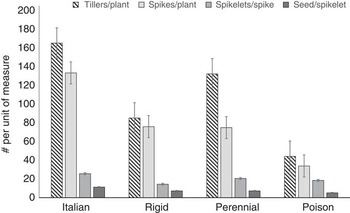
Growth habit is not a reliable key to distinguish Italian and rigid ryegrass. Italian ryegrass, being 79 cm tall and with the highest number of tillers, may be the most competitive of these species (Table 4; Figure 3). This is the species that primarily infests wheat fields in Arkansas. Italian and poison ryegrass had similar heights (Table 4). Rigid ryegrass was taller than perennial ryegrass. Italian ryegrass had more tillers than the other ryegrass species (Figure 3). An alternative way to distinguish Italian from rigid ryegrass is by reproductive characteristics.
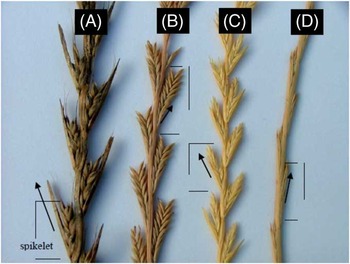
Spikes of four ryegrass species: (A) poison ryegrass, (B) Italian ryegrass, (C) perennial ryegrass, and (D) rigid ryegrass. Arrow indicates glume length and box indicates spikelet length.

Reproductive Characteristics
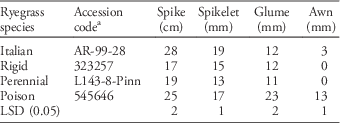
Italian, poison, and rigid ryegrass flowered at the same time (late April), while perennial ryegrass flowered mid- to late May. At maturity, Italian ryegrass and poison ryegrass seed had awns, but perennial and rigid ryegrass seed did not (Table 5). The awn length of poison ryegrass was at least 4-fold longer than that of Italian ryegrass. The key traits that distinguish ryegrass species at the reproductive stage, particularly Italian and rigid species, are the presence or absence of awns, spikelets, and glumes. Ryegrass seed is either awned or awnless. If ryegrass seed is awnless, it is perennial or rigid ryegrass. If the seed is awned, it is either Italian or poison ryegrass. Poison ryegrass has an awn greater than 10 mm long, but Italian ryegrass has an awn shorter than 5 mm. The other key characteristic to distinguish poison ryegrass from either Italian, rigid, or perennial ryegrass is that the glume is longer than the spikelet in poison ryegrass, while the glume is shorter than the spikelet in Italian, rigid, and perennial ryegrass.
Comparison of reproductive characteristics of four ryegrass species.

a Abbreviation: AR, Arkansas; L, Lolium
Italian and poison ryegrass have longer spikes and spikelets than either rigid or perennial ryegrass. The glume of poison ryegrass was almost twice the length of any other ryegrass species (Table 5; Figure 4). The poison ryegrass glume (23 mm) was longer than the spikelet (17 mm), whereas the Italian ryegrass glume (12 mm) was shorter than the spikelet (19 mm). Poison ryegrass awns (>10 mm) were at least two times longer than Italian ryegrass awns (<5 mm).
Comparisons of reproductive characteristics (tillers per plant, spikes per plant, spikelets per spike, and seeds per spikelet) among Italian, rigid, perennial, and poison ryegrass grown under field conditions.

The glume was shorter than the spikelet in Italian, rigid, and perennial ryegrass, but the glume was longer than the spikelet in poison ryegrass (Table 5; Figure 4). In rigid and perennial ryegrass, the glume was longer than two-thirds of the spikelet length, but the glume was shorter than two-thirds of the spikelet in Italian ryegrass.
Italian ryegrass had the highest number of spikes per plant, and poison ryegrass had the lowest number of spikes per plant. Rigid and perennial ryegrass had the same number of spikes per plant (Figure 3). Italian ryegrass had the highest number of spikelets per spike, and rigid ryegrass had the lowest number of spikelets per spike (Figure 3). Poison and perennial ryegrass had the same number of spikelets per spike. Italian ryegrass had the highest number of seeds per spikelet (11 to 12), and poison ryegrass had the lowest number of seeds per spikelet (5 to 6). Rigid and perennial ryegrass had the same number of seeds per spikelet (Figure 3). Italian ryegrass has longer spikes and spikelets than rigid, poison, or perennial ryegrass. Italian ryegrass, being the tallest among ryegrass species and with the highest number of tillers, produced the highest number of spikes per plant (Table 4; Figure 3).
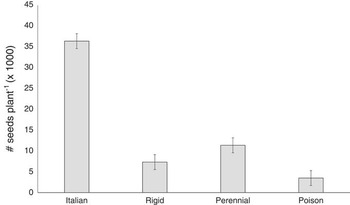
High number of tillers and seeds per spikelet in Italian ryegrass resulted in the highest number of seeds at 36,393 seed plant−1. Poison ryegrass, having the lowest number of tillers and seeds per spikelet, produced the lowest number of seeds at 3,501 seed plant−1 (Figure 5). The highest number of tillers and spikes per plant in Italian ryegrass resulted in the highest number of seeds per plant compared with the other ryegrass species tested in this experiment. Italian ryegrass produced 3.2, 5.0, and 10.4 times the number of seeds per plant compared with perennial, rigid, and poison ryegrass, respectively (Figure 5).
Seed production capability of Italian, rigid, perennial, and poison ryegrass.

Overall, in Arkansas, Italian ryegrass was capable of producing up to 180 tillers and up to 45,000 seed plant−1.
The capacity of Italian ryegrass to produce high numbers of seeds per plant and subsequently increase seed deposition to the soil seedbank is a major problem not only in Italian ryegrass control measures but also in evolution of herbicide-resistant Italian ryegrass. The results presented in this work indicate the importance of Italian ryegrass in Arkansas wheat fields. As Bararpour and Oliver (2007) reported, the natural infestation of Arkansas Italian ryegrass (±323 plants m−2) interference reduced wheat yield an average of 72% over 6 yr.
It is important to be able to distinguish Italian, rigid, poison, and perennial ryegrass at vegetative and reproductive stages for effective ryegrass management practices. Differences in susceptibility of the individual species indicated the importance of proper species identification before herbicide application (Mathis and Oliver Reference Mathis and Oliver1980; McClelland et al. Reference McClelland, Oliver, Mathis and Frans1978). These morphological and reproductive characteristics will enable producers to identify Italian ryegrass, which is the main problematic ryegrass species in wheat fields in the mid-southern United States, and to distinguish Italian from rigid, perennial, or poison ryegrass. If the correct identification of ryegrass species has been made then a case of herbicide failure is most likely due to a resistant biotype rather than misidentification. Although ryegrass accessions from Arkansas were identified as Italian ryegrass, the existing morphological variability reflects the genetic diversity of ryegrass (Heap and Kight 1986; Powles et al. Reference Powles, Holtum, Matthews and Liljegren1990), which is influenced by the prevailing environmental conditions.
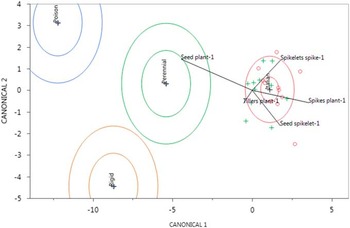
Based on discriminant analysis of vegetative traits, Italian ryegrass accessions from Arkansas did not clearly separate into distinct groups (nondistinct morphological differences) despite observable differences (Figure 6). Therefore, Italian ryegrass in Arkansas belongs to one vegetative morphotype. Discriminant analysis of vegetative and reproductive traits revealed that the ryegrass accessions formed distinct groups by species, and despite the morphological diversity within the Italian ryegrass species, it is still taxonomically distinct from the other ryegrass species.
Ryegrass species classification on vegetative and reproductive characteristics as determined by discriminant analysis.

Keys for Ryegrass Identification
Classification for ryegrass recognition at vegetative and reproductive stages based on the results presented in this work is summarized below. This classification system is user-friendly, as it combines data from the detailed analysis of both qualitative and quantitative ryegrass characteristics.
Vegetative Key
-
∙ If leaf blade is narrow (2 mm), then it is perennial ryegrass
-
∙ If leaf blade is wide (5 to 10 mm), then it is
-
° 5 to 6 mm=Italian and rigid ryegrass else
-
° 10 to 11 mm=poison ryegrass
-
Reproductive Key
-
∙ If awn is absent, then it is perennial or rigid ryegrass
-
∙ If awn is present, then it is Italian or poison ryegrass, and then
-
° glume<spikelet and awn<5 mm=Italian ryegrass, else
-
° glume>spikelet and awn>10 mm=poison ryegrass
-