The Antarctic Treaty and its Protocol on Environmental Protection have governed and regulated human activities in Antarctica since 1961 and 1998, respectively. Recently, they have come under increased scrutiny as questions are being posed about their capacity to respond and adapt to the increasing human pressures on the continent.
Most prominent among these pressures are climate change, the growth of tourism and adventure travel, the expansion of research infrastructure and logistics, bio-contamination, bio-prospecting and fishing. Less visible are geopolitical positioning and the institutional resilience of the Antarctic Treaty System (ATS) itself. Whilst scrutiny has mostly come from governmental and non-governmental organisations, the media, geopoliticians and humanities scholars, visual artists have also sought to question these contemporary pressures and to examine their origins and connections to the history of Antarctic exploration.
This paper will interrogate six artists who have been chosen because their Antarctic drawings, paintings, photographs and performances question or disrupt human perceptions and engagement with Antarctica. The artists are Sidney Nolan (1917–1992), Chris Drobowolski (born 1972), Pierre Huyghe (born 1962), An-My Lê (born 1960), Anne Noble (born 1954) and Julius von Bismarck (born 1983).
Context
The visual arts have played a central role in our interpretation and engagement with Antarctica ever since William Hodges drew the first Antarctic icebergs during Captain Cook’s first crossing of the Antarctic Circle in 1774 (Fox, Reference Fox2005).
For the handful of artists and illustrators who followed in Hodges’ wake, the principle task was to bring back realistic representations of what they encountered. In keeping with the romantic/sublime spirit of the time, natural phenomena such as the size of icebergs were prone to artistic exaggeration (Price, Reference Price2017). The distinction between the scientific and the populist was blurred. Expeditions needed to generate public excitement and satisfy sponsors.
The underlying “documentary” purpose of the Antarctic visual art remained largely unchanged up until the International Geophysical Year (IGY) of 1957–1958. Visual technologies such as photography did alter, however. Despite its then perceived objectivity in recording the logistics, trials and tribulations of Antarctic explorations, photography proved less precise than drawing and watercolour where it came to conveying anatomical or botanical study, or the documenting of topographic panoramas and atmospheric phenomena.
Recognising both the advantages and disadvantages of the new medium, explorers such as Jean-Baptiste Charcot, Captain Scott and Sir Ernest Shackleton sought instead to employ photographs to simultaneously publicise their efforts, reveal Antarctica to the widest possible audiences and cover their expeditionary costs by offering image rights and organising lantern-slide lectures and exhibitions. Photography was integral to expeditionary cultures.
The most significant shift in Antarctic visual arts, however, came after the IGY and the signing of the Antarctic Treaty with an increase in aesthetic experimentation, contemplation and questioning of dominant framings (Andrews, Reference Andrews2007). The drivers of change include; improving accessibility of Antarctica after the IGY; the creation of national Antarctic Artists & Writers Programmes; public visual archives; the development of Antarctic tourism; expeditionary activism and private expeditions.
Approaches
We can identify some shared approaches and practices amid the wildly differing conceptual and stylistic directions taken by Antarctic artists. The most mediatised and enduring was a resurgent romantic aesthetic of Antarctica’s ice features, geology and exotic fauna. Another was the quest for natural abstraction that still dominates much of Antarctica’s inland regions where an absence of any objects to scale eradicates perspective and results in minimalist works that can echo the paintings of Ellsworth Kelly or Barnett Newman. A third approach was Land Art, or the use of Antarctica as a backdrop for installations that appeared at the interface of ice and sky and reflected an ancient human need for the marking and transformation of territories.
The fourth approach and focus of the remainder of this paper was a social and political engagement with the human dimension and settler colonial occupation of Antarctica. Although they worked in a variety of mediums and over a number of decades, the artists who shared this engagement did so through a common refutation of the idea that Antarctica was reducible to notions of purity, exoticism and utopianism – as if the continent somehow existed outside of human space and time. Antarctica was just as socially and politically constructed as any other region of the Earth – albeit in often very different ways – and this deserved interrogation.
Although he was primarily concerned with the tactile nature of painting as a means for storytelling and conveying landscape, the artist whose work prefigured and paved the way for this increasingly critical perspective on Antarctica is Sidney Nolan, one of the most renowned and expressive Australian artist of the 20th century (Wiseman, Gowing, & James, Reference Wiseman, Gowing and James2006). In 1964, it was the United States Antarctic Program that invited Nolan and his friend, the famous writer and correspondent Alan Moorehead, to Antarctica’s Ross Sea region. Whilst there, Nolan took photographs and produced 200 watercolour sketches. On his return, he painted 68 canvases, the majority of which are of turbulent landscapes in which he captures the wild plasticity of ice and dynamism of water. A handful of canvases, on the other hand, look back in time to depict Heroic Age campsites and explorers. Painted in the same expressionist style, his explorers are shown with large rounded eyes that seem to betray a Beckettian state of existential angst at their predicament, echoing our own collective uncertainties. In this sense, Antarctica, like the barren stages of the Theatre of the Absurd, is interpreted as a distiller of human frailty and inadequacy of human rationalism (Esslin, Reference Esslin1962).
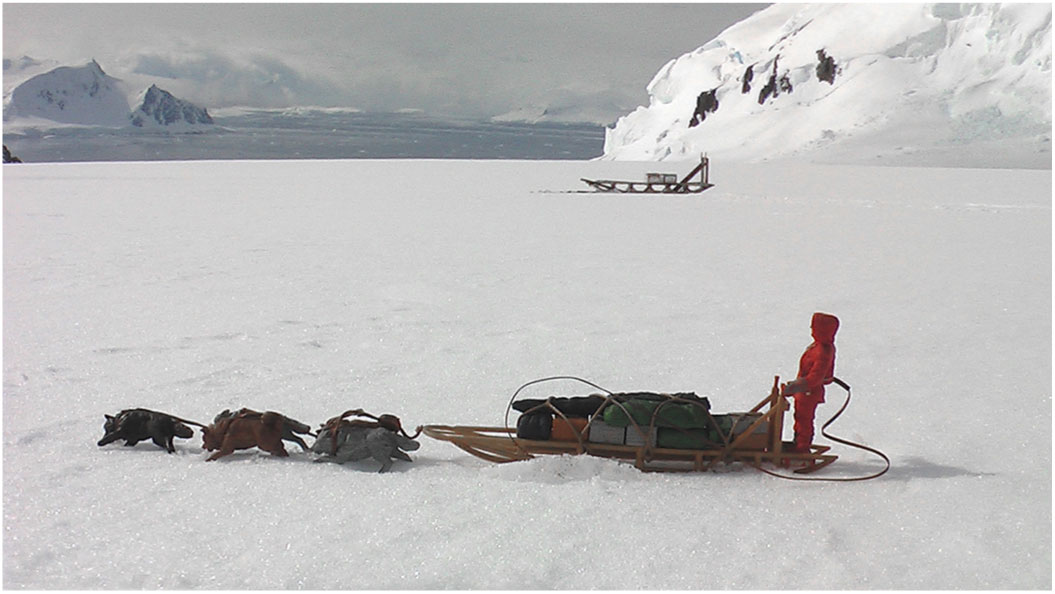
The independence and irreverence of Nolan’s approach influenced a whole array of later Antarctic painters, from the New Zealander Margaret Eliot to the Australians Steven Eastaugh and Jan Senbergs, who continued the dramatisation of the co-relationship between humanity and Antarctica. Chris Dobrowolski, a British artist, spent three and half months with the British Antarctic Survey in 2008–2009 and used sledging cases, models, toys, miniature figurines, Ladybird books, photography, performance and a sledge made from gold picture frames. With these, he stages whimsical scenes that celebrate and poke fun at British Antarctic culture and expressions of heroic nostalgia (Dobrowolski, Reference Dobrowolski2014; Wells, Reference Wells2012). One example is a toy snowcat pulling a sledge loaded with a Penguin Biscuits delivery truck, against a painted background of Antarctica. With their touching blend of humour, weirdness and tragedy, Drobolwski’s assemblages often also play with scale and perspective to blur the differences between fiction and reality, as if to emphasise Antarctica as a continent that resides somewhere between the observed, the experiential and the imagined (Fig. 1). Antarctica is a “laboratory” for artistic experimentation.
“Toy Antarctic Sledge”, Chris Dobrowolski, 2009.

The convergence of Antarctic fiction and reality also informed the French multimedia artist Pierre Huygue, who in 2005 embarked on what he termed A Journey that Wasn’t (Barikin, Reference Barikin2015). Huygue and his crew of sailors and artists navigated along the Antarctic Peninsula onboard a 36-m schooner, the Tara, in search of an unidentified white animal rumoured to live on an Antarctic island, an Island without dimension or position, which appears and disappears with the seasons. From this nebulous objective that echoes the early quest for Terra Australis Incognita, materialised a film about an albino penguin found – fictional or not, we shall never know – on the subsequently named “Idleness Island”. Encapsulating Huygue’s idea that “[e]lsewhere always remains a story: to bring it back, you have to create an equivalent” (Hodge, Reference Hodge2014), the piece de resistance was an open-air spectacle in New York’s Central Park that immersed audiences in a fantastical Antarctic realm. Reminiscent of some of Gustave Doré illustrations of Coleridge’s The Rime of the Ancient Mariner, it is peppered with contradictory accounts from the different participants onboard the Tara. Huygue’s multifaceted creation re-imagines Antarctica as an alien realm of hazy, fragmented and often “mistaken visibilities” (Yusoff, Reference Yusoff, Cosgrove and della Dora2009).
Far more sombre and literal in its intent are the Antarctic photographs of Vietnamese-American photographer An-My Lê. Her portfolio focuses on the cultural and environmental impacts and consequences of war by capturing “the disjunction between the natural landscape and the intervention of soldiers and machines meant for destruction” (Guggenheim; Glasberg, Reference Glasberg2008). Taken at the United States’ McMurdo and South Pole stations in 2008, Lê’s Antarctic work is reminiscent of earlier photographs of the South Pole station taken by Connie Samaras in 2005 (Bloom, Reference Bloom, Dodds, Hemmings and Roberts2017). Where Samaras rejected the sublime to better focus on the prefabricated nature of the new station and its relation to the environment, Lê’s images frame with clinical precision the epic theatricality of American buildings, ground and aerial logistics in Antarctica.
Thanks to her use of large-format colour negatives, Lê manages to record every detail of the operations unfolding before her whilst remaining detached from them. This makes her Antarctic photographs at once removed and deeply affecting – subtle and intimidating – in the way they draw parallels between the scientific occupation of Antarctica and military operations unfolding elsewhere across the globe. Her images testify as to how, despite Antarctica’s peaceful purpose, the scientific–military–technical occupation is a forceful, mechanical one, and bares resemblance to a military invasion. They reflect how the Antarctic Treaty ushered into existence a colonial impulse that produced hotspots of occupational intensities.
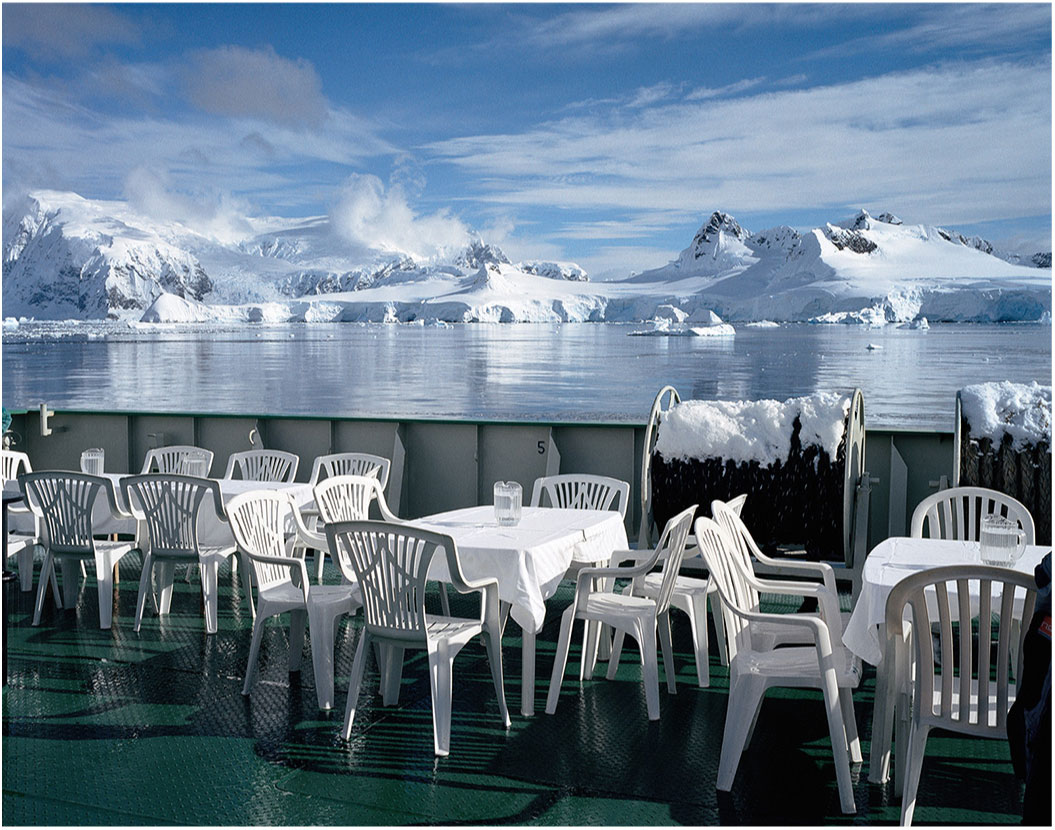
The logistics of Antarctic science is just one of the many aspects of our human engagement with Antarctica photographed by the New Zealander Anne Noble, who has visited the continent on multiple occasions in the noughties. She is one of the most important and incisive Antarctic artists. Spanning everything from science and flag planting to tourism and the representation of Antarctica in polar museums and visitor centres across the world, her work can be aesthetically spellbinding, but often conveys a gently ironic or mocking view on the origins and perpetuation of heroic narratives from a bygone era. Indeed, with individual subjects ranging from a picnic chair planted in the middle of a white nowhere; to white cloth covered tables on the deck of a cruise ship sailing along the Peninsula; to stuffed penguin displays; to inflatable globes where the valve is situated at the South Pole; to “Piss Poles”, yellow flags marking the spot where people should urinate in the Antarctic field; Noble patiently, methodically and beautifully demystifies Antarctica. Although she rarely includes people in her compositions, and almost never shows their faces, she confronts and unsettles viewers with humanity’s attempts to colonise, control and appropriate (Noble, Reference Noble2014). From cosmic observatory, to playground, to consumable, Noble’s Antarctica is unsettlingly made by humans (Fig. 2).
“Wilhelmina Bay”, Anne Noble, 2005.

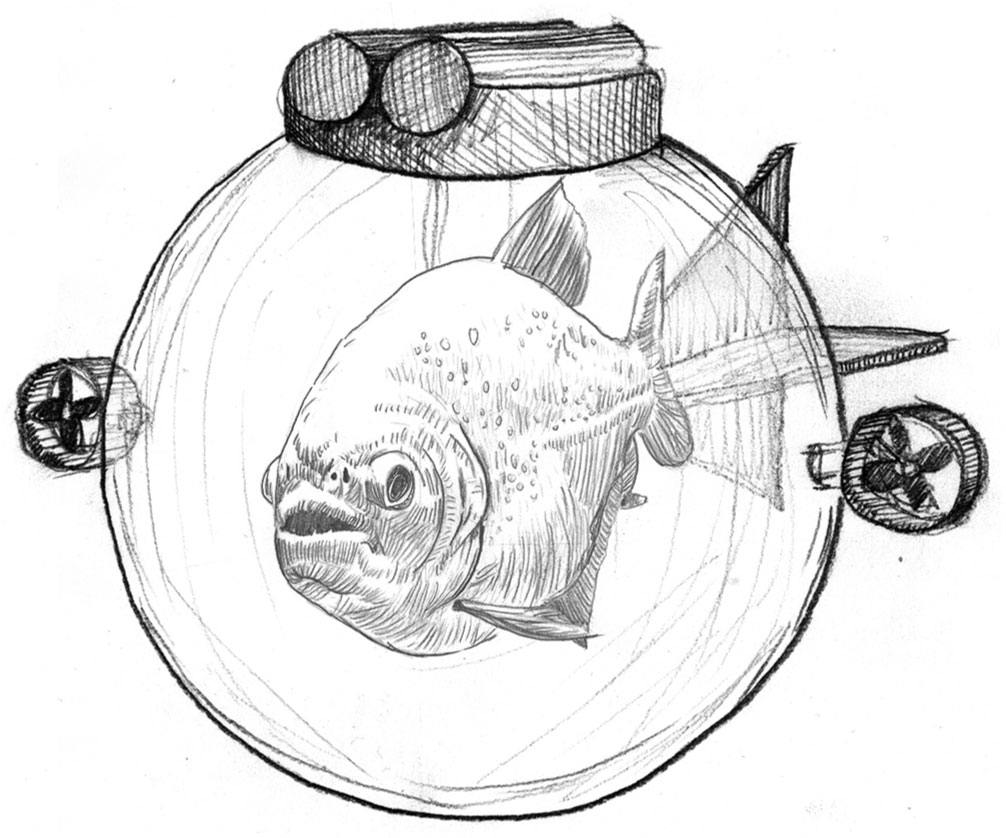
The final artist to consider is Julius von Bismarck, who participated in the privately sponsored 2017 Antarctic Biennale curated by Nadim Samman and the Russian artist Alexander Ponomarev (Ponomarev & Samman, Reference Ponomarev and Samman2017). Conceived as an expeditionary “cruise” down the Antarctic Peninsula, the Antarctic Biennale provided 20 artists and 12 intellectuals with the opportunity to engage in performances, workshops and debates about the Antarctic imaginary. Bismarck’s highly original contribution was a commentary on the contamination of Antarctica by alien species, human or otherwise. He brought with him a miniature remotely operated submarine comprising a hermetic glass bowl not dissimilar in appearance from those of full-scale research submarines. Except that this glass bowl was filled with heated freshwater and inhabited by a tropical freshwater fish. The submarine was lowered into the frigid Antarctic waters and the tropical fish “visited” a new world without ever coming into direct contact with it or risking contamination of the Antarctic environment. (Whilst the ship-operator demanded that the fish first be killed first so as to obey bio-security rules, there remains some ambiguity as to whether it actually was.)
Through this whimsical metaphor, Bismarck posed many overlapping questions about our human engagement of Antarctica. Given the claims made by the Environmental Protocol to protect “Antarctica and its associated ecosystems”, it might be desirable for humans to be placed in a glass bowl when venturing south of 60˚ South latitude (Fig. 3). Are we the alien species par excellence?
“Raumfisch”, Julius von Bismarck, 2017.

Conclusion
There is great value in artistically questioning human Antarctica. As the Antarctic Treaty turns 60 in 2019, it is especially important to encourage the continued development and diversity of Antarctic art by making room for practices that celebrate the ironies and paradoxes of our interactions with the continent.
Visual artists help us challenge complacency by awakening us to falsehoods and fabrications that might have otherwise gone undetected. Art brings, enriches and shifts Antarctic cultures beyond the scientific and the environmental, making this cold (but warming) and apparently distant region more relevant, disturbing and enthralling. Artists from other world regions and artistic traditions than those discussed here might well help us to challenge the idea of a singular “human occupation” of Antarctica. There are 53 signatory nations to the Treaty, and it is high time that the next decade of the ATS does embrace and empower a more diverse artistic engagement with the southern continent and ocean.
Also pressing is an artistic engagement with the impacts on Antarctica of human activities beyond it shores. In our era of anthropogenic climate change, Antarctica is now under assault (Sullivan, Reference Sullivan1961) as much from within as from without. The mere documentation of melting ice is not enough and often misleading. Artists need to find new ways of questioning the processes and impacts of warming polar waters, new and established alien species, and extractive opportunities that might one day go beyond fish and genetic materials.