1 Introduction
The following asymptotic formulas are said to be “equivalent” to the Prime Number Theorem (PNT):
 $$\begin{eqnarray}\displaystyle & \displaystyle \unicode[STIX]{x1D713}(x):=\mathop{\sum }_{p^{\unicode[STIX]{x1D6FC}}\leqslant x}\log p=x+o(x), & \displaystyle\end{eqnarray}$$
 $$\begin{eqnarray}\displaystyle & \displaystyle M(x):=\mathop{\sum }_{n\leqslant x}\unicode[STIX]{x1D707}(n)=o(x), & \displaystyle\end{eqnarray}$$
 $$\begin{eqnarray}\displaystyle & \displaystyle m(x):=\mathop{\sum }_{n\leqslant x}\unicode[STIX]{x1D707}(n)/n=o(1), & \displaystyle\end{eqnarray}$$
 $$\begin{eqnarray}\displaystyle & \displaystyle \int _{1}^{x}\frac{d\unicode[STIX]{x1D713}(t)}{t}=\mathop{\sum }_{n\leqslant x}\frac{\unicode[STIX]{x1D6EC}(n)}{n}=\log x-\unicode[STIX]{x1D6FE}+o(1), & \displaystyle\end{eqnarray}$$
all as
 $x\rightarrow \infty$
. Here
 $\unicode[STIX]{x1D707}$
is the Moebius function,
 $\unicode[STIX]{x1D6FE}$
Euler’s constant, and
 $\unicode[STIX]{x1D6EC}$
the von Mangoldt function. The sense of the (informal!) equivalence is that these statements can be derived quite simply from one another [Reference Bateman and Diamond2].
In this article we consider analogues of these formulas for Beurling generalized (g-) numbers. A Beurling g-prime system is an unbounded sequence of real numbers
 ${\mathcal{P}}=\{p_{i}\}$
satisfying
 $1<p_{1}\leqslant p_{2}\leqslant \cdots \,$
, and the multiplicative semigroup generated by
 ${\mathcal{P}}$
and 1 is called the associated collection
 ${\mathcal{N}}$
of g-integers (cf. [Reference Bateman, Diamond and LeVeque1, Reference Diamond and Zhang5, Reference Montgomery and Vaughan7]). Beurling number theory investigates how closely g-integers and g-primes imitate their classical counterparts. A concrete instance of this study is the Landau prime ideal theorem.
Each of the above formulas has a g-number interpretation, to be given below. Our question is, When do the Beurling versions of these relations imply others? Some of the implications between the assertions hold unconditionally, while others are valid only with further hypotheses. Because the relations all imply each other in the classical case, we expect the same under conditions that approximate the classical ones, for example, if the g-integer system has a positive density
 $A$
or that
 $N(x)-Ax$
is suitably small.
We are indebted to the referee for clarifying some points.
2 Implications between assertions
The Beurling forms of number theoretic functions here bear their usual names. Thus
 $\unicode[STIX]{x1D70B}(x)$
denotes the counting function of g-primes
 $p_{i}\leqslant x$
and
 $\unicode[STIX]{x1D6F1}(x)$
its prime and prime power counterpart. Similarly,
 $\unicode[STIX]{x1D713}(x)$
denotes the sum of
 $\log p_{i}$
over all numbers
 $p_{i}^{\unicode[STIX]{x1D6FC}}\leqslant x$
, and let
 $\unicode[STIX]{x1D713}_{1}(x):=\int _{1}^{x}\,d\unicode[STIX]{x1D713}(t)/t$
. Classically,
 $M(x)$
represents the sum function of the Moebius
 $\unicode[STIX]{x1D707}$
function, with
 $\unicode[STIX]{x1D707}$
being the (multiplicative) convolution inverse of the
 $1$
function. For a g-number system with integer counting function
 $N$
, we define the measure
 $dM$
as the convolution inverse of
 $dN$
; by familiar Mellin transform properties,
 $$\begin{eqnarray}\int _{1-}^{\infty }u^{-s}\,dM(u)=1/\unicode[STIX]{x1D701}(s)\quad \text{with}~\unicode[STIX]{x1D701}(s)=\int _{1-}^{\infty }u^{-s}\,dN(u),\end{eqnarray}$$
the generalized version of the Riemann zeta function. Also set
 $m(x):=\int _{1-}^{x}t^{-1}\,dM(t)$
. Note that these definitions make sense even when
 $dM$
is not discrete or when factorization into primes is not unique.
Consider the Beurling forms of (1.1)–(1.4). The psi relation (1.1) is equivalent to
 $\unicode[STIX]{x1D70B}(x)\sim \unicode[STIX]{x1D6F1}(x)\sim x/\text{log}\,x$
(the PNT for g-numbers), as shown by integration by parts, just as in the classical case. Also, (1.4), the “sharp Mertens relation”, takes the form
 $$\begin{eqnarray}\unicode[STIX]{x1D713}_{1}(x)=\log x+c_{1}+o(1),\quad x\rightarrow \infty .\end{eqnarray}$$
(Simple examples show that
 $c_{1}\neq -\unicode[STIX]{x1D6FE}$
in general.) And, finally, the Moebius relations are the expected
 $M(x)=o(x)$
and
 $m(x)=o(1)$
.
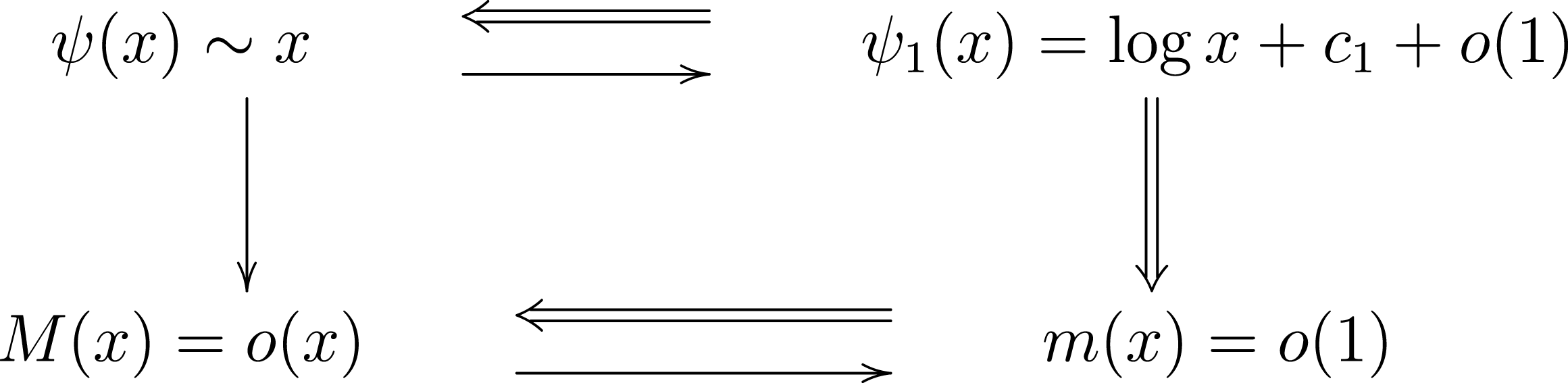
Figure 1 shows implications between our several asymptotic formulas. Double arrows indicate unconditional implications and single arrows implications subject to an additional condition. An absence of vertical arrows indicates that we are unable to prove implications without making hypotheses which themselves imply the assertions
 $\unicode[STIX]{x1D713}(x)\sim x$
and
 $\unicode[STIX]{x1D713}_{1}(x)=\log x+c_{1}+o(1)$
.
Implications between four formulas.

3 Sharp Mertens relation and the PNT
One relation between the sharp Mertens formula and the PNT is true unconditionally.
Proposition 3.1. If (2.1) holds, then so does the PNT.
Proof. By (2.1) and integration by parts
 $$\begin{eqnarray}\unicode[STIX]{x1D713}(x)=\int _{1}^{x}t\,d\unicode[STIX]{x1D713}_{1}(t)=x\unicode[STIX]{x1D713}_{1}(x)-\int _{1}^{x}\unicode[STIX]{x1D713}_{1}(t)\,dt\sim x.\square\end{eqnarray}$$
Next we show that (2.1) implies somewhat more than the PNT.
Proposition 3.2. Suppose that a sharp Mertens-type relation holds for a g-number system. Then
 $$\begin{eqnarray}\int _{1}^{x}\{\unicode[STIX]{x1D713}(t)-t\}\,t^{-2}\,dt\end{eqnarray}$$
converges to a finite limit as
 $x\rightarrow \infty$
.
Proof. Again apply integration by parts, this time to
 $\int \,d\unicode[STIX]{x1D713}(t)/t$
, and recall the preceding proposition. We find
 $$\begin{eqnarray}\unicode[STIX]{x1D713}_{1}(x)=\frac{\unicode[STIX]{x1D713}(x)}{x}+\int _{1}^{x}\frac{\unicode[STIX]{x1D713}(t)}{t^{2}}\,dt=1+o(1)+\log x+\int _{1}^{x}\{\unicode[STIX]{x1D713}(t)-t\}\,t^{-2}\,dt.\end{eqnarray}$$
Since
 $\unicode[STIX]{x1D713}_{1}(x)-\log x$
has a limit as
 $x\rightarrow \infty$
, so does the last integral.◻
A simple example in which the PNT holds but (2.1) fails can be created by adjoining to the rational primes enough additional g-primes to make
 $\unicode[STIX]{x1D713}(x)=x+\{1+o(1)\}x/\text{log}\,x$
.
Here is a condition under which the PNT does imply (2.1).
Theorem 3.1. Assume the PNT holds and that
 $$\begin{eqnarray}N(x)-Ax\ll x\log ^{-\unicode[STIX]{x1D6FE}}x\end{eqnarray}$$
with
 $\unicode[STIX]{x1D6FE}>1$
. Then (2.1) holds.
We can establish (2.1) using a slightly weaker integral hypothesis, but, as the following example from [Reference Diamond and Zhang4] shows, for estimates of the type (3.2),
 $\unicode[STIX]{x1D6FE}>1$
is optimal: take
 $$\begin{eqnarray}d\unicode[STIX]{x1D6F1}(u)=\frac{1-u^{-1}}{\log u}\,du+\biggl(\frac{1-u^{-1}}{\log u}\biggr)^{2}\,du,\end{eqnarray}$$
and define the associated “integer” counting function
 $N$
on
 $[1,\infty )$
by
 $$\begin{eqnarray}\int _{1-}^{\infty }u^{-s}\,dN(u)=\exp \biggl\{\int _{1}^{\infty }u^{-s}\,d\unicode[STIX]{x1D6F1}(u)\biggr\}.\end{eqnarray}$$
(Note that
 $\unicode[STIX]{x1D6F1}$
and
 $N$
are continuous functions on
 $(1,\infty )$
; Beurling g-number theory requires only that
 $\unicode[STIX]{x1D6F1}$
be non-decreasing.) We have
 $\unicode[STIX]{x1D713}(x)=x+(1+o(1))x/\text{log}\,ex$
, and by a small calculation,
 $N(x)=cx+O(x/\text{log}\,x)$
. Thus the PNT is valid and (3.2) holds with
 $\unicode[STIX]{x1D6FE}=1$
. On the other hand, with this function
 $\unicode[STIX]{x1D6F1}$
, the integral in Proposition 3.2 diverges as
 $x\rightarrow \infty$
, and so the sharp Mertens formula fails.
Proof. The key relation is
 $$\begin{eqnarray}\int _{1}^{x}\log \,t\,dN(t)=\int _{1}^{x}\,dN\ast d\unicode[STIX]{x1D713},\end{eqnarray}$$
the integral version for g-numbers of the Chebyshev elementary prime number identity. Here
 $\ast$
denotes multiplicative convolution. The right side of (3.3) equals
 $$\begin{eqnarray}\int \!\!\int _{1\leqslant st\leqslant x}\,dN(s)\,d\unicode[STIX]{x1D713}(t)=\int _{1}^{x}N(x/t)\,d\unicode[STIX]{x1D713}(t),\end{eqnarray}$$
and the left side, after integration by parts, is
 $$\begin{eqnarray}N(x)\log \,x-\int _{1}^{x}\frac{N(t)}{t}\,dt=Ax\log \,x-Ax+o(x).\end{eqnarray}$$
We approximate
 $N(u)$
by
 $Au$
and
 $\unicode[STIX]{x1D713}(u)$
by
 $u$
on the right side of (3.4), obtaining
 $$\begin{eqnarray}\int _{1}^{x}\frac{Ax}{t}\,d\unicode[STIX]{x1D713}(t)+I_{1}+I_{2},\end{eqnarray}$$
with
 $$\begin{eqnarray}\displaystyle & \displaystyle I_{1}:=\int _{1-}^{x}(dN-A\unicode[STIX]{x1D6FF}_{1}-A\,dt)\ast (\unicode[STIX]{x1D6FF}_{1}+dt), & \displaystyle \nonumber\\ \displaystyle & \displaystyle I_{2}:=\int _{1-}^{x}(dN-A\unicode[STIX]{x1D6FF}_{1}-A\,dt)\ast (d\unicode[STIX]{x1D713}-\unicode[STIX]{x1D6FF}_{1}-dt). & \displaystyle \nonumber\end{eqnarray}$$
Here
 $\unicode[STIX]{x1D6FF}_{1}$
is point mass at 1 and
 $dt$
Lebesgue measure on
 $(1,\infty )$
. An easy calculation employing condition (3.2) shows
 $$\begin{eqnarray}I_{1}=\int _{1-}^{x}\frac{x}{t}(dN-A\unicode[STIX]{x1D6FF}_{1}-A\,dt)=N(x)-Ax+cx+o(x)\end{eqnarray}$$
with
 $c=\int _{1}^{\infty }(N(t)-At)\,dt/t^{2}$
.
By Axer’s theorem [Reference Diamond and Zhang5, Theorem 7.2, Case (B)], [Reference Hardy6, Theorem 267], or [Reference Montgomery and Vaughan7, §8.1.1, Example 7], we have
 $I_{2}=o(x)$
. Combining (3.5) and (3.6) with the approximations of
 $I_{1}$
and
 $I_{2}$
, we get
 $$\begin{eqnarray}Ax\log \,x-Ax+o(x)=Ax\unicode[STIX]{x1D713}_{1}(x)+cx+o(x),\end{eqnarray}$$
which is equivalent to (2.1).◻
4 Implications between
 $M(x)=o(x)$
and
$m(x)=o(1)$


Proposition 4.1. Let
 ${\mathcal{N}}$
be a g-number system with
 $m(x)=o(1)$
. Then
 $M(x)=o(x)$
.
Proof. Integrate by parts:
 $$\begin{eqnarray}M(x)=\int _{1-}^{x}t\,dm(t)=xm(x)-\int _{1}^{x}m(t)\,dt=o(x).\square\end{eqnarray}$$
The converse implication is not unconditionally true.
Proposition 4.2.
 $M(x)=o(x)\not \Rightarrow m(x)=o(1)$
.
Proof. Take, as an example,
 $N_{r}(x)=\lfloor x\rfloor$
, the counting function of rational integers, and let
 $dN(t):=t^{-1}dN_{r}(t)$
. This is a g-number system with integer density 0 and convolution inverse function
 $$\begin{eqnarray}M(x)=\int _{1-}^{x}t^{-1}\,dM_{r}(t)=\mathop{\sum }_{n\leqslant x}\frac{1}{n}\,\unicode[STIX]{x1D707}(n),\end{eqnarray}$$
with
 $M_{r}$
the sum function of the Moebius function. By classical prime number theory, this
 $M(x)\rightarrow 0$
as
 $x\rightarrow \infty$
, and so (of course) it satisfies
 $M(x)=o(x)$
as
 $x\rightarrow \infty$
. But,
 $$\begin{eqnarray}m(x):=\int _{1-}^{x}t^{-1}\,dM(t)=\mathop{\sum }_{n\leqslant x}\frac{1}{n^{2}}\,\unicode[STIX]{x1D707}(n)=\frac{6}{\unicode[STIX]{x1D70B}^{2}}+o(1)\neq o(1).\square\end{eqnarray}$$
On the other hand, if
 $N(x)-Ax$
is small enough, then we can show
 $M(x)=o(x)\;\Longrightarrow \;m(x)=o(1)$
. Here we use a pointwise hypothesis, though again a slightly weaker integral condition would suffice.
Proposition 4.3. Suppose
 ${\mathcal{N}}$
is a g-number system for which
 $M(x)=o(x)$
and (3.2) holds for some
 $A>0$
and
 $\unicode[STIX]{x1D6FE}>1$
. Then
 $m(x)=o(1)$
.
Proof. For
 $x\geqslant 1$
, write
 $$\begin{eqnarray}x\,m(x)=\int _{1-}^{x}\frac{x}{t}\,dM(t)=A^{-1}+\int _{1-}^{x}\{\unicode[STIX]{x1D6FF}_{1}+dt-A^{-1}dN\}\ast dM.\end{eqnarray}$$
Evaluate the last integral using Axer’s theorem again, finding that it is
 $o(x)$
, and thus
 $m(x)=o(1)$
.◻
5 Connections of the PNT with
$M(x)=o(x)$

Does the PNT by itself imply that
 $M(x)=o(x)$
holds? Although this assertion might be true, we cannot prove it. However, we can do so if we add some weak additional condition on
 $N$
. One example of such a condition is the logarithmic density assumption [Reference Diamond and Zhang4, Proposition 14.10]
 $$\begin{eqnarray}\int _{1^{-}}^{x}t^{-1}\,dN(t)\sim A\log x.\end{eqnarray}$$
A theorem with another mild sufficient condition [Reference DeBruyne, Diamond and Vindas3, Theorem 2.1], that is not comparable with (5.1), is the following.
Theorem 5.1. Let
 ${\mathcal{N}}$
be a g-number system for which the PNT holds and
 $N(x)\ll x$
. Then
 $M(x)=o(x)$
.
The key to our argument is the following relation, which approximates
 $M(x)/x$
by the negative of an average of itself.
Lemma 5.1. Under the hypotheses of the theorem,
 $$\begin{eqnarray}\frac{M(x)}{x}=\frac{-1}{\log x}\int _{1}^{x}\frac{M(t)}{t^{2}}\,dt+o(1).\end{eqnarray}$$
Proof of the lemma.
A variant of Chebyshev’s identity (3.3) reads
 $$\begin{eqnarray}LdM=-dM\ast d\unicode[STIX]{x1D713},\end{eqnarray}$$
where
 $L$
is the operator of multiplication by
 $\log t$
and
 $\ast$
is multiplicative convolution. This formula can be established using familiar properties of the Mellin transform:
 $$\begin{eqnarray}\displaystyle \int _{1-}^{\infty }u^{-s}\log u\,dM(u) & = & \displaystyle \biggl\{\frac{-1}{\unicode[STIX]{x1D701}(s)}\biggr\}^{\prime }=\frac{\unicode[STIX]{x1D701}^{\prime }(s)}{\unicode[STIX]{x1D701}(s)}\cdot \frac{1}{\unicode[STIX]{x1D701}(s)}\nonumber\\ \displaystyle & = & \displaystyle -\int _{1-}^{\infty }u^{-s}\,d\unicode[STIX]{x1D713}(u)\cdot \int _{1-}^{\infty }u^{-s}\,dM(u)\nonumber\\ \displaystyle & = & \displaystyle -\int _{1-}^{\infty }u^{-s}(d\unicode[STIX]{x1D713}\ast dM)(u).\nonumber\end{eqnarray}$$
Now
 $$\begin{eqnarray}\int _{1-}^{x}L\,dM=\int _{1-}^{x}dM\ast (\unicode[STIX]{x1D6FF}_{1}+dt-d\unicode[STIX]{x1D713})-\int _{1-}^{x}dM\ast (\unicode[STIX]{x1D6FF}_{1}+dt),\end{eqnarray}$$
and, integrating by parts the left side of the last formula, we get
 $$\begin{eqnarray}M(x)\log x-\int _{1}^{x}M(t)\,dt/t=M(x)\log x+O(x),\end{eqnarray}$$
since
 $|dM|\leqslant dN$
, and hence
 $|M(t)|\leqslant N(t)\ll t$
.
Let
 $J=J(x)$
denote the first term on the right side of (5.3). If we evaluate the convolution integrals and use the PNT, we find
 $$\begin{eqnarray}J=\int _{1-}^{x}\{x/t-\unicode[STIX]{x1D713}(x/t)\}\,dM(t)=\int _{1-}^{x}o(x/t)\,dN(t).\end{eqnarray}$$
Given
 $\unicode[STIX]{x1D716}>0$
, we have
 $|o(x/t)|<\unicode[STIX]{x1D716}x/t$
for all
 $t<x/B$
, for some
 $B>0$
. Also,
 $|o(x/t)|<Kx/t$
for some
 $K>0$
and
 $x/B<t\leqslant x$
. Thus
 $$\begin{eqnarray}|J|<\unicode[STIX]{x1D716}x\int _{1-}^{x/B}\,dN(t)/t+Kx\int _{x/B}^{x}\,dN(t)/t\ll x(\unicode[STIX]{x1D716}\log x+1)\end{eqnarray}$$
by integration by parts, and so
 $J=o(x\log x)$
.
Also, the last term of (5.3) is, upon integrating again by parts,
 $$\begin{eqnarray}\int _{1-}^{x}\frac{x}{t}\,dM(t)=M(x)+x\int _{1}^{x}\frac{M(t)}{t^{2}}\,dt.\end{eqnarray}$$
Finally, we combine the bounds for the terms of (5.3), divide through by
 $x\log x$
, and note that
 $M(x)\ll x$
to obtain (5.2).◻
Corollary 5.1. Under the hypotheses of the theorem and the condition
 $y<x\ll y$
we have
 $$\begin{eqnarray}\frac{M(x)}{x}=\frac{M(y)}{y}+o(1).\end{eqnarray}$$
Proof. Applying the lemma with
 $x$
and with
 $y$
, we find
 $$\begin{eqnarray}\displaystyle \frac{M(x)}{x}-\frac{M(y)}{y} & = & \displaystyle \frac{1}{\log y}\int _{1}^{y}\frac{M(t)}{t^{2}}\,dt-\frac{1}{\log x}\int _{1}^{x}\frac{M(t)}{t^{2}}\,dt+o(1)\nonumber\\ \displaystyle & = & \displaystyle \biggl(\frac{1}{\log y}-\frac{1}{\log x}\biggr)\int _{1}^{y}\frac{O(t)}{t^{2}}\,dt-\frac{1}{\log x}\int _{y}^{x}\frac{O(t)}{t^{2}}\,dt+o(1)\nonumber\\ \displaystyle & = & \displaystyle O\biggl(\frac{\log x-\log y}{\log x}\biggr)+o(1)=o(1).\square\nonumber\end{eqnarray}$$
Proof of Theorem 5.1.
First, suppose there is some number
 $K$
such that
 $M(x)$
is of one sign for all
 $x\geqslant K$
. By (5.2), as
 $x\rightarrow \infty$
,
 $$\begin{eqnarray}\frac{M(x)}{x}=\frac{-1}{\log x}\,\int _{1}^{K}\frac{O(t)}{t^{2}}\,dt-\frac{1}{\log x}\int _{K}^{x}\frac{M(t)}{t^{2}}\,dt+o(1).\end{eqnarray}$$
Thus we have
 $$\begin{eqnarray}\frac{M(x)}{x}+\frac{1}{\log x}\int _{K}^{x}\frac{M(t)}{t^{2}}\,dt=\frac{O(1)}{\log x}+o(1)=o(1).\end{eqnarray}$$
Since
 $M(x)$
and the integral are of the same sign,
 $M(x)/x\rightarrow 0$
as
 $x\rightarrow \infty$
, and this case is done.
Next, suppose that
 $M$
, a right-continuous function, changes sign at a point
 $x$
. We show that
 $M(x)/x=o(1)$
. If
 $M(x)/x=0$
, the claim holds. If
 $M(x)>0$
, then there is a number
 $y\in (x-1,x)$
with
 $M(y)\leqslant 0$
. By (5.4),
 $M(x)/x-M(y)/y=o(1)$
, and since
 $M(x)/x>0\geqslant M(y)/y$
, each is
 $o(1)$
. Similar results hold if
 $M(x)<0$
.
Finally, suppose that
 $M(t)$
has infinitely many sign changes, one of which is at
 $t=y$
(so that
 $M(y)/y=o(1)$
) and that
 $x>y$
. If
 $x\leqslant 2y$
, then
 $M(x)/x=o(1)$
by (5.4) (regardless of the sign of
 $M(t)$
on
 $(y,x]$
). If
 $M(t)$
is of one sign on
 $(y,x]$
and
 $x>2y$
, then (5.2) gives
 $$\begin{eqnarray}\frac{M(x)}{x}=\frac{-\log y}{\log x}\,\frac{1}{\log y}\int _{1}^{y}\frac{M(t)}{t^{2}}\,dt-\frac{1}{\log x}\int _{y}^{x}\frac{M(t)}{t^{2}}\,dt+o(1)\end{eqnarray}$$
or
 $$\begin{eqnarray}\frac{M(x)}{x}+\frac{1}{\log x}\int _{y}^{x}\frac{M(t)}{t^{2}}\,dt=\frac{\log y}{\log x}\,\frac{M(y)}{y}+o(1)=o(1)\end{eqnarray}$$
as
 $y\rightarrow \infty$
. Since
 $M(x)/x$
and the integral are of the same sign, here too
 $M(x)/x=o(1)$
.◻
A converse statement, deducing the PNT from
 $M(x)=o(x)$
, would require a much stronger condition than
 $N(x)=O(x)$
. Indeed, an example in [Reference Diamond and Zhang5, Proposition 14.12] has
 $M(x)=o(x)$
and
 $N(x)=Ax+O(x\log ^{-3/2}x)$
but no PNT. A fortiori (see Figure 1),
 $N(x)=O(x)$
and
 $M(x)=o(x)$
do not imply
 $\unicode[STIX]{x1D713}_{1}(x)=\log x+c_{1}+o(1)$
.
6 Sharp Mertens relation and
$m(x)=o(1)$

Theorem 6.1. Suppose
 ${\mathcal{N}}$
is a g-number system for which

holds. Then
 $m(x)=o(1)$
.
For our argument, it is useful to have a logarithmic density condition of the type (5.1).
Lemma 6.1. If
 ${\mathcal{N}}$
satisfies (2.1), then, for some positive constant
 $A$
,
 $$\begin{eqnarray}N_{1}(x):=\int _{1-}^{x}\frac{dN(t)}{t}\sim A\log x.\end{eqnarray}$$
Proof. Let
 $\unicode[STIX]{x1D701}(s)$
denote the zeta function associated with
 ${\mathcal{N}}$
. Using the Hardy–Littlewood–Karamata tauberian theorem [Reference Diamond and Zhang5, Thoerem 5.4], [Reference Montgomery and Vaughan7, Theorem 5.11], it suffices to show that
 $(s-1)\unicode[STIX]{x1D701}(s)\rightarrow A$
for some
 $A>0$
as
 $s\rightarrow 1+.$
Equivalently, we shall prove
 $$\begin{eqnarray}Z(s):=\log \{\unicode[STIX]{x1D701}(s)(s-1)/s\}=\log A+o(1).\end{eqnarray}$$
We shall assume that
 $\unicode[STIX]{x1D713}_{1}(x)=0$
for
 $x$
near 1, for the initial values of
 $\unicode[STIX]{x1D713}_{1}$
will not affect the asymptotic behavior of
 $N_{1}$
(except the value of
 $A$
). Now
 $Z(s)$
has the Mellin formula
 $$\begin{eqnarray}\displaystyle Z(s) & = & \displaystyle \int _{1}^{\infty }x^{-s}\biggl\{d\unicode[STIX]{x1D6F1}(x)-\frac{(1-x^{-1})\,dx}{\log x}\biggr\}\nonumber\\ \displaystyle & = & \displaystyle \int _{1}^{\infty }\frac{x^{-(s-1)}}{\log x}\biggl\{\frac{d\unicode[STIX]{x1D713}(x)}{x}-\frac{(1-x^{-1})\,dx}{x}\biggr\}.\nonumber\end{eqnarray}$$
Integrate by parts, noting that
 $$\begin{eqnarray}\unicode[STIX]{x1D713}_{2}(x):=\unicode[STIX]{x1D713}_{1}(x)-\log x+1-x^{-1}=\left\{\begin{array}{@{}ll@{}}O\big((x-1)^{2}\big),\quad & x\rightarrow 1+,\\ c_{1}+1+o(1),\quad & x\rightarrow \infty .\end{array}\right.\end{eqnarray}$$
We find
 $$\begin{eqnarray}Z(s)=\int _{1}^{\infty }\unicode[STIX]{x1D713}_{2}(x)\frac{x^{-s}}{\log x}\biggl(s-1+\frac{1}{\log x}\biggr)\,dx.\end{eqnarray}$$
Since
 $\unicode[STIX]{x1D713}_{2}(x)\ll (1-x^{-1})^{2}\ll 1-x^{-1}$
on
 $(1,\,\infty )$
, part of the last integral is of order
 $$\begin{eqnarray}(s-1)\int _{1}^{\infty }(1-x^{-1})\,\frac{x^{-s}\,dx}{\log x}=(s-1)\log \frac{s}{s-1}\rightarrow 0\quad \text{as}~s\rightarrow 1+.\end{eqnarray}$$
The remaining part yields
 $$\begin{eqnarray}Z(1+)=\int _{1}^{\infty }\unicode[STIX]{x1D713}_{2}(x)\frac{dx}{x\log ^{2}x}=:\log A,\end{eqnarray}$$
Proof of Theorem 6.1.
Using Mellin transforms, as we did in the proof of Lemma 5.1, we find
 $$\begin{eqnarray}L\,dm=-dm\ast d\unicode[STIX]{x1D713}_{1}.\end{eqnarray}$$
Integration and use of the above formula for
 $\unicode[STIX]{x1D713}_{1}$
yield
 $$\begin{eqnarray}\displaystyle \int _{1}^{x}\log t\,dm(t) & = & \displaystyle -\int _{1}^{x}\unicode[STIX]{x1D713}_{1}(x/t)\,dm(t)\nonumber\\ \displaystyle & = & \displaystyle -\int _{1}^{x}\{\log (x/t)\,+\,c_{1}\,+\,f(x/t)\}\,dm(t)\nonumber\end{eqnarray}$$
with
 $f(x/t)\rightarrow 0$
as
 $x/t\rightarrow \infty$
. If we cancel
 $\int _{1}^{x}\log t\,dm(t)$
and use the bound
 $|dm(t)|\leqslant dN(t)/t$
, we find
 $$\begin{eqnarray}m(x)\log x=-c_{1}m(x)+\int _{1}^{x}f(x/t)\,dN(t)/t.\end{eqnarray}$$
For large
 $B$
, write
 $$\begin{eqnarray}I(x):=\int _{1}^{x}f(x/t)\,dN(t)/t=\int _{1}^{x/B}o(1)\,dN(t)/t+\int _{x/B}^{x}O(1)\,dN(t)/t.\end{eqnarray}$$
By the last lemma,
 $I(x)=o(\log x)$
and so
 $$\begin{eqnarray}m(x)\log x=-c_{1}m(x)+o(\log x).\end{eqnarray}$$
Finally, we have
 $$\begin{eqnarray}m(x)=\frac{o(\log x)}{\log x+c_{1}}=o(1).\square\end{eqnarray}$$
The last theorem does not have a converse.
Proposition 6.1.
 $m(x)=o(1)$
and density
 $\not \Rightarrow \unicode[STIX]{x1D713}_{1}(x)=\log x+c_{1}+o(1).$
Proof. Again, it suffices to show that
 $m(x)=o(1)$
and density
 $\not \Rightarrow \unicode[STIX]{x1D713}(x)\sim x$
. Our construction is based on Example 13.8 from [Reference Diamond and Zhang5]: to reduce calculation, we this time define a “wobbly” g-number system
 ${\mathcal{N}}$
by setting
 $$\begin{eqnarray}\unicode[STIX]{x1D6F1}(x):=\int _{1}^{x}\frac{1-\cos (\log t)}{\log t}\,dt.\end{eqnarray}$$
The PNT does not hold, since, by a small calculation,
 $$\begin{eqnarray}\unicode[STIX]{x1D6F1}(x)/\operatorname{li}(x)=1-\sin (\log x+\unicode[STIX]{x1D70B}/4)/\sqrt{2}+o(1),\quad x\rightarrow \infty .\end{eqnarray}$$
Also, by [Reference Diamond and Zhang5, Lemma 13.10], the integer-counting function satisfies
 $$\begin{eqnarray}N(x)=x+\frac{c_{0}x\cos (\log x)}{\log ^{3/2}x}+O\biggl(\frac{x}{\log ^{5/2}x}\biggr),\end{eqnarray}$$
and so this g-integer system has density.
In the rest of the argument we show that
 $m(x)=o(1)$
as
 $x\rightarrow \infty$
. From the proof of the aforementioned lemma,
 $$\begin{eqnarray}\unicode[STIX]{x1D701}_{{\mathcal{N}}}(s)=\unicode[STIX]{x1D701}(s)=\frac{\sqrt{(s-1)^{2}+1}}{s-1},\end{eqnarray}$$
with the branch of the square root taken that is positive for
 $s$
real and exceeding 1. Now for
 $\Re s>1$
,
 $$\begin{eqnarray}1/\unicode[STIX]{x1D701}(s+1)=\int _{1-}^{\infty }u^{-s-1}\,dM(u)=\int _{1-}^{\infty }u^{-s}\,dm(u),\end{eqnarray}$$
and by the Mellin inversion formula, for any real number
 $b>0$
,
 $$\begin{eqnarray}\frac{1}{2}\{m(x+)+m(x-)\}=\lim _{T\rightarrow \infty }\frac{1}{2\unicode[STIX]{x1D70B}\text{i}}\int _{b-\text{i}T}^{b+\text{i}T}\frac{x^{s}\,ds}{s\unicode[STIX]{x1D701}(s+1)}.\end{eqnarray}$$
Thus
 $$\begin{eqnarray}m(x)=\lim _{T\rightarrow \infty }\frac{1}{2\unicode[STIX]{x1D70B}\text{i}}\int _{b-\text{i}T}^{b+\text{i}T}\frac{x^{s}\,ds}{\sqrt{s^{2}+1}}+O(1/x).\end{eqnarray}$$
The integrand of the last integral has singularities at
 $\pm \text{i}$
. We deform the contour to the vertical line
 $\{s:\Re s=-1/2\}$
, with loops taken about
 $\pm \text{i}$
to avoid crossing the rays
 $(-\infty -\text{i},-\text{i})$
and
 $(-\infty +\text{i},\text{i})$
.
Our first assertion is that the contribution of the integral along the vertical line is of order
 $x^{-1/2}$
. We see this by writing it as
 $$\begin{eqnarray}\int _{-1/2-\text{i}\infty }^{-1/2+\text{i}\infty }\frac{x^{s}}{s}\,ds+\int _{-1/2-\text{i}\infty }^{-1/2+\text{i}\infty }x^{s}\biggl\{\frac{1}{\sqrt{s^{2}+1}}-\frac{1}{s}\biggr\}\,ds,\end{eqnarray}$$
with the understanding that the last integral is broken at the points
 $-1/2\pm \text{i}$
(again, to avoid crossing the rays through
 $\pm \text{i}$
). The first integral is 0 by a residue calculation, and the second one has order
 $$\begin{eqnarray}\int _{0}^{\infty }x^{-1/2}(t+1)^{-3}\,dt\ll x^{-1/2}.\end{eqnarray}$$
We next calculate the loop integral
 $I_{\text{i}}$
about
 $\text{i}$
. In the disc of radius
 $1/2$
about
 $\text{i}$
, we have
 $$\begin{eqnarray}\frac{1}{\sqrt{s^{2}+1}}=\frac{1}{\sqrt{s-\text{i}}}\,\frac{1}{\sqrt{s+\text{i}}}=\frac{1}{\sqrt{s-\text{i}}}\,\frac{1}{\sqrt{2\text{i}}}\{1+O(|s-\text{i}|)\}.\end{eqnarray}$$
The bottom of the loop is the line segment
 $s=i+r\text{e}^{-\unicode[STIX]{x1D70B}\text{i}}$
with
 $r$
going from
 $1/2$
to (a small number)
 $\unicode[STIX]{x1D716}$
, then a circle about
 $\text{i}$
of radius
 $\unicode[STIX]{x1D716}$
, and finally a line segment
 $s=i+r\text{e}^{\unicode[STIX]{x1D70B}\text{i}}$
along the top segment with
 $r$
going from
 $\unicode[STIX]{x1D716}$
to
 $1/2$
. The integrand has order
 $\unicode[STIX]{x1D716}^{-1/2}$
on the small circle and the arc length is
 $2\unicode[STIX]{x1D70B}\unicode[STIX]{x1D716}$
, so this portion of the integral goes to 0 with
 $\unicode[STIX]{x1D716}$
. Combining the contributions of the horizontal line segments, we find
 $$\begin{eqnarray}\displaystyle I_{\text{i}} & = & \displaystyle \frac{x^{\text{i}}}{\unicode[STIX]{x1D70B}\sqrt{2\text{i}}}\int _{0}^{1/2}\text{e}^{-r\log x}\{r^{1/2}+O(r^{3/2})\}\,\frac{dr}{r}\nonumber\\ \displaystyle & \ll & \displaystyle \int _{0}^{\infty }\text{e}^{-r\log x}r^{1/2}\,\frac{dr}{r}\ll \frac{1}{\sqrt{\log x}}.\nonumber\end{eqnarray}$$
A similar bound holds for the loop integral about
 $-\text{i}$
. Thus
 $m(x)=o(1)$
, so this g-number system has the desired properties.◻