Introduction
Elderly residents in long-term care (LTC) facilities are at increased risk of delirium because they often present with conditions such as dementia that predispose them for this syndrome. Prevalence rates of delirium in LTC settings range from 22% to 70% (Culp et al., Reference Culp1997; Voyer et al., Reference Voyer, Richard, Doucet and Carmichael2009). Unlike dementia, a chronic cognitive impairment that evolves steadily over a period of years, delirium is an acute and often reversible disorder impacting attention, consciousness level, and cognition (American Psychiatric Association, 2000). Because delirium is associated with considerable negative outcomes, including increased functional decline, morbidity, and mortality (Fick et al., Reference Fick, Agostini and Inouye2002), every effort needs to be made to prevent this disorder.
Delirium is often preceded by subtle changes in behavior and cognition. The period of early symptoms or changes in functioning, which precedes the full-blown syndrome, is called the prodromal phase of delirium. Identification of observable clinical changes, indicative of imminent delirium, could lead to early implementation of interventions designed to prevent a full-blown episode. Preventive interventions have been shown to result in a significant reduction (about a third) in the incidence of delirium and/or in its reduced severity and duration (Inouye et al., Reference Inouye1999; Marcantonio et al., Reference Marcantonio, Flacker, Wright and Resnick2001).
Previous studies on prodrome in delirium, including descriptions of symptoms, signs, and patterns have been conducted in acute care settings (Levkoff et al., Reference Levkoff1994; Matsushima et al., Reference Matsushima, Nakajima, Moriya, Matsuura, Motomiya and Kojima1997; Duppils and Wikblad, Reference Duppils and Wikblad2004; de Jonghe et al., Reference de Jonghe2007). These results cannot be generalized to residents in LTC facilities. The aim of the present study is to identify clinical changes observable in the 2 weeks before the onset of full-blown delirium among LTC residents.
Methods
Design, study settings, and selection of participants
This nested case-control study looks at data collected as part of the Delirium Study in Long-term Care Settings, a prospective, observational study conducted at 7 LTC facilities in Montreal and Quebec City, Canada (McCusker et al., Reference McCusker2011). The sites varied in size (111 – 415 LTC beds), funding (private or government), daily hours of care (most had a minimum of 3 hours), and background of nursing staff from one third to 100% were registered nurses (RNs). In those sites that employ nurses with less training than RNs, these auxiliary nurses work with RNs in a care team in which they may assist with various nursing tasks (e.g., distribution of medicines, blood samples, skin care, and measurement of vital signs). In addition to nursing staff, nurses’ aides assist residents with activities of daily living and emotional support. Admission to these residences is managed by a central committee that evaluates requests with respect to medical diagnoses, severity of dependency, and extent of the healthcare need.
All residents aged 65 years and over, admitted to LTC (not respite care) and able to communicate in English or French were eligible for the study. There were two reasons only for exclusion: bedside nurse (the nurse providing the most direct care to the resident) or research assistant's (RA) workload. Residents whose bedside nurse already had two other residents recruited for the study, were excluded. Where the RA's workload was heavy, a random number table was used to select a manageable number of residents to enroll.
Research assistants (RAs) involved in the project received in-class and bedside coaching on how to administer all the materials (tools, chart review). For each study site, an RA prepared weekly lists of all eligible residents. In an attempt to recruit residents who were representative of their institution, both newly admitted and longer-term residents were recruited consecutively from residents’ lists. Different recruitment procedures were used depending on each resident's competence to give consent (based on the clinical impression of the primary nurse: the nurse who provides the most direct care to the resident). The RA then invited the competent residents to take part in the study. For incompetent residents, a letter notified the legal guardian or a family member designated as surrogate about the study. They then informed the nurse of their willingness to meet with the RA who described the study and requested their signed consent. The study protocol was approved by both the Research Ethics Board of McGill University and of those sites with their own review committee.
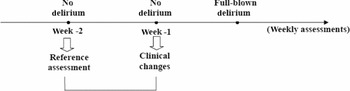
In the present study, cases comprised all new incident cases of delirium as measured by the Confusion Assessment Method (CAM) (Inouye et al., Reference Inouye, van Dyck, Alessi, Balkin, Siegal and Horwitz1990) and for which there had been a period of at least the 2 previous weeks without delirium (Figure 1). Thus, residents with prevalent delirium were not excluded so long as they had recovered and had been delirium-free for at least 2 weeks before the onset of the incident episode. Each case was matched to a control that was free of delirium at the same study time and also for the 2 previous weeks.
Cases selection over the 6-month follow-up period and definition of clinical changes. Cases were all new incidents of delirium with a period of at least 2 prior weeks without delirium. A total of 13 indicators of clinical change were developed by comparing the results of the assessment conducted 2 weeks before the development of delirium (the reference) to those obtained at the assessment conducted 1 week later.

Data collection and measures
Residents had on-going weekly assessments for up to 24 weeks or until their death, withdrawal or transfer to another facility. At baseline, the RA conducted an assessment of the resident that included an evaluation of the severity of cognitive impairment using the Mini-Mental State Exam (MMSE) (Folstein et al., Reference Folstein, Folstein and McHugh1975) and the Hierarchic Dementia Scale (HDS) (Cole and Dastoor, Reference Cole and Dastoor1987), their level of functional autonomy using the Barthel Index (Mahoney and Barthel, Reference Mahoney and Barthel1965), and of the presence of delirium and its symptoms using the CAM. The CAM and a shortened version of the MMSE (five items) were repeated weekly for 6 months.
Instruments
The presence of delirium and its symptoms were measured with the CAM, an established and widely used instrument to assist in the detection of delirium (Inouye et al., Reference Inouye, van Dyck, Alessi, Balkin, Siegal and Horwitz1990; Wei et al., Reference Wei, Fearing, Sternberg and Inouye2008). The CAM assesses the nine symptom domains for delirium specified in the revised third edition of the Diagnostic and Statistical Manual of Mental Disorders (similar to DSM-IV criteria): (1) acute onset and fluctuation; (2) inattention; (3) disorganized thinking; (4) altered level of consciousness; (5) disorientation; (6) memory impairment; (7) perceptual disturbances; (8) psychomotor agitation or retardation; and (9) altered sleep-wake cycle. The presence of criteria 1 and 2 and the presence of either criterion 3 or 4 defines definite delirium. For a diagnosis of probable, the first criterion changes to acute onset or fluctuation of symptoms over the course of the day and the remainder of the algorithm stays the same. In the present study, we reasoned that residents meeting the criteria for definite or probable delirium had delirium. The RA completed the CAM based on observations of the resident during a structured interview that included the administration of an MMSE (full at baseline and partial at weekly follow-up) as well as a chart review to identify acute onset and sleep-wake disturbance over the previous 7 days (chart review of the previous 4 weeks for assessment of acute onset at baseline assessment). A nurse-administered CAM, validated against a consensus diagnosis, has a sensitivity of 89% and specificity of 100% (Zou et al., Reference Zou, Cole, Primeau, McCusker, Bellavance and Laplante1998). Similar to procedures used in our previous studies of delirium, we trained the research staff to recognize the symptoms of delirium by clinical demonstrations, trial rating of cases and discussion of findings until there was satisfactory agreement between the research staff and the clinical investigator. Before data collection began and during the course of the study, samples of residents were assessed simultaneously and independently by each of the research staff and the clinical investigator. κ values and sensitivity and specificity were calculated for each of the CAM-defined core symptoms of delirium (fluctuation, inattention, disorganized thinking, and altered level of consciousness). κ values ranged from 0.41 to 0.74, similar to κ values reported in previous studies (Levkoff et al., Reference Levkoff1992; Cole et al., Reference Cole, McCusker, Dendukuri and Han2002). Sensitivity of research staff assessments of symptoms ranged from 75% to 100%, as compared to the clinical investigator; specificity ranged from 75% to 91%.
The MMSE (Folstein et al., Reference Folstein, Folstein and McHugh1975), a widely-used instrument with established reliability and validity (Tombaugh and McIntyre, Reference Tombaugh and McIntyre1992), was rated by the RA. The MMSE score ranges from 0–30, with a lower score indicating greater cognitive impairment. It has been validated in LTC facilities (Kafonek et al., Reference Kafonek, Ettinger, Roca, Kittner, Taylor and German1989). Severity of cognitive impairment was assessed by the HDS (Cole and Dastoor, Reference Cole and Dastoor1987), a scale that can be used among individuals with mild or severe cognitive impairment (Boller et al., Reference Boller, Verny, Hugonot-Diener and Saxton2002) and has been validated in LTC residents (Ronnberg and Ericsson, Reference Ronnberg and Ericsson1994). The HDS comprises 20 subscales, each rated from 0 to 10, based on the resident's highest level of performance on the subscale. Total HDS scores range from 0–200, and were grouped into four categories of cognitive impairment severity: severe (<40), moderate (40–99), mild (100–159), and none/minimal (160–200).
The bedside nurse rated activities of daily living (ADL) according to Barthel Index (BI) (Mahoney and Barthel, Reference Mahoney and Barthel1965). We requested the nurse rate the resident's current status and also asked whether at any time during the past week the resident had been more or less independent in each ADL. We used the modified scoring suggested by Shah (Shah et al., Reference Shah, Vanclay and Cooper1989): total weighted score ranges from 0 (complete dependence) to 100 (complete independence). The internal consistency reliability was 0.90 to 0.93 (Shah et al., Reference Shah, Vanclay and Cooper1989) and inter-rater reliability (Pearson's r) was 0.99.
Data extracted from resident charts at the end of the study included demographic information (age, gender, and years since admission), diagnosis of dementia, and other medical diagnoses. Information on medical problems was used to compute the Charlson Comorbidity Index (Charlson et al., Reference Charlson, Pompei, Ales and MacKenzie1987), validated as a predictive index for survival in two elderly nursing home cohorts (Bravo et al., Reference Bravo, Dubois, Hebert, De Wals and Messier2002; Buntinx et al., Reference Buntinx, Niclaes, Suetens, Jans, Mertens and Van den Akker2002).
Study design
We conducted a nested case-control study (Breslow and Day, Reference Breslow and Day1980) with the full cohort of residents followed from week 0 to a maximum period of 24 weeks (weekly measure). A case was defined as a resident observed to have incident delirium (CAM positive) at time t and no delirium in the two preceding weeks; the time t is then termed index time.
Incidence density sampling (Lubin and Gail, Reference Lubin and Gail1984; Richardson, Reference Richardson2004) was used to match cases to controls from the full cohort study, according to the following algorithm: resident is delirium-free at time t and in the two preceding weeks; resident has never been a case before time t; resident belongs to the same facility as the case; resident belongs to the same cognitive impairment group as the case, such groups being defined by the HDS levels (0–39; 40–99; 100–159; 160–200). The risk set at time t (Breslow and Day, Reference Breslow and Day1980) is the set of all cases and matched controls at time t. The full risk set is used to study the relationship of several exposure variables to the case/control status.
Exposure variables
For each case and matched control set, thirteen (binary) indicators of clinical change were constructed at index time t, by comparing the results of the assessments conducted at t minus 2 weeks to those at t minus 1 week. Clinical changes were defined as either: (1) the onset of new delirium symptoms measured with the CAM; or (2) a worsening of cognitive function, measured with five MMSE items (see Table 2). New-onset psychomotor agitation was defined as either a change from no agitation to agitation (t minus 2 vs. t minus 1) or a change from retardation to agitation. Conversely, new-onset psychomotor retardation was defined as either a change from no retardation to retardation or a change from agitation to retardation. Lastly, a measure of the number of changes in symptoms and cognition present for a given resident was computed.
Statistical analysis
Percentages were calculated to describe resident characteristics and all exposure variables for cases and controls. Since our risk sets have different ratios of controls per case, each observation in a risk set was weighted by 1/(number of cases) for cases and 1/(number of controls) for controls. To study the relationship between case/control status and other variables (resident characteristics and clinical changes in exposure variables), conditional logistic regression (Breslow and Day, Reference Breslow and Day1980) was used. To handle ties for cases in a risk set, the exact method was applied (Breslow and Day, Reference Breslow and Day1980). Univariate models were fitted for all the analyses. Multivariate models adjusting for patient characteristics (age, comorbidity, level of functional autonomy, and the presence of a diagnosis of dementia in the medical chart) were fitted for each clinical change variable when the p-value of the unadjusted model was less than 0.10. Odds ratio and 95% confidence intervals were calculated from the regression coefficients. Although the study was initiated without detailed sample size calculations, a posteriori power calculations based on a Type I error of 0.05, 85 cases and a ratio control/case of 7, show that the power to detect an odds ratio of 1.5, 1.75, 2.00, and 2.4 is 25%, 42%, 60%, and 80%, respectively. All analyses were carried out using SAS for Windows, version 9.2.
Results
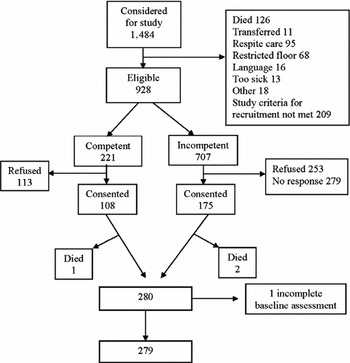
Of the 1,484 residents considered for inclusion in the study, 928 (62.6%) were eligible for enrollment (Figure 2). Consent was obtained for 283 residents: 108 (49%) of the 221 competent residents and 175 (25%) of the 707 incompetent residents. Of those who consented, 4 did not complete the baseline assessment, leaving a total of 279 residents remaining for this study. Twenty-eight residents (10%) died during follow-up and 15 (5%) withdrew from the study before 24 weeks elapsed. Analyses comparing participants with eligible subjects who did not participate, showed no significant difference in gender and age. The prevalence of delirium at baseline was 11% (32/279). Among residents without delirium at baseline and alive during follow-up (n = 246), 82 (33%) had at least one episode of incident delirium during follow-up.
Flow chart.

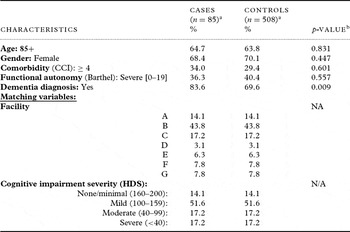
A total of 101 cases had one CAM positive assessment preceded by two delirium-free weeks. Overall, 508 controls were matched with 85 cases. Some cases were matched in the same risk set because of case ties (same index time, HDS-group and facility); 64 risk sets were used for the analysis. Sixteen risk sets had more than one case. The median number of controls per case was 7 (range 1–20). Characteristics of cases and controls, weighted by number of observations in the risk set, are presented in Table 1. The majority of residents (cases and controls) were aged 85 years and older; female and about a third of them had severe comorbidity and functional impairment. There were no differences in age, gender, level of comorbidity, and functional autonomy between cases and controls. A diagnosis of dementia in the medical chart was more prevalent in cases than in controls.
Resident characteristics by study group

Note: CCI: Charlson Comorbidity Index; HDS: Hierarchic Dementia Scale.
a Weighted unequal risk set size (see statistical analysis section).
b Computed from conditional logistic regression models.
N/A: Not applicable.
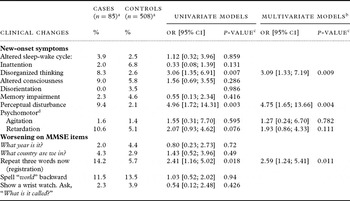
Table 2 shows the results of univariate and multivariate conditional logistic regression. Among all new-onset delirium symptoms considered in the study, two, perceptual disturbances (OR = 4.75; 95% CI: 1.65–13.66) and disorganized thinking (OR = 3.09; CI 1.33–7.19), were significantly more frequently observed in residents who subsequently developed delirium than in those who did not. The percentages of cases with these new-onset disorganized thinking and perceptual disturbances were 8.3% and 9.4%, respectively. As for the indicators related to a worsening of cognitive function, a worsening on the MMSE score for the item evaluating registration (ability to immediately repeat three words) was significantly associated with the development of delirium (OR = 2.59; 95% CI 1.24–5.41). The percentage of cases with such worsening was 14.2%.
Univariate and multivariate conditional logistic regression models of clinical changes and delirium

OR: Odds ratio; CI: Confidence interval; MMSE: Mini-Mental State Examination.
a Weighted unequal risk set size (see statistical analysis section).
b The odds ratios are adjusted for age, diagnosis of dementia, comorbidity (Charlson Comorbidity Index) and level of functional autonomy (Barthel).
c Computed from conditional logistic regression models.
d The reference group consisted of residents (cases or controls) with no psychomotor agitation or retardation at t minus 1 week.
Missing values for new-onset symptoms were less than 4% and ranged from 8.1% to 18.8% for the MMSE items.
Table 3 shows the number of clinical changes (new onset delirium symptoms and/or worsening of MMSE items) among residents who later became delirious and among those who did not. Residents with three or more clinical changes were more likely to develop delirium than those with no clinical change (OR = 2.52; 95% CI 1.08–5.87). The frequency of three or more changes was 8.3%.
Number of clinical changes (new-onset delirium symptoms and worsening of MMSE items) among cases and controls

OR: Odds ratio; CI: Confidence interval.
a Weighted unequal risk set size (see statistical analysis section for details).
b The odds ratios are adjusted for age, diagnosis of dementia, comorbidity (Charlson Comorbidity Index) and level of functional autonomy (Barthel).
c Computed from conditional logistic regression models.
Discussion
As far as we are aware, this study is the first to investigate clinical changes during the prodromal phase of delirium among LTC residents. The rationale underlying the search for indicators of imminent delirium is based on the following assumption: knowledge about clinical changes, such as these, may help in identifying LTC residents in need of intervention to prevent full-blown delirium, thereby prompting staff to increase monitoring of these residents and, perhaps, to request medical attention to search out any possible underlying causes such as infection, adverse drug reactions, or metabolic problems.
In the present study, we found that residents who developed delirium were more likely to have new-onset perceptual disturbances and disorganized thinking in the 2 weeks before the onset of delirium than were those residents who did not develop delirium. We also observed a worsening on the MMSE item measuring registration more frequently among the residents who developed delirium. Although these results suggest that some specific clinical changes among LTC residents predict the onset of full-blown delirium, the percentages of cases with such clinical changes were low. For instance, only 9% of the cases that developed delirium had new-onset perceptual disturbances.
Another finding of this study was the association between the presence of three or more different clinical changes and the development of delirium. However, only 8% of the residents who developed delirium displayed three or more clinical changes compared to 5% for the controls, which begs the question of the clinical value of such monitoring. In addition, it is important to realize that the RAs who conducted the assessments of clinical changes in this study had received extensive training. The introduction of a new tool based on clinical indicators of imminent delirium would imply proper training of the caring staff. The time and resources required would, therefore, need to offer sufficient value in return.
Although other studies investigating prodrome in delirium were conducted in acute care settings and, therefore, cannot be compared to the results obtained in the present study; their results are noteworthy. Duppils and colleagues (Duppils and Wikblad, Reference Duppils and Wikblad2004) investigated behavioral changes before the onset of delirium among elderly patients undergoing hip surgery (N = 103). They found that disorientation, urgent calls for attention, and increased psychomotor activity were more frequent among elderly patients who eventually developed a delirium compared to those who remained delirium-free. In a smaller longitudinal study (Matsushima et al., Reference Matsushima, Nakajima, Moriya, Matsuura, Motomiya and Kojima1997) of patients admitted to a coronary care unit (N = 20), significant differences were observed for anxiety, increased body activity, and sleep disturbance between a group of patients who developed delirium and a control group. Lastly, de Jonghe et al. (de Jonghe et al., Reference de Jonghe2007) investigated prodromal delirium symptoms in elderly patients undergoing hip surgery (65 cases and 35 controls) where they found that memory impairment, incoherence, and disorientation were observed more frequently in patients who developed a delirium compared to patients who did not.
In all the studies we have mentioned, the measurements of symptoms/behaviors were gauged daily from a few hours to 4 days prior to the development of delirium. In the present study, measures were gauged in the 2 weeks immediately before the episode of delirium. Interestingly, in the study by de Jonghe et al. (Reference de Jonghe2007), although significant differences in delirium symptoms were observed between patients with delirium and their controls 1 to 3 days prior to the development of delirium, no such differences were observed 4 days prior to the episode of delirium. In addition, de Jonghe et al. (Reference de Jonghe2007) found a significant increase in delirium symptoms closer to the delirium onset. Daily measurements of new-onset symptoms/changes in the days preceding the delirium might have brought about different results in the present study, but this was not feasible. However, from a clinical perspective, the effectiveness of using clinical signs present just 1 or 2 days before the delirium episode may be questionable, since it may already be too late at this interval to implement interventions to prevent the full-blown episode. Future studies are required to answer this question.
A potential limitation of this study relates to the difference observed between cases and controls regarding the presence of a diagnosis of dementia in the medical chart. The proportion of residents having dementia was higher among cases than in controls. Because, controls were matched for severity of cognitive impairment, the difference is unlikely to have had an impact on the results observed. It should also be noted that the association observed in univariate analysis remained unchanged in multivariate analysis when adjusted for the presence of a diagnosis of dementia.
The study has the following strengths: delirium and its symptoms were measured prospectively on a weekly basis using a well-known delirium instrument. The RAs involved in this study received extensive training on the use of the instruments. Controls were matched for several variables including severity of cognitive impairment to lessen the probability that the differences observed between cases and controls could be attributed to these factors.
This study has no immediate implications for clinical practice. It is important we emphasize that monitoring warning signs of delirium implies an extra task for nurses. Therefore, given the already heavy workload of nurses in LCT settings, any new tool introduced to monitor warning signs for delirium would need to have a relatively good sensitivity for delirium to justify its use. Example: while perceptual disturbance would be a relatively easy sign for nurses to detect, it offers poor sensitivity for delirium. In other words, 90% of the time when residents developed delirium, they had not shown perceptual disturbances.
It is important to mention however, that these low percentages of cases with such clinical changes may be related to methodological issues. New-onset delirium symptoms were based on a single weekly 10-minute structured interview and not on an entire shift. Higher prevalence might have resulted from assessment of delirium symptoms based on a longer observation period. For this reason, it is important at this juncture to not downplay the significance of new-onset symptoms. Daily measurement of delirium symptoms over a longer observation period should be included in future study on prodrome in delirium among LTC residents. Even so, it should also be kept in mind that the 10-minute weekly assessment conducted by the RA is representative of the type of assessment a registered nurse could do in LTC settings, given the high residents-nurse ratios in those settings. Observations of residents over a longer period would require input from additional caring staff such as licensed practical nurses or nurse aides.
In conclusion, knowledge about the prodrome in delirium among LTC residents is still at an early stage. This study has shown that, in the 2 weeks before the development of the delirium episode, LTC residents who developed delirium were more likely to present with new-onset perceptual disturbances, disorganized thinking, and inability to register objects. However, the incidence rates of these new onset symptoms were too low to justify a clinical recommendation at this point. Future studies using daily assessment of symptoms of delirium over longer periods of observation are necessary to further investigate the potential of using these clinical changes as warning indicators that delirium is imminent.
Conflict of interest
None.
Description of authors’ roles
Philippe Voyer contributed to the study design, helped with obtained funding, assisted in recruitment of the participating facilities, helped with supervising data collection, planned the analysis for this paper, outlined the manuscript and revised it, and approved the final draft.
Jane McCusker designed the study, obtained funding, supervised data collection and analysis, provided feedback on the manuscript, and approved the final draft.
Martin Cole contributed to the study design, helped with obtained funding, helped with supervising data collection and analysis, provided feedback on the manuscript, and approved the final draft.
Eric Belzile supervised the data management, conducted the statistical analysis, provided feedback on the manuscript, and approved the final draft.
Antonio Ciampi contributed to the study design, helped with obtained funding, was responsible for the statistical analysis, provided feedback on the manuscript, and approved the final draft.
Nathalie Champoux contributed to the study design, helped with obtained funding, was responsible for the statistical analysis, provided feedback on the manuscript, and approved the final draft.
Johanne Monette contributed to the study design, helped with obtained funding, was responsible for the statistical analysis, provided feedback on the manuscript, and approved the final draft.
Sylvie Richard wrote the first draft and made several revisions to prepare the final drafts of the manuscript.
Acknowledgments
This work was supported by the Canadian Institutes of Health Research (IAO69519), Canadian Institute of Aging and Institute of Gender and Health (CRG-82953), and the Alzheimer Society of Canada and the Canadian Nurses Foundation (07–91).