

Introduction
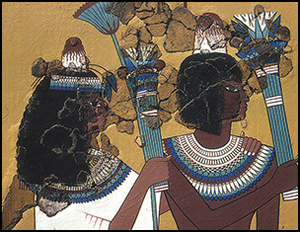
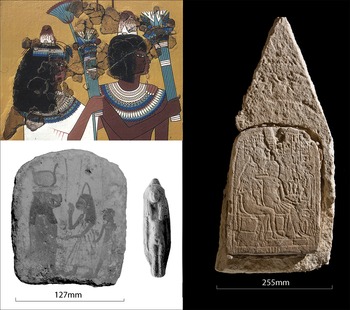
For around 1500 years, from the early New Kingdom to the Ptolemaic period (c. 1549–30 BC), some visual representations of ancient Egyptians show individuals wearing a striking cone-shaped item on their heads (Figure 1; Padgham Reference Padgham2012). The cones, which are usually white or sometimes coloured or decoratively marked (Maraite Reference Maraite, Ombsomer and Oosthoek1991), are particularly prevalent in elite tomb imagery, but also appear in scenes on stelae, papyri, coffins and other media. They are often depicted as being worn by guests, both female and male, in banqueting scenes, including those honouring the dead, or by male tomb owners as they participate in funerary rituals, or are rewarded by the king (Padgham Reference Padgham2012). Other contexts in which individuals can be shown wearing cones include while worshipping divinities, in scenes of fishing and hunting in the afterlife, when playing music, and in scenes connected with childbirth (Müller Reference Müller, Helck and Otto1984).
Depictions of ancient Egyptian head cones, all from Amarna: Top left) two figures wear cones in a partially reconstructed wall painting from a private chapel at the Workmen's Village (reconstruction by F. Weatherhead); right) funerary stela from the South Tombs Cemetery, showing a seated man and woman wearing head cones (object 39938); bottom left) stela showing a female with a head cone worshipping the goddess Taweret, and a female figurine found nearby, also with a head cone (Egypt Exploration Society Lucy Gura Archive Amarna Negatives 21/521 and 21/528; © Egypt Exploration Society).
The nature and role of the cones have long been debated. The most enduring interpretation is that the cone is a lump of perfumed unguent that, as it melted, scented and cleansed the hair and body. This interpretation has arisen partly from depictions of anointing rituals using oils and perfumes, sometimes in scenes that also show cones being worn (Padgham Reference Padgham2012: 14, 97–98; Harrington Reference Harrington, Draycott and Stamatopoulou2016: 137–40, fig. 5), and partly from observations of how some modern African groups apply animal fat to their hair (e.g. Keimer Reference Keimer1953: 329–72). A few scenes show apparent unguent cones on stands or in bowls, including during production, or the process of being placed on the head (Padgham Reference Padgham2012: 14). Fat or wax is usually suggested as the base material of the cones, and myrrh as a probable perfume (e.g. Jones Reference Jones1989: 49–52; Manniche Reference Manniche1999: 85); cartonnage (plastered layers of textile or papyrus), wickerwork, shaved hair and wood have all been suggested as alternative constituents (Padgham Reference Padgham2012: 11).
Unguents were generally thought to purify the ancient Egyptian wearer, placing them in an elevated state of being when in the company of a divinity, or after death as the ‘justified deceased’ (Manniche Reference Manniche1999; Harrington Reference Harrington, Draycott and Stamatopoulou2016: 136–40). Scholars often link the cones specifically with sensuality, sexuality and related notions, as they are frequently associated in imagery with women, sometimes unclothed. The cones also appear in banquet scenes and other contexts that invoked divinities, such as the fertility goddess Hathor. In tomb scenes, they are often read as sensual motifs associated with the rebirth of the tomb owner, who is usually male (e.g. Cherpion Reference Cherpion1994; Manniche Reference Manniche and Tefnin1997). They have also been interpreted more broadly as symbols of the tomb owner's contentedness—his status as a justified spirit—in the afterlife (Bruyère Reference Bruyère1926: 69–72). Padgham (Reference Padgham2012) suggests the cones sometimes represent the ‘bA’ after it had received divine offerings. The ba formed a person's vital power and was especially important after death, when it could move from the grave and interact with the living. Padgham (Reference Padgham2012: 83) proposes that when shown on living individuals, the cone indicates the ‘active’ state of their ba, which allowed them to interact more effectively with divine figures.
In the absence of any convincing examples of head cones from archaeological contexts, scholars have questioned whether the cones were ever produced as three-dimensional objects, or were instead entirely symbolic of anointing or beautification rituals or of more abstract ideas (e.g. Bruyère Reference Bruyère1926: 69–72; Cherpion Reference Cherpion1994; Manniche Reference Manniche1999: 96; Meskell Reference Meskell2002: 153; Padgham Reference Padgham2012). Recent fieldwork at Amarna, the location of the late second-millennium BC city of Akhetaten, however, has now identified two cones from non-elite graves. Diffuse reflectance infrared Fourier transform spectroscopy (DRIFTS) indicates that their primary component is most probably a biological wax. These finds confirm that head cones existed in a three-dimensional form and provide two important examples of their real-life use.
Akhetaten and its cemeteries
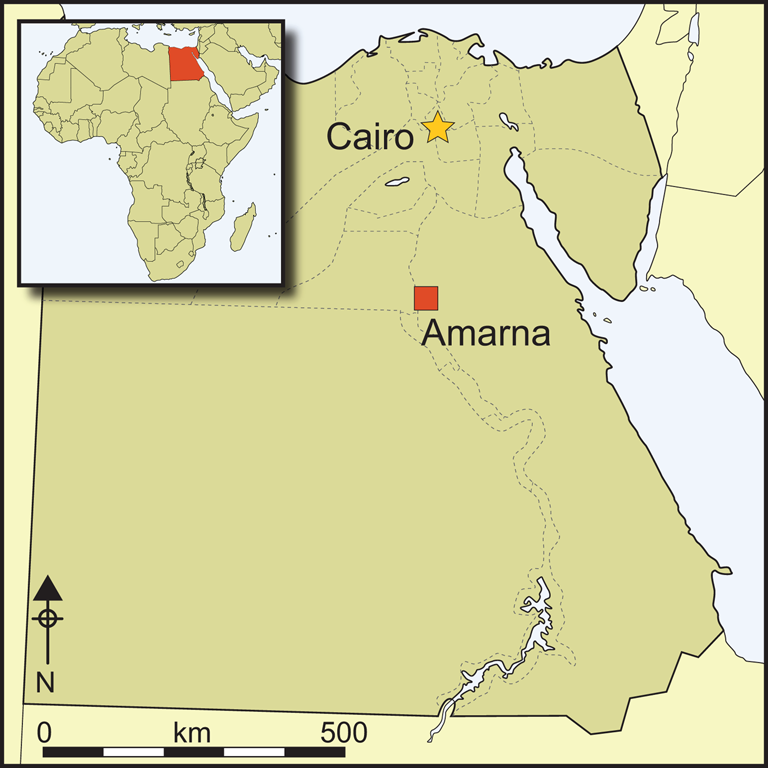
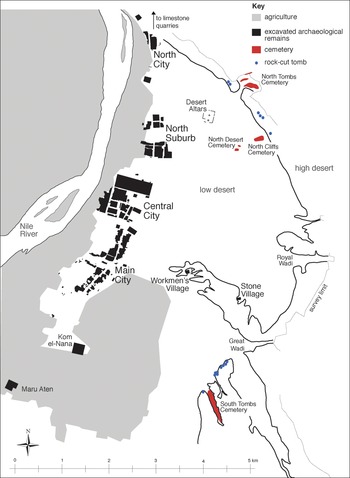
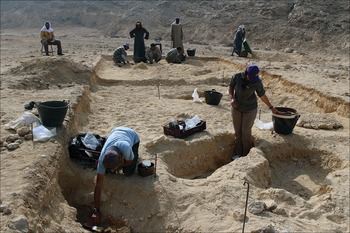
Akhetaten was created by the ‘monotheistic’ pharaoh Akhenaten as the cult home for the sun god Aten and was occupied briefly between c. 1347 and 1332 BC (Kemp Reference Kemp2012). It was an unusual city due to the absence of temples and official celebrations for gods other than the Aten. Its non-elite cemeteries have been the focus of archaeological investigation since 2005, with around 700 graves excavated across four burial grounds (Figures 2–3; Kemp et al. Reference Kemp, Stevens, Dabbs, Zabecki and Rose2013; Dabbs et al. Reference Dabbs, Rose, Zabecki, Ikram, Kaiser and Walker2015; Stevens Reference Stevens2018). Although widespread looting has affected all four cemeteries, they still hold remarkable research potential for the study of the non-elite in ancient Egypt. One outcome of the fieldwork, for example, has been to provide further evidence for mortuary belief and practice at Akhetaten beyond the decoration of the rock-cut tombs of the city's officials. In the latter, the dead seem to no longer join Osiris and the gods of the underworld, but instead remain in the world of the living, awakening each dawn as a ba to worship and be nourished by the sun god. The study of the small number of surviving coffins and stelae from the non-elite cemeteries suggests the accommodation of a wider range of responses to death here, which drew upon both the solar cult and older Osirid elements (Kemp et al. Reference Kemp, Stevens, Dabbs, Zabecki and Rose2013: 76; Bettum Reference Bettum2015).
Map of Amarna showing the non-elite cemeteries in red (map by B. Kemp, incorporating survey data by H. Fenwick).
Excavations at the North Tombs Cemetery in 2017 (image courtesy of the Amarna Project).
Representations of head cones at Akhetaten
The head cone featured in the artistic vocabulary at Akhetaten, appearing in images of varying formality and purpose (for examples, see Figure 1). Its relative scarcity in elite tomb scenes is probably due to the reduced range of tomb iconography at Akhetaten (Padgham Reference Padgham2012: 94), which is dominated by scenes of the royal family and temples for the Aten. When the cone appears in these tombs, it is usually worn by the male tomb owner as he is rewarded by Akhenaten—an occasion when he is sometimes depicted praising the Aten. Rare tomb scenes showing cone-wearing individuals participating in mortuary offering rites and burial preparation also occur (Padgham Reference Padgham2012: 94).
Two funerary stelae recovered from the non-elite cemeteries depict individuals wearing cones (Figure 1; Kemp et al. Reference Kemp, Stevens, Dabbs, Zabecki and Rose2013: fig. 6, objects 39426 & 39938). Head cones are also shown on a range of media excavated across Akhetaten's settlement areas, including stelae, figurines, jewellery and wall paintings (Figure 1; Peet & Woolley Reference Peet and Woolley1923: 96–97, 104, pl. XXVIII.1–3; Demarée Reference Demarée1983: 164, pl. XIX.C7; der Manuelian Reference der Manuelian, Freed, Markowitz and D'Auria1999: 256, no. 175; Stevens Reference Stevens2006: 87; Weatherhead & Kemp Reference Weatherhead and Kemp2006: 240–43, 262–65, 409–10, fig. 3.33a–c, pl. 3.4; Graves-Brown Reference Graves-Brown, Dodson, Johnston and Monkhouse2014).
The people wearing cones in images from Amarna perform a wide and familiar range of actions: they serve at, and probably participate in, banquets; they play music; they are the subject of mortuary rites, including the reception of offerings; they receive royal rewards; and they engage with divinities (e.g. Isis, Shed, Taweret and the Aten).
The excavated cones
Cone 1 (object 39920)
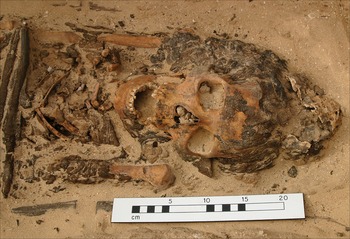
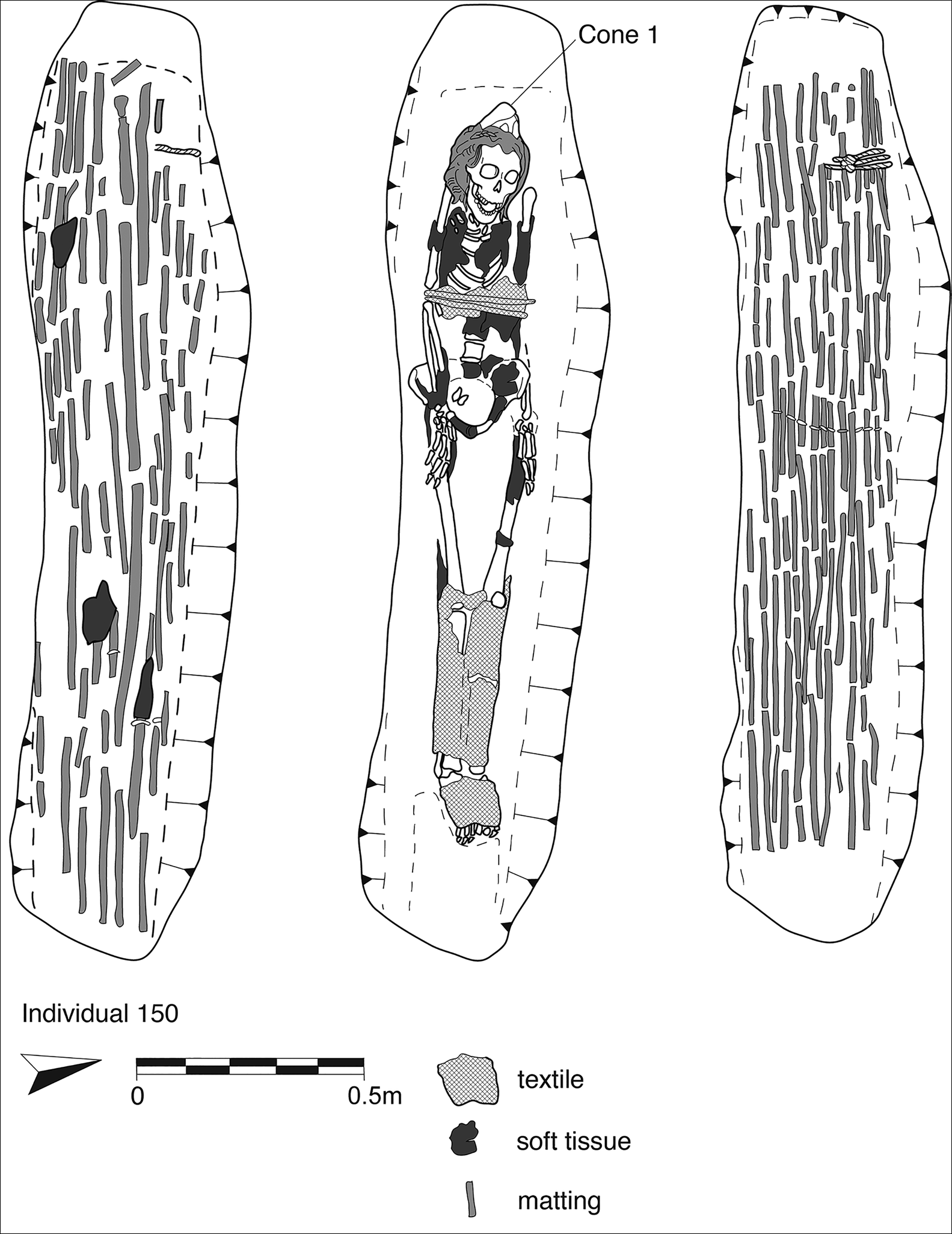
The first of the Amarna cones was excavated at the South Tombs Cemetery in 2010 from the grave of an individual who was estimated to be a 20–29-year-old female (individual 150) (Figures 2, 4–6, 8; Shepperson Reference Shepperson2010: 9; Dabbs et al. Reference Dabbs, Rose, Zabecki, Ikram, Kaiser and Walker2015: 46). Age and sex estimations are based on cranial and pelvic morphology (Dabbs et al. Reference Dabbs, Rose, Zabecki, Ikram, Kaiser and Walker2015: 46). The grave had not been robbed and the cone was found in situ, placed on top of the head over the well-preserved hair. Although not completely preserved, the cone survived in six main pieces, representing the full height of one side and part of the base. The overall shape seems to be that of a low dome, originally measuring approximately 80mm high × 100mm wide.
Cone 1 in situ on the head of individual 150 (image courtesy of the Amarna Project).
Sequence plan of the excavation of individual 150, with cone 1 in situ (illustration by M. Shepperson).
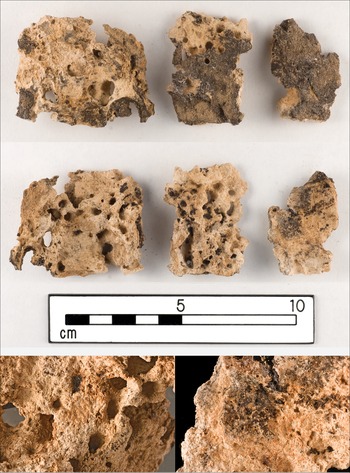
The cone material is cream-coloured with occasional dark patches, particularly on the exterior. It is brittle with a distinctive ‘silky’ feel. It does not form a solid mass, surviving as a shell with walls that are now of irregular thickness between approximately 2.5–17mm. Some of this irregularity is due to insect tunnelling, which has perforated the interior, forming voids. Occasional criss-cross marks on the inner surface are suggestive of textile impressions, and a few additional brown patches may represent the degraded textile itself (Figure 6)—possibly the remains of an inner textile core or lining, which provided an attractive target for insects.
The largest pieces of cone 1 showing the outer (above) and inner faces; the close-ups below are of the inner surface, with probable textile impressions/remains visible in the right-hand image. The scale bar relates only to the images above it (image courtesy of the Amarna Project).
Cone 2 (object 42037)
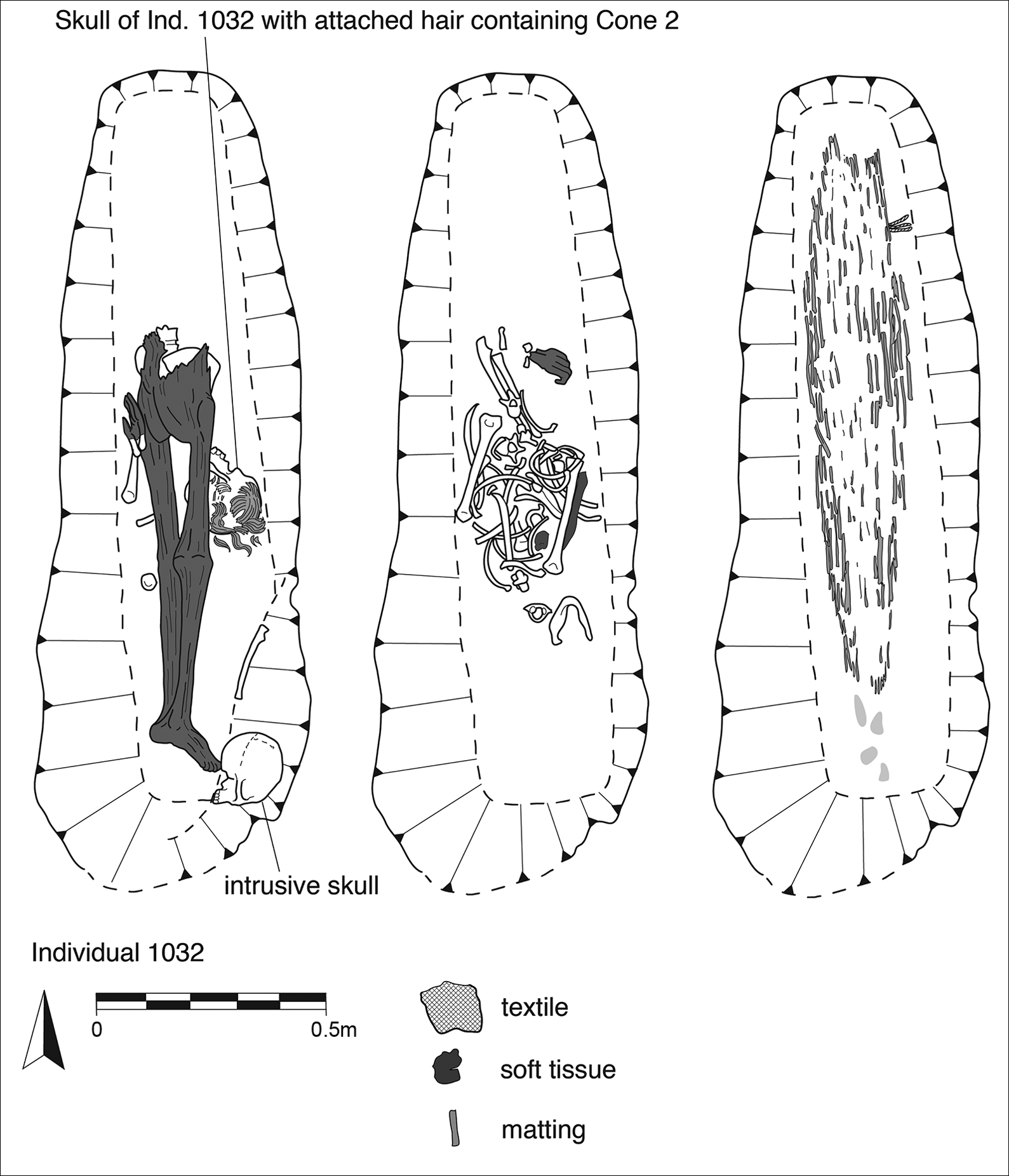
The second cone was found in 2015 at the North Tombs Cemetery (Figure 2), within the grave of a 15–20-year-old (individual 1032; Figure 7). Robbing activities had disturbed the burial, disarticulating the body and leaving the skull and much of the torso jumbled in the bottom of the grave. The articulated legs and pelvis were still in their original positions. Beneath the skull was a mass of hair, within which cone 2 was found. The sex of individual 1032 could not be estimated due to soft tissue obscuring the sexually dimorphic features of the cranium and pelvis. Metric analysis is not possible, as skeletal growth was not complete at the time of death.
Sequence plan of the excavation of individual 1032 (illustration by M. Shepperson).
Cone 2 survives as one large and two smaller non-joining pieces. Visually, the material is very similar to cone 1, also exhibiting black surface patches and many insect voids. Other areas bear dark brown surface stains. The fragments seem to be warped, no longer retaining the cone's original shape. It is, however, possible to envisage the fragments originating from a hollow cone similar to cone 1. Figure 8 shows the similarity in scale of the two cones.
The largest pieces of cones 1 and 2, with the joining pieces from the top and side of cone 1 placed in their probable original positions, viewed front-on (image courtesy of the Amarna Project).
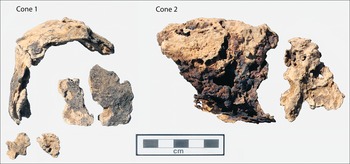
The largest piece of cone 2 survives as a waxy material folded around brown-black layers of organic matter. Overall, this fragment is 80mm long, 68mm wide and 27–38mm thick, thinning away from the fold. The waxy substance itself also thins away from the fold from approximately 18–2mm. It is not clear from which part of the cone this large fragment originates, although when the fold is placed at the top—as shown in Figure 8—the lower edge is fairly uniform, as though it was perhaps placed against the head. The layered organic matter enveloped in the wax appears to comprise hardened body fluids and soft tissue. Its origin is difficult to establish, but perhaps when the robbers removed the skull, a piece of hairless soft tissue became associated with the large fragment of the cone, which gradually subsided around it. The folded nature of this fragment means that none of the interior surface is visible. This surface is, however exposed on the second largest piece, where no obvious textile impressions or organic remains are present. The third and smallest fragment comprises a small fold, again enclosing dark, organic matter.
Analysing the material
Methods
DRIFTS and X-ray fluorescence spectroscopy (XRF) are two methods of portable, non-destructive analysis that were used on site at Amarna to identify the primary constituents of the cones. The interior and exterior surfaces of both cones were analysed, along with the hair of individual 150 to determine whether there was any transfer of cone materials to the hair, such as might be expected if the cone material was intended to scent or condition it.
DRIFTS analysis was performed using an Agilent 4100 Exoscan FTIR portable spectrometer (Agilent Technologies, Santa Clara, CA, USA) with a ZnSe beam splitter, a DTGS detector and a diffuse reflectance sampling interface. Sample spectra were obtained in absorption mode using a diffuse reflectance device, over a wavelength interval from 650cm−1–4000cm−1 at 300 scans per sample and a resolution of 2cm−1. Spectral processing was performed using Omnic 8.3 software (Thermo Fisher Scientific Inc, Waltham, MA, USA).
XRF spectra were collected using a Bruker Tracer III-SD handheld energy dispersive X-ray spectrometer (Bruker Elemental, Kennewick, WA, USA). The excitation source was a Rhodium (Rh) target X-ray tube, operated at 40kV and 14mA current and real-time collection of 120 s. X-ray signals were detected using Peltier cooled XFlash silicon drift detector (SDD) with a resolution of 146.4eV. Spectral interpretation was performed using Bruker Artax Control Software 7.4.0.0.
Results
Spectra taken from the interior of both cones showed peaks characteristic of plant or animal wax, including strong C-H stretching at 2955, 2924 and 2852cm−1, C=O stretching at 1746cm−1, δ CH2 at 1472cm−1, ν(C-O) at 1176 and 1107cm−1 and ρ(CH2) at 721cm−1 (Figure 9: top) (Kühn Reference Kühn1960; Regert et al. Reference Regert, Colinart, Degrand and Decavallas2001; Poli et al. Reference Poli, Chiantore, Nervo and Piccirillo2011; Arrizabalanga et al. Reference Arrizabalanga, Gómez-Laserna, Aramendia, Arana and Madariaga2014). Additional peaks indicative of calcium-fatty acid complexes—typical decay products formed from wax ester hydrolysis—are seen in the spectrum of cone 1 (Salvadó et al. Reference Salvadó, Butí, Nicholson, Emerich, Labrador and Pradell2009; Cuní et al. Reference Cuní, Cuní, Eisen, Savisky and Bové2012), while cone 2 has a trace of calcium carbonate (Miliani et al. Reference Miliani, Rosi, Daveri and Brunetti2012). As beeswax is the only biological wax currently known to have been used by the ancient Egyptians (Serpico & White Reference Serpico, White, Nicholson and Shaw2000: 390, 409–12, 420–22), it can be posited to be the source of this material. The lack of COO− stretching peaks of sodium carboxylate species, occurring at 1559 and 1416cm−1 (Corkery Reference Corkery2004), in either cone, suggests that the wax is not Punic, which was manufactured through the processing of wax with alkali or seawater (Stacey et al. Reference Stacey2018).
A) DRIFTS spectra of modern beeswax, and cones 1 and 2. The peaks marked with ‘*’or ‘•’ are due to calcium-fatty acid complexes and calcium carbonate, respectively (the reflective surface of the modern beeswax reference results in derivative-shaped C-H stretching peaks); B) X-ray fluorescence spectra of the exterior (red) and interior (blue) of cone 1. The Kα peaks of elements are labelled (illustration by C. Rogge).
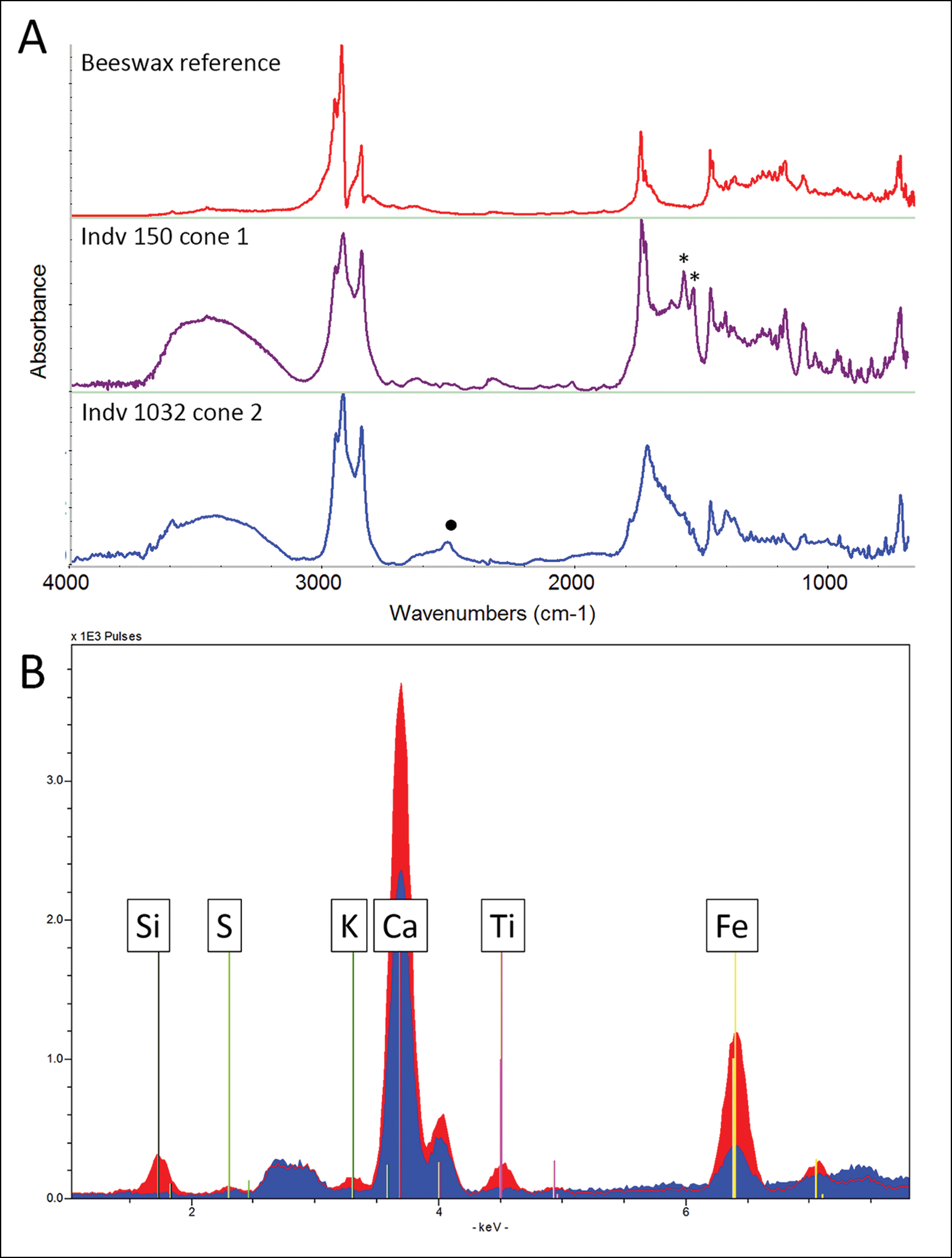
The spectra of the exterior of the cones are dominated by peaks arising from calcium carbonate, kaolinite and other silicate species (data not shown). These probably derive from burial deposits, rather than from deliberately applied pigments. XRF analysis confirms that the exterior surfaces of cone 1 contain higher quantities of elements consistent with calcium carbonate, clays and other soil materials (Figure 9: bottom). The interior of the cone contains calcium, consistent with the detection of calcium-fatty acid complexes by DRIFTS.
Fourteen locations on the hair of individual 150, from the crown of the head directly underneath the cone to the tips of the natural hair and the added extensions, were analysed. All areas display typical peaks N-H and amide stretching peaks expected for hair (Lyman & Schofield Reference Lyman and Schofield2008). The sharp C-H and C=O stretching peaks indicative of wax were not detected in any location, suggesting no significant transfer of cone material to the hair.
Cones for the living or the dead?
The discovery of the Amarna cones confirms that three-dimensional wax cones were produced for use in ancient Egypt. The excavated examples do not, however, take the form of a solid lump of unguent, surviving instead as a seemingly undecorated wax shell, which formed a fairly small low dome. The cones were perhaps shaped around a wad of textile, or given a textile inner lining to confer structural strength. If the wax was impregnated with perfume, this material is below the detection thresholds of the techniques used; it is reasonable to expect any perfume to have largely evaporated following burial. It is possible that the interiors of the cones were once filled with a separate substance, such as a softer salve. How this would work in practice, however, is difficult to envisage, and the absence of any detectable residue on the hair beneath cone 1 might suggest otherwise.
It is conceivable that these two cones were ‘model’ versions made for a burial environment, and that cones intended to be worn by the living could have been constructed differently. There is no reason to assume, however, that hollow—or perhaps textile-lined/-stuffed—cones of wax were not also worn in life. Even if scented, they may not have been intended to melt en masse and moisturise, serving more to mark the wearer as someone who was in a purified, protected or otherwise ‘special’ state.
The Amarna cones in context
There is little to distinguish the burials of the two individuals found with cones from the majority of those now excavated at Amarna. As with most of the Amarna dead, the bodies of individuals 150 and 1032 were wrapped in textile, rolled in a mat made of plant material and interred in a pit dug into the sand. The undisturbed burial of individual 150 suggests that the cones were placed on the heads of the deceased before the bodies were wrapped in textile. The graves may have been topped with simple stone cairns, which have occasionally survived at other graves (Kemp et al. Reference Kemp, Stevens, Dabbs, Zabecki and Rose2013: 67–68, fig. 3). There is no immediate evidence for the treatment of the bodies with preservatives, but no relevant analyses have been undertaken to confirm this. Neither grave contained associated burial goods, although individual 1032's grave had been robbed. Although quite elaborate, the hairstyle of individual 150 is not unusual for occupants of the South Tombs Cemetery, with long, thick braids featuring many extensions and end-curls. It is unclear whether this styling was performed ante- or post-mortem. Individual 1032's hair was preserved mostly in large patches (approximately 120mm long) that had become detached from the skull during decomposition and robbery. The hair ended in open, probably unstyled curls. That no braids were set into the hair is unusual for the North Tombs Cemetery, but it is difficult to ascertain the significance of this in relation to the cone.
We do not know the names or occupations of these two individuals, or much about their place in society. Together, the excavated cemeteries at Amarna probably contain a broad social cross-section of the ancient city, other than the upper elite. It is challenging, however, to differentiate social position across the predominantly simple and uninscribed burials. The South Tombs Cemetery may be the primary burial ground for the Main City, the largest urban area at Akhetaten (Figure 2). The North Tombs Cemetery is more puzzling, as it contains mostly adolescents and young adults (the majority of them female), prompting Stevens and Dabbs (Reference Stevens and Dabbs2017) to suggest that many of these individuals were labourers engaged in the construction and maintenance of Akhetaten. It is not, however, clear where they lived.
Ongoing osteological analysis shows that, as with many people in these cemeteries, the lives of individuals 150 and 1032 were probably labour-intensive and interspersed with periods of nutritional stress. Individual 150 has indications of degenerative joint disease (osteoarthritis) in the left shoulder and elbows, and a spondylolytic fracture of the fifth lumbar vertebra, which did not fuse together (for linkage between spondylolysis and biomechanical stress, see Merbs Reference Merbs1989: 163). Individual 1032 experienced several traumatic injuries during life, including three compression fractures of the thoracic and lumbar vertebral column (T1, T7, L4), a Schmorl's node on the fourth lumbar vertebra (for more on the association between Schmorl's nodes and trauma, see Dimar et al. Reference Dimar, Nathan and Glassman2012) and a fracture of the base of the right first metacarpal. The latter healed with poor alignment, possibly affecting the ability to use the right hand. Both individuals exhibited linear enamel hypoplasia in the dentition, which is suggestive of intense periods of stress during childhood (see Aufderheide & Rodríguez-Martín Reference Aufderheide and Rodíguez-Martín1998: 407).
Towards an understanding of the Amarna head cones
The head cones find thematic parallels in other items found occasionally within the Amarna graves, such as mirrors, tweezers, combs and eye-paint sets (predominantly found in burials of females), and ‘festival’ jewellery, such as plant-form pendants. Most of these items were probably used in life and then transferred to the burial. All may have, in part, conveyed a sense of desiring to ‘look one's best’ in the afterlife—a function that the cones too could have served. But these items could also have been included to increase the ritual or symbolic potency of these burials.
Although it is difficult to establish the exact role of the cones in the Amarna burials, we need not assume that their appearance is directly connected with Akhenaten's religious changes. While cones do appear in contexts invoking the solar cult of the Aten (Padgham Reference Padgham2012: 3, 43–45, 63–64), there is little to suggest that they were particularly connected to Akhenaten's version of solar religion. The fact that cones have been first identified at Amarna is probably due to the careful and extensive excavation of these cemeteries. The early days of Egyptology saw the rapid clearance of many of ancient Egypt's other non-elite cemeteries, and it is easy to imagine that other cones were overlooked.
In terms of ritual use, the Amarna cones may have been placed on the body during anointing or other mortuary rites. Perhaps the cones had a practical role in the grave, even after burial. Clearly, the wax has not melted; yet, if originally impregnated with perfume, might this have been understood to evaporate gradually and provide ongoing purification of the body? It is also possible that the cones attest to aspects of the ‘Opening of the Mouth’ to reanimate the deceased—a ritual in which cones often appear in New Kingdom tomb scenes (Padgham Reference Padgham2012: 15–38). As a ritual associated with Osiris, the Opening of the Mouth is only depicted twice at Amarna—once with a cone (Padgham Reference Padgham2012: 94) and once without (Pendlebury Reference Pendlebury1951: 90, 92, pl. 104). A small metal blade found under the head of the deceased individual in another Amarna grave has also been suggested as a possible remnant of this rite (Kemp et al. Reference Kemp, Stevens, Dabbs, Zabecki and Rose2013: 76).
In symbolic terms, there is nothing immediately incongruous with the notion that the cones designated the Amarna deceased as ba figures, thus better enabling them to collect offerings and participate in rituals in the afterlife; whether this saw them join the Aten at dawn, as in the elite tombs, can only be speculated. It may be noteworthy that cones are not found associated with the many elaborately prepared mummies recovered from ancient Egypt. While this could simply be due to the fact that such mummies were usually interred with other media, such as coffins, on which the cone could be represented, it is conceivable that the cone enhanced the effectiveness of the partially treated body, an idea also consistent with it symbolising the ba.
The large number of graves available for study at Amarna also provides the opportunity to approach the cones in terms of on-the-ground patterning. Although additional cones may have been lost to looting and natural degradation, it is clear that they were not commonly interred with the dead at Akhetaten. This, perhaps, is key to understanding their purpose within a non-elite burial environment, with their rarity suggesting an element of individual circumstance underpinning their use. Other occasional patterns across the Amarna burials could indicate practices linked to the life experiences of people of a particular age, sex, ethnicity and so on. The only two flexed burials so far encountered, for example, are of older women (Stevens et al. Reference Stevens, Shepperson and Wetzel2013: 8; Stevens Reference Stevens2015), while two infant graves yielded model mud-balls that may be a remnant of ‘magic’ rites (for one of these burials, see Stevens et al. Reference Stevens, Shepperson and Wetzel2013: 13). The individuals with cones, or those who buried them, might have had unique access to the raw materials or skills used to make these items. Or perhaps the cones were connected with the deceased's occupation, other evidence for which does not survive in the archaeological record.
Given the potential association of the cones with female sensuality and fertility, it is also perhaps noteworthy that at least one of these individuals (individual 150) was an adult female. Were the cones considered a particularly potent symbol of rebirth for females, or might they have enhanced female fertility in the afterlife, perhaps as a remedy for real-life problems? Fertility cannot be assessed directly through skeletal analysis, and these burials provide no evidence of potential fertility-related problems (e.g. interment with foetuses, as occasionally found at Amarna, possibly indicating death in childbirth). Nonetheless, this intersection of circumstances—the rarity of the cones, their association with at least one adult female, their iconographic appearance in contexts associated with birth and fertility, and the importance of family-centred concerns in personal cults (Weiss Reference Weiss2015)—makes fertility-related problem-solving a tempting component of an explanation for the presence of cones in these graves.
Similar notions are perhaps invoked by a set of emotive scenes in the Amarna Royal Tomb that seem to record the death of a female member of the Amarna royal family, usually thought to be Princess Meketaten, in childbirth (Martin Reference Martin1989: 37–48). In one scene, the deceased figure wears a cone as she is mourned in an arbour covered with floral symbols of fertility and rebirth. A second scene may once have shown her wearing a cone as she lies on a bed or bier (Figure 10). Death in childbirth—a conflation of two dangerous and symbolically linked processes—conceivably made a person more vulnerable as they navigated the life-afterlife divide and sought out a contented eternal existence. Only the deceased female wears the cone in these scenes, perhaps to focus its potency upon her. Ceramic figurines of naked females wearing cones have also been found in settlement areas at Amarna and were probably used in rituals of childbirth, fertility and healing. One example was found, and perhaps once used, with a stela showing a cone-wearing female worshipping Taweret, goddess of domestic life and childbirth (Figure 1; Peet & Woolley Reference Peet and Woolley1923: 25, pl. XII.2). Collectively, this imagery, and that of the Royal Tomb scenes, recalls the entangled motifs and rituals of birth and rebirth, and sexuality and fertility, known to have existed in ancient Egypt (e.g. Roth Reference Roth1992), and which may also have involved the cones in certain contexts.
Scenes in the Amarna Royal Tomb probably relating the death of Princess Meketaten, who is shown wearing a head cone. The presence of the cone in the right-hand scene is less certain; it only appears in this early copy of the relief, which is now badly damaged. Left) after Martin (Reference Martin1989: pl. 68); right: after Bouriant et al. (Reference Bouriant, Legrain and Jéquier1903: pl. 6).

Conclusions
The excavation of two cones from the Amarna cemeteries confirms that three-dimensional, wax-based head cones were sometimes worn by the dead in ancient Egypt, and that access to these objects was not restricted to the upper elite. Although the exact function of the Amarna cones is difficult to establish, there is little direct evidence to link them with Akhenaten's religious reforms. Bearing in mind their inherent fragility, the rarity of cones in the Amarna burials, and the fact that they have not been found elsewhere, suggests that they only formed occasional components of burials, and were included under specific and individual circumstances. Perhaps they represented a particularly suitable component of adult (female?) burials, drawing upon the interconnected symbolism and rituals of fertility, birth and rebirth in order to help the deceased attain the latter, enhance fertility in the afterlife, or both. The Amarna discovery supports the idea that head cones were also worn by the living, although it remains difficult to ascertain how often and why. In the case of ancient Akhetaten, we can probably interpret head cones as part of a suite of personal accoutrements deemed appropriate for use in a range of celebrations and rituals for, and involving, the living, the dead, the Aten and other deities.
Acknowledgements
The cemetery excavations are part of the Amarna Project (McDonald Institute for Archaeological Research, University of Cambridge), directed by Barry Kemp. Analysis of the cones, in late 2017, was made possible through the generous support of the Institute for Bioarchaeology (British Museum). The cemetery study has also been funded by the National Endowment for the Humanities, the British Academy, National Geographic, the King Fahd Center for Middle East Studies (University of Arkansas), the McDonald Institute for Archaeological Research, the Amarna Research Foundation, the Michela Schiff-Giorgini Foundation, the Seven Pillars of Wisdom Trust, the Robert Kiln Trust and public donations to the Amarna Trust. The work is undertaken with the permission and support of the Egyptian Ministry of Antiquities (MoA); we are particularly grateful to MoA conservators Nagmeldin Morshed, Mohamed Ibrahim, Ahmed Tarek and Eid Mertah for their assistance during the on-site analyses of the cones. Thanks are also due to Lucy Skinner for her assistance recording and analysing the cones and for helpful discussions on their materiality and function. Any views, findings, conclusions or recommendations expressed here do not necessarily represent those of the National Endowment for the Humanities.



