Judicial independence is everywhere these days, and there seems to be a normative consensus that it is a good thing. The General Assembly of the United Nations supports it; the World Bank and other donors spend significant funds promoting it; and governments, both democratic and authoritarian, proclaim its existence. Despite all this effort and normative support, we know relatively little about the makeup and determinants of judicial independence. Judicial independence, as one of us has put it, has become like freedom: everyone wants it, but no one knows quite what it looks like or how to get it, and it is easiest to observe in its absence (Ginsburg Reference Ginsburg and Peerenboom2010). Most analysts focus on indicia that judges are dependent on politicians or outside pressures, but it is much more difficult to affirmatively show that judges are independent.
Given the importance placed on judicial independence by the international community, it is perhaps unsurprising that, over the past 25 years, constitutional drafters have begun to incorporate provisions that insulate the judiciary from external interference. Many countries’ constitutions now contain explicit declarations that the judiciary is independent, provisions that insulate the tenures and salaries of judges, and limitations on the roles of the executive and legislative branches in the selection and removal of judges. Such provisions were relatively rare in constitutions written just 25 years ago. Before 1985, more than 550 constitutions had been written around the world, and 60% contained either zero or only one of the six constitutional features that we identify below as enhancing the independence of the judiciary.Footnote 1 Since 1985, we have witnessed a spike in explicit provisions on judicial independence, with two-thirds of constitutions written thereafter containing two or more such features.
One might expect that such a sharp increase in de jure judicial independence would be accompanied by an increase in de facto judicial independence. Hayo and Voigt’s (Reference Hayo and Voigt2007, Reference Hayo and Voigt2010) findings would certainly support such an expectation. They find that, while de jure judicial independence is not closely related to de facto independence, it is still the single most important determinant thereof (Hayo and Voigt Reference Hayo and Voigt2007). Their result provides direct evidence to corroborate the observation that de jure judicial independence improves de facto human rights protection, a relationship that is presumably mediated by de facto judicial independence (see, e.g., Camp Keith Reference Camp Keith2002a, Reference Camp Keith2002b; Camp Keith, Tate, and Poe Reference Camp Keith, Tate and Poe2009).
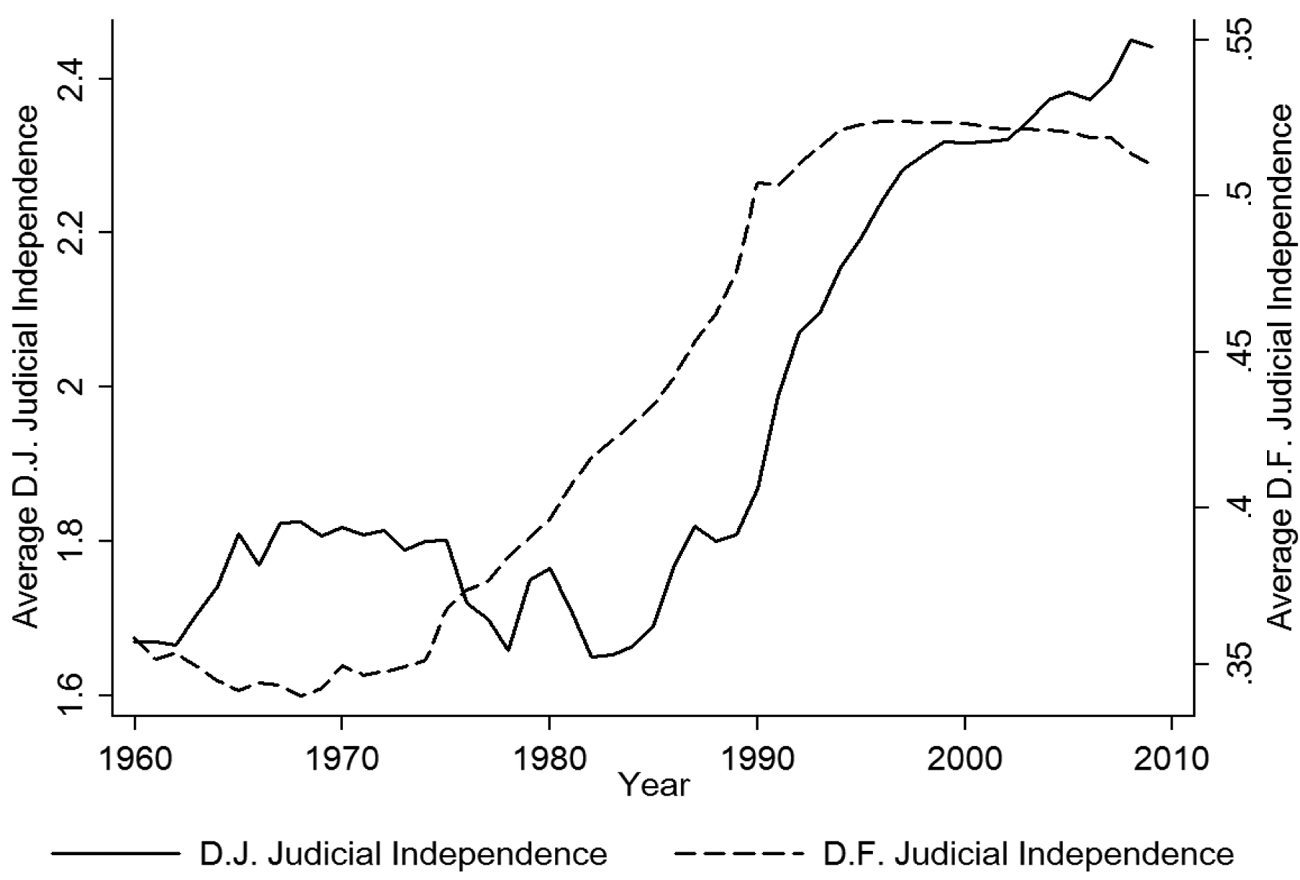
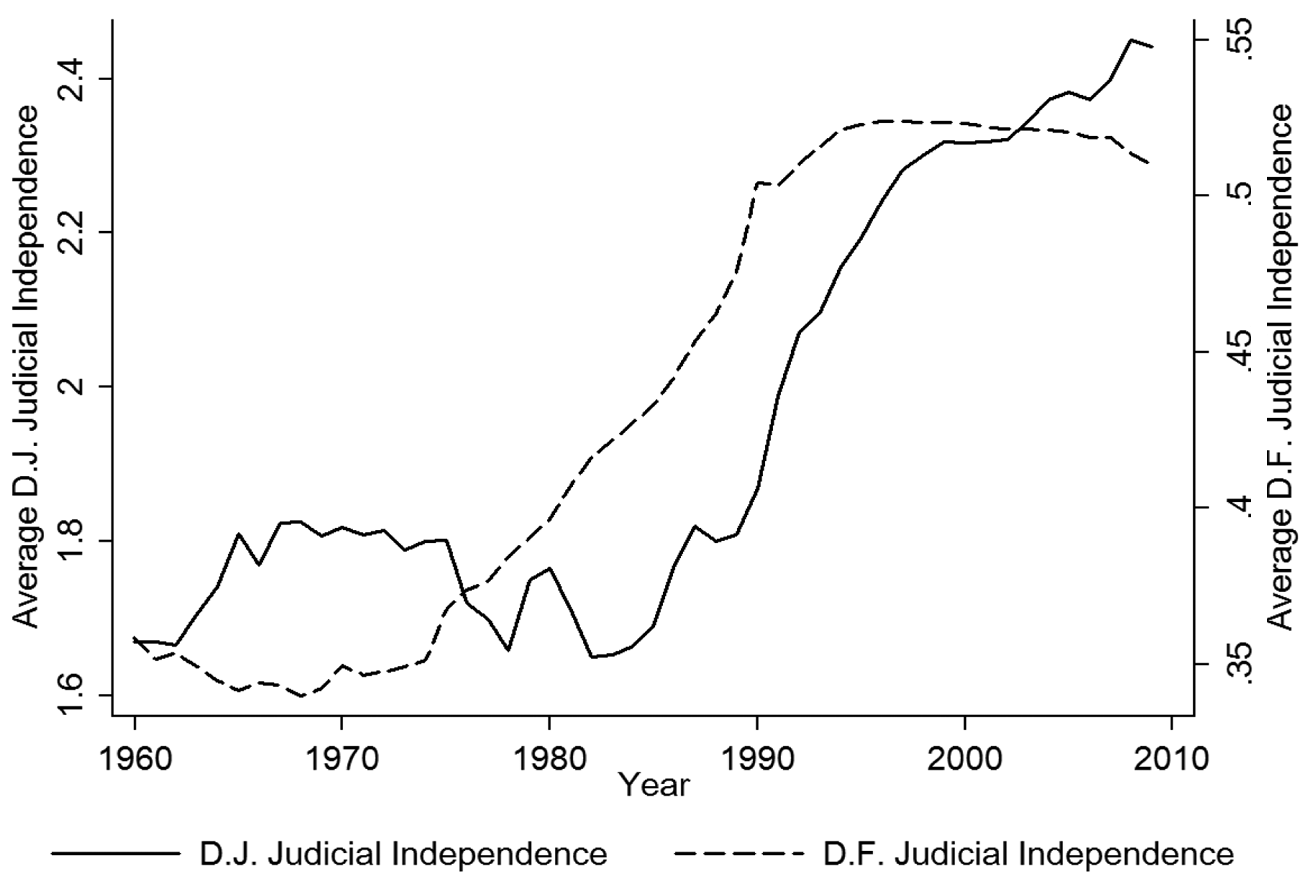
Despite the results reported by Hayo and Voigt, much of the extant literature is skeptical of claims that parchment barriers play a causal role in creating independent judiciaries (Larkin Reference Larkin1996; Smithey and Ishiyama Reference Smithey and Ishiyama2002; Herron and Randazzo Reference Herron and Randazzo2003; Helmke and Rosenbluth Reference Helmke and Rosenbluth2009). This skepticism seems warranted by trends in the global development of de jure and de facto judicial independence over the last 35 years. As illustrated in figure 1, the average level of de facto judicial independence, indicated by the dashed line, increased sharply between the start of the third wave of democratization in the mid-1970s and the end of the Cold War in 1990. The average level of de jure judicial independence, indicated by the solid line, started to increase around 1985 and has continued to increase in each year since (see also Hayo and Voigt 2013). Thus, increases in de jure judicial independence lagged behind increases in de facto independence, and increases in the level of de jure judicial independence since 1990 are not associated with continued increases in the level of de facto judicial independence. This seems to support those skeptical of any causal relationship running from parchment to practice. At a minimum, the patterns illustrated in figure 1 suggest that the relationship between de jure and de facto judicial independence is not as simple as the results reported by Hayo and Voigt suggest.
Average levels of de jure and de facto judicial independence from 1960 to 2009. De jure independence is measured using an additive index of the six features described in table A1 that are hypothesized to enhance judicial independence. De facto judicial independence is from Linzer and Staton (2012).
In this article, we further explore this relationship in order to determine precisely how and under what conditions de jure independence improves de facto independence. We use data on de jure judicial independence from the Comparative Constitutions Project (CCP) and data on de facto judicial independence from Linzer and Staton (Reference Linzer and Staton2012). By identifying which components of de jure law matter for practice, the analysis helps to reconcile the results reported by Hayo and Voigt (Reference Hayo and Voigt2007) and Camp Keith et al. (Reference Camp Keith, Tate and Poe2009) with the common perception that parchment barriers are insufficient to create judicial independence in practice.
The article is organized as follows. We begin with some conceptual considerations, providing our definition of judicial independence and articulating a theory of the association between de jure and de facto judicial independence. Next, we introduce six aspects of formal constitutions that we expect may enhance judicial independence in practice, explain how we operationalize those concepts, and provide some data on the prevalence of those aspects in constitutions written around the world since 1789. We then turn to the empirical analysis, in which we conduct an original statistical analysis that focuses on the individual aspects of constitutions we expect to enhance independence.
We find that the only provisions in constitutions that affect de facto judicial independence are those that are likely to be self-enforcing as a result of competition between the executive and legislative branches. Specifically, we argue that judicial independence is enhanced in practice when both the selection and the removal processes for judges ensure that judges are independent from other political actors. These protections work conjunctively; one without the other does not produce the desired effects. The effect is strongest in contexts in which executive authority is checked by other political actors and in authoritarian regimes. Importantly, this result explains the apparently weak relationship between de jure and de facto judicial independence illustrated in figure 1. Despite overall increases in de jure judicial independence, few constitutions written over the last 25 years include both selection and removal procedures that enhance judicial independence. Thus, it is unsurprising that better constitutional protection of judicial independence has not generally resulted in more independence in practice, because drafters have not provided the right combination of protections. Our results have important implications for institutional reform strategies and, more generally, for our understanding of the effectiveness of parchment barriers.
Conceptualizing Judicial Independence
Judicial independence is a complex and contested concept, but at its core, it involves the ability and willingness of courts to decide cases in light of the law without undue regard to the views of other government actors. Given all the other qualities that we might want out of a judiciary, such as consistency, accuracy, predictability, and speedy decision making, it is not clear that independence is the supreme value we want to maximize. But it is, nevertheless, an important component in many definitions of judicial quality, and a judiciary that repeatedly decides cases in legally implausible ways under the influence of government actors is likely to suffer a decline in its reputation for independence and quality (Vanberg Reference Vanberg2005; Staton Reference Staton2011).
Which Judges?
However conceived, judicial independence can vary across and even within courts in any particular legal system. A local court may be quite independent of local government but beholden to senior judges who control promotions (Ramseyer and Rasmusen Reference Ramseyer and Rasmusen2003; see also Ferejohn Reference Ferejohn1999). A supreme court might be subject to no political influence or pressure yet be so ideologically in line with government that it never rules against it in salient cases (Silverstein Reference Silverstein, Moustafa and Ginsburg2008). The supreme court may be independent but local courts corrupt (as in India, for example). In our analysis, we focus on the independence of the highest ordinary court in the jurisdiction.Footnote 2 This decision is based on both theoretical and practical grounds. Theoretically, the highest ordinary court is typically the court of last resort, so its independence (or lack thereof) is likely to affect the independence of the entire judiciary (Ramseyer and Rasmusen 2007). Practically, focusing on the highest ordinary court reduces the aforementioned dimensions of variance to make the analysis manageable and is standard practice in the existing literature.
The Role of Constitutional Text
Why might constitutional text enhance judicial independence? It is a general challenge to the empirical study of constitutions to understand exactly when and how formal provisions might make a difference. The general understanding of the literature is that constitutional arrangements are political bargains that are likely to work only when they are “self-enforcing.” Because there is usually no external actor available to police the constitutional bargain, parties or institutions must check one another to make the constitution effective (Weingast Reference Weingast1997; Ordeshook Reference Ordeshook1999). Publicly available textual provisions help facilitate such self-enforcement by providing a clear focal point around which the subjects of the constitution can concentrate their enforcement efforts (Carey Reference Carey2000; Elkins, Ginsburg, and Melton Reference Elkins, Ginsburg and Melton2009). But these general intuitions do not speak directly to judicial independence.
Let us start by acknowledging that judicial independence can be valuable for a variety of reasons. It may allow judges to give force to private law norms, such as contracts, by ensuring that such norms are not violated (Gilbert Reference Gilbert2013). By resolving constitutional ambiguities, judicial independence can also serve to facilitate constitutional self-enforcement by other actors (Law Reference Law2008). Suppose, for example, that there is a dispute between the legislature and executive about the scope of executive power in a particular constitutional scheme. Sending the case to a judge who is independent can help both institutions coordinate their behavior and ensure that their conflict does not spiral out of control (McAdams Reference McAdams2005). Thus, judicial independence may have value to many players to a constitutional bargain.
However valuable, the judiciary is relatively weak among constitutional branches. Lacking the proverbial pen or the sword, the judiciary ultimately relies on a stock of political capital among key audiences that can help it to enforce its decisions (such as the police or executive) or defend it against attack from other actors (such as the general public). The comparative literature on courts has documented how judges deploy strategies to help build up their power and reputation among different audiences (for a review of this literature, see Helmke and Rosenbluth [Reference Helmke and Rosenbluth2009]; see also Garoupa and Ginsburg [Reference Garoupa and Ginsburg2009] and Staton [Reference Staton2011]).
Constitutional provisions on judicial independence serve to insulate the judiciary from other actors by reducing the number of weapons at the disposal of the judiciary’s potential enemies. Constitutional text raises the cost of interfering with judges, in part because it informs other actors (e.g., the public, governmental institutions, and other interested audiences) about potential threats to the judiciary. This increases the likelihood that other actors will coordinate to defend the judiciary’s independence when it is threatened. In other words, constitutional promises incentivize the production of information on interference with the judiciary, making the promise of judicial independence more credible. In keeping with the general literature on self-enforcement, these provisions are most likely to be effective in regimes in which there are checks and balances among multiple institutions or in which there is public support for courts.
It should be apparent from this discussion that not all regimes have equal demand for constitutionally independent judiciaries. Pure dictatorships will have no interest in the constraints that may be imposed by judicial independence. Electoral authoritarians, however, may wish to empower the judiciary for certain discrete tasks and may enshrine this into the constitution (Toharia Reference Toharia1975; Moustafa Reference Moustafa2007; Moustafa and Ginsburg Reference Moustafa and Ginsburg2008). We generally expect that democracies will incorporate a separation of powers that increases both demand for and the efficacy of constitutional judicial independence. As a result, there may be fewer constitutional guarantees for judicial independence in soft authoritarian regimes (Elkins, Ginsburg, and Melton Reference Elkins, Ginsburg, Melton, Ginsburg and Simpser2014b), but there will be some. These provisions are likely to be most effective when authoritarian regimes have some internal division among powerful actors, who may therefore have an interest in impartial adjudication. We thus include all regime types in our analysis, although we examine whether the relationship between de jure and de facto independence is different in democracies and autocracies.
Constitutional provisions on judicial independence come in several varieties. Some specify details about appointment, promotion, and removal of judges. To the extent that these identify multiple constitutional actors who must be involved, they may become self-enforcing. For example, if a constitution requires the legislature to propose judges for appointment by the president, it seems unlikely that the president would be able to ignore the legislature because the legislature is likely to retaliate (by cutting the budget, for example). Thus, we expect that text will be more likely to correspond to actual political practice when it designates multiple bodies to be involved in appointment, promotion, or removal processes for judges, because each body involved in the process has an incentive to protect its constitutionally assigned powers.
Other provisions require external actors to enforce them. For example, some 77% of constitutions in force explicitly state that the judiciary will be independent. This nominal guarantee is unlikely to prevent the executive or the legislature from curtailing judicial independence if the judiciary makes an unpopular decision. To be effective, nominal provisions need to increase the probability that an external audience will be willing to punish actors that infringe on the principle of judicial independence. Similarly, some constitutional provisions, such as long terms for judges, protection of judges’ salaries, and prohibition of mandatory retirement ages, require some audience to come the defense of judges if violated. Given the coordination problems surrounding enforcement, we expect that enforcement will be more likely for provisions that are more specific. This implies that a blanket guarantee of judicial independence, for example, is less likely to be enforced by external actors than life terms or salary guarantees for judges. A blanket nominal guarantee leaves too much uncertainty about the meaning of judicial independence (even scholars cannot agree on how to define it) and may prevent effective coordination. Institutional protections for salary or term, however, are very clear, increasing the likelihood that actors will agree on the meaning of the provision, be able to identify violations, and effectively coordinate to punish violators (Weingast Reference Weingast1997; Carey Reference Carey2000).
Judicial independence in constitutions is a bit different from other powers. Elkins, Ginsburg, and Melton (Reference Elkins, Ginsburg and Melton2012) argue that executive and legislative power depends on the number of powers assigned to the respective branches. Each additional power granted to the executive and legislative branches provides either greater agenda control or a greater ability to punish the other branch. Both of these aspects of political power increase the range of policies that one branch can pressure the other into approving. Judicial independence provisions do not involve affirmative grants of power so much as institutional protections that facilitate the exercise of assigned powers.Footnote 3 Constitutional protection of the judiciary insulates it from coercion by the other branches of government, enhancing its autonomy. As a result, any gap in that protection creates an opportunity that the other branches of government can exploit.
Consider the selection and removal procedures of judges, which are central to conceptions of judicial independence (Jackson Reference Jackson2007). Imagine a constitution that provides the following procedure for the selection of supreme court justices: (1) a judicial council presents a list of candidates to the executive, (2) the executive proposes a candidate from that list to the legislature, and (3) the legislature must approve the candidate by a supermajority vote (see, e.g., Constitution of the Maldives, art. 142). By involving three discrete institutions to cooperate, such a procedure would seem to reduce the probability that the justices selected to serve on the supreme court would be biased toward any particular political actor. Now assume that, in that same constitution, the procedure to remove justices is dominated by the legislature.Footnote 4 In this fictitious constitution, even though the justices selected for the supreme court are fairly independent at the moment they are appointed, they will be forced to keep the legislature happy to remain in office.
Unlike the theory of executive and legislative power presented by Elkins et al. (2012) or the implicit theories adopted by the literature on judicial independence (Camp Keith et al. Reference Camp Keith, Tate and Poe2009; Abbasi Reference Abbasi2013), our theory of judicial independence is not additive. Simply adding more de jure protection is unlikely to increase judicial independence in practice because those who wish to interfere with courts need only find one hole in the judicial armor. Instead of treating each aspect of de jure protection as contributing equally to de facto judicial independence, we expect that multiple aspects of de jure judicial independence must be combined for that protection to be effective. Combining selection and removal procedures that involve multiple actors seems particularly likely to enhance de facto judicial independence. These aspects of de jure protection allow the selection of independent judges who will not fear arbitrary removal from office and are most likely to be self-enforcing.
There is, of course, nothing determinative about text. There is no guarantee that textual provisions will be observed or that they will facilitate coordination. Indeed, existing scholarship has found an increasing gap between constitutional text and constitutional practice as the documents matured over time (Elkins et al. 2009, 30). Our argument here is probabilistic. Ceteris paribus, textual promises will facilitate enforcement to the extent that they raise the visibility of judicial independence or designate multiple officials to be involved in institutional processes related to the judiciary. Our theory suggests that such provisions are most effective under two conditions: (1) when they are combined with other provisions that insulate the judiciary from external interference and (2) when there are checks and balances. Ideally, a judiciary would be insulated by multiple layers of de jure protection and reside in a system with at least some veto players. However, as we demonstrate below, such an environment is quite rare.
It is worth clarifying that our account does not try to specify a complete causal theory. In designing constitutions, policy makers have a number of alternative instruments at their disposal to accomplish any particular goal. The judicial independence “solution” is likely to be particularly attractive when the judiciary is already a credible actor. As a result, we might observe constitutionalization of de jure independence after increases in de facto independence. It would not be surprising to find a reciprocal relationship between de jure and de facto independence. Our concern is to measure the correlation between the two concepts, as a first step toward building a full causal account.
We should also clarify the theoretical alternatives to our argument that text matters under some conditions. One view of constitutional text suggests that it is driven by diffusion across time and space, so that constitution makers copy and borrow (Elkins Reference Elkins2010; Law and Versteeg Reference Law and Versteeg2010). This account would suggest that the spread of provisions on judicial independence would be driven by emulation or learning, rather than by local political factors. The theory does not, however, provide any account of the relationship between text and practice and, indeed, implies that there may be only a weak relation.
Another possibility is that some unobserved factor may be causing any correlation that we find between de jure and de facto judicial independence. For instance, deference toward the judiciary may be a societal norm, which prompts constitutional drafters to create strong protection for the judiciary’s independence and politicians to respect the judiciary’s independence in practice. We cannot rule out this possibility in the analysis below, but our emphasis on the specific mechanisms of appointment and removal suggests that there is something about these particular attributes of de jure judicial independence. If a third factor was causing both stronger formal protections and de facto independence, one might expect that all of the formal protections that we identify would be equally correlated with practice.
Components of De Jure Judicial Independence
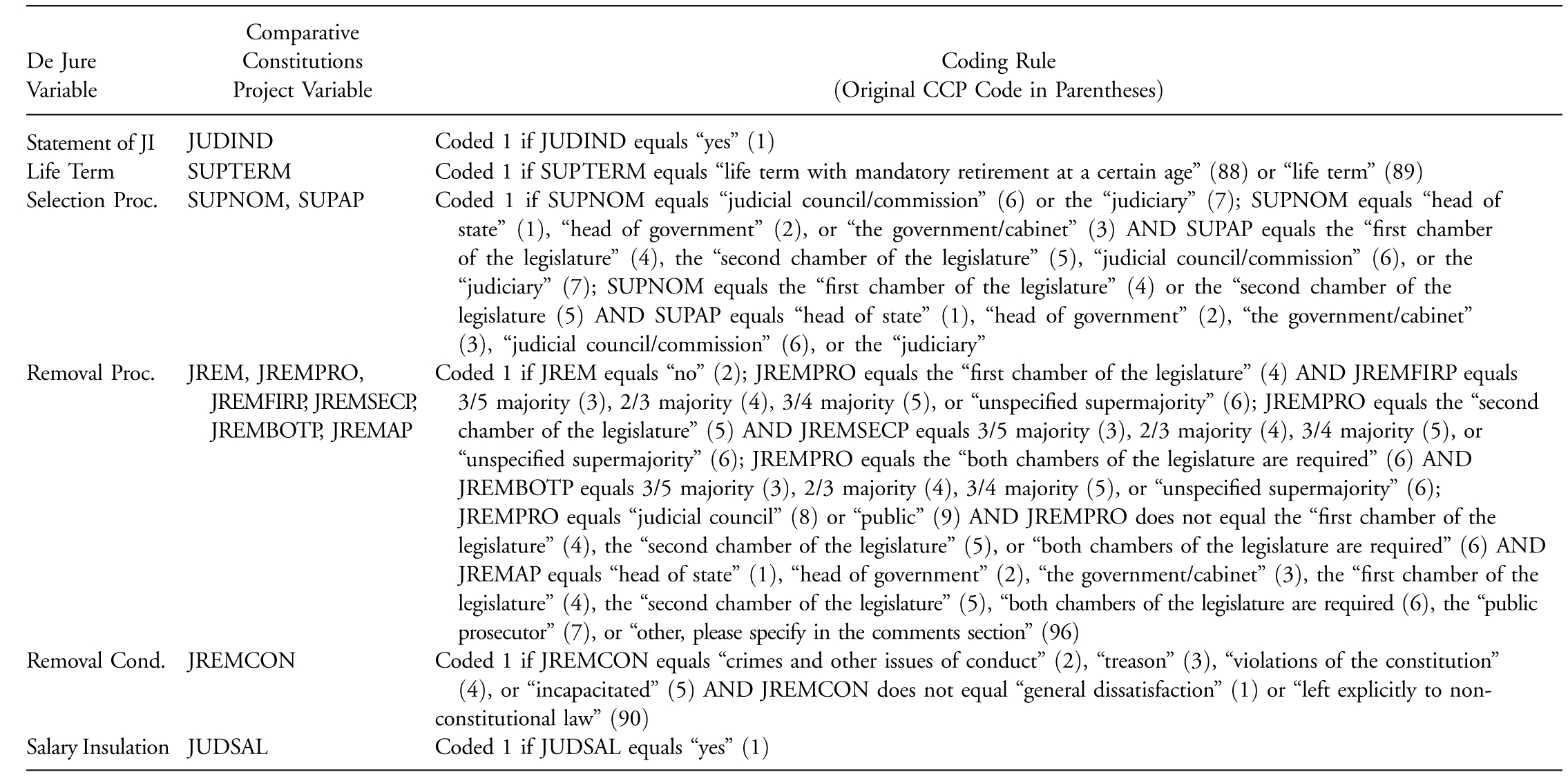
There are a number of studies that specify which aspects of constitutions should enhance judicial independence (Hayo and Voigt Reference Hayo and Voigt2007; Camp Keith et al. Reference Camp Keith, Tate and Poe2009; Rios-Figueroa Reference Rios-Figueroa, Helmke and Rios-Figueroa2011). We draw on these studies to identify six aspects of constitutions that enhance judicial independence and autonomy. In keeping with our theory, the emphasis is on components that will insulate the judiciary from attacks by other political actors, and with the exception of the first aspect, we try to focus on provisions that either raise the visibility of judicial independence or designate multiple officials to be involved in institutional processes related to the judiciary.
-
1. Statement of Judicial Independence. Our first criterion is simply nominal: we ask whether the constitution contains an explicit declaration regarding the independence of the central judicial organ. This is the variable analyzed in Hayo and Voigt (2010). Recall that we are skeptical about the effect such a declaration will have on judicial independence in practice.
-
2. Judicial Tenure. The founders of the US Constitution felt that they needed to give judges lifetime appointments to enhance independence. In some countries, however, supreme court judges are subject to limited terms that vary from 1 year (e.g., Syria’s constitution of 1930) to 15 years (e.g., Mexico after 1994). Hayo and Voigt (2007) code judges with limited tenure as having more independence if they are only allowed one term, on the theory that judges with single terms will be less beholden to politicians involved in reappointment. Rios-Figueroa (2011) argues that the key factor is whether the term length of judges is longer than the term of those who appoint them. Our approach is stricter than either of these: we expect tenure to enhance judicial independence only if it is for the life of the judge.Footnote 5 While this might seem to be a strict criterion, most countries with life tenure have a mandatory retirement age, so in practice, judges can have terms shorter than those produced in systems that stipulate long terms. Even so, a life guarantee means that judges will not necessarily be looking for another job after retirement, which should enhance independence. The rationale for a relationship between other limited term lengths and de facto judicial independence is less clear.
-
3. Selection Procedure. To be able to issue independent decisions, the judiciary must be sufficiently insulated from political pressures to decide cases. The procedures for judicial appointment and removal go to this set of issues. For the appointment process to the highest court, we look at the bodies that nominate and approve appointments. We consider appointment processes that involve a judicial council or two (or more) actors as enhancing judicial independence.Footnote 6
-
4. Removal Procedure. Even if judges are independently appointed, they will not be independent if they are under constant threat of being removed from office. For the removal procedure, we focus on whether the constitution regulates judicial removal and, if so, who proposes removal. The judiciary should be more independent if judges cannot be removed, if removal requires the proposal of a supermajority vote in the legislature, or if only the public or judicial council can propose removal and another political actor is required to approve such a proposal.
-
5. Limited Removal Conditions. Beyond the removal procedure, we believe that the conditions under which judges can be removed affect judicial independence. If the constitution explicitly limits removal to crimes and other issues of misconduct, treason, or violations of the constitution, we expect the judiciary to be more independent.
-
6. Salary Insulation. It is usually assumed that judges will be more independent if their salaries are protected from reduction. The logic is that political actors might seek to punish judges by reducing their salaries in response to adverse decisions. Many constitutions thus prohibit reductions in salary, and we suspect that this prohibition creates more independent judiciaries.
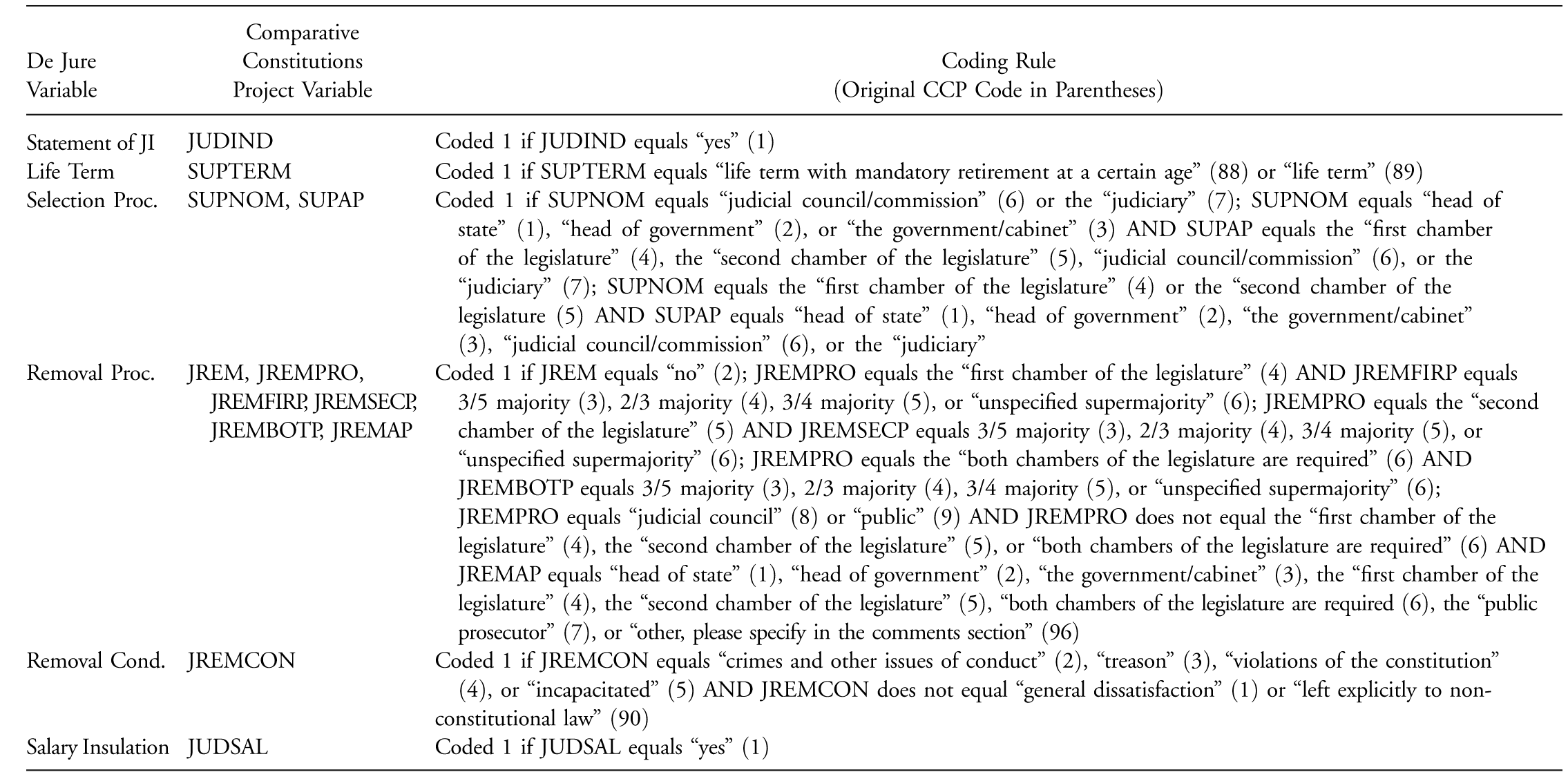
To measure these six aspects of de jure judicial independence, we use data from the CCP, a project that aims to catalog the contents of all constitutions written around the world since 1789 (Elkins, Ginsburg, and Melton 2014a).Footnote 7 For each aspect, we create a binary variable, which is coded one when that aspect of the constitution is expected to enhance judicial independence in practice and zero otherwise. We expect to observe a positive relationship between these de jure indicators and de facto judicial independence in the analysis below.
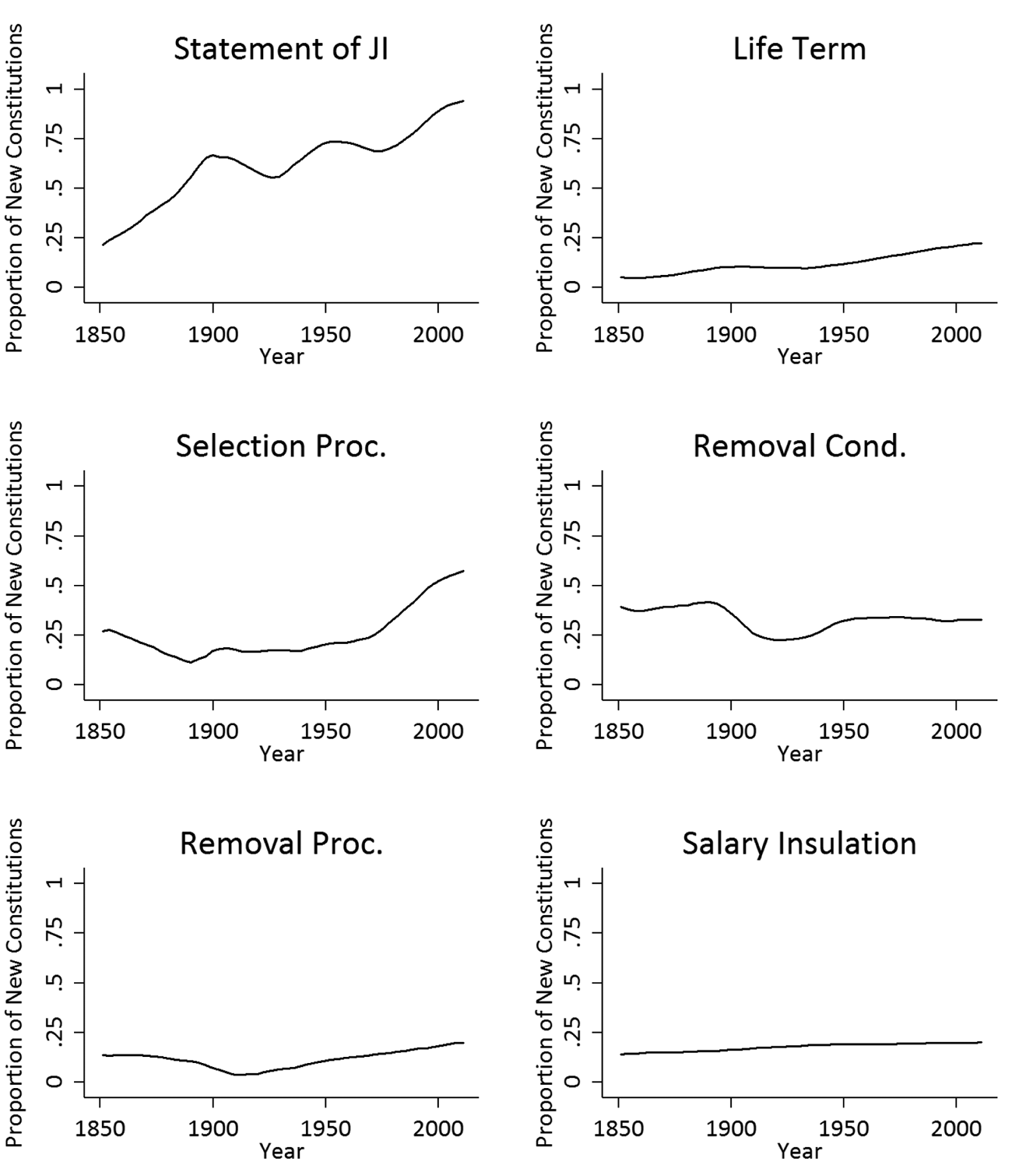
Before we turn to this analysis, though, let us briefly describe the distribution of de jure protection of judicial independence. Our analysis includes all constitutions in the CCP data set through 2009. We already noted that most constitutions written after 1985 contain at least two of the six features that we expect to enhance judicial independence in practice. However, few constitutions written between 1985 and 2009 (only 2%) included all six protections, with the vast majority (85%) protecting between one and four of the features we identified as theoretically important. As for the particular features protected, figure 2 illustrates the proportion of newly promulgated constitutions that protect each of the six aspects of de jure judicial independence from 1850 to 2009. Most of the growth in de jure judicial independence over the last 25 years came from increases in the number of constitutions with explicit statements of judicial independence. This is the aspect of de jure judicial independence that we expect will be the least effective because it lacks any affiliated institutional structure. Selection procedures that enhance judicial independence have also increased in popularity over time. All other aspects of constitutions that we associate with judicial independence were relatively stable over the time period analyzed in figure 2 and were absent in most constitutions in force circa 2009.
Aspects of de jure judicial independence in new constitutions (1850–2009)
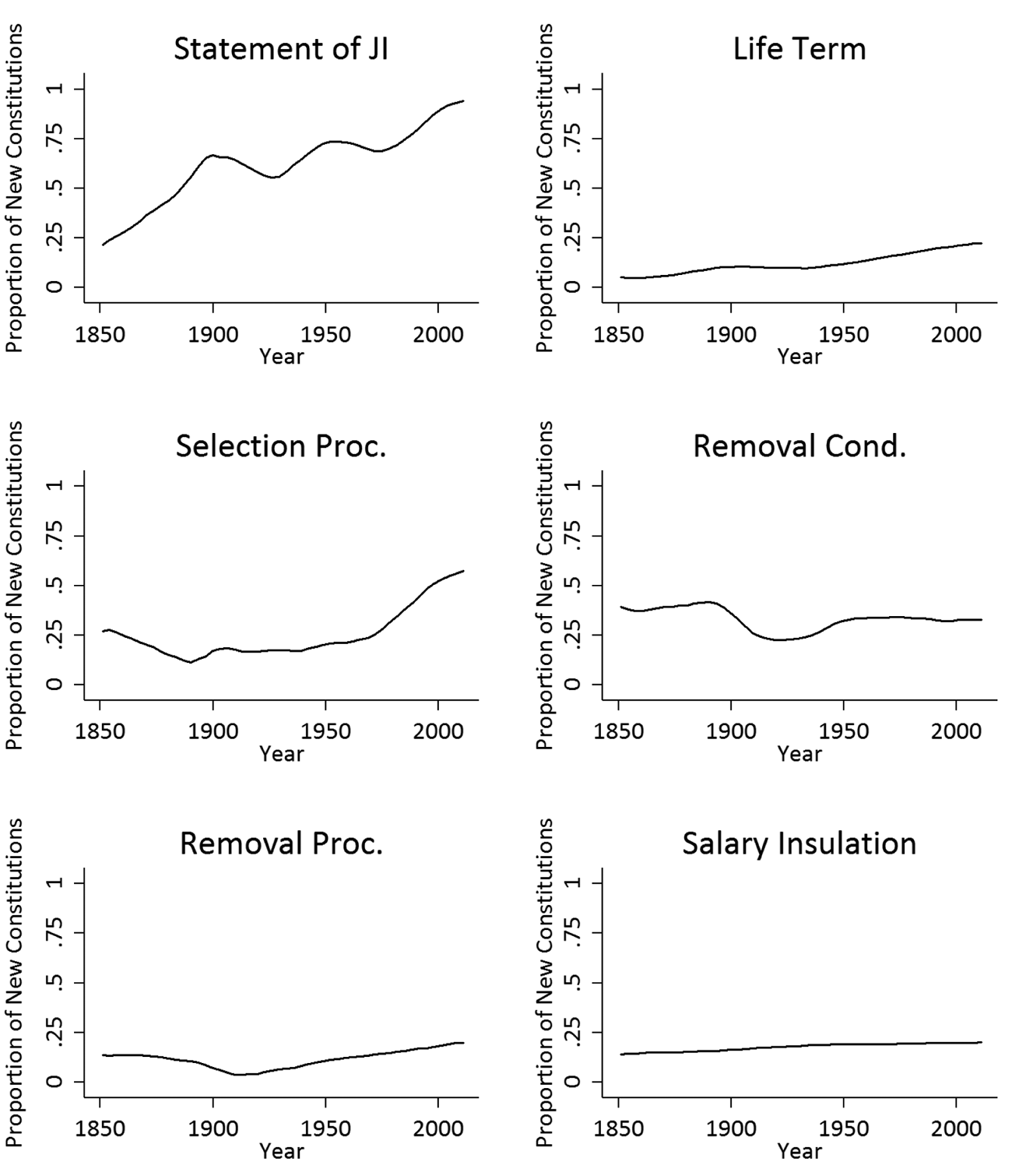
Of the constitutions in force in 2009, the only aspect of de jure judicial independence found in a majority of texts was a formal declaration of judicial independence. For the other aspects of de jure protection, most constitutions were silent. The term length for judges was not specified in 58% of constitutions, no removal procedure was provided in 58% of constitutions, and there was no mention of salary protection in 83% of constitutions. The exception was the selection procedure. While some selection procedure was specified in 70% of constitutions, most of these did not include multiple actors or a judicial council, the procedures expected to enhance judicial independence.
Poor de jure protection of judicial independence is worrisome. Any gaps in de jure protection provide an opportunity for executive and legislative actors to influence the judiciary, but few constitutions provide comprehensive de jure protection. Only three constitutions (two of these were in force in 2009) protected all six of the aspects of de jure judicial independence, and only 30 (16 in force in 2009) protected five of the six aspects of de jure judicial independence. The vast majority of constitutions (76% overall and 54% of constitutions in force in 2009) protected fewer than three of the six aspects. These gaps provide mechanisms for government actors to influence the judiciary, creating the possibility that whatever de jure protection was actually in place will be ineffective. Although there has been some improvement in de jure protection of judicial independence over the last 25 years, the vast majority of constitutions still lack the comprehensive protection that we suspect is necessary (although not sufficient) to create an independent judiciary in practice.
Research Design
We now turn to our analysis of the relationship between de jure and de facto judicial independence. We test the hypotheses elaborated above using data from 192 countries spanning from 1960 to 2008. In the analysis, we focus on between-country variance because both de jure and de facto judicial independence are relatively stable within countries over time (Hayo and Voigt Reference Hayo and Voigt2007; Linzer and Staton Reference Linzer and Staton2012). As a result, models that focus on within-country variance will have low power, and the power of our analysis is already quite limited by the fact that most of the components of de jure judicial independence are only present in a handful of countries. Thus, for each specification, we estimate two regression models. The first model is cross-sectional, using the data available from 2008, and is estimated via ordinary least squares (OLS). The second model is time series cross-sectional and is estimated using a population-averaged estimator. Since population-averaged estimators are particularly sensitive to missing data, the estimates from the population-averaged models are based on the combined results from 10 data sets imputed using Amelia II (Honaker, King, and Blackwell Reference Honaker, King and Blackwell2009; Honaker and King Reference Honaker and King2010).
Dependent Variable
The dependent variable for all models is a new measure of de facto judicial independence developed by Linzer and Staton (Reference Linzer and Staton2012). They use a multirater measurement model to combine eight extant measures of de facto judicial independence into a single measure. The resulting measure is continuous and ranges from 0 to 1.
For the most part, the extant measures used in Linzer and Staton’s measurement model are well accepted, relying on information drawn from the US State Department Human Rights Country Reports or from expert surveys (see the measures by Feld and Voigt [Reference Feld and Voigt2003]; Howard and Carey [Reference Howard and Carey2004]; Tate and Camp Keith [Reference Tate and Camp Keith2009]; Cingranelli and Richards [Reference Cingranelli and Richards2010]). However, some measures included in Linzer and Staton’s (Reference Linzer and Staton2012) index have a more attenuated relationship with judicial independence, like contract intensive money (Clague et al. Reference Clague, Keefer, Knack and Olson1999) and the executive constraints subcomponent of the Polity index (Marshall and Jaggers Reference Marshall and Jaggers2010). Although these measures are often used as proxies for judicial independence, they were not created for that purpose and clearly tap multiple concepts. That said, all of the measures used by Linzer and Staton (Reference Linzer and Staton2012) are highly correlated, suggesting a high level of convergent validity (Rios-Figueroa and Staton Reference Rios-Figueroa and Staton2011).
While the Linzer and Staton (2012) measure is not perfect, measures of latent concepts never are. Most importantly, concerns arise from their use of component measures that have questionable validity. Invalid component measures, such as the controversial measures mentioned above, might lead to biased estimates of de facto judicial independence. We say “might” because this is not guaranteed. The model will interpret a single invalid measure as unreliable and decrease the weight given to that indicator when estimating judicial independence. Thus, one would have to introduce multiple invalid measures, which are all biased in the same direction, to bias the estimates of judicial independence from Linzer and Staton’s model. Anything less will increase uncertainty in the estimates but not bias them.
In our view, the benefits of using Linzer and Staton’s measure far outweigh the risks. The measurement theory underlying the model gives us significant confidence in both the validity and the reliability of the resulting measure. In fact, assuming all of the component measures are valid, the multirater measurement model employed by Linzer and Staton (2012) guarantees not only that the measure will be valid but that it will also be at least as reliable as any component measure in each country-year. Given that the only real threat posed by the measure would result from the use of multiple invalid extant measures, we believe that it is the best and safest measure available to us.
Independent Variables
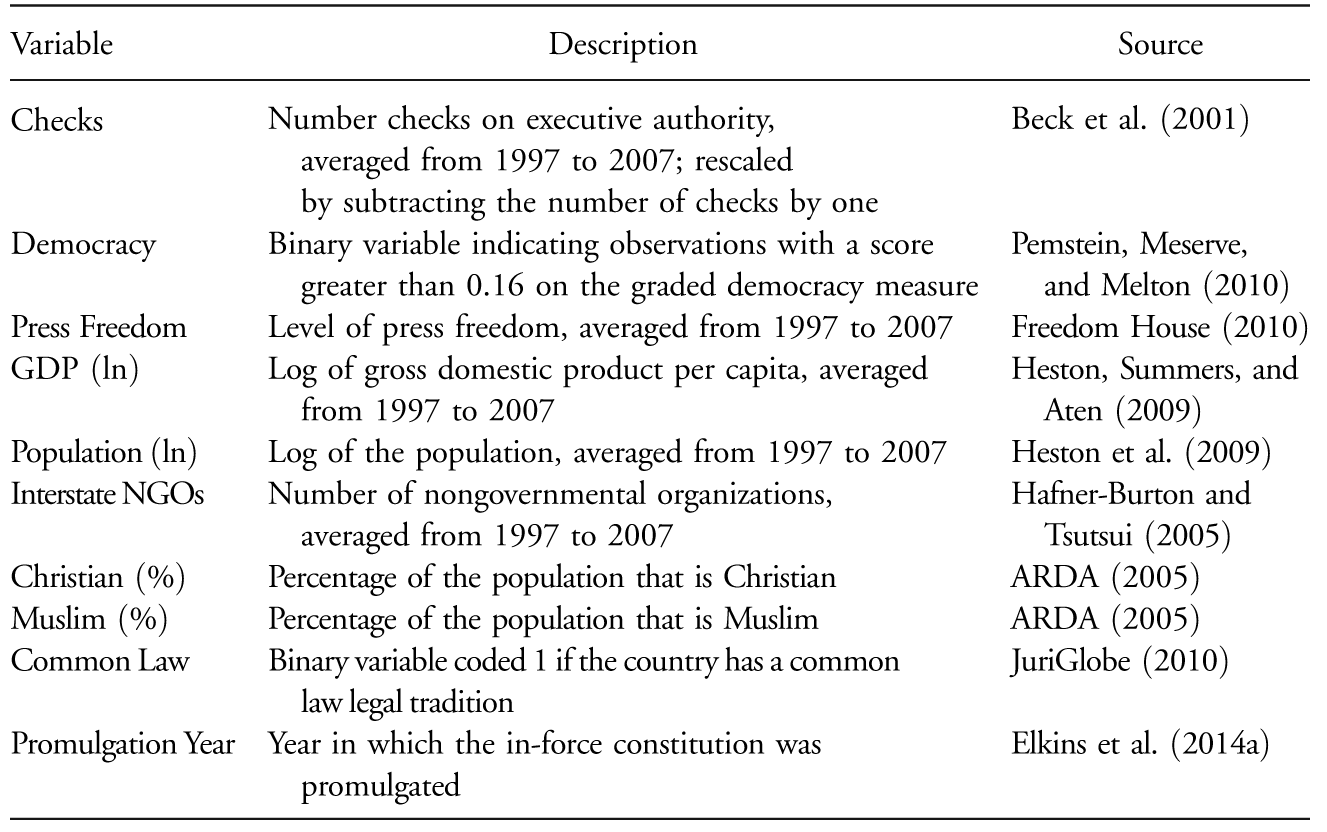
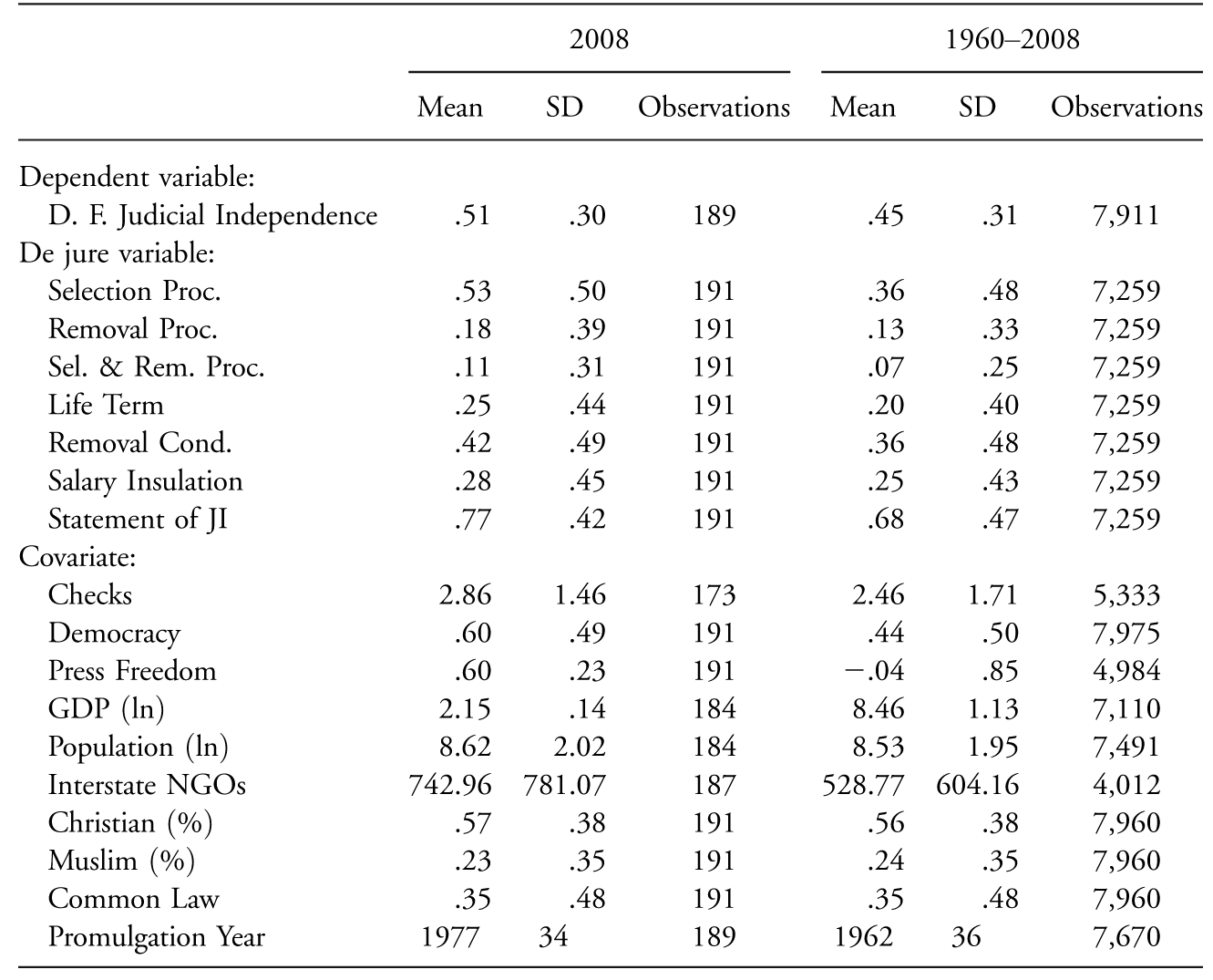
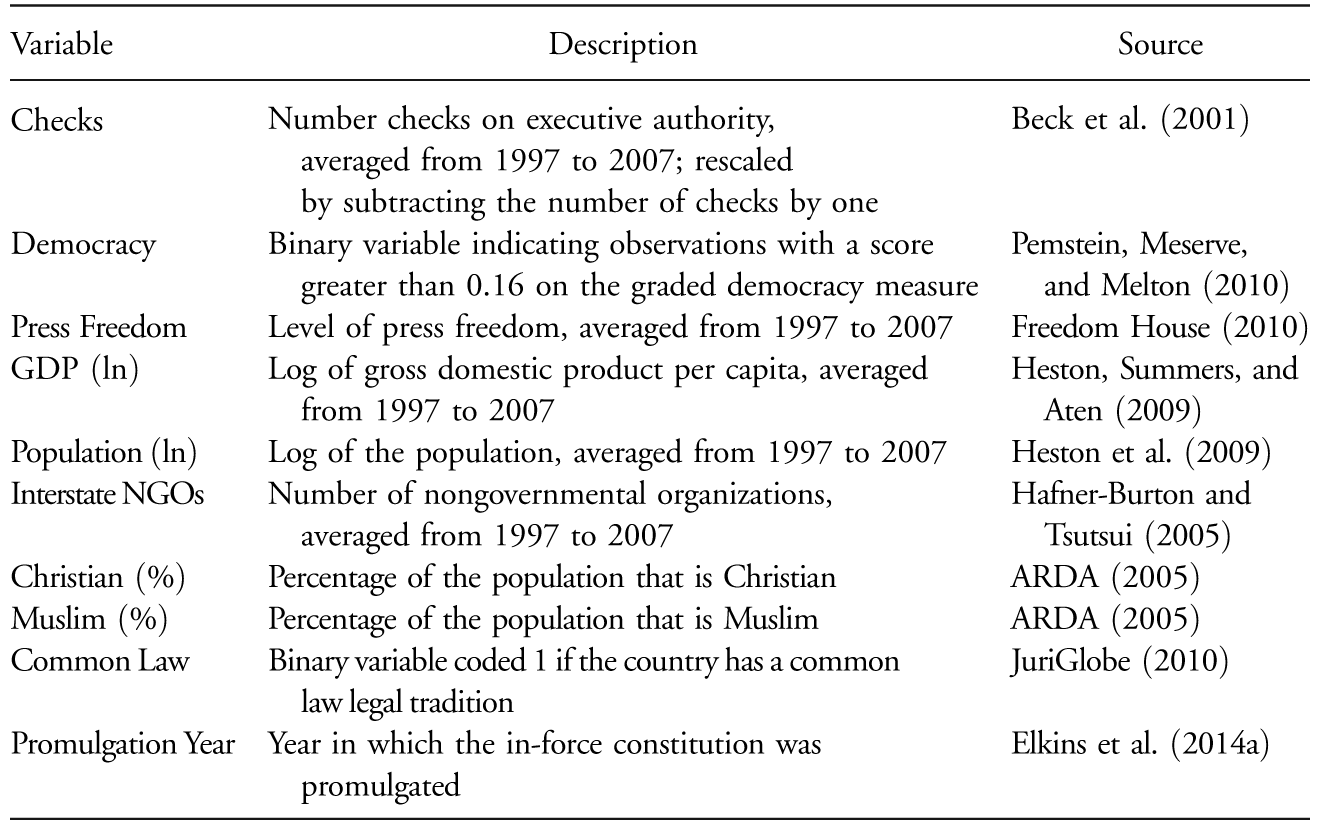
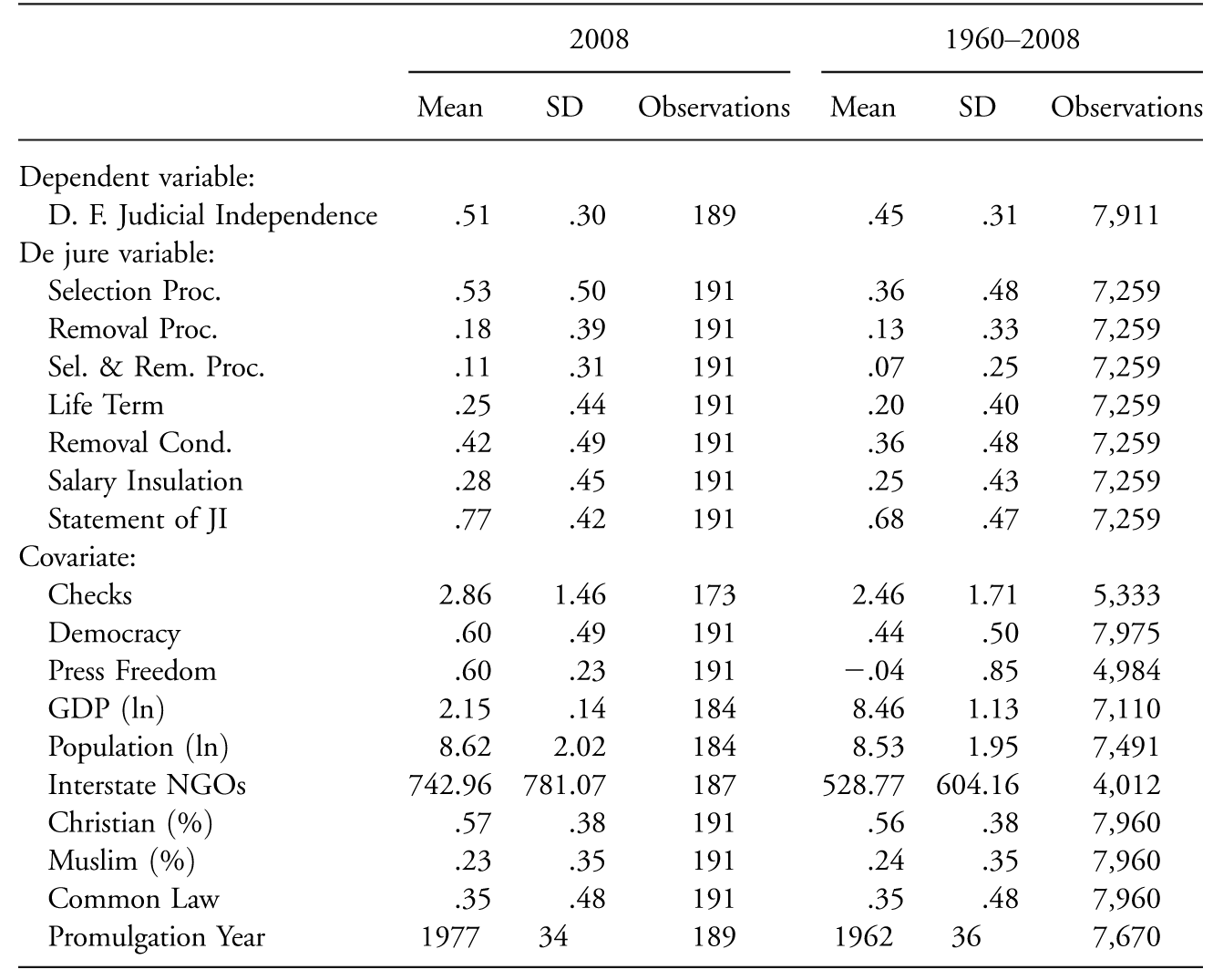
The main independent variables in our models are the measures of de jure judicial independence elaborated in the previous section. In addition, we include a number of covariates that are commonly thought to increase de facto judicial independence. These covariates include all of the variables used by Hayo and Voigt (2007) as well as a number of additional variables that we suspect affect independence in practice. Specifically, we include variables representing the number of veto points, or checks, in the political system; the level of democracy; press freedom and the number of nongovernmental organizations, which should help facilitate coordination to defend the judiciary; economic development; population size; religious composition; legal origin; the promulgation year of the constitution; and region fixed effects. Of these variables, the only one not standard in statistical models of judicial independence is the promulgation year of the constitution, which we include as a proxy for institutional stability. Descriptions of these variables are available in table 1, and summary statistics for each variable are available in table 2.
The Relationship between De Jure and De Facto Judicial Independence
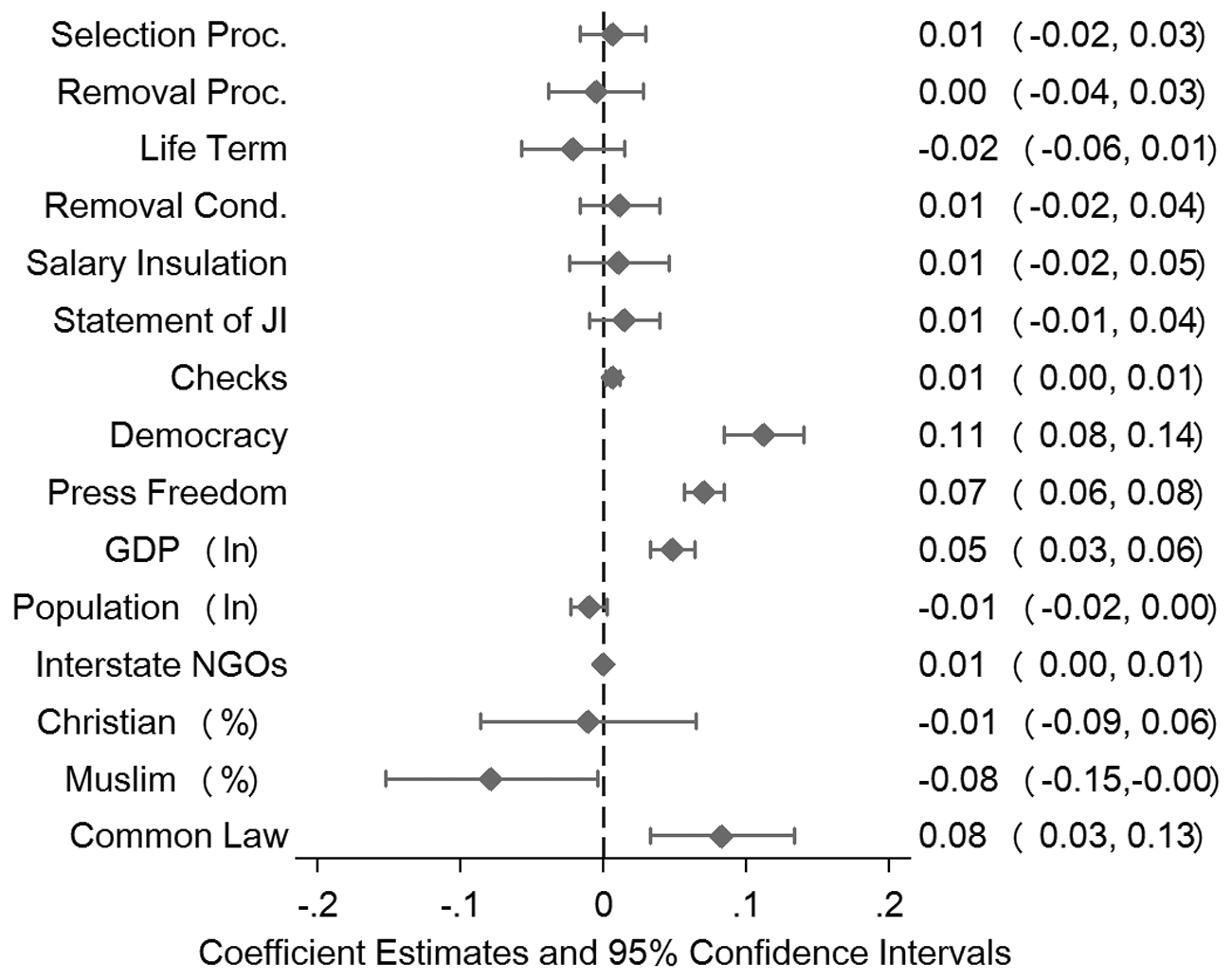
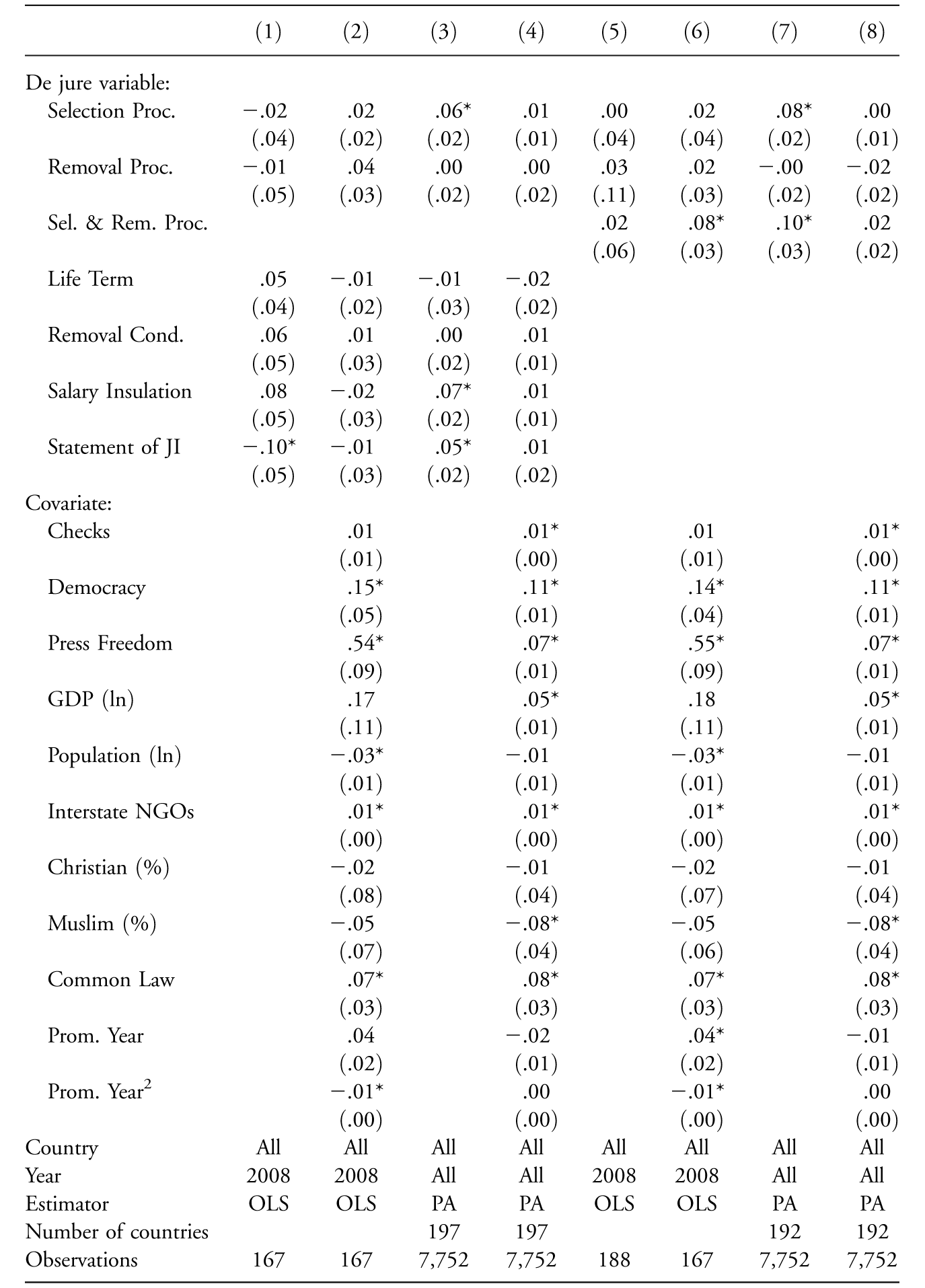
The regression results are presented in figures 3–5.Footnote 8 Figure 3 presents the results of a regression model estimated with control variables, using a population-averaged estimator. The figure illustrates the effect of several variables on de facto judicial independence. The marker associated with each variable is the point estimate from a population-averaged model, and the bar surrounding the point is the 95% confidence interval. A variable is considered statistically significant when the 95% confidence interval does not overlap the reference line.
Determinants of de facto judicial independence. Estimates are from model 4 of table A2. They are estimated using a population-averaged model. Dependent variable is Linzer and Staton’s (2012) measure of judicial independence, which is continuous and ranges from 0 to 1. Promulgation year and region fixed effects are omitted.
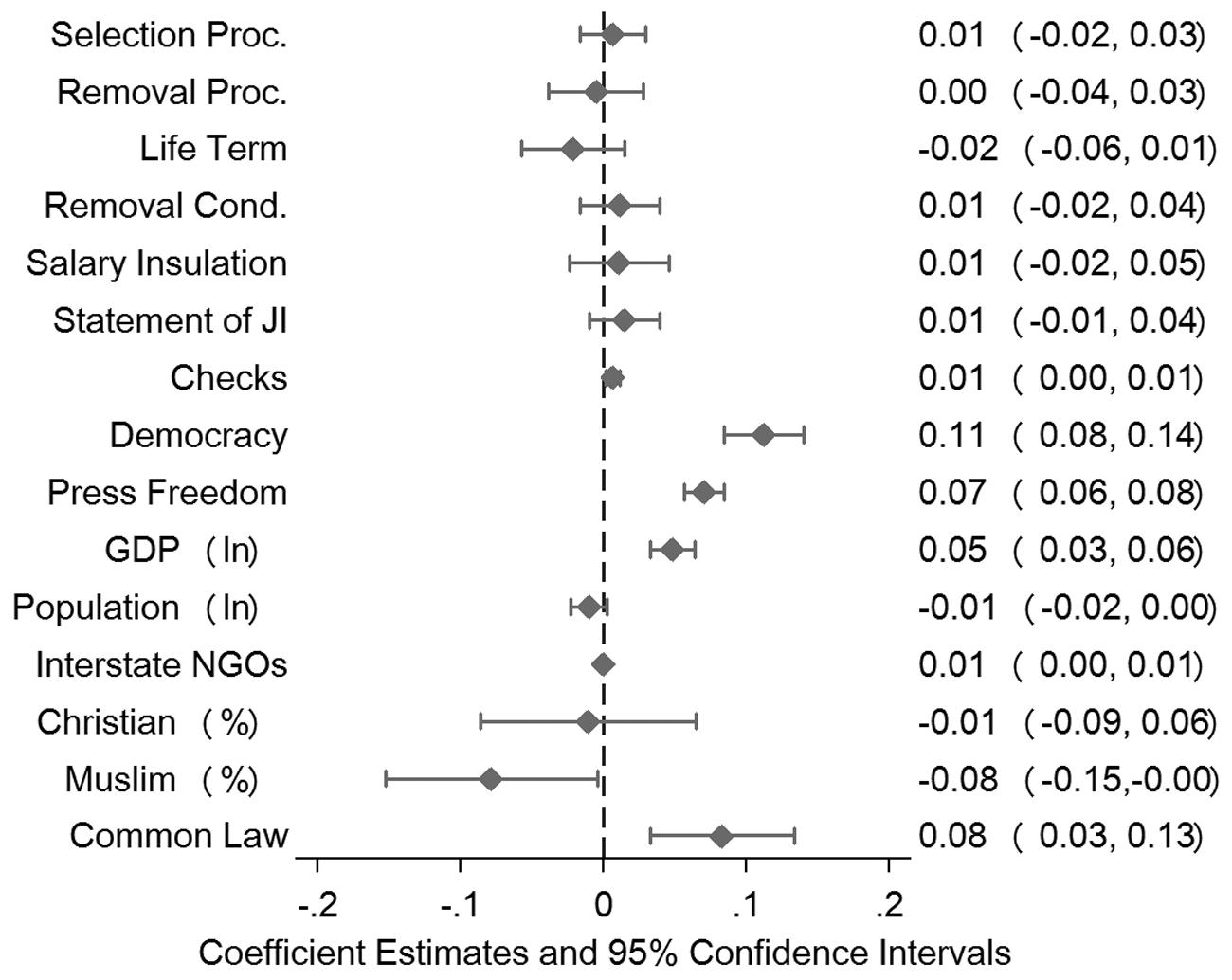
Looking first at the covariates in the figure, several are statistically and substantively significant. The level of democracy, press freedom, and economic performance all have positive and statistically significant effects on de facto judicial independence. As one might expect, democracy has one of the largest effects. On the basis of the estimates in model 8, a country with a level of democracy of 1 is expected to score about 0.11 higher on de facto judicial independence than a country with a score of 0. In other words, countries like Iran and North Korea that have the lowest levels of democracy score, on average, 0.11 points lower on Linzer and Staton’s measure than Scandinavian countries, which have the highest levels of democracy.
Press Freedom and gross domestic product (GDP) also have consistently large, positive effects on de facto judicial independence. The results from model 8 suggest that a one-unit increase in GDP leads to about a 0.05 unit increase in de facto judicial independence. The effect of GDP is interesting because it is present after controlling for the level of democracy, which means that rich authoritarian regimes may be more likely to protect judicial independence in practice. The effect of press freedom is also interesting. According to model 8, a shift from one end of the press freedom scale to the other (from a score of −1 to 1) is expected to increase de facto judicial independence by about 0.14. Not only is this a relatively large effect, but it is consistent with research arguing that public support for the judiciary is critical for its independence (Vanberg 2005; Staton 2011).
Aside from these important time-variant variables, there are also a number of time-invariant variables that seem to affect de facto judicial independence. States with a large Muslim population are less likely to have an independent judiciary. Moving from a state with no Muslims to one that is completely Muslim is expected to decrease de facto judicial independence by about 0.08. Common law countries are expected to score about 0.08 higher on Linzer and Staton’s judicial independence measure than are civil law countries. Importantly, the effects of the aforementioned covariates are relatively stable across the models we have estimated. Some of the other covariates are also statistically significant in some model specifications, but their effects are either inconsistent (e.g., population and the number of nongovernmental organizations) or small (e.g., checks).
Figure 3 tests the independent effect of all six aspects of de jure judicial independence. None of the de jure judicial independence variables are statistically significant in figure 3. Note, though, that there are some specifications in which one (or more) of these six variables is statistically significant. For instance, several of these variables become statistically significant when the covariates are removed from the model (see models 1 and 3 in table A2). Statements of judicial independence have a large and statistically significant effect on de facto judicial independence when there are no covariates in the model, although the direction of the effect is not consistent across models. In addition, when there are no covariates in the model, constitutions that provide for a selection procedure that insulates the judiciary or that insulate the judiciary’s salary from external interference significantly increase the level of de facto judicial independence.
However, as one can see from figure 3, when covariates are included, the effects of these de jure attributes disappear. This is almost certainly because many of the covariates are correlated with the attributes that we associate with de jure judicial independence. For instance, our results show that democracy is positively correlated with de facto judicial independence, and prior research suggests that it is also positively correlated with de jure judicial independence (Elkins et al. 2014b).Footnote 9 As a result, we have more faith in the estimates from figure 3 than other models we have estimated, included in the appendix. Thus, consistent with the theory elaborated above, we find that none of the de jure attributes have an independent and statistically significant effect on de facto judicial independence when control variables are included.
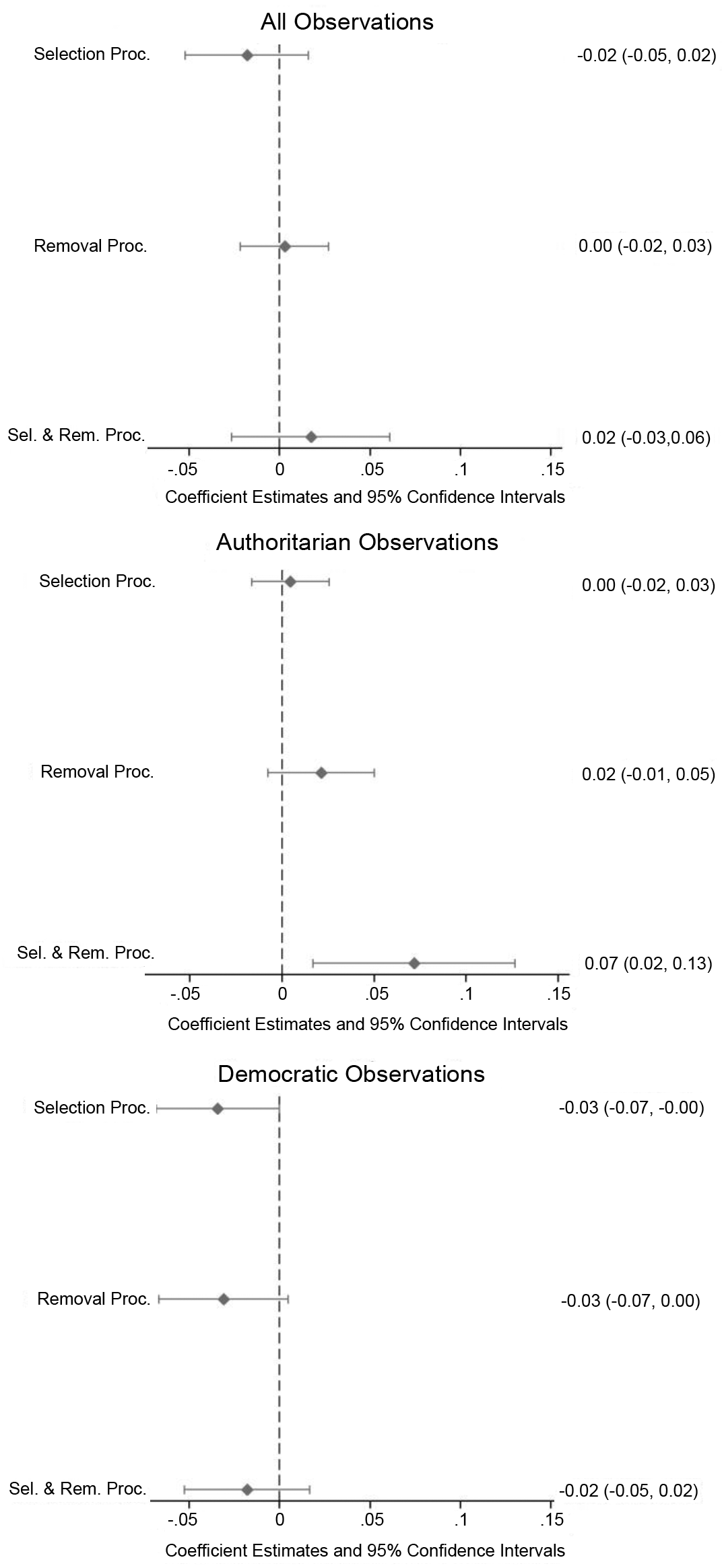
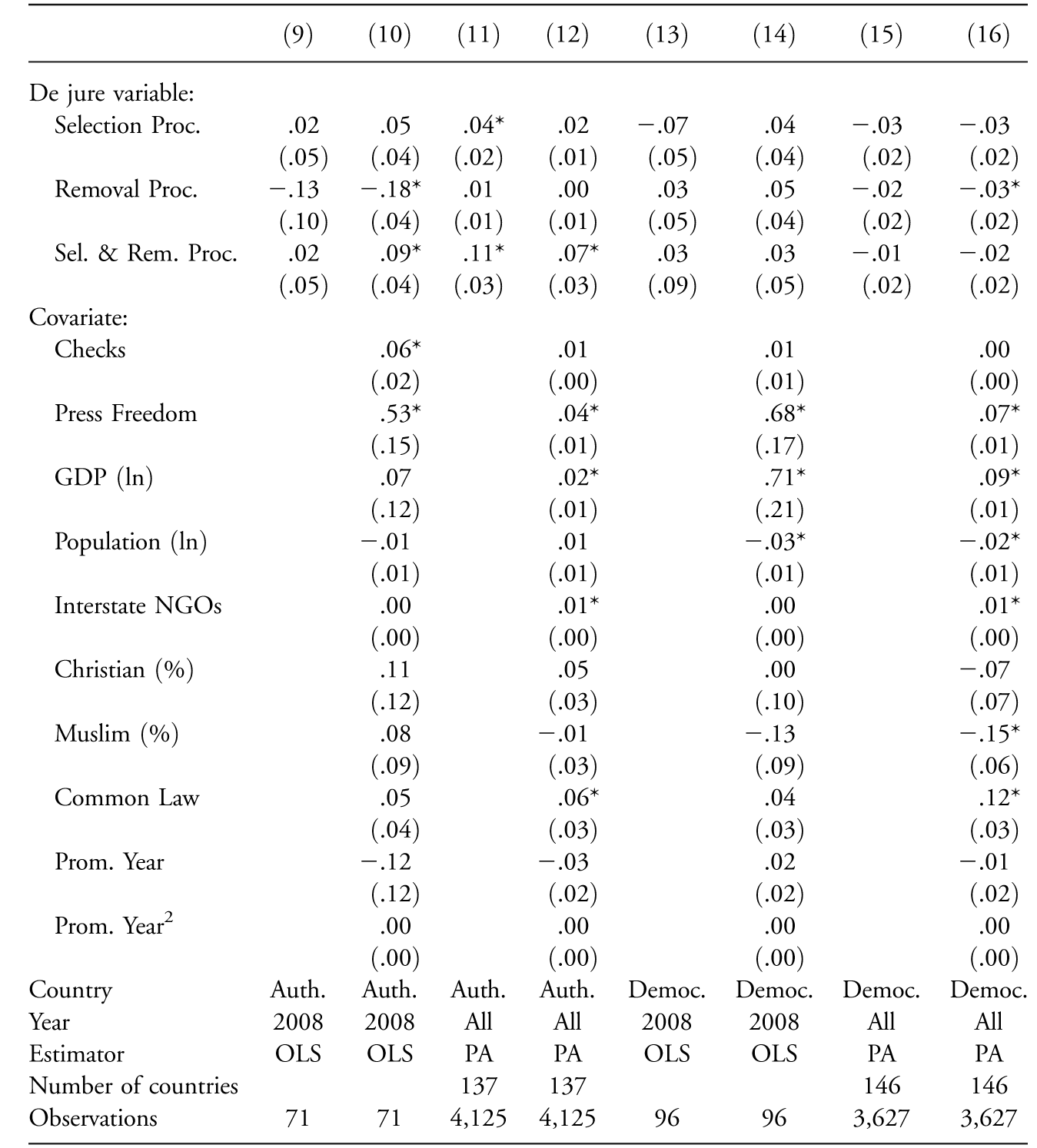
We next assessed the effect of different combinations of de jure judicial independence attributes on de facto judicial independence. To do so, we created binary variables to represent the four possible combinations of the selection and removal procedure variables: (1) neither is present in the constitution, (2) both are present, (3) only the selection variable is included, and (4) only the removal procedure is included. The results of these models are illustrated in figure 4, which estimates the effect that each of these possibilities has on de facto judicial independence. Note that the reference category in the models underlying figure 4 is the first combination listed above: constitutions without either a selection or a removal procedure expected to enhance judicial independence. Thus, the estimates represent the difference in de facto judicial independence between the reference category and the specified attribute or combination of attributes.
Effect of de jure judicial selection and removal process. Estimates are from model 8 of table A2 and models 12 and 16 of table A3. They are estimated using a population-averaged model. Dependent variable is Linzer and Staton’s (2012) measure of judicial independence, which is continuous and ranges from 0 to 1. Covariates are omitted.

None of the variables are statistically significant in the top plot of figure 4. Recall that we hypothesized that countries with both selection and removal procedures that enhanced judicial independence in their constitution would have higher levels of de facto judicial independence. Although the effect of having both selection and removal procedures that enhance judicial independence is statistically significant in some models we have estimated, the effect disappears in the populated-averaged model represented in figure 4. This suggests that, across our entire sample, there is only moderate support for our hypothesis that combining different attributes of de jure judicial independence will enhance independence in practice.
The Moderating Effect of Regime Type
Previous research suggests that regime-type affects the likelihood of observing de jure judicial independence (Elkins et al. 2014b), as well as the particular motives of those who do adopt it (Moustafa and Ginsburg 2008). This leads to our expectation, specified above, that the relationship between de jure and de facto judicial independence might vary by regime type. To test this hypothesis, we reestimated the model from the top panel of figure 4, stratifying the sample by regime type. The middle panel of figure 4 represents a model that only uses observations coded as authoritarian, and the bottom panel of figure 4 represents a model that only uses observations coded as democratic.
The estimates from the bottom two panels of figure 4 suggest that authoritarian countries with selection and removal procedures that enhance the autonomy of the judiciary have levels of de facto judicial independence around 0.07 higher (95% confidence interval = 0.02–0.13) than authoritarian countries that lack both of these attributes.Footnote 10 This is relatively large effect, about one-half of a standard deviation. Notably, the magnitude of the effect is as large as any of the covariates (not shown) that are included in the model. Only the common law variable is as large, at 0.06. The next closest is press freedom, which is about half the size at 0.04. (Note that a maximum shift in the level of press freedom, from −1 to 1, would yield an increase in de facto judicial independence of 0.08.) It seems that, at least in authoritarian countries, Hayo and Voigt’s (2007) suggestion that de jure judicial independence is the most important predictor of de facto judicial independence may be true, but only for this specific combination of de jure attributes. The same cannot be said for democratic countries. On the basis of the estimates illustrated in the bottom panel of figure 4, there appears to be no relationship between de jure and de facto judicial independence in democracies, perhaps because electoral constraints or other institutions prevent gross manipulation of the judiciary.
The effect found in figure 4 is probably surprising to some. Not only is there a fair amount of skepticism about judicial independence in authoritarian regimes, but there is equal (if not greater) skepticism about the effectiveness of parchment barriers. However, we believe the result is perfectly consistent with the developing literature on authoritarian institutions. An electoral authoritarian, in particular, might want to have courts that are independent over a certain set of cases, such as those involving the economy. But this does not mean that the electoral authoritarian wants to give up all control. In particular, if the leader has sufficient political power to control multiple branches of government, she might not be troubled by constraints on the appointment of judges. A requirement that judges be selected by multiple institutions under the leader’s indirect control might still produce a judiciary that is likely to avoid interfering with core issues of importance to the regime. Once they are in place, however, we sometimes observe judges deviating from these constraints (Moustafa 2007). Protection from removal might make judges more likely to deviate from the preferences of political leaders, since early removals are likely to be observed by both the public and opposition factions, raising costs for government.
The Moderating Effect of Checks and Balances
Our final hypothesis is that de jure judicial independence will be more effective in systems with checks on executive authority. This hypothesis is important to test, given our finding about the importance of the selection and removal procedures for judges. Even if the procedures involve multiple actors at a formal level, it is possible that one party (or interest group) might hold all of the positions of power in a system, in which case, the de jure protections established by the constitution could be easily circumvented. The party could undermine the independence of the judiciary while following the constitutionally prescribed procedures, or depending on the constitutional amendment procedure, it could amend the constitution to establish procedures that give it more influence over the judiciary.
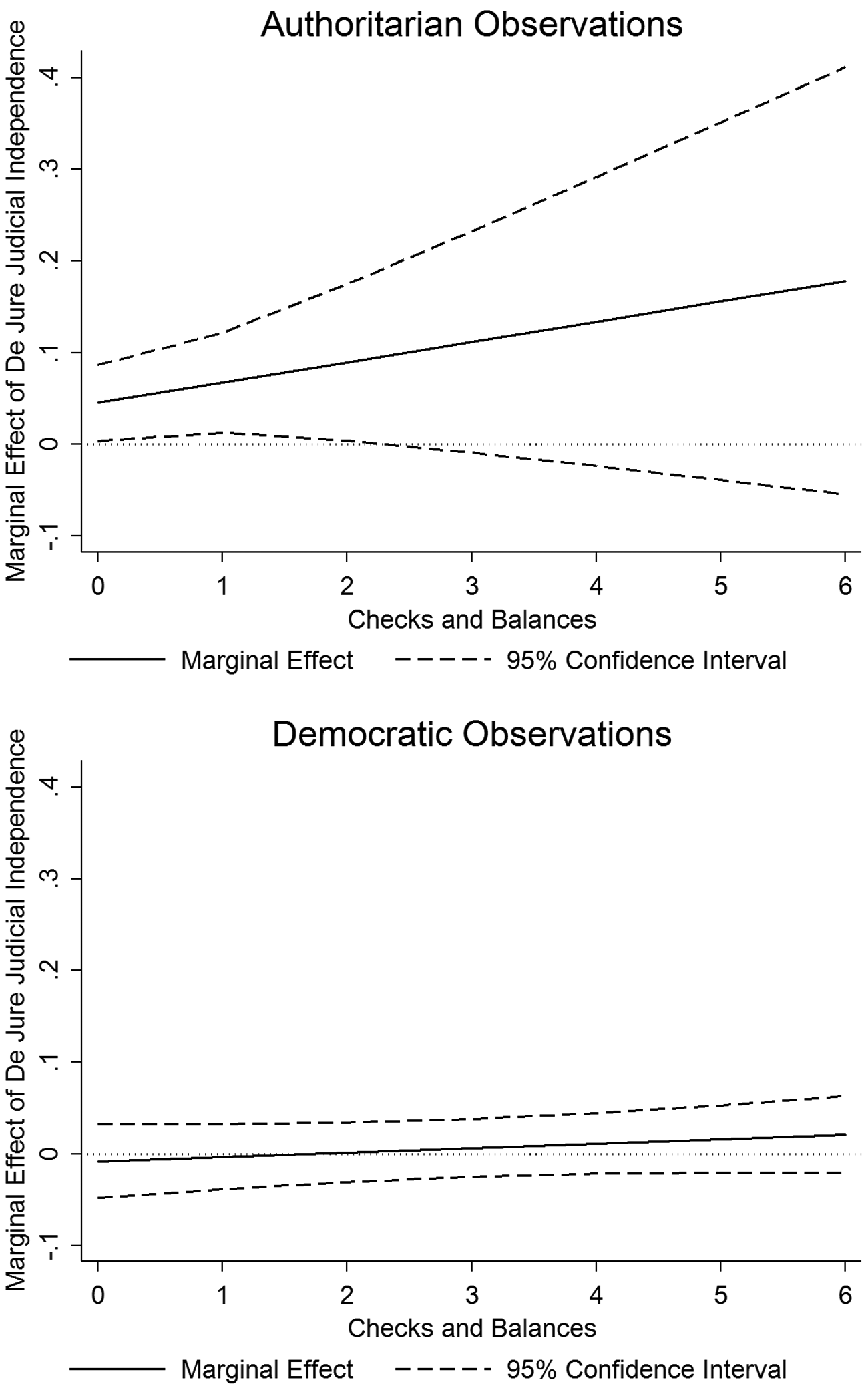
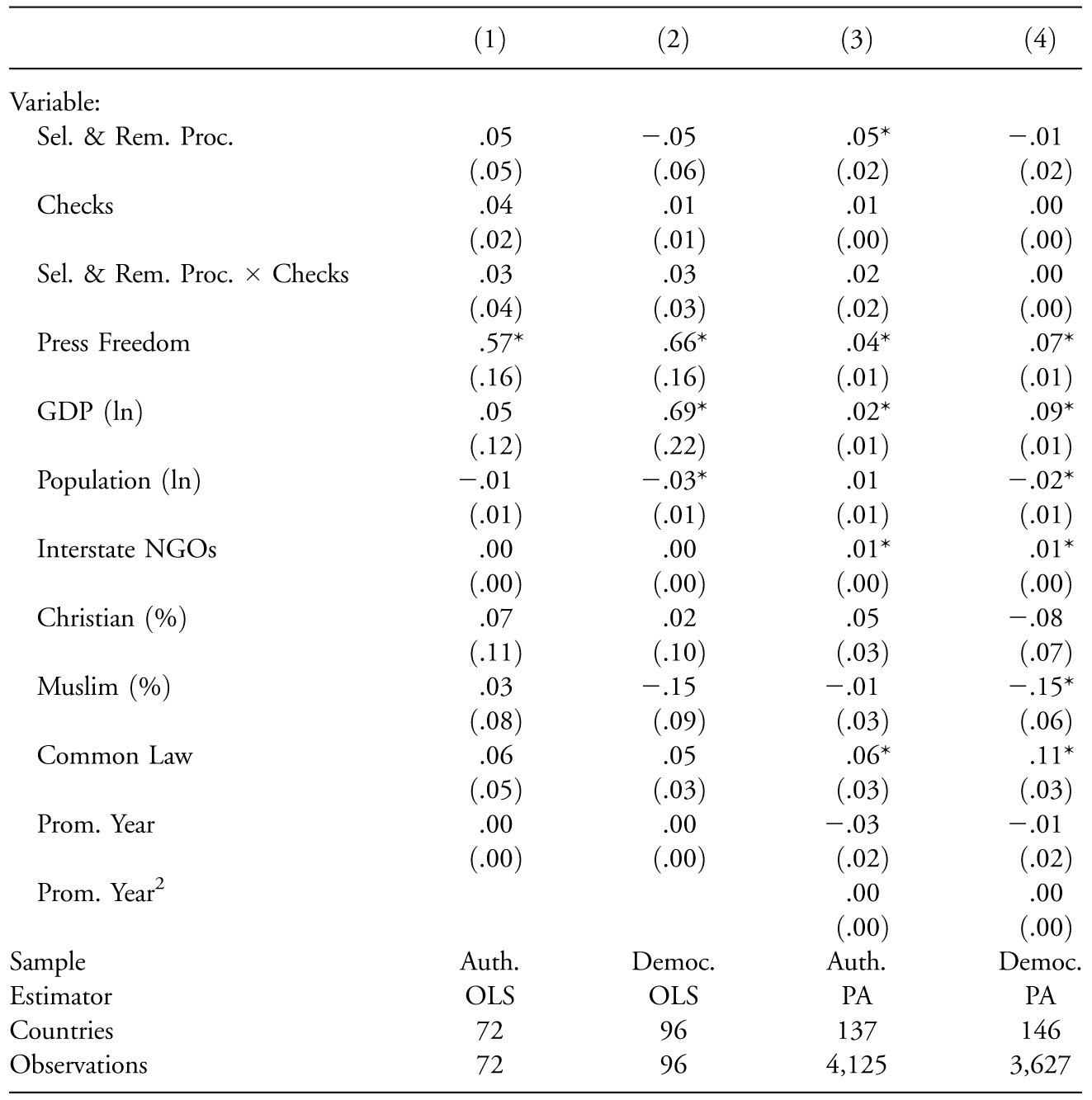
To test this hypothesis, we reestimated several models similar to those reported in figure 4 and included an interaction between the number of checks and balances (as measured by Beck et al. [2001]) and a variable indicating countries that combine selection and removal procedures that enhance independence. The results from these models are presented in figure 5.Footnote 11 The solid line indicates the marginal effect of the index as the number of checks on executive authority increases, and the two dashed lines illustrate the 95% confidence interval around that effect. As predicted, de jure protection of judicial independence has a stronger effect on de facto judicial independence in countries with checks on executive authority. Regardless of regime type, the effect of having both a selection and a removal process that enhances independence increases as the number of checks on executive authority increases. However, similar to the results reported in figure 4, the effect is only statistically significant in authoritarian regimes. In such regimes, the effect becomes statistically significant when there are one or two veto players who can check the authority of the executive. Selection and removal procedures that enhance judicial independence are expected to increase judicial independence in practice by about 0.07 when there is one veto player and about 0.09 when there are two.Footnote 12
Effect of de jure judicial selection and removal process by number of checks. Estimates are from models 3 and 4 of table A4. Dependent variable is Linzer and Staton’s (2012) measure of judicial independence, which is continuous and ranges from 0 to 1.
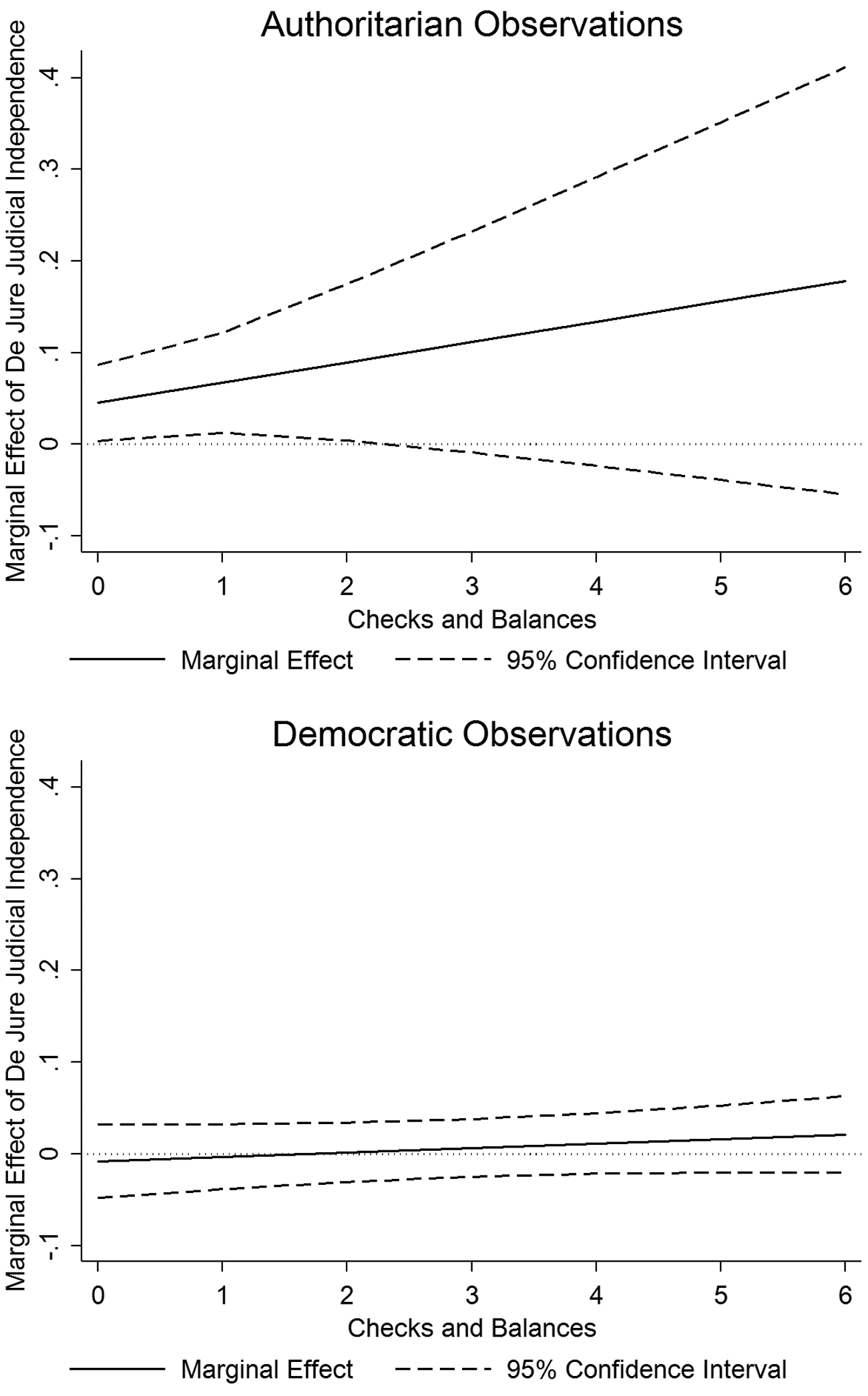
The effect of selection and removal procedures that enhance judicial independence becomes statistically insignificant when there are more than two veto players, but this is most likely due to the fact that few authoritarian regimes have such high numbers of veto players, and those that do only rarely have the critical combination of selection and removal procedures that enhance judicial independence. In fact, in authoritarian regimes, as the number of checks increases, the number of countries with such a combination of de jure attributes in their constitution drops precipitously. We only observe the relevant combination in 84 country-years when there are zero checks, in 56 country-years when there are one or two checks, and in 9 country-years when there are three or more checks. These numbers are important in two respects. First, they suggest that the results in figure 5 are based on only a few country-years, which limits their generalizability. Second, they suggest the possibility, which we do not explore here, that authoritarian regimes may be strategic in their entrenchment of selection and removal procedures that enhance judicial autonomy, since they seem to be more likely to do so when there are no veto players to prevent them from manipulating those procedures.
Looking at the panel for democratic regimes, the marginal effect of de jure judicial independence is increasing in the number of checks and balances, but the 95% confidence interval overlaps the reference line regardless of the level of checks and balances, indicating that the effect is not statistically significant. One explanation for this finding is that the democratic countries with the highest levels of de facto judicial independence tend to be the countries with older constitutions, which tend to have weaker de jure protection of judicial independence. Thus, the null results presented in figure 5 might be caused by the fact that older democracies have found alternative mechanisms of guaranteeing de facto judicial independence. This in turn suggests that we might find the hypothesized relationship if we restrict our analysis to newly democratized countries.Footnote 13
Restricting the analysis to only those democracies that experienced one or more regime transitions from 1960 to 2008 does slightly change the results.Footnote 14 In this set of countries, when the number of veto players is five or greater, the marginal effect of selection and removal procedures that enhance judicial independence in practice is statistically significant at the 90% level. Thus, there is some evidence that selection and removal procedures designed to enhance de facto judicial independence are effective in transitional democracies.
To summarize the statistical analysis, our results confirm neither the estimates presented in Hayo and Voigt (2007) nor the views of those skeptical of the role that parchment plays in creating an independent judiciary. We find that de jure judicial independence is correlated with de facto judicial independence, but the effect is limited to those provisions that are self-enforcing as a result of competition between the executive and legislative branches. Specifically, we find that constitutions with processes that involve multiple bodies in the selection and removal of judges are associated with higher levels of judicial independence. This finding is restricted to contexts with checks on the authority of the executive and in authoritarian regimes.
Conclusion
The literature on the relationship between de jure and de facto judicial independence is still very small and, in many ways, has proceeded without a theory of why text might make a difference in practice. Drawing on the literature on self-enforcing constitutions, we expect that de jure protections that rely on multiple constitutional actors to check one another will be more effective than those that lack obvious mechanisms for self-enforcement. Our theory allows us to differentiate among various de jure protections of independence. Because clever politicians can exploit the absence of any single de jure protection for judicial independence, we argue that protections ought to work in tandem with one another, so that their impact is likely to be conjunctive rather than additive.
Our analysis draws on new data from the CCP to examine the relationship between de jure and de facto independence. We compared the CCP data on de jure independence with the increasingly influential new measure of de facto independence by Linzer and Staton. We find support for our hypotheses, and in particular, we show that rules governing the selection and removal of judges are the most important protections for judicial independence. The effect of selection and removal procedures that enhance judicial independence is most pronounced in authoritarian regimes with checks and balances. We observe little (if any) effect in democratic regimes but find some evidence for the effect in new democracies.
This result helps us understand why, over the last 25 years, increases in de jure protection of judicial independence have not been followed by similar increases in de facto judicial independence. The most effective components of de jure judicial independence, those related to the selection and removal of judges, are still relatively rare in contemporary constitutions. Only 11% of constitutions in force in 2009 contained selection and removal procedures that protected the judiciary from interference by the other branches of government.
The results reported here also help us understand the tension in the existing literature. The positive relationship between de jure and de facto judicial independence reported by Hayo and Voigt (2007) is largely driven by their use of an additive index, which masks heterogeneity in the effectiveness of different aspects of de jure judicial independence. The lack of a relationship found by other scholars is perhaps the result of case selection, given how rarely constitutions entrench effective de jure protection of judicial independence. For instance, two recent empirical studies find no relationship between de jure and de facto judicial independence in postcommunist countries (Smithey and Ishiyama Reference Smithey and Ishiyama2002; Herron and Randazzo Reference Herron and Randazzo2003). However, few postcommunist constitutions establish protections for both selecting and removing judges, and, importantly, none of the cases analyzed by the aforementioned studies had such protection.
Our findings in this study have important practical implications. A broad consensus has emerged over the last 20 years that an independent judiciary is desirable. However, moving from a desire for judicial independence to effective practice has proven to be a challenge that has been exacerbated by contradictory findings in prior studies about the role of formal institutions in creating an independent judiciary. Our results clarify which aspects of de jure judicial independence enhance judicial independence in practice and identify the conditions under which de jure protection is most effective. Our results suggest that de facto judicial independence might be improved if countries adopt both selection and removal procedures that insulate judges from the other branches of government.
The results reported here also have implications for understanding the effectiveness of constitutions as so-called parchment barriers. Our results suggest that certain constitutional provisions are associated with judicial independence in practice, and this is an interesting result all on its own. It is even more interesting when one considers that an independent judiciary is often given the responsibility for interpreting and enforcing the constitution. Thus, a logical hypothesis one could derive from our results is that there may be better compliance with constitutional provisions unrelated to the judiciary (such as constitutional rights) in constitutions with the specified judicial selection and removal procedures than in countries without such protections. The idea that effective de jure protection of the judiciary can enhance overall compliance with the constitution is an intriguing possibility that is worth testing in future research. Finding such a relationship would suggest that constitutional drafters have some power over whether their products are merely parchment barriers or something more.
Appendix

Note—Coefficient estimates from least squares (OLS) and population-averaged (PA) regression models with de facto judicial independence as the dependent variable. Robust standard errors are in parentheses. Constant and binary variables indicating region are omitted.
* p < .05.

Note—Coefficient estimates from least squares (OLS) and population-averaged (PA) regression models with de facto judicial independence as the dependent variable. Robust standard errors are in parentheses. Constant and binary variables indicating region are omitted. Auth. = authoritarian; democ. = democratic.
* p < .05.
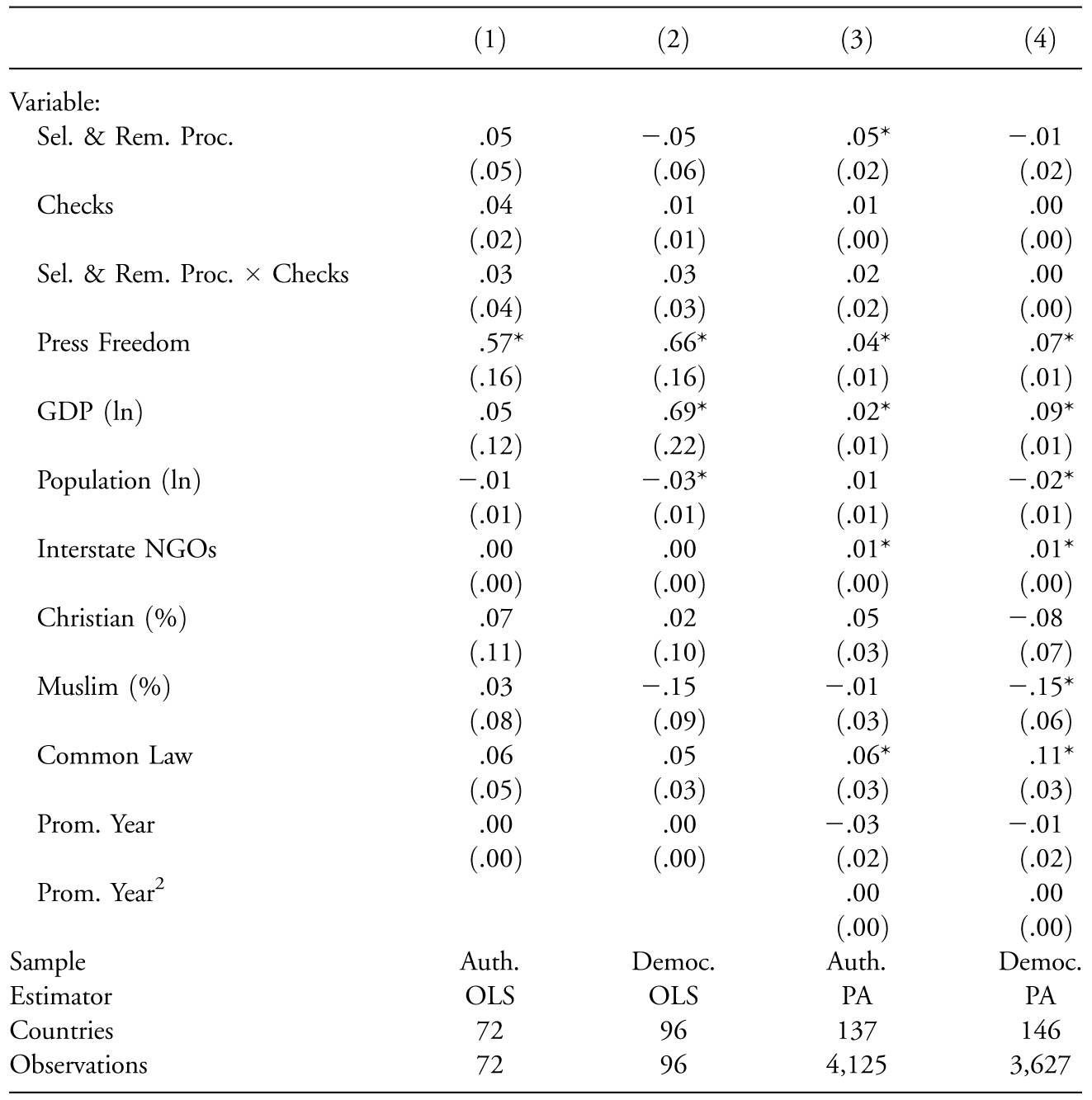
Note—Models 1 and 2 contain estimates from least squares (OLS) regression models; models 3 and 4 contain estimates from population-averaged (PA) models. De facto judicial independence is the dependent variable, and robust standard errors are in parentheses. Multiple imputation was used before estimation of models 3 and 4 to ensure that missing data do not bias the estimates. Estimates from the imputed data sets are combined using Rubin’s rules. The constant is omitted from the table, and region fixed effects are omitted from the models. Auth. = authoritarian; democ. = democratic.
* p < .05.