INTRODUCTION
The pink shrimp is a commercial fishing category composed of Farfantepenaeus brasiliensis (Latreille, 1817) and Farfantepenaeus paulensis (Pérez-Farfante, Reference Pérez Farfante and Kensley1967), which are typical penaeids species exhibiting a short life cycle of anfibiotic type, where reproduction and spawning typically occurs offshore and the development phase, from post-larvae to juvenile, occurs into estuaries and coastal lagoons, which are considered nursery areas (Dall et al., Reference Dall, Hill, Rothlisberg, Staples, Blaxter and Southward1990; Pérez-Castañeda & Defeo, Reference Pérez-Castañeda and Defeo2004). Farfantepenaeus brasiliensis is widely distributed from North Carolina to Rio Grande do Sul, whereas Farfantepenaeus paulensis is distributed from Cabo Frio to the North of Argentina (Pérez-Farfante, Reference Pérez-Farfante1969).
The penaeid exploitation is of major global economic importance and represents the largest part of the fishery market's demand of the world. Brazil is the 14th most productive country on the shrimp fisheries (Gillet, Reference Gillet2008) and F. brasiliensis and F. paulensis are among the mostly exploited species of this group (D'Incao, Reference D'Incao1991; Valentini et al., Reference Valentini, D'Incao, Rodrigues, Neto and Rahn1991; Severino-Rodrigues et al., Reference Severino-Rodrigues, Pita, Graça-Lopes, Coelho and Puzzi1992; D'Incao et al., Reference D'Incao, Valentini and Rodrigues2002; Costa et al., Reference Costa, Fransozo, Castilho and Freire2005). Despite their presence in the list of ‘National Fishes and Aquatic Invertebrate Species Overexploited and Threatened of Overexploitation' (IBAMA, 2004) both species still represent 20–30% of the annual shrimp landing on the Brazilian coast according to ‘The Brazilian Institute of Environment and Renewable Natural Resources'—IBAMA, between 2000 and 2007 (IBAMA, 2007).
Besides the species coexistence and the economic and social importance of the category, studies are essentially conducted on the southern Brazilian coast, specifically at Santa Catarina and Rio Grande do Sul States. Moreover, they recurrently focus only on F. paulensis (D'Incao et al., Reference D'Incao1991; Peixoto et al., Reference Peixoto, Cavalli, D'Incao, Milach and Wasielesky2003, Reference Peixoto, Cavalli and Wasielesky2005; Dumont et al., Reference Dumont, D'Incao, Santos, Maluche and Rodrigues2007), leaving a regional gap of knowledge on their biology and behaviour in south-eastern Brazil. In order to have an appropriate management, which guarantees the stocks' livelihood it is mandatory to know about the life cycle of the species on regional scale (Fernandes-Góes et al., Reference Fernandes-Góes, Fransozo and Góes2005), and particularly the reproductive dynamics because it is the process of population renewing (Dumont & D'Incao, Reference Dumont and D'Incao2004). For example, the size at first maturation is used as minimum landing size of the commercially exploited species (Vazzoler, Reference Vazzoler1996) and its estimation allows the expectation of each individual to reproduce at least once during its life, ensuring the maintenance of the resource (López-Martínez et al., Reference López-Martínez, Rábago-Quiroz, Nevárez-Martínez, García-Juarez, Rivera-Parra and Chávez-Villalba2005). Therefore, the aim of this work is to present the reproductive patterns of F. brasiliensis and F. paulensis indicating the reproductive period and the estimates of the size at first maturation for these species contributing with significant information to promote the development of an appropriate management for the pink shrimp fisheries in south-eastern Brazil.
MATERIALS AND METHODS
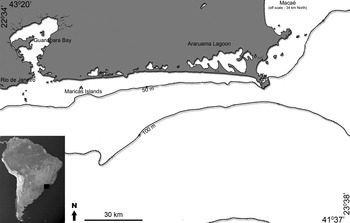
The surveys were conducted monthly from September 2007 to August 2009 at three sampling areas (Figure 1): Guanabara Bay (22°24′ and 22°57′S and 42°33′ and 43°19′W), between four and 18 m deep; Araruama Lagoon (22°50′ and 22°57′S and 42°00′ and 42°44′W) at 1 m deep; and the collections offshore occurred between 40 and 80 m deep between Maricás Islands (west limit—23°04′40″S and 43°04′53″W) and Macaé (east limit—22°34′08″S and 41°40′28″W). Samples were collected with bottom trawls by the artisanal fleet in Guanabara Bay with a net mesh of 20 mm and 16 mm at the bagger and by the industrial fleet offshore with a net mesh of 90 mm and 45 mm at the bagger. At Araruama Lagoon trawling was operated manually (80 m long with a net mesh of 10 mm).
Location of the sampling areas offshore along Rio de Janeiro State and at the fishing grounds including Guanabara Bay and Araruama Lagoon.

The specimens that were analysed from Guanabara Bay and Araruama Lagoon corresponded to the whole sample from a single monthly trawling, in each of these areas. Whereas that from offshore, captured by the industrial fleet, corresponded only to the first thirty kilos of pink shrimp individuals, acquired from one or more trawling, depending on the amount of each sample. There were no samples in March and April 2009, because of the closed season.
In laboratory all specimens were classified according to sex, weighed to nearest 0.1 g and measured (total length (TL) and carapace length (CL)) to nearest 0.1 mm. To analyse the reproductive parameters only gonads of females were used due to their bigger size and easier macroscopic observation (Dumont & D'Incao, Reference Dumont and D'Incao2004). Sixty females of both species from each sample were dissected out for gonad weighing and observation of their coloration. The maturation stage was classified according to a gonadal colour table for Farfantepenaeus paulensis based on histological procedures (Dumont et al., 2007). According to the colour table the gonads were classified as immature, maturing, ripe and spent.
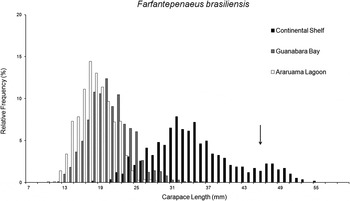
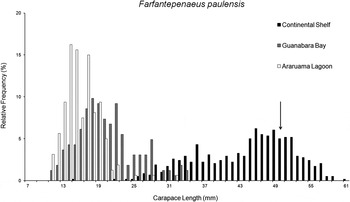
In order to avoid an overestimation of the L50 due to the difficulty to discriminate macroscopically the gonads of the immature stage from the spent or recovering stage (Cha et al., Reference Cha, Oh, Hong and Park2002; Peixoto et al., Reference Peixoto, Cavalli and Wasielesky2005) a histogram of frequencies of occurrence by CL classes of individuals presenting gonads staining relative to the immature stage was analysed. The latest mode of the histogram was considered to separate immature from spent/recovering stage. Therefore, for F. brasiliensis all individuals up to 46 mm of CL were considered as spent/recovering (Figure 2). For F. paulensis all individuals up to 50 mm of CL were considered as spent/recovering (Figure 3).
Individuals with gonads referring to the immature stage of Farfantepenaeus brasiliensis. The arrow indicates the size-class (carapace length, mm) where the individuals began to be considered at the stage spent/recovering.

Individuals with gonads referring to the immature stage of Farfantepenaeus paulensis. The arrow indicates the size-class (carapace length, mm) where the individuals began to be considered at the stage spent/recovering.

Size at first maturation (L50) was estimated by fitting the frequency of mature females to a logistic model calculated by the expression: P = 1/1 + e(−r.(Cl–Lm)), where P is the relative frequency of occurrence of ripe females, r is the slope of the curve and Lm is the size at first maturation.
The reproductive period was based on the frequency analysis of mature females, employing only the data collected offshore by the industrial fleet; there are no females at that stage within the breeding areas (Guanabara Bay and Araruama Lagoon). The analysis of gonadosomatic index (GSI) was used to corroborate the reproductive period: GSI = GW/CW * 100; CW = TW – GW, where GW is the gonadal weight, TW is the total weight, and CW is the body weight. Even varying a little from the conventional GSI formula, applying this form of calculus it is possible to highlight deep variations on the physiology of the ovaries (Vazzoler, Reference Vazzoler1996). To verify if there was significant difference between the GSI along the study period one-way analysis of variance and a Tukey a posteriori test were used. All seasonal analyses were grouped bimonthly, so the months of closed season could be grouped together and the seasonal sexual proportion was verified by a Chi-square test (Zar, Reference Zar1999).
RESULTS
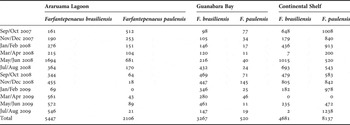
Farfantepenaeus brasiliensis was the most captured penaeid species in this work (Table 1), with 13.433 specimens representing 55.48% of the total catch, while Farfantepenaeus paulensis represented 44.52%, with 10.779 specimens. The same occurred considering the samples from Guanabara Bay and Araurama Lagoon, where F. brasiliensis represented 86.27% and 72.13% of the total captured, respectively. Considering only the industrial fleet collection offshore, the contribution of F. paulensis was higher than F. brasiliensis with 63.49% of the production and 8.139 individuals. Farfantepenaeus brasiliensis contributed with 4.680 individuals (36.51%) in this site.
Total of captured individuals per bi-month and sample area.

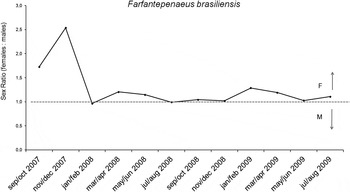
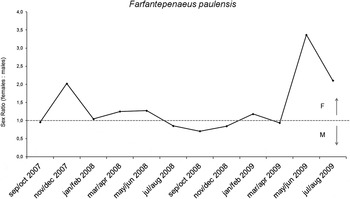
The Chi-square test demonstrated that the sex-ratio of the pink shrimp during the period of this study was favourable to the number of females (F. brasiliensis—χ2 = 60.34; F. paulensis—χ2 = 118.01; P < 0.05), however there was a variation between the months (Figures 4 & 5).
Bimonthly variation of the sex-ratio of Farfantepenaeus brasiliensis. Dotted lines indicate a ratio of 1:1 (female: male).

Bimonthly variation of the sex-ratio of Farfantepenaeus paulensis. Dotted lines indicate a ratio of 1:1 (female: male).

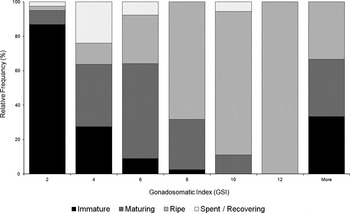
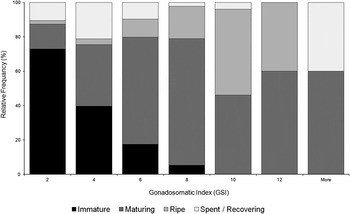
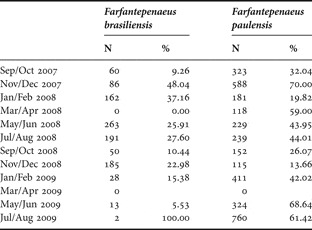
As expected, females with reproductive activity begun were verified only offshore, as well as ripe females. Table 2 shows the percentage of mature females from the mentioned area for each period of study. The relation of the values of GSI in each stage was well set for the two species, with the lowest values of GSI related to immature and spent/recovery stages and the highest values to the ripe stage (Figures 6 & 7). With this information was estimated the females’ size at first maturity (L50) for F. brasiliensis in 37.90 mm of CL and for F. paulensis in 41.95 mm of CL. Offshore 60.85% of the F. brasiliensis females and 29.37% of F. paulensis females caught by the industrial fleet were smaller than the calculated L50. At Guanabara Bay and Araruama Lagoon, for both species, all females caught were below this body length.
Relative frequency of occurrence of the gonadosomatic index values of Farfantepenaeus brasiliensis in each stage of gonadal maturation.

Relative frequency of occurrence of the gonadosomatic index values of Farfantepenaeus paulensis in each stage of gonadal maturation.

Total number (N) and percentage (%) of mature females collected by the industrial fleet at continental shelf area.

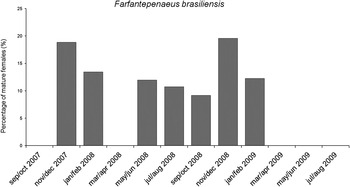
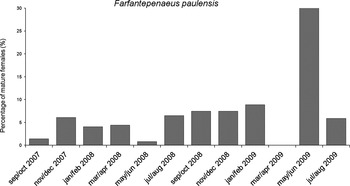
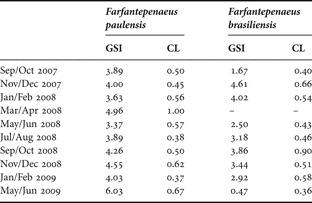
The frequency of occurrence of ripe females (Figures 8 & 9) demonstrated that during all the studied period the pink shrimp presented reproductive females. The GSI analysis demonstrated periods of greatest gonad activity as an indicator of spawning season (Table 3). For F. brasiliensis these spawning peaks occurred from November 2007 to February 2008 and again in November/December 2008. For F. paulensis the reproductive peaks were featured in March/April 2008, January/February 2009 and between May and August 2009.
Bimonthly variation of the frequency of occurrence of mature females of Farfantepenaeus brasiliensis.

Bimonthly variation of the frequency of occurrence of mature females of Farfantepenaeus paulensis.

Values of gonadosomatic index (GSI) for Farfantepenaeus brasiliensis and Farfantepenaeus paulensis captured offshore along the period of study (CL, confidence limits; 95%).

DISCUSSION
The sex-ratio of the pink shrimp in this study was favourable to the number of females as generally observed for penaeids (Cha et al., Reference Cha, Oh, Hong and Park2002; Peixoto et al., Reference Peixoto, Cavalli and Wasielesky2005). It has already been suggested that this difference is a strategy to guarantee the reproduction (Peixoto et al., 2005) and may be related to the dimorphism in growth of males and females of this family (Branco & Verani, Reference Branco and Verani1998a, Reference Branco and Veranib; López-Martínez et al., Reference López-Martínez, Rábago-Quiroz, Nevárez-Martínez, García-Juarez, Rivera-Parra and Chávez-Villalba2005; Yamada et al., Reference Yamada, Kodama, Yamakawa, Horiguchi and Aoki2007). Males have higher constant growth (k) reaching their asymptotic lengths earlier than females (Garcia & Le Reste, Reference García and Le Reste1986; Albertoni et al., Reference Albertoni, Palma-Silva and Esteves2003) driving dissimilarities in mortality rates. Such disparities are common in decapods and can be related to differences in behaviour and migration between regions (Fernandes-Góes et al., Reference Fernandes-Góes, Fransozo and Góes2005; Keunecke et al., Reference Keunecke, Silva Junior, Vianna, Verani and D'Incao2009).
The values of GSI observed for pink shrimp proved to be associated with maturation stages, with some overlap between them. The same pattern was verified by Yamada et al. (Reference Yamada, Kodama, Yamakawa, Horiguchi and Aoki2007) for Trachysalambria curvirostris and by Peixoto et al. (Reference Peixoto, Cavalli, D'Incao, Milach and Wasielesky2003) for Farfantepenaeus paulensis, both species of the family Penaeidae. Moreover, this analysis was sensitive to distinguish which size-class should be considered the spent/recovery stage from immature stages (Dumont et al., Reference Dumont, D'Incao, Santos, Maluche and Rodrigues2007).
From the frequency of occurrence of ripe females and monthly GSI analysis the reproductive period of pink shrimp in two main peaks over a year was verified. Although this work has dealt with individuals collected during two years, only one of the major peaks of spawning was corroborated in the second year for both species, due to the lack of individuals collected because of the closed season from March to May.
Farfantepenaeus brasiliensis presented higher spawning frequencies in the summer and winter months, while F. paulensis presented higher spawning frequencies in the autumn and summer months. Both sets of results agree with studies which verified a continuous spawning for many penaeid species throughout a year with two periods of higher importance (Isaac et al., Reference Isaac, Dias Neto and Damasceno1992; Crocos et al., Reference Crocos, Parck, Die, Warbuton and Manson2001; Dumont et al., Reference Dumont, D'Incao, Santos, Maluche and Rodrigues2007). The reproduction occurs in response to environmental factors such as the rainfall and temperature, which modify the percentage of ripe females in the population (Dall et al., Reference Dall, Hill, Rothlisberg, Staples, Blaxter and Southward1990; Dumont & D'Incao, Reference Dumont and D'Incao2004) that may vary between years and species (Crocos et al., Reference Crocos, Parck, Die, Warbuton and Manson2001; Cha et al., Reference Cha, Oh, Hong and Park2002; Peixoto et al., 2002, Reference Peixoto, Cavalli, D'Incao, Milach and Wasielesky2003; López-Martínez et al., Reference López-Martínez, Rábago-Quiroz, Nevárez-Martínez, García-Juarez, Rivera-Parra and Chávez-Villalba2005; Dumont et al., Reference Dumont, D'Incao, Santos, Maluche and Rodrigues2007). Such environmental oscillations could influence deeply the differential behaviour between F. brasiliensis and F. paulensis, which will respond in its own way to these changes. Besides which, the continental shelf along Rio de Janeiro State is not the main reproduction and spawning area for F. paulensis (D'Incao et al., Reference D'Incao, Valentini and Rodrigues2002).
Pérez-Farfante (Reference Pérez-Farfante1969) defined in 25 mm of carapace length (CL) the minimum size of adults of Farfantepenaeus and Branco & Verani Reference Branco and Verani(1998a, Reference Branco and Veranib) defined in 105 mm of total length (TL), around 23.7 mm of CL, the size of adults of F. brasiliensis and in 115 mm of TL, corresponding to 25.5 mm of CL, the size of F. paulensis. These estimates are lower than those found in this study of 37.9 mm of CL for F. brasiliensis and 41.9 mm of CL for F. paulensis. Pérez-Farfante (Reference Pérez-Farfante1969) and Branco & Verani Reference Branco and Verani(1998a, Reference Branco and Veranib) took into account only the morphology of the organisms to classify them as adults or not, but usually the morphological maturity of crustaceans does not occur synchronously with the gonadal maturity, so individuals considered morphologically mature can be functionally immature (Mantelatto & Fransozo, Reference Mantelatto and Fransozo1996). The different sampling sites may also have influenced these results, since the L50 can possibly vary with latitude and water temperature, as observed for several species of this family and genus by other authors (Dall et al., Reference Dall, Hill, Rothlisberg, Staples, Blaxter and Southward1990; Crocos et al., Reference Crocos, Parck, Die, Warbuton and Manson2001).
The size at first maturation is usually used as the minimum landing size of commercially exploited species (Vazzoler, Reference Vazzoler1996). However, the minimum landing size for this resource, according to Brazilian law (Enforced Law 55—SUDEPE, December 20, 1984), is 90 mm of TL. However, this has no scientific basis and was defined in order to meet the requirements of the productive sector and to ensure that there were no losses of market values (Dr Fernando D'Incao, personal communication). In addition, as observed in this study, this ordination is not being respected by the artisanal fisheries in estuaries that focused only on individuals below the L50. Even the industrial fleet captures a lot of young individuals; during two years of sampling, 86.19% of the total sample of F. brasiliensis females was below the size at first maturity. In the case of F. paulensis, the representation of young females was less pronounced, with 29.24% of the catch (which may be related to species distribution, south-eastern Brazil being its geographical boundary (Pérez-Farfante & Kensley, 1997)), so the smaller individuals may be found more often on the south Brazilian coast.
Froese (Reference Froese2004) believes that the minimum landing size should be even larger than the size at first maturation; it increases the population resilience with females being larger and thus more fruitful, since the number of eggs increases exponentially with the growth in several species. Besides, specimens that can reach older ages are a sign of wellbeing and donors of good genes. The extension of the reproductive phase increases the guarantee against a bad recruitment.
Nevertheless, the social factor must have to be taken into account for an appropriate management (Gillet, Reference Gillet2008), and because the artisanal fisheries only capture young individuals, as shown in this work, the use of the size at first maturation as minimum landing size for pink shrimp is questionable, since it would represent the end of these kind of fisheries. Moreover, these two species have different L50, and therefore should be treated in a different way by the legislation, for example with a specific ordination for each species. This would be important, since it was demonstrated that F. paulensis has only 29.24% of its capture below its size at first maturation, whereas for F. brasiliensis this proportion is more representative (86.19%), which would justify the implementation of a minimum land size for this species. However, this possibility is not feasible, because these two species are sympatric and syntopic in great part of their range, including the south-eastern Brazilian coast. Usually, they are captured together and their morphological distinction is complex.
All these facts reinforce the idea that other biological aspects of pink shrimp must be studied in south-eastern Brazil, such as recruitment, for instance, in order to develop further restrictive measures, ensuring the maintenance of pink shrimp stocks.
ACKNOWLEDGEMENTS
The financial support of FAPERJ—Fundação de Amparo à Pesquisa do Estado do Rio de Janeiro, FEPERJ—Federação de Pescadores do Estado do Rio de Janeiro and SAPERJ—Sindicato dos Armadores de Pesca do Estado do Rio de Janeiro and the help of the staff at Fishery's Biology and Technology Laboratory are gratefully acknowledged.