In order to improve the health and well-being of patients, both healthcare providers and patients seek to the most innovative and beneficial health technologies for patients with various diseases. Emerging health technologies, such as including new drugs, medical devices, equipment, procedures, and so on, are constantly developed for disease diagnosis and treatments and adopted by healthcare practitioners and patients, which are disseminated throughout the healthcare system gradually. Nevertheless, new and increased use of medical technologies may have contributed to healthcare expenditure growth substantially (Reference Xu, Zhu, Kwon and Fang1). As Rogers' definition stated, “new health technology” is an idea, practice, or object that is perceived as new by an individual or other unit of adoption. It matters little whether or not an idea is objectively new as measured by the lapse of time since its first use or discovery (Reference Rogers2). New health technology in this study is defined as health technology, including new medical equipment, new medical devices, new prescription drugs, and new procedures or prostheses, adopted by a particular hospital within 2 years but not spread in the city/province. Multiple factors were identified as influencing the adoption of new health technologies, including physician characteristics (Reference Rogers2–Reference Escarce4), medical industry promotion efforts (Reference Rogers2, Reference Trisha Greenhalgh, Bate, Macfarlane and Kyriakidou3), communication channels (Reference Rogers2), social system, patient demand, and participation and payment mechanisms (Reference Escarce4, Reference Dirksen, Ament and Go5). In most cases, physician–patient communication and consultation ultimately determine which medical technologies will be adopted (Reference O'Sullivan6). Meanwhile, health technology assessment (HTA) based decision making is experiencing rapid development in China in recent years (Reference Guo, Mao, Liu, Meng, Wu and Yuan7–Reference Mao11). HTA is becoming increasingly important guidance for selecting the most appropriate treatment in clinical practice, as well as an objective tool used for communication and consultation between healthcare professionals and patients. At this state, patient involvement or participation in clinical decision making has drawn attention from both the health policy and clinical decision-making areas.
Shared decision making (SDM) is an essential component of patient-centered care involving discussions between the physician and their patient on various treatment options to meet the patient's priorities and healthcare needs (Reference Murray, White and Lo12). It is considered as a balance between the traditional paternalistic model where physicians dominate the decision-making process and the informed choice model where decisions are left entirely to the patient. As defined by the National Health Service, SDM is a collaborative process through which a clinician supports a patient to reach a decision about their treatment (13). Health professionals bring medical expertise, and patients bring expertise about their own lives and what matters to them and their families. Many healthcare providers, patients, ethicists, medical educators, and researchers have advocated the importance of SDM, which may positively impact patients in a number of ways; such as increased patient satisfaction (Reference Gattellari and Tattersall14–Reference Drew and Collins16), better adherence to treatments (Reference Golin, Duan, Leake and Gelberg15, Reference Street17) better control of diseases, better quality of life (Reference Street17), and lower costs (Reference Robinski, Mau, Wienke and Girndt18, Reference Oshima Lee and J Emanuel19).
A better understanding of physician–patient SDM is particularly important for new health technology adoption. One previous study has shown that SDM was more likely to occur when discussing something new or new treatment options (Reference Gisèle Diendéré, Rocque, Julien, Légaré, Côté and Mahmoudi20). New technologies may have more uncertainties in terms of effectiveness and cost-effectiveness, and part of the reason is that regulatory bodies mainly assess the performance and safety of new health technology, and clinical-effectiveness is minimal (Reference Erica Colligan and Tiryaki21). In China better communication is also seen as important to improve the deteriorating relationship between physicians and patients (Reference Huang22). Better communication would assist physicians to share more decision-making details with patients on the complexity of the medical information, and the uncertainty regarding the safety, effectiveness, cost, and ethical concerns of the potential treatments (Reference Mundy, Trowman and Kearney23). If the decisions on the adoption of new health technology involve better communication and increased focus on discussions of harms, benefits, values, and preferences from both professionals and patients for the new health technology, the adoption of new technologies may be benefited by improving patient's satisfaction.
Physician–patient SDM becomes critically important (Reference Zheng and Johnston24, Reference Zhang25) in China under the increasing tension or medical dispute in Chinese healthcare settings. As reported in a previous study (Reference The26), one third of physicians have experienced conflict and thousands have been subjected to violence in mainland China. One reason for this scale of violence against physicians may be the operation of the traditional paternalistic model where physicians dominate the decision-making process and sometimes it may result in patient's distrust of physicians. Another relevant reason is that patient sometimes experience long-time waits for short-time visits, which may lead to patients' suspicious of expensive investigations or medications might benefit the doctor or hospital more than themselves (Reference The26). Therefore, in the context of the current physician–patient relationship, it is crucial to clarify the role of SDM in China's new technology decision-making process and technology diffusion.
Although investigations from the perspective of physicians have been conducted considering patient participation in community-based prevention and control of chronic diseases (Reference Wang Fang and Li27), as well as medication safety management (Reference Shao Zhiwei, Yan, Jie and Huiqiong28–Reference Ye and Liu30), studies focusing on the patient perspective are scarce in China (Reference Shu and Yao31). Within the context of health innovation adoption, this study provides additional insight for identifying potential pathways that could enhance the adoption of innovations.
Conceptual Framework
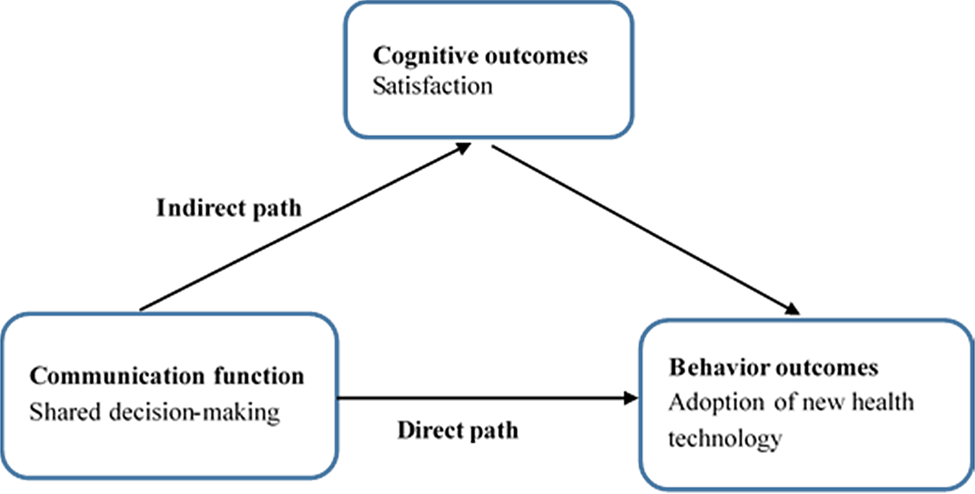
Based on health communication-health outcome framework (Reference Kreps and Clowers32, Reference Shay and Lafata33), we hypothesize that higher-level of SDM is associated with more likely adoption of new health technology directly, and greater patient satisfaction, indirectly. Figure 1 illustrates the conceptual framework underlying our study.
Conceptual framework linking SDM to patient outcomes.

Methods
Data Sources
Patients and their treating physicians were surveyed from July 2016 to October 2016 in eleven hospitals in Eastern China (eight hospitals in Fujian Province and three hospitals in Shanghai). Inpatients and their treating physicians completed the self-reported questionnaires within 1 day, on the patient–physician SDM, satisfaction with treatment decision making and adoption of a new health technology (Supplementary File 1).
Measures
Patient Involvement with SDM
Patient involvement with SDM was assessed using the nine-item Shared Decision-Making Questionnaire (SDM-Q-9) (Reference L. Kriston and Hölzel34). The SDM-Q-9 questionnaire used a 5-point Likert scale ranging from “strongly disagree” to “strongly agree.” The total score of the nine items was used to access patient involvement with SDM in the health technology adoption decision-making process.
Patient Preference and Physician Perception of their Roles in Decision Making
Patient preferences and their treating physicians' perception of patient participation were assessed using a questionnaire developed by Bruera et al. (Reference Bruera, Calder, Palmer and Benisch-Tolley35). Patients were asked to select their preferences and physicians were asked their perceptions on the decision-making process from seven options: 1 = making treatment decisions on patients own; 2 = making treatment decisions after hearing the physician's opinion; 3 = making treatment decisions together with the physician; 4 = physician making treatment decisions after talking to the patient; 5 = physician making treatment decisions alone; 6 = don't know; and 7 = prefer not to answer. Patient responses were then further grouped into active decision making (answers 1 and 2), SDM (answer 3) and passive decision making (answers 4 and 5) (Reference Bruera, Calder, Palmer and Benisch-Tolley35). In this study, we recognized the physician's perception in decision making as the actual SDM role, and if patient preferences were consistent with his/her treating physician's perception in SDM, the concordance was “1,” and if not consistent, the concordance was “0.”
Adoption of a New Health Technology
A new health technology in this study is defined as health technologies, including new medical equipment, new medical devices, new prescription drugs and new procedures or prostheses, adopted by the within 2 years in a particular hospital, but not in the city/province. For patient information, these technologies were defined as a new health technology informed by their treating physicians when they completed their consent to the study. If the patient has used these new items, the adoption was “1,” and if never used, the adoption was “0.”
Satisfaction with Treatment Decision Making
Satisfaction with treatment decision making was measured using a 5-point-scale (from 1 = “strongly dissatisfied” to 5 = “strongly satisfied”), with a higher score indicating higher satisfaction.
Analysis
Statistical analysis included descriptive analysis for SDM, adoption of a new health technology and satisfaction with the treatment decision-making process. A correlation analysis was conducted for the predictors reported in previous studies (Reference Camerini and Schulz36–Reference Hou, Pang, Lu, Xu and Zhou38), including adoption of a new health technology, patient satisfaction with the decision-making process, patient involvement in decision making, concordance between preference, and actual SDM. Finally, based on the results of the correlation, multivariate logistic regression models and multivariate regression linear models were conducted, controlling for patient demographic characteristics such as age, gender, educational background, and duration of the disease. Only the variables found to be significant at the .05 level in the correlation analysis were included in the final multivariate analysis. Data were analyzed using STATA version 12.0.
Results
Demographic Characteristics
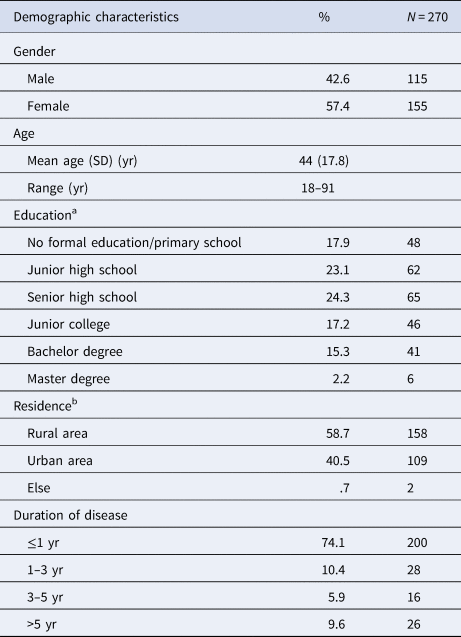
A total of 542 physicians and 619 patients in eleven hospitals from Shanghai and Fujian Province in Eastern China completed the questionnaire. From this cohort, 270 pairs of patients and their treating physicians were used for data analysis. The demographic characteristics of the matched patients are described in Table 1. The average age of patients was 44 years (ranging from 18 to 90), 57.4 percent were female, and 34.70 percent had college or above education. Most patients were rural residents (58.7 percent) and most of the patients (74.1 percent) reported that they had been diagnosed for less than 1 year.
Demographic characteristics of patients

Else: urban-rural fringe area.
a One patient data missing.
b Two patients’ data missing.
Physician–Patient SDM
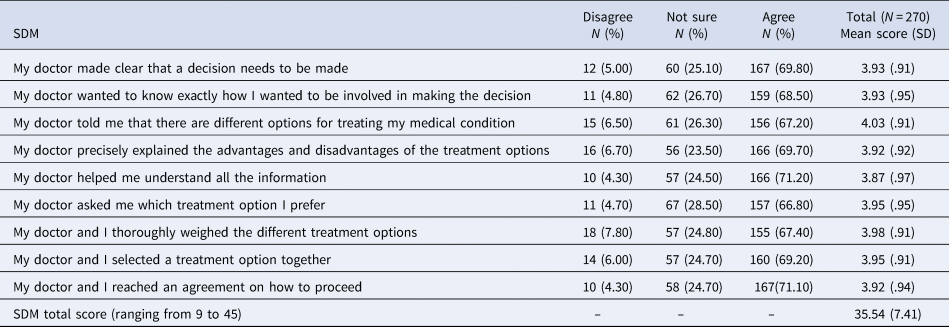
Regarding the perceived level of involvement in the new health technology adoption process, the results of the SDM-Q-9 were consistent across the nine items (Table 2). Of the nine items, more than 67 percent of respondents perceived good communication with their physicians on the treatment decision making in the health technology adoption process. The average total SDM score was 35.54, suggesting that overall the patients endorsed SDM with their treating physician.
Patients SDM assessment using SDM-Q-9

Note: SDM-Q-9 means nine-item Shared Decision-Making Questionnaire.
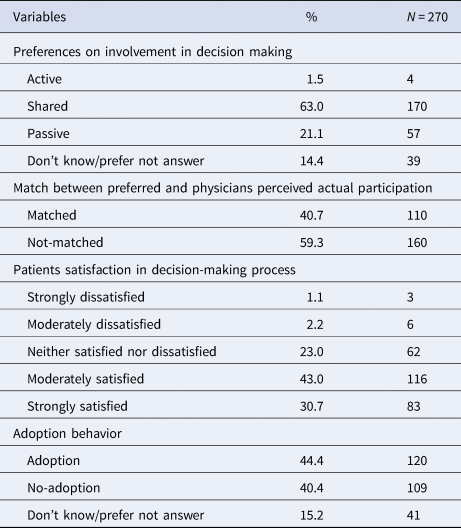
The majority of respondents (n = 170, 63.0 percent) reported their preference for SDM in the health technology adoption decision-making process (Table 3), whereas fifty-seven patients (21.1 percent) preferred passive decision making, only four patients preferred their own centered decision making, and thirty-nine patients did not know. However, regarding patient preferences and actual SDM, less than half (n = 110, 40.7 percent) of the patients reported preferences that were consistent with their actual SDM.
Patient participation and adoption variables

Patient Adoption Behavior and Satisfaction with Treatment Decision Making
Regarding the 270 patients' adoption of a new health technology, 120 (44.4 percent) patients adopted a new health technology in this selected sample hospital. With respect to patient satisfaction with the treatment decision-making process, most of the patients were moderately satisfied (n = 116, 43.0 percent), or strongly satisfied (n = 83, 30.7 percent).
Association Between Physician–Patient SDM and Adoption of a New Health Technology
In the correlation analysis, the SDM score and concordance between preference and actual SDM were positively correlated with their adoption behavior. However, the correlation coefficients were quite low .15 (p < .01) and .13 (p < .05) for SDM score and concordance between preference, respectively. Regarding patient satisfaction on the health technology decision-making process, it was significantly associated with SDM scores (p < .01) and adoption behavior (p < .01). Patients who had higher SDM scores and those that adopted a new health technology were more satisfied with the treatment decision-making process.
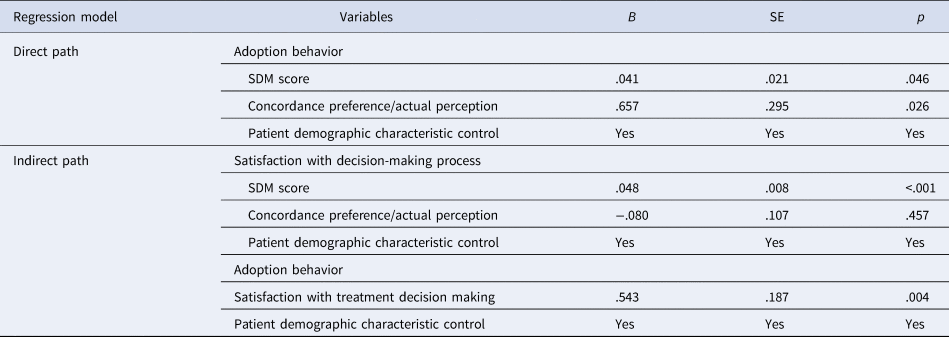
With respect to the direct effect of SDM on adoption of a new health technology, the SDM score and concordance between preference and actual SDM were significantly associated with adoption behavior (p < .05). The respondent's adoption likelihood also increased as the SDM scores and level of concordance increased. Patients with a preference consistent with the actual SDM were 1.97 times more likely to adopt a new health technology than those that were not consistent.
In the indirect effect analysis of SDM, two multivariate linear regression models have been developed (Table 4). In the first model, SDM was significantly and positively associated with patient's treatment decision-making satisfaction process (p < .05). However, there is no statistical correlation between the concordance (preference and actual SDM) and patient satisfaction (p > .05). Furthermore, patient satisfaction with treatment decision making was significantly correlated with the adoption of new health technology (p < .05). In both direct and indirect regression analyses, patient demographic characteristics were not associated with their treatment decision-making satisfaction and adoption behavior.
Multivariate regression model of patient adoption behavior in Eastern China

Discussion
This study describes the current status of SDM, patient satisfaction and adoption of new technology, and examines the relationship between these variables. Although the adoption of a new health technology is chosen under the consultation with their physician, this study highlights that physician–patient SDM also plays an important role in the adoption of a new health innovation. On the other hand, this study provides additional insights for the translation of HTA evidence into decision making from the patient level. New technology with the advantages of solid HTA evidence can be potentially promoted by interventions considering the impact of SDM in appropriate ways. In recent years, evidence-based medicine and HTA have been attracting increasing attention in China, and more and more evaluation reports on the safety, effectiveness, cost-effectiveness, and social ethical adaptability of technologies have been produced from academia and industry. However, there is still a lack of effective ways to promote the clinical use of new technologies with proven advantages in safety, effectiveness, and cost-effectiveness, which may impede the implementation of some relevant policy decisions. Therefore, combining the research of new technology diffusion with the research of HTA is of great significance in promoting the appropriate transformation of new technology into clinical practice.
The main finding in this study was that most of the respondents perceived their treating physicians had involved them in SDM, such as decisions about initiation of treatment and different treatment options. Patients also thought that physicians and patients reached an agreement on whether and how to adopt a new health technology. This could also explain a higher proportion of study respondents who preferred an SDM role, compared with those reported in the previous studies focusing on the Chinese population, ranging from 24.80 to 65.00 percent (Reference Zheng, Huang, Xiao, Qu, Peng and Liu37, Reference Hou, Pang, Lu, Xu and Zhou38). The higher preference on SDM may be due to the study hospitals being located in Eastern China, a region with high economic development and higher awareness for better patient participation than other regions. However, most patient preferences were not in concordance with their treating physician's perception in this study, suggesting that communication in the decision-making process was not sufficient for patients and their treating physicians.
Another finding was that patient demographic characteristics and involvement in decision making was positively related to the patient satisfaction and adoption of new health technology. In our study, the younger, female, and more educated patients are much more likely to actively participate in the SDM process with their physicians. More educated patients are also much more likely to adopt new ideas and behaviors, such as the new health technology in their disease treatment. All of these relationships in this study are consistent with previous reports investigating the impact of patient demographic characteristics, and clinical decisions (Reference Hou, Pang, Lu, Xu and Zhou38–Reference Peres, Muller and Mahajan40) on their participation and SDM score. Patients were very satisfied with the process of decision making, especially those who had much higher SDM-Q-9 scores indicated they had better involvement in the decision making and closer communication with their treating physician. Furthermore, active patient involvement in decision making and higher satisfaction also increased the likelihood of adoption of a new health technology. Although the correlation is quite low, the result was consistent with results of previous studies (Reference Ananian, Houvenaeghel, Protiere, Rouanet, Arnaud and Moatti41–Reference Wallen and Brooks44). However, for patients whose preference was consistent with the actual perception, they are more likely to adopt a new health technology but are not much satisfied compared with others. This result supports a previous study which found improved psychological adjustment among patients who actively participated in decision making (Reference Deadmana, Leinster, Owensc, Deweyd and Sladee45). However, more studies have demonstrated that a poor concordance between patient preference and their actual decision-making role led to lower satisfaction, difficulties in decision making, decision regret, and depression (Reference Liu, Rohrer, Luo, Fang, He and Xie39, Reference Deadmana, Leinster, Owensc, Deweyd and Sladee45–Reference Say and Thomson48). No significant impact of the concordance found in this study could be due to the bias between physician's perception and the actual role. However, comparing with the patient's perception, physician perception was considered much more reliable because of the medical information asymmetry between the physicians and the patients. Further research is required to study the association between adoption of new health technologies and the SDM perception concordance in the Chinese population (Reference Wendy Lam, Chan, Chow and Ho49).
This study used a conceptual framework to examine the relationship of SDM and patient satisfaction and adoption of a new health technology. Furthermore, we confirmed the direct and indirect path model, which explains the association between communication functions (SDM) and health outcomes including cognitive outcomes (patient treatment satisfaction) and behavioral outcomes (adoption of new health technology). Additionally, we improved the framework with the predictors of communication functions, not only SDM, but also including concordance between preference and actual perception on patient behavioral outcomes. Another advantage compared to previous studies is that we used patient self-reports as well as physicians' perceptions to evaluate the physician–patient communication and decision making from different stakeholder perspectives.
The improvement of SDM may be achieved through training healthcare providers and teaching communication skills for working with patients (Reference Liu, Rohrer, Luo, Fang, He and Xie39, Reference Frosch, May, Rendle, Tietbohl and Elwyn46, Reference Légaré, Stacey, Turcotte, Cossi, Kryworuchko, Graham, Lyddiatt, Politi, Thomson, Elwyn and Donner-Banzhoff47). According to a survey in China, more than 70 percent of the medical professionals stated that inadequate communication with patients prevented improvement in the doctor–patient relationship (Reference Zhang25). The current study also revealed that patient participation and communication and consultation with their treating physicians in decision making can improve the psychological adjustment and reduce decisional conflict (Reference Shay and Lafata33). Patient involvement in decision making may enhance their adoption of a new health technology, because adoption of those new procedures, treatments, and clinical interventions may be experiencing patient resistance due to a lack of understanding in the initial stage of technology diffusion (Reference O'Sullivan6, Reference Peres, Muller and Mahajan40).
Despite a number of interesting findings in this study, there were also limitations. First, the generalization of results is limited, because only a few hospitals in Eastern China were included in this study. It remains unclear, whether these results are generalizable to other regions. Second, patient participation in decision making is an extremely multifactorial construct. Appropriate measurements for the process of patient participation were believed to be important. In this study, the measurements have demonstrated validity for measuring a patient's SDM role and involvement in treatment decision making. However, it is not clear whether the measurements could be generalized to other specific new health technologies, which also requires further research to examine these results. Furthermore, regarding the measurement or instrument in this study we did not design questionnaire written at a low literacy and numeracy level to adapt patients with lower level of education, which may lead to relative lower response rate. Ultimately, SDM was the most important predictor of cognitive outcome (patient satisfaction with treatment decision making) and behavioral outcomes (adoption of a new health technology).
Conclusion
SDM was the most important predictor of patients' satisfaction with decision making and adoption of a new health technology. Therefore, better communication and consultation between physicians and patients is recommended to improve their SDM, such that patients' satisfaction with treatment decision making and the adoption of health innovations can be enhanced in China.
Supplementary Material
The supplementary material for this article can be found at https://doi.org/10.1017/S0266462320000719.
Acknowledgments
We sincerely acknowledge support of the National Natural Science Foundation of China for the program of physician–patient shared decision making in China (Grant no. 71573044) and foundation of Ministry of Education for study of the physician–patient shared decision making and optimization strategy based on discrete selection experiment (Grant no. 18YJCZH187).
We would like to thank all the patients and physicians who participated in the study. We acknowledge the cooperation of all the hospitals in this study, which provided great convenience to our survey. Many thanks to professor Wendy Babidge for her kindly help to review and edit the manuscript, and also thanks to research assistants Luyang He, Yan Xu, Gongru Wang, Xiaoxiao Qin, Da Li, Yijie Li, and Junqiu Li, for their great contributions to data collection and data entry.
Conflict of Interest
The authors declared no potential conflicts of interest with respect to the research, authorship, and/or publication of this article.
Ethical Standards
This study protocol and questionnaires were approved by the Fudan University School of Public Health Institutional Review Board (IRB #2015-12-0577).