Active participation is a central tenet of democratic governance. This is particularly important when considering how to best prepare young people for full participation in public life. The stakes of this question are quite high; if younger generations are truly disengaged, the future vitality of democracy comes into question (Putnam Reference Putnam2000; Zukin et al. Reference Zukin, Keeter, Adolina and Jenkins2006). While political science offers a number of noteworthy insights into the ways in which political resources (Verba, Lehman Schlozman, and Brady Reference Verba, Lehman Schlozman and Brady1995), attitudes and heuristics (Campbell et al. Reference Campbell, Converse, Miller and Stokes1961; Dawson Reference Dawson1994; Verba, Lehman Schlozman, and Brady Reference Verba, Lehman Schlozman and Brady1995), and organizational membership (Putnam Reference Putnam2000; Verba, Lehman Schlozman, and Brady Reference Verba, Lehman Schlozman and Brady1995) contribute to rates of political participation across racial groups, the discipline tends to overlook the role of citizenship education in shaping these trends. This paper seeks to fill this void by exploring the following question: how do civic education courses affect political participation across racial and ethnic groups? While a handful of studies touch on this topic, they are constrained by limited measures of political participation (Levinson Reference Levinson2012; Niemi and Junn Reference Niemi and Junn1998) or by ignoring the heterogeneous effects of civic education courses along racial and ethnic lines (Campbell Reference Campbell2008; Langton and Jennings Reference Langton and Jennings1968; Gainous and Martens Reference Gainous and Martens2012; Reference Martens and Gainous2013).
This paper builds on the existing literature and addresses the above lacunae in two ways. First, I argue that a wide range of participatory activities must be analyzed in order to understand the ways in which young people across racial and ethnic groups come to participate in politics. Relevant activities range from traditional acts of political engagement such as voting to acts of public voice such as protests. Before political scientists make any overarching claims about the political behavior of a generational group, we must first understand how young people from different social groups leverage the resources available to them to participate in politics. Second, and relatedly, I develop a theory that explores the ways in which the curricula utilized in civic education courses contribute to heterogeneous participatory effects among white, black, and Latinx youth. Given that civic education courses tend to place greater emphasis on the political experiences of white Americans, I predict that students of color experience different kinds of socialization processes as a result of these courses compared to their white peers.
I utilize the Black Youth Project's Youth Culture Survey (Cohen Reference Cohen2005) and supplemental data collected in 2017–2018 to test this theory. Notably, I find that civic education courses are associated with higher rates of external efficacy among white youth, but not black and Latinx youth. Rather than fostering a belief in the responsiveness of government, civic education courses are associated with acts of public voice for young people of color, which span beyond traditional forms of participation such as voting.
I conclude with a normative discussion that raises questions regarding how to best teach citizenship to young people in schools. While varied forms of participation are important for the function of a healthy democracy, the racialized dimension of the results presented in this paper should give us pause. While expanding access to citizenship education can encourage more participation among young people, the nature of these courses must first be reconsidered if these effects are to be experienced in ways that enhance representation for racial and ethnic minorities.Footnote 1
AN EXPANDED APPROACH TO POLITICAL PARTICIPATION
Scholarship examining political participation in the United States typically focuses on acts of political engagement, defined as activities with “the intent or effect of influencing government action either directly affecting the making of implementation of public policy or indirectly influencing the selection of people who make those policies” (Zukin et al. Reference Zukin, Keeter, Adolina and Jenkins2006, 7). Many prominent studies find that youth political engagement is consistently low using metrics such as voter turnout (e.g. Putnam Reference Putnam2000; Zukin et al. Reference Zukin, Keeter, Adolina and Jenkins2006). However, Zukin et al. (Reference Zukin, Keeter, Adolina and Jenkins2006) suggest that young people are more engaged when a larger battery of political behaviors is considered. I follow a similar approach; any study that aims to understand how young Americans participate in politics must examine a wider range of activities, especially because unequal access to resources, different socialization experiences, and barriers produced by public policy orient youth towards different kinds of participatory acts (Atkins and Hart Reference Atkins and Hart2003; Bruch and Soss Reference Bruch and Soss2018; Campbell Reference Campbell2006; Greenberg Reference Greenberg1970; Kahne and Lee Reference Kahne and Lee2013; Lyons Reference Lyons1970; McIntosh, Hart, and Youniss Reference McIntosh, Hart and Youniss2007; Verba, Lehman Schlozman, and Brady Reference Verba, Lehman Schlozman and Brady1995; Zukin et al. Reference Zukin, Keeter, Adolina and Jenkins2006). Both traditional and non-traditional forms of political participation are components of mass politics in a healthy democracy and should be treated as such in any comprehensive account of political behavior (Zukin et al. Reference Zukin, Keeter, Adolina and Jenkins2006, 52).
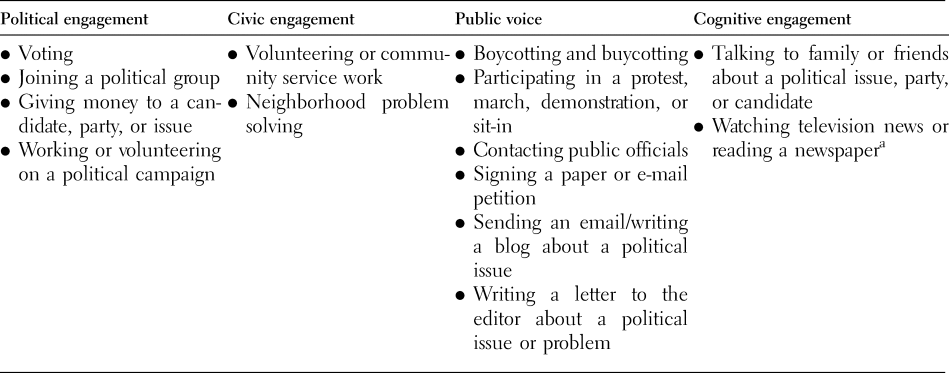
Zukin et al. (Reference Zukin, Keeter, Adolina and Jenkins2006) organize a battery of political and civic activities into four categories of engagement: political, civic, public voice, and cognitive. Political engagement, attempting to influence government policy or officials through voting and campaign activity, is distinct from civic engagement, which aims to enhance “public good” through “hands-on cooperation with others” by participating in activities such as volunteering, organizational membership, and attending community meetings (Zukin et al. Reference Zukin, Keeter, Adolina and Jenkins2006, 51). Public voice is defined as “the ways citizens give expression to their views on public issues” (i.e. contributing to political blogs or participating in a protest). Finally, cognitive engagement refers to “paying attention to public affairs and politics” by participating in activities such as following the news or talking to friends and family about political issues (54). Footnote 2 A summary of the activities that fall within each category is shown in Table 1.
Indicators of public engagement

Adapted from Zukin et al. (Reference Zukin, Keeter, Adolina and Jenkins2006) and Cohen (Reference Cohen2010).
a The data set utilized in this study did not ask respondents about their media consumption. Thus, for the sake of this paper, cognitive engagement is limited to talking to family or friends about political issues, parties, or candidates.
Given that access to political resources, socialization experiences, and differential effects of public policy vary across racial groups (e.g. Bruch and Soss Reference Bruch and Soss2018; Cohen Reference Cohen2010; Verba, Lehman Schlozman, and Brady Reference Verba, Lehman Schlozman and Brady1995), the above approach allows for a more nuanced examination of cross-group differences in political behavior. The 2008 Mobilization, Change, and Political and Civic Engagement Project (MCPCE) finds that young people across racial and ethnic groups participate in politics differently (Cohen Reference Cohen2010, 180–185). For example, Latinx youth are less likely than white and black youth to participate in acts of political engagement and public voice (Cohen Reference Cohen2010, 180–184).Footnote 3 This variation in participatory trends across groups warrants continued investigation. Thus, any study analyzing youth political participation in the United States should analyze cross-racial differences. Additionally, there is reason to expect that civic education courses in particular have a racialized effect on political participation. A growing literature has shown how institutions and public policy generate racialized differences in political participation; for example, voter ID-laws (e.g. Sobel and Smith Reference Sobel and Smith2009), distance to polling locations (e.g. Brady and McNulty Reference Brady and McNulty2011), criminal convictions (e.g. Burch Reference Burch2013), and authoritarian disciplinary structures within schools (e.g. Bruch and Soss Reference Bruch and Soss2018) all depress political engagement among communities of color. I suggest that the availability and content of citizenship education courses represent another institutional feature that generates divergent participatory trends across racial groups. In the next section, I discuss this theoretical expectation about the content of citizenship education in more detail.
THEORIZING THE LINK BETWEEN CIVIC EDUCATION AND POLITICAL PARTICIPATION
A number of political scientists have examined the impact of civic education courses on student outcomes. While these studies provide noteworthy insights regarding the acquisition of political knowledge (Martens and Gainous Reference Martens and Gainous2013; Niemi Reference Niemi, Campbell, Levinson and Hess2012; Niemi and Junn Reference Niemi and Junn1998), intent to vote and volunteer (Campbell Reference Campbell2006; Langton and Jennings Reference Langton and Jennings1968; Martens and Gainous Reference Martens and Gainous2013), and political efficacy (Langton and Jennings Reference Langton and Jennings1968; Martens and Gainous Reference Martens and Gainous2013), they are limited for two reasons. First, these studies do not consider how civic education courses impact a wider variety of participatory behaviors beyond acts of conventional political engagement. To the best of my knowledge, no existing work examines the impact of civic education courses on less traditional forms of participation such as acts of public voice.
Second, this literature overlooks the importance of race when considering how the content of civics courses contributes to divergent behavioral outcomes. For example, Langton and Jennings (Reference Langton and Jennings1968) conclude that civic education curriculum is “not even a minor source of political socialization” (865). However, the same study also finds that civic education courses do matter considerably for black students, especially those from families with lower rates of educational attainment (1968, 866). Similarly, while Niemi and Junn (Reference Niemi and Junn1998) find that black students enrolled in civic education classes tend to possess greater political knowledge than their white peers regarding topics such as the Montgomery bus boycott (71 percent versus 43 percent) and the nonviolent tactics employed by the Civil Rights Movement (79 percent versus 68 percent), their data set is unable to gauge how this knowledge influences political behavior more broadly (111). Others suggest that it is not the curriculum utilized within these courses that shape the political behavior of young people, but the overall climate of the school (Bruch and Soss Reference Bruch and Soss2018, 49; Campbell Reference Campbell2006, 153). The present study addresses these gaps by exploring how the content of civic education courses might shape various forms of political participation along racial and ethnic lines.
Potential Mechanisms Linking Civic Education Courses to Political Participation
Civic education courses may impact political participation in a number of ways. Some obvious mechanisms include the acquisition of civic and political knowledge and the development of language and communication skills associated with higher rates of political participation (Niemi Reference Niemi, Campbell, Levinson and Hess2012; Niemi and Junn Reference Niemi and Junn1998; Verba, Lehman Schlozman, and Brady Reference Verba, Lehman Schlozman and Brady1995). Civic education courses can also be conceptualized as a socialization process that shapes students' attitudes towards the political system. Given that these attitudes are commonly associated with interactions with formal institutions (Verba, Lehman Schlozman, and Brady Reference Verba, Lehman Schlozman and Brady1995), it makes sense to explore how a key institution such as schools contribute to the development of such attitudes. I theorize that civic education courses may be associated with the development of political efficacy among certain students.
Political efficacy—one's belief in the responsiveness of government and their own ability to influence public affairs—is commonly associated with higher rates of political participation (Verba, Lehman Schlozman, and Brady Reference Verba, Lehman Schlozman and Brady1995). Political efficacy can be furthered distilled into two distinct attitudes: external efficacy and internal efficacy. External efficacy refers to one's belief in the responsiveness of government and one's own ability to influence public affairs (Cohen Reference Cohen2010; Rogowski and Cohen Reference Rogowski and Cohen2015). I argue that external efficacy is more likely to be associated with political engagement. If an individual believes in the responsiveness of political institutions, they are more likely to participate in activities such as voting that strengthens the legitimacy of those institutions.Footnote 4 Contrastingly, individuals who have less faith in the responsiveness of government will be more likely to look beyond institutionalized forms of politics, instead pursing acts of public voice. This relationship is summarized in column one of Table 2.
Political attitudes and behavior

Internal Efficacy, on the other hand, reflects an individual's belief that they possess the knowledge and skills to address personal and social problems (Cohen Reference Cohen2010; Rogowski and Cohen Reference Rogowski and Cohen2015). I expect internal efficacy to be most strongly associated with one's ability to effectively identify and communicate solutions to problems. If one feels they have the knowledge and skills to participate in discourse surrounding political issues, they will be more likely to engage in acts of cognitive engagement. This relationship is summarized in the second column of Table 2. Cohen (Reference Cohen2010) and Rogowski and Cohen (Reference Rogowski and Cohen2015) note the varying salience of these attitudes across the racial/ethnic group, raising the question as to whether civic education plays a role in developing these attitudes. In the analysis below, I examine the relationship between civic education courses and both internal and external efficacy across racial groups.
Interrogating the Content of Civic Education
Civic education courses in the United States traditionally cover a narrow series of topics while promoting specific values and behaviors. Education scholars find that civics courses typically cover two overarching themes: political institutions and American heroes. Courses tend to emphasize the three-branches of government, how bills become law, and other institutional structures that aim to provide a broad overview of how American government functions (Levinson Reference Levinson2012). Young people report this trend as well. A representative sample of 15–25-year-olds found that 45 percent of respondents associated their civic education course with the “constitution and how government in the United States works” (Levine and Lopez Reference Levine and Hugo Lopez2004, 2). In maintaining this focus, these courses emphasize traditional modes of civic and political participation such as volunteering, voting in elections, and contacting public officials while promoting narratives that emphasize the fairness of democratic forms of government (Levine and Lopez Reference Levine and Hugo Lopez2004; Levinson Reference Levinson2012). According to Levinson, emphasizing institutionalized mechanisms of America's democratic system privileges “traditional modes of civic action that are both increasingly outdated and unrepresentative of a range of actions and behaviors that have historically been important civic tools for members of disadvantaged, oppressed, and marginalized groups” (Levinson Reference Levinson2012, 45). Frequently these values and behaviors are explored through the invocation of American heroes. While heroes are certainly not the only facet of civic education courses with the potential to shape the political attitudes and behaviors of young people, they do provide a unifying story (Peabody and Jenkins Reference Peabody and Jenkins2017) that conveys important democratic ideals (Allison and Goethals Reference Allison and Goethals2011; Wrone Reference Wrone1979), “values associated with good character and responsible citizenship” (Sanchez Reference Sanchez1998, 3), and a model for a democratic society (Klapp Reference Klapp1954).
How Heroes Shape Our Politics
According to Levinson, “A nation's heroes are often thought to provide a window into understanding its soul: what the nation values and emulates, and how it conceives itself-what it believes to stand for…Youth are explicitly taught the meaning they should ascribe to such heroes, and thus the values they should ascribe to their country” (Reference Levinson2012, 143–144). Students are cognizant of this trend as well with 30 percent of 15–25-year-olds associating their civic education course with great American heroes and the virtues of the American system of government (Levine and Lopez Reference Levine and Hugo Lopez2004).Footnote 5 These heroes provide young people with tangible examples for how to pursue effective civic and political action (Reference Levinson2012). George Washington and Andrew Jackson, for example, are frequently employed to exemplify the virtue of military service while Thomas Jefferson and Abraham Lincoln are upheld as the embodiment of democratic ideals such as freedom and equality (Levinson Reference Levinson2012). While some suggest that such a conception of heroism no longer resonates with the American public (Peabody and Jenkins Reference Peabody and Jenkins2017), I argue that the invocation of heroes in civics courses is distinct for two reasons.
First, Peabody and Jenkins' analysis of the Harris Interactive “Heroes” Poll reveals that Americans consistently identify political figures when asked “who is deemed heroic,” even when presented with open-ended questions (Reference Peabody and Jenkins2017, 140). Most strikingly, many of these figures, including Martin Luther King and Abraham Lincoln, “garner praise over time and across generational groups” (Reference Peabody and Jenkins2017, 140). Thus, even at a moment when the American public is skeptical of the invocation of heroism by the media and political elites, there is something compelling about these narratives that continues to resonate with people that is worth exploring. Second, while one could argue that young people do not look to historical figures of such stature for tangible examples of role models, it is possible that these heroes come to mind when they think about how American politics and government should work and what participatory avenues are actually available for people like them (Allison and Goethals Reference Allison and Goethals2011; Klapp Reference Klapp1954; Sanchez; Wrone Reference Wrone1979).
Given that heroes are invoked in in order to teach young people ideas about democratic processes, exposure to traditional curricula should theoretically bolster external efficacy and political engagement by espousing a belief that individuals who participate can make difference. However, given that these narratives typically emphasize white political actors, I expect this to only be true for white students. Contrastingly, given that descriptive representation is shown to bolster efficacy among racial and ethnic minorities (Marx et al. Reference Marx, Jin Ko and Friedman2009; West Reference West2017), students of color who do not see themselves represented in traditional civic education curricula are unlikely to experience these effects.Footnote 6
I also expect that the emphasis of civic education curricula on formal political institutions and (predominantly white) “American heroes” will have varying impacts on the political attitudes and behaviors of youth across racial groups. White students would come to believe in the responsiveness of America's governing institutions by examining the ways in which effective individuals made an impact through political action. These curricula may be intended to contribute to positive orientations towards political engagement for all students, but the narratives contained therein largely overlook people of color who have historically been denied access to formal political institutions. This would send a message that people of color are not worthy political leaders with the ability to shape American political institutions. Thus, I construct the following two hypotheses:
- H1:
Civic education courses will be associated with the development of external efficacy among white youth, but not black and Latinx youth.
- H2:
Civic education courses will be associated with political engagement among white youth, but not for black and Latinx youth.
While textbook writers have made a concerted effort to discuss white leaders alongside prominent people of color (Levinson Reference Levinson2012), the institutional focus of these courses promotes a narrative that places white political actors at the heart of institutionalized forms of political action while people of color, when mentioned at all, are relegated to extra-systemic forms of participation. Representation of this kind is an important factor in student outcomes. Freire (Reference Freire1968) suggests that seeing one's identity reflected in historical processes is an essential component of building critical consciousness. Similarly, social psychologists find that salient role models hold the potential to reduce “race-based performance differences” among young people of color (Marx et al. Reference Marx, Jin Ko and Friedman2009).
When people of color such as Martin Luther King, Rosa Parks, and Cesar Chavez do emerge in these narratives, they are portrayed acting beyond the system, pushing government to respond to acts of public voice such as protests, marches, and sit-ins when institutional means are inaccessible or unresponsive. Contrastingly, there are scant examples of white actors participating in acts of public voice. Thus:
- H3:
Civic education courses will be associated with acts of public voice among black and Latinx youth, but not for white youth.
At the same time, civic education courses create opportunities for students to develop language and communication skills that are not inherently political. Because these courses are frequently discourse-oriented, students are given the space to develop ideas and share them with peers, bolstering internal efficacy (Callahan and Muller Reference Callahan and Muller2013; Martens and Gainous Reference Martens and Gainous2013). Civics courses are an especially important space for English language learners to absorb political information that can later be shared with family and friends (Callahan and Muller Reference Callahan and Muller2013; Campbell and Niemi Reference Campbell and Niemi2016). While white and black youth undoubtedly benefit from the communication skills embedded into civics curriculum, the impact on these courses on internal efficacy should be most pronounced among first and second-generation immigrants.Footnote 7 According to Pew, 55 percent of U.S.-born Latinxs are second generation immigrants and nearly 60 percent are age 33 or younger (Pew Research 2016). First and second-generation Latinx immigrants are more likely to speak a language other than English at home (Callahan and Muller Reference Callahan and Muller2013; Campbell and Niemi Reference Campbell and Niemi2016), suggesting that the language skills gained from civic education courses at school may have a more pronounced impact on attitudes and behaviors associated with cognitive engagement for this group. Thus:
- H4:
Civic education courses will be positively associated with the development of internal efficacy among Latinx youth, but not for white and black youth.
- H5:
Civic education courses will be positively associated with cognitive engagement among Latinx youth, but not white and black youth.
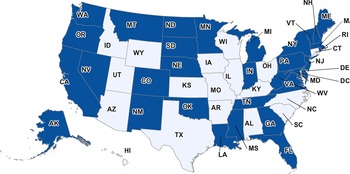
Other facets of civic education, however, are likely to be experienced more consistently across racial and ethnic groups. Though civic education is a requirement in 46 out of 50 states, there is a great deal of variation in learning standards across geographical contexts (CIRCLE 2014). However, a commitment to service learning (combining learning objectives with community service) is fairly consistent across states. As demonstrated in Figure 1, service learning is required in 31 out of 50 states. While civic education may yield divergent outcomes in political behavior across racial and ethnic groups, I expect civic education to be associated with civic engagement across all groups given the salience of service learning across the United States. Thus:
- H6:
Civic education courses will be positively associated with civic engagement for white, black, and Latinx youth.
Service Learning Required in State Education Standards
Source: Center for Information and Research on Civic Learning and Engagement (CIRCLE 2014).

THEORY TESTING
Data
I use the Youth Culture Survey made available through the Black Youth Project to test the hypotheses presented above. The first wave of the survey was conducted in 2005 by the National Organization of Research (NORC) at the University of Chicago and utilized a random digit dial sample to explore the attitudes of young people ages 15–25. The survey addressed several topics including political participation and access to civic education (Cohen Reference Cohen2005). Questions addressing these topics specifically were retrospective in nature. The survey contains a nationally representative sample of 1,590 respondents, including an oversample of black youth and a small oversample of Latinx youth. Respondents were first given the opportunity to identify with multiple racial and ethnic groups (white, black, Latinx, Asian, Hawaiian or Pacific Islander, Native American, and biracial) before being asked to identify with a single group. I use the responses to the latter question to categorize respondents into racial groups in my models below.
The Black Youth Project's Youth Culture Survey is particularly useful for the purposes of this paper, since it allows for an analysis of the political attitudes and behaviors of young people from across racial and ethnic groups. While three additional waves of the survey were conducted during 2012–2014, the 2005 study was the only wave to ask respondents about their involvement in a variety of political activities as well as their access to civic education courses. The 2005 survey is admittedly constrained to the political context in which it was conducted. However, these constraints should not be the cause for excessive concern for two reasons. First, the past thirteen years have not witnessed dramatic policy shifts pertaining to civic education, dispelling concern that accesses to these courses or the content taught within them has shifted considerably over this period (CIRCLE 2014). To confirm this, I conducted a content analysis of the historical figures explicitly referenced in the high school Social Studies standards in the state of TX—a state whose education policies define textbook production for the nation due to its high concentration of school-age children (Williams and Maloyed Reference Williams and Maloyed2013). This analysis reveals few substantial changes between 2005 and 2018. In fact, of the 59 figures explicitly referenced in the state's standards in 2018, 83 percent are white men. This is only slightly lower than 91 percent in 2005. A full summary and discussion of this analysis is located in Table 3 of the Appendix.
Second, it is worth noting that the 2005 data were collected prior to the rise of youth-driven social movements such as Black Lives Matter, increased millennial interest in electoral politics corresponding to the election of President Obama in 2008, and activism following the 2016 presidential election. However, supplemental data collected in 2017–2018 confirm many of the trends present in the 2005 data. These supplemental data are discussed at the end of the paper.
In analyzing the 2005 data, I excluded respondents with missing data on key outcome variables, yielding a final count of 1,252 respondents. The same analysis was conducted using multiple imputations, which did not yield significantly different results. The results of the multiply imputed analyses are shown in Tables 11–16 of the Appendix.
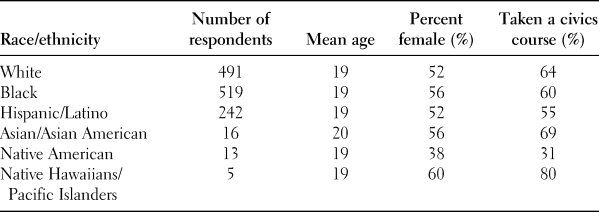
The respondents' average age is 19 and slightly over half (53 percent) are female. T-tests confirm that there are no statistically significant differences between the respondents of the original data set and those included in the analysis in terms of age (p = 0.59), gender (p = 0.71), or race (p = 0.71) (see Table 1 of the Appendix). While the Black Youth Culture Survey did collect information from Asian/Asian American, Native American, Native Hawaiian/Pacific Islander, and biracial youth, it does not include a sufficient sample size to conduct an analysis for these groups. Future work should aim to capture sufficiently-sized samples from these populations in order to test the transferability of the hypotheses explored here. A breakdown of the respondents' characteristics by the racial/ethnic group is included in Table 3.
Respondent characteristics by race/ethnicity

Variables
Following the method put forth by Zukin et al. (Reference Zukin, Keeter, Adolina and Jenkins2006), I create four indices of political participation (political engagement, civic engagement, public voice, and cognitive engagement) by combining the individual participation items. These variables and corresponding activities are summarized in Table 1. Question wording and corresponding alpha scores for each of these variables are shown in Tables 17 and 18 of the Appendix. Drawing from the Civic Voluntarism Model put forth by Verba, Lehman Schlozman, and Brady (Reference Verba, Lehman Schlozman and Brady1995), six control variables are included in the models to account for other factors commonly associated with political participation: age, gender, group affiliation, religious affiliation, parental political interest, and citizenship status. While respondents were asked to report individual and family income, misreporting of this figure is common and may be especially pronounced among young respondents asked to report their parents' income (Zaller Reference Zaller1992). Thus, I utilize maternal educational attainment as a proxy for socioeconomic status (see Bertrand and Mullainathan Reference Bertrand and Mullainathan2001; Braveman et al. Reference Braveman, Cubbin, Egerter, Posner, Chideya, Marchi, Meltzer and Posner2006; Lewis-Beck et al. Reference Lewis-Beck2008).
Civic education is the key independent variable in this study and is measured by a question that asks whether respondents have “ever been enrolled in a high school civics or American government course” (Cohen Reference Cohen2005). While one may be surprised to find that only 59 percent of the respondents reported having access to a civics course, this low rate reflects the fact that 11 states did not require a course of this kind when the Black Youth Project's Youth Culture Survey was conducted in 2005. Two of those states, IL and NJ, account for nearly 10 percent of the survey's total respondents (see Table 2 in the Appendix).Footnote 8 Additionally, the shift to high stakes testing in math, reading/language arts, and science has pushed teachers to cut back on the time allotted to social studies classes such as civics and American government (Kahne and Middaugh Reference Kahne and Middaugh2008). In fact, 71 percent of school districts reported “cutting back on other subjects to make room for math and reading … social studies was part of the curriculum most frequently cited as the place where these reductions took place” (2008, 33–34). In other words, the high percentage of “no” responses in states that do require a civic education course may reflect the very real possibility that a student was being taught a standardized test subject such as math, reading/language arts, and science during a class period officially devoted to civics or American government. In this case, the formality of having been in a civic education course may not have registered with many of the respondents. This does not pose a measurement error threat, since I am interested in cases where students have been exposed to civic education courses in a meaningful sense.
MODELS
I conduct regression analyses that fall into two categories. The first category examines the impact of civic education courses internal and external efficacy (H1 and H4).Footnote 9 The second category tests the direct impact of civic education courses on the four categories of participation summarized in Table 1. This second series of models also includes the efficacy variables tested in the first model series as control variables because they are highly correlated with political participation (H2, H3, H5, and H6).Footnote 10 Because I expect to see heterogeneous effects across racial and ethnic groups, I conducted each of the analyses separately for white, black, and Latinx respondents (see Junn and Masuoka Reference Junn and Masuoka2013).Footnote 11
Results
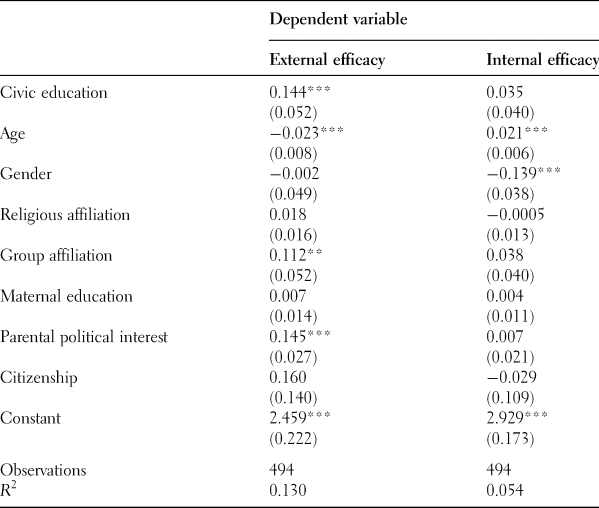
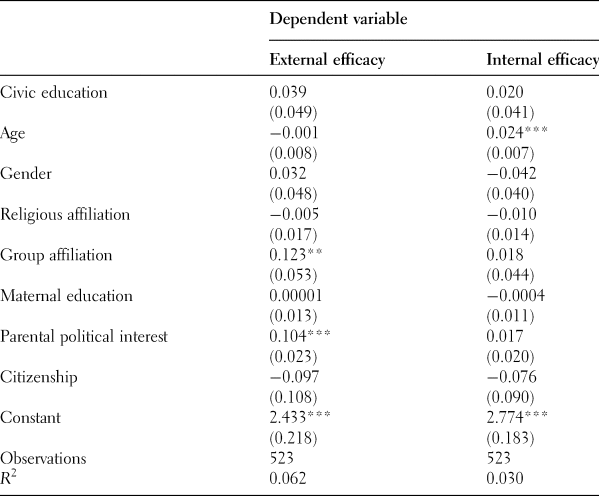
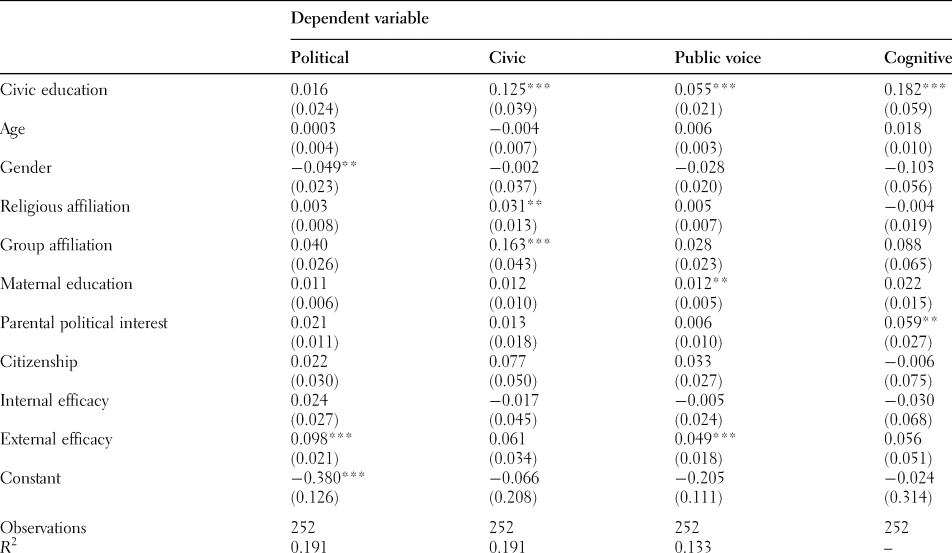
I first test H1 and H4. The analyses in Tables 4–6 demonstrate that civic education courses are associated with the development of both external and internal efficacy. However, the impact of these courses varies across each racial/ethnic group. As demonstrated by the results reported in Table 4, civic education courses are associated with higher rates of external efficacy among white youth at levels of statistical significance (p < 0.01). Specifically, having access to a civic education course is associated with a 14.4 percentage point increase in external efficacy among white youth. There is no significant relationship between civic education and external efficacy among black or Latinx youth. Civic education courses are associated with a 14.4 percentage point increase in internal efficacy among Latinx youth (p < 0.05).Footnote 12 This is consistent with the work of Callahan and Muller (Reference Callahan and Muller2013) who find that youth growing up in Spanish-speaking households benefit from such courses through an increased ability to share new information about politics with family members at home. These results are summarized in Table 6.
Political attitudes-white youth

Note: **p < 0.05, ***p < 0.01.
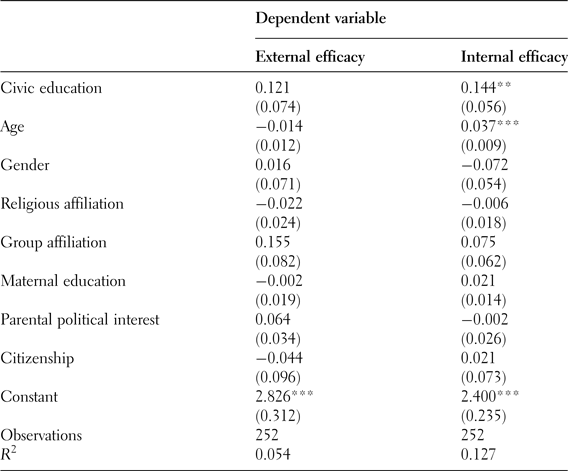
Political attitudes-black youth

Note:**p < 0.05, ***p < 0.01.
Political attitudes-Latinx youth

Note: **p < 0.05, ***p < 0.01.
These results also reveal significant gender effects among whites and among Latinxs (see Tables 22–27 of the Appendix for additional models that disaggregate by gender). Specifically, civic education courses are associated with higher rates of external efficacy among white men (p < 0.01), but not women. Given that the historical figures in civic education courses are overwhelmingly white men (see Table 3 in the Appendix), this finding is not particularly surprising. Among Latinx respondents, civic education courses are associated with higher rates of internal efficacy among Latinas, but not among Latinos (p < 0.01). This echoes existing work suggesting that young Latinas are most likely to use skills acquired in school to serve as language brokers, translating written and face-to-face communication for parents and other adults (Anguiano Reference Anguiano2018; Burial et al Reference Burial, Perez, De Ment, Chavez and Moran1998; Weisskirch Reference Weisskirch2005). These results are discussed more comprehensively in the Appendix.
As expected, the model in Table 5 shows that civic education courses are not associated with higher levels of either internal or external efficacy among black youth. Rather, group affiliation (p < 0.05) and parental political interest (p < 0.05) are more strongly associated with external efficacy for this group. This first series of models supports both hypotheses H1 and H4: civic education courses are associated with the development of external efficacy among white youth and internal efficacy among Latinx youth. Given that civic education courses are associated with distinct attitudes across racial and ethnic groups, we should also expect distinct impacts political participation across groups if the theoretical expectations about the relationship between efficacy and participation are true.
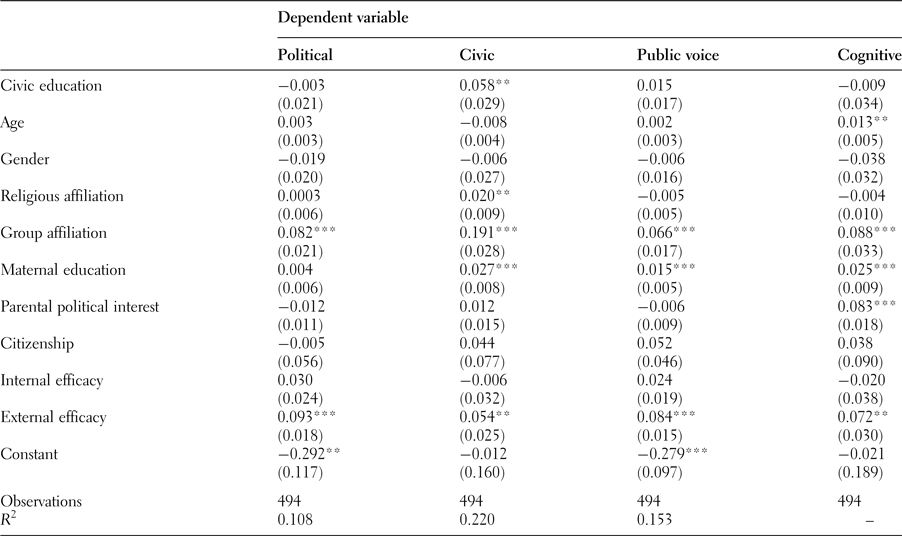
Next, I test H2, where I expected that civic education will be associated with political engagement for white youth, but not for black and Latinx youth. The results in Table 7 disconfirm this hypothesis: civic education courses are not associated with political engagement among white respondents. Even in models predicting individual acts, civic education courses are not associated with any of the four acts in the political engagement index for white youth (see Table 19 of the Appendix). Rather, group affiliation (p < 0.01) and external efficacy (p < 0.01) are more strongly associated with political engagement among this group. However, it is possible that civic education courses may still indirectly impact the political engagement of white youth through the development of external efficacy as shown above. In other words, these courses may still present narratives that bolster white respondents' belief in the responsiveness of government, which may have downstream effects on the political engagement of white youth as hypothesized. As expected, given the lack of representation in accounts of traditional forms of political participation, civic education courses are not associated with political engagement among young people of color.
Political behaviors-white youth

Note: **p < 0.05, ***p < 0.01.
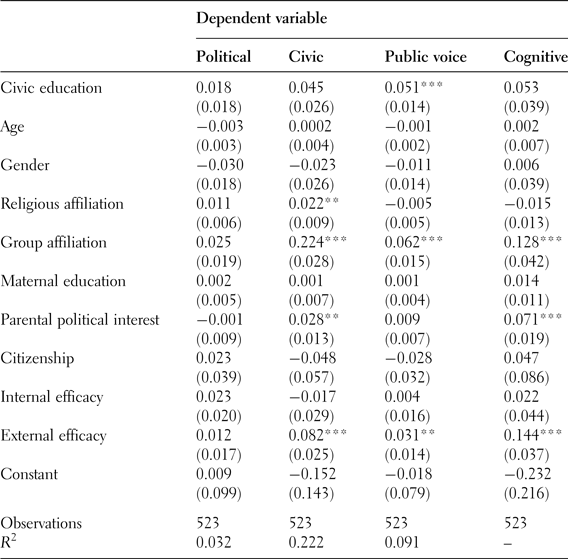
Tables 8 and 9 lend support to H3. Civic education courses are associated with acts of public voice among both black (p < 0.01) and Latinx (p < 0.05) youth, but not white youth. This suggests that young people of color who have taken a civic education course are more likely to opt into extra-systemic forms of participation such as protests, marches, sit-ins, and petition signing even after controlling for other factors commonly associated with political participation. Specifically, civic education courses are associated with a five percent increase in acts of public voice among both black and Latinx youth.Footnote 13 The impact of civic education on each of the seven measures of public voice is included in Tables 19–21 in the Appendix. As expected, because white political actors are infrequently portrayed acting beyond political institutions, civic education courses are not associated with acts of public voice among white youth (see Table 19 of the Appendix).
Political behaviors-black youth

Note: **p < 0.05, ***p < 0.01.
Political behaviors-Latinx youth

Note: **p < 0.05, ***p < 0.01.
This second series of models also reveals a number of significant gender effects among young people of color (see Tables 28–33 of the Appendix for additional models disaggregated by gender). For example, civic education courses are significantly associated with higher rates of public voice among black women, but not black men. A number of scholars have discussed high rates of activism among black women through an intersectional lens, emphasizing that the need to resist both gender and racial oppression spurs high rates of political participation (Baxter and Lansing Reference Baxter and Lansing1983; Collins Reference Collins2008; Davis Reference Davis1981; Gay and Tate Reference Gay and Tate1998). While formal hypotheses regarding gender were not presented for the purposes of this analysis, the Appendix provides a more comprehensive discussion of this topic to encourage others to explore possible mechanisms that link civic education courses to political participation through an intersectional lens (e.g. Bruch and Soss Reference Bruch and Soss2018).
Next, I test H5. Recall that I theorize that internal efficacy provides a mechanism through which individuals come to participate in acts of cognitive engagement. Since civic education courses are associated with the development of internal efficacy among Latinx youth, these courses should also be associated with acts of cognitive engagement among this same group of individuals. The results reported in Table 9 confirm this hypothesis. Civic education courses are associated with acts cognitive engagement among Latinx youth (p < 0.01). Specifically, having access to a civic education course is associated with an 18.3 percent increase in cognitive engagement for this group.
Finally, I test H6: because service learning is a traditional component of citizenship education, civics courses should be associated with civic engagement among all youth. The analyses presented in Tables 7–9 partially confirm this hypothesis. Civic education courses are associated with civic engagement among white (p < 0.05) and Latinx (p < 0.01) youth at traditional levels of statistical significance. Specifically, white and Latinx youth with access to civic education courses are 5.8 and 11.8 percent more likely to participate in acts of civic engagement, respectively.Footnote 14 However, civic education courses are not associated with civic engagement among black respondents. Rather, group affiliation (p < 0.01), parental political interest (p < 0.05), and external efficacy (p < 0.01), are stronger predictors of civic engagement for this group. This finding raises a number of questions regarding access to service learning opportunities in schools, specifically among black youth. While service-learning requirements may be common at the state level (CIRCLE 2014), a more nuanced examination of how education policy is implemented at the district and school level must be taken into consideration to adequately address whether these programs are delivered to all students equitably. Additionally, given that group and religious affiliations outside of school are positively associated with this kind of participation among black youth, those interested in reforming civic education should explore how such organizations cultivate youth participation. Studies of African American political participation have documented the role of black institutions in shaping political behavior and should figure prominently in these discussions (Cohen Reference Cohen1999; Dawson Reference Dawson1994; Reference Dawson2001; Du Bois Reference DuBois1995; McAdam Reference McAdam1982). Specifically, why are these groups better able to foster civic engagement among black youth? A plausible explanation is that these organizations create spaces for young people of color to develop the attitudes and skills necessary to play an active role within their communities. In the context of this study, this begs the question of why civic education courses do not create such spaces.
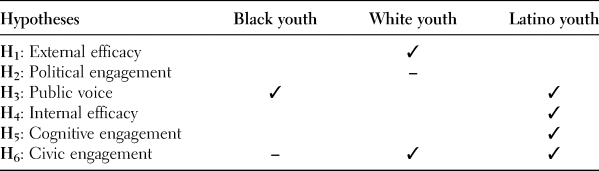
The results discussed so far, summarized in Table 10, strongly support the claim that civic education courses are associated with distinct attitudinal and participatory outcomes across racial and ethnic groups. White youth with access to civic education courses report higher rates of external efficacy and civic engagement. This is distinct from black and Latinx respondents who report greater willingness to participate in acts of public voice. Latinx respondents with access to these courses also report higher rates of internal efficacy and cognitive engagement, likely reflecting the residual benefits of the language and communication skills traditionally emphasized in these courses among Spanish-speaking students specifically. Though civic education courses are positively associated with youth political engagement, the divergent trends that emerge across racial and ethnic groups raise serious normative questions regarding how the curricula implemented in these courses drive young people toward distinct and racialized roles within American democracy. If the intent of these courses is truly to foster active participation and promote equal representation, they are presently failing to live up to these aspirations.
Significant results by dependent variable and corresponding hypotheses

2005 versus 2018
It is reasonable to question whether the results presented above are contingent on a specific political context. Indeed, the past thirteen years have witnessed a number of transformative political events including the election of the first black president and the rise of youth-driven social movements such as Black Lives Matter and March for Our Lives. Thus, it is possible that these changes have led to more equitable rates of participation across each of the four categories discussed above, diluting the potential for civic education to have an effect on participatory outcomes. I am able to explore these temporal changes using data I collected from Chicago-area high school students enrolled in U.S. History and American Government courses between November 2017 and April 2018. While this sample is limited to one metropolitan area and utilizes slightly different questions, it lends important insights into whether the patterns documented above have persisted over time.Footnote 15
There are two questions I can answer using these new data. First, how have overall rates of political participation changed among those with access to a civic education course? Second, do racial gaps in political participation among those with access to a civic education course in 2005 look similar to those found in 2018? If the answer to the latter question is affirmative, it is evidence that the effects found in 2005 have persisted over time. A comprehensive description of the 2018 sample, survey instrument, and analysis is located in the Appendix.
I find that participation among those with access to a civic education course has generally increased since 2005, suggesting that broader shifts in American politics have helped bolster participation among young people across racial groups over the past several years (see Figures 2–5 of the Appendix).Footnote 16 Patterns across racial groups, however, persist in 2018. For example, the 2005 racial gap in acts of public voice is reduced when white youth and young people of color have access to a civics course. Similarly, there are no significant gaps in acts of public voice between young white youth and black (p = 0.62) and Latinx (p = 0.64) enrolled in civic education courses in the 2018 sample. In other words, in both 2005 and 2017–18, rates of public voice across racial groups are similar among those with access to a civic education course. These patterns emerge across other participatory domains as well, as discussed in further detail alongside (Figures 2–5 in the Appendix). In short, the gaps in the 2005 civics group are very similar to those in the 2017–18 civics group. While these comparisons are certainly not definitive, they do help assuage some concerns regarding the temporal constraints of the 2005 data.
CONCLUSION
Political scientists have questioned the impact of civic education courses on student outcomes for decades. However, these studies have frequently led to conflicting results. This work aims to make sense of this ambiguity by centering a large battery of participatory acts in the analysis and attending carefully to racial group differences. Given that young people across racial groups have unequal access to important political resources, undergo different socialization experiences, and are affected by policies differently, it is necessary to consider a broader range of civic and political activities that better reflect the diverse lived experiences of young people in America. In doing so, I find that civic education courses do play an important role in political socialization. However, the impact of these classes is different across racial and ethnic groups.
These findings serve as a note of caution to those who view an expansion in traditional forms of civic education as a panacea for lackluster rates of civic and political participation in the United States. Civic education does matter, but a standardized approach to civics courses should not be assumed to yield consistent outcomes across diverse student populations. The way in which schools teach citizenship likely contributes to the racialized participatory trends highlighted in this paper. Specifically, while acts of public voice and civic engagement play an important role in a well-functioning democracy, it also important to explore ways in which civic education courses can better equip young people from across racial and ethnic groups with the knowledge, skills, and resources to be more active participants across multiple participatory domains.
Political scientists should continue to play an active role in this conversation, providing research that can be leveraged by those seeking to reform citizenship education in America. Given the discussion about the centering of white “heroes” in civic education courses, I suggest that remedying this practice by centering the grassroots political action of people color in course narratives is one important potential reform. The research agenda on the political behavioral impact of civic education could suggest yet further avenues of reform. Specifically, future work should explore the ways in which specific facets of curricula such as the presentation of historical narratives shape student orientations towards politics, attend more closely to the findings about gender differences, and further elucidate the attitudinal mechanisms briefly explored in this paper. While barriers to participation are plentiful in American politics, reviving and reforming civic education in schools holds the potential fostering more equitable participation in American democracy.
Supplementary Material
The supplementary material for this article can be found at https://doi.org/10.1017/rep.2019.19
Acknowledgements
I am grateful for suggestions and feedback from Jamie Druckman, Cathy Cohen, Reuel Rogers, Traci Burch, David Campbell, Sara Stoelinga, Lindsay Knight, Kumar Ramanathan, Sam Gubitz, Tabitha Bonilla, Elan, Hope, Ethan Busby, and D.J. Flynn, as well as participants at the 2018 APSA and Chicago Area Behavior Workshop annual meetings, the Northwestern American Politics Student Workshop, the Northwestern Political Behavior Workshop, and three anonymous reviewers. I also thank the Black Youth Project, The Center for Information & Research on Civic Learning and Engagement (CIRCLE), and the TX Secretary of State's Office for their help in providing the data utilized in this paper.