Introduction
The 2017 Atlantic hurricane season was an unusually active one. The Commonwealth of Puerto Rico (PR), a territory of the United States (US) in the Caribbean, was affected by three hurricanes that season. The first, Hurricane Harvey passed PR on August 24, driving high winds across the island but causing little damage. The second, Hurricane Irma glanced by PR on September 6, causing power losses throughout the island. The final, Hurricane Maria - a Category 4 hurricane - hit PR on September 20. Hurricane Maria’s eye struck the island directly, moving northwesterly from the city of Humacao to the northern city of Arecibo.
Hurricane Maria had a devastating impact on PR, an island of 3.5 million inhabitants. It exposed several frailties in the island’s general and health care infrastructure. In the immediate aftermath, 44% of the island’s population lost access to clean water, all communication infrastructure (eg, cell phone towers and internet connectivity) was lost, only one of the island’s 69 hospitals remained operational, and the entire island lost power. Reference Silva1
Before the 2017 hurricane season, PR’s residents suffered poorer health compared to other US citizens. 2 On average, Puerto Ricans are poorer, earn less income, have less health insurance (which limits access to health care), have a higher unemployment rate, and have higher rates of diabetes, cancer, and heart disease. Reference Krista, Nicole, Amanda and Stephen3 Both the vulnerabilities described in their infrastructure and the well-being of Puerto Ricans have foundations in the historical legacy of American colonialism, Reference Rodríguez-Díaz4 limited political representation within the US federal system (thus limiting the capture of Federal health dollars through government-sponsored insurance schemes such as Medicaid), and the financial collapse of the island’s credit. Reference Lloréns5
The above historical factors, combined with the devastation caused by Hurricane Maria, left Puerto Ricans with an imminent humanitarian crisis. To meet the demands of on-going primary care and medical emergencies, the US Government activated the National Disaster Medical Service (NDMS) through the Federal Emergency Management Agency (FEMA; Washington, DC USA) and Department of Health and Human Services (HHS; Washington, DC USA). The NDMS utilized Federal Medical Shelters (FMS) to bring medical care to local communities in the weeks after the hurricane. This study’s objective was to provide a description of the characteristics of patients seeking emergency care, and their acute medical issues, at FMS Manatí two weeks after the hurricane’s landfall.
Methods
Study Design and Setting
This retrospective, cross-sectional study included all patients presenting to the FMS Manatí seeking emergency care from October 6, two weeks after Hurricane Maria’s landfall, to November 2, 2017. Ethics approval was granted by Columbia University Medical Center’s (New York, New York USA) Institutional Review Board.
The city of Manatí is located in the central north of the island of PR. It is the largest city in the municipality of the same name, and in 2018, had a population of approximately 40,700. 6 Hurricane Maria’s pathway passed to the west of Manatí. Nonetheless, both the city and surrounding areas suffered enormous physical damage to housing and infrastructure. In order to support the provision of humanitarian assistance and health care after the hurricane, FMS Manatí was formed in the Coliseo Juan Aubin Cruz Abreu “Bincito” in the city of Manatí. Served by members of the US military, Disaster Medical Assistance Team/DMAT workers, and volunteer health care workers from across the US, FMS Manatí served as a venue for shelter and hospitalized care as a 250-bed emergency shelter. Additionally, the shelter utilized two emergency tents in order to provide emergency care for patients and a mental health screening tent. Patients were triaged by nursing staff upon entry to the facility by the nature and severity of their presenting complaint. They were then seen by emergency disaster nurses, physicians, and physician assistants. Patients who required advanced emergency care or admission to hospital were transferred to the nearest hospital via military ambulance. If patients required electricity to power medical devices (eg, nebulizers or ventilators [invasive and non-invasive]), they were admitted to the medical shelter.
Measures
Upon presentation to the FMS, baseline patient data were collected (age, day and time of arrival and discharge, discharge destination, and presenting complaint - the reason the patient stated they presented as documented at triage) into a database created and managed by the co-authors over the 30-day period. Subsequently, the presenting complaints of patients were categorized into six themes and 15 categories based on: (1) new acute issues organized by organ system (ie, musculoskeletal [MSK], headache, cardiac, infection, dental, psychiatric, allergy, or rash); (2) patient request for oxygen; (3) management of a chronic medical condition such as diabetes; (4) trauma (eg, injury or animal bite); (5) transfer from hospital; or (6) other. Limited descriptive information prevented further subcategorization of the presenting complaints into specific diagnoses.
Analysis
Descriptive, graphical analyses were performed to assess utilization of the shelter (average number of visits per day, average length of stay in days), changes to presenting complaints over time (proportions of each category per day), and by age groups defined as infant (age ≤1 years), child (1 year < age ≤10 years), adolescent (10 years < age ≤ 25 years), and adult (age > 25 years). Trend analyses using linear regression models were performed to determine whether proportions of presenting complaints remained stable over the study time period. The significance level was defined at α = 0.05 (2-sided). All analysis was performed in R (version 3.5.2; R Foundation for Statistical Computing; Vienna, Austria).
Results
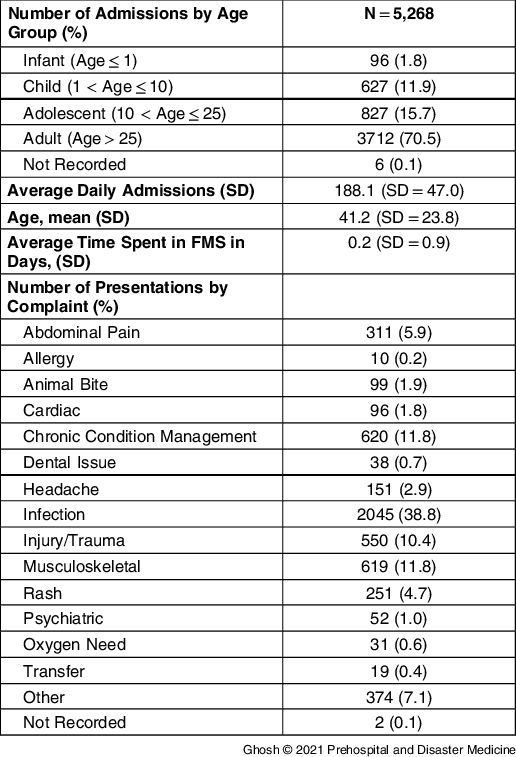
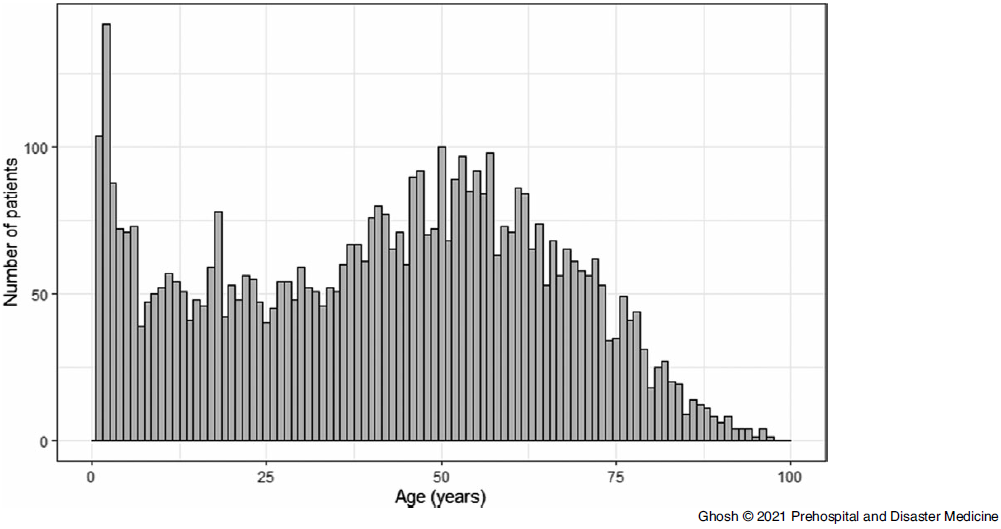
Over the study time period (October 24 - November 2, 2017), 5,268 patients presented to FMS Manatí seeking emergency care (Table 1). There were on average 188.1 presentations per day over the study period and the average period of time spent in care was 0.2 days (approximately five hours). The mean age of patients presenting was 41.2 years. The largest age category were adults (70.5%), followed by adolescents (15.7%). The population followed a bimodal age distribution, with the first peak at one year and the second, smaller peak at 50-52 years (Figure 1). Over the study time period and across all age groups, infection was consistently the most common complaint (38.5%), followed by both MSK-related issues and management for chronic conditions (11.8% each).
Baseline Characteristics of Patients Presenting to FMS Manatí Over 30-Day Perioda

Abbreviation: FMS, Federal Medical Shelter.
a Days 1-3 excluded due to incomplete data collection.
Age Distribution of Patients Seeking Care at FMS Manatí.
Abbreviation: FMS, Federal Medical Shelter.

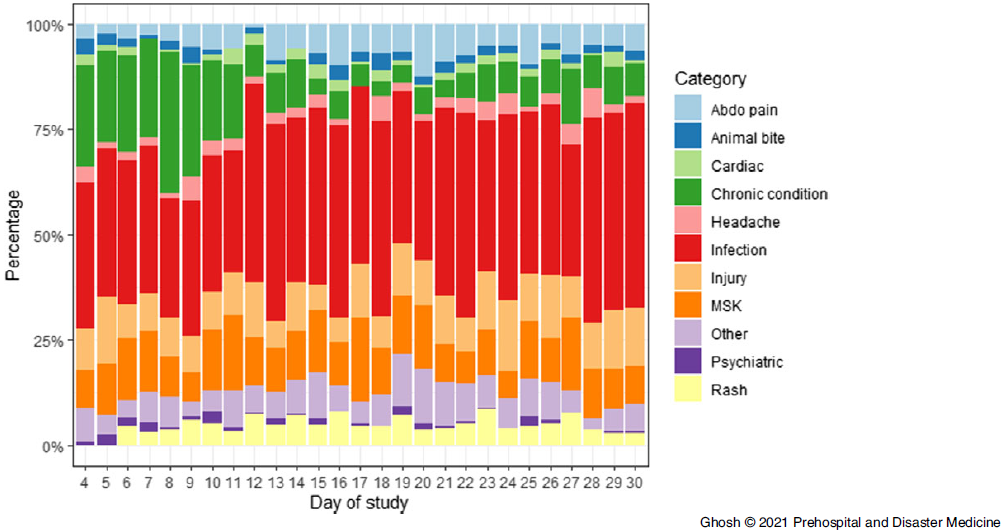
For the most common presenting complaints (Figure 2), the proportion of patients presenting with infections and MSK-related complaints remained stable over the study time period (infection: P value for trend = .05; MSK: P value for trend = .07). While it appeared that the proportion of chronic condition management appeared to decline over the study period, the downwards trend was also not significant (P value for trend = .15).
Daily Percentage Breakdown of Presenting Complaints by Categorya at FMS Manatí Over 30-Dayb Period.
Abbreviations: FMS, Federal Medical Shelter; MSK, musculoskeletal.
aTransfer, Oxygen, Dental, and Allergy; Not recorded categories excluded due to small number.
bDays 1-3 excluded due to incomplete data collection.

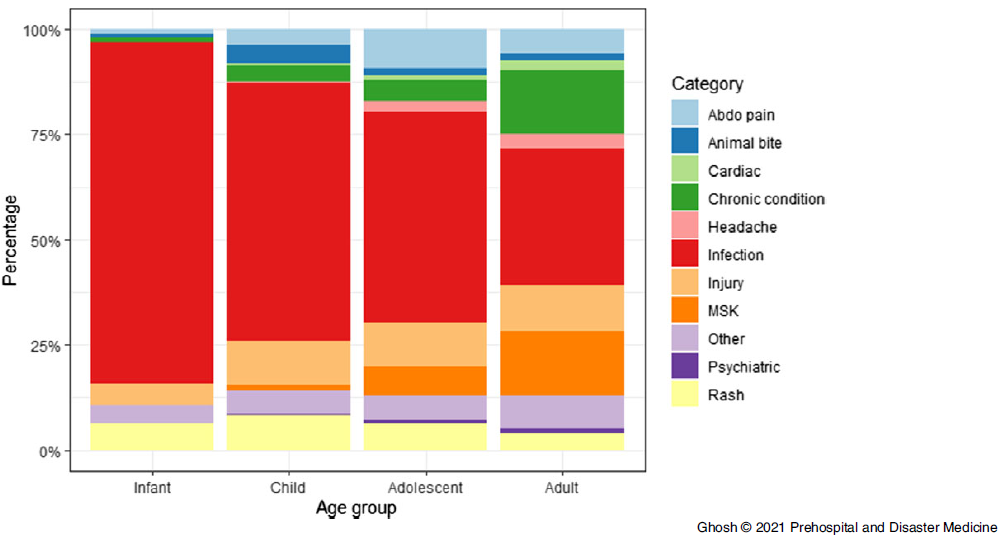
However, when segmented by age group, infections disproportionately affected infants more than children, adolescents, and adults (80.2% versus 61.1%, 49.2%, and 31.7%, respectively) while adults suffered the highest proportion of complaints from chronic condition management (14.9%), MSK-related complaints (14.9%), and injury/trauma (10.7%) compared with other age groups (Figure 3).
Percentage Breakdown of Categories of Presenting Complaintsa by Age Group at FMS Manatí Over Study Period.
Abbreviations: FMS, Federal Medical Shelter; MSK, musculoskeletal.
aTransfer, Oxygen, Dental, and Allergy; Not recorded categories excluded due to small number.

Discussion
In this study describing the presenting complaints of hurricane-affected individuals attending a temporary FMS in Manatí, PR within the first month after landfall, treatment for infections, MSK complaints, and the management of chronic conditions were the most important medical needs. Furthermore, children appeared to suffer disproportionately from infections, while adults reported similar rates of infection and MSK complaints and issues with their chronic disease management. Most concerns with chronic disease management were related to inability to obtain medications.
This analysis of the on-the-ground health issues reflects a confluence of vulnerabilities affecting hurricane-impacted residents and serves to provide the narrative for the increased mortality and morbidity attributed to the hurricane. Reference Kishore, Marqués and Mahmud7,Reference Scaramutti, Salas-Wright, Vos and Schwartz8 Displaced populations with poor access to safe water, Reference Lin, Sevillano-Rivera and Jiang9 sanitation, and shelter 10 are known to be at risk for communicable diseases, in particular vulnerable individuals such as the elderly and children. 10–Reference Fernandez, Byard, Lin, Benson and Barbera12 The data highlight these consequences on children, who disproportionately suffered from infections compared to other age groups. Despite surveys showing that disaster planning for pediatric patients occurs in hospitals, Reference Ketterhagen, Dahl-Grove and McKee13 this may reflect reported gaps in community-based pediatric disaster management. Reference Burke, Iverson, Goodhue, Neches and Upperman14 Other particularly vulnerable patients identified were those dependent on oxygen and other electrical medical technologies. Previous articles have called for the need of improved planning for those with such functional/electricity dependent needs before a disaster to establish community resilience. Reference Jan and Lurie15–Reference Molinari, Chen, Krishna and Morris17
Furthermore, this analysis underlines the consequences of disruption to PR’s health care system. Reference Alcorn18 Patients suffering chronic diseases such as diabetes, hypertension, and heart failure often find their care affected by natural disasters because of an inability to seek care, obtain medications, and by the stress induced by the natural disaster itself. Reference Ford, Mokdad, Link, Garvin and McGuire19,Reference Mensah, Mokdad and Posner20 Moreover, the findings suggests that a large number of patients sought medication refills because they were unable to obtain them through their usual primary care physicians. Reports from patients served at the FMS suggested that primary care clinics had closed and that some medical professionals had left the island or were caring for their own families - consistent with later reports. Reference Catherine21,Reference Ramphal22 The dual shock from disrupted health care infrastructure and lost health-related human capital likely led to the need for chronic disease management in the short-term, which declined when scripts were filled through the FMS.
Limitations
A number of limitations exist for this study. First, while FMS Manatí was an important site for health care access in post-hurricane Manatí, it was not the only site. Therefore, the analysis may not represent the true nature of post-hurricane emergency needs after the hurricane. However, patients noted that few medical clinics were open after the hurricane. Moreover, the number of patients presenting and seeking medical care remained stable over the study period, suggesting that individuals were not getting care elsewhere. Second, the dataset under-estimated the need for psychiatric care because a separate but adjacent center to address the mental health needs of patients was created. Therefore, this cohort likely under-estimated the number of patients seeking psychiatric care.
Conclusion
The devastation wrought by Hurricane Maria caused significant damage to infrastructure and disruption to health care services. These findings from FMS Manatí highlight the disproportionate effect the hurricane had on children, who presented more frequently with infections, and for older patients, who presented with MSK complaints and for the management of chronic conditions. The findings suggest that individual planning for patients with comorbidities needs to be initiated by primary care physicians, and a focus on access to medications after a disaster needs to be prioritized during disaster response. Expanding resources for vulnerable populations (such as children and patients with multiple comorbidities) needs to be focused on public health planning for disasters.
Conflicts of interest/funding
Dr. Ghosh is supported by National Center for Advancing Translational Sciences (NCATS) grant KL2-TR-002385 of the Clinical and Translational Science Center at Weill Cornell Medical College. Dr. Ibrahim is supported in part by a K24 Mid-Career Development Award from the National Institute of Arthritis and Musculoskeletal and Skin Diseases (K24AR055259). All authors have no relevant relationships with commercial interests to disclose.