


Suicide constitutes a public health problem that has a significant economic, social and psychological impact on a global scale (Naghavi, Reference Naghavi2019; Wetherall et al., Reference Wetherall, Cleare, Eschle, Ferguson, O’Connor, O’Carroll and O’Connor2018; World Health Organization, 2014, 2018). Recent data from the Global Burden of Disease Study (Naghavi, Reference Naghavi2019) indicates that the number of deaths from suicide was 817,000, 95% CI [762,000, 884,000] in 2016, corresponding to a rate of 11.1, 95% CI [10.3, 12.0] deaths per 100,000 inhabitants.
Epidemiological data varies when considering certain sociodemographic variables (Khazaei, Armanmehr, Nematollahi, Rezaeian, & Khazaei, Reference Khazaei, Armanmehr, Nematollahi, Rezaeian and Khazaei2017, Naghavi, Reference Naghavi2019). When age is considered, in the age range of 15–29 years, suicide ascends to the second place as a leading cause of death (World Health Organization, 2014). The sex variable, is another important variable to be taken into account, being suicide more frequent in males (male/female ratio of suicide rate = 1.9, World Health Organization, 2014).
Similar in many aspects to what is observed worldwide, in Argentina, the data provided by the World Health Organization in 2014 shows a suicide mortality rate of 10.8 per 100,000 inhabitants. When considering age groups, the highest rates are recorded in the age ranges of 15–29 (13.8), 50–69 (15.8), and ≥ 70 years (21.6). In this region, the differences by sex are very marked being the ratio of the male/female suicide rate equal to 4.2 (normalized by age), that is, more than 4 times higher in men (Suicide Rate in Men = 17.2, Suicide Rate in Women = 4.1). According to these data, Argentina would be among the regions with the highest suicide rates, and with the widest gender differences.
These epidemiological data demonstrate the importance of having empirical research that substantiates diverse actions to address the problem of suicide, whether that is in the form of public health policies, psychological treatments, or other avenues (Barrigón & Baca-García, Reference Barrigón and Baca-García2018). In accordance to this, the American Psychological Association has recently specified that suicide prevention should be a public health priority (American Psychological Association, APA, 2018). Unfortunately, the results of the research advances on the subject do not yet allow strong predictions to be made regarding suicidal risk (Barredo et al., Reference Barredo, Aiken, van’t Wout-Frank, Greenberg, Carpenter and Philip2019; Miller et al., Reference Miller, McLaughlin, Busso, Brueck, Peverill and Sheridan2018).
One of the main predictors of suicide is suicidal ideation (SI; Beck, Rush, Shaw, & Emery, Reference Beck, Rush, Shaw and Emery2012; Ellis & Rutherford, Reference Ellis and Rutherford2008; Miller et al., Reference Miller, McLaughlin, Busso, Brueck, Peverill and Sheridan2018 Wenzel & Beck, Reference Wenzel and Beck2008; Wenzel, Brown, & Beck, Reference Wenzel, Brown and Beck2009), which is defined as any cognition reported by a person (e.g. thought, image, belief) which refers to putting an end to that person’s own life, or the intention to take suicidal behavior to completion. This research project aims to test an explanatory model of SI, contemplating the direct and indirect effects (through affectivity and hopelessness) that cognitive emotional regulation strategies have.
Cognitive Emotion Regulation Strategies and Suicide Ideation: An Integrative Model
The emotion regulation strategies imply any process that can alter an experienced emotion, its duration and/or expression (Denny, Silvers, & Ochsner, Reference Denny, Silvers, Ochsner, Kring and Sloan2009).
There is recent evidence indicating that different emotional regulation (ER) strategies could be integrated into two main orthogonal dimensions (Braunstein, Gross, & Ochsner, Reference Braunstein, Gross and Ochsner2017), based on: (a) The nature of the ER goal (ranging from implicit to explicit) and (b) the nature of the emotion change process (ranging from more automatic to more controlled). Among these different factors involved in ER, cognitive processes play a prominent role (Garnefski & Kraaij, Reference Garnefski and Kraaij2007).
Based on the categorization proposed by Braunstein et al. (Reference Braunstein, Gross and Ochsner2017), it is possible to distinguish at least two groups of cognitive strategies of ER: More implicit/automatic strategies, and more explicit/controlled strategies. Two of the most studied implicit/automatic cognitive strategies of ER in the context of psychopathology are Rumination and Catastrophization (Aldao, Nolen-Hoeksema, & Schweizer, Reference Aldao, Nolen-Hoeksema and Schweizer2010; Garnefski, Kraaij, & Spinhoven, Reference Garnefski, Kraaij and Spinhoven2001; Phottoff et al., Reference Potthoff, Garnefski, Miklósi, Ubbiali, Domínguez-Sánchez, Costa Martins and Kraaij2016). These two strategies have a common component referred to as the repetitive negative thought, about the causes, situational factors, and consequences of one’s emotional experience (Selby, Anestis, & Joiner, Reference Selby, Anestis and Joiner2008). Recent reviews conclude that these types of repetitive negative thoughts are generally associated with an increased vulnerability to suicidal ideation (Law & Tuker, Reference Law and Tucker2018; Rogers & Joiner, Reference Rogers and Joiner2017).
From the Emotional Cascade Model (Selby et al., Reference Selby, Anestis and Joiner2008; Selby, Franklin, Carson-Wong, & Rizvi, Reference Selby, Franklin, Carson-Wong and Rizvi2013), these relationships can be explained by the fact that this type of repetitive negative thinking would increase the intensity, and frequency in time, of negative affectivity. In cases in which the person does not have another more appropriate resource (e.g. more controlled ER such as reinterpretation), they will implement maladaptive coping methods (e.g. self-injury, suicidal ideation, suicide attempt) that will aim to decrease the intensity of these negative emotions.
Negative affectivity would also mediate the relationship between rumination and suicidal ideation, through the so-called effect of affective infusion that would occur on memory (Bower & Forgas, Reference Bower, Forgas and Forgas2001), thus affecting cognitive judgments (Flores Kanter, Medrano, & Hann, Reference Flores-Kanter, Medrano and Conn2015; Flores Kanter, Medrano, & Manoiloff, Reference Flores-Kanter, Medrano and Manoiloff2015; Medrano, FloresKanter, Moretti, & Pereno, Reference Medrano, Flores-Kanter, Moretti and Pereno2016). In this way, the intensity and frequency of negative affect could have an impact on the cognitive judgments about the future, leading to negative thoughts or negative expectations regarding what is going to happen (i.e. hopelessness, Ellis, Reference Ellis and Ellis2006, Wenzel et al., Reference Wenzel, Brown and Beck2009). In doing so, the probability of occurrence of suicidal ideation increases (Beck et al., Reference Beck, Rush, Shaw and Emery2012).
Beyond the previous theoretical considerations, there have not yet been enough empirical studies regarding the mechanism by which ruminative processes impact suicidal ideation (Rogers & Joiner, Reference Rogers and Joiner2017). To date, only one study has tried to prove these assumptions through structural equation model, which have the advantage of allowing to verify the relative weight, as well as the direct and indirect effects, of the respective variables. However, this previous research has only contemplated the role of negative affect in the relationship between rumination and suicidal ideation (Hasking, Boyes, Finlay-Jones, McEvoy, & Ree, Reference Hasking, Boyes, Finlay-Jones, McEvoy and Rees2018). The involvement of other key variables in the prediction of suicidal ideations, such as the adaptive cognitive strategies (more explicit/controlled) of ER, remains pending (Garnefski & Kraaij, Reference Garnefski and Kraaij2007).
In general, the cognitive strategies of ER commonly described as adaptive, contemplate more controlled and explicit ways of processing negative events with what the person faces (Braunstein et al., Reference Braunstein, Gross and Ochsner2017; Miller et al., Reference Miller, McLaughlin, Busso, Brueck, Peverill and Sheridan2018). This includes strategies such as reinterpretation, refocusing attention on positive aspects, acceptance, and focus on plans (Garnefski, Kraaij, & Spinhoven, Reference Garnefski, Kraaij and Spinhoven2001). There is evidence that these strategies negatively predict different indicators of psychopathology, particularly anxiety and depression (Potthoff et al., Reference Potthoff, Garnefski, Miklósi, Ubbiali, Domínguez-Sánchez, Costa Martins and Kraaij2016). These strategies have also been linked to maladaptive behaviors. Specifically, within the Emotional Cascade Model, these ER strategies work as protective factors for this type of behavior (Selby et al., Reference Selby, Anestis and Joiner2008; Reference Selby, Franklin, Carson-Wong and Rizvi2013). However, in the specific context of the prediction of suicidal ideations these strategies have rarely been investigated. To date, only two previous studies were found, in which only positive reinterpretation and its association with suicidal ideas were contemplated. In one of the studies, Forkmann et al. (Reference Forkmann, Scherer, Böcker, Pawelzik, Gauggel and Glaesmer2014) applied self-report measures and a path analysis, not verifying a statistically significant effect of the reinterpretation on suicidal ideation. Using an experimental design and physiological indicators of the effectiveness in the use of reinterpretation, Kudinova, et al. (2016) did show differences between people with SI and people without SI. People with SI showed less effective use of this strategy, especially when they had to apply it to unpleasant images.
Unlike the Emotional Regulation Questionnaire (ERQ) applied by Forkman et al. (Reference Forkmann, Scherer, Böcker, Pawelzik, Gauggel and Glaesmer2014), in the study by Kudinova, et al. (2016) the use of reinterpretation is clearly distinguished from negative, positive and neutral events (the ERQ, on the other hand, combines the use of reinterpretation in both types of events). It seems that suicidal ideation would be more linked to the difficulty in applying reinterpretation when people are faced with an unpleasant event specifically.
Beyond these considerations, the same limitations are presented as in the case of automatic strategies, that is, in previous studies referring to more controlled ER cognitive strategies it is not explaining why this relationship occurs. In this sense, the aforementioned studies do not contemplate mediating variables, such as affectivity and hopelessness, nor other variables of adaptive or maladaptive cognitive ER of relevance.
Research Objectives and Hypothesis:
While there have been previous studies that have examined variables such as affectivity, cognitive strategies for ER and hopelessness in relation to suicidal ideation, they have been analyzed separately. Thus as yet, there is no research that assesses the combined contribution of these variables, nor the direct and indirect effects they could have on predicting suicidal ideation. It is for this reason that this study proposes a model of suicidal ideation (Figure 1) that considers: (a) the cognitive strategies for emotional regulation (Path 1 and 2), (b) affectivity (Path 3 and 4), and (c) hopelessness (Path 5).
Predictive Model of Suicidal Ideation.

Based on the considerations made, this study proposed testing the following hypotheses: (a) Automatic cognitive ER strategies will have a direct and positive effect on suicidal ideation (Path 1), also indirectly predicting these ideations through (b) a negative effect on more controlled ER cognitive strategies (Path 14), (c) increasing negative affect (Path 6) and hopelessness (Path 10), and (d) decreasing positive affect (Path 7). For their part, (e) controlled ER cognitive strategies will show a direct and negative effect on suicidal ideation (Path 2), also producing (f) an increase in positive affect (Path 9), and (g) a decrease in negative affect (Path 8) and hopelessness (Path 11). (h) Positive affect will have a direct and negative effect on suicidal ideation (Path 4) presenting, additionally, an indirect effect (i) decreasing hopelessness (Path 12). In contrast, (j) negative affect will show a direct and positive effect on suicidal ideation (Path 3), indirectly affecting ideation by means of (k) an increase in hopelessness (Path 13). Finally, (l) hopelessness will produce a direct and positive effect on suicidal ideation (Path 5).
The present study will also allow verifying, in a large sample, if the model is applicable in different subgroups, considering relevant variables in the study of suicide, such as age and gender, aspects that have been neglected in the background on the subject (Rogers & Joiner, Reference Rogers and Joiner2017).
Method
Participants
By means of a non-probabilistic, self-selected sample, we take a sample of 2,164 Argentines. The socio-demographics of the participants are shown in Table 1. The sample was obtained through an open mode on-line sample methods (The International Test Commission, 2007). This methodology of data collection has proven to be equivalent to traditional forms of collection (i.e. face to face, Weigold, Weigold, & Russell, Reference Weigold, Weigold and Russell2013), considering quantitative equivalence (i.e., mean equivalence), qualitative equivalence (i.e., internal consistency and intercorrelations), and auxiliary equivalence (i.e., response rates and comfort completing questionnaires using paper-and-pencil and the Internet).
Demographics Characteristics of Sample

Note. Actual treatment = psychiatric or psychological; Suicide I. = Suicide Ideation: The presence of ideation was identified based on the recategorization of the scores obtained from the ISO scale, being a total score of 4 (indicates that the participant was in total disagreement with all the items) considered as Absence of ideation while scores ≥ 5 (indicates that the participant at least agreed with one of the statements) as Presence of suicidal ideation.
Instruments
Cognitive Emotion Regulation Questionnaire (CERQ; Garnefski & Kraaij, Reference Garnefski and Kraaij2007). The CERQ is a self-report instrument composed of 36 items responded to on a Likert scale, in which 1 is almost never and 5 is almost always. This instrument makes it possible to investigate nine different cognitive ER strategies, which the person tends to use when facing negative events: Self-blame, other-blame, rumination, catastrophizing, putting into perspective, positive refocusing, positive reappraisal, acceptance, and planning. The Argentine version of the scale was used (Medrano, Moretti, Ortiz, & Pereno, Reference Medrano, Moretti, Ortiz and Pereno2013), adapted and validated in the sample of university students (N = 359, M age = 24.6, female = 50.1). The model of 9 correlated factors showed acceptable adjustment indicators (χ2 = 875.50, df = 538, CFI = .91, GFI = .90, RMSEA = .04). The internal consistency indicators measured by Cronbach’s Alpha varied between .59 and .83. The results will show the adequacy of the measurement model and internal consistency indicators for the present study.
Positive and Negative Affect Scale (PANAS). The PANAS consists of 20 terms that describe different positive (e.g. active, strong, inspired) and negative feelings and emotions (e.g. irritated, fearful, nervous). The participant being evaluated must indicate, using a five-point scale (1 = very little or nothing up to 5 = always or almost always), what level of intensity is felt for each one of the emotions presented. The version validated in Argentina by Flores Kanter and Medrano (Reference Flores-Kanter and Medrano2016) was applied. By means of a confirmatory factor analysis, the authors found an acceptable adjustment to the model in two factors (χ2 = 547.69, CFI=.93, TLI=.92, RMSEA=.06), which considers the negative affect and positive affect as relatively independent dimensions. In the present sample, optimal Cronbach’s alpha coefficients were observed for both dimensions (α PA= .86; α NA= .90).
Beck’s Hopelessness Scale (BHS). For this study, the version adapted for the Argentinian population was used (Mikulic, Casullo, Crespi, & Marconi, Reference Mikulic, Casullo, Crespi and Marconi2009). This scale is comprised of 20 items with a dichotomous reply format (i.e. true or false) and is used to evaluate negative expectations for the future. The instrument shows an adequate level of internal consistency (α = .78). In the present sample, an optimum Cronbach´s alpha coefficient for the dimension is observed (α = .88).
Inventory of Suicide Orientation - ISO – 30. The version adapted by Fernández Liporace and Casullo (Reference Fernández Liporace and Casullo2006) in Argentina was used. This instrument measures the level of agreement with certain statements using a Likert scale with 4 response options. From the scale, only the questions that were related to the dimension of suicidal ideation were applied (e.g. “In order to stop things getting worse, I believe suicide is the solution"). In the validation of the instrument, this is the most reliable dimension on the scale (α = .88). In the present sample, an optimum Cronbach´s alpha coefficient for the dimension is observed (α = .93).
Procedure
An ex post facto study was developed, for which an online survey format was used to gather information through the Google Forms platform and via social media. At the beginning of the questionnaire, an explanation was provided about the research objective, along with assurance about the anonymity of the responses and an explanation that participation was completely voluntary.
Statistical Analysis
For the analysis of data, exploratory analyses were carried out first. They were carried out in order to verify the univariate and multivariate normal distribution. The univariate normal distribution was considered following the criteria established by Lei and Lomax (Reference Lei and Lomax2005), who indicate that values of asymmetry between + –1.7 and 1.76, and kurtosis between + –3.5 and 3.9 do not lead to considerable biases in parameter estimation using the maximum likelihood (ML) method, nor does it significantly affect indices of adjustments such as the CFI. On the other hand, to evaluate the multivariate normality, the indication of Rodríguez-Ayán and Ruiz-Díaz (Reference Rodríguez-Ayán and Ruiz-Díaz2008) was taken into consideration, indicating that it is appropriate to obtain a Mardia index of multivariate kurtosis obtained by AMOS that does not exceed the value of 70, given that this will indicate that the ML estimate will not be biased and will provide adequate results. The mentioned aspects coincide with the considerations offered by Savalei (Reference Savalei2008) about the robustness of ML. Regarding this, the author indicates that with a high sample size (n ≥ 1,000), when there is no missing data, with Mardia’s multivariate kurtosis in the range 24–36, or Kurtosis univariate in the range 5–11, ML statistic test performs optimally.
The main data analysis consisted of applying a path analysis through structural equations model. Prior to this, the adequacy of the measurement models was verified (Byrne, Reference Byrne2010), referring to the ER strategies. This was necessary given that there is still controversy regarding the way of grouping different emotional regulation strategies, particularly cognitive ones. In the case of the ER-controlled strategies, they would depend on a general factor of the second order, while in the case of the maladaptive the evidence suggests separating between strategies such as rumination and catastrophization, of other types of strategies, such as self-blaming and blaming others (Selby et al., Reference Selby, Anestis and Joiner2008; Reference Selby, Franklin, Carson-Wong and Rizvi2013). A bi-factor model would be optimal to represent the latter model, from which could be identified the items that can be grouped into a general factor of those that depend more on the specific factors (Rodriguez, Reise, & Haviland, Reference Rodriguez, Reise and Haviland2016). To evaluate the adjustment of proposed models (measurement and structural models), parameter estimates were carried out through the maximum likelihood estimation method. In line with the specialized literature (Hu & Bentler, Reference Hu and Bentler1999), chi-square indices (χ2), comparative fit index (CFI), Tucker Lewis index (TLI), goodness of fit index (GFI) and root mean square error of approximation (RMSEA) were used. As suggested by Hu and Bentler (Reference Hu and Bentler1999), for the RMSEA index acceptable values ranging between .05 and .08 are considered, values less than .05 are considered optimal; for the CFI, TLI, and GFI indices, values above .90 are acceptable and values considered to be optimal are those that are above or equal to .95.
Complementary, multi-group invariance analyzes were applied, in order to verify if the hypothesized model could be considered equivalent according to relevant sociodemographic factors, age and gender. For the invariance determination, we analyzed the model at the structural weights (equal regression weights), structural intercepts (equal path intercepts), and structural residuals (equal residual variance and covariance) levels. Structural residuals are a severe constraint that is excessively stringent (Byrne, Reference Byrne2010), so invariance at this level was not expected. To determine the invariance in the different levels, we consider both the χ2 values and the change in the CFI coefficients. A non-significant increase in the χ2 value (relative to df) in the constrained model relative to the unconstrained model indicated that the constraints across groups were possible. On the other hand, if the drop in CFI of the constrained model relative to the unconstrained model did not exceed 0.01, the constrained model was accepted. The ΔCFI criterion was argued to be superior to Δχ2, as it is less sensitive to sample size (Cheung & Rensvold, Reference Cheung and Rensvold2002). To run these analyses, the AMOS IBM 20 program and the SPSS IBM 20 software were used.
In this study, international ethical guidelines were taken into account when conducting studies with human beings (American Psychological Association, 2017). All participants were entirely informed of the research objectives, the anonymity of their responses, and their voluntary participation. Likewise, it was clarified that participation would not cause any harm to his person and that they could leave the study as soon as they wished. The research protocol was previously approved by the ethics committee of the Research Secretariat of the 21st Century University.
Results
Preliminary Descriptive Analysis
The descriptive statistics and the correlation coefficients obtained for the respective variables are shown below (Table 2).
Descriptive Statistics and Correlation Coefficients
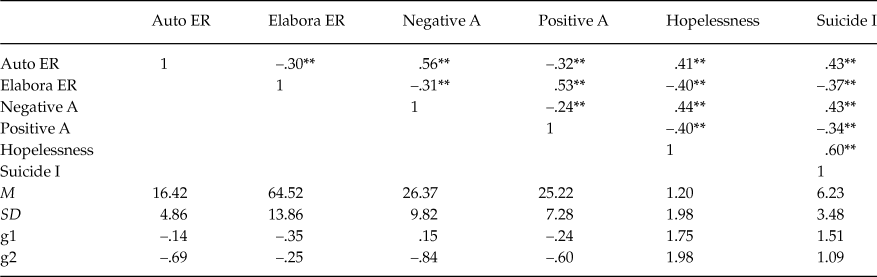
Note. Auto ER = Automatic Cognitive Emotion Regulation Strategies; Elaborate ER = Elaborative Cognitive Emotion Regulation Strategies; A = Affect; I = Ideation; g1 = Skewness; g2 = Kurtosis.
** p < .01.
Table 2 demonstrates that significant correlations of moderate and strong magnitude are found among the variables under consideration. In addition to the above, both the ranges obtained from skewness (–.14/1.75) and kurtosis (–.25/1.98), as well as the value of Mardia’s multivariate kurtosis (7.48), are an appropriate condition for the ML statistic test to perform optimally.
Measurement Model Analyses
The bifactor measurement model applied for the automatic ER strategies showed adequate indexes of adjustments (χ2 = 580.89, df = 88, CFI = .96, TLI = .95, RMSEA = .05). Additional indices were also calculated to evaluate this model properly (Flores-Kanter, Dominguez-Lara, Trógolo, & Medrano, Reference Flores-Kanter, Dominguez-Lara, Trógolo and Medrano2018). Among them the H index, an indicator of reliability, indicates how well a series of items represent the latent variable. Here an adequate value of .86 was obtained, which suggests that the general factor (GF) is well defined by its indicators, and also the consideration of it as an orthogonal general latent variable is replicable. It is necessary also in also in bifactor models to identify those items that are most strongly influenced by this GF, and distinguish them from those that would be more particular to the specific factors. For this, the extra calculation of the ECV–I indicator is applied. The ECV–I indices allow concluding that the items 15 (ECV–I = .87; I am worried about what I think and feel about what happened), 26 (ECV–I = .89; I think about the mistakes I made) , 35 (ECV–I = .88; I constantly think about how horrible the situation was), 10 (ECV–I = .80, I keep thinking about how terrible this is), and 27 (ECV–I = .88; I think too much about the feelings that the situation generated for me), are the ones most explained by the GF. In terms of the reliability measured by the Cronbach alpha coefficient, an optimum value of .81 was obtained for the general factor. In accordance with what was raised by Selby et al. (Reference Selby, Anestis and Joiner2008), it is possible to appreciate that the general factor is alluding to a negative repetitive ruminative thinking style, of an automatic-implicit nature.
For its part, the second-order hierarchical measurement model applied to the controlled strategies of ER also showed adequate indexes of adjustments (χ2= 1240.72, df = 147, CFI = .94, TLI = .93, RMSEA = .06). In terms of the reliability measured by the Cronbach´s alpha coefficient, an optimum value of .91 was obtained for the general factor.
Structural Model Analyses: Total Sample
Optimal adjustment indices were obtained from analyzing the adequateness of the model, (χ2 = .10, p = .75, CFI = .99, TLI = .99, GFI = .99, RMSEA = .01). The model makes it possible to explain 42% variability in suicidal ideation. It is worth mentioning that all paths are significant (p < .05) and their direction are coherent with what is expected on a theoretical level.
The standardized regression coefficients obtained for the model can be seen in Figure 2.
Path Analysis. Integrative Explanatory Model of Suicidal Ideation.
*p < .05. **p < .01.

By examining the magnitude of the total effects, it is observed that the variables that have a larger contribution to suicidal ideation are hopelessness (β total = .44) and automatic cognitive ER strategies (β total = .43). Following them in order of magnitude are the controlled cognitive ER strategies (β total = –.26), negative affect (β total =.22) and positive affect (β total = –.13).
Model Invariance across Sociodemographic Groups
The results of the multi-group analysis are presented in Table 3.
Fit Statistics for Multi-group Confirmatory Factor Analysis by Gender and Age Groups
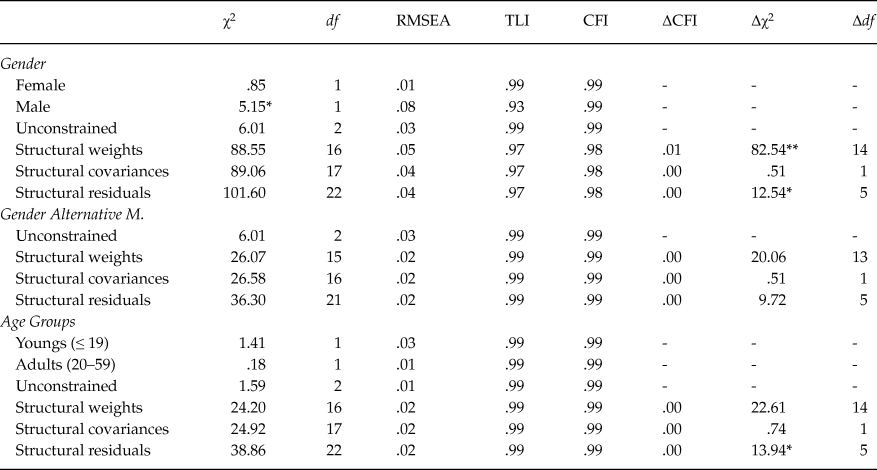
Note. Gender Alternative M. = Gender Alternative Model: The visual observation of the parameters allowed the detection of the source of noninvariance between the groups. The path corresponds to the effect from Automatic Cognitive Emotion Regulation Strategies to Elaborative Cognitive Emotion Regulation Strategies.
* p < .05. **p < .01.
Regarding the observed invariance in terms of gender, a statistically significant difference in the χ2 value is obtained. This implies that the path coefficients across groups are not equal and that the gender may be a moderator of the relationship between measured variables. A close examination of path coefficients in both groups revealed that, in men, there is no statistically significant effect between Automatic ER and Controlled ER (β = –.03, p = .48, R 2 = .001). On the contrary, in women this effect is significant, and explaining a higher percentage of the variance of the Controlled ER (β = –. 40, p < .01, R 2= .16). Next, a model was tested indicated that this path is not equal between the groups, keeping the remaining paths equal. This model presents an optimal fit in both groups and does not show significant changes in the χ2 values or substantial changes in the CFI, whereby the invariance is assumed (see Table 3, Gender Alternative Model).
Regarding the invariance considering the age groups, the criteria of Ruiz (2005) were considered. Although the sample had young people, adults, and older people, due to the size of the groups it was only possible to perform the analysis of invariance between young people and adults (Savalei, Reference Savalei2008). It should also be noted that previously it was verified that the gender variable is balanced in the age groups, to rule out the influence of this last variable. The chi-square test indicates that a homogeneous gender distribution is maintained in the two groups (Youngs: 71.6% Women, 28.4% Man, Adults: 72.4% Women, 27.6% Man, χ2 = .12, df = 1, p = .73). The model presents an optimal fit in both groups and does not show significant changes in the χ2 values or substantial changes in the CFI, whereby the invariance is assumed.
Discussion
The main objective of this study was to verify the adequacy of an explanatory model of suicidal ideation. While all the variables proposed in the model show evidence of a significant effect on suicidal ideation, the variables that show a stronger contribution are automatic cognitive ER strategies and hopelessness.
Regarding automatic cognitive ER strategies, the demonstrated strong effect on suicidal ideation is explained both by the direct and indirect effects of such strategies. Evidence suggests that these types of strategies appear in the first place when a person faces a negative event (Beck & Clark, Reference Beck and Clark1997, Hofmann, Ellard, & Siegle, Reference Hofmann, Ellard and Siegle2012), and hence their automatic/implicit character (Braunstein et al., Reference Braunstein, Gross and Ochsner2017). Also, perhaps there lies its adaptive and evolutionary value (Medrano, Muñoz-Navarro, & Cano-Vindel, Reference Medrano, Muñoz-Navarro and Cano-Vindel2016). Our results indicate that when the person is involved in repetitive negative thoughts of a ruminative nature, it increases their chances of concluding in thoughts of hopelessness and/or suicidal thoughts. This is consistent with the reviews that point to a consistent association between rumination and suicidal ideation (see, for example, Holdaway, Luebbe & Becker, Reference Holdaway, Luebbe and Becker2018; and Rogers & Joiner, Reference Rogers and Joiner2017). In any case, the strongest effect is found in the present study through the intensification produced by this type of ER strategy on negative affectivity, and the effect that the latter produces on cognitive judgments of hopelessness and/or suicidal ideation. This association can be attributed to the process of affective infusion (Bower & Forgas, Reference Bower, Forgas and Forgas2001).
In general, both paths (direct and indirect) proved to be invariant based on gender and age. Even so, the effect of interference that these types of strategies have on those of a more controlled nature seems to depend on the gender of the person, given that it was only evident in the women of the present study. Therefore, the assumption that automatic cognitive processes occur first and can interfere with and/or modify the elaborative or subsequent reflective processes (see, for example, Beck & Clark, Reference Beck and Clark1997, and Clark & Beck, Reference Clark and Beck2012) would not be generalizable in this case to both genders.
It is also relevant to highlight the preventive nature of the more controlled ER cognitive strategies. These have shown in the present study that their increase is linked to a lower probability of concluding in hopelessness and/or suicidal thoughts. Similar to automatic strategies, the strongest effect of controlled ones is indirectly through positive affectivity. In this last case, the effects of affective congruence are inverses to what is observed for negative affectivity. Here too, both paths (direct and indirect) proved to be invariant based on gender and age. These results are consistent with the experimental studies of Kudinova et al. (Reference Kudinova, Owens, Burkhouse, Barretto, Bonanno and Gibb2016), who demonstrated a less effective use of reinterpretation in the face of unpleasant images in people with suicidal ideation.
The model presented is consistent with the predictions of the Emotional Cascade theory (Selby et al., Reference Selby, Anestis and Joiner2008), and the affective infusion model (Bower & Forgas, Reference Bower, Forgas and Forgas2001). In effect, the ruminative negative repetitive thinking would increase the intensity, and frequency in time, of negative affectivity. Negative affect in turn, through affective infusion that would occur on memory, would affect cognitive judgments, for example, leading to negative thoughts or negative expectations regarding what is going to happen. In doing so, the probability of occurrence of suicidal ideations increases. The above would worsen in those cases in which the person does not have another more appropriate resource (e.g. reinterpretation). On the one hand, it will set in motion maladaptive forms of coping (e.g. suicidal ideation, self-injury), which will aim to diminish the intensity of these negative emotions; but in addition, the positive affect, necessary to diminish the occurrence of this type of negative cognitive judgments (e.g. hopelessness, suicidal ideations) will not be generated.
Regarding the practical implications of the results, it is important to highlight that: (a) Regardless of whether the automatic ER strategies interfere with the more controlled ER strategies (which varies depending on gender), (b) it is important to work in both ER strategies separately, given that they demonstrate a differential effect, both on affectivity, and on hopelessness and suicidal ideation. In terms of priority, the data obtained suggest prioritizing the work on automatic strategies, that is, the approach in the first place of the repetitive negative thoughts of a ruminative nature, and, later, work in most controlled ER strategies. For the first case, a tool that shows promise is the mindfulness approach (King & Fresco, Reference King and Fresco2019). For the second case, cognitive reinterpretation has been recommended as a specific intervention for the prevention of suicide (see, for example, Kiosses et al., Reference Kiosses, Alexopoulos, Hajcak, Apfeldorf, Duberstein, Putrino and Gross2018).
Beyond the data presented, the type of design used does not allow us to draw definitive conclusions regarding the causality or temporal antecedence of the variables used in the model. Switching from transactional designs to other longitudinal ones will enable researchers to make rigorous inferences regarding the causal relationships involved in the models (Cole & Maxwell, Reference Cole and Maxwell2003). Future research could focus on testing the model, improving the design that is used, applying, for example, a prospective design of more than one causal link. Finally, exclusive self-reported use of emotion regulation strategies is a limitation. Combined with other more direct measures of effectiveness in the use of cognitive strategies of ER is recommendable in future studies (Kudinova, et al. Reference Kudinova, Owens, Burkhouse, Barretto, Bonanno and Gibb2016).
In summary, for the first time in a single model, this study presents a series of variables that make it possible to predict suicidal ideation. This is the first study that contemplates mediating variables, specifically, affectivity and hopelessness, in the relationship between cognitive ER strategies and suicidal ideations. In addition, it has been possible to contemplate a large sample that allowed analysis of invariance based on gender and age, aspects necessary in order to advance in this line of research (Rogers & Joiner, Reference Rogers and Joiner2017). Finally, this study is an important contribution to deepening knowledge about this subject within the region, which has been quite underdeveloped in comparison to the contributions that have been made in the US or Europe (Flores Kanter, Reference Flores-Kanter2017). Only more studies and the appropriate use of obtained results will be able to ensure that effective and efficient answers are provided in response to the issue of suicide, both within the wider region as well as Argentina in particular.



