INTRODUCTION
As stem cell-based neurorestorative approaches to Parkinson’s disease (PD) are entering first-in-human clinical trials, it is critical to understand outcomes of previous attempts at cell-based transplantation. Allotransplant of dopaminergic neuroblasts in fetal ventral mesencephalic (fVM) tissue is the best-studied reparative intervention in PD, with open-label studies starting in 1987. Initial research paved the way for multiple clinical trials of bilateral fVM tissue implant in PD with hundreds of individuals receiving transplants. Such studies stopped after publication of two randomized, sham surgery-controlled, clinical trials (Freed et al., Reference Freed, Greene, Breeze, Tsai, DuMouchel, Kao and Fahn2001; Olanow et al., Reference Olanow, Goetz, Kordower, Stoessl, Brin, Shannon and Freeman2003), with concern over heterogeneous outcomes and development of graft-induced dyskinesia in some patients. However, those studies suggested that a subset of study participants derived benefit in the short term, based upon superior outcomes in younger patients and those who had a more robust levodopa response. This provides encouragement in pursuing a restorative approach, but raises questions about choice of cohort for future studies. Additionally, despite this rich history of cell and tissue transplant experience in PD, long-term patient outcomes are rarely reported. We therefore examined surviving participants from the National Institutes of Health (NIH)-funded, randomized, double-blind, sham surgery-controlled clinical trial of fVM tissue transplant in PD with surgeries performed between 1995 and 1998 at the University of Colorado (Freed et al., Reference Freed, Greene, Breeze, Tsai, DuMouchel, Kao and Fahn2001).
The Colorado/Columbia double-blind sham surgery-controlled trial was developed to determine the effectiveness of implantation of fVM tissue containing dopamine neuron precursors into the putamen of patients with advanced PD, with half of the patients receiving the implant (n = 20) and half receiving sham surgery (n = 20). The protocol also specified recruiting half of the participants to be 60 years of age or younger and half to be older than 60 in order to allow the examination of the effects of age on treatment outcomes. The double blind was maintained for 12 months. Fourteen of those in the sham surgery group subsequently elected to receive open-label tissue implantation and six declined. Recruitment, clinical assessments, and videotaping were performed at the Irving Center for Clinical Research at Columbia University in New York City. Surgeries were performed at the University of Colorado Hospital. Results of the study found no significant differences on the primary outcome variable (a self-report global rating item based on a seven point scale) between the implant and sham groups. However, there were statistically significant improvements on some of the secondary outcomes of the trial among the younger participants (age ≤ 60), a predetermined outcome. Patients who ultimately received the implant (n = 34) continued to be followed periodically as long as they were able to be contacted and to participate. The six original sham patients who did not receive the implant were lost to follow-up.
Quality of life (QoL) assessments were conducted in 2006, 2013, and 2015 with telephone, email, website, and postal addresses used to contact original participants. Eleven individuals participated in the assessment in 2006, and five in each of the two following assessments. We found that six individuals had died by 2006; 10 were unable or chose not to participate at that time, and seven could not be located.
The last full assessment occurred in 2015–2016 when five patients were assessed (Henchcliffe et al., Reference Henchcliffe, Carter, Hanineva, Kang, Babich, Gollomp and McRae2016; McRae et al., Reference McRae, Fazio, Kuhne, Ellgring, Russell, Hultgren and Fahn2014, Reference McRae, Li, Dunk, Cochran, Engblom, Gissen and Henchcliffe2016). A sixth person was included in this report as a “survivor” as she had participated in previous periodic assessments, was still employed part-time in a highly professional position, and died of heart attack just two months before the most recent assessment. These six individuals are hereafter referred to as “survivors;” three initially received the implant and three received sham surgery first and then the implant. “Nonsurvivors” in the present study (n = 28) exclude the six survivors.
Determining who may be good candidates to accept into upcoming stem cell trials is an important consideration (Barker, Studer, Cattaneo, Takahashi, & G_Force PD Consortium, Reference Barker, Studer, Cattaneo and Takahashi2015; Barker, Parmar, Studer, & Takahashi, Reference Barker, Parmar, Studer and Takahashi2017). Because participants in the Colorado/Columbia Fetal Implant Trial have been followed periodically for a number of years since surgery, exploring differences between survivors and nonsurvivors at baseline across a range of variables would make a valuable contribution to the discussion of patient selection for upcoming stem cell trials. Thus, we examined baseline data for the two groups to determine if there are characteristics that distinguish the survivors from the nonsurvivors at the time of the most recent data collection in 2015–2016.
METHOD
Patients
Forty participants with advanced PD were originally recruited from across the United States and Canada and were randomly assigned to receive either the fVM tissue implant or sham surgery. Because six participants did not receive the implant, analyses were conducted only with the sample of participants who received the implant (6 survivors and 28 nonsurvivors). The mean age of the 34 participants at baseline was 56.1 (10.0) years; the average disease duration was 13.9 (5.8) years. Nineteen women and 15 men participated in the study; the average level of education was 16.4 (2.8) years.
Methods
Neurological assessment both “on” and “off” PD medications was performed by medical staff at the Neurological Institute, Columbia University Medical Center during a four-day inpatient evaluation at baseline. Neuropsychological assessment (Trott et al., Reference Trott, Fahn, Greene, Dillon, Winfield, Winfield and Stern2003) and positron emission tomography (PET) imaging (Ma, Dhawan, Freed, Fahn, & Eidelberg, Reference Ma, Dhawan, Freed, Fahn, Eidelberg, Broderick, Rahni and Kolodny2005) were also done in New York. Appropriate institutional review board approvals were received from the universities involved in the trial. After acceptance into the clinical trial, patients were invited to participate in the related QoL study (McRae et al., Reference McRae, Cherin, Yamazaki, Diem, Vo, Russell and Freed2004), which included a personality assessment; 30 individuals chose to participate in this study. Thus, sample sizes varied depending on the source of the data. In this study, the sample size for medical data was n =34 and for QoL data it was n = 24.
Measures
The following five measures from the parent study were included in the present analyses. These assessments were made by medical and neuropsychological staff associated with the study. The sixth measure described below (NEO) is a self-report instrument that was included in the associated QoL study.
Unified Parkinson Disease Rating Scale (UPDRS; Fahn et al., Reference Fahn, Elton, Fahn, Marsden, Calne and Goldstein1987) is a standard scale used to assess the course of disease and includes a series of ratings of a wide range of symptoms and signs of PD. It serves as the basis of treatment for persons with PD and is commonly used in research. Lower scores on this scale indicate better functioning; the total scores of the UPDRS both “on” and “off” medication were included in the analyses.
Hoehn & Yahr (H & Y; Hoehn & Yahr, Reference Hoehn and Yahr1967) is a scale that provides a rating of the stage of disease in PD. The scale ranges from 1 (unilateral involvement) to 5 (wheelchair bound or bedridden unless aided). Lower scores on this scale indicate better functioning; the H & Y scores both “on” and “off” medication were included in the analyses.
Schwab and England (S & E; Schwab & England, Reference Schwab, England, Gillingham and Donaldson1969) scale measures the ability to perform activities of daily living. The scale ranges from 0 (completely dependent) to 100 (completely independent). Higher scores on this scale indicate better functioning; the S & E scores both “on” and “off” medication were included in the analyses.
PET: (Dhawan et al., Reference Dhawan, Ma, Pillai, Spetsieris, Chaly, Belakhlef and Eidelberg2002) F-Fluorodopa PET scans were performed before surgery and 12 months after surgery, while participants were on medication. Images were assessed by a rater unaware of the treatment assignment of each patient.
Neuropsychological Measures: A number of neuropsychological tests were administered to the patients (Trott et al., Reference Trott, Fahn, Greene, Dillon, Winfield, Winfield and Stern2003). The following assessments representing a broad range of tasks and skills were included in the analyses: Animal Naming, Wisconsin Card Sorting Test (WCST), Digit Span, Benton Visual Retention Test (BVRT) Recognition, and California Verbal Learning Test (CVLT) Monday trials total and delayed recall. Animal Naming measures verbal fluency based on the total number of animals listed in one minute (Goodglass & Kaplan, Reference Goodglass and Kaplan1983). The WCST assesses executive function by measuring the participant’s ability to sort cards based on specific rules and feedback (Heaton, Reference Heaton1981). The Digit Span test measures immediate verbal and working memory based on ability to repeat sequences of numbers in forward and backward order (Wechsler, Reference Wechsler1981). The 10 item multiple choice version of the BVRT was used to assess nonverbal memory. Participants were asked to recognize a design they had viewed for 10 seconds in an array of four designs that included three distractors (Benton, Reference Benton1955). The CVLT evaluates learning and verbal memory through participants’ ability to recall lists of words both immediately after hearing them and following a delay (Delis et al., Reference Delis, Massman, Kaplan, McKee, Kramer and Gettman1991). Raw scores for neuropsychological measures were used in all analyses before being standardized for regression analyses.
NEO Five-Factor Inventory (NEO; Costa & McCrae, Reference Costa and McCrae1992). Based on previous results (McRae et al., Reference McRae, Cherin, Diem, Vo, Ellgring, Russell and Freed2003), the NEO was included in the present study because it is a unique assessment that had the potential to distinguish between the survivors and nonsurvivors. The NEO is a 60-item self-report instrument that includes items that measure the “Big Five” domains of personality: Neuroticism, Extraversion, Openness to Experience, Conscientiousness, and Agreeableness. Each scale consists of 12 items which have a scoring range of 0 to 4; scores for each scale could range from 0 to 48.
Analyses
T-tests were conducted to compare the two groups on all the measures. Sample size was 6 (survivors) and 28 (nonsurvivors) for the demographic, neurological, PET, and neuropsychological measures; sample size was 5 (survivors) and 19 (nonsurvivors) for the personality measure (NEO; Costa & McCrae, Reference Costa and McCrae1992). There was one outlier in terms of education (completed only grade three), so educational level for that person was not included in subsequent analyses. Because of the potentially confounding relationships between age, education, and performance on the neuropsychological tasks, correlations were computed to examine those relationships. Logistic regression analyses were conducted to examine predictors of survival, which included empirically derived variables that demonstrated statistically significant differences between survivors and nonsurvivors. Effect sizes (Cohen’s d; Cohen, Reference Cohen1988), which indicate the size of the difference between two means in standard deviation (SD) units, were also calculated. Effect sizes are particularly meaningful with small samples, as in this study. According to Cohen (Reference Cohen1988), general guidelines for effect sizes are: 0.2 = small effect, 0.5 = medium effect, and 0.8 = large effect. Significance level for the original study was set at .10 because of the small sample size and the experimental nature of the study. Reviewers of the original grant from the National Institute of Neurological Disorders and Stroke (NINDS) suggested that we use the liberal statistical boundaries because of the importance of the study and the necessarily limited sample size.
RESULTS
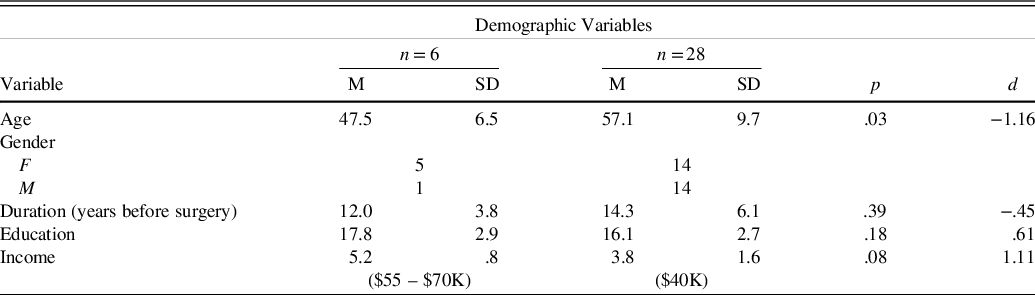
The results of the analyses indicated that there were differences between the two groups in terms of several demographic variables (Table 1). Survivors were significantly younger at baseline, had higher household incomes, and 5 of 6 were female. Effect sizes for age and income based on Cohen’s d were large (Cohen’s d = −1.16 and 1.11, respectively).
Differences between survivors and nonsurvivors on demographic variables

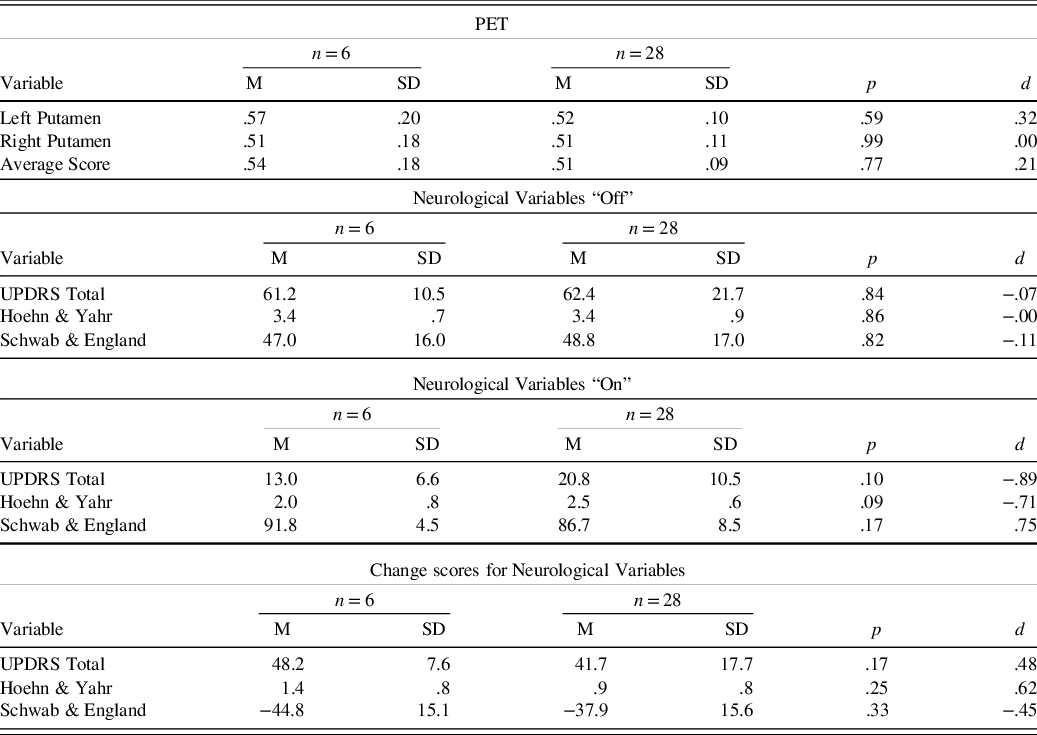
There were no statistically significant differences at baseline between survivors and nonsurvivors on 18FDOPA uptake based on PET scans. Nor were there any statistically significant differences on the neurological measures in the “off” condition (Table 2). However, there were significant differences between survivors and nonsurvivors on UPDRS and H & Y “on” medications (both p = .09). Although not statistically significant, the effect size for differences between survivors and nonsurvivors on the S & E “on” medications was large (Cohen’s d = .75). Paired sample t-tests were used to calculate differences between “off” and “on” scores on each of the neurological measures. The results indicated that scores of both groups showed significant differences between “off” and “on” ratings (p ranged from <.000 to .008). There were no significant differences between survivors and nonsurvivors on the amount of change reported.
Differences between survivors and nonsurvivors on neurological variables (“Off”)

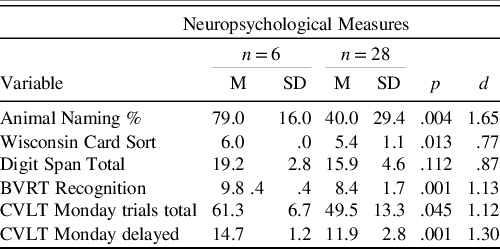
There were statistically significant differences between the groups on all neuropsychological tasks except Digit Span Total, with survivors performing better on these tasks than nonsurvivors (Table 3). In order to investigate relationships between age, education, and neuropsychological variables, correlational analyses were conducted. The results indicated that age was significantly related to CVLT Monday delayed recall (r = −.43, p = .02) and BVRT (r = −.33, p =.06) with younger participants scoring better than the older patients. Education (with outlier removed) was related to Digit Span total (r = .34, p = .06). One additional analysis indicated that women scored better than men on the Monday CVLT delay task (p = .004).
Differences between survivors and nonsurvivors on neuropsychological variables

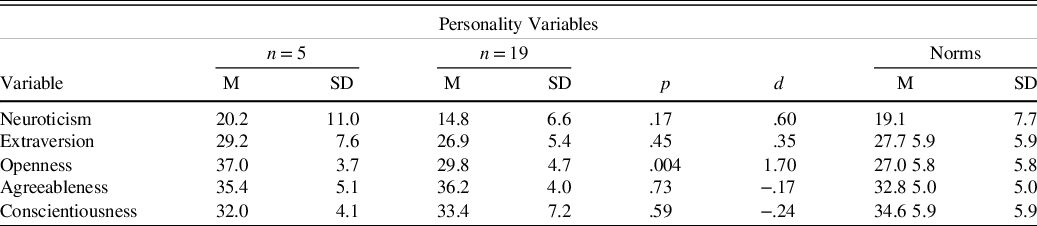
On the NEO, Openness to Experience was the only subscale where statistically significant differences were found between the two groups (Table 4). The score for survivors was much higher than for nonsurvivors and was almost two standard deviations above the norm for the Openness to Experience scale. The effect size (Cohen’s d = 1.70) indicated the difference between scores for the survivors and nonsurvivors was very large.
Differences between survivors and nonsurvivors on personality variables

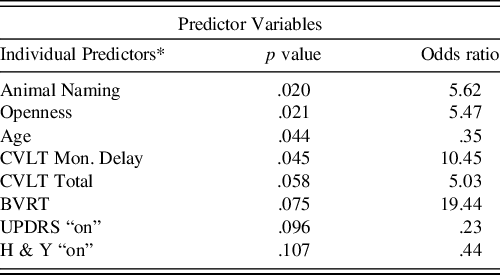
After standardizing each predictor variable, logistic regression analyses were performed with each variable entered individually into the equation. The WCST was not included in the analyses because perfect scores and no variability for the survivors made statistical analysis impossible. Results indicated that Animal Naming and Openness were the strongest predictors of survivorship in this study (Table 5), with all the neuropsychological variables included in the analyses also being significant predictors. Because of the small sample size, these results may be regarded as tentative and warrant further exploration.
Survivorship based on logistic regression with standardized predictor variables

* Arranged in descending order based on significance level.
With the finding that Openness was one of the most significant predictors of survivors vs. nonsurvivors, we conducted a post hoc analysis to explore the relationships between Openness and the other variables in the study. Openness was significantly related to age (p = .007), with greater Openness reported by younger participants. Openness was also related to all the neuropsychological measures except Digit Span (p ranged from .006 to .052). In addition, Openness was related to the three neurological measures assessed during the “on” medication state (p ranged from .007 to .024), but not the “off” state. In all cases, greater Openness was associated with better results. Although duration of disease was not related to Openness, it was related to S & E “on” (p = .019), with longer duration related to poorer scores regarding activities of daily living.
As noted earlier, results presented in this paper are based on the 34 participants who received the implant.
DISCUSSION
The purpose of this study was to determine whether there were differences between survivors and nonsurvivors at baseline among patients in a double-blind fVM implant trial in order to contribute to optimal patient selection for upcoming cell-based trials. The results of analyses of the broad range of data presented in this study indicate that there were a number of differences between the two groups at baseline that might assist in the selection of candidates for future stem cell studies.
In terms of demographic variables, it is not surprising that current survivors of the fetal implant trial were younger at the start of the study in 1995. It is also not surprising that five of the six survivors were female as research has indicated that women have longer life expectancy than men (Austad, Reference Austad2006; Barford et al., Reference Barford, Dorling, Davey Smith and Shaw2006; Zarulli et al., Reference Zarulli, Barthold Jones, Oksuzyan, Lindahl-Jacobsen, Christensen and Vaupel2018). In addition, data suggest that while PD exerts a greater burden of disease on men than women (Lubomski et al., Reference Lubomski, Rushworth, Lee, Bertram and Williams2014), responses to treatment may be more favorable in women (Georgiev et al., Reference Georgiev, Hamberg, Hariz, Forsgren and Hariz2017). Protective effects of estrogens, greater striatal dopaminergic activity, and higher levodopa availability in women may contribute to these gender differences in disease burden and treatment response (Cerri et al., Reference Cerri, Mus and Blandini2019; Georgiev et al., Reference Georgiev, Hamberg, Hariz, Forsgren and Hariz2017; Jurado-Coronel et al., Reference Jurado-Coronel, Cabezas, Rodriguez, Echeverria, Garcia-Segura and Barreto2018). Likewise, the influence of household income on survivorship is possibly related to the impact of socioeconomic status on life expectancy; i.e., financial security enables access to more options for medical care and other support services (Chetty et al., Reference Chetty, Stepner, Abraham, Lin, Scuderi, Turner and Cutler2016; Mirowsky & Ross, Reference Mirowsky and Ross2000; Yang et al., Reference Yang, Schorpp, Boen, Johnson and Harris2018).
While there were no differences between survivors and nonsurvivors on PET scores or neurological measures “off” dopaminergic medications at baseline, there were statistically significant differences between the two groups on the UPDRS and H & Y “on” medications, with survivors receiving better scores (Table 2). This result suggests that survivors may have benefited more from dopamine medications than nonsurvivors at baseline. It also suggests that researchers consider differences between groups in the “on” condition as well as “off” as failure to do so may result in overlooking positive results of the study.
The report of the results of neuropsychological assessment in the original study (Trott et al., Reference Trott, Fahn, Greene, Dillon, Winfield, Winfield and Stern2003) indicated that there were no differences between the implant (n = 20) and sham surgery (n = 20) groups at baseline. However, when we analyzed groups based on those who were survivors (n = 6) and nonsurvivors (n = 28), there were significant differences between groups at baseline on all the variables except Digit Span Total (Table 3). In addition, all four of the neuropsychological variables included in the regression analyses were significant predictors of survivorship (p ranged from .020 to .075). These results suggest that the survivor group was more cognitively intact across a broad range of domains at baseline than the nonsurvivors. Because very little is known about the impact of fetal cell implantation on cognition, these results suggest the importance of further exploration of this area in future cell-based research. In addition, this finding emphasizes the importance of neuropsychological assessment in inclusion criteria for future cell-based therapies and the advisability of selecting those who score highest across a broad spectrum of tests.
In regard to personality, results of this study suggest that self-reported Openness to Experience was one of the two most significant predictors of survivorship in this sample. The authors of the measure originally described personality characteristics associated with Openness in the following ways: “active imagination, preference for variety, intellectual curiosity, and independence of judgment” (Costa & McCrae, p. 15). Other descriptors include willingness to try new things and entertain new ideas, being creative, and original (DeYoung et al., Reference DeYoung, Cicchetti, Rogosch, Gray, Eastman and Grigorenko2011; DeYoung, Reference DeYoung2013; McRae et al., Reference McRae, Russell, Dunk, Stern, Ellgring and Henchcliffe2018). As research in personality and disease has expanded in recent years, Openness to Experience has been found to contribute to better outcomes in a variety of diseases (Dermody et al., Reference Dermody, Wright, Cheong, Miller, Muldoon, Flory and Manuck2016; Ferguson & Bibby, Reference Ferguson and Bibby2012; O’Suilleabhain et al., Reference O’Suilleabhain, Howard and Hughes2018; Turiano et al., Reference Turiano, Spiro and Mroczek2012). In addition, Openness has been shown to be related to cognitive abilities, including inductive reasoning, divergent thinking, memory, processing speed, visual-spatial processing, and both fluid and crystallized intelligence (Jackson et al., Reference Jackson, Hill, Payne and Parisi2020). As a result, Openness has become a variable of interest to those researching aging and cognition (Jackson et al., Reference Jackson, Hill, Payne and Parisi2020; Nishita et al., Reference Nishita, Tange, Tomida, Otsuka, Ando and Shimokata2019).
In PD, Openness may have a particularly important role as it is theorized to be linked with dopamine-related personality characteristics (DeYoung et al., Reference DeYoung, Peterson and Higgins2005; DeYoung et al., Reference DeYoung, Cicchetti, Rogosch, Gray, Eastman and Grigorenko2011; DeYoung, Reference DeYoung2013; Santangelo et al., Reference Santangelo, Piscopo, Barone and Vitale2017; Smillie & Wacker, Reference Smillie and Wacker2014). Research has supported the theory that dopamine is an important driver of the cognitive exploration that underlies the construct of Openness (DeYoung et al., Reference DeYoung, Cicchetti, Rogosch, Gray, Eastman and Grigorenko2011). Some of the results of this study are related to this theory and bear further exploration, e.g., relationships between Openness and neurological measures taken during the “on” state and Openness and results of neuropsychological assessment.
These findings seem to be consistent with the existing literature on Openness. Openness has been found to be strongly associated with cognitive function, and this advantage appears to be maintained across the life span such that Openness to Experience is predictive of better cognitive performance across all domains (DeYoung et al., Reference DeYoung, Peterson and Higgins2005; Nishita et al., Reference Nishita, Tange, Tomida, Otsuka, Ando and Shimokata2019; Sharp et al., Reference Sharp, Reynolds, Pedersen and Gatz2010). A potential mechanism may be the concept of cognitive reserve, in which those with higher levels of Openness tend to exhibit greater active engagement in cognitively enriching activities which are, in turn, protective of cognitive status (Sharp et al., Reference Sharp, Reynolds, Pedersen and Gatz2010; Stern, Reference Stern2002).
Further investigation into Openness and neuropsychological function, with particular emphasis on possible mechanistic links involving dopamine and cognitive reserve, is needed to determine how these factors precisely relate to survivorship. Continued exploration of these relationships could provide valuable information regarding who might benefit most from future cell-based therapies.
SUMMARY
This study reveals a number of baseline features that distinguish survivors from nonsurvivors in an NIH-funded randomized, sham surgery-controlled clinical trial of fVM implantation in advanced PD. While it was expected that those who were younger and female would be survivors based on lifespan research, the results showing that the personality trait of Openness and better performance on the neuropsychological variables of Animal Naming, BVRT, and CVLT Monday Total and Delayed recall were strong predictors of survivorship were unexpected. Considering that recent research has explored the relationships between Openness, the role of dopamine in personality characteristics, and cognition, this study adds to the foundation for future research in this area and supports the inclusion of neuropsychological assessment and Openness in upcoming cell-based trials.
ACKNOWLEDGMENTS
The authors would like to acknowledge the courage and perseverance of all participants in this extraordinary experimental sham surgery-controlled trial.
FINANCIAL SUPPORT
McRae: Funding as PI for this research was received from NINDS for the original study from 1995 to 2000 (grant number R03 NS054992).
Dunk: No specific funding was received for this work.
Russell: Funding as a consultant for this research was received from NINDS for the original study from 1995 to 2000 (grant number R03 NS054992).
Ellgring: Funding as a consultant for this research was received from NINDS for the original study from 1995 to 2000 (grant number R03 NS054992).
Stern: Funding for this research was received from NINDS for the original study from 1994 to 1999 (grant number R01 NS32368).
Greene: Funding for this research was received from NINDS for the original study from 1994 to 1999 (grant number R01 NS32368).
Fahn: Funding for this research was received from NINDS for the original study from 1994 to 1999 (grant number R01 NS32368).
Henchcliffe: Funding for this research was received from anonymous patient donors.
CONFLICTS OF INTEREST
The authors have nothing to disclose.