


Ahead of the 2024 European Parliamentary elections, the Spanish populist far-right political party Vox campaigned using a poster juxtaposing images of two women: one woman clothed in a burka, the other woman in a low-cut tank top, smiling. The message reads: ‘Which Europe do you want? We are clear about it’.Footnote 1 Elsewhere in Europe, in the run-up to Germany’s 2025 federal election, leader of the center-right Christian Democrats (CDU) Friedrich Merz claimed that immigrants were responsible for gang rapes and show a ‘complete lack of respect for women’.Footnote 2 Such messages are not new to European parties – for instance, the Belgian far-right party Vlaams Belang used similar burka posters and messaging in 2012 – but appear to be on the rise (Gul Reference Gul2024; Meguid et al Reference Meguid, Coffé, Weeks and Kittilson2025). They are part of a broader tactic that the sociologist Sara Farris (Reference Farris2017) terms ‘femonationalism’: the exploitation of gender rhetoric to promote nativism and xenophobia, especially anti-Islam agendas.
The limited studies of femonationalism have primarily focused on documenting examples of and positing motivations for the use of femonationalism, for instance, in mainstreaming unpalatable nativist platforms. These studies typically rely on qualitative analyses of specific Northern European countries (Akkerman and Hagelund Reference Akkerman and Hagelund2007; De Lange and Mügge Reference De Lange and Mügge2015; Farris Reference Farris2017; Morgan Reference Morgan2017; Spierings Reference Spierings2020b). However, quantitative, cross-national examinations of femonationalism remain limited. First, the current literature lacks a clear definition and an established set of empirical indicators to allow us to measure femonationalism across space and time. As Sartori (Reference Sartori1970, 1038) reminds us, ‘we cannot measure unless we know first what it is we are measuring’. We advance the following inclusive and measurable definition: femonationalism is the strategic use of gendered rhetoric – invoking women’s rights or women’s safety – to legitimize nativist anti-immigration policies. Secondly, just as the field does not know if femonationalist appeals are systematically increasing or being employed by parties across the political spectrum, we also do not know empirically under which political and electoral contexts such appeals are used, or the content of the appeals.Footnote 3 Answers to these questions are critical because femonationalist appeals have the potential to disrupt existing liberal–conservative partisan alignments by attracting both voters holding gender-traditional and gender-egalitarian attitudes. Further, the use of equality to justify nativist appeals has troubling normative implications.
This paper presents the first large-scale, descriptive analysis of femonationalism in legislative speech – a previously unexamined context. This is a hard test for observing femonationalism, because we might expect such rhetoric to emerge first in less formal contexts such as social media. Using an original dataset of femonationalist rhetoric in parliamentary debates about immigration in the five Western European countries of Denmark, France, Germany, the Netherlands, and Sweden from 2009 to 2024, we find that femonationalist rhetoric usage is still rare, but on the rise. Far-right parties are most likely to use femonationalist rhetoric, but mainstream right and centrist parties employ it as well. Consistent with our argument that femonationalism is a strategy to retain a party’s issue distinctiveness, we find that far-right parties employ higher levels of femonationalist speech when party opponents converge towards their core anti-immigration policy position.
Further opening the black box of femonationalism, our quantitative text analysis indicates that the top topics emerging within femonationalist speeches are related to threats to Western values, crime and security, and immigration and integration policy. Our analysis also finds a gender difference in the use of these specific femonationalist topics: women legislators are significantly more likely to focus on threats to Western values (including gender equality) and less likely to focus on crime and security or (to a lesser extent) immigration policy than men.
Our study makes several contributions to research on political parties, gender and politics, and legislative behavior. First, it introduces a quantifiable, testable measure of femonationalism, a concept that is under-measured and under-conceptualized despite growing scholarly attention. The resulting descriptive analysis offers new insight into its cross-national and interparty prevalence and the conditions under which it is employed. As Gerring (Reference Gerring2012) notes, description is a necessary step towards explanation. By mapping patterns across countries and parties, we enable future causal research while emphasizing the intrinsic importance of understanding how gendered rhetoric is mobilized for instrumental purposes. Secondly, we identify an underappreciated party tactic: rather than adding new issues to their agenda (Bergman and Flatt Reference Bergman and Flatt2020; De Sio and Weber Reference De Sio and Weber2014; Meguid Reference Meguid2023; Riker Reference Riker1982; Spoon and Williams Reference Spoon and Williams2021), parties can shift the framing of core issues like immigration, often at lower cost to their brand. Thirdly, the study clarifies how femonationalism operates in practice. Consistent with the dichotomy also highlighted by Mainz (Reference Mainz2026), our structural topic models confirm that alongside gender-egalitarian appeals, many femonationalist speeches emphasize physical security threats posed by immigrants, echoing gender-traditional tropes of benevolent sexism.
Femonationalism
The use of gender to advance nativist anti-immigration positions is a relatively recent phenomenon in European politics. Although nativist appeals have been a defining trait of radical-right parties (Betz Reference Betz2019; Mudde Reference Mudde2007, Reference Mudde2019), they did not traditionally invoke women or gender. In the past fifteen years, however, scholars have identified the emergence of nativist appeals centered on women as victims of immigration, immigrants, and immigrant culture. Using the term ‘femonationalism’, Farris (Reference Farris2017) argues that certain groups use gender equality rhetoric to legitimize anti-immigration and Islamophobic positions. Farris further links these appeals to three categories of actors: radical-right parties, feminist scholars and civil society groups, and neoliberal actors.Footnote 4
Our conception of femonationalism is broader than Farris’s original definition in terms of its content and the actors involved. Regarding content, Farris explicitly restricts femonationalism to instances where progressive feminist arguments about gender equality are instrumentalized to advance anti-immigration agendas. However, the empirical examples Farris marshals throughout her work reveal a considerably more complex conception of femonationalism. First, appeals referencing threats to women’s physical security abound in Farris’s empirical analysis.Footnote 5 While such appeals can resonate with feminist concerns about women’s bodily autonomy and the right to physical safety, they are also consistent with paternalistic perceptions of women’s vulnerability – what scholars term benevolent sexism – positioning women as requiring male protection. In other words, femonationalism draws upon both egalitarian and traditionalist ideological repertoires; it is not uniquely or necessarily progressive.
Secondly, while not stated by Farris, femonationalist discourse is rooted in nativist attitudes, which can be observed across the ideological spectrum. Femonationalism reflects the idea that immigrants and their cultures are threatening to the native population, the nation, and their values – specifically as they pertain to women and girls. At its root is a nativist concept of ethnic hierarchy (Card et al Reference Card, Dustmann and Preston2005; Ford Reference Ford2011; Kustov Reference Kustov2019; Vernby and Dancygier Reference Vernby and Dancygier2019), whereby the native population is preferred, and non-natives are seen not just as different but less than. They are further ranked based on perceived cultural similarity, with immigrants from significantly different linguistic, religious, and value systems deemed more culturally inferior and a threat to the native population’s ‘power, privileges and prerogatives’ (Rodriguez Reference Rodriguez2008, 147). Invoking immigrants as threats to native women’s safety or equality is consistent with this argument.
In light of this preceding discussion, we arrive at the following definition: femonationalism is the strategic use of gendered rhetoric – invoking women’s rights or women’s safety – to legitimize nativist anti-immigration policies. Crucially, unlike Farris’s framework, it remains agnostic regarding which actors deploy femonationalist appeals. Rather than presupposing the ideological persuasions of political agents, we treat the question of who employs these appeals as an empirical matter requiring direct investigation.
We follow existing studies in focusing on the perceived threat to native women (Mainz Reference Mainz2026; Meguid et al Reference Meguid, Coffé, Weeks and Kittilson2025). This distinction is theoretically consequential: when native women are positioned as victims of immigration, femonationalism operates explicitly through ethnic hierarchy logic – native women become markers of group boundaries requiring masculine protection from demographic and cultural threat – rather than mobilizing universalist feminist concerns. Importantly, the use of gender concerns in this context does not presume – nor does it require – sincere party commitment to gender equality. Strategic mobilization of gender equality values and/or women’s security concerns operates independently from broader ideological alignment with feminist principles. Highlighting the strategic rather than sincere use of this rhetoric, Mudde (Reference Mudde2019, 172–3) writes:
It is only within the context of Islamophobia that groups defend gender equality and women’s rights, juxtaposing an egalitarian ‘West’ against a misogynistic ‘Islam’ . Given that they argue that gender equality has been achieved, even northern European populist radical-right parties tend to vote against gender equality policies, rejecting women’s quotas as ‘tokenism’ because ‘real women’ don’t need the state to protect their equality.
In our conceptualization, femonationalist content has two main dimensions: women’s rights and women’s security. Referencing threats to gender rights, for example, Danish People’s Party (radical-right) legislator Martin Henriksen claimed in a 2013 speech that ‘Our basic values such as freedom of speech and assembly and equality between men and women will be pressured… There will be more division, more conflict in Denmark because of a deeply irresponsible immigration policy’. Femonationalism also presents immigration as a threat to women’s and girls’ physical security. For example, in 2018, Swedish Democrat legislator Richard Jomshof claimed, ‘The result of recent decades of mass immigration and multiculturalism is very clear.… The imported criminality, with showdowns and shootings, stone throwing and fires, sexual assaults and gang rapes, is tearing Sweden apart’ (our emphasis).
Having detailed our concept of femonationalism, we turn to its quantitative measurement. As the examples above highlight, political actors often use femonationalism in a veiled manner, framing socially unacceptable statements in a seemingly progressive (in terms of women’s equality) or benevolent (in terms of women’s safety) way. This makes femonationalism challenging to identify and measure empirically. We propose the following criterion to classify an appeal as femonationalist:
Make an argument using gender to justify a nativist anti-immigration stance, referencing the gender-based threat that immigration, immigrants, or people of immigrant background pose to the country, its people, and its values.
As captured by this operationalization, femonationalism requires three simultaneous conditions. First, the rhetoric must explicitly reference gender and make anti-immigration claims. However, this pairing alone is insufficient; merely mentioning women or girls in a nativist context does not constitute femonationalism. Second, gendered rhetoric must be deployed strategically to justify and advance a nativist agenda.Footnote 6 Third, the gendered nativist rhetoric must reference a perceived threat to the country, its inhabitants, and its core values – whether framed as risks to national gender equality standards or threats to women’s and girls’ physical security. A 2015 example from Dutch radical-right PVV leader Geert Wilders captures this concept of national threat: ‘Dutch women and girls feel unsafe because of the testosterone bombs that Prime Minister Rutte is importing’. This condition ensures that we capture political actors making, and attentive voters listening to, deliberate efforts to tie immigration to gendered threats to the country. Furthermore, this distinction helps differentiate between political statements about refugees in their home countries – which are not inherently framed as a threat to the European country and thus do not constitute femonationalism – and political statements that invoke the threat immigrants pose to native women or gender equality in Europe, which are femonationalist rhetoric.
Femonationalism as a Political Tool
Having mapped the concept of femonationalism onto its central empirical indicators, we turn to understanding its use as a political tool. Previous research largely uses qualitative methods to highlight the increasing use of such gendered immigration appeals by far-right parties (Akkerman and Hagelund Reference Akkerman and Hagelund2007; Akkerman Reference Akkerman2015; Campbell and Childs Reference Campbell and Childs2015; De Lange and Mügge Reference De Lange and Mügge2015; Direnberger et al Reference Direnberger, Banfi and Eskandari2022; Fangen and Lichtenberg Reference Fangen and Lichtenberg2021; Morgan Reference Morgan2017; Towns et al Reference Towns, Karlsson and Eyre2014). This literature has recently been joined by quantitative studies which aim to more systematically identify the prevalence of femonationalism in party manifestos and social media, especially among far-right parties (Gul Reference Gul2024; Meguid et al Reference Meguid, Coffé, Weeks and Kittilson2025; Reinhardt et al Reference Reinhardt, Heft and Pavan2024). Building on this work, we offer a novel, cross-national theory about the parties that employ these tactics and the conditions under which they are more likely to do so.
Which politicians and parties tend to use femonationalist speech? Unlike Farris (Reference Farris2017), who suggests that actors from across the political space, including neoliberals and feminist theorists, use femonationalism, we argue that there are key reasons why parties on the political right, and far-right parties especially, have the greatest incentives to employ it. Our argument rests on both the policy focus of these parties and the incentives stemming from their particular electoral challenges. Taking the policy focus first, femonationalism is a nativist stance. While it is innovative in applying a gendered framing, at its core, the appeal advances nativist anti-immigration, and often anti-Islam, positions. As such, its use should be restricted to political actors who espouse this nativist anti-immigration policy position.
While there has been a convergence of parties across the European political space towards the anti-immigration pole (Dancygier and Margalit Reference Dancygier and Margalit2020), right-wing parties stand out for their anti-immigration positions. Far-right parties in particular are defined by their core issue of anti-immigration (Mudde Reference Mudde2007). Nativist policy dominates their party platform (Bar-On Reference Bar-On and Rydgren2018; Eger and Valdez Reference Eger and Valdez2019; Rydgren Reference Rydgren and Rydgren2018), and it is the major issue and position that distinguishes far-right voters (Gul and Meguid Reference Gul and Meguid2026; Ivarsflaten Reference Ivarsflaten2008; Lubbers et al Reference Lubbers, Gijsberts and Scheepers2002; Rydgren Reference Rydgren2008). Far-right parties often remain the owner of this issue and are thus less likely to deviate from this stance (Adams et al Reference Adams, Clark, Ezrow and Glasgow2006; De Sio and Weber Reference De Sio and Weber2014; Meijers and Williams Reference Meijers and Williams2020). As such, far-right parties satisfy the nativist anti-immigration criterion behind femonationalism.
While less likely to be as extreme on immigration as their far-right counterparts, mainstream right-wing parties have adopted more vocal anti-immigration stances since the 1980s. In seeking to attract new voters, or at least stem the flow of former voters to the far right, these parties have sought to imitate the far-right through policy accommodation (Abou-Chadi Reference Abou-Chadi2016; Meguid Reference Meguid2005, Reference Meguid2008). Insofar as these mainstream right parties have regularly controlled government, this accommodation has led to the adoption and implementation of nativist immigration and assimilation laws across Europe over the past thirty years. Thus, mainstream right parties also meet the anti-immigration criterion for the use of femonationalism. In contrast, parties that are not opposed to immigration are less likely to use gender to advance nativist positions.
Secondly, as discussed above, femonationalism is not simply the standard nativist rhetoric about immigrants threatening the economic, physical, and cultural security of a country that parties have typically employed (Rydgren Reference Rydgren2008). Rather, it reflects a marked change with potential for solving electoral challenges that far-right parties and some mainstream right-wing parties face. Far-right parties are typically known as ‘Männerparteien’, or men’s parties, and on average suffer a large gender gap in voter support (Givens Reference Givens2004; Harteveld et al Reference Harteveld, Van Der Brug, Dahlberg and Kokkonen2015; Immerzeel et al Reference Immerzeel, Coffé and Van der Lippe2015; Mudde Reference Mudde2007; Oshri et al Reference Oshri, Harsgor, Itzkovitch-Malka and Tuttnauer2023; Spierings and Zaslove Reference Spierings and Zaslove2015; Weeks et al Reference Weeks, Meguid, Kittilson and Coffé2023). Mainstream conservative parties also tend to be characterized by a voter gender gap in recent decades, although to a lesser extent.Footnote 7 Simply pursuing their current anti-immigration policy focus is not sufficient for these parties to attract untapped women voters. Studies suggest that men hold more anti-immigration positions than women (Shorrocks Reference Shorrocks2021). Further, even anti-immigrant women may be deterred from voting for these parties if the parties are seen as prejudiced or ‘toxic’ (Harteveld and Ivarsflaten Reference Harteveld and Ivarsflaten2018).
By using the frame of gender equality or women’s safety to promote anti-immigration, parties can shift the focus of their speech towards socially acceptable values while still promoting nativism. In this way, femonationalism can be seen as part of a broader ‘genderwashing’ phenomenon that has been well documented in authoritarian regimes. As Bjarnegård and Zetterberg (Reference Bjarnegård and Zetterberg2022) highlight, autocrats use symbolic attention to gender equality to make regimes seem more liberal and democratic. Similarly, in democratic regimes, the use of femonationalism might leave nativist politicians less vulnerable to accusations of racism or prejudice. With femonationalist rhetoric linking immigration to threats to women and gender equality, nativist parties can instead frame migrant men as the prejudiced ones – in a similar way, for example, to radical-right parties using appeals to civic nationalism (democratic values, freedom of speech) to present themselves more favorably (Halikiopoulou et al Reference Halikiopoulou, Mock and Vasilopoulou2013). As Akkerman and Hagelund (Reference Akkerman and Hagelund2007, 214) argue, ‘When gender issues were launched into the immigration debate in the shape of family violence, enforced marriage, genital mutilation and honor killings, and framed as cultural phenomena, explicit criticism of immigrant cultures seemed to lose some of its power to shock in the public debate’.
Further, the gendered frame of femonationalism has the potential to explicitly appeal to under-tapped women voters. Women are more likely than men to believe gender equality is a problem (Campbell et al Reference Campbell, Childs and Lovenduski2010; Swim et al Reference Swim, Aikin, Hall and Hunter1995). Women are also more likely to experience gender-based violence than men, and women express different attitudes from men about such violence – for example, women are less likely to endorse victim-blaming (Nayak et al Reference Nayak, Byrne, Martin and Abraham2003).
At the same time, femonationalism is unlikely to drive away men voters. First, femonationalist rhetoric typically does not promote concrete policy changes that would improve women’s rights or status relative to men; instead, the goal is to reduce immigration and often Islamic immigrants in particular (policies that men and especially young men are more likely to support). Secondly, men are just as – or perhaps slightly more – likely to express benevolent sexist attitudes compared to women (Glick et al Reference Glick, Lameiras, Fiske, Eckes, Masser, Volpato, Manganelli, Pek, Huang, Sakalli-Uğurlu, Castro, D’Avila Pereira, Willemsen, Brunner, Six-Materna and Wells2004). Thus, framing women as fragile victims who need to be protected is a strategy unlikely to deter men voters. Femonationalism allows nativist parties to kill two birds with one stone: it appeals to much-needed women voters without repelling men. Given these features of femonationalism, we expect the following.
Hypothesis 1: Far-right parties employ more femonationalism in their immigration speeches than other parties.
Hypothesis 2: Mainstream right parties employ more femonationalism in their immigration speeches than non-right parties (center, left, and far left).
In highlighting the electoral challenges that femonationalism can help solve for rightist parties, we have already hinted at the conditions under which we expect parties to employ this rhetoric. We argue that political parties on the right, especially the far right, will add a gendered framing to their nativist appeals to increase their ideological distinctiveness in response to mainstream party accommodation of their anti-immigration position.
Our strategic argument builds on the insights of the party competition literature. Scholars have long argued that political parties seek to increase their vote share (and reduce that of their competitors) by offering policy positions similar to their competitors (Abou-Chadi Reference Abou-Chadi2016; Adams et al Reference Adams, Clark, Ezrow and Glasgow2006; Downs Reference Downs1957; Meguid Reference Meguid2008). This policy convergence, or accommodation, makes more voters spatially closer to the accommodating party. As convergence progresses, it serves to reduce the distinctiveness of the target party’s issue stance and even challenges their ownership of the issue (Bélanger and Meguid Reference Bélanger and Meguid2008; Meguid Reference Meguid2008; Therriault Reference Therriault2015).
This process of issue accommodation has been in action across Western Europe over the past forty years. Many mainstream parties reacted to the rise of far-right parties by adopting more anti-immigration stances (Abou-Chadi Reference Abou-Chadi2016; Abou-Chadi and Krause Reference Abou-Chadi and Krause2020; Chou et al Reference Chou, Dancygier, Egami and Jamal2021; Han Reference Han2015). As Dancygier and Margalit (Reference Dancygier and Margalit2020, 751–2) demonstrate, immigration has become increasingly salient to party competition since the 1990s, and now parties across the political spectrum are converging towards the anti-immigration pole (Dancygier and Margalit Reference Dancygier and Margalit2020; Habersack and Werner Reference Habersack and Werner2023; Hjorth and Larsen Reference Hjorth and Larsen2022). With the anti-immigration issue space becoming more crowded, the distinctiveness of the far right’s nativist stance is reduced. Because far-right parties disproportionately depend on this issue position for attracting votes (Mudde Reference Mudde2007; Ivarsflaten Reference Ivarsflaten2008), successful accommodation can compromise their electoral viability.
One way that parties can respond to such party-system crowding is by expanding their issue appeals, in order to reach out to different constituencies and potentially increase their electoral base (De Sio and Weber Reference De Sio and Weber2014; Meguid Reference Meguid2023; Meguid et al Reference Meguid, Coffé, Weeks and Kittilson2025; Spoon and Williams Reference Spoon and Williams2021). However, this decision is full of potential pitfalls. First, parties must be careful that the new issue aligns with their previous positions. Secondly, niche parties in particular are known for a particular issue position and draw an electorate with heterogeneous preferences on issues outside their core topic. Adoption of a new issue might contribute to the defection of their current voters with only a minimal gain of new ones (De Sio and Weber Reference De Sio and Weber2014; Meguid Reference Meguid2023). In other words, issue expansion might result in a net vote loss.
Given that parties gain by focusing on issues they are already well known for (Budge et al Reference Budge, Robertson and Hearl1987; Rovny Reference Rovny2012), it is logical for far-right parties facing convergence to consider campaigning on new dimensions of their existing core issue rather than searching for a new issue entirely. In this case, femonationalist framing is a promising candidate for anti-immigration nativist parties aiming to maintain the distinctiveness, and thus their attractiveness.
We argue that femonationalism is a low-cost and low-risk reactive strategy with potentially high returns. Conceptually, it is easy for political parties to add a gendered dimension to the standard economic, cultural, and security threat framing of a nativist anti-immigration appeal. For instance, nativist parties can shift from their very effective vote-getting message of highlighting immigrant crime (Burscher et al Reference Burscher, Van Spanje and de Vreese2015; Fasani et al Reference Fasani, Mastrobuoni, Owens and Pinotti2019; Rydgren Reference Rydgren2008) to highlighting crime by immigrants against women, especially rape and murder. Similarly, existing appeals which focus on immigrant culture as a threat can be reframed to play up the danger to the domestic population and the country’s value system posed by practices that undermine women’s autonomy and encourage gender discrimination (see the discussion of gender segregation in schools and swimming pools, adoption of the burka, polygamy, and forced marriages). Moreover, femonationalism – which can emphasize threats to both women’s security and women’s rights – allows parties to maintain both existing voters with largely gender-traditional attitudes and newer voters with more gender-egalitarian perspectives (Gul and Meguid Reference Gul and Meguid2026).
Of course, the adoption of femonationalism is not completely risk-free. Adding a gendered lens to the far right’s rhetoric, especially rhetoric focused on gender rights, might spark voter concerns that the traditionally patriarchical far-right party is becoming ’woke’. Therefore, we expect that femonationalism will be used by far-right parties following party-system convergence. Those parties facing pro-immigration party systems will be less likely to risk diluting their message to adopt these appeals.
Initial evidence supports the plausibility of such a strategy. Party systems have become more anti-immigration over time, and parties on the political right, including the far right, increasingly discuss gender issues (Abou-Chadi et al Reference Abou-Chadi, Breyer and Gessler2021; Kováts and Põim Reference Kováts and Põim2015; O’Brien Reference O’Brien2018; Weeks et al Reference Weeks, Caravantes, Espírito-Santo, Lombardo, Stratigaki and Gul2024). And research suggests the effectiveness of this tactic. Off’s (Reference Off2023) study of Swedish voters shows that voters are drawn to far-right parties in particular when gender issues are salient in public debate. While more research is needed, the use of femonationalism in recent decades may be one additional reason why far-right parties have not experienced vote loss despite mainstream party accommodative efforts (Krause et al Reference Krause, Cohen and Abou-Chadi2023). We therefore argue the following.
Hypothesis 3: Far-right parties employ femonationalism following party-system convergence on nativist immigration positions.
Data and Methods
We test these hypotheses with an original dataset of femonationalist rhetoric in parliamentary speech. Examining femonationalism in legislative debates offers multiple advantages. First, legislative debates convey party policy as read into the official historical record (Laver Reference Laver, Back, Debus and Fernandes2021). Secondly, unlike with manifestos, voters are more likely to directly or indirectly (through media coverage) ‘hear’ the party’s pronouncements (Flaxman et al Reference Flaxman, Goel and Rao2016; Fowler et al Reference Fowler, Franz, Martin, Peskowitz and Ridout2021; Yildirim et al Reference Yildirim, Thesen, Jennings and De Vries2023).
As in most research using legislative debates to study political behavior, we aggregate speeches. While aggregation can occur at either the legislator or party level (Ash et al Reference Ash, Krümmel and Slapin2025; Bäck et al Reference Bäck, Baumann, Debus and Müller2019; Ivanusch Reference Ivanusch2024; Slapin et al Reference Slapin, Kirkland, Lazzaro, Leslie and O’grady2018), our focus on parliamentary democracies motivates aggregation at the party level. In European systems, legislators primarily act as party agents rather than autonomous representatives (Proksch and Slapin Reference Proksch and Slapin2012). Party leaders exercise strong control over agenda access and messaging, privileging collective strategy and party brand coherence over individual expression (Alke et al Reference Alke, Brouard, Rozenberg, Back, Debus and Fernandes2021; Blumenau and Damiani Reference Blumenau, Damiani, Back, Debus and Fernandes2021). As a result, parliamentary speech largely reflects centrally co-ordinated party positions rather than individual legislators’ preferences.
We examine all parliamentary speeches on immigration from five Western European countries – Denmark, France, Germany, the Netherlands, and Sweden – between 2009 and 2024.Footnote 8 Our analysis focuses on countries where far-right parties have held legislative seats, allowing us to study who employs femonationalist rhetoric and under what circumstances. Within this set, it is critical to ensure variation both in the timing of far-right entry into parliament and in the potential receptiveness of each country’s electorate to nativist and gendered messages.
As femonationalism is a relatively new and abstract concept, we use a ‘most likely’ case selection strategy to maximize our chances of observing it in meaningful quantities (Levy Reference Levy2008). We select countries where femonationalism is expected while ensuring variation in key structural and political factors that might shape its presence and use, including the electoral strength and degree of parliamentary representation of far-right parties, electoral rules, histories of and consensus around nativist policy, and the nativist and gender attitudes of their voters.
These five countries reflect this selection criteria: all five countries have had far-right legislators, with France and Germany achieving consistent parliamentary presence only recently. This variation allows us to test for the possibility that non-far-right parties initiate femonationalist speech. These five countries likewise represent varying constellations of nativist and gender attitudes in their electorates during this time period (EVS 2022; Gul and Meguid Reference Gul and Meguid2026). The countries range from low nativism in Sweden and France to middling levels in Denmark and Germany, and high levels in the Netherlands, relative to the Western European average. A range of attitudes about women’s roles in the family, workplace, and society can also be found across these countries, with low levels of gender-egalitarian values in France, middling levels in Germany and the Netherlands, and high levels in Denmark and Sweden. With this variation, the set of countries provides an appropriate laboratory for examining femonationalist speech.
Data
We collected a corpus of transcripts of debates from these five European democracies delivered in the lower chambers between 2009 and 2024.Footnote 9 For Denmark, data come from the Danish Legislative Speech Corpus (Hjorth Reference Hjorth2021); for France, from the official API of the Assemblée Nationale; for Germany, the PolMine project (Blätte and Blessing Reference Blätte and Blessing2018); Netherlands data were graciously shared by Tom Louwerse; and for Sweden, data come from the Swedish Parliament Corpus 1867–2022 (Yrjänäinen et al Reference Yrjänäinen, Norén, Borges, Jarlbrink, Brorsson, Olsson, Snickars and Magnusson2024). We include all types of debates. Each time a new legislator takes the floor, a new speech starts. Our pre-processing steps included dropping speeches shorter than fifty words to avoid noise from interjections, and removing speeches by the Chair of the legislature, whose content is mostly procedural. Appendix Table A.1 shows the descriptive statistics.
Our empirical measure begins with individual-level speech data. We identify the category of each speech using the policy categories of the Comparative Agendas Project, which allows us to classify speeches according to the attention political actors give to specific policy issues (Baumgartner et al Reference Baumgartner, Breunig and Grossman2019).Footnote 10 Given that femonationalism is a reframing of the immigration issue, we retain only speeches coded under immigration.
Secondly, we use a native-language dictionary-based approach to measure when legislators use femonationalism in their immigration speeches. Following best practices, we created a domain-specific dictionary, built with the measurement of femonationalism in mind. We used several sources to compile the dictionary, including manifesto data, secondary literature, and examples from newspaper coverage. Appendix B details the sources and dictionary construction process.
Ideally, we should be able to use dictionary-identified speeches as the training set for an automated analysis. However, femonationalism is a latent, multidimensional concept that is highly context-specific. As we discuss in the conceptual section above, it not only requires both nativist and gendered references, but also it requires the speaker to connect those references to a threat to the receiving country, its people, or its values. Training a model to learn how the context and the subtext modify the words and expressions that legislators utter would most likely exclude relevant objects (false negatives) and include irrelevant objects (false positives). Ultimately, as Grimmer and Stewart (Reference Grimmer and Stewart2013, 268) highlight, ‘the complexity of language implies that automated analysis methods will never replace careful and close reading of texts’.
Given these challenges, we use manual hand-coding to fine-tune the native-language dictionary-based identification of potential femonationalist speech.Footnote 11 At this stage, speeches were translated into English using Google Translate, which prior work shows yields results comparable to coding in original languages (Lucas et al Reference Lucas, Nielsen, Roberts, Stewart, Storer and Tingley2015; Proksch et al Reference Proksch, Lowe, Wäckerle and Soroka2019). Translation of each token in context minimizes semantic loss and homogenizes potential noise across languages (Lucas et al Reference Lucas, Nielsen, Roberts, Stewart, Storer and Tingley2015). Three research assistants then classified speeches, with English facilitating readability and intercoder reliability. Each immigration speech is coded 1 if it meets the conditions for femonationalism defined in the Femonationalism Section, and 0 otherwise.
Our classification process included a calibration exercise. Appendix Table C.1 displays the average Cronbach’s Alpha intercoder reliability result, as well as country-level coefficients. Overall, results suggest a good level of agreement across coders. Our ultimate coding of a given speech reflects the majority coding decision. Altogether, we identify 406 femonationalist speeches in our dataset. This represents a very small fraction of all immigration-related speeches: on average, only 0.4 per cent of a party-legislative term’s immigration speeches are coded as femonationalist (maximum 7.8 per cent), highlighting the rarity of this rhetoric.
Dependent Variable
To assess the country- and party-level determinants of femonationalist rhetoric, our dependent variable measures the count of femonationalist speeches by a political party aggregated at the legislative term level. We consider a legislative term as the inter-election period. Each legislative term is identified by its start year. Across the five cases, legislature starting dates run from 2005 to 2022, while the individual speech records used to construct those units cover dates from 2009 to 2024 (see Appendix Tables A.2 and A.4).
We aggregate data at the legislative level both because we are interested in understanding the role of political competition dynamics – such as party-system accommodation, electoral fortunes, and women’s share of the parliamentary party – which are term-level variables, and because femonationalism is rare in our speech data, making month- or year-level analyses impractical. This data transformation leaves us with 202 observations, including sixty-three unique parties across the five countries. Femonationalist speeches per party-legislative term ranges from an N of 0 (no femonationalist speeches) to twenty-seven (Denmark’s New Right party in the legislature commencing 2019), with a mean of 2.0. Table A.4 in Appendix A presents femonationalism counts by country and legislature.
Independent Variables
Recall that our theory posits that the use of femonationalism varies by party family and is adopted in response to party-system issue accommodation. To measure party ideology, we include a Party Family covariate using Chapel Hill Expert Survey (CHES) data (Jolly et al Reference Jolly, Bakker, Hooghe, Marks, Polk, Rovny, Steenbergen and Vachudova2022). We aggregate this variable into five categories from far left to far right.Footnote 12 For the set of (typically smaller) parties not included in the CHES data, we code party family based on the consensus among schemes used by the ParlGov project, the Manifesto Project Database, and the party’s self-identification in EU parliamentary party groups.
To test whether party competition on immigration affects a party’s likelihood of employing femonationalism, we include a measure of party-system issue accommodation. Given the absence of direct measures of party position on immigration for our range of parties, countries, and years (Dancygier and Margalit Reference Dancygier and Margalit2020; Jolly et al Reference Jolly, Bakker, Hooghe, Marks, Polk, Rovny, Steenbergen and Vachudova2022; Lehmann and Zobel Reference Lehmann and Zobel2018), we follow the party competition literature by employing the Manifesto Research on Political Representation (MARPOR) data. Specifically, we use the MARPOR immigration ‘proxy’ categories recommended by Lehmann and Zobel (Reference Lehmann and Zobel2018, 1076) as being ‘closely connected to the topic of immigration and immigrant integration’: national identity, multiculturalism, and underprivileged minority groups (for example, immigrants).Footnote 13 We derive a party’s (anti-)immigration policy position based on its net emphasis of support for national way of life and opposition to multiculturalism and immigrants in its election manifesto.Footnote 14 We then calculate the (unweighted) mean anti-immigration position of all other parties per country for a given election excluding the focal party (Party System Immigration Position).Footnote 15 The higher the value, the more anti-immigration the party system is. To test H3 – that parties, specifically the far right, will increase their femonationalist speech with party-system anti-immigration accommodation – we include an interaction between Party Family and Party System Immigration Position.
Our models also include a set of country- and party-level controls. At the country-level, we include a measure of Lagged Immigration Salience to capture the public’s perceived importance of this issue. We use a Eurobarometer question measuring the percentage of respondents who identify immigration as the most important issue facing the country (European Commission 2023). We match the survey data with the month preceding the start of the legislature in which the speeches occurred.
We also include a time-trend variable. This variable takes a value of ‘1’ for legislatures beginning in the 2005–10 period, ‘2’ for 2011–15, and ‘3’ for 2016–22. We use the first year of a country’s legislature to assign it to each period. The three periods each aggregate years across all five countries during which the countries faced similar exogenous economic shocks (for example COVID-19), political shocks (for example Trump’s election or Brexit), and social crises (for example the 2015 refugee crisis).
At the party level, we control for a party’s level of feminization following findings that women elites (legislators and to a lesser extent women party leaders) may be more likely than men to represent issues related to women’s lived experiences, including violence against women and gender equality (Catalano Reference Catalano2009; Childs and Withey Reference Childs and Withey2004; Greene and O’Brien Reference Greene and O’Brien2016; Hargrave Reference Hargrave2024; O’Brien Reference O’Brien2019; Pérez et al Reference Pérez, de Oger and Fortes2023; Piscopo Reference Piscopo2011; Purcell and Nagao Reference Purcell and Nagao2024; Swers Reference Swers2005; Wängnerud Reference Wängnerud2000). We include a Woman Party Leader variable, which takes a value of 1 if the party leader is a woman, and 0 otherwise. Since legislators function as party agents in our debate analysis, the gender of the party leader – who controls the party’s agenda and messaging – is key to understanding whose interests and concerns are likely to be prioritized in parliamentary discourse. We also include the share of women in the parliamentary party, Per Cent Women Legislators. Both variables are taken from Weeks et al (Reference Weeks, Meguid, Kittilson and Coffé2023), supplemented with data from European Journal of Political Research Political Data Yearbooks, Wikipedia, and countries’ official parliamentary websites for more recent years.
We control for party electoral fortune by including a Vote Change variable, measuring change in party vote share from previous to current legislative election (Döring et al Reference Döring, Huber and Manow2022). Using vote change instead of legislative seat change provides a more accurate measure of a party’s electoral gains or losses, especially given that some parties in our dataset win relatively few seats (for example, France’s FN party prior to 2012). We lastly control for the log of the total number of immigration speeches per party-legislature (Log Immigration Speeches), to account for variation in the frequency of the parliamentary participation on immigration across political parties as well as across countries. Appendix Table A.3 presents summary statistics for all variables included in analyses.
Empirical Strategy
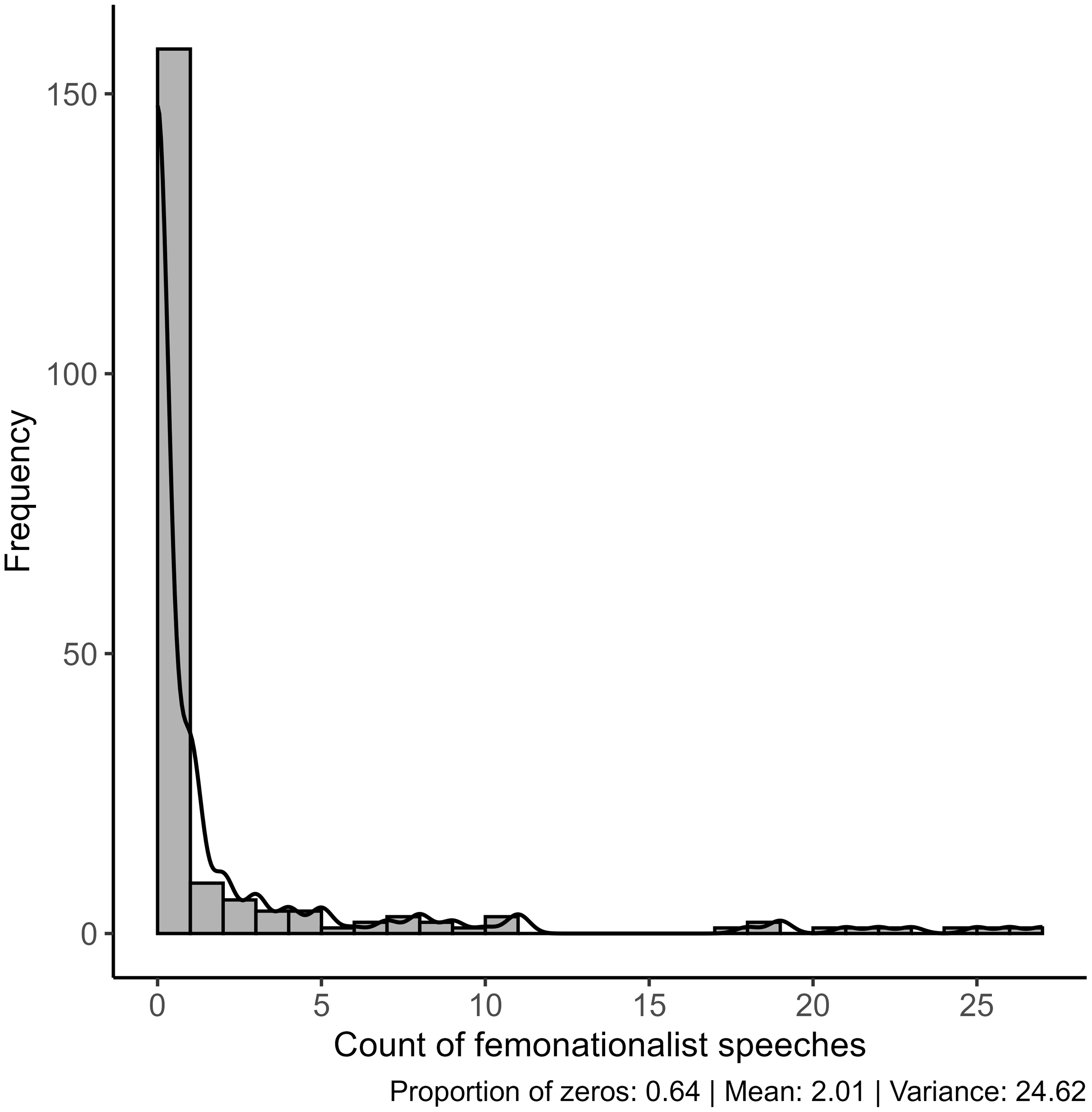
Our methodological approach proceeds in three stages. First, we describe femonationalism in speeches over time and by party family across these five countries. Secondly, we investigate the party- and country-level determinants of femonationalist speech with multivariate regression analyses. As over 60 per cent of our party-legislature level count observations are zero and the variance is much larger than the mean (see Figure 1), we use zero-inflated negative binomial models, appropriate for modeling count outcomes with many zeros.Footnote 16 The zero-inflated negative binomial model allows us to model separately the correlates of femonationalism use using a logistic regression to account for zeros (parties that do not employ femonationalism in legislative debates) and the correlates of the counts of femonationalism for the cases with non-zero femonationalism using a negative binomial regression (Ridout et al Reference Ridout, Hinde and Demétrio2001; Ward and Ahlquist Reference Ward and Ahlquist2018). We argue that far-right parties are the key protagonists of femonationalism and observe that the tactic has increased over time (in other words, we are very unlikely to observe it in early years and among non-far-right parties, where we expect zeros). We thus model both far-right party ideology and a time trend on the logistic side of the model. We conduct tests of model fit, which suggest similar fits for the zero-inflated model and a simpler negative binomial model.Footnote 17 Therefore, we also provide negative binomial models as a robustness check (see Appendix Table D.1). As an additional check, we also estimate simple ordinary least squares (OLS) models using the share of femonationalist speeches as the dependent variable; these results, presented in Appendix Table D.2, yield substantively similar conclusions.
Distribution of femonationalist speeches in party-legislative sessions, 2009–24.

In the third and last stage of analysis, we employ quantitative text analysis, including both structural topic models and keyness statistics, to identify different latent topics emerging in femonationalist speech, and the role of speaker gender as a predictor of femonationalist topic and terminology prevalence. The structural topic model uses an unsupervised machine learning algorithm to reduce the complexity of legislative debates on femonationalism into a low-dimensional summary by estimating the main topics and their corresponding features (words) with the highest conditional probability of occurring in speeches (Bischof and Airoldi Reference Bischof and Airoldi2012). It thus provides a way of inductively identifying the main themes emerging in femonationalist debates. Keyness statistics compare the relative frequency of words among women versus men speakers (Taylor and Marchi Reference Taylor and Marchi2018), allowing us to better understand the use of femonationalism by gender.
Strategic Determinants of Femonationalism
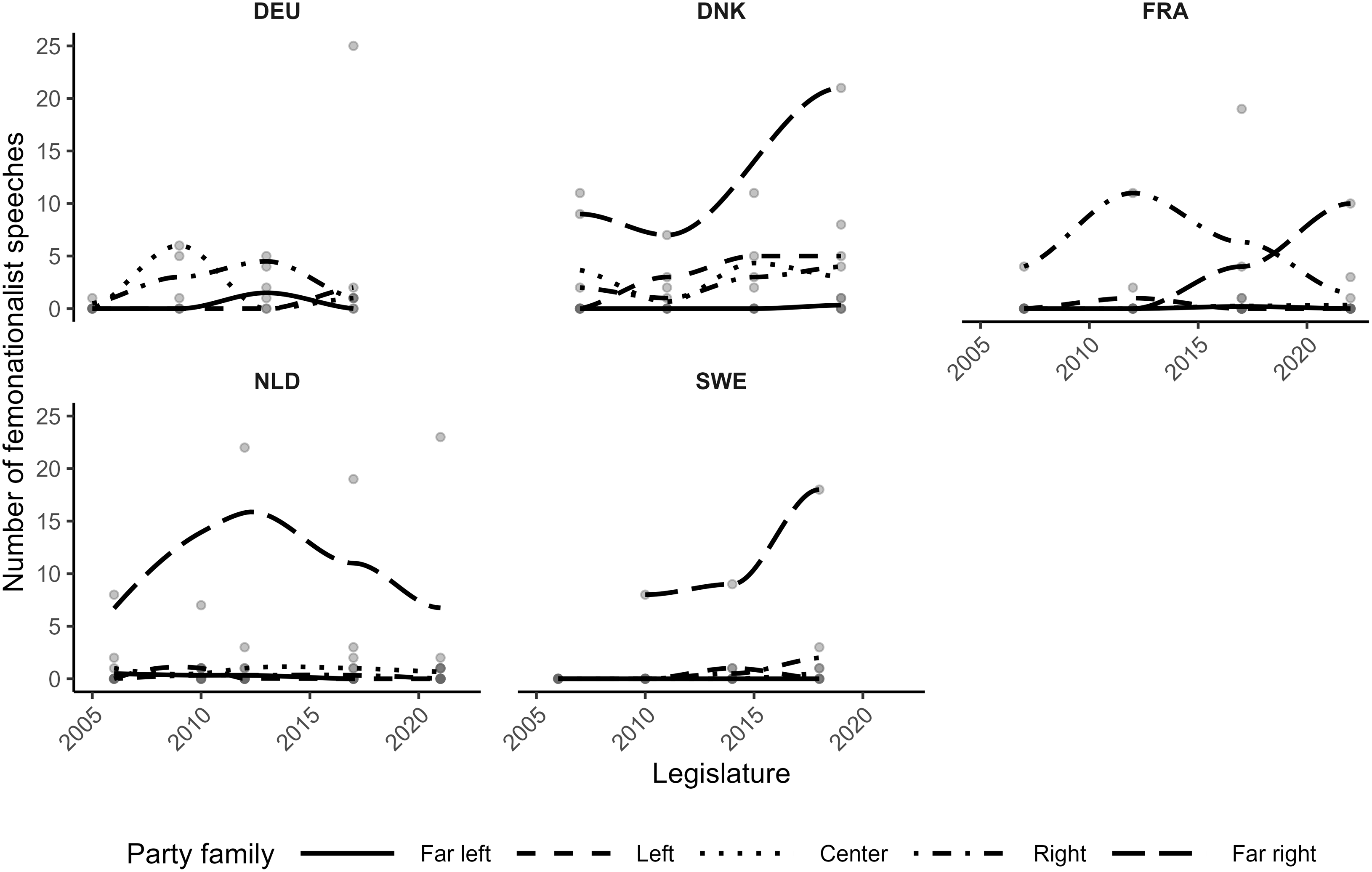
Given that existing studies are only beginning to measure femonationalism quantitatively, we start by presenting descriptive findings from our European speech data. Figure 2 shows the count of femonationalist speeches by party family and legislative term, for all five countries in our analysis. The figures reveal country differences in femonationalist usage in both the timing and level.Footnote 18 But despite country-level variation, we see that the far-right party family is driving the use of femonationalism – and its increase over time – as anticipated by H1. Figure 2 shows that other parties are also employing this rhetoric; the centrist and mainstream right parties stand out (suggesting some support for H2), but the far right, especially in more recent times, predominates cross-nationally. Appendix Figure A.1 further confirms the same pattern when using the share of femonationalist statements.
Count of femonationalist speeches by party family and country.
Notes: the figure shows the count of femonationalist speeches, aggregated by party family and legislature, by country. Each data point represents a party-legislature, where legislatures are labeled by their starting year.

Figure 3 shows mean femonationalist speech counts by key party characteristics, with 95 per cent confidence intervals. Consistent with Figure 2, we find that far-right parties have the highest levels of femonationalism. Speech levels vary little with a party’s female leadership but tend to decline as the share of female legislators rises, likely reflecting underlying party ideology. Vote losses (negative vote change) do not correspond with higher femonationalism. However, at the national level, a party facing moderately high anti-immigration party systems (their own position excluded from the calculation) and facing contexts with greater immigration salience tend to use more femonationalist speech.Footnote 19 These descriptive patterns suggest that both party ideology and national context shape femonationalist rhetoric, patterns we test systematically in multivariate models.
Femonationalist speech by party and country characteristics.

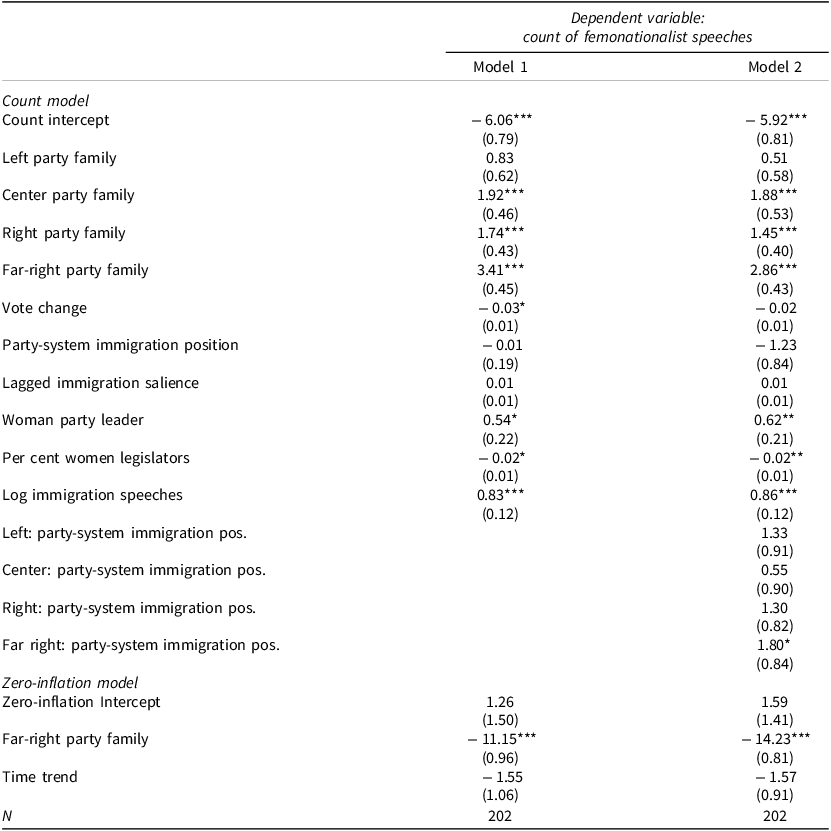
In Table 1, we present results of zero-inflated negative binomial models of the count of femonationalist speech. We cluster the standard errors by election (country-legislature) to account for potential unobserved legislature-specific factors that could influence all parties’ speeches in a given legislative period (Rogers Reference Rogers1994; Williams Reference Williams2000). Table 1 consists of two models: Model 1 presents the results of an additive model to test H1 and H2, and Model 2 includes an interaction between party family and party-system immigration position (excluding the focal party) to test H3. Turning first to Model 1 and H1–2, we find that party family is correlated with both the presence (zero-inflated) and the count of femonationalism speech (count model). As shown in the zero-inflation model, being a far-right party strongly and negatively predicts whether a party abstains completely from using femonationalism. Turning to the count part of Model 1, we clearly see that far-right parties are the major users of femonationalism. Centrist and mainstream rightist parties are also significantly associated with femonationalism (reference category is far left). The time trend, while negative as expected, is not statistically significant.
Determinants of femonationalist speeches: zero-inflated negative binomial models

***p < 0.001; **p < 0.01; *p < 0.05.
Note: standard errors clustered by election (country-legislature) in parentheses.
To give a sense of the effect size for H1–2, the exponentiated coefficient (incident rate ratio) for the far right (Model 1, count coefficient) is 30.3, indicating that a party in the far-right family is associated with a thirty times higher expected count of femonationalist speeches compared to the baseline far-left party family. Centrist parties, conversely, are associated with a 6.8 times higher expected count of femonationalist speeches and mainstream rightist parties, 5.7 times higher expected count, both compared to the far left.
Wald tests confirm that far-right parties use femonationalist rhetoric significantly more than all other party families.Footnote 20 Their predicted use is significantly higher than that of left, centrist, and mainstream right parties, and – as reflected in the coefficient itself – significantly higher than the far left reference category (all differences significant at p < 0.001). These comparisons provide strong support for H1.
Regarding H2, Wald tests show that mainstream right parties use significantly more femonationalist speech than both far left (p < 0.001) and left parties (p < 0.01). However, mainstream right parties do not differ significantly from centrist parties. Thus, H2 is partly supported: mainstream right parties exceed left-wing parties in their use of femonationalism, but the difference between those rightist and centrist parties is not statistically significant.
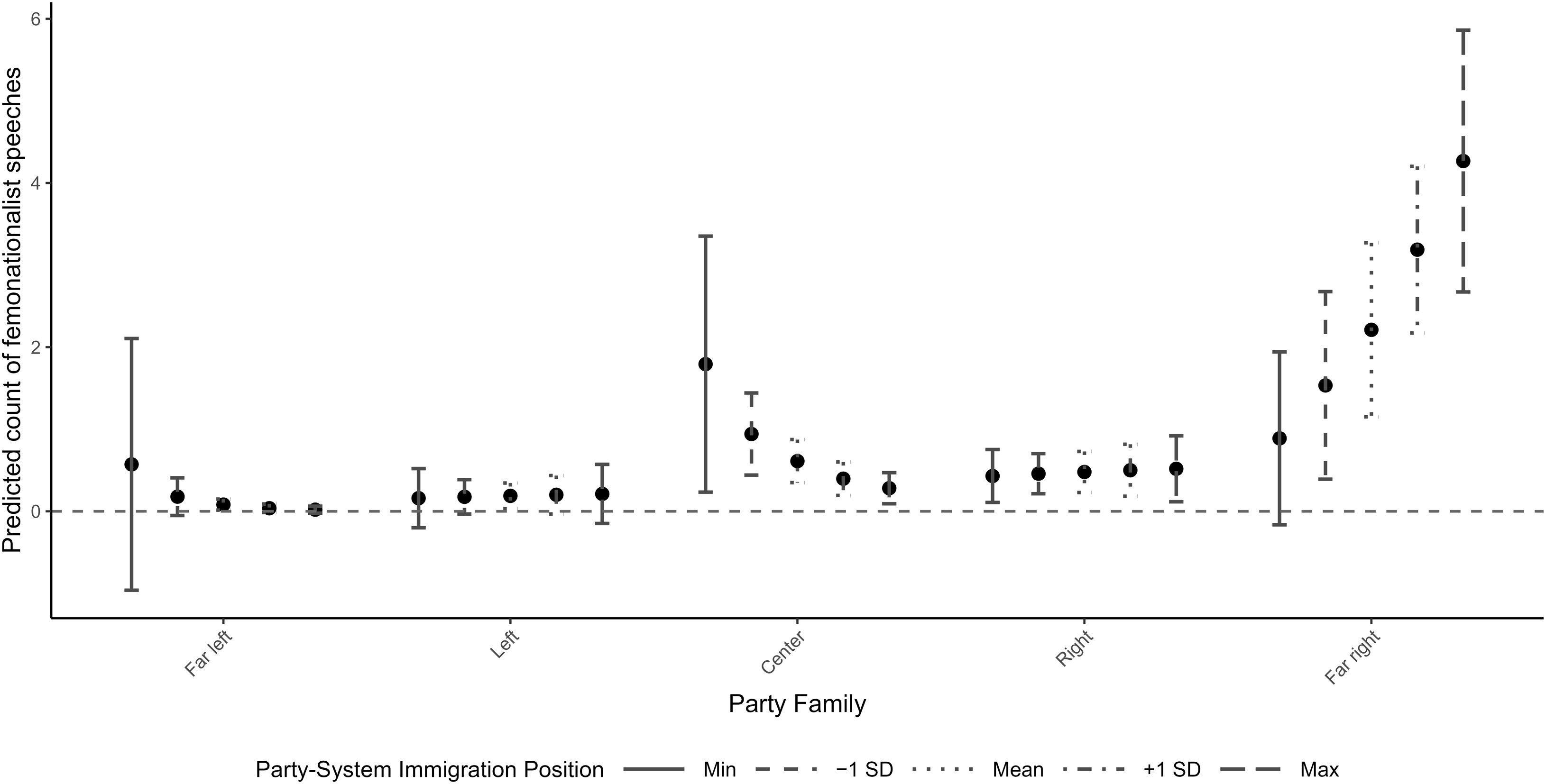
In Model 2, we test our argument about the strategic conditions under which political parties employ femonationalism (H3). Recall that we argue that far-right parties shift to femonationalist framings when they face competitors converging on their anti-immigration position. In the interactive term of Model 2, we observe a pattern consistent with this relationship. To more easily visualize the impact of party-system accommodation, in Figure 4 we calculate the predicted values of the dependent variable – count of femonationalist speeches by party family, varying the immigration-position context. Here, we see the clear relationship between party-system convergence and radical-right parties’ use of femonationalist framing. As shown in the far left column, when the party system’s position on immigration is at −1.34, a position favorable to immigration, the far right’s predicted use of femonationalist speeches cannot be distinguished from zero. However, as the party system shifts to a more anti-immigration position, far-right parties increase their femonationalist references. The predicted count of femonationalist speeches for the far-right party family moving from least to most anti-immigration party-system context is: 0.9, 1.5, 2.2, 3.2, and 4.3.
Predicted count of femonationalism by average party-system position and party family.
Notes: predictions are based on regression results shown in Table 1, Model 2. 95 per cent confidence intervals are shown.

Party responsiveness to party-system accommodation is much less marked for other party families. Figure 4 shows that both centrist and rightist parties employ femonationalism, although they use it at much lower levels, and their count does not vary significantly as the party system becomes more anti-immigration. Parties on the far left and left, on the other hand, rarely have predicted counts of femonationalism that differ significantly from zero, across all levels of party accommodation.
These results support the interaction predicted by H3 and are consistent with an accommodative interpretation of femonationalist rhetoric. Given that the average position of parties on the political far right and right is anti-immigration (mean position = 1.7 for far right and 0.39 for right, compared to 0.27 for center parties, 0.15 for left, and −0.59 for far left), this finding is consistent with an accommodation story: convergence is associated with subsequent far-right party efforts to diversify their decreasingly unique anti-immigration position. Far-right parties are less likely to employ this gendered framing when the party system does not threaten their policy stance. The lack of femonationalist response by the parties of the far left and left aligns with the fact that, even over time, they have remained the least anti-immigration party families in Western European nations, and thus their ideological distinctiveness is not threatened by anti-immigration accommodation.
To finish our discussion of the models in Table 1, in terms of control variables, we find the number of immigration speeches given by a party in the legislative term is positively correlated with femonationalist count, as would be expected. Consistent with a strategic story, the results also show that parties losing support employ higher levels of femonationalist appeals, although this relationship is not robust across specifications. We also find evidence that party feminization is linked to the use of femonationalism, although the indicators yield opposite predictions. Having a woman leader is positively correlated with femonationalism, while the share of women legislators is negatively associated with femonationalist rhetoric. These findings for women legislators and, especially, women leaders are not robust to all alternative specifications (see Appendix D), suggesting that they may reflect unobserved party-level characteristics rather than an independent feminization effect. Further analysis of the causal role of women party elite is needed to disentangle these patterns. Finally, across the two models, we find little support for the importance of the immigration issue as perceived by the public on a party’s use of femonationalism.
Sensitivity Checks
We conduct a number of sensitivity checks. First, we replicate our results using a simpler negative binomial model (Appendix Table D.1) and an OLS model with the share of femonationalist speeches as the dependent variable (Appendix Table D.2). Across these specifications, our main findings hold: party family strongly predicts femonationalist speech, with the effect especially pronounced when the party-system position tilts towards anti-immigration.Footnote 21 Second, the main results are also robust to additional control variables – using vote level instead of vote change, including party governmental status, or adding radical-right party vote – to capture differences across national contexts (for example, differences in electoral or legislative rules across countries which might affect far-right presence in the parliament and thus the far-right’s and other parties’ speech behavior; see Appendix Tables D.3–D.5). Third, our main results do not change when we employ an alternative operationalization of party-system immigration position advocated by Alonso and Fonseca (Reference Alonso and Fonseca2012), which includes support for law and order, a key nativist party demand (see Appendix Table D.6), nor do they change when we use an alternative operationalization of party-system immigration position weighted by vote share or seat share (Appendix Tables D.7–D.8).
Fourth, to address concerns about potential serial correlation within parties, we re-estimate the main results using standard errors clustered by party rather than election (see Appendix D Table D.9). Again, our results remain substantially the same. Fifth, to assess the sensitivity of our interactive results to the inclusion of particular countries, we performed the analysis dropping one country at a time (see Appendix Figure D.1). Our primary interactive result remains robust at the 0.1 significance level regardless of the exclusion of any single country, indicating that the observed patterns are consistent across the entire sample of countries. Finally, we estimate models with a lagged dependent variable to assess whether our predictors explain current femonationalist rhetoric net of parties’ prior levels. Although this specification substantially reduces the sample, including a 43 per cent loss of far-right cases, the key patterns remain: far-right parties are significantly more likely to use femonationalist rhetoric, and the far-right × party-system immigration-position interaction remains positive, significant at the 0.1 level (Appendix Table D.10).
Quantitative Text Analysis: Opening the Black Box of Femonationalism
Our regression models offered novel insights into the key actors employing femonationalism, and the conditions under which they do so. In this section, we employ quantitative text analysis to shed new light on the specific topics discussed within femonationalist speeches, as well as the role of speaker gender in determining the topic and word prevalence. We first present results from a structural topic model (STM), which uses patterns in the complete femonationalist speech corpora (N = 406 speeches) to inductively uncover latent topics (Grimmer and Stewart Reference Grimmer and Stewart2013). We include both speaker country and gender covariates in the model, because our goal is to identify broad patterns in the content of speeches across the range of data. We pre-process the speech data before running the model by removing punctuation and stopwords (commonly used words and words referring to the country or parliament itself), changing all text to lowercase, and lemmatizing the words (reducing them to their base form; for example, ‘marriages’ becomes ‘marriage’) using the quanteda and textstem packages in R (Benoit et al Reference Benoit, Watanabe, Wang, Nulty, Obeng, Müller and Matsuo2018; Rinker Reference Rinker2018).
Figure 5 presents the results of a three-topic model.Footnote 22 The length of the horizontal line shows the conditional probability of each topic’s prevalence across femonationalist speeches. Next to each line, we show the nine words most frequently and exclusively used within each topic (FREX words). To label the topics, we examined the highest probability words, frequency-exclusivity words (FREX), and examples of responses that are highly associated with topics. Figure 5 shows that the most commonly discussed topic in our sample of femonationalist speeches is ‘threat to Western values’, which occurs on average in 40 per cent of speeches, followed by ‘crime and security’ (31 per cent) and ‘immigration and integration policy’ (29 per cent).
Top topics emerging in femonationalist speeches.
Note: expected topic proportions are presented with nine associated words occurring with highest frequency-exclusivity in the topic.

The topic ‘Threat to Western values’ includes speeches that focus on the cultural threat of immigrants to the gender rights of the native population and often invokes terminology related to day-to-day life. Speeches that score highly in this topic often mention ‘parallel societies’ where (often Muslim) people live according to non-Western values, and immigrant daughters or wives are isolated (words such as ‘burka’, ‘full veil’, and ‘gender-segregated’ are common). ‘Descendant’ emerges as a commonly used word because speeches often describe this as a problem across multiple generations of immigrants. As an example of this values-based topic, in a 2020 speech scoring 98 per cent on this topic, the Danish New Right politician Mette Thiesen says, ‘We can see that mosques are popping up in several cities. We can see that the women-oppressive Muslim headscarf thrives in institutions and schools and public workplaces’.
The second topic, ‘Crime and security’, focuses on gender-related crimes committed by immigrants, including but not limited to violence against women. For example, in a 2023 speech scoring 99 per cent on this topic, the Dutch PVV legislator Gidi Markuszower argues that immigration must be curbed because:
wherever an asylum seeker center is built, there will be nuisance. The figures from this minister’s own ministry say that asylum seekers committed 4,000 crimes in 2021! This also includes rape, attempted murder, theft and violence.
Speeches focused on the third most common topic, ‘Immigration and integration policy’, frequently discuss the enforcement of immigration rules, integration requirements, and policy improvements. The focus is on legislative measures and addressing perceived abuses of the system. For example, in a 2016 speech scoring 98 per cent on this topic, the French UMP legislator Charles de La Verpillière argued that integration should be a prerequisite and suggested policy revisions:
We also recommend requiring that the issuance of a residence permit be conditional on sufficient knowledge of the French language and respect for republican principles, in particular secularism and equality between men and women. The French Parliament must also be able to set quotas each year, that is to say the number of foreigners who can be welcomed into France.
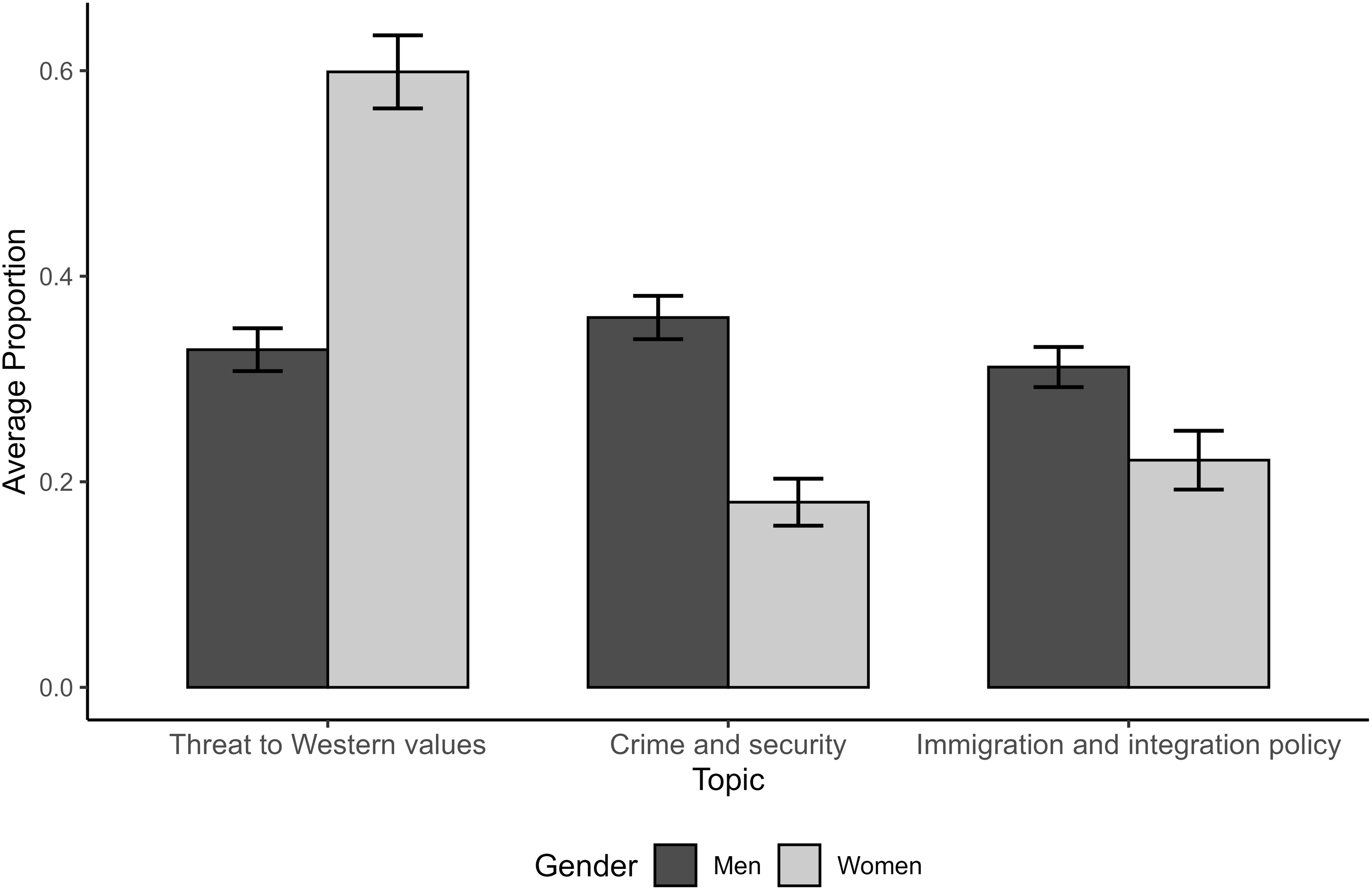
There is a significant literature suggesting that women tend to speak about different topics in legislatures than men (Bäck et al Reference Bäck, Debus and Müller2014; Catalano Reference Catalano2009; Hargrave and Langengen Reference Hargrave and Langengen2021; Taylor-Robinson and Heath Reference Taylor-Robinson and Heath2003). How, then, does speaker gender influence femonationalist speech, and do women emphasize different topics from men? In our sample, 27 per cent of femonationalist speeches are made by women, a figure that is lower than the mean share of women legislators in the legislature within our sample (35 per cent), but similar to the share of women in right (32 per cent) and especially far-right (27 per cent) parties. When we recalculate the mean topic proportions from the three-topic model presented in Figure 5 by speaker gender, we see important gender differences. Figure 6 shows that the majority of women’s femonationalist speeches (60 per cent) relate to the topic of Western values, whereas this topic is the focus of only 33 per cent of men’s speeches. Men, conversely, are twice as likely to discuss the topic of crime and security (36 per cent versus 18 per cent among women). Men’s speeches also tend to focus more on immigration and integration policy (31 per cent), which is less common among women speakers (22 per cent).
Top topics emerging in femonationalist speeches, by speaker gender.

Keyness statistics, which identify the most distinctive words used by different groups based on their frequencies (see also Müller and Ncib Reference Müller and Ncib2024; Zollinger Reference Zollinger2024), shed further light on gender differences in femonationalist appeals. Figure 7 displays the twenty terms used most distinctively by men and women in femonationalist speeches. While the ranking of any one term on its own should not be over-interpreted, overall, the figure provides evidence very much in line with the gender differences reported in the separate topic model analysis. The most distinctive words of men’s speeches are ‘asylum’ and ‘seeker’, which are used 371 and 251 times, respectively, compared to only forty-nine and fifteen times in women’s speeches. This finding closely aligns with the focus on crime and security among men observed in Figure 6. The other words that characterize men’s speeches more than women’s include, for example, ‘border’ and ‘influx’, as well as ‘abuse’, [asylum] ‘center’, and ‘arrest’, which strongly suggest that men’s femonationalist speeches are more likely to focus on security themes.
Keyness statistics: Comparing men and women’s femonationalist speeches.
Note: the figure shows the twenty terms mentioned with greatest relative frequency by men relative to women.

Women, conversely, are more likely to emphasize cultural differences in their femonationalist speeches, including words such as ‘gender-segregated’, ‘workplace’, ‘halal’, and ‘meat’. In line with previous scholarship on gender and politics, we observe that, in femonationalist speeches, women are more attuned to gender equality as a rights issue, whereas men tend emphasize the security threat. For example, the Danish DF politician Pia Kjaersgaard says in a 2020 speech, ‘Parallel societies, social control, handshakes, headscarves, halal, Sharia law, gender-segregated swimming pools … It’s all something that is the result of the massive immigration, and something that we have to deal with on a daily basis on many different levels’. While our quantitative text analysis is exploratory and we do not evaluate specific hypotheses, our results suggest an important and previously underappreciated gendered dimension to femonationalist speech.
Conclusion
Our examination of parliamentary speeches in five countries reveals that femonationalist appeals are increasingly visible. Our study is limited to Western Europe, but countless examples can be observed in other regions of the world. For example, in the United States, Republican presidential nominee Donald Trump infamously said in 2015 of Mexican immigrants: ‘They’re bringing drugs. They’re bringing crime. They’re rapists’.Footnote 23 While scholarly attention to this phenomenon is increasing, there has been a lack of cross-national quantitative studies examining the prevalence of femonationalism as well as the attributes of the actors employing it and the conditions under which it is used. Our paper fills these lacunae by examining a theoretically relevant set of Western European democracies.
Examining the use of femonationalism in parliamentary speech on immigration across five Western European countries from 2009 to 2024, we confirm that far-right parties are key protagonists of femonationalist rhetoric, with centrist and mainstream right parties also employing it at significant but lower levels. Our analyses further show that far-right parties use femonationalism following accommodation of their anti-immigration position, suggestive of a strategic rationale, although further causal analysis is needed. By adding a gendered framing to their nativist appeals, far-right parties, we argue, seek to ensure their programmatic distinctiveness and thus strive to maintain or increase their electoral relevance.
Our rich new dataset of femonationalist speech also allows us to more carefully understand the different types of appeals employed and gender differences in the content of femonationalist text. We show that, empirically, there are multiple significant dimensions to femonationalism appeals: based on speech in these five countries, we identify framings ranging from immigration’s threat to Western values of gender equality and women’s rights to more security-oriented rhetoric emphasizing violence against women and the physical dangers of asylum seekers. Furthermore, our analyses show that women are more likely to invoke a rights-based framing and men, a security-based framing.
Our paper makes several empirical and theoretical contributions. We offer a practical operationalization of femonationalism and introduce a new dataset that expands our understanding of how political parties and legislators use gendered rhetoric in immigration debates. For the first time, we can systematically track trends across party families and countries over time. This dataset provides a valuable tool for exploring how the framing of immigration has evolved – a timely contribution given the rise of far-right parties and nativist sentiment across democracies.
We also advance scholarship on party competition by identifying a previously underexplored tactic: changing the framing of an issue. While parties under threat often shift their positions or adopt new issues (Meguid Reference Meguid2023), we show they can also reframe existing ones. Femonationalism adds a gendered lens to anti-immigration rhetoric, but similar framing strategies exist. For example, homonationalism – support for LGBTQ rights framed as part of native Western values – serves a similar purpose for far-right parties (Spierings Reference Spierings2020a; Turnbull-Dugarte and Ortega Reference Turnbull-Dugarte and Ortega2024). Such tactics are not confined to immigration: in the United States, school safety debates have been reframed around a perceived transgender threat, reinforcing Republican distinctiveness on education and security (Chatfield Reference Chatfield2024).
Our findings also speak to the electoral potential of femonationalism. Through quantitative text analysis, we show this rhetoric ranges from gender egalitarian to gender traditional. These variations, similar to themes noted by Mainz (Reference Mainz2026) have not previously been systematically categorized. Different framings may appeal to different constituencies: rights-based femonationalism may resonate with gender-egalitarian (often women) voters, while protectionist framings reflect benevolent sexism and may appeal more to male far-right supporters (Coffé et al Reference Coffé, Fraile, Alexander, Fortin-Rittberger and Banducci2023; Swim et al Reference Swim, Aikin, Hall and Hunter1995). Though more research is needed on voter responsiveness, femonationalism’s capacity to span these cultural divides makes it a potentially powerful tool.
Our study has several limitations. First, the analysis is restricted to five Western European countries and to parliamentary speeches on immigration, which limits the generalizability of our findings. Future work could usefully examine other countries and other policy areas, such as law and order, to further assess how broadly femonationalist frames are deployed. Secondly, our analyses focus on the party level as this is the most important unit of legislative organization in parliamentary democracies. However, as femonationalist speech becomes more prevalent and more data become available, future research should examine individual-level determinants – especially the gender – of who takes the floor to use this rhetorical strategy. Thirdly, while our analyses find support for the reactive, strategic use of femonationalism, we cannot fully rule out the possibility of feedback effects, such as femonationalist rhetoric influencing subsequent mainstream party positions. Future research should study such downstream consequences of femonationalist discourse.
Beyond these extensions, our work raises additional topics for investigation. First, while the existing literature has begun to identify which voters respond to femonationalist appeals (see Lawall Reference Lawalln.d.) and whether such appeals shift immigration attitudes (Mainz Reference Mainz2026), future studies should examine whether the identity of the speaker matters. We find preliminary evidence that parties led by women and with fewer female legislators are more likely to employ femonationalist rhetoric. But does the gender of the politician delivering the message affect its impact? And is symbolic signaling sufficient, or does credibility require coupling rhetoric with gender-related policy? Secondly, with more data, researchers could also explore alternative logics, such as whether far-right parties use femonationalism in response to electoral setbacks combined with shifting party-system positions. Finally, although our analysis centers on Western Europe, femonationalist rhetoric is spreading globally. Future research should examine how its use and effectiveness vary beyond the European context.
Supplementary material
The supplementary material for this article can be found at https://doi.org/10.1017/S0007123426101665.
Data availability statement
Fernandes, Jorge M.; Meguid, Bonnie M.; Weeks, Ana Catalano, 2026, ‘Replication Data for Thinly Veiled: The Use of Femonationalist Speech in European Parliaments’, https://doi.org/10.7910/DVN/1FRIK0, Harvard Dataverse, v1.
Acknowledgments
We thank the editors and and anonymous reviewers of BJPS. Previous versions of the paper were presented at the 2024 annual meeting of the American Political Science Association, University of Bath Political Economy and Public Economics Workshop, IE University, the University of Manchester, and the University of Rochester Democracy Center Workshop. We thank Katharina Lawall as well as other participants of the conferences and seminars for their comments and suggestions. We thank Maria Barretos, Edgar Chicurel, Jefferson Leal, Beatriz Ribeiro, and Miguel Won for their excellent research assistance. All authors contributed equally to this work.
Financial support
Ramón y Cajal Fellowship, AEI (RYC2021-031037-I).
Competing interests
The authors declare no ethical issues or conflicts of interest in this research.
Ethical standards
The authors affirm this research did not involve human subjects.





 Open access

