


Statement of Research Significance
Research Question(s) or Topic(s): Can more accurate assessment of self-reported physical activity (i.e., metabolic equivalents (METs)) provide greater specificity on the effects of cognitive functioning in youth? Main Findings: Higher parent-reported METs were associated with increased cognitive functioning, particularly in executive functioning. METs had more robust associations to cognitive functioning than broad sports involvement. Study Contributions: These findings link physical activity with increased cognitive performance in pre-adolescent youth. Further, they provide a more accurate estimate of physical activity as a predictor of cognitive functioning, which will be important for intervention research.
Introduction
More than 80% of adolescents are insufficiently active according to global physical activity guidelines for children and adolescence (World Health Organization, 2020). This is concerning as physical activity in children is important across children’s development as it relates to academic, health, and other life outcomes (Ding et al., Reference Ding, Varela, Bauman, Ekelund, Lee, Heath, Katzmarzyk, Reis and Pratt2020; Donnelly et al., Reference Donnelly, Hillman, Castelli, Etnier, Lee, Tomporowski, Lambourne and Szabo-Reed2016; Howie & Pate, Reference Howie and Pate2012). In particular, physical activity in children has a positive relationship with cognition, brain structure and functioning, and academic performance (Herting & Chu, Reference Herting and Chu2017).
The relationship between physical activity and cognition is of interest in children, with several studies examining fitness showing favorable associations with cognition and physical fitness (Donnelly et al., Reference Donnelly, Hillman, Castelli, Etnier, Lee, Tomporowski, Lambourne and Szabo-Reed2016). As regular physical activity promotes aerobic fitness in children, it stands to reason that tracking more long-term physical activity trends may be beneficial when examining cognitive trajectories. Further, these studies highlight the importance of factors such as intensity of activity and domain of cognition being assessed and warrants further investigation (Chang et al., Reference Chang, Labban, Gapin and Etnier2012; Donnelly et al., Reference Donnelly, Hillman, Castelli, Etnier, Lee, Tomporowski, Lambourne and Szabo-Reed2016; Esteban-Cornejo et al., Reference Esteban-Cornejo, Tejero-Gonzalez, Sallis and Veiga2015; McMorris et al., Reference McMorris, Sproule, Turner and Hale2011).
Intensity of physical activity in relation to cognition has long been noted as a variable of importance; although, it is widely debated over how it affects cognition. The “inverted U” hypothesis has largely argued that there is a point of optimal intensity at which cognitive gains can be observed (Gutin, Reference Gutin1973). Inversely, dynamic theories of exercise and cognition suggest that with increased activity intensity, there is an increase in cognitive potential through mediating brain-derive neurotrophic factor or vascular endothelial growth factor (Lee et al., Reference Lee, Wong, Lau, Chia-Di Lee, Yau and So2014; Uysal et al., Reference Uysal, Kiray, Sisman, Camsari, Gencoglu, Baykara, Cetinkaya and Aksu2015; Winter et al., Reference Winter, Breitenstein, Mooren, Voelker, Fobker, Lechtermann, Krueger, Fromme, Korsukewitz and Floel2007). Literature assessing weekly physical activity levels in youth supports this notion demonstrating that vigorous intensity activity actually had greater impacts on academic achievement compared to moderate intensity activities (Coe et al., Reference Coe, Pivarnik, Womack, Reeves and Malina2006; Kwak et al., Reference Kwak, Kremers, Bergman, Ruiz, Rizzo and Sjöström2009; So, Reference So2012). In this way, continued investigations into how variability of activity intensity impacts more specific areas of cognitive functioning is warranted.
Children and adolescents engaged in sports are more likely to meet physical activity recommendations (Guagliano et al., Reference Guagliano, Rosenkranz and Kolt2013; Kokko et al., Reference Kokko, Martin, Geidne, Van Hoye, Lane, Meganck, Scheerder, Seghers, Villberg, Kudlacek, Badura, Mononen, Blomqvist, De Clercq and Koski2019) and obtain more moderate and vigorous physical activity (Marques et al., Reference Marques, Ekelund and Sardinha2016) than children not in organized sports. Despite this general evidence, there is very little evidence regarding the specific relationships between exercise intensity and cognitive outcomes in youth. The few studies examining this relationship have identified that childhood sport involvement is related to increased cognitive functioning, with physical activity thought to be a primary mediating factor in this relationship (Bidzan-Bluma & Lipowska, Reference Bidzan-Bluma and Lipowska2018). While the exact mechanism behind sports engagement and cognition is debated (Tomporowski & Pesce, Reference Tomporowski and Pesce2019), physical activity remains a key component in this relationship. Indeed, a randomized control trial of after school programs showed increased physical activity in children led to increased cognitive performance (Hillman et al., Reference Hillman, Pontifex, Castelli, Khan, Raine, Scudder, Drollette, Moore, Wu and Kamijo2014) further strengthening the potential relationship between physical activity during sports and improved cognition.
Despite this shared relationship, the literature is mixed in how to best measure activity through sports engagement. Sports provide unique opportunities for children to engage in physical activity, but the range of intensity required by each sport varies (Ainsworth et al., Reference Ainsworth, Haskell, Leon, Jacobs, Montoye, Sallis and Paffenbarger1993, Reference Ainsworth, Haskell, Herrmann, Meckes, Bassett, Tudor-Locke, Greer, Vezina, Whitt-Glover and Leon2011). Activity metrics of sports engagement include the number count of sports engaged in Fox et al. (Reference Fox, Barr-Anderson, Neumark-Sztainer and Wall2010), use of categorical variables that may correspond to whether the child likely meets physical activity guidelines (Coe et al., Reference Coe, Pivarnik, Womack, Reeves and Malina2006), and MET-minutes per day (Kwak et al., Reference Kwak, Kremers, Bergman, Ruiz, Rizzo and Sjöström2009), among other measures. While all measures of physical activity have strengths and weakness, MET-minutes are promising as METs provide a standard tool of measurement to account for the energy expenditure exhibited during individual activities (Ainsworth et al., Reference Ainsworth, Haskell, Leon, Jacobs, Montoye, Sallis and Paffenbarger1993); in other words, METs are a means of comparing levels of intensity of activity regardless of the activity a person is engaged in. For example, when comparing a child in baseball against a child in track, a MET-minute of baseball is 5 and a MET-minute of track is 10; thus, the child in baseball would have to participate in two minutes of baseball to have the same energy expenditure as the child in track who is active for one minute. In this way, MET-minutes per week is a means of measuring weekly sport-specific average energy expenditures in children, which can then be used to measure the association on cognition, though this has yet to be done in the known literature. While some work has been done to investigate the relationship between METs and childhood outcomes, this literature has largely focused on academic achievement measures (e.g., GPA) rather than cognitive tasks (Coe et al., Reference Coe, Pivarnik, Womack, Reeves and Malina2006; Kwak et al., Reference Kwak, Kremers, Bergman, Ruiz, Rizzo and Sjöström2009).
We aim to clarify relationships between youth physical activity in sports and a broad range of cognitive functioning through use of a standard tool for measurement energy expended. To this end, we will investigate the relationship between past year total estimated MET-minutes during sports engagement and cognitive functioning during late childhood. As a comparison, we will examine how participation in total number of sports in the past year impacts cognitive performance. Finally, we will compare results across both analyses. We predict that higher volume of activity in sports (i.e., MET-minutes) and more sports engagement over the past year will be associated with increased cognitive performance in 9- and 10-year-old children while accounting for demographic variables and body mass index (BMI). Further, we predict that total volume of sports activity will be a better indicator of cognition compared to general engagement in sports.
Method
Procedures
Participants included 11,880 youth who were recruited from a demographically diverse sample at twenty-two sites across the country. Participants were enrolled in the Adolescent Brain Cognitive Development (ABCD) Study and were part of an effort to follow children over 10 years to measure how health factors impact brain and cognitive development. Data from the ABCD study is released on an annual basis, with baseline data from release 3.0 utilized for the current cross-sectional study. Participants were largely recruited through local school systems and were 9 and 10 years old; greater recruitment detail is available by Garavan and colleagues (Reference Garavan, Bartsch, Conway, Decastro, Goldstein, Heeringa, Jernigan, Potter, Thompson and Zahs2018). Before scheduling baseline session, participants completed a brief phone interview to determine eligibility for the study. Exclusionary criteria included current diagnosis of schizophrenia, moderate or severe autism spectrum disorder, intellectual disability, or alcohol/substance use disorder, major neurological disorders including brain tumor, stroke brain aneurysm, brain hemorrhage, subdural hematoma, multiple sclerosis, sickle cell disease nor seizure disorder diagnoses including Lennox-Gastaut syndrome, Dravet syndrome, and Landau Kleffner syndrome; history or traumatic brain injury; Magnetic Resonance Imaging contraindications; gestational age less than 28 weeks and birthweight less than 2 lbs 10 oz or any other birth complications that resulted in hospitalization for more than a month. Participants and their parents completed interviews, cognitive testing, and questionnaires independently from one another; however, only measures relevant to the current study are described below. All study procedures were completed in accordance with the Helsinki Declaration. Assent and consent were obtained from both youth and parent, respectively, and in accordance with centralized Institutional Review Board approval at the University of California San Diego.
Measures
Demographics. Parents were administered the ABCD Parent Demographics Survey which was adapted from the PhenX toolkit (Barch et al., Reference Barch, Albaugh, Avenevoli, Chang, Clark, Glantz, Hudziak, Jernigan, Tapert, Yurgelun-Todd, Alia-Klein, Potter, Paulus, Prouty, Zucker and Sher2018). Parents were asked questions about child’s sex assigned at birth, current age, race, ethnicity, household income, parental education status, parental marriage status, and additional demographic factors.
Sports and activities. Parents of participants were given the Sports and Activities Involvement Questionnaire which was adapted from the Vermont Health Behavior Questionnaire (Barch et al., Reference Barch, Albaugh, Avenevoli, Chang, Clark, Glantz, Hudziak, Jernigan, Tapert, Yurgelun-Todd, Alia-Klein, Potter, Paulus, Prouty, Zucker and Sher2018). Parents selected yes/no from a comprehensive list the number of sports and activities their child had engaged in, how many days a week they engaged in that activity, how long they engaged in that activity a day, and whether they engaged in that activity in the past year. Only past year sports engagement was utilized for the current study. In order to investigate sports related activity, non-sports related activities on the survey were excluded (e.g., playing a musical instrument, drawing, performing in drama, crafting, participating in competitive games like chess, and hobbies like stamp collecting). The following sports were included: dance, baseball, basketball, climbing, field hockey, football, gymnastics, ice hockey, horseback riding, ice skating, martial arts, lacrosse, rugby, skateboarding, skiing, soccer, surfing, swimming, tennis, track, wrestling, volleyball, and yoga.
Parent reported duration of time spent engaging in each sport per day was answered as: “less than 30 minutes,” “30 minutes,” “45 minutes,” “60 minutes (1 hr),” “90 minutes (1.5 hrs),” “120 minutes (2 hrs),” “150 minutes (2.5 hrs),” “180 minutes (3 hrs),” “greater than 3 hours,” and “Don’t know.” Children who engaged in greater than 3 hours of activity were excluded from analyses due to unclear information of how long they engaged in a sport on a weekly basis. Further, children who engaged in less than 30 minutes of activity were averaged with a time of 15 minutes. In addition to number of minutes children engaged in an activity, parents also responded with the number of days children engaged in activities. Parents had the option of responding with “1,” “2,” “3,” “4,” “5,” “6,” “7,” “Once every 2 weeks,” “One day every month,” “Less than one day per month,” and “Don’t know.” Parents who responded “less than one day per month” were excluded due to lack of sufficient information. If parents did not know either the number of minutes or the numbers of days their child engaged in an activity, they were also excluded from the sample.
To account for sport intensity, MET values were assigned to each sport based on the Physical Activity Compendium for Adults (Ainsworth et al., Reference Ainsworth, Haskell, Herrmann, Meckes, Bassett, Tudor-Locke, Greer, Vezina, Whitt-Glover and Leon2011). The adult compendium was used for MET values because this compendium included all sports within the Sports and Activities Involvement Questionnaire, whereas the Physical Activity Compendium for Youth (Ainsworth et al., Reference Ainsworth, Watson, Ridley, Pfeiffer, Herrmann, Crouter, McMurray, Butte, Bassett, Trost, Berrigan and Fulton2018) only included one third of the sports under consideration. To examine the volume of sport activity each week, the MET values for each sport were then multiplied by the duration of the sport (minutes) and number of days of participation and summed across sports to obtain MET-minutes per week for the whole year. To investigate the impact of total number of sports, a sum of total number of sports engaged in over the last year was calculated.
Body mass index. Given the moderating role of body weight in the relationship between physical activity and cognition, BMI was included in the current models (Martin et al., Reference Martin, Booth, Laird, Sproule, Reilly and Saunders2018). Anthropometrics were obtained on all participants, including height and weight, during the baseline session (Barch et al., Reference Barch, Albaugh, Avenevoli, Chang, Clark, Glantz, Hudziak, Jernigan, Tapert, Yurgelun-Todd, Alia-Klein, Potter, Paulus, Prouty, Zucker and Sher2018). Height and weight were utilized to calculate BMI using standard BMI formula. Participants with BMI scores less than 13 or greater than 40 were removed from the sample.
Cognition. At baseline, all participants were given the National Institutes of Health (NIH) Toolbox cognition battery (Luciana et al., Reference Luciana, Bjork, Nagel, Barch, Gonzalez, Nixon and Banich2018). The NIH Toolbox cognition battery consists of seven different measures that examine cognitive functions, including episodic memory, executive functioning, attention, working memory, processing speed, and language abilities. NIH Toolbox was administered by research assistants via electronic tablet. Detailed descriptions of cognitive tasks can be found in Luciana and colleagues (Luciana et al., Reference Luciana, Bjork, Nagel, Barch, Gonzalez, Nixon and Banich2018). In brief, the battery and the corresponding cognitive domains being measured included Picture Vocabulary a measure of language and verbal intellect; the Flanker task a measure of cognitive control and attention; List Sorting Working Memory a measure of working memory and information processing; Dimensional Change Card Sorting a measure of cognitive flexibility and set-shifting; Pattern Comparison Processing Speed a measure of processing speed and information processing; Picture Sequence Memory a measure of visuospatial sequencing and memory; and, Oral Reading Recognition a measure of reading ability and academic achievement. Age-corrected standard scores for each subtest were utilized.
Statistical analyses
A series of Generalized Additive Mixed Models (GAMM) were analyzed in R (version 4.4.2) to examine the relationship between (1) past year MET-minutes per week output from sports engagement and (2) past year total sports engaged in on cognitive outcomes. Smoothed terms of each fixed effect with cubic regression spline basis functions were independently inputted into GAMMs with restricted error maximum likelihood fitting (Wood, Reference Wood2017). BMI was additionally included in the models as a covariate of interest, as were basic demographic variables (sex assigned at birth, race, ethnicity, household income, parental education status, and parental marriage status). Further, data collection site and family status were treated as nested random effects to account for shared familial and site-specific variance. Model derivatives were estimated and visualized (see Supplementary Figures). Peak points (i.e., turning points) of derivatives are provided for when a significant rate of change (i.e., confidence intervals included 0) between the activity-related predictor and cognitive outcome is no longer observed.
To draw comparisons between MET-minutes and number of sports, both sets of models were refit with maximum likelihood (ML) and compared against “empty” models (i.e., fixed effects of BMI, demographic variables, and random effects of collection site and family status) using Akaike Information Criterion (AIC) to determine if addition of MET-minute per week output or total sports variables significantly adds predictive value to the model [determined by an AIC difference > 2 (Kuha, Reference Kuha2004; Posada, Reference Posada2004)]. All model comparisons were ensured for identical participants utilized, data transformations (i.e., log-transformation) of activity-based predictors (i.e., past year MET-minutes per week and past year total sports), similar basis functions (i.e., cubic regression spline), fixed degrees of freedom set at 9, fixed basis dimensions (k), and model estimation methods (i.e., ML).
Results
Participants
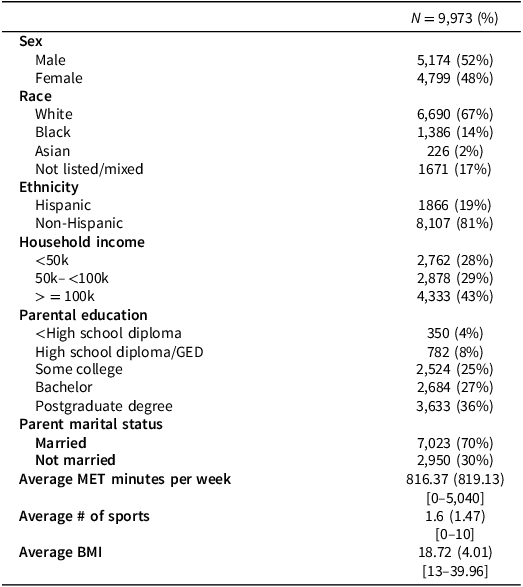
Total participants include 9,973 youth. 1,878 participants were excluded from analyses due to missing data for any relevant variables. Further, 29 participants were excluded as outliers (over 5,040 MET-minutes per week), due to the unrealistically high number of average hours a week participants would have engaged in sports. Full demographic data is denoted in Table 1. Of note, median MET total from past year sports activities was 687.0 (M = 816.37, SD = 869.57, Min = 0, Max = 5,040). Median BMI in children within the sample was 17.57 (M = 18.72, SD = 4.01, Min = 13.0, Max = 39.96.0).
Demographic variables of participants

Table 1. Long description
The table presents demographic data for 9,973 participants. It includes the following columns: Sex, Race, Ethnicity, Household income, Parental education, Parent marital status, Average MET minutes per week, Average number of sports, and Average BMI. The table has 9 columns and 10 rows, including the header row. Row 1: Sex, Male, 5,174 (52 percent); Female, 4,799 (48 percent). Row 2: Race, White, 6,690 (67 percent); Black, 1,386 (14 percent); Asian, 226 (2 percent); Not listed/mixed, 1,671 (17 percent). Row 3: Ethnicity, Hispanic, 1,866 (19 percent); Non-Hispanic, 8,107 (81 percent). Row 4: Household income, <50k, 2,762 (28 percent); 50k-<100k, 2,878 (29 percent); >= 100k, 4,333 (43 percent). Row 5: Parental education, <High school diploma, 350 (4 percent); High school diploma/GED, 782 (8 percent); Some college, 2,524 (25 percent); Bachelor, 2,684 (27 percent); Postgraduate degree, 3,633 (36 percent). Row 6: Parent marital status, Married, 7,023 (70 percent); Not married, 2,950 (30 percent). Row 7: Average MET minutes per week, 816.37 (819.13). Row 8: Average number of sports, 1.6 (1.47). Row 9: Average BMI, 18.72 (4.01).
Notes. Average MET minutes per week, Average number of sports, and Average BMI are formatted in Mean (Standard Deviation) [Minimum–Maximum]. GED = General Education Development, MET = Metabolic Equivalent of Task, BMI = Body Mass Index.
Generalized additive mixed models
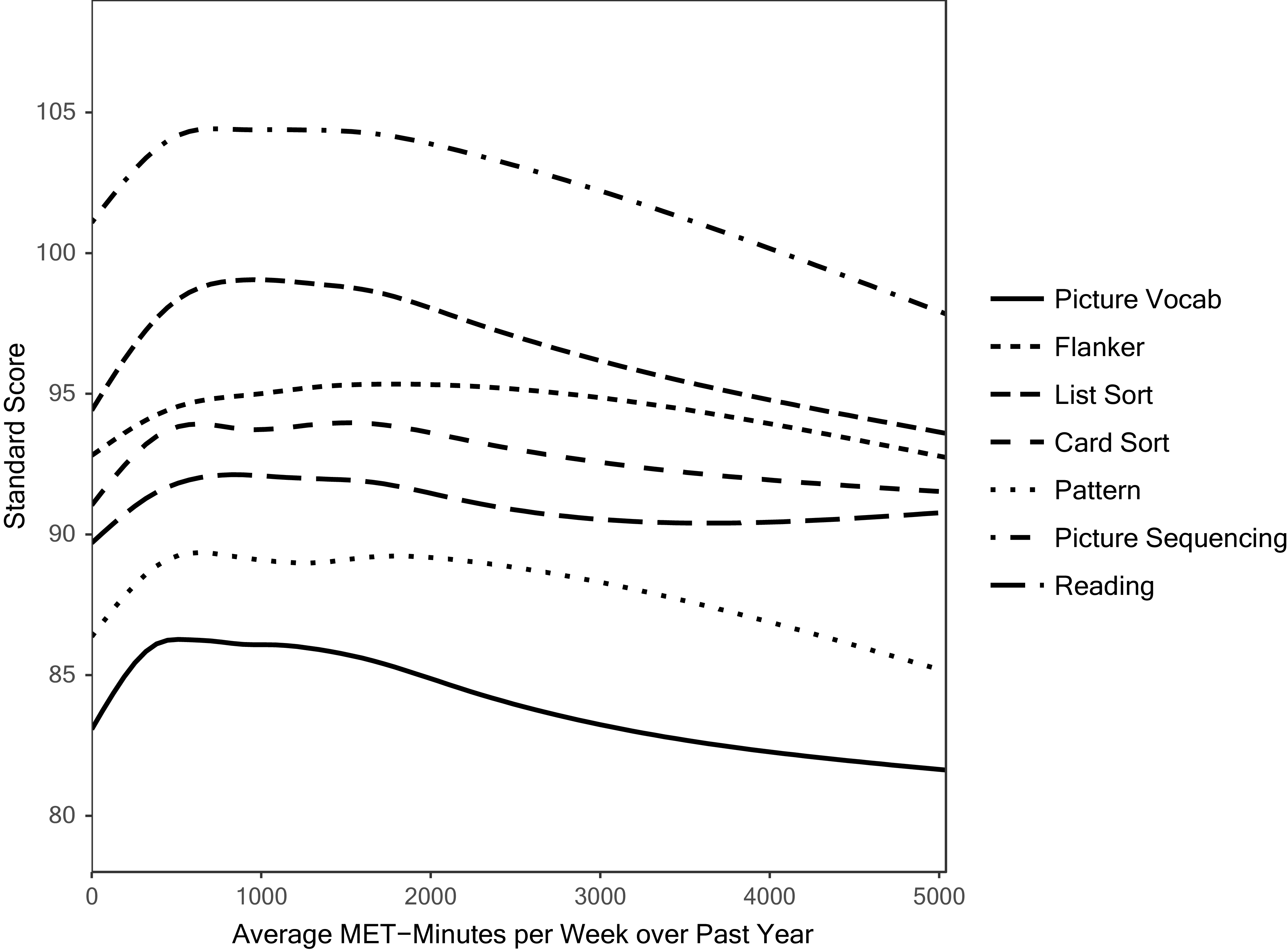
Past Year Total MET-Minutes per Week. Past-year average MET-minutes were associated with non-linear increases in Flanker [F(1.8,9) = 0.23, p = 0.01, peak MET derivative = 2,400], List Sort Working Memory [F(2.1,9) = 0.24, p = 0.009, peak MET derivative = 850], Dimension Change Card Sort [F(1.8,9) = 0.24, p = 0.008, peak MET derivative = 1,850], Pattern Comparison Processing Speed [F(1.6,9) = 0.19, p = 0.02, peak MET derivative = 1,800], and Picture Sequencing Memory [F(2.1,9) = 0.24, p = 0.009, peak MET derivative = 1,050] performance, and non-linear decreases in Picture Vocabulary performance [F(1.7,9) = 0.23, p = 0.01, peak MET derivative = 1,800, starting at MET = 150]. Past-year average MET-minutes were non-significantly associated with Oral Reading Recognition [F(0.8,9) = 0.09, p = 0.1]. See Figure 1 for cognitive domains by past-year average MET-minutes and Supplementary Figures 1–6 for significant non-linear effects. Covariates. Higher BMI was significantly associated with higher Picture Vocabulary (t-value = 4.04, p < 0.001) and decreased Picture Sequencing Memory performance (t-value = −2.89, p = 0.004).
Cognitive outcomes for past year average MET minutes per week.

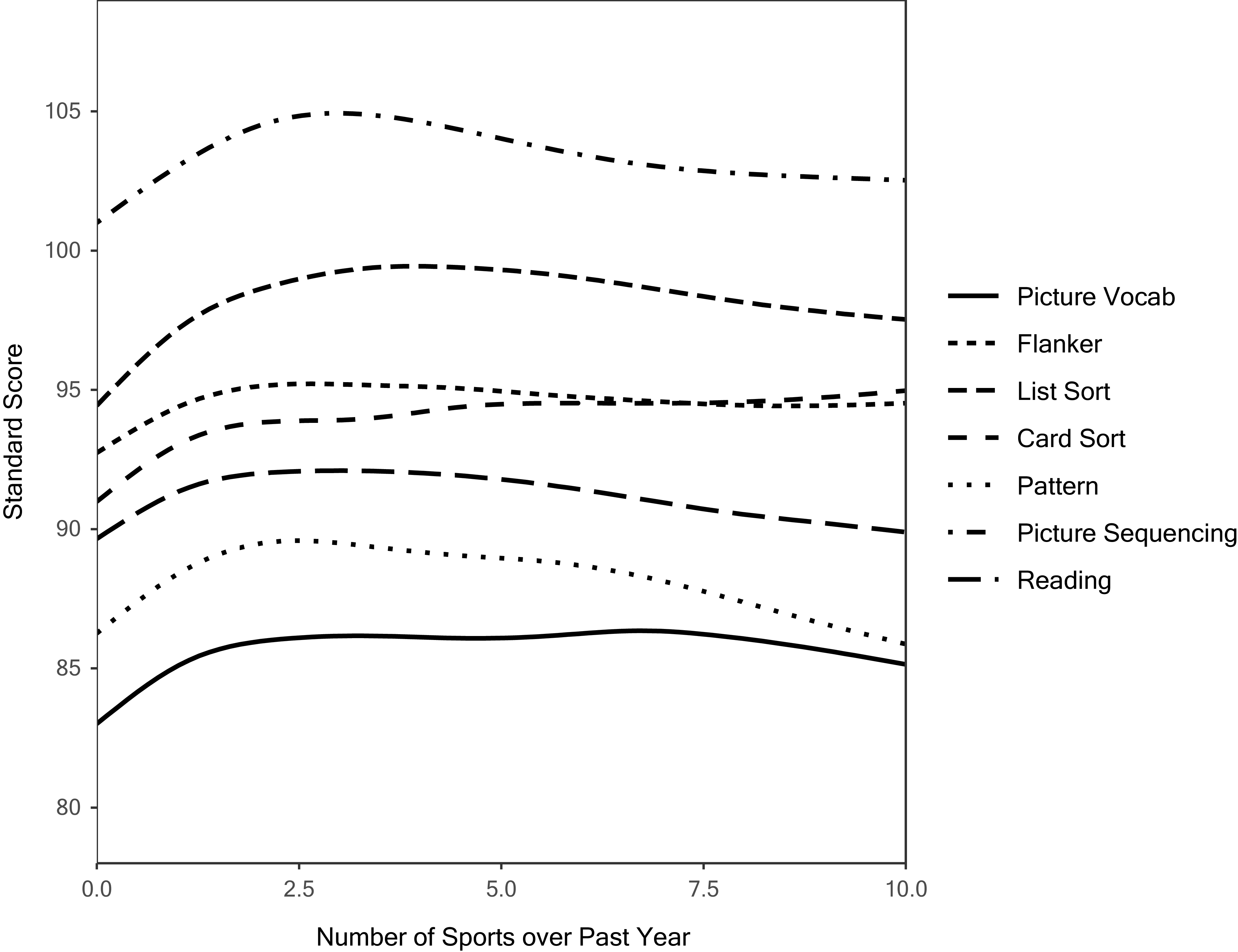
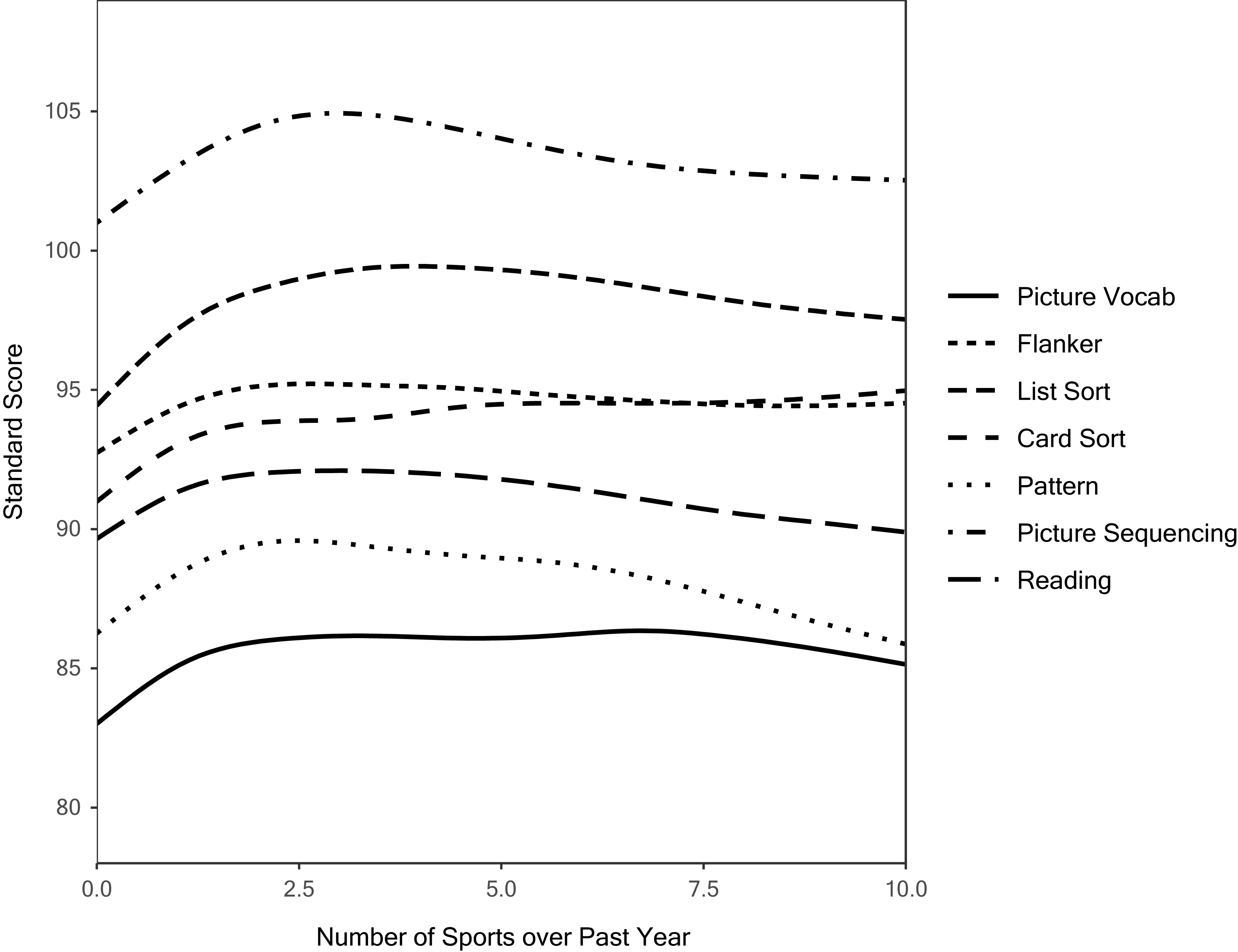
Past year total number of sports. Greater past-year total number of sports were associated with non-linear increases in Flanker [F(2.5,9) = 0.30, p = 0.007, peak total sport derivative = 1], List Sort Working Memory [F(1.6,9) = 0.18, p = 0.03, peak total sport derivative = 1], Dimension Change Card Sort [F(2.2,9) = 0.26, p = 0.01, peak total sport derivative = 1], Pattern Comparison Processing Speed [F(2.6,9) = 0.30, p = 0.007, peak total sport derivative = 1], and Picture Sequencing Memory [F(2.7,9) = 0.32, p = 0.005, peak total sport derivative = 2] performance, and non-linear decreases in Picture Vocabulary [F(2.2,9) = 0.32, p = 0.004, peak total sport derivative = 4, starting at total sport = 1] and Oral Reading Recognition performance [F(2.3,9) = 0.29, p = 0.01, peak total sport derivative at only 3 sports]. See Figure 2 for comparison of cognitive domains by total number of past-year sports and Supplementary Figures 7–13 for significant non-linear effects. Covariates. Increased BMI was significantly related to increased Picture Vocabulary (t-value = 3.94, p < 0.001) and decreased Picture Sequencing Memory performance (t-value = −2.81, p = 0.005).
Cognitive outcomes for total sports over past year.
Comparison of GAMM models
For Picture Vocabulary, the addition of both past-year total sports (Sports ΔAIC = 17.9) resulted in a significantly better AIC value while MET-minutes per week did not (MET ΔAIC = 1.9) with past-year total sports having a larger effect on the model. Whereas, for Flanker (MET ΔAIC = 16.9; Sports ΔAIC = 3.9), Dimension Change Card Sort (MET ΔAIC = 18.2; Sports ΔAIC = 5.6), Pattern Comparisons (MET ΔAIC = 9.4; Sports ΔAIC = 6.6) and Picture Sequencing Memory (MET ΔAIC = 7.2; Sports ΔAIC = 5.5), a larger explanatory effect was observed for past-year MET-minutes per week in contrast to total sports. Additionally, past-year MET-minutes per week output resulted in a significantly better AIC value for List Sort Working Memory (MET ΔAIC = 3.1) whereas total sports did not demonstrate significantly better model performance. Lastly, neither past-year MET-minutes per week nor total sports added significant predictive value to Oral Reading Recognition models.
Discussion
Greater past year sport-derived MET-minutes per week were non-linearly associated with higher performance in domains of inhibition, working memory, cognitive flexibility, processing speed, and episodic memory. Surprisingly, past year MET-minutes per week were associated with non-linear decreases in performance on a test of language. Similarly, larger number of sports was non-linearly associated with greater inhibition, working memory, cognitive flexibility, processing speed, and episodic memory, but non-linear decreases in language and reading recognition performance. Comparison of sport-derived MET-minutes per week compared to total number of sports revealed that while total sports added predictive value to a task of language, MET-minutes per week explained greater variance in models of inhibition, working memory, processing speed, and episodic memory.
Total past-year volume of activity in sports was associated with higher cognitive functioning across multiple measures of executive functioning, in children. Our findings expand on previous literature suggesting that increased physical activity leads to cognitive gains in children, particularly in domains of executive functioning (Etnier & Chang, Reference Etnier and Chang2009; Van Der Niet et al., Reference Van Der Niet, Smith, Scherder, Oosterlaan, Hartman and Visscher2015). Past work has demonstrated cognitive gains in children through engagement in specific sports. Tennis play in children is related to working memory and cognitive flexibility (Ishihara et al., Reference Ishihara, Sugasawa, Matsuda and Mizuno2017), while children who played soccer experienced increased visuospatial working memory, attention, planning and inhibition performance (Alesi et al., Reference Alesi, Bianco, Luppina, Palma and Pepi2016). These domains largely fall under skills of executive functioning, which are generally associated with pre-frontal regions of the brain (Chung et al., Reference Chung, Weyandt, Swentosky, Goldstein and Naglieri2014). Pre-adolescence is a time when increased frontal and parietal lobe gray matter are developing (Giedd et al., Reference Giedd, Blumenthal, Jeffries, Castellanos, Liu, Zijdenbos, Paus, Evans and Rapoport1999; Lenroot & Giedd, Reference Lenroot and Giedd2006; Stiles & Jernigan, Reference Stiles and Jernigan2010). These changes in brain morphometry have direct links to cognitive processes and development (Casey et al., Reference Casey, Giedd and Thomas2000). Thus, it may be that engagement in sport activities during this time period represents a unique benefit to cognitive functioning, as environmental factors can play a role in shaping this development due to pediatric brains representing a time of great neuroplasticity (Mundkur, Reference Mundkur2005). Longitudinal analyses will help to tease apart these trajectories over time.
One proposed mechanism for changes in cortical development included Brain-Derive Neurotrophic Factor or BDNF (Knaepen et al., Reference Knaepen, Goekint, Heyman and Meeusen2010). Past research has demonstrated links between exercise and BDNF (Szuhany et al., Reference Szuhany, Bugatti and Otto2015), with BDNF potentially playing a mediating role between neuroplasticity and cognition (Gomez-Pinilla et al., Reference Gomez-Pinilla, Vaynman and Ying2008). Further, work investigating the effects of other neurotrophic factors, such as vascular endothelial growth factor, have shown similar relationships to BDNF (Lee et al., Reference Lee, Wong, Lau, Chia-Di Lee, Yau and So2014; Uysal et al., Reference Uysal, Kiray, Sisman, Camsari, Gencoglu, Baykara, Cetinkaya and Aksu2015). It is through these pathways that exercise may potentially impact cognitive performance in youth, particularly in brain areas associated with executive functioning such as the prefrontal regions. Our findings highlight that with increased volume of activity, there are increased cognitive benefits. However, both visual inspection and interpretation of model derivatives reveal evidence towards the “inverted U” hypothesis such that there is an optimal level at which gains can be observed (Gutin, Reference Gutin1973), and there may be diminishing returns past a certain level (see Figure 1 and Figure S1–5). In this way, more work needs to be done to determine what level of activity is necessary to provide maximum impact in these regions.
Another proposed mechanism for change is the dynamic involvement of a sport itself. As highlighted above, different sports have been shown to have differing cognitive benefits (Alesi et al., Reference Alesi, Bianco, Luppina, Palma and Pepi2016; Ishihara et al., Reference Ishihara, Sugasawa, Matsuda and Mizuno2017). It has been hypothesized that sports may require higher levels of cognitive flexibility, particularly sports requiring higher executive functioning due to the unpredictable nature of the sport (Koch & Krenn, Reference Koch and Krenn2021; Möhring et al., Reference Möhring, Klupp, Ludyga and Grob2022). It is possible that increased involvement in sports allows for greater opportunity for these dynamic skills to grow, which in turn leads to better cognition, particularly in areas of executive functioning.
Interestingly, while sports engagement in general was beneficial for cognition in youth, we found that total MET-minutes per week of sport activity was more sensitive to changes in cognitive effects than just total overall number of sports engaged in. These findings further elucidate the importance of more fine-tuned measurement of physical activity in youth. It is possible that the measurement of intensity and volume output during sports may provide greater impact on cognition than simply involvement in sports. While some studies demonstrate engagement in sports itself may be beneficial for brain development and mental health (Gorham et al., Reference Gorham, Jernigan, Hudziak and Barch2019), measuring the total volume of activity that occurs within these sports may provide an alternative and more sensitive approach to examining the mechanisms between sports and brain development outcomes. These findings further elucidate how differences in operationalizing physical activity impact cognitive functioning and highlight the importance of utilizing more fine-tuned measurements.
It is worth noting that, overall, the total volume of activity children engaged in through sports a week was relatively low. Total median MET-minutes per week was 687, which is lower than the recommended number of MET-minutes per week for a child (1,260 MET min/week; Piercy et al., Reference Piercy, Troiano, Ballard, Carlson, Fulton, Galuska, George and Olson2018). While it is possible children are engaging in other activities outside of sports that help them to reach the overall recommended MET-minutes engagement, at the sample median, sports were not enough to fully reach this standard. Instead, sports may provide an opportunity for children to supplement total weekly volume of activity, with additional sport-based MET-minutes associated with increased cognition. In this way, childhood sport engagement may be a means by which to increase overall physical activity, which in turn may boost cognitive performance.
Surprisingly, increased MET-minutes and sports engagement over the past year were both associated with decreased performance on a test of language and verbal intellect. While there is a paucity of research investigating the effects of sports on language, some studies have suggested increased sports engagement leads to better language skills (Bidzan-Bluma & Lipowska, Reference Bidzan-Bluma and Lipowska2018). However, a majority of these studies focused on academics with the one study that investigated language comprehension being in a younger cohort (Abdelkarim et al., Reference Abdelkarim, Ammar, Chtourou, Wagner, Knisel, Hökelmann and Bös2017). It is possible that increased participation in sports may present limited opportunities to engage in language building skills compared to peers who do not engage in sports. Inversely, children with premorbid higher language skills may self-select out of more sports engagement. Indeed, one study found that early childhood verbal ability was associated with decreased regular participation in sports by age 11 (Aggio et al., Reference Aggio, Smith and Hamer2018). Due to the cross-sectional nature of our study, we cannot deduce causality; however, this clearly represents an area of further investigation for studies that target sports engagement and language skill development.
BMI was shown to be a variable of significance in models examining picture vocabulary and picture sequencing memory in disparate directions. Increased BMI was associated with worse visuospatial sequencing and memory, but greater language and verbal performance. While findings were disparate, significant relationships were still observed, which lend support to previous literature suggesting BMI is important to consider when investigating physical activity and cognition (Raistenskis et al., Reference Raistenskis, Sidlauskiene, Strukcinskiene, Baysal and Buckus2016). Still, the heterogeneity in findings suggests that potential secondary mechanisms may better explain these relationships (Mora-Gonzalez et al., Reference Mora-Gonzalez, Esteban-Cornejo, Cadenas-Sanchez, Migueles, Molina-Garcia, Rodriguez-Ayllon, Henriksson, Pontifex, Catena and Ortega2019), and thus alternative measures should continue to be explored.
While the present findings help to expand the current literature on the effects of the total volume of activity children engage in during sports and cognition, there are several limitations to our study. MET values for each sport were based on adult values, rather than child values. This decision was made to keep assessment of intensity consistent across activities, as not all activities queried were listed in the Youth Compendium of Physical Activities. Due to resting metabolic rate differences between adults and children, the adult MET values may underestimate the intensity of activities within this study (Ainsworth et al., Reference Ainsworth, Watson, Ridley, Pfeiffer, Herrmann, Crouter, McMurray, Butte, Bassett, Trost, Berrigan and Fulton2018). Further, levels of activity were measured via retrospective parent report. It is possible that errors in reporting may have occurred when trying to report on activities children engaged in the past year. Future work should utilize objective measures of activity, such as accelerometers, to more accurately measure the total volume and intensity of physical activity in children as they are engaging in sports. Due to the responses given to parents, certain questions had to be removed due to lack of specificity. In this way, children who engaged in larger volumes of activity may have been excluded from the study and prevented us from capturing the full effects of large sports activity on cognition. While we found that MET-minute was a better indicator of cognition over total sports, this was not corroborated via out-of-sample validation, and further work is needed to validate this model beyond the ABCD cohort. Finally, while we examined total past year MET-minutes per week, due to the nature of the survey, it is possible that total MET-minutes were overestimated of children’s total engagement in a given activity. Additionally, most sports that children engage in are seasonal. In this way, total MET-minutes would fluctuate for children depending on the time of year. Our study provided an estimate of total volume of activity on a week through sports, but a more exact measurement of time spent in each sport is warranted to further elucidate the effects of activity on cognition.
Our findings support the notion that activity in sports is associated with greater cognitive performance in late childhood. Increased total volume of sports activity over the past year was associated with increased cognitive performance in domains of executive functioning including inhibition, working memory, cognitive flexibility, and processing speed as well as episodic memory. Past year MET-minutes per week were demonstrated to explain more variance in models of cognition than past year sports engagement, suggesting that MET-minutes are more sensitive to changes in domains of executive functioning. Other health factors such as BMI were shown to be significantly related to cognition as well and should be included as future studies continue to disentangle the relationship between sports engagement and cognition. Further, future work should continue to examine additional objective measures of sports activity, such as accelerometer data, to help investigate these complex relationships. Overall, these findings provide additional support for community initiatives to increase sports as a form of physical activity in youth and highlight the importance of physical activity in bolstering cognitive performance during a dynamic period of brain development.
Supplementary material
The supplementary material for this article can be found at https://doi.org/10.1017/S1355617726102239.
Acknowledgements
Sources of financial support: Data used in the preparation of this article were obtained from the Adolescent Brain Cognitive DevelopmentSM (ABCD) Study (https://abcdstudy.org), held in the NIMH Data Archive. This is a multisite, longitudinal study designed to recruit more than 10,000 children age 9–10 and follow them over 10 years into early adulthood. The ABCD Study® is supported by the NIH and additional federal partners under award numbers U01DA041048, U01DA050989, U01DA051016, U01DA041022, U01DA051018, U01DA051037, U01DA050987, U01DA041174, U01DA041106, U01DA041117, U01DA041028, U01DA041134, U01DA050988, U01DA051039, U01DA041156, U01DA041025, U01DA041120, U01DA051038, U01DA041148, U01DA041093, U01DA041089, U24DA041123, U24DA041147. A full list of supporters is available at https://abcdstudy.org/federal-partners.html. A listing of participating sites and a complete listing of the study investigators can be found at https://abcdstudy.org/consortium_members/. ABCD consortium investigators designed and implemented the study and/or provided data but did not necessarily participate in the analysis or writing of this report. This manuscript reflects the views of the authors and may not reflect the opinions or views of the NIH or ABCD consortium investigators. Manuscript preparation supported by NIDA grants U01DA041089, U01DA041025, F32DA064409 (PI: Sullivan), and K08DA062011 (PI: Wallace).
Competing interests
All authors declare that they do not have any conflicts of interest.


 Open access

