Introduction
Functional tongue reconstruction following significant glossectomy is a challenging problem. Recently, with the development of microsurgical reconstructive surgery, swallowing function following glossectomy and tongue reconstruction has greatly improved.Reference Kimata, Uchiyama, Ebihara, Saikawa, Hayashi and Haneda 1 – Reference Ruhl, Gleich and Gluckman 3 However, adjuvant radiotherapy (RT) has been an essential component for patients with a high risk of recurrence, and the detrimental effects of RT on swallowing function are well documented in the literature. Long-term morbidity associated with swallowing function due to RT has become increasingly important as patients survive longer.Reference Agarwal, Palwe, Dutta, Gupta, Laskar and Budrukkar 4 – Reference Murphy and Gilbert 7
Few studies have examined the effects of adjuvant RT on the reconstructed tongue.Reference Miyamoto, Sakuraba, Nagamatsu, Kayano, Kamizono and Hayashi 8 , Reference Shin, Koh, Kim, Jeong, Ahn and Hong 9 The present study evaluated the longitudinal and long-term effects of RT on swallowing function after tongue reconstruction.
Materials and methods
We retrospectively reviewed the medical records of 267 consecutive patients who had undergone glossectomy and tongue reconstruction with free flap transfer, from 2007 through 2014, at the National Cancer Center Hospital and the National Cancer Center Hospital East, Japan. Of these, 16 patients who received adjuvant RT, and who survived without local recurrence or metastasis for at least 1 year, were included in the present study (a recurrent lesion can negatively affect a patient's swallowing function or general condition). There were 12 men and 4 women, with a mean age of 55.9 ± 10.9 years (range, 20–68 years).
The sites of the primary tumour were: the tongue, in 12 patients; the oral floor, in 3 patients; and the submaxillary gland, in 1 patient. Fifteen tumours were classified as stage IV disease according to the Union for International Cancer Control (seventh edition);Reference Sobin, Gospodarowicz and Wittekind 10 the remaining one tumour was a local recurrent lesion.
Defects of the tongue were reconstructed with the transfer of rectus abdominis musculocutaneous flaps or anterolateral thigh flaps. One patient who underwent segmental mandibulectomy and hemiglossectomy underwent reconstruction with simultaneous transfer of a fibular flap and a rectus abdominis musculocutaneous flap.
A percutaneous endoscopic gastrostomy (PEG) feeding tube was placed before RT commenced, in all patients. After a mean post-operative interval of 47.8 ± 12.7 days (range, 26–70 days), all patients received adjuvant intensity-modulated RT, with a mean dose of 66.3 ± 1.0 Gy (range, 66–70 Gy) delivered in daily fractions of 2.0–2.12 Gy. The reasons for adjuvant RT were: extracapsular extension of nodal disease, in 11 patients; a microscopically involved surgical margin of resection, in 7 patients; and histological evidence of invasion, affecting 5 regional lymph nodes in 1 patient. Three patients had multiple reasons for adjuvant RT. Eight patients received concurrent platinum-based chemotherapy during RT, and the remaining eight patients received RT alone.
Swallowing function was evaluated on the basis of the patient's ability to tolerate oral intake, and was divided into five categories in accordance with the diet form: full diet, soft diet, puréed diet, fluid diet and no oral intake. Dependence on PEG tube feeding was also evaluated; this was defined as the use of PEG tube feeding on a regular basis regardless of the amount of oral intake. Swallowing function was evaluated before RT, at RT completion, and at 6 and 12 months after RT completion.
Results
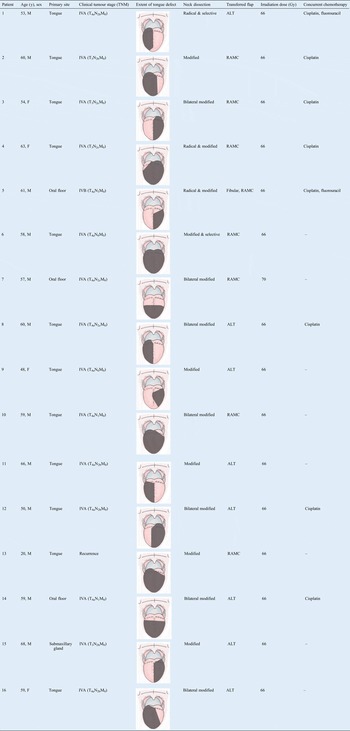
Patient characteristics are summarised in Table I. All transferred flaps survived, and no major peri-operative complications occurred except for surgical site infection of the neck in one patient. Decannulation was possible in all patients by four months after RT completion.
Patient characteristics

Y = year; TNM = tumour–node–metastasis; M = male; ALT = anterolateral thigh; RAMC = rectus abdominis musculocutaneous; F = female
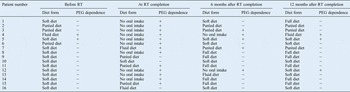
Swallowing function is summarised in Table II. Before RT, all patients could tolerate oral intake, but two patients occasionally used PEG tube feeding for additional nutrition. At RT completion, only 3 patients could consume all nutrition orally, and 10 patients could tolerate no oral intake. The remaining patients could orally tolerate fluid or puréed diet, but were dependent on PEG tube feeding for additional nutrition.
Swallowing function before RT, at RT completion, and after 6 and 12 months

RT = radiotherapy; PEG = percutaneous endoscopic gastrostomy; ‘−’ = negative; ‘+’ = affirmative
By 6 months after RT completion, 11 patients could consume all nutrition orally, but the remaining 5 patients were still dependent on PEG tube feeding for all or additional nutrition. By 12 months after RT completion, all patients were consuming nutrition orally, but 3 patients occasionally used PEG tube feeding for additional nutrition.
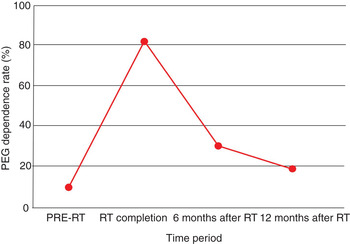
The rate of PEG tube feeding dependence was highest at RT completion but gradually decreased, and by 12 months after RT completion, dependence had returned nearly to that before RT (Figure 1).
Longitudinal change in the rate of percutaneous endoscopic gastrostomy tube feeding dependence. PEG = percutaneous endoscopic gastrostomy; RT = radiotherapy.

Discussion
To our knowledge, the present study is the first to evaluate the longitudinal and long-term effects of adjuvant RT on swallowing function after tongue reconstruction. The study found that most patients had severe acute dysphagia and required PEG tube feeding at RT completion, but had resumed oral intake after one year.
The high incidence of PEG tube feeding dependence at RT completion in the present study represents the severity of acute dysphagia after post-operative RT. Acute dysphagia is a common sequela of RT for head and neck cancers; the reported incidence of PEG tube feeding dependence due to acute dysphagia ranges from 36 to 68 per cent.Reference Mortensen, Overgaard, Jensen, Specht, Overgaard and Johansen 6 , Reference Clavel, Fortin, Després, Donath, Souliéres and Khaouam 11 Within several weeks after starting RT, patients begin to suffer from mucositis, radiation dermatitis and soft-tissue oedema. The resulting pain, copious mucous production, xerostomia and tissue swelling contribute to acute dysphagia.Reference Murphy and Gilbert 7 Acute dysphagia can increase until RT completion and even several weeks beyond.Reference Deantonio, Masini, Brambilla, Pia and Krengli 12 It is noteworthy that the rate of PEG tube feeding dependence in the present study was 81.3 per cent at RT completion (affecting 13 of 16 patients) and was much higher than rates reported in previous studies.Reference Mortensen, Overgaard, Jensen, Specht, Overgaard and Johansen 6 , Reference Clavel, Fortin, Després, Donath, Souliéres and Khaouam 11 Because patients who have undergone significant glossectomy and tongue reconstruction have less reserve capacity for swallowing, they are more likely than patients receiving RT alone to exhibit the acute toxic effects of RT.
The present study found that the rate of late dysphagia was lower than the rate of acute dysphagia. These results suggest that the swallowing dysfunction due to post-operative RT can become less severe over time. However, these findings were unexpected because we had believed that the swallowing disorders in these patients were largely permanent and irreversible. This belief was based on our experience and the findings of previous reports.Reference Miyamoto, Sakuraba, Nagamatsu, Kayano, Kamizono and Hayashi 8 , Reference Larsson, Hedelin, Johansson and Athlin 13 , Reference Logemann, Pauloski, Rademaker, Lazarus, Gaziano and Stachowiak 14 Larsson et al. investigated the longitudinal functional results of patients with head and neck cancers treated with RT, and found that the majority of patients still had eating problems and continued to lose weight one year after treatment.Reference Larsson, Hedelin, Johansson and Athlin 13 Logemann et al. found that swallowing dysfunction resulting from RT and concurrent chemoradiotherapy did not improve or resolve in the first year after treatment, and suggested that the disorders might continue to worsen over the next several years.Reference Logemann, Pauloski, Rademaker, Lazarus, Gaziano and Stachowiak 14
We propose two possible explanations of why the long-term results of the present study were better than those of previous studies. One possible reason is that the primary sites of tumours in the present study were homogeneous. Our study only included patients with oral cancer and excluded patients with oropharyngeal cancer; in contrast, most previous studies included both groups of patients.Reference Garden, Harris, Trotti, Jones, Carrascosa and Cheng 15 – Reference Givens, Karnell, Gupta, Clamon, Pagedar and Chang 17 A significant predictor of late dysphagia after RT is the radiation dose to the pharyngeal constrictor muscles.Reference Deantonio, Masini, Brambilla, Pia and Krengli 12 , Reference Eisbruch, Schwartz, Rasch, Vineberg, Damen and Van As 18 In patients with oropharyngeal cancer, these muscles usually receive a high radiation dose because of their proximity to the target;Reference Deantonio, Masini, Brambilla, Pia and Krengli 12 however, in patients with oral cancer, the muscles can be spared without compromising the dose to the target region. This difference in patient population might have affected the results. A second possible explanation for our better results is our exclusive use of intensity-modulated RT. In our previous study, 71 per cent of patients underwent conventional RT after tongue reconstruction;Reference Miyamoto, Sakuraba, Nagamatsu, Kayano, Kamizono and Hayashi 8 however, in the present study all patients underwent intensity-modulated RT. This can optimise dose distribution, and spare anatomical structures whose damage causes dysphagia and aspiration. The potential benefit of intensity-modulated RT in patients who have undergone tongue reconstruction has not been examined; however, our use of intensity-modulated RT might have contributed to the lower rate of dysphagia.
Our findings have at least two implications for the multidisciplinary support of patients. One implication is the importance of early nutritional support with tube feeding. Maintaining body weight is important for patients with head and neck cancers because weight loss is associated with treatment interruption, infection and early mortality.Reference Capuano, Grosso, Gentile, Battista, Bianciardi and Di 19 , Reference Gourin, Couch and Johnson 20 Prophylactic tube feeding is more effective than reactive tube feeding for maintaining body weight.Reference Lewis, Brody, Touger-Decker, Parrott and Epstein 21 Because of the long duration of tube feeding in our patient population, a PEG tube is preferable to a nasogastric tube. A second implication of our findings is that patients should be encouraged to continue oral intake while they depend on tube feeding. Prolonged dependence on tube feeding without oral intake can result in disuse atrophy of the muscles of deglutition and may further complicate rehabilitation after the treatments.Reference Corry, Poon, McPhee, Milner, Cruickshank and Porceddu 22 Therefore, despite the acute toxic effects of RT and concurrent chemoradiotherapy, patients should be encouraged to continue some amount of oral intake and avoid prolonged periods of nothing by mouth, based on the premise of ‘use it or lose it’.Reference Hutcheson, Bhayani, Beadle, Gold, Shinn and Lai 23
-
• Acute dysphagia was severe in patients who underwent post-operative radiotherapy (RT) after tongue reconstruction
-
• Acute dysphagia was associated with a high rate of percutaneous endoscopic gastrostomy (PEG) tube feeding dependence at RT completion
-
• Swallowing disorders improved over time, and most patients had resumed oral intake after one year
-
• Multidisciplinary support of patients during PEG dependence is important to improve long-term functional outcomes
This study has several limitations. There was selection bias in the extraction of patients. All subjects of the present study were patients who had survived for more than one year after RT completion, and who were free of recurrence or metastasis. This selection bias might have caused us to underestimate the harmful effects of RT on the reconstructed tongue by excluding patients with a poor prognosis. In addition, this study was retrospective and had a small sample size. No firm conclusions can be drawn from a series of only 16 patients. Therefore, further investigation is necessary to determine the true effect of RT on swallowing function after tongue reconstruction. These limitations should be considered when the results are discussed.