Introduction
According to the existing quantitative literature, oil seems to be robustly linked to the onset of civil war (Ross, Reference Ross2004a; Dixon, Reference Dixon2009). However, recent debates on the nexus of oil and internal conflictFootnote 1 have overlooked the existence of a number of peaceful rentier oil states. Only very few convincing efforts have been made to explain why some oil-exporting countries lapse into violence but others do not. In this paper, we address this puzzle by arguing that the onset of civil war depends on the specific conditions of oil production. We claim that some features of oil production increase the risk of civil war while others reduce these hazards, depending on how these conditions structure state–society relations. Specifically, we argue that states that are either highly dependent on oil or who have problematic relations with local oil regions are prone to civil war. However, these risks will be muted when conflict is filtered through democratic institutions or when states can use abundant oil revenues to buy peace. Empirically, we compare 39 net oil-exporting countries using (crisp-set) Qualitative Comparative Analysis (csQCA), a technique that is best used to study the conditional relationships between different factors for samples of between 10 and 50 cases.
This paper makes three contributions to the existing literature on civil war. First, we propose a conditional explanation for the enigma of why some oil producers are prone to civil war but others are not, a theoretical approach that has been rarely applied in the study of the oil–conflict link; second, with the aid of this explanation, we point to the ambiguous nature of oil production, which depends on the mix of conflict risks and mitigating conditions; and, third, we suggest that there are several simultaneous pathways that lead to civil war and to peace.
The paper proceeds as follows: first, we review the literature on the resource–conflict link, showing that the enigma of why some oil-exporting countries experience civil war while others do not is still unresolved. Subsequently, we develop our hypothesis that certain conditions of oil production make states conflict prone, although democratic institutions and high abundance may offset these risks. We then outline an empirical strategy, introducing csQCA, followed by the operationalizations of our ‘outcome’ – civil war onset – and our ‘conditions’ – (oil) dependence, overlap (of ethnic exclusion and oil reserves), (oil) abundance and democracy. Conditional relationships between these different aspects are then tested using a sample of 39 net oil exporters between 1970 and 2008. We afterwards perform the analysis and discuss the results. We also point to a number of important model specifications, in order to underline the reliability of our main results. Finally, we draw relevant conclusions and highlight our contribution to the current debate about the determinants of civil war within resource-endowed countries.
Previous research on the oil–conflict link
Collier and Hoeffler’s (Reference Collier and Hoeffler2004; initially 1998) influential pioneering work on ‘greed and grievance’ has inspired many subsequent studies on the link between natural resources and violent conflict. Collier and Hoeffler argue that the ratio of primary commodities to GDP increases the likelihood of civil war by providing the opportunity for armed rebel activity and the related motive of ‘greed’, rather than by spurring conflict-promoting grievances – such as the political and economic deprivation experienced by, for instance, ethnic or religious groups. These ideas have since been further developed in the literature. Generally, natural resources can promote violence through three major causal mechanisms (see also Ross, Reference Ross2004b; Humphreys, Reference Humphreys2005; Le Billon, Reference Le Billon2008) (1) motivation to take up arms may result from resource-related grievances, such as ecological damage or the withholding of resource revenues; the costs and benefits related to resources are the driving forces of conflict; (2) resources also provide the opportunity for conflict by making rebellion or warfare financially (or militarily) feasible, particularly through the ‘lootability’ of resources; (3) resources may make indirect mechanisms work by providing neither motive nor opportunity directly, but by exerting instead a detrimental influence on other areas – such as state institutions (the ‘weak state’) and socio-economic development – which in turn makes civil war more likely.
Numerous quantitative studies have tried to demonstrate that natural resources increase the risk of civil war onset, with varying results. Ross (Reference Ross2004a) analyzed 14 quantitative studies of the resource–conflict link, finding that primary commodities as a whole cannot be robustly linked to either civil war onset or duration. According to his conclusions, only oil-exporting countries seem to be particularly prone to civil war onset. This finding is supported by a meta analysis conducted by Dixon (Reference Dixon2009). Ross (Reference Ross2012) argues that oil’s conflict curse derives from specific ‘troubles with oil’: oil-related grievances over revenue distribution both inside and outside of oil-producing regions create incentives for secessionist and other conflicts; or, alternatively, the prospect of oil makes it easier for rebels to find support and makes rebellion feasible. Others (Fearon and Laitin, Reference Fearon and Laitin2003; Fearon, Reference Fearon2005) propose that the oil–violence nexus does not work through conditions of feasibility or finance but materializes instead through the weak state mechanism (see also Ross, Reference Ross2006: 290–291), or that it can be attributed to the effects of ‘sparse networks’ (Humphreys, Reference Humphreys2005).
The ‘oil curse’ has been increasingly questioned by a number of studies that find less significant – or even positive – results. According to Hegre and Sambanis (Reference Hegre and Sambanis2006: 531), only oil exports (and not the production of oil or the production and export of other resources) are marginally linked robustly to low-key armed conflict, but not to civil war. Smith (Reference Smith2004) finds a positive effect of oil dependence on regime stability and peace in developing countries. Brunnschweiler and Bulte (Reference Brunnschweiler and Bulte2009) also point to the more positive effects of resources in general, including regime stability and peace.
More recently, a growing number of studies have argued that the effects of oil on civil war are conditional: since conditions of oil endowment and production differ across countries, this variation may explain why some oil-producing and/or -exporting countries lapse into violence while some do not. Fjelde (Reference Fjelde2009) finds that the interaction of high levels of corruption and appropriable oil wealth reduces the conflict probabilities of a country, by offsetting the destabilizing effect of oil production. According to Basedau and Lay (Reference Basedau and Lay2009), oil dependence increases the risk of civil war onset, creating a U-shaped relationship (see also Ross, Reference Ross2012: 153), whereas high levels of abundance – measured in per capita resource revenues – are seemingly used to buy peace through large-scale distribution and/or the establishment of a huge and effective security apparatus. Lujala (Reference Lujala2010) finds that (though only significant at the 10% level) the mode of resource extraction and its location matter: oil is only linked to civil war onset when produced onshore; offshore oil production is unrelated to the onset of civil war. Most recently, a number of studies supported the idea that ethnic exclusion in oil production forms a particularly risky combination (Hunziker and Cederman, Reference Hunziker and Cederman2012; Wegenast and Basedau, Reference Wegenast and Basedau2014), specifically for the onset of secessionist conflict (Sorens, Reference Sorens2011). Given this puzzle, a conditional explanation seems to be the most promising approach. In the following section, we thus develop a theoretical argument about what combinations of conditions may explain civil war onset – or its absence – in oil-endowed countries.
The conditional effects of oil production
‘Oil’ or ‘oil exports’ are, in fact, rather vague concepts. If we want to explain the variation in civil war onset among oil exporters, it is necessary to engage in a more finely grained conceptualization of oil and how its specific properties make related causal mechanisms work. As outlined above, the literature discusses a number of oil conditions – such as abundance, dependence (Basedau and Lay, Reference Basedau and Lay2009), governance of the oil sector (Snyder and Bhavnani, Reference Snyder and Bhavnani2005; Luong and Weinthal, Reference Luong and Weinthal2006), the location and mode of production as well as production type (e.g. Lujala, Reference Lujala2010; Le Billon, Reference Le Billon2012), as well as many other factors (see also Humphreys, Reference Humphreys2005; Le Billon, Reference Le Billon2012; Ross, Reference Ross2012). Since civil war is defined as an intense armed conflict between the state and segments of its society, it makes sense to consider specifically those conditions of oil production that potentially influence relations between the state and society. We therefore propose that, first, two conditions of oil in particular make an oil-related conflict between state and society very likely, and, second, that two additional conditions will rather hinder the emergence of these conflicts in the first place – or, if present, will ensure that they can be handled peacefully.Footnote 2
Oil conditions increasing civil war risk: dependence and location of oil resources
The first condition we expect to create problems is dependence on oil (Collier and Hoeffler, Reference Collier and Hoeffler2004, Reference Collier and Hoeffler2005; Ross, Reference Ross2012). High(er) dependence on oilFootnote 3 indicates that oil is the main source of wealth in a country and will thus involve the state, circumstances that may have a number of harmful consequences that might directly and indirectly increase the risk of civil war (Collier and Hoeffler, Reference Collier and Hoeffler2005; Dunning, Reference Dunning2008; Basedau and Lay, Reference Basedau and Lay2009): First, in an economy dependent on oil, it is more likely that political and social conflict with the state will center around this commodity. The centrality of oil is likely to raise societal expectations that the government may be unable to fulfill. Additionally, dependence makes countries vulnerable to price shocks in the world oil market and the other ills of the ‘Dutch Disease’, creating those economic grievances that make rebellion more likely and feasible. At the same time, dependence on oil fosters a rent-seeking mentality and results in weaker institutions and governance, which makes governments less capable of reacting to such grievances. Ceteris paribus, higher dependence is likely to increase civil war risks for a number of different reasons.
The second condition that we assume to increase conflict risks is related to the physical location of the resources, and how that ‘geography of oil’ affects the relations between the central state and ethnic or other identity-based groupings. Secessionist and autonomist conflicts – like those in Indonesia (e.g. Aceh) or Nigeria (Biafra, Niger Delta) illustrate that the location of substantial oil reserves in regions that are culturally distinct from the country’s center forms a particularly dangerous combination (e.g. Hunziker and Cederman, Reference Hunziker and Cederman2012; Wegenast and Basedau, Reference Wegenast and Basedau2014). Grievances over the distribution of revenues and any negative side effects – such as environmental damage – aligned along ethnic or other identity lines facilitate mobilization and provide significant incentives for uprising. The risk of rebellion increases if groups are already aggrieved, politically or otherwise. Both ethnic identities and grievances can ease the collective and coordination problems that rebels face (Kalyvas and Kocher, Reference Kalyvas and Kocher2007; Ross, Reference Ross2012). Furthermore, oil may contribute to ethnic insurgency by supplying the necessary financial means for armed rebellion – or through the generation of popular support that is granted in expectation of future booty (Kalyvas and Kocher, Reference Kalyvas and Kocher2007; Ross, Reference Ross2012). In sum, we believe that the overlap of oil production and the settlement areas of the politically excluded, relevant ethnic groups substantially increases the risk of conflict.
Conditions of oil production decreasing civil war risks: abundance and democracy
The two aforementioned risk conditions explain why conflict over oil can emerge. However, conflict does not necessarily mean that a civil war will break out, given at least two ways of mitigating oil-related conflicts. The first is directly related to oil and builds on the theory of the rentier state (Luciani, Reference Luciani1987), which has been largely disregarded in the debate over the resource–conflict link. The literature has now acknowledged that a high degree of abundance in oil will reduce the risk of conflict. It has to be stressed that a country’s resource dependence and abundance are not identical (Soysa, Reference Indra De2002: 8–9; Ross, Reference Ross2006: 266). Dependence means that the rents from natural resources are the most important source of income relative to other value-adding activities, whereas abundance or wealth refers to the absolute resource rents available (in per capita terms, or relative to global reserves or production). A number of recent studies (e.g. Basedau and Lay, Reference Basedau and Lay2009; Ross, Reference Ross2012), as well as evidence from very rich oil Emirates in the Persian Gulf, have implied that governments can use high per capita revenues from oil to buy peace. Regimes can offset oil-related or other conflict risks by generous and large-scale distributional policies, and as a result grievances are unlikely to emerge publicly. A huge security sector, fueled by oil money, also helps to render rebellion virtually impossible.
The second condition looks beyond the material foundations of peace and relates to how governments structurally manage conflict between the state and society. We believe that regime type matters in this regard. Arguably, democracies are not only superior in their ability to create legitimacy but constitute, in essence, a more effective procedural arrangement by which to resolve conflict peacefully. In Sir Karl Popper’s famous words, ‘democracy is a political system in which the government can be removed without violence’.Footnote 4 We do not necessarily intend to suggest that democracy in itself represents one particular mechanism by which civil war onset can be avoided, but argue that democracy might have a conditional effect on whether or not governments are able to deal with oil-related risks. We expect specifically that, ceteris paribus, democratic countries will find more legitimate and effective – and peaceful – ways to tackle any grievances that arise. Nationwide or regional problems can thus therein be voiced and addressed without the need to resort to violence.
Against the backdrop of this discussion, we hypothesize that two conditions will make countries more prone to civil war while two others are able to mitigate these conflict risks. Specifically we expect:
H1a: High dependence on oil creates civil war risks through, for instance, price shocks and other elements of the ‘resource curse’.
H1b: Oil production in settlement areas of politically excluded ethnic groups create civil war risks by spurring conflict over the distribution of oil and its revenues or the negative externalities of production.
H2a: These conflict risks will not materialize when the country can buy peace through abundant per capita revenues from oil.
H2b: These risks will not materialize when the country has developed democratic institutions, which are able to channel conflicts toward peaceful political solutions.
Method and operationalization
csQCA
In our empirical analysis, we use QCA which is particularly well-suited to test our conditional theoretical expectations. QCA belongs to a cluster of formal configurational data analysis techniques that are ‘concerned with the systematic matching and contrasting of cases to establish common causal relationships by eliminating other possibilities’ (Berg-Schlosser et al., Reference Berg-Schlosser, De Meur, Rihoux and Ragin2009: 2). Introduced by the sociologist Charles Ragin (Reference Ragin1987) during the late 1980s, and developed further over the last two decades (e.g. Ragin, Reference Ragin2008), QCA techniques have become a useful complement to the prevailing approaches within macro-comparative research (Mahoney, Reference Mahoney2010). To the best of our knowledge, QCA has rarely been used as a comparative technique within the field of peace and conflict studies.Footnote 5
QCA combines some of the advantages of qualitative (case-oriented) and quantitative (variable-oriented) techniques. It is better suited to the comparison of an intermediate number of cases (medium-N) than most quantitative or qualitative techniques are. As a supplement to the quantitative methods dominant in civil war research, QCA adds two interesting dimensions: first, the ability to unravel causally complex structures like equifinality,Footnote 6 multifinality,Footnote 7 and asymmetric causalityFootnote 8 (Grofman and Schneider, Reference Grofman and Schneider2009: 662), and, second, the ability to identify combinations of conditions (Ragin, Reference Ragin2008: 176–189). Both dimensions fit very well with our theoretical expectations that oil may or may not lead to civil war depending on particular conditions, and the combinations thereof.
As a data analysis technique, QCA combines the principles of the ‘method of agreement’ and the ‘method of difference’ (Berg-Schlosser et al., Reference Berg-Schlosser, De Meur, Rihoux and Ragin2009: 2) – the two famous principles of J. S. Mill’s logic of comparison – used in order to identify necessaryFootnote 9 and sufficientFootnote 10 conditions, or combinations of conditions, in relation to a certain outcome. Using QCA, Boolean minimization reduces the empirical complexity. In the words of Charles Ragin, ‘if two Boolean expressions differ in only one causal condition yet produce the same outcome, then the causal condition that distinguishes the two expressions can be considered irrelevant and can be removed to create a simpler, combined expression’ (Ragin, Reference Ragin1987: 93). As a result of this Boolean minimization, more parsimonious combinations of conditions are created that together form a sufficient condition for the occurrence of the outcome (Rihoux and De Meur, Reference Rihoux and De Meur2009: 34–39). As part of these combinations of conditions, the initial single condition operates as an INUS factor (an insufficient but necessary part of a condition that is itself unnecessary but sufficient for the outcome). INUS conditions are causally relevant factors that are almost always overlooked when standard statistical techniques are applied (Grofman and Schneider, Reference Grofman and Schneider2009: 670, note 4).
There is a consensus among experts on csQCA that a good configurational analysis will present at least three technical components (Rihoux and De Meur, Reference Rihoux and De Meur2009; Schneider and Wagemann, Reference Schneider and Wagemann2010): the truth table, the solution formula and measures of fit – such as coverage and consistency. The truth table presents the data to be analyzed, showing the conditions as columns, the cases as rows and the value of the outcome. However, the cases are not always confined to a single row, but are rather grouped together if they are associated with a single combination of conditions relating to the same outcome. Using Boolean language, the solution formula shows the causally relevant conditions linked to the outcome. According to the current convention, uppercase letters signify the presence of a condition or outcome, while lowercase letters show the absence or the negation of a condition or outcome. The +sign points to a logical OR and the * sign to a logical AND (see for more details Grofman and Schneider, Reference Grofman and Schneider2009; Schneider and Wagemann, Reference Schneider and Wagemann2010: 414).
Due to the dichotomous nature of our outcome (civil war onset), we decided to use csQCA as the primary method of data analysis.Footnote 11 There are two main reasons why we think this decision is appropriate: first, the onset of civil war as a historical event comes very close to the basic premise of csQCA of not having ‘differences in degree’ but of having rather ‘differences in kind’. Second, to work with a binominal-coded outcome allows us to use the same data on civil war onset that most of the quantitative literature has been using to date, and therefore makes our results more directly comparable with previous research. We will discuss extensively the coding and calibration of these binominal conditions and the outcome over the course of the following sections.
Sample selection
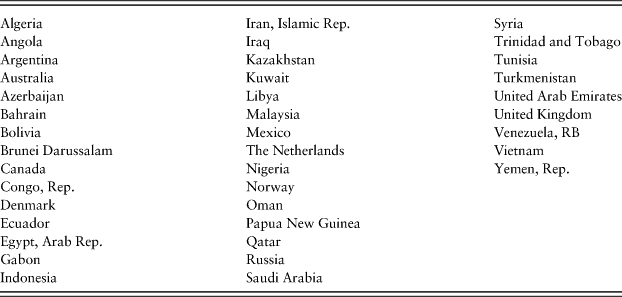
Our base sample consists of all countries that were net oil exporters for a period of at least 1 year between 1970 and 2008, the historical timeframe for which reliable data is available.Footnote 12 To exclude those like Singapore, for instance, who are solely traders of oil, we also excluded all those countries with no proven reserves of mineral fuels, as according to the PRIO petroleum dataset.Footnote 13 Following Ross (Reference Ross2006) and others, we further reduced our sample size, so as to only retain countries with non-trivial amounts of oil production and revenues.Footnote 14 This two-step sample-selection procedure has left us with 39 petroleum-producing countries (see Table 1).
Sample

Selection criteria: all countries between 1970–2008 with: (1) at least one single year of net exports of mineral fuels (SITC Rev1 3)15; (2) proven reserves of mineral fuels (crude oil and natural gas) according to PRIO Petrodata (V1.2.); and, (3) a mean value of at least USD 100 per capita rents from mineral fuels or at least 5% fuel exports as a share of GDP between 1970 and 2008, or between 1970 and the year before the onset of civil war.
Outcome: civil war onset
The outcome Footnote of our csQCA is the onset of civil war, which is operationalized through the use of UCDP/PRIO definitions and data (Gleditsch et al., Reference Gleditsch, Wallensteen and Eriksson2002).Footnote 16 According to UCDP/PRIO, an armed conflict is a ‘contested incompatibility that concerns government and/or territory where the use of armed force between two parties, of which at least one is the government of a state, results in at least 25 battle-related deaths’ per year. We define a civil war as any armed conflict that has caused at least 1000 battle-related deaths in a given year. We positively coded civilwaronset for a country when at least one such conflict began, or if an ongoing low-intensity conflict or a new episode of a conflict caused 1000 or more battle-related deaths over the course of 1 year. All other constellations, including those featuring armed conflicts with fewer than 1000 victims, were coded as not experiencing civil war onset. On this basis, there are 28 cases in our sample that have not experienced civil war onset and 11 cases in which at least one civil war broke out between 1970 and 2008.
Conditions
According to our theoretical expectations and corresponding to our four hypotheses, we limit ourselves to four explanatory conditions: (1) oil dependence, (2) the overlap of oil reserves and ethnic exclusion, (3) oil abundance, and (4) democracy. Reducing our approach to four conditions does not mean, however, that we have completely restricted our analysis only to them. In section 6 we will also discuss and report the findings from alternative model specifications, which include additional conditions.Footnote 17
Dependence
We measure dependence on oil by using the ratio of available fuel exports to GDP. To minimize endogeneity problems, we use the mean between 1970 and the year before the civil war onset.Footnote 18 If no civil war began, the mean for the whole period under investigation is calculated. Because csQCA requires binary-coded conditions, we had to select a cut-off point. As the setting of thresholds always runs the risk of being arbitrary, we were keen to make a thoroughly transparent and informed decision. Fixing thresholds by simply using medians or other arithmetic coefficients is not considered to be an appropriate practice when using QCA (Rihoux and De Meur, Reference Rihoux and De Meur2009). Thresholding should be done based on theoretical considerations, previous findings and/or significant empirical distributions in the sample. Collier and Hoeffler (Reference Collier and Hoeffler2004: 574) have identified the point of the highest conflict risk being at 0.33 dependence on oil. Looking at the actual distribution of dependence in our sample (see Appendix 2 in the supplementary materials), we find that there are a number of cases clustering around the Collier and Hoeffler peak – starting at a level of ~0.15 (indicating that 15% of the GDP consists of fuel exports). This empirical distribution reassures us that cases above 0.15 undergo a significantly higher risk of civil war onset. All values below our preferred threshold (0.15) have, therefore, been coded as 0, and all values equal to and above it as 1 (dependence). In order to test for the margins of this decision we engaged in robustness checks with alternative cut-off points (see for more details section 6).
Overlap
Our second condition captures whether oil reserves and production are located in areas where ethnic groups that are excluded from political decision making settle. To measure this overlap, we use PRIO data on the location of oil reserves and production (Lujala et al., Reference Lujala, Gleditsch and Gilmore2005) and match them to geo-referenced data from the Ethnic Power Relations Dataset (see Wucherpfennig et al., Reference Wucherpfennig, Weidmann, Cederman, Girardin, Duhart, Brown, Flora and Wimmer2010). We positively code for the overlap of ethnic exclusion and resource endowment (overlap), when overlap between the settlement of an excluded group and oil location could be identified within the period of investigation or, in the case of civil war onset, before the outbreak of civil war.Footnote 19 If the area in which the excluded group settles is dispersed throughout the entire territory of the state, we do not code this as an overlap. All other constellations are also rated 0.Footnote 20
Abundance
We measure abundance in oil and gas by the average of oil and gas rents per capita between 1970 and the onset of civil war (or, if no war occurs, until 2008). Data on estimated income from these rents comes from the World Bank data on adjusted net savings. For abundance, we also engage in proactive empirical pre-testing and calibration – identifying a pertinent threshold with regard to how abundance directly relates to the occurrence of civil war onset on a binominal basis. We found a cut-off point of approximate USD 500 per capita from rents, above which no civil war began (see Appendix 3). We believe that the identification of a threshold above which no civil war broke out is already an important finding in itself, because it means that we have identified a set of cases in which the value of abundance is a necessary condition for civil war onset, as well as a sufficient condition for peace. We expect this finding to be confirmed by our subsequent QCA analysis.Footnote 21 Similar to dependence, all values below the cut-off point have been coded as 0 and all values equal to and above as 1 (abundance).Footnote 22 In order to minimize possible distortions from a specific threshold of abundance we also employed alternative cut-off points in our robustness checks (see section 6).
Democracy
Employing the commonly used data source Polity IV (Marshall et al., Reference Marshall, Gurr and Jaggers2010), we fix the threshold between more or less democratic countries by calculating the mean of combined values between 1970 and 2008 – or between 1970 and the onset of civil war (if applicable).Footnote 23 Following the standard procedure as used by a large number of previous studies, all countries that score higher than 10 on a transformed and combined democracy/autocracy scale are considered to be relatively democratic and are thus coded as 1. All mean values below 10 are coded as 0, denoting non-democratic states.Footnote 24 As Polity has been criticized for being a biased measure toward political violence in the middle of its index (Vreeland, Reference Vreeland2008), we also reran our tests employing alternative measures on the divide between democracy and autocracy. There were no major changes to our results.Footnote 25
Empirical analysis
Model and truth table
We use the following csQCA model (1) to test for the necessary and sufficient conditions of civil war onset and peace:
 $$civilwaronset=f(dependence,{\rm }overlap,{\rm }abundance,{\rm }democracy)$$
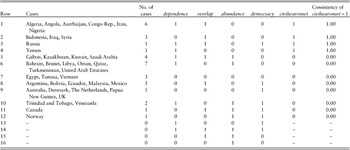
Table 2 shows the truth table based on Model (1) for our sample of 39 oil-exporting countries. There are 16 possible configurations combining four binominal conditions (24=16) of which only four (rows 13–16) are not covered by empirical cases (=logical remainders). Four of the 16 possible configurations – which together represent 11 cases – have led to civil war onset. Row 1 shows one configuration with six countries (Algeria, Angola, Azerbaijan, the Republic of Congo, Iran, and Nigeria). A second configuration represents civil war onsets in Indonesia, Iraq, and Syria. Russia (row 3) and Yemen (row 4) are each part of another, different configuration leading to civil war. Furthermore, there are eight different configurations – covering 28 cases in which no civil war broke out between 1970 and 2008.Footnote 26
Truth table: civilwaronset=f (dependence, overlap, abundance democracy)

Identifying the necessary conditions of civil war onset and peace
A condition is defined as necessary if it must be present for a certain outcome to occur.Footnote 27
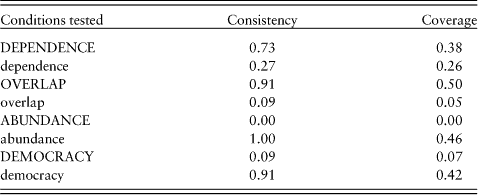
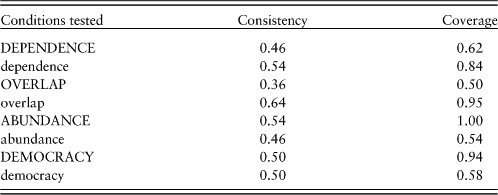
There is a single necessary condition for civil war onset, as shown by the consistency level of 1.00 in Table 3.Footnote 28 As expected, and in line with the finding of the bivariate pre-testing, all countries that have experienced a civil war onset feature rents per capita below USD 500 (abundance). There are in addition two other conditions, which only marginally fail the test of necessity: the spatial overlap between the settlement of politically excluded groups and oil reserves and non-democracies (democracy). If overlap for Yemen had been coded 1, the consistency levelFootnote 29 of OVERLAP would be 1.00 instead of 0.93, indicating a necessary condition. The same is true for democracy and Russia. If we were to code Russia as completely non-democratic, the absence of democracy (democracy) would be an additional necessary condition for civil war onset (consistency value of 1.00 instead of 0.91).
Results for the necessary conditions tests of CIVILWARONSET

The coverageFootnote 30 of low abundance as the only necessary condition of civil war onset lies at 0.46. This means that 46% of the cases that exhibit rents per capita below USD 500 (low abundance) have experienced civil war onset in the past.
Unlike in the necessity tests for civil war onset, there is no necessary condition for peace (the absence of civil war). None of the consistency values reach a value of 1.00 in Table 4 for the eight different values of the four binominal conditions that are tested.
Results for the necessary conditions tests of civilwaronset

Taken together – on a more technical level – the solution formula for necessary conditions of civil war onset (2) reads as follows:
 $${\rm abundance }\leftarrow{\rm CIVILWARONSET}$$
Identifying sufficient and INUS conditions of civil war onset and peace
Tests for sufficiency attempt to verify whether or not a single condition always leads to the same outcome. In addition, sufficiency tests in QCA ascertain whether or not there are jointly sufficient conditions. Each constitutive part of the phenomenon that might be jointly sufficient is called an INUS condition. These conditions are insufficient in themselves, but they are necessary parts of a condition that is itself unnecessary but sufficient for the outcome to occur (Ragin Reference Ragin2008: 154).
Boolean minimization is used to test for sufficient conditions in relation to a certain outcome and to seek the most parsimonious solution formula.Footnote 31 This Boolean operationalization, however, presupposes that each possible logical configuration is covered by at least one real-world case. Logical remainders, as logically possible configurations that are not represented through empirical cases in the dataset, hinder this quest for parsimony to the extent that they limit the reliability of the solution formula.Footnote 32 The parsimonious solution includes assumptions about logical remainders, while the complex solution does not include assumptions about logical remainders. Due to the lack of space here, we present only parsimonious solutions in the following two sections. Complex solutions are briefly discussed in the respective footnotes, but are more extensively reported upon in the Supplementary data appendices that form an adjunct to this paper.
Civil war onset (CIVILWARONSET)
A csQCA test for sufficiency using the outcome of civil war onset (CIVILWARONSET), including assumptions about logical remainders, yields the following parsimonious solutionFootnote 33 , Footnote 34 , Footnote 35 :
 $$\eqalignno{\hskip-6pc{\rm DEPENDENCE}{\times}{\rm abundance }{\plus} \cr \hskip-6pc{\rm OVERLAP}{\times}{\rm abundance}{\times}{\rm democracy }{\plus} \cr \hskip-6pc\to{\rm CIVILWARONSET}$$
solution coverage: 1.00
solution consistency: 1.00
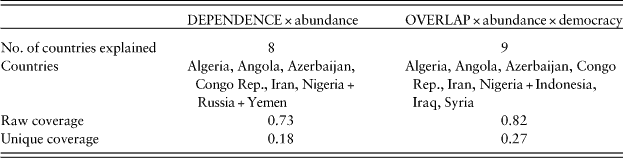
This parsimonious solutionFootnote 36 (3) points to two distinct – in the language of QCA, equifinal – pathways that have led to civil war among net oil-exporting countries.Footnote 37 Both pathways give substantial support to our hypothesis that specific conditions of oil create civil war risks, particularly when they are not offset by the presence of mitigating conditions. Table 5 provides an overview with regard to the country coverage of this solution.
Parsimonious solution for civil war onset (Alternative 1), including assumptions on logical remainders

Counterfactual assumptions with regard to logical remainders: DEPENDENCE×overlap×abundance×DEMOCRACY → CIVILWARONSET. This is Configuration 13 in Table 3 of the truth table.
In the first pathway, high dependence and low abundance are together a sufficient explanation of civil war onset among oil-exporting nations. Although we do not claim that all civil wars within oil exporters are directly over oil, we note that this pathway is compatible with country specific evidence. Mostly the impact of oil on conflict-proneness materializes indirectly. In countries such as Algeria and the Congo, dependence has produced varying problems that rulers were unable to buy off because they lacked abundant revenues from oil. In the Republic of Congo, a fierce internal struggle between the incumbent president and his predecessor was additionally fueled by rivaling external interests over control of the oil reserves and escalated into conflict in 1997 (Englebert and Ron, Reference Englebert and Ron2004). Algeria, at first glance not a showcase of oil-induced violence, may illustrate some of the more indirect negative effects of oil dependence. In the 1980s, falling oil prices led to shrinking oil revenues and undermined the regime’s ability to quell societal dissatisfaction by means of redistribution policies. This inability to buy peace did not directly cause the onset of civil war, however, it contributed to the outbreak of the bloody Algerian conflict – which was rather triggered by the government’s decision to disclaim the results of the elections, which were won by the Islamist opposition (Lowi, Reference Lowi2009; Shabafrouz, Reference Shabafrouz2010).
The second pathway leading to civil war features countries in which the settlements of politically excluded identity groups geographically overlap with oil reserves – but in which neither abundance nor democracy mitigate this major civil war risk. Pertinent examples for this combination are countries with a secessionist conflict – such as Indonesia, a country with territorial conflicts in Aceh and Papua. Iraq’s problems with Kurds and Sunnis, all of which take place in resource-rich regions, or Nigeria’s conflicts in the oil-rich Niger delta are additional cases that fit under this categorization (cf. Le Billon, Reference Le Billon2012; Ross, Reference Ross2012).Footnote 38
Taken separately, all four conditions in the model are relevant in explaining the onset of civil war. They form INUS conditions as part of these two sufficient explanations. The combination of high dependence and low abundance is relevant in eight out of ten of the civil war cases (73%) and the combination of overlap, low abundance and no democratic institutions is a possible explanation in nine out of 10 onsets (82%). Six out of the 11 cases conform to both pathways. We also provide a more qualitative and detailed description of the link between oil and civil war onset within each country in Appendix 17 of the supplementary materials.
Peace/no onset of civil war (CIVILWARONSET)
After having tested for the sufficient conditions for civil war onset, formula (4) summarizes the results of the csQCA test for sufficiency using no civil war onset (peace) as an outcome:
 $$\eqalignno{\hskip-6pc{\rm ABUNDANCE }{\plus} \cr \hskip-6pc{\rm dependence}{\times}{\rm overlap }{\plus} \cr \hskip-6pc{\rm dependence}{\times}{\rm DEMOCRACY} \cr \hskip-6pc\to{\rm civilwaronset}$$
solution coverage: 1.00
solution consistency: 1.00
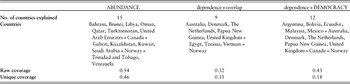
As indicated by this solution formula, there are three different pathways to peace in net oil-exporting countries. Table 6 below shows the countries that are covered by each of the pathways.Footnote 39 One pathway to peace is displayed by a single sufficient condition, which mirrors the necessary condition for civil war identified above: high abundance from oil rents per capita (ABUNDANCE). This finding suggests that once a country has sufficient revenues to buy peace it will be spared from civil war, regardless of what potential problems related to the production of oil are present. Unsurprisingly, countries with very high per capita income from oil – such as countries in the Persian Gulf (Bahrain, Kuwait, Oman, Qatar, Saudi Arabia, United Arab Emirates) or elsewhere (Gabon, Brunei) – represent this explanation, although they also show one or both of the oil-related risk conditions.Footnote 40
Coverage of the parsimonious solution formula for the absence of peace (civilwaronset), including assumptions about logical remainders

Counterfactual assumptions with regard to logical remainders: DEPENDENCE×OVERLAP×ABUNDANCE×DEMOCRACY+dependence×OVERLAP×ABUNDANCE×democracy+dependence×overlap×ABUNDANCE×democracy → CIVILWARONSET. These are Configurations numbers 14, 15, and 16 in Table 2 (truth table).
The second pathway to peace consists of a combination of low dependence with no overlap between politically marginalized groups and oil location. In other words, in these countries no oil-related conflict risks exist at all. It hence seems irrelevant for the non-occurrence of civil war whether the conflict-mitigating conditions of high abundance and democracy are: completely absent (Egypt, Tunisia, Vietnam), partly absent (e.g. Papua New Guinea and many Western countries) or fully present (Norway).
The third pathway highlights the importance of democratic institutions. Democracy is apparently capable of maintaining peace when dependence is low no matter whether there is an overlap between ethnic exclusion and oil. Specifically, many of the Latin American oil producers illustrate the validity of this finding. For instance, in Bolivia protests in relation to the distribution of hydrocarbons (often located in indigenous territory) have been possible without the necessity of resorting to major violence. In 2005, President Carlos Mesa resigned in the face of massive protests and subsequently Evo Morales was elected as the first indigenous president (Perreault, Reference Perreault2008).
All in all, a comparison of 39 oil producers using QCA has largely supported our four hypotheses. The results presented above, however, allow for more finely grained conditional specifications. First, countries highly dependent on oil but with low oil abundance per capita will experience civil war. Second, an overlap of ethnic exclusion with oil reserves leads to intense conflict within non-democratic states, which are unable to buy peace through the redistribution of abundant oil revenues. Among the conflict-mitigating conditions, high oil abundance eradicates conflict risks, regardless of their number and presence. Democracy plays a somewhat less prominent role, but mitigates civil war risks particularly when ethnicity and oil overlap and when oil dependence is rather low.
Discussion of model specifications
How trustworthy are our results? Discussions of tests for robustness of QCA results are rare. Only Skaaning (Reference Skaaning2011) has provided some ideas about how to test the validity of findings, using Boolean algebra. We thus follow his advice, and have used two strategies to strengthen confidence in our results. We first modify our QCA model by incorporating additional conditions and/or replacing existing ones with others. Second, we replicate our QCA analysis and concentrate on our preferred model, by changing thresholds of dependence, abundance, and democracy – three of the dichotomous conditions we have used.
We also perform a large number of alternative QCA tests, including at least five additional theoretically relevant conditions: lootability of oil,Footnote 41 anocracy,Footnote 42 population size,Footnote 43 outside protection,Footnote 44 and GDP per capita.Footnote 45 We run csQCA tests for all possible combinations of altogether nine different dichotomous conditions, looking at two aspects that indicate a csQCA model is appropriate: first, the elimination of contradictions and, second, the number of logical remainders. Based on the analytical logic of QCA, there is a certain trade-off between the number of conditions included in the model and the number of potential logical remainders, given the constant number of historical cases. The more binary-coded conditions, the exponentially higher the number of theoretically possible configurations. Given the usually static number of historical cases, it is imperative then that the number of logical remainders – configurations not represented by empirical cases – increases as well. This complicates the interpretation of results, and increases the need to use more simplifying assumptions (counterfactuals) in order to be able to identify the most parsimonious solutions. Therefore, it is usually suggested to calibrate QCA models so as to have a lesser number of contradictory cases on the one hand combined with less logical remainders on the other, given a constant number of empirical cases.
When including all five additional conditions mentioned above, it turned out that there is no other combination of four or less conditions that is in line with the outcome without producing zero contradictory cases, even though there are combinations of conditions that produce parsimonious solutions with a lower number of assumptions about logical remainders.Footnote 46 Therefore, we believe that solutions as presented in this paper provide the most parsimonious solution, given a number of important alternative conditions.Footnote 47
As a second strategy, we extensively test the effects of changing thresholds for three of our four dichotomous conditions.Footnote 48 We independently change thresholds for dependence, abundance, and democracy. Overall, our reported results are extremely stable. We report these tests in Appendices 8–13 of the Supplementary data. If one changes the threshold for dependence to between 10% and 30% of rent revenues, solutions for the onset of civil war do not change – even though Egypt, Tunisia, Vietnam, and Yemen move into the same configuration, producing contradictory cases if one sets the degree of dependence above the value of Yemen (0.2988). However, this has some additional consequences for the solution on the outcome peace. If the degree of dependence is above the mean level for Yemen, the solution path that combines low dependence and no overlap in formula (4) is omitted – due to the emerging configuration with contradictory cases mentioned above.
Moving the threshold of abundance between the values for Algeria (395.95) and Canada (652.49) does not significantly challenge our findings. However, it leads to the fall of a number of different cases into contradictory configurations, but neither of the two pathways for civil war onset nor our three explanations for peace disappeared. Russia is the only case that is sensitive to changes in the threshold of abundance to the levels that we have tested. Moving the threshold of abundance up and down, Russia appears as a single case in an additional third pathway corresponding to the onset of civil war.Footnote 49 This pathway includes high dependence, overlap and democracy (for more details, see Appendix 10). However, all of the other explanatory pathways remain stable and valid.
While using the alternative specification of Polity not contaminated by political violence as suggested by Vreeland (Reference Vreeland2008) does not substantially alter our results, changes in the threshold for democracy have perhaps the most wide-ranging effect. Solutions for the onset of civil war remain stable when moving the threshold of the policy index further down, but the second part of the parsimonious solution formula (3), as presented above, becomes omitted if one sets the cut-off point for democracy above the value of Mexico, which is at 10.7. The first pathway, signaling that high dependence and low abundance are jointly sufficient conditions for civil war, remains uncontested. It is interesting to note that a changing threshold for democracy has no effect on the solution formula for peace, while it simply leads to the fall of some cases into a contradictory configuration. We interpret this sensitivity as a further indication that – especially within non-democracies with extremely low levels of political pluralism – the geographical overlap of oil with politically excluded identity groups leads to civil war, while there is little doubt that a high quality of democracy helps to mitigate the risk of civil conflict.
Conclusion
We have argued that civil war risks in oil-exporting countries are contingent on specific conditions of oil production and how they structure state–society relations. Specifically, we have hypothesized that states either highly dependent on oil or with problematic relations to oil regions are prone to civil war. However, these risks will be mitigated when state institutions are democratic and can manage conflicts peacefully, or when governments use abundant oil revenues to buy peace. Methodologically, we have used QCA as a comparative technique, one that is particularly devised to test for complex conditional relationships in medium-N samples. Results largely confirm our hypotheses, and remain stable in a number of model specifications that include alternative conditions and different thresholds. We believe, therefore, that our findings advance the debate about the link between natural resources and civil war in a number of different ways:
First, we have strong empirical indications of a conditional explanation of the oil–conflict link. Our results reveal that there is no one single mechanism that links oil to civil war. It is not oil as such – or a single operationalization – that creates this relationship, but rather certain combinations of oil-related (and other) conditions in a country.
Second, with this conditional explanation in mind, we underscore the ambiguous nature of oil production, depending on the mix of conflict risks and mitigating aspects. Questioning the popular notion that ‘oil abundance’ is a major determinant of civil war onset, we found – already at the stage of pre-testing – that low abundance is a necessary condition for civil war onset (see also Smith, Reference Smith2004). This finding provides evidence for the relevance of peace-buying mechanisms, which require a certain amount of income from oil – as suggested by the rentier state approach. When available at and above a certain level, abundance substantially reduces – if not eradicates completely – oil-related civil war risks.
Third, our results reveal that there are several simultaneous pathways that lead to civil war and peace, which strongly points to the equifinal nature of the underlying problem. High dependence and low abundance are each an INUS condition, which jointly are able to explain the onset of civil war for over 70% of the relevant cases – indicating that they are a particularly risky combination.Footnote 50 This pathway shows that oil is frequently a more indirect cause of violent conflict: dependence on oil makes countries vulnerable to the ills of the ‘resource curse’, such as adverse effects on institutional quality and the economy when windfalls from oil fail to materialize. The second pathway leading to civil war within oil-exporting countries connects the properties of oil to the political regime and inter-ethnic relations: non-democratic oil regimes suffer from civil war if politically excluded groups settle in oil territories and there are no abundant oil revenues at the government’s disposal. Unsurprisingly, many of the countries showing this configuration (such as Indonesia, Iran, and Nigeria) have experienced secessionist conflicts. Theoretically, this finding supports our expectation that, contingent on the oil money (un)availability, non-democratic regimes are able to deal less successfully with conflict risks that emerge from identity- and resource-based problems.
Unlike most of the quantitative literature on civil war, we were also able to specify the explanations for peace, defined here as the non-occurrence of civil war. Interestingly, we have found no necessary conditions for peace, and the sufficient conditions for peace do not simply take the opposite values of our explanations for civil war. Altogether, we have identified three pathways that may sufficiently explain the non-occurrence of civil war: (1) high abundance of oil – underscoring the peace-buying mechanisms within countries with oil-related risks; (2) low dependence and overlap not being present – indicating that the absence of both risk conditions will lead to the avoidance of civil war; and, (3) low dependence and democracy – pointing to the mitigating function performed by democratic institutions if ethnic exclusion overlaps with oil reserves at the local level.
Taken together, our explanations constitute a key contribution to the literature on civil war onset: wars in oil producing countries are evidently not determined by a single condition and thus there are different conditional pathways that lead to them. The same is also true for sustaining peace, where our results highlight the important role that peace-buying mechanisms play. Our findings also leave much room for additional work. Further research will need, for instance, to focus particularly on the question of whether or not there are also equifinal pathways that lead to either civil war or peace among the net exporters of other natural resources. It also seems pertinent and equally important for future scholarship to trace – on the basis of in-depth comparative case studies – a more detailed understanding of the functioning of the mechanisms that lie behind the different pathways that we have identified. This will possibly also include additional contextual conditions not directly relating to oil. Although our hypotheses, the testing of up to nine different conditions and the robustness checks consider many non-oil specific aspects such as ethnicity, income level, or population size, we cannot completely preclude that other conditions will contribute to the explanation of single cases. In combination with the findings presented here, such literature would undoubtedly help to further the overarching scholarly ambition of better comprehending – and hence eventually minimizing, if not eradicating – natural resource-related violence.
Acknowledgments
The authors would like to thank André Bank, Tobias Böhmelt, Jörg Friedrichs, Bert Hoffmann, Michael Ross, Philippe Schmitter, and Claudius Wagemann as well as the anonymous reviewers of the journal for their insightful comments and productive criticism. They are also very grateful to Georg Strüver and Hannes Bahrenburg for their excellent research assistance. Research for this article was generously funded by the German Research Foundation as part of the projects ‘A Dangerous Liaison? Ethnicity, Natural Resources and Civil Conflict Onset’, ‘Is Resource Wealth A Risk Factor?’ (both directed by Matthias Basedau) and ‘Stability and Change of Authoritarian Regimes’ (directed by Thomas Richter).
Supplementary material
To view supplementary materials for this article, please visit http://dx.doi.org/10.1017/S1755773913000234.