In 2017, government, unions, and business associations completed 13 years of centralized, state-oriented nation- and sectorwide wage negotiations in Uruguay. This recentralization of collective bargaining included 6 rounds of discussions in 21 sectors, plus new national wage councils for state, rural, and domestic workers, covering virtually all registered employees in the economy. That same year, inflation reached the lowest level since 2009 (6.5 percent), and for the first time in 8 years, it fell within the Central Bank target range. After the slowdown of 2015 (0.3 percent) and 2016 (1.6 percent), GDP growth resumed to reach 2.6 percent, and labor conflict plunged to its lowest levels since the left-wing Frente Amplio (FA, Broad Front) took power in 2005. In 2019, by the end of the seventh general wage bargaining round, a united, labor-backed left emerged once again as a competitive contender in the presidential election. Though it was unable to get a fourth mandate, in March 2020 the FA completed 15 years of unprecedented progressive governments in Uruguay.
The rise and stabilization of neocorporatism under the FA in Uruguay—that is, peak-level, centralized wage bargaining oriented by a democratic state—is remarkable for various reasons, both regional and world scale. The FA’s successful construction of a stable, state-coordinated wage bargaining model was unique in the Latin American “left turn” of the 2000s. In global terms, the expansion of neocorporatism in this small and peripheral country of South America is also noteworthy. Democratic corporatism had its heyday in the 1970s and early 1980s, when unions, business, and government converged in centralized wage negotiations, which produced better macroeconomic results than more decentralized models had (Cameron Reference Cameron and John1984). Thereafter, intertwined structural, political, and international trends undermined the foundations of peak-level wage bargaining (Scharpf Reference Scharpf1991). Centralized income policies gave way to a variety of multisector wage coordination models in the traditional bastions of Continental and Nordic Europe.
This study seeks to account for this Uruguayan exceptionalism in light of the two main contemporary debates in the theory of wage coordination. The first discussion focuses on the origins of coordinated income policies. An “employer-centered” approach developed since the 1990s—formalized most fully in the Varieties of Capitalism (VoC) school—holds that coordination was, in its origins, decisively pushed by cross-class coalitions of export-oriented employers seeking wage moderation and the construction of a welfare state that could insure their workers with specific skills (Swenson Reference Swenson1991; Estévez-Abe et al. Reference Estévez-Abe, Iversen, Soskice and Hall2001; Mares Reference Mares2003). For scholars close to the Power Resources theory, by contrast, labor empowerment and left state activism shapes, in the first place, the cooperative behavior of business in the context of broader welfare policies (Korpi Reference Korpi2006; Martin and Thelen Reference Martin and Kathleen2007; Hacker and Pierson 2002).
The second, more recent, debate hinges on the possibilities to stabilize egalitarian forms of corporatism in a post-Keynesian, globalized world. Again, the VoC approach stresses fiscal (i.e., real) devaluation, nonaccommodating monetary policies, and independent central banks that could tame union-induced wage inflation as crucial prerequisites for successful coordinated bargaining (Iversen Reference Iversen1999; Franzese and Hall Reference Franzese, Hall, Iversen, Pontusson and Soskice2000). This general perspective has recently come under attack by Thelen (Reference Thelen2014) and the “models of growth” scholars (Baccaro and Pontusson Reference Baccaro and Jonas2016, Reference Baccaro and Jonas2019). These authors emphasize the inegalitarian aspects of export-oriented, “deflationary” corporatism (epitomized by Germany). They underscore its more recent tendency to segment the labor market between insiders in the manufacturing export sector and low-skilled workers or “outsiders” in the less exposed sectors. These scholars envision, however, more complex coalitions (encompassing both nontradable and service sectors and unskilled or precarious workers, and a more preeminent state role) that could yield more egalitarian models of coordinated wage bargaining. These social alliances are presumably taking place in Sweden’s and Denmark’s contemporary coordinated models.
Following Etchemendy and Collier (Reference Etchemendy and Collier2007), I define as segmented neocorporatism a mode of centralized, tripartite income policy formulation that applies to a substantial majority of, though not all, salaried workers; that is, in the case of Uruguay, one that excludes the quarter of wage earners who are not registered with social security. Framed by the theoretical counterpoints just outlined, the empirical sections of this study have two main goals. The first is to explain the origins of centralized wage bargaining in Uruguay during the first FA government, circa 2005–10. This study argues that a labor law framework for centralized negotiations crafted in the early 1940s, which was frozen but not repealed either under the dictatorship or in the neoliberal 1990s, and the consolidation of a unified labor movement are key to understanding the rapid launching of peak-level wage negotiations in 2005. However, these institutional legacies were decisively complemented when the left party FA empowered labor from above through a series of reforms and measures in the domains of industrial relations, union organization, and collective action.
The second empirical goal is to provide a causal account of the stabilization of coordinated bargaining in times of economic distress, inflationary pressures, and labor tensions after 2012. The initial launching of centralized income policies may rapidly unravel, especially in times of economic downturns and international financial volatility (see Crouch Reference Crouch1977). By stabilization, I mean that the government managed to keep wage growth within its parameters, and the CPI converged around the Central Bank target range. Plus, labor conflict was contained and politically administered.
Two variables essentially explain the stabilization of the coordinated model after 2012: state wage policy and monetary deterrence. First, the government redoubled its activism in salary councils. It presented new state guidelines aimed to prevent wage indexation and defended its parameters in council negotiations more firmly. Second, monetary policy tightening served to anchor wage negotiations, particularly in the 2015–16 wage round. A relatively credible and strict commitment to inflation targeting was vital to induce labor to limit wage indexation. In 2015– 16 the government persuaded unions to negotiate future nominal wage increases in contracts—instead of real wage gains; that is, “adjusted inflation plus something,” which had been the norm in the previous bargaining rounds. This pattern of nominal wage targets was successfully replicated again in the seventh round of collective negotiations in 2018–19. Therefore, labor was more easily brought into an informal “inflation control” coalition, as the possibility of real wage gains depended on the achievement of lower inflation.
Thus, the Uruguayan example, as a unique case of Latin American stable neocorporatism, can bring important insights to the main contemporary debates on wage coordination. As this study will elaborate, the Uruguayan case clearly supports the Power Resources approach: the left party–labor alliance, rather than any business-led, cross-class coalition, was the central force behind the initial construction of a coordinated model. However, in terms of the viability of corporatism in a liberalized, post-Keynesian world, Central Bank independence and monetary deterrence did play a key role in the stabilization of Uruguayan coordinated bargaining after 2012, as the VoC approach predicts.
Nevertheless, this study will show that the Uruguayan model hardly fits the “supply-side” corporatist model based on net export growth, strong wage moderation, deflation, and depressed household consumption that this literature expounds. On the contrary, active fiscal policy and domestic market consumption, in the context of more or less formal alliances with precarious or unskilled workers, places the Uruguayan case closer to the more inclusive forms of coordinated models theorized by Thelen and the “models of growth” scholars. Indeed, the Uruguayan case shows that (formal) Central Bank independence and nonaccommodating (occasionally contractive) monetary policies are compatible with egalitarian neocorporatist models, provided that there is an active fiscal policy and precarious workers are politically included. The question is whether Uruguay can finally build the “social bloc” (Baccaro and Pontusson Reference Baccaro and Jonas2019) that would make egalitarian corporatism politically and economically viable in the long run.
The first section of the article discusses contemporary wage coordination theories. Subsequently, the article presents the case study method and conceptualizes Uruguay as a neocorporatist model of wage coordination. The second part explores the origins and historical antecedents of this novel pattern of interest representation in Uruguay. Next it explains the largely successful stabilization of centralized wage coordination in the post-2012 environment of erratic growth and labor tensions. In conclusion, the article reassesses the Uruguayan case in light of recent political economy debates about the origins and endurance of coordinated capitalism.
THE CONTEMPORARY DEBATES
The political economy literature widely refers to “neo,” or “societal,” or “democratic” corporatism as the centralized, state-sponsored wage pacts between business and labor that started in the World War II aftermath and produced better trade-offs between inflation and unemployment after the 1973 Oil Crisis (Cameron Reference Cameron and John1984; Calmfors and Driffll Reference Lars and Driffll1988). Since the early 1990s, however, enhanced capital mobility and exchange rate (and later monetary) unification limited government’s inflation management and its capacity to compensate labor with social policy—key parameters of the neocorporatist pact (Scharpf Reference Scharpf1991). In Latin America, neocorporatism—that is, genuine national wage bargaining between a democratic government, unions, and employers—seldom existed in contexts of authoritarianism, low autonomy of social actors, or class polarization.
In sum, after the golden age of the 1970s and 1980s, centralized, peak-level wage pacts had lost effectiveness. However, mainstream comparative political economy scholars hastened to note that multisector “wage coordination,” with varying degrees of centralization and involvement of peak-level union confederations, business chambers, and the state, continued to be a central feature of many European Continental and Nordic political economies. Cost-effective competition in a post-Keynesian, globalized world still required forms of concerted wage moderation and cooperative class relations. The concept of “corporatist countries” became, in practice, extended to different ways of multisector “wage coordination” (Wallerstein and Golden Reference Wallerstein, Miriam, Iversen, Pontusson and Soskice2000, 110).
Thus, the study of wage bargaining since the 1990s in traditionally corporatist countries followed two paths. The first discussion centered on the historical prerequisites for the launching of coordinated wage models in the context of broader welfare states. A novel “employer-centered” approach was pioneered by the work of Swenson (Reference Swenson1991), who claimed that cross-class coalitions in the export manufacturing sector enabled corporatist wage agreements in the cradle of corporatism in Denmark and Sweden. It was later most fully systematized by the Varieties of Capitalism (VoC) school (Hall and Soskice Reference Hall and David2001; see also Mares Reference Mares2003) and its larger typology of Liberal (LMEs) vs. Coordinated Market Economies (CMEs). VoC’s basic distinction in the labor market is between average workers in LMEs, who embody general, transferable skills across sectors, and those in CMEs, who carry firm or industry-specific skills.
Crucially, in the microfoundations of social policy laid out by VoC scholarship, the rational worker will invest in specific skills only if he or she has life risks covered. Therefore, both employers and unions in CMEs will favor policies that protect skilled workers from the vagaries of the market. Among them, coordinated bargaining figures prominently, as it insures the real wage of employees that invest heavily in training schemes. In short, nonmarket wage arrangements in this perspective are a public good provided by cross-class coalitions of employers and workers, rather than the outcome of distributive struggles. As Estévez-Abe et al. (Reference Estévez-Abe, Iversen, Soskice and Hall2001, 181) contend, coordinated capitalism “often stems more from the strength rather than the weakness of employers.”
This thesis was more recently disputed by authors who point out the decisive role played by left power and state activism in the origins of coordinated capitalism and in the prevention of unilateral, labor cost–savings paths for business thereafter (Korpi Reference Korpi2006; Martin and Thelen Reference Martin and Kathleen2007). Korpi’s Reference Korpi2006 reformulation of the Power Resources Theory posits that employers in advanced European economies were not the main “protagonists” in the crafting of welfare policies and centralized wage models but mostly “consenters” to institutional arrangements largely imposed by left parties and allied unions. Both Korpi and Hacker and Pierson (Reference Hacker and Paul2002, 285–86) warned that apparent ex-post consensus between employers and unions on established welfare mechanisms (among them coordinated bargaining) did not imply a joint previous effort to introduce them in historical perspective.
The second major discussion relates to the feasibility of corporatist arrangements in a post-Keynesian, globalized world. Contrary to neoclassical economists, VoC scholars argue that even in a world of capital mobility, labor market organization could have real policy consequences in the long run. They point out that “signaling games” between independent central banks implementing nonaccommodating monetary policies, and concentrated labor movements, still produce better inflation outcomes with low unemployment. A centralized and encompassing labor movement has incentives to moderate individual unions in the face of central bank independence and a credible threat of a nonaccommodating (i.e., potentially contractive) monetary policy that could produce unemployment. Conversely, an independent central bank will be more inclined to monetary deterrence when challenged by uncoordinated, militant unions than when confronting a labor movement that can credibly commit to moderating its wage pattern (Hall Reference Hall1994; Iversen Reference Iversen1999; Franzese and Hall Reference Franzese, Hall, Iversen, Pontusson and Soskice2000).
This type of wage coordination is one of the key “institutional complementarities” that drives CMEs’ success in international markets. Of course, monetary unification limited this signaling game in the Eurozone. Nevertheless, the corporatist management that survives globalization in the VoC perspective is one heavily biased toward “supply-side policies”; that is, wage moderation and downward labor costs, central bank–induced deflationary policies, and export competitiveness.
For Thelen (Reference Thelen2014) and the Models of Growth approach (Baccaro and Pontusson Reference Baccaro and Jonas2016, Reference Baccaro and Jonas2019), however, this “supply-side” corporatism masks important distributive differences within CMEs. Thelen (Reference Thelen2014, 30) underscores that in the context of enhanced economic internationalization and deindustrialization, the resilience of coordinated wage models that VoC scholars laud is often accompanied by the growth of a deregulated periphery of low-skilled workers and subcontracting companies. Crucially, this labor market dualization in CMEs, such as in Germany or Japan, serves the interests of (and is often promoted by) both employers and unions in competitive export manufacturing, as it lowers the cost of labor and business services.
From a different but converging angle, Baccaro and Pontusson (2016, 176,186) question how the entire VoC framework downplays demand-side macroeconomics. They argue that coordinated models in a globalized world still have essentially two main “drivers of growth,” exports and domestic market consumption, the latter of which can be bolstered by wages or private debt. In some cases, such as Germany, coordinated models since the 1990s have indeed been based on real devaluation attained through wage and fiscal restraint, strong central bank independence, and continuous export growth. In other cases, such as Sweden, however, the growth of exports and wage-driven, domestic market consumption to boost aggregate demand has been more balanced, and active fiscal policies have been more prominent (Baccaro and Pontusson Reference Baccaro and Jonas2019, 28).
In sum, either from a labor-institutional (Thelen) or a macroeconomic (Baccaro and Pontusson) perspective, these visions illuminate the increasingly inegalitarian form of corporatism implicit in the VoC framework. They oppose an alternative model in which inclusionary labor market reforms (such as sustained, state-backed labor compensation and training) and more active demand management are underpinned by more encompassing coalitions not anchored in core export manufacturing interests. This progressive “social bloc” (Baccaro and Pontusson Reference Baccaro and Jonas2019, 28) may include employers in the construction and service sectors and unskilled workers. The empirics of neocorporatist management in Uruguay tell much about the origins of coordinated wage models and the possibilities to consolidate inclusionary forms of corporatism.
A CASE STUDY OF NEOCORPORATISM
Gerring (Reference Gerring2001, 215) posits four types of case study method: extreme case, typical case, crucial case, and counterfactual. Uruguay between 2005 and 2019 clearly falls into the extreme case category: it is simply the only instance of stable democratic neocorporatism in any historical pattern of interest representation in Latin America. Indeed, with the exception of Argentina under the Kirchners, traditional unions were not main protagonists even in the recent new left projects of the 2000s (Levitsky and Roberts Reference Levitsky and Kenneth2011). Only the Uruguayan model was able to combine centralized, state-oriented wage negotiations with stable macroeconomics and the support of a unified labor movement in both good and bad times.
As Gerring argues, extreme cases are useful when a phenomenon is diffcult to operationalize (2001, 217). Many Latin American countries have experienced some instance of policy concertation, or (as in Mexico, 1987–88) wage pacts. However, Uruguay presents, without question, most features associated with a neocorporatist outcome: a routine of peak-level negotiated wage rounds, an important degree of intersectoral coordination, and a heavily concentrated labor movement.
Moreover, this study intends to exploit the advantages of the case study method in two ways. The first is to tackle the complexity of causal assessment. Watching a single unit over time enables the analysis to present two outcomes relevant to the general phenomenon of neocorporatism (origins and stabilization or performance), with their corresponding sequential explanations. Furthermore, though case studies are obviously less well endowed to study causal effects across a general population, scholars agree that they are especially useful to examine causal mechanisms; that is, the sequence or pathway that connects x with y in a plausible fashion (Gerring Reference Gerring2007, 44; George and Bennett Reference George and Bennett2005, 12). For example, labor empowerment “from above” after 2005 in the dimensions of industrial relations, union organization, and collective action was key to linking the prior general variable “power resources” of the left with the outcome of effective neocorporatist wage negotiations.
The victory of the FA—a party including socialists, communists, former Tupamaros, and even splits from traditional parties—in October 2004 culminated decades of patient construction by the left (Chasquetti and Buquet Reference Chasquetti and Daniel2005). Soon after taking office, the new president, Tabaré Vázquez, issued decree 105/05, which convened the tripartite, industrywide Salary Councils. The government also assembled, by decree, the Superior Tripartite Council (CST), formed by representatives of the Ministry of Labor, national leaders of employer organizations, and the single union confederation PIT-CNT. This radical U-turn in income policy was soon completed with the creation of new National Wage Councils for public, rural, and domestic workers.
Thus, since mid-2005, wages in Uruguay have been formally shaped by politics as much as by market forces. Systematic data on wages by sector and economic activity are very diffcult to find (or nonexistent) in Latin America in general, and in Uruguay in particular. Therefore, a Labor Contracts Database was manually constructed, collecting the wage levels of the 21 private Salary Councils plus the national state administration. As wage councils are frequently divided into negotiation units, I chose the two largest subgroups in each sector. Overall, the contracts analyzed in all sectors represent about 80 percent of salaried workers in Uruguay (see the appendix for more details on the database).
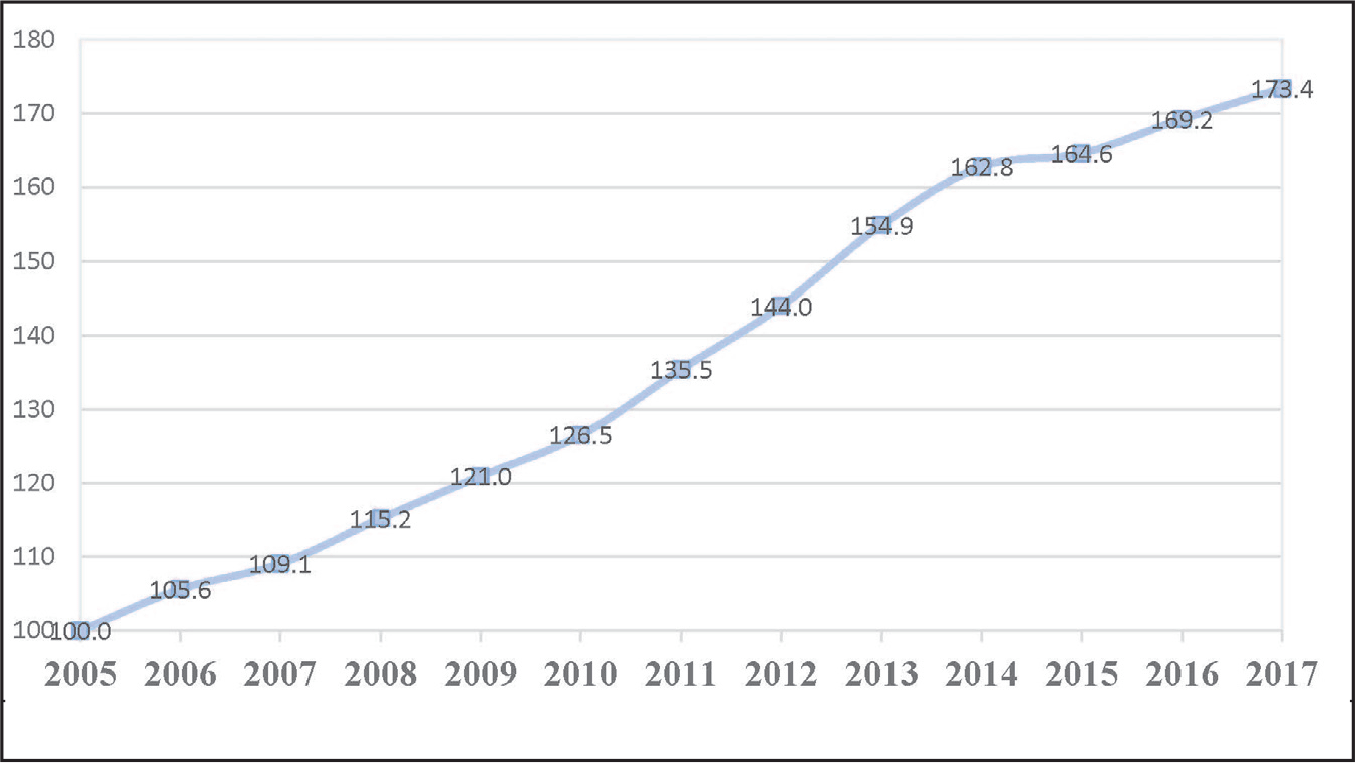
Figure 1 shows real wage growth in Uruguay from 2005 to 2017. I do not argue that neocorporatism is the single reason behind this phenomenal growth in contract real wages, about 70 percent on sectoral average—especially in times of economic boom until 2012 and after a large currency devaluation in 2002. However, it is evident that for the FA government and its union base, neocorporatism paid off. Real wages grew steadily from 2005 on, though clearly at a slower pace after 2013.
Uruguay: Real Wage Increase Under Centralized Wage Bargaining
Note: Average top 22 union contracts (2005 = 100)
Source: Labor Contracts Database; see appendix. This is the source for all wage data in all the following figures.

Uruguay’s mode of wage coordination can be aptly labeled as neocorporatist: a democratic state plays a key role, and it is quite centralized in international comparative terms. It would rank only one step below full centralization (e.g., Sweden until the early 1980s) as “nonbinding” central negotiations, in Visser’s Reference Visser2019 index, the most widely used measure in the neocorporatist literature. Wage negotiations are framed by a formal national income policy. Under the FA government, “guidelines” for each wage round are presented to national business and labor organizations at the peak-level CST and thereafter delegated to the tripartite sectoral councils. Guidelines for each round are constructed by the Ministry of Economics and Finance (MEF), in consultation with the Ministry of Labor (MTSS), taking into consideration macroeconomic variables, in particular the inflation target set by the Central Bank.
Though they are discussed but not formally voted on at the CST, governmentcrafted guidelines serve as an important parameter in negotiations in the sectoral Salary Councils. The government implicitly signals that in case of a strong disagreement, it will vote its parameter. Typically, guidelines recommend alternative formulas for wage adjustments and contract length. Significantly, almost every government guideline in this period also deliberately attempted to improve incomes in low-wage sectors.
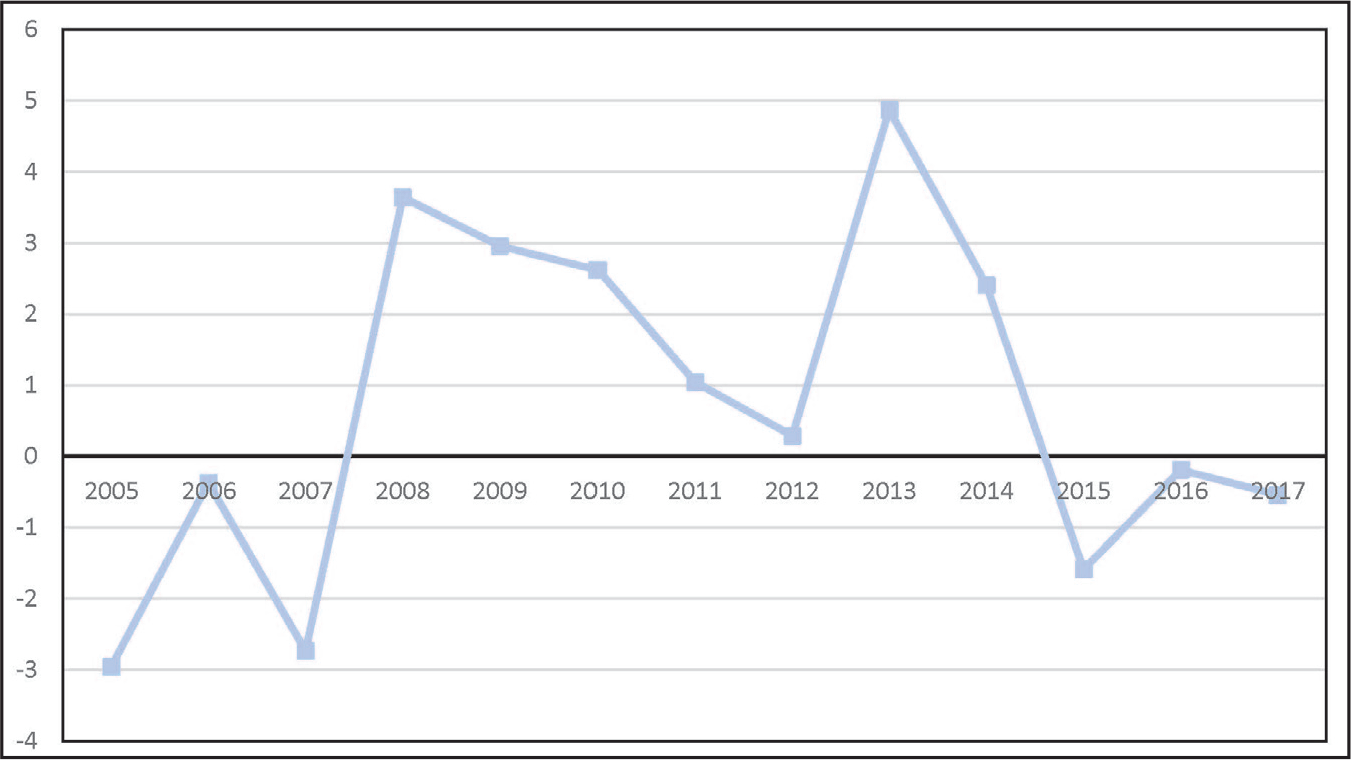
Thus, good measures of state-oriented coordination in the Uruguayan neocorporatist model are the degree to which wages followed average government guidelines and the degree to which low-wage sectors grew in relation to high-wage sectors. Figure 2 depicts the gap (in absolute percentage points) between the average-year wage increase of the 21 private sector salary councils plus the central state administration, and the maximum wage hike recommended by the government. It shows that in the first three years, the government successfully coordinated wage setting within its targets.Footnote 1 In the rounds negotiated in 2008 (third since 2005) and especially 2012–13 under President José Mujica (fifth), more expansive pressures from unions arose. However, in the period 2015–17 (sixth round, under President Tabaré Vázquez, beginning his second term), the FA government increased coordination levels and managed to control wage growth under its parameter again, as in the 2005–7 period.
Gap Between Government Parameter/Guidelines and Actual Annual Wage Increase
Note: Average 22 Top Union Contracts, Absolute Percentage Points (y axis)

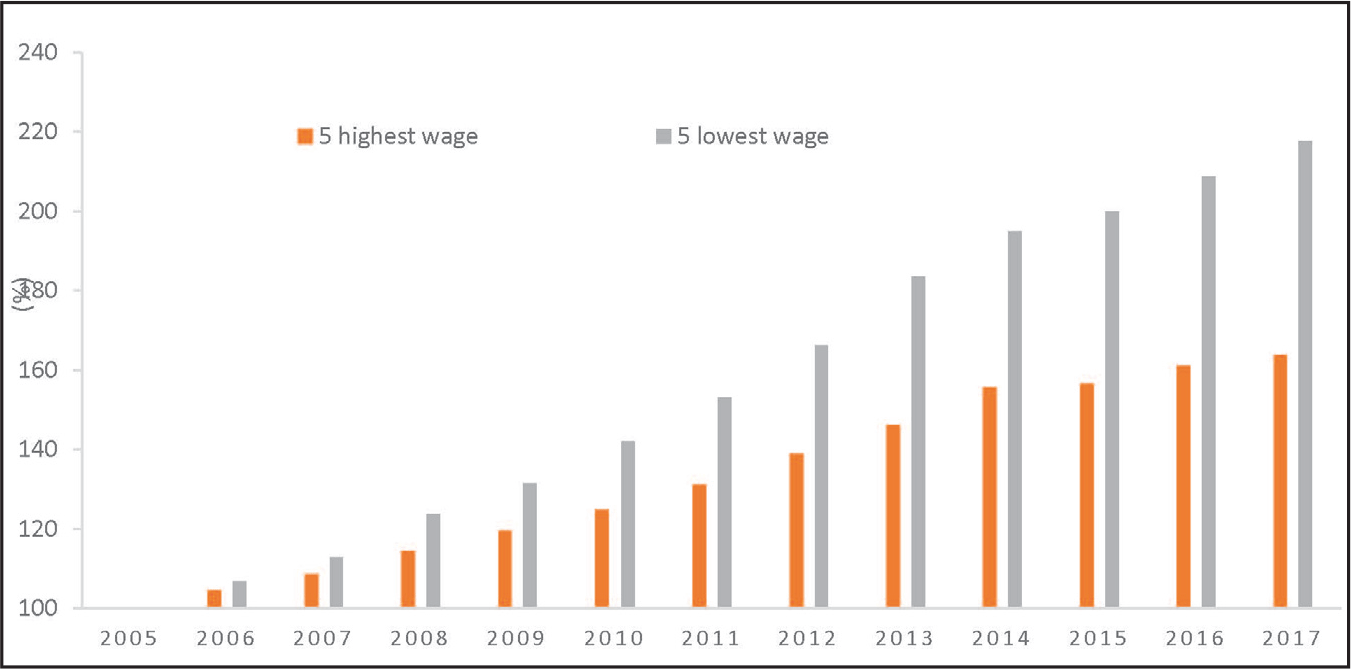
Figure 3 compares the evolution of the five lowest wage sectors (such as cleaning or security workers) and the five sectors with the highest wages in 2005. It is clear that the low-wage sectors did, relatively, much better. Though one could argue that depressed sectors have more leeway to grow, it is hard not to link, at least in part, that growth to the influence of government parameters that formally included the improvement of low-wage sectors in each round. In sum, neocorporatism in Uruguay achieved important degrees of coordination, especially at the beginning and the end of the analyzed period.
Real Wage Growth: Five Highest vs. Five Lowest Nominal Wage Sectors in 2005 (2005 = 100)

EXPLAINING SEGMENTED NEOCORPORATISM IN URUGUAY: CONSTRUCTION, 2005–2010
What explains the Uruguayan exceptionalism; that is, the surge of centralized and relatively coordinated neocorporatism after 2005? I will argue, first, that the initial construction of centralized wage bargaining was enabled by two defined institutional legacies; namely, the existence of a “frozen” but valid and enforceable legal framework for sectoral and national collective bargaining, and the unified character of the labor movement at both the sector and confederate levels.
Historical Antecedents and Institutional Legacies
The second batllismo (i.e., the heirs of the Colorado Party progressive faction founded in the 1900s) passed, in 1943, the Salary Councils Law (10,449), which organized economic activity–wide collective bargaining at the national level, monitored by the state. Sectoral collective bargaining sanctioned by the state favored the unification of actors’ representation in wage negotiations at the plant and branch levels. Salary Councils functioned between 1944 and 1968, when they were replaced by a unilateral state income policy (Mazzuchi Reference Mazzuchi2009, 17). They were, of course, banned under the dictatorship. Significantly, the 1943 legal framework was not dismantled or replaced, either under authoritarianism in the 1970s and 1980s or under the neoliberal governments of the 1990s and early 2000s, when the executive did not convoke Salary Councils (Carneiro Reference Carneiro2016).
If the old labor legislation supplied the legal frame, the structure of the labor movement provided the second essential pillar for neocorporatism. In Uruguay, despite the early implantation of sectoral wage bargaining, the labor movement was a marginal national political actor until the late 1960s, and carried a strong tradition of autonomy from the state. The working class was permeated by anarchist, socialist, and communist ideologies, instead of by the populist and state-corporatist practices prevalent in Argentina and Brazil. Yet in 1965–66, in the context of continental class radicalization, a fundamental step was taken with the labor movement’s unification in the CNT (National Convention if Workers), which soon would become FA’s labor support base (Lanzaro Reference Lanzaro1986; Pérez Betancur et al. Reference Pérez, Verónica and Fernando2019, 90). In the 1980s, the base-level unionists who confronted the dictatorship under the label of PIT (Inter-Union Assembly of Workers) consolidated the path to unity when they merged with the older confederation and formed PIT-CNT.
However, one can hardly refer to wage negotiations between labor and employers before 2005 as “neocorporatist or “coordinated.” After 1943, Uruguay followed a kind of decentralized sectoral bargaining path. Indeed, Lanzaro (Reference Lanzaro1986, 55) describes the Uruguayan labor movement between the postwar period and the late 1960s as “decentralized and marked by compartmentalization and divisions,” a pattern quite opposed to a neocorporatist actor. Bogliaccini (Reference Bogliaccini2012, 101) notes the “uncoordinated” character of business and industrial relations during the 1943–68 period.
With the return of democracy in 1985, bargaining between employers and unions became more centralized. The Colorado government restored Salary Councils and created the tripartite Superior Wage Council (CSS), which oversaw negotiations. Yet the experience of the second half of the 1980s stops short of a fully democratic neocorporatist or coordinated model. First, the government periodically established new wages by decree in an inflationary context (see Pucci Reference Pucci1992, 91–93). Second and most important, the government set mandatory limits on wage adjustments and revoked those agreements that did not comply with the criteria (Pucci et al. 2014, 19; Filgueira Reference Filgueira1991, 70). Third, collective labor actors, such as public, domestic, and rural workers, were left out of negotiations. After 2005, the FA did not set relevant wages by decree or impose mandatory ceilings (indeed, as shown in figure 2, actors sometimes ignored government parameters), which, in practice, covered all the registered labor force.
The importance of labor unity, and especially of the centralized framework of the 1943 law for the rapid launching of centralized bargaining by decree in Uruguay, cannot be overstated. National wage negotiations were a prominent demand of a unified labor movement. Basic tenets of neocorporatist theory posit that labor monopoly prevents collective action problems and facilitates cooperation (e.g., Cameron Reference Cameron and John1984). There was no doubt about who the labor interlocutors in national wage bargaining would be.
Left Power and Institution Building: Neocorporatism from Above
The legacies of a centralized bargaining framework and labor monopoly provided essential pillars for the U-turn in income policy. Yet the FA put in place a new institutional structure oriented toward strengthening the neocorporatist model. The weak state promotion of collective rights in Uruguay (despite the role played by the 1943 law), combined with a decade of neoliberalism that severely reduced union membership, seriously affected labor’s bargaining capacity. Thus, the government acted in three defined areas to back the labor side in negotiations.
Industrial Relations. The FA passed a new national Collective Bargaining Law (18,566) in 2009. Though built on the1943 law, the new norm changed the labor relations model in several respects.Footnote 2 First, it formalized the principle that collective agreements were valid for all workers in the given sector, no matter if union members or not. Second, it regulated criteria to designate the most representative union in negotiations. It mandated that if workers in a firm were not organized, they were automatically represented by the established union in the given sector. Thus the new law consolidated labor representation in Salary Councils. Third, it ruled that collective contracts were automatically valid until a new contract was reached—regardless of time limits—thereby strengthening labor’s capacity to achieve incremental gains. Fourth and most important, the law empowered both labor and business actors (and not just the state, as in the old norm) to legally demand the opening of Salary Councils (Loustaunau Reference Loustaunau2010, 61; Bogliaccini Reference Bogliaccini2012, 143). In addition, the government instituted new national-level Salary Councils for public employees and rural and domestic workers, all of whom had been traditionally left out of wage negotiations.
Union Protection. If union activists can be easily fired by employers or do not enjoy time to prepare and participate in negotiations, it is diffcult to have meaningful wage bargaining. In 2005 the government passed the Ley de Libertad Sindical (17,940, Union Freedom Law) which granted protection from layoffs and established the right of labor activists to a paid leave to engage in union activities. This norm also regulated a system of union dues deductions from workers’ pay.
Collective Action. Union mobilization capacity was essential to launch, from scratch, a genuine system of wage negotiations and to induce business cooperation within it. Prior legislation in Uruguay forbade plant seizures and allowed the Ministry of Interior to clear firms using public force at the demand of employers. The FA government overruled that provision and issued a new decree (165/06) that implicitly recognized plant seizures as part of the right to strike. The norm provoked an outcry from employers and, in the following years, would catalyze an important number of plant seizures by union activists and workers.
This wave of labor regulations (some of them issued within weeks of the FA’s arrival in government) constituted an impressive organizational thrust, intended to back unions. Furthermore, it is worth stressing the unity of the left in power and its majority in Congress to foster the new institutions that both empowered labor and strengthened neocorporatism.
STABILIZATION, 2013–2019
Certainly a good context to launch centralized wage negotiations premised on distributing income in Uruguay was the period 2005–10. The economy grew steadily after the financial crisis of the early 2000s (6.21 percent on average, 2005–10). The big currency devaluation of 2002 gave employers more leeway to afford real wage growth in the coming years. The commodity boom boosted Uruguayan agrarian exports, especially soy. However, by 2011–12, the rate of growth was reduced by half and the economy was showing signs of overheating as inflation approached two digits. In that context, tensions with the union movement mounted.
Controlling Inflation and Labor Tensions
The fifth wage bargaining round in 2013 marked the peak of sectoral labor conflict in the whole FA period. The sixth wage bargaining round in 2015–16, when the fiveyear budget, critical for future state wages, also was discussed in Congress, witnessed a major labor offensive. The PIT-CNT rejected government’s initial wage guidelines (more restrictive in a year of sluggish GDP growth). It called a daylong national strike in August 2015 for the first time in seven years. That same year, the teachers’ union launched the fiercest conflict since the FA took office, involving a series of strikes in public schools and street demonstrations (Pérez Betancur and Piñeiro Reference Pérez Betancur and Piñeiro2016, 358). In 2016, in view of increasing inflation pressures, the PIT-CNT demanded the flexibilization of wage guidelines. After a new wave of strikes, a final direct negotiation between the president and the national confederation settled the issue.
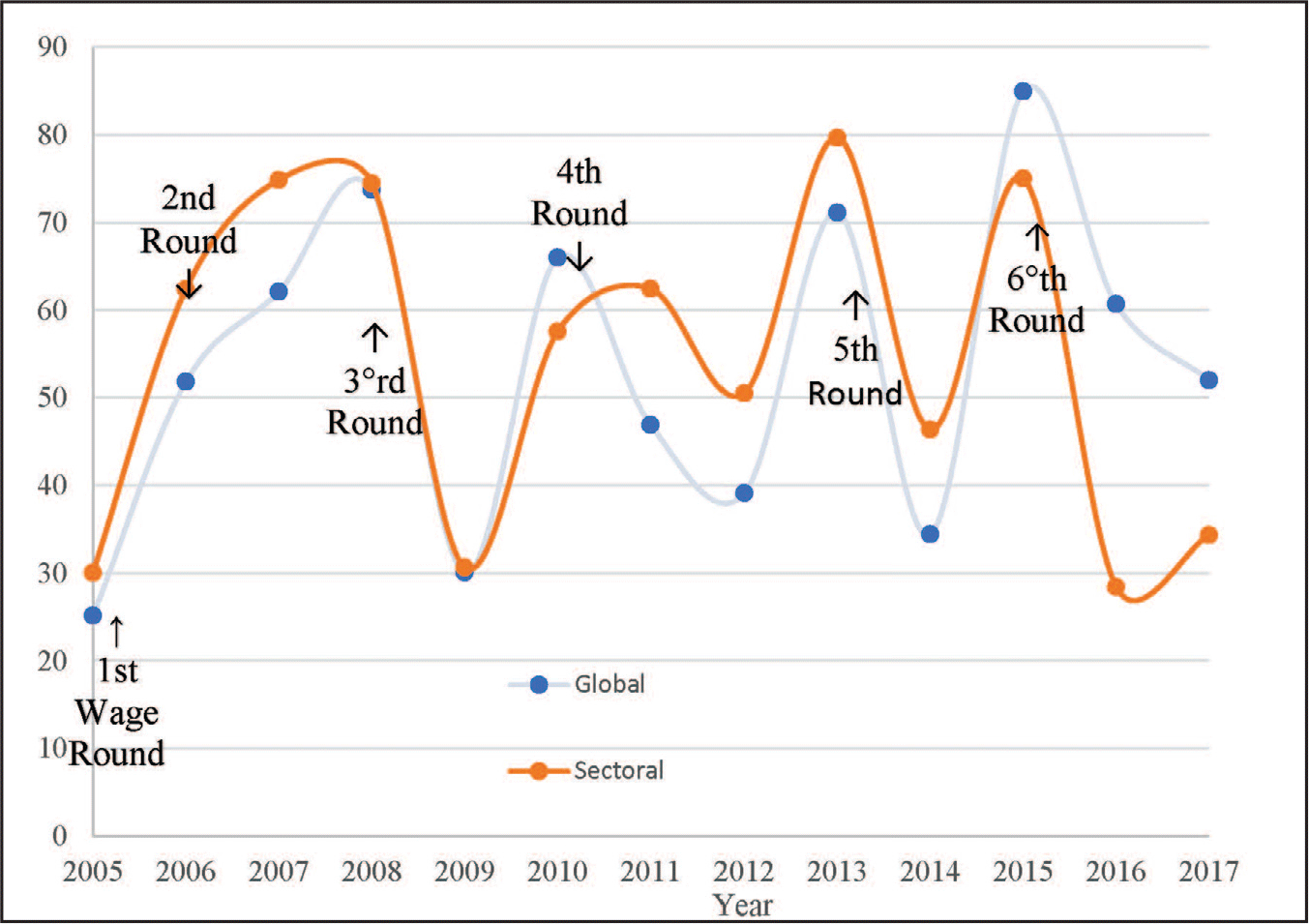
In brief, the economic downturn and a number of wildcat and national strikes threatened the neocorporatist edifice in the period 2013–17. However, this study argues that the FA largely succeeded in managing these tensions in both the political and economic realms. Figure 4 depicts labor conflict trends in the period under study. The index measures both “sector” and “global” conflict (which includes multisector and national strikes waged by PIT-CNT; see appendix for more details).
Uruguay: Labor Conflict Index (2005 = 100)
Source: Department of Labor Relations, Catholic University of Uruguay (https://ucu.edu.uy/es/ conflictividad_laboral)

The figure evinces that years in which a bargaining round starts tend to be more conflictive, as both labor and business negotiate contracts for the next one or two years. The sectoral index—which basically denotes wage and labor conditions disputes in Salary Councils—peaks in 2013, and global conflict, which essentially captures the tensions between the government and the national confederation PITCNT, reaches its highest point in 2015. Thereafter, however, conflict subsides. Indeed, though conflict always diminishes after the first year of bargaining rounds, the figure shows that in 2016 and 2017, wage council–related (i.e., sectoral) conflict reaches the lowest levels since the beginning of neocorporatist management in 2005. In other words, under much worse economic conditions and with significantly empowered unions, by the end of the period, the government managed to keep labor conflict on similar levels to those in the initial years.
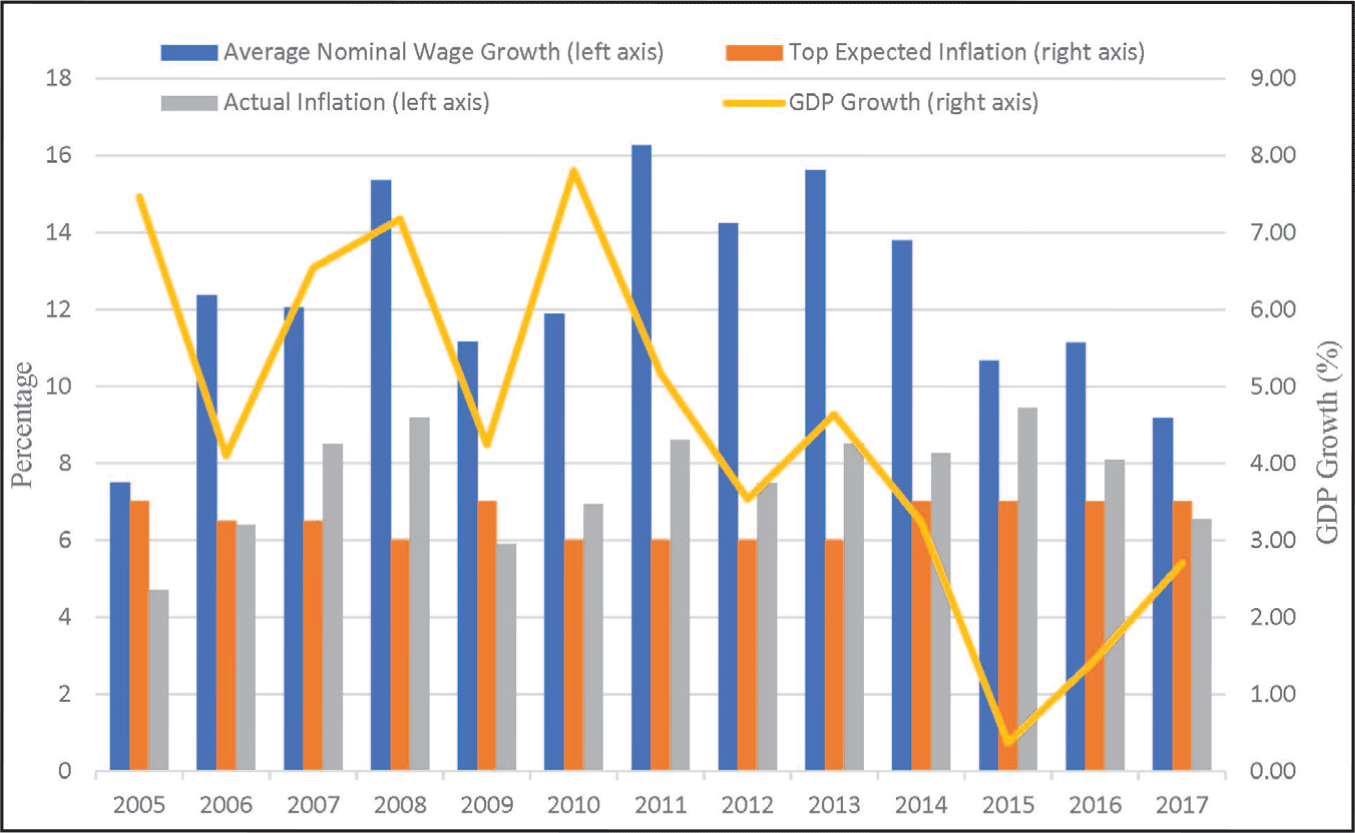
To complete the analysis, figure 5 plots Central Bank expected inflation, actual inflation, and the nominal average wage increase of total sectors each year (left axis) against GDP growth (right axis) for the period 2005–17. It is clear that declining nominal wages accompanied lesser GDP growth after 2013. The figure shows that in 2017 the FA government could “align” expected inflation, actual inflation, and nominal wage growth as never since 2005, when centralized bargaining was just beginning. Indeed, in 2017, for the first time since 2009, “actual inflation” was lower than “expected inflation”; that is, inflation fell within the Central Bank target range. As shown in figure 2, in 2015–17 the government managed to shape wage growth below the maximum “recommended” in its own guidelines to social actors—notwithstanding ongoing the tensions with labor. Despite monetary adjustment in a context of coordinated wage restraint, until 2017 the costs in terms of unemployment were not huge.Footnote 3
Though data are not shown in the figure, a qualitative review of the last bargaining round (2018–19) yields similar results in terms of wage moderation— indeed, with zero real wage gains this time (see El País 2020). Neocorporatist theory is essentially built around the idea of wage restraint—along with economic equality. Thus (some degree of) wage moderation when the economy slowed down was indispensable for the sustainability of the system. The question becomes, how was the government able to appease an allied, but empowered, labor movement in times of economic downturn?
Explaining Stabilization: Wage Policy and Monetary Policy Tightening
I argue that state wage policy—that is, increasing government activism in wage negotiations—and a nonaccommodating monetary approach largely explain the stabilization of neocorporatism in Uruguay in the 2013–19 period. In the wage rounds of 2013, 2015, and 2018, the government fundamentally changed its criteria for designing wage guidelines for social actors. First, it drew a clear distinction between “low,” “medium,” and “high” performance sectors according to objective criteria of output, workers under unemployment compensation, and others. Second, and more important, the government sought to contain wage indexation. Until 2013, government guidelines effectively allowed unions to demand “inflation plus some degree of real wage gain.” The problem with this formula was that it fueled the general indexation of the economy and inflation expectations. It also lowered unions’ incentives to bet on low inflation—as they would obtain, in theory, real wage gains no matter the inflation target. In 2013, in order to tame wage indexation, the government negotiated with unions an alternative option: an initial nominal wage increase, that, if lower than inflation evolution, would match the CPI, but only at the end of the contract. Given that this second formula does not ensure real wage gains, in the 2013 round, unions overwhelmingly chose the traditional recipe.
However, in the 2015–16 bargaining round, the government was much more rigorous in enforcing its wage policy. Guidelines to social actors recommended only a nominal wage increase and a “trigger clause” (correctivo) that would match inflation if the CPI were higher than the initial wage hike at the end of the contract (Masoller Reference Masoller2017).Footnote 4 Of course, the Ministry of Economy sought to extend the time period of agreements (and move forward the trigger clause as much as possible) in order to contain wages during the contract.Footnote 5 This general change in state guidelines oriented toward containing indexation was essential to moderate wages in the 2015– 16 negotiations and again in the 2018–19 round, in which the government replicated the model of “nominal targets” in its wage guidelines.
The new state guidelines gave employers tools basically to avoid real wage gains by situating themselves, according to objective criteria, within the less dynamic sectors. Plus, the new approach strengthened unions’ incentives to cooperate with antiinflationary policies, as (initial) nominal wages higher than (final) inflation became the only way to obtain real wage gains in sectoral contracts.Footnote 6 In addition to the fundamental change in wage guidelines, government activism manifested itself in two central aspects. First, the government warned in advance that it would not validate excess wage hikes through state payments in regulated sectors, such as public works or health services to private providers (Vallcorba Reference Vallcorba2017). Second and more important, the government clearly and formally, for the first time since 2005, signaled that it would not support agreements outside its wage guidelines in Salary Councils.Footnote 7
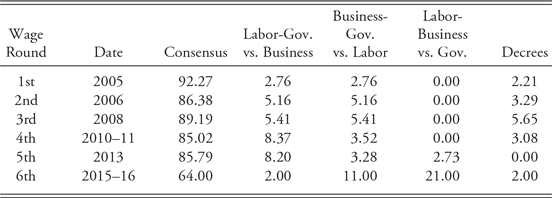
Uruguay is an atypical case, in which salary increases are formally voted in tripartite tables formed by three representatives of the state, two of labor, and two of employers. Table 1 summarizes the voting patterns of government and social actors in all Salary Councils in the six wage rounds between 2005 and 2016. A close look at the data reveals the crucial change in government wage activism in the sixth round. Consensus on wage levels between state and social actors diminished by almost a third between 2005 and 2015–16, and 25 percent with respect to the last 2013 round. Government-business alliances against labor increased almost four times in the same period, and government-labor voting against employers reached the minimum level since centralized bargaining started in 2005. The phenomenal increase in labor-business voting against state representatives is also telling: wage increases outside government guidelines were an entire responsibility of employers that could afford them.
Voting Patterns in Salary Councils, 2005–2017 (percent)
Source: Mazzuchi Reference Mazzuchi2009; Labor Relations Reports, Catholic University of Uruguay https://ucu.edu.uy/es/conflictividad_laboral

Government’s new activism in wage negotiations was complemented with the tightening of its monetary approach. The BCU (Uruguay Central Bank) started to set explicit inflation ranges from 2005 on and used the interbank rate as its main instrument. Thus the government maneuvered monetary policy both to control inflation and to cope with exchange rate appreciation pressures in the context of strong capital inflows. In 2008 it also reformed the Central Bank charter. The reform created a Committee of Macroeconomic Policy, formed by three representatives of the Ministry of Economy and three from the Central Bank, and mandated that the president of Uruguay would have the final word in case of disagreements. This committee sets the inflation target.
Interestingly, the reform clearly subjected the monetary authority to the government’s macroeconomic goals, and the Central Bank president continued to be, in practice, appointed by the Ministry of Economy. Thus, the reform was far from neoclassical conceptions. Indeed, in one of the most cited world datasets (Garriga Reference Garriga2016), Uruguay Central Bank’s score of “independence” actually diminished under the FA. However, at the same time, the new charter gave the Central Bank ample leeway to pursue the government’s inflation goals with its chosen instruments, it confirmed money stability as the bank’s main task, and it put strict limits on treasury finance.
Overall, it is clear that in the context of a centralized income policy that empowered unions—that is, one that, depending on tripartite coordination levels, may be prone to wage-push inflation—monetary policy was geared to thwart inflation pressures. For example, both after 2007 (see Lorenzo Reference Lorenzo and Bustos2010, 159) and in 2011, the BCU lifted the monetary policy rate to avert inflation. Not coincidentally, 2011 signaled the peak year in terms of nominal average wage increases in the whole FA period (see figure 5).
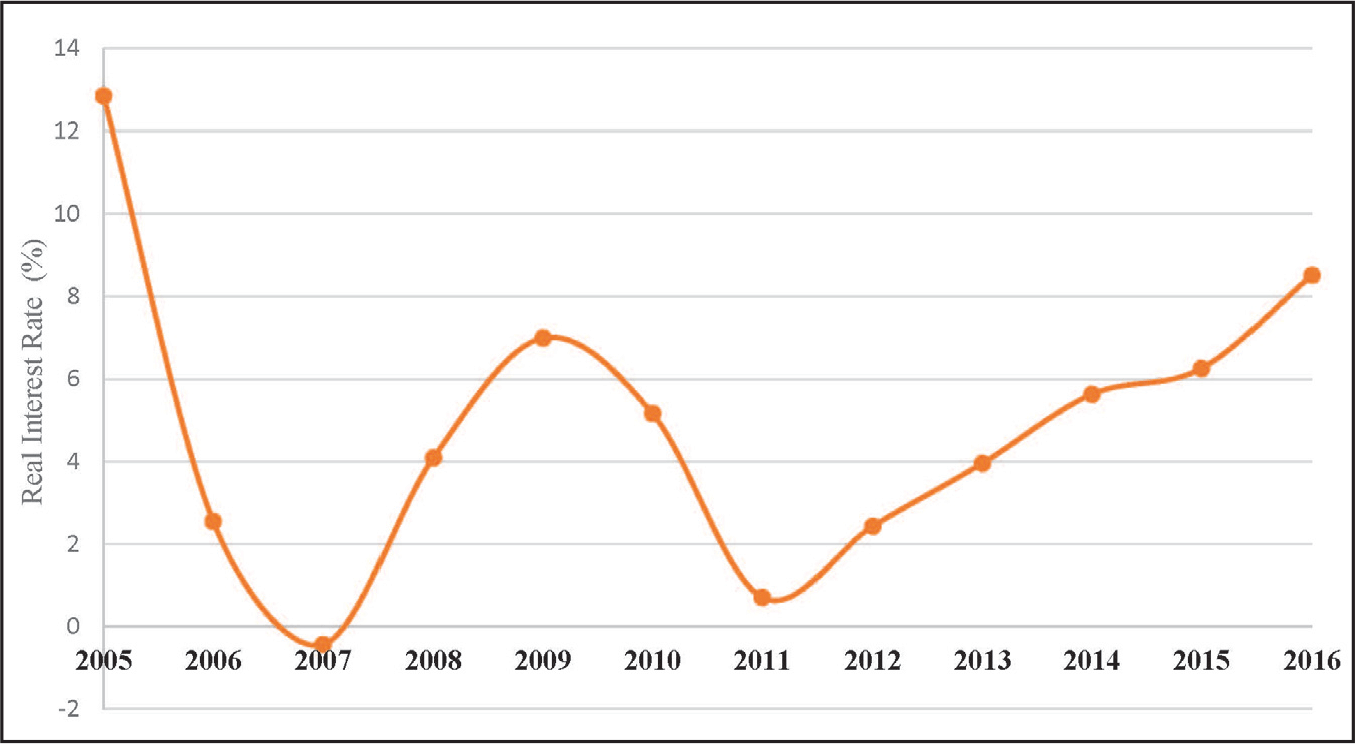
The monetary approach was further tightened in the 2013–17 period of stabilization, labor tensions, and sluggish growth. In 2013 the BCU switched to using monetary base targets instead of the interest rate in order to tame increasing inflationary pressures. Figure 6 depicts real (i.e., deflated) interest rates in Uruguay. It clearly shows how the BCU tightened its monetary approach and doubled the interest rate between 2013 and 2016, taking it from 3.9 to 8.5 percent—and lifted the rate 2.3 points in the context of the new bargaining round 2015–16, the biggest one-year jump since 2009. Of course, this anti-inflationary approach ran parallel to an important exchange rate appreciation, facilitated by Uruguay’s continuous capital inflows (see figure 1 in the appendix).
The point is that government’s ability and will to control inflation had to be minimally credible, especially in the “stabilization period” 2013–19, to shape wage negotiations and induce union moderation. If unionists were to agree to a nominal wage parameter that would not ensure real (i.e., higher than inflation) gains in advance, a credible inflation target (and an “independent” Central Bank to pursue it) was essential to lower the labor movement’s nominal wage expectations and to moderate demands. Figure 5 shows that FA’s bet was successful: monetary contraction helped bring down inflation in 2015–17, within the BCU target range. Thus, initial nominal wage increases still produced real wage gains in that period, even in the context of union restraint and slower growth—though not, as mentioned earlier, in the years 2018–19, not shown in the table.
Uruguay, 2005–2017: Average Nominal Wage Growth, Top Expected Inflation (Central Bank), Actual Inflation, and GDP Growth
Source: Wages: Average of top 22 sectoral contracts (Labor Contracts Database, see appendix). Expected Inflation: top of target range, BCU. Inflation: National Statistical Institute of Uruguay.

Uruguay: Real Interest Rates, 2005–2016
Source: Active interest adjusted by inflation with GDP deflator. IMF, international financial statistics; World Bank for GDP deflator.

A REASSESSMENT IN COMPARATIVE PERSPECTIVE
At first glance, during the last years of the FA period, business consensus with the wage coordination model seemed unquestionable. In the Salary Councils’ votes in the sixth round (2015–17), for example, employers opposed only 2 percent of total wage settlements. The majority of negotiations resulted in either tripartite consensus or alternative forms of business support (see table 1). Despite an important conflict with the rural business sector in 2019, employers did not stage a major cross-sectoral mobilization, or lockout, under the centralized wage model in Uruguay. Indeed, as the analysis has shown, the main tensions and conflicts in wage negotiations during 2015–19 originated with labor, not with employers, who more or less formally backed the new, stricter government approach to income policy.
However, as the critics of employer-centered and VoC approaches to welfare policies analyzed earlier caution (Korpi Reference Korpi2006; Hacker and Pierson Reference Hacker and Paul2002), we should not conflate ex-post class consensus with initial business support for coordinated models. In Uruguay, centralized income policies were largely imposed on employers by a labor-based left; that is, organized workers using their nonmarket, political “power resources.” The view of Juan Mailhos, head negotiator of the National Chamber of Commerce and Services of Uruguay (CNCSU), the most traditional and powerful business association of the country, is eloquent:
We are liberals. We want collective bargaining to be at firm level, voluntary, and without state participation. And the FA made it sectoral, mandatory, and with state participation. Even though we do not like the system, we participated to avoid a bigger harm. We did it not so much because of possible state fines, but to control labor conflict. Here, the government changed the legal frame and allowed for workplace seizures. (Mailhos Reference Mailhos2016)
Thus the Uruguayan example clearly reinforces the Power Resource theory in explaining centralized income policies, over the need of business to stabilize a skilled workforce, as stressed by the VoC literature.Footnote 8 One should not build a strawman with employer-centered views of coordinated bargaining; both Swenson (Reference Swenson1991) and Mares (Reference Mares2003), for example, point out the important role played by labor in the initial organization of welfare and centralized wage policies. However, it is undeniable that in this view, cross-class coalitions with employers are decisive to push forward nonmarket wage arrangements.
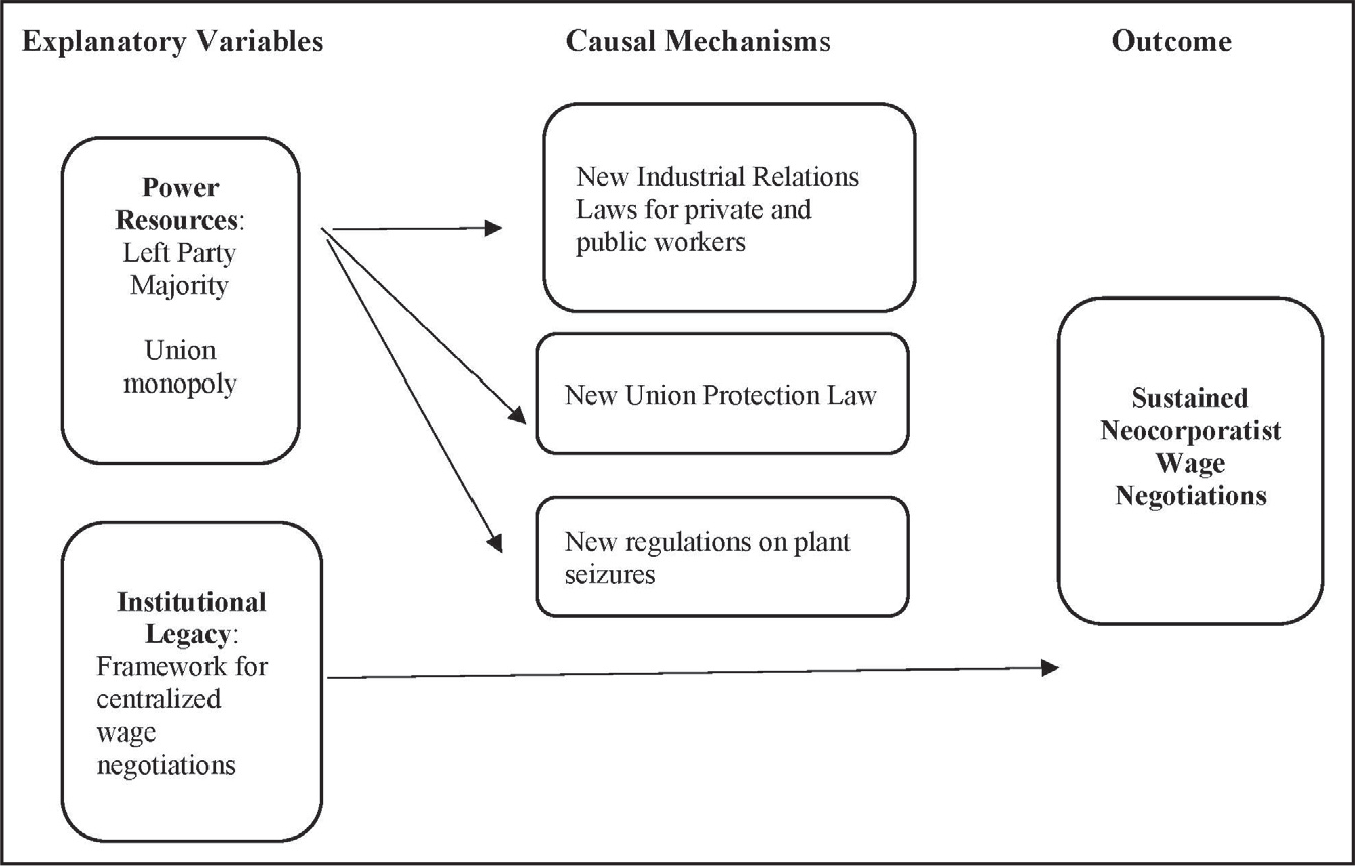
Yet in Uruguay, centralized and state-oriented wage setting did not originate in the needs of firms or sectors to enhance international competiveness. The FA government and its congressional majority’s impressive organizational push in industrial relations in 2005–9, as described here, was fiercely contested by all employer organizations (see Bogliaccini Reference Bogliaccini2012). Though heavily concentrated by international standards, the Uruguayan union movement had been decimated in the previous neoliberal decade. It needed institutional support to become a viable interlocutor in peak-level negotiations and to include new groups like public, domestic, and rural workers in centralized negotiations. The new labor relations law that consolidated PIT-CNT unions’ representation and extension rules to nonunion members, the protections from layoffs afforded to union negotiators, and the tacit government approval of plant seizures built a context that severely increased the costs of noncooperation for business. While traditional large-N studies in the Power Resource theory often analyze left influence through static variables, such as share of cabinet positions and union concentration, this case study has shown how class power set in motion defined regulatory mechanisms that made neocorporatist negotiations unavoidable (figure 7).
Origins of Segmented Neocorporatism in Uruguay

However, in Uruguay, left power combined with two central perquisites for the functioning of coordinated models in a globalized economy underscored by VoC scholars: institutional independence of the Central Bank and a nonaccommodating (i.e., occasionally contractive) monetary policy. It is appropriate to read the stabilization of neocorporatist management in 2013–19 in light of the interaction between the economic (and monetary) authority and a centralized labor movement theorized by Iversen (Reference Iversen1999) and Franzese and Hall (Reference Franzese, Hall, Iversen, Pontusson and Soskice2000). On the one hand, the Central Bank used monetary policy to avert inflationary pressures, particularly in rounds with high nominal wage averages after 2011, and in 2015–16. On the other hand, a concentrated labor movement was able to restrain nominal (and real) wages in the period of slower growth in 2015–19.
Thus, to some extent, the virtuous cooperative game posed by the post-Keynesian corporatist theory of the late 1990s and early 2000s unfolded: the Central Bank and the Ministry of Economy could bet on wage restraint by a concentrated labor movement to help control inflation. Indeed, the new state activism in wage policy during 2015–19, in a way, increased bargaining centralization. At the same time, labor and party leaders knew that the government would let the Central Bank punish excess wage demands with higher interest rates to (try to) meet a credible inflation target. In brief, stabilization and inflation control after 2012 were the result of both a stricter income policy and some monetary restraint. Indeed, the Central Bank could set the inflation rate within target only in the 2017 bargaining round, when it put a firmer grip on income policy (figure 5).
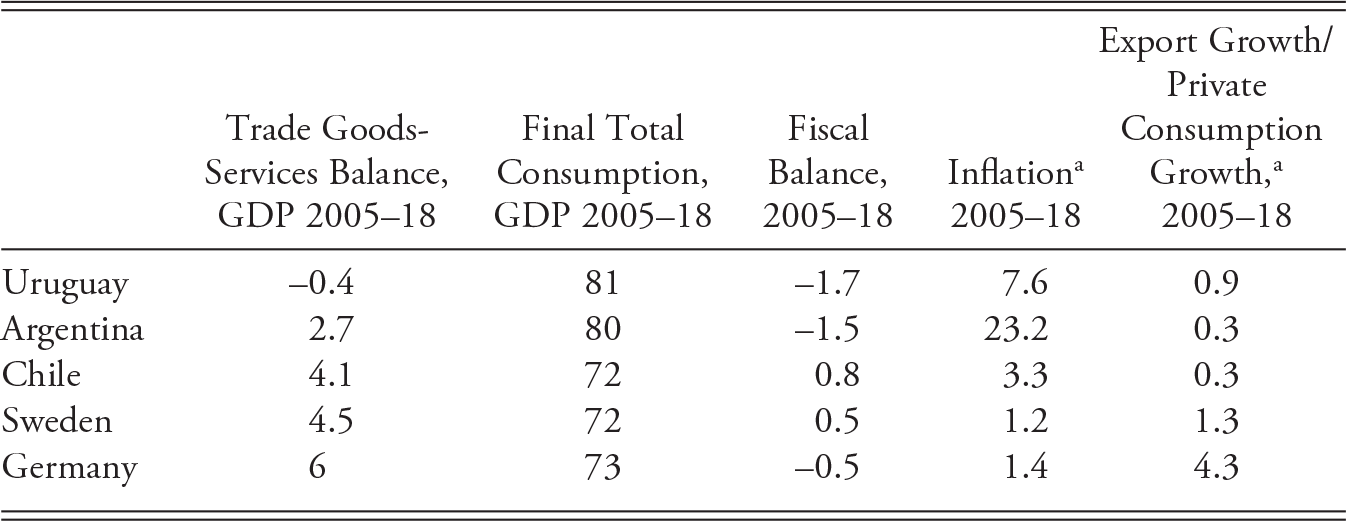
Finally, although it is undeniable that the Uruguayan model incorporated central aspects of post-Keynesian macroeconomics just mentioned, it does not fit the type of export-oriented, deflationary neocorporatism that is hegemonic in the VoC literature. As noted, Baccaro and Pontusson (2016, 2019) argue that in a deflationary corporatism, growth is based on exports, strong wage restraint, and the relative dampening of household consumption (e.g., Germany). A second model of CME growth (e.g., Sweden) deploys a more balanced combination between export growth and domestic consumption growth (Baccaro and Pontusson Reference Baccaro and Jonas2016, 186). Table 2 compares the macroeconomics of neocorporatism in Uruguay with another (weakly coordinated) corporatist country in Latin America (Argentina 2003–15), a liberal country (Chile), and—despite obvious differences in development—with Germany and Sweden, CME’s symbols of “dualized” and more egalitarian corporatism, respectively.
The Macroeconomics of Neocorporatism: Uruguay in Comparative Perspective
aAnnual growth
Note: All columns average 2005–18 except Argentina, 2005–15
Sources: All data WDI Database (https://databank.worldbank.org/), except IMF Fiscal Monitor (https://data.imf.org/) for fiscal balance

Uruguayan macroeconomics under corporatism display, on average, no trade surplus (i.e., a balance in the development of external and domestic markets), high levels of total (private and state) expenditures in comparative terms, more fiscal profligacy (on average, almost 3 points more than liberal Chile), more inflation than all countries except Argentina, and a ratio of export growth to private consumption growth that is closer to the more egalitarian Sweden than to Germany. In other words, table 2 suggests that Uruguayan neocorporatism is relatively “Keynesian”; that is, tends to rely more on domestic consumption, inflation, and fiscal policy than the European version—which predictably shows a higher trade surplus and a higher ratio of export growth to consumption growth, especially in Germany. In Uruguay under the FA, exports grew, but so did private consumption. Plus, figure 3 shows that the coordinated model in Uruguay favored low-wage, low-skill, nonexport sectors. Interestingly, the table suggests that the main difference between the Uruguayan coordinated model and inflation-ridden corporatism in Argentina is not fiscal policy or domestic consumption but the nonaccommodating monetary policy and the capacity to coordinate wage restraint to control inflation analyzed here (see also Etchemendy Reference Etchemendy2019).
In brief, the Uruguayan coordinated model tends to be more Keynesian than deflationary. It also developed as relatively egalitarian in institutional terms. Unlike the classical European version, neocorporatism in Uruguay is segmented in the sense that between a third and a quarter of wage earners not registered in social security were not covered by negotiations. However, it largely avoids further dualization of the labor market between a core of protected insiders and a periphery of precarious outsiders that Thelen (Reference Thelen2014) identifies in CMEs of Continental Europe.Footnote 9
Like other progressive governments in Latin America in the 2000s, the FA substantially expanded social policies for the informal sectors (Pribble Reference Pribble2013). It incorporated precarious workers, such as rural and domestic workers, through the creation of special Salary Councils, and legislated to protect the subcontracted workforce. All these “pro–labor market outsiders” policies are largely related to the institutional features of the FA and its alliance with labor. First, unlike in Argentina, unions were incorporated into several social policy councils in the areas of health and social security, which oversee informal sectors (Schipani Reference Schipani2020). Second, as a mass organic party with high levels of grassroots organization, the FA is strongly embedded in Uruguayan society (Pérez Betancur et al. Reference Pérez, Verónica and Fernando2019). Informal sectors became a central part of the FA’s lower-class electoral base (see Luna Reference Luna2014).
Of course, the relatively inclusive character (in both macroeconomic and institutional terms) of neocorporatism in Uruguay may be diffcult to sustain in the medium and long run. First and most obviously, exports in Uruguay are based on price-sensitive agrarian commodities, not on manufacturing industry, as in corporatist Europe. This article shows that the coordinated model navigated relatively well the period of sluggish growth and lower commodity prices after 2012. Still, a permanent fall in export prices could exert downward pressure on the exchange rate and (thus) on wage levels, which would disrupt centralized negotiations. The well-developed labor-training systems that enable international competition in Europe are absent in Latin America in general and in Uruguay in particular (Schneider Reference Schneider2013; Bogliaccini and Madariaga Reference Bogliaccini2020).
Yet perhaps the most important challenge to the coordinated model is coalitional. Both Thelen (Reference Thelen2014, 31) and Baccaro and Pontusson (Reference Baccaro and Jonas2019, 27) note that the more inclusionary contemporary versions of corporatism have two essential coalition blocs: precarious workers and women, and multiemployer organizations that include a competitive, employment-generating service sector. As we have seen, Uruguay fares rather well in the first dimension. Domestic, rural, and informal or precarious workers were, in one way or another, part of the FA version of the welfare state. The women’s movement, actively involved in domestic workers’ labor regulations and care social policies, is an important FA social base.
However, business in Uruguay has largely resisted the coordinated model. At best, employers have cooperated passively: only the construction chamber openly backs the coordinated system (Otegui Reference Otegui2018).Footnote 10 As Bogliaccini (Reference Bogliaccini2019) shows, Uruguayan employers have historically organized along sectoral lines. Centralization at a peak level has been rather weak, and occurred only briefly during the 1990s. The chronic organizational weakness of business in Uruguay may undermine neocorporatist management. Multisectoral business organizations are more likely to discuss general cooperative outcomes in economic policy, beyond sectoral pressures (Martin
and Swank Reference Martin and Duane2012). A solid, encompassing business association may counterbalance the alliance between the left and the PIT-CNT confederation to discuss regulatory issues, and thus give employers more stakes in the system.Footnote 11 In brief, what Baccaro and Pontusson (Reference Baccaro and Jonas2019, 1), with a Gramscian echo, call the “social bloc”—that is, the constellation of multiclass organized interests that underlie stable models of growth—has not taken shape in Uruguay. A strong, competitive service business sector, embedded in a strong, classwide sectoral organization, would need to complement the alliance with formal and unskilled and informal workers.
CONCLUSIONS
This article has tried to explain the origins and performance of centralized income policy in Uruguay in light of contemporary theories of wage coordination. The article has argued that defined institutional legacies (a “latent” framework for centralized collective bargaining and a unified labor movement), combined with a massive organizational push by the FA in the domain of industrial relations, largely accounted for the construction of neocorporatism in the second half of the 2000s. The tradition of autonomy from the state that permeated the Uruguayan labor movement during the twentieth century was not enough to cement an effective model to discuss income distribution. State intervention was necessary to shape a viable labor interlocutor in wage negotiations. Thus, the Uruguayan example clearly upholds the Power Resource Theory, in that the driving force behind centralized bargaining, launched in 2005, was workers, organized in a governing union-party alliance, not a cross-class coalition of business and labor, as employer-centered accounts of coordinated models suggest.
At the same time, a neocorporatist system launched in times of solid economic growth needed to pass the test of a less dynamic period. This analysis has shown that stabilization of centralized wage setting after the commodity boom was largely achieved first, through enhanced state activism in Salary Councils and new government wage guidelines clearly oriented to curtail indexation. This strategy was complemented with the tightening of monetary policy: a credible CPI projection was vital to negotiate future nominal (rather than real) wage parameters, bring unions to the “inflation control” coalition, and thus achieve some degree of wage restraint. The Uruguayan coordinated model incorporated central aspects of post-Keynesian macrocorporatist theory, such as the role played by a formally independent Central Bank to pursue the inflation target decided by the government (not the Central Bank) and a nonaccommodating monetary policy. Still, neocorporatism in Uruguay tends to be relatively egalitarian: its macroeconomics have displayed a combination of supply-side and Keynesian policies, and its institutions have promoted the inclusion of precarious workers.
This article has divided the theoretical debates in terms of origins and post-Keynesian stabilization of coordinated models. The underlying question, however, both in the VoC theory and for its critics, is essentially the same; namely, how much working-class power, and how much business consent and profitability, are needed
to construct egalitarian forms of capitalism? This article has shown that class power, institutionally refracted by the FA/PIT-CNT alliance, was indispensable in shaping an inclusionary version of neocorporatism in Uruguay. At the same time, as even critics of the VoC approach, such as Thelen and Baccaro and Pontusson, suggest, the role of business organizations and (new forms of) cross-class coalitions is key for consolidating inclusive coordinated models. In that sense, the future sustainability of neocorporatist management in Uruguay demands that employers enhance their political organization to balance the force of the FA/PIT-CNT coalition. Other challenges stem from the electoral victory of the center-right parties in October 2019. Still, the successful construction and stabilization of neocorporatism in 2005– 2019 suggests that centralized wage negotiations in Uruguay are likely to become a permanent feature of the political economy in the years to come.
SUPPORTING INFORMATION
Additional supporting materials may be found with the online version of this article at the publisher’s website: appendix. For replication data, see the author’s file on the Harvard Dataverse website: https://dataverse.harvard.edu/dataverse/laps