





1 Introduction
1.1 Background
Over the last decades, the study of complements of hyperplane arrangements in complex vector spaces has given rise to a rich theory at the crossroads of algebraic topology and combinatorics. One of the seminal papers in this field is the work of Arnol’d on the cohomology of pure braid groups [Reference Arnol’d1], motivated by the connection to configuration spaces and the classical Fadell–Neuwirth theorem [Reference Fadell and Neuwirth22]. In this sense, complements of hyperplane arrangements and their fundamental groups are generalizations of configuration spaces of ordered points in the plane and pure braid groups.
This analogy is particularly strong for fiber-type arrangements, introduced by Falk and Randell [Reference Falk and Randell23] as the class of hyperplane arrangements satisfying a recursive fibration property akin to Fadell and Neuwirth’s for configuration spaces. Fiber-type arrangements of hyperplanes have been the focus of substantial research: they can be characterized purely combinatorially via Stanley’s theory of supersolvable lattices [Reference Stanley30], and much of the theory of braid groups and configuration spaces has an analogue in this more general context. For instance, we mention results on the lower central series (LCS) of the fundamental group of the complement [Reference Falk and Randell23] and the associated LCS Lie algebra [Reference Cohen8, Reference Cohen, Cohen and Xicoténcatl11], isomorphic to the holonomy Lie algebra of the arrangement [Reference Kohno25]. A key fact in this context, first observed by Cohen [Reference Cohen8], is that the fiber bundles arising in the hyperplane arrangement case can be pulled back from classical Fadell–Neuwirth bundles for configuration spaces of points in the plane. This facilitates the explicit computation of the monodromy of (fiber-type) arrangement bundles [Reference Cohen and Suciu12, Reference Cohen8] and the determination of the cohomology ring of the complement from the iterated semidirect product structure of its fundamental group [Reference Cohen9].
Recently, the focus of the theory of arrangements has been broadened toward the case of hypersurfaces in complex tori (toric arrangements) and, more generally, in connected abelian Lie groups (abelian arrangements). This research direction has gained substantial momentum since the 2010s in the wake of De Concini, Procesi, and Vergne’s seminal work on vector partition functions and Dahmen-Micchelli spaces of splines [Reference De Concini and Procesi14, Reference De Concini, Procesi and Vergne16, Reference De Concini, Procesi and Vergne15], among others. Some notable advances have been made on the topological side, including the computation of the integral cohomology ring in the toric case [Reference Callegaro, D’Adderio, Delucchi, Migliorini and Pagaria6] and in the noncompact abelian case [Reference Bazzocchi, Pagaria and Pismataro2]. Such topological invariants appear to be strongly related to the structure of the partially ordered set of connected components of intersections of the hypersurfaces (the so-called poset of layers), which, in turn, has been studied from the combinatorial point of view – see, for instance, [Reference Zaslavsky31, Reference Ehrenborg, Readdy and Slone19, Reference Delucchi and Riedel17, Reference Bibby3].
The notion of fiber-type arrangements in the toric and abelian settings has been introduced in [Reference Bibby and Delucchi4], together with an equivalent combinatorial characterization that generalizes Stanley’s supersolvability for lattices. A main takeaway from [Reference Bibby and Delucchi4] is that, in this broader context, there are two combinatorial notions of supersolvability: one is equivalent to the inductive fibration property for the arrangement complement, and the other, stronger one (called strict supersolvability) defines a class of posets in which closer analogues of the features of classical supersolvable lattices hold. While a thorough poset-theoretic investigation of this circle of ideas, leading to an even finer classification, has been carried out in [Reference Pagaria, Pismataro, Tran and Vecchi28], a main motivation of the current article is to carry out a further investigation from the topological point of view.
In [Reference Bibby and Delucchi4, Theorem 5.3.1], it was noted that strict supersolvability of the poset of layers of an arrangement implies that the corresponding fiber bundles are pulled back from Fadell–Neuwirth bundles for suitable configuration spaces. This raises two natural questions. First, are the fiber bundles arising from the “weaker” notion of supersolvability realizable as pullbacks of configuration space bundles? Moreover, one can ask whether, at least in the special case of toric arrangements, invariants such as the monodromy, the cohomology ring, and the LCS Lie algebra can be determined by utilizing the aforementioned relationship between strict supersolvability and classical configuration spaces.
1.2 Overview and structure of the paper
We further the topological study of supersolvable toric and abelian arrangements along the two directions mentioned above.
In Section 2, we lay the foundations and show that the fiber bundles associated to any supersolvable abelian arrangement can be pulled back from Fadell-Neuwirth-type bundles involving orbit spaces of the action of products of symmetric groups on classical ordered configuration spaces (Theorem 2.12).
In Section 3, we specialize to toric arrangements, where the pullbacks are from spaces of configurations of points in the plane. In Theorem 3.1, we give a characterization of the maps along which the configuration space bundles are pulled back. These maps – a coefficient map
$\mathbf {a}$
 into an unordered configuration space in the supersolvable case and a root map
$\mathbf {b}$
 into an ordered configuration space in the strictly supersolvable case – may be used to describe the monodromy of the fiber bundles associated to supersolvable toric arrangements. In particular, this monodromy factors through the Artin representation of the braid group in the automorphism group of the free group (Proposition 3.6). As a consequence, we show that the fundamental group of the complement of any supersolvable toric arrangement is an iterated semidirect product of free groups (Corollary 3.8), a structure previously observed in the strictly supersolvable case in [Reference Bibby and Delucchi4]. These results provide a clear distinction between supersolvable and strictly supersolvable toric arrangements. In the former case, the iterated semidirect product structure of the fundamental group is determined by braid automorphisms. In the latter, the monodromy factors further through the pure braid group, yielding an almost-direct product structure in the sense of [Reference Falk and Randell23].
In Section 4, we focus on the special case of strictly supersolvable toric arrangements. The complement of such an arrangement sits atop a tower of bundles, determined by a sequence of root maps to ordered configuration spaces. The main gist is that this sequence of root maps determines the structure of both the cohomology ring of the complement (Theorem 4.4) and the LCS Lie algebra of its fundamental group (Theorem 4.2). Specifically, each relevant root map induces a map in (first) homology, which we call a homological root homomorphism. These homomorphisms, computed in terms of the defining characters of the arrangement in Theorem 6.4, may be used to obtain explicit presentations for both the cohomology ring and the LCS Lie algebra. The resulting cohomology presentation, different from those of [Reference Callegaro and Delucchi7, Reference Callegaro, D’Adderio, Delucchi, Migliorini and Pagaria6, Reference Bazzocchi, Pagaria and Pismataro2], exhibits the Koszulity of the cohomology algebra (Corollary 4.5). We also compute the topological complexity of the complement, noting that it depends only on the ambient dimension and the rank of the arrangement (Theorem 4.8).
Illustrations via concrete examples are provided throughout the paper. These include a family of rank-two strictly supersolvable toric arrangements consisting of three hypersurfaces in the two-dimensional torus, discussed in Section 5, and the family of Weyl type C toric arrangements of arbitrary rank studied in Section 7. Presentations of the cohomology ring of the complement and the LCS Lie algebra of its fundamental group are obtained for both families. In rank two, we also demonstrate how our methods yield explicit fundamental group presentations.
2 Arrangements and configuration spaces
2.1 Abelian and toric arrangements
Let
$\mathbb {G}$
 be a connected abelian Lie group,
$\Gamma \cong \mathbb {Z}^d$
 a finitely generated free abelian group, and
${T= {\mathrm {Hom}}(\Gamma ,\mathbb {G})\cong \mathbb {G}^d}$
 .
Definition 2.1. An abelian arrangement
$\mathscr {A}$
 is, for some finite set
$\mathfrak {X}=\mathfrak {X}(\mathscr {A})\subseteq \Gamma $
 , the collection of connected components of the subspaces

with
$\chi \in \mathfrak {X}(\mathscr {A})$
 .
The complement of
$\mathscr {A}$
 is denoted by

The poset of layers of
$\mathscr {A}$
 is the set
$\mathscr {P}(\mathscr {A})$
 whose elements are the nonempty connected components of intersections
$\cap _{\chi \in S}H_\chi $
 where
$S\subseteq \mathfrak {X}(\mathscr {A})$
 , partially ordered by reverse inclusion.
Remark 2.2. We pay special attention to two cases: when
$\mathbb {G}=\mathbb {C}$
 , T is a complex affine space and
$\mathscr {A}$
 is called a hyperplane arrangement; when
$\mathbb {G}=\mathbb {C}^\times $
 , T is a complex torus and
$\mathscr {A}$
 is called a toric arrangement. We focus primarily on toric arrangements that are essential, that is, where the maximal elements of
$\mathscr {P}(\mathscr {A})$
 are points, since, as noted in [Reference Callegaro, D’Adderio, Delucchi, Migliorini and Pagaria6, Remark 2.7], one can always find an essential arrangement
$\mathscr {A}'$
 in a torus
$(\mathbb {C}^\times )^r$
 such that
$M(\mathscr {A})\cong M(\mathscr {A}')\times (\mathbb {C}^\times )^{d-r}$
 . We refer to r as the rank of
$\mathscr {A}$
 .
Remark 2.3. Let
$\mathscr {A}$
 be a toric arrangement and consider
$\chi \in \mathfrak {X}(\mathscr {A})$
 . Fixing an isomorphism
$\Gamma \cong \mathbb {Z}^d$
 and the corresponding coordinates on
$T\cong \mathbb {C}^\times $
 , we have

where
$(c_1,\ldots ,c_d)\in \mathbb {Z}^d$
 corresponds to
$\chi \in \Gamma $
 . Let
$m:=\gcd (c_1,\ldots ,c_d)$
 . Then,
$H_\chi $
 is connected if and only if
$\chi $
 is primitive, equivalently, if
$m=1$
 . In general, the different connected components of
$H_{\chi }$
 are given by

where
$\mu $
 runs over all m-th roots of unity.
Example 2.4. Let
$\mathbb {G}=\mathbb {C}^\times $
 and
$\Gamma =\mathbb {Z}^2$
 , so
$T\cong (\mathbb {C}^\times )^2$
 . The columns
$\chi _1$
 ,
$\chi _2$
 , and
$\chi _3$
 of the integer matrix

define a toric arrangement
$\mathscr {A}=\{H_0,H_1,H_2,H_3\}$
 , where
$H_0$
 and
$H_1$
 denote the two connected components of
$H_{\chi _1}$
 ,
$H_2:=H_{\chi _2}$
 , and
$H_3:=H_{\chi _3}$
 . Considering
$\mathbb {R}/\mathbb {Z}\subseteq \mathbb {C}/\mathbb {Z}\cong \mathbb {C}^\times $
 , the “real part” of the arrangement is depicted in Figure 1a, and the Hasse diagram for the poset of layers is depicted in Figure 1b.

Figure 1 Long description
Panel a shows a square grid representing S super 1 times S super 1. It contains two vertical blue lines at the left and center. Two diagonal pink lines rise from the bottom-left of each vertical section to the top-right. A dark green horizontal line sits at the base. Panel b shows a Hasse diagram for the poset P of A. At the top are two coordinate pairs (1, 1) and (-1, 1). These connect downward to a middle row of four labels: H sub 0 in blue, H sub 2 in pink, H sub 3 in green, and H sub 1 in blue. Specifically, (1, 1) connects to H sub 0, H sub 2, and H sub 3. (-1, 1) connects to H sub 2, H sub 3, and H sub 1. All four middle labels converge at the bottom to a single letter T.
2.2 Supersolvability
A subgroup Y of T is admissible if there is a rank-one direct summand
$\Gamma '\subseteq \Gamma $
 such that Y is the image of the injection
$\epsilon ^*: {\mathrm {Hom}}(\Gamma ',\mathbb {G})\to {\mathrm {Hom}}(\Gamma ,\mathbb {G})$
 induced by the projection
$\epsilon :\Gamma \to \Gamma '$
 . When Y is admissible, the corresponding projection

admits the map induced by the quotient
$q:\Gamma \to \Gamma /\Gamma '$
 as a section. This allows us to define abelian arrangements

in T and
$T/Y$
 , respectively. Note that
$\mathscr {P}(\mathscr {A}_Y)$
 is by definition a subposet of
$\mathscr {P}(\mathscr {A})$
 .
The projection
$p:T\to T/Y$
 restricts to a map on arrangement complements
$\bar {p}:M(\mathscr {A})\to M(\mathscr {A}/Y)$
 and induces an isomorphism of posets
$\mathscr {P}(\mathscr {A}_Y)\cong \mathscr {P}(\mathscr {A}/Y)$
 .
Definition 2.5 [Reference Bibby and Delucchi4, Definitions 2.4.1, 5.1.1].
Let Y be an admissible subgroup of T, and
$\mathscr {A}$
 an abelian arrangement in T. We say
$\mathscr {P}(\mathscr {A}_Y)$
 is an M-ideal of
$\mathscr {P}(\mathscr {A})$
 if, for any two distinct
$H_1,H_2\in \mathscr {A}\smallsetminus \mathscr {A}_Y$
 and any component X of
$H_1\cap H_2$
 , there is some
$H_3\in \mathscr {A}_Y$
 such that
$H_3\supseteq X$
 . Say
$\mathscr {P}(\mathscr {A}_Y)$
 is a TM-ideal if, in addition, the intersection
$H\cap Y$
 is connected for all
$H\in \mathscr {A}\smallsetminus \mathscr {A}_Y$
 .
Say
$\mathscr {A}$
 is (strictly) supersolvable if there is a chain

with each
$\mathscr {P}(\mathscr {A}_{Y_r})$
 a (T)M-ideal of its successor.
Remark 2.6. Notice that, in Definition 2.5, the rank of
$\mathscr {P}(\mathscr {A}_Y)$
 is one less than the rank of
$\mathscr {P}(\mathscr {A})$
 . Henceforth, whenever we say
$\mathscr {P}(\mathscr {A}_Y)$
 is a corank-one M-ideal of
$\mathscr {P}(\mathscr {A})$
 , it is assumed that Y is an admissible subgroup of T.
Lemma 2.7. Let
$\mathscr {A}$
 be an abelian arrangement in
$T\cong \mathbb {G}^d$
 , and suppose that
$\mathscr {P}(\mathscr {A}_Y)$
 is a corank-one M-ideal of
$\mathscr {P}(\mathscr {A})$
 . Let
$p: T\to T/Y$
 be the projection to the quotient. Then, for every
$X\in \mathscr {P}(\mathscr {A})$
 , we have
$p(X)\in \mathscr {P}(\mathscr {A}/Y)$
 . Moreover, if
$X\in \mathscr {P}(\mathscr {A}_Y)$
 , then
$\dim p(X) = \dim (X) -\dim (\mathbb {G})$
 ; otherwise,
$\dim p(X) = \dim (X)$
 .
Proof. Let
$X\in \mathscr {P}(\mathscr {A})$
 . Then, X is a coset of a closed connected subgroup of T.
Now choose
$ H_1,\ldots ,H_k\in \mathscr {A}_Y$
 and
$H_1',\ldots ,H_l'\in \mathscr {A}\smallsetminus \mathscr {A}_Y$
 such that X is a connected component of
$H_1\cap \ldots \cap H_k\cap H_1'\cap \ldots \cap H_l'$
 , where
$k,l\geq 0$
 . Since
$p(H_i')=T/Y$
 for all
$i=1,\ldots ,l$
 (e.g., by [Reference Bibby and Delucchi4, Corollary 3.3.2.]), the coset
$p(X)$
 is contained in a connected component
$W\in \mathscr {P}(\mathscr {A}/Y)$
 of
$\cap _i p(H_i)$
 .
If
$X\in \mathscr {P}(\mathscr {A}_Y)$
 , then we may suppose
$l=0$
 , and
$H_i= p(H_i)\times Y$
 implies
$X=p(X)\times Y $
 . In particular,
$\dim (p(X)) = \dim (X) -\dim (\mathbb {G})$
 .
If
$X\not \in \mathscr {P}(\mathscr {A}_Y)$
 , then
$l>0$
 . For every
$1\leq i<j\leq l$
 , the definition of an M-ideal implies that there is
$H\in \mathscr {A}_Y$
 such that the connected component of
$H_i\cap H_j$
 containing W equals the connected component of
$H\cap H_i$
 containing W. Thus, we can assume that X is a connected component of an intersection of the form
$H_1\cap \ldots \cap H_k \cap H_1'$
 . Since
$H_1'$
 is transverse to every
$H_i$
 ,
$\dim (X)=\dim (\cap _i H_i)-\dim (\mathbb {G})$
 . Moreover, since
$p(H_1')=T/Y$
 ,
$p(X)=W$
 and, in particular,
$\dim p(X) = \dim (W) = \dim (\cap _i p(H_i)) = \dim (\cap _i H_i)-\dim (\mathbb {G}) = \dim (X)$
 .
For us, the importance of an M-ideal is that it characterizes when the map
$\bar {p}:M(\mathscr {A})\to M(\mathscr {A}/Y)$
 is a fiber bundle [Reference Bibby and Delucchi4, Theorem A]. Our immediate goal is to show that these bundles are closely related to bundles over configuration spaces. We subsequently specialize to toric arrangements, where this structure has particularly interesting consequences.
Example 2.8. Recall the toric arrangement from Example 2.4. The subgroup
$Y=H_0$
 yields a TM-ideal
$\mathscr {P}(\mathscr {A}_Y) = \{T,H_0,H_1\}$
 ; hence the poset
$\mathscr {P}(\mathscr {A})$
 is strictly supersolvable. The subgroup
$Y=H_3$
 (or similarly
$Y=H_2$
 ) yields an M-ideal
$\mathscr {P}(\mathscr {A}_Y)=\{T,H_3\}$
 , which is not a TM-ideal, since
$H_2\cap H_3$
 is disconnected.
2.3 Somewhat ordered configuration spaces
Given a positive integer k and a topological space X, denote the ordered configuration space by

The symmetric group
$\Sigma _{k}$
 acts freely on
$ {\mathrm {Conf}}_k(X)\subseteq X^k$
 by permuting coordinates. The unordered configuration space is the quotient space
$ {\mathrm {Conf}}_k(X)/\Sigma _{k}$
 , whose elements are regarded as sets (rather than ordered tuples) of distinct points in X. More generally, consider a composition of the integer k, that is, a sequence
$\mathbf {k}=(k_1,\dots ,k_m)$
 of positive integers satisfying
$k=k_1+\cdots +k_m$
 . Such a composition determines a subgroup
$\Sigma _{\mathbf {k}} := \Sigma _{k_1}\times \dots \times \Sigma _{k_m} \subseteq \Sigma _{k}$
 . The somewhat ordered configuration space (or
$\mathbf {k}$
 -ordered configuration space) is then defined as the quotient

An element of
$ {\mathrm {Conf}}^{\mathbf {k}}(X)$
 can be represented by an ordered tuple
$(S_1,\dots ,S_m)$
 of pairwise disjoint subsets of X with
$|S_i|=k_i$
 for each i.
By a classical result of Fadell and Neuwirth [Reference Fadell and Neuwirth22, Theorem 3] (see also [Reference Fadell and Husseini21, Theorem 1.1]), for ordered configuration spaces of a manifold X without boundary, the forgetful map

is a fiber bundle, with fiber homeomorphic to X with k points removed. We refer to this as the Fadell-Neuwirth bundle.
Proposition 2.9. Let X be a manifold without boundary, and let
$\mathbf {k}=(k_1,\dots ,k_m)$
 be a composition of an integer k. Setting
$(\mathbf {k},1) = (k_1,\dots ,k_m,1)$
 , the function
$\pi : {\mathrm {Conf}}^{(\mathbf {k},1)}(X) \to {\mathrm {Conf}}^{\mathbf {k}}(X)$
 , given by
$(S_1,\dots ,S_m,S_{m+1}) \mapsto (S_1,\dots ,S_m)$
 , is a fiber bundle whose fiber is homeomorphic to X with k points removed.
Proof. The Fadell-Neuwirth bundle (2.3) of ordered configuration spaces is equivariant with respect to the
$\Sigma _{\mathbf {k}} = \Sigma _{k_1}\times \dots \times \Sigma _{k_m} \subseteq \Sigma _{k}$
 actions and hence induces a bundle on the quotients.
Remark 2.10. Let
$\mathbf {n}=(n_1,\dots ,n_m)$
 be a permutation of the composition
$\mathbf {k}=(k_1,\dots ,k_m)$
 , and, for
$0\leq i\leq m$
 , let
$\mathbf {n_i}=(n_1,\dots ,n_{i},1,n_{i+1},\dots ,n_m)$
 . Then, the map
$ {\mathrm {Conf}}^{\mathbf {n_i}}(X)\to {\mathrm {Conf}}^{\mathbf {n}}(X)$
 given by
$(S_1,\dots ,S_{m+1})\mapsto (S_1,\dots ,S_{i-1},S_{i+1},\dots ,S_{m+1})$
 is a bundle equivalent to the bundle
$\pi $
 of Proposition 2.9.
Remark 2.11. The bundle
$ {\mathrm {Conf}}^{(\mathbf {k},1)}(X) \to {\mathrm {Conf}}^{\mathbf {k}}(X)$
 of Proposition 2.9 may be pulled back from the bundle
$ {\mathrm {Conf}}^{(k,1)}(X) \to {\mathrm {Conf}}^{(k)}(X)= {\mathrm {Conf}}_k(X)/\Sigma _{k}$
 over the unordered configuration space.
2.4 Monodromy and the Artin representation
If
$p\colon E {\kern-1pt}\to{\kern-1pt} B$
 is a fiber bundle with section s and we choose basepoints
$b_0{\kern-1pt}\in{\kern-1pt} B$
 and
$e_0{\kern-1pt}\in{\kern-1pt} p^{-1}(b_0){\kern-1pt}={\kern-1pt} F\subset E$
 , the long exact homotopy sequence of the bundle splits, yielding

Here and below, we use
$f_\sharp $
 to denote the map on fundamental groups induced by a continuous map
$f\colon (X,x_0)\to (Y,f(x_0))$
 . With basepoints suppressed, the split exact sequence above realizes the fundamental group
$\pi _1(E)$
 of the total space as a semidirect product of the fundamental groups of the base and fiber. The semidirect product structure is determined by an action of
$\pi _1(B)$
 on
$\pi _1(F)$
 , that is, a homomorphism
$\phi \colon \pi _1(B) \to {\mathrm {Aut}}(\pi _1(F))$
 . Here,
$ {\mathrm {Aut}}(\pi _1(F))$
 denotes the group of right automorphisms of
$\pi _1(F)$
 , with group operation
$\alpha \cdot \beta $
 given by the composition
$\beta \circ \alpha $
 for automorphisms
$\alpha $
 and
$\beta $
 . The homomorphism
$\phi \colon \pi _1(B) \to {\mathrm {Aut}}(\pi _1(F))$
 is the monodromy of the bundle
$p\colon E \to B$
 .
In the case
$X=\mathbb {C}$
 , the bundle
$ {\mathrm {Conf}}^{(k,1)}(\mathbb {C}) \to {\mathrm {Conf}}_k(\mathbb {C})/\Sigma _{k}$
 noted above is equivalent (that is, fiberwise homeomorphic) to the bundle denoted
$p_k\colon Y^{k+1}\to B^k$
 in [Reference Cohen and Suciu12, §2], where
$B^k= {\mathrm {Conf}}_k(\mathbb {C})/\Sigma _{k}$
 . As noted there, the monodromy of this bundle is the Artin representation
$\alpha _k\colon B_k \to {\mathrm {Aut}}(F_k)$
 , where
$B_k$
 is the k-strand Artin (full) braid group and
$ {\mathrm {Aut}}(F_k)$
 is the group of right automorphisms of the free group
$F_k$
 . See, for instance, [Reference Hansen24] for a general reference on braids. In terms of the (standard) generators
$\sigma _1,\dots ,\sigma _{k-1}$
 of
$B_k$
 and
$\mathsf {y}_1^{},\dots ,\mathsf {y}_k^{}$
 of
$F_k$
 , the Artin representation is given by

Since the Artin representation is faithful, for a braid
$\beta $
 , we often abbreviate the automorphism
$\alpha _k(\beta )$
 simply as
$\beta $
 . With this convention, the restriction
$\hat {\alpha }_k\colon P_k \to {\mathrm {Aut}}(F_k)$
 of the Artin representation to the pure braid group
$P_k<B_k$
 , with generators
$a_{i,j}=\sigma _{j-1}^{}\cdots \sigma _{i+1}^{}\sigma _i^2\sigma _{i+1}^{-1}\cdots \sigma _{j-1}^{-1}$
 ,
$1\le i<j\le k$
 , is given by

One can write
$\mathsf {y}_i^{}\mathsf {y}_j^{} \cdot \mathsf {y}_q^{} \cdot (\mathsf {y}_i^{}\mathsf {y}_j^{})^{-1}={[}\mathsf {y}_i^{}\mathsf {y}_j^{},\,\mathsf {y}_q^{}] \cdot \mathsf {y}_q^{}$
 and
$[\mathsf {y}_i^{},\mathsf {y}_j^{}]\cdot \mathsf {y}_q^{} \cdot [\mathsf {y}_i^{},\mathsf {y}_j^{}]^{-1}={[}[\mathsf {y}_i^{},\mathsf {y}_j^{}],\mathsf {y}_q^{}]\cdot \mathsf {y}_q^{}$
 .
Observe that pure braid automorphisms are IA-automorphisms of the free group
$F_k$
 , inducing the identity on the abelianization. Also, as noted in [Reference Cohen and Suciu12, §2], the restriction
$\hat {\alpha }_k$
 of the Artin representation to
$P_k=\pi _1( {\mathrm {Conf}}_k(\mathbb {C}))$
 is the monodromy of the Fadell-Neuwirth bundle
$ {\mathrm {Conf}}_{k+1}(\mathbb {C})\to {\mathrm {Conf}}_k(\mathbb {C})$
 .
2.5 Abelian arrangement bundles as pullbacks
Let
$\mathbb {G}$
 be a connected abelian Lie group. Let
$\mathscr {A}$
 be an essential abelian arrangement in
$T\cong \mathbb {G}^d$
 and Y an admissible subgroup of T such that
$\mathscr {P}(\mathscr {A}_Y)$
 is an M-ideal of
$\mathscr {P}(\mathscr {A})$
 . Then, the projection
$p:T\to T/Y$
 restricts to a map
$\bar {p}:M(\mathscr {A})\to M(\mathscr {A}/Y)$
 . We prove that the restriction
$\bar {p}$
 is a pullback of a configuration space bundle from Proposition 2.9, building on special cases seen in [Reference Cohen8, Theorem 1.1.5] and [Reference Bibby and Delucchi4, Theorem 3.5.1].
Theorem 2.12. Let
$\mathscr {A}$
 be an abelian arrangement in
$T\cong \mathbb {G}^d$
 , and suppose that
$\mathscr {P}(\mathscr {A}_Y)$
 is a corank-one M-ideal of
$\mathscr {P}(\mathscr {A})$
 . There exist a composition
$\mathbf {k}$
 and a continuous map
$g:M(\mathscr {A}/Y) \to {\mathrm {Conf}}^{\mathbf {k}}(\mathbb {G})$
 such that
$\bar {p}:M(\mathscr {A})\to M(\mathscr {A}/Y)$
 is the pullback of
$\pi : {\mathrm {Conf}}^{(\mathbf {k},1)}(\mathbb {G})\to {\mathrm {Conf}}^{\mathbf {k}}(\mathbb {G})$
 along g, as in Figure 2.
Pullback diagram of Theorem 2.12.

Proof. Write
$\mathscr {A}\smallsetminus \mathscr {A}_Y = \{H_1,\dots ,H_l\}$
 . We think of
$T\cong \mathbb {G}\times (T/Y)$
 , and for
$q=(x,t)\in T$
 we let
$[q]_1=x$
 denote the first coordinate. By [Reference Bibby and Delucchi4, Corollary 3.3.2], for each i, the restriction of p to
$H_i\subseteq T$
 is a covering map
$p_i\colon H_i\to T/Y$
 . As such, the number
$k_i:=|p_i^{-1}(t)|$
 is independent of the choice of
$t\in T/Y$
 . The sequence
$\mathbf {k}=(k_1,\dots ,k_l)$
 is the composition we will use.
Define the function
$g:M(\mathscr {A}/Y)\to {\mathrm {Conf}}^{\mathbf {k}}(\mathbb {G})$
 by

This is well defined since, by [Reference Bibby and Delucchi4, Lemma 3.2.4, Proposition 3.2.5], one has
$[p_i^{-1}(t)]_1\cap [p_j^{-1}(t)]_1=\emptyset $
 for every
$t\in M(\mathscr {A}/Y)$
 and
$i\neq j$
 .
In order to prove that g is continuous, take an open set
$U\subseteq {\mathrm {Conf}}^{\mathbf {k}}(\mathbb {G})$
 and consider
$t\in g^{-1}(U)$
 . We will construct an open neighborhood of t in
$M(\mathscr {A}/Y)$
 contained in
$g^{-1}(U)$
 . Since
$ {\mathrm {Conf}}^{\mathbf {k}}(\mathbb {G})$
 has the quotient topology from
$ {\mathrm {Conf}}_k(\mathbb {G})$
 , which has the subspace topology from
$\mathbb {G}^k$
 , we can choose small open sets
$U_{ij}\subseteq \mathbb {G}$
 , for
$1\leq i\leq l$
 and
$1\leq j\leq k_i$
 , so that

is a representative of an open neighborhood of
$g(t)$
 in U. For all
$i,j$
 , the set
$ (U_{ij}\times T/Y) \cap H_i $
 is open in
$H_i$
 . Since covering maps are open, for every
$i,j$
 , the set

is an open neighborhood of t in
$M(\mathscr {A}/Y)$
 with
$g(V_{ij})\subseteq U$
 . Thus,
$\bigcap _{ij}V_{ij}$
 is the desired open neighborhood of t in
$g^{-1}(U)$
 .
To complete the diagram (2), the map h is defined on
$M(\mathscr {A})\subseteq T\cong \mathbb {G}\times (T/Y)$
 via
$h(t,x)=(g(t),x)$
 . The check that this square satisfies the universal property of a pullback is routine (as in the proof of [Reference Bibby and Delucchi4, Theorem 5.3.1]).
Remark 2.13. Theorem 2.12 implies that the maps
$\bar {p}:M(\mathscr {A})\to M(\mathscr {A}/Y)$
 are indeed fiber bundles. This was proved in [Reference Bibby and Delucchi4, Theorem 3.3.1], where, for simplicity, the additional technical hypothesis that no two hypersurfaces share a connected component was assumed.
Remark 2.14. When
$\mathscr {P}(\mathscr {A}_Y)$
 is a TM-ideal, the composition of Theorem 2.12 is
$\mathbf {k}=(1,1,\dots ,1)$
 , and the bundle
$\bar {p}:M(\mathscr {A})\to M(\mathscr {A}/Y)$
 is a pullback of the Fadell-Neuwirth bundle (2.3) of ordered configuration spaces, recovering [Reference Bibby and Delucchi4, Theorem 5.3.1].
3 Toric arrangements
3.1 Toric arrangement bundles
In the case that
$\mathbb {G}=\mathbb {C}^\times $
 , there is a close relationship between toric arrangements and configurations of points in the plane. This, in turn, has several particularly nice consequences.
Theorem 3.1. Let
$\mathscr {A}$
 be a toric arrangement, and suppose
$\mathscr {P}(\mathscr {A}_Y)$
 is a corank-one M-ideal of
$\mathscr {P}(\mathscr {A})$
 .
-
1. There exist a composition $\mathbf {n}$
 and a map
$f:M(\mathscr {A}/Y)\to {\mathrm {Conf}}^{\mathbf {n}}(\mathbb {C})$
such that
$\bar {p}:M(\mathscr {A})\to M(\mathscr {A}/Y)$
is the pullback of the bundle
$\pi : {\mathrm {Conf}}^{(\mathbf {n},1)}(\mathbb {C})\to {\mathrm {Conf}}^{\mathbf {n}}(\mathbb {C})$
along f.
-
2. There exist an integer n and a map $\mathbf {a}\colon M(\mathscr {A}/Y) \to {\mathrm {Conf}}_n(\mathbb {C})/\Sigma _{n}$
such that
$\bar {p}:M(\mathscr {A})\to M(\mathscr {A}/Y)$
is the pullback of the bundle
$\pi \colon {\mathrm {Conf}}^{(n,1)}(\mathbb {C}) \to {\mathrm {Conf}}^{(n)}(\mathbb {C})= {\mathrm {Conf}}_n(\mathbb {C})/\Sigma _{n}$
over the unordered configuration space along
$\mathbf {a}$
. -
3. If $\mathscr {P}(\mathscr {A}_Y)$
is a TM-ideal, there is a map
$\mathbf {b}\colon M(\mathscr {A}/Y) \to {\mathrm {Conf}}_n(\mathbb {C})$
such that
$\bar {p}:M(\mathscr {A})\to M(\mathscr {A}/Y)$
is the pullback of the bundle
$\pi \colon {\mathrm {Conf}}_{n+1}(\mathbb {C}) \to {\mathrm {Conf}}_n(\mathbb {C})$
over the ordered configuration space along
$\mathbf {b}$
.


Proof. From Theorem 2.12, we have a composition
$\mathbf {k}$
 and a map
$g:M(\mathscr {A}/Y)\to {\mathrm {Conf}}^{\mathbf {k}}(\mathbb {C}^\times )$
 along which we can pull back the bundle
$ {\mathrm {Conf}}^{(\mathbf {k},1)}(\mathbb {C}^\times )\to {\mathrm {Conf}}^{\mathbf {k}}(\mathbb {C}^\times )$
 to the bundle
$\bar {p}$
 , as in the left-hand square of Figure 3. We further have a continuous map
$z\colon {\mathrm {Conf}}^{\mathbf {k}}(\mathbb {C}^\times )\to {\mathrm {Conf}}^{(\mathbf {k},1)}(\mathbb {C})$
 , given by
$(S_1,\dots ,S_m)\mapsto (S_1,\dots ,S_m,0)$
 , making the middle square of Figure 3 a pullback diagram. Letting
$n=k+1$
 , from Remark 2.11, we also have a map
$w \colon {\mathrm {Conf}}^{(\mathbf {k},1)}(\mathbb {C}) \to {\mathrm {Conf}}^{(n)}(\mathbb {C}) = {\mathrm {Conf}}_n(\mathbb {C})/\Sigma _{n}$
 making the right-hand square a pullback.
Pullback diagram of Theorem 3.1.

Parts (1) and (2) of the theorem follow with
$\mathbf {n}=(\mathbf {k},1)$
 ,
$f=z\circ g$
 , and
$\mathbf {a}=w\circ z \circ g$
 .
For part (3), as noted in Remark 2.14, if
$\mathscr {P}(\mathscr {A}_Y)$
 is a TM-ideal, the composition of Theorem 2.12 is the trivial composition
$\mathbf {k}=(1,1,\dots ,1)$
 . Consequently,
$\mathbf {n}=(\mathbf {k},1)$
 is trivial as well, and
$ {\mathrm {Conf}}^{(\mathbf {k},1)}(\mathbb {C})$
 is the ordered configuration space
$ {\mathrm {Conf}}_n(\mathbb {C})$
 . Setting
$\mathbf {b}=z \circ g$
 in this instance completes the proof.
Corollary 3.2. Let
$\mathscr {A}$
 be a toric arrangement, and suppose
$\mathscr {P}(\mathscr {A}_Y)$
 is a corank-one M-ideal of
$\mathscr {P}(\mathscr {A})$
 . Then, the associated fiber bundle
$\bar {p}:M(\mathscr {A})\to M(\mathscr {A}/Y)$
 admits a section.
Proof. By Theorem 3.1 and Remark 2.11, we need only check that the bundle
$\pi : {\mathrm {Conf}}^{(k,1)}(\mathbb {C})\to {\mathrm {Conf}}_k(\mathbb {C})/\Sigma _{k}$
 has a section. A section of
$\pi $
 is obtained by mapping a set
$S=\{x_1,\dots ,x_k\}$
 of k distinct points in
$\mathbb {C}$
 to the configuration
$(S,\max \{|x_1|,\dots ,|x_k|\}+1)$
 in
$ {\mathrm {Conf}}^{(k,1)}(\mathbb {C})$
 .
Remark 3.3. The existence of a section can be extended to supersolvable abelian arrangements when
$\mathbb {G}$
 is noncompact, in a similar fashion to Corollary 3.2. When
$\mathbb {G}$
 is compact, if there is an i with
$k_i=1$
 , then the bundle
$ {\mathrm {Conf}}^{(\mathbf {k},1)}(\mathbb {G})\to {\mathrm {Conf}}^{\mathbf {k}}(\mathbb {G})$
 has a section, since, for a configuration
$(S_1,\dots ,S_m)$
 , we can add a point near the (unique) point in
$S_i$
 . This section can then be pulled back to a section of
$M(\mathscr {A})\to M(\mathscr {A}/Y)$
 as long as there is some
$H\in \mathscr {A}\smallsetminus \mathscr {A}_Y$
 such that
$H\cap Y$
 is connected.
3.2 Polynomials
Parts (2) and (3) of Theorem 3.1 bring to the fore the relationship between (strictly) supersolvable toric arrangements and Hansen’s theory of polynomial coverings [Reference Hansen24] and the associated braid bundles of [Reference Cohen and Suciu12]. In these situations, choices of the pullback maps
$\mathbf {a}$
 and
$\mathbf {b}$
 may be obtained directly from the characters defining the toric arrangement.
Remark 3.4. The unordered configuration space
$ {\mathrm {Conf}}_n(\mathbb {C})/\Sigma _{n}$
 may be realized as the complement of the discriminant in
$\mathbb {C}^n$
 , the space of monic complex polynomials of degree n with distinct roots. With this identification, the covering map
$ {\mathrm {Conf}}_n(\mathbb {C})\to {\mathrm {Conf}}_n(\mathbb {C})/\Sigma _{n}$
 takes an n-tuple
$(x_1,\dots ,x_n)$
 of distinct complex numbers to the polynomial (in z) with these roots, namely
$\prod _{i=1}^n (z-x_i)$
 .
Now let
$\mathscr {A}$
 be an essential supersolvable toric arrangement in
$(\mathbb {C}^\times )^{d+1}$
 , with
$\mathscr {P}(\mathscr {A}_Y)$
 a corank-one M-ideal of
$\mathscr {P}(\mathscr {A})$
 . Write
$\mathscr {A}\smallsetminus \mathscr {A}_Y=\{H_1,\dots ,H_l\}$
 . Choosing coordinates
$(x_1,\dots ,x_d,y)=(\mathbf {x},y)$
 appropriately, for every
$j=1,\ldots l$
 the hypersurface
$H_j$
 is defined by

where
$m_{j,0}\in \mathbb {Z}_{>0}$
 is a positive integer,
$\mathbf {m}_j=(m_{j,1},\dots ,m_{j,d}) \in \mathbb {Z}^d$
 , and
$\mu _j$
 is a root of unity (cf. Remark 2.3). Since
$\mathscr {A}$
 is supersolvable over
$\mathscr {B}=\mathscr {A}/Y$
 , the map
$f\colon M(\mathscr {B}) \times \mathbb {C} \to \mathbb {C}$
 given by

is a simple Weierstrass polynomial on
$M(\mathscr {B})$
 in the sense of [Reference Hansen24]: the coefficient maps
$a_i\colon M(\mathscr {B}) \to \mathbb {C}$
 are continuous, and, for each
$\mathbf {x}\in M(\mathscr {B})$
 , the polynomial
$f(\mathbf {x},y) \in \mathbb {C}[y]$
 has distinct roots. Note that the coefficient map
$a_n$
 is the constant function
$a_n(\mathbf {x})=0$
 . Sending
$\mathbf {x}$
 to the set of roots of the polynomial
$f(\mathbf {x},y) = y^n + \sum _{i=1}^n a_i(\mathbf {x}) y^{n-i}$
 defines a map
$\mathbf {a} \colon M(\mathscr {B}) \to {\mathrm {Conf}}_n(\mathbb {C})/\Sigma _{n}$
 . Identifying the unordered configuration space with the complement of the discriminant in
$\mathbb {C}^n$
 via Remark 3.4, this corresponds to sending
$\mathbf {x}$
 to (the coefficients of) the polynomial
$f(\mathbf {x},y)$
 . Following Hansen [Reference Hansen24], we call
$\mathbf {a} \colon M(\mathscr {B}) \to {\mathrm {Conf}}_n(\mathbb {C})/\Sigma _{n}$
 the coefficient map.
If, moreover,
$\mathscr {P}(\mathscr {A}_Y)$
 is a TM-ideal, then, factoring and reindexing as needed, we can assume that
$m_{j,0}=1$
 for each j. In this instance, the simple Weierstrass polynomial f is completely solvable, meaning it factors as

where
$\mu _j$
 is some root of unity, with continuous root maps
$b_i\colon M(\mathscr {B}) \to \mathbb {C}$
 . Since the roots are distinct, this defines a root map
$\mathbf {b} \colon M(\mathscr {B}) \to {\mathrm {Conf}}_n(\mathbb {C})$
 , given by
$\mathbf {x} \mapsto (b_1(\mathbf {x}),\dots ,b_n(\mathbf {x}))$
 . Note that
$n=l+1$
 in this instance.
Remark 3.5. The maps
$\mathbf {a}$
 and
$\mathbf {b}$
 defined here via the polynomial f are instances of the corresponding maps of Theorem 3.1.
These considerations yield the following versions of parts (2) and (3) of Theorem 3.1, which may be checked directly. Recall from §2.4 that the monodromy of a bundle
$p\colon E \to B$
 , with fiber F and a (fixed) section, is the homomorphism from
$\pi _1(B)$
 to
$ {\mathrm {Aut}}(\pi _1(F))$
 , the group of (right) automorphisms of
$\pi _1(F)$
 , giving the action of the fundamental group of the base on that of the fiber. Also recall the Artin representation discussed in §2.4 and that the homomorphism on fundamental groups induced by a map f is denoted by
$f_\sharp $
 .
Proposition 3.6. Let
$\mathscr {A}$
 be a toric arrangement, and suppose
$\mathscr {P}(\mathscr {A}_Y)$
 is a corank-one M-ideal of
$\mathscr {P}(\mathscr {A})$
 . Let f be the associated Weierstrass polynomial with
$\mathscr {B}=\mathscr {A}/Y$
 .
-
1. The bundle $\bar {p}:M(\mathscr {A})\to M(\mathscr {B})$
is the pullback of
$\pi \colon {\mathrm {Conf}}^{(n,1)}(\mathbb {C}) \to {\mathrm {Conf}}_n(\mathbb {C})/\Sigma _{n}$
along the coefficient map
$\mathbf {a} \colon M(\mathscr {B}) \to {\mathrm {Conf}}_n(\mathbb {C})/\Sigma _{n}$
, given by
$\mathbf {x} \mapsto y \prod _{j=1}^l(y^{m_{j,0}} - \mathbf {x}^{\mathbf {m}_j})$
. The monodromy of the bundle
$\bar {p}:M(\mathscr {A})\to M(\mathscr {B})$
factors as
$\alpha _n \circ \mathbf {a}_\sharp $
, where
$\alpha _n\colon B_n \to {\mathrm {Aut}}(F_n)$
is the Artin representation. -
2. If $\mathscr {P}(\mathscr {A}_Y)$
is a TM-ideal, the bundle
$\bar {p}:M(\mathscr {A})\to M(\mathscr {B})$
is the pullback of
$\pi \colon {\mathrm {Conf}}_{n+1}(\mathbb {C}) \to {\mathrm {Conf}}_n(\mathbb {C})$
along the root map
$\mathbf {b} \colon M(\mathscr {B}) \to {\mathrm {Conf}}_n(\mathbb {C})$
, given by
$\mathbf {x} \mapsto (0,\mu _1\mathbf {x}^{\mathbf {m}_1},\dots ,\mu _l\mathbf {x}^{\mathbf {m}_l})$
. The monodromy of the bundle
$\bar {p}:M(\mathscr {A})\to M(\mathscr {B})$
factors as
$\hat {\alpha }_n \circ \mathbf {b}_\sharp $
, where
$\hat {\alpha }_n\colon P_n \to {\mathrm {Aut}}(F_n)$
is the restriction of the Artin representation.


Example 3.7. Recall the toric arrangement
$\mathscr {A}$
 from Example 2.4, which, by Example 2.8, has a TM-ideal
$\mathscr {P}(\mathscr {A}_{H_0})$
 and an M-ideal
$\mathscr {P}(\mathscr {A}_{H_3})$
 .
The quotient by
$H_0$
 then induces a fiber bundle
$\bar {p}\colon M(\mathscr {A})\to M(\mathscr {A}/H_0)=\mathbb {C}\smallsetminus \{0,-1,1\}$
 , which can be pulled back from an ordered, or unordered, configuration space bundle:

In particular, the root map
$\mathbf {b}\colon \mathbb {C}\smallsetminus \{0,-1,1\} \to {\mathrm {Conf}}_3(\mathbb {C})$
 is given by
$\mathbf {b}(x)=(0,x^2,1)$
 . The induced homomorphism
$\mathbf {b}_\sharp \colon F_3 \to P_3$
 may be obtained from the calculations of §5 below. If
$F_3=\langle \mathsf {x}_0,\mathsf {x}_1,\mathsf {x}_2\rangle $
 , where
$\mathsf {x}_0,\mathsf {x}_1,\mathsf {x}_2$
 are represented by based loops
$\gamma _0$
 ,
$\gamma _1$
 , and
$\gamma _2$
 about
$0$
 ,
$-1$
 , and
$1$
 , respectively (see §5.1 for explicit formulas), we have

The quotient by
$H_3$
 induces a fiber bundle
$\bar {p}\colon M(\mathscr {A})\to M(\mathscr {A}/H_3)=\mathbb {C}\smallsetminus \{0,1\}$
 , which can be pulled back from a configuration space bundle through g,
$z\circ g$
 , or
$w\circ z\circ g$
 , as below:

The coefficient map
$\mathbf {a} \colon \mathbb {C}\smallsetminus \{0,1\} \to {\mathrm {Conf}}_5(\mathbb {C})/\Sigma _{5}$
 is given by (the roots of)
$\mathbf {a}(y)=x(x^2-1)(x^2-y) \in \mathbb {C}[x]$
 . Let
$\pi _1(\mathbb {C}\smallsetminus \{0,1\})=F_2=\langle \mathsf {u}_0,\mathsf {u}_1\rangle $
 , where
$\mathsf {u}_j$
 is represented by a counterclockwise circular path
$\mu _j$
 of radius
$1/2$
 based at
$1/2$
 and centered at j. Lifts of the loops
$\mathbf {a} \circ \mu _j$
 in
$ {\mathrm {Conf}}_5(\mathbb {C})$
 are depicted in Figure 4. These paths may be used to check that the homomorphism
$\mathbf {a}_\sharp \colon F_2 \to B_5$
 induced by
$\mathbf {a}$
 is given by
$\mathbf {a}_\sharp (\mathsf {u}_0)=\sigma _2\sigma _3\sigma _2$
 and
$\mathbf {a}_\sharp (\mathsf {u}_1)=\sigma _1^2\sigma _4^2$
 .
Paths in
$ {\mathrm {Conf}}_5(\mathbb {C})$
 representing
$\mathbf {a}_\sharp (\mathsf {u}_0)$
 and
$\mathbf {a}_\sharp (\mathsf {u}_1)$
 .

Figure 4 Long description
The braid strands are labelled left-to-right by the numbers minus 1, minus 1 over square root of 2, 0, 1 over square root of 2, 1. The left-hand side braid has the first, third and fifth strands vertical, the second strand ends at the fourth position crossing in front of the third and fourth strands, the fourth strand ends ta the second position crossing in the back of the third and fourth strands. The right-hand side braid has the first, third and fifth strands vertical, the second strand winds around the first and returns to its original position, and the fourth winds around the fifth and returns to its original position.
3.3 Fundamental group
For a supersolvable toric arrangement
$\mathscr {A}$
 , the results of §§3.1–3.2 may easily be used to see that the complement
$M(\mathscr {A})$
 is a
$K(G,1)$
 -space, where
$G=G(\mathscr {A})=\pi _1(M(\mathscr {A}))$
 , as shown in [Reference Bibby and Delucchi4, Corollary B]. These results have further topological and group-theoretic implications. We begin with several properties of the group G.
An iterated semidirect product of finitely generated free groups
$G=F_{n_r} \rtimes \big (F_{n_{r-1}} (\rtimes \dots \rtimes (F_{n_2} \rtimes F_{n_1}\big )$
 is said to be an almost-direct product if the action of the group
$\rtimes _{i=1}^{j} F_{n_i}$
 on
$H_1(F_{n_k};\mathbb {Z})$
 is trivial for each j and k with
$1\le j<k \le r$
 . That is, each of the homomorphisms
$\rtimes _{i=1}^{k-1} F_{n_i} \to {\mathrm {Aut}}(F_{n_k})$
 determining the iterated semidirect product structure of G has image contained in the subgroup of IA-automorphisms, consisting of automorphisms that induce the identity on the abelianization of
$F_{n_k}$
 .
Corollary 3.8. If
$\mathscr {A}$
 is a supersolvable toric arrangement, then the fundamental group of the complement
$\pi _1(M(\mathscr {A}))$
 is an iterated semidirect product of free groups, the constituent free groups acting on one another by braid automorphisms. If
$\mathscr {A}$
 is a strictly supersolvable toric arrangement, then
$\pi _1(M(\mathscr {A}))$
 is an almost-direct product of free groups, the constituent free groups acting on one another by pure braid automorphisms.
Proof. We proceed by induction on the rank of
$\mathscr {A}$
 . As the base case is clear, assume that the rank of
$\mathscr {A}$
 is greater than one. Since
$\mathscr {A}$
 is supersolvable, we have, by Proposition 3.6, a supersolvable arrangement
$\mathscr {B}$
 and a fiber bundle
$M(\mathscr {A})\to M(\mathscr {B})$
 whose fiber F is homeomorphic to
$\mathbb {C}$
 with finitely many points removed. The associated long exact sequence on homotopy groups reduces to a short exact sequence on the fundamental groups

This short exact sequence splits by Corollary 3.2, implying that
$\pi _1(M(\mathscr {A}))$
 is a semidirect product of
$\pi _1(M(\mathscr {B}))$
 (an iterated semidirect product of free groups with actions given by braid automorphisms, by induction) and
$\pi _1(F)$
 (a free group). By Proposition 3.6 (1), the monodromy of the bundle
${M(\mathscr {A})\to M(\mathscr {B})}$
 factors through a braid group, so
$\pi _1(M(\mathscr {B}))$
 acts on
$\pi _1(F)$
 by braid automorphisms.
If we moreover have that
$\mathscr {A}$
 is strictly supersolvable, then we can choose
$\mathscr {B}$
 to also be strictly supersolvable and the fiber bundle
$M(\mathscr {A}) \to M(\mathscr {B})$
 is pulled back from the ordered configuration space bundle, via Theorem 3.1 (3). By induction,
$\pi _1(M(\mathscr {B}))$
 is an almost-direct product of free groups with actions given by pure braid automorphisms. By Proposition 3.6 (2), the monodromy of the bundle
$M(\mathscr {A})\to M(\mathscr {B})$
 factors through a pure braid group, so
$\pi _1(M(\mathscr {B}))$
 acts on
$\pi _1(F)$
 by pure braid automorphisms, which as noted in §2.4 act trivially on homology.
Recall that a discrete group is said to be linear if it admits a faithful, finite-dimensional linear representation (over some field). From the work of Bigelow [Reference Bigelow5] and Krammer [Reference Krammer27], it is known that the Artin braid group is linear. This, together with the above, can be used to establish the linearity of supersolvable toric arrangement groups. The proof given below follows that of [Reference Cohen, Cohen and Prassidis10], where supersolvable hyperplane arrangement groups were shown to be linear.
Corollary 3.9. If
$\mathscr {A}$
 is a supersolvable toric arrangement, then the fundamental group of the complement
$\pi _1(M(\mathscr {A}))$
 is a linear group.
Proof. We again proceed by induction on the rank of
$\mathscr {A}$
 . The base case is clear, as the fundamental group of the complement of a rank-one toric arrangement is a finitely generated free group.
For
$\mathscr {A}$
 supersolvable, as above, we have a corank-one supersolvable arrangement
$\mathscr {B}$
 and a fiber bundle
$M(\mathscr {A})\to M(\mathscr {B})$
 . By Theorem 3.1 (2), this bundle may be realized as a pullback of the bundle
$ {\mathrm {Conf}}^{(n,1)}(\mathbb {C}) \to {\mathrm {Conf}}_n(\mathbb {C})/\Sigma _{n}$
 over the unordered configuration space, with fiber
$\mathbb {C}\smallsetminus \{n\ \text {points}\}$
 . This yields a commutative diagram of fundamental groups with split short exact rows

realizing the group
$\pi _1(M(\mathscr {A}))$
 as a pullback.
The fundamental group
$\pi _1( {\mathrm {Conf}}_n(\mathbb {C})/\Sigma _{n})$
 is the n-strand Artin braid group
$B_n$
 , which, as noted above, is linear. The group
$\pi _1( {\mathrm {Conf}}^{(n,1)}(\mathbb {C}))$
 may be realized as the subgroup of the
$(n+1)$
 -strand braid group
$B_{n+1}$
 for which the endpoint of the last strand is fixed, so is also linear. Assuming inductively that
$\pi _1(M(\mathscr {B}))$
 is linear, it follows that the pullback
$\pi _1(M(\mathscr {A}))$
 is also linear, as it is a subgroup of the product
$\pi _1( {\mathrm {Conf}}^{(n,1)}(\mathbb {C}))\times \pi _1(M(\mathscr {B}))$
 of linear groups.
Remark 3.10. If
$\mathscr {A}=\mathscr {A}_r$
 is supersolvable of rank r, then, from (2.2), we have an increasing chain of M-ideals
$\mathscr {P}(\mathscr {A}_{j})$
 ,
$1\le j <r$
 , corresponding supersolvable arrangements
$\mathscr {A}_j:= \mathscr {A}_{Y_j}$
 , so that
$\mathscr {A}_j=\mathscr {A}_{j+1}/Y_j$
 , and coefficient maps
$\mathbf {a}_j \colon M(\mathscr {A}_{j-1}) \to {\mathrm {Conf}}_{n_{j}}(\mathbb {C})/\Sigma _{n_j}$
 for
$j\geq 2$
 . Setting
$n_1=1+|\mathscr {A}_1|$
 , the fundamental group
$G=G(\mathscr {A})=\pi _1(M(\mathscr {A}))$
 is an iterated semidirect product of free groups
$G=\rtimes _{j=1}^{r} F_{n_j}$
 , acting upon one another by braid automorphisms by Proposition 3.6 (1).
For each j,
$2\le j \le r$
 , let
$\phi _j={\alpha }_{n_j} \circ (\mathbf {a}_j)_\sharp \colon \pi _1(M(\mathscr {A}_{j-1})) \to {\mathrm {Aut}}(F_{n_j})$
 . If
$F_{n_j}=\langle \mathsf {y}_{p,j}^{}\ 1\le p \le n_j\rangle $
 , the group G has generators
$\mathsf {y}_{p,j}$
 ,
$1\le p \le n_j$
 ,
$1\le j \le r$
 , and relations

If, further,
$\mathscr {A}$
 is strictly supersolvable, we have corresponding root maps
$\mathbf {b}_j \colon M(\mathscr {A}_{j-1}) \to {\mathrm {Conf}}_{n_{j}}(\mathbb {C})$
 , and the homomorphism
$\phi _j\colon \pi _1(M(\mathscr {A}_{j-1})) \to {\mathrm {Aut}}(F_{n_j})$
 may be expressed as
$\phi _j=\hat {\alpha }_{n_j} \circ (\mathbf {b}_j)_\sharp $
 . In this instance, G is an almost-direct product of free groups, acting upon one another by pure braid automorphisms, by Proposition 3.6 (2).
Since
$\phi _j$
 is the composition of the Artin representation and the homomorphism induced by the coefficient or root map, determining the latter yields an explicit presentation of the group
$G=\pi _1(M(\mathscr {A}))$
 . We illustrate this with our running example next. See §5.1 and §7.1 for further illustrations.
Example 3.11. Recall the toric arrangement
$\mathscr {A}$
 from Example 2.4 and the associated fiber bundles from Example 3.7.
For the first of these bundles,
$\bar {p}\colon M(\mathscr {A})\to M(\mathscr {A}/H_0)=\mathbb {C}\smallsetminus \{0,-1,1\}$
 , the action of the fundamental group of the base
$F_3=\langle \mathsf {x}_0,\mathsf {x}_1,\mathsf {x}_2\rangle $
 on that of the fiber
$F_3=\langle \mathsf {y}_1,\mathsf {y}_2,\mathsf {y}_3\rangle $
 is the composition
$\phi =\hat \alpha _3 \circ \mathbf {b}_\sharp $
 of the root-map-induced homomorphism
$\mathbf {b}_\sharp \colon F_3 \to P_3$
 and the Artin representation
$\hat \alpha _3\colon P_3 \to {\mathrm {Aut}}(F_3)$
 . Computing with the expression for
$\mathbf {b}_\sharp $
 from (3.1) in Example 3.7 and with the Artin representation given in (2.5) yields a presentation of
$\pi _1(M(\mathscr {A}))$
 with generators
$\mathsf {x}_0,\mathsf {x}_1,\mathsf {x}_2,\mathsf {y}_1,\mathsf {y}_2,\mathsf {y}_3$
 and relations

for
$u\in \{\mathsf {x}_0,\mathsf {x}_1,\mathsf {x}_2\}$
 ,
$v\in \{\mathsf {y}_1,\mathsf {y}_2,\mathsf {y}_3\}$
 , and

For the second bundle,
$\bar {p}\colon M(\mathscr {A})\to M(\mathscr {A}/H_3)=\mathbb {C}\smallsetminus \{0,1\}$
 , the action of the fundamental group of the base
$F_2=\langle \mathsf {u}_0,\mathsf {u}_1\rangle $
 on that of the fiber
$F_5=\langle \mathsf {v}_1,\dots ,\mathsf {v}_5\rangle $
 is the composition
$\psi =\alpha _5 \circ \mathbf {a}_\sharp $
 of the coefficient-map-induced homomorphism
$\mathbf {a}_\sharp \colon F_2 \to B_5$
 and the Artin representation
$\alpha _5\colon B_5 \to {\mathrm {Aut}}(F_5)$
 . Computing with the expression for
$\mathbf {a}_\sharp $
 given in Example 3.7 and (2.4) yields a presentation of
$\pi _1(M(\mathscr {A}))$
 with generators
$\mathsf {u}_0,\mathsf {u}_1,\mathsf {v}_1,\mathsf {v}_2,\mathsf {v}_3,\mathsf {v}_4,\mathsf {v}_5$
 and relations

Rewriting these relations using
$\mathsf {v}_2^{}=\mathsf {u}_0^{-1}\mathsf {v}_4^{}\mathsf {u}_0^{}$
 yields a presentation with six generators and nine relations. Letting
$\mathsf {w}=\mathsf {y}_1^{}\mathsf {y}_2^{}\mathsf {y}_3^{}\mathsf {y}_2^{-1}\mathsf {y}_1^{-1}$
 , one can check that the correspondence between this presentation and that arising from the first bundle is given by

4 Strictly supersolvable toric arrangements
Let
$\mathscr {A}=\mathscr {A}_r$
 be a strictly supersolvable toric arrangement of rank r, with corresponding TM-ideals
$\mathscr {P}(\mathscr {A}_{Y_j})$
 and arrangements
$\mathscr {A}_j=\mathscr {A}_{j+1}/Y_j$
 ,
$1\le j < r$
 . From Proposition 3.6 (2), we have associated root maps
$\mathbf {b}_j \colon M(\mathscr {A}_{j-1}) \to {\mathrm {Conf}}_{n_{j}}(\mathbb {C})$
 , where
$n_j=1+|\mathscr {A}_{j}|-|\mathscr {A}_{j-1}|$
 . In this section, we focus on several invariants that may be obtained from the sequence
$\big ((\mathbf {b}_2)_*,\dots ,(\mathbf {b}_r)_*\big )$
 of homological root homomorphisms, where

4.1 Lower central series Lie algebra
We first investigate the (integral) lower central series (LCS) Lie algebra of the fundamental group
$G(\mathscr {A})=\pi _1(M(\mathscr {A}))$
 of the complement of a strictly supersolvable toric arrangement
$\mathscr {A}$
 . We denote this Lie algebra by
$\mathfrak {h}(G(\mathscr {A}))$
 , or, more briefly,
$\mathfrak {h}(\mathscr {A})$
 . We begin with a brief discussion of the LCS Lie algebra of the pure braid group, sometimes referred to as the universal Yang-Baxter Lie algebra, which will play a prominent role in what follows.
Example 4.1. The structure of the LCS Lie algebra of the pure braid group
$P_n=\pi _1( {\mathrm {Conf}}_n(\mathbb {C}))$
 was determined by Kohno [Reference Kohno26]. The Lie algebra
$\mathfrak {h}(P_n)$
 is generated by
$A_{i,j}=[a_{i,j}]$
 ,
$1\le i<j \le n$
 , the homology classes of the generators
$a_{i,j}$
 of
$P_n$
 , and has relations

From this description, it follows that
$\mathfrak {h}(P_{n+1})$
 is the semidirect product of
$\mathfrak {h}(P_n)$
 by
$\mathbb {L}[n]$
 (the free Lie algebra generated by
$A_{i,n+1}$
 ,
$1\le i\le n$
 ) determined by the Lie homomorphism
$\theta _n\colon \mathfrak {h}(P_n) \to {\mathrm {Der}}(\mathbb {L}[n])$
 given by
$\theta _n(A_{i,j})= {\mathrm {ad}}(A_{i,j})$
 . From the relations above, the adjoint action of
$\mathfrak {h}(P_n)$
 on
$\mathbb {L}[n]$
 is given by

We will refer to (4.2), resp., the underlying relations, as the infinitesimal pure braid relations.
Theorem 4.2. For
$\mathscr {A}$
 strictly supersolvable, the lower central series Lie algebra
$\mathfrak {h}(\mathscr {A})$
 of the fundamental group
$G(\mathscr {A})=\pi _1(M(\mathscr {A}))$
 is an iterated semidirect product of free Lie algebras, determined by the sequence of homological root homomorphisms and the infinitesimal pure braid relations.
Proof. For
$\mathscr {A}$
 strictly supersolvable of rank r, the fundamental group
$G(\mathscr {A})=\rtimes _{i=1}^{r} F_{n_i}$
 is an almost-direct product of free groups. The LCS Lie algebra of the free group
$F_n$
 is the free Lie algebra
$\mathbb {L}[n]$
 . From the almost-direct product structure of
$G(\mathscr {A})$
 , we have an isomorphism of abelian groups
$\mathfrak {h}(\mathscr {A}) \cong \mathbb {L}[n_1]\oplus \dots \oplus \mathbb {L}[n_r]$
 as in [Reference Falk and Randell23, Theorem 3.1] (see also [Reference Cohen, Cohen and Xicoténcatl11, Theorem 4.4]).
We must show that the sequence of homological root homomorphisms, together with (4.2), determines the iterated semidirect product structure of the Lie algebra
$\mathfrak {h}(\mathscr {A})$
 . This is accomplished by induction on the rank r of
$\mathscr {A}$
 . In the base case
$r=1$
 , there is nothing to prove, as the fundamental group
$G(\mathscr {A})$
 is a finitely generated free group, the lower central series Lie algebra
$\mathfrak {h}(\mathscr {A})$
 is a free Lie algebra, and the sequence of homological root homomorphisms is vacuous.
For the general case, write
$\mathscr {B}=\mathscr {A}_{r-1}$
 ,
$n=n_r$
 , and denote the root map
$\mathbf {b}_r$
 simply by
$\mathbf {b}$
 . By induction, the LCS Lie algebra
$\mathfrak {h}(\mathscr {B})$
 of
$G(\mathscr {B})$
 is an iterated semidirect product of free Lie algebras determined by (4.2) and the (truncated) sequence of homological root homomorphisms
$\big ((\mathbf {b}_2)_*,\dots ,(\mathbf {b}_{r-1})_*)$
 . Since the bundle
$\bar {p}:M(\mathscr {A})\to M(\mathscr {B})$
 is the pullback of the bundle
$\pi \colon {\mathrm {Conf}}_{n+1}(\mathbb {C}) \to {\mathrm {Conf}}_n(\mathbb {C})$
 along the root map
$\mathbf {b}=\mathbf {b}_r \colon M(\mathscr {B}) \to {\mathrm {Conf}}_n(\mathbb {C})$
 , we have commutative diagrams of fundamental groups and associated LCS Lie algebras:

Since the Fadell-Neuwirth bundle admits a section, the bundle
$M(\mathscr {A})\to M(\mathscr {B})$
 does as well, and the rows of both diagrams are split exact.
Using the fact that
$\mathfrak {h}(P_{n+1})$
 is the semidirect product of
$\mathfrak {h}(P_n)$
 by
$\mathbb {L}[n]$
 determined by the Lie homomorphism
$\theta _n\colon \mathfrak {h}(P_n) \to {\mathrm {Der}}(\mathbb {L}[n])$
 given in (4.2), the right-hand pullback diagram of Lie algebras implies that
$\mathfrak {h}(\mathscr {A})$
 is the semidirect product of
$\mathfrak {h}(\mathscr {B})$
 by
$\mathbb {L}[n]$
 determined by the composite
$\theta _n \circ \mathbf {b}_* \colon \mathfrak {h}(\mathscr {B}) \to {\mathrm {Der}}(\mathbb {L}[n])$
 . This completes the proof.
Remark 4.3. The preceding result may be used to obtain a presentation for the LCS Lie algebra
$\mathfrak {h}(\mathscr {A})$
 . Denote the homology classes of the generators
$y_{p,j}$
 of
$G(\mathscr {A})$
 by
$e_{p,j}$
 . From the proof of Theorem 4.2, these classes satisfy
$[e_{p,i},e_{q,j}] = {\mathrm {ad}}\left ((\mathbf {b}_j)_*(e_{p,i})\right )(e_{q,j})$
 in
$\mathfrak {h}(\mathscr {A})$
 , and all relations in
$\mathfrak {h}(\mathscr {A})$
 are consequences of these. Thus,
$\mathfrak {h}(\mathscr {A})$
 is the quotient of the free Lie algebra generated by
$\{e_{p,j} \mid 1\le j \le r,\ 1\le p\le n_j\}$
 by the Lie ideal generated by

4.2 Cohomology ring
We now turn our attention to the cohomology ring of the complement of a strictly supersolvable toric arrangement.
Theorem 4.4. For
$\mathscr {A}$
 strictly supersolvable, the structure of the integral cohomology ring
$H^*(M(\mathscr {A});\mathbb {Z})$
 of the complement is determined by the sequence of homological root homomorphisms (4.1) and the infinitesimal pure braid relations.
Proof. From §§3.1–3.3, if
$\mathscr {A}$
 is strictly supersolvable of rank r, the fundamental group of the complement
$G(\mathscr {A})=\pi _1(M(\mathscr {A}))=\rtimes _{i=1}^{r} F_{n_i}$
 is an almost-direct product of free groups (Corollary 3.8), and the complement
$M(\mathscr {A})$
 is a
$K(G(\mathscr {A}),1)$
 -space. Consequently, results of [Reference Cohen9] may be used to determine the structure of
$H^*(M(\mathscr {A});\mathbb {Z})=H^*(G(\mathscr {A});\mathbb {Z})$
 . We phrase the proof in terms of homology and cohomology of groups. For the remainder of the paper, we suppress coefficients when considering (co)homology with integer coefficients, for example,
$H^*(G(\mathscr {A}))=H^*(G(\mathscr {A});\mathbb {Z})$
 .
Since
$G(\mathscr {A})$
 is an almost-direct product of free groups, the integral homology groups are free abelian, with ranks given by

See [Reference Cohen and Suciu13, Corollary 3.2]. In particular,
$H_1(G(\mathscr {A}))$
 has rank
$N=n_1+\dots +n_r$
 , and
$H_2(G(\mathscr {A}))$
 has rank
$\sum _{i<j} n_i n_j$
 . Note that
$N=r+|\mathscr {A}|$
 , and observe that
$\mathrm {rank}\,H_2(G(\mathscr {A}))$
 is equal to the number of relations recorded in (3.2). As shown in [Reference Cohen9, §2], the abelianization map
$\mathfrak {a}\colon G(\mathscr {A}) \to \mathbb {Z}^N$
 induces isomorphisms
$a_*\colon H_1(G(\mathscr {A}))\to H_1(\mathbb {Z}^N)$
 ,
$a^*\colon H^1(\mathbb {Z}^N) \to H^1(G(\mathscr {A}))$
 , a monomorphism
$\mathfrak {a}_*\colon H_2(G(\mathscr {A})) \to H_2(\mathbb {Z}^N)$
 , and an epimorphism
$\mathfrak {a}^*\colon H^2(\mathbb {Z}^N) \to H^2(G(\mathscr {A}))$
 .
Denote the integral exterior algebra
$H^*(\mathbb {Z}^N)$
 by
$\mathsf {E}$
 , and let
$\mathsf {I}$
 be the ideal in
$\mathsf {E}$
 generated by
$\ker \big (\mathfrak {a}^*\colon H^2(\mathbb {Z}^N)\to H^2(G(\mathscr {A}))\big )$
 . Similarly, let
$\mathsf {E}_{\mathbb {Q}}=H^*(\mathbb {Z}^N;\mathbb {Q})$
 and let
$\mathsf {I}_{\mathbb {Q}}$
 be the ideal in
$\mathsf {E}_{\mathbb {Q}}$
 corresponding to
$\mathsf {I}\subset \mathsf {E}$
 . By [Reference Cohen9, Theorem 3.1], we have
$H^*(G(\mathscr {A});\mathbb {Q}) \cong {\mathsf {E}_{\mathbb {Q}}}/{\mathsf {I}_{\mathbb {Q}}}$
 . Since
$H^*(G(\mathscr {A}))$
 is torsion-free (and is finitely generated), it follows that
$H^*(G(\mathscr {A})) \cong {\mathsf {E}}/{\mathsf {I}}$
 . As the map
$\mathfrak {a}^*\colon H^2(\mathbb {Z}^N)\to H^2(G(\mathscr {A}))$
 is dual to
$\mathfrak {a}_*\colon H_2(G(\mathscr {A})) \to H_2(\mathbb {Z}^N)$
 , to prove the theorem, it suffices to show that the latter is determined by the sequence of homological root homomorphisms and the infinitesimal pure braid relations.
Recall that
$G(\mathscr {A})=\rtimes _{j=1}^{r} F_{n_j}$
 has generators
$\mathsf {y}_{p,j}$
 ,
$1\le p \le n_j$
 ,
$1\le j \le r$
 , and relations given by (3.2). Write a representative relation of this kind as
$\mathsf {x}^{-1} \mathsf {y} \mathsf {x}=\phi (\mathsf {x})(\mathsf {y})$
 , where
$\mathsf {x}=\mathsf {y}_{p,i}$
 ,
$\mathsf {y}=\mathsf {y}_{q,j}$
 ,
$i<j$
 , and
$\phi $
 is the composition of the (faithful) Artin representation and the homomorphism induced by the root map
$\mathbf {b}_j$
 . The pure braid
$\mathsf {z}=(\mathbf {b}_j)_\sharp (\mathsf {x})$
 acts by conjugation, so we have
$\phi (\mathsf {x})(\mathsf {y})=\mathsf {z}^{-1}\mathsf {y} \mathsf {z} = \mathsf {w} \mathsf {y} \mathsf {w}^{-1}$
 , where
$\mathsf {w},\mathsf {y} \in F_{n_j}$
 . Since
$\mathsf {y}\mathsf {x}=\mathsf {x}\mathsf {y}[\mathsf {y}^{-1},\mathsf {w}]=\mathsf {x}\mathsf {y}\cdot \mathsf {y}^{-1} [\mathsf {w},\mathsf {y}]{\mathsf {y}} = \mathsf {x}\mathsf {y}\cdot \big [\mathsf {y}^{-1},[\mathsf {w},\mathsf {y}]\big ] \cdot [\mathsf {w},\mathsf {y}]$
 , this representative relation can be rewritten in the form

as in [Reference Cohen9, Proposition 2.2].
The homology classes
$e_{p,j}$
 of the generators
$\mathsf {y}_{p,j}$
 of
$G(\mathscr {A})$
 form a basis for
$H_1(G(\mathscr {A}))=H_1(\mathbb {Z}^N)$
 . Identifying
$H_2(\mathbb {Z}^N)=\mathbb {Z}^{\binom {N}{2}}$
 with the second graded piece of the exterior algebra
$\mathsf {E}$
 , this group has basis
$e_{p,i}e_{q,j}$
 , where
$1\le i\le j \le r$
 ,
$1\le p \le n_i$
 ,
$1\le q \le n_j$
 , and
$p<q$
 if
$i=j$
 . Since, as noted above, the (free abelian) group
$H_2(G(\mathscr {A}))$
 has rank
$\sum _{i<j} n_in_j$
 , this group has generators in correspondence with (the reformulations (4.3) of) the relations (3.2). If
$\mathbf {r}$
 denotes the (generator corresponding to the) representative relation (4.3) above, with
$\mathsf {x}=\mathsf {y}_{p,i}$
 and
$\mathsf {y}=\mathsf {y}_{q,j}$
 , it follows from [Reference Cohen9, §2] that
$\mathfrak {a}_*(\mathbf {r}) = e_{p,i}e_{q,j} + {\mathsf {W}} e_{q,j}$
 , where
${\mathsf {W}}=\mathfrak {a}(\mathsf {w})$
 is the image of
$\mathsf {w}$
 under the abelianization map.
The relation (4.3) also gives rise to a relation in the LCS Lie algebra
$\mathfrak {h}(\mathscr {A})$
 of
$G(\mathscr {A})$
 , as in [Reference Cohen8, Lemma 2.3.4]. Rewriting the relation
$\mathbf {r}$
 as

we have
$0=[{\mathsf {W}},e_{q,j}] + [e_{p,i},e_{q,j}] = [e_{p,i}+{\mathsf {W}},e_{q,j}]$
 in
$\mathfrak {h}(\mathscr {A})$
 . Since these (defining) relations in
$\mathfrak {h}(\mathscr {A})$
 are determined by the sequence of homological root homomorphisms and the infinitesimal pure braid relations, by Theorem 4.2, so is the map
$\mathfrak {a}_*\colon H_2(G(\mathscr {A})) \to H_2(\mathbb {Z}^N)$
 , as required.
Corollary 4.5. For
$\mathscr {A}$
 strictly supersolvable, the integral cohomology ring
$H^*(M(\mathscr {A}))\cong \mathsf {E}/\mathsf {I}$
 is a Koszul algebra.
Sketch of proof.
It suffices to show that the ideal
$\mathsf {I}$
 in the exterior algebra
$\mathsf {E}$
 has a quadratic Gröbner basis. This is established over the rationals in [Reference Cohen9, §3]. We sketch how the discussion there may be used to establish the integral case.
An explicit basis
$\mathcal {J}$
 for
$\ker \big ( \mathfrak {a}^*\colon H^2(\mathbb {Z}^N) \to H^2(G(\mathscr {A}))\big )$
 is given in [Reference Cohen9, Corollary 2.5], and it is subsequently shown that
$\mathcal {J}$
 is a Gröbner basis for the ideal
$\mathsf {I}_{\mathbb {Q}}=\left \langle \ker \big (\mathfrak {a}^*\colon H^2(\mathbb {Z}^N;\mathbb {Q})\to H^2(G(\mathscr {A});\mathbb {Q})\big )\right \rangle $
 in the degree-lexicographic monomial order. The proof of [Reference Cohen9, Lemma 3.3] establishing the latter includes the construction of a basis for the entire ideal
$\mathsf {I}_{\mathbb {Q}}$
 . This basis is integral by inspection, so it is a basis for the ideal
$\mathsf {I}$
 . Using this basis and the same monomial order, one can check that the initial ideal of
$\mathsf {I}$
 is generated by the initial terms of the elements of
$\mathcal {J}$
 . Hence,
$\mathcal {J}$
 is a Gröbner basis for
$\mathsf {I}$
 .
Remark 4.6. Turning briefly to rational homotopy theory, Dupont established formality of toric arrangement complements [Reference Dupont18, Theorem 1.3]. This has implications via the work of Papadima and Yuzvinsky [Reference Papadima and Yuzvinsky29]. When
$\mathscr {A}$
 is strictly supersolvable, Koszulity of the rational cohomology ring in Corollary 4.5 implies that the Bousfield–Kan rational completion of
$M(\mathscr {A})$
 is
$K(\pi ,1)$
 . Moreover, the Koszul dual of
$H^*(M(\mathscr {A});\mathbb {Q})$
 is the universal enveloping algebra of the rational LCS Lie algebra of
$\pi =\pi _1$
 , and this relationship yields an alternate proof of the LCS formula in [Reference Bibby and Delucchi4, Theorem D].
4.3 Topological complexity
Let X be a path-connected topological space with the homotopy type of a finite cell complex, and let
$X^I$
 denote the space of all continuous paths
$\gamma \colon I=[0,1] \to X$
 .
Definition 4.7. The topological complexity of X, denoted
$\mathsf {TC}(X)$
 , is the sectional category of the fibration
$\pi \colon X^I \to X \times X$
 ,
$\gamma \mapsto (\gamma (0),\gamma (1))$
 , sending a path to its endpoints. That is,
$\mathsf {TC}(X)= {\mathrm {secat}}(\pi \colon X^I \to X\times X)$
 is the smallest positive integer k for which
$X\times X=U_1\cup U_2 \cup \dots \cup U_k$
 , where each
$U_i$
 is open and there is a continuous section
$s_i\colon U_i \to X^I$
 of the path space fibration,
$\pi \circ s_i= {\mathrm {id}}_{U_i}$
 , for each i,
$1\le i \le k$
 .
The homotopy-type invariant
$\mathsf {TC}(X)$
 , introduced by Farber [Reference Farber20], is motivated by the motion-planning problem from robotics. This notion may be extended to a discrete group G by defining
$\mathsf {TC}(G)$
 to be the topological complexity of an Eilenberg-Mac Lane space of type
$K(G,1)$
 .
Theorem 4.8. If
$\mathscr {A}$
 is a strictly supersolvable toric arrangement of rank r in
$(\mathbb {C}^\times )^d$
 , then the topological complexity of the complement is
$\mathsf {TC}(M(\mathscr {A}))=d+r+1$
 .
Proof. As noted in Remark 2.2, there is an essential toric arrangement
$\mathscr {A}'$
 in
$(\mathbb {C}^\times )^r$
 such that
${M(\mathscr {A}) \cong M(\mathscr {A}')\times (\mathbb {C}^{\times })^{d-r}}$
 . Since
$\mathscr {A}$
 is strictly supersolvable, so is
$\mathscr {A}'$
 . By Corollary 3.8, the group
$G(\mathscr {A}')=\pi _1(M(\mathscr {A}')) \cong \rtimes _{j=1}^r F_{n_j}$
 is an almost-direct product of free groups. The fact that
$\mathscr {A}'$
 is essential implies that the ranks of these free groups satisfy
$n_j \ge 2$
 for each j,
$1\le j\le r$
 . By [Reference Cohen9, Theorem 4.2], we have
$\mathsf {TC}(G(\mathscr {A}')\times \mathbb {Z}^m)=2r+m+1$
 for any nonnegative integer m. Since
$G(\mathscr {A})=\pi _1(M(\mathscr {A})) \cong G(\mathscr {A}')\times \mathbb {Z}^{d-r}$
 and
$M(\mathscr {A})$
 is a
$K(G(\mathscr {A}),1)$
 -space, so that
$\mathsf {TC}(M(\mathscr {A}))=\mathsf {TC}(G(\mathscr {A}))$
 , taking
$m=d-r$
 completes the proof.
5 Rank-two circuits
We illustrate results from Section 3 and Section 4 using a class of strictly supersolvable rank two toric arrangements, namely, rank two circuits.
For integers
$k,m_1,m_2$
 with
$k>0$
 and
$m_2-m_1=m>0$
 , let
$n=km=k(m_2-m_1)$
 and consider the toric arrangements
$\mathscr {C}$
 and
$\mathscr {C}_{n,m}$
 in
$(\mathbb {C}^\times )^2$
 with character matrices

The maps
$M(\mathscr {C}) \to M(\mathscr {C}_{n,m})$
 ,
$(x,y) \mapsto (x,x^{m_2}y)$
 , and
$M(\mathscr {C}_{n,m}) \to M(\mathscr {C})$
 ,
$(x,y) \mapsto (x,x^{-m_2}y)$
 , are homeomorphisms, so we work exclusively with
$\mathscr {C}_{n,m}$
 . The arrangement
$\mathscr {C}_{n,m}$
 in
$(\mathbb {C}^\times )^2 \subset \mathbb {C}^2$
 , given by the vanishing of the polynomial
$x(x^n-1)y(y-x^m)(y-1)$
 , is strictly supersolvable over the arrangement
$\mathscr {B}$
 in
$\mathbb {C}^\times \subset \mathbb {C}$
 , given by the vanishing of
$x(x^n-1)$
 .
5.1 Fundamental group
By Proposition 3.6 (2), the bundle
$M(\mathscr {C}_{n,m}) \to M(\mathscr {B})$
 is equivalent to the pullback of the Fadell-Neuwirth bundle
$ {\mathrm {Conf}}_4(\mathbb {C}) \to {\mathrm {Conf}}_3(\mathbb {C})$
 along the map
$\mathbf {b}\colon M(\mathscr {B}) \to {\mathrm {Conf}}_3(\mathbb {C})$
 given by
$\mathbf {b}(x)=(0,x^m,1)$
 . We determine the map on fundamental groups induced by
$\mathbf {b}$
 . With
$\mu =\exp (2\pi \boldsymbol {\iota }/n)$
 , where
$\boldsymbol {\iota }=\sqrt {-1}$
 , the fundamental group of
$M(\mathscr {B})=\mathbb {C}\smallsetminus \{0,1,\mu ,\dots ,\mu ^{n-1}\}$
 is free on
$n+1$
 generators. Fix
$\epsilon>0$
 small, and fix the basepoint
$\ast =1-\epsilon $
 in
$M(\mathscr {B})$
 . Let
$\ell (t)=1-\epsilon \exp (2 \pi \boldsymbol {\iota } t)$
 ,
$0\le t \le 1$
 , be a loop about
$1$
 based at
$\ast $
 , and for
$1\le j \le n$
 , let
$f_j(t)=(1-\epsilon )\exp (2 \pi \boldsymbol {\iota } t)$
 ,
$0\le t \le j/n$
 , be the circular arc from
$*$
 to
$\mu ^j(1-\epsilon )$
 . Note that
$\mu ^j \ell (t)$
 is a loop about
$\mu ^j$
 based at
$\mu ^j(1-\epsilon )$
 , and that
$f_n(t)$
 is a loop about
$0$
 based at
$\ast $
 . Loops based at
$\ast $
 representing the generators of
$\pi _1(M(\mathscr {B}))=F_{n+1}$
 are then given by
$\gamma _0(t)=f_n(t)$
 ,
$\gamma _j(t)=f_j(t) \centerdot \mu ^j\ell (t) \centerdot \bar f_j(t)$
 for
$1 \le j \le n-1$
 , where
$\bar f_j(t):=f_j(1-t)$
 denotes the reverse path,
$f(t) \centerdot g(t)$
 denotes concatenation, and
$\gamma _n(t)=\ell (t)$
 . The case
$n=6$
 ,
$m=3$
 is illustrated in Figure 5.
Loops in
$M(\mathscr {B})$
 when
$n=6$
 ,
$m=3$
 .

The fundamental group of
$ {\mathrm {Conf}}_3(\mathbb {C})$
 (with basepoint
$\mathbf {b}(\ast )=(0,r,1)$
 , where
$0<r=(1-\epsilon )^m<1$
 ) is the three-strand pure braid group
$P_3=\langle a_{1,2}^{},a_{1,3}^{},a_{2,3}^{}\mid a_{1,2}^{}a_{1,3}^{}a_{2,3}^{}= a_{1,3}^{}a_{2,3}^{}a_{1,2}^{}=a_{2,3}^{}a_{1,2}^{}a_{1,3}^{}\rangle $
 . The pure braids
$a_{1,2}^{}$
 and
$a_{2,3}^{}$
 may be represented by loops
$(0,r\exp (2\pi \boldsymbol {\iota } \theta ),1)$
 and
$(0,1-(1-r)\exp (2\pi \boldsymbol {\iota } \theta ),1)$
 ,
$0\le \theta \le 1$
 , respectively. (An explicit representative of
$a_{1,3}^{}$
 will not be needed in the following calculations.) The map
$\mathbf {b}_\sharp \colon \pi _1(M(\mathscr {B})) \to P_3$
 induced by
$\mathbf {b}$
 is given by

and, recalling that
$n=km$
 , for
$1 \le j < n$
 ,

A few details of these calculations follow. It will be enough to take
$\epsilon < \min \{\frac {1}{2},\sin (\pi /2mn)\}$
 .
For the second equation in (5.1), we show that for every t the segment
$S(t)$
 between
$\ell (t)^m$
 and
$(1-r\exp (2\pi \boldsymbol {\iota } t))$
 is contained in
$\mathbb {C}\smallsetminus \{0,1\}$
 , so that the map
$H\colon I\times I \to {\mathrm {Conf}}_3(\mathbb {C}), (s,t) \mapsto (0,h(s,t),1)$
 with
$h(s,t)= s(\ell (t))^m + (s-1)(1-r\exp (2\pi \boldsymbol {\iota } t))$
 is a well-defined path homotopy. A straightforward check shows that if
$t=0$
 , then
$S(t)\subseteq ]0,1[$
 , and if
$t=\frac {1}{2}$
 , then
$S(t)\subseteq ]1,\infty [$
 . If
$0<t<\frac {1}{2}$
 , then
$\Im (1-r\exp (2\pi \boldsymbol {\iota } t))<0$
 and the condition on
$\epsilon $
 implies
$ 0>\arg (\ell ( t))> -\frac {\pi }{m} $
 so that
$\Im (\ell (t)^m)<0$
 as well, and thus, by convexity,
$S(t)\subseteq \mathbb {R} + \boldsymbol {\iota } \mathbb {R}_{<0}\subseteq \mathbb {C}\smallsetminus \{0,1\}$
 . The case
$\frac {1}{2} < t < 1$
 is analogous.
For (5.2), let
$1 \le j \le n$
 and consider two cases. First, if
$j=kq$
 for some integer q, let
$\theta =mt$
 and observe that the path
$\mathbf {b}\circ f_j(t)$
 ,
$0\le t \le j/n$
 , is in fact the loop
$(0,r \exp (2 \pi \boldsymbol {\iota } \theta ),1)$
 ,
$0 \le \theta \le q$
 , which represents
$a_{1,2}^q$
 . For such j, note also that
$\mathbf {b}\circ (\mu ^j \ell (t))=\mathbf {b}\circ \ell (t)$
 represents
$a_{2,3}^{}$
 . If, on the other hand, k does not divide j, using the condition on
$\epsilon $
 , one shows that the loop
$(\mu ^j \ell (t))^m$
 is contained in a “sector” U of amplitude
$<\pi /n$
 around the nontrivial n-th root of unity
$\mu ^{jm}\neq 1$
 . Since U is contractible and misses
$0$
 and
$1$
 , any path contained in it is nullhomotopic in
$\mathbb {C}\smallsetminus \{0,1\}$
 . This shows that
$\mathbf {b}\circ \ell (t)$
 is nullhomotopic in
$ {\mathrm {Conf}}_3(\mathbb {C})$
 .
Since the bundle
$M(\mathscr {C}_{n,m}) \to M(\mathscr {B})$
 is equivalent to the pullback along
$\mathbf {b}$
 of the bundle
$ {\mathrm {Conf}}_4(\mathbb {C}) \to {\mathrm {Conf}}_3(\mathbb {C})$
 , with fiber
$\mathbb {C}\smallsetminus \{\text {three points}\}$
 , the fundamental group
$\pi _1(M(\mathscr {C}_{n,m})) \cong F_3 \rtimes _{\alpha } F_{n+1}$
 is the semidirect product of free groups determined by the homomorphism
$\phi =\hat \alpha _3 \circ \mathbf {b}_\sharp \colon F_{n+1} \to {\mathrm {Aut}}(F_3)$
 , where
$\hat \alpha _3\colon P_3 \to {\mathrm {Aut}}(F_3)$
 is (the restriction of) the Artin representation. Denoting the generators of
$F_{n+1}$
 by
$\mathsf {x}_i^{}=[\gamma _i]$
 ,
$0\le i \le n$
 , and those of
$F_3$
 by
$\mathsf {y}_1^{},\mathsf {y}_2^{},\mathsf {y}_3^{}$
 , the group
$\pi _1(M(\mathscr {C}_{n,m}))$
 has presentation

This may be made explicit using the Artin representation; see §2.4. For
$q \in \mathbb {Z}$
 , one checks that
$a_{1,2}^q(\mathsf {y}_i^{})=(\mathsf {y}_1^{}\mathsf {y}_2^{})^q\mathsf {y}_i^{}(\mathsf {y}_1^{}\mathsf {y}_2^{})^{-q}=[(\mathsf {y}_1^{}\mathsf {y}_2^{})^q,\,\mathsf {y}_i^{}]\cdot \mathsf {y}_i^{}$
 for
$i=1,2$
 , and
$a_{1,2}^q(\mathsf {y}_3^{})=\mathsf {y}_3^{}$
 . Using this, one can show that

where


the calculations above may be used to express
$\mathsf {x}_i^{-1}\mathsf {y}_j^{}\mathsf {x}_i^{} = \phi (\mathsf {x}_i^{})(\mathsf {y}_j^{})$
 in terms of the generators
$\mathsf {x}_i^{}, \mathsf {y}_j^{}$
 .
Example 5.1. Consider the case
$m=3$
 ,
$n=km=6$
 . Loops in the base of the strictly supersolvable bundle
$M(\mathscr {C}_{6,3})\to M(\mathscr {B})$
 are depicted in Figure 5. The discussion above yields a presentation for the group
$\pi _1(M(\mathscr {C}_{6,3}))$
 with generators
$\mathsf {x}_0^{},\mathsf {x}_1^{},\dots ,\mathsf {x}_6^{},\mathsf {y}_1^{},\mathsf {y}_2^{},\mathsf {y}_3^{}$
 and relations
$\mathsf {x}_i^{-1}\mathsf {y}_j^{}\mathsf {x}_i^{}=w_{i,j}^{} \mathsf {y}_j^{}w_{i,j}^{-1}$
 . Note that
$w_{i,j}^{} \mathsf {y}_j^{}w_{i,j}^{-1}=[w_{i,j},\,\mathsf {y}_j^{}]\cdot \mathsf {y}_j^{}$
 . For
$i=1,3,5$
 , we have
$w_{i,j}=1$
 . For other values of i, writing
$u^v=v^{-1}uv$
 , we have

5.2 Lower central series Lie algebra
Passing to (integral) homology, let
$X_j=[\mathsf {x}_j]$
 ,
$0 \le j \le n$
 , and
$A_{i,j}=[a_{i,j}]$
 ,
$1\le i<j\le 3$
 , denote the generators of
$H_1(M(\mathscr {B}))\cong \mathbb {Z}^{n+1}$
 and
$H_1( {\mathrm {Conf}}_3(\mathbb {C}))\cong \mathbb {Z}^{3}$
 , respectively. From (5.4), the homological root homomorphism
$\mathbf {b}_*\colon H_1(M(\mathscr {B})) \to H_1( {\mathrm {Conf}}_3(\mathbb {C}))$
 is then given by

By Theorem 4.2, the integral lower central series (LCS) Lie algebra
$\mathfrak {h}(\mathscr {C}_{n,m})$
 of
$\pi _1(M(\mathscr {C}_{n,m})$
 is the semidirect product of the free Lie algebra
$\mathbb {L}[n+1]$
 (generated by
$X_j$
 ,
$0\le j\le n$
 ) by the free Lie algebra
$\mathbb {L}[3]$
 (generated by
$Y_i=A_{i,4}$
 ,
$1\le i \le 3$
 ) determined by the Lie homomorphism
$\Theta =\theta _3 \circ \mathbf {b}_* \colon \mathbb {L}[n+1] \to {\mathrm {Der}}(\mathbb {L}[3])$
 , where
$\theta _3(A_{i,j})= {\mathrm {ad}}(A_{i,j})$
 . Using the above description of the map
$\mathbf {b}_*$
 , we have
${[}X_0,Y_i]=m {\mathrm {ad}}(A_{1,2})(Y_i)$
 ,
${[}X_j,Y_i]= {\mathrm {ad}}(A_{2,3})(Y_i)$
 if
$j=qk$
 , and
${[}X_j,Y_i]=0$
 if
$j\neq qk$
 , yielding

Consequently, the LCS Lie algebra
$\mathfrak {h}$
 may be realized as the quotient of the free Lie algebra
$\mathbb {L}[n+4]$
 (generated by
$X_j$
 ,
$0\le j\le n$
 , and
$Y_1,Y_2,Y_3$
 ) by the Lie ideal
$\mathcal J$
 generated by

where
$1\le j \le n$
 ,
$c_j=1$
 if
$j=kq$
 , and
$c_j=0$
 if
$j \neq kq$
 .
Remark 5.2. The space
$M(\mathscr {C}_{n,m})$
 is a
$K(G,1)$
 -space for the almost-direct product of free groups
$G=\pi _1(M(\mathscr {C}_{n,m}))=F_3 \rtimes _{\phi } F_{n+1}$
 . The relations in the presentation (5.3), resp., the generators of the Lie ideal
$\mathcal J$
 above, are in correspondence with a basis
$\{r_{i,j}, 0 \le i \le n, 1\le j\le 3\}$
 for
$H_2(G)=H_2(M(\mathscr {C}_{n,m})) \cong \mathbb {Z}^{3n+3}$
 . Furthermore, the injective map
$\mathfrak {a}_* \colon H_2(G) \to H_2(\mathbb {Z}^{n+4})$
 induced by the abelianization
$\mathfrak {a} \colon G \to \mathbb {Z}^{n+4}$
 may be determined from the generators of
$\mathcal J$
 as in the proof of Theorem 4.4.
Fixing generators
$e_j$
 ,
$0\le j \le n$
 , and
$f_1,f_1,f_3$
 for
$H_1(\mathbb {Z}^{n+4})$
 , the group
$H_2(\mathbb {Z}^{n+4})$
 may be identified with the second graded piece of the exterior algebra
$\bigwedge H_1(\mathbb {Z}^{n+4})$
 , generated by
$e_ie_j, e_if_k, f_kf_l$
 (
$i<j$
 ,
$k<l$
 ). The map
$\mathfrak {a}_* \colon H_2(G) \to H_2(\mathbb {Z}^{n+4})$
 is then given by

where, as above,
$1\le j \le n$
 ,
$c_j=1$
 if
$j=kq$
 , and
$c_j=0$
 if
$j \neq kq$
 .
Example 5.3. We continue with the case
$m=3$
 ,
$n=6$
 . The LCS Lie algebra of
$G=\pi _1(M(\mathscr {C}_{6,3}))$
 is the quotient of the free Lie algebra
$\mathbb {L}[10]$
 , generated by
$X_0,X_1,\dots ,X_6,Y_1,Y_2,Y_3$
 , by the Lie ideal
${\mathcal J}$
 generated by

The map
$\mathfrak {a}_2 \colon H_2(G) \to H_2(\mathbb {Z}^{10})$
 is given by

5.3 Cohomology ring
As discussed in the proof of Theorem 4.4, the integral cohomology ring of the
$K(G,1)$
 -space
$M(\mathscr {C}_{n,m})$
 is isomorphic to
$\mathsf {E}/\mathsf {I}$
 , where
$\mathsf {E}=\bigwedge H^1(\mathbb {Z}^{n+4})$
 and
$\mathsf {I}=\langle \ker (\mathfrak {a}^*\colon H^2(\mathbb {Z}^{n+4}) \to H^2(G)\rangle $
 . Denote the generators of
$H^1(\mathbb {Z}^{n+4})= {\mathrm {Hom}}(H^1(\mathbb {Z}^{n+4}),\mathbb {Z})$
 by the same symbols as those of
$H_1(\mathbb {Z}^{n+4})$
 , so that
$\mathsf {E}$
 is the exterior algebra on
$e_0,e_1,\dots ,e_n,f_1,f_2,f_3$
 . Calculating with (5.5) and recalling that
$n=km$
 , we obtain
$H^*(M(\mathscr {C}_{n,m})) \cong \mathsf {E}/\mathsf {I}$
 , where

Example 5.4. Returning to the case
$m=3$
 ,
$n=6$
 , we have
$H^*(M(\mathscr {C}_{6,3})) \cong \mathsf {E}/\mathsf {I}$
 , where
$\mathsf {E}$
 is the exterior algebra on
$e_0,e_1,\dots ,e_6,f_1,f_2,f_3$
 , and
$\mathsf {I}$
 is the ideal generated by
$e_ie_j$
 ,
$0\le i<j\le 6$
 ,
$f_1f_2+3e_0(f_1-f_2)$
 ,
$f_1f_3$
 , and
$f_2f_3+(e_2+e_4+e_6)(f_2-f_3)$
 .
We compare our presentation of the cohomology ring for toric arrangements with others in the literature. One presentation, from [Reference Callegaro, D’Adderio, Delucchi, Migliorini and Pagaria6, Theorem 7.4] and [Reference Bazzocchi, Pagaria and Pismataro2, Theorem 5.9], is for the integral (hence also rational) cohomology, and the other, from [Reference Callegaro, D’Adderio, Delucchi, Migliorini and Pagaria6, Theorem 6.13], is a different presentation for the rational cohomology. Below, we describe each of these presentations in the case of
$M(\mathscr {C}_{n,m})$
 , after some simplification by removing redundant generators, and provide explicit isomorphisms to our presentation.
First, consider the exterior
$\mathbb {Z}$
 -algebra
$\mathsf {E}_1$
 on generators
$z_1$
 ,
$z_2$
 ,
$w_1$
 ,
$w_2$
 , and
$w_{0,j}$
 for
$j=1,\dots ,n$
 , and the ideal

As in [Reference Callegaro, D’Adderio, Delucchi, Migliorini and Pagaria6, Theorem 7.4], we view the generators of
$\mathsf {E}_1$
 as represented by the differential forms below, with
$\mathsf {I}_1$
 capturing precisely the relations satisfied by these forms, so that the quotient
$\mathsf {E}_1/\mathsf {I}_1$
 is isomorphic to
$H^*(M(\mathscr {C}_{n,m}))$
 . With
$\boldsymbol {\iota }=\sqrt {-1}$
 , write

Comparing this presentation to the one we derived above, there is an explicit isomorphism from
$\mathsf {E}_1/\mathsf {I}_1$
 to
$\mathsf {E}/\mathsf {I}$
 given by

Alternatively, using rational coefficients, consider the exterior
$\mathbb {Q}$
 -algebra
$\mathsf {E}_2$
 on generators
$\psi _0$
 ,
$\psi _1$
 ,
$\psi _2$
 ,
$\overline {\omega }_1$
 ,
$\overline {\omega }_2$
 , and
$\overline {\omega }_{0,j}$
 for
$1\leq j\leq n$
 , and the ideal

By [Reference Callegaro, D’Adderio, Delucchi, Migliorini and Pagaria6, Theorem 6.13], the quotient
$\mathsf {E}_2/\mathsf {I}_2$
 is isomorphic to
$H^*(M(\mathscr {C}_{n,m});\mathbb {Q})$
 . The generators are represented by differential forms distinct from those above (see [Reference Callegaro, D’Adderio, Delucchi, Migliorini and Pagaria6, Definition 2.20]). Comparing with our presentation, there is an explicit isomorphism from
$\mathsf {E}_2/\mathsf {I}_2$
 to the rationalization of
$\mathsf {E}_1/\mathsf {I}_1$
 (and hence also to that of
$\mathsf {E}/\mathsf {I}$
 ) given by

6 Homological root homomorphisms
As illustrated in §4 and §5, for a strictly supersolvable toric arrangement
$\mathscr {A}$
 , determining the sequence of homological root homomorphisms (4.1) yields explicit presentations of the cohomology ring of the complement and the LCS Lie algebra of its fundamental group. Accordingly, we analyze these homological root homomorphisms in this section.
We continue with the notation of §3:
$\mathscr {A}$
 is an essential toric arrangement in
$(\mathbb {C}^\times )^{d+1}$
 , with
$\mathscr {P}(\mathscr {A}_Y)$
 a corank-one TM-ideal of
$\mathscr {P}(\mathscr {A})$
 and
$\mathscr {A}\smallsetminus \mathscr {A}_Y=\{H_1,\dots ,H_l\}$
 . In coordinates
$(x_1,\dots ,x_d,y)=(\mathbf {x},y)$
 on
$\mathbb {C}^{d+1}$
 , the hypersurface
$H_j$
 is given by
$y=\mu _j x_1^{m_{j,1}}x_2^{m_{j,2}} \cdots x_d^{m_{j,d}} = \mu _j\mathbf {x}^{\mathbf {m}_j}$
 , where
$\mathbf {m}_j\in \mathbb {Z}^d$
 and
$\mu _j$
 is some root of unity. Letting
$\mathscr {B}$
 denote the essential arrangement
$\mathscr {A}/Y$
 in
$(\mathbb {C}^\times )^d$
 , the root map
$\mathbf {b} \colon M(\mathscr {B}) \to {\mathrm {Conf}}_n(\mathbb {C})$
 , where
$n=l+1$
 , is given by

For a generic basepoint
$\mathbf {x}_0$
 in
$M(\mathscr {B})$
 , the components of
$\mathbf {b}(\mathbf {x}_0)$
 have distinct real parts, which we use to order the strands of (geometric) pure braids. If need be, by conjugating by a (nonpure) braid, we may ensure that the ordering of the roots in (6.1) corresponds to the ordering of the strands in the pure braid group
$P_n$
 . (We suppress this conjugation from the notation.) In particular, the root
$b_1(\mathbf {x})=0$
 arising from the coordinate hyperplane
$y=0$
 in
$\mathbb {C}^{d+1}$
 corresponds to the first (leftmost) strand in
$P_n$
 . See §7.1 for an illustration.
6.1 Homology generators
Assume without loss of generality that each hypersurface
$H\in \mathscr {B}$
 is connected and is given, as in (2.1), by the equation
$x_1^{m_{H,1}}\cdots x_d^{m_{H,d}}=\mu _H$
 , where
$\mu _H$
 is a root of unity and
$\mathbf {m}_H=(m_{H,1},\dots ,m_{H,d})\in \mathbb {Z}^d$
 . We abbreviate this defining equation as
$\mathbf {x}^{\mathbf {m_H}}=\mu _H$
 , and write
$f_H(\mathbf {x})=\mathbf {x}^{\mathbf {m_H}}-\mu _H$
 . The first integral (de Rham) cohomology group
$H^1(M(\mathscr {B}))$
 of the complement of
$\mathscr {B}$
 is free abelian of rank
$N=d+|\mathscr {B}|$
 . A basis is given by the set of differential forms

where
$\zeta _i=\frac {1}{2\pi \boldsymbol {\iota }}\mathrm {dlog}\, x_i$
 and
$\omega _H=\frac {1}{2\pi \boldsymbol {\iota }}\mathrm {dlog}\, f_H=\frac {1}{2\pi \boldsymbol {\iota }}\mathrm {dlog}(\mathbf {x}^{\mathbf {m}_H}-\mu _H)$
 ; see [Reference Callegaro, D’Adderio, Delucchi, Migliorini and Pagaria6] and the references therein (and recall that
$\boldsymbol {\iota }=\sqrt {-1}$
 ). We exhibit a dual basis for the first integral homology group
$H_1(M(\mathscr {B}))$
 .
The complement
$M(\mathscr {B})$
 may be realized as
$\mathbb {C}^d\smallsetminus V$
 , where V is the variety in
$\mathbb {C}^d$
 determined by the toric arrangement
$\mathscr {B}$
 , together with the coordinate hyperplanes. Let
$L=\{\mathbf {x}_0+z\cdot \mathbf {v}\mid z\in \mathbb {C}\}$
 , where
$\mathbf {x}_0\in M(\mathscr {B})$
 is the basepoint noted above and
$\mathbf {v}\in \mathbb {C}^d$
 , be a complex line in
$\mathbb {C}^d$
 that is transverse to V. The intersection
$L\cap V$
 is a collection of points: the d points
$\mathbf {q}_i$
 where L meets the coordinate hyperplane
$\{x_i=0\}$
 , and, for each
$H\in \mathscr {B}$
 , the points
$\mathbf {q}_{H,1},\dots \mathbf {q}_{H,r_H}$
 where L meets H.
For
$\epsilon>0$
 sufficiently small, each of the disks
$D_\epsilon (\mathbf {q}_i)$
 , resp.,
$D_\epsilon (\mathbf {q}_{H,j})$
 , in L of radius
$\epsilon $
 centered at the aforementioned points meets the variety V at only
$\mathbf {q}_i$
 , resp.,
$\mathbf {q}_{H,j}$
 . Let
$\xi _i$
 and
$\xi _{H,j}$
 denote the (oriented) boundary circles of the disks
$D_\epsilon (\mathbf {q}_i)$
 and
$D_\epsilon (\mathbf {q}_{H,j})$
 ,

Viewing these circles in
$M(\mathscr {B})$
 via the inclusion
$L\cap M(\mathscr {B}) \hookrightarrow M(\mathscr {B})$
 , denote their homology classes in
$H_1(M(\mathscr {B}))$
 by
$X_i=[\xi _i]$
 and
$X_{H,j}=[\xi _{H,j}]$
 . As we will see below, for
$H\in \mathscr {B}$
 , the classes
$X_{H,j}$
 and
$X_{H,k}$
 coincide for
$1\le j,k\le r_H$
 . So write
$X_H=X_{H,1}$
 for
$H\in \mathscr {B}$
 .
Proposition 6.1. The first homology group
$H_1(M(\mathscr {B})) \cong \mathbb {Z}^{d+|\mathscr {B}|}$
 has basis

dual to the basis (6.2) of
$H^1(M(\mathscr {B}))$
 .
Proof. We use the (perfect) Kronecker pairing
$H^1(M(\mathscr {B}))\otimes H_1(M(\mathscr {B})) \to \mathbb {Z}$
 , given, in terms of (the cohomology class of) a differential form
$\omega $
 and a homology class
$X=[\xi ]$
 , by integration,
$\langle \omega ,X\rangle =\int _\xi \omega $
 .
Restricting the functions
$f_H$
 giving the hypersurfaces in
$\mathscr {B}$
 to the line
$L=\{\mathbf {x}_0+z\cdot \mathbf {v}\}$
 yields functions of one complex variable
$\phi _{H}(z)=f_H(\mathbf {x}_0+z\cdot \mathbf {v})$
 and
$\psi _{H}(z)=\phi ^{\prime }_{H}(z)/\phi _{H}(z)$
 . Similarly, restricting the coordinate functions
$x_i$
 yields
$\phi _i(z)=x_i(\mathbf {x}_0+z\cdot \mathbf {v})$
 and
$\psi _i(z)=\phi ^{\prime }_i(z)/\phi _i(z)$
 . Express the points where L meets
$\{x_i=0\}$
 as
$\mathbf {q}_i=\mathbf {x}_0+z_i\cdot \mathbf {v}$
 , and the points where L meets
$H\in \mathscr {B}$
 as
$\mathbf {q}_{H,j}=\mathbf {x}_0+z_{H,j}\cdot \mathbf {v}$
 ,
$1\le j\le r_H$
 . Note that
$\phi _i(z_i)=0$
 , that
$\phi _H(z_{H,j})=0$
 for each j,
$1\le j\le r_H$
 , and that these are the only zeros of these functions. Writing
$\mathbf {x}_0=(x_{0,1},\dots ,x_{0,d})$
 and
$\mathbf {v}=(v_{1},\dots ,v_{d})$
 , we see immediately that the function
$\psi _i(z)=v_i/(x_{0,i}+v_iz)$
 has a simple pole at
$z_i=-x_{0,i}/v_i$
 , with residue
$1$
 . Since
$\lim _{z\to z_{H,j}} (z-z_{H,j})\cdot \psi _{H}(z)=1$
 by L’Hospital’s rule, the function
$\psi _{H}(z)$
 has a simple pole at
$z_{H,j}$
 , with residue
$1$
 , for each j,
$1\le j\le r_H$
 .
With these observations, one can use the residue theorem to show that the set (6.4) is a basis for
$H_1(M(\mathscr {B}))$
 , dual to the basis (6.2) for
$H^1(M(\mathscr {B}))$
 . First, consider the Kronecker pairing
$\langle \omega _K,X_{H,j}\rangle $
 for
$H,K\in \mathscr {B}$
 . We have

where
$\gamma _{H,j}$
 is the circle of radius
$\epsilon $
 centered at
$z_{H,j}$
 , oriented counterclockwise. If
$K\neq H$
 , then, by our choice of
$\epsilon $
 , none of the poles
$z_{K,l}$
 of
$\psi _K(z)$
 lie within this circle, and
$\langle \omega _K,X_{H,j}\rangle =\frac {1}{2\pi \boldsymbol {\iota }}\int _{\gamma _{H,j}} \psi _K(z)=0$
 . Similarly, we have
$\langle \zeta _i,X_{H,j}\rangle =\frac {1}{2\pi \boldsymbol {\iota }}\int _{\gamma _{H,j}} \psi _i(z)=0$
 , since the pole
$z_i$
 of
$\psi _i(z)$
 does not lie within this circle either.
If
$K=H$
 , then

by the residue theorem, since
$z_{H,j}$
 is the only pole of
$\psi _H(z)$
 within the circle
$\gamma _{H,j}$
 . Thus, for
${1\le j,k\le r_H}$
 , the homology classes
$X_H=X_{H,j}$
 and
$X_{H,k}$
 are two expressions of the dual of the cohomology class
$\omega _H$
 , hence are equal. In particular,
$X_H=X_{H,1}$
 is the dual of
$\omega _H$
 .
Similar considerations yield

If
$i=j$
 , a quick calculation yields
$\langle \zeta _i,X_{j}\rangle =1$
 . The remaining cases follow from the fact that the pole
$z_i$
 of
$\psi _i(z)$
 does not lie within either the circle
$\gamma _{H,1}$
 or, for
$i\neq j$
 , the circle
$\gamma _j$
 of radius
$\epsilon $
 centered at
$z_j$
 . Consequently, the homology class
$X_i$
 is the dual of the cohomology class
$\zeta _i$
 .
Remark 6.2. We will also make use of explicit generators for the first integral homology group of the configuration space
$ {\mathrm {Conf}}_n(\mathbb {C})$
 . Recall from Example 4.1 that
$H_1( {\mathrm {Conf}}_n(\mathbb {C}))=H_1(P_n)$
 (the first graded piece of the LCS Lie algebra
$\mathfrak {h}(P_n)$
 ) has basis
$\{A_{i,j}\mid 1\le i<j\le n\}$
 . The classes
$A_{i,j}$
 may be represented by loops in
$ {\mathrm {Conf}}_n(\mathbb {C})$
 about the diagonal hyperplanes
$\Delta _{i,j}=\{x_i=x_j\}$
 , and are dual to the classical generators of the integral cohomology ring
$H^*( {\mathrm {Conf}}_n(\mathbb {C}))$
 , which we recall next. For
$1\le i<j\le n$
 , define
$\mathrm {pr}_{i,j}\colon {\mathrm {Conf}}_n(\mathbb {C}) \to \mathbb {C}^\times $
 by
$\mathrm {pr}_{i,j}(x_1,\dots ,x_n)=x_j-x_i$
 . Fixing a generator
$\omega =\frac {1}{2\pi \boldsymbol {\iota }} \mathrm {dlog}\,z$
 of
$H^1(\mathbb {C}^\times )$
 yields classes
$\omega _{i,j}=\mathrm {pr}_{i,j}^*(\omega )=\frac {1}{2\pi \boldsymbol {\iota }} \mathrm {dlog}(x_j-x_i)$
 in
$H^1( {\mathrm {Conf}}_n(\mathbb {C}))$
 , which generate the ring
$H^*( {\mathrm {Conf}}_n(\mathbb {C}))$
 . Then,
$\omega _{i,j}\in H^1( {\mathrm {Conf}}_n(\mathbb {C}))$
 and
$A_{i,j}\in H_1( {\mathrm {Conf}}_n(\mathbb {C}))$
 are dual.
6.2 The homological root homomorphism
We now determine the map

in homology induced by the root map (6.1). Recall that this map is given explicitly by
$\mathbf {b}(\mathbf {x})=(b_1(\mathbf {x}),b_2(\mathbf {x}),\dots ,b_n(\mathbf {x}))$
 , with
$b_1(\mathbf {x})=0$
 and
$b_{j+1}(\mathbf {x})=\mu _{j}\mathbf {x}^{\mathbf {m}_{j}}=\mu _jx_1^{m_{j,1}}\cdots x_d^{m_{j,d}}$
 for
$1\le j\le l$
 , where
$l=|\mathscr {A}|-|\mathscr {B}|$
 and
$n=l+1$
 . Our goal is to find an explicit description of
$\mathbf {b}_\ast $
 in terms of the generators of
$H_1(M(\mathscr {B}))$
 and
$H_1( {\mathrm {Conf}}_n(\mathbb {C}))$
 given in Proposition 6.1 and Remark 6.2.
Remark 6.3. Let
$\pi \colon (\mathbb {C}^\times )^{d+1} \to (\mathbb {C}^\times )^d$
 ,
$\pi (\mathbf {x},y)=\mathbf {x}$
 , be the projection map that forgets the last coordinate. For
$H_i,H_j \in \mathscr {A}\smallsetminus \mathscr {A}_Y$
 and any connected component L of
$H_i\cap H_j$
 , Lemma 2.7 implies that
$\pi (L)$
 is a layer of
$\mathscr {B}$
 of dimension equal to the dimension of L. Therefore,
$\pi (L)$
 is a hypersurface of
$\mathscr {B}$
 .
Explicitly, if
$H_i$
 and
$H_j$
 are given by
$y=\mu _i\mathbf {x}^{\mathbf {m}_i}$
 and
$y=\mu _j\mathbf {x}^{\mathbf {m}_j}$
 , let
$\mathbf {a}=(\mathbf {m}_j-\mathbf {m}_i)/m(i,j)$
 , where
$m(i,j)=\gcd (m_{j,1}-m_{i,1},\dots ,m_{j,d}-m_{i,d})$
 . The intersection
$H_i\cap H_j$
 is then given by the equation
$(\mathbf {x}^{\mathbf {a}})^{m(i,j)}-\mu _i\mu _j^{-1}=0$
 , with connected components given by
$\mathbf {x}^{\mathbf {a}}-\lambda \eta ^q=0$
 , where
$\lambda =|\mu _i\mu _j^{-1}|^{1/m(i,j)}$
 ,
$\eta =\exp (2\pi \boldsymbol {\iota }/m(i,j))$
 , and
$1\le q \le m(i,j)$
 . Thus,
$\mathbf {x}^{\mathbf {a}}-\lambda \eta ^q=0$
 is an equation of a hypersurface H of
$\mathscr {B}$
 . Since H is given by the vanishing of
$f_H(\mathbf {x})=\mathbf {x}^{\mathbf {m}_H}-\mu _H$
 , we have either
$f_H(\mathbf {x})=\mathbf {x}^{\mathbf {a}}-\lambda \eta ^q$
 (when
$\mathbf {m}_H=\mathbf {a}$
 ) or
$f_H(\mathbf {x})=\mathbf {x}^{\mathbf {-a}}-\lambda ^{-1}\eta ^{-q}$
 (when
$\mathbf {m}_H=-\mathbf {a}$
 ). If
$s(i,j)=\big |\{H\in \mathscr {B} \mid \mathbf {m}_H=\mathbf {a}\}\big |$
 , then
$m(i,j)-s(i,j)=\big |\{H\in \mathscr {B} \mid \mathbf {m}_H=-\mathbf {a}\}\big |$
 , and

is an integer vector. Write
${\boldsymbol {\nu }}(i,j)=\big (\nu _1(i,j),\dots ,\nu _d(i,j)\big )$
 .
Theorem 6.4. Let
$\mathscr {A}$
 be an essential toric arrangement in
$(\mathbb {C}^\times )^{d+1}$
 , with
$\mathscr {P}(\mathscr {A}_Y)$
 a corank-one TM-ideal of
$\mathscr {P}(\mathscr {A})$
 ,
$\mathscr {A}\smallsetminus \mathscr {A}_Y=\{H_1,\dots ,H_l\}$
 , and
$\mathscr {B}=\mathscr {A}/Y$
 . On the basis
$\{X_k \mid 1\le k \le d\} \cup \{X_H \mid H \in \mathscr {B}\}$
 of
$H_1(M(\mathscr {B}))$
 , the homological root homomorphism
$\mathbf {b}_*\colon H_1(M(\mathscr {B}))\to H_1( {\mathrm {Conf}}_n(\mathbb {C}))$
 , where
$n=l+1$
 , is given by

the latter sum running over all
$i<j$
 for which H is a connected component of
$\pi (H_i \cap H_j)$
 .
Proof. We again use the Kronecker pairing. For
$X\in H_1(M(\mathscr {B}))$
 , the coefficient of
$A_{r,s}$
 in
$\mathbf {b}_*(X)$
 is equal to
$\langle \omega _{r,s},\mathbf {b}_*(X)\rangle =\langle \mathbf {b}^*(\omega _{r,s}),X\rangle $
 .
We determine the map
$\mathbf {b}^*\colon H^1( {\mathrm {Conf}}_n(\mathbb {C}))\to H^1(M(\mathscr {B}))$
 in cohomology. If
$r=1$
 and
$s=j+1$
 , then

If
$r=i+1$
 and
$s=j+1$
 for
$1\le i<j\le l$
 , then
$b_{j+1}(\mathbf {x})-b_{i+1}(\mathbf {x})= \mu _j\mathbf {x}^{\mathbf {m}_j}-\mu _i\mathbf {x}^{\mathbf {m}_i}$
 . In the notation established in Remark 6.3, we have

and the vanishing of each factor
$\mathbf {x}^{\mathbf {a}}-\lambda \eta ^q$
 gives a hypersurface H of
$\mathscr {B}$
 , also defined by the vanishing of
$f_H(\mathbf {x})=\mathbf {x}^{\mathbf {m}_H}-\mu _H$
 . In the
$s(i,j)$
 instances where
$\mathbf {m}_H=\mathbf {a}$
 , we have
$\mathrm {dlog}(\mathbf {x}^{\mathbf {a}}-\lambda \eta ^q)=\mathrm {dlog}\,f_H$
 , while in the
$m(i,j)-s(i,j)$
 instances where
$\mathbf {m}_H=-\mathbf {a}$
 , we have
$\mathrm {dlog}(\mathbf {x}^{\mathbf {a}}-\lambda \eta ^q)=\mathrm {dlog}\,f_H+\mathrm {dlog}(\mathbf {x}^{\mathbf {a}})$
 . These observations yield

Since
${\boldsymbol {\nu }(i,j)}=\mathbf {m}_i+(m(i,j)-s(i,j))\mathbf {a}$
 , we have
$\mathrm {dlog} ( \mathbf {x}^{\boldsymbol {\nu }(i,j)})= \mathrm {dlog}(\mathbf {x}^{\mathbf {m}_i})+ (m(i,j)-s(i,j))\mathrm {dlog}(\mathbf {x}^{\mathbf {a}})$
 . Consequently,

It is now a straightforward exercise using Proposition 6.1, (6.5), and (6.6) to determine the homological root homomorphism
$\mathbf {b}_*\colon H_1(M(\mathscr {B}))\to H_1( {\mathrm {Conf}}_n(\mathbb {C}))$
 . For
$X\in H_1(M(\mathscr {B}))$
 , write
$\mathbf {b}_*(X)=\sum _{1\le r<s\le n} c_{r,s}A_{r,s}$
 , where
$c_{r,s}=\langle \omega _{r,s},\mathbf {b}_*(X)\rangle =\langle \mathbf {b}^*(\omega _{r,s}),X\rangle $
 .
First, consider the generator
$X=X_H$
 corresponding to
$H\in \mathscr {B}$
 . If
$r=1$
 and
$s=j+1$
 , then
$c_{1,j+1}=\sum _{k=1}^d m_{j,k} \langle \zeta _k,X_H\rangle =0$
 , using (6.5). If
$r=i+1$
 and
$s=j+1$
 , using (6.6), we have

Thus,
$\mathbf {b}_*(X_H)=\sum A_{i+1,j+1}$
 , where the sum is over
$i<j$
 for which H is a connected component of
$\pi (H_i \cap H_j)$
 , as asserted.
Next, consider the generator
$X=X_k$
 corresponding to the coordinate hyperplane
$\{x_k=0\}$
 . If
$r=1$
 and
$s=j+1$
 , then
$c_{1,j+1}=\sum _{q=1}^d m_{j,q} \langle \zeta _q,X_k\rangle =m_{j,k}$
 , using (6.5). If
$r=i+1$
 and
$s=j+1$
 , using (6.6), we have

This completes the proof.
Example 6.5. Let
$\mathscr {C}$
 be the rank-two circuit in
$(\mathbb {C}^\times )^2$
 considered in Section 5, defined by
$x-\mu ^j=0$
 ,
$1\le j \le n$
 ,
$x^{m_1}y=1$
 , and
$x^{m_2}y=1$
 , where
$m=m_2-m_1>0$
 ,
$n=km$
 , and
$\mu =\exp (2\pi \boldsymbol {\iota } /n)$
 . With
$H_1$
 given by
$y=x^{-m_1}$
 and
$H_2$
 by
$y=x^{-m_2}$
 , the point
$x=\mu ^j$
 is a component of
$\pi (H_1\cap H_2)$
 when
$j=qk$
 , so that
$\mu ^j$
 is an m-th root of unity. As in §5.2, denote the generators of the first homology of
$M(\mathscr {B})=\mathbb {C}\smallsetminus \{0,1,\mu ,\dots ,\mu ^{n-1}\}$
 by
$X_j$
 ,
$0\le j \le n$
 , where
$X_0$
 is the class of a loop about
$0$
 , and
$X_j$
 is the class of a loop about
$\mu ^j$
 for
$j \ge 1$
 . By Theorem 6.4, the homological root homomorphism associated to the root map
$\mathbf {b}(x)=(0,x^{-m_1},x^{-m_2})$
 is given by

Noting that

it is readily checked that the resulting LCS Lie algebra
$\mathfrak {h}(\mathscr {C})$
 and cohomology ring
$H^*(M(\mathscr {C}))$
 are isomorphic to
$\mathfrak {h}(\mathscr {C}_{n,m})$
 and
$H^*(M(\mathscr {C}_{n,m}))$
 , obtained from the homological root homomorphism for the “standard form” rank-two circuit
$\mathscr {C}_{n,m}$
 recorded in §5.2 (and easily recoverable from Theorem 6.4).
7 Type C toric arrangements
Let
$\mathscr {C}_n$
 denote the Weyl type C toric arrangement in
$(\mathbb {C}^\times )^n$
 , consisting of the hypersurfaces
$x_i^2-1=0$
 (
$1\le i \le n$
 ),
$x_i^{-1}x_j-1=0$
 , and
$x_ix_j-1=0$
 (
$1\le i<j\le n$
 ), with complement
$M(\mathscr {C}_n)$
 . As the poset of layers
$\mathscr {P}(\mathscr {C}_n)$
 is a Dowling poset, the arrangement
$\mathscr {C}_n$
 is strictly supersolvable; see [Reference Bibby and Delucchi4, Example 5.1.8]. Topologically, repeatedly forgetting the last coordinate gives rise to a tower of fiber bundles

We illustrate our results by determining the integral lower central series Lie algebra and cohomology ring of the fundamental group of
$M(\mathscr {C}_n)$
 .
7.1 The case
$n=2$

We begin in rank two, where we record the almost-direct product structure of the fundamental group of the complement of the type C toric arrangement in
$(\mathbb {C}^\times )^2$
 .
Consider the type C toric arrangements
$\mathscr {C}_1$
 in
$\mathbb {C}^\times \subset \mathbb {C}$
 and
$\mathscr {C}_2$
 in
$(\mathbb {C}^\times )^2 \subset \mathbb {C}^2$
 , given by the vanishing of the polynomials
$x(x^2-1)$
 and
$x(x^2-1)y(y^2-1)(y-x)(xy-1)$
 , respectively. The strictly supersolvable bundle
$M(\mathscr {C}_2)\to M(\mathscr {C}_1)$
 is equivalent to the pullback of the Fadell-Neuwirth bundle
$ {\mathrm {Conf}}_6(\mathbb {C}) \to {\mathrm {Conf}}_5(\mathbb {C})$
 along the map
$\mathbf {b}\colon M(\mathscr {C}_1) \to {\mathrm {Conf}}_5(\mathbb {C})$
 given by
$\mathbf {b}(x)=(0,1,-1,x,x^{-1})$
 .
In
$M(\mathscr {C}_1)=\mathbb {C}\smallsetminus \{-1,0,1\}$
 , define loops
$\gamma _1(t)=1-\frac {1}{2}\exp (2 \pi \boldsymbol {\iota } t)$
 ,
$\gamma _{-1}(t)=-1+\frac {1}{2}\exp (2 \pi \boldsymbol {\iota } t)$
 ,
$0\le t \le 1$
 , and paths
$\gamma _0^+(t)=\frac {1}{2}\exp (2 \pi \boldsymbol {\iota } t)$
 ,
$\gamma _0^-(t)=\frac {1}{2}\exp (2 \pi \boldsymbol {\iota } (t+\frac {1}{2}))$
 ,
$0 \le t \le \frac {1}{2}$
 , where
$\boldsymbol {\iota }=\sqrt {-1}$
 ; see Figure 6. The fundamental group
$\pi _1(M(\mathscr {C}_1))$
 , based at
$*=x_0=\frac {1}{2}$
 , is generated by the homotopy classes of the loops
$\gamma _0^+\centerdot \gamma _{-1} \centerdot \bar {\gamma }_0^+$
 ,
$\gamma _0^+\centerdot \gamma _0^-$
 , and
$\gamma _1$
 , where
$\bar \lambda (t)=\lambda (1-t)$
 is the reverse path and
$\lambda \centerdot \mu $
 is concatenation. Denoting these classes by
$\mathsf {n}_{1}$
 (loop about
$x=-1$
 ),
$\mathsf {z}_1$
 (about
$x=0$
 ), and
$\mathsf {p}_1$
 (about
$x=1$
 ),
$\pi _1(M(\mathscr {C}_1),x_0)$
 is the free group
$F_3=\langle \mathsf {z}_1,\mathsf {p}_1,\mathsf {n}_1\rangle $
 on three generators.
Loops and paths in
$M(\mathscr {C}_1)$
 .

Figure 6 Long description
The three circles are centered at minus 1, 0 and 1, each with radius 1 over 2, so that (from left to right) the first is tangent to the second and the second is tangent to the third. The point 1 over 2, where two circles meet, is marked with an asterisk. The circles are oriented counterclockwise. The first and third circle represent loops around minus 1 and 1, and they are labelled gamma sub minus 1 and gamma sub 1, respectively. The middle circle represents two oriented paths, one from asterisk to the point minus 1 over 2, labelled gamma super plus sub 0, the other from the point minus 1 over 2 to asterisk, labelled gamma super minus sub 0.
The above paths may be used to determine the map
$\mathbf {b}_\sharp \colon F_3 \to P_5$
 induced by
$\mathbf {b}$
 on fundamental groups, where
$P_5=\pi _1( {\mathrm {Conf}}_5(\mathbb {C}),\mathbf {b}(x_0))$
 is the five-string pure braid group. Ordering braid strands by increasing real part at the basepoint
$\mathbf {b}(x_0)=(0,1,-1,\frac {1}{2},2)$
 , one can check that

where the
$a_{i,j}$
 are the standard generators of the pure braid group and
$u^v=v^{-1}uv$
 . Conjugating by
$\sigma _1^{-1}\sigma _3^{}\sigma _2^{}\in B_5$
 yields an automorphism of
$P_5$
 ,
$u\mapsto u^{\sigma _1^{-1}\sigma _3^{}\sigma _2^{}}$
 , which ensures that the strands of
$P_5$
 correspond to the order of the roots given by
$\mathbf {b}(x)$
 as in Section 6 (and slightly simplifies subsequent fundamental group calculations). Carrying this out yields

The map
$\mathbf {b}_\sharp \colon F_3 \to P_5$
 , together with the Artin representation
$\hat \alpha _5\colon P_5 \to {\mathrm {Aut}}(F_5)$
 , determines the almost-direct product structure of the fundamental group
$\pi _1(M(\mathscr {C}_2)) = F_5 \rtimes _\phi F_3$
 , where
$\phi =\hat \alpha _5 \circ \mathbf {b}_\sharp $
 . Denote the generators of
$F_5$
 by
$\mathsf {y}_1=\mathsf {z}_2$
 ,
$\mathsf {y}_2=\mathsf {p}_2$
 ,
$\mathsf {y}_3=\mathsf {n}_2$
 ,
$\mathsf {y}_4=\mathsf {a}_{1,2}$
 , and
$\mathsf {y}_5=\mathsf {b}_{1,2}$
 , when viewing them as elements of
$\pi _1(M(\mathscr {C}_2))$
 . Then, the group
$\pi _1(M(\mathscr {C}_2))$
 has generators
$\mathsf {z}_1,\mathsf {p}_1,\mathsf {n}_1,\mathsf {z}_2,\mathsf {p}_2,\mathsf {n}_2,\mathsf {a}_{1,2},\mathsf {b}_{1,2}$
 , and relations
$u^{-1}v u = \phi (u)(v)$
 , where
$\phi (u)(v)=w(u,v) \cdot v\cdot w(u,v)^{-1}=[w(u,v),v]\cdot v$
 for u and v generators of
$F_3$
 and
$F_5$
 , respectively. Letting
$\mathsf {v}=\mathsf {z}_2^{\mathsf {p}_2\mathsf {n}_2\mathsf {a}_{1,2}}$
 and
$\mathsf {w}=\mathsf {z}_2^{}\mathsf {p}_2^{}\mathsf {n}_2^{}\mathsf {a}_{1,2}^{}\mathsf {b}_{1,2}^{}$
 , calculations with the Artin representation (2.5) yield:

Passing to homology, denote the generators of
$H_1(M(\mathscr {C}_1))\cong \mathbb {Z}^3$
 and
$H_1( {\mathrm {Conf}}_5(\mathbb {C}))\cong \mathbb {Z}^{10}$
 by
$Z_1=[\mathsf {z}_1]$
 ,
$P_1=[\mathsf {p}_1]$
 ,
$N_1=[\mathsf {n}_1]$
 , and
$A_{i,j}=[a_{i,j}]$
 ,
$1\le i<j\le 5$
 . From (7.1) or Theorem 6.4, the homological root homomorphism
$\mathbf {b}_*\colon H_1(M(\mathscr {C}_1)) \to H_1( {\mathrm {Conf}}_5(\mathbb {C}))$
 is then given by

By Theorems 4.2 and 4.4, this may be used to determine the LCS Lie algebra
$\mathfrak {h}(\mathscr {C}_2)$
 and the cohomology ring
$H^*(M(\mathscr {C}_2))$
 . We discuss the requisite calculations for general n below.
7.2 General n
Let
$\mathscr {C}_n$
 denote the type C toric arrangement in
$(\mathbb {C}^\times )^n \subset \mathbb {C}^n$
 , given by the (connected) hypersurfaces

Let
$M(\mathscr {C}_n)$
 be the complement, with fundamental group
$G(\mathscr {C}_n)=\pi _1(M(\mathscr {C}_n))$
 . Since
$M(\mathscr {C}_n)$
 is a
$K(G(\mathscr {C}_n),1)$
 -space, we have
$H_*(M(\mathscr {C}_n))=H_*(G(\mathscr {C}_n))$
 ,
$H^*(M(\mathscr {C}_n))=H^*(G(\mathscr {C}_n))$
 , etc.
The first integral cohomology
$H^1(M(\mathscr {C}_n))$
 is free abelian of rank
$n+2n+2\binom {n}{2}$
 , generated by

Denote the dual basis for
$H_1(M(\mathscr {C}_n))$
 by
$\{Z_i, P_i, N_i \mid 1\le i\le n\}\cup \{ X_{i,j}, Y_{i,j} \mid 1\le i<j\le n\}$
 , with
$Z_i$
 dual to
$z_i$
 ,
$P_i$
 dual to
$\rho _i$
 ,
$N_i$
 dual to
$\eta _i$
 ,
$X_{i,j}$
 dual to
$\alpha _{i,j}$
 , and
$Y_{i,j}$
 dual to
$\beta _{i,j}$
 (so that, for instance,
$Y_{i,j}$
 denotes the class of a loop in
$M(\mathscr {C}_n)$
 about only the hypersurface
$x_ix_j=1$
 ).
Let
$\mathfrak {h}_n=\mathfrak {h}(\mathscr {C}_n)$
 be the integral LCS Lie algebra of the group
$G(\mathscr {C}_n)$
 , and let
$\mathcal {L}_n=\mathbb {L}[H_1(M(\mathscr {C}_n))]$
 be the free Lie algebra generated by
$Z_i,P_i,N_i$
 (
$1\le i \le n$
 ) and
$X_{i,j},Y_{i,j}$
 (
$1\le i<j\le n$
 ).
Theorem 7.1. The Lie algebra
$\mathfrak {h}_n \cong \mathcal {L}_n/{\mathcal J}_n$
 is isomorphic to the quotient of the free Lie algebra
$\mathcal {L}_n$
 by the Lie ideal
${\mathcal J}_n$
 generated, for
$1\le i,j,k\le n$
 with
$i<j$
 , resp.,
$i<j<k$
 , where relevant, by

We now turn our attention to the integral cohomology ring of
$M(\mathscr {C}_n)$
 . Let
$\mathsf {E}_n=\bigwedge [H^1(M(\mathscr {C}_n))]$
 be the exterior algebra generated by
$z_i,\rho _i,\eta _i$
 (
$1\le i \le n$
 ) and
$\alpha _{i,j},\beta _{i,j}$
 (
$1\le i<j\le n$
 ).
Theorem 7.2. The cohomology ring
$H^*(M(\mathscr {C}_n)) \cong \mathsf {E}_n/{\mathsf {I}}_n$
 is isomorphic to the quotient of the exterior algebra
$\mathsf {E}_n$
 by the ideal
${\mathsf {I}}_n$
 generated, for
$1\le i,j,k\le n$
 with
$i<j$
 , resp.,
$i<j<k$
 , where relevant, by

It is readily checked that the differential forms (7.2) satisfy the relations defining the ideal
$\mathsf {I}_n$
 given in the statement of the theorem.
Remark 7.3. Since the arrangement
$\mathscr {C}_n$
 is strictly supersolvable, by Corollary 4.5, the cohomology ring
$H^*(M(\mathscr {C}_n))$
 is a Koszul algebra.
Both Theorems 7.1 and 7.2 may be established by induction. After some necessary preliminaries, we sketch proofs below.
For the strictly supersolvable bundle
$M(\mathscr {C}_{n+1}) \to M(\mathscr {C}_n)$
 , one choice of the root map
$\mathbf {b} \colon M(\mathscr {C}_n) \to {\mathrm {Conf}}_K(\mathbb {C})$
 , where
$K=2n+3$
 , is

This corresponds to ordering the coordinate hyperplane and the hypersurfaces in
$\mathscr {C}_{n+1}\smallsetminus \mathscr {C}_n$
 as follows:

Recall the generators
$Z_i,P_i,N_i$
 (
$1\le i \le n$
 ) and
$X_{i,j},Y_{i,j}$
 (
$1\le i<j\le n$
 ) for the first homology group
$H_1(M(\mathscr {C}_n))$
 dual to the cohomology generators (7.2), and recall that the generators of
${H_1( {\mathrm {Conf}}_K(\mathbb {C}))=\mathbb {Z}^{\binom {K}{2}}}$
 are denoted by
$A_{i,j}$
 ,
$1\le i < j \le K$
 .
Proposition 7.4. The homological root homomorphism
$\mathbf {b}_* \colon H_1(M(\mathscr {C}_n)) \to H_1( {\mathrm {Conf}}_K(\mathbb {C}))$
 is given by

Proof. To apply the results of Section 6 in the context of the bundle
$M(\mathscr {C}_{n+1})\to M(\mathscr {C}_n)$
 , we work with the basis
$\{\tilde z_i, \tilde \rho _i, \tilde \eta _i \mid 1\le i\le n\}\cup \{ \tilde \alpha _{i,j}, \tilde \beta _{i,j} \mid 1\le i<j\le n\}$
 for the cohomology group
$H^1(M(\mathscr {C}_n))$
 , where
$\tilde \alpha _{i,j}=\frac {1}{2\pi \boldsymbol {\iota }}\mathrm {dlog}(x_i^{-1}x_j-1)=\alpha _{i,j}-z_i$
 , and
$\tilde \upsilon =\upsilon $
 for all other basis elements. Denote the dual basis for
$H_1(M(\mathscr {C}_n))$
 by
$\{\tilde Z_i, \tilde P_i, \tilde N_i \mid 1\le i\le n\}\cup \{ \tilde X_{i,j}, \tilde Y_{i,j} \mid 1\le i<j\le n\}$
 . Theorem 6.4 yields

From the cohomology change of basis
$\tilde \alpha _{i,j}=\alpha _{i,j}-z_i$
 and
$\tilde \upsilon =\upsilon $
 for other basis elements, the elements of the desired homology basis are given by

With this, a straightforward calculation completes the proof.
Proof sketch for Theorem 7.1.
The proof is by induction on n. Recall that
$\mathfrak {h}_n$
 denotes the integral lower central series Lie algebra of the fundamental group
$G(\mathscr {C}_n)=\pi _1(M(\mathscr {C}_n))$
 .
In the base case
$n=1$
 , we have
$M(\mathscr {C}_1)=\mathbb {C}\smallsetminus \{-1,0,1\}$
 ,
$G(\mathscr {C}_1)=F_3$
 , the free group on three generators, and
$\mathfrak {h}_1=\mathcal {L}_3=\mathbb {L}[H_1(M(\mathscr {C}_1))]$
 , the free Lie algebra generated by
$Z_1,P_1,N_1$
 . Note that in this instance, the Lie ideal
$\mathcal {J}_1$
 recorded in the statement of the theorem is zero.
Assuming inductively that
$\mathfrak {h}_n \cong \mathcal {L}_n/{\mathcal {J}}_n$
 , we must show that
$\mathfrak {h}_{n+1} \cong \mathcal {L}_{n+1}/{\mathcal {J}}_{n+1}$
 . Let
$\mathbb {L}[K]$
 be the free Lie algebra generated by
$A_{q,K+1}$
 ,
$1\le q \le K$
 . From (the proof of) Theorem 4.2, the Lie algebra
$\mathfrak {h}_{n+1}$
 is the semidirect product of
$\mathfrak {h}_n$
 by the free Lie algebra
$\mathbb {L}[K]$
 determined by the Lie homomorphism
$\Theta =\theta _K \circ \mathbf {b}_* \colon \mathfrak {h}_n \to {\mathrm {Der}}(\mathbb {L}[K])$
 , where
$\theta _K(A_{i,j})= {\mathrm {ad}}(A_{i,j})$
 and
$\mathbf {b}_*$
 is induced by the root map
$\mathbf {b} \colon M(\mathscr {C}_n) \to {\mathrm {Conf}}_K(\mathbb {C})$
 . Recall from (4.2) that the adjoint action of the LCS Lie algebra of the pure braid group
$P_{K}=\pi _1( {\mathrm {Conf}}_{K}(\mathbb {C}))$
 on
$\mathbb {L}[K]$
 is given on generators by

From the semidirect product structure of
$\mathfrak {h}_{n+1}$
 , for
$x\in \mathfrak {h}_n$
 and
$y\in \mathbb {L}[K]$
 , we have

in
$\mathbb {L}[K] \subset \mathfrak {h}_{n+1}$
 . Using this and Proposition 7.4, the generators
$Z_i,P_i,N_i,X_{i,j},Y_{i,j}$
 of
$\mathfrak {h}_n$
 and
$A_{q,K+1}$
 of
$\mathbb {L}[K]$
 satisfy

To complete the inductive proof, it suffices to show that the generators of the Lie ideal
$\mathcal {J}_{n+1}$
 not in
$\mathcal {J}_{n}$
 (i.e., those involving
$Z_{n+1}$
 ,
$P_{n+1}$
 ,
$N_{n+1}$
 ,
$X_{i,n+1}$
 ,
$Y_{i,n+1}$
 ) specified in the statement of the theorem correspond to the relations implicit in (7.4). This may be accomplished using the infinitesimal pure braid relations (4.2) and the dictionary below.

For example, we have

This yields relations

in
$\mathfrak {h}_{n+1}$
 . Rewriting using the above dictionary, we obtain

which are equivalent formulations of the generators involving
$P_i$
 of
$\mathcal {J}_{n+1}$
 not in
$\mathcal {J}_{n}$
 in the statement of Theorem 7.1.
The remaining generators of
$\mathcal {J}_{n+1}$
 not in
$\mathcal {J}_{n}$
 may be obtained from (7.4) in a similar manner. Details are left to the intrepid reader.
Proof sketch for Theorem 7.2.
The proof is by induction on n.
In the base case
$n=1$
 , we have
$M(\mathscr {C}_1)=\mathbb {C}\smallsetminus \{-1,0,1\}$
 , the exterior algebra
$\mathsf {E}_1$
 is generated by
$z_1,\rho _1,\eta _1$
 , and
$\mathsf {I}_1=\langle z_1\rho _1,z_1\eta _1,\rho _1\eta _1\rangle $
 . Clearly,
$H^*(M(\mathscr {C}_1))\cong \mathsf {E}_1/\mathsf {I}_1$
 .
Assume inductively that
$H^*(M(\mathscr {C}_n))\cong \mathsf {E}_n/\mathsf {I}_n$
 . To prove the theorem, it suffices to show that the generators
$z_{n+1},\rho _{n+1},\eta _{n+1},\alpha _{i,n+1},\beta _{i,n+1}$
 of
$H^*(M(\mathscr {C}_{n+1}))$
 satisfy the relations corresponding to the generators of
$\mathsf {I}_{n+1}$
 not in
$\mathsf {I}_n$
 . As indicated in the proof of Theorem 4.4, the defining relations of the LCS Lie algebra
$\mathfrak {h}_{n+1}$
 encode the map
$\mathfrak {a}_*\colon H_2(M(\mathscr {C}_{n+1})) \to H_2(\mathbb {Z}^B)$
 , where
$B=(n+1)(n+3)$
 is the rank of
$H_1(M(\mathscr {C}_{n+1}))$
 and
$\mathfrak {a}_*$
 is induced by abelianization. Using [Reference Cohen9, Theorem 3.1], we consequently need to analyze elements of the kernel of the map
$\mathfrak {a}^*$
 dual to
$\mathfrak {a}_*\colon H_2(M(\mathscr {C}_{n+1})) \to H_2(\mathbb {Z}^B)$
 involving classes
$uv$
 , where
$u,v\in \{z_{n+1},\rho _{n+1},\eta _{n+1},\alpha _{i,n+1},\beta _{i,n+1}\}$
 .
Recall from (7.2) that the cohomology generators are expressed as logarithmic differential forms,
$z_i = \frac {1}{2\pi \boldsymbol {\iota }}\mathrm {dlog}(x_i)$
 , …,
$\beta _{i,j} = \frac {1}{2\pi \boldsymbol {\iota }}\mathrm {dlog}(x_ix_j-1)$
 . In the context of determining the (new) cohomology relations in
$H^*(M(\mathscr {C}_{n+1}))$
 from the root map
$\mathbf {b}\colon M(\mathscr {C}_{n}) \to {\mathrm {Conf}}_K(\mathbb {C})$
 of (7.3), there is a notable exception. Namely, the (‘fiber’) hypersurface given by
$x_ix_{n+1}-1=0$
 is expressed as
$x_{n+1}^{}=x_i^{-1}$
 , that is,
$x_{n+1}^{}-x_i^{-1}=0$
 , corresponding to the differential form
$\frac {1}{2\pi \boldsymbol {\iota }}\mathrm {dlog}(x_{n+1}^{}-x_i^{-1})$
 . In light of this, the aforementioned analysis should be done in terms of classes
$\hat \beta _{i,n+1}=\beta _{i,n+1}-z_i$
 .
We illustrate by carrying this analysis out for the class
$\alpha _{i,n+1}\hat \beta _{j,n+1}$
 , with
$i<j$
 . The relevant defining relations of the LCS Lie algebra
$\mathfrak {h}_{n+1}$
 ,

yield the following element of
$\ker (\mathfrak {a}^*)$
 :

Rewriting using
$\hat \beta _{j,n+1}=\beta _{j,n+1}-z_j$
 yields

one of the generators of
$\mathsf {I}_{n+1}$
 not in
$\mathsf {I}_n$
 .
The remaining generators of
$\mathsf {I}_{n+1}$
 not in
$\mathsf {I}_n$
 may be obtained in a similar manner.
Acknowledgments
E.D. acknowledges the hospitality and support of the other two authors and of the Louisiana State University Department of Mathematics for a research visit during which this work was initiated.
We thank the anonymous referee for a thorough reading of the manuscript and for pertinent suggestions.
Competing interests
None.
Financial support
C.B. was supported by NSF grant DMS-2204299.

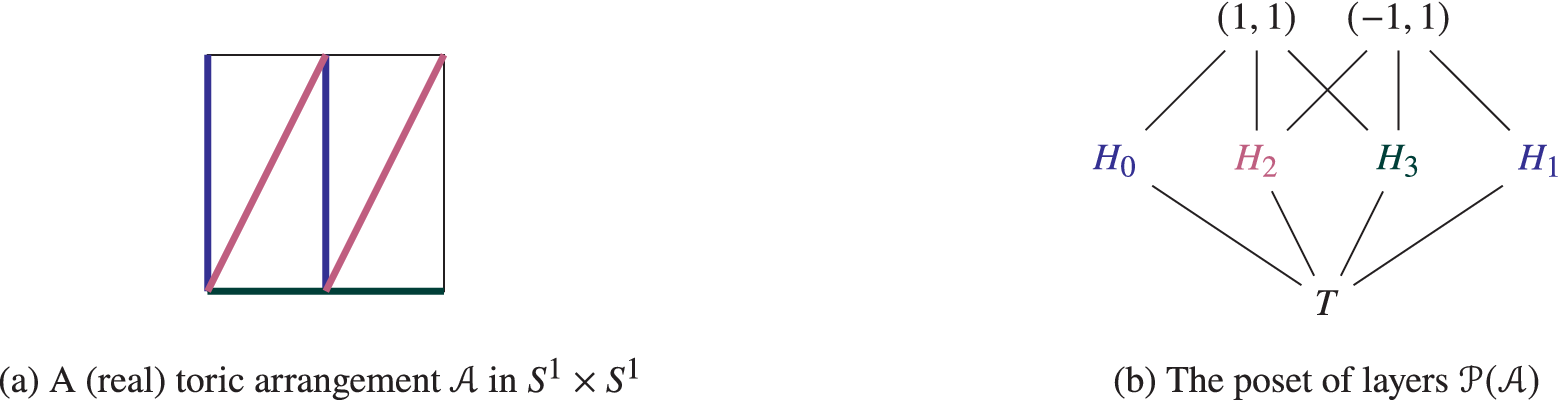
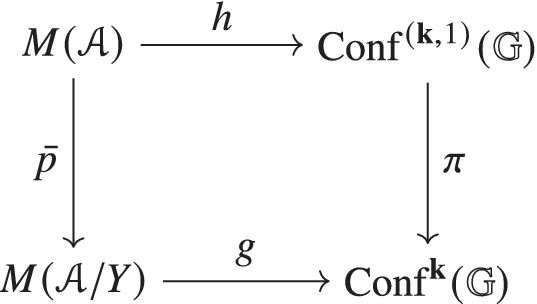
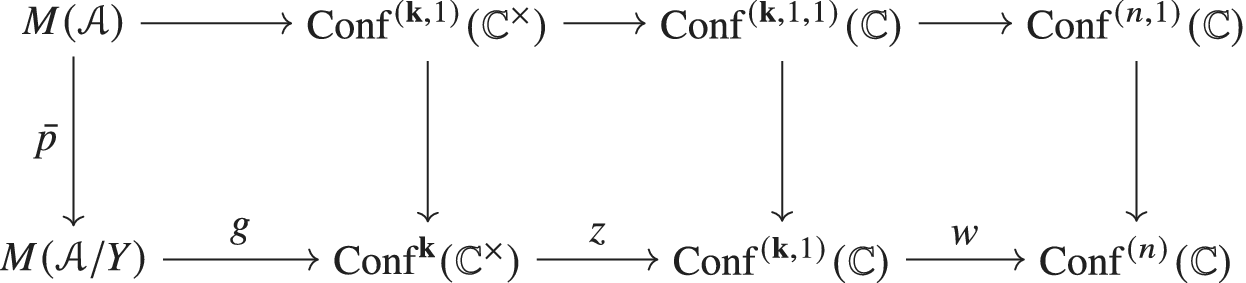
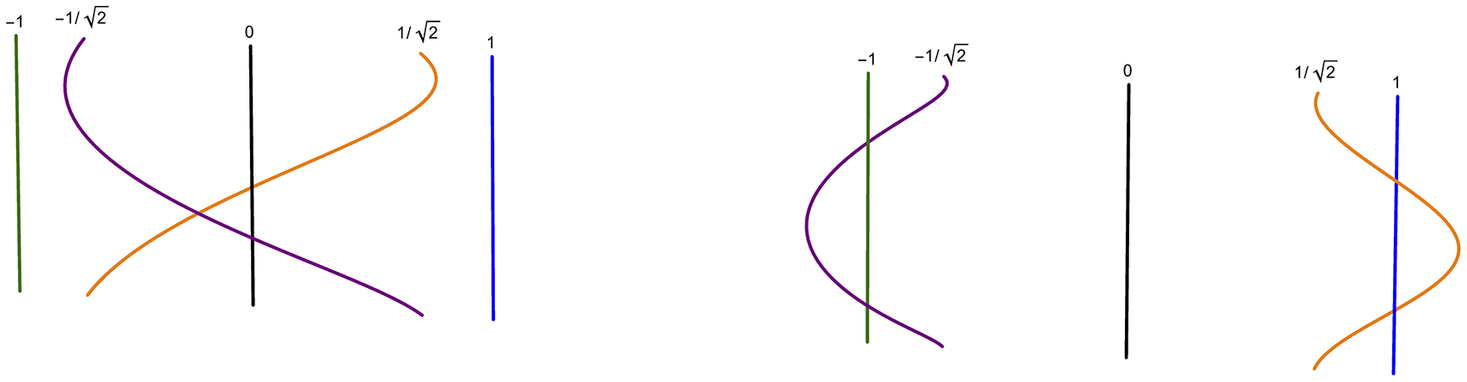


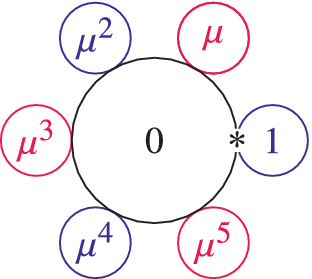


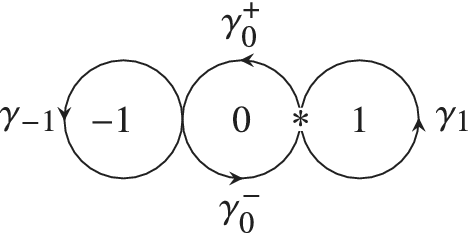


 Open access

