INTRODUCTION
The family Caristiidae, commonly known as manefish or veilfins, includes four genera (Caristius Gill & Smith, 1905; Neocaristius Stevenson & Kenaley, Reference Stevenson and Kenaley2011; Paracaristius Trunov, Kukuev & Parin, Reference Trunov, Kukuev and Parin2006; and Platyberyx Zugmayer, 1911) and nineteen recognized species (Trunov et al., Reference Trunov, Kukuev and Parin2006; Stevenson & Kenaley, Reference Stevenson and Kenaley2011, Reference Stevenson and Kenaley2013; Kukuev et al., Reference Kukuev, Parin and Trunov2012, Reference Kukuev, Parin and Trunov2013; Eschmeyer & Fong, Reference Eschmeyer and Fong2014). These fish are characterized by having relatively short heads, steep snouts, large eyes, deep and strongly compressed bodies, very long and high dorsal fins, greatly elongated pelvic fins (Trunov et al., Reference Trunov, Kukuev and Parin2006; Benfield et al., Reference Benfield, Caruso and Sulak2009; Stevenson & Kenaley, Reference Stevenson and Kenaley2011, Reference Stevenson and Kenaley2013; Kukuev et al., Reference Kukuev, Parin and Trunov2012, Reference Kukuev, Parin and Trunov2013), and for maintaining symbiotic relationships with siphonophores (Janssen et al., Reference Janssen, Gibbs and Pugh1989; Lindsay et al., Reference Lindsay, Hunt and Hayashi2001; Nelson, Reference Nelson2006; Benfield et al., Reference Benfield, Caruso and Sulak2009).
Manefish are found throughout the oceans of the world, but appear to be relatively uncommon (Trunov et al., Reference Trunov, Kukuev and Parin2006; Benfield et al., Reference Benfield, Caruso and Sulak2009; Stevenson & Kenaley, Reference Stevenson and Kenaley2011, Reference Stevenson and Kenaley2013; Kukuev et al., Reference Kukuev, Parin and Trunov2012, Reference Kukuev, Parin and Trunov2013). Larvae are epipelagic and juveniles occur from the epipelagic to the mesopelagic (Moser, Reference Moser and Moser1996; Beltrán-León & Ríos, Reference Beltrán-León and Ríos2000; Benfield et al., Reference Benfield, Caruso and Sulak2009; Jiménez-Rosenberg et al., Reference Jiménez-Rosenberg, Saldierna-Martínez, Aceves-Medina, Hinojosa-Medina, Funes-Rodríguez, Hernández-Rivas and Avendaño-Ibarra2010); while adults are mesopelagic and bathypelagic, occurring at depths ranging from 100 to 2000 m, but usually between 300 and 800 m (Benfield et al., Reference Benfield, Caruso and Sulak2009; Stevenson & Kenaley, Reference Stevenson and Kenaley2011, Reference Stevenson and Kenaley2013).
In the eastern Pacific region four species of manefish have been formerly recorded: Caristius macropus (Bellotti, Reference Bellotti1903) from the Bering Sea, and the west coast of Canada down to California; Paracaristius maderensis (Maul, Reference Maul1949), from the California Current region and the Colombian coasts; Paracaristius nudarcus Stevenson & Kenaley, Reference Stevenson and Kenaley2011 from off California and the Central Eastern Pacific; and Platyberyx andriashevi (Kukuev et al., Reference Kukuev, Parin and Trunov2012), a single record from off California, San Pedro Basin (Moser, Reference Moser and Moser1996; Beltrán-León & Ríos, Reference Beltrán-León and Ríos2000; Trunov et al., Reference Trunov, Kukuev and Parin2006; Stevenson & Kenaley, Reference Stevenson and Kenaley2011, Reference Stevenson and Kenaley2013). Notably, most records of Paracaristius maderensis in eastern Pacific waters are on the basis of juvenile specimens (Moser, Reference Moser and Moser1996; Beltrán-León & Ríos, Reference Beltrán-León and Ríos2000; Jiménez-Rosenberg et al., Reference Jiménez-Rosenberg, Saldierna-Martínez, Aceves-Medina, Hinojosa-Medina, Funes-Rodríguez, Hernández-Rivas and Avendaño-Ibarra2010), and only two adult specimens have been previously recorded from this region (see Trunov et al., Reference Trunov, Kukuev and Parin2006 for detailed localities).
In this paper the manefish family Caristiidae is reported for the first time on the Pacific coast of Central America on the basis of two specimens: an adult specimen of Paracaristius maderensis (215 mm standard length (SL)), captured on 15 June 1973 using a 3 m Isaacs-Kidd midwater trawl, at 103 km, 192.7° from Punta Burica, Panama (7°07′20.64″N 83°04′22.80″W), at a depth of 950–1000 m; and a juvenile specimen of Paracaristius sp. (17.5 mm SL), captured on video with the DeepSee submersible on 18 August 2013, at the Piedra Drop diving site on Isla del Coco National Park, Costa Rica (5°34′39.3″N 87°03′32.34″W), at a depth of 100 m. A brief description of these specimens as well as comparative morphometric data and distributional information are presented. Additionally, we document the association of Paracaristius sp. with the siphonophore Praya reticulata (Bigelow, Reference Bigelow1911), also captured on video with the DeepSee submersible. A brief description of the siphonophore and comparative distributional information are also provided.
MATERIALS AND METHODS
The adult specimen of Paracaristius maderensis was deposited at the Fish Collection of the Museo de Zoología, Universidad de Costa Rica (UCR-Velero-IV 19073). Counts and measurements (Table 1) were taken on the left side of the specimen and follow those in Hubbs & Lagler (Reference Hubbs and Lagler1958). Measurements were made using a caliper to the nearest 1 mm. Comparative information was obtained from Trunov et al. (Reference Trunov, Kukuev and Parin2006), Stevenson & Kenaley (Reference Stevenson and Kenaley2011, Reference Stevenson and Kenaley2013) and Kukuev et al. (Reference Kukuev, Parin and Trunov2012, Reference Kukuev, Parin and Trunov2013).
Morphometric and meristic data of Paracaristius maderensis from Panama (UCR-Velero-IV 19073) and comparative material (data from Stevenson & Kenaley, Reference Stevenson and Kenaley2011): morphometric data expressed as percentages of standard length (SL), except when indicated as percentages of head length (HL).

The juvenile specimen of Paracaristius sp. and the siphonophore were recorded on video, taken with a high-definition digital camera mounted on the DeepSee submersible (see Cortés & Blum, Reference Cortés and Blum2008 for details). Video was recorded on mini-DV tapes and then digitized to a QuickTime format. Image grabs for examination were obtained in the laboratory using the iMovie and the FinalCut software (Apple Inc.).
The descriptions in Moser (Reference Moser and Moser1996), Beltrán-Léon & Ríos (Reference Beltrán-León and Ríos2000), Jiménez-Rosenberg et al. (Reference Jiménez-Rosenberg, Saldierna-Martínez, Aceves-Medina, Hinojosa-Medina, Funes-Rodríguez, Hernández-Rivas and Avendaño-Ibarra2010) and Stevenson & Kenaley (Reference Stevenson and Kenaley2011, Reference Stevenson and Kenaley2013) were used to identify the juvenile specimen of Paracaristius sp. The siphonophore was identified and compared with the descriptions by Pugh (Reference Pugh and Boltovskoy1999) and Mapstone (Reference Mapstone2009); terminology of the gastrovascular canals, which are an important taxonomic feature, follows that given in Haddock et al. (Reference Haddock, Dunn and Pugh2005) with modifications by Mapstone (Reference Mapstone2009).
RESULTS
SYSTEMATICS
Order PERCIFORMES
Family CARISTIIDAE
Genus Paracaristius Trunov, Kukuev & Parin, Reference Trunov, Kukuev and Parin2006
(Figures 1 & 2)
Paracaristius maderensis, adult specimen, 215 mm standard length (UCR-Velero-IV 19073), caught off Panama. Scale bar: 20 mm.

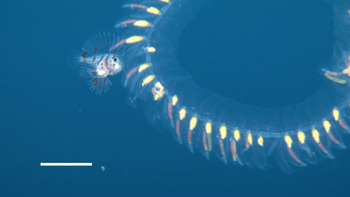
Paracaristius sp., juvenile specimen, 17.5 mm standard length, and siphosome of Praya reticulata, photographed off Isla del Coco National Park, Costa Rica, at a depth of 100 m. Scale bar: 20 mm.

DESCRIPTION
The adult specimen (Paracaristius maderensis; Figure 1) had a rectangular body, brown in colour; head laterally compressed, deep, and relatively short, with the anterior profile rounded; snout extremely compact; mouth relatively large, upper jaw with the posterior margin extending nearly to mid-orbit; dentary and premaxillary teeth in 2–3 indistinct rows along most of dentary and premaxilla, diminishing to a single row only near posterior terminus of dentition; vomerine teeth absent; pharyngobranchial teeth long and needle-like, approximately of the same length as rakers of first gill arch; eye relatively large; suborbital space relatively broad, completely covered with scales; fingerlike papillae absent along dorsal margin of hyoid arch and at articulation of interhyal and posterior ceratohyal; scales on body irregular in size, not arranged in distinct rows; lateral line absent; predorsal distance relatively short, dorsal-fin originating posterior to dorsal end of preopercle; and pectoral, pelvic, and anal fins elongate, delicate and black. Additional morphometric and meristic data of specimen and comparative information are given in Table 1.
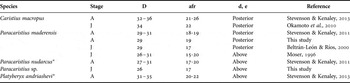
The juvenile specimen of Paracaristius sp. (Figure 2) had a teardrop-shaped body, with its maximum depth about 59% of the SL; silvery-white coloured, with six vertical black bands: (1) crossing the eye, (2) in the upper region of the gill opening, (3) in the lower horizontal half of the body near the pectoral fin, (4) above the origin of the anal fin to the dorsal fin base, (5) located up to the posterior half of the anal fin and (6) a thicker band than the others located in the caudal peduncle; and a relatively large head, about 42% of SL; transparent fan-like fins (pelvic and dorsal fins with several black blotches); dorsal relatively long, its base 77% of SL; and anal fin relatively short, its base 26% of SL. According to Moser (Reference Moser and Moser1996), this specimen matches well with the description of Paracaristius maderensis; however, it is important to note that the early stage of the recently described Paracaristius nudarcus, also present in the region, has not yet been adequately described; thus, our identification remains at the generic level. Some comparative morphological data from adults and juveniles of all eastern Pacific manefish species are given in Table 2.
Comparison of some meristic characters (dorsal and anal fin counts) and position of the dorsal fin origin relative to the eye of adults and juveniles of the four species of Caristiidae known to occur in the eastern Pacific region. Stage: A, adult; J, juvenile. D, dorsal fin rays. afr, anal fin rays; d, e, position of the origin of the dorsal fin relative to the eye; *, juvenile description not available.

SYSTEMATICS
Order SIPHONOPHORAE
Family PRAYIDAE
Genus Praya Quoy & Gaimard, Reference Quoy and Gaimard1834
Praya reticulata (Bigelow, Reference Bigelow1911)
(Figures 2 & 3)
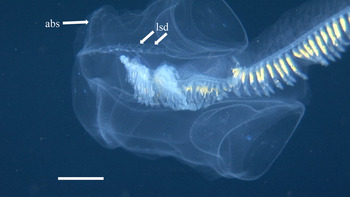
Praya reticulata, detail of the definitive nectophores. Abs, ascending branch of somatocyst; lsd, lateral surface diverticulum. Scale bar: 20 mm.

DESCRIPTION
Colony up to 100 cm in length (Figure 2), with definitive nectophores with a baso-ventral extension below the ostium of the nectosac (Figure 3), radial canals of nectosac with many anastomoses which form a reticulated pattern; ascending surface diverticulum with many short lateral branches; and somatocyst consisting of a single median ascending branch only. The bracts, although not visible in the video, are described by Pugh (Reference Pugh and Boltovskoy1999) and Mapstone (Reference Mapstone2009) as having a long upper canal curving in the direction of hydroecial lobe, and the anterior hydroecial canal is also long and curves distally. This species can be distinguished from its other eastern Pacific congener Praya dubia Quoy & Gaimard (Reference Quoy and Gaimard1834) in having several short lateral branches that rise from the ascending surface diverticulum (vs two subdividing lateral branches in P. dubia) and several anastomosing radial canals of the nectosac (vs bifurcating canals in P. dubia) (Pugh, Reference Pugh and Boltovskoy1999; Mapstone, Reference Mapstone2009).
FISH–SIPHONOPHORE ASSOCIATION
The observations of the fish–siphonophore association were made during a DeepSee submersible immersion at the Piedra Drop diving site, on 18 August of 2010, between 15:20 and 15:24 h, at a depth of 100 m (bottom depth = 315 m). The manefish was observed swimming freely very close to Praya reticulata while the colony was moving. During that time no predation events or other specific interactions were recorded.
Horizontal and vertical displacements of the fish and the siphonophore were observed. The fish, always in close contact with the gastrozoids showed at all times the pelvic fins in a broadly expanded or parachute-like position, making only slight movements. Most of the time, the fish was observed swimming, in a normal position (horizontal), with the anterior region directed to the oral end of the gastrozoids, and using only pectoral and pelvic fins' flapping movements. Vertical sinusoidal movements of the caudal fin were also observed while the fish showed a nearly vertical head down position in both vertical and horizontal displacements; these displacements were performed in order to follow the serpentine movements of the siphonosome. No specific interaction between a single zooid and the fish was recorded.
DISCUSSION
In general terms, observations of associations between fish and siphonophores are rare (Purcell & Arai, Reference Purcell and Arai2001), and details about these associations are relatively well known in only a few cases, e.g. Caranx malabaricus (Bloch & Schneider, 1801) with Porpita porpita (Noble, Reference Noble1963) and Nomeus gronovii (Gmelin, 1789) with Physalia physalis (Arai, Reference Arai1988). In the few cases reported, adult fish are known to feed on the siphonophores (Jenkins, Reference Jenkins1983; Purcell & Arai, Reference Purcell and Arai2001), whereas juvenile fish shelter among their tentacles, steal prey and/or eat part or the whole animal (Biggs, Reference Biggs1976; Purcell & Arai, Reference Purcell and Arai2001). In caristiid fish all these scenarios appear to be feasible (e.g. Caristius sp. has been observed stealing food and eating parts of the cystonect siphonophore Bathyphysa conifera (Janssen et al., Reference Janssen, Gibbs and Pugh1989); unidentified caristiid juveniles have been observed associated with the siphosome of an unidentified Praya species (Lindsay et al., Reference Lindsay, Hunt and Hayashi2001); and adult specimens of Paracaristius sp. have been observed in close proximity of damaged siphonophores of the family Apolemiidae, suggesting that the damage observed in the colony might have been produced by these fish (Benfield et al., Reference Benfield, Caruso and Sulak2009)).
Until now a specific association between Paracaristius and Praya reticulata has not been properly described in the literature. Our observations, preliminary and very limited in space and time, suggest that the presence of the Paracaristius sp. juvenile does not disturb to Praya reticulata, and that the fish uses the siphonophore as a shelter. These results are consistent with what has been observed in other caristiid species (see above). Based on our observations we cannot conclude that the fish feeds on the siphonophore; however, given the evidence (e.g. Janssen et al., Reference Janssen, Gibbs and Pugh1989), this hypothesis cannot be rejected.
In this sense, the morphology of the fish (Figure 2) could indicate that the prey it eats is probably stolen from the siphonophore (as reported by Janssen et al., Reference Janssen, Gibbs and Pugh1989 in Caristius sp.); given that these fish are not shaped like a typical pelagic predator, but have a tear drop shaped body and fan-like fins, characteristics of fish that manoeuvre around objects. Benfield et al. (Reference Benfield, Caruso and Sulak2009) suggested that the parachute-like position exhibited by the fish during the time that was observed provides greater stability when swimming in close proximity to siphonophores. Ting & Yang (Reference Ting and Yang2008) suggested that the vertical sinusoidal movement of the caudal fin also exhibited by the fish, termed caudal fin-wave propagation, is adaptive in providing stabilization during head-down postures, as we also noted. All these factors could explain why the fish was observed swimming very close to Praya reticulata while the colony was moving.
Adult Paracaristius maderensis, of circumtropical distribution (Figure 4), are found at depths of 100 to 2000 m (Trunov et al., Reference Trunov, Kukuev and Parin2006; Stevenson & Kenaley, Reference Stevenson and Kenaley2011; Froese & Pauly, Reference Froese and Pauly2014). Juveniles have been collected at depths between 44 and 285 m on the Pacific coast of Colombia (Beltrán-León & Ríos, Reference Beltrán-León and Ríos2000), and have been captured on video at depths between 496 and 829 m in the northern Gulf of Mexico (Benfield et al., Reference Benfield, Caruso and Sulak2009). In the eastern Pacific region, this species has been previously recorded in the California Current region (Moser, Reference Moser and Moser1996; Jiménez-Rosenberg et al., Reference Jiménez-Rosenberg, Saldierna-Martínez, Aceves-Medina, Hinojosa-Medina, Funes-Rodríguez, Hernández-Rivas and Avendaño-Ibarra2010), and off the Colombian central coast (Beltrán-León & Ríos, Reference Beltrán-León and Ríos2000) (Figure 4). Other species in the genus have similar horizontal and vertical distribution patterns (see Trunov et al., Reference Trunov, Kukuev and Parin2006 and Stevenson & Kenaley, Reference Stevenson and Kenaley2011 for details). Praya reticulata, also of circumglobal distribution (Figure 4), is found at depths of 50 to 4380 m (Alvariño, Reference Alvariño1971; Shih et al., Reference Shih, Figueira and Grainger1971; Mapstone, Reference Mapstone2009). In the eastern Pacific region this species has been previously recorded in the Subartic Province (Stepanjants, Reference Stepanjants1967), in the California Current region, where it seems to be more common than Praya dubia (Bigelow, Reference Bigelow1931; Alvariño, Reference Alvariño1971, Reference Alvariño1991; Shih et al., Reference Shih, Figueira and Grainger1971; Mills, Reference Mills1981; Mapstone, Reference Mapstone2009), in equatorial waters (Alvariño, Reference Alvariño1971), and in the southern portion of the eastern Pacific, including the Subantartic Province (Totton, Reference Totton1965). The overlap in the horizontal and vertical distribution of Paracaristius species and Praya reticulata suggests that this association may be common in epi- and mesopelagic waters worldwide. Although the encounter reported here is a short-term observation, and the specific identification of the manefish is provisional, this study increases the information of the siphonophore association and in situ behaviour of this unusual group of fish.
Distribution of Paracaristius maderensis (squares) and Praya reticulata (circles) (Alvariño, Reference Alvariño1971; Shih et al., Reference Shih, Figueira and Grainger1971; Trunov, Reference Trunov, Kukuev and Parin2006; Mapstone, Reference Mapstone2009; Stevenson & Kenaley, Reference Stevenson and Kenaley2011); stars indicate the present records (closed star, adult P. maderensis; open star, Paracaristius sp. and P. reticulata).

The discovery of these specimens in Costa Rican and Panamanian waters, particularly this new record of Paracaristius maderensis, increases the knowledge about our marine fauna and provides evidence of a broader distributional pattern for these species in the eastern Pacific region.
Supplementary material and methods
The supplementary material referred to in this article can be found online at journals.cambridge.org/mbdcup.
ACKNOWLEDGEMENTS
The authors are grateful to William A. Bussing (1933–2014) to whom we dedicate this paper, and to Myrna I. López, Ana R. Ramírez and the authorities of the Museo de Zoología and the Centro de Investigación en Ciencias del Mar y Limnología (CIMAR) of the Universidad de Costa Rica for encouragement and facilities. The submarine video was obtained with the support of the Undersea Hunter Group, the Vicerrectoría de Investigación of the Universidad de Costa Rica, and the CIMAR, with the permits of the Área de Conservación Marina Isla del Coco (ACMIC) and the Isla del Coco National Park. The authors are also grateful to Duane E. Stevenson, Steve H.D. Haddock and two anonymous referees for helpful comments.