I. INTRODUCTION
Titanium dioxide nanotube arrays (TiO2 NT arrays) have received considerable attention because of their large surface area, robust photocatalytic activity, and vectorial charge transfer properties. Reference Gong, Grimes and Varghese1–Reference Dutta, Patra, De, Bhaumik and Saha6 However, practical application of these materials is restricted by the intrinsic wide band gap of TiO2 (3.0–3.2 eV), which limits its photocatalytic activity in the visible light region. An additional drawback of TiO2 NT arrays is the high recombination rate of photogenerated electron–hole pairs resulting in low photocatalytic efficiency. To surmount these problems, considerable efforts have been undertaken to extend the optical absorption of TiO2 NT arrays into the visible range and lower the recombination rate of electrons and holes. These remedial techniques have included metal or nonmetal ion doping, Reference Asahi, Morikawa, Ohwaki, Aoki and Taga7,Reference Antony, Mathews, Panda, Sundaravel, Dash and Tyagi8 dye sensitization, Reference Ye, Gong, Lai, Lin and Lin9,Reference Guo, Xue, Wang, Lin and Wang10 narrow band gap semiconductor coupling, Reference Hou, Li, Zhao, Chen and Raston11 and noble metal modification. Reference Liu, Hou, Pavaskar, Aykol and Cronin12–Reference Xie, Wu, Wang, Guo, Wang and Sun16
In particular, noble metal-modified TiO2 NT arrays have become the focus of many studies due to the surface plasmon resonance (SPR) effect. Reference Atwater and Polman17,Reference Mayer and Hafner18 It has been reported that this approach may extend the visible light absorption by TiO2. Reference Tian and Tatsuma19–Reference Mubeen, Hernandez, Moses, Lee and Moskovits21 Besides the noble metals, silver (Ag) may also be of an attractive modifier due to its strong resonance wave length of 400–550 nm and lower cost in comparison to noble metals (e.g., gold (Au), platinum (Pt)). Reference Rycenga, Cobley, Zeng, Li, Moran and Zhang22 These advantages make Ag a good candidate for modification of TiO2 NT arrays. Modification of TiO2 NT arrays using Ag can enhance the visible light absorption and reduce the recombination rate of photogenerated electron–hole pairs in TiO2 NT arrays. Zhang et al. Reference Zhang, Peng, Wang, Yu, Zhang and Yang23 prepared Ag nanoparticles to n-dope TiO2 NT arrays (Ag/N-TiO2 NT arrays) using an electrochemical method and observed enhanced photocatalytic activity under visible light. The authors attributed this improved photocatalysis to the enhanced light harvesting SPR effect of Ag nanoparticles. Xie et al. Reference Xie, Sun, Wang, Lai, Wang, Chen and Lin14 reported that the enhanced photocatalytic degradation rate of Ag/TiO2 NT arrays under visible light irradiation was facilitated by the SPR effect of Ag. It is well known that both the size and shape of noble metal nanoparticles are the key parameters in determining the SPR effect. Reference Rycenga, Cobley, Zeng, Li, Moran and Zhang22 However, most research is currently focused on the preparation and general applications of Ag/TiO2 NT arrays nanocomposites. The correlation between the size of Ag particles on the TiO2 NT arrays and the photocatalytic activity of resulting Ag/TiO2 NT arrays nanostructures has not been well researched.
In this article, TiO2 NT arrays decorated with Ag particles were prepared using a two-step procedure which included an electrochemical anodization process followed by a photochemical reduction method. The dependence of photocatalytic activity on Ag nanoparticles size was determined by measuring the degradation of dissolved methyl orange (MO) under visible light irradiation. In addition, the photocatalytic mechanism of Ag/TiO2 NT arrays was discussed.
II. MATERIALS AND METHODS
A. Synthesis
Highly ordered TiO2 NT arrays were fabricated on a Ti substrate by electrochemical anodic oxidation. All chemical reagents (Shanghai Chemical Company, China) were of analytical grade and used without further purification. The Ti foils (99.5% purity, Alfa Aesar, size 3 cm × 1.5 cm) were ultrasonically cleaned in acetone, ethanol, and distilled water in succession, then dried in an oven prior to anodization. A two-electrode electrochemical cell was used for the anodic oxidation with Ti foil as the working electrode and a platinum foil as the counter electrode. The anodization was carried out under a constant 20 V anodic potential for 2 h at room temperature (approximately 25 °C). The electrolyte for the experiments was an aqueous solution of 0.2 M H3PO4 and 0.3 M NH4F equilibrated at pH 1.5, similar to the method described by Liu et al. Reference Liu, Yang, Qiang and Wu24 Following anodic oxidation, the TiO2 NT arrays were rinsed with distilled water and dried in an oven. The as-prepared amorphous TiO2 NT arrays were annealed at 450 °C for 2 h with heating and cooling rates of 3 °C min−1 in an ambient air atmosphere.
The Ag/TiO2 NT arrays were prepared by photochemical reduction method. Reference Sun, Li, Wang, Li, Lai and Chen25 This consisted of immersing the TiO2 NT arrays in 0.2 M silver nitrate (AgNO3) solution at room temperature for 24 h followed by rinsing with distilled water. Subsequently, the TiO2 NT arrays were immersed in methanol (a hole scavenger) and irradiated with a 16 W low-pressure Hg Lamp (λmax = 365 nm) for set time periods (15, 30, and 60 min respectively) to reduce the Ag+ cations to metallic Ag nanoparticles. Finally, the as-prepared samples were rinsed with distilled water and dried at 70 °C for 1 h.
B. Characterization
The morphology of the prepared Ag/TiO2 NT arrays was characterized using a field emission scanning electron microscope (SEM; model JSM-6700F, JEOL, Tokyo, Japan). To observe the microstructure and elemental composition of the Ag/TiO2 NT arrays, the sample was prepared on carbon-coated copper grids to facilitate observation by the transmission electron microscopy (TEM; model JEM2010, JEOL, Tokyo, Japan, operated at 200 kV) equipped with energy dispersive x-ray spectroscopy detector. The crystal structures of the samples were analyzed using a Bruker D8 advanced x-ray diffractometer (XRD; D8A25, Bruker, Germany). The UV-visible diffuse reflectance spectrometry was obtained using a UV-visible spectrophotometer (UV-vis; model UV-3100, Shimadzu, Kyoto, Japan) equipped with an integrating sphere, and BaSO4 was used as a reflectance standard.
C. Photocatalytic measurement
The photocatalytic activity of the samples was evaluated by the chemical degradation of a methyl orange dye in aqueous solution (10 mg/L). A 300 W halogen tungsten lamp with an UV cut off filter was used as the visible light source (λ > 400 nm). The prepared samples (fixed size 1.5 cm × 1.5 cm) were individually placed in the bottom of a reactor. The photocatalytic system was kept in the dark for 30 min to establish adsorption–desorption equilibrium prior to visible light irradiation. The absorbance changes of methyl orange were monitored by measuring the maximum absorption of the solution at 464 nm using an UV-visible spectrophotometer (UV-vis; model UV-3100, Shimadzu, Tokyo, Japan). All the experiments were performed at 30 °C with continuous sparging of air in the solution.
III. RESULTS AND DISCUSSION
A. Characterization of samples
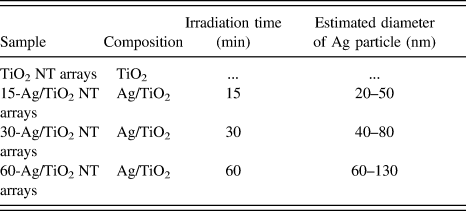
Figures 1(a)–1(d) show the SEM images of TiO2 NT arrays, and the Ag/TiO2 NT arrays prepared using UV light irradiation exposures of 15 min (15-Ag/TiO2 NT arrays), 30 min (30-Ag/TiO2 NT arrays), and 60 min (60-Ag/TiO2 NT arrays), respectively. As shown in Fig. 1(a) and the inset image, the nascent TiO2 NT arrays were highly ordered and vertically aligned. These TiO2 NT arrays exhibited a diameter of approximately 100 nm and a tube length of up to 700 nm. The UV photochemical reduction process yielded silver nanoparticles (Ag NPs) of varying sizes attached to the TiO2 NT arrays. The average size of 15-Ag/TiO2 NT arrays, 30-Ag/TiO2 NT arrays, and 60-Ag/TiO2 NT arrays was about 30, 60, and 90 nm, respectively. It appeared that the size of Ag NPs on the TiO2 NT arrays increased directly in response to the duration of the UV light irradiation time, as listed in Table I.
SEM images of TiO2 NT arrays (a) and Ag/TiO2 NT arrays obtained under different UV irradiation time: 15 min (b), 30 min (c), and 60 min (d). The inset in (a) is the corresponding cross-section image; the inset in (b) is the corresponding enlarged image.

Experimental condition for the preparation of the samples and their corresponding physical properties.

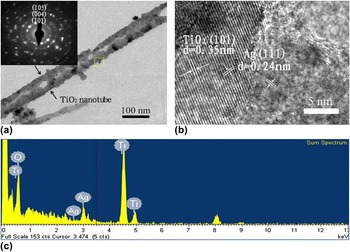
The morphology of 15-Ag/TiO2 NT arrays was further investigated using TEM. Figure 2(a) shows the TEM image of 15-Ag/TiO2 NT arrays revealing that the channels of nanotubes contained Ag NPs. The inset in Fig. 2(a) shows the selective area electron diffraction (SAED) pattern of the TiO2 NT arrays displaying several diffraction rings which can be indexed to tetragonal anatase TiO2 (101), (004), and (105) planes. Figure 2(b) is a high magnification TEM image taken from the yellow square area in Fig. 2(a). The lattice spacings of 0.35 nm and 0.24 correspond to the interplanar spacing of the anatase TiO2 (101) plane and the Ag (111) plane, respectively. Reference Gao, Fang, Chen, Liu, Liu and Wang26 The composition of the 15-Ag/TiO2 NT arrays was determined by EDX [Fig. 2(c)]. The EDX spectrum confirmed the presence of Ag on the 15-Ag/TiO2 NT arrays sample.
TEM images of 15-Ag/TiO2 NT arrays at (a) low magnification, (b) high magnification, and (c) its corresponding EDX spectrum. The inset in (a) shows the corresponding SAED pattern of TiO2 NT arrays.

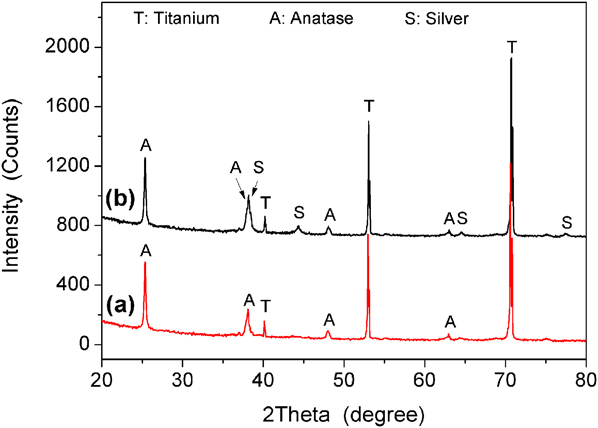
Figure 3 shows the XRD patterns of the TiO2 NT arrays and the 15-Ag/TiO2 NT arrays. The peaks attributable to the metal Ti phase may result from the Ti substrate of samples (Joint Committee on Powder Diffraction Standards (JCPDS) card No. 44-1294). Referring to the TiO2 NT arrays sample [Fig. 3(a)], the peaks at 2θ = 25.3°, 37.8°, 48.1°, and 62.7° are characteristic of the crystalline phase of anatase TiO2 (JCPDS card No. 84-1286). For the Ag/TiO2 NT arrays sample [Fig. 3(b)], three additional peaks at 2θ = 44.3°, 64.4°, and 77.4° are observed, which correspond to the characteristic peaks of metallic Ag (200), (220), and (311) planes, respectively (JCPDS #87-0717). However, the Ag peak at 2θ = 38.1° may be obscured by the anatase TiO2 peak at 2θ = 37.8°. Reference Zhang, Peng, Wang, Yu, Zhang and Yang23 The XRD patterns of Ag/TiO2 NT arrays reveal that metallic Ag NPs were deposited on the TiO2 NT arrays in accordance with the EDX results.
XRD patterns of (a) TiO2 NT arrays annealed at 450 °C and (b) 15-Ag/TiO2 NT arrays.

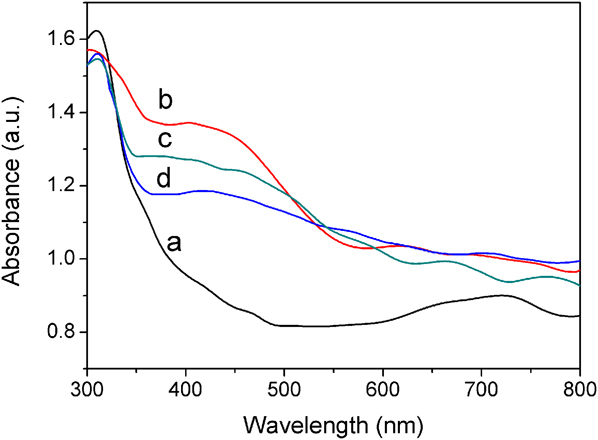
The optical properties of TiO2 NT array and Ag/TiO2 NT array samples were investigated using ultraviolet-visible diffuse reflectance spectroscopy (UV-vis DRS). As shown in Fig. 4, the absorption edge at a wave length lower than 380 nm can be assigned to the intrinsic band gap absorption of anatase TiO2. Reference Asahi, Morikawa, Ohwaki, Aoki and Taga7 The plasmon absorption of the Ag NPs, the Ag/TiO2 NT array samples (Fig. 4, curve b–d) yields a broad plasmon absorption peak at around 450 nm. It is worth noting that the 15-Ag/TiO2 NT arrays show an enhanced visible light absorption region (wave length 400–500 nm) compared with other samples due to the effect of SPR, which was dominated by absorption of the small nanoparticle-sized Ag deposits. Reference Jain, Lee, El-Sayed and El-Sayed27
UV-vis diffuse reflectance spectra of (a) TiO2 NT arrays, (b) 15-Ag/TiO2 NT arrays, (c) 30-Ag/TiO2 NT arrays, and (d) 60-Ag/TiO2 NT arrays.

B. Photocatalytic activity evaluation
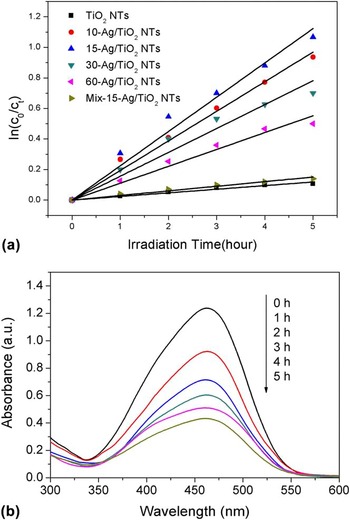
The photocatalytic activity of the prepared samples was evaluated by degradation of methyl orange (MO) under visible light irradiation. Prior to irradiating the MO solution with visible light, an adsorption–desorption equilibrium was achieved. Figure 5(a) shows the degradation curves of MO when exposed to the catalysts and light. The kinetic behavior of photocatalytic degradation of MO can be expressed by the following Langmuir–Hinshelwood mechanism Reference Matthews28 :
 $$\ln \left( {{{{C_0}} \mathord{\left/ {\vphantom {{{C_0}} {{C_{\rm{t}}}}}} \right. \kern-\nulldelimiterspace} {{C_{\rm{t}}}}}} \right) = kt$$
where k is the apparent rate constant of pseudo-first-order reaction, t is the reaction time, C 0 and C t are the initial concentration and the residual concentration of MO aqueous solution, respectively.
(a) MO photodegradation kinetic curves of TiO2 NT arrays and Ag/TiO2 NT arrays samples under visible light irradiation. (b) Temporal absorption spectral patterns of MO during the photodegradation process in the 15-Ag/TiO2 NT arrays sample.

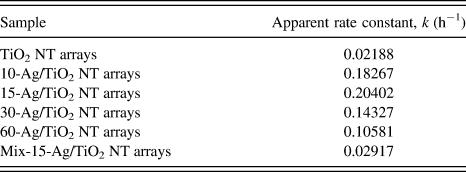
The corresponding kinetic constants and regression coefficients of MO degradation are provided in Table II. The k value of 15-Ag/TiO2 NT arrays (∼0.20402 h−1) is 1.2, 1.4, 1.9, and 9.3 times greater than that of the 10-Ag/TiO2 NT arrays (∼0.18267 h−1), 30-Ag/TiO2 NT arrays (∼0.14327 h−1), 60-Ag/TiO2 NT arrays (∼0.10581 h−1), and TiO2 NT arrays (∼0.02188 h−1), respectively. A larger photocatalytic reaction rate constant implies higher photocatalytic activity. These results indicate that the 15-Ag/TiO2 NT arrays exhibit the highest photocatalytic activity. Meanwhile, for the Ag/TiO2 NT arrays samples, the photodegradation ratio of MO increases with the decreasing Ag particles size. The results of photocatalytic activity experiment reveal that the Ag particle size has a significant effect on the photocatalytic activities of Ag/TiO2 NT array samples. Additionally, the experiment is performed in the way that 15-Ag NPs (0.2 M silver nitrate solution is exposed using UV light irradiation of 15 min) and TiO2 NT arrays are synthesized separately and then physically mixed together (Mix-15-Ag/TiO2 NT arrays). The results show that the photocatalytic activity of Mix-15-Ag/TiO2 NT arrays is similar to that of TiO2 NT arrays. Therefore, it is seen that the 15-Ag/TiO2 interfaces play an important role in the electron transfer. Figure 5(b) shows the UV-vis spectra of MO in situ degraded on the 15-Ag/TiO2 NT arrays under visible light irradiation. As shown, the characteristic absorption peaks of MO decreases over time. The results indicate that the Ag NPs modification significantly improves the photocatalytic activities of TiO2 NT arrays under visible light irradiation. This enhancement of the photocatalytic activity may be attributed to faster electron transport and more efficient separation of the plasmon-generated electrons and holes in the Ag NPs modified TiO2 NT arrays. In other words, the plasmon-induced electrons are transported from the surface of Ag NPs to the conduction band of TiO2, which react with the dissolved molecular oxygen in the dye solution rather than recombining with the generated holes.
Photocatalytic kinetic rate constants of TiO2 NT array and Ag/TiO2 NT array samples under visible light irradiation.

C. Photocatalytic mechanism
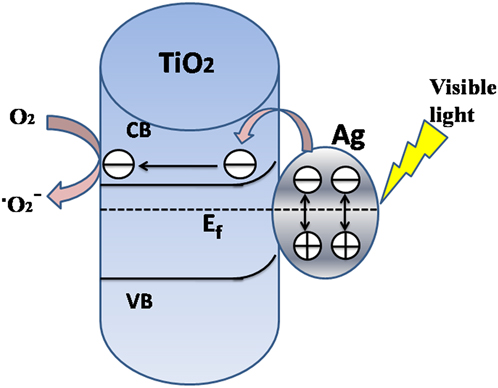
On the basis of reported results, a possible mechanism for the increased photocatalytic activities of Ag/TiO2 NT arrays under visible light irradiation is shown in Fig. 6. The scheme illustrates the transfer processes of photogenerated electrons and holes in the catalytic system of Ag/TiO2 NT arrays. The relevant formula reactions are summarized as follows:
 $${\rm{Ag}} + {\rm{visible}}\;{\rm{light}} \to {\rm{Ag}}\left( {{{\rm{e}}^ - } + {{\rm{h}}^ + }} \right)$$
 $${\rm{Ag}}\left( {{{\rm{e}}^ - } + {{\rm{h}}^ + }} \right) + {\rm{Ti}}{{\rm{O}}_2} \to {\rm{Ag}}\left( {{{\rm{h}}^ + }} \right) + {\rm{Ti}}{{\rm{O}}_2}\left( {{{\rm{e}}^ - }} \right)$$
 $${\rm{Ti}}{{\rm{O}}_2}\left( {{{\rm{e}}^ - }} \right) + {{\rm{O}}_2} \to {\rm{Ti}}{{\rm{O}}_2} + {\rm{O}}_2^ -$$
 $$2{{\rm{e}}^ - } + {{\rm{O}}_2} + 2{{\rm{H}}^ + } \to {{\rm{H}}_2}{{\rm{O}}_2}$$
 $${{\rm{H}}_2}{{\rm{O}}_2} + {\rm{O}}_2^ - \to \bullet {\rm{OH}} + {\rm{O}}{{\rm{H}}^ - } + {{\rm{O}}_2}$$
 $$\bullet {\rm{OH}} + {\rm{MB}} \to {\rm{degradation}}\;{\rm{products}}$$
Schematic diagram for the charge separation and migration process of Ag/TiO2 NT arrays under visible light irradiation.

The visible light photon produces the surface plasmon resonance through energy transfer, which promotes the electrons of Ag NPs to an excited state by SPR [Eq. (2)]. Reference Lee, Kim, Kim and Sung29 Subsequently, the excited electrons from the Ag NPs are quickly transferred to TiO2 conduction band, Reference Xie, Sun, Wang, Lai, Wang, Chen and Lin14,Reference Linic, Christopher and Ingram30 while Ag is converted to the Ag+ [Eq. (3)]. The injected electrons on the TiO2 NT arrays react with dissolved molecular oxygen to yield superoxide radical anions (O2 −) [Eq. (4)] and hydrogen peroxide H2O2 [Eq. (5)] in oxygen-equilibrated media. These new formed intermediates can interact to produce hydroxyl radical •OH [Eq. (6)] which effectively degrades the dye molecules to various products [Eq. (7)]. Reference Gao, Fang, Chen, Liu, Liu and Wang26,Reference Wu, Yu and Fu31
As shown in equation, most of the photogenerated electrons were produced by the Ag NPs since the TiO2 NT arrays cannot utilize visible light to generate electron–hole pairs. Ag nanoparticle size plays an important role in dominating the light extinction behavior (e.g., the sum of light absorption and scattering). Reference Mayer and Hafner18 For smaller metal particles (<∼30 nm), particle light absorption is more prevalent than light scattering. As the metal particle size increases, light scattering becomes the dominant process. Reference Rycenga, Cobley, Zeng, Li, Moran and Zhang22 Therefore, the dependency of the photocatalytic activity of the Ag/TiO2 NT arrays on the particle size of the resident Ag NPs can be explained as follows: (i) for smaller Ag NPs (i.e., 15-Ag/TiO2 NT arrays), the incident visible light is strongly absorbed by Ag NPs. Electrons near the Fermi level of Ag (E f) are excited to surface plasmon states. A fraction of these excited electrons transfer from Ag NPs to nearby TiO2 NT arrays, leading to higher photocatalytic degradation efficiency. (ii) By contrast, the larger Ag NPs (i.e., 30-Ag/TiO2 NT arrays, 60-Ag/TiO2 NT arrays) are more efficient at scattering visible light, so that there are fewer excited electrons available than with the smaller Ag NPs. The scattered visible light cannot be absorbed by TiO2 NT arrays due to its wide band gap. As a result, fewer excited electrons are injected into the conduction band of TiO2 NT arrays, and the photocatalytic activity of larger particle Ag-decorated TiO2 NT arrays is muted in comparison to the smaller particle Ag.
IV. CONCLUSION
Ag/TiO2 NT arrays were synthesized using a novel anodization and photoreduction process. The dependence of photocatalytic activity on Ag NPs size was found to be a crucial factor in the visible light absorption efficiency and subsequent photocatalytic degradation efficiency of the modified TiO2 NT arrays. The experimental results indicated that the visible light photocatalytic performance of Ag/TiO2 NT arrays improved with smaller resident Ag nanoparticles. The optimum catalytic efficiency was obtained with the 15-Ag/TiO2 NT arrays sample due to plasmon absorption of the Ag NPs in the visible region. It was concluded that the Ag NPs modification effectively promoted the separation and transfer of photogenerated charge carriers, which is the determining factor in the enhanced photocatalytic activity of the modified TiO2 NT arrays.
ACKNOWLEDGMENTS
This work was financially supported by the National Natural Science Foundation of China (Grant No. 11274103), and the Key Project of education bureau of Hubei Province of China (Grant No. D20111003).