In goats, the polymorphism of the αS1-casein (CSN1S1) locus has been associated with phenotypic variation of milk coagulation and cheese-making properties (Remeuf Reference Remeuf1993; Vassal et al. Reference Vassal, Delacroix-Buchet and Bouillon1994). The caprine CSN1S1 gene has 18 allelic variants associated with high (A, B 1, B 2, B 3, B 4, B’, C, H, L, and M), medium (E and I alleles), low (D, F and G alleles) and null (01, 02 and N alleles) milk CSN1S1 content (Martin et al. Reference Martin, Szymanowska, Zwierzchowski and Leroux2002; Moioli et al. Reference Moioli, D'Andrea and Pilla2007; Caroli et al. Reference Caroli, Chiatti, Chessa, Rignanese, Ibeagha-Awemu and Erhardt2007). Remeuf (Reference Remeuf1993) observed a significant influence of CSN1S1 genotype on milk curdling rate, curd firmness and cheese yield. Similarly, Vassal et al. (Reference Vassal, Delacroix-Buchet and Bouillon1994) detected differences in fresh cheese yields amongst AA and EE and AA and FF CSN1S1 genotypes (AA>EE; AA>FF). Moreover, milk containing a high level of CSN1S1 has been found to have a greater curdling rate and firmer curd than milk with a low content of CSN1S1 (Ambrosoli et al. Reference Ambrosoli, DiStasio and Mazzocco1988; Clark & Sherbon Reference Clark and Sherbon2000), although rennet coagulation time was longer. Another locus that appears to be very polymorphic in goats is the κ-casein (CSN3) gene, with 16 alleles (A, B, B′, B″, C, C′, D, E, F, G, H, I, J, K, L, and M) identified to date (Yahyaoui et al. Reference Yahyaoui, Angiolillo, Pilla, Sanchez and Folch2003; Jann et al. Reference Jann, Prinzenberg, Luikart, Caroli and Erhardt2004; Prinzenberg et al. Reference Prinzenberg, Gutscher, Chessa, Caroli and Erhardt2005). Recent studies have shown evidence of an effect of the CSN3 genotype on goat milk composition (Chiatti et al. Reference Chiatti, Chessa, Bolla, Cigalino, Caroli and Pagnacco2007, Caravaca et al. Reference Caravaca, Carrizosa, Urrutia, Baena, Jordana, Amills, Badaoui, Sánchez, Angiolillo and Serradilla2009), but associations with milk coagulation properties have not been explored so far.
The current work had two different goals. First, we wanted to assess the effects of goat CSN1S1 genotype on milk coagulation properties in Spanish goats. This investigation is very relevant because in a previous study we found that, in strong contrast with French goat breeds, CSN1S1 genotype was not associated with protein or total caseins contents in Murciano-Granadina goats. This latter result allows us to anticipate that the effect of the CSN1S1 locus on milk renneting properties of Murciano-Granadina goats can be quite different from that observed in Alpine or Saanen breeds. Moreover, we also reported that CSN3 genotype is associated with milk protein and casein contents, with goats carrying the B-allele showing higher values than those carrying the A-allele (Caravaca et al. Reference Caravaca, Carrizosa, Urrutia, Baena, Jordana, Amills, Badaoui, Sánchez, Angiolillo and Serradilla2009). Interestingly, the B variant of the bovine CSN3 gene, which differs from the A-allele at 2 positions (A: Thr136 and Asn148, B: Ile136 and Ala148), has been associated with an increased protein content and a shorter renneting time (reviewed by Martin et al. Reference Martin, Szymanowska, Zwierzchowski and Leroux2002). These findings brought us to the second goal: to study the effect of the goat CSN3 genotype on milk coagulation properties as well as to find out if there is any type of interaction between CSN1S1 and CSN3 genotypes.
Materials and Methods
Experimental design
Initially 509 goats, distributed in three herds that were reproductively unconnected, were genotyped for the CSN1S1 gene following the protocols reported by Caravaca et al. (Reference Caravaca, Amills, Jordana, Angiolillo, Agüera, Aranda, Menéndez-Buxadera, Sánchez, Carrizosa, Urrutia, Sánchez and Serradilla2008). Three groups, representing three different levels of CSN1S1 synthesis, high (BB), medium (EE) and medium-low (EF), were chosen. These genotypes can be ascertained unambiguously with the genotyping methods reported above and they were well represented in the Murciano-Granadina population under analysis. Not enough FF goats were found to be able to include a “low group” in our study. Other heterozygous genotypes were not included in the experiment in order to optimize the use of experimental resources (CSN1S1 homozygous genotypes are expected to display more significant differences that heterozygous ones and their effects have been widely reported in the scientific literature). Subsequently, these goats were typed for the CSN3 gene by using a primer extension analysis protocol (Yahyaoui et al. Reference Yahyaoui, Angiolillo, Pilla, Sanchez and Folch2003). With regard to CSN3, only AA, AB and BB goats were selected because these three genotypes were the most abundant ones in the Murciano-Granadina breed, while the remaining alleles (G and F) where found at very low frequencies (Caravaca et al. Reference Caravaca, Carrizosa, Urrutia, Baena, Jordana, Amills, Badaoui, Sánchez, Angiolillo and Serradilla2009). The CSN1S2 and CSN2 genes were not analysed in the current study because previous results indicated that alleles associated with a reduced or null amount of either of these two proteins were not segregating in the Murciano-Granadina breed (Caravaca et al. Reference Caravaca, Carrizosa, Urrutia, Baena, Jordana, Amills, Badaoui, Sánchez, Angiolillo and Serradilla2009).
The total volume of milk at one milking was collected every other month from each of the 74 goats throughout an entire lactation period. Total protein, fat, SNF and lactose contents were determined for each individual milk sample at a professional laboratory (Milk Interprofessional Laboratory, Cantabria, Spain) using a spectrophotometer (C9 CombiFoss FT 6000, Foss Electric, Hillerød, Denmark) for routine analyses. In addition, a near infrared spectrophotometer (Foss-NIRSystems 6500 SY-II, Foss NIRSystems, Silver Spring, MD), previously calibrated (Agüera et al. Reference Agüera, Urrutia, Sánchez, Ares, Amigo, Serradilla, Davies and Garrido-Varo2004), was used to measure total casein, CSN1S1, and CSN1S2 contents using the method described by Caravaca et al. (Reference Caravaca, Amills, Jordana, Angiolillo, Agüera, Aranda, Menéndez-Buxadera, Sánchez, Carrizosa, Urrutia, Sánchez and Serradilla2008).
Measurement of milk coagulation properties and cheese manufacture
Milk coagulation properties were measured with an Optigraph® coagulometer (Ysebaert, Frepillon, France). This equipment calculates (i) Rennet coagulation time (R) in mins (time elapsed from rennet addition to milk to curdling starting); (ii) Curdling rate (S2, S4) in mins (time to achieve a level of curd firmness causing an attenuation of the signal, measured through the voltage variation of 1000 and 2000 V of the electric energy generated in the receptors of the NIR bean transmitted through the sample); and (iii) Curd firmness (AR, A2R, A20 and A30), by measuring in real time the voltage of the electric energy at specific time points of the coagulation process. Equivalences between these parameters and those measured with the Formagraph device (Guyonnet Reference Guyonnet1999; Panari et al. Reference Panari, Filippi and Lampis2002; Kübarsepp et al. Reference Kübarsepp, Henno, Kärt and Tupasela2005) are shown in Table 1. Two replicates of each individual milk sample were measured and the corresponding mean value was used for statistical analyses. The rennet added (3 μl/sample) was powder rennet CHR-Hansen, strength 1300 IMCU/g, IDF standard 157, diluted 1:100 weight/volume.
Equivalences among coagulation variables measured with Formagraph and Optigraph equipments (elaborated with information from Guyonnet Reference Guyonnet1999; Panari et al. Reference Panari, Filippi and Lampis2002; Kübarsepp et al. Reference Kübarsepp, Henno, Kärt and Tupasela2005)

The whole volume of milk collected from each goat at one milking was used to elaborate a single cheese at an experimental cheese manufacture laboratory (Centro de Investigación y Formación Agraria de Hinojosa del Duque, Cordoba, Spain). A total of 193 cheeses were elaborated following a traditional recipe adapted by Ares (Reference Ares1995). Dornic acidity and pH of milk, cutting time (in mins) since rennet is added to cutting of curd and cheese yield (in kg milk/kg cheese) were recorded during each individual elaboration.
Statistical analysis
Only records having complete information for genotype, milk composition analysis, coagulation parameters and cheese manufacture data were used for the statistical analyses (193 milk samples collected from 74 goats). Numbers of goats and observations for each CSN1S1 and CSN3 genotypes are shown in Table 2. The MIXED procedure from SAS (SAS V8e 2007) was employed to estimate differences between genotypes for repeated observations analysis, following Littell et al. (Reference Littell, Henry and Ammerman1998). The mixed model used was:

where β was the vector of fixed parameters or values of levels of fixed factors: CSN1S1 and CSN3 genotypes (3 levels each) and their interaction (9 levels); herd-year-season (5 levels); parity number (5 levels); number of kids born (3 levels), and number of months elapsed from kidding to sampling day (10 levels) and covariates (milk pH and Dornic acidity); X was the incidence matrix for these effects; u was the vector of random animal effects; Z was the incidence matrix for random effects, and e was a vector of the residual random errors, assumed to be normally distributed with mean E (e)=0 and variance V (e)=R. Linear combinations of parameters values L′β (L being a vector of coefficients) and their corresponding variances V (L′β), estimated with this model, allowed for testing differences between genotype means using a t distribution. The Bonferroni correction for multiple comparisons was applied.
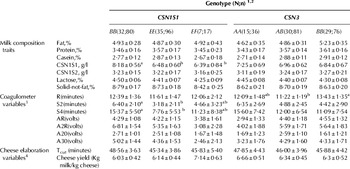
Least squares means and standard errors of milk composition traits and coagulation and cheese elaboration variables (measured with an Optigraph device) in Murciano-Granadina goats with different αs1-casein (CSN1S1) and κ-casein (CSN3) genotypes

1 N: Number of goats; n: number of complete records (for milk chemical analysis, coagulation properties and cheese making evaluation) for each CSN1S1 and CSN3 genotype
2 Means significantly different at P⩽0·05, with Bonferroni correction are shown with different superscript letters within the same row for each locus
3 R: rennet coagulation time; S2: coagulation rate at S=1000 volt; S4: coagulation rate at S=2000 volts (less time means grater coagulation rate); AR: curd firmness obtained at R minutes after curdling started; A2R: curd firmness obtained at 2R minutes after curdling started; A20: curd firmness at 20 minutes after adding rennet; A30: curd firmness at 30 minutes after adding rennet
4 Tcut: total coagulation time measured during cheese elaboration since rennet is added to cutting of curd. Cheese yield in litres of milk per kg of cheese obtained
Results and Discussion
The statistical analysis revealed that there was no interaction between CSN1S1 and CSN3 genotypes for any of the variables. Results will therefore be presented separately for each of them.
Analysis of the effects of casein loci on goat milk composition and coagulation properties is a critical step before using this information in selection schemes devoted to improve these traits. Moreover, the existence of breed-specific allelic effects of the casein loci reinforces the need to evaluate their impact on a population basis. Our data (Table 2) showed that, as demonstrated in previous studies performed in the same breed (Caravaca et al. Reference Caravaca, Amills, Jordana, Angiolillo, Agüera, Aranda, Menéndez-Buxadera, Sánchez, Carrizosa, Urrutia, Sánchez and Serradilla2008, Reference Caravaca, Carrizosa, Urrutia, Baena, Jordana, Amills, Badaoui, Sánchez, Angiolillo and Serradilla2009), CSN1S1 genotype affects the average milk CSN1S1 concentration, with BB goats (8·18±0·56 g/l) displaying higher levels than their EE (6·48±0·60 g/l) and EF counterparts (6·39±0·84 g/l). In close agreement with Caravaca et al. (Reference Caravaca, Carrizosa, Urrutia, Baena, Jordana, Amills, Badaoui, Sánchez, Angiolillo and Serradilla2009), CSN1S1 genotype did not significantly affect protein or casein concentrations. However, and contrary to results published for French breeds (Martin et al. Reference Martin, Szymanowska, Zwierzchowski and Leroux2002), EE goats had the highest levels of caseins (although these differences were not significant). This is an interesting point because casein concentration is the main determinant of milk renneting properties and cheese yield. Consistent with this, we found that EE goats display a greater curdling rate (lesser time to get different degrees of curd firmness) than their BB counterparts (S2: EE<BB, P<0·05; S4: EE<BB, P<0·05). Similarly, studies performed in cows (Marziali & Ng-Kwai-Hang Reference Marziali and Ng-Kwai-Hang1986; Pagnacco & Caroli Reference Pagnacco and Caroli1987; Politis & Ng-Kwai-Hang Reference Politis and Ng-Kwai-Hang1988) and to a lesser extent in goats (Storry et al. Reference Storry, Grandison, Millard, Owen and Ford1983; Remeuf & Lenoir Reference Remeuf and Lenoir1986; Ambrosoli et al. Reference Ambrosoli, DiStasio and Mazzocco1988) have generally shown that the higher the protein and caseins contents, the greater the rate of curdling and the firmer the curd. Furthermore, Colin et al. (Reference Colin, Laurent and Vignon1992) found that the curdling rate explains 74% of the variation of the fresh cheese yield. In our study, however, we did not detect significant differences in curd firmness or cheese yield amongst CSN1S1 genotypes.
It should be mentioned that our results do not match results provided by Remeuf (Reference Remeuf1993) for French breeds, showing that milk from AA goats (genotype associated with “high” CSN1S1 content in the same way as BB) display a significantly higher curdling rate than milk from EE and FF goats. Moreover, Remeuf (Reference Remeuf1993) and Pirisi et al. (Reference Pirisi, Colin, Laurent, Scher and Parmentier1994) found a significant effect of CSN1S1 genotype on rennet coagulation time, curd firmness and cheese yield. However, it is difficult to get a clear picture of the effects of CSN1S1 genotype on rheological parameters in goats because studies performed so far suffer from a lack of consistency. Just to give an example, Ambrosoli et al. (Reference Ambrosoli, DiStasio and Mazzocco1988) did not find a significant relationship between milk CSN1S1 content and curdling rate. In contrast, Zullo et al. (Reference Zullo, Barone, Chianese, Colatruglio, Occidente and Matassino2005), using a Formagraph, reported significant associations in Cilentana goats between CSN1S1 genotype and curdling rate, with milk from BB goats showing a lower curdling rate than that of EE, AA and AB goats, in agreement with our results. Discrepancies amongst studies might be the consequence of technical and biological factors. Amongst the technical factors, cheese-making conditions, such as culture and type and concentration of curdling enzyme and incubation temperature, are well known to strongly influence the coagulation process and cheese yield (Clark & Sherbon Reference Clark and Sherbon2000). Sample size and methods of measurement might be also important factors influencing the nature and significance of the associations found. The stringency of the statistical analysis (with or without correcting for multiple testing) might also influence the significance of the data. Differences in the genetic background and the management of the analysed breeds might also explain the existence of contradictory results amongst studies. At a biological level, the proportion of total caseins, the main parameter determining the rheological properties of milk, seems to be associated with CSN1S1 genotypes in French (Martin et al. Reference Martin, Szymanowska, Zwierzchowski and Leroux2002) but not in Spanish goat breeds (Caravaca et al. Reference Caravaca, Carrizosa, Urrutia, Baena, Jordana, Amills, Badaoui, Sánchez, Angiolillo and Serradilla2009). This lack of association is quite intriguing because milk CSN1S1 levels are influenced by CSN1S1 genotype in the Murciano-Granadina and Malagueña breeds (Caravaca et al. Reference Caravaca, Amills, Jordana, Angiolillo, Agüera, Aranda, Menéndez-Buxadera, Sánchez, Carrizosa, Urrutia, Sánchez and Serradilla2008). Paradoxically, in our study BB goats have more CSN1S1 than their EE counterparts (as expected from previous studies), but less total casein. This finding might be explained by the existence of a compensatory mechanism that regulates the imbalance produced by a decreased rate of CSN1S1 synthesis. The existence of such effect has been demonstrated in β-casein deficient mice that display an increased secretion rate of other milk proteins (Kumar et al. Reference Kumar, Clarke, Hooper, Horne, Law, Leaver, Springbett, Stevenson and Simons1994). Moreover, measurement of genetic correlations between casein levels in cattle has shown that CSN1S1 content is negatively correlated with CSN1S2 (rg=−0·49) and CSN3 (rg=−0·56) contents (Schopen et al. Reference Schopen, Heck, Bovenhuis, Visker, van Valenberg and van Arendonk2009), showing that increasing CSN1S1 content in milk does not necessarily imply that total casein concentrations will augment concomitantly. In summary, while the CSN1S1 genotype has a clear effect on the synthesis rate of this protein in all caprine populations analysed so far, we hypothesize that the magnitude of the consequent compensatory effect on total casein levels might vary from breed to breed due to genetic and environmental factors. This would translate into differences between breeds with regard to the effect of the CSN1S1 genotype on milk composition as well as on its rheological properties.
With regard to the effects of CSN3 genotype on milk composition, we found higher protein and casein concentrations in BB than in AA goats, although differences were not significant (Table 2). With regard to milk coagulation properties and cheese yield, CSN3 genotype was exclusively associated with rennet coagulation time (Table 2). In this way, milk from BB goats had a greater R value (13·43±1·35 mins) than milk from AB goats (11·22±1·19 min) (P<0·05). The lack of a significant difference between the two homozygous genotypes makes difficult the interpretation of these findings. In general, minimizing rennet coagulation time is desirable because it reduces the processing time required for cheese production. In cow milks with high levels of proteins or caseins, rennet coagulation time tends to be shorter and displays associations with a faster coagulation rate and a higher curd firmness (cited by Clark & Sherbon Reference Clark and Sherbon2000). No significant association between CSN3 polymorphism and curdling rate (S2 and S4) was detected. However, the ranking of genotypes (BB>AB>AA) was the anticipated one, because BB milk tended to have more protein and casein contents than AA milk (Table 2) and, therefore, it was expected to have a higher curdling rate. Finally, curd firmness and cheese yield were not significantly associated with CSN3 genotype (Table 2). These results are in strong contrast with the ones obtained in cattle showing that the B-allele of the bovine CSN3 gene is associated with a shorter coagulation time and better curd and cheese yield than the A-allele (Schaar et al. Reference Schaar, Hanson and Pettersson1985, Marziali & Ng-Kwai-Hang Reference Marziali and Ng-Kwai-Hang1986). These latter data are consistent with the fundamental role of CSN3 in the first stage of rennet coagulation of milk, where enzymatic proteolysis occurs and about 87–90% of CSN3 must be enzymatically degraded before aggregation takes place (Walstra et al. Reference Walstra, Jenness and Badings1984; Lucey Reference Lucey, Roginski, Fuquay and Fox2002). However, it should be noticed that the set of mutations that characterize B and A variants in goats and cattle are completely different so we should not expect identical outcomes in both species. Finally, interaction effects between CSN1S1 and CSN3 genotypes were not significant, which rules out the existence of haplotype effects.
In summary, in the current study, we have observed that goats with an EE genotype for the CSN1S1 locus show a significantly higher curdling rate than their BB or EF counterparts. This finding is surprising because in French breeds, milk from goats with “high” genotypes (AA and BB goats) has better rheological properties than that from “medium” (EE) or “low” (FF) genotypes. We attribute this discrepancy to physiological and genetic differences between French and Spanish caprine breeds as well as to technical aspects associated with each particular experiment. Our data also suggest that the CSN3 genotype might affect the rennet coagulation time, although the molecular basis of this association is unclear and additional experiments should be performed to confirm it. At a practical level, we have not observed any association between either CSN1S1 or CSN3 genotypes and cheese yield, the main parameter determining the economic benefits of goat farming systems in Spain. This finding suggests that, at least in the case of Murciano-Granadina goat breeders, selection based on the genotypic information of these two loci is not expected to generate increased incomes due to an improvement of the cheese transformation process.
This work was funded by a grant from the Spanish Ministry of Education and Science (AGL2002-04304-C03-02- GAN).