More than half of all nations have experienced violent civil conflict since 1960.Footnote 1 Debated solutions to the endemic problem of civil conflict include militarized counterinsurgency operations,Footnote 2 the deployment of international peacekeeping forces,Footnote 3 partition,Footnote 4 and constitutional power-sharing arrangements.Footnote 5 Compared to these coercive interventions, foreign aid and development programs that reduce poverty are widely viewed as a relatively less intrusive and potentially effective strategy for mitigating violent civil conflict, based on the theory that poverty drives support for and participation in armed rebellion.Footnote 6
However, current evidence on the impact of development programs on civil conflict is surprisingly mixed. Empirical analyses of the effects of development programs on civil conflict variously find modest or null pacifying effects in Afghanistan,Footnote 7 violence-reducing effects in Iraq,Footnote 8 violence-increasing effects in the Philippines,Footnote 9 and violence-increasing effects in the case of foreign aid.Footnote 10 What conclusions should scholars and policy-makers draw about the likely effectiveness of development programs in mitigating violent civil conflict?
Motivated by the mixed empirical record, we examine the conditions under which antipoverty programs reduce violence. We investigate a unique within-country policy experiment: the impact of the rollout of the National Rural Employment Guarantee Scheme (NREGS), one of the world's largest antipoverty programs, on India's Maoist conflict. We refine existing theories and empirical tests by highlighting the importance of state capacity in shaping the effects of antipoverty programs on violence. When local state capacity is weak, program funds are unlikely to pass through to local populations and corruption may even reinforce local grievances with the state and provide opportunities for rebel financing. When local state capacity is strong, however, large-scale antipoverty programs may substantially improve livelihoods, undercutting popular support for insurgency as well as economic incentives to participate in rebellion. Variation in state capacity, which exists across as well as within countries,Footnote 11 could plausibly explain important but previously unexplained heterogeneity across settings in the effects of antipoverty programs on civil conflict.
To test the argument, we assemble a new district-level panel data set on Maoist conflict violence from multiple local-language press sources (in Bengali, Hindi, Oriya, and Telugu). This alleviates significant underreporting and urban and temporal reporting bias in other Maoist conflict data sets based on English-language press sources. Our data set geo-codes attacks and deaths to districts over time, covering 144 districts between 1999 and 2009 across the six central and eastern “red belt” states in which over 90 percent of Maoist conflict events and deaths occur.
We also employ a difference-in-differences identification strategy to estimate the effects of NREGS adoption on Maoist conflict violence. The program's staggered rollout over a three-year period across our sample of 144 districts enables us to compare changes in violence in districts adopting NREGS versus control districts. All specifications include district and year fixed effects. We also control for the criteria utilized by the Indian government to assign districts to different phases of NREGS adoption. Taking these strategies, we show that NREGS adoption caused a large long-run reduction in violence. We also provide evidence that NREGS reduced violence by improving rural livelihoods—the program's pacifying effects were larger following a poor monsoon rainfall when rural communities are especially dependent on the program for supplemental income.
Finally, we examine local state capacity's role in shaping these effects. Like many antipoverty programs around the world, the implementation of NREGS is highly decentralized and dependent upon local state capacity, which varies widely across districts in India. To measure district-level state capacity, we use administrative data on NREGS employment provision and also construct a ranking of pre-existing local state capacity across districts based on average village-level access to four basic state services as measured in the 2001 census. We show that NREGS's violence-reducing effects were not uniform but overwhelmingly concentrated in districts in the top two quartiles of local state capacity.
Our principal contribution is to use a within-country policy experiment and micro-level violence data to demonstrate the potential for antipoverty programs to mitigate violent civil conflict.Footnote 12 We refine existing theories and empirical tests by highlighting the role of state capacity in shaping the effects of antipoverty programs on violence, helping to integrate competing theories about the relative salience of poverty versus state weakness in fueling conflict.Footnote 13 The heterogeneous findings of existing studies may in part be driven by variation across settings in local capacity to implement development programs effectively. Finally, we contribute to the study of political violence in India and to the study of the Maoist insurgency specifically.Footnote 14 Most closely related are two concurrent papers on the impact of NREGS on violence in India.Footnote 15 We differ in two important ways: using local-language instead of biased English-language violence data and highlighting the importance of local state capacity in shaping the effects of NREGS.Footnote 16
Theoretical Framework
Poverty, Conflict, and Development Programs
A large theoretical literature argues that poverty and underdevelopment contribute to civil conflict. Broadly, these theories fall into two camps. One strand of theory takes the form of economic opportunity cost arguments, as articulated, for example, in Becker's canonical theory of crime.Footnote 17 These theories hold that poverty and low returns to peaceful economic activity make participation in violent insurgency relatively more economically attractive and rebel recruitment therefore easier.Footnote 18 A second strand of argumentation linking poverty to insurgency highlights the role of political grievances related to poverty in fueling support for insurgency.Footnote 19 Poverty and weak public service delivery by the state can generate political grievances and delegitimize incumbent regimes, creating space for insurgencies. While the opportunity cost and economic grievance channels differ slightly, both originate in poverty and underdevelopment as a root cause and predict that successful antipoverty programs ought to reduce violence—either by undercutting popular support for insurgency or by reducing the economic incentives to participate in rebellion.
Although extensive evidence has been amassed linking poverty and underdevelopment to conflict,Footnote 20 the empirical evidence on the impact of development programs on conflict is significantly more mixed. Beath and colleagues find in a randomized control trial that the largest development program in Afghanistan improved perceptions of government but caused no or possibly a very modest reduction in violence.Footnote 21 Crost and colleagues, using a regression discontinuity design, find that the KALAHI-CIDSS, a participatory local public goods program in the Philippines, increased violence in the early stages of program implementation as a result of rebel attempts to sabotage the program.Footnote 22 Berman and others find that CERP, a US military-funded public services program in Iraq, reduced insurgent violence.Footnote 23 However, they provide evidence that this was not a result of an income channel but to a decidedly more Machiavellian strategy of conditioning access to the program to gather intelligence on insurgent activity from civilians. Finally, several crossnational analyses find that foreign aid often increases conflict.Footnote 24
These mixed empirical findings suggest that the salient question for research on development programs and civil conflict is not whether but under what conditions these programs reduce violence. We refine existing theories and empirical tests by investigating scope conditions and contextual factors that might shape the extent to which development programs are effective at pacifying civil conflict. While many factors will plausibly generate heterogeneous effects, drawing on previous research, we focus on the design and quality of implementation of antipoverty programs, which depends in large part upon state capacity, and discuss these factors in the context of NREGS and the Maoist conflict in India.
The Role of State Capacity
For antipoverty programs to successfully mitigate violent conflict, programs must deliver perceptible improvements in livelihoods, on a scale sufficient to dis-incentivize participation in insurgency and bolster the legitimacy of the state vis-à-vis insurgent groups. However, even well-designed programs are frequently derailed by failure at the program-implementation stage. Foreign aid has been found, for example, to be extremely “leaky,” with just a small fraction of funds reaching local populations.Footnote 25 Domestic development programs also routinely fail at the implementation stage because of weak enforcement or elite capture.Footnote 26
One of the most important determinants of policy-implementation failure is weak state capacity,Footnote 27 or an absence of a government's ability to administer its territory effectively.Footnote 28 In weak state-capacity settings, government is often captured by powerful societal elites who siphon funds in the form of corruption.Footnote 29 Moreover, in weak state-capacity areas, bureaucracies lack the basic administrative capacity to absorb funds and deliver services.Footnote 30
For these reasons, the effects of antipoverty programs on violent civil conflict are likely to depend heavily upon state capacity, which varies not only across but within countries.Footnote 31 When local state capacity is weak, program funds are unlikely to pass through to local populations and corruption may even reinforce local grievances with the state and provide opportunities for rebel financing. When local state capacity is strong, however, antipoverty programs may reduce violence as predicted by rebel opportunity cost and grievance theories of violent civil conflict.Footnote 32 In these contexts, well-designed antipoverty programs have the potential to substantially improve livelihoods, undercutting popular support for insurgency as well as economic incentives to participate in rebellion.
NREGS and the Maoist Conflict
To test the argument, we examine a unique within-country policy experiment: the impact of India's National Rural Employment Guarantee Scheme, one of the world's largest antipoverty programs, on the Maoist conflict, a protracted insurgency. Enacted in 2005 and rolled out across all rural districts in India between 2006 and 2008, NREGS guarantees each rural household up to one hundred days of low-wage employment on local public works projects annually. Although NREGS is a national policy, it also serves as a pillar of the Indian government's strategy of combating the Maoist insurgency through development programs.
The rollout of NREGS provides an excellent opportunity to test existing opportunity cost and grievance theories which suggest that antipoverty programs can reduce violence.Footnote 33 NREGS is far larger in scale than other programs previously studied in the conflict and development literature. NREGS is the largest rural antipoverty program in India's history, with over 24 percent of India's rural households participating in the program according to a national sample survey conducted in 2009.Footnote 34 A growing program-evaluation literature provides evidence that NREGS has had a large impact on rural poverty in India,Footnote 35 which is a central factor in the Maoist insurgency.
The Maoist insurgency is spatially concentrated in India's poorest regions,Footnote 36 with a history of underdevelopment and political marginalization dating to the colonial era.Footnote 37 Poverty-related grievances are central to the Maoist insurgency's ideological appeal.Footnote 38 The insurgency can be traced historically to the “Naxalite” movement, which originated in 1967 as an anti-landlord peasant uprising in Naxalbari, a village in West Bengal.Footnote 39 The insurgency subscribes to a left-wing Maoist ideology and advocates pro-rural poor agenda, including land redistribution and the prevention of displacement of tribal populations by mining projects.
The rollout of NREGS provides a valuable setting to evaluate our contention that the pacifying effects of antipoverty programs depend upon state capacity, which varies widely across the districts in the six “red belt” states under study.Footnote 40 The implementation of NREGS depends upon local state capacity because it is administered locally by elected village councils and bureaucrats at the district level (the rough equivalent of a US county). The program is complex to administer, intensifying the importance of local bureaucratic capabilities in shaping local household access to the program.Footnote 41 Although by law NREGS guarantees households as much employment as desired (up to the 100-day limit), because of weak state capacity in practice “rationing,” or underprovision of employment relative to demand, is rampant.Footnote 42
Two of the states under analysis, Andhra Pradesh and Chhattisgarh, have disciplined bureaucracies and an established track record of successful administration of government programs. According to the 2009 national sample survey, just 24.9 and 30.6 percent of households in Andhra Pradesh and Chhattisgarh, respectively, were rationed (wanted NREGS unemployment but did not obtain it). In the remaining states, however, implementation of NREGS is poor, particularly in Bihar, Jharkhand, and Orissa, where bureaucratic effectiveness is dismal.Footnote 43 NREGS rationing rates in these states were a staggering 78.5, 62.8, and 56.7 percent, respectively. Even within states, some districts are characterized by much weaker state capacity than others, a pattern resembling the presence of subnational “brown areas” in developing countries more generally.Footnote 44
In sum, in areas of adequate state capacity, NREGS plausibly provided benefits to local populations in a way that disincentivizes participation in the insurgency, bolsters the legitimacy of the Indian state vis-à-vis the Maoist insurgency, and addresses the roots of the Maoist conflict. In areas of low state capacity, however, such effects are less plausible.
Empirical Strategy and Data
Measuring Violence
Our outcome variable is Maoist conflict violence, measured in terms of violent incidents and deaths. One of the challenges of studying a rural insurgency is that violence is difficult to measure and easily available data sources are affected by severe reporting bias. To deal with these challenges, we assemble a new district-level panel data set on Maoist conflict violence from multiple press sources, including those in the local languages spoken in the regions affected by the Maoist insurgency (Bengali, Hindi, Oriya, and Telugu). The data set covers 144 districts between 1999 and 2009 in the so-called “red corridor,” the six central and eastern states—Andhra Pradesh, Bihar, Chhattisgarh, Jharkhand, Orissa, and West Bengal—in which over 90 percent of Maoist conflict deaths occur. The data set geo-codes attacks and civilian, Maoist, and security force deaths to districts on a quarter-yearly basis.Footnote 45 The six states together contain 144 districts and over 378 million people.
This local-language data set, which took a team of local-language researchers over two years to compile, alleviates significant underreporting as well as urban and temporal reporting bias in other widely used data sets on the Maoist conflict based on English-language new sources. This more accurate data set is important for our empirical strategy, which examines over-time variation in violence arising from an overwhelmingly rural insurgency. In section 1 of the online appendix, we provide an in-depth description of how the data set was constructed, a validation against qualitative measures of conflict intensity,Footnote 46 and a comparison against the widely used South Asia Terrorism Portal (SATP) database based on English-language news sources. In brief, we capture 37 percent greater number of violent incidents and deaths than does the SATP database, especially in rural districts and in earlier years. We provide evidence that relying upon the biased SATP database, as two concurrent papers on the Maoist conflict do,Footnote 47 would, predictably, bias our estimates downward. This comparison is fruitful in highlighting the methodological importance of using local-language data sources to study rural civil conflict accurately.
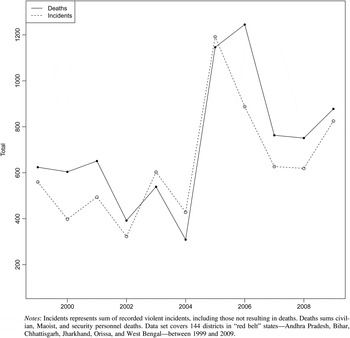
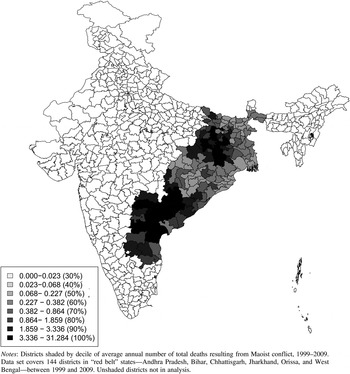
Figure 1 displays a map of total deaths and incidents associated with the Maoist conflict over time. Notably, violence spiked following the unification of two rival Maoist factions in 2004, an event which is widely viewed to have precipitated the resurgence of the Maoist conflict in India over the last decade. Violence falls steeply between 2006 and 2008, the period when NREGS was rolled out. Although our data set ends in 2009, qualitative information suggests that in 2010 violence rose again, mainly as a result of the launch of “Operation Green Hunt,” a large-scale military offensive by the central government, before again declining gradually to pre-2004 levels between 2011 and 2015. Figure 2 displays a map of average annual deaths associated with the Maoist conflict between 1999 and 2009 by district. Consistent with qualitative information, we see that within India's “red corridor” Maoist conflict violence is centered in two “hot-spots,” one along the southern border between Andhra Pradesh and Chhattisgarh and the other near the northern border between Jharkhand and Bihar.
Maoist conflict violence over time, 1999–2009

Average annual deaths from Maoist conflict by district, 1999–2009

Empirical Strategy and Explanatory Variable
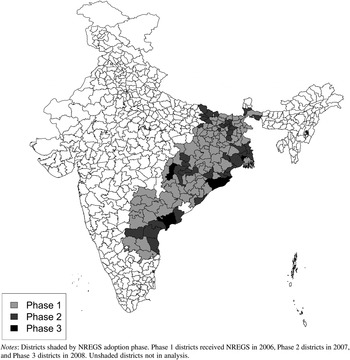
To estimate the effects of NREGS adoption on Maoist conflict violence, we take a difference-in-differences identification strategy. We exploit the staggered rollout of NREGS across the 144 districts in our sample over three years between 2006 and 2008 in three distinct phases. Phase 1 districts received the program in February 2006, Phase 2 districts in April 2007, and Phase 3 districts in April 2008 (see Figure 3).Footnote 48 This provides a substantial amount of variation in exposure to the program, a “natural experiment” that we exploit to estimate its effects. For instance, we observe a full eight quarter-years of NREGS adoption in Phase 1 districts before Phase 3 districts received the program, and a full four quarters of program adoption before Phase 2 districts received the program.
Districts by NREGS adoption phase

All analyses include district and year fixed effects, which means that we identify the effects of NREGS adoption from changes in violence in districts receiving the program compared to changes in violence in districts experiencing no change in their program-adoption status. District fixed effects absorb any time-invariant omitted variables that could bias the estimates. Time fixed effects absorb common time trends and shocks that affect the dynamics of conflict violence. Our core explanatory variable pools across the three different phases of NREGS adoption with a binary treatment indicator that takes a value of 1 following program adoption in a district and 0 otherwise, as is common in any fixed effects regression analysis (see, for example, Angrist and Pischke for a discussion).Footnote 49
An important challenge for our identification strategy is that districts were assigned to NREGS implementation phases nonrandomly, raising concerns about the parallel trends assumption that underpins a difference-in-difference identification strategy. Districts were scored on a “backwardness index” (BI), a score constructed by India's Planning Commission prior to the enactment of NREGS.Footnote 50 The Planning Commission assigned to states a fixed number of slots for each NREGS adoption phase. Within states, poorer districts were recommended to earlier phases of NREGS adoption in order of their rank on the backwardness index. However, thirty-two districts were prioritized for Phase 1 adoption regardless of score as a result of being classified as “left-wing-extremism affected” (LWE) by the Indian government. States retained some discretion in the allocation of districts to NREGS adoption phases.
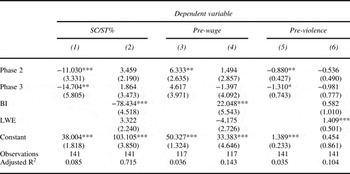
We deal directly with this issue by explicitly controlling for a district's backwardness index score and LWE classification in interaction with time dummy variables in all specifications.Footnote 51 By conditioning for selection on observables, this absorbs time trends specific to LWE districts and time trends in violence related to development levels as measured on the backwardness index. We will later provide direct evidence on the validity of the parallel trends assumption by testing for pre-NREGS adoption trends in violence. In Table 1, we provide preliminary cross-sectional evidence that controlling for a district's BI score and LWE designation achieves balance across phases on major pre-treatment variables plausibly related to the Maoist conflict.
Balance on covariates across NREGS phases before and after controls

Notes: Unit of observation district. Phase 2 and Phase 3 are dummy variables indicating the second and third phases of NREGS implementation. The reference category is Phase 1. BI is a control variable representing a district's score on the backwardness index. LWE is a dummy variable representing a “Left-Wing Extremism” designated district. Pre-wage is the average daily real wage of male agricultural field laborers between 2004 and 2006 (source: Agricultural Wages of India series). SC/ST% Pop is the percentage of the population composed of scheduled caste and scheduled tribal groups (source: 2001 census). Pre-violence is average quarter-yearly deaths, 2000–2005 (mean: 1.05, sd: 2.25). Analysis estimated by OLS. *p < .1; **p < .05; ***p < .01.
Predictably, Phase 1 districts are characterized by lower real wages, higher disadvantaged minority population shares and higher pre-treatment violence levels. As discussed, poorer and more violence-prone districts were prioritized by the Indian government for earlier phases of NREGS adoption. After controlling for BI score and LWE classification used to assign districts to phases of NREGS implementation in this way, however, the different phase groups are no longer statistically distinguishable in terms of these pre-treatment covariates. These results highlight the importance of conditioning upon BI score and LWE classification (in interaction with time dummy variables) in our empirical strategy, to ensure that our analyses estimate the effects of NREGS adoption and not time trends related to omitted variables.
State Capacity and Other Variables
An important part of our empirical investigation is to study how the effects of NREGS adoption vary as a function of local state capacity. State capacity, which refers to the latent capacity of a government to implement its policy objectives as distinct from a political commitment to specific policy choices,Footnote 52 is notoriously difficult to measure. Existing literature typically relies on a number of proxies, ranging from per capita income levels, to measures of taxation, to various expert perception-based indices.Footnote 53
Because we utilize within-country micro-level data, we are in a position to develop more precise measures of state capacity at the local level. We utilize two measures of local state capacity at the district level. The first is a measure of program intensity based on average NREGS annual employment provision per capita. This is computed by taking administrative data from the Ministry of Rural Development on average annual person-days of employment for each district and normalizing by the rural population as measured in the 2001 census. Given the prevalence of “rationing” of employment under NREGS as a result of weak bureaucratic capacity, as discussed, the amount of employment provided per person is a good direct measure of variation in local capacity to implement the program. However, employment provision is potentially also driven by other variables, such as political commitment to NREGA, or pre-existing violence, which we would wish to exclude from a measure of state capacity. An econometric solution that we take is to control for these potential omitted variables. But it is also possible to develop a second more direct measure of local state capacity that is measured prior to and independent of NREGS's performance.
To measure pre-existing district-level state capacity, we construct a composite ranking of districts based on average village-level access to four extremely basic state services as measured by enumerators in the 2001 census. The four basic state services we measure for each district are share of villages with: (1) a paved road; (2) a primary school; (3) a primary health center; and (4) an agricultural credit cooperative (the lowest tier of the Indian government's agricultural credit network). Each of the 144 districts in our sample is ranked on each of these indicators, and these ranks are averaged to construct a composite ranking of local state capacity measured several prior years to the enactment of the program under study. This ranking of local state capacity captures some of the essential ingredients of state capacity as a concept. It captures a district's ability to implement policies, measured prior to and independent of the specific program under study.Footnote 54 It is “sticky” over time,Footnote 55 and succeeds in predicting actual NREGS employment provision nearly a decade later. The top quartile of districts on this indicator of local state capacity provided on average 4.2 days of NREGS employment per capita, the second quartile provided 3.5 days per capita, the third quartile 2.5 days per capita, and the bottom quartile 2.5 days per capita. Section 2 of the online appendix provides a detailed discussion and analysis of our two measures of local state capacity.
Additionally, some analyses investigate variation in the effects of NREGS as a function of rainfall shocks. Annual district-level rainfall data in total millimeters come from the Indian Meteorological Department, which creates monthly gridded rainfall maps based on rainfall gauges throughout the country. We take the natural log of this variable so that rainfall is measured in the natural log of total millimeters. Since all regressions include district fixed effects, they implicitly identify the effects of over-time variation within districts, that is, rainfall shocks. For the first two quarters in a year, we define the salient rainfall realization as that of the previous year (the monsoon rainfall occurs during the summer months), while for the latter two quarters in the year we define the salient rainfall realization as that of the current year.
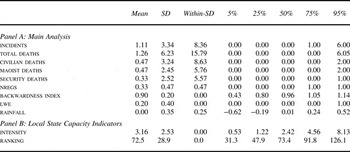
Table 2 reports descriptive statistics for the major variables in the analysis. We note considerable within-district variation over time in violence. Our empirical analysis will explore the role that NREGS adoption has played in affecting this variation over time within districts.
Descriptive statistics

Notes: Unit of observation is district quarter-year, 2000–2009. Within-SD is within-district standard deviation of variable after partialing out district averages. incidents variable sums recorded violent incidents, including those not resulting deaths. total deaths variable sums civilian, Maoist, and security personnel deaths. NREGS is a binary indicator that takes a value of 1 for program adoption and 0 otherwise. Backwardness index and lwe variables do not vary over time. rainfall variable is measured in the natural log of annual mm, standardized to have sample mean 0. Panel B is for district-level measures of state capacity. intensity is average post-NREGS adoption annual days of employment per rural person. ranking is the district's average ranking across four indicators of basic state services as measured in the 2001 census.
Results
To estimate the effects of NREGS adoption, as discussed, we utilize a difference-in-differences identification strategy based upon the phased rollout of NREGS across districts between 2006 and 2008. We utilize a Poisson quasi-maximum likelihood (QML) regression model, which is appropriate for our violence outcome data—a count variable.Footnote 56 We estimate a regression equation of the form,
 $$E(Violence_{it}) = {\rm exp}({\rm \gamma}_{i} + {\rm \tau}_{t} {\rm \,+\, \beta} _{1} NREGS_{it} + {\bf \delta} {\bf X}^{\bf \prime}),$$
where Violenceit is either total incidents or total deaths in district i and quarter-year t, either total incidents or total deaths. The variable NREGSit is an indicator variable for NREGS adoption, pooling across all three phases of NREGS adoption. To compute the effect of NREGS adoption on the rate of Maoist conflict violence, our substantive quantity of interest, we exponentiate the coefficient on the treatment indicator (which gives the incidence rate ratio), and subtract 1 to obtain the estimated percentage change in violence caused by NREGS adoption. To account for over-time correlation within districts in violence, all models estimate robust standard errors adjusted for clustering within districts.
All regressions include district fixed effects, γ i . This means we utilize within-district variation over time to estimate NREGS's effects on violence and can rule out important time-invariant omitted variables, such as terrain and ethnic composition, which might affect violence. All regressions include year fixed effects, τ t , which absorb time-based shocks and trends common to all districts. The term X' is a vector of covariates, which will be discussed in detail along with the results. All regressions control for a district's score on the backwardness index as well as LWE classification, in interaction with year dummy variables. These minimize concerns about nonparallel time trends across different phase groups arising from the assignment of poorer and more violence-prone districts to earlier phases of NREGS adoption on the basis of these official indices. In support of this, we will directly test and provide evidence on the parallel trends assumption that underpins our difference-in-differences empirical strategy.
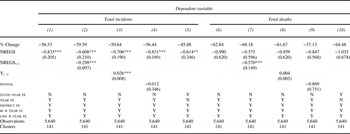
Table 3 reports the main regression estimates. The table reports both the coefficient estimates with their standard errors as well as the substantive quantity of interest, the estimated percentage change in violence caused by NREGS adoption. The regression estimates suggest that NREGS adoption caused a significant reduction in violence. In the base specification reported in columns (1) and (6), NREGS adoption is estimated to have caused a 57 percent reduction in Maoist conflict incidents and a 63 percent reduction in Maoist conflict deaths. Although the estimates of the program's effects on total deaths do not reach conventional levels of statistical significance, the coefficients are substantively important, large, and stable across specifications. The main reason that the standard errors are larger for models of total deaths than for models of total incidents is that the variance for total deaths as a variable is much larger.
Poisson regression estimates of NREGS effect on Maoist conflict violence

Notes: Unit of observation is district quarter-year, 2000–2009. Total incidents represents total incidents of Maoist violence. Total deaths represents sum of civilian, Maoist, and security force deaths. Estimated percentage change in violence caused by NREGS adoption computed by exponentiating the coefficient on the NREGS adoption variable (or sum of coefficients in specifications including a one quarter-year lagged NREGS adoption variable) and subtracting 1. Analysis estimated by Poisson quasi-maximum likelihood model. Standard errors in parentheses adjusted for clustering within districts. *p < .1; **p < .05; ***p < .01.
The estimates are stable across an array of additional specifications that seek to address different concerns. The specifications reported in columns (2) and (7) include a (one-quarter-year) lagged explanatory variable indicator to explore the time path of NREGS's effects. The negative and significant coefficient on the lagged treatment indicator suggests that a large part of NREGS's violence-reducing effects emerged in the long run, a pattern we explore in greater depth in the next section. Columns (3) and (8) control for a lagged value of the dependent variable, to account for possible auto-correlation dynamics in violence. Columns (4) and (9) control for a spatial lag of the explanatory variable, defined as the share of spatially contiguous districts adopting NREGS. We include this variable to control for potential spatial spillover effects.Footnote 57 We find no evidence for this in the case of NREGS, however. Finally, columns (5) and (10) control for state-year fixed effects, which rules out the possibility that nonparallel trends across states, or any state-level policies such as counterinsurgency police campaigns, drive the results. The estimates are substantively unchanged across specifications; we report additional robustness tests in section 3 of the online appendix.
The estimates suggest that the rollout of NREGS has played a large role in mitigating Maoist conflict violence, and that in the program's absence levels of violence might have been much higher. To provide a back-of-the-envelope calculation of the size of these pacifying effects, consider the total levels of violence observed in 2008: 619 violent incidents resulting in 751 deaths. According to our regression estimates, without the adoption of NREGS across districts, levels of total violence would have been 1,440 violent incidents resulting in 2,030 deaths—suggesting that the program eliminated roughly 821 potential violent incidents and 1,279 casualties across districts in that year. While these are counterfactual projections based on our estimates, they demonstrate that NREGS played an important role in the overall pacification of the conflict between 2006 and 2008 and vindicate the Indian government's strategy of combating the insurgency through development programs, the largest of which is NREGS.
More broadly, the estimates are among the largest to date in the comparative literature on the impact of development programs on conflict. To place these effects in comparative perspective, we investigate the financial scale of the program. In 2008, total program cost was roughly $1.77 billion across the districts in our sample, according to administrative data—$8.3 per rural capita, or $142 per participating household (using a population-weighted 28 percent rural household NREGS participation rate from the 2009 national sample survey for the states under analysis and average household size of 4.8 from the 2007 national family health survey as estimates). These are sizable expenditures. The $142 of expenditure per participating household amounts to roughly eighty-four days of wages for a male agricultural laborer (based on the average daily wage, $1.7, for male agricultural laborers in 2008 in our sample, according to the Agricultural Wages of India data series) which could very plausibly shift participating households’ economic incentives to participate in rebellion or mitigate grievances with the state. None of the previously studied programs in the literature on development programs and conflict provide expenditures on local populations on the same scale relative to local incomes as NREGS, helping to explain the large pacifying effects we observe.
State Capacity
NREGS's violence-reducing effects plausibly depended heavily on pre-existing local state capacity. Not only were the expenditures we described concentrated in districts with sufficient local state capacity to build projects and implement the program, but in these areas a larger share of expenditures was likely to pass through to local populations in the form of genuine employment provision as opposed to corruption.
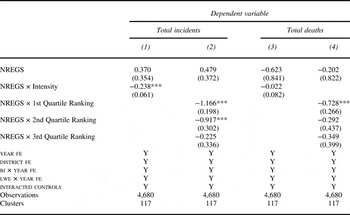
To test for these heterogeneous effects, we estimate regressions that interact the main explanatory variable, NREGS adoption, with (1) a district-level indicator of program intensity based on average annual NREGS employment provision per capita and (2) a direct ranking of local state capacity based on district-level access to basic state services as measured in the 2001 census. We divide the ranking variable into quartiles for ease of interpretation, with the bottom quartile serving as the reference category. The level or direct effects of state capacity are absorbed by district fixed effects. To rule out the concern that heterogeneous effects are driven not by state capacity but other underlying differences, we also control for several pre-treatment socioeconomic variables as well pre-treatment violence in interaction with the NREGS adoption variable. These control variables are centered at their means so that the lower-order NREGS adoption term and the NREGS adoption term interacted with local state capacity can be interpreted independently. The results are reported in Table 4.
State capacity and the heterogeneous effects of NREGS on violence

Notes: Unit of observation is district-quarter year, 2000–2009. Total incidents represents total incidents of Maoist violence. Total deaths represents sum of civilian, Maoist, and security-force deaths. Intensity is a district-level measure of average NREGS employment per rural capita. Top, second, and third quartile are indicators for quartiles on a district-level ranking of state capacity based on access to basic state services as measured in the 2001 census; the bottom quartile is the reference category. All analyses control for pre-existing wage level, pre-existing levels of violence, pre-existing irrigation level, and pre-existing share of scheduled caste and tribe minorities in interaction with the NREGS adoption variable. Control variables are centered for ease of interpretation. Analysis estimated by Poisson quasi-maximum likelihood model. Standard errors in parentheses adjusted for clustering within districts. *p < .1; **p < .05; ***p < .01.
The results suggest that the violence-reducing effects of NREGS adoption were overwhelmingly concentrated in states and districts that implemented the program effectively. Strikingly, once the NREGS adoption variable is interacted with measures of local state capacity, the lower-order term is no longer significant and in fact is slightly positive in some specifications—suggesting that the heterogeneity is so large that in the lowest state capacity districts NREGS had essentially no impact on violence whatsoever. Controlling for a variety of other factors that may generate heterogeneous effects, the estimates suggest that in the top state capacity quartile of districts NREGS adoption reduced violent incidents by 50 percent, whereas in the bottom state capacity quartile of districts the impact on violence is positive but statistically indistinguishable from 0. In the top state capacity quartile of districts, NREGS adoption is estimated to reduce total deaths by 61 percent, whereas in the bottom quartile the effect is slightly negative and statistically indistinguishable from 0.
In interpreting these effects, it is important to keep in mind that by including district fixed effects, the regression analyses absorb static omitted variables, including the level effects of state capacity on violence. The estimates suggest that over time NREGS adoption caused a reduction in violence in districts with high levels of pre-existing local state capacity, whereas it did not do so in districts with low levels of pre-existing local state capacity. An important concern is that time trends in violence related to local state capacity might drive our results. We investigate this concern in section 4 of the online appendix, looking at time trends in violence around the adoption of NREGS in high- and low-state-capacity districts. The results suggest that in high-state-capacity districts, violence fell following the adoption of NREGS and not prior, while in low-state-capacity districts violence remained flat over time. This suggests that the interaction of high local state capacity and the adoption of the antipoverty program drove the decline in violence, rather than either one on its own.
Consistent with the theoretical discussion, therefore, the findings show that the effects of antipoverty programs on violent civil conflict depend heavily on state capacity. What are the comparative implications for development programs and their likely effects on civil conflict? In comparative perspective, India is thought to represent a case of “intermediate” state capacity.Footnote 58 Within India, the violence-reducing effects of NREGS were concentrated in the top two quartiles of local state capacity. In countries and subregions with intermediate to high levels of state capacity, therefore, large-scale antipoverty programs may have significant pacifying effects. In countries and subregions with intermediate to low levels of state capacity, however, the prospects for antipoverty programs to mitigate violent conflict are dimmer. Overall, the findings suggest that while development programs are no panacea for conflict, in intermediate- to high- state-capacity settings they can play a significant role in reducing violence.
Timing of Effects
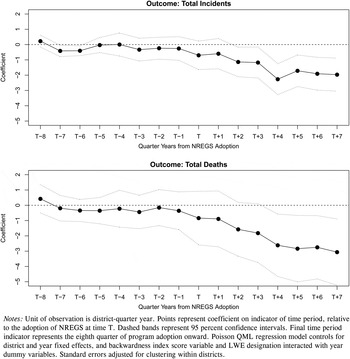
One concern in interpreting the results is that perhaps districts adopting NREGS were experiencing declining trends in violence relative to control districts, independent of program adoption—which would violate the “parallel trends” assumption that underpins our empirical strategy. To address this concern, we investigate fine-grained time patterns of changes in violence before and after the adoption of NREGS. We regress our measures of violence on indicators for each of the eight quarters prior to NREGS adoption and for each of the eight quarters including and following NREGS adoption (the final dummy variable is an indicator of the eighth quarter onward). As before, we include district and year fixed effects and controls for the backwardness index score and LWE classification in interaction with year dummy variables. We report the estimated coefficients in the form of a plot in Figure 4.
Changes in violence before and after NREGS adoption by quarter-year

The analysis shows that the coefficient estimates on the pre-adoption quarter dummy variables are stable and close to 0 in the eight quarters in advance of NREGS adoption. This crucial “placebo” test provides evidence that our results are not driven by pre-adoption trends in violence. Instead both violent incidents and deaths started to fall precisely in the quarter in which NREGS was adopted, with the violence-reducing effects of the program emerging fully in the long run over a period of two years. The long-run nature of NREGS's pacifying effects is consistent with qualitative information about the gradual uptake of the program. The results are also realistic in showing that antipoverty programs pacify long-standing civil conflict gradually rather than immediately.
A final concern that remains is that perhaps other interventions, whether counter-insurgency operations or other development programs, were specifically timed to coincide with the rollout of NREGS across districts. We discuss and analyze this possibility systematically in section 4 of the online appendix. In brief, there is little evidence that other major interventions were formally or informally “bundled” with NREGS. There is no evidence of a short-run spike in Maoist and security-force deaths around the adoption of NREGS, which would be typical of counter-insurgency operations. State-level police numbers as well as road-building under India's second largest rural development program were uncorrelated with the roll-out of NREGS.
Rainfall Shocks and the Income Channel
We have argued that NREGS adoption reduced violence by improving rural livelihoods—thereby undercutting popular support for insurgency and by reducing the economic incentives to participate in rebellion. As previous research notes, the mitigation of “greed” and “grievance” are distinct channels through which development programs may reduce violence.Footnote 59 Both relate, however, to the improvement of rural livelihoods as the main driver of NREGS's pacifying effects—which we therefore jointly call an “income” channel to differentiate them from entirely separate categories of explanation.
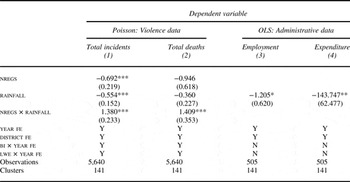
An important implication of the income channel is that NREGS's violence-reducing effects should have been larger in districts experiencing a negative rainfall shock to agricultural productivity and labor demand. A program-evaluation literature shows that NREGS serves as a particularly important source of supplemental income to rural households during droughts.Footnote 60 To examine whether the program's violence-reducing effects were correspondingly larger during these periods, we interact the NREGS adoption variable with a district-level measure of rainfall, a well-known source of variation in agricultural productivity and labor demand in rural economies.Footnote 61 Since we include district fixed effects, we implicitly identify the effects of within-district rainfall variation over time, or rainfall shocks. An income-channel-based theory would expect to see a positive estimate of the coefficient on the interaction term, implying that more negative rainfall realization results in a larger reduction in violence after the adoption of NREGS (or, conversely, a more positive rainfall realization results in a smaller reduction in violence). We report these analyses in Table 5.
Rainfall shocks and heterogenous effects of NREGS on violence

Notes: In columns (1) and (2) unit of observation is district quarter-year, 2000–2009. In columns (3) and (4), unit of observation is district-years, for all district years post-NREGS adoption. Total incidents represents total incidents of Maoist violence. Total deaths represents sum of civilian, Maoist, and security force deaths. Employment is annual days of NREGS employment per rural capita. Expenditure is rupees per rural capita. Rainfall is measured in the log of annual mm (within-district SD 0.24), with mean normalized to 0. Analysis estimated by Poisson quasi-maximum likelihood model in columns (1) and (2) and by OLS in columns (3) and (4). Standard errors in parentheses adjusted for clustering within districts. *p < .1; **p < .05; ***p < .01.
The large, positive, and statistically significant coefficient estimates on the interaction term between rainfall and NREGS adoption in columns (1) and (2) provide strong support for the idea that NREGS's violence-reducing effects were larger in districts experiencing a negative rainfall shock. Relative to average levels of rainfall, a one within-district standard deviation (0.24) shortfall of rainfall is estimated to intensify NREGS's pacifying effects from a 50 to 64 percent reduction in violent incidents and from a 61 to 72 percent reduction in total deaths. This is consistent with an income channel because it shows that NREGS's pacifying effects are larger when the program plays a particularly important role as a safety net and source of supplemental rural household income during adverse rainfall years.
In columns (3) and (4), we provide direct evidence that NREGS employment and expenditures increase during low-rainfall periods. We focus on the sample of district-years in which NREGS has already been adopted, and estimate an OLS regression of the program monitoring indicators on rainfall.Footnote 62 As before, the inclusion of district fixed effects means that we identify the effects of within-district rainfall variation over time, that is, rainfall shocks. The negative and statistically significant coefficients provide additional confirmation that NREGS helps to offset negative rainfall shocks to rural household incomes by intensifying employment provision during these periods.
Overall, the relatively large responsiveness of NREGS's pacifying effects to rainfall shocks, as well as the increase in observed employment generation during these periods, are largely consistent with an income channel. The results square well with those of Fetzer,Footnote 63 who shows that NREGS adoption eliminates the rainfall-violence relationship by serving as a social insurance mechanism during droughts. Our results suggest that NREGS does not reduce violence solely by mitigating rainfall shocks. Holding rainfall at average levels, NREGS adoption is estimated to cause a significant reduction of violence (which we can read from the coefficient on the lower-order NREGS adoption term, since the rainfall variable is centered at its mean), suggesting that the program's violence-reducing effects resulted from a combination of social insurance during droughts as well an overall improvement in livelihoods.
How do the rainfall results speak to potential alternative channels for NREGS's violence-reducing effects? Previous research has suggested some alternative channels connecting development programs to reductions in violence. Berman, Shapiro, and Felter,Footnote 64 for example, find that the CERP program operated by the US military in Iraq reduced violence through an intelligence-gathering channel. Moreover, the infusion of fiscal resources at the local level resulting from new programs may have had complex impacts on violence,Footnote 65 perhaps even pacifying violence by providing corruption as an alternative to violent extortion as a source of funding for the insurgency. Another alternative mechanism is that the setting up of an administrative apparatus for the implementation of new programs could reduce violence by expanding the reach of the state.
It is difficult to decisively rule out these competing channels because each could potentially be correlated with the greater citizen demand for and intensity of NREGS employment provision in districts experiencing negative rainfall shocks. However, rainfall shocks are highly stochastic from year to year, and are therefore unlikely to be correlated with the development of local administrative capacity, which requires long-run investments.Footnote 66 It is more difficult to rule out intelligence gathering as a channel, which could hypothetically intensify during droughts when local populations are particularly dependent upon government programs, though qualitative information suggests that the Indian government does not actively utilize NREGS to procure informants.Footnote 67 Opportunities for corruption could also expand with greater employment provision during droughts; this is a question that deserves greater research. However, our earlier findings showing that NREGS's violence-reducing effects were concentrated in high-state-capacity districts, typically characterized by better service provision and lower levels of corruption, cast some doubt on this line of reasoning. Nonetheless, teasing out competing theoretical channels for the violence-reducing effects of antipoverty programs is an important line of inquiry for further research.
Conclusion
Motivated by the mixed empirical record, we have exploited a within-country policy experiment to study the impact of antipoverty programs on civil conflict and the role of local state capacity in shaping these effects. Using a new panel data set on Maoist conflict violence constructed from local-language press sources, we have provided evidence that the rollout of the National Rural Employment Guarantee Scheme played a major role in the pacification of the Maoist conflict in India. These pacifying effects were not uniform, however, but overwhelmingly concentrated in districts with adequate local state capacity to implement the program effectively.
The findings are important because they demonstrate the potential for antipoverty programs to mitigate violent civil conflict, an implication that is central to a large literature connecting poverty to civil conflict but for which the literature to date provides surprisingly little empirical evidence. Our results also show that state capacity plays a crucial role in shaping the effects of antipoverty programs on violence. In weak state-capacity settings, it is unlikely that program benefits will pass through to local populations on the scale required to undercut popular support for insurgency and reduce the economic incentives to participate in rebellion. In high state-capacity settings, however, antipoverty programs represent a promising policy tool to combat insurgency by improving livelihoods. The findings therefore help to reconcile debates about whether weak state capacity or poverty is to blame for violent civil conflict.Footnote 68 One of the ways in which weak state capacity contributes to conflict is by making government programs aimed at alleviating poverty ineffective.
More broadly, the findings suggest that a valuable topic for future research is not just whether but under what conditions antipoverty programs reduce violence. Large-scale antipoverty programs, ranging from workfare programs like NREGS to conditional cash transfer schemes, have in recent decades proliferated across developing countries. This provides an excellent opportunity to investigate how variation across settings may shape the effects of development programs on violent civil conflict, perhaps through research designs comparable to that developed in this research note—based on the staggered or partial rollout of programs across subnational political units. In particular, it would be valuable to investigate whether antipoverty programs are more or less effective in diminishing support for different types of insurgencies, for example, ethnic or nationalist rebellions versus insurgences motivated by material deprivation and inequality.Footnote 69 This may additionally help to shed light on the channels through which antipoverty programs reduce violence.Footnote 70
Supplementary Material
Supplementary material for this research note is available at <https://doi.org/10.1017/S0020818317000236>.