Introduction
On 26 October 1923, representatives of a consortium of 12 of Indochina's largest companies and the Bank of Indochina met with the governor general of Indochina, Martial Merlin, to discuss their plan to endow southern Vietnam with a ‘more modern and rational organization’.Footnote 1 The modest language was more than a little disingenuous, as their proposed company, the ‘Magasins généraux et transportations fluviales en Cochinchine’, would have enjoyed a private monopoly over commercial transport, commerce, and agricultural credit in the French colony of Cochinchina: in short, a monopoly over most of its economic activity.Footnote 2 The key to their plan was state intervention to dismantle the Chinese enterprises that continued to play a central role in the colony's economy.Footnote 3 As envisioned in the plan, increasingly restrictive transportation regulations would gradually drive Chinese shipping companies out of business, allowing the state to reserve the colony's main riverine arteries for the consortium's exclusive use. The consortium would then use its new control of commercial shipping to dislodge Chinese traders and wholesalers and establish a monopoly on the trade in rice and other basic commodities that formed the backbone of the Cochinchinese economy. The company's network of general stores would become the only source of manufactured and imported goods, the only market for the colony's agricultural produce, and, crucially, the only source of short-term credit advanced on future harvests. The plan is breathtaking in its scope and scale, and invites comparison not only with the earlier Cultivation System of the Dutch East Indies but also with the totalizing Command Economy of post-colonial Vietnam.
Despite Merlin's support, the plan was never implemented. Nevertheless, the episode serves to illustrate several important and interrelated themes in the story of the Indochinese political economy between 1862 and 1940.Footnote 4 One theme is the central role of ethnic Chinese enterprise in colonial Indochina: its long-term resilience, the degree to which French economic development, or mise-en-valeur, consisted of appropriating revenue streams from Chinese enterprise, and the way so-called Chinese monopolies—or at least French perceptions of them—frequently served as a model for the French monopolies that replaced them. Another theme is the nature and direction of state intervention in the Indochinese economy. Anne Booth has argued that colonial states in Southeast Asia were ‘busy’ ones, actively intervening in the economy to achieve a shifting and heterogeneous mix of objectives.Footnote 5 This article explores exactly how the state in Indochina was busy, arguing that state protection, whether in the form of contracts, subsidies, or as in this case, regulatory intervention, was to play a crucial but evolving role in the development of French-owned enterprises in Indochina. A third theme is the way this state intervention provided the basis for the growth of what this article calls the ‘colonial conglomerates’, locally based enterprise groups that came to play a predominant role in the Indochinese economy. From modest origins in the early colonial period, these conglomerates embarked on remarkable programmes of expansion and diversification that drove not just economic development but also the demographic, social, cultural, and political change so evident in the Indochina of the 1920s and 1930s.Footnote 6 The final theme is thus the surprising elements of dynamism and change in an economy frequently characterized in terms only of its exploitation, cronyism, and stagnation.Footnote 7
This article explores these four themes against the backdrop of the struggle for what Braudel termed the ‘commanding heights’ of the economy. For Braudel, economic activity was composed of three spheres: the basic ‘material life’ of immediate production and consumption, the intermediate ‘economic life’ of more or less transparent market exchange for small profits, and the commanding heights of ‘true capitalism’, where capitalists exploited state regulation and imbalances of power and information to derive monopoly profits.Footnote 8 In the colonial context, there are parallels with Furnivall's famous hierarchical ‘plural economy’, with ethnic Chinese enterprises occupying the economic middle ground between capitalist European firms on the one side, and indigenous agriculturalists on the other.Footnote 9 However Braudel's schema captures better the opaque operations of capitalism in the colonial context, as well as underlining the way that the different spheres of the economy could be contested by multiple actors, whether European, Chinese or indigenous Indochinese.Footnote 10
This article is divided chronologically in four parts corresponding to the different stages in the development of the colonial conglomerates and the evolution of their role in Indochina's economy.Footnote 11 Each part weaves together a general discussion of Indochina's political economy with a detailed examination of one of the colonial conglomerates, the group led by Auguste-Raphaël Fontaine and centred on the alcohol factories of the Société française des distilleries de l’Indochine. This focus on a particular conglomerate allows us to explore more deeply the mechanisms that linked state, enterprise, and a particularly Indochinese kind of economic development. The result of these explorations is a subtle but important revisioning of the colonial economy. This revisioning allows us to discern the roots of French enterprises in the very Chinese syndicates they sought to supplant, to shed light on the crucial and evolving role played by state intervention, to highlight the importance of particular locally based enterprises rather than abstract flows of French capital, and to acknowledge underlying continuities as much as the real and durable economic change that occurred under colonial rule.
To 1897: Chinese syndicates and the roots of enterprise in Indochina
During the early years of French rule in Indochina, the state's capacity to intervene in the local economy was limited and the activities of French enterprises remained superficial. The result was a co-dependency that linked the state to syndicates of ethnic Chinese merchants and financiers, many of whom had enjoyed a similar relationship with the region's pre-colonial states. This co-dependency was expressed most clearly in the ‘tax farms’ on high-value commodities like opium and alcohol. For the state, the farms provided a dependable and essentially cost-free source of revenue, while for the Chinese syndicates they provided the basis for extensive, integrated commercial and financial networks. As part of campaigns to reduce their power, French both inside and outside the administration described these networks as ‘monopolies’, yet for the moment the state's dependence on the revenue they provided guaranteed their survival and prosperity. Nevertheless, by the 1880s increasing state and private capacity pointed to policies that would see these supposed Chinese monopolies serve as models for far more real French ones.
French Indochina took shape after 1862 and the establishment of the colony of Cochinchina in modern-day Southern Vietnam. The French extended their influence gradually over the following years, establishing protectorates over Cambodia, Annam, Tonkin (Central and Northern Vietnam), and Laos. Indochina was created in 1887 as a union of the ‘countries’ (French pays) of Cochinchina, Cambodia, Annam, and Tonkin, later joined by Laos.Footnote 12 Yet despite the creation of a central Indochinese administration headed by a governor general, its capacity to intervene in the region's economy was constrained by a lack of knowledge, personnel, and capital and a resulting dependence on local political and economic elites. In part, the state's incoherent economic policy stemmed from ideological confusion: while Saigon was originally conceived as a free port that would rival Hong Kong for regional trade, two decades later Prime Minister Jules Ferry would justify the conquest of Tonkin in terms of its mercantilist potential as an outlet for French industry.Footnote 13 Yet the single greatest obstacle to economic intervention was financial: early administrations simply lacked funds. Administrative structures played a role: according to the protectorate treaties, the collection of direct taxes remained the responsibility of indigenous administrations.Footnote 14 The lack of any central budget and the maintenance of separate budgets for each of Indochina's five ‘countries’ further limited the initiative of the central administration.Footnote 15 Moreover, the creation of the French colony coincided with a downturn in the Asian economy, a contraction in trade, and decreased tax revenue. As a result, French economic policy in the period was characterized by expedience and incoherence as different levels of the administration attempted simultaneously to raise revenue and stimulate economic activity at the lowest possible cost.
Europeans seeking to profit from the newly opened markets of Cochinchina and Cambodia faced considerable challenges. Unlike parts of Southeast Asia with more diversified economies that featured products like sugar, tobacco, gutta-percha, or tin, the economy of Southern Indochina depended above all on rice production, with small secondary trades in products like pepper and fish products.Footnote 16 This left few niches for early French enterprise, with success stories confined largely to a handful of Bordelais merchant and shipping houses like Denis Frères.Footnote 17 Their pre-existing operations in Asia's trading hubs allowed them to move easily into the reopened port of Saigon, capture part of the import-export trade, and compete for lucrative contracts supplying the French administration.Footnote 18 Overt attempts to divest Chinese enterprises of their more productive revenue streams were decidedly mixed: for example the state's first opium farm, granted in 1862 to two European entrepreneurs, Télésio and Ségassie, collapsed two years later amid charges of fraud and tax evasion, and the farm reverted to the same Chinese syndicates that had controlled opium sales in pre-colonial times [see below].Footnote 19
Where entrepreneurs from Bordeaux predominated in Cochinchina, in the protectorates of Annam and Tonkin, Lyonnais entrepreneurs—above all the remarkable Ulysse Pila—were to take the lead after 1884.Footnote 20 Yet as in Southern Indochina, early attempts at economic development à la française were equivocal. For almost two decades, consortiums led by Pila participated actively in the administration's attempts to grace its new northern possessions with a modern infrastructure at minimal cost through the use of what would today be termed public-private partnerships.Footnote 21 In return for lengthy concessions, Pila and his backers undertook the development of coalmines, cement factories, railways, and modern ports in Tonkin and Annam.Footnote 22 If their business model, which included production, transportation, and commercialization, had come to fruition it would in many ways have mirrored the integrated Chinese networks of Cochinchina and Cambodia, albeit with the introduction of heavy industry and more capital investment.Footnote 23 Yet despite a range of generous concessions—including a monopoly on the opium trade between Yunnan and Tonkin—key elements of the scheme either encountered local resistance, failed to turn a profit, or both. While some initiatives like the coal mines and cement works would eventually develop into cornerstones of the colonial economy, by 1904 the state had assumed control of the ports of Hai Phong and Da Nang, and the Compagnie Lyonnaise Indochinoise had been absorbed into the Union Commerciale Indochinoise under the leadership of a consortium of Tonkin-based French entrepreneurs.Footnote 24
With French enterprises so weak, the state was forced to turn to the same Chinese syndicates that had dominated the pre-colonial economy. Whether as settlers or sojourners, people from the various regions of modern-day China have been integral to the political economies of Southeast Asia for centuries, with their enterprises prospering through a combination of local knowledge, access to regional flows of capital, and political connections.Footnote 25 At the local level, small merchants, moneylenders, and peddlers had an intimate knowledge of the village economy. Meanwhile in the region's capitals and ports, regional syndicates of manufacturers, traders, and financiers either produced or otherwise controlled the flow of goods that made up the region's commercial economy. By the 1800s, these syndicates had diversified to take advantage of the tin mining boom, compete for state revenue farms, establish prostitution and gambling rackets, or all of the above.Footnote 26 Thanks to the sorts of monopoly profits they derived from their new activities, Chinese entrepreneurs were able to access increasingly large amounts of capital, further consolidating their control of the region's economy and, for a time at least, cementing close relationships with colonial states.
Indochina was no exception. Ethnic Chinese have long been present in the region, particularly in Cochinchina and Cambodia, which in the eighteenth and nineteenth centuries constituted a ‘new frontier’ for emigration from Southern China.Footnote 27 In 1862 the merchant-adventurer Andrew Spooner described how ‘the commerce of Cambodia is all entirely in Chinese hands. The reason for this is quite natural. They are the only ones in contact with the outside world, who receive foreign merchandise and export products.’Footnote 28 Much of the success of Chinese enterprise in pre-colonial Indochina was thanks to a close relationship with the state, whether for maintaining trading rights, winning the right to operate a revenue farm, or for protecting profits once made.Footnote 29 With the establishment of the colony of Cochinchina in 1862, in large measure the French simply adopted the practices of their predecessors and cooperated closely with two rival Chinese syndicates already active in the region.Footnote 30
‘Wangtai’ [Vietnamese Vuong Dai] was the chop name of a Cantonese-born entrepreneur named Cheung Ah Lum who had been resident in Cochinchina since the 1850s.Footnote 31 The base of his empire was in the rice trade, large parts of which flowed through his warehouses and mills in Cholon, the Chinese sister city to French Saigon. Revenue from rice allowed Wangtai to diversify into real estate—one district of Cholon was known as ‘Wangtai City’—construction, and industry. As the owner of the colony's first brick and ceramics factories he was ideally situated to profit from state infrastructure projects in the 1870s and 1880s, and even today, visitors to Saigon's landmark Duc Ba Cathedral can see its bricks marked with the Wangtai trademark.Footnote 32 He also participated in the highly regulated opium and alcohol markets. His syndicate operated the Cochinchinese opium farm for two years between 1864 and 1867 and the Cambodian farm from 1887 to 1889; after the creation of a State opium régie for Cochinchina in 1882 he was to be the state's primary subcontractor, with responsibility for processing, warehousing, distributing, and selling the key commodity.Footnote 33
As for the trade in rice liquor, after the dismantling of the unified opium and alcohol farm in 1882 Wangtai and his partners gradually assumed control over at least five of Cochinchina's 22 new provincial farms, including the crucial Cholon farm.Footnote 34 Nevertheless, it is the Cambodian farm they operated between 1887 and 1889 that illustrates most clearly the kind of co-dependence that linked specific elements of the colonial state to Chinese enterprise. Not only did the head of Indirect Taxation for Cochinchina, Louis-Edme Fontaine, grant Wangtai the contract for the Cambodian farm despite the existence of higher bids, but also he authorized the state's new farmer to import liquor to the protectorate duty-free.Footnote 35 When the generous concession came to light in 1890, an investigation revealed that Fontaine, now Cochinchina's director of customs and régies, had received various gifts from Wangtai, including several large cash payments. Shortly thereafter, Fontaine retired citing ‘health reasons’ and was reassigned to an obscure post in the provinces of the Loire.Footnote 36 Meanwhile, the resilient Cantonese businessman was absolved of wrongdoing and refunded his deposit thanks to the personal intervention of the governor general.Footnote 37
If anything, the French were even more dependent on the ‘Ban Hap’ [Vietnamese Van Hiep or Van Hop] syndicate of Fujian Chinese connected to the Tan brothers of Singapore—Tan Keng Sing, Tan Keng Leong, and Tan Keng Hoon—and in Cochinchina led variously by Gan Tin Wee and Tan Keng Hoon.Footnote 38 From 1867 to the end of 1881, the syndicate operated the opium farm for Cochinchina, to which they added the gaming (1871) and liquor farms (1874) to create a unified farm providing more than one-third of the colony's total revenue.Footnote 39 This system of subcontracting tax collection to Chinese syndicates was so convenient that the administration negotiated with King Norodom to integrate Cambodia's opium and alcohol farms within a regional super farm beginning 1 January 1882.Footnote 40 In effect, the state had created an enterprise that we might today describe as too big to fail. The fusion of the opium and alcohol farms, for example, occurred in 1874 when the opium farm's operating expenses overwhelmed Ban Hap's available credit. Rather than risk provoking a wave of bankruptcies across Cholon as the syndicate defaulted on its payments, the state renegotiated Ban Hap's terms of payment and granted it the liquor farm as an additional source of revenue.Footnote 41
Nevertheless, the economic co-dependency of the French and Chinese began to break down in the early 1880s. The evolving relationship is seen most clearly in the failure of the adjudication for the new Cochinchinese and Cambodian super farm on 20 January 1881, which failed to attract a single bid.Footnote 42 Five years later this story would be repeated in the new protectorate of Tonkin as the call for tenders for a new opium farm once again failed for lack of bids.Footnote 43 While the use of tax farms would persist in parts of Indochina for almost two decades—see, for example, the Chinese-operated opium farms fronted by the French adventurer René de Saint Mathurin in Tonkin and Annam—in Cochinchina the administration was compelled to create a new state opium régie and divide the colony-wide liquor farm into smaller provincial monopolies beginning 1 January 1882.Footnote 44 While the end of tax farming in Southeast Asia is typically told in terms of centralizing states and increasing administrative capacity, in the case of Cochinchina at least, the dismantling of the tax farms was driven not by the state but rather by the Chinese syndicates best situated to analyse not only the benefits of operating a tax farm, but also the considerable costs.Footnote 45
The willingness of the syndicates to give up their control of the farms underlines their function within larger commercial systems. In fact, profits from the opium and alcohol trades were far from guaranteed. Sloppy accounting, rising prices, and above all illegal competition meant that the monopolies themselves frequently ran into the red.Footnote 46 In 1880, for example, the state's representative with the farm calculated that in November the sales of contraband opium in Cholon were approximately 80 per cent of legal sales.Footnote 47 Whatever profits they may or may not have generated, opium and alcohol were an important means of facilitating the exchanges of rice and other primary products that were at the base of Wangtai's and Ban Hap's fortunes. Particularly in the 1860s and 1870s, at a time when French control of the newly conquered spaces of Cambodia and Cochinchina was still tenuous, the armed agents of Ban Hap's opium and alcohol farms were the only law that most villagers knew. A French administrator described how the farm's armed cruisers operated free from fear of bandits, and how, with payment for alcohol and opium accepted in kind, Ban Hap's syndicate was able to capture the bulk of the trade in rice, pepper, and other products. As Luro explained,
Having its headquarters in Saigon, its regional offices in the provincial capitals, and its distributors in every district, and its 1200 to 1500 licensed vendors in any town or market of any importance in Cochinchina, [the syndicate] extends over the country a network from which nothing can escape without its permission . . . as a result, from this monopoly on the opium trade, it derives a monopoly on commerce in general.
Networks like these would allow the syndicates to survive the demise of the farms and indeed prosper as the expenses of security and law enforcement were assumed by the state.
It is important not to adopt uncritically the use of the term ‘monopoly’.Footnote 48 In fact, the Ban Hap syndicate was less a monopoly than a franchiser representing multiple networks of importers and exporters, distillers, wholesalers, and merchants.Footnote 49 Nevertheless, references to Chinese monopolies were to become a feature of colonial language. A decade after Cochinchina's liquor farm had been dismantled, the noted French microbiologist Albert Calmette echoed Luro's language to bolster his argument for the creation of a French liquor monopoly employing his new fermentation and distillation processes.Footnote 50 In part, the use of the term reflected simple ignorance: for many colonists the Chinese were an undifferentiated and vaguely sinister mass, and it mattered little that the community was riven by rivalries across both dialect groups and generations. Cheung Ah Lum and Tan Keng Hoon, for example, represented the congregations of Canton and Fujian respectively, and the latter was happy to send his toughs to administer a severe beating to the younger brother of his fellow congregationalist Tay Chow Beng when the latter moved too aggressively into the clandestine gaming market.Footnote 51 Yet even more than ignorance, references to Chinese monopolies like those made by Luro or Calmette were a means to justify interventionist policies that the state, at least for the moment, lacked the financial and administrative capacity to implement. But while these monopolies may have existed more in French rhetoric than in the rough-and-tumble world of Cochinchinese commerce, as time went on these imaginary monopolies were to provide models for a new generation of state-supported monopolistic French enterprises.
Signs of the changes to come can already be discerned before 1897. One is to be found in the canal projects of Cochinchina. As with revenue farms, the French took up work begun under the pre-colonial Nguyen regime with projects like the Vinh Te canal in the Mekong Delta.Footnote 52 Their efforts expanded rapidly after the 1880s when corvée labour was replaced with steam-powered dredges and French hydrological engineers developed a comprehensive plan for the drainage of the provinces of Western and Southern Cochinchina and the creation of a transportation network centred on Cholon. The result was increased production and an expanding rice frontier whose limits were only reached in the 1940s.Footnote 53 While the Chinese merchants who dominated the rice trade were the primary beneficiaries, the model of state-funded public works—and the corporations who carried them out, like the Société française d’entreprises de dragages et de travaux publics—were a portent of Indochina's future.
Another sign of change can be found in the creation of the Bank of Indochina in 1875. If the success of Chinese enterprises in Southeast Asia flowed in part from their access to capital, then the creation of the Bank signalled an intention to place the French on the same footing as their Chinese competitors.Footnote 54 Less obvious is how the Bank in many ways depended on exactly the same circuits of trade and finance that had previously been monopolized by the Chinese syndicates. The Bank's main function was to facilitate the predominantly Chinese flows of trade and capital across East and Southeast Asia: in addition to four branches in Vietnam, it eventually had seven in China and one each in Bangkok and Singapore.Footnote 55 The operations of every Bank of Indochina branch—and indeed all the European banks operating in Indochina—were managed by a Chinese comprador, normally the head of a prominent trading family, who provided the bank with a deposit of hundreds of thousands of piasters for the privilege.Footnote 56 This capital was then recycled as short-term advances securitized with commodities to Chinese merchants and bankers, or to the few larger French enterprises that began to take root in the region. The Bank of Indochina may not have immediately transformed the region's financial structures, but as time went on it was able to access an increasingly important part of its profits, and make available to French entrepreneurs an important part of its capital. While elements of the close relationship between the colonial state and Chinese enterprise would persist until the end of the colonial era, by 1897, the stage was set for a new generation of Indochinese entrepreneurs to contest the commanding heights of the Indochinese economy and establish new and deeper forms of interdependency with the colonial state.
1897 to 1919: the Indochinese moment and the birth of the colonial conglomerates
The late 1890s saw the convergence of a range of factors that resulted in the transformation of the Indochinese economy and the birth of the colonial conglomerates. One important factor was increasing state capacity. As the state gradually dismantled tax farms after 1882, parts of the farms’ commercial networks and coercive mechanisms were absorbed by the state's growing Department of Customs and Régies in a process of inexpensive bureaucratic expansion.Footnote 57 The Department soon became the largest branch of the civilian administration, serving an important police function through its enforcement of invasive tax laws.Footnote 58 Another factor was growing scientific knowledge and technical expertise. Hydrologists in the Mekong, microbiologists at Pasteur Institutes in Saigon (1890) and Nha Trang (1895), and agronomists in the new Direction de l’agriculture et du commerce (1898) were all making important advances that would be amplified through the application of technologies like scientific forestry, factory production lines, steam dredges, and coal-cutting machines. Yet the most important driver of economic change and the early growth of the colonial conglomerates was Governor General Paul Doumer and his financial reorganization of Indochina.
During his five-year tenure beginning in 1897, Paul Doumer balanced the budget, centralized, rationalized, and expanded the civilian administration, and began an impressive programme of economic development.Footnote 59 Doumer, an ambitious young politician with close ties to the worlds of French finance and industry, first convinced the government in Paris to write off the debts the various Indochinese administrations had accumulated since 1858, then reorganized their finances to eliminate chronic deficits. Next came the raising of funds through a series of bond issues.Footnote 60 The bonds had two functions: first, they funded Doumer's programme of public works. Contracts for new canals, ports, roads, and above all, railroads would be an important means by which the state promoted the growth of local French enterprises. Second, they temporarily decreased the administration's dependence on revenue derived from Chinese enterprise, creating the breathing space necessary to dismantle remaining Chinese revenue farms and engineer a shift towards new, or at least newly French-controlled, sources of revenue.
French enterprise in colonial Indochina has typically been described as the product of French or ‘metropolitan’ capital.Footnote 61 In some cases, this was certainly true. Capital-intensive enterprises that seemed to hold out the promise of high profits did indeed attract metropolitan interest and at least some capital. Obvious examples would be the mines of the Société française des charbonnages du Tonkin, the Haiphong–Yunnan railway, or the Hallet-Rivaud group's vast rubber plantations in Cochinchina. Enterprises like these are only part of the story, however, and this article argues that to understand better the shape and direction of economic change in the colonial period we need to focus on locally based enterprises and explore the way their aims and interests were less ‘French’ than ‘Indochinese’.Footnote 62
In part, the interdependence of the colonial conglomerates with the colonial state was due to the simple fact that during this early period, flows of private capital from France to Indochina were minimal. While Jacques Marseille has argued convincingly that the colonies were an important destination for French capital even before the upswing in investment after 1918 [see below], he has also shown that for much of the colonial period, the capital was coming not from private sources, but rather from the French state.Footnote 63 Pierre Brocheux has described an essentially complementary movement in the relative levels of public and private investment across the colonial period, with the increase in state expenditure associated with Doumer dropping off after 1918 as private capital inflows reached unprecedented levels.Footnote 64 Much of the state expenditure went to the large French enterprises called upon to build the colony's new infrastructure, most notably the railways that by law were built entirely from French steel.Footnote 65 Yet part of that revenue would either go directly to local enterprises or towards creating a state apparatus capable of regulating markets on behalf of its clients. Doumer's appointment in 1897 thus marks the point when the administration and its local clients were finally able to bring to bear the necessary mix of fiscal freedom, administrative and commercial capacity, and personal ambition on the problem of Chinese economic power.
One result of this local alliance of state and capital was the growth of the enterprises that would become the colonial conglomerates. The early revenue bases of the colonial conglomerates might be in officially monopolized products like cigarettes, salt or alcohol, services like ports, transportation or mail, public works, or always lucrative contracts to supply the ever-growing needs of the state and military apparatuses. Between 1900 and 1937, for example, Bernard's Messageries fluviales de Cochinchine, with its monopoly on the route between Saigon and Bangkok and its quasi-monopoly on passenger transport on the Mekong, received over 18 million piasters in state subsidies.Footnote 66 Nevertheless, state monopolies were no guarantee that an enterprise would become a colonial conglomerate. The Debeaux group's management of the alcohol, tobacco, and salt sales monopolies in Tonkin and Northern Annam was so widely criticized that in 1910 the state bought out the three years remaining on its ten-year contract. This marked the effective end of the group, with both Debeaux and his partner, Guermeur, quickly disappearing from the administrative councils of Indochina's major enterprises. The demise of the Debeaux group shows that relations between the state and its client enterprises could be anything but smooth. Major state contractors like Messageries fluviales or the Société française des distilleries de l’Indochine were engaged in almost constant litigation with the central government.Footnote 67 Yet for those colonial conglomerates able to manage relations with the colonial administration, lucrative state contracts provided the dependable revenue streams that made later expansion and diversification possible.
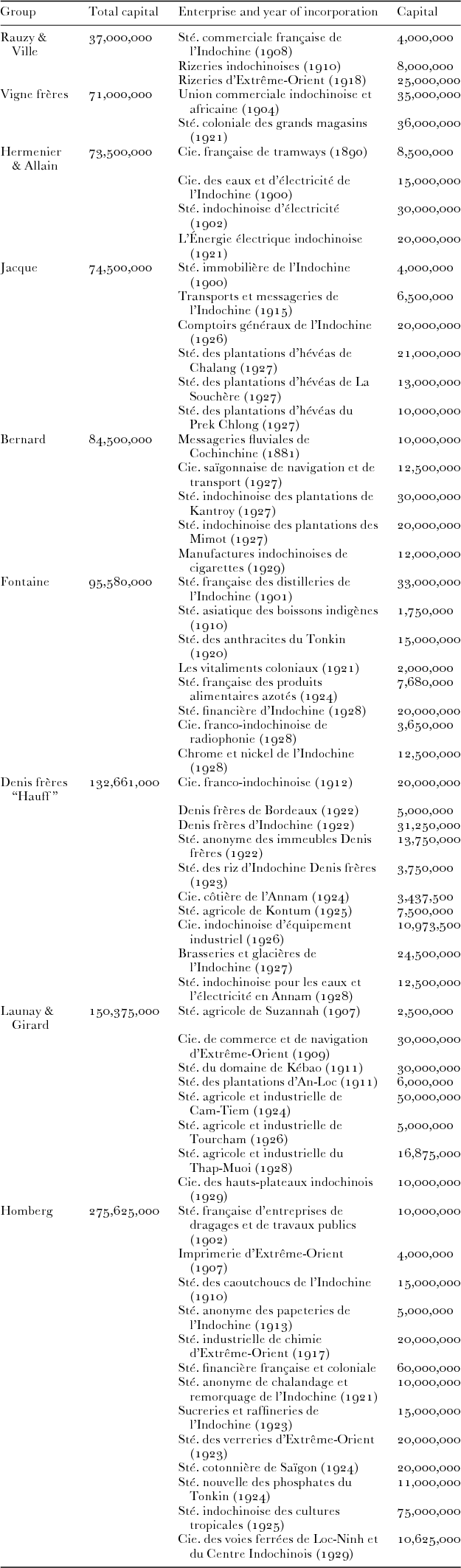
The choice of enterprise groups discussed in this article was based on two criteria: first, whether or not they conducted the bulk of their operations in Indochina. This means the discussion excludes, for example, the Hallet-Rivaud rubber concern whose operations stretched across Southeast Asia and instead focuses on groups led by men like Colonel Bernard, the Denis brothers, or A. R. Fontaine, who were longtime residents in the colony and deeply implicated in its political economy. Fontaine, for example, spent more than half his life in Indochina, coming to Tonkin as a young man in 1886 and only returning permanently to France in 1927.Footnote 68 Even the group headed by the Parisian financier Octave Homberg, while initially conceived as an ‘imperial’ enterprise with operations across North Africa and Asia, rapidly came to focus primarily on Indochina.Footnote 69 Second is the ability of the group to contest the commanding heights of the Indochinese economy, as seen in its participation in the ventures that reshaped the colony in the interwar years like Credit Foncier or the proposed Magasins généraux et transportations fluviales en Cochinchine. The Mazet and Vigne groups, for example, each had roughly equal levels of capitalization in 1930 yet only Vigne was a fixture on the boards of the colony's most important ventures.
Table 1 is based on a close reading of the list of major enterprises in the 1930 Annuaire des entreprises coloniales. The series of business directories grew out of the Répertoire des entreprises coloniales first published in 1912. Compiled by a colonial lobby group—the French Colonial Union—and based on information supplied by the enterprises themselves, these directories must be used with care. Nevertheless, they remain an important source of information on capitalization, webs of ownership and investment, and general developments over time. Enterprises in the table are grouped according to the presence of the same person or known associates at the position of president or managing director.Footnote 70 The result is a rough snapshot of the conglomerates on the eve of the economic downturn of the 1930s.Footnote 71 The intent is to capture the groups at the moment of their fullest expansion, but one of the effects is to leave out important stories and personalities from their pasts. Second, it tends to understate the size and extent of the conglomerates by leaving out their small- and medium-sized enterprises not incorporated in France. This shortcoming is addressed at least partially in the discussion of the Fontaine group, which includes many of the group's smaller enterprises and points to similar sorts of diversification by the other colonial conglomerates. In the absence of detailed studies of these enterprise groups over time, however, Table 1 is a useful first step towards understanding the colonial conglomerates, their relation to the state, and their patterns of diversification.
Selected Colonial Conglomerates in 1930
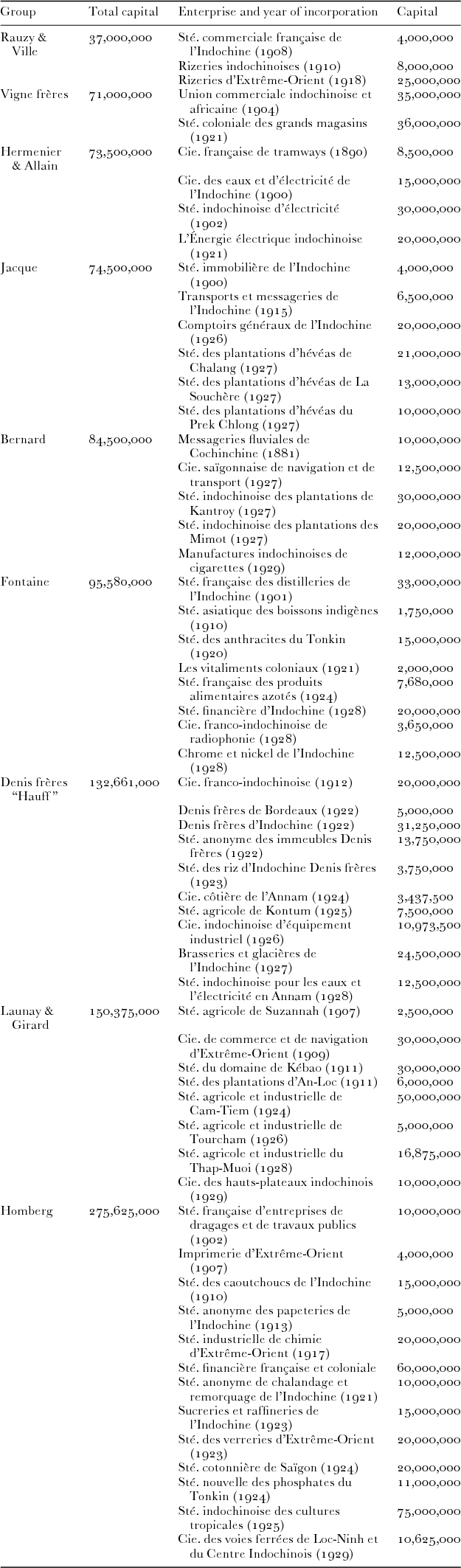
Notes: Based on information from the 1930 Annuaire des entreprises coloniales. All figures in French francs. Figures originally in piasters have been converted at the rate of 12.5 francs to 1 piastre, as used in the 1930 Annuaire.
The career of A. R. Fontaine is an example of how Indochinese entrepreneurs were able to leverage access to key officials in the colonial administration to fund the growth of the colonial conglomerates. Fontaine arrived at the port of Hai Phong on 1 May 1886 along with a shipment of wines and liqueurs from his native Bourgogne, supplied on credit. The liquor sold and his funds running low, Fontaine served briefly as a government clerk in Thai Nguyen and then in Hai Phong before returning to Dijon in late 1890 to deal with his creditors and secure whatever capital he could from his network of family, friends, and former associates.Footnote 72 On his return to Hanoi, Fontaine leveraged this small sum and the social capital accumulated during his time in the administration to transform himself from petty trader to respected businessman. By 1893 he was the owner of several enterprises around Hanoi and an investor in Tonkin's first European-owned distillery, built by a Frenchman named Dénoc and housed in one of Fontaine's properties.Footnote 73 It was a modest affair producing ersatz ‘European’ liquors intended to benefit from 1893 legislation granting locally produced alcohol a 50 per cent tax break relative to imported. His dubious rums, cognacs, and absinthes apparently failed to find an appreciative market, and as Dénoc's losses mounted in 1894 Fontaine assumed control of the company.
Like other founders of colonial conglomerates, Fontaine's genius lay in his realization that the state was by far the most lucrative market available to French enterprise, and in the skill and ruthlessness with which he then pursued that market. Just months after taking control of Dénoc's distillery, Fontaine secured a generous four-year contract from acting governor general—and Fontaine's former colleague in Hai Phong—Léon Chavassieux for the provision of 230,000 hectolitres of rum annually for French troops stationed in Tonkin. The affair was so murky that the minister of colonies directed Chavassieux's replacement, Armand Rousseau, to forward all relevant documents to Paris for examination.Footnote 74 Yet within two years, Fontaine had succeeded in winning the support of Frézouls, the new director of customs and régies, for a monopoly on the production of ‘indigenous alcohol’ in Tonkin and Northern Annam. The two then collaborated to win the backing of the newly arrived Doumer, who in 1897 determined to make the alcohol monopoly—and Fontaine's distilleries—one of the cornerstones of Indochina's fiscal reorganization.Footnote 75 In the settlement that resulted, Fontaine would produce liquor, his partner Raoul Debeaux would sell it, and the state would use its coercive mechanisms to guarantee profits and revenue for all.
Over the next eight years, Frézouls, Doumer, and his successor as governor general, Paul Beau, first used increasingly onerous regulations to exclude indigenous distillers from the market, then signed a series of contracts without the foreknowledge—and often despite the explicit opposition—of ministerial officials in Paris.Footnote 76 According to a 1913 report by the French Ministry of Finance, the contracts guaranteed Fontaine profits anywhere from five to ten times higher than similar contracts in France at the time.Footnote 77 The list of the Société française des distilleries de l'Indochine's initial shareholders underlines the very ‘Indochinese’ nature of its capital and the crucial role political influence played in securing such preferential terms.Footnote 78 In addition to Fontaine and his partner Debeaux, shareholders consisted almost entirely of Indochinese colonial officials, including, for example, the attorney general responsible for drafting and enforcing the legislation regulating alcohol production.Footnote 79 The Société française des distilleries de l'Indochine's tax farm on indigenous liquor would persist essentially unchanged until the end of the colonial period, with the corporation's dividends consistently rivalling those of the Bank of Indochina itself, famed for paying some of the highest dividends on the Paris bourse.Footnote 80 Thus an ‘Indochinese moment’ of collaboration between local officials and entrepreneurs operating independently of political and financial powerbrokers in the metropole was to result in the creation of a tax farm earlier Chinese syndicates could only have dreamed of, and provide the basis for the development of one of Indochina's most powerful colonial conglomerates.
Nevertheless, the creation and extension of this tax farm by another name was contested and incomplete. Despite a network of distributors that reached into the colony's smallest villages and the ever-present threat of fines and imprisonment, contraband distilling by Chinese and indigenous producers remained endemic: estimates typically placed the state's share of the total alcohol market at under half.Footnote 81 When Fontaine and the colonial state attempted to extend their new tax farm to Cochinchina, moreover, they found themselves pitted against the same Chinese syndicates that had previously been the state's preferred clients. By 1901 the Fujian Chinese entrepreneur Tay Chow Beng [Vietnamese Trinh Chieu Minh] was at the head of a syndicate of 39 of 47 of Cochinchina's major distilleries.Footnote 82 As Fontaine's new factory in Cholon entered into production in 1904 and the state moved against the syndicate, Tay Chow Beng and his partners resisted with every means at their disposal, orchestrating publicity campaigns that denounced French alcohol as poisonous, hiring some of the colony's best lawyers to defend their members against the administration's spurious prosecutions, and even having the Qing ambassador in Paris lodge a complaint with the minister of colonies.Footnote 83 By 1907, the administration had been forced to come to terms: the syndicate's 14 surviving distilleries were permitted to remain in operation and were guaranteed 22 per cent of Cochinchina's annual sales.Footnote 84 More important, the administration renounced its responsibility for distribution and sales of alcohol, leaving it to a syndicate headed by the redoubtable Tay Chow Beng.Footnote 85 Like many of the colonial conglomerates, the Fontaine group owed its initial success to a unique convergence of new industrial technologies, increasing state capacity, and weak oversight by officials in Paris. Yet the story of Tay Chow Beng reminds us that the resulting configuration, while powerful, was far from hegemonic, and that Chinese syndicates would continue to play an important role in the Indochinese economy.
1919–1928: the Indochinese moment and the growth of the colonial conglomerates
The decades after 1897 mark a turning point in the development of the Indochinese economy. Thanks to state policies that either shifted revenue away from Chinese syndicates or created entirely new revenue streams, local French enterprises were for the first time able to compete with the Chinese on their own terms and their own territory. When private investment replaced the state as the primary source of capital after the end of the war in Europe, these enterprises were ideally positioned to diversify away from their state-protected revenue streams and play a leading role in the growing economy.
Whereas private investment in Indochina during the first six decades of French rule totalled approximately 365 million francs, in the single decade beginning 1920 it was well over three billion.Footnote 86 These investment inflows resulted from the interplay of a post-war commodities boom that included Indochinese products like coffee, sugar, cotton, and rubber; the rise in the value of the Indochinese piaster relative to the franc; and efforts by governments in Paris and Hanoi to promote the colony as a site of investment. The capital flows had important spatial consequences, with Vietnam's highlands, Cambodia, and Laos all for the first time becoming privileged sites of investment (the first two for plantation agriculture, the last for mines). Robequain estimates that more than two-thirds of the capital that flowed into Indochina during the interwar years went to pre-existing rather than new ventures.Footnote 87 Thus Indochinese enterprises, whether Chinese-, indigenous-, or French-led, were the major beneficiaries of the increased availability of capital.
Despite increasing exclusion from its commanding heights, Chinese continued to participate in the expanding economy of the interwar years. Chinese syndicates maintained their control of the rice trade that remained the basis of the Indochinese economy: on the eve of the Great Depression, Chinese entrepreneurs owned 75 rice mills in Cholon, Vietnamese 16, and French 3.Footnote 88 Chinese enterprise was also able to access many of the same sorts of capital flows as its French competitors, with banks like the Bank of Indochina recycling increased liquidity to their Chinese clients.Footnote 89 Diversification, particularly into banking, real estate, and plantation agriculture, soon followed. In addition to participating in institutions like the Bank of Indochina and the Franco-Chinese Bank, the period also saw Chinese operating three banks in Cochinchina. By 1925, the property company founded at the turn of the century by Hua Bon Hoa was reputed to own more than 20,000 properties in Saigon and Cholon, including the opulent Majestic Hotel, completed in 1925. The Binh Tay market and its environs, completed in 1928, was the creation of the rice magnate Quach Dam.Footnote 90
The expanding economy also opened up opportunities for ethnic Vietnamese enterprise. The fish sauce producer Lien Thanh (1906) was a remarkable success story; by the 1920s, the company was selling its products throughout Indochina and cooperating with the Pasteur Institute to develop consumer protection standards for fish sauce. Meanwhile, the rubber baron Truong Van Ben had invested profits from his plantation in Thu Duc in a coconut oil processing plant, and was serving on the board of directors of Launay and Girard's Société agricole et industrielle de Thap Muoi.Footnote 91, Footnote 92 Vietnamese were increasingly competitive in shipping, contesting the condominium of Chinese and French shipping concerns. In Cochinchina, Nguyen Huu Thung was operating a fleet of ships servicing the Vietnamese coast and beyond to Hong Kong. In Tonkin, the trajectory of the shipping company founded by Bach Thai Buoi in 1906 was reaching its apogee, with over 2,000 employees operating a fleet of river and ocean-going vessels plying routes connecting the ports of Vietnam with Singapore, Japan, the Philippines, and Southern China. Mirroring his French and Chinese competitors, Buoi's empire diversified to include shipyards, coalmines, and media.Footnote 93 At least some of the competitiveness of Vietnamese entrepreneurs in the interwar years was due to a surge in popular economic nationalism and the more or less successful boycotts it inspired. Buoi, for example, was famous for coining the phrase, ‘Vietnamese people use Vietnamese products’.Footnote 94
Nevertheless, it was the colonial conglomerates that drove much of the economic change of the interwar period. With commodity prices rising, mining was an obvious target (see for example the Fontaine group's coal mines at Trang Bach and Mao Khe or the Homberg group's Société nouvelle des phosphates du Tonkin). Conglomerates like the Homberg, Bernard, and Launay and Girard groups also invested heavily in the rubber industry.Footnote 95 Denis Frères embarked on an impressive wave of diversification, using capital from incorporation in 1922 to expand into brewing—Brasseries et glacières de l’Indochine, still in existence today—and to enter the market for infrastructure projects with the Compagnie indochinoise d’équipement industriel and the Société indochinoise pour les eaux et l’électricité en Annam. However, the most spectacular—and most speculative—expansion was carried out by Octave Homberg, who by 1929 was presiding over a portfolio of companies that included not only the colony's major public works contractor, but also plantations, mining, printing, paper, chemicals, sugar, glassworks, cotton, shipping, and railways, among others.
While A. R. Fontaine was not able to mobilize such remarkable amounts of capital as his frequent partner Homberg, he was able to finance the diversification of his own group through a combination of share issues and windfall profits from supplying industrial alcohol to the French armaments industry during the war and interwar periods.Footnote 96 The remarkable spike in the Société française des distilleries de l'Indochine's dividends after 1919, for example, resulted primarily from Fontaine's efforts to shield himself and his shareholders from special war taxes, and profits not paid as dividends were reinvested in a programme of expansion he had begun sketching out well before the war's end.Footnote 97 Fontaine's plan centred on using new enzyme technologies to create an integrated industrial and commercial system stretching from the rice markets of the Indochinese countryside to distilleries in Saigon and Hanoi to factories in Parisian suburbs producing fortified breakfast drinks for French schoolchildren.Footnote 98 In addition to these core enterprises, Fontaine invested in a dizzying range of sectors, from plantation agriculture to mining to radio to bicycles.Footnote 99 By the mid 1920s, the group was even manufacturing that most local of products, fish sauce.Footnote 100 Yet the group's inability to plug into networks of trade and capital outside the reach of its connections with the colonial state remained limited: his attempt to promote a monopoly of alcohol production in Siam in 1908, for example, was a failure.Footnote 101
Fontaine was also very much part of the period's other important trend: the creation of joint ventures that pooled the financial and political resources of the colonial conglomerates with the Bank of Indochina. Examples include the proposed Magasins généraux et transportations fluviales en Cochinchine that began the article, the Da Nhim project [see below] or the Société des laques indochinoises, which brought the Bank of Indochina and the Industrial Bank of China together with the Fontaine, Hermenier, Vigne, Launay and Girard, and Homberg groups. Probably the most important was Crédit foncier de l’Indochine (1923) and its subsidiary Crédit agricole de l’Indochine (1928). In 1930 the former's board of directors included Octave Homberg, Fernand Bernard, A. R. Fontaine, Joseph Vigne, Georges Hermenier, and Lucien Launay, with former Governor General Ernest Roume as president. The two ventures offered loans secured with urban and rural property, respectively, helping to inflate the real estate bubble of the 1920s.Footnote 102
As the above sketch testifies, much of the capital invested in Indochina during the interwar years either went into extractive industries like mining and plantation agriculture, or more speculative sectors like land or finance: in short, the kind of superficial and exploitative economic development described by Murray and others. Yet even in this period we can discern a growing awareness of the need for structural change. In 1923, Minister of Colonies and former Governor General of Indochina Albert Sarraut tabled a comprehensive proposal—quickly dubbed the Sarraut Plan—for a new kind of long-term state-led economic development intended to ensure a more equitable distribution of the benefits of the empire's mise-en-valeur. Martin Thomas has explored the slow death of the project over the 1920s, ascribing the failure to a combination of party politics and the opposition of French industrialists afraid as much of nascent class struggle in the colonies as potential competition for their markets.Footnote 103
While Sarraut's plan may not have reflected political realities in the metropole, it may have been more representative of new currents of thought in the empire's Indochinese periphery. The influential Octave Homberg, for example, was an early and public supporter of the plan, while A. R. Fontaine enjoyed a close personal and professional relationship with Sarraut that would last until the businessman's death in 1934.Footnote 104 At the same time that Sarraut was struggling to win support for his project in Paris, men like Homberg and Fontaine were already attempting to put elements of the plan into practice in Indochina. As part of his efforts to promote the growth of Vietnamese enterprise, for example, Fontaine invested half a million francs to create the Société agricole de Cai Sang, which he then placed under the management of his protégé Tran Van Kha and their associate, the well-known businessman and politician Bui Quang Chieu.Footnote 105 Fontaine was also an outspoken proponent of gradual political and social reform—outlined in a series of books and pamphlets in the late 1920s—with clear affinities to Sarraut's programme of associationism.Footnote 106
Perhaps the clearest example of the potential held out by this new kind of economic development is found in the Société d’études des engrais azotés en Indochine et de la chute du Da-Nhim, incorporated in Paris in 1928.Footnote 107 The project was backed by a consortium that included some of the largest French infrastructure and financial concerns; local partners were Homberg's Société financière française et coloniale, Rauzy and Ville's Société française commerciale de l’Indochine, and Fontaine's Société française des distilleries de l'Indochine.Footnote 108 The consortium proposed to divert the Da Nhim river from its course on the plateau of the Central Highlands to the coastal plain below, creating an artificial waterfall that would be used to power Indochina's first hydroelectric station. Power generated would be used not only to electrify large parts of Annam and Cochinchina, but also to create an industrial zone at the nearby port of Cam Ranh featuring Indochina's first artificial fertilizer plant. The dam thus formed part of a larger effort to revolutionize agricultural productivity in Indochina that continued to lag behind its Southeast Asian neighbours. In the end, the combination of the economic downturn and the administration's refusal to provide subsidies meant that the consortium could never realize its designs. Nevertheless, the interest it generated among Japanese planners and engineers both during and after the war points to the way the project anticipated the coming transformations of colonial mise-en-valeur into wartime co-prosperity, and eventually into post-colonial economic development. In 1964 under the independent Republic of Vietnam, the project would be completed by the Nippon Kōei Corporation, funded by Japanese war reparations payments, and overseen by some of the same engineers who had promoted the project two decades earlier.Footnote 109
1928–1941 and the end of the Indochinese moment
The years after 1928 brought major changes for the Indochinese economy and the colonial conglomerates. Two factors were to drive these changes. The first was a slow and partial reorientation of the economy away from its traditional markets in East and Southeast Asia and its increased integration in an imperial economic system centred on France. The second was a decrease in private investment following the Crash of 1929. The latter was to expose the unsustainability of much of the diversification undertaken by the colonial conglomerates after 1918. The net result of both developments was to shift initiative away from local entrepreneurs, whether French, Chinese, or Indochinese, and to consolidate the position of metropolitan financial interests led by the Bank of Indochina and working together with an increasingly technocratic state.
Signs of the emerging crisis began to appear in Indochina in 1928 when rubber prices dropped precipitously, and Saigon and Cholon were hit by a wave of bankruptcies that would intensify the following year.Footnote 110 As commodity prices fell after 1929, high levels of rural indebtedness translated into widespread foreclosures that saw many small and medium farmers dispossessed of their land, and moneylenders—Indian Chettiars and above all the Bank of Indochina and Crédit foncier de l’Indochine—transformed into the colony's major landowners. Exacerbating the effects of the crisis, the state cooperated with the Bank of Indochina to carry out what was termed a ‘cleansing’ of the economy, and curtailed public spending after 1935.Footnote 111
Nevertheless, relative to other economies in Southeast Asia, the effects of the Depression in Indochina were mitigated by several factors: one was the way France and its empire were less integrated in global markets and thus less vulnerable to their fluctuations, another was the continued dependence of the Indochinese economy on commodities with relatively inelastic demand like coal and rice, the latter of which could at least be eaten if it couldn't be traded. The economy in the years after 1928 was thus far from moribund: Brocheux reports that the period 1931–1939 saw the creation of 74 new companies, compared to 135 during the boom years of 1919–1930. In 1932, for example, the Denis frères group helped found the Société algérienne et indochinoise des tabacs, while Truong Van Ben added a soap and detergent factory to his existing coconut oil processing operation outside of Saigon.Footnote 112 The success of such ventures, focusing on producing inexpensive consumer goods for local consumption, supports the conclusion that the effects of the economic crisis, while real and prolonged, were also to some extent moderated.Footnote 113
Many of the changes in the period after 1928 were driven less by the global downturn than by a long-term reorientation of Indochina's economy away from its traditional markets in Asia and towards the imperial market. In 1928 the ‘Kircher tariffs’, named after the longtime director of customs for Indochina, saw its independent tariff regime replaced and the colony integrated within the metropolitan customs system. The process of linking the two economies accelerated in 1931 when the Indochinese piaster was taken off the silver standard that predominated in Asia and attached, along with the French franc, to gold.Footnote 114 The years that followed saw a drop in exports to markets in East and Southeast Asia and a complementary increase in exports to France, while French imports increased their already preponderant share of the local markets. The result was the development after 1930 of what Jacques Marseille has characterized as a dysfunctional relationship between France and its colonies as protected Indochinese resources and markets came to serve as crutches for uncompetitive French industries.Footnote 115
Multiple dynamics were at play in this process of imperial economic integration. Synthetic accounts such as Marseille's typically see the process as driven by metropolitan industrial and financial interests, and Booth highlights the threat cheap Japanese goods represented to French dominance of the market for manufactured goods.Footnote 116 Yet local interests also played an important role. In his study of the debate surrounding the assimilation of the customs regimes, Giacometti concluded that the chief architect of the Kircher tariffs was none other than A. R. Fontaine.Footnote 117 Unlike the colony's other rice traders like Denis frères or Rauzy and Ville who exported primarily to Asian markets, Fontaine sought to increase his penetration of the French market not just for rice, but also for rice derivatives, rum, industrial alcohol, and processed food.Footnote 118 Finding himself at odds with most of the colony's rice exporters, Fontaine proceeded to found his own lobby, the Syndicat des exportateurs français de riz de Saigon, and then worked closely with Kircher to secure the passage of the controversial bill.Footnote 119 The new tariff system shifted the balance of power to such an extent that the governor general intervened unofficially to request that Fontaine refrain from taking over the rice export market.Footnote 120
As this contest over the tariff regime suggests, interests in Indochina were far from homogeneous and the reorientation of the Indochinese economy away from markets in Asia far from complete. When exports to Indochina's two principal trading partners, China and Japan, fell precipitously, the administration entered into negotiations that saw a preferential reciprocal tariff regime established with Japan in 1932 and quickly extended to China.Footnote 121 Thus Fontaine's coup was short-lived, and his French and Chinese competitors continued to challenge his control of the Indochinese rice market. As exports to Asia recovered, so too did imports from the region. Booth's figures show Japanese imports, which had halved after the implementation of the Kircher tariffs, tripling in the three years after 1932.Footnote 122 While a multitude of interests and actors both in France and in Indochina were to drive the integration of the two economies after 1928, others were to ensure that the integration was contested and incomplete.
The effects of the Depression years for the colonial conglomerates were thus complex. As capital flows dried up, the rapid and often speculative diversification of the interwar years proved unsustainable.Footnote 123 The 1937–1938 Annuaire des entreprises is filled with notices that the status of an enterprise was ‘uncertain’, or that it was in the process of being taken over, and Robequain estimates that between 1929 and 1937, losses through company dissolution and capital reduction totalled 1,255 million francs out of a total pre-Crash capital of about 2,000 million.Footnote 124 Nevertheless, five of the groups—Bernard, Denis frères, Vigne, Launay and Girard, and Rauzy and Ville—were able to weather the economic downturn and remain independent.Footnote 125 The Jacque group survived but was forced to divest large parts of its holdings like the famous la Souchère rubber plantation, acquired at auction by the Bank of Indochina in 1933. At the Hermenier and Allain group, while Maurice Allain continued to preside over its enterprises, the presence of the Director René Thion de la Chaume as vice-president underscored the Bank of Indochina's increased oversight.
Two others, the Homberg and Fontaine groups, were less fortunate. Following its near-bankruptcy, Homberg's holding company the Société française financière et coloniale was saved by a consortium of banks led by the Bank of Indochina in December 1930. The Bank removed Homberg from the helm of scores of Indochina's major corporations, leaving him only a handful of presidencies at minor concerns like the Société anonyme des papeteries de l’Indochine. Meanwhile in the late 1920s A. R. Fontaine had used his holdings in the Société française des distilleries de l'Indochine and Crédit foncier as security for loans from the Bank of Indochina that went to shore up loss-making ventures like Chrome et nickel de l’Indochine. As losses mounted and he was unable to repay, the Bank quietly assumed ownership of the group's core enterprises. By 1931, the man who had once owned half of one of the empire's most profitable corporations owned a mere 188 of its shares, or less than 0.3 per cent.Footnote 126 In 1932, the Bank delivered the coup de grace and forced Fontaine to step down as president of his flagship Société française des distilleries de l'Indochine.Footnote 127 He died two years later, broken and virtually penniless.
As private investment slowed after 1929, the state assumed once again its role as the arbiter of Indochina's political economy. Yet where it had once worked closely with men like Fontaine and Homberg in their efforts to scale the economy's commanding heights, it now made common cause with the Bank of Indochina in a project of rationalization and reordering.Footnote 128 The fate of the Fontaine group illustrates how the process might unfold. When de la Chaume replaced Fontaine as President of the Société française des distilleries de l'Indochine he moved immediately to close the group's loss-making ventures like the Société française des produits alimentaires azotés and the Société financière d’Indochine. The group's rubber interests were folded into the Bank's Société indochinoise des plantations d’hévéas, while the mines of the Société des anthracites du Tonkin were transferred to the Société française de charbonnages du Tonkin, controlled by the Paris-based Crédit Industriel et Commercial. The group's most profitable venture, the Société française des distilleries de l'Indochine, was allowed to remain a separate entity but under control of its major shareholder, the Bank of Indochina. In other cases, the Bank made little attempt to dissimulate its control, between 1930 and 1937, it absorbed outright 27 enterprises.Footnote 129 By the mid 1930s, the state and the Bank of Indochina had succeeded in disciplining the disorderly economic landscape that the colonial conglomerates had built after 1897.Footnote 130
This new economic order was sustained through state intervention that mixed forms both old and new. Just as early colonial regimes had once indulged Chinese tax farmers rather than risk provoking a generalized crisis, the state after 1929 provided emergency loans and brokered financial bailouts for enterprises it and the Bank deemed too vital to fail.Footnote 131 Similarly, increased investment in infrastructure—spending on railways leaped in 1930 and remained high until the end of the crisis in 1936—had clear echoes of Doumer's public works projects of more than three decades earlier. And preferred clients could still benefit from the creation of new tax farms: in 1934 legislation required that ethanol from the Société française des distilleries de l'Indochine's factories make up 10 per cent of all petroleum sold in Indochina. Yet even these older forms of state intervention illustrate how the economic landscape had changed: this new tax farm did not require invasive state intervention, and appropriated revenue not from Chinese syndicates but rather from the Anglo-Dutch Shell Oil Company.
Other forms of intervention reflected the regime's increasingly technocratic orientation. In a move to stimulate exports, the state dropped export taxes on key commodities like zinc, tin, and rice. Major rice growers and rubber plantations received loans and subsidies through new state agencies like the Caisse de compensation du caoutchouc (Rubber Compensation Fund, 1931), the Office de soutien à la production agricole (Office of support for agricultural production, 1932), and the Service des prêts fonciers (Land Loan Service, 1932). Rubber was a particularly privileged sector: between 1931 and 1934 the industry received a total of more than 180 million francs in loans and subsidies.Footnote 132 By the mid 1930s, the Indochinese moment had come to an end, many of the colonial conglomerates had been disciplined and rationalized, and the commanding heights of the Indochinese economy were being shaped by new forms of technocratic management/governance that owed as much to experts like Paul Bernard at the Société française financière et coloniale or Jean Rigal at the Société française d’entreprises de dragages et de travaux publics as to graduates of the state's reformed École coloniale.Footnote 133
Conclusion
Despite the fact that they were separated by a mere five years, two projects—the Magasins généraux et transportations fluviales en Cochinchine that began this article and the Société d’études des engrais azotés en Indochine et de la chute du Da-Nhim—capture many of the changes that occurred to the commanding heights of the Indochinese economy across almost 80 years of French rule. The first project had its roots in the region's past and in the central role that Chinese syndicates and Asian markets for primary products continued to play in the economy. As with the contracts and tax farms that had been the basis for the early growth of the colonial conglomerates, the project would have mobilized state regulatory powers to wrest revenue away from existing enterprises, creating a real French monopoly in the place of an imagined Chinese one. Its only innovations lay in its scale and in the way it united seven of the nine conglomerates discussed here in one common enterprise. The project, however, was never realized, and the inheritors of men like Gan Tin Wee and Tay Chow Beng continued to contest the commanding heights of the Indochinese economy.
If the first project illustrates many of the underlying continuities in the colonial economy, the second project looks to an unrealized Indochinese future. While state intervention in the form of subsidies was still central, the project focused on a new sector—hydroelectric power generation—that would have had important implications for the future development of agriculture, industry, and urbanization. Moreover, the role of the colonial conglomerates, while still significant, was subordinate to the metropolitan industrial and financial concerns that would have provided expertise and capital. The project thus points to the Indochina of the late colonial period where the unfettered growth of the 1920s had given way to an apparently rationalized mise-en-valeur under the joint management of the state and the Bank of Indochina.
This article has retold the story of Indochina's political economy not from the perspective of Paris and its politicians and financiers, but rather from the perspective of places like Hanoi, Saigon, and Phnom Penh and of the Indochinese entrepreneurs who made and sometimes lost their fortunes there. Over the course of eight decades, new technologies, shifting flows of capital and evolving forms of state intervention allowed a range of actors to contest the spaces of the economy's commanding heights. For a time, these spaces were dominated by enterprise groups founded by men with names like Bernard, Denis, or Fontaine. Yet just as Chinese syndicates had once ceded ground to the colonial conglomerates, so would these enterprise groups in their turn be compelled to adapt to powerful new configurations of capital, state power, and ideology. Nevertheless the vestiges of the conglomerates still visible in the plantations of the Vietnam Rubber Group, the factories of the Société Khmer des Distilleries, the mines of the Vietnam Mining Corporation, or the Da Nhim hydroelectric plant of Electricity Vietnam remind us of the Indochinese moment and of the lasting changes it brought to the region's economy.