Introduction
The introduction of democratic or participatory innovations is a popular method for enhancing democratic credentials (Smith, Reference Smith2009; Geissel and Newton, Reference Geissel and Newton2012; Geissel and Joas, Reference Geissel and Joas2013; Grönlund et al., Reference Grönlund, Bächtiger and Setälä2014; Kuyper and Wolkenstein, Reference Kuyper and Wolkenstein2019). However, while it seems clear that citizens demand more involvement, it remains unclear exactly how they want to be involved.
Previous studies have examined similar issues from different perspectives. Some assess the merits of participatory mechanisms by assessing their pros and cons (Rowe and Frewer, Reference Rowe and Frewer Lynn2000; Fung, Reference Fung2003, Reference Fung2006; Smith, Reference Smith2009; Geissel, Reference Geissel, Geissel and Joas2013; Caluwaerts and Reuchamps, Reference Caluwaerts and Reuchamps2016). This approach provides us with insights into what democratic benefits a participatory mechanism can provide but fails to consider how citizens evaluate these mechanisms and their characteristics. Other studies examine popular attitudes toward specific types of participatory mechanisms (Jacquet, Reference Jacquet2018; Christensen and von Schoultz, Reference Christensen and von Schoultz2019; Goldberg et al., Reference Goldberg, Wyss and Bächtiger2019) or differences in process preferences, that is, how political decision should be made (Font et al., Reference Font, Wojcieszak and Clemente2015; Bengtsson and Christensen, Reference Bengtsson and Christensen2016; Gherghina and Geissel, Reference Gherghina and Geissel2017). Although these studies provide important insights, they do not show what participatory mechanisms citizens want or how specific design features of these mechanisms affect citizens’ evaluations of them. Appreciating what participatory features appeal to citizens is important for knowing what processes are likely to succeed in broadening popular involvement in political decision-making.
This study examines how features of participatory mechanisms affect their popularity with a conjoint analysis that makes it possible to test multidimensional causal effects of several treatment components simultaneously (Hainmueller et al., Reference Hainmueller, Daniel and Yamamoto2014; Knudsen and Johannesson, Reference Knudsen and Johannesson2018). The study relies on a representative sample of the Finnish population (n = 1050) to examine the effects of seven central attributes of participatory innovations that are likely to affect whether citizens would like to see them introduced: (1) inclusiveness, (2) popular control, (3) considered judgment, (4) transparency, (5) efficiency, (6) transferability, and (7) policy issue. It is also examined whether the effects of the features differ across policy issues or depend on whether respondents prefer citizens or representatives as decision-makers.
The results show that the attributes affect how citizens evaluate participatory procedures. People generally prefer transparent participatory processes that include face-to-face interaction among participants and expert advice to deal with complicated issues. At the same time, the participatory processes should be advisory and not include too many meetings. These effects appear to be uniform across policy issues and do not depend on the process preferences of citizens.
The article proceeds as follows. In the following section, it is explained why the participatory features of democratic innovations are likely to affect citizens’ attitudes toward their introduction and hypotheses on causal relationships are outlined. The following section explains how these hypotheses are tested with a conjoint experiment, before moving on to the empirical analyses. The final section discusses the results and their implications for the study of participatory mechanisms.
What participatory mechanisms do people want?
Democratic innovations, or ‘institutions specifically designed to increase and deepen citizen participation in the political decision-making process’ (Smith, Reference Smith2009: 1), have been implemented at different political levels all over the world. The common idea is that increasing citizen involvement in political decision-making ensures that policy outcomes reflect the will of citizens, or that at the very least, participants feel that decision-makers have demonstrated a will to listen to their demands.
Despite these commonalities, there are also important differences between the democratic innovations that reflect adherence to the fulfillment of different democratic ideals. Even when different normative conceptions see participation as beneficial, there can be important differences in what democratic goods they aim to achieve (Chambers, Reference Chambers2003; Mutz, Reference Mutz2006; LeDuc, Reference LeDuc2015). According to Chambers (Reference Chambers2003: 308), vote-centric democratic theory sees democracy as an arena where fixed interests and preferences compete via fair mechanisms of aggregation of votes to ensure that all decisions are backed by the majority of citizens. Talk-centric theories focus on the communicative processes of opinion and will-formation that precede voting. This perspective incorporates different versions of deliberative democracy whereby participation should aim to ensure the quality of decisions by changing preferences through a process of deliberation (Bengtsson and Christensen, Reference Bengtsson and Christensen2016; Setälä, Reference Setälä2017; Jacquet, Reference Jacquet2018; Kuyper and Wolkenstein, Reference Kuyper and Wolkenstein2019).
This distinction has direct consequences for how democratic innovations work (Rojon et al., Reference Rojon, Arieke and Klandermans2019). Direct-democratic mechanisms are molded on a vote-centric conception of democracy and give citizens the right to make decisions directly (Altman, Reference Altman2011; Qvortrup, Reference Qvortrup2013). Talk-centric deliberative mechanisms rarely make citizens formal decision-makers, but help citizens discuss the issues and thereby achieve enlightened understanding of the underlying problems (Grönlund et al., Reference Grönlund, Bächtiger and Setälä2014; Setälä, Reference Setälä2017; Kuyper and Wolkenstein, Reference Kuyper and Wolkenstein2019). While both goals are laudable from a democratic perspective, implementing participatory mechanisms entails trade-offs as they are rarely able to achieve all goals simultaneously (LeDuc, Reference LeDuc2015). For example, making citizens the final decision-makers may undermine their willingness to be respectful and engage in genuine dialogue when they are not forced to defend their position in public (Smith, Reference Smith2009: 129–130). However, it remains unclear what goals citizens would prefer participatory processes to achieve. Do they want decisive vote-centric institutions where citizens can make decisions as they see fit, or are they willing to engage in more demanding talk-centric mechanisms where the emphasis is on developing a better understanding of the issues at hand?
It has been difficult to ask ordinary citizens how they feel about democratic innovations since most citizens are unfamiliar with the participatory mechanisms on offer. For example, it makes little sense to simply ask people whether they would like to see more deliberative mini-publics without carefully explaining what they entail (Goldberg et al., Reference Goldberg, Wyss and Bächtiger2019). Previous studies relying on surveys have asked more generally whether a respondent supported the use of public discussions in connection to decision-making (Christensen et al., Reference Christensen, Himmelroos and Grönlund2017a; Christensen and von Schoultz, Reference Christensen and von Schoultz2019). However, this at best provides a crude assessment of support for the use of mini-publics since these also involve other features such as rules or expectations for how participants conduct themselves during discussions (Grönlund et al., Reference Grönlund, Bächtiger and Setälä2014).
The approach suggested here instead entails an examination of how features of participatory processes affect citizens’ evaluations of them. Although differences exist in the proposed evaluation criteria (Geissel, Reference Geissel, Geissel and Joas2013), previous research on democratic innovations has established sets of criteria for evaluating the functioning of participatory innovations (Rowe and Frewer, Reference Rowe and Frewer Lynn2000; Fung, Reference Fung2003, Reference Fung2006; Smith, Reference Smith2009; Geissel, Reference Geissel, Geissel and Joas2013; Caluwaerts and Reuchamps, Reference Caluwaerts and Reuchamps2016). All participatory processes constitute a bundle of different participatory features or central design characteristics that determine what they can achieve. These features provide a basis for identifying what people want since they shape citizens’ evaluations of democratic innovations.
It may be countered that it is irrelevant what kind of participation people want since normative democratic goods should not be evaluated by their popularity. However, even when a specific participatory innovation could potentially deliver every imaginable democratic good, it would still need citizens’ support to be able to fulfill this potential. Not only are people less likely to support its introduction in the first place, but they are also less likely to take advantage of the possibility to take part once in place (Bengtsson and Christensen, Reference Bengtsson and Christensen2016; Gherghina and Geissel, Reference Gherghina and Geissel2017; Christensen and von Schoultz, Reference Christensen and von Schoultz2019). Hence, although popularity does not alter the proposed advantages of a participatory mechanism, it affects the possibility of bringing the hypothetical advantages to fruition.
This study therefore relies on a conjoint experiment to assess what aspects of participatory practices are valuable from a citizen’s perspective. The aim is to examine how citizens’ evaluations of participatory mechanisms are shaped by central design features. The study is inspired by the scheme developed by Smith (Reference Smith2009), which arguably constitutes the starting point for empirical evaluations of democratic innovations and has influenced subsequent work in the field.Footnote 1 While this framework does not on all accounts allow for a one-to-one comparison between talk-centric and vote-centric designs, it nonetheless on most accounts highlights important differences between these two perspectives. In his work, Smith (Reference Smith2009) relies on six criteria for evaluating democratic innovations:
1. Inclusiveness: who can take part?
2. Popular control: how much influence over policy outcomes?
3. Considered judgment: do participants decide independently or interact with each other or experts?
4. Transparency: is decision-making open to public scrutiny?
5. Efficiency: what are the costs of participation?
6. Transferability: how easy is it to take part?
According to Smith (Reference Smith2009: 12), the first four items are explicit democratic goods, whereas the last two are institutional goods that consider the feasibility of participatory innovations. This calls attention to the fact that it is also important to consider the practical implications of introducing novel participatory mechanisms. The intention is not to test how well this framework captures popular attitudes since it is considerably more nuanced than what can be accommodated here. Instead, it makes it possible to identify key aspects that are likely to affect how citizens evaluate participatory mechanisms.
The following outlines what aspects are particularly relevant for each criterion and outlines hypotheses on how they may affect the favorability of participatory procedures.
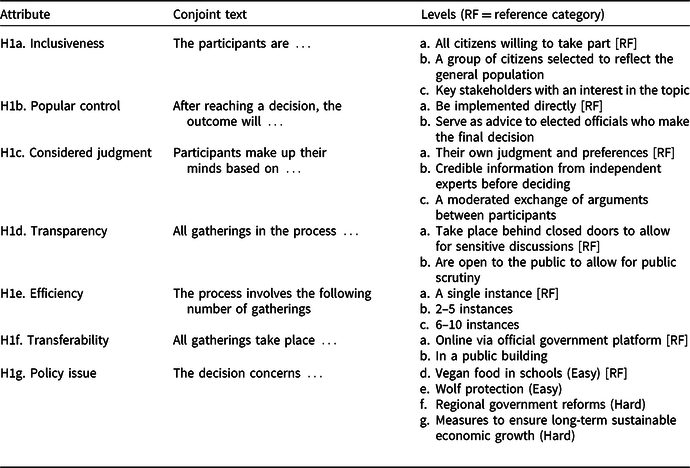
Inclusiveness concerns a fundamental choice with down-stream repercussions for the whole process. This aspect is often highlighted since it is debated whether participatory innovations can help alleviate or will further exacerbate, existing participatory inequalities (Young, Reference Young2000: 35). Participatory mechanisms can be placed on a continuum ranging from arrangements open to all wanting to take part on one end to more exclusive arrangements where only selected stakeholders can take part on the other end (Fung, Reference Fung2006: 67–68). Vote-centric instruments such as referendums stress the formal equality of all citizens to take part, but although this may appear to be the most inclusive, this is not the case when equality of usage is lacking (Dalton et al., Reference Dalton, Cain, Scarrow, Cain, Dalton and Scarrow2006). It can therefore be more inclusive to purposefully select participants to ensure the inclusion of groups otherwise unlikely to attend, as is often highlighted by talk-centric deliberative mechanisms. This can be secured through random selection of participants to ensure descriptive representation of all segments of society (Gastil and Wright, Reference Gastil and Wright2019). Nevertheless, considering the intuitive appeal of open arrangements, H1a is that more inclusive procedures increase favorability compared to exclusive procedures. Footnote 2
For popular control, vote-centric instruments of direct democracy where citizens become final decision-makers constitute one extreme (Altman, Reference Altman2011; Qvortrup, Reference Qvortrup2013). Involvement is sometimes not enough to ensure legitimacy, since it is imperative to ensure that participants can actually have a say over decision-making outcomes (Ulbig, Reference Ulbig2008). However, most participatory instruments that are introduced today give citizens the chance to provide input but leave the final decision-making powers in the hands of elected representatives (Geissel and Newton, Reference Geissel and Newton2012). It is again debated what arrangements are preferable for democratic legitimacy. Some chide advisory participatory processes for being nothing more than a window dressing that gives an appearance of popular influence, but in the end are of no consequence at all (Blaug, Reference Blaug2002). However, even when we trust the capabilities of citizens to take part, some issues are so complex that people prefer not to let them be decided by ordinary citizens without the necessary expertise (Bengtsson and Christensen, Reference Bengtsson and Christensen2016). Moreover, there is a potential problem with accountability when there are no elected representatives to hold accountable (Setälä, Reference Setälä2006). People may prefer a more advisory role while leaving the final decision in the hands of accountable representatives with access to the necessary expertise. Nevertheless, the hypothesis is that people will intuitively prefer a more decisive arrangement, meaning H1b is that procedures where participants make final decision increase favorability compared to advisory procedures.
When it comes to considered judgment, a basic distinction exists between voting based on existing preferences and taking decisions based on deliberation to form enlightened opinions. The former principle is in line with vote-centric democratic theory. While electoral campaigns provide some information, it is believed that people can process this information independently and cast their vote based on this (LeDuc, Reference LeDuc2015). The talk-centric perspective emphasizes support for developing preferences. While different accounts exist, Fishkin (Reference Fishkin2009) incorporates the central elements in stating that a high-quality deliberative process includes information, balanced opinions, diversity, and equal consideration of the merits of arguments regardless of who offers them. This principle then highlights the value of neutral information and exchange of arguments as necessary in political decision-making. This makes it possible for citizens to form enlightened opinions that do not necessarily correspond to their opinion before the deliberative process started. Based on previous studies of process preferences in Finland (Bengtsson and Christensen, Reference Bengtsson and Christensen2016; Christensen and von Schoultz, Reference Christensen and von Schoultz2019), H1c is that procedures where participants can rely on dialogue and experts before making decisions increase favorability compared to procedures where participants rely on own judgments.
Transparency is usually considered beneficial from both vote-centric and talk-centric perspectives since it is assumed that participatory processes should be open to public scrutiny for the general population to trust them (Smith, Reference Smith2009: 25–26; Fung, Reference Fung2013; Woolley and Gardner, Reference Woolley and Gardner2017). However, some argue that secrecy and closed doors enhance the effectiveness of decision-making (Thompson, Reference Thompson1999; Stasavage, Reference Stasavage2004) and may enhance deliberative quality (Chambers, Reference Chambers2007). In a similar vein, Naurin (Reference Naurin2007) finds that publicity does not necessarily enhance deliberative quality, while de Fine Licht (Reference de Fine Licht2011) finds that transparency does not necessarily lead to greater public acceptance and trust. Hence, people may recognize that there is a trade-off between transparency and effectiveness when it comes to participatory innovations and therefore be willing to accept discussions that take place behind closed doors. Nevertheless, H1d is that procedures enhancing openness increases favorability compared to less transparent procedures.
The following two criteria are of a more practical nature and do not address the talk-centric or vote-centric division. For efficiency, Smith (Reference Smith2009) focuses on administrative costs and the demands they place on citizens. For the current purposes, the demands they place on citizens are especially relevant since they are likely to shape attitudes toward their usage, whereas it is difficult to establish anything more than a vague order of costliness of different procedures (Rowe and Frewer, Reference Rowe and Frewer Lynn2000: 17). What is likely to affect the evaluations is the time participants are expected to invest in the proceedings since this is easy to assess for the respondents and has been frequently debated in the literature (Verba et al., Reference Verba, Schlozman and Brady1995). When assessing the merits of a specific participatory process, time requirements are an easily understandable feature that can be used as a proxy for the inconveniences that the introduction causes for fellow citizens. There are considerable differences between different types of participatory mechanisms in how much time they require from participants. Some mechanisms such as referendums only require participants to provide input at a single event. Other mechanisms, including some versions of deliberative mini-publics (Grönlund et al., Reference Grönlund, Bächtiger and Setälä2014), require that participants invest considerable time over a longer period. Nonetheless, H1e is that procedures with more meetings decreases favorability compared to procedures with a single meeting.
For transferability, Smith (Reference Smith2009) focuses on the question of scale and whether participatory mechanisms can operate effectively at larger scales. The emphasis is here on examining the differences between online and offline participation since it has been contended that digital information and communication technologies (ICTs) can help resolve the problems size offers for democracy (Smith, Reference Smith2009). Online versions of participatory mechanisms may be able to transcend previous restrictions and make it possible to introduce them at a larger scale (Smith, Reference Smith2009: 143–144). While Smith (Reference Smith2009) is skeptical toward the promises of e-democracy, much has happened since the publication of this work. The advent of social media and smart phones has made the Internet and ICTs omnipresent in all spheres of life, including the political, and it is now difficult to imagine participatory reforms without taking advantage of the possibilities that technology offers (Carrara, Reference Carrara2012; Coleman and Moss, Reference Coleman and Moss2012; Fung, Reference Fung2015; Neblo et al., Reference Neblo, Esterling Kevin and Lazer2018). It therefore seems likely that whether a process take place online or face-to-face will affect its popularity. Considering the apparent popularity of online possibilities, H1f is that online procedures increase favorability compared to face-to-face procedures.
In addition to the criteria of Smith (Reference Smith2009), it is important to assess whether citizens’ evaluations differ depending on policy issue since previous studies show that this can affect preferences for participatory practices (de Fine Licht, Reference de Fine Licht2014; Wojcieszak, Reference Wojcieszak2014). Carmines and Stimson James (Reference Carmines and Stimson James2006) make a distinction between easy and hard political issues. These labels are somewhat misleading since easy issues are not necessarily easier to resolve with a straightforward solution. On the contrary, they involve symbolic issues that are likely to be longstanding issues of conflict and deal with policy ends rather than means. However, they are easy in the sense that they do not require people to think deeply about them, allowing gut response answers from both ill-informed and well-informed respondents since they can rely on established heuristics to decide their opinions. Hard issues on the other hand are difficult because they involve more technical issues where people are less likely to decide based on gut responses. Here, they are forced to reflect on the issues and make rational and calculated decisions based on existing evidence and information (Carmines and Stimson James, Reference Carmines and Stimson James2006: 80). Based on the idea that people are more likely to favor involvement when issues are less technical and more straightforward, H1g is that procedures involving easy issues increase favorability compared to procedures involving hard issues.
But these effects are not necessarily evenly distributed across all groups. Studies show that citizens’ preferences for participatory practices differ across issues (de Fine Licht, Reference de Fine Licht2014; Wojcieszak, Reference Wojcieszak2014). Wojcieszak (Reference Wojcieszak2014) suggests that the effects of the features will be stronger for easy issues, where people will demand popular influence, whereas people are more willing to let representatives and expert make decisions for hard issues that require careful consideration. This is reflected in the hypothesis H2, which states that the effects of participatory features are stronger for procedures involving easy issues compared to procedures involving hard issues.
The characteristics of the respondents may also affect what kind of participatory mechanisms they prefer. While several attributes can be of importance, the present study focuses on attitudes toward participation as a way of making political decisions and how this attitude shapes the effect of the participatory features. Previous studies show that people hold persistent preferences for how political decisions should be made and what actors should be involved (Font et al., Reference Font, Wojcieszak and Clemente2015; Bengtsson and Christensen, Reference Bengtsson and Christensen2016; Gherghina and Geissel, Reference Gherghina and Geissel2017). A central question is whether ordinary citizens or elected representatives should make the final decision on important political decisions (Wojcieszak, Reference Wojcieszak2014; Gherghina and Geissel, Reference Gherghina and Geissel2019). The process preference of respondents may moderate the effects of the participatory features on favorability given that the issue is particularly salient for those who demand more involvement of ordinary citizens. This is explored in H3: The effects of participatory features are stronger for people who support citizen involvement in decision-making compared to people who prefer elected representatives to make decisions.
Data, variables, and methods
A conjoint experiment is used to test the hypotheses in Finland, which constitutes an optimal case for the current purposes. Studies have demonstrated that Finns have consistent preferences when it comes to process preferences and that there is a demand for more participation (Bengtsson and Christensen, Reference Bengtsson and Christensen2016). Furthermore, various democratic innovations are used at both national and local levels, meaning that the issue of participatory mechanisms is familiar to many (Christensen et al., Reference Christensen, Himmelroos and Grönlund2017a,b; Jäske, Reference Jäske2017, Reference Jäske2019). The respondents come from an online panel recruited through Qualtrics, selected to be representative of the Finnish population with respect to age, gender, and place of living (n = 1050).Footnote 3 More information on sample size and the representativeness of the survey is in the Supplementary Material.
Conjoint analysis makes it possible to examine multidimensional causal effects of several treatment components simultaneously through relatively simple statistical analyses without unnecessary assumptions (Hainmueller et al., Reference Hainmueller, Daniel and Yamamoto2014; Knudsen and Johannesson, Reference Knudsen and Johannesson2018). While conjoint analysis also has certain limitations (see, e.g. Leeper et al., Reference Leeper, Hobolt Sara and Tilley2019), the main advantage for the present purposes is that a conjoint experiment makes it possible to discern how characteristics of participatory mechanisms affect how citizens evaluate them. Furthermore, this choice does not depend on respondents being familiar with specific mechanisms such as deliberative mini-publics since it is not necessary to present actually existing alternatives. Finally, the answers are not affected by social desirability bias, which may otherwise bias the results when respondents feel pressured to select a certain type of process.
The choice-based conjoint analysis used here presents respondents with two alternative participatory processes that randomly vary the levels of the attributes. The attributes are the characteristics assumed to affect evaluations, and the levels are discrete categories describing theoretically relevant values of the attribute in question. Each respondent evaluates five comparisons where they are asked to indicate what alternative they prefer, which is in line with the recommendations of Aguinis and Bradley (Reference Aguinis and Kyle2014: 363).Footnote 4 The dependent variable is whether a specific process is chosen or not and the analyses examine the impact of the seven attributes on this choice: the six participatory features identified by Smith (Reference Smith2009) and policy issues. Table 1 summarizes the attributes included in the conjoint experiment and the corresponding levels.Footnote 5
Attributes and levels

For inclusiveness, three levels capture what Fung (Reference Fung2006) considers the extremes of participatory inclusiveness (open to all-only key stakeholders) and an intermediate position (a selected group). The two levels for popular control consider whether the decision is implemented directly to approximate direct control or serves as advice to elected representatives who make the final decision to describe the advisory role. There are three levels for considered judgment, the first describes participants deciding based on their own judgment and preferences, the two others include more deliberative elements and include either credible expert advice or a moderated exchange of arguments before deciding (Fishkin, Reference Fishkin2009; Grönlund et al., Reference Grönlund, Bächtiger and Setälä2014). For transparency, the two levels vary the extent of openness to the public. Since presenting a process where all meetings take place behind closed doors could negatively bias estimations, it is emphasized that this is done to allow sensitive discussions, whereas doors are open to allow for public scrutiny. To gauge the impact of efficiency and the number of times participants meet, the first level only involves a single gathering, while the two other levels gradually increase the number of gatherings to either 2–5 or 5–10. Since it is not the intention to examine the effect of more gatherings as such, it is chosen to limit the number of gatherings to under 10 which still presents plausible participatory processes. For transferability, gatherings are either described as taking place online on an official government platform or in a government building. It is emphasized that the online meetings are on an official platform to emphasize that the gatherings are still official meetings on par with meeting face-to-face in a government building. The conjoint includes four different policy issues that were newsworthy in Finland at the time of data collection to give the experiment more relevance to the real world and thereby improve external validity (Aguinis and Bradley, Reference Aguinis and Kyle2014: 361). Two are considered hard issues that make it necessary to make rational decisions based on careful considerations. The first concerns measures to ensure long-term sustainable economic growth, which is topical and involves complicated economic and environmental issues that are typically categorized as a hard issue (Wojcieszak, Reference Wojcieszak2014). The other hard issue concerns regional government reform, which was debated at the time and with little agreement on the specific benefits and costs. Two other issues are considered easy issues in the sense of being largely symbolic and therefore likely to illicit gut responses. The first concerns wolf protection, which is an issue that is often regarded in symbolic terms with people being more likely to defer to gut responses. The other easy issue is the provision of vegan food in schools, which is also a largely symbolic issue where people are unlikely to rely on rational calculations of nutrition values for deciding.
In conjoint analysis, some combinations of attribute levels may be impossible or highly implausible (Hainmueller et al., Reference Hainmueller, Daniel and Yamamoto2014). In such situations, it is necessary to restrict the variation and exclude certain combinations from occurring. Although participatory practices also encounter such problems, none of the combinations are logically impossible and therefore no restrictions were added to the randomization, as is recommended (Hainmueller et al., Reference Hainmueller, Daniel and Yamamoto2014: 20).Footnote 6
Testing H3 makes it necessary to measure the extent to which people prefer citizens or elected representatives as principal decision-makers (Font et al., Reference Font, Wojcieszak and Clemente2015; Bengtsson and Christensen, Reference Bengtsson and Christensen2016; Gherghina and Geissel, Reference Gherghina and Geissel2017). This is here measured with a single item where respondents are asked whether they prefer ordinary citizens or elected representatives to make decisions on a scale from 0 to 10, where 10 indicates a preference for elected representatives (Wojcieszak, Reference Wojcieszak2014). For the moderation analyses, this is recoded into a categorical variable where all respondents scoring 0–3 are coded as preferring citizens (17% of respondents), 4–6 are considered intermediate (35% of respondents) and those scoring 7–10 are coded as preferring elected representatives (49% of respondents).Footnote 7
The data are analyzed using linear regression with standard errors clustered at the individual level to consider that each respondent makes five comparisons. Based on assumptions concerning the stability of observed effects and their independence from ordering and presentation, the causal effects of treatment components can be estimated using Ordinary Least Squares (OLS) regression (Hainmueller et al., Reference Hainmueller, Daniel and Yamamoto2014: 14–16).Footnote 8 The estimated coefficients indicate the average marginal component effect (AMCE) or the average change in the probability that an alternative will win support when it includes the listed attribute value instead of the baseline attribute value. The AMCE was introduced by Hainmueller et al. (Reference Hainmueller, Daniel and Yamamoto2014) and represents the marginal causal effect of an attribute averaged over the joint distribution of the remaining attributes. It is also possible to examine whether the causal effects of attributes are interdependent by including interaction effects between the attributes of interest to obtain the average component interaction effect (ACIE). This makes it possible to examine causal effects across subgroups, whereas the AMCE constitutes the average effect across the whole population. As Leeper et al. (Reference Leeper, Hobolt Sara and Tilley2019) note, it is important to be careful when selecting the reference category for examining group differences with interaction effects. For this reason, the marginal means were also estimated. These did not lead to substantively different conclusions but are shown in the Supplementary Material and referred to in the analyses.
The survey also included measures on how interested the respondents are in the policy issues at hand and socio-demographic variables to ensure that the sample is representative: age, gender, and place of living. A few measures of various political orientations were collected to ensure that there are no systematic differences in this regard between attribute levels: left/right ideology, political interest, satisfaction with democracy, and internal political efficacy. To examine this, ANOVAs were conducted to analyze mean scores across attribute levels for these attitudinal variables as well as age, gender, and education (shown in Supplementary Material). Since all analyses show no differences in mean scores, the randomization succeeded and the potential confounders can be left out of all analyses, as is usually the case for this type of experiments (Mutz, Reference Mutz2011; Hainmueller et al., Reference Hainmueller, Daniel and Yamamoto2014).
The analysis proceeds in three steps. The first step involves testing H1a–H1g on how the attributes affect evaluations of participatory mechanisms with a linear regression analysis where respondents’ choices are included as the dependent variable (coded profile chosen yes/no) and the attributes are included as categorical variables with the reference categories outlined above. All results are presented using coefficient plots, as recommended by Hainmueller et al. (Reference Hainmueller, Daniel and Yamamoto2014). The second step concerns H2 on differences across policy issue, and here interaction effects are included to see whether the effects differ depending on the type of issue.Footnote 9 The final step concerns H3 and how the effects are shaped by whether respondents prefer citizens or representatives to make political decisions. This is examined by including interaction effects between the attributes and the categorical variable for process preferences explained above.
Analysis
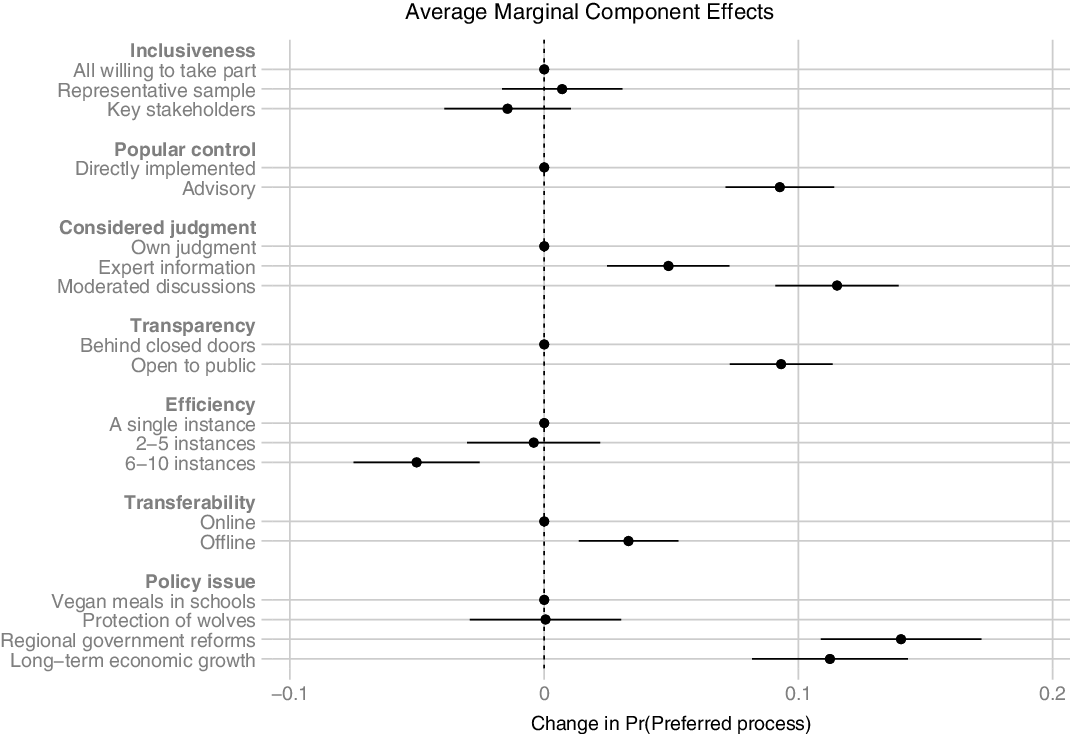
The first step is examining H1a–H1g on the direct effects of the participatory features. Figure 1 shows the AMCEs of all attributes.
Average Marginal Component Effects (AMCEs) on preference for participatory process.

Contrary to the expectations of H1a, inclusiveness is irrelevant for how people evaluate participatory procedures since the effects for both processes with participants selected from a representative sample (β = 0.007) and those that include key stakeholders (β = −0.014) do not alter the favorability compared to the reference category of processes where all can take part.
Advisory processes entail a boost in favorability of 9.3 percentage points compared to arrangements where participants can decide the outcome directly, which contradicts H1b by showing that advisory mechanisms boost favorability rather than those with more decisive decision-making powers.
For considered judgment, the results support H1c since processes where participants decide based on expert information entail an increase in favorability of 5 percentage points, while processes with moderated discussions among participants increase favorability by 11.5 percentage points. Transparency also matters as suggested by H1d since processes with closed doors entail a 9.3 percentage point reduction in favorability compared to more transparent processes.
For the number of meetings, there is some evidence to support H1e, even if the effect is not particularly strong. Having 2–5 meetings has no discernible impact on favorability compared to meeting a single time (B = −0.004), but processes where participants meet 6–10 instances entail a five percentage point reduction in the favorability of participatory processes compared to meeting a single time.
For transferability and the question of online vs. face-to-face meetings, offline processes entail a 3.3 percentage point increase in favorability, which contradicts H1f since it entails that face-to-face meetings enhance the popularity of participatory processes compared to online meetings.
Finally, when it comes to policy issues, the coefficient for vegan meals in schools is small and insignificant, which shows that this does not affect favorability compared to the reference category protection of wolves. However, the effects for the hard issues are significant: regional government reform entails a 14 percentage point increase in favorability, while economic growth leads to an 11 percentage point increase in favorability compared to vegan meals. While the effects are substantial, the direction of the effects run counter to H1g since people prefer participation for the hard issues, while they are less interested when it comes to easy issues.
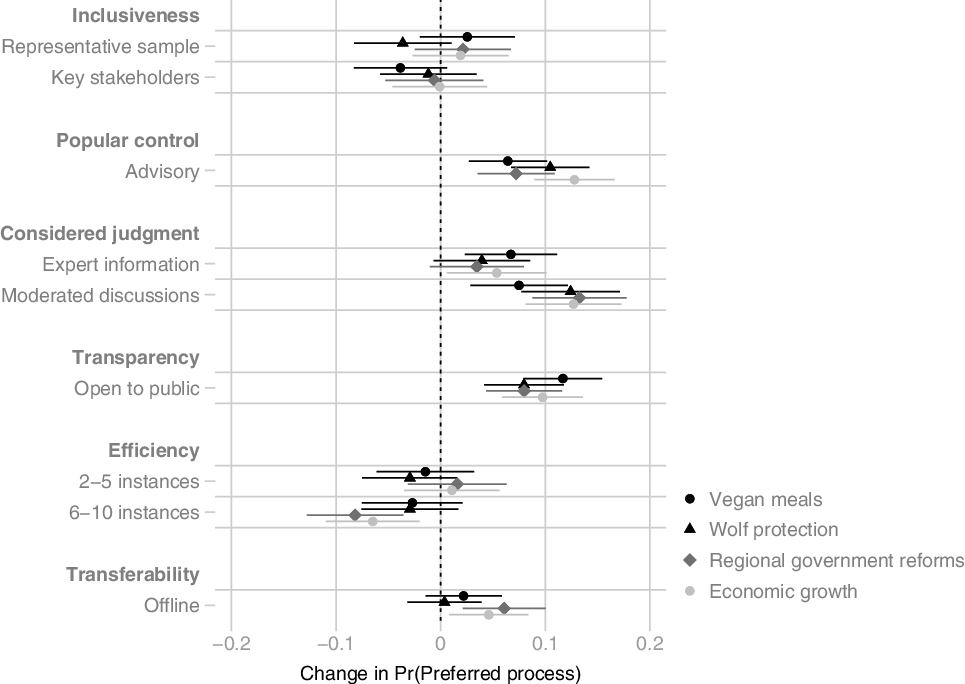
The second step involves examining whether there are differences in effects across policy issues, and Figure 2 shows the ACIEs for the four policy issues. For simplicity, reference categories are excluded in Figures 2 and 3.
Average Component Interaction Effects (ACIES) on preference for participatory process across four policy issues.

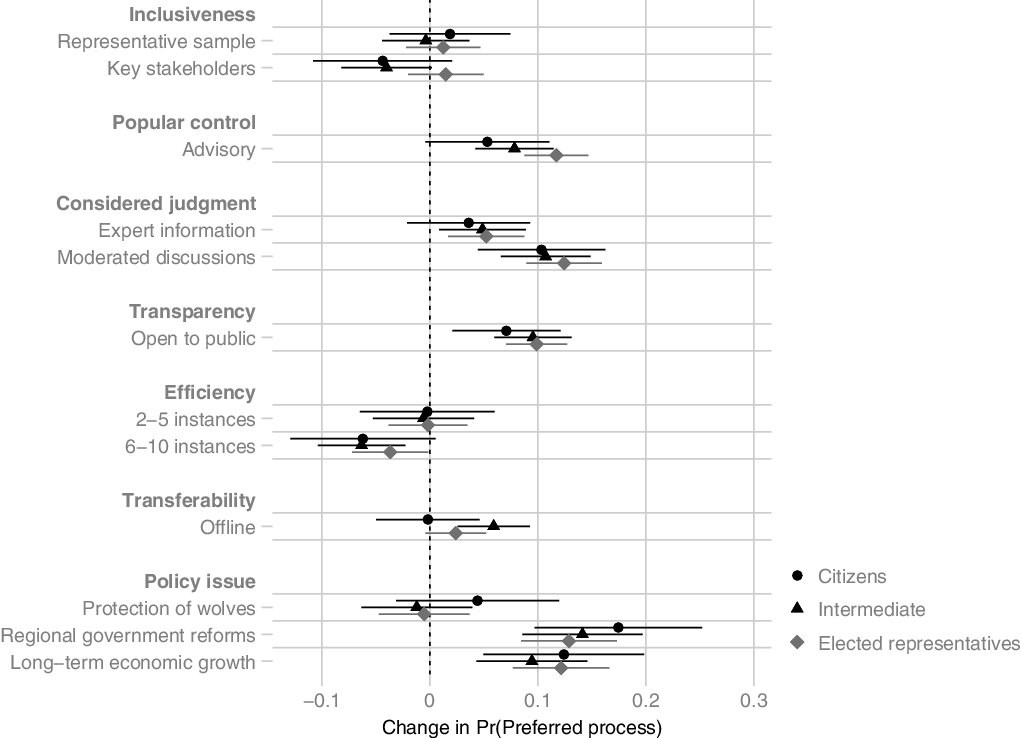
Average Component Interaction Effects (ACIES) on preference for participatory process across process preferences.

The effects are similar across policy issues, and when differences occur, they are generally of minor importance.Footnote 10 The coefficients for inclusiveness all remain insignificant across issues. For popular control, advisory processes have an even stronger effect on favorability when the issue concerns economic growth, but the effect remains in the same direction and magnitude. For considered judgment, processes involving moderated discussions are preferred to participants deciding independently for all issues. The results for expert advice are less clear-cut, but despite differences in significance, none of the interaction effects are statistically significant and the effects are of a similar magnitude and direction. Open processes are preferred over those behind closed doors regardless of issue. For efficiency, the negative effect of more meetings is only significant for the two hard issues, while the differences are less pronounced for easy issues. For transferability, offline meetings also only have significant effects for hard issues.
While these last two findings seem to indicate some differences, it is noteworthy that the marginal means (see Supplementary Material) show that hard issues (regional government reform and economic growth) have higher mean scores compared to the easy issues (wolf protection and vegan meals) for all attribute levels. This is, however, testimony to the strong direct effects of the policy issue rather than differences in effects among policy issues. On most accounts, the effects appear similar across policy issues and since there is no uniform trend for effects to be stronger for the easy issues as H2 suggests, this hypothesis is rejected.
The final step involves H3 and differences in effects depending on the extent to which respondents prefer citizens or elected representatives as decision-makers. The results in Figure 3 demonstrate that the effects again are similar on most accounts.
Two significant interaction effects indicate differences in effects across process preferences. For popular control, the preference for advisory powers is weaker among those who prefer citizens as decision-makers (P = 0.050). This difference is hardly surprising, and the most remarkable is that even for those who prefer citizens as decision-makers, there is no positive effect of directly implemented decisions. For transferability, the interaction effect for the intermediate category (P = 0.039) entails that it is only for the intermediate category that offline processes have a positive effect on favorability, whereas the effects are negligible when people have clearer process preferences. The results otherwise resemble the general findings, and the marginal means lead to similar conclusions. Although some differences occur, H3 is rejected since there is again no uniform trend for stronger effects among those who support citizens as decision-makers.
Discussion of results
These results have important implications for the use of participatory mechanisms. The following discussion highlights the most important results and their implications for future research.
First and foremost, the results highlight that the design features of participatory mechanisms shape citizens’ evaluations of them. Furthermore, the effects were similar across policy issues and process preferences, suggesting that the effects are relatively stable in society. The results are therefore able to give new insights into what type of participatory mechanisms ordinary citizens want to see introduced on a more detailed level compared to previous research that have examined either broad process preferences (Font et al., Reference Font, Wojcieszak and Clemente2015; Bengtsson and Christensen, Reference Bengtsson and Christensen2016; Gherghina and Geissel, Reference Gherghina and Geissel2017) or attitudes to specific mechanisms (Jacquet, Reference Jacquet2018; Christensen and von Schoultz, Reference Christensen and von Schoultz2019; Goldberg et al., Reference Goldberg, Wyss and Bächtiger2019).
Furthermore, the evaluations may well differ between scholars and ordinary citizens. A great deal of scholarly attention has focused on inclusiveness and how to ensure that all groups in society are included (Young, Reference Young2000; Dalton, Reference Dalton2017; Gastil and Wright, Reference Gastil and Wright2019). However, this aspect seems to be of little importance for ordinary citizens since it made little difference who could take part in the processes. While this result by no means entails that the scholarly preoccupation has been misguided, it is nonetheless noteworthy that people are not to a similar extent concerned about who are able to take part in participatory mechanisms. This may partly be because respondents failed to appreciate the differences between the choices offered in the conjoint analysis. But it may also be that people care more about chances to provide input into political decision-making, less about exactly who provides it.
Several results showed that people demand possibilities for participation in political decision-making, also when the involvement may be demanding. For example, processes involving hard policy issues were favored over those involving easy issues (de Fine Licht, Reference de Fine Licht2014; Wojcieszak, Reference Wojcieszak2014). While the hard issues on offer here also have more important implications for society, it clearly shows that people want possibilities to take part for issues that matter to society rather than for symbolic issues where involvement may be window dressings (Blaug, Reference Blaug2002). Furthermore, people expressed a preference for processes that involve more deliberative elements such as expert advice and discussions (Fishkin, Reference Fishkin2009) over processes where participants decide independently.
However, other results also show that there are limits to how involved people want to be. Participation should not be too time-consuming since people rebuffed processes involving more than five meetings. And perhaps the most surprising result was that people prefer advisory processes over those where participants make the final decision (Altman, Reference Altman2011; Qvortrup, Reference Qvortrup2013). What people demand is possibilities for interaction with decision-makers, not necessarily for citizens to make decisions. Even for people who explicitly stated that they prefer citizens as decision-makers, there was no discernible positive effect of directly implemented procedures when deciding between processes. In other words, the preferences revealed in the conjoint differed from the stated preferences when asking respondents directly. This highlights the difficulties involved in examining whether and how citizens want to participate. While the result could be problematic for the literature on process preferences, it should be acknowledged that the process preference was measured in a rather crude manner compared to the instruments used in previous studies (Font et al., Reference Font, Wojcieszak and Clemente2015; Bengtsson and Christensen, Reference Bengtsson and Christensen2016). Nevertheless, it is worth iterating that a demand for more participation does not necessarily entail a wish to become the final decision-makers.
Overall, features associated with talk-centric innovations tend to boost favorability, which indicates that people prefer more talk-centric procedures over vote-centric direct-democratic procedures (Chambers, Reference Chambers2003; LeDuc, Reference LeDuc2015). This contradicts the conclusions of Rojon et al. (Reference Rojon, Arieke and Klandermans2019), although they also find a positive effect from advisory meetings on support for participatory reforms. The results here suggest that people prefer procedures that give possibilities to develop preferences rather than decisive direct-democratic procedures that allow people to make decisions. This suggests that people recognize the need for reflection on the issues at hand rather than only wanting participatory mechanisms as a way to take power away from political elites. Hence, the demand for participatory mechanisms is in this case not primarily driven by dissatisfaction with the current political system, but is more likely to be a result of cognitive mobilization, that is, citizens being willing and able to take an active role in decision-making (Dalton et al., Reference Dalton, Burklin Wilhelm and Drummond2001). Also, while this does not necessarily mean that people will also take part, it is clearly too early to dismiss the willingness of ordinary citizens to engage in more demanding forms of participation.
It is still necessary to ascertain whether similar effects can be found in other countries since the Finnish experience with advisory mechanisms could make them disposed to prefer these over more decisive processes (Christensen et al., Reference Christensen, Himmelroos and Grönlund2017a,b; Jäske, Reference Jäske2017). Other countries, such as Germany, lack experiences with participatory mechanisms at the national level or, as Switzerland, have mainly experiences with more decisive direct-democratic procedures. Future studies should aim for comparisons across political systems to determine the extent to which participatory preferences are shaped by previous experiences with participatory instruments. The current study also only examines effects on what forms of participatory processes people want to see introduced, but this does not necessarily entail that they are willing to take part. A next step would therefore be to examine whether similar results are found when asking people what participatory processes they would like to participate in.
While it still must be examined whether the conclusions of this study are valid outside of Finland, or if other criteria play a more prominent role in shaping evaluations of participatory mechanisms, the results show that using conjoint analysis to examine preferences for participatory processes can provide valuable new insights into how citizens evaluate these mechanisms.
Supplementary material
To view supplementary material for this article, please visit https://doi.org/10.1017/S1755773920000107.