1. Introduction
Researchers and practitioners have increasingly recognized the important role of Central Bank communication in influencing macroeconomic variables, such as inflation and interest rates. However, the precise nature of its impact on the term structure of interest rates, and how those interest rates, in turn, might influence communication, remain unclear. Some authors argue that Central Bank communication affects the long end of the yield curve (Leombroni et al. Reference Leombroni, Vedolin, Venter and Whelan2021, for instance), while others focus on its impact on the short end of the yield curve (Máté et al. Reference Máté, Sebők and Barczikay2021, for instance). Additionally, the effects of yield curve shape on Central Bank communication, if any, are unclear. This paper investigates the bidirectional effects between Central Bank communication and the term structure of the interest rates.
The most common monetary policy instrument that policymakers can control directly is the short-term interest rate. As the entire term structure of interest rates affects investment and consumption decisions, all maturities are relevant to policymakers. Nevertheless, they can only affect longer maturities of interest rates indirectly. Changes in the short-term interest rate by the central bank may trigger an indirect impact on the yield curve, as investors respond to the new short-term interest rate by trading their assets. Their portfolio adjustments depend on their expectations about the future path of monetary policy and other economic fundamentals, which lie outside the direct control of the interest rate policy instrument.
Recent literature on central banking has acknowledged the role of Central Bank communication as a monetary policy instrument (Blinder et al. Reference Blinder, Ehrmann, Fratzscher, de Haan and Jansen2008; de Haan and Sturm, Reference de Haan, Sturm, de Haan and Sturm2019). Notably, there has been a shift towards studying the central bank’s communication with the general public rather than with financial experts (Blinder et al. Reference Blinder, Ehrmann, De Haan and Jansen2024). However, our focus in this paper is on communication with financial experts. In their examination of central bank communication, Blinder et al. (Reference Blinder, Ehrmann, Fratzscher, de Haan and Jansen2008) identifies two aspects: “creating news” and “reducing noise.” The latter investigates how central bank communications enhance predictability, reducing volatility in financial markets. In contrast, the former explores how central bank communication influences market expectations and subsequently affects asset prices. Our research contributes to the literature that views central bank communication as a monetary policy tool shaping expectations through “creating news.”
This type of policy instrument can impact medium—and long-term interest rates by shaping agents’ expectations. By conveying their outlook on future interest rate decisions, inflation, and economic activity, the central bank can influence agents’ beliefs about economic fundamentals, thereby affecting trading, prices, and asset returns. This mechanism, known as the information effect, involves Central Bank announcements prompting the private sector to update its beliefs about the monetary policy path and the future trajectory of economic fundamentals (Romer and Romer, Reference Romer and Romer2000; Nakamura and Steinsson, Reference Nakamura and Steinsson2018).
The empirical evidence regarding the impact of Central Bank communication on the term structure of interest rates is conflicting. Some studies argue that communication primarily affects short-term maturities (e. g. Lucca and Trebbi, Reference Lucca and Trebbi2009; Máté et al. Reference Máté, Sebők and Barczikay2021), while others suggest a long-term maturity influence (e.g., Lamla and Lein, Reference Lamla and Lein2011; Chague et al. Reference Chague, De-Losso, Giovannetti and Manoel2015; Leombroni et al. Reference Leombroni, Vedolin, Venter and Whelan2021). This conflicting evidence may be attributed to differences in data and modeling approaches.
For example, an assumption in literature is that the equation driving the economy and the Central Bank communication have no contemporaneous or lagged interest rate for any maturity.Footnote 1 Additionally, some works model the effect of communication on interest rates for a single maturity (e.g. Lucca and Trebbi, Reference Lucca and Trebbi2009; Lamla and Lein, Reference Lamla and Lein2011; Máté et al. Reference Máté, Sebők and Barczikay2021), requiring separate models for each maturity. Likewise, a branch of the literature assumes that Central Bank Communication (CBC) is determined independently of the shape of the yield curve. This hypothesis implies a unidirectional effect from CBC to yield curve (CBC-yield assumption). The Central bank may, however, react to changes in the shape of the yield curve since it is related to several macroeconomic variables.
This paper aims to investigate the bidirectional relationship between Central Bank communication and the yield curve. To this end, we allow for both the yield curve affecting the CBC and the CBC affecting the yield curve. Specifically, we extend the Dynamic Nelson and Siegel (DNS) model of Diebold and Li (Reference Diebold and Li2006) to also include the Central Bank communication alongside latent factors (level, slope, and curvature) and macroeconomic factors (inflation, capacity utilization, and interest rate). This model allows us to examine the bidirectional effects between CBC and the yield curve, as well as to consider the lagged effects of the yield curve due to the autoregressive structure of the latent factors.
Our results show that Central Bank communication indeed impacts the shape of the yield curve. Specifically, if the central bank communicates more positively, the curvature of the yield curve response is positive. Conversely, if the central bank adopts a negative discourse, the responses in both slope and curvature are negative. Since changes in curvature are related to intermediate maturity changes, our results indicate that the central bank can affect more than just the short-term interest rate by using communication as a policy instrument. We also find that changes in the shape of the yield curve, in turn, affect Central Bank communication. Finally, we identify a relationship between Central Bank communication and the curvature factor of the yield curve.
Our findings complement and connect with the following existing literature. While Diebold et al. (Reference Diebold, Rudebusch and Aruoba2006) relates the level and slope factors to macroeconomic variables, we relate the curvature factor to Central Bank communication. Chun (Reference Chun2011) relates the fluctuations in bonds with the expected path of monetary policy and macroeconomy using analyst forecasts. Our approach can be seen as an alternative that uses Central Bank communication as an agent expectation. Han et al. (Reference Han, Jiao and Ma2021) relates the shape of the yield curve, associated with a time-varying factor loading, with real macroeconomic variables and argues that this time-varying factor loading contains information about the market perception of the economic risk and uncertainty. In our approach, we use Central Bank communication to include the perception of economic risk in the model. We believe that our results shed new light on the effects of Central Bank communication on the yield curve.
2. Quantifying the central bank communication
This section provides a concise overview of the Brazilian Central Bank’s monetary policy framework and communication practices, drawing parallels with the Federal Reserve’s (Fed) approach in the United States.
Since 1999, the Brazilian Central Bank has adopted an inflation-targeting regime, with the National Monetary Council setting the annual inflation target for the Consumer Price Index Extended, including a tolerance interval. The primary objective of the Brazilian Central Bank is to keep inflation close to this target.
The Brazilian Central Bank employs a set of actions to achieve its objectives, sharing similarities with the monetary policy conduct of the Federal Reserve. Like the Fed, Brazil’s Monetary Policy Committee (COPOM) has convened eight meetings annually (every 45 days) since 2006 to set the policy rate, known as the Selic rate. In line with the Fed’s practices, the Brazilian Central Bank issues two key documents to communicate with the private sector: COPOM statements and COPOM minutes (Brazilian Central Bank, 2024). Similar to the Federal Reserve, these statements are promptly released after the meeting, while the minutes are disclosed a week later. The Statement is a brief document outlining the decision on the short-term interest rate, while Minutes provide a more detailed account of the macroeconomic outlook and the committee’s decisions, mirroring the Federal Reserve’s communication practices.
The communication strategy of the Brazilian Central Bank has changed over time, reflecting a commitment to increased transparency. The initial shift involved formalizing communication at regular 45-day intervals. A notable subsequent change is the transition towards more detailed statements, departing from the concise ones prevalent before 2016 (Alves et al. Reference Alves, Abraham and Laurini2023). While the Federal Reserve has a long history of utilizing forward guidance, the Central Bank of Brazil has only recently begun to explore its potential as a monetary policy instrument. This shift was acknowledged during the COPOM’s 232nd meeting, where they highlighted the specific challenges faced by emerging economies, such as increased vulnerability to external shocks, as justification for adopting forward guidance cautiously.
A natural way to quantify the Central Bank communication is to analyze the press release issued by the Central Bank, a practice widely used by researchers (Boukus and Rosenberg, Reference Boukus and Rosenberg2006; Lucca and Trebbi, Reference Lucca and Trebbi2009; Rosa, Reference Rosa2011; Chague et al. Reference Chague, De-Losso, Giovannetti and Manoel2015). To transform textual information into numerical variables, we employed sentiment analysis to extract information from the COPOM minutes made available by the Central Bank. We began by acquiring unprocessed text data and handling it appropriately. After collecting the raw data at each meeting, we removed punctuation, blank lines, stop words, and the names of the members of the monetary policy committee to eliminate words that should not impact the tone of the text.
It is important to note that the COPOM statements and minutes were only regularly published by the Brazilian central bank starting in 2006, which serves as the beginning of our sample in this article. Furthermore, our focus is solely on the COPOM minutes due to the brevity of the statements before 2016. By categorizing the content of the minutes into semantic categories, we used this processed textual data to extract the sentiment of the Brazilian Central Bank.
We used a dictionary-oriented technique to analyze the sentiment of the COPOM minutes. The vocabulary of these documents is highly specialized, and the phrases employed have specific connotations, usually with financial meanings. Hence, we classified the words in the papers using the financial dictionary provided by Loughran and McDonald (Reference Loughran and McDonald2011). The Brazilian Central Bank publishes the minutes both in Portuguese and in English, allowing the direct application of the Loughran and McDonald (Reference Loughran and McDonald2011), thereby avoiding translation issues. This dictionary helped us to identify each word’s semantic content, categorizing it as positive, negative, or uncertain. We created sentiment variables representing Central Bank communication using these three semantic categorizations. We regarded the proportion of each category to the total amount of words in each document as sentiment variables for COPOM minutes. For every period
 $t$
that the COPOM meetings took place, we denoted the proportion of positive, negative, and uncertainty words by
 $s_{p,t}$
,
 $s_{n,t}$
and
 $s_{u,t}$
. We also followed Cannon (Reference Cannon2015) to define the tone of the central bank by:
 \begin{align} \tau _t \equiv \frac {s_{p,t} - s_{n,t}}{s_{p,t} + s_{n,t}}. \end{align}
The tone summarizes the sentiment of the central bank in a single variable, which is helpful in analyzing the Central Bank communication and yield curve relationship. We used these four variables to analyze how Central Bank communication affects the term structure of interest rates.
3. The yield curve and the central bank communication
To analyze the interconnection between the yield curve and Central Bank communication, we augmented the Dynamic Nelson and Siegel (DNS) model proposed by Diebold and Li (Reference Diebold and Li2006) to include Central Bank communication as a new factor. Considering observable and latent factors, the DNS has proved to perform well in fitting and forecasting the yield curve. The original DNS of Diebold and Li (Reference Diebold and Li2006) decomposes the yield curve using only the unobserved factors known as level (
 $L_t$
), slope (
 $S_t$
), and curvature (
 $C_t$
). Then, Diebold et al. (Reference Diebold, Rudebusch and Aruoba2006) extended the original model to include a bidirectional relation between the unobserved factors and observed macroeconomic factors, specifically inflation, capacity utilization, and interest rate. Our model further extends this macro-yield model to include Central Bank communication.
To incorporate the Central Bank communication into the DNS model, let us define the vector of factors as
 $X_t \equiv (L_t, S_t, C_t, s_{p,t}, s_{n,t}, s_{u,t}, CU_t, R_t, \pi _t)'$
. We assumed that the factors follow a Vector Auto-Regression (VAR) representation:
 \begin{align} X_t = c + \Phi X_{t-1} + \varepsilon _t, \quad \varepsilon _t \sim N(\textbf {0}, Q), \end{align}
where
 $c$
is a vector of constant,
 $\Phi$
is a
 $9 \times 9$
matrix of VAR coefficients, and
 $Q$
is assumed to be diagonal. We opted for this concise structure to enhance parsimony in our model, thereby reducing the number of parameters to estimate when compared to more general covariance structures.
In our analysis, we used a Cholesky decomposition of the reduced-form covariance matrix to establish a recursive ordering for constructing impulse-response functions. This methodological choice stems from the lack of a comprehensive theoretical model that would allow for the application of identification constraints. As a result, identification in our model relies on the sequential ordering of variables.
The ordering of variables is guided by two main factors: the assumed dependencies on shocks and the proportion of variance explained by each component. The initial variables in the impulse-response function are constituted by the latent factors of the interest rate curve. Empirical evidence suggests that these factors subsume a significant portion of the pertinent information required for discerning movements within the term structure of interest rates. This inference is supported by the literature on principal components and dynamic modeling of the term structure, which collectively indicates that the level, slope, and curvature components collectively account for the majority of the observed variance in the interest rate curve. Specifically, the level component is the predominant source of variation, followed by the curvature and slope components, respectively. Therefore, the sequence of these variables is aligned with the variance each component accounts for.
Another reason for prioritizing yield curve components over sentiment and macroeconomic factors stems from the macro-spanning literature. This body of research suggests that the yield curve encapsulates the informational content of macroeconomic variables. In line with the recursive causal identification method, which relies on the sequence of shock incorporation, we posit that yield curve variables autonomously assimilate shocks to a greater extent. Therefore, they are placed at the forefront of the ordering. This sequencing approach is common in yield curve models incorporating macroeconomic variables. Despite evidence contradicting the spanning hypothesis, determining a variable ordering in this identification structure remains useful.
Following this literature, we position macroeconomic variables at the end of the ordering, as they are expected to respond to other shocks in the system, aligning with the approach proposed in Diebold et al. (Reference Diebold, Rudebusch and Aruoba2006). By placing interest rate curve variables at the beginning and macroeconomic variables at the end of the ordering, we position sentiment-linked variables in intermediate positions. This suggests that they respond to interest rate curve shocks and transmit these effects to macroeconomic variables, thereby defining the recursive identification structure.
In line with the DNS model, we used the unobserved factors to build the entire term structure of interest rate:
 \begin{align} y_t(m) = L_t + S_t \left ( \frac {1-e^{-\lambda m}}{\lambda m} \right ) + C_t \left ( \frac {1-e^{-\lambda m}}{\lambda m} - e^{-\lambda m} \right ) + \eta _t, \quad \eta _t \sim N\left(0,\sigma _{\eta }^2 \right), \end{align}
where
 $y_t(m)$
is the interest rate in period
 $t$
of a bond with maturity
 $m$
and
 $\lambda$
is a factor decay.
The model formed by Equations (2) and (3) describes the dynamics of the yield curve considering macroeconomic variables and Central Bank communication. The parameters of the model can be summarized in a vector
 $\theta = (c, \phi _{ij}, q_i, \lambda, \sigma _{\eta }^2)$
, where
 $\phi _{ij}$
represents the elements of the matrix
 $\Phi$
, and
 $q_i$
denotes the diagonal elements of the matrix
 $Q$
and
 $i,j \in \{1,\cdots, 9\}$
. For a given set of parameters
 $\theta$
, we can assess how the Central Bank communication (and macroeconomic variables) affects the latent factor
 $L_t$
,
 $S_t$
, and
 $C_t$
. Depending on the size of the factor decay
 $\lambda$
, the latent factors can construct the entire term structure of interest rate, allowing us to indirectly evaluate the effect of communication and macroeconomic shocks in the yield curve. The level, slope, and curvature are unobservable, and we also need to estimate them.
We can estimate the vector of parameter
 $\theta$
and latent components using either a Frequentist or Bayesian approach. In the Frequentist case, we can construct the likelihood function based on the prediction error decomposition produced by the Kalman Filter and then maximize this function (Diebold et al. Reference Diebold, Rudebusch and Aruoba2006). The maximum likelihood estimation, however, may present numerical challenges, particularly when the number of factors increases. Instead, we use a Bayesian technique estimation (Laurini and Hotta, 2010) to prevent this kind of issue. In the Bayesian case, we elicit prior distribution to mix with likelihood function information. Then, we use Markov Chain Monte Carlo (MCMC) methods to sample from the posterior distribution. In Appendix A, we present prior distribution and MCMC details.
4. Results
4.1 Yield curve fit
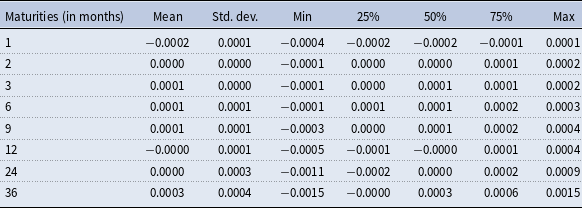
We estimated the model for yields across eight different maturities, presented in the first column of Table 1. The DNS model augmented with Central Bank communication fits the yield curve well, as the difference between the fitted yield curve and the observed yield curve—using the estimated latent factors—is negligible. Table 1 provides descriptive statistics for this difference.
Summary statistics for the difference between the fitted yield curve and the observed yield curve

Figure 1 shows the estimated latent factors used to build the fitted yield curve. The level factor is highly persistent and shows a decreasing tendency overall. In contrast, the estimated slope and curvature are less persistent and assume positive and negative values. Additionally, there is a correlation of 0.5 between the slope and curvature movements.
Latent factors: level, slope and curvature.

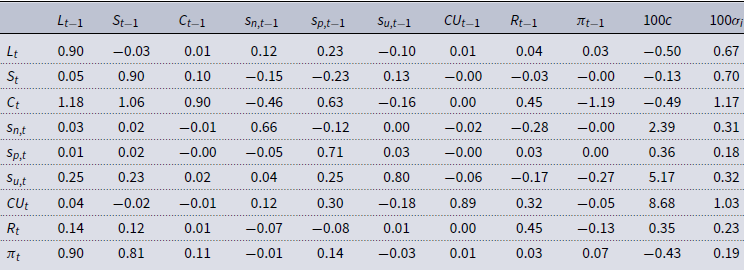
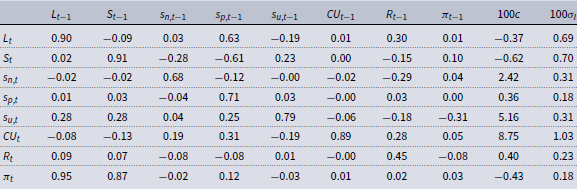
Considering the correlation between slope and curvature, and acknowledging that the maximum maturity is 36 months, it becomes arguable that distinguishing between the effects of curvature and slope may be challenging. To address this concern, we conducted an analysis using the previously presented model, referred to as the unrestricted model, imposing a constraint to exclude the curvature factor, thus forming the restricted model. A comparison of the performance between these two models reveals that incorporating the curvature factor enhances the yield curve fit. This improvement is evident through smaller Mean Absolute Error, Mean Squared Error, and Mean Error values for every maturity, as depicted in Figure 2 in Appendix B, where we also present parameter estimates of both models.
Since these three unobservable factors form the entire yield curve in the DNS model, analyzing their dynamic behavior and relationship with other observed factors helps us to understand the yield curve behavior.
4.2 Unobservable factors and related variables
The correlation between the latent factors and the extracted sentiment of Central Bank communication, described in the proportion of positive, negative, and uncertain words, reveals meaningful insights. Figure 3 displays the correlation matrix of latent factors and sentiment variables, showing a strong correlation between these factors and central bank sentiment. Notably, the curvature of the yield curve is correlated to all sentiment variables. The slope, in turn, is only weakly correlated to the proportion of positive and uncertain words, but it is highly associated with the proportion of negative words. The level is also weakly correlated to the positive words. These observations suggest a need for further investigation into the relationship between the curvature factor and Central Bank communication.
Heatmap of correlation matrix: yield curve latent factors and central bank communication.

Level, slope and curvature factors and its empirical counterparts.

A large body of literature links the level factor with inflation and the slope factor with the economic activity cycle. Links between observable variables and the curvature of the yield curve are less frequent. Here, we summarize the Central Bank communication in the tone variable, as defined in Equation (1), and link the curvature of the yield curve with this variable. Figure 4 displays the estimated latent factors and the linked comparison series.
In panel (a) of Figure 4 shows that the level of the yield curve is correlated with inflation, as highlighted in the literature (see, e.g., Diebold et al. (Reference Diebold, Rudebusch and Aruoba2006)). The literature also usually connects the slope factor with the economic cycle, which we represent here by the year-on-year economic growth. In contrast to the findings in the literature, the correlation between the cycle and the slope factor is low (see panel (b) of Figure 4). Surprisingly, the curvature factor and the Central Bank communication (represented by the tone variable) move in the same direction overall, presenting a Pearson correlation of
 $0.50$
, as shown by panel (c) of Figure 4.
The linkage between the curvature factor and Central Bank communication sheds new light on how Central Bank communication can serve as a tool to affect the term structure of interest rates. Increasing the curvature of the yield curve means that medium-term maturities will have higher interest rates (Litterman and Scheinkman, Reference Litterman and Scheinkman1991; Diebold and Li, Reference Diebold and Li2006). Accordingly, our finding implies that Central Bank communication is related to the movements in medium-term maturities, supporting the literature that argues that the impact of the CBC is beyond the short-term but can affect other maturities too (Lamla and Lein, Reference Lamla and Lein2011; Chague et al. Reference Chague, De-Losso, Giovannetti and Manoel2015; Leombroni et al. Reference Leombroni, Vedolin, Venter and Whelan2021).
For the Brazilian yield curve, the slope and curvature are positively correlated. Thus, the tone of Central Bank communication is also associated with the yield curve slope, presenting a correlation of
 $0.42$
. The literature argues that the yield curve slope can predict recessions (Fama, Reference Fama1986; Estrella and Mishkin, Reference Estrella and Mishkin1998; Rudebusch and Williams, Reference Rudebusch and Williams2009; Benzoni et al. Reference Benzoni, Chyruk and Kelley2018). Financial economists claim that the yield curve slope “contains information about current and expected future monetary actions” (Benzoni et al. Reference Benzoni, Chyruk and Kelley2018, p. 1).
We claim that the central bank informs the private sector about the current and expected future monetary policy in their communications and also their point of view about the economic scenario. Therefore, CBC also contains information about the cycle, aligning with previous findings from Gardner et al. (Reference Gardner, Scotti and Vega2022), who argue that their sentiment index of FOMC describes good and bad times. Indeed, for the Brazilian case, the tone of the Brazilian central bank exhibits a decreasing tendency during recessions, as shown in Figure 5, in Appendix B. Additionally, Han et al. (Reference Han, Jiao and Ma2021) also argues that, before recessions, the role of curvature and slope is smaller, and during recessions, it tends to play a more relevant role. The tone of the Brazilian central bank, which is correlated with the slope and curvature in the data, captures this movement and informs the market. This knowledge changes the investors’ beliefs, possibly implying a change in their portfolios, affecting prices and interest rates of different maturities.
4.3 The yield curve and Central Bank communication dynamics
We proceed with an impulse response analysis to verify how different types of discourse (more positive, negative, or uncertain) impact the yield curve. We divide the impulse response function analysis into two groups. The first analysis how Central Bank communication shocks affect the latent factors of the yield curve and how long these shocks last to dissipate. The second group examines how the latent factors shocks affect Central Bank communication. In Appendix B, we present the complete impulse response function in Figure 6.Footnote 2
Let us now describe the first group of impulse responses. Figure 7 displays the response of level, slope, and curvature to shocks in negative, positive, and uncertainty words, all in the proportion of total words. The response of the level factor to shocks in negative words is negligible, but it is non-negligible for shocks in the proportion of positive and negative words. In reaction to the proportion of positive word shocks, the level rises and then dissipates slowly. The level response to uncertain word shocks is negative and more persistent.
Impulse response function: level, slope, and curvature response to shocks in sentiment variables. The solid blue line represents the median and the shaded blue area represents the
 $50\%$
credible interval.

The responses of slope and curvature factors are particularly intriguing, given their established relationship with Central Bank communication as discussed in section 4.2. An increase in the proportion of negative words (which decreases the tone) reduces both the slope and the curvature factor. Around five months ahead, the curvature achieves a negative one-to-one response. Similarly, the response of the curvature to an increase in the proportion of positive words (which increases the tone) reaches a positive one-to-one around five months. The reaction of slope to shocks in the proportion of positive words is almost negligible, considering the
 $50\%$
credible interval.
We can interpret these responses of curvature and slope to the shocks in positive and negative words as an effect of Central Bank communication in the short and medium term of interest rate. When the Central bank surprisingly informs the market of its vision about the economic outlook, increasing the proportion of positive (negative) words in its communications, private agents will change their portfolios in such a way that the curvature of the yield curve will increase (decrease). This increase (decreasing) means that medium-term bond yields are also increasing (decreasing). Since the slope also declines with a positive shock in the proportion of negative words, the short-term yield bonds will also reduce. Thus, Central Bank communication can serve as a tool to affect not only short-term interest rates but also medium-term yields. Again, this result aligns with the literature that argues that the impact of the CBC is beyond the short-term but can affect other maturities too (Lamla and Lein, Reference Lamla and Lein2011; Chague et al. Reference Chague, De-Losso, Giovannetti and Manoel2015; Leombroni et al. Reference Leombroni, Vedolin, Venter and Whelan2021). In addition, our findings are consistent with previous out-of-sample results of Alves et al. (Reference Alves, Abraham and Laurini2023), which found that Central Bank communication helps to predict yield curves, for medium and long forecast horizons independently of the maturities. This consistency underscores the importance of incorporating sentiment indices into our model.
It is intriguing to delve into the underlying mechanism driving the yield curve response outlined above. One plausible explanation is as follows: an increase in the proportion of negative words could indicate a more dovish stance in monetary policy. As the proportion of negative words rises, the central bank’s tone decreases. Notably, analyzing the historical tone of the Brazilian central bank, it becomes evident that lower values of tone are associated with periods of looser monetary policy (see, e.g., Moreira and Portugal (Reference Moreira and Portugal2019)). Therefore, a more dovish stance would make market participants expect that short-term interest rates are lower than long-term rates, resulting in a steeper yield curve. Indeed, a decrease in slope, as illustrated in Figure 7, implies a steeper yield curve in the DNS model utilized here. Similar reasoning can be applied to the other impulse response functions.
Finally, let us describe the second group of impulse responses, which analyzes how Central Bank communication reacts to changes in the shape of the yield curve. To do so, we analyze the impulse response function presented in Figure 8. In general, the proportion of negative, positive, and uncertain words increases—some months ahead—considering the credible interval
 $50\%$
. An increase in the level factor does not affect the proportion of negative words in the first months, considering the credible interval. Around ten months ahead, however, the increase in the level also raises the proportion of the negative words publicized by the central bank. A similar pattern emerges for slope and curvature shocks. This result means that the central bank does not react immediately to the proportion of negative words, although it will increase at some point.
Impulse response function: proportion of negative, positive, and uncertainty response to shocks in latent factors of the yield curve. The solid red line represents the median and the shaded red area represents the
 $50\%$
credible interval.

The proportion of positive and uncertain words increases immediately in response to shocks in any of the latent factorsFootnote 3 and the response dissipates around thirty months ahead. The reaction of the proportion of uncertain words is also positive and immediate for all three shocks. Thus, we can conclude that the Central Bank communication also reacts to the changes in the yield curve shape, represented by the latent factors.
We interpret the observed patterns as indicative of the central bank’s active role in managing market expectations. When the central bank observes changes in the yield curve’s shape, it recognizes the need to promptly adjust its communication strategy to guide market expectations in alignment with its intended direction. As our results illustrate, some of these adjustments occur immediately, while others manifest with a lag. This response suggests a dynamic interplay where the central bank strategically adapts its messaging according to evolving economic conditions, indicating an active stance in shaping market perceptions.
The mechanism described above links our findings to the reflection problem described by (Morris and Shin, Reference Morris and Shin2002, Reference Morris and Shin2018). Our findings reveal a bidirectional relationship between central bank actions and market prices. This reciprocal effect raises noteworthy considerations regarding the reflection problem. While our primary goal is not to empirically test for the existence of the reflection problem, the results raise some considerations about the Brazilian Central Bank communication.
The concern lies in the imperative of market participants aligning their actions with the central bank’s communication. As our results suggest that the central bank communication reacts to the yield curve’s shape, the interplay between these reactions and market participants attempting to mirror the central bank’s actions introduces the risk of a self-defeating policy. Excessive reliance on market movements, particularly if the central bank reacts too strongly, can render the market signal less informative about the underlying economic fundamentals (Morris and Shin, Reference Morris and Shin2018).
This concern takes on added significance in the context of the emerging economy, which is more exposed to external shocks. The heightened vulnerability to external factors amplifies the importance of striking the right balance in central bank communication and policy responses. In light of external uncertainty, the central bank should carefully choose the weights it assigns to economic fundamentals and market signals to manage expectations in its intended direction.
Before concluding, it is important to note that while our results offer interesting insights, there are some limitations in the methodology employed. First, it is important to acknowledge the inherent constraints associated with the dictionary approach employed to measure sentiment. Recent work by Hayo and Zahner (Reference Hayo and Zahner2022) has raised doubts about the reliability of conclusions based on variations in dictionary-based indicators. While Hayo and Zahner (Reference Hayo and Zahner2022) critique presents valid concerns, it is essential to note that the nature of our data—committee meeting minutes—differs significantly from the speeches and press conference texts analyzed in their study. This distinction introduces a unique perspective that may mitigate certain challenges associated with noise, particularly those more pronounced in alternative forms of central bank communication.
Despite the acknowledged limitations, we justify our reliance on the Loughran and McDonald (Reference Loughran and McDonald2011) dictionary approach, a widely used method in the literature, as highlighted by Aruoba and Drechsel (Reference Aruoba and Drechsel2024). Moreover, previous research employing the Loughran and McDonald (Reference Loughran and McDonald2011) dictionary has demonstrated its efficacy in enhancing yield curve forecasts, supporting the rationale for adopting this approach (Alves et al. Reference Alves, Abraham and Laurini2023). Although this approach has its drawbacks, including its dependence on the choice of dictionary, we assert that it is appropriate for our research objectives. Analyzing the sensitivity to dictionary choice or exploring more elaborate methods to extract central bank sentiment will be a task for future works, though it falls outside the scope of this research.
A second limitation of our work is the simplicity of the identification strategy. Future research can further focus on building a complete structural model to analyze the relationship between sentiments, macroeconomic variables, and the yield curve. These considerations do not compromise the validity of our current findings but rather provide avenues for future research to refine and expand upon our methodology and analysis.
5. Conclusion
In this paper, we have studied the effect of Central Bank communication on the yield curve. To achieve this, we have employed an augmented dynamic Nelson and Siegel model that makes the shape of the yield curve depend on Central Bank communication. Our findings indicate a bidirectional relationship between the yield curve, represented by its latent factors, and Central Bank communication. Notably, we have observed that the curvature of the yield curve is closely related to Central Bank communication. A central bank with a more positive discourse is associated with a greater curvature of the yield curve. Central Bank communication is also related to the slope factor, showing that short and medium maturities of interest rates are affected by Central Bank communication. Therefore, Central Bank communication may serve as a monetary policy tool capable of impacting medium-term interest rates in addition to the traditional short-term interest rate instrument.
Acknowledgements
The author acknowledges financial support Coordenação de Aperfeiçoamento de Pessoal de Nível Superior - Finance Code 001.
Funding statement
The author acknowledges financial support from CNPq (310646/2021-9) and FAPESP (2023/02538-0).
Competing interests
The author declares that there are no conflicts of interest.
Appendix A. Bayesian estimation details
The prior distribution can be briefly summarized as follows. For the variance parameters,
 $\sigma _i^2$
and
 $\sigma _{\eta }$
, we specify gamma distributions to ensure the positiveness of these parameters. The decay parameter
 $\lambda$
also needs to be positive. Therefore, we use a log-normal distribution for this parameter. For the persistence parameters,
 $\phi _{ii}$
, we use a normal distribution truncated in the range
 $(0,1)$
, since we are interested in a stationary system. We assume a prior normal distribution for the parameters
 $\phi _{ij}$
with
 $j\neq i$
. The prior distribution for the rest of the parameters,
 $c_i$
,
 $\gamma _i$
, and
 $\alpha _i$
, are standard normal distributions. More details about the prior distributions are available upon request.
We run three chains with a total of
 $20,000$
iterations to estimate the posterior distribution of the model and exclude the first
 $10,000$
as a burn-in period. For this number of iterations, the MCMC algorithms converge, following usual diagnostics (Gelman and Rubin (Reference Gelman and Rubin1992), Geweke (Reference Geweke1992), and visual inspection of trace plots.).
The method used to sample from the posterior of the augmented DNS model was the Hamiltonian Monte Carlo. The Hamiltonian Monte Carlo (HMC) is a Markov Chain Monte Carlo (MCMC) algorithm that uses gradient information to sample from the posterior distribution efficiently. The samples are generated by simulating Hamiltonian dynamics in the posterior distribution. By using gradient information, the HMC can explore the parameter space more efficiently than traditional methods, such as Random Walk Metropolis-Hastings. In short, the algorithm consists in proposing a new draw by combining gradient information and the simulated Hamiltonian dynamics and, then, accepts this proposal using a metropolis step. See Laurini and Hotta (Reference Laurini and Hotta2010) for a detailed explanation of the DNS model Bayesian estimation using HMC, and see Hoffman and Gelman (Reference Hoffman and Gelman2014) and Betancourt (Reference Betancourt2017) for a detailed explanation of the HMC algorithm.
Appendix B. Additional Figures
Unrestricted model parameters (including curvature): the table presents the posterior mean of parameters

Restricted model parameters (excluding curvature): the table presents the posterior mean of parameters

Error metrics: comparison between unrestricted (including curvature factor) and restricted model (excluding curvature). The figure highlights the importance of including curvature in fitting the yield curve.

Tone and recessions according to economic cycle dating committee (CODACE - comitê de datação de ciclos econômicos in Brazilian Portuguese).

Complete impulse response functions.