Introduction
Andrew Sherratt's seminal argument for a ‘secondary products revolution’, or the intensification in the use of domestic livestock for dairy production, wool and traction during the Old World Chalcolithic, was initially advanced in the absence of a substantial body of zooarchaeological evidence (Sherratt Reference Sherratt, Hodder, Isaac and Hammond1981, Reference Sherratt1983). Over the subsequent three decades, the acquisition of abundant and high-quality zooarchaeological data has advanced significantly our understanding of the changing roles of domestic livestock in prehistory (for extensive summaries of the relevant literature, see Greenfield Reference Greenfield1988, Reference Greenfield, Mulville and Outram2005, Reference Greenfield2010, Reference Greenfield and Greenfield2014a). Reflecting early critiques of the model (e.g. Chapman Reference Chapman1982; Bogucki Reference Bogucki1984), it is now widely acknowledged that the reality of these developments is more complex than originally envisioned, with no single moment or place of revolutionary change evident. Extensive research into secondary products has led to a more nuanced understanding of the scale and diversity of the early use of dairying and—to a lesser extent—wool production in both Europe and Asia (e.g. Evershed et al. Reference Evershed2008; Outram et al. Reference Outram, Kasparov, Stear, Varfolomeev, Usmanova and Evershed2012; Salque et al. Reference Salque, Radi, Tagliacozzo, Pino Uria, Wolfram, Hohle, Stäuble, Whittle, Hofmann, Pechtl, Schade-Lindig, Eisenhauer and Evershed2012; Arbuckle Reference Arbuckle, Arbuckle and McCarty2014; Breniquet & Michel Reference Breniquet and Michel2014; Greenfield Reference Greenfield and Greenfield2014a & Reference Greenfieldb; Pipes et al. Reference Pipes, Kruk, Milisauskas and Greenfield2014; Greenfield & Arnold Reference Greenfield and Arnold2015; Becker et al. Reference Becker, Benecke, Grabundžija, Küchelmann, Pollock, Schier, Schoch, Schrakamp, Schütt and Schumacher2016; Spiteri et al. Reference Spiteri, Gillis, Roffet-Salque, Navarro, Guilaine, Manen, Muntoni, Segui, Urem-Kotsou, Whelton and Craig2016; Ethier et al. Reference Ethier, Banffy, Vuković, Leshtakov, Bacvarov, Roffet-Salque, Evershed and Ivanova2017).
In contrast, the timing of both the earliest use of traction and its later intensification remains the subject of debate. Most research into the use of cattle for traction has focused on later periods, often based on non-osteological data (e.g. Piggott Reference Piggott1983; Rowley-Conwy Reference Rowley-Conwy1987; Milisauskas & Kruk Reference Milisauskas and Kruk1991; Bartosiewicz et al. Reference Bartosiewiez, Van Neer and Lentacker1997; Bakker et al. Reference Bakker, Kruk, Lanting and Milisauskas1999; Bondár & Székely Reference Bondár and Székely2011; Mischka Reference Mischka2011; Pétrequin et al. Reference Pétrequin, Arbogast, Pétrequin, van Willigen and Bailly2006). Numerous studies have accessed both osteological and non-osteological data to argue for the use of cattle for traction from the early fourth millennium cal BC onwards—parallel to the earliest evidence for carts and ploughing (e.g. Milisauskas & Kruk Reference Milisauskas and Kruk1991; Bogucki Reference Bogucki1993; De Cupere et al. Reference De Cupere, Lentacker, Neer, Waelkens and Verslype2000; Bălăşescu et al. Reference Bălăşescu, Moise, Radu, Dumitroaia, Chapman, Weller, Preoteasa, Munteanu, Nicola and Monah Cucuteni2005; Johanssen Reference Johannsen2006; Lingereux et al. Reference Lingereux, Vaquer, Collonge, Pétrequin, Arbogast, Pétrequin, van Willigen and Bailly2006; Galindo-Pellicena et al. Reference Galindo-Pellicena, Martín-Francés, Gracia, de Gaspar, Arsuaga and Carretero2015). The possible earlier use of cattle for traction has been suggested for Europe, but never investigated systematically (e.g. Isaakidou Reference Isaakidou, Serjeantson and Field2006; Tarrús et al. Reference Tarrús, Saña, Chinchilla, Bosch, Pétrequin, Arbogast, Pétrequin, van Willigen and Bailly2006). Here, we fill this research gap by providing systematic evidence for the use of domestic cattle for traction from the earliest Neolithic in the Central and Western Balkans (c. 6000 BC).
Prehistoric traction: what does it mean and what are we looking for?
In the study of prehistoric Europe, ‘traction’ is often conflated with ‘ploughing’, or the use of carts (e.g. Bartosiewicz Reference Bartosiewicz, Pétrequin, Arbogast, Pétrequin, van Willigen and Bailly2006; Pétrequin et al. Reference Pétrequin, Arbogast, Pétrequin, van Willigen and Bailly2006; Bondár & Székely Reference Bondár and Székely2011). Fundamentally, however, traction is the use of animals as engines to pull loads. While ploughing and cartage are forms of traction, they represent only two types of activity on a much broader spectrum of exploitation practices. Such specific uses are commonly assumed to indicate the training and long-term management of specialised animals—castrated male cattle (oxen) in particular—of which identification is inferred osteologically from age profiles, sex comparisons (via increased retention of adult animals, particularly males) and pathological studies (e.g. Milisauskas & Kruk Reference Milisauskas and Kruk1991; Bogucki Reference Bogucki1993; Isaakidou Reference Isaakidou, Serjeantson and Field2006; Tarrús et al. Reference Tarrús, Saña, Chinchilla, Bosch, Pétrequin, Arbogast, Pétrequin, van Willigen and Bailly2006; Galindo-Pellicena et al. Reference Galindo-Pellicena, Martín-Francés, Gracia, de Gaspar, Arsuaga and Carretero2015). Ethnographic examples indicate that oxen are preferred, due to their greater strength and stamina, but also that cows (even while pregnant) can be used for traction when deemed necessary, or when labour demands are less intensive (Bartosiewicz et al. Reference Bartosiewiez, Van Neer and Lentacker1997; Halstead Reference Halstead2014). The identification of castrates in archaeological contexts is often linked implicitly with their putative exploitation for labour: castrate = oxen = traction (Milisauskas & Kruk Reference Milisauskas and Kruk1991; Galindo-Pellicena et al. Reference Galindo-Pellicena, Martín-Francés, Gracia, de Gaspar, Arsuaga and Carretero2015). A better way of viewing traction, however, would be as a continuum, ranging from specialised animals bred and used for regular work through to animals used for more occasional pulling activities, or for regular labour over only a short number of years. The identification of the more limited use of animals for ‘light’ traction will inform us about how the more specialised traction-animals later developed, as well as the economic context of their emergence and maintenance.
The available data across both the Near East and Europe during the Neolithic and Chalcolithic on the early exploitation of domesticates for other secondary products—dairy in particular—are not suggestive of specialised management for the maximising of secondary product production. Rather, the data indicate a more variable, ad hoc exploitation, often for prolonged periods prior to targeted management practices (see for example Arbuckle Reference Arbuckle, Arbuckle and McCarty2014; Greenfield Reference Greenfield and Greenfield2014a; Spiteri et al. Reference Spiteri, Gillis, Roffet-Salque, Navarro, Guilaine, Manen, Muntoni, Segui, Urem-Kotsou, Whelton and Craig2016; Ethier et al. Reference Ethier, Banffy, Vuković, Leshtakov, Bacvarov, Roffet-Salque, Evershed and Ivanova2017). This has led to research on both the evidence for the early use of dairy products, as well as a separate analysis of the increasing reliance on dairy products in animal management (see Greenfield Reference Greenfield2010; Marciniak Reference Marciniak2011). We advocate a similar approach for investigating traction by examining both the early evidence and the changes in the intensity of exploitation over time. The occasional use of a good-natured cow or young bull to haul timber would be considered traction exploitation, but one that would not necessarily alter management profiles or significantly affect bone development across an entire faunal sample (De Cupere Reference De Cupere, Lentacker, Neer, Waelkens and Verslype2000; Lin et al. Reference Lin, Miracle and Barker2016). Hence, we may expect a certain period of limited traction exploitation—confined to a few individual animals, possibly for only a portion of their lives—and which would thus not alter the larger age-at-death profiles for the herd as a whole. This article aims to identify this hypothesised early ‘light’ phase of cattle exploitation, and to comment on its significance for the understanding of the use of livestock for labour in prehistory.
Bone remodelling and stress
Bone surfaces remodel in response to biomechanical stress and injury. Stress can relate to carrying the weight of the live animal, as well as any additional load that is placed upon individual bone elements (Wolff Reference Wolff1892). Bone remodelling takes many forms, including enlargement of muscle and ligament attachments, and alterations to articular surfaces due to increased loading. Remodelling to bone surfaces can be classified into two groups (Bartosiewicz et al. Reference Bartosiewiez, Van Neer and Lentacker1997; Bartosiewicz Reference Bartosiewicz, Grupe, McGlynn and Peters2008): those in response to traumatic injury and/or old age (pathological), and those resulting from increased strain (sub-pathological). The degree of remodelling in both cases relates to the intensity of the strain (over time) or injury. The intensity of sub-pathological alterations developing from repeated additional strain on an element or set of elements relates to the type, duration and intensity of work involved. With regard to the effect of traction upon cattle skeletons, sub-pathological alterations primarily affect the medial articular surfaces of foot elements (i.e. the metacarpus, metatarsus and phalanges; Bartosiewicz Reference Bartosiewicz, Grupe, McGlynn and Peters2008).
Neolithic cattle in the Central and Western Balkans
To test for possible evidence for limited or ‘light’ traction, we investigated cattle foot bones from 12 samples, representing 11 sites covering the entire Central and Western Balkan Neolithic (c. 6100/6000–4500 cal BC; see Table 1). Previous zooarchaeological work in this region has shown initial diversity in Early Neolithic animal exploitation strategies, including at sites focusing on the management of ovicaprines, and at others focusing on cattle and pigs (Orton et al. Reference Orton, Gaastra and Vander Linden2016). A shift is observed across the region during the Middle and Later Neolithic to a pattern of domesticate exploitation with an increased focus on cattle and pigs, paralleled in some regions with an increase in the hunting of wild animals (Greenfield Reference Greenfield1986, Reference Greenfield1991, Reference Greenfield, Bonsall, Boroneanţ and Radovanović2008; Orton et al. Reference Orton, Gaastra and Vander Linden2016; Ethier et al. Reference Ethier, Banffy, Vuković, Leshtakov, Bacvarov, Roffet-Salque, Evershed and Ivanova2017). Temporal changes between these periods are observable in the age, sex and size distributions of cattle kept at sites, although there is no evidence for the retention of individuals into advanced age, for castrated males, the over-representation of male animals, or for an increase in mean body size (Greenfield Reference Greenfield1986, Reference Greenfield1991, Reference Greenfield, Bonsall, Boroneanţ and Radovanović2008).
Summary of site samples used in the present study. Site names are given along with cultural affiliation, calibrated radiocarbon dates (where available) and the number available for each element studied. The number of elements identified as aurochs (Bos primigenius) is given in brackets. The Early Neolithic cultural complex Starčevo-Körös-Criș is abbreviated here to ‘SKC’.

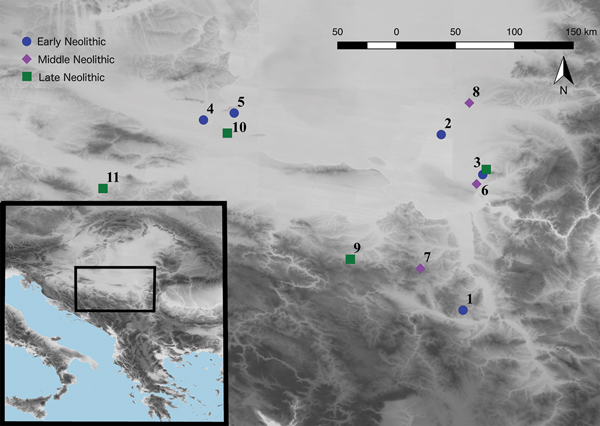
All zooarchaeological material presented here has been directly studied by the first two authors using the same protocol and recording of bone alterations following Bartosiewicz et al. (Reference Bartosiewiez, Van Neer and Lentacker1997) and Lin et al. (Reference Lin, Miracle and Barker2016). Seven complete and five partial assemblages were recorded. Table 1 presents an overview of the sites studied, with locations shown in Figure 1. Radiocarbon dates are available for nine site samples and are provided in the online supplementary material (OSM).
Locations of the sites used for this study.

Methods
Foot elements (metacarpals, metatarsals and first and second phalanges) of both domestic cattle (Bos taurus) and aurochs (Bos primigenius) were examined for all sites. These elements were selected as they offer the best direct evidence for traction in the osteological record. These are the elements most directly affected by the stress of pulling (vs age or increased body weight), as well as those most commonly preserved in the archaeological record (Bartosiewicz et al. Reference Bartosiewiez, Van Neer and Lentacker1997; Bartosiewicz Reference Bartosiewicz, Grupe, McGlynn and Peters2008). Table 1 presents a summary of the phases represented at these sites and the number of elements analysed.
Foot elements were studied for both pathological and sub-pathological alterations. These were scored on the basis of their pathology index (PI hereafter) values following Bartosiewicz et al. (Reference Bartosiewiez, Van Neer and Lentacker1997), and the distributions of PI values were compared between sites. Sub-pathological alterations consistent with traction were recorded and their frequencies per sample are given in Table 2. Measurements were also taken for the distal metapodia following the traction index osteometric system developed by Lin et al. (Reference Lin, Miracle and Barker2016). The diagnostic index ‘e/D1’ was measured for all distal metapodia of both cattle and aurochs. This index describes the degree of remodelling and extension of the medial condyle, with a value of 0.75 or higher indicating a degree of remodelling consistent with traction usage in modern reference specimens (Lin et al. Reference Lin, Miracle and Barker2016).
Distribution of elements with positive (PI >2.5) indications of sub-pathological alterations relating to traction. As in Table 1, the number of aurochs elements are given in brackets.

The combination of the two recording systems allows for the comparison of alterations across all foot elements (PI), as well as a direct index of metapodial remodelling independent of the more subjective PI approach. Where it was possible to estimate the sex of individuals (e.g. through metrical comparisons of distal metapodia), this was included as part of the recording of pathological and osteometric data. Skeletal elements from aurochs (wild cattle, and thus not used for traction) were studied as a control group for both PI and osteometric comparisons.
Results
All studied Neolithic sites demonstrate pathological and/or sub-pathological alterations to cattle bone. The overall level of pathological or sub-pathological alterations remains low, with the majority of alterations graded as minor to moderate (grades 1–3 on the Bartosiewicz et al. (Reference Bartosiewiez, Van Neer and Lentacker1997) system). The number of pathological or sub-pathological specimens from each site is small (see Table 2), which is consistent with data from later periods (e.g. De Cupere et al. Reference De Cupere, Lentacker, Neer, Waelkens and Verslype2000). All sites in the present study demonstrate a combination of age/trauma (pathological) and usage-related (sub-pathological) remodelling to bone surfaces. Pathological remodelling was identified on the remains of both domestic cattle and wild aurochs, and includes bone exostoses (additional bone growths) present at tendon and ligament attachment sites on the surfaces of phalanges and metapodia, the medial and/or lateral faces of distal metapodia and phalanges (Figures 2–3), the proximal shafts of metapodia and the posterior surfaces of proximal phalanges and metapodia.
Distribution of pathology index (PI) values for Bos taurus elements from the largest site assemblages examined for this study, along with Bos primigenius elements from all sites. PI values were assigned following Bartosiewicz et al. (Reference Bartosiewiez, Van Neer and Lentacker1997).

Bos taurus metatarsal from Kneževi Vinograd showing sub-pathological remodelling to the medial condyle resulting from traction usage. This bone was directly dated to 6015–5897 cal BC (see the OSM for details) (photographs by J. Gaastra).

By contrast, sub-pathological remodelling of bones from traction was identified only on domestic cattle. These include extension of the margins of the medial condyle of metapodia (Figure 4), as well as extension of the medial facet of the proximal articular surface of both first (Figure 5) and second (Figure 6) phalanges. The restriction of such sub-pathological remodelling to domestic cattle only is important, as this form of remodelling (on hind limbs in particular) has been shown to relate most directly to the motion and strain of pulling, rather than to other factors such as the age or weight of the animal (Bartosiewicz et al. Reference Bartosiewiez, Van Neer and Lentacker1997; Bartosiewicz Reference Bartosiewicz, Grupe, McGlynn and Peters2008; Lin et al. Reference Lin, Miracle and Barker2016). These alterations show no chronological or geographic patterning in the frequency or intensity of remodelling (Table 2).
Proximal articular surfaces of Bos taurus anterior first phalanges from Blagotin (A) and Stragari (B). Specimen A shows broadening of the medial articular facet in comparison with a normal articular surface as seen in specimen B (photographs by J. Gaastra).

Proximal articular surfaces of Bos taurus anterior second phalanges from Foeni-Salaş (A) and Blagotin (B). Specimen A shows broadening of the medial articular facet in comparison with a normal articular surface as seen in specimen B (photographs by J. Gaastra).

A first phalanx of Bos primigenius from Potporanj with examples of age-related pathological alterations observed on foot elements (photographs by J. Gaastra).

Previous research has shown that only a subset of the cattle population provides evidence of traction, and that the distribution of PI values is of far more importance than the sample's mean PI value in identifying traction (De Cupere et al. Reference De Cupere, Lentacker, Neer, Waelkens and Verslype2000). Here, PI value distributions are therefore plotted as histograms (Figure 2). The majority of elements for both taxa across all sites scored between 0–1 and 1–2. Both of these categories can be considered as indicative of normal bone development. In domestic cattle, a small proportion of each assemblage exhibited sub-pathological alterations consistent with bone remodelled due to the strain of traction (2.5–3 and 3–3.5 in PI score, see Figure 2 & Table 2). These alterations included broadening of the medial condyles for both metacarpals and metatarsals, as well as extension of the medial proximal articular facet of both first and second phalanges (see Figures 4–6). These modifications were present on a subset of cattle elements from all three Neolithic periods. The distribution of PI values provides some indication of more extensive remodelling to cattle bones from Late Neolithic sites (Figure 2), although this variation is too small to provide any firm conclusions.
Osteometric analysis of distal metapodia following the criteria of Lin et al. (Reference Lin, Miracle and Barker2016) also indicate the use of cattle for traction from at least the beginning of the Neolithic in the Western Balkans. The ‘e/D1’ index indicates traction-positive cattle metacarpals and metatarsals from sites in all three Neolithic periods. All traction-positive metapodia came from domestic cattle only, and all had distal PI values of three or higher (Bartosiewicz et al. Reference Bartosiewiez, Van Neer and Lentacker1997). These indices can be seen in Figures 7 and 8, where the ‘e/D1’ index has been plotted alongside distal breadth/Bd (Lin et al. Reference Lin, Miracle and Barker2016) to indicate the sex of animals measured. From these data, we can see not only the presence of traction-positive cattle based on both distal metacarpals and metatarsals, but also a bias towards evidence from the hind limb. This is consistent with the findings of Lin et al. (Reference Lin, Miracle and Barker2016), and further confirms that these sub-pathological alterations are the result of the strain of traction, which is more strongly expressed in the hind limb (Bartosiewicz Reference Bartosiewicz, Grupe, McGlynn and Peters2008; Lin et al. Reference Lin, Miracle and Barker2016). These data also indicate the use of both females and males for traction during the Neolithic. Given the small sample sizes, however, it cannot yet be determined whether male animals were more commonly used for traction in the Late Neolithic (Figures 7–8).
Osteometric comparisons of medial remodelling of distal metacarpals from domestic cattle (Bos taurus) and wild aurochs (Bos primigenius) using the ‘e/D1’ index developed by Lin et al. (Reference Lin, Miracle and Barker2016).

Osteometric comparisons of medial remodelling of distal metatarsals from domestic cattle (Bos taurus) and wild aurochs (Bos primigenius) using the ‘e/D1’ index developed by Lin et al. (Reference Lin, Miracle and Barker2016).

Conclusion
This study has identified new evidence for the systematic use of cattle for traction that dates back to long before previous studies (e.g. De Cupere Reference De Cupere, Lentacker, Neer, Waelkens and Verslype2000; Galindo-Pellicena et al. Reference Galindo-Pellicena, Martín-Francés, Gracia, de Gaspar, Arsuaga and Carretero2015). The two techniques used here demonstrate that cattle—both male and female—were being used for traction from the time of their initial appearance across the Central and Western Balkans. Small numbers of animals that were used for traction are identifiable in the earliest Neolithic settlements—a pattern observable throughout the entire 1500-year duration of the local Neolithic, and thus presumably afterwards.
The comparative sub-pathological and osteometric analyses of cattle presented here provide firm evidence for the exploitation of cattle labour dating back far earlier than previously considered. These data indicate not only that exploitation was systematic across multiple sites over a long period, but also that cattle were used non-intensively for traction. It is also notable that this widespread, non-specific use of cattle for ‘light’ traction recalls similar patterns observed for contemporaneous dairy production (Greenfield Reference Greenfield, Mulville and Outram2005, Reference Greenfield2010; Marciniak Reference Marciniak2011; Greenfield & Arnold Reference Greenfield and Arnold2015; Spiteri et al. Reference Spiteri, Gillis, Roffet-Salque, Navarro, Guilaine, Manen, Muntoni, Segui, Urem-Kotsou, Whelton and Craig2016). Traction was not an ‘all-or-nothing’ situation; we need instead to reconsider it as a more complex process, with animals used as engines in multiple ways. Our repeated identification of the exploitation of cattle for pulling heavy loads calls into question the current scope of the analysis and interpretation of the use of animals in prehistoric Europe.
These results indicate a need for researchers to employ systematic analytical techniques to document further this crucial initial phase of the use of cattle for traction, which is detectable through sub-pathological alteration of foot bone elements. This study clearly shows that cattle were exploited for traction from the onset of the Neolithic. Such studies need to be replicated in other European regions to determine the extent and duration of this form of traction. It is still unknown whether this form of ‘light’ traction is seen in only a selection of Neolithic groups or was a common practice across Europe. A firm understanding of the nature of early traction evidence in prehistoric Europe has significant implications for our knowledge of both management practices and the nature of labour and movement in prehistoric societies. What is now needed is a wider comparative assessment of sub-pathological evidence for cattle traction in Neolithic (and post-Neolithic) Europe to determine both how widely this pattern of early traction was distributed and at what point we begin to see evidence for specialised heavy-traction animals.
Acknowledgements
This paper stems from the European Research Council project EUROFARM, funded under the European Union's Seventh Framework Programme (FP/20072013; ERC Grant Agreement 313716). The collection of Haskel Greenfield's data was funded by the Social Science and Humanities Research Council of Canada and the University of Manitoba, the International Research and Exchanges Board of Washington, D.C. and the Fulbright-Hayes Program. We wish to thank all team members and project partners for their support and for the use of their data.
Supplementary material
To view supplementary material for this article, please visit https://doi.org/10.15184/aqy.2018.178