Functional foods are described as products that after their ingestion exert health benefit. Among these, probiotic foods have recently shown a great increase both in production volume and popularity among consumers (FAO/OMS 2001). Even though fermented milks and different types of yogurt have been the first products chosen to carry probiotic bacteria, cheeses probably offer a better food-based delivery vehicle, on the basis of increased cell protection (Boylston et al. Reference Boylston, Vinderola, Ghoddusi and Reinheimer2004). In turn, fresh cheeses have been proposed as more suitable carriers for probiotics than semi-hard and hard cheeses, due to their shorter ripening time and higher moisture content (Heller et al. Reference Heller, Bockelmann, Schrezenmeir, de Vrese and Farnworth2003). However, semi-hard and hard cheeses were also tested as probiotic delivery vehicles such as Cheddar (Mc Brearty et al. Reference Mc Brearty, Ross, Fitzgerald, Collins, Wallace and Stanton2001; Darukaradhya et al. Reference Darukaradhya, Phillips and Kailasapathy2006; Phillips et al. Reference Phillips, Kailasapathy and Tran2006; Ong et al. Reference Ong, Henriksson and Shah2006, Reference Ong, Henriksson and Shah2007), Canestrato Pugliese (Corbo et al. Reference Corbo, Albenzio, De Angelis, Sevi and Gobbetti2001) and Gouda (Gomes et al. Reference Gomes, Malcata, Klaver and Grande1995), among others.
One of the major sources of variability in probiotics' survival in cheese seems to be the strong disparity in their resistance to environmental stress, a species and strain- dependent feature (Corbo et al. Reference Corbo, Albenzio, De Angelis, Sevi and Gobbetti2001; Phillips et al. Reference Phillips, Kailasapathy and Tran2006). Moreover, the same probiotic may show different behavior when tested in diverse environmental conditions: one strain of Lb. acidophilus reported as poorly resistant by Phillips et al. (Reference Phillips, Kailasapathy and Tran2006) showed good survival in a similar cheese stored at different temperature (Ong et al. Reference Ong, Henriksson and Shah2006). Therefore, the results cannot be extrapolated from one probiotic cheese type to another or between probiotic strains.
Probiotic cheeses have been the subject of numerous recent reports. Most commercial probiotic cheeses are fresh, “cottage” or soft type cheeses. They offer a simple food matrix to deliver probiotics; for producers, they are easy to handle and often sold unripened, which makes it easier to maintain probiotic viability during shelf-life. However, the choice should not be limited to these types of cheese, to meet preferences of most consumers.
Argentina is one of the world's largest cheese producing countries, and Argentineans consume about 11·2 kg cheese per capita per annum (Guardini, Reference Guardini2008). Nonetheless, only one probiotic cheese is commercially available: a soft cheese including three probiotic strains. Pategrás cheese is the preferred semi-hard cheese type by Argentinean consumers (Zalazar et al. Reference Zalazar, Meinardi and Hynes1999), and appears as an interesting alternative to propose a new probiotic cheese.
In a previous report, we showed that two probiotic strains (Lb. acidophilus and Lb. paracasei subsp. paracasei) maintained good viability in Pategrás cheese either when added directly as a lyophilised culture or after a pre-incubation in a substrate (Bergamini et al. Reference Bergamini, Hynes, Quiberoni, Suárez and Zalazar2005). In the present work, we studied the viability of another five probiotic strains and a three-strain mixed culture in Pategrás cheese and compared the performance of each culture in the environment of the proposed food carrier.
Material and Methods
Cheese manufacture
Six cheese-making trials of probiotic cheeses were carried out at pilot plant scale, according to the industrial technology for the semi-hard Pategrás cheese (Zalazar et al. Reference Zalazar, Meinardi and Hynes1999). In five of the six trials, a different probiotic strain was used as individual adjunct culture, while in the sixth trial, a three-strain mixed culture was used.
In each trial, three types of cheeses were made by cheese-making day: control cheeses (C, without probiotics) and two types of probiotic cheeses: L cheeses with the direct addition of probiotics as lyophilized cultures and P cheeses with the addition of probiotics after a pre-incubation in a substrate. Three replicates for each cheese were made on different cheese-making days.
Cheese-making and ripening were carried out as described previously (Bergamini et al. Reference Bergamini, Hynes, Quiberoni, Suárez and Zalazar2005). A lyophilised culture of Streptococcus thermophilus (Diagramma, Santa Fe, Argentina) was used as primary starter and was added in a dose high enough to achieve 106 cfu/ml in cheesemilk.
Probiotic cultures and methodology of addition
Five different strains of probiotic bacteria were assayed as adjunct cultures: two belong to the species Lb. acidophilus (strains B and C), two were comprised of the Lactobacillus casei group (Lb. casei and Lb. rhamnosus) and the last was a strain of Bifidobacterium lactis. Four of the five strains assayed were commercial cultures, and their suppliers claimed that they show good survival in the gastrointestinal tract and probiotic properties. Finally, the strain of Lb. rhamnosus assayed was obtained from the culture collection of the Instituto de Lactología Industrial (Santa Fe, Argentina) and was selected on the basis of its technological and probiotic properties. This strain was cultured at 37°C in sterile MRS broth and then centrifuged. The pellet containing the bacteria was used similarly to the commercial cultures.
Each one of the five strains was assayed as a single-strain adjunct culture in different cheese-making trials. Then, a three-strain mixed culture, which included two strains tested in the present work (Lb. acidophilus C and Bifid. lactis) and one studied in a previous work (Lb. paracasei subsp. paracasei; Bergamini et al. Reference Bergamini, Hynes, Quiberoni, Suárez and Zalazar2005), was assayed in the last trial.
The substrate used for the pre-incubation of probiotic bacteria before their addition to P cheeses was prepared according to Bergamini et al. (Reference Bergamini, Hynes, Quiberoni, Suárez and Zalazar2005). Each single-strain probiotic culture and the three-strain mixed culture were inoculated in this substrate, which was incubated at 37°C for 5 h and then stored at 4°C until the next day, when it was used to manufacture P cheeses.
The dose of probiotics was aimed to obtain a high cell load in the product, without increasing acidification rate or extension, as both influence cheese composition and quality. Probiotic cultures were inoculated in the substrate to attain 5×10⁷ cfu/ml approximately. The initial amount of probiotics was the same for L and P cheeses.
pH and microbial counts in the substrate
During the incubation and refrigerated storage of the substrate, pH and probiotic bacteria plate counts were assessed at 0, 2, 5 and 20 h. Probiotic lactobacilli were enumerated on MRS agar in samples containing single-strain adjunct cultures, whereas MRS agar with 0·15% bile was used to assess lactobacilli in samples with the mixed probiotic culture. Bifidobacteria were counted on propionate lithium MRS-agar. Plate colonies were recorded after 48 h incubation at 37°C for lactobacilli, while 72 h incubation in anaerobic conditions at 37°C were selected for bifidobacteria (Vinderola & Reinheimer, Reference Vinderola and Reinheimer2000, Bergamini et al. Reference Bergamini, Hynes, Quiberoni, Suárez and Zalazar2005).
pH and microbial analysis of cheeses
pH was measured in cheeses at 3, 30 and 60 days of ripening according to American Public Health Association standard (APHA) (Bradley et al. Reference Bradley, Arnold, Barbano, Semerad, Smith, Vines and Marshall1993).
Microbial counts of primary starter and probiotic adjunct culture were performed in cheeses on aseptic samples taken during ripening (60 days). Ten grams of cheese were emulsified with 90 ml sterile sodium citrate (2% w/v) in a Stomacher 400C lab blender (Brinkmann, NY, USA). Decimal dilutions in 0·1% casein peptone water were made. Aliquots of the appropriate dilutions were plated in Skim Milk Agar (SMA) for primary starter and incubated in aerobic conditions at 37°C during 48 h (Bergamini et al. Reference Bergamini, Hynes, Quiberoni, Suárez and Zalazar2005). Probiotic bacteria were counted as described above. Non-starter lactobacilli in C cheeses were enumerated on MRS agar after 48 h of incubation at 37°C.
Statistical analysis
Data from microbiological and compositional analyses were processed by one-way ANOVA with SPSS 10.0 (SPSS Inc., Chicago, Estados Unidos). When differences were found, means were compared by the least significant difference test (LSD) using the same tool.
Results
Pre-incubation step
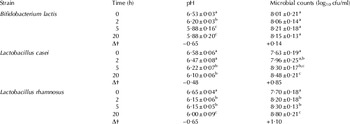
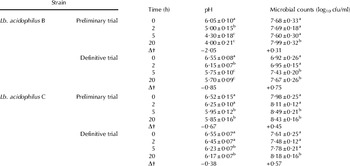
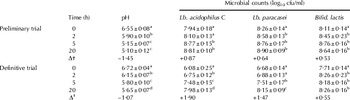
Probiotics counts and pH evolution during pre-incubation step were appropriate in substrates with single-strain cultures of Bifid. lactis, Lb. casei and Lb. rhamnosus for the initial probiotic dose proposed. After incubation and cold storage, probiotics were over 108 cfu/ml and pH overcome ca. 6·0 in the substrate (Table 1), which is compatible with its use in cheese-making. Contrarily, Lb. acidophilus B, Lb. acidophilus C and the mixed culture composed by Lb. acidophilus C, Lb. paracasei and Bifid. lactis over-acidified the medium and even coagulated the substrate in some cases (Table 2 & 3). As a consequence, the inocula of these cultures were reduced and the trials repeated, in order to obtain appropriate probiotic counts without over-acidification. Thus, the initial dose in the substrate was set in the definitive trials at 6×10⁶ cfu/ml for Lb. acidophilus B and 1×10⁷ cfu/ml for Lb. acidophilus C; for the mixed culture, the dose of Lb. paracasei and Lb. acidophilus C was reduced (2×10⁶ cfu/ml) and Bifid. lactis was added in the same proportion as in the individual trial.
Evolution of probiotic population and pH during pre-incubation step and cold storage of substrate inoculated with single-strain probiotic cultures of bifidobacteria and lactobacilli of the Lb. casei group: Bifid. lactis, Lb. casei and Lb. rhamnosus (Mean±SD)

† Difference between final (20 h) and initial value (0 h). Pre-incubation step at 37°C lasted from 0 to 5 h, and then the substrate was stored at 5°C
a, b, c Different superscripts in the same column for each strain indicate significant differences (α<0·05)
Evolution of probiotic population and pH during pre-incubation step and cold storage of substrate inoculated with single-strain Lb. acidophilus probiotic cultures: Lb. acidophilus B and Lb. acidophilus C (Mean±SD). Preliminary trial: trial with an initial dose of probiotic bacteria of about 5×10⁷ cfu/ml. Definitive trial: trial with a reduced initial dose of probiotic: 6×10⁶ cfu/ml for Lb. acidophilus B and 1×10⁷ cfu/ml for Lb. acidophilus C

† Difference between final (20 h) and initial value (0 h). Pre-incubation step at 37°C lasted from 0 to 5 h, and then the substrate was stored at 5°C
a, b, c Different superscripts in the same column for each strain and trial indicate significant differences (α<0·05)
When assayed as single-strain cultures, all the lactobacilli strains showed a significant increase (between 0·6 and 1·1 log order) during pre-incubation step and storage of the substrate (Table 1 & 2). On the other hand, bifidobacteria counts showed a slight increase during pre-incubation when tested as a single culture, although differences between initial and final numbers were not significant (Table 1). During pre-incubation of the mixed culture, the three strains increased significantly, and in a higher proportion than that obtained when cultured individually (Table 3).
Evolution of probiotic population and pH during pre-incubation step and cold storage of substrate inoculated with a three strain mixed probiotic culture (Mean±SD). Preliminary trial: trial with an initial dose of each probiotic bacteria of about 5×10⁷ cfu/ml. Definitive trial: trial with the same dose of Bifid. lactis and a reduced initial dose of probiotic lactobacilli (2×10⁶ cfu/ml each one)

† Difference between final (20 h) and initial value (0 h). Pre-incubation step at 37°C lasted from 0 to 5 h, and then the substrate was stored at 5° C
a, b, c, d Different superscripts in the same column for each trial indicate significant differences (α<0·05)
As for acidifying activity, a significant decrease of pH (between 0·4 and 1·1) was observed during pre-incubation and storage (Table 1, 2 & 3). The highest acidification was found in the substrates inoculated with Lb. acidophilus B and the three-strain mixed culture, even when the initial dose had been already reduced.
pH and microbial counts in cheeses
The addition of probiotic cultures did not cause significant differences in cheese pH, except in two trials. Probiotic cheeses (L and P) containing Lb. acidophilus B had lower pH than their respective control cheeses at the end of the ripening, while only young P cheeses made with the three-strain mixed culture showed a pH significantly lower than their corresponding control cheeses at 3 days ripening (data not shown).
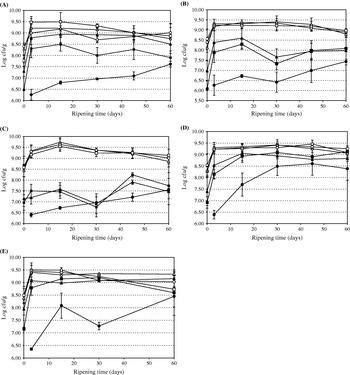
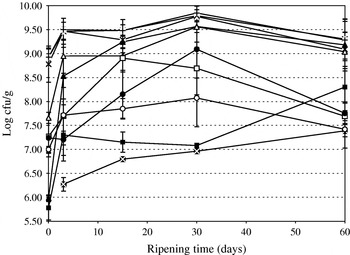
Primary lactic starter population evolved similarly during ripening of all, control and probiotic cheeses (Fig. 1 & 2). Streptococci were about 3×10⁸ cfu/g in the fresh curd before moulding, then increased by about 0·6–1·7 log order at 3 days from manufacture. Then, counts of primary starter remained virtually constant or showed small decrease of about 0·5 to 1 log towards the end of the ripening. Lactic starter final counts were ca. 109 cfu/g in all cheeses. Overall, counts of Strep. thermophilus did not show significant differences (α>0·05) between control and probiotic cheeses in each trial.
Evolution of primary starter and probiotic bacteria. ○, □, ▵: Strep. thermophilus in C, L and P cheeses. ▪, ▴: Probiotic bacteria in L and P cheeses. •: NSLAB in C cheeses. C: control cheeses without probiotics. L: experimental cheeses with probiotic bacteria added directly as a lyophilised culture. P: experimental cheeses with probiotic bacteria added before a pre-incubation step in a substrate. Probiotic bacteria in each single-strain culture trials were: A) Lb. acidophilus B, B) Lb. acidophilus C, C) Bifid. lactis, D) Lb. casei, E) Lb. rhamnosus. In each trial, control cheeses were included.

Evolution of primary starter and probiotic bacteria in the trial with the mixed culture.  , ×, +: Strep. thermophilus in C, L and P cheeses. ▪, □: Lb. acidophilus C in L and P cheeses, respectively. ▴, ▵: Lb. paracasei subsp. paracasei in L and P cheeses, respectively. •, ○: Bifid. lactis in L and P cheeses, respectively.
 : NSLAB in C cheeses. C: control cheeses without probiotics. L: experimental cheeses with probiotic bacteria added directly as a lyophilised culture. P: experimental cheeses with probiotic bacteria added before a pre-incubation step in a substrate.

As for probiotic bacteria, all strains assayed remained at higher levels than 107 cfu/g up to the end of ripening (Fig. 1 & 2). The counts of probiotic bacteria in the fresh curd ranged from 6·0×105 to 8·9×107 cfu/g, depending of the probiotic strain and the methodology of addition. As the primary starter, probiotic bacteria increased significantly, about 1 log order, between days 0 and 3 after manufacture, with the sole exception of Bifid. lactis. In effect, Bifid. lactis counts showed only a slight increase or no change in probiotic cheeses. Overall, the initial increase in probiotics counts was somewhat higher in L cheeses than in P cheeses, except for Bifid. lactis in the trial with the mixed culture.
Probiotic counts were very similar in both types of probiotic cheeses, in all trials. ANOVA detected significant differences only in a few cases at the beginning of the ripening. P cheeses presented higher probiotics concentration, which significantly differed from L cheeses, in the following cases: Lb. rhamnosus on day 0, and, in the trial with the mixed culture, Lb. paracasei on day 0 and Lb. acidophilus C up to 15 days. Shortly after manufacture, all P cheeses showed higher probiotic counts than L cheeses, although the differences were not significant, and later during ripening, they levelled up in most cases. Only Lb. acidophilus B remained at higher level in P cheeses for 60 days.
Evolution of probiotic population from day 3 to 60 varied from one strain to another; the methodology of addition also had an influence (Fig. 1 & 2). Lb. acidophilus B counts diminished after 15 days ripening; later there was a slight increase (Fig. 1A). As for Lb. acidophilus C, they decreased ca. 1 log order between 15 and 30 days, then increased ca. 0·5 log towards the end of ripening (Fig. 1B). Finally, in the last trial where a mixed culture was used, Lb. acidophilus C increased during the first 15 days then decreased in L cheeses, while in P cheeses increased between 30 and 60 days (Fig. 2). Regardless of these variations, final concentration for Lb. acidophilus strains was always ca. 108 cfu/g.
As for the strains of the Lb. casei group: Lb. casei, Lb. rhamnosus and Lb. paracasei (mixed culture), they remained almost constant in cheeses from day 3 up to the end of the ripening (Fig. 1 D, E & Fig. 2). Only Lb. rhamnosus showed a small decrease in L cheeses. Final concentration of these strains in both types of probiotic cheeses was approximately 109 cfu/g, i.e. one log more than Lb. acidophilus strains.
Finally, Bifid. lactis in cheeses from trial with individual probiotic culture remained constant for 30 days, and then increased up to ca. 4×10⁷ cfu/g (Fig. 1C). In cheeses with the mixed culture, Bifid. lactis showed the opposite behaviour: an initial increase followed by a decrease; however final concentration was similar (Fig. 2).
NSLAB in control cheeses reached 106 cfu/g at 3 days ripening, then increased up to 107–108 cfu/g towards the end of the ripening.
Discussion
The approach of pre-incubating probiotic cultures in a substrate before addition into cheese-milk is very promising. Most strains were able to develop in the substrate, increasing the real inoculum and the initial cell load in the cheese. Drawbacks of this strategy lie in the fact that over-acidification can be caused by the metabolically active probiotics and the direct addition of lactic acid produced by them in the substrate, which in turn would change cheese-making acidification curves and technology, as well as final cheese composition and quality (Mc Brearty et al. Reference Mc Brearty, Ross, Fitzgerald, Collins, Wallace and Stanton2001). Over-acidification of the substrate was verified for strains of Lb. acidophilus B and C, which also showed a marked growth during pre-incubation. We lowered the initial dose of probiotics and repeated these trials with better results.
Bacterial interactions are possible in a medium containing more than one strain (Boylston et al. Reference Boylston, Vinderola, Ghoddusi and Reinheimer2004). In the present work, the results suggest a synergic effect for the three probiotic strains which composed the mixed culture. Lb. acidophilus C, Lb. paracasei and Bifid. lactis grew better in the mix than in the individual trials, even if the initial dose of lactobacilli was reduced to avoid over-acidification. The positive influence of lactobacilli on bifidobacteria growth has been related to their proteolytic activity, which could produce growth-promoting factors such as small nitrogen compounds (Gomes et al. Reference Gomes, Malcata and Klaver1998). On the other hand, Gomes et al. (Reference Gomes, Malcata and Klaver1998) have attributed the positive influence of bifidobacteria on the growth of lactobacilli to the buffer effect due to the production of acetate by bifidobacteria.
In Pategrás cheeses, the counts of the thermophilic starter did not significantly decrease during ripening, which differs from the behaviour of most mesophilic starters, commonly used in previous research works on probiotic cheeses. The lysis of primary starter during ripening has been considered as a favourable fact for the growth or viability maintenance of adjunct cultures in cheese (Thomas, Reference Thomas1987). However, our results are in agreement with other authors, who have determined that non-lytic starters are compatible with the increase or preservation of high counts of adjunct cultures (Corbo et al. Reference Corbo, Albenzio, De Angelis, Sevi and Gobbetti2001; Milesi et al. Reference Milesi, Candioti and Hynes2007). In addition, most strains of Strep. thermophilus are not able to metabolize the galactose produced from the hydrolysis of lactose, and consequently, this monosaccharide accumulates in the cheese or is available for other microorganisms, such as NSLAB or adjunct cultures (Williams et al. Reference Williams, Withers and Banks2000). In this way, Strep. thermophilus could be a more appropriate starter than lactococci for probiotic cheeses, provided that over-acidification is not a problem, as the availability of galactose could enhance probiotic survival or even proliferation.
A positive impact on probiotics' growth and survival derived from the use of a mixed probiotic culture was that each probiotic strain reached counts similar to cheeses containing the single-strain cultures even when the initial dose in the mix was lower. Ong et al. (Reference Ong, Henriksson and Shah2006 & Reference Ong, Henriksson and Shah2007) found that six strains of probiotic bacteria added to Cheddar cheese as single or three-strain mixed cultures always reached similar levels. However, other authors showed a significant decrease of probiotics counts when they were added as two- or three-strain mixed cultures to Cheddar cheese. Darukaradhya et al. (Reference Darukaradhya, Phillips and Kailasapathy2006), for example, showed a decrease of Lb. acidophilus L10 and Bifid. lactis B94 up to 106 cfu/g when tested in a mixed culture. Also the Lb. acidophilus strains assayed in the present work were reported to lose viability to very low counts (103 cfu/g) in Cheddar cheese when inoculated as a part of mixed cultures (Phillips et al. Reference Phillips, Kailasapathy and Tran2006). This last result points out the importance of the environmental conditions and the other cultures existing in the ecosystem: we found that in a different cheese and in the presence of different probiotic and lactic partners the same strains showed good viability.
Another factor that affects bacterial resistance to adverse environmental conditions is cell physiological state (Bertazzoni Minelli et al. Reference Bertazzoni Minelli, Benini, Marzotto, Sbarbati, Ruzzenente, Ferrario, Hendriks and Dellaglio2004). In our work, we added probiotic bacteria into cheese-milk by two different methodologies, which in turn implied differences in the metabolic activity of the cultures. The survival of probiotic bacteria in Pategrás cheeses, however, was not affected and final probiotic concentration in cheeses was similar, regardless of the initial physiological state of the probiotic culture. Although probiotic initial counts were higher in cheeses with a pre-incubated probiotic culture, this difference turned out to be significant only in few cases at the beginning of ripening and probably was no more than a consequence of the higher real inoculums. We have found a similar trend for two probiotic strains in a previous work (Bergamini et al. Reference Bergamini, Hynes, Quiberoni, Suárez and Zalazar2005).
Among the strains tested in the present work and those characterized in a previous report (Bergamini et al. Reference Bergamini, Hynes, Quiberoni, Suárez and Zalazar2005), the strains belonging to the Lb. casei group were the most resistant to the environmental conditions prevailing in the cheeses. Lb. casei group is the main component of NSLAB, a microbial community that settles in cheese during ripening and reach 106–107 cfu/g after the first few weeks (Crow et al. Reference Crow, Curry and Hayes2001). Although probiotic and NSLAB lactobacilli colonize different habitats (intestine versus food matrix) and, a priori, it could be speculated that they could behave differently, it is possible that strains of Lb. casei group are well adapted to both niches, explaining the resistance of these strains.
Lb. acidophilus strains also showed a good survival in cheeses, but it was somewhat lower than that of the strains of the Lb. casei group.
Bifid. lactis showed the lowest final counts among the probiotic strains studied, although they remained high enough (above 107 cfu/g) for at least 60 days.
In conclusion, in this work we showed that Pategrás cheese is an excellent food-based vehicle for probiotic bacteria. All the single-strain cultures and the mixed probiotic culture assayed maintained high counts during the shelf-life settled for the product. Pategrás cheese performed well even to carry some probiotics strains reported as sensitive in previous works. Strains of the Lb. casei group: Lb. paracasei, Lb. casei and Lb. rhamnosus reached and maintained the highest cell concentration during cheese ripening, followed by Lb. acidophilus and bifidobacteria. Even if generalization is not an appropriate approach when probiotic foods are developed, in this work we found some general trends by testing several cultures in the same conditions. We provided evidence about the robustness and versatility of the food carrier, which delivered well six different probiotic cultures, and we confirmed that direct addition was the best inoculation method. The results obtained in the present work constitute the first step in the development of Pategrás cheese as probiotic food. In vivo tests are necessary in order to verify the probiotic functionality of this cheese.
Authors acknowledge the financial support of Agencia Nacional de Promoción Científica y Tecnológica (ANPCyT, PICT01 09-08040 BID 1201 OC/AR) and Universidad Nacional del Litoral (UNL, CAI+D 12/H 311 2002).