The capture of prey via sudden attacks from concealed positions has independently evolved in many groups of predators, and this foraging strategy is especially widespread among fish (Fu et al. Reference Fu, Zeng, Li, Pang, Cao, Peng and Wang2009) and snakes (Lourdais et al. Reference Lourdais, Gartner and Brischoux2014). Typically, the location of ambush is not randomly chosen because it can have far-reaching fitness consequences, affecting the survivorship and nutrient/energy supply of the ambusher (Shine & Sun Reference Shine and Sun2002). Indeed, in many species of spider, conspecifics show preferences for similar ambush locations (Morse Reference Morse2000), and in stoneflies, conspecifics directly compete for the best-quality ambush sites (Walde & Davies Reference Walde and Davies1984). Naturally, competition for ambush sites can also involve individuals from different sympatric species, which, for example, has been reported in antlions and wormlions (Miler et al. Reference Miler, Yahya and Czarnoleski2017), although interspecific competition has usually been studied in contexts other than ambush sites (Di Bitetti et al. Reference Di Bitetti, Di Blanco, Pereira, Paviolo and Pirez2009, Downes & Bauwens Reference Downes and Bauwens2002). Importantly, competition may be decreased by various means of niche partitioning, and studying niche partitioning within species helps us understand the origin and maintenance of trait differences among conspecifics as well as the mechanisms that promote their co-occurrence (for a review, see Bolnick et al. Reference Bolnick, Svanbäck, Fordyce, Yang, Davis, Hulsey and Forister2002). This is especially true in the context of competitive foraging, which is exemplified by studies on bats or cichlid fishes (Barclay Reference Barclay1985, Kohda et al. Reference Kohda, Shibata, Awata, Gomagano, Takeyama, Hori and Heg2008).
To address the partitioning of ambush sites between conspecifics, we studied ambush-site preferences in the terrestrial leech Haemadipsa picta (Moore, 1929) from a Bornean tropical rainforest (Figure 1a). Haemadipsid leeches (Arhynchobdellida: Haemadipsidae) are widespread throughout the Indo-Pacific tropical and subtropical rainforests, although particular species often have narrow geographic distributions (Borda & Siddall Reference Borda and Siddall2010, Borda et al. Reference Borda, Oceguera-Figueroa and Siddall2008, Tessler et al. Reference Tessler, Barrio, Borda, Rood-Goldman, Hill and Siddall2016, Reference Tessler, Weiskopf, Berniker, Hersch, McCarthy, Yu and Siddall2018). Perhaps due to their reputation as voracious blood feeders, haemadipsid leeches remain obscure animals, with only fragmentary and often anecdotal information available regarding their life strategies. Only a few studies that have focused on the ecology of these animals are available in the literature (Fogden & Proctor Reference Fogden and Proctor1985, Kendall Reference Kendall2012, Smythies Reference Smythies1959). According to a recent observational study, H. picta co-occurs in parts of Bornean forests with its potential competitor and close relative, Haemadipsa subagilis, but the two species differ in their distribution patterns at the microscale (Gąsiorek & Różycka Reference Gąsiorek and Różycka2017). Specifically, H. picta leeches become less abundant with increasing distance from animal trails, and larger individuals are more frequently found on higher foliage. In contrast, H. subagilis leeches occur mostly near the ground, and their abundance does not change with distance from the trails or on the basis of individual differences in body size. Gąsiorek & Różycka (Reference Gąsiorek and Różycka2017) speculated that these patterns might indicate size-dependent preferences for ambush locations in H. picta aimed at targeting different prey items and thus at escaping from local competition. To address this hypothesis, we collected observational information on the vertical distribution of H. picta on foliage in natural conditions and then performed a field experiment in which leeches with different body sizes could freely choose their ambush locations on plants under controlled conditions. Ecological theories predict that the spatial distribution and abundance of organisms are driven by either preferences for certain environments or by environmental gradients that affect birth and death rates, which have nothing to do with the intentional choice of habitats (Binckley & Resetarits Reference Binckley and Resetarits2005). Clearly, studies that combine observational and experimental approaches can help us differentiate between these two distinct ecological mechanisms.
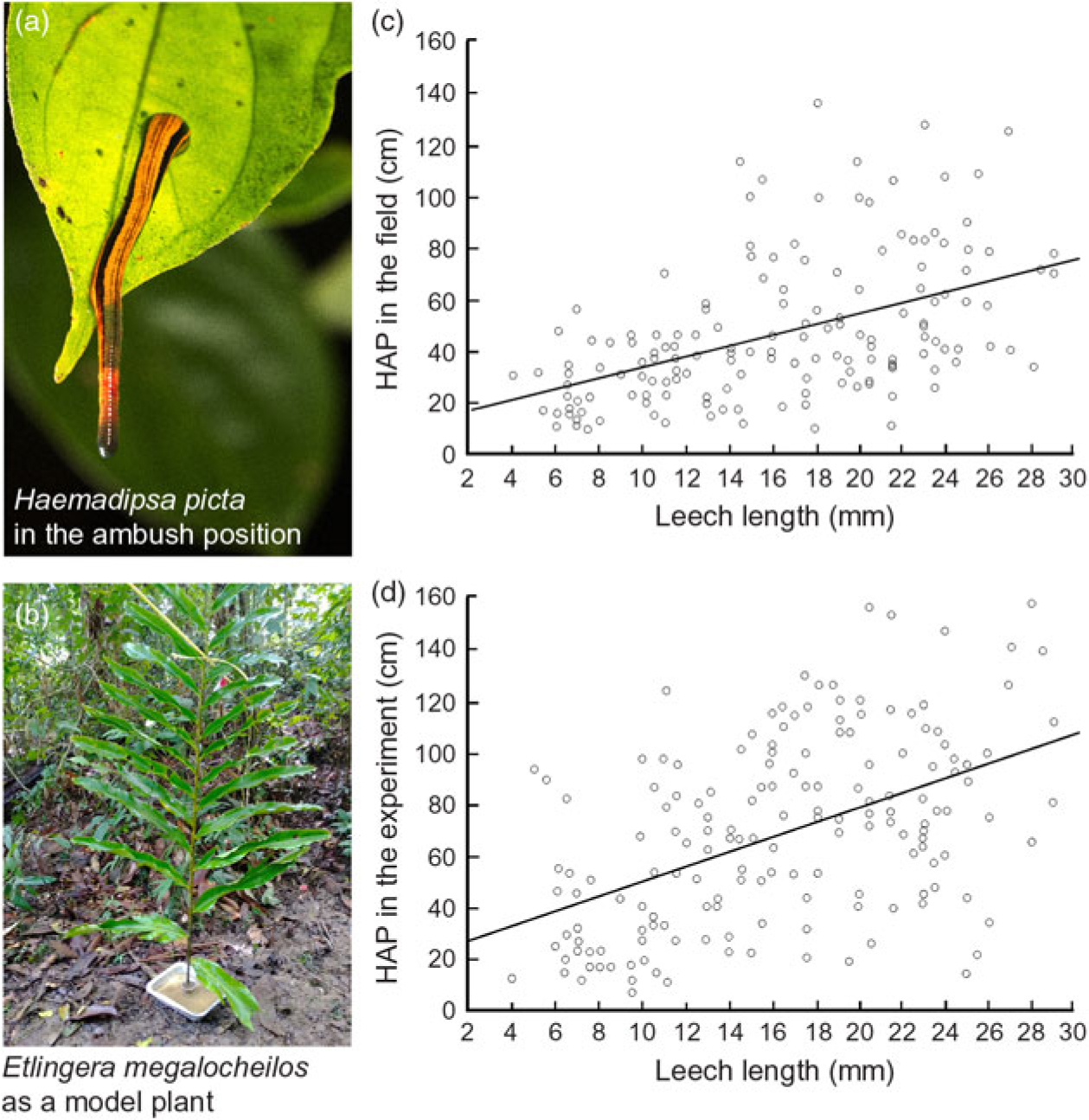
The blood-feeding leeches Haemadipsa picta in the tropical rainforest in Danum Valley (Malaysian Borneo) await their hosts at different heights in the foliage (a). For 8 days, 24 leeches day−1 were collected in natural conditions and the above-ground height of their ambush positions in the foliage was recorded. The collected leeches were transferred to an experimental site, where they were placed individually at the base of one of 12 model plants and left for 2 h undisturbed to choose ambush sites (b). Larger leeches hunted at higher ambush positions in the foliage (HAP), and this pattern was observed under natural conditions (c) and in the experiment (d). Lines represent least-square regressions fitted to the data, (c): y = 13.6 + 2.1x, (d): y = 21.2 + 2.8x.

Our study was performed in July 2018 in the dipterocarp lowland rain forest near the Danum Valley Field Centre (DVFC), Sabah (Malaysian Borneo). Each morning for 8 days, we walked along the forest trails radiating out from the DVFC to collect leeches of H. picta, with a maximum of 24 animals collected each day (Figure 1). Using a measuring tape, we recorded the height (to the nearest 0.5 cm) of the ambush position (HAP) of each leech. The collected leeches were individually placed into labelled plastic cups, where they were kept until the start of the experiment. The cups had perforated tops to allow air ventilation and were lined with wet tissue to maintain humidity. The experiment was performed over 8 days in a nearby shady stream valley in the forest and involved two sessions per day. Twelve leeches were used in the morning sessions (starting at ∼10h00), and the remaining 12 leeches were used in the afternoon sessions (starting at ∼14h00). We used pseudostems of the ginger Etlingera megalocheilos, which was selected as a model plant, to provide each leech with a variety of ambush locations on the foliage, as this species has a simple and repeatable structure: a thick vertical pseudostem, elongated leaves evenly distributed along the pseudostem, and the lowest leaf originating from the pseudostem at a height of ∼20 cm above the ground. The pseudostems measured 140–150 cm in height and were cut with a machete from a large population of E. megalocheilos inhabiting the area of the DVFC. For the experiment, the pseudostems were vertically mounted at positions along the stream valley that were at least 3 m apart, ensuring no direct contact between the leaves and the ground or local vegetation. The lower end of the pseudostem was placed into a small plastic cup containing soil, and the cup was positioned in the centre of a 25 × 40-cm tray filled with water (Figure 1b). To maintain their vertical position, the upper ends of the pseudostems were fixed to a net of nylon threads that spanned between the nearby trees. Prior to each experimental session, the pseudostems were vigorously splashed with stream water, which provided moisture to maintain plant turgor and a humid environment for the leeches. An experimental session began by placing one leech on the surface of the soil in one randomly assigned cup containing a ginger pseudostem. The leeches were then left undisturbed for 2 h so that they could freely explore the model plants and choose an ambush location. Note that the escape of leeches from our model plants and intrusions of local leeches were effectively prevented by the large surface area of water surrounding the ginger pseudostems. At the end of the sessions, we recorded the HAP of the leeches on the plants (to the nearest 0.5 cm). The leeches were collected, fixed in 95% ethanol, and then measured in the evening on the day of collection. We measured body length (to the nearest mm) by placing each leech horizontally on graph paper in a fully (but unforced) spread position. In total, we collected complete data on the body lengths of leeches in connection to the HAP under natural and experimental conditions for 167 individuals of H. picta. Note that we followed strict measuring procedures and obtained a large sample size to minimize measuring errors inherent in the size measurements of soft-bodied organisms. To analyse the HAP, we used a general linear model with body length as a covariate. The model for natural conditions also included the observational day as a random factor, and the model for experimental conditions included the experimental day and measurement session (morning vs. afternoon) as random factors. The analysis of the two models showed highly non-significant effects of the random factors. Therefore, for the sake of simplicity, we removed all random factors from the final models, which reduced our analysis to that of simple regressions. Another regression model was fitted to the experimental vs. observational HAP data to examine whether a leech found at a certain ambush position under natural conditions was consistently choosing a similar position under experimental conditions. We also used a paired-sample t-test to compare the HAPs for individual leeches between the natural and experimental conditions. Plots of residual vs. predicted values generated from our regression models suggested a tendency for non-normal distribution in our data. Although parametric methods are regarded as robust to mild deviations from normality (Quinn & Keough Reference Quinn and Keough2002), we complemented each regression analysis with the analysis of Spearman’s rank correlation coefficient. Consequently, we used a Wilcoxon matched-pairs test as a non-parametric alternative to our t-test. All analyses were performed in STATISTICA 13 (Tibco, Poland).
The studied individuals of H. picta varied considerably with respect to body length (4–29 mm) and the height of ambush positions on the foliage, which spanned 11–137 cm under natural conditions and 0–158.5 cm under experimental conditions. The mean HAP value was significantly higher in the experimental than in the natural conditions (67.5 cm vs. 47.7 cm; t-test analysis: t = 6.57, df = 166, P < 0.0000001; Wilcoxon test analysis: Z = 6.07, P < 0.00000001). Overall, these results indicate that our experimental setup provided leeches with semi-natural conditions that closely mimicked their natural hunting environment. It also appears that after physical disturbance, hunting leeches can resume their ambush positions over relatively short periods of time – in our case, the 2-h experimental sessions allowed the replication of the vertical distribution of leeches on the foliage observed in the field. As shown in Figure 1, larger leeches hunted at higher ambush locations in the foliage, and this pattern was consistently observed under natural conditions (regression analysis: F1,165 = 49.2, Pearson r = 0.48, P < 0.0000001; Spearman’s correlation analysis: R = 0.52, P < 0.000000000001) and in the experiment (regression analysis: F1,165 = 50.3, Pearson r = 0.48, P < 0.0000001; Spearman’s correlation analysis: R = 0.47, P < 0.000000001), in which leeches were allowed to freely choose their ambush sites and the effects of any confounding ecological factors were minimized. Interestingly, our estimations of the regression slopes in Figure 1 (field: 2.1; experiment: 2.8) help to predict that a 1-mm increase in body length of a leech corresponds to 2–3 cm higher above-ground position of a leech in foliage. We still observed high individual variance in the HAP that could not be attributed to the size dependency of hunting tactics – the effect of body length accounted for 22% and 23% of the total individual variance in the HAP under the natural and experimental conditions, respectively. Leeches were consistent in their ambush site preferences – individuals that chose higher ambush positions under natural conditions also chose higher ambush positions on our model plants in the experiment (regression analysis: F1,165 = 15.5, Pearson r = 0.29, P < 0.0002; Spearman’s correlation analysis: R = 0.30, P < 0.00001), although the HAPs under natural conditions explained only 8% of the variance in the HAPs in the experiment. Overall, in accordance with Gąsiorek & Różycka (Reference Gąsiorek and Różycka2017), our findings from the natural and experimental conditions indicate that H. picta leeches actively choose hunting locations according to their above-ground height and shift their ambush sites to higher foliage over ontogeny.
Size-dependent preferences for ambush sites have not been frequently studied, but male Anolis conspersus lizards that occupy moderately shaded tree parts in the Cayman Islands were reported to be larger than females and foraged on higher branches, specializing in different sizes of prey than females (Schoener Reference Schoener1967). Clearly, more work will be necessary to gain a full understanding of the foraging ecology of H. picta, but it is tempting to speculate that foraging decisions of H. picta indicate that different prey are targeted following the ontogenetic shifts in the foraging optima of growing leeches. There is fragmentary evidence to indirectly support our predictions. Martin et al. (Reference Martin, Seaby and Young1994) studied the co-existence of two sympatric species of predatory leeches in British lakes, showing that although both leeches hunted similar prey species, the larger leech Glossiphonia complanata targeted larger individuals of prey than the smaller leech Helobdella stagnalis. Consistent with the idea of ontogenetic shifts in the foraging tactics of sanguivorous leeches, Elliott (Reference Elliott2008) reported that blood meals of the aquatic leech Hirudo medicinalis were more frequent among larger leeches, with mammalian blood found exclusively in the largest leeches. Lent et al. (Reference Lent, Fliegner, Freedman and Dickinson1988) demonstrated that the ingestive behaviour and physiology of H. medicinalis changed with the body size of leeches. A field study by Weiskopf et al. (Reference Weiskopf, McCarthy, Tessler, Rahman, McCarthy, Hersch, Faisal and Siddall2018) in a tropical forest in Bangladesh showed that different species of haemadipsid leeches targeted a wide range of mammalian species with different body sizes and life strategies. Interestingly, an ability to detect mammalian DNA in the blood meals of leeches differed between the species of leeches, which was most likely linked to size differences between the studied leeches. Although statistically non-significant, there was also a consistent tendency within each species – blood meals with detectable mammal DNA tended to be more frequent among larger leeches.
Ultimately, how the foraging strategy of terrestrial sanguivorous leeches shapes multi-trophic interactions must also be addressed. The rainforests of South-East Asia represent a biodiversity hotspot of terrestrial leeches (Borda & Siddall Reference Borda and Siddall2010), and the key message of this study is that we must consider these obscure creatures to better understand the functioning of these ecosystems.
Author ORCID
Marcin Czarnoleski https://orcid.org/0000-0003-2645-0360
Acknowledgements
This study was conducted during the Tropical Ecology Field Course of the Jagiellonian University (grant DS/WB/INOS/757/2018), organized in partnership with the South East Asia Rainforest Research Partnership (SEARRP). We thank Mike Bernadus Bala Ola for ginger species identification.