Introduction
The study of biotic interactions presents multiple challenges to those working with extant organisms, and exploring their history using fossils proves even more challenging; yet because biotic interactions are thought to influence the ecology and evolution of the organisms involved, they remain a subject of great interest (e.g., Vermeij Reference Vermeij1987; Jablonski Reference Jablonski2008; Voje et al. Reference Voje, Holen, Liow and Stenseth2015). The ecology of crinoids suggests that this group of echinoderms should be especially prone to interactions with other marine organisms because, as passive suspension feeders, they must expose much of their anatomy to moving water. For example, their many long and slender arms, which capture and transport food particles, provide a suitable substrate for epibionts, including hydroids, polychaetes, gastropods, arthropods, chordates, and even other echinoderms (Clarke Reference Clarke1921). Furthermore, the diversity of organisms epizoic on crinoids known from the fossil record is likewise large: Meyer and Ausich (Reference Meyer and Ausich1983) reported more than 20 associations, many restricted to the Paleozoic, including that between crinoids and platyceratid gastropods, which is perhaps best known (see Gahn and Baumiller Reference Gahn and Baumiller2003, Reference Gahn and Baumiller2006; Fryda et al. Reference Fryda, Racheboeuf and Frydová2008 for reviews).
Whereas the exact nature of the interactions between crinoids and other organisms is often difficult to ascertain, it is striking how few are known to involve predation. In a thorough summary, Meyer and Ausich (Reference Meyer and Ausich1983) listed fish and arthropods as the most likely predators of Recent and fossil crinoids. However, even for the Recent, much of the evidence was circumstantial, including: (1) crinoid elements found in the guts of fishes; (2) missing or regenerated arms and pinnules; and (3) observations of predation made in aquaria, such as attacks by the lobster Palinurus mauritanicus Gruvel, Reference Gruvel1911 on the feather star, Antedon bifida (Pennant Reference Pennant1777) (Vasserot Reference Vasserot1965).
Studies published since the review by Meyer and Ausich (Reference Meyer and Ausich1983) have greatly expanded the body of evidence for attacks by fish on crinoids and indicate that loss and regeneration of body parts is frequent in feather stars (e.g., Mladenov Reference Mladenov1983; Meyer Reference Meyer1985; Schneider Reference Schneider1988; Baumiller and Gahn Reference Baumiller and Gahn2013) and stalked crinoids (Oji Reference Oji1986, Reference Oji1996; Gahn and Baumiller 2010) even though direct observations of attacks by fish, and especially of lethal attacks, have been few (e.g., Meyer et al. Reference Meyer, LaHaye, Holland, Arenson and Strickler1984; Meyer Reference Meyer1985; Schneider Reference Schneider1988; Lawrence and Vasquez Reference Lawrence and Vasquez1996). One oft-invoked cause of the low levels of lethal fish predation on crinoids has been the distastefulness of the latter, already recognized by Clark (Reference Clark1915). Experiments conducted to explore this phenomenon have confirmed that some fish find feather stars distasteful (Meyer Reference Meyer1985; Slattery Reference Slattery2010; Tinkova et al. Reference Tinkova, Kasumyan, Dgebuadze, Oanh and Britaev2014), but the observed patterns are geographically and taxonomically complex. For example, Slattery (Reference Slattery2010) found Comaster nobilis (Carpenter, Reference Carpenter1884) to be the most distasteful feather star to two Great Barrier Reef fishes, whereas it was the preferred crinoid prey for the Indo-Pacific sergeant fish, Abudefduf vaigiensis (Quoy & Gaimard, Reference Quoy and Gaimard1825) (Tinkova et al. Reference Tinkova, Kasumyan, Dgebuadze, Oanh and Britaev2014). Whether stalked crinoids are unpalatable to fish is very poorly known, but a study by McClintock et al. (Reference McClintock, Baker, Baumiller and Messing1999) failed to find evidence of any chemical deterrents in isocrinids to reef fishes.
Fish have remained central to the story of predation on crinoids, but over the past three decades, an extensive body of work indicates that certain echinoderms also prey on crinoids. Mladenov (Reference Mladenov1983) identified the asteroid, Pycnopodia helianthoides (Brandt, Reference Brandt1835), as a potential predator of the feather star Florometra serratissima (A. H. Clark, Reference Clark1907). Shaw and Fontaine (Reference Shaw and Fontaine1990) found that a number of predatory invertebrates elicited a swimming response in F. serratissima, including several predatory asteroids. More recently, the asteroid Glabraster antarctica (E. A. Smith, Reference Smith1876), was captured on video feeding on a stalked crinoid (hyocrinid) in the deep sea (Bowden et al. Reference Bowden, Schiaparelli, Clark and Rickard2011).
Perhaps more surprisingly, echinoids, generally assumed not to be predatory, have been implicated in attacks on stalked crinoids. Evidence for this comes from: (1) gut-content analyses of cidarids associated with isocrinids; (2) photographs and videos showing direct interactions between cidarids and isocrinids (Baumiller et al. Reference Baumiller, Mooi and Messing2008); and (3) videos of hyocrinids being preyed upon by the echinoid Sterechinus antarcticus Koehler, Reference Koehler1901 (Bowden et al. Reference Bowden, Schiaparelli, Clark and Rickard2011). These antagonistic interactions between echinoids and stalked crinoids have potentially far-reaching macroecological and macroevolutionary implications, since both groups commonly co-occur in modern and ancient environments. For example, there are reasons to suspect that echinoid predation documented in the Recent existed in the past and played a role in the well-documented retreat of stalked crinoids to deep water since the Cretaceous (Bottjer and Jablonski Reference Bottjer and Jablonski1988; Bowden et al. Reference Bowden, Schiaparelli, Clark and Rickard2011) and in driving the trend toward increasing mobility among crinoids that began in the Mesozoic (Baumiller et al. Reference Baumiller, Salamon, Gorzelak, Mooi, Messing and Gahn2010; Gorzelak et al. Reference Gorzelak, Salamon and Baumiller2012). The mobility trend is generally thought to have culminated with the feather stars, members of the order Comatulida (Hess and Messing Reference Hess and Messing2011) that shed their stalks early in ontogeny. These feather stars are widely recognized as possessing the greatest locomotory repertoire ranging from crawling to swimming, which resulted in them being the crinoids best able to withstand predation pressure (Meyer and Macurda Reference Meyer and Macurda1977). Thus, it may well be that the reported interactions between echinoids and crinoids are restricted to the largely sessile stalked crinoids, whereas the highly mobile feather stars are immune to attacks by echinoids. In this study, this hypothesis is explored by testing whether: (1) feather stars are palatable to echinoids, (2) echinoids can capture and consume live feather stars in aquaria, and (3) echinoids consume feather stars in natural habitats.
Feather Star Palatability to Echinoids
A number of feather stars have been shown to be unpalatable to certain fishes (e.g., Slattery Reference Slattery2010; Tinkova et al. 2014), and there is compelling evidence that chemical compounds are involved (Rideout et al. Reference Rideout, Smith and Sutherland1979; Bakus Reference Bakus1981). It has also been shown that the fresh body wall of some echinoderms is distasteful to the spider crab Libinia emarginata Leach, Reference Leach1815 (Bryan et al. Reference Bryan, McClintock and Hopkins1997). Therefore, it is plausible that feather stars may also be distasteful to other invertebrates, including echinoids. To test whether feather stars are unpalatable to echinoids, a set of aquarium experiments were conducted at the Coral Reef Research Foundation, Palau, using the feather stars Anneissia bennetti (Müller, Reference Müller1841) and Lamprometra palmata (Müller, Reference Müller1841) and the echinoids Diadema sp., Echinothrix calamaris (Pallas, Reference Pallas1774), Tripneustes gratilla (Linnaeus, 1758), and Echinometra mathaei (Blainville, Reference Blainville1825). The feather stars were collected by scuba-diving from a reef channel at the south end of Malakal Harbor, Palau (depth between 5 and 10 m), whereas the echinoids were retrieved by snorkeling from a lagoon ~1 km north of the channel (depth <1 m); all specimens were kept in aerated seawater tanks. Individual echinoids were placed in an observation tank where they were isolated from each other by plastic mesh cylinders that contained freshly amputated feather star arms. The feather star elements were weighed (wet weight; 0.001 g precision) before being offered to each echinoid. After a specified period of time had passed (as described below), the trial was terminated, and all of the remaining feather star material was collected from each of the echinoid cages and weighed. On average, each trial lasted 25.2 h (minimum of 16.0 h and maximum of 42.2 h).
All four regular echinoid taxa readily consumed feather star elements, although not every individual did so. In two of the 46 trials (4.3%), no feather star material was consumed. The rate of consumption varied widely among echinoids, but on average the diadematids (Diadema, 0.014 g/h, n=12; and Echinothrix, 0.016 g/h, n=17) ingested feather star elements three to eight times faster than the camaradonts (Echinometra, 0.002 g/h, n=13; and Tripneustes, 0.004 g/h, n=4). The rates of consumption are likely underestimated, because in five trials with Diadema and 11 with Echinothrix, all of the feather star material had been ingested with none left at the end of the trial. Presumably, if more feather star material had been available, an even greater amount would have been eaten during these trials. The greater consumption rate of the diadematids compared with Echinometra may be due to the fact that the former are generally larger, but differences in size cannot explain the low ingestion rate of Tripneustes, which were the largest specimens used in this study. The differences could be due to ingestion mechanics, preferences, and/or the degree of satiation, hypotheses that were not explored in this study. In spite of the need for more detailed and controlled experiments, one of the questions addressed here has been answered: A. bennetti, a feather star whose tissues and extracts have been shown to be distasteful to some fish (Slattery Reference Slattery2010), is palatable to four common regular echinoids.
Interactions between Echinoids and Living Feather Stars in Aquaria
Aquarium-based experiments demonstrate that echinoids will readily consume severed parts of feather stars, but this alone is of very limited use for gaining insights into potential predator–prey dynamics between these taxa. One of the most salient features of feather stars is their mobility, which, when compared with their sessile counterparts (i.e., some stalked crinoids), has often been associated with their success in shallow-water environments where predation intensity is higher (Baumiller Reference Baumiller2013; Harper and Peck Reference Harper and Peck2016). The abilities of feather stars to crawl, swim, and escape by autotomizing arms would appear to make them an unlikely target of predation by echinoids.
To address this further, live individuals of Lamprometra palmata and Echinothrix calamaris were collected by scuba and snorkeling from the same localities described earlier. One individual of each taxon was placed in the same seawater tanks used in the palatability experiments, and a video camera was used to record their behavior. Initially, there were no interactions between the echinoids and the crinoids. On the smooth glass bottom of the aquarium, which was devoid of any structures for attachment, the feather stars remained quite still, whereas the echinoids almost immediately began moving around the bottom of the tank. Once the echinoids came in contact with the feather stars, they typically used their spines and pedicellariae to manipulate the feather stars and bring them toward their mouths. The response of the feather star involved the movement of some arms, presumably as an escape strategy, but swimming was never observed. However, the feather stars’ movements were quite slow, and escape was usually unsuccessful. Although the L. palmata and E. calamaris specimens were placed together soon after they were collected, it is not clear whether the feather stars’ sluggish behavior was a consequence of being poorly acclimated to their artificial surroundings. Although the details varied, in ~50% of the trials the echinoids captured living feather stars and consumed them entirely, including the arms, calyx, and cirri, over the course of about 10 h. (Movie 1).
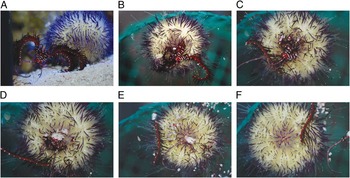
Another set of observations between regular echinoids and feather stars was made in an established Indo-Pacific reef aquarium on exhibit in the Geology Museum, Brigham Young University–Idaho. Individuals of two different feather star species, Himerometra robustipinna (Carpenter, Reference Carpenter1881) and L. palmata, were introduced to the aquarium containing the regular echinoids Diadema setosum (Leske, Reference Leske1778), Eucidaris metularia (Lamarck, Reference Lamarck1816), and Lytechinus variegatus (Lamarck, Reference Lamarck1816); all specimens were obtained through a biological supply company. Within days of being placed together in the tank, all echinoid taxa interacted with the crinoids. In many instances, D. setosum and E. metularia grabbed and began consuming the tips of crinoid arms, but in most cases, the feather stars were able to escape by autotomizing their arms and then either crawling or swimming away. In two separate encounters, Diadema pinned down and consumed two previously injured individuals of L. palmata. The single L. variegatus in the aquarium showed the highest degree of aggression: in less than 1 week, it attacked and consumed the arms of the asteroids Linckia laevigata (Linnaeus, Reference Linnaeus1758) and Linckia multiflora (Lamarck, Reference Lamarck1816), successfully captured and began chewing on the anterior prosoma of a juvenile horseshoe crab, and consumed two feather stars. One of the latter interactions initially observed in an aquarium continued when both individuals were moved to a small tank set up specifically for photography and videography. Once relocated, the echinoid resumed consumption of the crinoid almost immediately and ate nearly all of it over the course of about 8.4 h (Fig. 1). Collectively, these aquarium trials revealed a surprisingly high degree of aggression by regular echinoids toward feather stars. Moreover, they demonstrate that feather stars can successfully evade echinoids via arm autotomy, crawling, and swimming, but that they are not always successful in escaping such attacks.
Photos of a specimen of a regular echinoid, Lytechinus variegatus (Lamarck, Reference Lamarck1816), in various stages of consuming a live feather star, Himerometra robustipinna (Carpenter, Reference Carpenter1881), in an aquarium. A, Photograph taken in the main display tank before the specimens were moved to a smaller aquarium for acquiring a time-lapse video of the interaction. The video captured one image per minute, and the total recorded duration of the interaction was 8.4 h. B–E, photographs taken while time-lapse video was being recorded. Photographs were compared with video to provide approximate times, given in hours and minutes from the beginning of the video: B, 2:10; C, 4:30; D, 5:45; E, 8:20. F. Photograph taken shortly after the time-lapse video ended. The echinoid appeared to be disturbed by a continuous stream of camera flashes and tried to flee. A small fragment of crinoid material can still be observed in its mouth. Note also the small skeletal fragments in images E and F, crinoid material that passed entirely through the echinoid’s digestive system.

Interactions between Echinoids and Live Feather Stars in Nature
Aquarium observations of feather stars and echinoids indicate that the latter find feather stars palatable and that they can successfully prey on them in captivity. While these results do not allow one to conclude that such interactions occur in nature, the hypothesis is worth considering, and echinoid gut content analyses prove useful in this regard. For example, the gut contents of four species of deep-sea echinoids were used to demonstrate that they consume the corals Lophelia pertusa (Linnaeus, Reference Linnaeus1758) and Madrepora oculata Linnaeus, Reference Linnaeus1758 (Stevenson and Rocha Reference Stevenson and Rocha2013). Here, data collected during a multiyear deep-sea study were examined to test whether feather stars are also a likely target of echinoid predation (Stevenson Reference Stevenson2014).
Ten echinoid species (127 specimens in total) ranging in test diameter size between 3 cm and 15 cm were collected during four Northeast Atlantic cruises (BOBECO with the vessel NO Pourquoi pas?; CE10004, CE11006, and CE12006 with the RV Celtic Explorer) in the Bay of Biscay, France, and on the north side of the Porcupine Bank and on the Goban Spur, Ireland (Supplementary Table 1). Echinoids were collected randomly in preselected quadrats spanning coral habitat. Collection took place with the mechanical arm of remotely operated vehicles (ROVs) Victor 6000 and Holland I at depths between 108 m and 2815 m. Specimens were dissected on board the research vessel immediately upon recovery from the ROVs.
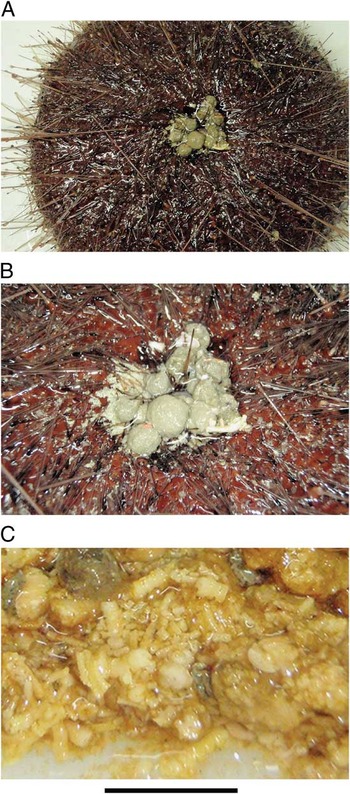
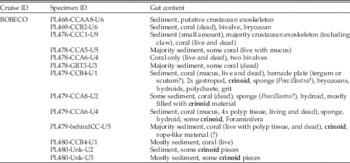
Only one of the 10 species of echinoids, the echinothurid Araeosoma fenestratum (Thomson, Reference Thomson1872), contained crinoid material in the gut (Table 1, Supplementary Table 2). Six of the 13 specimens of A. fenestratum were dissected and found to contain up to 90% recently ingested crinoid skeletal material (Fig. 2). To investigate the gut contents further, the material was macerated in sodium hypochlorite to examine the skeletal structures present.
Gut contents of Araeosoma fenestratum (Thomson, Reference Thomson1872), before (A, B) and after dissection (C). In C, articulated skeletal elements of Koehlermetra porrecta (Carpenter, Reference Carpenter1888) can be seen. Scale bar, 7 cm (A); 3 cm (B); 1 cm (C).

Gut contents of Araeosoma fenestratum (Thomson, Reference Thomson1872) collected in various canyons off the coast of France. Bold type highlights crinoid material found in gut contents.

Comatulid material in the guts of A. fenestratum belonged to a single taxon, Koehlermetra porrecta (Carpenter, Reference Carpenter1888), a member of the family Thalassometridae (Hess and Messing Reference Hess and Messing2011). The most abundant ossicles were brachials, pinnulars, and cirrals, including the very distinct terminal hook-shaped cirrals. The brachials included large proximal ossicles, including axillary plates, and more distal, cuneate brachials with fine, short spines on their proximal margins, a feature that has not been noted in previous descriptions of K. porrecta (e.g., Carpenter Reference Carpenter1888: Plate LII, Figs. 3, 5). Almost all the brachials were recovered as single ossicles, but there were at least two examples of articulated brachials: one with an axillary and two superadjacent brachials, and a second consisting of three articulated cuneate brachials. The pinnulars included small uniserial plates with well-developed facets on their margins for the reception of cover plates. None of the pinnulars were articulated or attached to a brachial, and many of them showed signs of breakage. Cirrals occurred mostly as single ossicles, but articulated ossicles (a maximum of six in a row) were commonly observed among the gut contents. The proximal ends of several portions of the cirri were fragmented. Two broken centrodorsals were also discovered in the guts of A. fenestratum, one of them with an attached radial plate.
Based on the discovery of several uniserial brachials and two columnals, stalked crinoid material was also present in the guts of Araeosoma specimens. The columnals exhibited elliptical articular surfaces with synarthrial articulations; the long axes of the ellipse on each columnal were not parallel to each other, a characteristic of members of the Bourgeticrinina.
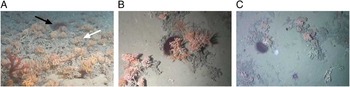
The large amount of feather star material (up to 90%) relative to other contents in the guts of Araeosoma suggests that some individuals ate one or more complete crinoids. The presence of feather star material in the guts of A. fenestratum and its absence in other sampled echinoids suggest that A. fenestratum targeted crinoids rather than randomly ingesting crinoid material in the sediment. Furthermore, the presence of at least two centrodorsals in the guts of A. fenestratum indicates that cirri and arms were not autotomized but rather consumed along with complete feather stars. This interpretation is also consistent with the degree of articulation of the crinoid material found in A. fenestratum. As mentioned earlier, some of the brachials and many of the cirrals were still conjoined, a pattern of articulation unexpected under a scenario of echinoids simply ingesting crinoid debris from sediment (Blyth Cain Reference Blyth Cain1968; Meyer Reference Meyer1971; Liddell Reference Liddell1975; Baumiller Reference Baumiller2003). Video stills obtained from sites where specimens were collected further support the interpretation that A. fenestratum preyed on living feather stars (Fig. 3).
Examples of the echinothuroid Araeosoma fenestratum (Thomson, Reference Thomson1872) in proximity to the feather star Koehlermetra porrecta (Carpenter, Reference Carpenter1888); Bay of Biscay (Guilvinec); 778–941 m. Maximum dimension of A. fenestratum ca. 15 cm. A. fenestratum are the dark ovate forms (one specimen identified by black arrow in A), while K. porrecta are the more numerous tan to orange multi-armed forms (one specimen identified by white arrow in A).

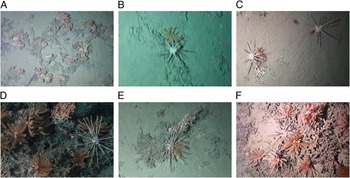
Additional images from the BOBECO expedition show that A. fenestratum is not the only echinoid that interacts directly with feather stars. Several cidarids were observed in the act of consuming feather stars on video (Fig. 4). In spite of convincing photographic evidence, of the 46 cidarids (Cidaris cidaris (Linnaeus, Reference Linnaeus1758)) collected in the Northeast Atlantic, none had feather star material in their guts (Supplementary Table 2). However, the discrepancy between photographic evidence and gut contents may be a consequence of sampling bias. During the BOBECO expedition, cidarids were conveniently located and collected off the living coral infrastructure but were rarely sampled from substrates where feather stars were common. Cidarids found on the coral infrastructure may be exploiting the nutritious, sessile, and/or more easily accessible resource (coral mucus, polyps, etc., of the living infrastructure) rather than expending energy by preying on highly mobile feather stars. However, in the absence of sessile nutrients away from the coral infrastructure, cidarids may resort to crinophagy, as the photographic evidence suggests.
Examples of interactions between the cidarid Cidaris cidaris (Linnaeus, Reference Linnaeus1758) and the feather star Koehlermetra porrecta (Carpenter, Reference Carpenter1888) in the Bay of Biscay. (A, D–F) locality Guilvinec, depth 778–941 m; (B, C) locality Douarnenez-Morgat, depth 697–1195 m. Maximum dimension of the test of C. cidaris ca. 10 cm.

Discussion and Conclusions
This study strongly suggests the existence of predator–prey interactions between regular echinoids and feather stars. Preliminary results suggest that (1) echinoids find feather stars palatable; (2) when confined in aquaria, highly mobile feather stars can be captured and consumed by echinoids; and (3) predation by echinoids on feather stars likely occurs in nature. The last claim is not based on direct observations but rather evidence from the gut contents of deep-sea echinoids and photographs that suggest echinoids eat feather stars; thus it must be considered as circumstantial.
Bathymetry of Interactions
Although this study found that various echinoids will consume reef-dwelling feather stars and are capable of subduing them in aquaria, this does not represent compelling evidence for echinoid predation on feather stars in shallow-water settings today. No observations of such interactions have been reported in spite of decades of in situ research on echinoids and crinoids at scuba-accessible depths. On the other hand, a substantial body of evidence from photographs and gut analyses indicates that crinophagy by echinoids in the deep sea is taxonomically and geographically widespread, involving several stalked and at least one stalkless crinoid prey and a range of echinoid predators in the Antarctic and the east and west Atlantic (Baumiller et al. Reference Baumiller, Mooi and Messing2008; Bowden et al. Reference Bowden, Schiaparelli, Clark and Rickard2011; this study). Moreover, these interactions seen in the deep sea may be quite common based on the number of observations relative to the number of opportunities for gathering such data. Given the bathymetric pattern, it is interesting to speculate as to its causes. The most obvious may be taxonomic: today, stalked crinoids occur only below 100 m, and the only prey feather star known to date, Koehlermetra porrecta, is bathyal (Hess and Messing Reference Hess and Messing2011), so none of these taxa can be subject to predation at shallower depths. The reasons for the taxonomic pattern are likely complex but may be related to the functional morphology and behavior of the prey taxa.
Functional Morphology and Behavior of Crinoid Prey
The known crinoid prey of echinoids today are two or possibly three stalked taxa and one stalkless feather star, Koehlermetra porrecta. Of the stalked taxa, two live anchored permanently to the substrate by a terminal disk or a radix, the hyocrinids (Bowden et al. Reference Bowden, Schiaparelli, Clark and Rickard2011) and the bourgeuticrinids (this study) and thus must be sessile, while isocrinids are known to detach and reattach their distal stalk and have limited mobility (Baumiller et al. Reference Baumiller, Mooi and Messing2008). The functional morphology and behavior of K. porrecta is virtually unknown. While it seems reasonable that sessile crinoids and those having limited mobility may fall prey to slow-moving benthic organisms, the inability of a feather star to escape echinoids seems puzzling. This is especially so given the central role that feather star mobility as a means of predator avoidance has received in evaluating their ecological and evolutionary success (Meyer and Macurda Reference Meyer and Macurda1977; Macurda and Meyer Reference Macurda and Meyer1983; Meyer Reference Meyer1985). Although the ability to locomote is assumed to apply to all feather stars, it has also been recognized that it varies widely. Already in the early twentieth century H. L. Clark (Reference Clark1915: p. 109) pointed this out: “To speak of the methods of locomotion in crinoids, or even in comatulids, is like speaking of locomotion among birds … as birds may either fly or run … so may either commonly swim or creep.” Given the range of mobility, its function as a means of predator avoidance should be evaluated in the context of the predator. For example, swimming bursts of feather stars may be especially effective against slow benthic predators such as echinoids (Shaw and Fontaine Reference Shaw and Fontaine1990) but less so against fishes. Crawling, on the other hand, could facilitate diurnal seclusion and protection of viscera by semicryptic behavior and be effective against fishes but less so against benthic invertebrates. The inability of the feather star K. porrecta to avoid echinoid predation could be due to its limited mobility, perhaps its inability to swim. Unfortunately, a lack of behavioral studies of K. porrecta makes it difficult to evaluate conclusively its locomotory abilities, but some observations and results are relevant in this regard. For example, a recent molecular phylogeny by Rouse et al. (Reference Rouse, Jermiin, Wilson, Eeckhaut, Lanterbecq, Oji, Young, Browning, Cisternas, Helgen and Stuckey2013) suggests that thalassometrids form a clade with comasterids, a famously nonswimming group of feather stars (Clark Reference Clark1915: p. 120), and thus K. porrecta, a thalassometrid, may share this condition with comasterids. The morphology of K. porrecta also supports the nonswimming interpretation. It has ~20 stout arms. Clark (Reference Clark1950) considered it to be the most robust of the thalassometrids, and Janevski and Baumiller (Reference Janevski and Baumiller2010) found that good swimmers, such as the antedonids, generally have 10 gracile arms, while crawlers, such as comasterids, have many arms (>10) with a high width-to-length ratio and, consequently, a greater weight in water.
Paleobiological Implications
The role of biotic interactions in crinoid ecology and evolution has been the subject of many studies, some focusing on Paleozoic taxa (Lane Reference Lane1984; Signor and Brett Reference Signor and Brett1984; Baumiller and Gahn Reference Baumiller and Gahn2003; Sallan et al. Reference Sallan, Kammer, Ausich and Cook2010; Syverson and Baumiller Reference Syverson and Baumiller2014) and others on post-Paleozoic taxa (Meyer and Macurda Reference Meyer and Macurda1977; Meyer Reference Meyer1985; Oji and Okamoto Reference Oji and Okamoto1994; Baumiller et al. Reference Baumiller, Salamon, Gorzelak, Mooi, Messing and Gahn2010; Gorzelak et al. Reference Gorzelak, Salamon and Baumiller2012). Until recently, most of these studies have explored ideas centered on the responses of crinoids to fish predation. Arguably the most widely known studies emphasize the patterns of change in the bathymetric distribution and taxonomic diversity of various crinoid groups over the Mesozoic–Cenozoic eras, specifically in the context of the evolutionary and ecological success of feather stars (Meyer and Macurda Reference Meyer and Macurda1977). Unique among extant crinoids, the feather stars lose their stalk early in ontogeny, and many are known to be highly mobile as adults. Undoubtedly, these traits have ecological consequences, and it is tempting to consider differences between feather stars and stalked crinoids as causal in allowing feather stars to thrive in shallow-marine environments from which stalked crinoids are today excluded. However, recent studies suggest that this scenario is more complex and that the vagile–sessile characterization of feather stars versus non-feather stars represents a broad generalization rather than a dichotomy. First, some extant stalked crinoids are known to crawl (Messing et al. Reference Messing, RoseSmyth, Mailer and Miller1988; Baumiller et al. Reference Baumiller, LaBarbera and Woodley1991: Baumiller and Messing Reference Baumiller and Messing2007), and there is compelling fossil evidence for this behavior at least as far back as the Jurassic (Carvalho et al. Reference Carvalho, Pereira, Klompmaker, Baucon, Moita, Pereira, Machado, Belo, Carvalho and Mergulhão2016). Second, as discussed earlier, the known range of feather star mobility can vary greatly and has been explored only superficially in a very few taxa, so it is possibly quite limited in some feather stars today and may have been quite limited in some extinct feather stars as well. Moreover, viewing mobility solely as providing an advantage (predator avoidance, site selectivity, etc.) is likely an oversimplification, as the trait has been lost evolutionarily several times. This is most clearly illustrated by the Upper Cretaceous to Recent Bourgueticrinina (Hess and Messing Reference Hess and Messing2011), a suborder of the Comatulida that retain their disk or radix-bearing stalk and live a sessile existence as adults and, based on a recent molecular phylogenetic study by Rouse et al. (Reference Rouse, Jermiin, Wilson, Eeckhaut, Lanterbecq, Oji, Young, Browning, Cisternas, Helgen and Stuckey2013), “may indeed be paedomorphic comatulids, perhaps originating several times” (p. 178). Hess and Messing (Reference Hess and Messing2011) suggested that the Jurassic thiolliericrinids represented another example of an evolutionary reversal to a sessile, anchored lifestyle, from a free-living Solanocrinites-like ancestor, through paedomorphosis. The implications of these examples are that the attainment of motility may involve trade-offs and/or costs, for example, metabolic (physiological) or ecological costs, and that in certain contexts it is not evolutionarily favored. Under circumstances in which loss of motility is favored, a sessile condition could be achieved not only by the retention of a juvenile condition, as in bourgueticrinids and thiolliericrinids, but potentially by loss of mobility in a feather star, that is, a taxon lacking an adult stalk. Just as stalked crinoids have been recently shown to locomote, the existence of a sessile feather star is plausible.
Results of this study suggest that a broad range of regular echinoids can consume crinoids, including the most basal post-Paleozoic echinoids, the cidarids (Kroh and Smith Reference Kroh and Smith2010). This indicates that echinoid crinophagy is deeply rooted, and previously reported echinoid-type bite marks from the early Mesozoic (Baumiller et al. Reference Baumiller, Salamon, Gorzelak, Mooi, Messing and Gahn2010) are consistent with that interpretation. If echinoid crinophagy is restricted to the Mesozoic–Cenozoic, it would suggest that it involved the acquisition of a modified feeding apparatus across the Paleozoic–Mesozoic (Miocidaris–cidaroids). Alternatively, the interactions may have already occurred in the Paleozoic and involved more primitive echinoids and crinoids. The fossil record is not very forthcoming when it comes to direct observation of predators catching prey or of gut contents, but a compelling case for a Paleozoic echinoid–crinoid interaction was provided by Schneider (Reference Schneider2008), who described what may be the stomach contents of a Pennsylvanian Archaeocidaris from Texas containing articulated and disarticulated crinoid cirrals.
As far as the history of interactions between feather stars and echinoids is concerned, no fossil evidence is currently available. In spite of a history that extends ~200 Myr (Hess Reference Hess2014a), feather stars are rare fossils: only 39 fossil genera appear in the Treatise on Invertebrate Paleontology compared with 143 extant genera (Hess and Messing Reference Hess and Messing2011), and their remains have been described from fewer than 100 localities listed in the Paleobiology Database (downloaded on 1 June 2016 using the name “Comatulida” and removing stalked forms, bourgueticrinids, and thiolliericrinids). Also, in this study no diagnostic bite marks were observed on feather star elements consumed by sea urchins. In contrast, distinct echinoid bite marks have been found on stalked crinoid elements in the Recent (Baumiller et al. Reference Baumiller, Mooi and Messing2008), making it possible to search for evidence of the interaction in the fossil record (Baumiller et al. Reference Baumiller, Salamon, Gorzelak, Mooi, Messing and Gahn2010; Hess Reference Hess2014b). Arguably the clearest fossil examples of echinoid predation on live crinoids are articulated cup and brachials of the robustly stalked Jurassic Apiocrinites roissyanus (D’Orbigny, Reference D’Orbigny1841) (Figs. 2, 3; Hess Reference Hess2014b) showing scratches that have been presumed to be made by the echinothurioid Pelanechinus corallina (Wright, 1858) (Fig. 1; Hess Reference Hess2014b). Given the above, lack of fossil evidence of echinoid predation on feather stars is not unexpected and should not be taken as evidence of absence of the phenomenon in the geologic past.
Acknowledgments
Many thanks to the pilots of ROV Holland I and ROV Victor 6000, captain and crew of the NO Pourquoi Pas? for a safe voyage and for their support in seagoing operations. Thanks are also due to chief scientist Dr. Sophie Arnaud-Haond (NO Pourquoi Pas?, BOBECO cruise 2011), for successfully organizing and facilitating our work during the cruise. Thanks to Lori Colin, Pat Colin, and the staff of the Coral Reef Research Foundation, Koror, Palau, and the staff of the Geology Museum, Brigham Young University–Idaho. We thank Carol Abraczinskas for help with the figures. Rich Mooi and an anonymous reviewer provided thorough and insightful comments. A.S. was partly funded by the Explorers Club 2011 Exploration Award and IRC Embark postgraduate scholarship. T.K.B. was partly funded by the National Science Foundation (EAR 0824793; DEB 1036393) and the National Geographic Society (NGS 8505-08).
Supplementary Materials
To view supplementary material for this article, please visit: https://doi.org/10.1017/pab.2016.39
Data available from the Dryad Digital Repository: http://dx.doi.org/10.5061/dryad.6gj58