Implications
There are important implications for the investigation of cytochrome P450 (CYP) 3A substrates in pigs and salmon. The pig is valuable as an animal model in biomedical research. In fish, studies of CYP450 isoforms and its regulation by pharmaceuticals, including ketoconazole (KTZ), are essential from the perspective of environmental safety. Our study evaluated in vitro metabolism of three marker substrates for CYP3A activity in microsomes from pigs and Atlantic salmon. We demonstrated that KTZ inhibited all tested substrates in both species. Differences in the activity of CYP3A between male and female pigs imply intra-species variations in CYP3A regulation. Our findings suggest that in the development of assays to estimate enzyme activity, both inter- and intra-species variations must be considered.
Introduction
Cytochrome P450 3A (CYP3A) isoforms are involved in the hepatic metabolism of a number of exogenous and endogenous compounds. Since CYP3A isoforms metabolize many commercial therapeutic drugs, the substrates for CYP3A are well studied in humans (Abadie-Viollon et al., Reference Abadie-Viollon, Martin, Blanchard, Pekthong, Bachellier, Mantion, Heyd, Schuler, Coassolo, Alexandre and Richert2010; Hosomi et al., Reference Hosomi, Akai, Minami, Yoshikawa, Fukami, Nakajima and Yokoi2010). In mammals, substrates with varying degrees of selectivity are used in assays to estimate CYP3A activity, including testosterone, 7-benzyloxyresorufin (BR), 7-benzyloxy-4-trifluoromethylcoumarin (BFC) and 7-benzyloxyquinoline (BQ). However, little information is available on the metabolism of these substrates in porcine liver microsomes and even less in fish. In this study, we used two vertebrate models, pig and Atlantic salmon (Salmo salar), to further characterize the kinetic parameters of CYP3A-mediated reactions.
Various inhibitors of CYP3A activity have been described (Dresser et al., Reference Dresser, Spence and Bailey2000), some of which are highly selective, whereas others are less so. Ketoconazole (KTZ) is a well-known inhibitor of CYP3A isoforms in humans (Venkatakrishnan et al., Reference Venkatakrishnan, von Moltke and Greenblatt2000). However, its specificity is not limited to CYP3A, as it also inhibits various enzymes of the CYP system. KTZ affects CYP51, which is the target of antifungal azoles (Lamb et al., Reference Lamb, Kelly, Waterman, Stromstedt, Rozman and Kelly1999). CYP51 is one of the most conserved CYP450s and therefore, not surprisingly, KTZ also inhibits CYP51 in other species. It has been shown that KTZ is also able to inhibit the activity of CYP11, CYP17 and CYP19 (Weber et al., Reference Weber, Wil, Adelmann and Engelhardt1991) as well as the activity of 3-beta-hydroxysteroid dehydrogenase/isomerase in human ovaries (Di Mattina et al., Reference Di Mattina, Maronian, Ashby, Loriaux and Albertson1988). The specificity of KTZ in pigs and fish has been less characterized. Such studies on pigs are important because of its value as an animal model in biomedical research (Puccinelli et al., Reference Puccinelli, Gervasi and Longo2011). In fish, studies of KTZ and its potential to modify CYP450 are essential from the perspective of environmental safety. Pollution of the aquatic environment by pharmaceuticals, including azoles, is an area of growing concern. It is known that KTZ modifies in vivo expression and activity of CYP1A and CYP3A in rainbow trout (Hegelund et al., Reference Hegelund, Ottosson, Rådinger, Tomberg and Celander2004) and in juvenile Atlantic cod (Hasselberg et al., Reference Hasselberg, Grøsvik, Goksøyr and Celander2005). Less is known about the in vitro effect of KTZ on marker substrates of CYP3A and CYP1A in microsomes from Atlantic salmon.
The goal of the current study was to evaluate the effect of KTZ on BR and 7-ethoxyresorufin (ER) O-dealkylation (EROD), BFC O-debenzylation (BFCOD) and BQ O-debenzylation (BQOD) in microsomes from pigs and Atlantic salmon. To the best of our knowledge, this is the first study using pigs and Atlantic salmon to compare three fluorescent CYP3A substrates.
Material and methods
Chemicals
Resorufin, BR, ER, BQ, BFC, 7-hydroxy-7-benzyloxy-triflouromethylcoumarine (HFC), KTZ and NADPH were purchased from Sigma-Aldrich (Steinheim, Germany). Hydroxyquinoline (HQ) was purchased from Acros (Geel, Belgium). Acetonitrile and methanol of HPLC grade were purchased from Merck (Darmstadt, Germany). KTZ and HQ were dissolved in methanol and ethanol, respectively, and ER, BR, BFC and BQ were dissolved in dimethyl sulfoxide (DMSO). The DMSO concentrations were 0.4% to 0.8% in incubation volumes of 500 μl. These concentrations do not affect enzyme activity (Hickman et al., Reference Hickman, Wang, Wang and Unadkat1998). A stock solution of 1 mM HFC was prepared in 0.5 M potassium phosphate buffer (pH 7.4).
Animals, sample collection and preparation of liver microsomes
Entire (uncastrated) male and female pigs were born and reared at the Swedish University of Agricultural Sciences Funbo-Lövsta experimental station. The pigs were slaughtered at a live weight of 115 kg. Atlantic salmon of approximately 1300 g (NIVAs Research Station, Drøbak, Norway) were kept in seawater at 10°C and fed on a commercial diet before sampling. Liver samples collected from six pigs (three males and three females) and four fish (one male and three females) were immediately frozen in liquid nitrogen and stored at −80°C until used for microsome preparation. The microsomal fraction was prepared by differential centrifugation as described by Rasmussen et al. (Reference Rasmussen, Ekstrand and Zamaratskaia2011). The microsomal protein concentrations were assayed using a commercially available kit (Bio-Rad laboratories Inc., Hercules, CA, USA) according to the manufacturer's instructions, using bovine serum albumin as a standard. The care of the experimental animals for this study was approved by the Local Animal Ethics Committee in Tierp, Sweden.
Instrumentation and chromatographic conditions
The HPLC system consisted of a pumping system (L-6200A), autosampler (AS 2000) and D-6000 HPLC Manager software (Merck, Hitachi, Tokyo, Japan). The compounds were detected using a fluorescence detector (L-7480). The detection wavelengths were 410 and 538 nm (excitation and emission) for HFC and HQ and 560 and 586 nm (excitation and emission) for resorufin. The samples (5 μl for BR, ER and BFC metabolism and 10 μl for BQ metabolism) were injected onto a Hypersil ODS column (5 μm, 60 × 4.6 mm, Hewlett–Packard, Palo Alto, CA, USA) equipped with a guard column. The mobile phase was 20 mM phosphate buffer (pH 6.8), methanol and acetonitrile (52 : 45 : 3, v/v) at a flow rate of 0.8 ml/min. Under these chromatographic conditions, HCF was eluted at 3.7 min and HQ at 2.2 min. The total run time was 10 min for HCF and 5 min for HQ. The details for resorufin measurements are given elsewhere (Zamaratskaia and Zlabek, Reference Zamaratskaia and Zlabek2009).
Calibration curves
Known amounts of resorufin, HFC and HQ were added to the mixture of buffer–methanol (1 : 1). Replicate injections were made for each sample. The linear concentration range was 2 to 2000 pmol/ml for HFC and 0.2 to 20 nmol/ml for BQ. The limit of quantification for resorufin, HFC and HQ was defined as the lowest concentration in a sample that can be determined with acceptable precision (below 15%) under the stated experimental conditions.
Catalytic activity
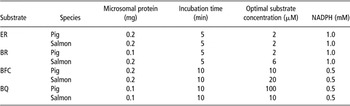
The activities of BR O-dealkylase (BROD), BFCOD and BQOD were estimated in porcine and salmon microsomes. The assay settings (substrate, protein content, incubation time and NADPH) are presented in Table 1. Subsequently, ER hydroxylase (EROD) activity was determined according to previously published methods (Zamaratskaia and Zlabek, Reference Zamaratskaia and Zlabek2009). All assays were conducted using 0.5 M potassium phosphate buffer (pH 7.4), and all reactions were initiated by the addition of 0.5 or 1.0 mM NADPH. The reaction mixture, in a final volume of 500 μl, was incubated in a water bath at 37°C for porcine microsomes and at 25°C for salmon microsomes. Reactions were terminated with ice-cold 100% methanol (500 μl), followed by centrifugation at 7500 × g for 5 min. For the incubations with KTZ (added in a volume of 2 μl), the volume of buffer was adjusted so that the final incubation volume remained at 500 μl. Reaction velocities were expressed as pmol of formed metabolite per min per mg of microsomal protein. Before analyses, all microsomal assays were optimized to control the limiting factors and maximize the metabolic biotransformation of the substrates.
Assay conditions for cytochrome P450 activity in porcine and Atlantic salmon liver microsomes

NADPH = nicotinamide adenine dinucleotide phosphate; ER = 7-ethoxyresorufin; BR = 7-benzyloxyresorufin; BFC = 7-benzyloxy-4-trifluoromethylcoumarin; BQ = 7-benzyloxyquinoline.
Linearity of metabolite formation and intra-assay variations
For the measure of linearity with respect to incubation time and protein content, three pools of microsomes were used: one of microsomes from three male pigs, one from three female pigs and a third pool of microsomes from the four fish. Linearity of metabolite formation from 4 μM of BR, 60 μM of BFC and 60 μM of BQ was determined using an incubation time of 5 to 30 min and protein content from 0.05 to 0.6 mg. Incubation temperatures, 37°C for porcine microsomes and 25°C for salmon microsomes, were maintained constant. For intra-assay variations, the relative standard deviation (%) was calculated from six or seven repeat measurements on the pools of porcine and salmon microsomes within a single day, with varying rates of metabolite formation, low and high. To assess inter-assay variations, measurements were performed on 5 or 6 different days. The microsomes for inter-assay variations were divided into small aliquots and stored at −80°C to avoid the effect of freezing/thawing on enzymatic activity. The intra-assay variations were as follows: BROD, 2.2% to 4.3%; BQ, 1.4% to 14.5% and BFC, 9.4% to 12.9%. The inter-assay variations ranged from 1.4% to 14.5%. The highest variations were observed in the microsomes from salmon. Analyses for each substrate were performed over the course of 1 or 2 days.
Enzyme kinetic analysis and inhibition constants
The studies were performed using three pools of microsomes from three male pigs (pool 1), three female pigs (pool 2) and four fish (pool 3, three males and one female). Potential gender-related differences were evaluated only in pigs. A comparison of male and female fish was not possible because of the limited number of samples. For kinetic studies, BROD activity was determined at substrate concentrations ranging from 0.05 to 6.0 μM for porcine microsomes and from 0.05 to 12 μM for salmon microsomes. BFCOD activity was determined at substrate concentrations ranging from 0.1 to 150 μM and BQOD activity from 1 to 150 μM in both porcine and salmon microsomes. EROD activity was determined at a substrate range from 0.1 to 3 μM in both porcine and salmon microsomes. In the studies of EROD, the pool consisted of microsomes from both males and females due to a limited number of samples. Kinetic studies were performed under linear conditions. Varying concentrations of KTZ in methanol solution, yielding final concentrations 1, 10 and 40 μM in the incubation mixture, were added to the incubation tubes. In the control incubations, methanol was added at the same volume (2 μl). The KTZ concentrations tested were selected based on results from our preliminary experiment. Incubations in this experiment included a single concentration of the substrate close to the K m value along with KTZ concentrations of 1, 2, 10, 15, 20, 40 and 100 μM. For the following analysis, we selected KTZ concentrations that resulted in approximately 80% remaining activity (1 μM KTZ), 50% remaining activity (10 μM KTZ) and 20% remaining activity (40 μM KTZ). The incubation mixtures were processed as described above. All assays were run in duplicate.
Michaelis–Menten parameters (K m and V max values), the kinetics pattern of metabolic inhibition (competitive and non-competitive) and inhibition constants (K i) were determined using GraphPad Prism Version 4.0 for Windows, GraphPad Software (San Diego, California, USA). For comparison, the data were also fitted to an allosteric regulation model equation. The choice of the best-fit enzyme model was based on a statistical analysis (F-test) to determine the difference between the sums of squares of the two models. The differences were considered significant at P < 0.05.
Comparison of the K m and V max values of male and female pigs was performed using an unpaired t-test with Welch's correction. The differences were considered significant at P < 0.05.
Results and discussion
Quantitation limits, linearity with incubation time and protein content
The limits of quantification were 0.5 pmol/ml for resorufin (Zamaratskaia and Zlabek, Reference Zamaratskaia and Zlabek2009), 2.0 pmol/ml for HFC and 0.2 nmol/ml for HQ. Linearity of resorufin formation from BR in porcine and fish microsomes was demonstrated up to a 15-min incubation time and 0.2 mg microsomal protein. Microsomal protein of 0.1 mg and an incubation time of 5 min were selected for the subsequent analysis of porcine microsomes and 0.2 mg and 5 min for the analysis of salmon microsomes. Product formation from BFC was linear up to a 20-min incubation time and 0.3 mg protein in porcine microsomes and up to a 15-min incubation time and 0.5 mg protein in salmon microsomes. Microsomal protein of 0.2 mg and incubation time of 10 min were selected for the subsequent analysis. The production of BQ metabolite HQ was linear up to a 15-min incubation time and 0.3 mg protein in porcine microsomes and up to a 20-min incubation time and 0.2 mg protein in salmon microsomes. Microsomal protein of 0.1 mg and an incubation time of 10 min were selected for the subsequent analysis.
It should be noted that in this study, the substrates ER, BR, BFC and BQ were dissolved in DMSO. It is known that organic solvents might alter the activity of CYP450s. Studies investigating the effect of DMSO on the microsomal incubations on CYP450 have demonstrated conflicting results. Easterbrook et al. (Reference Easterbrook, Lu, Sakai and Li2001) showed that DMSO (at 1% and higher) may not be appropriate for substrates of CYP3A4 in human hepatocytes, whereas Hickman et al. (Reference Hickman, Wang, Wang and Unadkat1998) found no effect of DMSO (1%) on CYP3A4 activity in microsomes. The DMSO concentrations in our study did not exceed 0.8% in the incubations. The comparison of DMSO with other solvents was not performed because neither acetonitrile nor methanol could dissolve BFC.
Kinetic analysis
Kinetic analysis demonstrated that data of BROD, BFCOD and BQOD were best described by the single enzyme Michaelis–Menten equation in both pigs and salmon. This finding is surprising because studies using mammals (Stresser et al., Reference Stresser, Turner, Blanchard, Miller and Crespi2002) and the medaka suggested that BFCOD followed an allosteric-type kinetic (Kullman et al., Reference Kullman, Kashiwada and Hinton2004). In our study, BFCOD kinetics in microsomes from both male and female pigs showed a slight tendency to follow the allosteric regulation model (P = 0.08).
Inhibition pattern
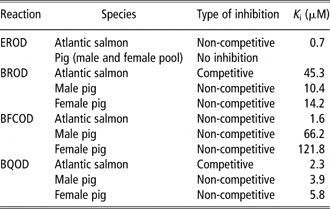
In vitro inhibition of CYP3A activity by KTZ is well known. Inhibition of CYP3A activity by KTZ has been variously reported as non-competitive or competitive (reviewed by Greenblatt et al., Reference Greenblatt, Venkatakrishnan, Harmatz, Parent and von Moltke2010). The differences between the reported mechanisms of inhibition can be mainly attributed to the differences in the substrates used. To examine this issue with regard to porcine and salmon microsomes, we evaluated the patterns of BROD, BFCOD and BQOD activities in the presence of KTZ. Inhibition constants and type are given in Table 2.
Inhibition parameters of EROD, BROD, BFCOD and BQOD by ketoconazole in microsomes from pigs and Atlantic salmon

EROD = 7-ethoxyresorufin O-dealkylation; BROD = 7-benzyloxyresorufin O-dealkylation; BFCOD = 7-benzyloxy-4-trifluoromethylcoumarin O-debenzylation; BQOD = 7-benzyloxyquinoline O-debenzylation; K i = inhibition constants.
Inhibition of alkoxyresorufin O-dealkylase activity (BROD and EROD)
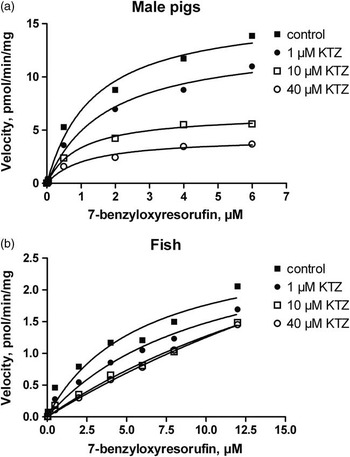
BROD activity was markedly decreased by KTZ in porcine microsomes in a non-competitive manner (Figure 1). Measurement of BROD was recently demonstrated to be a specific marker to estimate CYP3A activity in mouse hepatic microsomes (Hagemeyer et al., Reference Hagemeyer, Bürck, Schwab, Knoth and Meyer2010). In human liver microsomes, BROD activity is also related to CYP3A but with a lesser degree of specificity, since it may also be catalyzed by CYP1A2 and CYP2A6 (Burke et al., Reference Burke, Thompson, Weaver, Wolf and Mayers1994). CYPs isoform(s) responsible for metabolic biotransformations of BR in salmon are currently unknown.
Michaelis–Menten kinetics of 7-benzoxyresorufin O-dealkylation with or without ketoconazole (KTZ) in microsomes from male pigs (a) and Atlantic salmon (b).

In salmon microsomes, BROD activity was also inhibited by KTZ, but the competitive mode of inhibition differed from that of porcine microsomes. Additionally, KTZ showed higher potency in inhibiting BROD in porcine microsomes compared with salmon microsomes. In the presence of 40 μM of KTZ, BROD activity in porcine microsomes was reduced to 28 ± 1.5% and in salmon microsomes, it was reduced to 44 ± 17.7% over a substrate range of 0.5 to 6 μM.
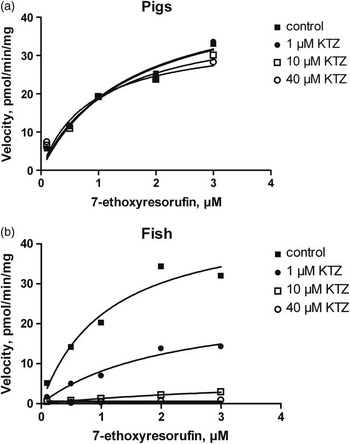
EROD activity was not altered by the presence of KTZ in the incubations of porcine microsomes (Figure 2). This is expected, given that there is no published evidence that ER is metabolized by CYP3A in pigs. Therefore, the lack of inhibition of EROD activity by KTZ in pigs is in accordance with other studies in mammals showing that KTZ inhibits CYP3A but not CYP1A. EROD is believed to be a marker of CYP1A activity in many species, including pigs (Kojima et al., Reference Kojima, Sekimoto and Degawa2008; Zamaratskaia and Zlabek, Reference Zamaratskaia and Zlabek2009) and fish (Förlin and Celander, Reference Förlin and Celander1993; Van der Oost et al., Reference Van der Oost, Beyer and Vermeulen2003; Schlenk et al., Reference Schlenk, Celander, Gallagher, George, James, Kullman, Van den Hurk and Willett2008). However, EROD activity decreased markedly in our incubations with salmon microsomes. The measurement of EROD activity in fish is particularly important, because EROD induction is often used as a biomarker of contaminant exposure (Van der Oost et al., Reference Van der Oost, Beyer and Vermeulen2003; Havelkova et al., Reference Havelkova, Randak, Zlabek, Krijt, Kroupova, Pulkrabova and Svobodova2007; Schlenk et al., Reference Schlenk, Celander, Gallagher, George, James, Kullman, Van den Hurk and Willett2008). This stresses the importance of detailed studies of EROD and its response in vitro and in vivo to various chemicals.
Michaelis–Menten kinetics of 7-ethoxyresorufin O-dealkylation with or without ketoconazole (KTZ) in pooled microsomes from male and female pigs (a) and Atlantic salmon (b).

An inhibition of EROD activity by KTZ was previously observed in hepatic microsomes from rainbow trout (Hegelund et al., Reference Hegelund, Ottosson, Rådinger, Tomberg and Celander2004) and in gill filaments from stickleback (Beijer et al., Reference Beijer, Abrahamson, Brunström and Brandt2010). In the same study, using the same species, a biphasic effect of KTZ on EROD activity was observed in cultured hepatocytes. However, in a study by Hegelund et al. (Reference Hegelund, Ottosson, Rådinger, Tomberg and Celander2004), the mode of inhibition of EROD by KTZ could not be estimated. Our present results showed that KTZ inhibited EROD activity in a non-competitive manner with K i of 0.7 μM.
Inhibition of BFCOD
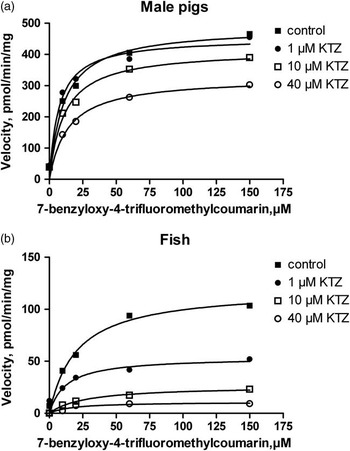
BFCOD activity is used as a marker of CYP3A in humans (Renwick et al., Reference Renwick, Surry, Price, Lake and Evans2000; Appiah-Opong et al., Reference Appiah-Opong, Commandeur, van Vugt-Lussenburg and Vermeulen2007) and pigs (Nannelli et al., Reference Nannelli, Chirulli, Longo and Gervasi2008), although some studies have used BFC as a marker of CYP1A/2B in humans and rats (Price et al., Reference Price, Giddings, Scott, Walters, Capen, Osimitz and Lake2008). In fish, BFC is believed to be the specific substrate for CYP3A (Christen et al., Reference Christen, Oggier and Fent2009). Our study showed that BFCOD activity was inhibited by KTZ in a non-competitive manner in salmon (Figure 3). This is in agreement with the results from in vitro inhibition studies using liver microsomes from Atlantic cod, where a non-competitive inhibition of BFCOD activity by KTZ was observed (Hasselberg et al., Reference Hasselberg, Grøsvik, Goksøyr and Celander2005). In porcine microsomes, the inhibition mode was non-competitive, with the K i value being twofold higher in the microsomes from female pigs (66.2 and 121.8 μM for male and female pigs, respectively). This indicates that in male pigs, KTZ binds to the enzyme with higher affinity compared with that in female pigs. The gender-related difference in the inhibition potency of KTZ with respect to BFCOD activity has not been shown before. The underlying mechanism for this difference should be elucidated in further studies. However, the results should be interpreted with caution because the K i values of 66.2 and 121.8 μM appeared to be greater than the highest inhibitor concentration used. Because of the limited amount of material, we could not repeat the experiment using higher concentrations of KTZ in the incubations. In salmon microsomes, BFCOD was inhibited, yielding a lower K i value of 1.6 μM, indicating that KTZ is a more potent inhibitor of BFCOD and binds to the BFC-metabolizing enzyme with higher affinity in salmon than in pigs.
Michaelis–Menten kinetics of 7-benzyloxy-4-trifluoromethylcoumarin O-debenzylation with or without ketoconazole (KTZ) in microsomes from male pigs (a) and Atlantic salmon (b).

Inhibition of BQOD
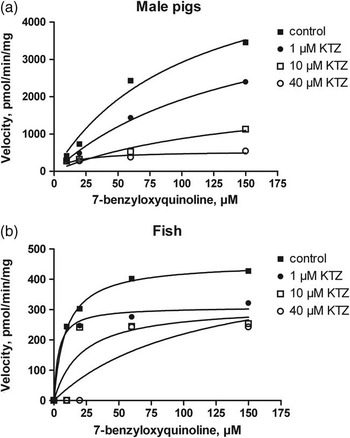
BQOD is another reaction used as a marker of CYP3A in various species including pig (Nannelli et al., Reference Nannelli, Chirulli, Longo and Gervasi2008), rat, rabbit (Chirulli et al., Reference Chirulli, Longo, Marini, Mazzaccaro, Fiorio and Gervasi2005) and fish (Smith and Wilson, Reference Smith and Wilson2010). In this study, KTZ was shown to be a competitive inhibitor of BQOD activity in salmon (Figure 4). Similar to BFCOD, the inhibition mode of BQOD was non-competitive in microsomes from male and female pigs.
Michaelis–Menten kinetics of 7-benzyloxyquinoline O-debenzylation with or without ketoconazole (KTZ) in microsomes from male pigs (a) and Atlantic salmon (b).

Generally, attempts to evaluate the mechanism of in vitro inhibition of CYP3A by KTZ have led to inconsistent results (reviewed by Greenblatt et al., Reference Greenblatt, Venkatakrishnan, Harmatz, Parent and von Moltke2010). This inconsistency is likely due to variable incubation parameters and the different substrates used. Additionally, the inhibition mechanism may vary among species. To the best of our knowledge, differences within species in the potency of inhibition by KTZ have not been previously reported.
Sex-related differences in porcine microsomes
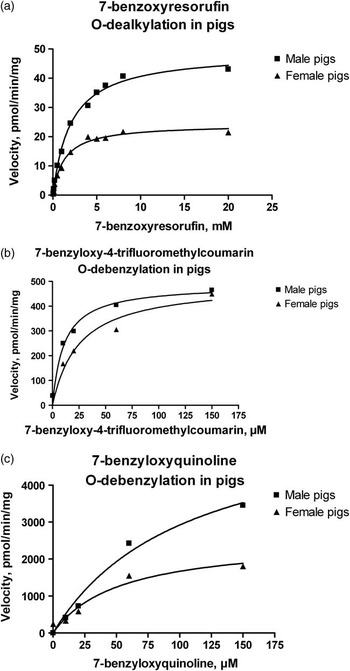
Sex-related differences in toxicity, especially in the responses to xenobiotics, have been extensively studied in recent years. Pigs are known to exhibit considerable sex-related variation in the activity of individual CYP450 isoforms (Skaanild and Friis, Reference Skaanild and Friis1999; Zamaratskaia et al., Reference Zamaratskaia, Chen and Lundström2006; Kojima et al., Reference Kojima, Sekimoto and Degawa2008). The differences in CYP activity exist not only between male and female pigs but also between entire and castrated male pigs (Zamaratskaia et al., Reference Zamaratskaia, Zlabek, Chen and Madej2009). CYP3A activity, estimated as the rate of nifedipine 6-hydroxylation, has been shown to be higher in surgically castrated pigs compared with entire male pigs (Gillberg et al., Reference Gillberg, Skaanild and Friis2006). This finding might have important implications in research on the metabolism of natural toxins and other small molecules, for example, of the boar taint compound skatole (Zamaratskaia and Squires, Reference Zamaratskaia and Squires2009). This study indicated that CYP3A activity differed between male and female pigs when estimated by BROD and BQOD (Figure 5). Apparent K m and V max values of BROD, BFCOD and BQOD in the microsomes from male and female pigs are presented in Table 3. Both K m and V max values for BROD were higher in male pigs compared with female pigs. The K m value for BQOD did not differ between male and female pigs, whereas V max was higher in male pigs. These sex-related differences might reflect sex-dependent expression of hepatic CYP3A. Kinetic parameters for BFCOD were similar in the microsomes from male and female pigs.
Sex-related differences in Michaelis–Menten kinetics of 7-benzoxyresorufin O-dealkylation, 7-benzyloxy-4-trifluoromethylcoumarin O-debenzylation and 7-benzyloxyquinoline O-debenzylation in the porcine microsomes.

Kinetic parameters (K m and V max) of BROD, BFCOD and BQOD in hepatic microsomes from male and female pigs

BROD = 7-benzyloxyresorufin O-dealkylation; BFCOD = 7-benzyloxy-4-trifluoromethylcoumarin O-debenzylation; BQOD = 7-benzyloxyquinoline O-debenzylation; s.e. = standard error.
The kinetic parameters (mean ± s.e.) were determined using GraphPad Prism Program 4.0.
Comparison of K m and V max values between male and female pigs was performed using an unpaired t-test with Welch's correction.
Our study had some potential limitations. First, CYP1A and CYP3A protein levels were not measured, and therefore, it is not possible to correlate protein levels with enzyme activity. Second, the substrates used were not specific for a single CYP450 isoform. Indeed, CYP3A is an enzyme with unusually broad substrate specificity, and thus far, no CYP3A-specific substrate has been identified. Another limitation is the use of liver microsomes alone to estimate enzyme activity, where several CYP450 isoforms were present and potential interference among them was not controlled for. Ideally, several in vitro models including both microsomes and pure enzymes should be used in such studies. Nevertheless, our in vitro approach provided important novel information on the behavior of mammalian CYP3A substrates in hepatic microsomes from pigs and Atlantic salmon. Our results also identified new avenues for investigating the complex mechanisms regulating CYP3A-mediated reactions.
Future studies are needed to address even members of the CYP2 family such as CYP2K (dominant CYP450 forms in fish liver microsomes), CYP2C, CYP2D and CYP2E (important isoforms in mammals). These studies should include analysis of both the protein level and the enzymatic activity of selected isoforms.
This study yielded several important findings. First, we reported, validated and optimized assays of three fluorescent CYP3A substrates in pigs and salmon. Second, we demonstrated inter-species variations and sex-related differences (in pigs) in kinetics and response to the inhibitor KTZ of CYP3A- (BROD, BFCOD and BQOD) and CYP1A- (EROD) mediated reactions. Further studies are needed to elucidate the mechanism responsible for these differences.
Conclusions
Our study demonstrated inter-species differences in in vitro response of EROD, BROD and BQOD to the inhibitor KTZ. KTZ was a potent non-competitive inhibitor of BROD and BQOD activity in microsomes from pigs, whereas, in Atlantic salmon microsomes, the metabolism of those substrates was competitively inhibited by KTZ. BFCOD activity was inhibited by KTZ in a non-competitive manner in both pigs and Atlantic salmon. Additionally, KTZ non-competitively inhibited EROD activity in Atlantic salmon microsomes, whereas no inhibition of EROD activity by KTZ was observed in porcine microsomes. BROD and BQOD activity differed between male and female pigs, being higher in male pigs. No sex-related differences in BFCOD activity were observed in pigs.
Acknowledgments
This study was funded by The Swedish Board of Agriculture, The Swedish Research Council, FORMAS 222-2004-2745 and partly by CENAKVA CZ.1.05/2.1.00/01.0024, Grant agency of USB GAJU 047/2010/Z and SP/2e7/229/07. The authors thank the staff at Lövsta Research Station involved in raising the pigs and Dr Sofia Trattner for salmon sampling.