According to the Global Cancer Statistics 2018, oral and pharyngeal cancers rank as the seventh most common cancers worldwide, whereas oesophageal cancer is the eighth most common cancer(Reference Chow1,Reference Uhlenhopp, Then and Sunkara2) . The incidence of these cancers is on the rise and is projected to increase by 30 % for oral and pharyngeal cancers and by 35 % for oesophageal cancer, by 2030(Reference Uhlenhopp, Then and Sunkara2,Reference Johnson, Burtness and Leemans3) . In Japan, the incidence of oral and pharyngeal cancers in males has been reported to be two to three times higher than the global average(Reference Bray, Ferlay and Soerjomataram4,5) and has increased by 44 %, from 6·1 per 100 000 individuals in 2000 to 8·8 per 100 000 individuals in 2015(Reference Hori, Matsuda and Shibata6). A similar trend has been observed in oesophageal cancer(Reference Uhlenhopp, Then and Sunkara2). The major risk factors for oral, pharyngeal and oesophageal cancers are cigarette smoking, alcohol consumption and infections such as human papillomavirus(Reference Chow1,Reference Uhlenhopp, Then and Sunkara2) .
The oral cavity, pharynx and oesophagus are parts of the digestive tract that extend into the stomach. Their surfaces are lined with the mucosal epithelium of non-keratogenic stratified squamous cells, and approximately 90 % of cancers in these organs are squamous cell carcinomas(Reference Uhlenhopp, Then and Sunkara2,Reference Johnson, Burtness and Leemans3,7) . These similarities suggest that oral, pharyngeal and oesophageal cancers share common dietary risk factors, such as a high consumption of salt, red meat and processed meat and a low consumption of vitamin C(Reference Rodríguez-Molinero, Migueláñez-Medrán and Puente-Gutiérrez8–Reference Qin, Jia and Zhou10). The underlying mechanism for the association between high-salt consumption and the risk of oral and oesophageal cancers is likely an inflammatory response induced by high-salt concentrations(Reference Müller, Wilck and Haase11,Reference Herrin, Rubright and Squier12) . Chronic inflammation leads to elevated levels of chemical mediators, such as TNF-α and transforming growth factor β, which cause oxidative stress, DNA damage and subsequent squamous cell carcinoma(Reference Kawanishi, Ohnishi and Ma13,Reference Coussens and Werb14) .
According to a meta-analysis of sixteen case–control studies and two cohort studies, salt or salted food consumption is positively associated with the risk of oesophageal cancer(Reference Banda, Chiu and Hu15). However, these two cohort studies did not show any significant associations(Reference Murata, Fujino and Pham16,Reference Li, Park and Wu17) . No cohort study has definitively reported an association between salt or high-salt food consumption and the risk of oral or pharyngeal cancer. Furthermore, only one case–control study(Reference Jessri, Rashidkhani and Hajizadeh18) has examined the dose–response relationship between salt consumption and estimated the risk of oesophageal cancer using a validated food frequency questionnaire.
Herein, we examined the dose–response relationships between salt and high-salt food consumption and the risk of oral, pharyngeal and oesophageal cancers in a large prospective cohort study of middle-aged Japanese individuals.
Experimental methods
Study cohort
The Japan Collaborative Cohort Study for the Evaluation of Cancer Risk (JACC Study) is a large nationwide community-based prospective study conducted using a baseline survey from 1988 to 1990 across forty-five administrative districts in Japan. A total of 110 585 participants (46 395 men and 64 190 women) aged 40–79 years completed self-administered questionnaires on lifestyle and medical histories related to cancer and CVD. The details of this study have been described previously(Reference Tamakoshi, Ozasa and Fujino19,Reference Date, Fukui and Yamamoto20) . Using the population-based cancer registry, follow-up for cancer incidence was conducted in twenty-four areas until the end of 2009 in four areas: 2008 in two areas, 2006 in two areas, 2003 in one area, 2002 in eight areas, 2000 in one area, 1999 in one area, 1997 in four areas and 1994 in one area.
Of the initial 110585 participants, we excluded 50158 individuals from three areas where the dietary questionnaire survey regarding salt consumption was not conducted and twenty-one areas where surveillance for cancer incidence was not conducted. Of the remaining 60 427 participants, 43 215 provided valid responses to the dietary questionnaire and were enrolled in the study. Finally, 680 additional participants with a history of cancer were excluded, and 42 535 participants were included in the analysis.
This study was conducted according to the guidelines laid down in the Declaration of The Ethical Board of Hokkaido University (approval number 14–044) and Osaka University (approval number 14285) approved the Helsinki Declaration and all procedures involving human subjects. Individual informed consent was obtained from thirty-six of the forty-five study areas (written consent in thirty-five and oral consent in one area), and group consent from the area leader was obtained from the remaining nine areas.
Cancer assessment and follow-up
Of the twenty-four survey areas for cancer incidence, ten were combined because of their geological similarities. Cancer incidence was determined using population-based cancer registries, supported by a systematic review of hospital-based cancer registries in eleven areas and direct hospital-based cancer registries in the remaining four areas. The mortality-to-incidence ratios were 0·31 to 0·61 in males and 0·15 to 0·53 in females, based on population-based cancer registries, and 0·25 to 0·72 in males and 0·13 to 0·79 in females, based on hospital-based cancer registries or inpatient records. The mortality-to-incidence ratios of the total area were 0·43 in males and 0·38 in females(Reference Mori, Sakauchi and Washio21). Three areas had a mortality-to-incidence ratio > 0·50 (exceeding the international accuracy standard(22)) for both sexes, accounting for only 12 % of the total participants in this study. In the subsample analysis of cancer cases with stage information (1: in situ, 2: localised, 3: regional lymph node involvement, 4: regional tissue or organ involvement and 5:metastasis), we examined the association between salt consumption and the combined risk of oral, pharyngeal and oesophageal cancers stratified by the presence or absence of advancement (1–2 and 3–5, respectively).
The dates and causes of death were verified annually or biannually with permission from the Director-General of the Prime Minister’s Office (Ministry of Public Management, Home Affairs, Post and Telecommunications) and/or the Ministry of Health, Labour and Welfare, Japan. The incidence data were coded according to the International Classification of Diseases, Revision 10 (ICD 10). Specifically, we defined oral (C01–C06 and C09), pharyngeal (C10 and C12-C14) and oesophageal (C15) cancers. Those registered as having cancer for the second or subsequent time were also included in the analysis.
Dietary assessment
Participants were asked to complete a thirty-five-item FFQ to determine their dietary consumption patterns. For thirty-three of the food items, the following five options were available: ‘rarely’, ‘1 to 2 days per month’, ‘1 to 2 days per week’, ‘3 to 4 days per week’ and ‘almost every day’. For miso (salty soybean paste) soup consumption, participants could choose one of the four options: ‘rarely’, ‘a few times per month’, ‘almost every other day’ and ‘every day’. Participants who chose ‘every day’ were further asked to specify the number of bowl servings per day.
In our analysis, the following foods were regarded as high-salt foods, with a salt content of 1·0 g or more per 100 g of food weight, based on the Standard Tables of Food Composition, Fifth Revised Edition: These included miso soup, dried and salted fish, processed meat, fish (ham and fish paste) and salty pickles. The average daily consumption of nutrients and total energy was calculated by multiplying the consumption frequency of each food item by its nutrient content and energy rving and then adding the nutrient consumption for all food items. The energy-adjusted nutrient consumption was calculated using the residual method. The validity of this FFQ has been previously reported, using a 12-day weighed dietary record as a reference(Reference Date, Fukui and Yamamoto20). Spearman’s rank correlation coefficient was 0·31 for salt, 0·72 for miso soup, 0·59 for boiled beans, 0·52 for deep-fried foods, 0·46 for fried vegetables, 0·46 for dried and salted fish, 0·67 for ham, 0·57 for fish paste and 0·68 for salty pickles. The estimated mean salt consumption in the validation study was 4·0 g/d based on the FFQ and 10·6 g/d based on dietary records(Reference Date, Fukui and Yamamoto20).
Statistical analysis
Person-years of follow-up were calculated as the duration from the date of the baseline questionnaire to the occurrence of cancer, death, moving out of the study area or the end of follow-up, whichever occurred first. Age- and sex-adjusted hazard ratios (HR) with 95 % CI for oral, pharyngeal and oesophageal cancers were calculated using Cox proportional hazards regression models according to the tertiles and 1 g increment of salt consumption. To examine the dose–response relationship, we used restricted cubic splines to model the nonlinear effects, with three knots placed at the medians of the tertiles of salt consumption after adjustment for age and sex.
In the multivariable analysis, smoking status (never and ever smokers) and alcohol consumption (never and ever drinkers) were adjusted for oral and oesophageal cancers (model 1). Further adjustments for fruit and vegetable consumption (tertiles for each) were conducted for oral, pharyngeal and oesophageal cancers (Model 2). P-values for linear trends were calculated by treating the median salt consumption in each tertile. The interaction between salt consumption and smoking or alcohol consumption was assessed using an interaction term generated by multiplying the median of each salt consumption tertile by smoking status and alcohol consumption. The Cox proportional hazards model confirmed the assumptions of the Schoenfeld residual test.
All statistical analyses were performed using the SAS statistical package, V.9.4 (SAS Institute). All probability values for the statistical tests were two-tailed. Statistical significance was defined as a P-value ≤ 0·05 and a P–interaction ≤ 0·10.
Results
During a median follow-up period of 14·4 years (568 342 person-years), we documented 145 total patients with cancer, including 43, 17 and 85 patients with oral cancer, pharyngeal cancer and oesophageal cancer, respectively. Table 1 shows the participants’ characteristics according to the salt consumption tertiles. Participants with higher salt consumption were older, more likely to be male and consumed higher amounts of vegetables.
Risk characteristics according to tertiles of salt consumption (Numbers and percentages; median values and interquartile ranges; mean values and standard deviations)

IQR, interquartile range.
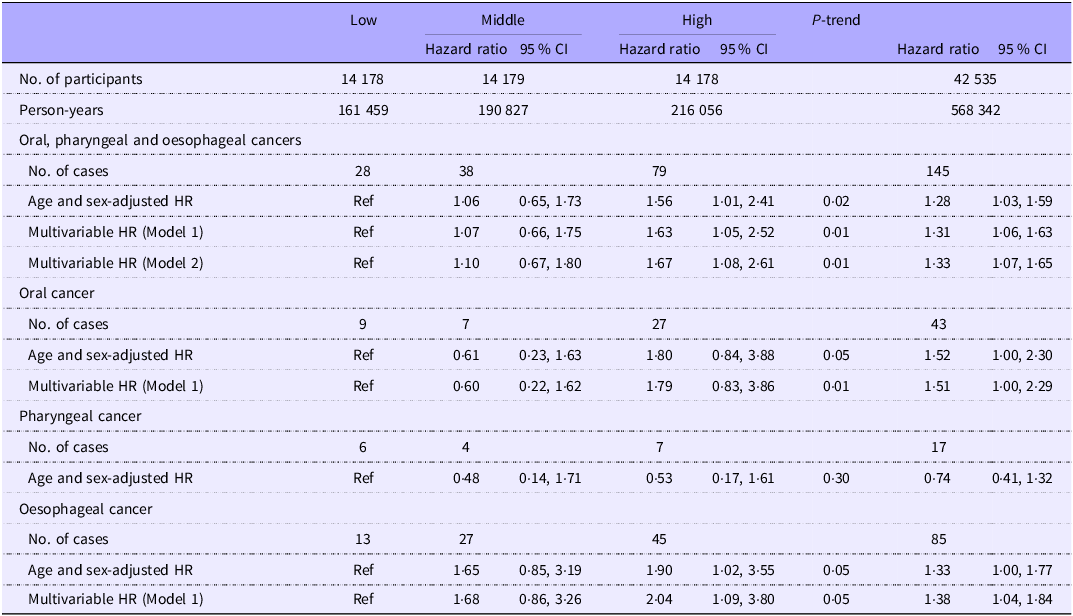
Table 2 shows the HR and 95 % CI according to tertiles of consumption and 1 g increments of salt consumption. High-salt consumption was associated with a higher risk of developing oral and oesophageal cancers, but not pharyngeal cancer. The multivariable HR (95 % CI) for the highest v. lowest tertiles of salt consumption (model 1) was 1·63 (1·05, 2·52, P-trend = 0·01) for oral, pharyngeal and oesophageal cancers combined, 1·79 (0·83, 3·86, P-trend = 0·01) for oral cancer and 2·04 (1·09, 3·80, P-trend = 0·05) for oesophageal cancer. After further adjustment for fruit and vegetable consumption (model 2), the multivariable HR (95 % CI) was 1·67 (1·08, 2·61, P-trend = 0·01) for oral, pharyngeal and oesophageal cancers combined. The multivariable HR (95 % CI) per 1 g increment of salt consumption was 1·33 (1·07, 1·65) for oral, pharyngeal and oesophageal cancers combined (model 2), 1·51 (1·00, 2·29) for oral cancer (model 1) and 1·38 (1·04, 1·84) for oesophageal cancer (model 1). A dose–response relationship was confirmed by the spline curve shown in online Supplementary Figure 1. In the subsample analysis of cancers with stage information (No. of cases = 55), salt consumption tended to be associated with the combined risk of oral, pharyngeal and oesophageal cancers in advanced cases but not in non-advanced cases, although the interaction was not statistically significant (online Supplementary Table 1).
Hazard ratios (95 % CI) of oral, pharyngeal and oesophageal cancers according to tertiles and 1 g increment of salt consumption

HR, hazard ratio.
Model 1: adjusted for age, sex, smoking status and alcohol consumption.
Model 2: adjusted further for fruit and vegetable consumption.
When stratified by smoking status and alcohol consumption, the positive association between salt consumption and the combined risk of oral, pharyngeal and oesophageal cancers did not vary between never and ever smokers (P–interaction = 0·56, model 1 and 0·86 in model 2) nor between never and ever drinkers (P–interaction = 0·77, model 1 and 0·87, model 2) (Table 3).
Hazard ratios (95 % CI) of oral, pharyngeal and oesophageal cancers combined according to tertiles of salt consumption, stratified by smoking and drinking status

HR, hazard ratio.
Model 1: adjusted for age, sex, smoking status and alcohol consumption.
Model 2: adjusted further for fruit and vegetable consumption.
In the stratified analysis by smoking status and alcohol consumption, the stratified variables were not included for adjustment.
Table 4 shows the association between salted food consumption and the combined risk of oral, pharyngeal and oesophageal cancers. Miso soup consumption of two or more cups/day was associated with a higher risk than consumption of less than one cup/day; however, the consumption of other high-salt foods had no significant association.
Hazard ratio (95 % CI) of oral, pharyngeal and oesophageal cancers combined according to the frequency of high-salt foods

HR, hazard ratio.
Model 1: adjusted for age, sex, smoking status and alcohol consumption.
Model 2: adjusted further for fruit and vegetable consumption.
Discussion
In this cohort study of Japanese adults, we first observed that salt consumption was positively associated with the combined risk of oral, pharyngeal and oesophageal cancers, particularly oral and oesophageal cancers. Among high-salt foods, miso soup, a significant source of dietary salt in Japan, is positively associated with cancer risk.
The association between total salt consumption and gastric cancer has been examined in many cohort studies(Reference Wu, Yang and Yang23); however, investigations into the relationship between salt consumption and oral, pharyngeal and oesophageal cancers are limited. A meta-analysis of sixteen case–control studies and two cohort studies that examined the association of salt or salted food consumption with oesophageal cancer risk reported a summary odds ratio (95 % CI) for high v. low consumption groups of 1·97 (1·49, 2·61) in case-control studies and 1·04 (1·00, 1·08) in cohort studies.(Reference Banda, Chiu and Hu15) Two cohort studies were conducted in Japan(Reference Murata, Fujino and Pham16) and the USA(Reference Li, Park and Wu17) A previous 13·9-year cohort study of Japanese males and females aged 30–79 years demonstrated no association between salted food consumption and the risk of oesophageal cancer; the multivariable HR (95 % CI) was 1·55 (0·18, 6·39) in male and 1·22 (0·35, 5·43) in female for high v. low consumption of salted food(Reference Murata, Fujino and Pham16). A 9·7-year cohort study of 494 968 American males and females aged 51–70 years reported no elevated risks of oesophageal squamous cell carcinoma and adenocarcinoma associated with one score increment of sodium consumption; the multivariable HR (95 % CI) was 0·96 (0·93, 0·99) and 0·99 (097, 1·01), respectively(Reference Li, Park and Wu17). Our findings confirmed a positive association between salt consumption and the risk of oral and oesophageal cancers, as observed in gastric cancer.
Several studies have examined the association between high-salt foods and the risk of oesophageal and gastric cancer; however, few studies have been conducted on oral and pharyngeal cancers. A greater consumption of processed meat was found to be associated with a higher risk of oesophageal and gastric cancers in meta-analyses of observational studies(Reference Qin, Jia and Zhou10,Reference Wu, Yang and Yang23) and with a higher risk of oral cancer in a case–control study(Reference Zheng, Blot and Shu24). However, other high-salt foods have not been consistently associated with the risk of these cancers. Positive associations with pickled foods have been observed in gastric cancer(Reference Wu, Yang and Yang23) but not in oesophageal cancer(Reference Qin, Jia and Zhou10). Similarly, no positive association between salted fish consumption and gastric cancer has been reported(Reference Wu, Yang and Yang23). Miso soup consumption was not associated with the risk of oral cancer in a Japanese case-control study(Reference Takezaki, Hirose and Inoue25) or gastric cancer in a meta-analysis(Reference Wu, Yang and Yang23). Further investigation is required to confirm whether high-salt foods are associated with an increased risk of oral, pharyngeal and oesophageal cancers.
A positive association with the risk of oral, pharyngeal and oesophageal cancers was primarily observed for miso soup, probably because of the larger variation in salt consumption across its categories compared with other high-salt foods. Additionally, considering that miso soup is usually served hot, high temperatures may increase the risk of oral, pharyngeal and oesophageal cancers(Reference Goldenberg26–Reference Islami, Poustchi and Pourshams28).
Our study had two strengths. First, it was a long-term cohort study that included many participants. Second, the participants were recruited from the general Japanese population, which may increase the generalisability of our findings. This study has a few limitations that should be considered when interpreting our findings and warrant further investigation. First, salt consumption estimated using the FFQ was underestimated. Consequently, our findings should be interpreted carefully based on absolute salt consumption levels. However, the relative consumption level showed moderate validity compared with the dietary record, as shown in the Experimental methods(Reference Date, Fukui and Yamamoto20), and the findings comparing the lowest and highest categories were less likely to be affected by this underestimation. If the underestimation was not biased towards the outcome, random errors in the exposure level could have diluted the true association. Second, we had a low statistical power owing to the small number of pharyngeal cancer cases; therefore, we did not find a significant association between salt consumption and the risk of pharyngeal cancer. Third, we did not examine chemical mediators to interpret the relationship between salt consumption and the risks of oral, pharyngeal and oesophageal cancers.
In conclusion, high-salt consumption was associated with a higher combined risk of oral, pharyngeal and oesophageal cancers. However, further epidemiological and biological studies are required to confirm these findings.
Supplementary material
For supplementary material/s referred to in this article, please visit https://doi.org/10.1017/S000711452500056X
Acknowledgements
We extend our gratitude to all JACC Study collaborators and participants as well as our colleagues from the Osaka University Center of Medical Data Science, Advanced Clinical Epidemiology Investigator’s Research Project, for their valuable insights and expertise, which greatly contributed to this research.
This study was supported by a Grant-in-Aid for Scientific Research from the Ministry of Education, Culture, Sports, Science and Technology of Japan (MEXT) (MonbuKagaku-sho), Grants-in-Aid for Scientific Research on Priority Areas of Cancer and Grants-in-Aid for Scientific Research on Priority Areas of Cancer Epidemiology from MEXT (Nos. 61010076, 62010074, 63010074, 1010068, 2151065, 3151064, 4151063, 5151069, 6279102, 11181101, 17015022, 18014011, 20014026, 20390156, 26293138) and JSPS KAKENHI Grant Number JP No.16H06277 (CoBiA) and 22H04923. This research was also supported by Grant-in-Aid from the Ministry of Health, Labour and Welfare, Health and Labour Sciences research grants, Japan (Research on Health Services: H17–Kenkou–007; Comprehensive Research on Cardiovascular Disease and Life-Style Related Diseases: H18–Junkankitou [Seishuu]–Ippan–012; H19–Junkankitou [Seishuu]–Ippan–012; H20–Junkankitou [Seishuu]–Ippan–013; H23–Junkankitou [Seishuu]–Ippan–005); an Intramural Research Fund (22-4-5) for Cardiovascular Diseases of National Cerebral and Cardiovascular Center; Comprehensive Research on Cardiovascular Diseases and Life-Style Related Diseases (H26-Junkankitou [Seisaku]-Ippan-001), H29–Junkankitou [Seishuu]–Ippan–003,20FA1002 and 23FA1006).
K. O., E. S. E, S. T., M. I. and H. I.: conceptualised and conducted the study. A. T.: Data curation. K. O., E. S. E, S. T., M. I., K. R. and H. I.: methodology. K.O.: formal analysis and writing the original draft. All authors contributed to the analytical strategy and interpretation of the results, critically reviewed the manuscript for important intellectual content, approved the final version for publication and agreed to be accountable for all aspects of the study.
The authors declare no conflicts of interest.