Introduction
Effective communication is critical to the successful delivery of health care services and is an essential part of patient-centered care. The Institute of Medicine (IOM)'s 2001 report Crossing the Quality Chasm identified patient-centeredness as one of six core elements of high-quality health care and defined it as “providing care that is respectful of and responsive to individual preferences, needs, and values and ensuring that patient values guide all clinical decisions” (Institute of Medicine, 2001). The importance of effective communication between health care providers (HCPs) and patients has also been highlighted by the Joint Commission. It recommends an approach to communicating health information that encompasses language and cultural needs, individual understanding, and other communication issues (Joint Commission, 2011). Several studies have found that sub-optimal communication has detrimental effects on patients and may increase their levels of uncertainty, anxiety, and dissatisfaction with care (Hagerty et al., Reference Hagerty, Butow and Ellis2005; Donovan-Kicken and Caughlin, Reference Donovan-Kicken and Caughlin2011), may increase lack of compliance with recommended treatment regimens (Jin et al., Reference Jin, Sklar and Min Sen Oh2008), and is associated with poorer quality of life (Kerr et al., Reference Kerr, Engel and Schlesinger-Raab2003).
The complexity of cancer care in older adults makes communication very challenging (Schroyen et al., Reference Schroyen, Adam and Jerusalem2014). It becomes more difficult when older patients have sensory losses (vision or hearing impaired) and becomes extremely challenging when older patients have cognitive deficits and begin losing their autonomy and independence. Ageism may become more evident when a third person is involved in the HCP-patient encounter. Issues of privacy may need to be addressed and the HCP's own biases need to be overcome. These challenges affect not only the patient, but also caregivers, clinicians, and all treatment team members (Amalraj et al., Reference Amalraj, Starkweather and Nguyen2009).
Cognitive syndromes are commonly encountered among older adults with cancer and the incidence increases as we age (Lawlor et al., Reference Lawlor, Gagnon and Mancini2000). Factors such as primary or metastatic brain tumors, delirium, comorbid depression, medical comorbidities, or adverse effects of treatments such as chemotherapy and radiation can predispose patients to developing cognitive deficits (Andreotti et al., Reference Andreotti, Root, Alici, Ahles, Holland, Wiesel, Nelson, Roth and Alici2015a). An important issue at the intersection of cancer and dementia is that cognitive deficits in older adults influence outcomes in cancer care. Cancer patients with cognitive impairment are at increased risk of functional dependence, treatment non-adherence, and are at greater risk of death (Hurria et al., Reference Hurria, Dale and Mooney2014). The National Comprehensive Cancer Network (NCCN) Older Adult Oncology Guidelines recommends the assessment of cognitive function for all older adults when considering a cancer treatment plan (NCCN, 2019). Once cognitive impairment is identified, HCPs need to assess for underlying etiologies to identify reversible and irreversible contributing factors, assess decision-making capacity, and revise goals of care.
It is crucial that the oncology care teams know how to communicate appropriately with patients across circumstances and settings to provide accurate information, assess accurate patient understanding, and decrease the possibility of errors. Training oncology HCPs in these principles and skills remains a challenge with a dearth of geriatric communication training programs.
The Communication Skills Training and Research Laboratory at Memorial Sloan Kettering Cancer Center (MSK) was created to train providers in communication skills to support the patient throughout the cancer disease trajectory. As such, we saw the need to train HCPs in the subject of communication with the older cancer patient who presents with cognitive impairment. We developed, implemented, and evaluated a communication skills (Comskil) training program for HCPs who work with older adults with cancer. An interprofessional team developed this training program following the same conceptual and methodological approach used in prior Comskil training programs developed for oncologists (Bylund et al., Reference Bylund, Brown and Gueguen2010, Reference Bylund, Brown and Bialer2011; Bialer et al., Reference Bialer, Kissane and Brown2011; Banerjee et al., Reference Banerjee, Manna and Coyle2017). The Communicating with Older Cancer Patients with Cognitive Deficits module was developed as one of three modules that make up a day-long Geriatric Communication Skills Training Program. The other two modules are: “Geriatrics 101” which focuses on ageism and frequent geriatric syndromes and “Shared Decision Making” which focuses on the difficulties of making clinician-patient-caregiver shared decisions in the context of cognitive decline.
The aims of this study are to describe the content of the Communicating with Older Cancer Patients with Cognitive Deficits module, assess HCP satisfaction with the module, uptake of communication skills, and their confidence in recognizing and addressing cognitive deficits and a lack of decision-making capacity that may influence the medical care of older adults with cancer.
Methods
Modular content
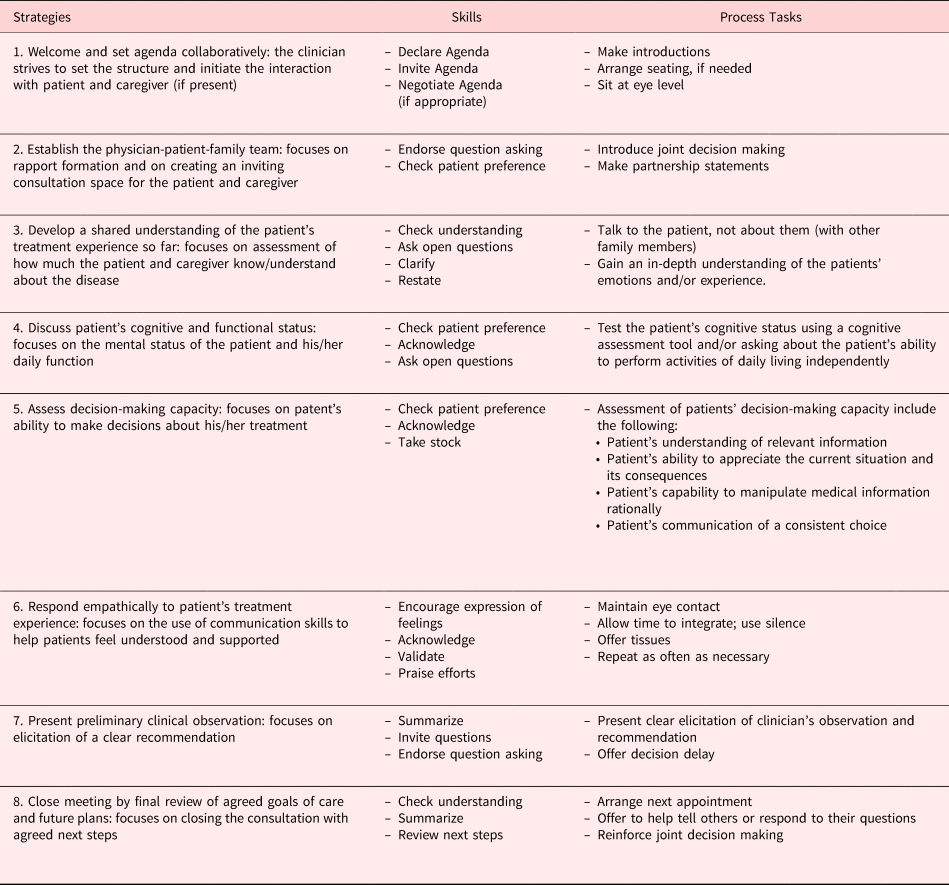
The goals of the module Communicating with Older Cancer Patients with Cognitive Deficits are: (a) to discuss cognitive syndromes in older adults with cancer, (b) to address patient/family questions and concerns related to potential cognitive and functional decline as a result of cancer treatment, and (c) to assess decision-making capacity in older adults with cancer who present with cognitive syndromes or who are at increased risk of cognitive decline. Using the established Comskil conceptual framework (Kissane et al., Reference Kissane, Bylund and Banerjee2012), this module proposes eight strategies, along with communication skills and process tasks, summarized in Table 1.
Modular blueprint for communicating with older cancer patients with cognitive deficits

Note. The goals are to (a) discuss cognitive syndromes in older adults with cancer, (b) address patient/family questions and concerns related to potential cognitive and functional decline as a result of cancer treatments, and (c) assess decision-making capacity in older adults with cancer who present with cognitive syndromes or who are at increased risk of cognitive decline.
Participants and procedure
Ninety-nine HCPs who worked primarily with geriatric patients were trained in groups of 12–15 over a 2-year period. Participants included Advance Practice Providers (including Nurse Practitioners and Physician Assistants; n = 24, 24.2%); nurses (n = 23, 23.2%), social workers (n = 14, 14.1%), physicians (n = 13, 13.1%), and “other” HCPs (including occupational therapists, physical therapists, and psychologists; n = 20, 20.2%). Participants ranged in age from 24 to 69 years (M = 39.78, SD = 14.22) and were predominantly female (83.8% females). Half of the participants were White (50.5%) with 20.2% Black, 11.1% Asian, 6.1% bi-/multi-racial, and 12.1% others. MSK's Institutional Review Board approved this educational study and the publication of these data.
Training format
The training combined a didactic presentation with experiential role-play to practice the communication skills learned. It entailed a 30-min frontal lecture presenting the literature on cognitive syndromes encountered in older adults with cancer, a review of commonly used cognitive assessment tools, a description of decision-making-capacity assessment, and strategies for communicating with older adults with cancer with cognitive deficits. Exemplary videos were embedded into the didactic presentation to illustrate key communication skills. The presentation was followed by small-group experiential role-play (90 min), with three participants per small-group role-play. Trained facilitators led the small-group role-play sessions in which simulated patients (SP; trained actor) followed pre-scripted roles of a geriatric patient and caregiver posing communication challenges due to cognitive deficits. Each participating HCP was asked to identify their learning objective and practice specific strategies (Table 1) with the simulated patient and caregiver dyad, and frequent timeouts were used to invite reflection.
Standardized patient assessment
A subset of 86 participants (86.87%) completed a 12-min video recorded interaction simulating an encounter between an HCP and a geriatric simulated patient and his/her simulated caregiver. This SPA was completed both pre- and post-training. Given that the day-long Geriatric Communication Skills Training Program included three modules (Geriatrics 101, Cognitive Syndromes, and Geriatric Shared Decision Making), we randomized participants to complete a module-specific SPA. As such, 27 participants (of the 86 participants that completed an SPA) were assigned to the Cognitive Syndromes SPA that simulated an encounter between a HCP and a geriatric simulated patient with cognitive deficits and his/her caregiver.
Evaluation
All participants completed pre-post surveys for each module with the following two goals: evaluation of the module and assessment of self-efficacy. Additionally, 27 participants completed pre- and post-training, 12-min video recorded interaction with the standardized patient (SPA).
Module evaluation
Evaluation of the module included six statements using five-point Likert-type scales (1 = “strongly disagree” and 5 = “strongly agree”) assessing participants’ levels of agreement or disagreement with each statement. In addition, participants rated four key components of training (booklet, didactic teaching, exemplary videos, role play experience) on a three-point Likert-type scale (1 = “did not aid my learning at all” and 3 = “aided my learning a lot”).
Self-efficacy
Pre-post training perception of self-efficacy was measured using a five-point Likert-type scale (1 = “strongly disagree” and 5 = “strongly agree”) in two statements: (a) “I feel confident in my ability to recognize cognitive syndromes in older adults with cancer” and (b) “I feel confident in my ability to appreciate communication challenges in the decision-making process when the patient is cognitively impaired.”
Communication skill uptake
The participants that completed the 12-min SPA on the given clinical scenario were evaluated by two trained blind coders who coded the SPA videos using the Comskil Coding System (Bylund et al., Reference Bylund, Brown and Bialer2011).
Data analysis
For module evaluation, a rating of agree or strongly agree was considered to be an indicator of satisfaction with the module and was analyzed descriptively. For assessing perception of improvement in self-efficacy, paired t tests were used to assess significant differences. Finally, for measuring increase in communication skills uptake using the SPAs, frequency of individual skills was used as the unit of measurement, and paired t tests were used to assess changes in outcomes from pre- to post-training.
Results
Results on module evaluation
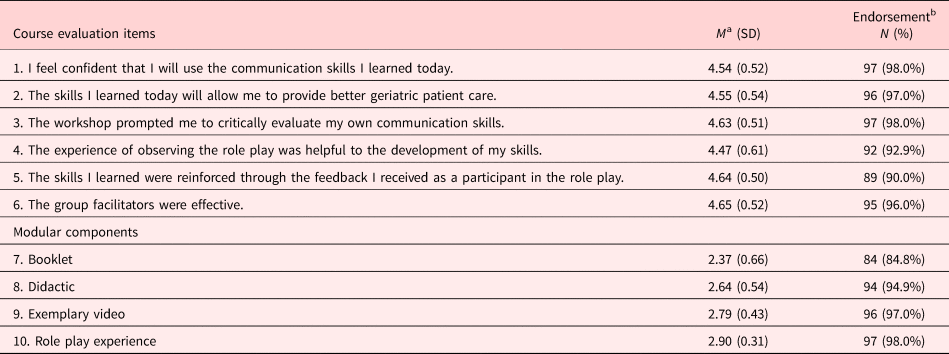
Overall, participants rated the module favorably. Specifically, more than 90% of the participants indicated that they agreed or strongly agreed with five of the six evaluation items (with one item receiving endorsement by more than 85% but less than 90% of participants). In addition, three of the four modular components (didactic teaching, exemplary videos, role play experience) were rated favorably, with over 90% participants agreeing that the modular components aided in their learning (booklet was endorsed favorably by approximately 85% participants) (Table 2).
Participant evaluation of communicating with older cancer patients with cognitive deficits module (N = 99)

Note. aItems 1–6 were scored on a 5-point Likert scale with anchors at (1) Strongly disagree to (5) Strongly agree; Items 7–10 were scored on a 3-point scale with anchors at (1) Did not aid my learning at all to (3) Aided my learning a lot.
b Endorsement refers to the number of participants that responded “Agree” or “Strongly agree” for Items 1–6; and “Aided my learning somewhat” or “Aided my learning a lot” for Items 7–10.
Improvements in self-efficacy
Participants’ self-efficacy regarding the item, “I feel confident in my ability to recognize cognitive syndromes in older adults with cancer” significantly improved [t(96) = −9.93, P– < 0.001] from pre- (M = 3.28, SD = 0.94) to post-module training (M = 4.16, SD = 0.65). As well, participants’ self-efficacy regarding the item, “I feel confident in my ability to appreciate communication challenges in the decision-making process when the patient is cognitively impaired” significantly improved [t(96) = −6.37, P < 0.001] from pre- (M = 3.71, SD = 0.98) to post-module training (M = 4.37, SD = 0.55). Thus, participants’ overall self-efficacy in communicating with geriatric cancer patients with cognitive deficits significantly increased from pre- to post-module training.
Communication skill uptake
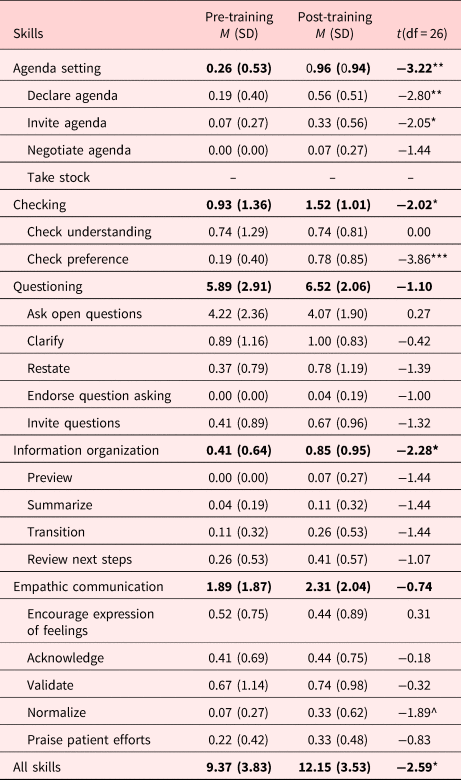
There was a significant increase in overall communication skills use from pre- to post-training. Overall, skill uptake increased in three skill categories — agenda setting, checking, and information organization. Participants demonstrated clear uptake of three individual skills — declare agenda, invite agenda, and check preference. Additionally, the overall skill usage increased from pre- to post-training (Table 3).
Communicating with older cancer patients with cognitive deficits module communication skill uptake (SPA skills coding) (N = 27)

^ p < .10, *p < .05, **p < .01, ***p < .001.
Discussion
Age is the most important risk factor for developing cancer and demographic changes in the United States will result in a marked increase in the number of cancer diagnoses over the next 20 years (Smith et al., Reference Smith, Smith and Hurria2009). Older adults are at increased risk of suffering cognitive syndromes at the time of cancer diagnosis and are more likely to experience worsening cognitive decline during cancer treatment with a significant impact on clinical outcomes and patient's autonomy and quality of life (Lange et al., Reference Lange, Rigal and Clarisse2014). Cognitive dysfunction, more commonly encountered in the older population, is a new challenge for oncologists and other HCPs that interact with elderly cancer patients. In this study, we have described the content of the Communicating with Older Cancer Patients with Cognitive Deficits module and presented data on HCPs’ satisfaction with the module, uptake of communication skills, and perception of self-efficacy in recognizing cognitive syndromes and appreciating communication challenges in the decision-making process when the patient is cognitively impaired. Results demonstrated a successful implementation of the program as evidenced through favorable program evaluation, significant gains in self-efficacy as well as significant improvement in several communication skills.
The HCPs reported significant improvement in their confidence to recognize cognitive syndromes in older adults with cancer. Despite the high prevalence, cognitive syndromes frequently go unrecognized in older adults with cancer (Andreotti et al., Reference Andreotti, Root and Ahles2015b). Validated cognitive assessment tools should be used to screen these patients for cognitive deficits and to identify those who require a referral for additional evaluation (McKoy et al., Reference McKoy, Burhenn and Browner2014). In addition to recognizing cognitive syndromes, serial assessments using the same instrument could help track changes throughout treatment. It is important that clinicians acquire or improve the necessary skills to communicate with the patient and caregiver the importance of completing this screening.
The most effective method for learning communication skills is observation of ideal and effective strategies, followed by rehearsing the skills (Bylund et al., Reference Bylund, Brown and Gueguen2010, Reference Bylund, Brown and Bialer2011). In the role-play, HCPs were encouraged to rehearse and demonstrate skills in screening for cognitive impairment and differentiating between acute changes in cognition and long standing cognitive impairment. The ability to differentiate between acute versus chronic cognitive impairment is instrumental in caring for this patient population given high rates of medical comorbidity and increased risk for delirium. An acute change in mental status is associated with significant morbidity and mortality (Inouye et al., Reference Inouye, Westendorp and Saczynski2014).
Cognitive deficits may interfere with treatment decisions. Determination of decision-making capacity is a complex construct, yet critical when obtaining informed consent for assessments, treatment planning as well as participation in clinical research (Saracino et al., Reference Saracino, Nelson, Roth, Korc-Grodzicki and Tew2017). This challenge arises across the cancer continuum with several critical points in which it becomes necessary to evaluate and reevaluate the patient's ability to make sound decisions, such as at the time of consent for procedures or when making decisions for chemotherapy (Saracino et al., Reference Saracino, Nelson, Roth, Korc-Grodzicki and Tew2017). If patients can comprehend and apply general information about issues regarding medical decisions, they are presumed to be able to make medical decisions on their own behalf (Wilkins et al., Reference Wilkins, Lund and McAdams2009). This module emphasizes the assessment of patients’ understanding of relevant information, their ability to appreciate their current situation and its consequences, and their capability to manipulate medical information while rationally communicating a consistent choice. A recent study comparing the use of a standardized tool for assessment of decision-making capacity versus clinician assessment revealed that the agreement between physician-rated capacity and performance on the standardized tool was poor (Kolva et al., Reference Kolva, Rosenfeld and Saracino2018). Therefore, it is paramount to educate clinicians to appreciate the communication challenges around the decision-making process.
Significant increases in skill uptake were not observed for all skill categories. The largest gains were observed in checking patient preferences, declaring agenda, and inviting patient agenda. This is an interesting yet not a surprising finding given the dearth of geriatric education HCPs are exposed to throughout their training (Thomas et al., Reference Thomas, Leipzig and Smith2003; Weiss and Fain, Reference Weiss and Fain2009) and the lack of experience navigating multiple, sometimes vague complaints. Older adults frequently are faced with ageism — stereotyping and discriminating against individuals based on their age (Palmore, Reference Palmore2015). Ageism can impair communication and lead to suboptimal care, more so in the cognitively impaired (Adelman et al., Reference Adelman, Greene and Ory2000). Education of HCPs about aging-related issues increases knowledge and reduces ageism and negative stereotypes about aging (Palmore, Reference Palmore2015). Taking additional time during the clinical encounter to check patient preferences allows patients to exercise their autonomy — even in cognitively impaired patients — to the extent that they can. Declaring agenda and inviting agenda bring about a structure to the clinical encounter improving patient engagement. Therefore, the improvements observed in the communication skills were a welcome finding emphasizing the importance of providing this training to HCPs caring for older adults with cancer with cognitive deficits.
Limitations
This study has several limitations. It was carried out at one cancer center in North-East USA. Results may not be generalizable to other institutions; future research should also examine how to adapt this educational module to other educational settings. We limited our evaluation of the program to self-report and demonstration of behavior in a structured setting and did not examine uptake of skills in clinic or at the bedside with actual patients. Future research should examine how HCPs use the newly learned skills when communicating with patients and their caregivers and assess the impact of the training on patient-reported outcomes.
Conclusions
This study demonstrated a successful implementation of a communication skills training program for HCPs, as substantiated through favorable program evaluation, significant gains in self-efficacy, as well as in several communication skills. Future research should focus on broader implementation and examination of the impact of training real-world use of communication skills with patients and on quality of care as determined by patient-reported outcomes.
Acknowledgments
This publication was made possible by Grant Number #U1QHP28705 from the Health Resources and Services Administration (HRSA), an operating division of the U.S. Department of Health and Human Services, Cancer Center Support Grant (CCSG-Core Grant; P30 CA008748; PI: Craig B. Thompson, MD), Rosanne H. Silbermann Foundation and Muriel Duenewald Lloyd Inspiration Fund. The content is solely the responsibility of the authors and does not necessarily represent the official views of the Health Resources and Services Administration, the U.S. Department of Health and Human Services, the National Institutes of Health (NIH), or the above foundations.